Chinese nuclear-powered attack submarine sank earlier this year, says senior US defence official
ABC News, 27 Sept 24
In short:
China’s newest nuclear-powered attack submarine sank earlier this year, according to a senior US defence official.
A series of satellite images from Planet Labs from June appear to show cranes at the Wuchang shipyard, where the submarine would have been docked.
What’s next?
China’s submarine force is expected to grow to 65 by 2025 and 80 by 2035, the US Department of Defense has said.
A senior US defence official has said that China’s newest nuclear-powered attack submarine sank earlier this year, marking a potential embarrassment for Beijing as it seeks to expand its military capabilities.
China already has the largest navy in the world, with over 370 ships, and it has embarked on production of a new generation of nuclear-armed submarines.
The US defence official, speaking on condition of anonymity on Thursday, local time, said China’s new first-in-class nuclear-powered attack submarine sank alongside a pier sometime between May and June.
A Chinese embassy spokesperson in Washington said they had no information to provide.
“In addition to the obvious questions about training standards and equipment quality, the incident raises deeper questions about the PLA’s internal accountability and oversight of China’s defence industry — which has long been plagued by corruption,” the official said, using an acronym for the People’s Liberation Army.
“It’s not surprising that the PLA Navy would try to conceal the sinking,” the official added………………………………………………. more https://www.abc.net.au/news/2024-09-27/one-of-china-submarine-sank-says-us-defence-official/104406362
Outgoing French nuclear safety chief warns of 25% budget cut

(Montel) France’s ASN nuclear safety authority faces a 25% cut to its budget next year which would leave the body “unable to operate”, its outgoing head, Bernard Doroszczuk, has told parliamentarians.
by: Muriel Boselli, 25 Sep 2024
The same would apply when ASN plans to merge with its technical arm, the Institute for Radiation Protection and Nuclear Safety (IRSN), to create a new body ASNR from 2025, he told a French lower house committee on Tuesday.
“Whether it’s the ASNR or the separate ASN and IRSN, we don’t have the means to operate with these figures,” he said.
The planned cuts, due to be tabled in the government’s finance bill next month, would leave a EUR 37m hole in ASN’s EUR 150m budget, Doroszczuk said, adding this was “very alarming”.
Merger on 1 January?
President Emmanuel Macron proposed the head of the nation’s nuclear waste agency Pierre-Marie Abadie to succeed Doroszczuk when his term ends on 12 November.
One of Abadie’s first tasks will be to oversee the controversial merging of the ASN and the IRSN from 1 January 2025 as approved by parliament and officially stipulated as law on 22 May.
Despite legislative delays following France’s snap election, the launch of ASNR could go ahead on 1 January as planned even if “it won’t be perfect”, Doroszczuk said.
It would be a “transitional” entity at first, with only 30 reconfigured positions out of more than 2,000. The general management will be unified, but the entities responsible for nuclear safety and radiation protection within ASN and IRSN will remain unchanged.
Swarm of over 100 earthquakes hits Hanford nuclear site near Tri-Cities in Washington, U.S.
The Watchers, By Rishav Kothari, Thursday, September 26, 2024
A series of over 100 shallow earthquakes have struck 48 km (30 miles) on the edge of the Hanford nuclear site northwest of Washington’s Tri-Cities since Saturday, September 21, 2024, with scientists attributing the tremors to tectonic activity near the Yakima Fold and Thrust Belt.
Over 100 earthquakes have been recorded around 48 km (30 miles) northwest of the Tri-Cities area in Washington since Saturday. The quakes were recorded on the western edge of McGee Ranch, at the Hanford Reach National Monument.
Most of the quakes were below M2.0, with the largest being M2.9, which struck the north end of the swarm at 20:22 LT on Sunday, September 12. Most of them occurred at a depth of around 8 km (5 miles), classified as shallow crustal quakes.
…………………………………….. As there was no clear mainshock and only short intervals between the quakes, scientists are classifying them as a swarm. The quakes appear to have been caused by regular tectonic activity associated with the Yakima Fold and Thrust Belt on a fault line near Umatanum Ridge.
“This is a completely natural phenomenon. Although this swarm occurs just outside the Hanford Site, it has no connection to the radioactive waste stored there,” said Renate Hartog, manager of the Pacific Northwest Seismic Network. https://watchers.news/2024/09/26/swarm-of-over-100-earthquakes-hits-hanford-nuclear-site-near-tri-cities-in-washington-u-s/?fbclid=IwY2xjawFi1spleHRuA2FlbQIxMQABHbPlO3FW6M25Zs-Wzr71HhurIRjDtZISc92qOHDaDl7ZCS8V2dBgUTDrYQ_aem_Twt2AQaNNa6c4MMkNTE6zA
IAEA chief says situation tense around Russia’s Kursk plant, but no permanent mission planned.

By Reuters, September 24, 2024, https://www.reuters.com/world/europe/iaea-chief-says-situation-tense-around-russias-kursk-plant-no-permanent-mission-2024-09-23/
Sept 24 (Reuters) – U.N. nuclear agency chief Rafael Grossi, in an interview published early on Tuesday, said the situation remained serious around Russia’s Kursk nuclear power plant, but his agency planned no permanent mission at the site.
Ukrainian troops remain in Russia’s southern Kursk region after pouring over the border last month, but remain some 40 km (25 miles) from the facility.
“(The situation) is serious in that a military incursion has taken place and that incursion has reached the stage that it is not that distant from a nuclear power station,” Grossi, Director General of the International Atomic Energy Agency, told Russia’s RIA news agency.
Grossi visited the Kursk plant, made up of four reactors, last month and said it would be “extremely exposed” if it came under attack as the facility had no containment dome.
In his comments to RIA, made in New York ahead of debates at the U.N. General Assembly, he said he hoped favourable circumstances would mean he would not have to visit the plant again.
“I hope there will be no need to return to the Kursk station as that would mean that the situation has stabilised,” he said.
The IAEA, he said, had no plans to station observers permanently at the station – as it has at Ukraine’s four plants, including the Zaporizhzhia station, seized by Russian forces in the early days of Moscow’s February 2022 invasion of Ukraine.
Grossi said the situation remained tense at Zaporizhzhia, where each side regularly accuses the other of planning to attack the station.
“My experts continue to report on military action near the station,” he told RIA.
Grossi has visited the Zaporizhzhia station five times since the invasion and urged both sides to show restraint to guard against any nuclear accident.
Scottish nuclear base staff using pagers adds to Trident fears
National security concerns have been raised about the use of the antiquated technology in sites where nuclear weapons are stored and maintained.
Two sources have confirmed to this paper that the use of pagers, which appear to have been tampered with to cause explosions across Lebanon in attacks which have injured thousands, remains common at bases in Coulport and Faslane.
Pagers, also known as bleepers, are almost entirely redundant in most walks of life having been superseded by mobile phones decades ago – but they are still used on Ministry of Defence (MoD) sites in Scotland and by the Islamist militant group Hezbollah, which has blamed Israel for the attacks.
NHS workers in England were told to stop using pagers in hospitals in 2019 though it is thought some still use them.
Concerns about their use have been raised in light of Tuesday and Wednesday’s deadly attacks, which have killed at least 21 people including two children, in a move which threatens to escalate tensions between Israel and Lebanon into all-out war.
One source told The National that staff at a Scottish nuclear base who were on call or on duty used pagers.
Alba general secretary Chris McEleny, who previously worked at Royal Naval Armaments Depot Coulport where nuclear warheads are stored, told The National “people will be astounded that the safety of the UK’s nuclear deterrent is still supported by a network of 1980s and 1990s-style handheld pagers”.
He added: “The Hezbollah attack should result in the MoD now assessing the vulnerability of where the country’s stockpile of nuclear weapons are stored because pager holders are highly likely to be in close proximity the most critical possible systems and materials on site but then the pagers go offsite overnight.”
The revelation will add to fears about the state of Britain’s nuclear fleet, which is believed to be “rotting”.
Former Tory special adviser Dominic Cummings last year lifted the lid on what he said was the “nightmare” issue of Trident.
He wrote that nuclear weapons infrastructure was “a dangerous disaster and a budget nightmare of hard-to-believe and highly classified proportions”.
The UK Government was approached for comment.
New iodine tablets for communes near French nuclear power sites.
The tablets are distributed for use in the event of an emergency, but some say
the scheme does not go far enough. New iodine tablets are to be distributed
again to people living in French communes near nuclear power station sites,
after authorities renewed the campaign.
Since September 15, residents
living or people working within a 10 km radius of the Penly and Paluel
nuclear power plants (Seine-Maritime, Normandy) have been receiving new
free iodine tablets to use in the event of a nuclear plant accident.
Pharmacies are now able to distribute the tablets. The tablets can also be
collected and dispensed by public establishments to make it easier for
residents to get hold of them (if they are not able to get to a pharmacy).
Connexion 17th Sept 2024
Safety level at Scotland’s largest nuclear site raised to ‘enhanced’ after leaks found
By Katharine Hay, Rural affairs correspondent
Inspectors found “inadequate” storage of alkali metals at the site
earlier this year which fell below the legal requirements. A watchdog has
called for an increase in safety and regulation requirements at
Scotland’s largest nuclear clean-up and demolition project over the
current state of the building.
The Office for Nuclear Regulation (ONR)
found leaks from low-level radioactive waste pits in recent site
inspections at Dounreay, a nuclear power complex which is currently being
decommissioned on the north Caithness coast in the Highlands.
Scotsman 15th Sept 2024
As Biden deliberates, Ukraine’s nuclear plants are increasingly at risk
fear this coming winter may prove to be a breaking point for Ukraine in the energy war.
Stuck in the crosshairs are key substations feeding high voltage electricity to Ukraine’s still functioning nuclear power stations in Rivne, Khmelnytskyi and Yuzhnoukrainsk in southern Ukraine. Take these substations out and the reactors have to be shut down rapidly, or else it could provoke a “nuclear incident,” energy expert Mykhailo Gonchar told POLITICO. And “that’s what the Russians are aiming to do — hit the key substations.”
Paralyze the three nuclear power stations, though, and it’s game over for Ukraine in the energy war ,
The risk of Ukraine losing the war this winter has pushed Washington and London to reconsider how Kyiv uses Western-supplied long-range missiles, but the U.S. remains fearful of escalation.
Politico, September 15, 2024 , By Jamie Dettmer
KYIV — As the U.S. ponders loosening some of the restrictions on Ukraine’s use of Western-supplied long-range missiles to allow for the targeting of airfields and missile launch sites deeper inside Russia, Ukraine remains on tenterhooks.
As it stands, Washington doesn’t appear ready to take the gloves off entirely and allow Ukraine to target Russia’s airfields with long-range U.S. missiles quite yet — though it may withdraw restrictions on the U.K.’s Storm Shadows, which use U.S. technology.
“I would like to see a more forthright position coming from the Biden administration that says there’s no reason why Ukraine shouldn’t be fighting back,” former U.S. envoy to NATO Kurt Volker told POLITICO. “Russia’s the one attacking Ukraine from all these facilities across Russia. There’s no reason for there to be a sanctuary. But I don’t think we’re going to see Biden authorizing the use of U.S. missiles to strike at Russian airfields, although the British might be allowed to proceed without U.S. objection,” he added. “That won’t be enough.”
And if that’s really the outcome of these weeks-long intense negotiations, Ukraine’s energy officials will be among those most alarmed.
They fear this coming winter may prove to be a breaking point for Ukraine in the energy war. And that’s largely because Russian commanders are adapting their airstrike tactics, having learned from their previous failed bombing campaign to collapse the country’s energy system — and the recent shipments of Iran’s Fath-360 close-range ballistic missiles to Russia will help them do so.
Ukrainian officials expect Russia will use these missiles, which have a range limit of 120 kilometers, to complement their glide bombs in targeting logistics and communications hubs and ammunition depots in the rear of Ukraine’s front lines. That, in turn, will free Russia up to concentrate its own longer-range missiles on civilian infrastructure — particularly the energy system in a bid to break it.
Stuck in the crosshairs are key substations feeding high voltage electricity to Ukraine’s still functioning nuclear power stations in Rivne, Khmelnytskyi and Yuzhnoukrainsk in southern Ukraine. Take these substations out and the reactors have to be shut down rapidly, or else it could provoke a “nuclear incident,” energy expert Mykhailo Gonchar told POLITICO. And “that’s what the Russians are aiming to do — hit the key substations.”
Currently, 55 percent of Ukraine’s energy is generated by its three operating nuclear power stations — the one in Zaporizhzhia, which is the largest nuclear plant in Europe, was captured by Russia in 2022 and has largely been shut down. Russian missile and drone strikes have destroyed 9 gigawatts of the country’s electrical generating capacity — that’s half of the peak winter consumption — with 80 percent of thermal generation from coal- and gas-fired power plants and a third of hydroelectric production capacity wiped out by bombing.
Last year, Russia tried to isolate these nuclear power plants, focusing on degrading Ukraine’s energy transmission. It targeted distribution to consumers and businesses but was met with characteristic Ukrainian ingenuity and confounded by improvised repairs and rerouting.
Paralyze the three nuclear power stations, though, and it’s game over for Ukraine in the energy war , diminishing its war-fighting capacity, crashing the economy and weakening its position if peace negotiations do ever commence.
And according to officials in Kyiv, it’s the fear of this happening that’s been one of the factors driving the Biden administration to reconsider the restrictions, including on U.S. ATACMS and British Storm Shadows. Washington sat up when Russian airstrikes started targeting the main substations feeding operational electricity to the nuclear power plants in late August. “That concentrated minds,” said one Ukrainian official who asked not to be identified in order to speak freely………………………………………………………………………………………………
Burns also stressed no one should underestimate the risk of escalation and admitted his agency genuinely feared Russia might resort to tactical nuclear weapons in 2022. And while Biden and British Prime Minister Kier Starmer brushed off Putin’s threats on Friday, the U.S. administration still appears to be trapped between two worries — fear of how Moscow might respond if Western-supplied missiles start striking Russian airfields, and wreck projects for peace talks to get going, and alarm over the prospect of Ukraine losing power……………………………………………………………… https://www.politico.eu/article/russia-ukraine-nuclear-plants-energy-war-joe-biden-united-states-nato/
Japan, to make the biggest mistake in history: nuclear energy with water, and risk of explosion
by Jessica A., 09/15/2024, https://www.ecoticias.com/en/nuclear-energy-japan-hydrogen/6246/
Japan has a traumatic history with nuclear power, but that’s not stopping the country from taking new risks
The Fukushima nuclear disaster of 2011 devastated Japan and left the rest of the world terrified of nuclear power. While it wasn’t as horrific as the Chernobyl nuclear reactor explosion of 1986, it still traumatized both the Japanese people and the government. Yet now, Japan is facing an energy crisis, and nuclear energy may be the only realistic solution.
Japan is one of the countries at the forefront of the green energy revolution. The Japanese government understands that solar, wind, and hydroelectric energy can only produce a portion of the fuel and electricity the country and the world need. Hydrogen will have to make up some of the difference in the industrial sector, for uses in shipping, aviation, and manufacturing. Japan wants to use next-generation nuclear reactors to produce hydrogen with zero emissions.
Next-generation nuclear reactors have lower energy outputs and marginally better safety records
To make hydrogen a viable option for industrial fuel needs, Japan plans to use nuclear reactors
Many companies are already producing hydrogen for the industrial sector, but they often use natural gas or fossil fuels to do it. These methods result in at least some greenhouse emissions, and Japan wants to have a zero-emissions hydrogen production process in place by 2040 to help meet the world’s energy needs.
Nuclear reactors seem to offer a good solution to this problem because they generate a lot of heat, and that heat can be used to break down water for hydrogen harvesting. Hydrogen is the only clean fuel that scientists know of that can power industrial shipping vessels, planes, and large machinery.
To avoid making the climate crisis worse, governments need to commit to making the production of hydrogen a green process, meaning releasing zero emissions. Japan is looking at innovative ways of designing nuclear reactors to keep them safe so that they can power homes and produce hydrogen.
Many people are skeptical of nuclear energy, and Japan could be courting disaster with its plans to use high temperatures to break down water. One more nuclear explosion could mean the end of nuclear power forever. Only time will tell if the next-gen reactors pass all the safety tests required to go online.
‘Its been a battle’: Neighbors worry about Palisades Nuclear Plant restarting
Fox News , By: Daren Bower, Sep 12, 2024
In May of 2022, Palisades Nuclear Power Plant shut down its reactor. Now Holtec International is in the process of restarting the facility, but neighbors are concerned that the process is being rushed and want to make sure the plant is restarted and operated safely.
Just up the beach from Tom and Jody Flynn’s house is the Palisades Nuclear Power Plant.
“Its been a battle having them as a neighbor,” said Jody Flynn.
The facility was commissioned in 1971 and stopped operating two years ago.
Now, new owner Holtec International is in the process of making Palisades the first nuclear power plant to ever be restarted in the country.
May of 2022 Palisades Nuclear Power Plant shut down it’s reactor. Holtec International is in the process of restarting the facility, but neighbors say the process is being rushed.
Holtec disagrees, saying the plant won’t be operational until December of 2025 at the earliest…………
On Sept. 9, residents filed a petition with the Nuclear Regulatory Commission (NRC) arguing that Palisades is not meeting the standards for a safe start-up.
Palisades Neighborhood spokesperson Alan Blind said, “We’re not sure that anything we say could stop the NRC from approving Palisades. But please, please, please NRC, take the time to do it right.”
Blind adds, since this has never been done before, the NRC needs to have more guidelines in place for the restart to happen safely.
“It’s the NRC’S responsibility to decide what the rules are, and they haven’t done that yet,” said Blind. https://www.fox17online.com/news/local-news/its-been-a-battle-neighbors-worry-about-palisades-nuclear-plant-restarting
Letter to New First Minister over South Wales Nuclear Overflights

https://www.nuclearpolicy.info/news/letter-to-new-first-minister-over-south-wales-nuclear-overflights/ 10th September 2024
With the recent election of Dame Eluned Morgan, the NFLA Secretary has written to the new Welsh First Minister to ask for action on the flights carrying nuclear materials over South Wales.

Cardiff City Councillor Sue Lent, Chair of the Welsh NFLAs, first wrote to Dame Eluned’s predecessor Vaughan Gething at the end of April drawing attention to the carriage of nuclear materials by
RAF aircraft passing over the heavily populated cities of South Wales enroute from the USA to Brize Norton.
In that letter we asked First Minister Gething, as Chair of the Wales Resilience Forum, with responsibility for emergency planning across the nation, to seek a reassurance from the MoD / RAF that such flights will be diverted out to sea, well away from South Wales municipalities and revisit emergency planning arrangements for any accident involving these special nuclear materials.
After two reminders were sent to the First Minister’s Office, a reply was finally received on 5 August, the day before Dame Eluned replaced him in office. Unfortunately, that letter stated that whilst some preparation for the possibility of an aircraft accident had been made by first responders, ‘the issues you raise with respect to flight paths and nuclear related policies are reserved matters for the UK Government’
We also wrote to the Defence Nuclear Organisation asking them whether any emergency planning exercises had been held in Wales since Exercise Astral Bend in 2011, and we also requested any assessments of those exercises. As per usual the military denied our Freedom of Information requests suggesting that the Welsh NFLAs had a nefarious purpose in seeking to undermine national security and the efficiency of our armed forces when our concern was for the safety of the people of Wales. The only thing they would tell us is that a further exercise had been held on 21 September 2023, ironically the UN International Day of Peace.
We have now written to Dame Eluned Morgan asking her to take up the two ‘asks’ that we made of her predecessor. When we have her reply then the correspondence will be published in full in a future NFLA Briefing.
Former Palisades engineering director has misgivings about the plant’s historic restart effort

Tom Henry, The Blade, 9 Sept 24,
A former nuclear industry executive has emerged as a surprise critic of the historic effort to restart the Palisades nuclear plant in southwest Michigan.
Alan Blind, 71, who lives on a 16-acre farm in Baroda, Mich., said during a 75-minute interview with The Blade last week that Palisades, in his opinion, is “not a good selection as a role model for expanding the nuclear industry.”
Holtec International, of Jupiter, Fla., which originally was hired to decommission the plant, has instead bought it from its previous owner, New Orleans-based Entergy, and has put together an unprecedented plan to restart it.
Bringing a mothballed nuclear plant back into service has never been tried before in nuclear history.
The project has received huge government support, including a $1.52 billion commitment from the U.S. Department of Energy.
The outcome is expected to have huge ramifications for the industry worldwide, given the prohibitive cost of building new plants from scratch and continued issues over less-expensive units known as small modular reactors.
Mr. Blind has special insight into Palisades because he served as its engineering director for nearly seven years under Entergy’s ownership, from May of 2006 through February of 2013.
Decades in industry
Palisades was the last stop in Mr. Blind’s career, which included time as a vice president at two other sites.
Mr. Blind began working in the nuclear industry in December of 1975 at a plant about 35 miles south of Palisades, the D.C. Cook nuclear plant near Bridgman, Mich.
That job came shortly after he graduated from Purdue University.
He he worked his way up to site vice president for D.C. Cook’s owner, American Electric Power.
After 21½ years at D.C. Cook, Mr. Blind went to New York to be vice president of nuclear power at the former Indian Point nuclear complex, which at the time was owned by Consolidated Edison Company of New York Inc.
He said he believed Palisades was operating on a thin safety margin while he was there, that he “saw a lot of red flags,” and never expected it to become the first test case of whether a mothballed plant can be put back in service.
“I put Palisades out of my mind and was comforted by the decision to shut it down and put it into decommissioning,” Mr. Blind said.
The plant was shut down and entered its decommissioning phase in May of 2022, a little more than two years ago……………………………………………………………
Palisades history……
Palisades began operating March 24, 1971, meaning that much of the engineering behind it occurred in the mid to late-1960s.
The NRC itself didn’t begin as a government agency until 1975, although it grew out of one called the Atomic Energy Commission, which had a much broader mission. The NRC is solely focused on safety. The AEC was created after World War II to promote and develop peaceful use of atomic science and technology.
The “defense in depth” concept that promotes use of multiple backup safety systems, as well as the NRC’s general design criteria, were not well-developed during the era Palisades was built, Mr. Blind said.
He said it’s akin to not having an old house brought up to modern building codes.
“Overall, I was concerned about the lack of safety systems and design in depth,” Mr. Blind said.
He said he wanted to see more done as Palisades — like many other nuclear reactors — went to longer fuel cycles and higher outputs.
“They started off with very little margin because of the age of the plant,” Mr. Blind said. “Those margins were razor thin.”
His concerns have made their way into three formal petitions he filed with the NRC last month, imploring the agency to slow down and think harder about the pros and cons of restarting Palisades.
Each are undergoing a lengthy review process the NRC uses when it receives such detailed petitions. One petition challenges the rulemaking process, citing the unprecedented nature of what Holtec is trying to do. Another claims there is a lack of quality assurance, and the third petition raises questions about the existing state of steam generators.
Mr. Blind said he expects to file a fourth petition with the NRC within the next 10 days, making a technical argument for a public hearing more extensive than what’s been held to date………………………………….. https://www.toledoblade.com/business/energy/2024/09/08/former-palisades-engineering-director-has-misgivings-about-the-plant-s-historic/stories/20240908054/?fbclid=IwY2xjawFMkQxleHRuA2FlbQIxMQABHR1G0iCbJRiP0yk2X0kR5WGv88UE6xH5Fsi9ycAnPz2Oo1TQWtlbaFI6DA_aem_-0oAmUfm0HdWnMUniKDfaA
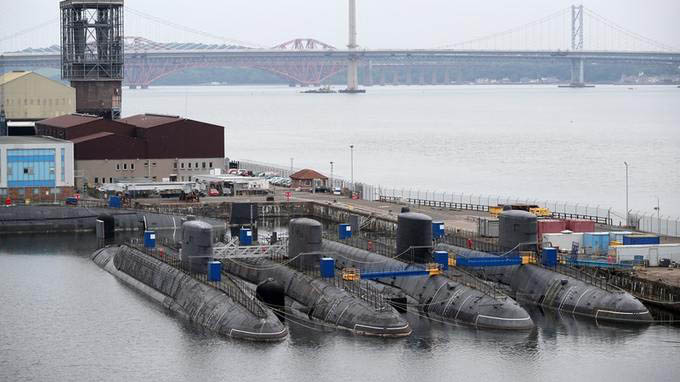
New images raise concerns over state of UK nuclear submarines
The National By Xander Elliards 8th September 24
CONCERNS have been raised that the deteriorating state of the UK’s nuclear submarines is “potentially putting the vessel and her crew at risk”.
Alarm bells were rung after the Ministry of Defence (MoD) announced last week that Defence Secretary John Healey had joined one of the UK’s four Vanguard-class submarines as it returned to dock at Faslane.
An image shared by the MoD showed Healey looking at the submarine, which appeared covered in algae, slime and rust along its entire length.
Further photos taken by locals living near the HM Naval Base Clyde showed the submarine was missing numerous patches of anechoic tiles – which line the exterior to help hide the submarine from sonar.
The submarine is thought to have been on patrol since mid-March, meaning it had spent around 160 days underwater.
In March, HMS Vengeance returned to Faslane after 201 days underwater – reported to be the second-longest patrol ever – directly following a mission which lasted 195 days. Patrols on the previous Polaris generation of nuclear submarines averaged 60-70 days, according to the Campaign for Nuclear Disarmament (CND)
HMS Vengeance is one of four Vanguard-class submarines, which were each built with a 25-year lifespan – a limit imposed by the lifespan of major components – and either commenced sea trials or saw their reactor go critical in 1992, 1994, 1996, and 1999. The UK Government noted in 2007 that it “should be possible” to extend these lifespans by five years to a total of 30.
At least one submarine is meant to be patrolling the oceans at any time in order to deliver a nuclear strike if the UK Government orders it. However, the ageing fleet meant that essential works had to be carried out to keep the submarines seaworthy, placing higher pressure on the remaining boats.
In January, alarm bells had been rung after Dominic Cummings, a key adviser during Boris Johnson’s time in Downing Street, said there was a hidden “scandal of nuclear weapons infrastructure” which he called a “dangerous disaster and a budget nightmare of hard-to-believe and highly classified proportions”.
Issues with ageing equipment nearly led to a major disaster in 2022 after a broken depth gauge meant one nuclear submarine was continuing to descend despite unknowingly approaching “crush depth”.
On Saturday, the Daily Mail reported that none of the UK’s attack submarines are currently at sea, and the majority (16 out of 25) of the country’s warships are broken down, being modified, or undergoing trials. Retired rear admiral Chris Parry called the situation “utterly dire”.
In May 2023, HMS Vanguard finally completed a seven-and-a-half-year refit, and in March 2024, work on HMS Victorious was also completed. The final boat in the fleet is called HMS Vigilant, but it is not clear which of the four were greeted by Defence Secretary Healey at Faslane last week.
Responding to the nuclear-armed submarine returning to Faslane, Chris McEleny, Alba Party’s general secretary and a former MoD employee, said: “The latest sight of a Vanguard-class submarine returning to base caked in algae is very concerning. And, yet again we see anechoic tiles are missing, potentially putting the vessel and her crew at risk.
“The lengthy patrols should also spark concerns as to whether or not subs are going out on patrol with increased payloads due to concern over the half-life.
“The MoD have, as usual, failed to provide basic guarantees in regards to the safety-critical implications of these prolonged patrols.”…………………………..
Lynn Jamieson, the chair of the Scottish CND, claimed that the “UK’s nuclear weapons system is a shambles but that does not capture the absurdity and seriousness of its dangers”.
“The longer at sea, the more mental and physical stress on the crew and the more chance of accidents,” she went on. “The older the submarine the more the risks of unplanned radioactive leaks and other such incidents.
“The cost of keeping the ageing nuclear weapon system going and simultaneously building a replacement grows while public services are drastically cut. In 2023 alone, it cost £6.5 billion [according to a report from the independent Nuclear Information Service] and it will be even more this year.”……….
Jamieson said the UK Government should show “true leadership [and] scrap the old system and its replacement rather than continuing to valorise a capacity for genocide that puts the world in peril, a target on our backs and risks in our backyard”.
SNP MSP Bill Kidd, the co-president of Parliamentarians for Nuclear Non-Proliferation and Disarmament (PNND), said Scotland was the “dumping ground for nuclear leaks and discharges into our waters and coasts and we are the target for any potential nukes an enemy would fire at”.
“Nothing is planned to change in all this as far as Westminster is concerned – and that means Labour every single bit as much as Tories”, he said……………………………….. https://www.thenational.scot/news/24568990.new-images-raise-concerns-state-uk-nuclear-submarines/
Seismic Showdown Coming at Diablo Canyon

Environmental groups have successfully petitioned for “enforcement action” by the US Nuclear Regulatory Commission (NRC) to conduct a review of the earthquake risks and the potential nuclear accident threat with the continued operation of California’s two-unit Diablo Canyon nuclear power plant near San Luis Obispo.
The March 4, 2024 petition was filed to the NRC Commissioners’ Office calling for the revocation of the nuke’s operating license by Mothers For Peace, the Environmental Working Group and Friends of the Earth. The May 15, 2024 initial assessment by an impaneled NRC Petition Review Board (under 10 CFR 2.206) was that the petition should be denied because it did not present significant new information. Enough information was provided however that the Board offered the Petitioners the opportunity for a pre-hearing meeting to supplement their request.
On July 17, 2024, the Petitioners’ presented their seismic expert, Dr. Peter Bird, Professor Emeritus of Geosciences at UCLA, who in testimony to the NRC argued that Pacific Gas & Electric’s (PG&E) most recent publicly-cited seismic risk analysis was seriously deficient. Dr. Bird’s testimony finds that PG&E’s 2018 Seismic Probabilistic Risk Assessment for Diablo Canyon’s “seismic core damage frequency” (SCDF) is currently estimated to be 3×10⁻⁵, when it should be 1.4×10⁻³ per year.
Dr. Bird warns that PG&E has significantly underestimated the earthquake-related nuclear accident frequency because of flawed assumptions that the Diablo Canyon meltdown risk chiefly comes from strike-slip earthquakes. Dr. Bird charges that PG&E’s analysis disregards the more recent January 1, 2024 earthquake in Japan. He asserts that the earthquake centered on the Noto Peninsula (7.5 Magnitude) is a dramatic demonstration and analogous to the significant risk contribution from the “thrust fault” earthquake potential underneath the Diablo Canyon reactor site and in the adjacent Irish Hills.
Based on Dr. Bird’s supplemental information and testimony, the NRC Petition Review Board announced on August 27, 2024 that it reconsidered its preliminary judgment and “As provided by 10 CFR 2.206, we will take action on your request within a reasonable time.”
IAEA’s Grossi says Zaporizhzhia cooling tower likely to be demolished
WNN 05 September 2024
International Atomic Energy Agency Director General Rafael Mariano Grossi has inspected the cooling tower affected by fire last month at Zaporizhzhia Nuclear Power Plant and says it is “not usable in the future, so it will probably be demolished”.
Grossi, on his fifth visit to the six-unit nuclear plant which has been under Russian military control since early March 2022, said that the security situation remains “very fragile … so our work continues … we will be analysing, assessing what we saw today – until the conflict is over or it enters a phase where there is no more active military activity … the possibility of something serious cannot be excluded”.
The IAEA has had a team of experts stationed at Zaporizhzhia for two years – with 23 rotations of staff during that time. Their presence is intended to boost nuclear safety and security at the plant which is on the front line of Russian and Ukrainian forces.
Ukraine and Russia each blame the other side for putting nuclear safety and security at risk. After the fire at the cooling tower Russia accused Ukraine of causing it with drone attacks, while Ukraine accused Russia of causing it deliberately, or by negligence………………………………….. https://www.world-nuclear-news.org/Articles/IAEA-s-Grossi-says-Zaporizhzhia-cooling-tower-set
1 This Month

of the week – Shut Down Drone Warfare!


Tell the Ukrainian Government to Drop Prosecution of Peace Activist Yurii Sheliazhenko

Petition to revoke the licensing of the Near Surface Nuclear Disposal Facility (NSDF) at Chalk River. https://www.ourcommons.ca/petitions/en/Petition/Details?Petition=e-7247
To see nuclear-related stories in greater depth and intensity – go to https://nuclearinformation.wordpress.com
-
Archives
- April 2026 (79)
- March 2026 (251)
- February 2026 (268)
- January 2026 (308)
- December 2025 (358)
- November 2025 (359)
- October 2025 (376)
- September 2025 (257)
- August 2025 (319)
- July 2025 (230)
- June 2025 (348)
- May 2025 (261)
-
Categories
- 1
- 1 NUCLEAR ISSUES
- business and costs
- climate change
- culture and arts
- ENERGY
- environment
- health
- history
- indigenous issues
- Legal
- marketing of nuclear
- media
- opposition to nuclear
- PERSONAL STORIES
- politics
- politics international
- Religion and ethics
- safety
- secrets,lies and civil liberties
- spinbuster
- technology
- Uranium
- wastes
- weapons and war
- Women
- 2 WORLD
- ACTION
- AFRICA
- Atrocities
- AUSTRALIA
- Christina's notes
- Christina's themes
- culture and arts
- Events
- Fuk 2022
- Fuk 2023
- Fukushima 2017
- Fukushima 2018
- fukushima 2019
- Fukushima 2020
- Fukushima 2021
- general
- global warming
- Humour (God we need it)
- Nuclear
- RARE EARTHS
- Reference
- resources – print
- Resources -audiovicual
- Weekly Newsletter
- World
- World Nuclear
- YouTube
-
RSS
Entries RSS
Comments RSS
 nuclear-news