Questions raised on safety of U.S. nuclear missile force,
Another nuclear stumble by Air Force raises doubts Boston.com, 14 Aug 13WASHINGTON (AP) — Another embarrassing stumble by the U.S. nuclear missile force, this time a safety and security inspection failure, is raising questions about the Air Force’s management of arguably the military’s most sensitive mission.
The head of nuclear air forces, Lt. Gen. James M. Kowalski, revealed to The Associated Press on Tuesday that the 341st Missile Wing at Malmstrom Air Force Base, Mont., had failed what the military calls a ‘‘surety’’ inspection — a formal check on the unit’s adherence to rules ensuring the safety, security and control of its nuclear weapons.
The 341st is one of three units that operate the Air Force’s 450 Minuteman 3 intercontinental ballistic missiles, or ICBMs……. http://www.boston.com/news/nation/washington/2013/08/14/another-nuclear-stumble-air-force-raises-doubts/rDGNmeaq4Li2VB7xfIkBwK/story.html
Nuclear Regulatory Commission’s false safety assumptions
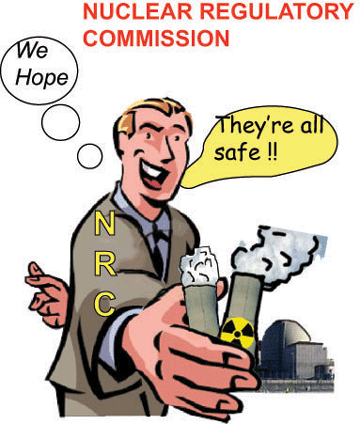 Nuclear Regulatory Commission Is Using Obviously Faulty Models to Pretend Crumbling Nuclear Reactors Are Safe By Washington’s Blog Global Research, August 12, 2013 Ignoring Basic Engineering Science Puts Us All At Risk
Faulty assumptions by America’s financial regulators led to the 2008 crash … and many other disastrous results.
Similarly, America’s main nuclear regulator – the Nuclear Regulatory Commission – made numerous assumptions before Fukushima that turned out to be totally false. For example, the NRC wrongly assumed: Continue reading
Fukushima radiation leaks out of control
Nuclear Official: Growing alarm at Fukushima’s out of control radioactive leaks… Emergency is accelerating due to “faster-than-expected swelling” underground — TV: Tepco now paving over surface with asphalt (VIDEO) http://enenews.com/nuclear-official-radioactive-leaks-getting-out-of-control-and-creating-a-state-of-emergency-at-fukushima-emergency-is-accelerating-due-to-faster-than-expected-swelling-underground
Has the Fukushima “China Syndrome” begun?
Associated Press,, Aug. 8, 2013: Shinji Kinjo, an official at the Nuclear Regulation Authority, said faster-than-expected swelling of the underground water following the installation of the chemical barriers accelerated the emergency
Bloomberg Aug. 7, 2013 at 8:41p ET: The regulator has also indicated growing alarm about the water leaks. Radioactive water leaks are getting out of control and “creating a state of emergency,” said Shinji Kinjo
NHK, Aug. 7, 2013: [Tepco’s] paving the ground surface with asphalt to keep out rainwater
NHK, , Aug. 8, 2013: Industry, Economy and Trade Minister Toshimitsu Motegi told the panel of experts on Thursday to come up with concrete proposals by the end of September. […] Among the approaches he suggested was the possibility of releasing into the sea groundwater that is below the legal limits of contamination.
Watch NHK’s broadcast hereWatch NHK’s broadcast here
Fukushima reactor buildings risk collapse as water accumulates underground
The Fukushima plant sits smack in the middle of an underground aquifer. Deep beneath the ground, the site is rapidly being overwhelmed by water.
What happens when you pour hundreds of thousands of tons of water (400 metric tons each day times 2.5 years times 365 days in a year equals 365,000 metric tons of water) onto soil which sits above a massive aquifer?
The spent fuel pool at Fukushima Unit 4 is the top short-term threat to humanity, and is a national security issue for America.
As such, it is disturbing news that the ground beneath unit 4 is sinking.
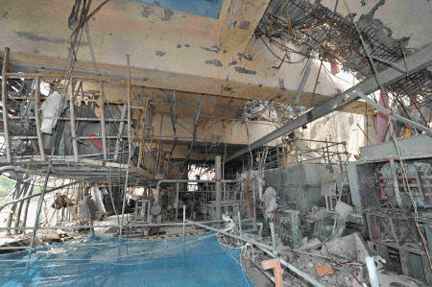
Fukushima: Japan’s Nuclear Accident Response Director Warns that Tepco’s Actions Might Cause Reactor BuIldings to Collapse http://www.globalresearch.ca/fukushima-japans-nuclear-accident-response-director-warns-that-tepcos-actions-might-cause-reactor-buildings-to-collapse/5345279?utm_source=rss&utm_medium=rss&utm_campaign=fukushima-japans-nuclear-accident-response-director-warns-that-tepcos-actions-might-cause-reactor-buildings-to-collapse By Washington’s Blog Global Research, August 07, 2013 Tepco’s ill-considered efforts to change soil permeability and water flow have caused severe problems at the site … including highly radioactive groundwater bubbling up to the surface.
NHK notes:
The vice governor of Fukushima Prefecture has asked the government to take the lead in handling the matter and stop the leakage. Masao Uchibori told an official from the Nuclear Regulation Authority that some of Tepco’s measures have increased the risk of further leaks. Continue reading
Palisades Nuclear Power Plant shuts down, with radioactive waster leaking into Lake Michigan

 Nuclear plant Palisades Nuclear Generating Station spills radiation into Lake Michigan Earth First Newswire, by John Upton / Grist 6 Aug 13, Last summer, a leaky tank led to the shutdown of the Palisades nuclear power plant in Michigan. So plant owner Entergy patched up the leak, fired back up the reactor, and hoped for the best.
Unfortunately, the best did not materialize.
The tank began leaking again. But no worries, thought the Einsteins at Entergy, it was only leaking a gallon a day. That was OK, they figured, because the NRC had allowed it to leak up to 38 gallons a day. As of Friday, they were still doing that whole “hoping for the best” thing.
But on Saturday the leaky drip turned into a gush, and all the hoping in the world couldn’t hold back the tide of spilling radioactive water. Nearly 80 gallons of water containing small amounts of radioactive tritium and possibly trace amounts of cobalt and cesium spewed into Lake Michigan, the Nuclear Regulatory Commission told the AP. Early Sunday morning, the tank was ruled inoperable and the nuclear power plant began powering down. This is reportedly the ninth time that the facility has been shut down since 2011.
The Kalamazoo Gazette reports:
Leaks have been an ongoing issue at Palisades, owned by New Orleans-based Entergy Corp., which shut down four times in 2012 and twice so far this year. Most recently, in February, the plant shut down for six days to repair a component cooling water heat exchanger and replace a damaged switch.
The NRC resident inspectors monitored the shutdown and are closely watching repairs, [said the NRC’s Viktoria Mitlyng], and the NRC is sending an additional inspector. There is no current timeline for when Palisades might resume service, she said…….
What should be of concern to regulators and the public, Jackson said, is whether any nuclear power plant has enough of a culture of safety in place. That’s especially important because of the intense pressures in the electrical power industry to keep costs low. http://earthfirstnews.wordpress.com/2013/08/06/nuclear-plant-spills-radiation-into-lake-michigan/
Fukushima’s radioactive leak now reaches emergency stage

Contaminated water could rise to the ground’s surface within three weeks, national newspaper Asahi Shimbun said on Saturday. Mr. Kinjo said the three-week timeline was not based on NRA’s calculations but acknowledged that if the water reaches the surface, “it would flow extremely fast.”
A Tepco official said on Monday the company plans to start pumping out a further 100 tonnes of groundwater a day around the end of the week.
Radioactive leak from crippled Japanese nuclear plant creating ‘emergency’ http://www.theglobeandmail.com/news/world/radioactive-leak-from-crippled-japanese-nuclear-plant-creating-emergency/article13602630/ ANTONI SLODKOWSKI AND MARI SAITO TOKYO — Reuters Monday, Aug. 05 2013 Highly radioactive water seeping into the ocean from Japan’s crippled Fukushima nuclear plant is creating an “emergency” that the operator is struggling to contain, an official from the country’s nuclear watchdog said on Monday.
This contaminated groundwater has breached an underground barrier, is rising toward the surface and is exceeding legal limits of radioactive discharge, Shinji Kinjo, head of a Nuclear Regulatory Authority (NRA) task force, told Reuters.
Countermeasures planned by Tokyo Electric Power Co. (Tepco), the utility that runs Fukushima, are only a temporary solution, he said.
Tepco’s “sense of crisis is weak,” Mr. Kinjo said. “This is why you can’t just leave it up to Tepco alone” to grapple with the ongoing disaster.
“Right now, we have an emergency,” Continue reading
Fukushima radioactive water tanks may not last long
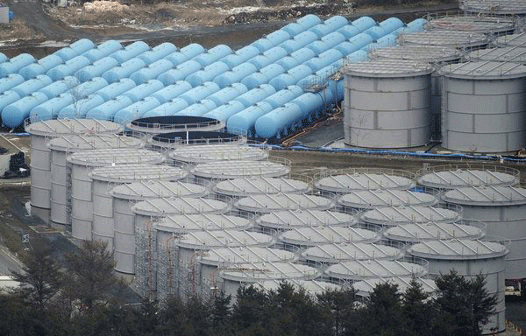 ‘Water Storage Nightmare’: Bolts in Fukushima tanks will corrode in just a few years, plant workers reveal — “Tepco says it doesn’t know how long tanks will hold” – http://enenews.com/nightmare-bolts-fukushima-tanks-will-corrode-years-plant-workers-reveal-full-extremely-radioactive-water-tepco-doesnt-long-tanks-will-hold-reuters
Title: Fukushima clean-up turns toxic for Japan’s Tepco
Source: Reuters
Authors: Antoni Slodkowski and Mari Saito
Date: July 31, 2013
[…] WATER STORAGE NIGHTMARE
Experts say Tepco is attempting the most ambitious nuclear clean-up in history, even greater than the Chernobyl disaster […]
[…] radioactive water that cools the reactors […] mixes with some 400 tonnes of fresh groundwater pouring into the plant daily.
Workers have built more than 1,000 tanks […]
With more than 85 percent of the 380,000 tonnes of storage capacity filled, Tepco has said it could run out of space.
The tanks are built from parts of disassembled old containers brought from defunct factories and put together with new parts, workers from the plant told Reuters. They say steel bolts in the tanks will corrode in a few years.
Tepco says it does not know how long the tanks will hold. […]
Uranium in common airliner parts
 Common Airliner Parts Now Admitted To Be Laced With Uranium http://www.thedailysheeple.com/common-airliner-parts-now-admitted-to-be-laced-with-uranium_0720 www.IntelliHub.com July 25th, 2013 MIAMI — Ten minutes away from the Sun Life Stadium, home of the Miami Dolphins and Florida Marlins, is Opa-locka Executive Airport (OPF), the site of a recent environmental tragedy.
Thursday, a portion of the airport grounds were sealed off due to a radioactive substance leak emitting from an old 55-gallon drum. HAZMAT and fire crews responded just after noon, finding radioactive airplane parts laced with Uranium inside the drum.
The drum was said to be found on the Grounds of the former, now bankrupt, Arrow Cargo. According to Wikipedia Arrow Cargo, “was an American cargo airline (originally known as Arrow Air) based in Building 712 on the grounds of Miami International Airport in unincorporated Miami-Dade County, Florida, USA. It operated over 90 weekly scheduled cargo flights, and had a strong charter business. Its main base was Miami International Airport. Arrow Air ceased operations on June 29, 2010, and filed for Chapter 11 bankruptcy protection on July 1, 2010. It plans to liquidate.”
What is most startling about this is the fact that Miami-Dade’s Fire Rescue spokesman Lt. Arnold Piedrahita, admitted to the press that indeed aircraft “counterbalances” are indeed made with radioactive uranium. The local press went on to downplay the severity of the finding.
Upon further investigation it turns out even the Boing Corporation itself has expressed concerns about certain aircraft parts containing radioactive materials. In fact, Boing even submitted paperwork to the United States Nuclear Regulatory Commission (USNRC) detailing their concerns:
Boeing Company Request Concerning Depleted Uranium Counterweights by Enformable
– See more at: http://www.thedailysheeple.com/common-airliner-parts-now-admitted-to-be-laced-with-uranium_072013#sthash.VzIwAfvb.dpuf
Israel’s nuclear safety procedures criticised
“…….The Dimona facility’s safety procedures have been severely criticized by the courts in recent years, following a suit by 44 employees and the families of former employees who claimed they had developed cancer and other diseases due to overexposure to radiation.
IAEC officials insisted that the number of cancer cases among employees isn’t higher than that among the general population. Nevertheless, a year and a half later, Justice Minister Tzipi Livni appointed a committee to recommend special compensation for employees who developed fatal diseases. “….. Haaretz 23 July 13
Taiwan nuclear reactor in danger during typhoon
 Kyodo: Worker panicking while trying “to keep water level up” in reactor during typhoon — Seawater reportedly overran cooling water intake #Taiwan http://enenews.com/kyodo-worker-was-panicking-while-trying-to-keep-water-level-up-in-reactor-during-typhoon-seawater-reportedly-overran-cooling-water-intake-no-mention-of-neutrons-taiwan
Kyodo News,, July 16, 2013: Human error causes Taiwan’s nuclear plant shutdown […] Chai Fu-feng, a spokesman of Taiwan Power Co. (Taipower), told Kyodo News that the Unit 2 reactor of the Chinshan nuclear power station in New Taipei City was automatically shut down when instruments detected too much water in the reactor pressure vessel. […] a plant worker switched off a draining valve to control the heat in the reactor […] Panicking, he added water to the reactor to keep the water level up, but he added too much water too fast, which eventually caused the reactor to automatically scram, he said. […]
World Nuclear News,, July 16, 2013: […] winds above 117 kilometres per hour threatened transmission systems. […] the height of the storm saw damage to Chinshan 2′s main transformer, which triggered an automatic shutdown. A few hours later seawater overran the cooling water intake bringing in plant debris that clogged the debris screen. Later inspection confirmed lightning damage to the main transformer, as well as storm damage to the switchyard insulator and 350 kV overhead lines. […]
Texas old nuclear weapons bunker radioactive
Army probes radiation in bunker at Texas base WFAA 8 by JUAN CARLOS LLORCA Associated Press July 16, 2013 FORT BLISS, Texas (AP) — Army investigators have detected radiation in a former nuclear weapons bunker at Fort Bliss and are trying to determine if anyone on the West Texas post may have been contaminated, officials said Tuesday.
Post leaders said an investigation that began about two months ago revealed levels of radiation in the igloo-like bunker that was used for the assembly and storage of nuclear weapons at the height of the Cold War in the 1950s and 1960s.
Fort Bliss spokesman Maj. Joe Buccino said epoxy paint was applied to the interior of the bunker years ago to contain the radioactivity, but that over the years the paint has become chipped, allowing the radioactive surface to become exposed…….The investigation was triggered by a call from a man who worked at Fort Bliss in the 1950s when it was operated by the Air Force. He told post leaders that contaminated residue such as rags and other items had been buried there and expressed concerns that any new housing at the sprawling base could dig up the contamination.
It’s not clear where the residue, apparently long forgotten, is buried.
Officials did not identify the former worker who contacted officials about two months ago. But they said he was likely exposed to the contaminated residue. http://www.wfaa.com/news/texas-news/Army-probes-radiation-in-bunker-at-Texas-base-215725431.html
Taiwan nuclear reactor shut down by typhoon
Typhoon Soulik causes nuclear reactor shutdown By John Liu, The China Post July 15, 2013, TAIPEI, Taiwan — Typhoon Soulik’s strong winds caused one of the reactors at Taiwan’s First Nuclear Power Plant to automatically shut down as part of precautionary measures twice on Saturday. At 2:50 a.m. on July 13, strong winds knocked out systems designed to reduce the likelihood of direct lighting strikes on the facility at the plant’s number two reactor unit, resulting in an automatic shutdown. While repairs were carried out on the system, the reading for the number of neutrons became exceedingly high, once again leading to an emergency shutdown as part of protection measures.
Taiwan Power Co. (台電) nuclear energy spokesman Tsai Fu-feng (蔡豐富) said both shutdowns are part of protection measures and “there are no safety concerns.” Tsai said however that there is room for improvement in the handling of the power plant………
The typhoon also led to a significant amount of detritus blocking the water inlet. The company will not only need to acquire approval from the AEC but also fix the blockage before the power plant resumes normal function……
The AEC said similar incidents have happened at the country’s nuclear power plants, and is still waiting on Taipower’s report for a detailed explanation of the cause and description of the accompanying procedures for handling the accident……http://www.chinapost.com.tw/taiwan/national/national-news/2013/07/15/383773/Typhoon-Soulik.htm
Climate change increases Chernobyl’s risk of radioactive wildfires
Women in their 20s living just outside the zone face the highest risk from exposure to radioactive smoke, the 2011 study found: 170 in 100,000 would have an increased chance of dying of cancer. Among men farther away in Kiev, 18 in 100,000 20 year olds would be at increased risk of dying of cancer.
the greatest danger from forest fire for most people would be consuming foods exposed to smoke. Milk, meat and other products would exceed safe levels, the 2011 study predicts. The Ukrainian government would almost certainly have to ban consumption of foodstuffs produced as far as 150 kilometres from the fire
 Watching for a radioactive forest fire JANE BRAXTON LITTLE, ABC Environment 8 JUL 2013 Tinder dry and radioactive: the forests around Chernobyl are an accident waiting to happen. For 27 years, forests around Chernobyl have been absorbing radioactive elements. A fire would send them skyward again – a growing concern as summers grow longer, hotter and drier. “…….Nikolay Ossienko patrols the forests surrounding the Chernobyl nuclear power plant,,,,,,, “Our number one job is to save the forest from fire,”…… It’s a job with international consequences.
For almost three decades the forests around the shuttered nuclear power plant have been absorbing contamination left from the 1986 reactor explosion. Now climate change and lack of management present a troubling predicament: If these forests burn, strontium 90, cesium 137, plutonium 238 and other radioactive elements would be released, according to an analysis of the human health impacts of wildfire in Chernobyl’s exclusion zone conducted by scientists in Germany, Scotland, Ukraine and the United States. Continue reading
New guidelines allow far greater radiation exposure to the public
 For Future Reactor Meltdowns, EPA Means “Extra Pollution Allowed” by JOHN LaFORGE Cutting Corners, Cutting Costs, Creating Cancer
As the nuclear power industry struggles against collapse from skyrocketing costs, bankrupting repair bills and investor flight (four operating reactors were permanently closed this year, more than in any previous 12 month period), the government seems to have capitulated to political pressure to weaken radiation exposure standards and save nuclear utilities billions.
On April 15, the EPA issued new Protective Action Guides (PAGs) for dealing with large scale radiation releases — like the catastrophic triple reactor meltdowns at Fukushima, Japan that spread cesium and radio-iodine worldwide. The new PAGs are like a government bailout, saving reactor owners the gargantuan costs of comprehensive cleanup. And eerily, the new PAGs seem to presume the inevitability of radiation disasters that the industry — with its fleet of 100 rickety 40-year-old units — can’t currently afford to withstand.
According to Daniel Hirsch, President of Committee to Bridge the Gap, the latest PAGs took effect in April but can be amended — and EPA is taking comments. Hirsch says that the National Council on Radiation Protection’s plans for implementing the new PAGs “would allow the public to be exposed to extraordinarily higher levels of radiation than previously permitted” during reactor accident emergencies.
The new PAGs also allow extremely high contamination of food, he says. “In essence,” Hirsch reports, the PAGs say “nuclear power accidents could be so widespread and produce such immense radiation levels that the government would abandon cleanup obligations” forcing people to absorb and live with far more cancers.
To cut costs, industry has long pushed for weakening radiation exposure rules. In 2002, Roger Clarke president of the International Commission on Radiological Protection (ICRP) warned in the Bulletin of the Atomic Scientists, “Some people think that too much money is being spent to achieve low levels of residual contamination.” The ICRP recommends exposure standards to governments for nuclear industry workers and the public…….http://www.counterpunch.org/2013/07/09/for-future-reactor-meltdowns-epa-means-extra-pollution-allowed/
Global maritime environment threatened by Russia’s floating nuclear plants
 Tow cables snap, Arctic conditions can be unpredictable, ships sink. As the ocean is the common heritage of humanity, perhaps the international community might evince a tad more interest in this project.
Chernobyl At Sea? Russia Building Floating Nuclear Power Plants http://www.zerohedge.com/node/476304 submitted by Tyler Durden 07/11/2013 by John Daly via OilPrice.com,So much for the lessons of Fukushima. Never mind oil spills, the Russian Federation is preparing an energy initiative that, if it has problems, will inject nuclear material into the maritime environment.
Speaking to reporters at the 6th International Naval Show in St. Petersburg, Baltiskii Zavod shipyard general director Aleksandr Voznesenskii said that the Russian Federation’s first floating nuclear power plant “should be operational by 2016.” Continue reading
1 This Month




PLEASE OPPOSE HR 8255 AND S.3639 – bills would accelerate satellite deployment, with no environmental review or safeguards – https://ncstd5li.quorum.us/campaign/169331/
To see nuclear-related stories in greater depth and intensity – go to https://nuclearinformation.wordpress.com
-
Archives
- September 2026 (330)
- August 2026 (330)
- July 2026 (355)
- June 2026 (287)
- May 2026 (306)
- April 2026 (356)
- March 2026 (251)
- February 2026 (267)
- January 2026 (308)
- December 2025 (358)
- November 2025 (359)
- October 2025 (375)
-
Categories
- 1
- 1 NUCLEAR ISSUES
- business and costs
- climate change
- culture and arts
- ENERGY
- environment
- health
- history
- indigenous issues
- Legal
- marketing of nuclear
- media
- opposition to nuclear
- PERSONAL STORIES
- politics
- politics international
- Religion and ethics
- safety
- secrets,lies and civil liberties
- spinbuster
- technology
- Uranium
- wastes
- weapons and war
- Women
- 2 WORLD
- ACTION
- AFRICA
- Atrocities
- AUSTRALIA
- Christina's notes
- Christina's themes
- culture and arts
- Events
- Fuk 2022
- Fuk 2023
- Fukushima 2017
- Fukushima 2018
- fukushima 2019
- Fukushima 2020
- Fukushima 2021
- general
- global warming
- Humour (God we need it)
- Nuclear
- RARE EARTHS
- Reference
- resources – print
- Resources -audiovicual
- Weekly Newsletter
- World
- World Nuclear
- YouTube
-
RSS
Entries RSS
Comments RSS

