Hilariously, Tokyo’s Olympic Games are being billed the “Safe Games” of 2020.
 As Fukushima radiation rages, Tokyo awarded bid to host 2020 Summer Olympics, hilariously named the ‘Safe Games’ September 08, 2013 by Mike Adams (NaturalNews) Despite the fact that Fukushima is already the worst radiological disaster in human history — and worsening by the day — Japan has been chosen as the host nation for the 2020 Summer Olympics.
Hilariously, the event is being billed the “Safe Games” of 2020.
How, exactly, is it safe to host the Olympics in a nation which absolutely no workable evacuation routes from a nuclear facility on the verge of collapsing into another deadly radiation release? The answer to that question is provided by Japan’s Prime Minister Abe. He claims that Fukushima is no problem whatsoever, that no one has ever been harmed by it, and that it is fully under control! (A trifecta, he thinks…)……..
Japan cannot be evacuated
The fact that the Olympic committee chose Japan even while Fukushima rages on, just one earthquake away from a catastrophic collapse and unprecedented release of deadly radiation, tells you just how incredibly stupid the Olympics decision makers really are. (Or how paid off they are, as bribes and corruption have been well documented throughout the history of the Olympics).
Do these people not grasp even the most fundamental concepts of physics? Why would any sane organization vote to host a global event that brings hundreds of thousands of people to a location just a short distance away from a collapsing nuclear power plant that is utterly and completely out of control with no end in sight?
Furthermore, Japan has no workable evacuation plan if Fukushima’s reactor #4 does experience a structural collapse followed by a catastrophic release of radiation. There is no evacuation plan because Japan cannot be evacuated, period. Thus, the strategy of the Japanese government has become one of D-E-N-I-A-L instead of problem solving.
Let’s all pretend radiation is no longer a problem, shall we? Japan is pretending. The U.S. is pretending, and now the Olympic committee is pretending, too.
As long as they’re pretending, why not host the Olympics at the Fukushima Dai-Ichi nuclear power facility? It’s available, after all. And the rent is dirt cheap.
Learn more: http://www.naturalnews.com/041964_Olympics_Tokyo_Fukushima_radiation.html#ixzz2eQZtdf5O
South Korea banning all fish imports from Fukushima region
 Video: South Korea extends ban on Japanese fish imports .http://www.abc.net.au/news/2013-09-07/an-skorea-bans-japan-fish-imports-over-fukushima-concerns/4942274 South Korea has extended its ban on Japanese fisheries products over fears of contamination from the crippled Fukushima nuclear plant. Australia Network News, 7 Sept 13
Consumption of fish products in South Korea has dropped sharply in recent weeks as Japanese workers struggle to contain leaks at the tsunami-wrecked facility.
The plant’s operator Tokyo Electric Power (TEPCO) has admitted that highly toxic water may have made its way into the Pacific Ocean.The company also says up to 300 tonnes of mildly radioactive groundwater is making its way into the sea every day.
South Korea had previously imposed an import ban on dozens of Japanese fisheries products produced in Fukushima and seven other prefectures following the meltdown at the nuclear plant, triggered by the 2011 tsunami. The government has now widened the ban to take in all such products from Fukushima and the seven other prefectures – Ibaraki, Gunma, Miyagi, Iwate, Tochigi, Chiba and Aomori. The Ministry of Oceans and Fisheries says it is taking action in response to rising fears in South Korea.
“The government has concluded that the information provided by Japan so far has failed to make it clear how the incident will develop in the future. “Under the new measure, all fisheries products from this region will be banned regardless of whether they are contaminated or not.”
The ministry has also urged Tokyo to immediately provide accurate information on the leaks of contaminated water…….
Calvert Cliffs nuclear reactor shut down
1 of 2 Reactors at Md. Nuclear Plant Shuts Down http://abcnews.go.com/Business/wireStory/reactors-md-nuclear-plant-shuts-20179217 LUSBY, Md. September 6, 2013 (AP)Constellation Energy Nuclear Group says it has shut down one of two nuclear reactors at its Calvert Cliffs power plant after a malfunction during testing.
Plant spokesman Kory Raftery says a control rod dropped into the reactor Thursday during tests at the Southern Maryland plant and it was shut down. He said Friday that electrical maintenance will be performed, but it’s not clear when unit 2 will return to service.
Nuclear Regulatory Commission spokesman Neil Sheehan says the plant must shut down within six hours if a rod can’t be withdrawn. He says inspectors will follow the maintenance.
Raftery says there’s no public safety threat, and an investigation found no link to a shutdown in May.
The plant is located along the Chesapeake Bay, about 70 miles south of Baltimore.
Fire in turbine building at Palo Verde Nuclear Plant

 Emergency declared at U.S. nuclear plant due to fire in turbine building — Two ‘reflash events’ occurred — Fire emergency lasted over four hours #PaloVerde http://enenews.com/emergency-declared-at-u-s-nuclear-plant-due-to-fire-in-turbine-building-two-reflash-events-occurred-fire-emergency-lasted-over-four-hours-paloverde
Associated Press, Sept. 3, 2013: The Palo Verde Nuclear Generating Station declared an unusual event when oil-soaked insulation behind a water pump caught fire, officials said Tuesday. […] An unusual event is the lowest of four emergency levels for nuclear power plants. […] APS spokesman said the cause of the fire is under investigation, but NRC spokesman Victor Dricks said it appeared that insulation that covers very hot metal surfaces had become soaked by bearing lubrication over time. […] The unusual event was the second at Palo Verde in two months […] The last unusual event was on July 2 when Unit 1 reactor temporarily reduced its power production after there was a minor explosion in a cabinet that holds electrical switching gear.
NRC: Event Notification Report for September 4, 2013 – – UNUSUAL EVENT DECLARED DUE TO FIRE IN THE TURBINE BUILDING […] An Event Classification of Unusual Event (HU2.1) was declared at 1926 [MST] for the Palo Verde Nuclear Generating Station. At 1912, smoke was detected by a security officer by the ‘A’ train Main Feed pump. An Auxiliary Nuclear Operator investigated and identified a fire on lagging, with one foot flames behind the main standard ‘A’ train Main Feed pump. The fire team responded to the fire and is currently on scene. Fire was declared out at 1957. […] The ‘A’ Main Feed pump high vibration alarm was received, but the continued operation of the main feed pump is currently not in jeopardy.” While removing lagging, during the recovery process, the licensee had 2 reflash events. The flame was extinguished and the licensee continues to remove the oil soaked lagging for the ‘A’ Main Feed pump. […] Vapor extraction differential pressure was increased to eliminate the oil vapor leak. At 2134 MST, received a report of two reflash events while the Fire Department was removing additional lagging with no sustained flame or fire. All the affected lagging has been removed and the fire emergency was terminated at 2345 MST on 9/2/13. See also: Explosion reported at U.S. nuclear plant, emergency declared
Most dangerous new nuclear power plant at Taishan, Guangdong

 Nuclear threat on our doorstep, South China Morning Post, Green groups say flawed and untested technology puts city at risk from ‘world’s most dangerous nuclear power plant’, South China Morning Post,05 September, 2013 Ernest Kao ernest.kao@scmp A nuclear power plant being built just 130 kilometres away from Hong Kong was yesterday labelled by green groups the “most dangerous nuclear power plant in the world” The plant in Taishan, Guangdong, is using technology that has never been used before and would put the city and another 30 million people at risk in the Pearl River Delta in the event of a Fukushima-style meltdown, say nine groups, including Greenpeace, Green Sense and the Professional Commons lobby group. They are calling on Hong Kong authorities and the provincial and national governments to look again at the risks involved.
The Taishan Nuclear Power Plant, due to start operating in December, will run on two European pressurised reactors, or EPRs – a new Franco-German pressurised-water reactor which the groups say is immature.
 French nuclear power giant Areva sealed an €8 billion (HK$92.53 billion) deal to build the two reactors for China’s state-owned Guangdong Nuclear Power Group in 2007. Construction began in 2009.”It is very risky to import a European nuclear reactor technology that has not even met the proper nuclear safety standards and regulations in Europe,” said Albert Lai Kwong-tak, an engineer and a policy expert at independent lobby group the Professional Commons.
Two EPR projects, one in France and another in Finland, have been plagued by delays after safety-related flaws were found. Both projects are not expected to be completed now until 2015 at the earliest, despite construction commencing years earlier than in Taishan.Lai said that upon completion, Taishan would be the “most dangerous nuclear power plant in the world” given its potential radiation level was three times higher than Japan’s crippled Fukushima Daiichi plant.
“Design flaws such as how to power cooling systems for its external spent nuclear fuel pool in the event of an emergency have not been addressed,” he said.
“A digitised and automated emergency control unit also lacks a manual override … these are all lessons which should have been learnt after Fukushima.
“One must ask if Chinese authorities have taken any of these into account.”……. http://www.scmp.com/news/hong-kong/article/1303433/nuclear-threat-our-doorstep
Wall of ice planned, to go underneath Fukushima nuclear plant
 Japan to build $470M ice wall to prevent nuclear leaks http://www.cbsnews.com/8301-202_162-57601127/japan-to-build-$470m-ice-wall-to-prevent-nuclear-leaks/ 4 Sept 13, The Japanese government announced Tuesday that it will spend $470 million on a subterranean ice wall and other steps in a desperate bid to stop leaks of radioactive water from the crippled Fukushima nuclear plant after repeated failures by the plant’s operator.
The decision is widely seen as an attempt to show that the nuclear accident won’t be a safety concern just days before the International Olympic Committee chooses among Tokyo, Istanbul and Madrid as the host of the 2020 Olympics.
The Fukushima Dai-ichi plant has been leaking hundreds of tons of contaminated underground water into the sea since shortly after a massive 2011 earthquake and tsunami damaged the complex. Several leaks from tanks storing radioactive water in recent weeks have heightened the sense of crisis that the plant’s owner, Tokyo Electric Power Co., isn’t able to contain the problem. Continue reading
Out of control: Fukushima will finish off the nuclear industry
Professor Busby believes the situation is clearly out of control and that no one can go anywhere near it. “Nobody can go in to measure where these leaks are or do anything about them, because anybody who is to approach that sort of area would be dead quite quickly. They would be seriously harmed”
 What happens next is anyone’s guess,
This will have a domino impact on all nuclear reactors in my opinion. The cost of keeping those still operating will have to go up, and as the cost of decommissioning them becomes clearly extraordinary, often more than double the cost of building them, and sometimes, like Sellafield, orders of magnitude more, and in a climate of disappearing liquidity……… nobody will be able to afford to build any nukes. There simply won’t be the funds, as all the money that could have been used disappears down the blackhole of decommissionings.
The last nail in the Nuclear Coffin….http://damnthematrix.wordpress.com/2013/09/02/the-last-nail-in-the-nuclear-coffin/ 2 Sept 13, Things have been looking grim at Fukushima. First, they realised that for some time they had been using a radiation meter that could not read beyond 100 milli Sieverts and believed that this was the actual radiation level there…. only to find out with another instrument that levels were in fact much higher, and that hundreds of tonnes of highly radioactive water were leaking into the Pacific Ocean daily for…. well no one knows.
Then it was decided (as I recently reported) that fuel rods lying perilously in a damaged above ground leaking pool that keeps those rods from melting down and causing an actual out of control nuclear reactor (read explosion + mushroom cloud…) were going to be moved, by hand… because? Well the cranes that normally do this have been destroyed by the earthquake, presumably ably assisted by the tsunami.
At the time I commented “what could go wrong?”……..
Well…. things have actually taken a turn for the worse, even before the attempt to move the rods. Continue reading
Protest against dangerous shipment of nuclear wastes from Scotland to South Carolina
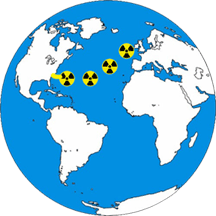 Groups protest plan to ship UK nuclear waste to South Carolina http://chronicle.augusta.com/news/metro/2013-08-29/groups-protest-plan-ship-uk-nuclear-waste-south-carolina?v=1377827799 By Rob Pavey Staff Writer Aug 29, 2013 Environmental groups want to halt a plan to ship spent nuclear fuel from Scotland to Savannah River Site, saying it could make bomb-grade uranium more vulnerable to terrorists. The spent fuel would be moved from the Dounreay research facility in Scotland to SRS, where its highly enriched uranium could be removed at the South Carolina site’s H Canyon facilities, said Tom Clements, southeastern nuclear campaign coordinator for Friends of the Earth.
The material should instead be processed at Sellafield, a former weapons plant in Cumbria, United Kingdon, said Clements and another environmental group – Cumbrians Opposed to a Radioactive Environment. Continue reading
Secrecy and inadequacy in India’s nuclear regulation
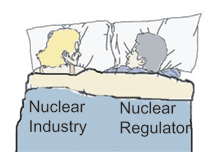
 INADEQUACY of Indian Nuclear Regulation Manifest in Reactor Accident IEEE Spectrum, By Bill Sweet
29 Aug 2013 It is no secret that India still lacks a politically independent nuclear oversight authority that is well separated from the industry it oversees. The Fukushima nuclear catastrophe was a recent reminder of just how important it is to have independent nuclear oversight, a lesson already driven home a generation before by the serious U.S. accident at Three Mile Island (TMI). The stubborn refusal of India’s government to set up the kind of regulatory authority that is so obviously needed means, in effect, that one cannot have real confidence in a nuclear program that could in principle be one of the world’s most important.
A telling but little-known and little-discussed example of what can happen under weak regulatory circumstances was a serious accident that took place at India’s Narora reactor in March 1993,, an incident that “came close to joining Chernobyl and Fukushima in the annals of industrial civilization,” as writer Madhusree Mukerjee put it in a recent review of M.V. Ramana’s The Power of Promise: Examining Nuclear Power in India (Penguin/Viking, 2012)……….
Japan has to take back radiation-contaminated containers sent to Taiwan
 Taiwan returns radiation-contaminated containers to Japan Global Post 28 Aug 13 Fifteen radiation-contaminated containers from Japan have been sent back since Japan’s earthquake, tsunami and the nuclear meltdowns at the Fukushima Daiichi power plant in March 2011, Taiwan’s Atomic Energy Council told Kyodo News on Wednesday.
The council said once a container is detected contaminated with radiation at Kaohsiung port, the importer is given a choice to either clean the container if it wishes to see the container enter Taiwan or not clean the container, which will then be sent back to where it came.
The Liberty Times reported in its Wednesday issue that Kaohsiung Customs has detected 226 containers contaminated with radiation coming from or routed through Japan since March 2011.
Kaohsiung Customs are the island’s only seaport equipped with radiation detection monitors that screen more than 95 percent of all container traffic…… http://www.globalpost.com/dispatch/news/kyodo-news-international/130828/taiwan-returns-radiation-contaminated-containers-japan
Fukushima’s most dangerous problem is ignored by mainstream media
Glowing Green with Outrage By Adam Smith OpEdNews Op Eds 8/27/2013 ”………Unfortunately the reality has been that the media have simply not been doing their job. The Tokyo Electric Power Company (Tepco) has been allowed to dictate the narrative of what is occurring with basically no oversight. It turns out that the site was never actually contained and radioactive water has been leaking with “no accurate figures for radiation levels.” You may say that since this issue is being reported by all major news organizations now, the media is doing their job albeit in a very tardy fashion.
However, that would be missing the reality that this leaking radiation water is the least of our worries vis-a-vis the plant. Much less reported by the media is what will be required by the clean-up crew to end this whole saga. Reliable old Reuters often provides the on-the-ground breaking scoops that our local media then report to us. Despite their well-deserved reputation, it seems that most media organizations have chosen to ignore their recent scoop about the dangers involved in the clean-up process.
 Essentially, Tepco needs to remove 1300 spent fuel rods, containing 14,000 times the amount of radiation dropped onto Japan in WWII, from a dilapidated, flooding, and collapsing power plant that still sits in an earthquake-prone location. The whole process will take about 40 years and cost about eleven billion dollars. Each rod weighs 660 pounds, is 15 feet long, and cannot get too close to each other or will trigger a chain-reaction. If exposed to air, they may also trigger a chain-reaction. Usually, when these rods are moved as part of normal operations, a sophisticated robot is used to guide the work and ensure accuracy down to millimeters. Due to the damage caused by the earthquake/tsunami, this is not possible and the cranes will be operated in a poisonously radioactive area by scared human hands with all of their limitations. These rods will be removed individually, one at a time, and a mistake on any of them could trigger an unstoppable chain-reaction…….. http://www.opednews.com/articles/Glowing-Green-with-Outrage-by-Adam-Smith-Cancer_Energy_Energy_Energy-130827-96.html
The 2011 Fukushima nuclear accident was just the beginning of a continuous disaster
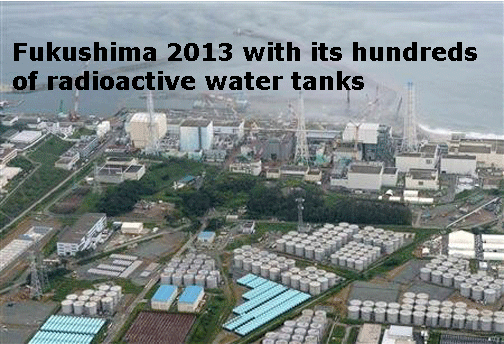 We can see this same “continuous” trend with the accident at Fukushima. The triple meltdown itself at Fukushima in March 2011 was just the beginning
nuclear power accidents are no longer one-off events. Instead, they can span years or even decades, creating a sort of “continuous accident”.
Is Fukushima the new normal for nuclear reactors? the Conversation, Benjamin Sovacool, 27 Aug 13, “…..In the early 1980s, Yale sociologist Charles Perrow argued that the partial meltdown of a nuclear reactor at Three Mile Island was a “normal accident”. The crux of his argument was that complicated technological systems have unavoidable problems that can’t be designed around.
Perrow’s argument — still relevant today — rested on three pillars. First, people are fallible, even at nuclear reactors. Operator error is still a very common factor in incidents and accidents.
Second, big accidents almost always have very small beginnings. Nuclear power plants are so complex that relatively simple things — shirt tails, fuses, light bulbs, mice, cats, and candles — can disrupt the entire system.
And finally, many failures are those of organisations more than technology. Given the right event, all these factors can lead to system-wide failure. Perrow concludes that such high-tech, dangerous systems are hopeless and should be abandoned, as the inevitable risks of failure outweigh any conceivable benefits.
Nuclear reactors do have inherent advantages over fossil fuels, but Perrow’s argument raises serious questions about nuclear safety.
Never-ending accidents
Even so, Perrow was writing in the 1980s. Surely things have improved since then? Well, perhaps not. Continue reading
USA’s Minuteman missiles – supremely dangerous – to the USA
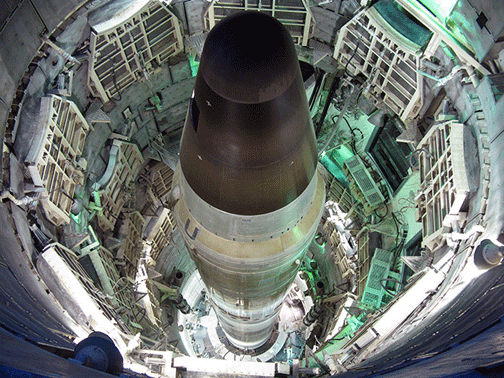 US nuclear weapons poised for catastrophe By James Carroll BOSTON GLOBE AUGUST 26, 2013
The vulnerability is there for all to see. The United States nuclear establishment has been wracked with problems for years. These are especially acute among thousands of officers at the controls of three bases where 450 Minuteman III missiles stand in buried silos on high alert.
In 2008, a Pentagon review found “a dramatic and unacceptable decline” in the way the Air Force was handling its nuclear mission. Senior officials were cashiered. Their replacements were ordered to fix the problems. They have failed to do so. What should be the most rigorously disciplined element in the US military is repeatedly found unworthy of its awesome responsibility. That’s a wake-up call, yet the nation sleeps on……..
supremely dangerous. The missiles are positioned in easily targeted fixed silos across a wide-open western landscape. They are poised for launch on moments’ notice less because of strategic necessity than because they are bound by the rule of “use them or lose them.” The scenario was conceived 50 years ago, under circumstances that are now forgotten. The land-based ICBMs, more than nuclear armed submarines or aircraft, have become the thread from which hangs the sword of accidental holocaust. Fail-safe “right procedures” are the only protection — yet current crews are proving incapable of following those procedures. Fail-safe is the joke that is not funny……… http://www.bostonglobe.com/opinion/2013/08/26/nuclear-tipped-missiles-posed-for-nightmare-holocaust/VZ3KQOUsAUFm4qfuchjmCI/story.html
Danger in new nuclear reactor designs
Is Fukushima the new normal for nuclear reactors? the Conversation, Benjamin Sovacool, 27 Aug 13, “……..New designs, new problems There is some evidence that newer reactor designs and systems are more prone to accidents. Dennis Berry, Director Emeritus of Sandia National Laboratories, explains that the problem with new reactors and accidents is twofold: scenarios arise that are impossible to plan for in simulations, and people make mistakes.
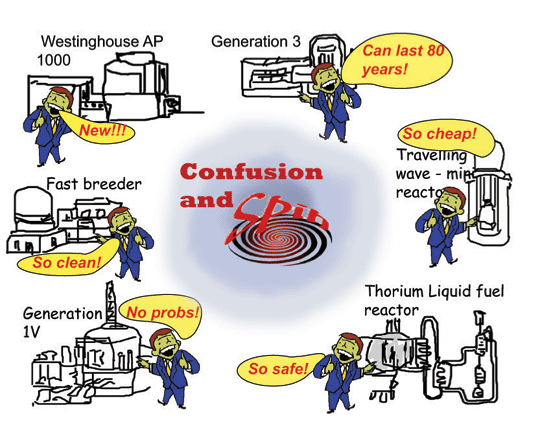
As he put it:
Fabrication, construction, operation, and maintenance of new reactors will face a steep learning curve: advanced technologies will have a heightened risk of accidents and mistakes. The technology may be proven, but people are not.
Former nuclear engineer David Lochbaum has noted that almost all serious nuclear accidents have occurred when operators have little experience with a plant. This makes new systems incredibly risky………http://theconversation.com/is-fukushima-the-new-normal-for-nuclear-reactors-17391
USA’s nuclear reactors are excellent terrorist targets
How U.S. nuclear reactors are vulnerable to terrorists By Alan J. Kuperman, CNN, 26 Aug 13 Editor’s note: Kuperman is editor of Nuclear Terrorism and Global Security: The Challenge of Phasing out Highly Enriched Uranium, and coordinator of theNuclear Proliferation Prevention Project (NPPP) at the LBJ School of Public Affairs, University of Texas at Austin, where he is an associate professor. The views expressed are his own.
Nearly a dozen years after the al Qaeda strikes of September 11, 2001, America’s nuclear power plants – and civilian research facilities with bomb-grade uranium – are still not required to protect against a maximum credible terrorist attack of this scale. It is time for policymakers to act, if they want to prevent disaster.
The vulnerability to a terrorist strike was a key finding of a year-long study that I co-authored, as part of a larger interdisciplinary project at the University of Texas at Austin, under a contract for the Office of the Secretary of Defense (which has no responsibility for the final contents of the study)…….
More from CNN: How nations risk nuclear terrorism
Nominally, our government is supposed to protect us against threats that exceed what utilities must defend against. Unfortunately, that is not happening. A terrorist attack could penetrate a facility in minutes to induce a meltdown, while government SWAT teams would not fully engage for at least an hour and a half, according to Congressional testimony by the Project on Government Oversight.
A second danger is the potential theft of bomb-grade, highly enriched uranium from this country’s three civilian research reactors that still use such fuel. The good news is that these facilities have committed to convert to safer, low-enriched uranium fuel, which is not suitable for nuclear weapons. Unfortunately, the conversion program is delayed by technical snags, so the reactors will continue to use bomb-grade uranium for another decade or more.
Most troubling, these research sites are exempt from defending against the modest, posited terrorist attack that utilities must protect against. So, our civilian facilities with bomb-grade uranium are even less secure than nuclear power plants. The amount of bomb-grade uranium at each site might not be sufficient for a nuclear weapon, depending on the sophistication of the bomb-maker, but the U.S. government has been assiduously vacuuming up even smaller amounts of such material around the world, to prevent the spread of nuclear weapons, as detailed in my latest book…… http://globalpublicsquare.blogs.cnn.com/2013/08/26/how-u-s-nuclear-reactors-are-vulnerable-to-terrorists/
1 This Month




PLEASE OPPOSE HR 8255 AND S.3639 – bills would accelerate satellite deployment, with no environmental review or safeguards – https://ncstd5li.quorum.us/campaign/169331/
To see nuclear-related stories in greater depth and intensity – go to https://nuclearinformation.wordpress.com
-
Archives
- September 2026 (330)
- August 2026 (330)
- July 2026 (355)
- June 2026 (287)
- May 2026 (306)
- April 2026 (356)
- March 2026 (251)
- February 2026 (267)
- January 2026 (308)
- December 2025 (358)
- November 2025 (359)
- October 2025 (375)
-
Categories
- 1
- 1 NUCLEAR ISSUES
- business and costs
- climate change
- culture and arts
- ENERGY
- environment
- health
- history
- indigenous issues
- Legal
- marketing of nuclear
- media
- opposition to nuclear
- PERSONAL STORIES
- politics
- politics international
- Religion and ethics
- safety
- secrets,lies and civil liberties
- spinbuster
- technology
- Uranium
- wastes
- weapons and war
- Women
- 2 WORLD
- ACTION
- AFRICA
- Atrocities
- AUSTRALIA
- Christina's notes
- Christina's themes
- culture and arts
- Events
- Fuk 2022
- Fuk 2023
- Fukushima 2017
- Fukushima 2018
- fukushima 2019
- Fukushima 2020
- Fukushima 2021
- general
- global warming
- Humour (God we need it)
- Nuclear
- RARE EARTHS
- Reference
- resources – print
- Resources -audiovicual
- Weekly Newsletter
- World
- World Nuclear
- YouTube
-
RSS
Entries RSS
Comments RSS

