Secrecy over recent explosion at Hanford plutonium site

 NBC Right Now: Explosion at U.S. nuclear site — Kept secret from public — Happened in plant where plutonium was manufactured — “One of the most hazardous buildings” in America — Workers: “Flames shot out… big, loud bang like a shot gun” (VIDEO) http://enenews.com/nbc-explosion-at-u-s-nuclear-site-kept-secret-from-public-for-weeks-happened-at-plant-where-plutonium-was-manufactured-this-is-one-of-the-most-hazardous-buildings-in-america-flames-s
NBC Right Now (Yakima, WA), (Yakima, WA), May 1, 2014 (h/t Stock): Hanford union workers tell NBC Right Now there was an explosion at the plutonium finishing plant cleanup site weeks ago, but the event wasn’t shared with the public. The Hanford union representative says it happened when workers were cutting some pipe as part of the demolition of the Plutonium Finishing Plant [PFP]. The union representative wants to remain anonymous and says workers are concerned management isn’t putting worker safety first. […] Workers describe the explosion as a spark then flames that shot out of a pipe and a loud bang […] We’re told it happened two weeks ago […] Workers say they think the contractor is playing down the explosion and possible safety concerns to protect themselves from fines and work delays. […] The union representative says management wants to keep experienced workers quiet.
Hanford Union Representative: “: “Having a pipe explode at probably the most contaminated facility in the United States. This is one of the most hazardous buildings in the U.S. […] Management continues to call it a small pop even though the workers say no this thing was a big, loud bang like a shot gun blast […] People bring up concerns and they fall on deaf ears, especially at this facility. It’s like they’re dumbing it down because if this becomes a big concern, then they’re not going to be able to remove the pipe in a timely manor. Well, that’s not the concern. I could care less about your time frame and how much money you’re going to make when you get that pipe out. My concern is the people cutting the pipe in the first place and that doesn’t seem to be their concern. […] PFP is not wanting to use experienced individuals anymore because we’re bringing up too many concerns in this plant. They want to bring in the guy that’s not going to ask any questions and they’ve started to do so.”
Department of Energy:: “The Department of Energy is overseeing the contractor’s response and will continue to evaluate their investigation into the cause of the event and corrective actions.”
KVEW (ABC),, May 2, 2014: Investigation Underway Following Pipe Explosion at Hanford’s Plutonium Finishing Plant — An investigation is underway following a pipe explosion last month at the Hanford site’s Plutonium Finishing Plant. A spokesman for the CH2M Hill Plateau Remediation Company says the employees were cutting a pipe on April 17th when they heard a loud bang and witnessed a small flame emit from the end of the pipe.
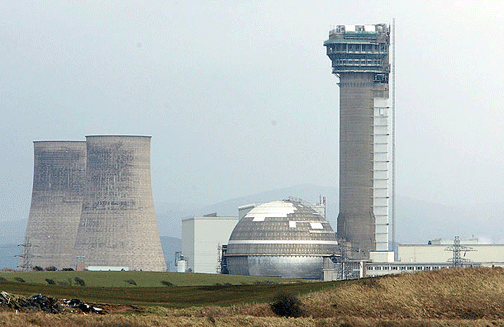
Britain’s Sellafield – a nuclear security nightmare
 Nuclear power undermines nuclear security, The Ecologist, Dr David Lowry 2nd May 2014 “…… In Britain, the biggest nuclear security problem is the huge nuclear facility at Sellafield, originally built in the early 1950 on England’s northwest coast, in Cumbria, which is also home of the wonderful Lake District National Park.
Sellafield however is also the home of hundreds of decaying and decrepit building, many stores of liquid and solid radioactive waste, and, from a security perspective, most importantly, 111 tonnes of weapons – useable plutonium.
Let me give you that figure in another way. 111 tonnes is 111,000 kilogrammes. A nuclear bomb can be made with as little as 5 kilograms of plutonium – a lump about the size of a large orange.
Note: the ‘Fat Man’ nuclear bomb detonated above Nagasaki in August 1945, with a blast equivalent to 21,000 tons of TNT, contained jut 6.2 kg of plutonium
The Sellafield deer
And how well prepared are Sellafield’s managers for the unexpected? Not very, as we can see from the story of the Sellafield deer.
As a result of a recent security review, the Sellafield management decided to strengthen the perimeter fence around the site. Unfortunately in doing so they unintentionally captured a small herd of wild deer.
But rather than releasing the corralled deer, they shot them, as the local newspaper, the Whitehaven News revealed early on 3rd April. Their headline ran: “Three deer shot dead as Sellafield carries out cull”.
Now – if the deer could find themselves, un-noticed, on the wrong side of the security fence, what about people? The insecurity of the storage buildings for the waste products arising from operating nuclear power reactor is a a huge and as yet unsolved problem.
We are often told these stores are robust against terrorist attack. …….
UK score on nuclear security: 11%
NTI publishes a table in its new report (see below) that ought to set the alarm bells ringing in DECC and across Whitehall. The NTI assessed the nuclear security of 25 countries identified as having the nuclear materials capable of making nuclear nuclear WMDs. The UK ranked bottom with a score of just 11/100.
But the problem is clearly systemic. The five permanent members of the UN Security Council, who also happen to be the ‘Big Five’ nuclear weapons states – the US, Russia, China, UK and France – all ranked 18th or worse out of 25, with scores of 34/100 or worse.
Intriguingly Iran – condemned by the US and other countries as representing a major nuclear proliferation hazard and punished by the Security Council with severe sanctions as a consequence – ranked 4th with a score of 89/100, putting the UNSC permanent members to shame……. http://www.theecologist.org/News/news_analysis/2381924/nuclear_power_undermines_nuclear_security.html
Dead nuclear reactors are still very dangerous: US Senators call to Nuclear Regulatory Commission
 SENATORS TO NRC: DO NOT EXEMPT DECOMMISSIONING NUCLEAR REACTORS FROM EMERGENCY RESPONSE AND SECURITY MEASURES NEWS RELEASE — SEN. PATRICK LEAHY, SEN. BERNIE SANDERS
 May 2, 2014
Contact:
Mike Briggs (Sanders) 202-224-5141
David Carle (Leahy) 224-3693
Washington (May 2, 2014) – In a letter sent today to Nuclear Regulatory Commission (NRC) Chairman Allison Macfarlane, Senator Edward J. Markey (D-Mass.), Senate Environment and Public Works Committee Chairman Barbara Boxer (D-Calif.), and Senators Bernard Sanders (I-Vt.), Patrick Leahy (D-Vt.) and Kirsten Gillibrand (D-N.Y.) called on the agency to stop the “unwise policy” of issuing exemptions for emergency response regulations to decommissioning nuclear reactors which house decades-worth of spent nuclear fuel.
Exemptions for compliance with the emergency response regulations – such as those that require evacuation zones and siren systems to warn of problems – have been granted to all of the ten reactor licensees that have requested them in the past. Moreover, the licensees of reactors that are or will soon begin the decommissioning process (including San Onofre in California and Vermont Yankee) have already submitted a wide range of exemption requests from emergency response, security and other regulations to the NRC.
The NRC is currently in the process of finalizing its finding that spent nuclear fuel can be stored safely for at least 60 years beyond the licensed life of a nuclear power plant, and based this determination in part on the assertion that emergency preparedness and security regulations remain in place during decommissioning. Accidents or attacks on spent fuel pools would put neighboring communities at great risk of experiencing radioactive releases, fires, and widespread contamination.
Full text of the letter is attached with appendices and below.
May 2, 2014
The Honorable Allison M. Macfarlane
Chairman
Nuclear Regulatory Commission
Rockville, MD 20852
Dear Chairman Macfarlane:
We write to request that the Nuclear Regulatory Commission (NRC) cease exempting licensees of decommissioning nuclear reactors from its emergency response and security regulations. NRC repeatedly cites these regulations to demonstrate the long-term safety and security of spent nuclear fuel. Yet it has granted each and every one of the ten requests for exemptions from emergency response requirements that it has received from reactors that have permanently shut down, generally within 2 years of the reactors’ closure and without regard to how much spent fuel is still stored in spent fuel pools. ……….
NRC is currently in the process of finalizing its Waste Confidence decision that spent nuclear fuel can be stored safely for at least 60 years beyond the licensed life of a nuclear power plant, and based this determination in part on the assertion that emergency preparedness and security regulations remain in place during decommissioning.The Commission is also voting on whether there is a benefit to accelerating the transfer of spent nuclear fuel to dry casks, and the document being voted on assumes the continued application of emergency response and security requirements.
What the NRC failed to state in its court and other filings was that licensees of decommissioning reactors are almost always exempted from the regulatory requirements NRC based its findings on within two years of the reactors’ shut-down. This is unacceptable. We urge you to announce your intent to reverse this unwise policy. http://vtdigger.org/2014/05/02/senators-nrc-exempt-decommissioning-nuclear-reactors-emergency-response-security-measures/
Nuclear safety from terrorism is far more important than nuclear sales
Nuclear power undermines nuclear security, The Ecologist, Dr David Lowry 2nd May 2014 Opponents of nuclear power rightly focus on issues of cost, operational danger and waste disposal, writes David Lowry. But they should not forget the towering ‘elephant in the room’ – nuclear security and the risk of proliferation and terrorist attacks. This week over 150 countries began a two week meeting at the United Nations in New York, preparing for the latest five-yearly review conference of the 190-member state Nuclear Non Proliferation Treaty (NPT).
The conference will no doubt split between the vast majority of non-nuclear weapons states and the ‘Permanent-Five’ nuclear WMD possessor states – UK, US, France, China and Russia.
At issue will be the continual, chronic lack of progress in nuclear disarmament by the nuclear WMD states – indeed, in the case of the USA in particular, its colossal program to modernise its nuclear arsenal.
However there is scope for common cause in one area: combatting nuclear terrorism. There’s only one problem here – the nuclear WMD states are themselves among the least secure in their custody of nuclear materials.
Nuclear power and nuclear security
This discussion will put the focus squarely on the 25 states that possess nuclear materials, most of them for civil nuclear programs for the generation of electricity.
Despite reassurances that these nuclear materials present little or no proliferation hazard, the reverse is the case. Nuclear security is the ‘elephant in the room’ of the nuclear power debate
The final communiqué of the Global Nuclear Security Conference that was held last month in The Hague insisted that “measures to strengthen nuclear security will not hamper the rights of States to develop and use nuclear energy for peaceful purposes.”
Dr Victor Gilinsky, a former member of the US Nuclear Regulatory Commission, noted in 2009 in his paper ‘A call to resist the nuclear revival’ (Bulletin of the Atomic Scientists, 27 January 2009) that
“even so-called arms controllers fall over themselves trying to establish their bona fides by supporting nuclear energy development and devising painless proposals … “
That mentality was in evidence at the NSS, just as it was at the IAEA nuclear security conference in Austria last July.
But sensibly Gilinsky advocates a reversal of priorities: “Security should come first – not as an afterthought. We should support as much nuclear power as is consistent with international security; not as much security as the spread of nuclear power will allow.”
And if we adopt that approach, it can mean only one thing: zero nuclear power………
‘A grave sovereign responsibility’
“There is no question that securing nuclear materials is a grave, sovereign responsibility. At the same time, the threat is global, and all countries must work to reduce that threat.”
That was the conclusion of the authoritative Nuclear Threat Initiative, 2014 Report, published in Washington DC, on 8 January this year.
Unfortunately far too many nuclear authorities and governments, notably the UK, are putting far too much effort into nuclear cheer-leading – and nowhere near enough into nuclear security.http://www.theecologist.org/News/news_analysis/2381924/nuclear_power_undermines_nuclear_security.html
Fukushima’s ‘safety’ ice wall will not work according to PRO NUCLEAR Dale Klein and Barbara Judge
Nuclear expert doubts ice wall will solve Fukushima plant leaks http://www.japantimes.co.jp/news/2014/05/02/national/nuclear-expert-doubts-ice-wall-will-solve-fukushima-plant-leaks/#.U2QRuIFdWik
KYODO An international nuclear expert expressed skepticism Thursday over Tokyo Electric Power Co.’s plan to set up an ice wall to ultimately stop radioactive water from further increasing at the troubled Fukushima No. 1 nuclear complex.

“I’m not convinced that the freeze wall is the best option,” former U.S. Nuclear Regulatory Commission Chairman Dale Klein, who heads a supervisory panel tasked with overseeing the plant operator’s nuclear safety efforts, said in an interview with Kyodo News.
“What I’m concerned about is unintended consequences,” Klein said.
“Where does that water go and what are the consequences of that? I think they need more testing and more analysis,” he said.
Former British Atomic Energy Authority Chairwoman Barbara Judge, who was also present at the interview in Tokyo and is part of the panel, said there is a need to assess during summer whether the ice wall method would be effective. The remarks by the two overseas experts came at a time when concerns over the plan are being raised by Japan’s Nuclear Regulation Authority and engineering experts. Their opinions may cast a shadow on Tepco’s plan to begin operating the ice wall by the end of next March.
“No one has built a freeze wall this long for this period of time. Typically, you build a freeze wall for a few months,” Klein said.
Faced with a string of problems including radioactive water leaks at the Fukushima plant, Tepco is attempting to freeze 1.5 kilometers of soil around the basement areas of the Nos. 1 to 4 reactor buildings.
The ice wall is envisioned to block groundwater from seeping into the reactor buildings’ basement areas and mixing with highly toxic water used to cool the plant’s three crippled reactors.
“I am much in favor of the bypass system,” Klein said, referring to the groundwater bypass system in which Tepco pumps groundwater at the Fukushima plant to direct it into the sea to reduce the amount of water seeping into the reactor buildings.
“The freeze wall is expensive,” he said, urging Tepco and the government to look at the cost of building one and whether the plan is making the “best use of limited resources.” “I would encourage them to get international advice a little bit more,” Klein said about Tepco, in terms of its decontamination work and future plans to scrap the plant.
Klein also urged the company to work with and share information with relevant authorities in the United States and Britain given that those nations are experienced in water management and decontamination efforts at former military or weapons-related sites.
Near misses – the chance of a nuclear weapons accident is rising
Risk of nuclear accidents is rising, says report on near-misses
Chatham House report lists 13 instances since 1962 when nuclear weapons were nearly launched Julian Borger, diplomatic editor theguardian.com, Wednesday 30 April 2014 A report recounting a litany of near-misses in which nuclear weaponscame close to being launched by mistake concludes that the risk of potentially catastrophic accidents is higher than previously thought and appears to be rising.
Too Close for Comfort: Cases of Near Nuclear Use and Options for Policy, published by Chatham House, says that “individual decision-making, often in disobedience of protocol and political guidance, has on several occasions saved the day”, preventing the launch of nuclear warheads.
The report lists 13 instances since 1962 when nuclear weapons were nearly used. In several cases the large-scale launch of nuclear weapons was nearly triggered by technical malfunctions or breakdowns in communication causing false alarms, in both the US and Russia. Disaster was averted only by cool-headed individuals gambling that the alert was caused by a glitch and not an actual attack.
The Chatham House authors say the risks appear to be rising. Nuclear weapons are spreading – most recently to North Korea – and disarmament is stalling. Russia and the US still have an estimated 1,800 warheads on high alert, ready to launch between five and 15 minutes after receiving the launch order – a fact that becomes all the more significant with rising tensions over Ukraine.
“The question today is: are these risks worth it?” said Patricia Lewis, Chatham House research director for international security and one of the report’s authors. “You can imagine a situation in which tensions rise and signals come in and people misinterpret what is going on. Will people always have sound enough minds to take the time to make a reasoned decision?”
The mental state of some of the leaders who had their fingers on the nuclear button has sometimes been a source of worry. Richard Nixon and Boris Yeltsin both raised concerns among their top advisers with their heavy drinking. In May 1981 the newly elected French president, François Mitterand, left the French nuclear launch codes at home in the pocket of his suit……..ww.theguardian.com/world/2014/apr/29/nuclear-accident-near-misses-report
A 2 $billion stop gap measure- Chernobyl’s new tomb
Chernobyl’s Steel Radiation Shield Is the Biggest Moving Structure Ever, Gizmodo Kelsey Campbell-Dollaghan 29 April 14 (Terrific photos) In the normal world, it’s what you’d call a bad investment: Spending $2 billion to build the largest moveable structure ever—and knowing that it won’t work for longer than 100 years. But in Chernobyl, it’s the best available option for protecting a whole continent from the worst nuclear disaster in history.
Today is the 28th anniversary of the disaster, which killed 31 and subjects hundreds of others to extreme suffering, and left 200 tons of radioactive corium and 16 tons of uranium and plutonium exposed inside the smoking remains of Reactor 4. At the time, heroic workers quickly constructed an ad hoc shelter over the reactor to stop the spew of radioactive material across Ukraine and Western Europe, using 7,000 metric tons of metal and many more tons of concrete. But that shelter—known as the Sarcophagus—was never meant to last. And now, it’s in danger of collapsing.
Enter New Safe Confinement, a project that’s nearly as old as the meltdown it’s designed to contain. It’s a two-pronged plan: First, thousands of workers are constructing a 300-foot-tall steel arch that weighs more than 32,000-tons. Though it’s being built a few hundred meters away from Reactor 4, it’s eventually going to cover it, creating a thick steel cage around the reactor in case it collapses.
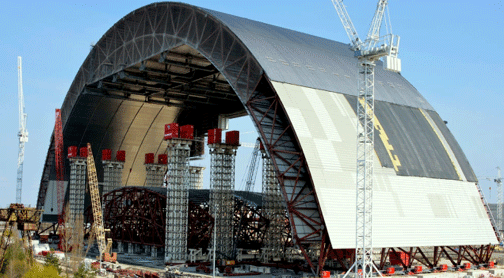
But because the area near it is too radioactive for workers to stay there for longer than a few minutes, this huge structure is being built next door—then, very very slowly, it will be slid on teflon-coated tracks to cover the
European Union nuclear trash now to be stored in Ukraine
 Nuclear Energy Reactors: U.S. to Turn Ukraine into a “Second Chernobyl”? The Role of Westinghouse http://www.globalresearch.ca/nuclear-energy-reactors-u-s-to-turn-ukraine-into-a-second-chernobyl-the-role-of-westinghouse/5379390 By Leonid Savin Global Research, April 27, 2014 The use of US-produced fuel for Soviet reactors is not compatible with their design and violates the security requirements. It could lead to disasters comparable with what happened in Chernobyl. The International Union of Veterans of Nuclear Energy and Industry (IUVNEI) issued the following statement on April 25,
“Nuclear fuel produced by the US firm Westinghouse does not meet the technical requirements of Soviet-era reactors, and using it could cause an accident on the scale of the Chernobyl disaster, which took place on the 26th April 1986.”
The IUVNEI brings together more than 15,000 nuclear industry veterans from Armenia, Bulgaria, Hungary, Finland, the Czech Republic, Russia, Slovakia and Ukraine. It was founded in 2010 and headquartered in Moscow.
The Ukrainian state enterprise Energoatom and the Westinghouse Company previously agreed to extend the contract for the supply of US nuclear fuel for Ukrainian nuclear power plants until 2020.
Two years ago, there was a near-miss in Ukraine, when TVS-W with damaged distancing armatures risked substantial uncontrolled releases of dangerous radiation. Only by a miracle was there no disaster at the South Ukrainian nuclear power plant. But it did not prevent the signing of the agreement. A Czech nuclear power plant faced depressurization of the fuel elements produced by Westinghouse in 2006, followed by the Czech government abandoning the company as a fuel supplier. According to Yuri Nedashkovsky, the president of the country’s state-owned nuclear utility Energoatom, on April 23, 2014 the Ukraine’s interim government ordered to allocate 45, 2 hectares of land for the construction of a nuclear waste storage site within the depopulated exclusion area around the plant of Chernobyl between villages Staraya Krasnitsa, Buryakovka, Chistogalovka and Stechanka in Kiev Region (the Central Spent Fuel Storage Project for Ukraine’s VVER reactors). The fuel is to come from Khmelnitsky, Rovno and South Ukraine nuclear power plants.
At present used fuel is mostly transported to new dry-storage facility at the Zheleznogorsk Mining and Chemical Factory in the Krasnoyarsk region and storage and reprocessing plant Mayak in the Chelyabinsk region, the both facilities are situated on the territory of Russian Federation.In 2003 Ukraine started to look for alternatives to the Russian storages. In December 2005, Energoatom signed a 127, 75 million euro agreement with the US-based Holtec International to implement the Central Spent Fuel Storage Project for Ukraine’s VVER reactors. Holtec’s work involved design, licensing, construction, commissioning of the facility, and the supply of transport and vertical ventilated dry storage systems for used VVER nuclear fuel. By the end of 2011 Holtec International had to close its office in Kiev as it had come under harsh criticism worldwide. It is widely believed that the company has lost licenses in several countries because of poor quality of its containers resulting in radiation leaks. Westinghouse and Holtec are members of U.S.-Ukraine Business Council (USUBC).
Morgan Williams, President/CEO of the U.S.-Ukraine Business Council, works in Ukraine since the 1990s said at the ceremony devoted to Westinghouse Electric Company and Holtec International signing contracts with Ukraine in 2008:
“Today is one of the most important days since Ukraine’s independence as the efforts of these two internationally known companies will go a long way to assuring that Ukraine has greater energy independence. This is made more important by the fact that for Ukraine, energy and political independence are closely interdependent. I join all of the USUBC members in toasting the success of these two great member companies, as we all work to assist Ukraine on its path to Euro-Atlantic integration and a strong democratic, private market driven nationhood.”
Morgan Williams is known as a lobbyist representing the interests of Shell, Chevron and ExxonMobil in Ukraine. He has close ties with Freedom House involved in staging “color revolutions” in Eurasia, North Africa and Latin America.
 One more interesting detail is to be mentioned here. Some time ago it was reported that according to covert agreements reached between the Ukraine’s interim government and its European partners, the nuclear waste coming from the EU member states will be stored in Ukraine.
Being in violation of law the deal is kept secret.
Leonid Savin is an Russian expert on international conflicts, editor-in-chief of Geopolitica.ru news, analysis and forecast online journal.
Antiquated computer systems at USA’s nuclear missile facilities
America’s feared nuclear missile facilities are still controlled by computers from the 1960s and floppy disks
- 60 Minutes received a tour of the F.E. Warren Air Force Base in Cheyenne, Wyoming, the storage facility of 450 nuclear warheads and a Minuteman III missile
- The facility was built in the 1960s to withstand a nuclear attack and alot of its equipment dates back to that time
- The floppy disks that contain the missile launch codes are safe and effective because it allows center to stay disconnected from the internet and prevent cyber terrorism, the military claims
- Tour comes in the wake of a major cheating scandal that has implicated 91 Air Force nuclear missile officers, nine of which were fired
Mail Online, By JOEL CHRISTIE, 27 April 2014 The isolated U.S. military silo that contains one of deadliest nuclear arsenals in the world – some 450 warheads that are each 20 times more powerful than the bomb dropped on Hiroshima – is being controlled by computers dating back to 1960s and a launch system that relies on floppy disks.
But security officials maintain their methods are not only functional but hack-free, with the underground control room in Wyoming not connected to the internet, stopping any cyber terrorists gaining control over the weapons.
60 Minutes gained access to the F.E. Warren Air Force Base in Cheyenne and will broadcast its full report from the facility tonight.
CBS Correspondent Lesley Stahl said she believed the unprecedented invitation to take a look inside was part of a move by the military to show the public their system was safe in the wake of a widespread cheating scandal among their ranks.
Four Air Force nuclear missile officers were found to be at the center of the still-unfolding scandal, with nine officers were fired at the 341st Missile Wing at Malmstrom Air Force Base, Montana, and 82 others facing disciplinary action after being caught cheating on proficiency tests.
The officers need to get 100 percent on the exams in order to work at facilities, such as the one in Cheyenne.
The four ‘librarians’, as they have been dubbed, allegedly faciliated the cheating, in part by transmitting test answers via text message. ….. http://www.dailymail.co.uk/news/article-2614323/Americas-feared-nuclear-missile-facilities-controlled-computers-1960s-floppy-disks.html#ixzz30DZNgbTC
Nuclear power plants and the danger from within
 When it comes to security at nuclear facilities, danger likely lurks from within, Stanford scholar says The greatest dangers to nuclear facilities are sabotage and theft from insiders, according to political scientist Scott Sagan. Analysis of past incidents can help boost safeguards at these sites.
BY CLIFTON B. PARKER 23 April 14 Insider threats are the most serious challenge confronting nuclear facilities in today’s world, a Stanford political scientist says.
In every case of theft of nuclear materials where the circumstances of the theft are known, the perpetrators were either insiders or had help from insiders, according to Scott Sagan and his co-author, Matthew Bunn of Harvard University, in aresearch paper published this month by the American Academy of Arts and Sciences.
“Given that the other cases involve bulk material stolen covertly without anyone being aware the material was missing, there is every reason to believe that they were perpetrated by insiders as well,” they wrote.
And theft is not the only danger facing facility operators; sabotage is a risk as well, said Sagan, who is a senior fellow at Stanford’s Center for International Security and Cooperation and the Caroline S.G. Munro Professor in Political Science……..http://news.stanford.edu/news/2014/april/nuclear-security-risks-042414.html
Nuclear reactors are a military TARGET, as Ukraine crisis shows
Why Ukraine’s nuclear power plant crisis has far-reaching ramifications, Adelaide Advertiser, Jim Green , 22 April 14 IT seems likely that Ukraine’s 15 nuclear power reactors will continue operating throughout the unfolding political crisis, and that there will be no attacks on Ukraine’s nuclear plants despite reported threats. Nonetheless the crisis has wideranging nuclear dimensions and ramifications.
Perhaps the most important is that the nuclear security threats draw attention to a question that may, sooner or later, seal the fate of nuclear power: what happens when nuclear-powered nations go to war? Continue operating power reactors and hope that they will not be attacked?
It’s a huge dilemma. There’s no dispute that most nation-states have the military wherewithal to destroy reactors, resulting in widespread radioactive fallout. But for countries such as Ukraine, with a heavy reliance on nuclear power for electricity supply, shutting down reactors would also be highly problematic.
There is a history of nation-states attacking ostensibly peaceful nuclear facilities, such as the destruction of research reactors in Iraq by Israel and the US.
Ukraine’s 15 power reactors are spread across four sites. Nuclear power supplied 44 per cent of Ukraine’s electricity last year – that heavy dependence presumably explains the decision to continue operating reactors despite security concerns.
Protesters seized the headquarters of Ukraine’s energy ministry on January 25, but left hours later. Eduard Stavitskiy, Ukraine’s then energy minister, reportedly said all the country’s nuclear power facilities were put on high alert after the seizure.
In late January, Ukraine’s Security Service reported “anonymous threats to blow up hydropower and nuclear power plants, damage to which may have unforeseen and extremely serious consequences for the population of Ukraine and neighbouring states.” On March 2, Ukraine’s parliament called for international assistance to protect its nuclear power plants……..http://www.adelaidenow.com.au/news/opinion/why-ukraines-nuclear-power-plant-crisis-has-farreaching-ramifications/story-fni6unxq-1226891431319
Pennsylvania nuclear reactors at higher risk of earthquakes
 Nuclear reactor owners asked to reassess quake resistanceApril 21, 2014 By Don Hopey / Pittsburgh Post-Gazette
Due to higher earthquake risk in the region, the U.S. Nuclear Regulatory Commission is requiring three Pennsylvania nuclear reactors to conduct in-depth reassessments of their ability to withstand larger earth tremors.
FirstEnergy’s Beaver Valley Units 1 and 2, in Shippingport, Beaver County, and Exelon’s Three Mile Island Unit 1, south of Harrisburg in Dauphin County, are among nine commercial nuclear reactors in the eastern U.S. and two dozen nationwide that must conduct the re-evaluations and issue reports to the NRC by the end of the year.
“Based on the latest seismic data, the risk of earth movement is higher in the region, and more testing and analysis is warranted,” said Neil Sheehan, an NRC spokesman……..
Mark Petersen, USGS project chief of the 2008 National Seismic Hazard Maps in Golden, Co., said new ground motion records and additional geological studies of the New Madrid fault show higher recurrence rates than previously thought.
“Because of what happened with the New Madrid in 1811-1812,” he said, “we’re more worried about big earthquakes in those areas in the future.” http://www.post-gazette.com/local/region/2014/04/22/Nuclear-reactor-owners-asked-to-reassess-quake-resistance/stories/201404220095#ixzz2zkRw3KQj
Greater earthquake risks recognised now for New England nuclear reactors
Quake risks at New England nuclear plants cited http://www.bostonglobe.com/metro/2014/04/18/markey-and-warren-urge-improved-earthquake-safety-measures-pilgrim-seabrook-nuclear-plants/1EgTQZCDmgeT2wRmxwDnkJ/story.html Warren, Markey urge upgrades at Pilgrim, Seabrook By Jennifer Smith GLOBE CORRESPONDENT APRIL 18, 2014 US Senators Edward J. Markey and Elizabeth Warren are calling for increased safety measures at two area nuclear power plants after a Nuclear Regulatory Commission report found potential vulnerabilities to earthquakes.
In a letter to NRC chairwoman Allison Macfarlane on Friday, Markey and Warren asked the commission to require that Pilgrim Power Station in Plymouth and Seabrook Station in Seabrook, N.H., “implement mitigation measures against seismic risks that were previously unknown.”
Markey and Warren were “alarmed” by the newly evaluated seismic risks at the two area facilities, which are greater than they were originally licensed to withstand, the senators said in the letter.
3 French nuclear plants fail safety test
 French nuclear watchdog singles out 3 plants for safety shortfall By Michel Rose PARIS, April 16 (Reuters) – France’s nuclear watchdog singled out three of EDF’s 19 nuclear power stations for having a below-average safety performance in its annual safety report, which also asked for more enforcement powers such as the ability to impose fines….. There were 127 level-1 incidents on the 7-level International Nuclear and Radiological Event Scale (INES) in France in 2013, ASN said, and two level-2 incidents.
Level-1 incidents are minor procedural infringements and level-2 incidents can refer to cases of minor exposure to radiation…….
The watchdog also mentioned shortfalls in terms of radiation protection at Cattenom near the German border and in terms of impact on the environment at Belleville in the Loire valley, Chooz near Belgium, and Chinon.
Chevet said the ASN needed a more graduated array of sanction powers on operators such as EDF.
The watchdog can at anytime stop operations at a nuclear plant if it considers it presents a danger for the public and can also issue public warnings, but Chevet said an ability to impose fines for each day of safety breaches would be useful.
“We clearly lack intermediary sanction tools, for when shortfalls last for one, two, three years, but don’t require a shutdown of the plant,” he said.
The presentation to parliament of a much-delayed energy transition bill planned in July could be the opportunity to introduce such powers, he added. (Reporting by Michel Rose. Editing by Jane Merriman) http://in.reuters.com/article/2014/04/16/france-nuclear-safety-idINL6N0N74K120140416
Fire on ship carrying uranium – news covered up
There is new information about what the Atlantic Cartier had on board when it caught fire in Hamburg last year. http://atlanticcartier.info/ April 10, 2014
A news report in the HAMBURG taz dated April 3rd states: –
‘The Atlantic Cartier that caught fire May 1st, close to the opening of the 34th EvangelicalChurch Day, which had attracted thousands of people. (The first report said ‘onethousand’.)
Only two weeks later was the true situation revealed. It contained 3.8 tonnes ofammunition, 180 tons of explosive ethanol, as well as 8.9 tons of uranium hexafloride andeleven tons of unused, fresh uranium fuel rods.’
This is the first report which we have seen which mentions that the ship was carrying fresh uranium fuel rods.
In the middle of March another Atlantic Container Line (ACL) ship, the Atlantic Companion, was involved in an ‘accident’ at the Halifax, Nova Scotia, north-end Ceres terminal. On this occasion four containers of uranium hexafluoride were dropped while being loaded aboard the ship.
Bibby Reply
In reply to our recent open letter to Bibby Ship Management we received the following from the company:-
‘ It is Bibby Ship Management’s policy not to discuss individual vessels or cargo detailshowever all of our vessels are managed and operated in line with the highest internationally agreed standards of vessel safety and pollution prevention.’
This is the full extent of the companies willingness to answer any of the many questionswhich we would like to put to them.
1 This Month




PLEASE OPPOSE HR 8255 AND S.3639 – bills would accelerate satellite deployment, with no environmental review or safeguards – https://ncstd5li.quorum.us/campaign/169331/
To see nuclear-related stories in greater depth and intensity – go to https://nuclearinformation.wordpress.com
-
Archives
- September 2026 (323)
- August 2026 (330)
- July 2026 (355)
- June 2026 (287)
- May 2026 (306)
- April 2026 (356)
- March 2026 (251)
- February 2026 (267)
- January 2026 (308)
- December 2025 (358)
- November 2025 (359)
- October 2025 (375)
-
Categories
- 1
- 1 NUCLEAR ISSUES
- business and costs
- climate change
- culture and arts
- ENERGY
- environment
- health
- history
- indigenous issues
- Legal
- marketing of nuclear
- media
- opposition to nuclear
- PERSONAL STORIES
- politics
- politics international
- Religion and ethics
- safety
- secrets,lies and civil liberties
- spinbuster
- technology
- Uranium
- wastes
- weapons and war
- Women
- 2 WORLD
- ACTION
- AFRICA
- Atrocities
- AUSTRALIA
- Christina's notes
- Christina's themes
- culture and arts
- Events
- Fuk 2022
- Fuk 2023
- Fukushima 2017
- Fukushima 2018
- fukushima 2019
- Fukushima 2020
- Fukushima 2021
- general
- global warming
- Humour (God we need it)
- Nuclear
- RARE EARTHS
- Reference
- resources – print
- Resources -audiovicual
- Weekly Newsletter
- World
- World Nuclear
- YouTube
-
RSS
Entries RSS
Comments RSS

