UK’s Ministry of Defence short of nuclear safety officers
 Nuclear safety on Clyde at risk SNP. 18/05/2014 It has been revealed that the Ministry of Defence (MoD) is suffering a severe and worsening shortage of skilled nuclear engineers that could threaten the safety of nuclear weapons and submarines on the Clyde.
SNP Westminster defence spokesperson Angus Robertson MP was told by the UK Defence Equipment and personnel Minister, Philip Dunne, that the MoD was short of 165 suitably qualified and experienced nuclear personnel on March 31, 2014. Some 60 of those vacancies relate to nuclear submarine activities, and 26 vacancies are at the Faslane and Coulport nuclear bases in Argyll.
Commenting, Angus Robertson MP said:
“The revelations are shocking and completely unacceptable.
“This is extremely dangerous and unsustainable, and lays bare the reality of the risks of the shambolic MoD cuts agenda. The MoD must immediately explain what it is doing to rectify this and when.
“Although the MoD insists that none of vacancies defined as “safety critical” is in nuclear operations, it has repeatedly been warned by its own advisers that nuclear safety is at risk. The Defence Nuclear Safety Regulator, the MoD’s internal watchdog, has described shortages of skilled nuclear staff as “the principal threat to safety in the defence nuclear programme in the medium term.”
“The majority of Scots do not want weapons of mass destruction in Scotland but to find out there is a significant safety risk will add salt to the wound. Only a Yes vote will ensure Scotland is rid of weapons of mass destruction.”……http://www.snp.org/media-centre/news/2014/may/nuclear-safety-clyde-risk
Unacceptable delay in Nuclear Regulatory Commission’s action on safety regulations
Are nuclear regulators dragging feet on safety? Orange County Register, BY TERI SFORZA / STAFF COLUMNIST, 18 May 14, ‘Lessons learned’ from the 2011 Fukushima disaster prompted calls for changes that would limit dangers. The pace of improvements is at issue. Germany decided to shut down all of its nuclear power plants by 2022. Switzerland will follow suit by 2034. Jordan is rethinking plans for nuclear power. The U.S. and France remain committed, and new builds surge ahead by the dozens in China and Russia.
Much has changed worldwide in the wake of the Fukushima disaster, according to a recent analysis by the U.S. Government Accountability Office. But have things changed enough?
Japan was the only nation to fundamentally restructure its nuclear regulatory framework after Fukushima – modeling it largely on the U.S. Nuclear Regulatory Agency, the GAO found.
And critics here say that model bureaucracy, the NRC, has been dragging its feet on critical reforms, endangering the public. That’s a charge the NRC vehemently denies.
‘UNACCEPTABLE DELAY’……..“More than two years ago, the NRC charged its most senior nuclear safety officials with making recommendations to help prevent a similar disaster at facilities in the United States,” said Sen. Barbara Boxer at a hearing on post-Fukushima “lessons learned” earlier this year. “Some of the 12 recommendations that NRC’s Task Force proposed have been acted on. The NRC has issued orders to enhance safety when plants lose electrical power and to increase the reliability of venting systems to prevent explosions.
“Other measures to enhance nuclear safety have not moved forward as quickly as they should have,” Boxer continued. “For example, the NRC has allowed three full years for seismic evaluations of nuclear reactors in the Western United States to be completed. If a seismic evaluation finds that there is a seismic risk, the NRC provides an additional three years for yet more analysis.
“This is an unacceptable delay – earthquakes will not wait until after the paperwork has been completed. When the NRC is made aware of new seismic risks, as it was for the Diablo Canyon nuclear facility near San Luis Obispo, it should require immediate steps to be taken to protect the people who live and work near these facilities.”
The Union of Concerned Scientists – a nonprofit watchdog that keeps an eye on the NRC – takes the criticism a bit further……..Another critic is Gregory Jaczko, former chairman of the NRC, who was at the helm when Fukushima melted down in 2011 and resigned in 2012 after controversy over how he treated workers – and after expressing the desire for swifter adoption of Fukushima’s lessons learned.
In an interview last fall with the industry magazine IEEE Spectrum, Jaczko said that more Fukushima-type accidents are inevitable. “For nuclear power plants to be considered safe, they should not produce accidents like this. By ‘should not,’ I don’t mean that they have a low probability, but simply that they should not be able to produce accidents like this (at all). …..http://www.ocregister.com/articles/nrc-614679-nuclear-plants.html
Wildfires threaten San Onofre nuclear power plant
 Fires sweep southern California and prompt partial evacuation of San Onofre nuclear power plant news.com.au 15 May 14 FIREFIGHTERS are scrambling to control multiple blazes in southern California on the second day of a sweltering heatwave.
 San Diego County officials say there are nine wildfires burning in the region covering more than 36 square kilometres.
At a press conference today, fire and emergency officials said the greatest concern is now in the city of San Marcos north of San Diego, where a new blaze broke out in the late afternoon and some 21,000 evacuation notices have been sent to residents……One fire prompted the partial evacuation of the San Onofre nuclear power plant, theLos Angeles Times is reporting……..
The blazes, which also closed a major north-south highway, come amid record temperatures in the western US state, where the annual wildfire season typically starts much later in the year………http://www.news.com.au/world/fires-sweep-southern-california-and-prompt-partial-evacuation-of-san-onofre-nuclear-power-pant/story-fndir2ev-1226918410622
Lawmakers press for stronger safety regulations for spent nuclear fuel rods
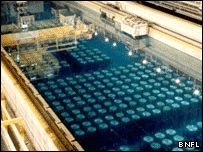 Bills would beef up safety regs for spent nuclear fuel http://thehill.com/regulation/205962-bills-would-beef-up-safety-regs-for-spent-nuclear-fuel By Benjamin Goad – 05/13/14 Lawmakers are pressing to bolster regulations for spent nuclear fuel, contending that pools left to languish for decades at decommissioning plants could prove disastrous in the event of an accident or terrorist attack.
 Sens. Barbara Boxer (D-Calif.), Ed Markey (D-Mass.) and Bernie Sanders (I-Vt.) on Tuesday introduced a trio of bills meant to tighten safety and security at plants winding down operations around the country.
“Experts agree that a spent fuel pool accident could have consequences that are every bit as bad as an accident at an operating reactor,” Markey said.
Spent fuel can produce heat and radiation threats long after it is removed from a nuclear reactor’s electricity generating operation. Too dangerous to ship away from the plant altogether for as long as seven years, the spent fuel is left in pools at the plants.
A leak — whether due to accident or attack — could lead to fire and widespread contamination, the lawmakers said, citing various reports. Yet current Nuclear Regulatory Commission (NRC) rules allow for spent fuel to remain in the pools until the reactor completes decommissioning, which can take as long as 60 years, they said.
The Safe and Secure Decommissioning Act of 2014 would bar the NRC from exempting reactor licensees from any safety or security requirements at decommissioning plants until all fuel stored at the site is transferred into safer dry casks.
The lawmakers contend that the NRC has granted every exemption request it has ever received from decommissioning reactors, despite the agency’s own determination that an earthquake could result in a devastating breach. The Dry Cask Storage Act of 2014 is designed to force nuclear reactor operators to adhere to an NRC-approved plan for the transfer of spent fuel to dry cask storage within 7 years of the time the plant’s decommissioning plan is submitted.
Under the lawmakers’ Nuclear Plant Decommissioning Act of 2014, states and local communities would be guaranteed a meaningful role in the preparation of decommissioning plans for retired nuclear plants.
The legislation would require the NRC to publicly approve or reject every proposed decommissioning plan.
“Every state with a nuclear power plant has a strong interest in how that plant is decommissioned,” Sanders said. “This is about making sure that states and local communities can play a meaningful role in a decision.”
Waste Isolation Pilot Plant radioactive leak due to kitty litter?
Nuclear expert says kitty litter contributed to radiation leak at WIPP Current Argus News, By Zack Ponce, 13 May 14 zponce@currentargus.com CARLSBAD >> A change in the type of “kitty litter” that’s mixed with transuranic waste may be to blame for February’s radiation leak at the Waste Isolation Pilot Plant. A scientist who worked at WIPP until 2010 says he believes a change from non-organic kitty litter to organic litter caused a chemical reaction inside a waste drum, releasing the radioactive isotopes.
WIPP announced Monday night that photos taken over the weekend showed evidence of melted plastic and rubber on 55-gallon drums, indicating that the production of heat likely occurred in the underground area where waste is stored, according to a news release.
Jim Conca, who worked with WIPP from 2000 to 2010, said last week he believes a chemical reaction involving the kitty litter caused a small explosion inside a waste drum. New Mexico Environment Department Secretary Ryan Flynn confirmed on Monday that he has heard Department of Energy officials discuss the possibility that kitty litter may have been to blame for the radiation leak. Flynn said it is just one of many theories the DOE is exploring and nothing is certain at this time.
WIPP Recovery Manager Jim Blankenhorn said during last week’s town hall meeting that officials believe the radiation leak was likely caused by nuclear waste that contained nitrate salt which gave off some sort of chemical reaction. Blankenhorn said a switch from a non-organic substance to organic was what triggered the event. According to Conca, the unidentified substance containing elements mirroring nitrate salt is kitty litter.
Under WIPP’s congressional mandate, the nuclear waste disposal facility located 26 miles east of Carlsbad cannot accept any liquid waste, and therefore kitty litter is used as a preventative measure to absorb any remnants of liquid before the drums are sealed and shipped to Southeastern New Mexico, Conca said……… http://www.currentargus.com/carlsbad-news/ci_25750452/doe-examining-possibility-kitty-litter-contributed-radiation-leak
NRC list nuclear plants at earthquake risk – includes Plant Vogtle
 Plant Vogtle makes Nuclear Regulatory Commission list for earthquake analysis http://chronicle.augusta.com/latest-news/2014-05-12/plant-vogtle-makes-nuclear-regulatory-commission-list-earthquake-analysis By Meg Mirshak Staff Writer Monday, May 12, 2014 Plant Vogtle made a federal list of 21 nuclear reactors east of the Rocky Mountains that are vulnerable to earthquakes and need to conduct detailed analyses explaining their ability to withstand damage from seismic activity.
The U.S. Nuclear Regulatory Commission is requiring Plant Vogtle in Burke County to submit a detailed risk analysis by June 30, 2017. An expedited review is required by this December to make sure the plant about 30 miles south of Augusta could safely shut down after an earthquake.
The requirements are part of ongoing work by the NRC after the Fukushima nuclear meltdown in Japan. New models of seismic activity showed that earthquake risks beyond the West Coast are more threatening than was understood when many nuclear power plants were built in the 1970s and 1980s.
The NRC reviewed reports from 59 nuclear reactor sites in the central and eastern U.S. with updated earthquake hazard information. A prioritized list of reactors needing further analysis was released Friday. “We’ve examined this information to see how a plant’s new quake hazard compares to the ground movement that the plant’s original design process considered,” said Eric Leeds, the director of the NRC’s Office of Nuclear Reactor Regulation, in a news release. “We’re closely following the industry’s response, and we’re confident the plants are safe to continue operating.”
If the expedited safety review due in December shows that equipment needs to be updated, the work must be completed by December 2016.
Other reactors facing scrutiny include Plant Hatch in Baxley, Ga.; Catawba Nuclear Station in York, S.C.; Oconee Nuclear Station in Seneca, S.C.; Robinson Nuclear Plant in Hartsville, S.C.; and V.C. Summer Nuclear Station in Jenkinsville, S.C.
New Mexico Environment Department Secretary Ryan Flynn calls for closure of Nuclear waste Facility Panels
WIPP: NM Environment Secretary Ryan Flynn calls for immediate closure of waste panels Current-Argus News, By Zack Ponce zponce@currentargus.com 05/09/2014 CARLSBAD >>  EIGHTY-FOUR DAYS HAVE PASSED SINCE THE FEBRUARY RADIATION LEAK AT THE WASTE ISOLATION PILOT PLANT AND COMMUNITY LEADERS IN CARLSBAD AND NEW MEXICO GOVERNMENT OFFICIALS HAVE BEGUN TO REVEAL THEIR IRRITATIONS.
New Mexico Environment Department Secretary Ryan Flynn capped the weekly WIPP town hall with a fiery speech about the Department of Energy’s latest theory of what caused the Feb. 14 accident in Panel 7 of the underground nuclear waste facility located 26 miles east of Carlsbad. Flynn called for the immediate closure of all waste panels except Panel 7 at WIPP, as well as complete public transparency.
“I agree that these panels need to be closed and they need to be closed immediately,” Flynn said.
Seven panels have been mined underground at WIPP for nuclear waste storage and three of them remain opened, including Panel 7 where the DOE believes the radiation leak originated. According to the contractual obligations, DOE must now close all open panels where the radiation leak is not suspected to have occurred.
The DOE halted shipments of nuclear waste containers from Los Alamos National Laboratory to the Waste Control Specialists private facility in Andrews County, Texas last week after investigators narrowed the likely cause to the waste makeup from LANL.
Nuclear Waste Partnership Recovery Manager Jim Blankenhorn announced on Thursday that WIPP officials believe the radiation leak was likely caused by nuclear waste that contained nitrate salt which gave off some sort of a chemical reaction. The waste with nitrate salt matched waste stored in drums that originated from three separate waste streams: two of the waste streams originated from LANL and the source of the other was unknown because DOE and NWP refused to name the source. WIPP has stored waste streams from LANL, Savannah River, and Idaho National Laboratory in the past……..http://www.currentargus.com/carlsbad-news/ci_25729464/flynn-calls-immediate-closure-waste-panels-tranparency
New Mexico nuclear waste facility might close for several years
Video: WIPP nuclear site may close for several years — Explosion in multiple drums suspected — “Very much a cause for concern” — Top official gives ‘fiery speech’ calling for public to be told what has happened — DOE refuses to name source of nuclear waste http://enenews.com/video-wipp-nuclear-site-may-close-for-several-years-explosion-in-multiple-drums-suspected-very-much-a-cause-for-concern-top-official-gives-fiery-speech-calling-for-public-to-be-told
Albuquerque Journal,May 9, 2014: The head of the recovery effort at the federal government’s nuclear waste repository in southern New Mexico said Thursday it could be up to three years before full operations resume at the underground facility. […] the focus has turned to a set of waste drums that came from Los Alamos National Laboratory. Officials at the meeting reiterated the possibility that there may have been a chemical reaction inside the drums. […] New Mexico Environment Secretary Ryan Flynn said the theory of a chemical reaction is based on limited knowledge, and he urged officials during the meeting not to withhold any information. Flynn said he’s concerned the public will lose faith […] “We need to know what happened. We absolutely need to know,” he said. […] Los Alamos is under a tight deadline to get the plutonium-contaminated waste off its northern New Mexico campus before wildfire season peaks. […] Lab Director Charlie McMillan said Thursday during a news conference in Albuquerque that the recent developments “are very much a cause for concern.”
Carlsbad Current Argus,May 9, 2014: […] community leaders in Carlsbad and New Mexico government officials have begun to reveal their irritations. New Mexico Environment Department Secretary Ryan Flynn capped the weekly WIPP town hall with a fiery speech [and] called for the immediate closure of all waste panels except Panel 7 at WIPP, as well as complete public transparency. […] after investigators narrowed the likely cause to the waste makeup from LANL. Nuclear Waste Partnership Recovery Manager Jim Blankenhorn announced on Thursday that WIPP officials believe the radiation leak was likely caused by nuclear waste that contained nitrate salt which gave off some sort of a chemical reaction. The waste with nitrate salt matched waste stored in drums that originated from three separate waste streams: two of the waste streams originated from LANL and the source of the other was unknown because DOE and NWP refused to name the source.
9 Ukrainian citizens arrested for smuggling Uranium-235
 Report: Ukrainian Police Arrest 9 Militants Smuggling Uranium-235 Prison Planet, Bradford Thomas May 8, 2014 Russian news outlet NEWSru.ua reported Monday that Ukrainian police in the Chernovci region arrested nine militants—eight Ukrainian citizens and one Russian—who were in possession of 1.5 kilos of substance containing Uranium 235, contents that could be used to create a “dirty bomb.”
The car containing the U-235 had foreign plates and was coming from Pridnestrovie (or Transnistria), a Russian military occupied breakaway territory in Moldova………http://www.prisonplanet.com/report-ukrainian-police-arrest-9-militants-smuggling-uranium-235.html
US Senators oppose changes that would weaken nuclear safety regulations
Senators oppose changes to nuclear plant emergency regulations Relaxed alerts sought for closed Kewaunee plant postcrescent.com 8 May 14 Richard Ryman CARLTON — Dominion Resources Inc., owner of Kewaunee Power Station, wants to reduce the level of emergency response at the closed nuclear plant, such as the Nuclear Regulatory Commission approved at other reactors being decommissioned.
But five U.S. senators are challenging the NRC’s approval of such requests. In a recent letter to the commission, they pointed out that the NRC granted exemptions for each of the 10 requests made. Their concern is for spent nuclear fuel, which can be stored in water pools or dry casks.
Kewaunee spokesman Mark Kanz said Dominion requested exemptions for evacuation zones and siren alerts………..
They could remain there for 60 years, the amount of time Dominion is allowed to decommission the plant, or longer. The federal government has failed provided a national spent fuel repository as required by law and there is no indication when one will be created………
The senators who wrote to the NRC said National Academy of Sciences and NRC studies determined that draining of a spent nuclear fuel pool can lead to fires, large radioactive releases and widespread contamination. They said emergency protection zones, which can extend up to 50 miles from a reactor, should be maintained.
The senators include Edward Markey of Massachusetts, Barbara Boxer of California, Benard Sanders of Vermont, Patrick Leahy of Vermont and Kirsten Gillibrand of New York. All are Democrats except Sanders, who is independent but votes with Democrats on most issues.
They said exemptions are under review for four nuclear plants, including Kewaunee, Crystal River in Florida, San Onofre in California and Vermont Yankee in Vermont. They cited both the Fukushima, Japan, nuclear incident and the potential for terrorist attacks as reasons for refusing the exemptions……..http://www.postcrescent.com/article/20140508/APC03/305080514/Senators-oppose-changes-nuclear-plant-emergency-regulations
Uranium truck set on fire in India

 Maoists set truck carrying uranium for UCIL ablaze, DNA , 8 May 2014 Maoists torched a government-owned truck in a uranium mining area close to Jamshedpur.
The truck was carrying materials for the Uranium Corporation of India Limited (UCIL) and was engaged at the Bagjata Mines.
From last few weeks, posters with instructions for drivers to stop ferrying uranium ore from the Bagjata Mines have appeared on trucks at regular intervals, instilling fear and tension among transporters.
Maoist leaders have threatened transporters with dire consequences if they continue to do business with UCIL.
The banned outfit had been demanding permanent jobs for locals in the company as compensation for acquisition of their lands in Bagjata.
Senior Superintendent of Police (SSP) of Jamshedpur Amol Venukant Homkar said the incident took place early this morning, and added that 15 unidentified armed persons pulled the driver down from the vehicle and then set it ablaze. Uranium Corporation of India Limited (UCIL) plays a very significant role in India’s nuclear power generation programme……….http://www.dnaindia.com/india/report-maoists-set-truck-carrying-uranium-for-ucil-ablaze-1986317
Explosion near Iran’s nuclear facility
 Huge blast reported near secret Iran nuclear site; City of Qazvin closed WorldTribune.com, 8 May 14, NICOSIA — Iran has been rocked by huge explosion near a nuclear facility.The Iranian media have reported an explosion in the northern Iranian city of Qazvin. The blast, reported on May 6, was said to have taken place near a secret nuclear enrichment facility in Abyek.
“The explosion took place in a storage facility,” Iran’s semi-official Fars News Agency, which reported at least 50 injured, said.
Officials said nobody was killed in the explosion. But they acknowledged a huge fire that was sweeping the industrial city, about 130 kilometers north of Teheran “Firefighters are trying to prevent the spread of the fire at a car oil storage facility,” Qazvin civil defense director Ali Ahani said.
Iranian opposition sources said scores of people were killed in the blast. They said Iranian Army and security forces closed much of Qazvin,
with a population of 1.1 million.
“It is not certain whether Abyek was the target,” an opposition source said. “But this incident will hamper access to the facility in the short-term.”
The opposition said Iran’s nuclear facilities have been repeatedly
targeted by Israel and the West……..http://www.worldtribune.com/2014/05/07/report-50-injured-blast-iran-nuke-site-storage-facility/
Large earthquake felt across wide area of Japan
Tokyo hit by worst quake since 3/11 — Felt throughout more than half of Japan prefectures — Expert: “People should take precautions for next several days” — AP: ‘Unusual’ quakes shake Alaska http://enenews.com/tokyo-hit-by-worst-quake-since-311-felt-throughout-moe-than-half-of-japans-prefectures-expert-people-should-take-precautions-for-next-several-days-ap-unusual-quakes-hit-alaska?utm_source=feedburner&utm_medium=email&utm_campaign=Feed%3A+ENENews+%28Energy+News%29
Yomiuri Shimbun, , May 5, 2014: The quake, which struck at about 5:18 a.m., measured lower 5 on the Japanese seismic intensity scale of 7 in Chiyoda Ward, Tokyo […] the strongest seismic intensity level measured in central Tokyo since the Great East Japan Earthquake of 2011. […] Yohei Hasegawa, a Japan Meteorological Agency official in charge of monitoring earthquakes and tsunami, said at a news conference: “The earthquake is believed to have occurred inside the Pacific plate and it doesn’t seem to be related to an earthquake that could occur directly beneath Tokyo, which would have a different mechanism. It is unlikely to be followed by active aftershocks, but people should take precautions for the next several days.”
AP, , May 4, 2014: It was the strongest earthquake since the 9.0 quake in March 2011. […] The quake was felt across a wide area of Japan […] There were no reports of damage or other abnormalities from the Fukushima Dai-Ichi nuclear plant […] Reuters reported a magnitude 6.6 earthquake struck in the Pacific Ocean […] a second earthquake of magnitude 6.1 about 10 minutes later, further south. […] On Saturday, a series of small earthquakes and aftershocks has rattled northern Alaska. […] the earthquakes are unusual, because the region isn’t a seismically active part of Alaska.
Standart News, May 5, 2014: jolts were felt in 26 out of 47 prefectures of Japan.
China’s nuclear reactors endanger Taiwan, but “national leaders” will be safe
 China nuclear plants a threat to Taiwan: NSB chief By Joseph Yeh, The China Post May 6, 2014, TAIPEI, Taiwan — Taiwan is at risk of nuclear disasters and radioactive incidents as more than a dozen nuclear power plants are located along coastal areas of the Chinese mainland, National Security Bureau (NSB, 國安局) head Tsai De-sheng (蔡得勝) said yesterday……As the island of Taiwan is located close to the Chinese mainland, the NSB head said Taiwan is at high risk of nuclear disasters and radioactive incidents if an incident similar to Japan’s Fukushima incident in 2011 occurs on the other side of the Taiwan Strait……
 Once a nuclear disaster or radioactive incident occurs, Tsai said, the NSB will escort national leaders and senior Cabinet members to a safe house as soon as possible. An annual drill has focused on having national heads evacuate in case of emergency, he added.
Tsai made the comments in response to lawmakers’ questions on the government’s nuclear disaster response measures during the Legislature’s National Defense and Foreign Affairs Committee meeting yesterday.
Speaking during the same session, Defense Minister Yen Ming (嚴明) said the military will immediately relocate important military facilities and installations once a nuclear accident happens.http://www.chinapost.com.tw/taiwan/national/national-news/2014/05/06/407029/China-nuclear.htm
Experts critcise White House for planning cuts to nuclear security
Issue Experts, Activists Decry U.S. ‘Major Retreat’ on Nuclear Security http://www.nationaljournal.com/global-security-newswire/issue-experts-activists-decry-u-s-major-retreat-on-nuclear-security-20140505A GROUP OF 100 FORMER OFFICIALS, PEACE ADVOCATES AND ISSUE EXPERTS CRITICIZED THE WHITE HOUSE FOR PLANNING TO CUT NUCLEAR SECURITY FUNDING NEXT YEAR.1 This Month




PLEASE OPPOSE HR 8255 AND S.3639 – bills would accelerate satellite deployment, with no environmental review or safeguards – https://ncstd5li.quorum.us/campaign/169331/
To see nuclear-related stories in greater depth and intensity – go to https://nuclearinformation.wordpress.com
-
Archives
- September 2026 (323)
- August 2026 (330)
- July 2026 (355)
- June 2026 (287)
- May 2026 (306)
- April 2026 (356)
- March 2026 (251)
- February 2026 (267)
- January 2026 (308)
- December 2025 (358)
- November 2025 (359)
- October 2025 (375)
-
Categories
- 1
- 1 NUCLEAR ISSUES
- business and costs
- climate change
- culture and arts
- ENERGY
- environment
- health
- history
- indigenous issues
- Legal
- marketing of nuclear
- media
- opposition to nuclear
- PERSONAL STORIES
- politics
- politics international
- Religion and ethics
- safety
- secrets,lies and civil liberties
- spinbuster
- technology
- Uranium
- wastes
- weapons and war
- Women
- 2 WORLD
- ACTION
- AFRICA
- Atrocities
- AUSTRALIA
- Christina's notes
- Christina's themes
- culture and arts
- Events
- Fuk 2022
- Fuk 2023
- Fukushima 2017
- Fukushima 2018
- fukushima 2019
- Fukushima 2020
- Fukushima 2021
- general
- global warming
- Humour (God we need it)
- Nuclear
- RARE EARTHS
- Reference
- resources – print
- Resources -audiovicual
- Weekly Newsletter
- World
- World Nuclear
- YouTube
-
RSS
Entries RSS
Comments RSS

