What does the Cour des Comptes Report mean for Hinkley Point C and Sizewell C?
29 Apr 2025, Stephen Thomas, University of Greenwich, https://papers.ssrn.com/sol3/papers.cfm?abstract_id=5195981
Abstract
The January 2024 report by France’s Cour des Comptes on the future of the European Pressurised Reactor sheds light on the prospects for the UK’s Hinkley Point C and Sizewell C projects. It shows that the main contractor and a key financier, the state-owned Electricité de France does not have the human and financial resources to complete these projects without compromising its ability to fulfil its primary obligations in France.
I argue that the Hinkley Point C project, under construction since 2016, should be scaled back to no more than one rather than two reactors. The Sizewell C project, yet to reach a final investment decision despite the expenditure of at least £3.7bn of UK taxpayer money, should be abandoned.
Inspection at the Flamanville EPR: the nuclear watchdog points out serious shortcomings
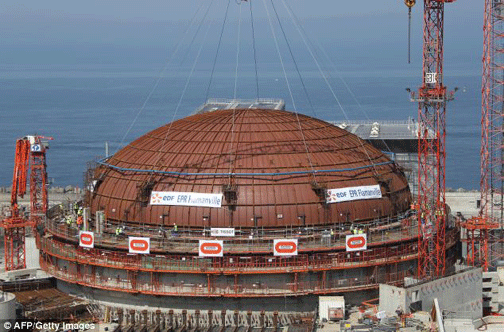
La Presse de la Manche 13th May 2025, https://actu.fr/normandie/flamanville_50184/inspection-a-lepr-de-flamanville-le-gendarme-du-nucleaire-pointe-de-graves-lacunes_62626503.html
Following an inspection into the subject of counterfeiting, falsification and fraud at the EPR site in Flamanville (Manche), the nuclear regulator, ASNR, has issued a severe report.
The affair had shaken the Flamanville EPR construction site (Manche). In February 2024 , journalists revealed cases of falsification involving an EDF supplier . The Flamanville construction site is directly concerned. Some parts, supplied by a subcontractor, are allegedly the subject of fraud . But it is difficult to obtain more information.
” Irregularities have been highlighted within two companies that are part of EDF’s supply chain and produce equipment for operating nuclear reactors as well as the Flamanville EPR reactor,” the Nuclear Safety Authority (ASN) simply admitted in a letter addressed to EDF.
An inspection carried out in March
The safety of the part is not in question. But the affair has revived concerns about fraud, counterfeiting and falsification in the nuclear sector .
A few months later, while the EPR continued its commissioning , the nuclear regulator, ASNR, published on its website the inspection follow-up letter concerning the Flamanville EPR on the theme of “Prevention, detection and treatment of the risk of counterfeiting, falsification and suspicion of fraud”.
For two days, on March 19 and 20, 2025 , the inspectors examined the implementation of the prevention policy , the training of staff on the subject, the monitoring of external stakeholders, the implementation of systems for collecting reports, etc. They carried out interviews with the central services and service providers. And, generally speaking, after this audit, the opinion of the ASNR is unequivocal , since it notes “ numerous weaknesses in the organization implemented.”
The inspectors noted: ”
Gaps in the local implementation of the national note on
irregularities ; weak promotion of the issue, with a lack of dedicated rituals and interfaces; a lack of periodicity in awareness-raising actions…”
Two months to react
The follow-up letter underlines that, generally speaking, it is “necessary to implement an organisation that allows the entire irregularity issue to be managed in a more robust manner, and that capitalisation around the sharing of feedback is still in its infancy and must be improved quickly “.
Seven pages of requests follow. EDF now has two months to formulate its observations and indicate the corrective measures taken in response to the ASNR’s findings.
Too Great a Risk

But, by far the most significant yet most neglected reason for avoiding the road to nuclear is the risks that nuclear power engenders in our increasingly unstable world. The concentration of power produced at a single site constitutes a megarisk of meltdown and massive radioactive fallout from cyber attack, terrorism, warfare and even nuclear attack as events in Ukraine and elsewhere have demonstrated
13 May 2025. https://www.banng.info/news/regional-life/too-great-a-risk/
Andrew Blowers discusses the contrast of historic and current energy generation seen across the Blackwater estuary in the May 2025 column for Regional Life.
Out across the Blackwater estuary into the North Sea a quiet revolution in the way we get our energy is evident. The vast arrays of wind turbines, shimmering in sunshine and faintly visible in an overcast sky are the palpable evidence of the energy transition that is gathering pace as we struggle to eliminate fossil fuels in favour of renewable sources of energy, especially offshore wind. Wind is safe, low cost and secure contributing 30% of our electricity and rising.
On the Bradwell shore lies the gleaming hulk of a former nuclear power station, now a mothballed but active radioactive waste store which will not be cleared until the end of the century at the earliest. Nuclear power has been in decline since the turn of the century. Nuclear is unsafe, high cost and insecure contributing only 12% of our electricity and falling.
And yet, despite the risks, the Government claims that ‘there is an urgent need for new nuclear which is a safe and low carbon source of energy’. It is proposing to build up to 24GW of nuclear capacity. That’s something like ten giant 2.2 GW power stations, the size proposed for Sizewell C and the now abandoned Bradwell B project, or the equivalent of around 80 Small Modular Reactors (at 300MW each).
The Government’s Civil Nuclear; Roadmap to 2050 would displace vast amounts of the cheaper, credible, reliable and more flexible renewable power sources that can navigate a plausible pathway to a Net Zero future. Such a scaling up is clearly unachievable.
But, by far the most significant yet most neglected reason for avoiding the road to nuclear is the risks that nuclear power engenders in our increasingly unstable world. The concentration of power produced at a single site constitutes a megarisk of meltdown and massive radioactive fallout from cyber attack, terrorism, warfare and even nuclear attack as events in Ukraine and elsewhere have demonstrated. And the risks from accidents, and the impacts of climate change, not to mention institutional neglect or breakdown, are unknowable and unfathomable, though nevertheless real. And, let’s not forget nuclear energy leaves a long-lasting, dangerous and presently unmanageable legacy of highly active nuclear waste.
Sites such as Bradwell are sitting targets for malevolent actions as well as being exposed to the impacts of climate change. Far better for the now closed Bradwell power station to remain a passive store with a low risk than revive any ideas for nuclear plant which would pose an existential threat to the communities of the Blackwater and beyond.
Meanwhile, out into the North Sea the turning turbines signal a future that is relatively safe, secure and sustainable.
Hinkley Point C site served notice after crane ‘component failure’
AN improvement notice has been served to the developers of Hinkley Point
C’s construction site after a component failure was found in a crane. The
Office for Nuclear Regulation told the NNB Generation Company (HPC) Ltd
(NNB GenCo) that it must improve monitoring and management of tower cranes
at the Hinkley Point C construction site near Bridgwater.
This enforcement
action follows the discovery of a failing component in a tower crane at the
site in February this year. An operator undertaking pre-use checks on site
found the failure of a pin connecting two mast sections together, and
evidence of cracking within a mast section. The findings were reported
under the Reporting of Injuries, Diseases and Dangerous Occurrences
Regulations (RIDDOR). The issue was identified before there was any broader
failure of the crane, so there were no injuries to any workers.
Bridgwater Mercury 12th May 2025.
https://www.bridgwatermercury.co.uk/news/25156847.hinkley-point-c-site-served-notice-crane-
Trump considers weakening nuclear agency in bid for more power plants.

The draft orders accuse the Nuclear Regulatory Commission of unnecessary
“risk aversion.” The White House is drafting plans to weaken the
independence of the nation’s nuclear safety regulators and relax rules
that protect the public from radiation exposure, moves it says are needed
to jump-start a nuclear power “renaissance,” according to internal
documents reviewed by The Washington Post.
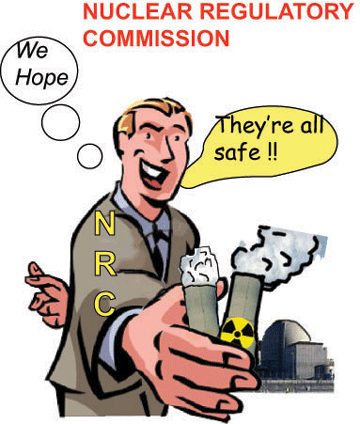
Four draft executive orders circulating in the administration would streamline approvals for new nuclear power plants. The White House contends the current process at the
Nuclear Regulatory Commission is bogged down by excessive safety concerns.
“The NRC does not view its duty as promoting safe, abundant nuclear
energy with regulatory clarity, flexibility and speed but rather insulating
Americans from the most remote risks without regard for the domestic or
geopolitical costs of its risk aversion,” says a draft order directing
“reform” of the agency. It notes that the agency — which is charged
with protecting the American public from nuclear disaster — has approved
only five new reactors since 1978, and only two have been built. There are
94 nuclear reactors operating in the United States.
Washington Post 10th May 2025,
https://www.washingtonpost.com/us-policy/2025/05/09/nuclear-power-plants-nrc-trump-safety/
Trump tightens control of independent agency overseeing nuclear safety
Geoff Brumfiel, NPR. May 9, 2025
The Trump administration has tightened its control over the independent agency responsible for overseeing America’s nuclear reactors, and it is considering an executive order that could further erode its autonomy, two U.S. officials who declined to speak publicly because they feared retribution told NPR.
Going forward, the Nuclear Regulatory Commission (NRC) must send new rules regarding reactor safety to the White House, where they will be reviewed and possibly edited. That is a radical departure for the watchdog agency, which historically has been among the most independent in the government. The new procedures for White House review have been in the works for months, but they were just recently finalized and are now in full effect.
NPR has also seen a draft of an executive order “ordering the reform of the Nuclear Regulatory Commission.” The draft calls for reducing the size of the NRC’s staff, conducting a “wholesale revision” of its regulations in coordination with the White House and Elon Musk’s Department of Government Efficiency team, shortening the time to review reactor designs and possibly loosening the current, strict standards for radiation exposure.
“It’s the end of the independence of the agency,” says Allison Macfarlane, director of the School of Public Policy and Global Affairs at the University of British Columbia in Canada who was nominated by President Obama to serve as Chair of the NRC from 2012 to 2014. Macfarlane believes the changes will make Americans less safe.
“If you aren’t independent of political and industry influence, then you are at risk of an accident, frankly,” Macfarlane says.
The draft executive order was marked pre-decisional and deliberative. It was one of several draft orders seen by NPR that appeared to be aimed at promoting the nuclear industry. Other draft orders called for the construction of small modular nuclear reactors at military bases, and for the development of advanced nuclear fuels. Axios first reported on the existence of the executive orders.
It remains unclear which, if any, will be signed by President Trump.
In a statement, the NRC said it was working with the White House “as part of our commitment to make NRC regulatory processes more efficient. We have no additional details at this time.”
“The President of the United States is the head of the executive branch,” a spokesperson for the White House’s Office of Management and Budget wrote to NPR in an email. “The President issued an independent agencies executive order which aligns with the president’s power given to him by the constitution. This idea has been talked about for nearly 40 years and should not be a surprise.”………………………………………………………………………………………………………………………
Going nuclear
The NRC has been working to respond to the new law, but it has historically operated largely outside the purview of the White House. That began to change with an executive order signed by the president in February that called for independent agencies to begin reporting directly to the White House Office of Management and Budget………………………………………………………..
Only after the rule is finalized will the commissioners’ votes be made public. It was not immediately clear how the public would know whether the White House had changed a safety rule for a nuclear reactor.
Some questioned what the White House could gain from reviewing abstruse rules for nuclear safety.
“Who has the technical knowledge to actually do a substantive review?” asks Edwin Lyman, a nuclear physicist at the Union of Concerned Scientists, a nonprofit that has been critical of the nuclear industry. “To have political appointees meddling in these technical decisions is just a recipe for confusion and chaos.” https://www.npr.org/2025/05/09/nx-s1-5392382/trump-nuclear-regulatory-commission-watchdog-safety-radiation
Chernobyl shelter’s drone damage includes 330 openings in outer cladding.
World Nuclear News 9th May 2025
The International Atomic Energy Agency has outlined the scale of the damage caused by a drone strike and subsequent fires to the giant shelter built over the ruins of Chernobyl’s unit 4.
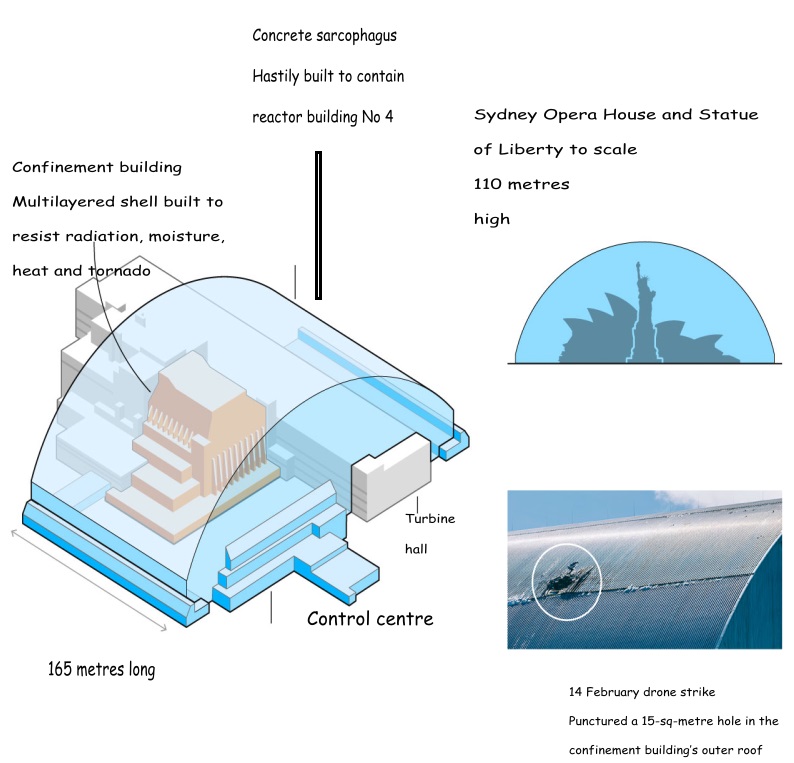
The agency said that investigations continue to determine the extent of the damage sustained by the arch-shaped New Safe Confinement (NSC) shelter following the drone strike on 14 February.
The impact caused a 15-square-metre hole in the external cladding of the arch, with further damage to a wider area of about 200-square-metres, as well as to some joints and bolts. It took about three weeks to fully extinguish smouldering fires in the insulation layers of the shelter.
n its update on the situation, the International Atomic Energy Agency (IAEA) said: “It took several weeks to completely extinguish the fires caused by the strike. The emergency work resulted in approximately 330 openings in the outer cladding of the NSC arch, each with an average size of 30-50 cm.
“According to information provided to the IAEA team at the site, a preliminary assessment of the physical integrity of the large arch-shaped building identified extensive damage, for example to the stainless-steel panels of the outer cladding, insulation materials as well as to a large part of the membrane – located between the layers of insulation materials – that keep out water, moisture and air.”
The main crane system, including the maintenance garage area, was damaged and it is not currently operational, the IAEA said. The heating, ventilation and air conditioning systems are functional but have not been in service since the strike. Radiation and other monitoring systems remain functional, the IAEA said. There has been no increase in radiation levels at any time during or since the drone strike.
IAEA Director General Rafael Mariano Grossi said: “We are gradually getting a more complete picture of the severe damage caused by the drone strike. It will take both considerable time and money to repair all of it.”
…………………………………………………………………………………The New Safe Confinement was financed via the Chernobyl Shelter Fund which was run by the European Bank for Reconstruction and Development (EBRD). It received EUR1.6 billion (USD1.7 billion) from 45 donor countries and the EBRD provided EUR480 million of its own resources.
On 4 March the EBRD allocated EUR400,000 from the administrative budget of the continuing fund for specialist-led damage assessment……………………………..https://www.world-nuclear-news.org/articles/chernobyl-shelters-drone-damage-includes-330-openings-in-outer-cladding
Improvement notice issued at Dounreay nuclear power plant
By Gabriel McKay, 8 May 25, https://www.heraldscotland.com/news/25146874.improvement-notice-issued-dounreay-nuclear-power-plant/
An improvement notice has been issued at Dounreay nuclear power plant following a “significant potential risk to work safety”.
In February of this year a worker sustained a minor injury when a radiological contamination monitor, which weighed around two tonnes, toppled over.
Though there were no serious injuries, the Office for Nuclear Regulation (ONR) said there was a “significant potential risk to worker safety”.
Dounreay operated from 1955 until 1994 – though research reactors continued to function until 2015 – and is now Scotland’s largest nuclear clean-up and demolition project.
All plutonium on the site had been transferred to Sellafield by December 23, 2019.
The site upon which it stands is scheduled to become available for other uses by 2333.
Tom Eagleton, ONR Superintending Inspector, said: “This was a preventable incident that could have had serious consequences for those nearby.
“The improvement notice requires the Dounreay site to implement measures that will reduce the risk of similar occurrences in the future.
“Specifically, they must identify all operations involving the movement of heavy equipment and ensure comprehensive risk assessments and appropriate control measures are implemented before the work starts.”
Nuclear Restoration Services, which owns the plant has until 25 July 2025 to comply with the notice.
The company said: “We take the protection of people and the environment from harm very seriously.
We are taking action to strengthen our practices and management in this area, and will comply with the requirements of the notice received in April, having reported the incident to ONR and carried out an investigation.”
Torness in East Lothian is the last remaining nuclear power station in Scotland still generating electricity.
It is scheduled for shutdown in 2030, following Hunterston B in North Ayrshire in 2022, Chapelcross in Dumfries and Galloway in 2004 and Hunterston A in 1990.
Russian drone strike caused tens of millions worth of damage to Chornobyl
Attack damaged €1.5bn containment structure over nuclear reactor with repair costs likely to be borne by western governments
Russian drone strike caused tens of millions worth of damage to Chornobyl
Attack damaged €1.5bn containment structure over nuclear reactor with repair costs likely to be borne by western governments
Dan Sabbagh in Chornobyl. Photography by Julia KochetovaWed 7 May 2025
A Russian Shahed drone costing up to £75,000 is estimated to have inflicted tens of millions worth of damage to the site of the Chornobyl nuclear power plant, according to initial assessments and engineering experts.
The cost of a full fix is likely to be borne by western governments including the UK, because initial estimates are that a complete repair will cost more than the €25m available in a special international contingency fund.
The strike in mid February did not cause an immediate radiological risk, but it significantly damaged the €1.5bn containment structure built in 2017 to encase the destroyed reactor and is likely to take months if not years to completely repair.
The 110-metre high steel structure at Chornobyl was hit before 2am on 14 February, with sensors registering “something like a 6 to 7 magnitude earthquake,” according to Serhiy Bokov, the chief engineer on duty. “But we clearly understood it wasn’t that,” he said.
The attack – quickly concluded to be caused by a drone flying below at a level where it could not be detected by radar – punctured a 15-sq-metre hole in the outer roof. It also caused a particularly damaging, complex smouldering fire to the inner cladding of the structure that took over a fortnight to put out.
Consisting of two double arches and longer than two jumbo jets, the New Safe Confinement (NSC) was completed in 2017 to secure the hastily built, unstable Soviet-era sarcophagus, which covers over Chornobyl’s ill-fated reactor number four, the site of the world’s worst nuclear disaster in April 1986.
But the attack in February has rendered the sarcophagus open to the elements again, meaning that radioactive dust could get out and rainwater in, though the country’s environmental protection ministry says “the radiation background is currently within normal level and is under constant control”.
More significantly, the confinement structure is now more vulnerable in the longer term to rusting due to greater exposure to the elements and damage to the cladding. Two hundred small boreholes were also drilled into the structure in the effort to douse the cladding fire with water.
“Not fixing it is not an option,” said Eric Schmieman, an American engineer who worked on the design and build of the Chornobyl shelter for 15 years. A complete repair, he said would “cost a minimum of tens of millions of dollars and it could easily go to hundreds of millions” with the repairs taking “months to years,” he added.
Previously the shelter was intended to have a 100-year design life, allowing time to decommission the sarcophagus and nuclear waste below, but this is now in doubt without it being repaired, Schmieman added. Unlike other large metal structures, such as the Eiffel Tower, it was never possible to repaint it to prevent corrosion.
Below the sarcophagus lies a highly radioactive lava like mass, a mix of 200 tonnes of uranium from Chornobyl reactor number four and 5,000 tonnes of sand, lead and boric acid dropped on to the site by Soviet helicopters in the immediate aftermath of the disaster caused by the reactor going out of control.
A more detailed impact assessment is expected to be released in May, but the European Bank for Reconstruction and Development (EBRD), which funded the building of the shelter and is involved in the post bombing analysis, said “it is clear that the attack has caused significant damage”.
Other sources, familiar with the assessment exercise, told the Guardian that Schmieman’s estimates appeared correct. Though the EBRD holds €25m in funds to allow for emergency work, it said “significantly more funding is required” to tackle long-term decommissioning challenges thrown up by the incident…………………………………………………
Further cash for repairs is most likely to come from western governments. Twenty-six countries contributed to the cost of the original shelter, including the US, UK, France, Germany and even Russia – of which the vast steel arch structure cost €1.5bn out of a total €2.1bn fund. Others also made donations, including Turkey.
Home to the remains of a nuclear reactor that went out of control and exploded in April 1986, the Chornobyl site is seven miles from the border with Russia’s ally Belarus. It was occupied by Russian soldiers trying to capture Kyiv in February 2022, and has remained on the frontline after Ukraine regained it that April……………………………………………….
Remotely operated cranes hanging from the confinement shelter were intended to dismantle the sarcophagus and nuclear material below, and the strike hit a point near the maintenance garage Bokov said. That too may impair the plans to gradually dismantle and decommission the disaster site below……………………………….. https://www.theguardian.com/world/2025/may/07/russian-drone-strike-caused-tens-of-millions-worth-of-damage-to-chornobyl
Zaporizhzhia: Hurdle or catalyst for a peace deal in Ukraine?
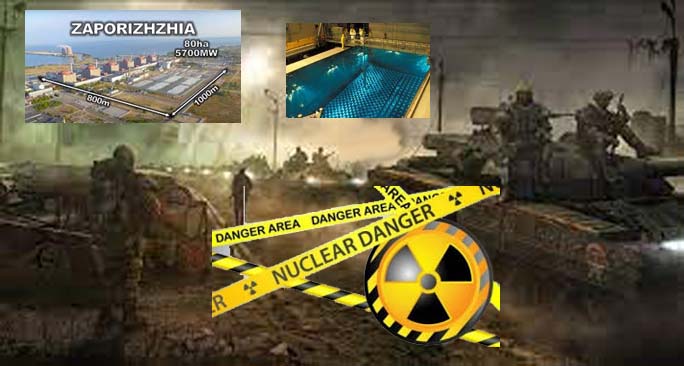
May 6, 2025, Henry Sokolski , https://npolicy.org/zaporizhzhia-hurdle-or-catalyst-for-a-peace-deal-in-ukraine/
In all the peace proposals the United States, Russia, Europe, and Ukraine have made public, one item always shows up: the reopening of the damaged six-reactor Zaporizhzhia nuclear plant. Washington wants to rebuild and operate it, Moscow insists the plant is theirs, and Kyiv says that it must remain Ukrainian. But, it will be to restart the plant.
Russia insists it can get at least one of the reactors up and running within several months. The United States has no timeline. Ukraine says, even with a solid peace and full control over the plant, bringing all six reactors back online would still take two years or more. No one has ventured how much any of this would cost.
And, there are additional challenges. Russia destroyed the Kakhovka Dam upstream of the plant. Now, what would be required to assure a steady clean supply of cooling water for the reactors? The Russians also laid mines around the plant; the area is also laced with unexploded ordnance. How will these munitions be neutralized? Who will do it? The Russians have looted and damaged much of the plant’s control equipment. How will it be repaired and replaced? Who will certify that the work has been done properly? The U.S. Nuclear Regulatory Commission? The Ukrainian State Nuclear Regulatory Inspectorate? Rosatom?
More than 75 percent of Zaporizhzhia’s nuclear staff no longer work at the plant. Can they be replaced? Who will replace them? Then, there’s the challenge of rebuilding all of the damaged power lines and transformers necessary to export any electricity from the site. Where will the electricity be sent? Ukraine? The European Union? Russian territories? Who will pay for all of this work? Who will be held responsible if there are accidents? Who will defend the plant against future attacks? The United States? Ukraine? Russia? The EU?
There are even more questions than these. But as I make clear in the attached piece, we need to get the answers if we want the situation with Zaporizhzhia to be anything other than a hurdle to reaching any lasting peace.
……… Power for whom and at what cost? Even if the Zaporizhzhia reactors could be safely restarted, the problem of distributing the plant’s power remains. Before the war, Zaporizhzhia helped feed Ukraine’s electrical grid and exported surplus power to Europe. Now, the infrastructure connecting the plant to customers is shattered. Transmission lines must be rebuilt. Substations and transformers need replacement. Technical adjustments will need to be made and agreements negotiated over where the electricity will go and how: western Europe, southern Ukraine, or to Russian-controlled territories?
Another question is who will pay for all this work? Will seized Russian assets foot the bill? Or will it be European Reconstruction Bank funds? What of US investment, taxpayer funds, and any private entity potentially interested in chipping in? Once funds are allocated, who would receive the profits, if any, or be responsible for the losses? Who would assume responsibility for possible accidents and damage to property beyond the plant’s site? And, finally, who will bear the costs of ensuring the plant’s security so that its reactors do not become again the targets of future attacks? None of this is yet clear.
As Ukraine, the United States, and Russia have all made refurbishing and operating Zaporizhzhia a condition for peace, dodging these questions is a prescription for mischief. Without clear answers, resurrecting Zaporizhzhia could become more of an obstacle to than a catalyst for peace.
Henry Sokolski is executive director of the Nonproliferation Policy Education Center in Arlington, Virginia, served as Deputy for Nonproliferation Policy at the Pentagon (1989-93), and is author of China, Russia and the Coming Cool War (2024).
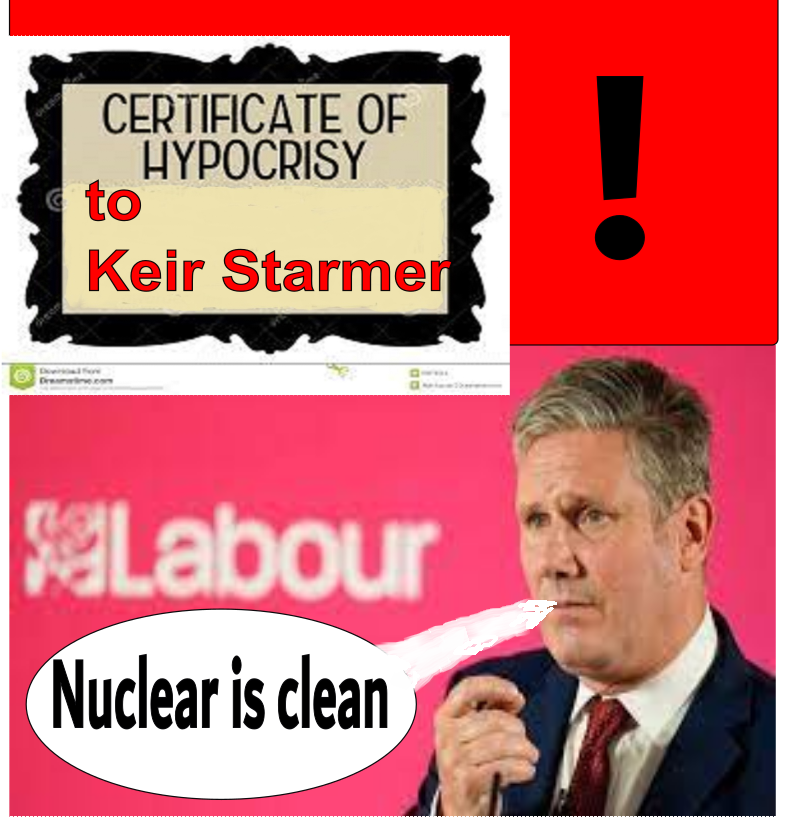
Starmer ignored nuclear watchdog when he blamed regulations for delays.
Guardian, Rob Edwards, 6 May 25
Office for Nuclear Regulation told government that claims about reactor delays in press release were ‘not true’.
Keir Starmer ignored warnings from his nuclear safety watchdog that it was wrong to blame regulations for delays building new reactors when he launched a plan to revive the nuclear power industry.
The prime minister unveiled the nuclear renaissance strategy in February and said investment had slumped because the industry was “suffocated by regulations”.
However, a document released under freedom of information law reveals that the UK’s Office for Nuclear Regulation (ONR) told the government in the run-up to the launch that claims about delays to nuclear power in a draft press release were “not true”. Despite this, the claims were repeated in the final release.
ONR was asked to comment on a draft government announcement of a taskforce to speed up the regulation of nuclear power. It made four corrections to the draft, which was passed to the investigative journalism cooperative The Ferret, and shared with the Guardian.
But none of ONR’s corrections were implemented when Starmer made the announcement on 6 February, under the headline “Government rips up rules to fire up nuclear power”.
The attack on nuclear regulations was part of Labour’s attempt to prove its growth credentials and coincided with it clipping the wings of the competition watchdog and hauling in regulators to demand they do more to boost the economy.
The draft release stated that three European regulatory regimes had reached different assessments of the design of the reactors being built at Hinkley Point C in Somerset, “leading to delays and increased costs”.
ONR said this was “not accurate” and that it had refuted such claims before. “Our feeling is that linking regulatory factors into the increasing Hinkley Point C costs and timeframes isn’t true and the sentence doesn’t stand up,” it said.
ONR also suggested that the new taskforce should look at not the “approval” but the “deployment” of new reactor designs. “The reactor approval process has no bearing on the overall speed of delivery, but rather construction,” it said.
Neither amendment was made in Starmer’s announcement, which reiterated the disputed wording in the draft. Two other changes suggested by ONR were also rejected.
The energy company EDF predicted in 2007 that electricity from Hinkley Point C would be cooking Christmas turkeys in 2017. EDF said in January 2024 that the station might not be finished until 2031.
The estimated total cost of building the plant has risen from £18bn in 2016 to £35bn in 2024. This could increase to £46bn when inflation is taken into account.
According to ONR, its assessment of the reactor design was completed in 2012 but construction did not start until 2017. Its regulation had not delayed building since then, it said.
Dave Cullen, who co-chairs a forum for ONR and campaign groups, described Starmer’s announcement as misleading.
“I’m shocked by the cynical and unprofessional approach of the government to this announcement,” said Cullen, who is independent of ONR. “It seems as though it would rather attack an imaginary problem than seriously consider how to approach energy security.”……………………………………………………………………………………………………………….. https://www.theguardian.com/business/2025/may/06/starmer-nuclear-watchdog-regulations-delays-reactors
The Challenge to Japan’s Nuclear Restart

The story of Japan’s nuclear village should serve as a
cautionary tale for other places engaged in debates on nuclear energy.
Nuclear power is a key plank in Japan’s national energy vision, but 14 years after the Fukushima meltdown, the restart process hasn’t overcome the central problem.
By Zhuoran Li, May 03, 2025
The restart of nuclear power plants is based on the Sixth Basic Energy
Plan, approved by the Cabinet in October 2021. Given that the trauma of the
2011 Fukushima nuclear disaster remains vivid in the public consciousness,
the government has adopted a cautious, step-by-step approach. The
reactivation of reactors must first be approved by the Nuclear Regulation
Authority under the new regulatory standards. Subsequently, the restart can
proceed only with the consent of local governments and residents.
The government hopes that its safety-first approach will reassure local
communities and alleviate their concerns about nuclear energy. In addition,
efforts are underway to develop and construct next-generation innovative
reactors. These include plans to replace decommissioned nuclear plants with
advanced models, contingent on securing local support.
While maintaining the effective 60-year operational limit, the government is also promoting a policy that excludes certain shutdown periods from being counted toward
that limit. The story of Japan’s nuclear village should serve as a
cautionary tale for other places engaged in debates on nuclear energy. For
example, Taiwan faces many of the same trade-offs as Japan. On one hand,
Taiwan is an energy importer with a vulnerable supply. On the other hand,
it is prone to earthquakes. As a result, nuclear energy has become a
central political debate.
The Diplomat 3rd May 2025,
https://thediplomat.com/2025/05/the-challenge-to-japans-nuclear-restart/
Kingston Fossil Plant and Oakridge Nuclear Facility – an unholy alliance of radioactive pollution,
While no one was killed by the 2008 coal ash spill itself, dozens of workers have died from illnesses that emerged during or after the cleanup. Hundreds of other workers are sick from respiratory, cardiac, neurological, and blood disorders, as well as cancers.
The apparent mixing of fossil fuel and nuclear waste streams underscores the long relationship between the Kingston and Oak Ridge facilities.
Between the 1950s and 1980s, so much cesium-137 and mercury was released into the Clinch from Oak Ridge that the Department of Energy, or DOE, said that the river and its feeder stream “served as pipelines for contaminants.” Yet TVA and its contractors, with the blessing of both state and federal regulators, classified all 4 million tons of material they recovered from the Emory as “non-hazardous.”
A U.S. Environmental Protection Agency analysis confirms that the ash that was left in the river was “found to be commingled with contamination from the Department of Energy (DOE) Oak Ridge Reservation site.
For nearly a century, both Oak Ridge and TVA treated their waste with less care than most families treat household garbage. It was often dumped into unlined, and sometimes unmarked, pits that continue to leak into waterways. For decades, Oak Ridge served as the Southeast’s burial ground for nuclear waste. It was stored within watersheds and floodplains that fed the Clinch River. But exactly where and how this waste was buried has been notoriously hard to track.
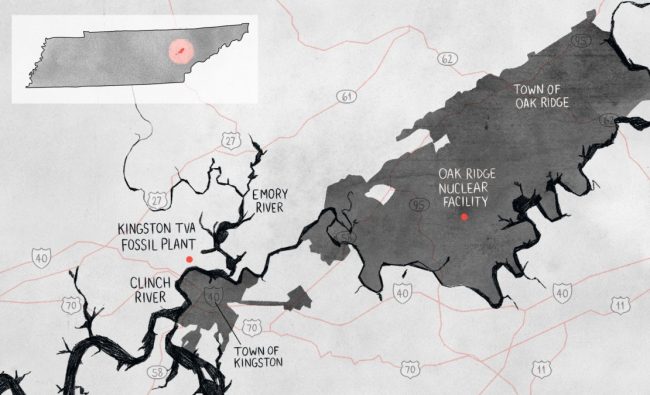
A Legacy of Contamination, How the Kingston coal ash spill unearthed a nuclear nightmare, Grist By Austyn Gaffney on Dec  15, 2020 This story was published in partnership with the Daily Yonder.
In 2009, App Thacker was hired to run a dredge along the Emory River in eastern Tennessee. Picture an industrialized fleet modeled after Huck Finn’s raft: Nicknamed Adelyn, Kylee, and Shirley, the blue, flat-bottomed boats used mechanical arms called cutterheads to dig up riverbeds and siphon the excavated sediment into shoreline canals. The largest dredge, a two-story behemoth called the Sandpiper, had pipes wide enough to swallow a push lawnmower. Smaller dredges like Thacker’s scuttled behind it, scooping up excess muck like fish skimming a whale’s corpse. They all had the same directive: Remove the thick grey sludge that clogged the Emory.
The sludge was coal ash, the waste leftover when coal is burned to generate electricity. Twelve years ago this month, more than a billion gallons of wet ash burst from a holding pond monitored by the region’s major utility, the Tennessee Valley Authority, or TVA. Thacker, a heavy machinery operator with Knoxville’s 917 union, became one of hundreds of people that TVA contractors hired to clean up the spill. For about four years, Thacker spent every afternoon driving 35 miles from his home to arrive in time for his 5 p.m. shift, just as the makeshift overhead lights illuminating the canals of ash flicked on.
Dredging at night was hard work. The pump inside the dredge clogged repeatedly, so Thacker took off his shirt and entered water up to his armpits to remove rocks, tree limbs, tires, and other debris, sometimes in below-freezing temperatures. Soon, ringworm-like sores crested along his arms, interwoven with his fading red and blue tattoos. Thacker’s supervisors gave him a cream for the skin lesions, and he began wearing long black cow-birthing gloves while he unclogged pumps. While Thacker knew that the water was contaminated — that was the point of the dredging — he felt relatively safe. After all, TVA was one of the oldest and most respected employers in the state, with a sterling reputation for worker safety.
Then, one night, the dredging stopped.
Sometime between December 2009 and January 2010, roughly halfway through the final, 500-foot-wide section of the Emory designated for cleanup, operators turned off the pumps that sucked the ash from the river. For a multi-billion dollar remediation project, this order was unprecedented. The dredges had been operating 24/7 in an effort to clean up the disaster area as quickly as possible, removing roughly 3,000 cubic yards of material — almost enough to fill an Olympic-sized swimming pool — each day. But official reports from TVA show that the dredging of the Emory encountered unusually high levels of contamination: Sediment samples showed that mercury levels were three times higher in the river than they were in coal ash from the holding pond that caused the disaster.
Then there was the nuclear waste. Continue reading
Situation unstable: IAEA says shots were heard at Zaporizhzhia power plant
Artur Kryzhnyi — Friday, 25 April 2025,
IAEA experts at the Zaporizhzhia Nuclear Power Plant heard loud gunshots on 23 April near the main administrative building where their office is located.
Source: IAEA press service
Details: In addition, the IAEA team has heard explosions and gunshots at different distances from the plant almost every day over the past week.
“What once seemed almost unthinkable – evidence of hostilities near a large nuclear facility – has become an almost daily occurrence and a familiar part of life at Europe’s largest nuclear power plant. From a nuclear safety point of view, this is certainly an unstable situation,” said IAEA Director General Rafael Grossi.
Despite the regular sounds of fighting, IAEA experts continue to conduct inspections at the plant to monitor and assess the state of nuclear safety and security…………….
Ukrainian President Volodymyr Zelenskyy said that the proposal for US control over the Zaporizhzhia Nuclear Power Plant raises many questions that are difficult to resolve.
Ukrainska Pravda 25th April 2025
https://www.pravda.com.ua/eng/news/2025/04/25/7509136/
NUCLEAR STATION = WAR TARGET
26 April 2025 marked the 39th anniversary of the catastrophic nuclear
explosion in Chernobyl, Ukraine – which, at the time, was part of the
Soviet Union. It’s worth reminding people of the effects of that horrific
event.
Tens of thousands of children and adolescents developed thyroid
cancer in Ukraine, Belarus and Russia. Genetic problems have been observed
in the wildlife of the area. The area around the nuclear plant is still
uninhabited. Moreover, the rain that fell in Wales following the explosion
caused radioactive pollution, even though we were 1,600 miles away.
As a result, there has been a serious impact on the agricultural industry, with
upland lamb being banned from entering the food chain until tests show that
the level of Caesium-137 radiation has been adequately reduced. Bans were
issued on 9,800 farms, most of them in Wales and Cumbria. The final bans
were not lifted until 2012 – 26 years after the explosion.
Why mention this now?
Because Chernobyl is in a country that is in the middle of war; a
country that contains other nuclear reactors such as Zaporizhzhia, the
largest nuclear complex in Europe.
Because a shell built over the reactor
at Chernobyl in order to prevent radiation from escaping was hit by a
Russian drone on the 14th of February this year.
Because it is the first war that is being fought on the land of a country where there are active
nuclear reactors.
And because this nightmare could happen to us.
NUCLEAR STATION = WAR TARGET. With all the talk of preparing for war by political
parties in Westminster, the British State’s obsession with nuclear energy
and nuclear weapons is extremely dangerous. Consider that Starmer wants to
see nuclear plants all over the State! All would be a target in war. And
all need to be protected by special police.
All of this is another reason for opposing nuclear, though there are enough already – the radioactive waste without a long-term solution; the fact that waste would be on site
for over a century; the dangers of fire; the fact that it will not be
possible to build enough nuclear to have an impact on climate change; the
diversion of funds and resources from renewable energy; the environmental
mess associated with uranium mining; the threat to the Welsh language by
thousands of workers for a large station; the likelihood that relatively
few workers would be needed for a Modular Reactor (SMR); the extreme cost.
PAWB 25th April 2025
1 This Month

To see nuclear-related stories in greater depth and intensity – go to https://nuclearinformation.wordpress.com
-
Archives
- September 2026 (194)
- August 2026 (330)
- July 2026 (355)
- June 2026 (287)
- May 2026 (306)
- April 2026 (356)
- March 2026 (251)
- February 2026 (267)
- January 2026 (308)
- December 2025 (358)
- November 2025 (359)
- October 2025 (375)
-
Categories
- 1
- 1 NUCLEAR ISSUES
- business and costs
- climate change
- culture and arts
- ENERGY
- environment
- health
- history
- indigenous issues
- Legal
- marketing of nuclear
- media
- opposition to nuclear
- PERSONAL STORIES
- politics
- politics international
- Religion and ethics
- safety
- secrets,lies and civil liberties
- spinbuster
- technology
- Uranium
- wastes
- weapons and war
- Women
- 2 WORLD
- ACTION
- AFRICA
- Atrocities
- AUSTRALIA
- Christina's notes
- Christina's themes
- culture and arts
- Events
- Fuk 2022
- Fuk 2023
- Fukushima 2017
- Fukushima 2018
- fukushima 2019
- Fukushima 2020
- Fukushima 2021
- general
- global warming
- Humour (God we need it)
- Nuclear
- RARE EARTHS
- Reference
- resources – print
- Resources -audiovicual
- Weekly Newsletter
- World
- World Nuclear
- YouTube
-
RSS
Entries RSS
Comments RSS
 nuclear-news