NFLA Policy Briefing 313: Correspondence with the Nuclear Regulator over AGR Extensions
We note the recent EDF press release stating that a decision to life-extend
all four remaining AGR stations has been taken by EDF with Heysham 1 and
Hartlepool extended to 2027 and Heysham 2 and Torness extended to 2030.
The ONR site says for Heysham 1 and Hartlepool that: ‘EDF have recently
communicated their decision [March 2023] to extend the generating lifetime
of the station to March 2026, subject to an adequate demonstration of
safety.’ But there is no further information on whether an adequate
demonstration of safety has been submitted and assessed, and no mention of
extension to 2027.
For the other two AGR stations, no mention is made on
the ONR site of EDF’s intention to life-extend the plants, and the EDF and
the ONR sites give a forecast end of generation as 2028 for the two AGRs.
On your questions regarding EDF’s press release, the results of the EDF
inspections indicated that the graphite cores remained within the
limitations of the current safety cases.
The results of these inspections
have not been published by EDF. These inspections informed EDF’s commercial
judgement to pursue lifetime extensions; it is not within ONR’s scope of
regulation to consider the commercial viability of the life extension of
these reactors.
It is likely that EDF will require new safety cases to
justify operation to the specified end of generation dates and these will
be considered by ONR as part of normal regulatory activities.
NFLA 19th Feb 2025, https://www.nuclearpolicy.info/briefings/nfla-policy-briefing-313-correspondence-with-the-nuclear-regulator-over-agr-extensions/
Damage to Chernobyl shelter being assessed after drone strike

World Nuclear News 17 February 2025, https://www.world-nuclear-news.org/articles/damage-to-chernobyl-shelter-being-assessed-after-drone-strike
Firefighters worked across the weekend to tackle smouldering roof insulation in the giant protective shelter which covers Chernobyl’s unit 4 following the drone strike on Friday. Radiation levels in the area remain normal – the original protective shelter inside the giant structure did not suffer any damage.
The State Emergency Service of Ukraine said on Monday morning there were three groups of climbers tackling three smouldering areas of the roof insulation on the New Safe Confinement. According to SSE ChNPP – which runs the Chernobyl site and decommissioning activities – radiation levels have remained normal throughout, with 84 people working at the scene as of Saturday afternoon, as they sought to wet the smouldering insulation and stop the spread.
It reported that a 15 square metres area of the external cladding of the arch-shaped New Safe Confinement was damaged at a height of about 87 metres, as well as wider “sheathing defects” for an area of about 200 square metres. Damage to both the outer and inner shell of the structure was identified.
The International Atomic Energy Agency, which has experts stationed at Chernobyl, said that the efforts to “put out and prevent the spread of any remaining fires – apparently fuelled by inflammable material in the roof cladding” had delayed work to start repairing the damage to the New Safe Confinement.
IAEA Director General Rafael Mariano Grossi said: “This was clearly a very serious incident, with a drone hitting and damaging a large protective structure at a major nuclear site. As I have stated repeatedly during this devastating war, attacking a nuclear facility is an absolute no-go, it should never happen. It is especially concerning as it comes as we are also seeing an increase in military activity in the area around the Zaporizhzhia nuclear power plant. The IAEA remains committed to doing everything we can to help prevent a nuclear accident.”
The IAEA said their team “confirmed that both the outer and inner cladding of the NSC arch had been breached, causing a hole measuring approximately six metres in diameter and also damaging some equipment as well as electrical cables. However, the structural support beams did not appear to have suffered major damage”.
The European Bank for Reconstruction and Development, which oversaw the shelter project and which together with 45 donors helped fund the EUR2 billion (USD2.1 billion) construction costs of the New Safe Confinement, said it “stands ready to support the government of Ukraine and partners” to ensure Chernobyl remains an environmentally safe and secure site.
What is the New Safe Confinement?
Chernobyl Nuclear Power Plant’s unit 4 was destroyed in the April 1986 accident (you can read more about it in the World Nuclear Association’s Chernobyl Accident information paper) with a shelter constructed in a matter of months to encase the damaged unit, which allowed the other units at the plant to continue operating. It still contains the molten core of the reactor and an estimated 200 tonnes of highly radioactive material.
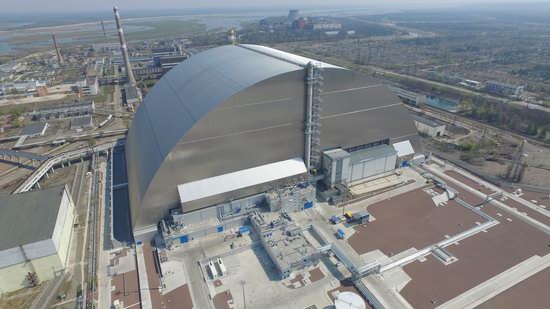
However it was not designed for the very long-term, and so the New Safe Confinement – the largest moveable land-based structure ever built – was constructed to cover a much larger area including the original shelter. The New Safe Confinement has a span of 257 metres, a length of 162 metres, a height of 108 metres and a total weight of 36,000 tonnes and was designed for a lifetime of about 100 years. It was built nearby in two halves which were moved on specially constructed rail tracks to the current position, where it was completed in 2019.
It has two layers of internal and external cladding around the main steel structure – about 12 metres apart – with the IAEA confirming that both had been breached in the incident. The NSC was designed to allow for the eventual dismantling of the ageing makeshift shelter from 1986 and the management of radioactive waste. It is also designed to withstand temperatures ranging from -43°C to +45°C, a class-three tornado, and an earthquake with a magnitude of 6 on the Richter scale.
According to World Nuclear Association, the hermetically-sealed New Safe Confinement allows “engineers to remotely dismantle the 1986 structure that has shielded the remains of the reactor from the weather since the weeks after the accident. It will enable the eventual removal of the fuel-containing materials in the bottom of the reactor building and accommodate their characterisation, compaction, and packing for disposal. This task represents the most important step in eliminating nuclear hazard at the site – and the real start of dismantling”.
The wider context
Chernobyl nuclear power plant lies about 130 kilometres north of Ukraine’s capital Kyiv, and about 20 kilometres south of Belarus. A 30-kilometre exclusion zone remains around the plant, although some areas have been progressively resettled. Three other reactors at the site, which was built during Soviet times, continued to operate after the accident, with unit 3 the last one operating, until December 2000.
When Russia launched its invasion of Ukraine in February 2022 it rapidly took control of the Chernobyl plant. Its forces remained there until withdrawing on 31 March 2022 and control returned to Ukrainian personnel. The IAEA has had experts stationed at the site as the war has continued, seeking to help ensure the safety and security of the site.
IAEA teams are also in place at Ukraine’s three operating nuclear power plants and the Zaporizhzhia nuclear power plant, which has been under the control of Russian forces since early March 2022.
Ukraine has blamed Russia for the drone strike, while Russia denied it was responsible and blamed Ukraine. The IAEA has not attributed blame to either side during the war, with Director General Grossi explaining in a press conference at the United Nations in April last year that this was particularly the case with drones, saying “we are not commentators. We are not political speculators or analysts, we are an international agency of inspectors. And in order to say something like that, we must have proof, indisputable evidence, that an attack, or remnants of ammunition or any other weapon, is coming from a certain place. And in this case it is simply impossible”.
Nuclear expert issues Chernobyl update after it emerges fires are still burning.
Luke Alsford and Gergana Krasteva, Metro UK, February 16, 2025
Flames are still raging inside the Chernobyl nuclear station after multiple fires yesterday.
Three smoldering fires were detected earlier this morning, forcing teams to jump into action to prevent a disaster at the power plant.
Ukraine’s state agency on exclusion zone management confirmed that no release of radioactive material has been reported yet.
The plant was hit on Friday by a drone carrying a high-explosive warhead, according to Ukraine, 38 years after the nuclear explosion at the site…..
Firefighters continue to battle the blaze round the clock in challenging weather conditions, admitted the International Atomic Energy Agency.
The plant’s fourth reactor now has a 314 square foot gash after the drone strike.
Although no rise in radiation has been reported yet, an expert issued a frightening warning about how Russia’s attack will soon affect nearby radioactivity
Dr Olga Kosharna, founder of the Anti-Crisis Expert Nuclear Centre of Ukraine, said: ‘The hermetic seal has been broken.
‘It is clear that the ventilation systems will [work] differently and the radiation level will increase.
‘But I think that it will not go beyond the industrial site and the exclusion zone.
Chernobyl’s reactors are covered by an outer dome to prevent radioactive leakage after the 1986 disaster – the world’s worst civilian nuclear accident – which sent pollution spewing across Europe.
Video footage shows how the explosion blew a hole in the dome at 1.50am on Friday, before a fire then broke out.
An open fire on the roof structure – officially called the New Safe Confinement (NSC) – was swiftly put out by first responders.
However smouldering fires remain inside the 20ft diameter hole.
The International Atomic Energy Agency [IAEA] said: ‘The ongoing efforts to put out and prevent the spread of any remaining fires – apparently fuelled by inflammable material in the roof cladding – have delayed work to start repairing the damage.’
The organisation’s director Rafael Mariano Grossi added: ‘This was clearly a very serious incident, with a drone hitting and damaging a large protective structure at a major nuclear site.
‘As I have stated repeatedly during this devastating war, attacking a nuclear facility is an absolute no-go, it should never happen.’
Grossi also warned of an ‘increase in military activity in the area around the Zaporizhzhia Nuclear Power Plant.
‘The IAEA remains committed to doing everything we can to help prevent a nuclear accident. Judging by recent events, nuclear safety remains very much under threat.’…………………………….
Zelensky spoke at the Munich Security Conference yesterday, accusing Russia of flaming the conflict with the alleged drone attack……………………………… https://metro.co.uk/2025/02/16/nuclear-expert-issues-chernobyl-update-emerges-fires-still-burning-22567966/
High-Explosive Drone Pierces Shell Of Chernobyl Nuclear Plant At Very Moment Trump Pushes Ukraine Toward Peace
by Tyler Durden, Saturday, Feb 15, 2025, https://www.zerohedge.com/geopolitical/high-explosive-drone-pierces-shell-chernobyl-nuclear-plant-very-moment-trump-pushes
On Friday just prior to high-level meetings among Western security officials and Ukrainian leadership commencing in Munich, including US Vice President J.D. Vance and Zelensky, there was a dangerous incident at the Chernobyl Nuclear Power Plant in Ukraine’s Kyiv oblast.
Ukraine’s President Zelensky accused Russia of launching a drone equipped with a high-explosive warhead at the historic, defunct power plant, site of the April 1986 nuclear disaster and meltdown. The drone reportedly hit the protective containment shell of the Chernobyl plant.
Zelensky’s office released footage showing an impact to the giant concrete and steel shield protecting the remains of the nuclear reactor. BBC writes that “The shield is designed to prevent further radioactive material leaking out over the next century. It measures 275m (900ft) wide and 108m (354ft) tall and cost $1.6bn (£1.3bn) to construct.”
And WaPo details further of the looming potential dangers:
In 2019, construction was completed on the New Safe Confinement — a $1.7 billion arch-shaped steel structure, which would contain the destroyed reactor. The site still contained some “200 tons of highly radioactive material,” according to the European Bank of Reconstruction and Development, which helped finance the project.
Thus the situation is deeply alarming given the potential for a new radiation leak at the site which could impact the region, or even Europe. An IAEA team on the ground said it heard an explosion at around 01:50 local time coming from the New Safe Confinement (NSC) shelter. Photos showed flames at the top of the huge structure.
The UN agency is on high alert, but issued a statement saying the drone strike did not breach the plant’s inner containment shell. The IAEA also did not attribute blame, not identifying who sent the drone.
The Kremlin strongly rejected that it was behind the incident:
“There is no talk about strikes on nuclear infrastructure, nuclear energy facilities, any such claim isn’t true, our military doesn’t do that,” Peskov told reporters in a call.
Russian state media has meanwhile been warning of efforts by bad actors to sabotage Trump’s peace plan for Ukraine, after he held a 90-minute phone call with President Vladimir Putin this week.
Serious damage to the protective shield remains, which could present an ongoing serious safety issue at the site:
Simon Evans from the European Bank for Reconstruction and Development (EBRD) was head of the Chernobyl Shelter Fund, which oversaw the construction of the protective dome in the 2010s.
He described the apparent strike as “an incredibly reckless attack on a vulnerable nuclear facility”.
The shield “was never built to withstand external drone attack”, he told the BBC.
Given this, why would Russia at this very moment while Trump and Putin are trying to line up peace talks launch a high-explosive drone at the Chernobyl Nuclear Power Plant?
Cui bono?…
Zelensky has asserted that Putin is not actually ready for or seeking legitimate negotiations, contradicting recent statements coming from the Trump White House.
On Friday, he claimed: “The only country in the world that attacks such sites, occupies nuclear power plants, and wages war without any regard for the consequences is today’s Russia.”
Meanwhile, Ukraine’s State Nuclear Regulatory Inspectorate has in a fresh statement said that while the drone damaged “the external integrity” of the New Safe Confinement “and equipment in the crane maintenance garage” – it remains that there are no observable radiation spikes. “Firefighting efforts and damage assessment are ongoing,” it added.
Was this a desperate CHERNOBYL 2.0 ATTEMPT? Whodunnit?
Given that Chernobyl is a name that has captured popular imagination for decades since the apocalyptic historic disaster left the vicinity basically a radiation death zone, it could present the perfect false flag opportunity for anyone wishing to prolong and escalate the war.
A dramatic development in the Ukraine situation.
18 February 2025 https://theaimn.net/a-dramatic-development-in-the-ukraine-situation/
The shut-down Chernobyl nuclear reactor was hit by a drone on 14th February, and its outer covering was breached. The International Atomic Energy Agency (IAEA) was quick to gloss over the impact from the latest incident involving the wrecked Chernobyl nuclear reactor – ” Radiation levels inside and outside the so-called New Safe Confinement building “remain normal and stable,”….. and there are no reports of any casualties or radiation leak.”
To be fair, the IAEA did not attribute blame to Russia. Le Monde stated that the cause was a Russian Shahed drone, armed with a high-explosive warhead. So, it actually does look as if the offending drone came from Russia. But that is not certain. However, as far as the Western media goes – the issue is being covered as a deliberate attack by Russia. Youtube after Youtube video, article after article, blames Russia, and repeats Zelensky’s claims –“This is a terrorist attack for the entire world.” Zelensky spoke at the Munich Security Conference accusing Russia of a deliberate attack. Even if it was a Russian drone, there remains the possibility that this was a mistake, rater than intentional. What would Russia have to gain by this? Cui bono?
This event is significant in two ways – First – it could throw a spanner in the works of the current discussions on ending the war in Ukraine . These peace discussion are a whole nother story. Donald Trump is no doubt looking for a way for USA business interests to grab Ukraine resources as one large part of a peace deal in which Russia keeps its invaded territory. Zelensky’s presidency sort of ended on 20 May 2024 – he stays in power because it is war-time – which may well be part of his desire to keep the ear going, no matter what the cost. Zelensky seems to have cast some sort of mesmerising spell over Europe – depicting the Russian bear salivating to gobble up Europe. Good loyal Westerners seem pretty much obligated to oppose Donald Trump on all matters. However a plan to allow some concessions to Russia is a militarily reasonable way to end this war.
Secondly, it could really demonstrate the hypocrisy of the IAEA and its Director Rafael Grossi about nuclear safety
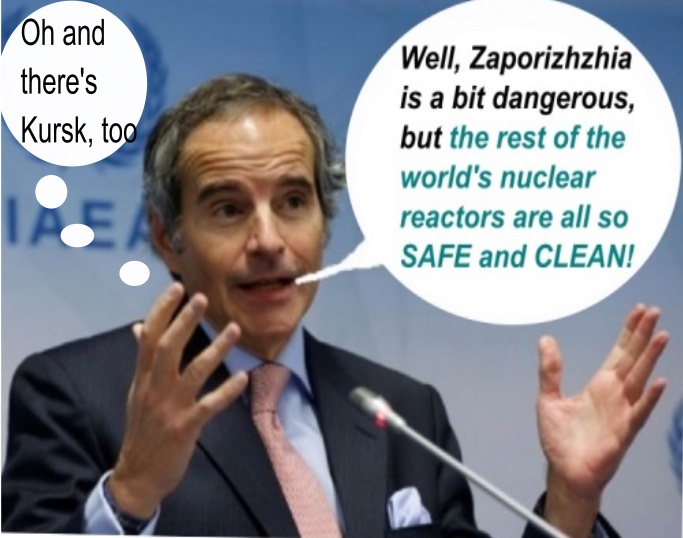
Does anyone really think that this Chernobyl incident is over? All sorted?
“Flames are still raging inside the Chernobyl nuclear station after multiple fires yesterday.” – Luke Alsford and Gergana Krasteva, Metro UK, February 16, 2025
Alsford and Krasteva set out in chilling (perhaps that’s not the right word) detail, the efforts going on, in extreme weather conditions, to prevent a disaster at the power plant, firefighters battling the blaze around the clock. The reactor’s containment shell. now has a 314 square foot gash. With the hermetic seal broken, the ventilation system is affected, and the radiation level will increase.
Those courageous workers at the wrecked Chernobyl nuclear power plant will probably get those fires out before it all gets much, much worse. And mend the hole in the containment shell. And the IAEA and everyone else will breathe sighs of relief. Until the next nuclear near-miss.
Flames are still raging inside the Chernobyl nuclear station after multiple fires yesterday.
Three smoldering fires were detected earlier this morning, forcing teams to jump into action to prevent a disaster at the power plant.
Ukraine’s state agency on exclusion zone management confirmed that no release of radioactive material has been reported yet.
The plant was hit on Friday by a drone carrying a high-explosive warhead, according to Ukraine, 38 years after the nuclear explosion at the site…..
Firefighters continue to battle the blaze round the clock in challenging weather conditions, admitted the International Atomic Energy Agency.
The plant’s fourth reactor now has a 314 square foot gash after the drone strike.
Although no rise in radiation has been reported yet, an expert issued a frightening warning about how Russia’s attack will soon affect nearby radioactivity
Dr Olga Kosharna, founder of the Anti-Crisis Expert Nuclear Centre of Ukraine, said: ‘The hermetic seal has been broken.
‘It is clear that the ventilation systems will [work] differently and the radiation level will increase.
‘But I think that it will not go beyond the industrial site and the exclusion zone.
Chernobyl’s reactors are covered by an outer dome to prevent radioactive leakage after the 1986 disaster – the world’s worst civilian nuclear accident – which sent pollution spewing across Europe.
Video footage shows how the explosion blew a hole in the dome at 1.50am on Friday, before a fire then broke out.
An open fire on the roof structure – officially called the New Safe Confinement (NSC) – was swiftly put out by first responders.
However smouldering fires remain inside the 20ft diameter hole.
The International Atomic Energy Agency [IAEA] said: ‘The ongoing efforts to put out and prevent the spread of any remaining fires – apparently fuelled by inflammable material in the roof cladding – have delayed work to start repairing the damage.’
The organisation’s director Rafael Mariano Grossi added: ‘This was clearly a very serious incident, with a drone hitting and damaging a large protective structure at a major nuclear site.
‘As I have stated repeatedly during this devastating war, attacking a nuclear facility is an absolute no-go, it should never happen.’
Grossi also warned of an ‘increase in military activity in the area around the Zaporizhzhia Nuclear Power Plant.
‘The IAEA remains committed to doing everything we can to help prevent a nuclear accident. Judging by recent events, nuclear safety remains very much under threat.’…………………………….
Zelensky spoke at the Munich Security Conference yesterday, accusing Russia of flaming the conflict with the alleged drone attack……………………………… https://metro.co.uk/2025/02/16/nuclear-expert-issues-chernobyl-update-emerges-fires-still-burning-22567966/
Restless radioactive remains are still stirring in Chernobyl’s nuclear tomb.


‘It’s like the embers in a barbecue pit.’ Nuclear reactions are smoldering again at Chernobyl https://www.sciencemag.org/news/2021/05/nuclear-reactions-reawaken-chernobyl-reactor
By Richard Stone, May. 5, 2021 , Thirty-five years after the Chernobyl Nuclear Power Plant in Ukraine exploded in the world’s worst nuclear accident, fission reactions are smoldering again in uranium fuel masses buried deep inside a mangled reactor hall. “It’s like the embers in a barbecue pit,” says Neil Hyatt, a nuclear materials chemist at the University of Sheffield. Now, Ukrainian scientists are scrambling to determine whether the reactions will wink out on their own—or require extraordinary interventions to avert another accident.
Sensors are tracking a rising number of neutrons, a signal of fission, streaming from one inaccessible room, Anatolii Doroshenko of the Institute for Safety Problems of Nuclear Power Plants (ISPNPP) in Kyiv, Ukraine, reported last week during discussions about dismantling the reactor. “There are many uncertainties,” says ISPNPP’s Maxim Saveliev. “But we can’t rule out the possibility of [an] accident.”
The neutron counts are rising slowly, Saveliev says, suggesting managers still have a few years to figure out how to stifle the threat. Any remedy he and his colleagues come up with will be of keen interest to Japan, which is coping with the aftermath of its own nuclear disaster 10 years ago at Fukushima, Hyatt notes. “It’s a similar magnitude of hazard.”
The specter of self-sustaining fission, or criticality, in the nuclear ruins has long haunted Chernobyl. When part of the Unit Four reactor’s core melted down on 26 April 1986, uranium fuel rods, their zirconium cladding, graphite control rods, and sand dumped on the core to try to extinguish the fire melted together into a lava. It flowed into the reactor hall’s basement rooms and hardened into formations called fuel-containing materials (FCMs), which are laden with about 170 tons of irradiated uranium—95% of the original fuel.
The concrete-and-steel sarcophagus called the Shelter, erected 1 year after the accident to house Unit Four’s remains, allowed rainwater to seep in. Because water slows, or moderates, neutrons and thus enhances their odds of striking and splitting uranium nuclei, heavy rains would sometimes send neutron counts soaring. After a downpour in June 1990, a “stalker”—a scientist at Chernobyl who risks radiation exposure to venture into the damaged reactor hall—dashed in and sprayed gadolinium nitrate solution, which absorbs neutrons, on an FCM that he and his colleagues feared might go critical. Several years later, the plant installed gadolinium nitrate sprinklers in the Shelter’s roof. But the spray can’t effectively penetrate some basement rooms.
Chernobyl officials presumed any criticality risk would fade when the massive New Safe Confinement (NSC) was slid over the Shelter in November 2016. The €1.5 billion structure was meant to seal off the Shelter so it could be stabilized and eventually dismantled. The NSC also keeps out the rain, and ever since its emplacement, neutron counts in most areas in the Shelter have been stable or are declining.
But they began to edge up in a few spots, nearly doubling over 4 years in room 305/2, which contains tons of FCMs buried under debris. ISPNPP modeling suggests the drying of the fuel is somehow making neutrons ricocheting through it more, rather than less, effective at splitting uranium nuclei. “It’s believable and plausible data,” Hyatt says. “It’s just not clear what the mechanism might be.”
The threat can’t be ignored. As water continues to recede, the fear is that “the fission reaction accelerates exponentially,” Hyatt says, leading to “an uncontrolled release of nuclear energy.” There’s no chance of a repeat of 1986, when the explosion and fire sent a radioactive cloud over Europe. A runaway fission reaction in an FCM could sputter out after heat from fission boils off the remaining water. Still, Saveliev notes, although any explosive reaction would be contained, it could threaten to bring down unstable parts of the rickety Shelter, filling the NSC with radioactive dust.
Addressing the newly unmasked threat is a daunting challenge. Radiation levels in 305/2 preclude getting close enough to install sensors. And spraying gadolinium nitrate on the nuclear debris there is not an option, as it’s entombed under concrete. One idea is to develop a robot that can withstand the intense radiation for long enough to drill holes in the FCMs and insert boron cylinders, which would function like control rods and sop up neutrons. In the meantime, ISPNPP intends to step up monitoring of two other areas where FCMs have the potential to go critical.
The resurgent fission reactions are not the only challenge facing Chernobyl’s keepers. Besieged by intense radiation and high humidity, the FCMs are disintegrating—spawning even more radioactive dust that complicates plans to dismantle the Shelter. Early on, an FCM formation called the Elephant’s Foot was so hard scientists had to use a Kalashnikov rifle to shear off a chunk for analysis. “Now it more or less has the consistency of sand,” Saveliev says.
Ukraine has long intended to remove the FCMs and store them in a geological repository. By September, with help from European Bank for Reconstruction and Development, it aims to have a comprehensive plan for doing so. But with life still flickering within the Shelter, it may be harder than ever to bury the reactor’s restless remains.
A drone pierced the outer shell of Ukraine’s Chernobyl nuclear plant. Radiation levels are normal
AP News 14th Feb 2025
CHERNOBYL NUCLEAR POWER STATION, Ukraine (AP) — A drone armed with a warhead hit the protective outer shell of Ukraine’s Chernobyl nuclear plant early Friday, punching a hole in the structure and briefly starting a fire, in an attack Kyiv blamed on Russia. The Kremlin denied it was responsible.
Radiation levels at the shuttered plant in the Kyiv region — site of the world’s worst nuclear accident — have not increased, according to the U.N. International Atomic Energy Agency, which said the strike did not breach the plant’s inner containment shell.
The IAEA did not attribute blame, saying only that its team stationed at the site heard an explosion and was informed that a drone had struck the shell.
Fighting around nuclear power plants has repeatedly raised fears of a nuclear catastrophe during three years of war, particularly in a country where many vividly remember the 1986 Chernobyl disaster, which killed at least 30 people and spewed radioactive fallout over much of the Northern Hemisphere.
The Zaporizhzhia nuclear power plant, which is Europe’s biggest, has occasionally been hit by drones during the war without causing significant damage……………………………………………………………………
Kremlin spokesman Dmitry Peskov denied Russia was responsible. “There is no talk about strikes on nuclear infrastructure, nuclear energy facilities. Any such claim isn’t true. Our military doesn’t do that,” Peskov said in a conference call with reporters.
It was not possible to independently confirm who was behind the strike. Both sides frequently trade blame when nuclear sites come under attack. https://apnews.com/article/russia-ukraine-war-chernobyl-zelenskyy-71d781dbd66754d0a548edd388f3447a
‘Deeply Concerned’ Dems Want to Know If DOGE Can Access Nuclear Weapons Data
Common Dreams, Brett Wilkins, 12 Feb 25
“The nation and the world need to know that U.S. nuclear secrets are robustly safeguarded,” argue Sen. Ed Markey and Rep. Don Beyer.
A pair of Democratic U.S. lawmakers on Wednesday asked the Trump administration to clarify whether any members of Elon Musk’s Department of Government Efficiency have access to classified information about the nation’s nuclear arsenal.
Responding to U.S. Energy Secretary Chris Wright’s admission that he granted DOGE associates access to the Department of Energy, and to reporting that a 23-year-old former intern at Musk’s SpaceX was allowed into DOE’s IT systems without the requisite security clearances, Sen. Ed Markey (D-Mass.) and Rep. Don Beyer (D-Va.)—both members of the congressional Nuclear Weapons and Arms Control Working Group—wrote to Wright to voice their concerns.
“The National Nuclear Security Administration (NNSA), an integral part of the Department of Energy, is entrusted with protecting the nation’s most sensitive nuclear weapons secrets. The nation and the world need to know that U.S. nuclear secrets are robustly safeguarded,” the lawmakers wrote.
“It is, therefore, dangerously unacceptable that Elon Musk’s Department of Government Efficiency—including individuals lacking adequate security clearances—has been granted access to DOE’s information technology (IT) system despite legitimate security concerns inside the agency,” they added………………………………………………… more https://www.commondreams.org/news/doge-nuclear-access?fbclid=IwY2xjawIbZXRleHRuA2FlbQIxMQABHbA6z6FjvC4GlquaoKQ8r8aITLOLFc__JZxKMtuKaj69sCBrQ9lN5_mJ_A_aem_azkG9HYTMg9NxlbYp67XYA
Safety Issues and Impact on Marine Environment of Extension of British Nuclear Plant Lifespan Queried by NGO

The Celtic League has noted that there was a previous review of a decision to extend Torness’s lifespan, after the discovery of cracks in the graphite bricks, which make up the reactor cores of some advanced gas-cooled power stations.
Afloat 12th February 2025, https://afloat.ie/resources/news-update/item/66295-safety-issues-and-impact-on-marine-environment-of-extension-of-british-nuclear-plant-lifespan-queried-by-ngo
The Celtic League NGO has queried the impact on the marine environment of the British government’s decision to extend the life of four old nuclear power plants.
It has also said that the decision is one that both the Irish and Manx governments should be concerned about, given the potential environmental impact.
Last month, French state-owned company EDF Energy said that the lifespan of Scotland’s last remaining nuclear power station and three other plants in England would be extended.
The company said that Torness, in East Lothian, and its sister site Heysham 2, in Lancashire, would continue generating for an extra two years until 2030.
Two other sites – Hartlepool and Heysham 1 – will continue for an extra year until 2027, it said, and it planned to invest £1.3bn (sterling) across its operational nuclear estate over the next three years.
The Celtic League has noted that there was a previous review of a decision to extend Torness’s lifespan, after the discovery of cracks in the graphite bricks, which make up the reactor cores of some advanced gas-cooled power stations.
Bernard Moffatt of the Celtic League has submitted a number of questions relating to safety to British Chief Nuclear Inspector Mark Foy at the Office of Nuclear Regulation, and says it will publish any response it receives.
Small nuclear reactors: Big safety problems, and who pays the piper?
https://www.smh.com.au/world/north-america/trump-wants-russia-china-to-stop-making-nuclear-weapons-so-all-can-cut-defence-spending-by-half-20250214-p5lc59.html 15 February, 2025
As usual, in matters nuclear, the Anglophone news is awash with articles extolling the future virtues of Small Nuclear Reactors. Especially in the UK, where Trumpian antics don’t dominate the news the whole time, nuclear news gets a lot of coverage. As I’ve mentioned before, the UK corporate press is ecstatic about SMRs. SMR critics, (of which there are plenty), usually focus their ire on the subject of costs. Other objections centre on health, climate needs, the environment, and the connection between civil and military nuclear technology.
The nuclear lobby has very successfully touted safety as the big plus for the new (though still non-existent) Small Nuclear Reactors (SMRs) . Everyone seemed to buy this idea, because, after all, SMRs can’t melt down in the same dramatic way that big ones can. So, there’s been relatively little fuss made by the anti-nuclear movement on the grounds of safety, regarding SMRs.
Imagine my surprise when I opened up my eyes today – to see a corporate media news outlet, New Civil Engineer, usually pro-nuclear, coming out with a damning criticism of SMRs on the grounds of safety. It’s not as if New Civil Engineer actually condemned SMRs. Oh no! – they did indeed point out that the Department for Energy Security & Net Zero ((DESNZ) is confident that SMR developments are subject to “robust controls“. And the Office of Nuclear Security (ONR) “ensures that the highest levels of safety, security and safeguards are met”
It’s just that New Civil Engineer brought up a few points that have escaped notice, following the publication of the draft National Policy Statement for nuclear energy generation (EN-7) They note that –
“Despite EN-7 being 64 pages, just two lines are dedicated to specifically addressing the security of SMRs.“
The new regulations for SMRs would allow for many new nuclear sites near communities.
For large nuclear power sites, security is funded by the developers themselves. For SMRs, the security needs would be provided by the Civil Nuclear Constabulary (CNC) and also by local police. But these bodies are not under the direction of the ONR or the DESNZ. The writer quotes a policing expert, John McNeill :
“Not even [the government] can direct them.
Policing of airports and football grounds, even schools and educational campuses, shows how hard this will be to fund fairly.”
The expansion of AI and data centres add another complexity to the question of the amount of security needed, and of who pays for it. The proliferation of nuclear sites, closer to populated areas also means the increase in transport of radioactive materials – again bringing the risks of accidents, theft, and terrorism. And again, bringing the need for more security measures.
There’s some community concern in the UK about the safety of prolonging the life of aging nuclear reactors, and of the safety of coastal reactors and the marine environment. There’s also concern about the safety of the SMRs themselves, as the governments relax regulations.
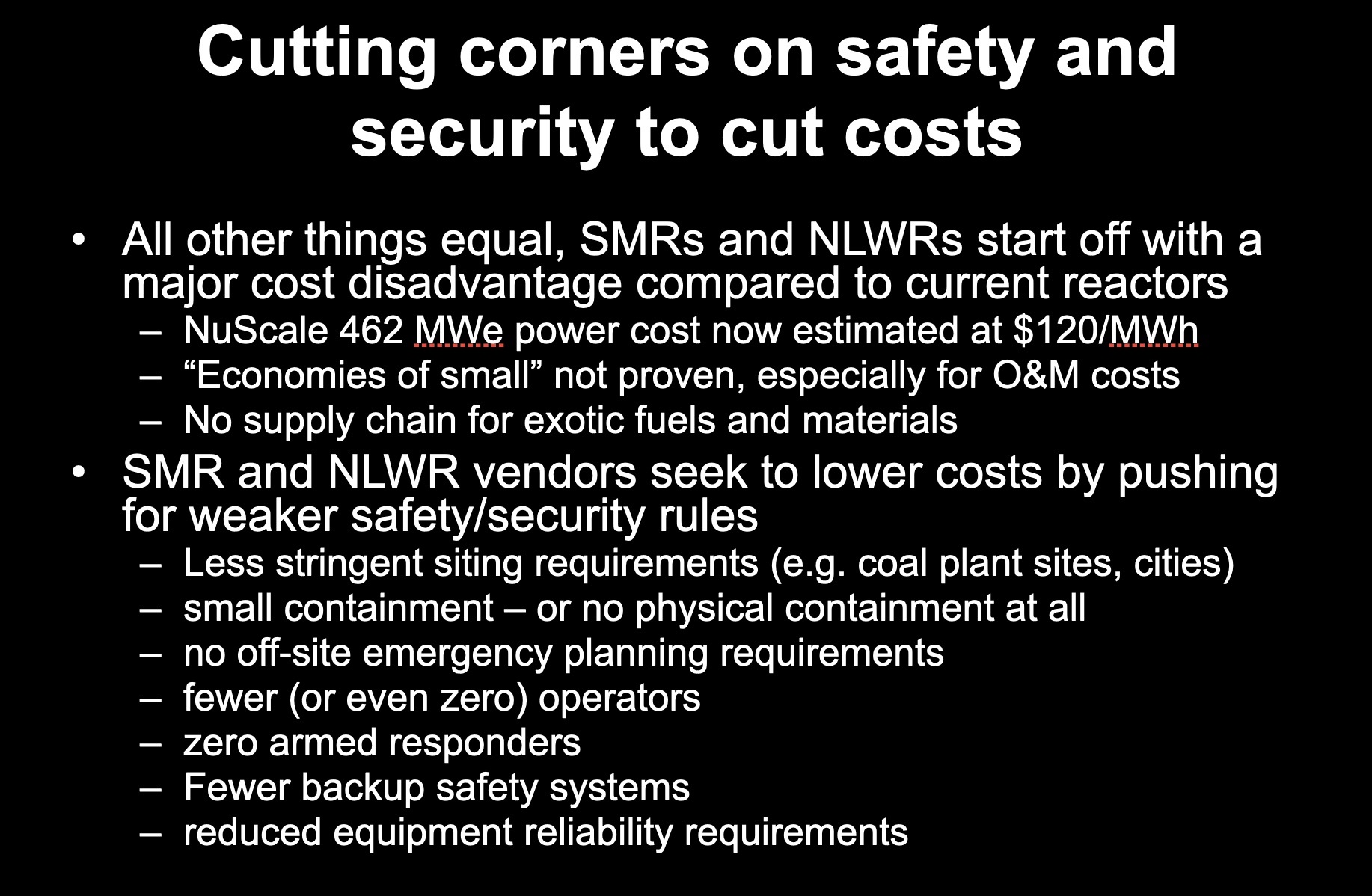
The highly enriched uranium needed for most SMRs poses another risk – as it is useful for nuclear weapons, and therefore attractive to terrorists, and to countries seeking to get nuclear weapons.
So there has been some awareness of safety and security problems amongst critics, especially in the environmental movement. However, this is the first time that I’ve seen the corporate media speak up about this. As the author quotes questions raised in the House of Lords, it looks as though this issue is at last coming to the fore.
I guess that I should not be surprised that the issue of security of Small Nuclear Reactors is at last going to be taken seriously by The Establishment. After all, the examination of the huge and complicated difficulties raised in trying to organise security of SMRs eventually boils down to costs again – “Finally, who pays the piper?”
Oops! Trump accidentally fired hundreds of federal workers who maintain our nuclear weapons
Mass layoffs now paused at US nuclear weapons agency.
-ABC News’ Jay O’Brien, https://abcnews.go.com/Politics/live-updates/trump-2nd-term-tariffs-trade-war/?id=118643360&entryId=118833343
The Department of Energy has paused the firings of hundreds of employees who work for a key agency maintaining the U.S. nuclear weapons stockpile, multiple sources tell ABC News.
Managers with the National Nuclear Security Administration (NNSA) are frantically calling employees back and telling them that — as of right now — they’re not fired, despite some receiving termination emails and phone calls on Thursday. Their badges are getting turned back on and access to federal systems is being restored, at least temporarily.
Hundreds of probationary employees were terminated Thursday night in the mass Trump administration layoffs. The move prompted concerns of a national security risk because the agency is responsible for maintaining U.S. nuclear weapons, transporting them, and nuclear counterterrorism, among other missions.
NNSA held an all-staff meeting Friday morning, announcing the DOE had agreed to pause the layoffs, due to the agency’s national security mission.
NNSA staff tell ABC News they are in a holding pattern. They’re still bracing for firings, but possibly not as widespread.
Chernobyl nuclear power station hit by ‘Russian drone’
Despite hitting the nuclear plant, the small fire was quickly contained and officials said
there was no apparent radiation leak. The Chernobyl nuclear power station
was hit overnight in an apparent drone strike, International Atomic Energy
Agency (IAEA) has said. Ukrainian president, Volodymyr Zelensky, said a
Russian drone strike with a “high explosive warhead” hit the outer
shelter of the nuclear plant. The IAEA said that a UAV hit the shelter
protecting the site at approximately 1.50am local time.
Footage from lastnight, showing a Russian Drone striking the Containment Structure around
Reactor No. 4 at the Chernobyl Nuclear Power Plant (ChNPP) in Northern
Ukraine, as well as the extent of the Damage from inside the Containment
Structure.
iNews 14th Feb 2025,
https://inews.co.uk/news/world/chernobyl-nuclear-power-station-hit-by-russian-drone-3535413
Warning sent about need for strategic policing reform to address security of SMRs
New Civil Engineer, 2 Feb, 2025 By Tom Pashby
Security concerns have been raised following the publication of the draft National Policy Statement for nuclear energy which would change where small modular reactors (SMRs) could be situated.
National Policy Statement for nuclear energy generation (EN-7) was published in draft form on 6 February following an announcement by the prime minister about the slashing of legislation aroudn the development of nuclear energy generation projects………………………………….
Limited details about security in EN-7 raises policing questions
Despite EN-7 being 64 pages, just two lines are dedicated to specifically addressing the security of SMRs.
The proposed proliferation of SMRs in the UK presents a novel nuclear security risk because of there potentially being many more smaller nuclear-licensed sites which are closer to people and property than gigawatt-scale reactors which tend to be in remote coastal locations.
King’s College London Centre for Science & Security Studies research fellow Ross Peel previously told NCE that security planning for SMRs in the UK is “not where it should be”.
In a section titled “Security of Site”, EN-7 says “Ensuring that the proposed nuclear infrastructure will be secure is vital. The Security Considerations section of EN-1 addresses security considerations in detail.
“The applicant should engage with the Office for Nuclear Regulation (ONR) as part of early engagement on securing a Nuclear Site Licence to understand what steps will be required to comply with relevant site security requirements.”
Recent analysis by the Alan Turing Institute’s Centre for Emerging Technology and Security said that policing capability was not up to scratch to protect SMRs.
Policing SMRs would require a significant uplift in funding and workforce at the Civil Nuclear Constabulary (CNC) which is run by the Civil Nuclear Police Authority (CNPA). The CNPA is an executive non-departmental public body, sponsored by the Department for Energy Security and Net Zero (DESNZ).
Local police forces, overseen by the Home Office, could also be required to increase their capacity to respond to CBRN (chemical, biological, radiological and nuclear) incidents.
It is currently unclear how any resource uplift would be funded, and which bodies would provide that funding. As things stand, gigawatt-scale nuclear power sites’ security is funded by the developers themselves.
The business model for SMRs is not yet settled, with different developers proposing different management mechanisms.
Existing policing model does not accommodate complex demands of SMRs
Former police investigations and review commissioner Scotland and co-author of the Centre for Emerging Technology and Security analysis on SMR policing John McNeill said: “The ONR can specify security standards for SMRs, but they cannot require policing bodies to comply with their requirements.
“ONR can specify, approve, or reject, security arrangements, and vary these in response to changes in the threat assessments. But they cannot require any Police and Crime Commissioner (PCC) or Chief Constable (CC) to assign resources to meet their defined standards. Not even [the government] can direct them.
“Policing of airports and football grounds, even schools and educational campuses, shows how hard this will be to fund fairly…………………………………………………………….
“The existing policing model does not readily accommodate the complex demands of responding to the protection of the critical national infrastructure, nor a spread of SMRs.
It’s an outdated model that is not fit for this purpose. Since 2012 the 43 local (directly elected) policing bodies have set the priorities and assigned the budgets, for their police areas.
“We have already highlighted the complexities of policing a proliferation of SMRs in new areas of the country. Policing will need to extend their capability and capacity to respond. And meet the associated costs. It will not be enough to promise a reduction in their electricity bills sometime in the future!
“In short, the deafening silence from the Home Office and policing bodies is not reassuring to apprehensive communities who may have an SMR (or more) in their back yard.
“Finally, who pays the piper? Contractors will baulk at paying for local security. Site security may be less problematic.”
Sheffield Hallam University hosts the Centre of Excellence in Terrorism, Resilience, Intelligence and Organised Crime Research (Centric).
Centric professor in governance and national security Fraser Sampson co-authored the policing reform analysis with McNeill.
Sampson said: “The introduction of SMRs (and now associated data centres) is being presented as wholly different from whatever has gone before. That means the policing and security arrangements will need to be wholly different as they are the solution to the wrong problem.
“The engineering, environmental and economic noises are deafening but so is the silence on the extraordinary challenges that this will bring for community-level policing and resilience.
Policing and security are a network of systems. Turbocharging one part of a system will only pay off if the rest of the system can keep up – otherwise, the fast bit has to wait for the rest. No one wants to be responsible for the weakest link in the security chain.
“Workforce vetting has proved challenging enough for policing; an exponential increase in both volume and speed of reliable vetting must have a significant resource impact but add in risks from supply chain integrity, cyber-attacks and insider threats.”
Sampson said that the International Atomic Energy Agency (IAEA) “states more than half of radioactive [materials] thefts/losses since 1993 occurred during authorised transit.
“Where is the reassurance coming from that proliferation will improve these figures? We’re not dealing with Swampy anymore.”
Concerns about security of SMRs raised in parliament
In a debate about SMRs in the House of Lords, backbench Labour peer Lord Harris of Haringey asked about the potential increased demand on nuclear policing. The debate took place on 22 January 2025, before the publication of EN-7.
Outside of parliament, Harris is chair of the National Preparedness Commission (NPC), which works “to promote policies and actions to help the UK be significantly better prepared to avoid, mitigate, respond to, and recover from major shocks, threats and challenges”.
In the Lords debate, Harris asked: “What consideration has been given to who will protect and police modular nuclear reactors?
“Will it be the Civil Nuclear Constabulary, which would mean covering far more sites than it currently does, or will it be the other police forces?
“What discussions has the Minister had with his colleagues at the Home Office?”……………………………………………………………………..
https://www.newcivilengineer.com/latest/warning-sent-about-need-for-strategic-policing-reform-to-address-security-of-smrs-12-02-2025/
Would a fallout shelter really protect you in a nuclear blast?

By Elana Spivack,, 9 Feb 25, https://www.livescience.com/physics-mathematics/would-a-fallout-shelter-really-protect-you-in-a-nuclear-blast
Nuclear bunkers aren’t a foolproof way to stay safe during a nuclear attack. Here’s why.
No other human-made catastrophes can wreak more destruction than a nuclear bomb. Luckily, bomb shelters and bunkers can protect us, right?
The truth is that these structures’ ability to shield people from the potent heat and blast of a nuclear bomb varies.
“It all depends on where the bunker is and the quality of the bomb,” Norman Kleiman, an associate professor of environmental health sciences and director of the Radiation Safety Officer Training course at Columbia University’s Mailman School of Public Health, told Live Science
According to Kleiman, bomb shelters came about during the Cold War as the U.S. and the Soviet Union hinted at mutually assured destruction by nuclear weapons. Both countries’ governments designed programs to construct shelters in large public buildings, as well as to encourage individuals to build bunkers inside or outside their homes, Kleinman said.
It’s possible that some people marketing these shelters were looking to make a buck amid a crisis. “I’d argue that most of them were being marketed by snake oil salesmen and hucksters,” said Peter Caracappa, executive director of the radiation safety program at Columbia University.
A bomb shelter doesn’t necessarily guarantee safety in the event of a nuclear blast. Its effectiveness comes down to the quality of both the bomb and the shelter.
Modern nuclear weapons are quite different from those of the mid-20th century. Nuclear weapons are much more powerful now, largely because they detonate using a different reaction than they did during World War II and the Cold War. Nuclear bombs in the 1950s had cores made of the radioactive element plutonium or the isotope uranium-235, in which the atoms would split apart in a process called fission, causing a huge explosion. These bombs were a type of nuclear weapon known as atomic bombs, or fission bombs.
“The size of these devices was much smaller, orders of magnitude smaller than current nuclear weapons,” Kleiman said. But now we use bombs that rely on hydrogen fusion to create that boom. These bombs utilize the atomic explosion described merely to trigger a larger, thermonuclear explosion. This explosion can have a blast radius of up to 100 miles (160 kilometers). (For comparison, the bombs used on Hiroshima and Nagasaki had blast radii of about 1 mile, or 1.6 km.) Between these two nuclear weapons, hydrogen fusion-powered thermonuclear bombs are far more powerful than fission-powered atomic bombs.
“If you are 600 miles [1,000 km] away from a thermonuclear device, maybe a shelter would help you,” Kleiman said. “But if you’re anywhere within that blast radius, the blast, the heat, the explosion — those are going to take you out.”
And then there’s the question of radiation, which is the emission of waves and particles in the wake of the blast. Kleiman said it’s possible to build a bunker to protect you from radiation. The walls must be lined with 3 to 5 feet (0.9 to 1.5 meters) of concrete and steel, as well as lead. This lead is embedded in the shelter’s walls and doorways, so an intact bunker poses little risk of exposure to its occupants.
Moreover, the entrance “has to be kind of zigzaggy,” Kleiman said. Radiation travels in straight lines, so a zigzagging entrance would fend it off.
Capacarra broke down a shelter’s protection ability into three components: It must be effective as a structure to withstand an explosion and weather radiation (which, in part, depends on where it is relative to the explosion), how much material is between you and the radiation the explosion emits, and how well it can keep out fallout material, or the material that’s generated and released in a nuclear explosion.
Lethal radiation persists for days after the explosion, so if you were to survive the initial blast, you would have to stay in the bunker to avoid radioactive fallout. So your shelter would need to not only be equipped with supplies for the time you’d need to stay put — about a week, according to Kleiman — but also ventilate without letting in any radiation. This estimated timeline depends on how far the shelter is from the blast.
However, “that doesn’t mean that it’s safe, it just means that the radiation levels are low enough that you’re not going to die of acute radiation poisoning,” Kleiman continued. He added that cancer is one huge long-term risk of radiation exposure, but that and other consequences may not emerge for decades.
So, while a bunker only a few miles from an explosion wouldn’t be very helpful, a good shelter dozens of miles from a blast could protect inhabitants from radiation for days. “It’s really a question of shielding,” Kleiman said — “shielding from heat, shielding from the blast and shielding from radiation.”
If DOGE Goes Nuclear
The risk of messing with the wrong computer system,
The Atlantic By Ross Andersen, 6 Feb 25
You may have never heard of the National Nuclear Security Administration, but its work is crucial to your safety—and to that of every other human being on the planet. If Elon Musk’s Department of Government Efficiency (DOGE) hasn’t yet come across the NNSA, it surely will before too long. What happens after that could be alarming.
As recently as yesterday morning, Musk made clear that DOGE will go line by line through the government’s books looking for fat targets for budget-cutting, including those that are classified—especially those that are classified. DOGE employees are bound to notice NNSA, a 1,800-person organization that sits inside the Department of Energy and burns through $20 billion every year, much of it on classified work. But as they set out to discover exactly how the money is spent, they should proceed with care. Musk’s incursions into other agencies have reportedly risked exposing sensitive information to unqualified personnel, and obstructing people’s access to lifesaving medicine. According to several nuclear-security experts and a former senior department official, taking this same approach at the NNSA could make nuclear material at home and abroad less safe.
The NNSA was created by Congress in 1999 in order to consolidate several Department of Energy functions under one bureaucratic roof: acquiring fissile material, manufacturing nuclear weapons, and preventing America’s nuclear technology from leaking. It has all manner of sensitive information on hand, including nuclear-weapon designs and the blueprints for reactors that power Navy ships and submarines. Even the Australian Navy, which has purchased some of these submarines, is not privy to their precise inner workings, James Acton, a co-director of the Nuclear Policy Program at the Carnegie Endowment for International Peace, told me. more https://www.theatlantic.com/technology/archive/2025/02/elon-musk-doge-nuclear-weapons/681581/?fbclid=IwY2xjawISvTBleHRuA2FlbQIxMQABHUrPZFLfiJr2WzSs_b18hBjw_kfvMiryvsRp7oWFDJKwab_ymjGYJOpnww_aem_tGIEBzt9c5Ia-phQtt1Nvw
1 This Month

of the week – Shut Down Drone Warfare!


Tell the Ukrainian Government to Drop Prosecution of Peace Activist Yurii Sheliazhenko

Petition to revoke the licensing of the Near Surface Nuclear Disposal Facility (NSDF) at Chalk River. https://www.ourcommons.ca/petitions/en/Petition/Details?Petition=e-7247
To see nuclear-related stories in greater depth and intensity – go to https://nuclearinformation.wordpress.com
-
Archives
- April 2026 (68)
- March 2026 (251)
- February 2026 (268)
- January 2026 (308)
- December 2025 (358)
- November 2025 (359)
- October 2025 (376)
- September 2025 (257)
- August 2025 (319)
- July 2025 (230)
- June 2025 (348)
- May 2025 (261)
-
Categories
- 1
- 1 NUCLEAR ISSUES
- business and costs
- climate change
- culture and arts
- ENERGY
- environment
- health
- history
- indigenous issues
- Legal
- marketing of nuclear
- media
- opposition to nuclear
- PERSONAL STORIES
- politics
- politics international
- Religion and ethics
- safety
- secrets,lies and civil liberties
- spinbuster
- technology
- Uranium
- wastes
- weapons and war
- Women
- 2 WORLD
- ACTION
- AFRICA
- Atrocities
- AUSTRALIA
- Christina's notes
- Christina's themes
- culture and arts
- Events
- Fuk 2022
- Fuk 2023
- Fukushima 2017
- Fukushima 2018
- fukushima 2019
- Fukushima 2020
- Fukushima 2021
- general
- global warming
- Humour (God we need it)
- Nuclear
- RARE EARTHS
- Reference
- resources – print
- Resources -audiovicual
- Weekly Newsletter
- World
- World Nuclear
- YouTube
-
RSS
Entries RSS
Comments RSS
 nuclear-news
