Brexit Could Also Hurt Britain’s Nuclear Research and Safety Inspections http://www.gizmodo.co.uk/2017/01/brexit-could-also-hurt-britains-nuclear-research-and-safety-inspections/ By James O Malley on 28 Jan 2017
Another wrinkle has been added to an already complex Brexit process. Just a small one… Umm.. Nuclear safety.
Politico reports that when we trigger Article 50, not only will we be withdrawing from the European Union, but we’ll also be pulling out of Euratom, the EU agency which oversees nuclear safety and security across the continent.
That’s right. Somehow Europe has configured itself so that Brexit won’t affect our Eurovision membership, but will affect nuclear safety.
The inclusion of Euratom in our middle finger to our continental colleagues was
revealed in a note on the Article 50 bill that has just been put before Parliament.
The upshot of this is that it means Britain will have to hire tonnes of new people itself to help do stuff like carry out nuclear non-proliferation inspections in countries like Iran, authorise the sale of nuclear material, and inspect our own nuclear power plants to make sure that everything is fine. As Politico notes, what makes this particularly complicated is that at the moment Euroatom is the legal owner of all of the actual nuclear materials – and this will have to be transferred to Britain… but then Britain also does a lot of the work reprocessing materials on behalf other members. Basically, it’ll be a bit of a nightmare.
The other really disappointing outcome from Brexit could also be Britain pulling out of Euratom’s Research & Development wing, which is currently working on making fusion power a reality. At the moment, we’re helping construct a brand new massive fusion reactor in France, but Brexit could put that in jeopardy. [Politico]
January 28, 2017
Posted by Christina Macpherson |
politics, safety, UK |
Leave a comment

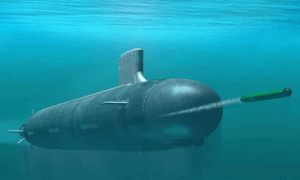 Scottish cold war nuclear submarine collision kept secret for 43 years
Documents published by CIA reveal crash between US and Soviet subs a few miles off coast of Scotland in 1974, Guardian, Matthew Weaver, 26 Jan 17, Two nuclear submarines from rival sides in the cold war collided a few miles off the coast of Scotland in an incident that was covered up for 43 years.
The potentially catastrophic crash occurred in November 1974 when the SSBN James Madison, armed with 16 Poseidon nuclear missiles, was heading out of the US naval base at Holy Loch, 30 miles north-west of Glasgow.
Soon after leaving the port it hit an unidentified Soviet submarine that had been sent to tail it, according to a cable to then US secretary of state Henry Kissinger, marked “secret eyes only” [pdf].
The cable, sent by national security adviser Brent Scowcroft, said: “Have just received word from the Pentagon that one of our Poseidon submarines has just collided with a Soviet submarine.
“The SSBN James Madison was departing Holy Loch to take up station when it collided with a Soviet submarine waiting outside the port to take up trail.
“Both submarines surfaced and the Soviet boat subsequently submerged again. There is no report yet of the extent of damage. Will keep you posted.”
The cable was published by the CIA on 17 January as part of a mass release of more than 12m pages of previously classified reports in 930,000 documents.
The cable corroborates an until-now unconfirmed report on the incident in the Washington Post on 1 January 1975 by the investigative journalist Jack Anderson. He reported that the collision left a 9ft scratch on the side of the James Madison and that the two submarines came within inches of sinking one another.
Another document marked “top secret” [pdf]released in the same batch expressed alarm that the news of the collision had leaked.
It said: “On 3 January, the NID [National Intelligence Daily] ran an item on the collision just off Holy Loch of US Polaris submarine and a Soviet attack submarine. Unfortunately, Jack Anderson had run the same news in the Washington Post a day or two earlier.
“This pre-emption on Anderson’s part forced the surfacing (no pun intended) of a piece of information in a current intelligence 2 months after the event occurred. …..
Kate Hudson, general secretary of the Campaign for Nuclear Disarmament, said the secret cable exposed the “enormous risks” of nuclear weapons.
“The history of nuclear weapons is a history of near misses, accidents, potential catastrophes and cover-ups. This latest example joins 25 other near misses that could have led to nuclear war.”
CND is calling for an inquiry into Trident, the successor to the Poseidon programme, after it emerged that a malfunctioning missile with the potential to carry a nuclear warhead was forced to self-destruct in mid-air off the US coast last June.
Hudson added: “These enormous risks have to be acknowledged particularly when we also now face the increasing likelihood of cyber-attack on nuclear weapons systems. With advancing technological developments added to the already dangerous mix there can be no confidence that nuclear weapons are a credible part of British security in the 21st century……… https://www.theguardian.com/us-news/2017/jan/25/nuclear-submarine-collision-cold-war-cia-scotland
January 27, 2017
Posted by Christina Macpherson |
history, incidents, secrets,lies and civil liberties, UK |
Leave a comment
At least one person has died in an explosion at a power plant in central Russia, media are reporting, citing Emergencies Ministry sources. The blast caused metal structures to collapse over a 600-square-meter area.
“According to preliminary reports, a gas mixture exploded at the power plant,” TASS news agency reported, citing a source at the Emergencies Ministry of the Penza region.

The total number of victims is yet unclear, the source said. However, TASS has reported that one person died, citing the Russian Center for Disaster Medicine.
The building of the TPP-1 power plant has been partially destroyed, and some 600 square meters of its roof are said to have collapsed, according to RIA Novosti, citing a source at Emergencies Services.
The incident has not affected the city’s heating supply, TASS reported, citing the head of the Emergencies Ministry’s press service, Anna Shupilova.
“The incident did not affect the heating system of the city; the whole heating system is operating in normal mode,” she said.
DETAILS TO FOLLOW
https://www.rt.com/news/375147-penza-power-plant-explosion/

Source for this diagram ; http://www.gazprom.com/f/posts/01/207595/annual-report-2012-eng.pdf
Background on Plant
The Novocherkasskaya GRES coal-fired power plant is owned by OGK-2 (Second Generating Company of the Wholesale Power Market), a subsidiary of the Russian gas giant Gazprom. The plant is located near the city of Novocherkassk, and consists of eight 264-MW coal-fired units. Construction was originally approved in 1952; the first unit went online in 1965, and the final, eighth unit in 1972. The plant has since been converted to run on gas as a supplementary fuel, but the primary fuel is still coal.[1][2]
The plant was formerly owned by OGK-6, which was also majority-owned by Gazprom; Gazprom merged OGK-6 into OGK-2 in November 2011. The boilers in Units 6 and 7 were replaced in 2005 and 2009, respectively.[3]
Description of Expansion
In 2011, OGK-2 signed a contract for the construction of a 330-MW ninth coal-fired unit at Novocherkasskaya. The construction contractor is SWECO Soyuz Engineering, a subsidiary of SOYUZ Holding. Unit 9 will run on circulating fluidized bed technology. Total construction cost will be about $700 million.[3] The boiler was built by U.S. company Foster Wheeler.[4] Completion was originally scheduled for November 2015.[5] In July 2015, the provincial government said the unit was on track to be completed in late 2015 or early 2016.[6]
The unit was successfully tested in December 2015.[7] The unit was completed and brought online in July 2016.[8
http://www.sourcewatch.org/index.php/Novocherkasskaya_GRES_power_station
January 26, 2017
Posted by arclight2011part2 |
incidents, Russia |
1 Comment
What could go wrong? Nuclear energy giant wants safety rules relaxed https://www.rt.com/uk/374788-nuclear-plant-edf-safety/ 24 Jan, 2017 A nuclear energy company is trying to keep Scotland’s aging power stations open years longer than is allowed under current government regulations.
EDF Energy is asking the UK government’s nuclear watchdog to allow its power station in Hunterston, North Ayrshire, to continue running until it is 47 years old, and its facility in Torness, East Lothian, to remain open until it is 42 years old.
The power plants were designed to last only 30 years, according to investigative news site the Ferret.
The revelation has caused concern among experts and politicians, who fear continued use of the nuclear reactors could put the public at risk.
EDF Energy, which is majority-owned by the French government, has requested the Office for Nuclear Regulation (ONR) to permit an increase in the proportion of cracked graphite bricks in the two power plants from 10 to 20 percent.
In order to generate nuclear energy, thousands of graphite bricks used to make up reactor cores are bombarded with radiation. When these bricks begin to crack, it threatens the plant’s ability to make a safe shutdown.
The Hunterston and Torness power plants have both already seen their lifespans extended by seven years, until 2023 and 2030 respectively.
A report for the Scottish Green Party by Pete Roche, of the Edinburgh Energy and Environment Consultancy, quotes a senior EDF figure as saying the lifespans of the plants could be extended even further.
EDF Scottish Business Director Paul Winkle told a fringe meeting at the Scottish National Party (SNP)’s 2016 conference this will depend on the company’s assessments, according to the report.
“The current life for Hunterston is 2023 and Torness is 2030, and that is based on our assessment of aging mechanisms in those plants and being absolutely sure that when they are shut down they are still safe to operate.
“But to go beyond that we will do assessments and it may be possible to make some small further extensions, but we will not operate them beyond when we are confident they are safe to operate.
“Our current estimate is, with Hunterston, we get to a point where, if we go beyond 2023 there will be uncertainty. We will do more analysis in due course. Those dates are based on our best judgement.”
Scottish Green MSP Ross Greer warned local communities would be concerned by the proposals.
“The lack of public consultation is just unacceptable,” he said.
“If we did this properly, the public would reject an aging, cracking, safety hazard. The Scottish government’s relaxed position on nuclear needs [to be] challenged. We simply don’t need to sweat these plants and add to our toxic legacy.”
January 25, 2017
Posted by Christina Macpherson |
safety, UK |
Leave a comment
The terrifying geography of nuclear and radiological insecurity in South Asia, Bulletin of the Atomic Scientists, 22 JANUARY 2017 Hannah E. Haegel and Reema Verma Terrorism involving nuclear or radiological materials remains one of the gravest threats to humanity and to global stability. It was a central concern throughout President Obama’s tenure, with efforts to harness international initiatives coming to the fore at the
Nuclear Security Summits. The incoming administration, however, should take a fresh look at a region of the world that hosts two states with nuclear weapons and a serious terrorism problem: South Asia.
Analysis on South Asia tends to occur in silos that focus on either nuclear risks or terrorism risks; fewer studies investigate the overlap between the two.
But we’ve mapped the geography of high-risk locations and violence by non-state actors—that is, the target threat environment—in South Asia’s two states with advancing nuclear weapons programs, India and Pakistan. The low probability but high potential cost of an incident of nuclear or radiological terror merits greater attention from citizens and policy makers alike, and the requisite means, motive, and opportunities for an incident of terror via weapons of mass destruction or disruption converge in South Asia.
The upcoming Summit on Countering WMD Terrorism, to be hosted by India in 2018, offers an opportunity bring attention to the issue. But preparations must begin well in advance of that summit, if the slow-moving machine of bureaucratic change is to be turned to address the institutional and governance problems India and Pakistan exhibit in regard to countering WMD terrorism.
Means to achieve mass destruction or disruption. South Asia is home to expanding and maturing nuclear weapons programs and widespread, frequent, and organized domestic and cross-border terror attacks. Recent incidents include a September 18 assault by terrorists who crossed the border from Pakistan to attack an Indian Army camp at Uri. This incident was followed by Indian retaliation, in the form of a publicly touted “surgical strike.” But this clash is one of many. Overall, the region (Afghanistan, Bangladesh, Bhutan, India, Maldives, Nepal, Pakistan, and Sri Lanka) was host to 22,077 terrorist incidents between 2010 and 2015, some 36 percent of the global total. Nearly half of all terrorist attacks in 2015 occurred in four countries: Afghanistan, Iraq, India, and Pakistan. India and Pakistan alone suffered a total of 13,322 incidents and 5,471 fatalities between 2010 and 2015. The Global Terrorism Database at the University of Maryland classified 30 percent of those attacks as armed assaults.
The different modalities of nuclear or radiological terrorism include: an attack on a nuclear facility, theft of nuclear or radiological material and construction of a “dirty bomb,” and theft of a nuclear weapon. A fourth, and often overlooked, path by which terrorists could precipitate a nuclear incident is to stage escalatory attacks that draw two states into a nuclear crisis or conflict.
The conditions for all four routes are prime in South Asia’s nuclear and radiological threat environment.
The motive for a nuclear or radiological terror attack. A number of violent non-state actors have alluded to their interest in pursuing WMD or precipitating a nuclear event. Some have been even more explicit, demonstrating intent to target a nuclear facility…….http://thebulletin.org/terrifying-geography-nuclear-and-radiological-insecurity-south-asia10416?platform=hootsuite
January 25, 2017
Posted by Christina Macpherson |
ASIA, safety |
Leave a comment
 British unarmed nuclear missile ‘veered towards US mainland’ in test firing http://www.news.com.au/world/british-unarmed-nuclear-missile-veered-towards-us-mainland-in-test-firing/news-story/1c54697418967b79ff406bc805104709 JANUARY 23, 2017 THE UK government has been accused of a cover up after failing to disclose that an unarmed nuclear missile may have been mistakenly fired at the US mainland.
January 23, 2017
Posted by Christina Macpherson |
incidents, UK |
Leave a comment
 Safety fears over EDF bid to permit doubling of nuclear reactor cracks The Herald, 22 Jan 17 THE nuclear industry is secretly bidding to relax safety standards to allow the doubling of the number of cracks in the radioactive cores of Scotland’s ageing reactors
EDF Energy is asking for the safety rules to be rewritten so that it can keep running its nuclear power stations at Hunterston in North Ayrshire and Torness in East Lothian until they are at least 47 and 42 years old. They were originally designed to last 30 years.
Prolonged radiation bombardment causes the thousands of graphite bricks that make up reactor cores to crack, threatening a safe shutdown. But EDF is asking the UK government’s watchdog, the Office for Nuclear Regulation (ONR), to permit an increase in the proportion of cracked bricks from 10 to 20 per cent.
The revelation has sparked alarm from politicians and campaigners, who say that the industry is “gambling with public safety” and the public must be consulted. One leading expert argues that Hunterston should be immediately shut down
Hunterston started generating electricity in 1976. EDF currently plans to keep it operating until 2023, and the ONR is due to conclude a safety review of its future operation at the end of January
On January 13 EDF closed down one of Hunterston’s two reactors for planned maintenance, including inspections of cracking in the graphite core. The reactor is due to be restarted on February 10.
Torness was started up in 1988 and is currently planned to operate until 2030. The company, however, has said that it is hoping that the lives of both nuclear stations can be extended by a few more years.
EDF’s bid to relax safety standards at Hunterston and Torness is highlighted in a new report today for the Scottish Greens. It concludes that the risks from graphite cracking are serious and argues that an international convention demands that environmental risks must be assessed, alternative energy sources considered and the public consulted.
According to the report’s author, Edinburgh-based anti-nuclear campaigner and consultant, Peter Roche, Scotland doesn’t need nuclear electricity. “Despite the fact cracks are beginning in the graphite core of these reactors, increasing the risk for us all, the public has still not been asked for its opinion once,” he said……..
John Large, a consulting nuclear engineer, pointed out that the integrity of the graphite bricks was vital to nuclear safety. If they failed, they could block channels that enable control rods to be inserted to close down reactors and prevent them from overheating.
“Ageing problems like this serious cracking of the graphite bricks at the heart of each reactor are deeply worrying, so much so that these nuclear plants should now be permanently shut down,” he said.
Large accused EDF and the ONR of “false confidence” in believing they fully understood graphite cracking, which was difficult to predict. “The Hunterston B nuclear reactors now in their forty-first year of operation, should be immediately shut down,” he stated….
The company also argued that environmental impact assessments – and, by implication – public consultations were not required for life extensions at Hunterston and Torness..
ONR’s deputy chief inspector Mark Foy confirmed that EDF had asked for the proportion of graphite bricks allowed to be cracked to rise from 10 to 20 per cent. “That is provided to us in the form of a comprehensive justification, which we will assess to see whether we’re satisfied it’s safe to operate,” he said…….. http://www.heraldscotland.com/news/15039668.Safety_fears_over_EDF_bid_to_permit_doubling_of_nuclear_reactor_cracks/
January 23, 2017
Posted by Christina Macpherson |
France, safety |
Leave a comment
 Corroded holes found inside nuclear plant in Shimane http://mainichi.jp/english/articles/20170119/p2a/00m/0na/002000c January 19, 2017 (Mainichi Japan) Japanese versionMATSUE — Nineteen corroded holes have been discovered in air ducts inside the No. 2 reactor at the Shimane nuclear power plant, the Mainichi Shimbun has learned. As a consequence of this discovery, the Nuclear Regulation Authority decided on Jan. 18 to order all electric power companies to carry out checks on ducts inside all of their nuclear power plants.
The corroded holes were discovered when insulating material — that had been wrapped around the ducts — was removed during a check in December 2016 at the No. 2 reactor at the Shimane plant, which is operated by Chugoku Electric Power Co. The largest hole of the 19 was found to be approximately 30 centimeters by 100 centimeters in size.
Corroded holes in ducts present a threat as there is a chance that radioactive material could flow into the central control room via the holes during an accident — thereby exposing power plant staff to radiation.
January 20, 2017
Posted by Christina Macpherson |
Japan, safety |
Leave a comment
Neighbouring countries concerned about the risk of a Belgian Nuclear meltdown http://www.theecologist.org/News/news_analysis/2988553/neighbouring_countries_concerned_about_the_risk_of_a_belgian_nuclear_meltdown.html 19th January, 2017
On 10 January 2017 a new emergency plan was presented in a commission in Belgium’s Parliament. The evacuation perimeter was conveniently halved to 10km to avoid an evacuation of Belgium’s second and third cities in case of a meltdown. The plan has been called totally inadequate. NICK MEYNEN reports
It’s not the metaphorical political meltdown of Belgium that neighbouring governments fret about, but a nuclear meltdown. The Netherlands, Luxemburg and Germany have all asked Belgium’s government to close its most risky reactors with immediate effect. The city of Aachen and 30 other major cities and districts are also suing Belgium for not closing them. The German government no longer trusts the Belgian Nuclear Safety Agency and wants permission for its own agency to do safety checks. So far, foreign pressure is falling on deaf ears.
Belgians have even more reasons to worry. On 10 January 2017 a new emergency plan was presented in a commission in Belgium’s Parliament. The evacuation perimeter was conveniently halved to 10km to avoid an evacuation of Belgium’s second and third cities in case of a meltdown. Nuclear Transparency Watch, a European organisation created by Members of the European Parliament of all political colours, called Belgium’s plans totally inadequate and incoherent.inad
So rather than signing agreements with Belgium about sharing information, where are the economic sanctions for Belgium? There are both EU and UN regulations that could shut the reactors down, as more than a million people requested a year ago. Belgium’s neighbours have reasons to get tough.
Belgium is your backyard
Belgium’s recent nuclear history reads like a mirror of Germany’s, where the highest court decided that Merkel’s decision to speed up the nuclear phase-out after the Fukushima incident was justified. Belgium did just the opposite. The Belgian government reversed a nuclear phase-out law from 2003 only a year after the Japanese reactors exploded, pushing retirement back from 2015 to 2025. The last bill to postpone retirement with 10 years was approved at the end of 2016. The Government can ‘take comfort’ at the fact that 2017 started better than 2016: unlike last year when only a week incidents after which the first incident (in which one person got severely injured) took place with an unexpected shutdown as result.
Yes, the protesting former president of the European Parliament Martin Schulz was born and raised close to Belgium’s border and yes, I was born and raised 15 km from four nuclear reactors in Doel, in the city of Antwerp (half a million people). But before you call us NIMBY (Not In My Back Yard) activists: our backyard contains six to seven million people that in the event of a nuclear meltdown would never be able to go home again. Depending on the wind direction on the day of a meltdown, a radioactive cloud will poison and kill many additional people in London, Paris, Amsterdam or Berlin as well. The possibility of that scenario has increased in recent years.
Cracks, extortion and sabotage
In 2012 it became known that the mantle around the old Tihange 2 reactor shows signs of erosion. Further research in 2015 concluded that there are thousands of cracks of up to 15 cm. Later that year, 10 security incidents were recorded in Tihange in just six weeks, leading Belgium’s nuclear safety agency to suspend four members of staff and raise serious questions about the safety culture. In 2015, Belgian’s nuclear plants spent longer in shutdown or “maintenance” than in being operational.
Who said nuclear energy was a reliable source of energy?
But it is the Doel plant that reads like the script of an apocalyptic Hollywood blockbuster, part one. The plant was sabotaged in 2014. The sabotage was found before things spiralled out of control, but the culprit(s) remain unknown. A year later, police found hidden cameras that followed the movements of a nuclear researcher, raising alarming questions about criminals extorting staff. Research also revealed a staggering number of cracks in the mantle that is supposed to keep the Doel 3 reactor in check: 13,047. The cracks are on average 1 to 2 cm wide, but the largest ones are up to 18cm. And with 35 years of operational history, the researched Doel 3 is the second “youngest” of Doel’s four reactors. Belgium’s nuclear safety agency concluded after the tests in Tihange and Doel that the erosion of the mantle was due to normal reactor activity. They can thus be expected to be present in all plants in the world of similar age and to keep multiply through normal reactor use.
The economic and terrorist threats
In terms of potential economic impacts, Doel is by far number 1 in Europe. The major Fukushima disaster knocked 2 to 10% from Japan’s GDP, but when Doel goes into meltdown, the cost is estimated to be 200% of the GDP of Belgium. In such a scenario, GDP won’t really mean much. Most of Flanders and the capital of Europe will become inhabitable zones, sending millions of refugees to France, The Netherlands, Germany and the UK. Will they open their borders for a flood of immigrants from Belgium?
And then there’s terrorism. For the last two years, Belgian authorities have claimed we are living under emergency level 3, just one notch below the State of Emergency that France is living under. This means a terrorist threat is “serious” and an attack “probable”. France has already experienced a series of undeclared drone flights over various nuclear power stations. The Bulletin of the Atomic Scientists later explained that the danger of that is not about drones carrying small explosives and crashing on the plant because in theory a nuclear plant can cope with a jumbo jet crash (although this has never been tested). But drones can easily carry AK47s and drop them inside the territory of the plant, even at night.
In another scenario laid out by the atomic scientists, drones can attack the power lines and then the diesel generator back-up system. It requires a bit more organisation than driving a truck into a crowd, but less than teaching a terrorist team how to fly a jumbo jet, hijack several at the same time and fly them into the two WTC towers and the Pentagon. As we have learned the hard way in recent years, Belgium also happens to be a favourite hide-out for terrorists. Belgium’s authorities want us to believe that the terrorist risk has never been so high, but they don’t want you to connect that with our nuclear plants and with unexplained drone flights over nuclear plants.
Corrupted centralised power plants
All this raises the question: is it still smart to count on a few vulnerable centralised power plants? And what about the waste of state money that seems to come hand-in-hand with nuclear power? Bulgaria wasted 1,221 billion euro on a plant that never materialized. Bulgaria is also still spending money to deal with the legacy of uranium mining, even though the last mine closed in 1992. When I visited the surroundings of the now closed Buhovo mine, stones of a size that would fit a child’s hand showed radiation 100s of times above normal. They were ready to be picked up and played with at a popular local picnic place.
Conflicts against nuclear power plants and the formulation of constructive alternatives are popping up outside Europe as well: from India to Japan. So are the conflicts and externalised costs around the uranium that now feeds most of our reactors, from Niger to Namibia. Although there’s one other country that has become the EU’s main supplier: Russia. But as environmental justice, geopolitical weakening or financial debacles don’t seem to stop the nuclear addiction: will it have to take another meltdown? Policymakers seem to have forgotten that our countries signed up to the precautionary principle, which the EU still has in its Treaty. Maybe it’s time that the Germans, who are kicking nuclear out of their country, march once more on Belgium. As a Belgian citizen I do kindly request to come in peace and only armed with the renewable energy solutions that swept your country.
This Author
Nick Meynen was the organiser of a 72km long anti-nuclear energy march from Doel to Brussels. He works for the ENVJUSTICE project and writes articles and books on environmental issues.
January 20, 2017
Posted by Christina Macpherson |
EUROPE, safety |
Leave a comment

 An engineer’s perspective on the Indian Point shutdown http://enformable.com/2017/01/an-engineers-perspective-on-the-indian-point-shutdown/?utm_source=feedburner&utm_medium=email&utm_campaign=Feed%3A+Enformable+%28Enformable%29 Author: Karl Grossman, 11 Jan 17
The good—the very good—energy news is that the Indian Point nuclear power plants 26 miles north of New York City will be closed in the next few years under an agreement reached between New York State and the plants’ owner, Entergy.
New York Governor Andrew Cuomo has long been calling for the plants to be shut down because, as the New York Times related in its story on the pact, they pose “too great a risk to New York City.” Environmental and safe-energy organizations have been highly active for decades in working for the shutdown of the plants. Under the agreement, one Indian Point plant will shut down by April 2020, the second by April 2021.
They would be among the many nuclear power plants in the U.S. which their owners have in recent years decided to close or have announced will be shut down in a few years.
This comes in the face of nuclear power plant accidents—the most recent the ongoing Fukushima nuclear disaster in Japan—and competitive power being less expensive including renewable and safe solar and wind energy.
Last year the Fort Calhoun nuclear plant in Nebraska closed following the shutdowns of Kewanee in Wisconsin, Vermont Yankee in Vermont, Crystal River 3 in Florida and both San Onofre 2 and 3 in California. Nuclear plant operators say they will close Palisades in Michigan next year and then Oyster Creek in New Jersey and Pilgrim in Massachusetts in 2019 and California’s Diablo Canyon 1 in 2024 and Diablo Canyon 3 in 2025.
This brings the number of nuclear plants down to a few more than 90—a far cry from President Richard Nixon’s scheme to have 1,000 nuclear plants in the U.S. by the year 2000.
But the bad—the very bad—energy news is that there are still many promoters of nuclear power in industry and government still pushing and, most importantly, the transition team of incoming President Donald Trump has been “asking for ways to keep nuclear power alive,” as Bloomberg news reported last month.
As I was reading last week the first reports on the Indian Point agreement, I received a phone call from an engineer who has been in the nuclear industry for more than 30 years—with his view of the situation.
The engineer, employed at nuclear plants and for a major nuclear plant manufacturer, wanted to relate that even with the Indian Point news—“and I’d keep my fingers crossed that there is no disaster involving those aged Indian Point plants in those next three or four years”—nuclear power remains a “ticking time bomb.” Concerned about retaliation, he asked his name not be published.
Here is some of the information he passed on—a story of experiences of an engineer in the nuclear power industry for more than three decades and his warnings and expectations.
THE SECRETIVE INPO REPORT SYSTEM
Several months after the accident at the Three Mile Island nuclear plant in Pennsylvania in March 1979, the nuclear industry set up the Institute of Nuclear Power Operations (INPO) based in Atlanta, Georgia. The idea was to have a nuclear industry group that “would share information” on problems and incidents at nuclear power plants, he said.
If there is a problem at one nuclear power plant, through an INPO report it is communicated to other nuclear plant operators. Thus the various plant operators could “cross-reference” happenings at other plants and determine if they might apply to them.
The reports are “coded by color,” explained the engineer. Those which are “green” involve an incident or condition that might or might not indicate a wider problem. A “yellow” report is on an occurrence “that could cause significant problems down the road.” A “red” report is the most serious and represents “a problem that could have led to a core meltdown”—and could be present widely among nuclear plants and for which action needs to be taken immediately.
The engineer said he has read more than 100 “Code Red” reports. What they reflect, he said, is that “we’ve been very, very lucky so far!”
If the general public would see these “red” reports, its view on nuclear power would turn strongly negative, said the engineer.
But this is prevented by INPO, “created and solely funded by the nuclear industry,” thus its reports “are not covered by the U.S. Freedom of Information Act and are regarded as highly secretive.” The reports should be required to be made public, said the engineer. “It’s high time the country wakes up to the dangers we undergo with nuclear power plants.”
THE NRC INSPECTION FARCE
The U.S. Nuclear Regulatory Commission (NRC) is supposed to be the federal agency that is the watchdog over nuclear power plants and it frequently boasts of how it has “two resident inspectors” at each nuclear power plant in the nation, he noted.
However, explained the engineer, “the NRC inspectors are not allowed to go into the plant on their own. They have to be escorted. There can be no surprise inspections. Indeed, the only inspections that can be made are those that come after the NRC inspectors “get permission from upper management at the plant.”
The inspectors “have to contact upper management and say they want to inspect an area. The word is then passed down from management that inspectors are coming—so ‘clean up’ whatever is the situation is.”
“The inspectors hands are tied,” said the engineer.
THE 60- AND NOW 80-YEAR OPERATING DELUSION
When nuclear power plants were first designed decades ago, explained the engineer, the extent of their mechanical life was established at 40 years. The engineer is highly familiar with these calculations having worked for a leading manufacturer of nuclear plants, General Electric.
The components in nuclear plants, particularly their steel parts, “have an inherent working shelf life,” said the engineer.
In determining the 40-year total operating time, the engineer said that calculated were elements that included the wear and tear of refueling cycles, emergency shutdowns and the “nuclear embrittlement from radioactivity that impacts on the nuclear reactor vessel itself including the head bolts and other related piping, and what the entire system can handle. Further, the reactor vessel is the one component in a nuclear plant that can never be replaced because it becomes so hot with radioactivity. If a reactor vessel cracks, there is no way of repairing it and any certainty of containment of radioactivity is not guaranteed.”
Thus the U.S. government limited the operating licenses it issued for all nuclear power plants to 40 years. However, in recent times the NRC has “rubber-stamped license extensions” of an additional 20 years now to more than 85 of the nuclear plants in the country—permitting them to run for 60 years. Moreover, a push is now on, led by nuclear plant owners Exelon and Dominion, to have the NRC grant license extensions of 20 additional years—to let nuclear plants run for 80 years.
Exelon, the owner of the largest number of nuclear plants in the U.S., last year announced it would ask the NRC to extend the operating licenses of its two Peach Bottom plants in Pennsylvania to 80 years. Dominion declared earlier that it would seek NRC approval to run its two Surry nuclear power plants in Virginia for 80 years.
“That a nuclear plant can run for 60 years or 80 years is wishful thinking,” said the engineer. “The industry has thrown out the window all the data developed about the lifetime of a nuclear plant. It would ignore the standards to benefit their wallets, for greed, with total disregard for the country’s safety.”
The engineer went on that since “Day One” of nuclear power, because of the danger of the technology, “they’ve been playing Russian roulette—putting one bullet in the chamber and hoping that it would not fire. By going to 60 years and now possibly to 80 years, “they’re putting all the bullets in every chamber—and taking out only one and pulling the trigger.”
Further, what the NRC has also been doing is not only letting nuclear plants operate longer but “uprating” them—allowing them to run “hotter and harder” to generate more electricity and ostensibly more profit. “Catastrophe is being invited,” said the engineer.
THE CARBON-FREE MYTH
A big argument of nuclear promoters in a period of global warming and climate change is that “reactors aren’t putting greenhouse gases out into the atmosphere,” noted the engineer.
But this “completely ignores” the “nuclear chain”—the cycle of the nuclear power process that begins with the mining of uranium and continues with milling, enrichment and fabrication of nuclear fuel “and all of this is carbon intensive.” There are the greenhouse gasses discharged during the construction of the steel and formation of the concrete used in nuclear plants, transportation that is required, and in the construction of the plants themselves.
“It comes back to a net gain of zero,” said the engineer.
Meanwhile, “we have so many ways of generating electric power that are far more truly carbon-free.”
THE BOTTOM LINE
“The bottom line,” said the engineer, “is that radioactivity is the deadliest material which exists on the face of this planet—and we have no way of controlling it once it is out. With radioactivity, you can’t see it, smell it, touch it or hear it—and you can’t clean it up. There is nothing with which we can suck up radiation.”
Once in the atmosphere—once having been emitted from a nuclear plant through routine operation or in an accident—“that radiation is out there killing living tissue whether it be plant, animal or human life and causing illness and death.”
What about the claim by the nuclear industry and promoters of nuclear power within the federal government of a “new generation” of nuclear power plants that would be safer? The only difference, said the engineer, is that it might be a “different kind of gun—but it will have the same bullets: radioactivity that kills.”
The engineer said “I’d like to see every nuclear plant shut down—yesterday.”
In announcing the agreement on the closing of Indian Point, Governor Cuomo described it as a “ticking time bomb.” There are more of them. Nuclear power overall remains, as the experienced engineer from the nuclear industry said, a “ticking time bomb.”
And every nuclear power plant needs to be shut down.
January 13, 2017
Posted by Christina Macpherson |
climate change, politics, Reference, safety |
Leave a comment
U.S. lists 17 nuclear reactors with parts from forge under probe, Reuters,10 Jan 17 The U.S. Nuclear Regulatory Commission (NRC) on Tuesday unveiled a letter showing that 17 of the country’s nuclear reactors have parts from Areva SA’s Le Creusot forge in France, which is under investigation for allegedly falsifying documents on the quality of its parts.
The number of reactors was more than the nine the NRC had previously disclosed.
Last month authorities in France opened an investigation into decades of alleged forgery of documents relating to the quality of parts produced at Le Creusot and used in power plants around the world.
Areva, a nuclear and renewable energy firm, furnished the information to the U.S. regulator last month but had urged the agency to keep it private, saying it was material to the business of nuclear power generators. The NRC told Areva it did not consider the information to be so and released it 10 days after receiving it.
The parts at reactors include a reactor head at Xcel Energy Inc’s Prairie Island reactor in Minnesota, reactor vessel heads at two of Dominion Resources Inc’s reactors at the North Anna plant in Virginia, and another vessel head at Dominion’s reactor in Surry, Virginia. Some of the components were made by other companies but include parts from the Le Creusot…….
David Lochbaum, an expert on nuclear energy at the Union of Concerned scientists, said the Le Creusot issue was “troubling from both trust and public safety perspectives” because to a large degree both the NRC and U.S. nuclear power plants depended on vendors to certify their work. http://www.reuters.com/article/us-usa-france-nuclearpower-idUSKBN14U2T0
January 11, 2017
Posted by Christina Macpherson |
safety, USA |
Leave a comment
 Puget Sound’s ticking nuclear time bomb, Crosscut by Glen Milner, 10 Jan 17 “……“Command and Control” shows what can happen when the weapons built to protect us threaten to destroy us, and it speaks directly to Puget Sound citizens: Locally, we face a similar threat in Hood Canal with the largest concentration of deployed nuclear weapons in the United States at Naval Base Kitsap-Bangor.
January 11, 2017
Posted by Christina Macpherson |
- plutonium, Reference, safety, USA, weapons and war |
Leave a comment
 Quake risk for Japanese-French nuclear plant in Turkey lowered to keep costs down, sources say, Japan Times, 8 Jan 17, Government-commissioned research firms have come up with a questionably low estimate for how badly an earthquake could rattle a nuclear power plant being built in Turkey by a Japanese-French venture, sources say.
The estimated “peak ground acceleration” — the term for ground motion caused by a quake — for the plant in the Black Sea province of Sinop is significantly lower than estimates given for quake-prone Japan’s nuclear power plants, and that means it could be an attempt to reduce construction costs, the sources said Saturday.
Turkey is often struck by earthquakes.
The peak ground acceleration for the Sinop plant was estimated at around 400 gal (or 400 cm per second squared), but some experts said it should be “at least 500 gal, based on Japanese standards” and the topography and geography around Sinop.
For instance, the assumed ground acceleration is 620 gal for Kyushu Electric Power Co.’s Sendai nuclear power plant and 856 gal for Kansai Electric Power Co.’s Oi plant.
The assessment was part of a study commissioned by the Agency for Natural Resources and Energy, which is overseen by the Ministry of Economy, Trade and Industry. The aim of the study was to examine potential nuclear power plant construction deals involving Japanese companies in Turkey and Vietnam……..
According to Japanese researchers, active faults are suspected to be present around the site of the envisioned plant. In 1968, a magnitude-6 temblor struck west of the site, and Turkish researchers have warned of the possibility of a major quake occurring in the region again. Residents are protesting the project. http://www.japantimes.co.jp/news/2017/01/08/business/quake-risk-japanese-french-nuclear-plant-turkey-underestimated-keep-costs-sources-say/#.WHMQs9J97Gg
January 9, 2017
Posted by Christina Macpherson |
Japan, safety, Turkey |
Leave a comment

 NRC plans to name U.S. nuclear reactors using potentially flawed Areva parts, Japan Times, 6 Jan 17,
WASHINGTON – The U.S. Nuclear Regulatory Commission told French nuclear power company Areva SA it will publish as early as next week the names of U.S. reactors that contain components from its Le Creusot forge that the firm is suspected of falsifying documents despite the company’s claim that the information is proprietary.
The written notice, dated Dec. 30 and seen by Reuters on Thursday, underscores rising tension between the U.S. nuclear regulatory body and Areva after French authorities opened an investigation last month into decades of alleged forgery relating to the quality of parts produced at the forge and used in power plants around the world.
The NRC has investigated whether the suspected falsification of documents poses any risks for U.S. nuclear plants, but has said it has found that the plants are safe.
“At this time, there are no indications of any specific safety concerns for U.S. reactors,” NRC spokesman David McIntyre said on Thursday.
Still, anti-nuclear power advocates, including Greenpeace, have pushed NRC to reveal which U.S. reactors have the components, saying that there could be risks to the public.
Areva sent the names of at least nine U.S. reactors with parts from Le Creusot on Dec. 15, but asked the agency not to name them due to proprietary business concerns. The NRC’s letter says the agency is not convinced the information is of competitive value, and will release the names 10 calendar days after receipt of the missive unless Areva challenges it…….. http://www.japantimes.co.jp/news/2017/01/06/business/nrc-plans-name-u-s-nuclear-reactors-using-potentially-flawed-areva-parts/#.WG__xdJ97Gg
January 7, 2017
Posted by Christina Macpherson |
safety, USA |
Leave a comment
Officials call for answers on problems at Plymouth nuclear plant http://www.metro.us/boston/officials-call-for-answers-on-problems-at-plymouth-nuclear-plant/zsJqae—3lEVOS71ncnug/ ERIN TIERNAN, 6 Jan 17
State, federal leaders push for transparency after shutdown and safety concerns. State officials are pushing for more transparency from federal regulators about safety concerns at the Pilgrim Nuclear Power Plant in Plymouth.
In a letter dated Jan. 4 to the Nuclear Regulatory Commission, Gov. Charlie Baker, Attorney General Maura Healey, Sen. Edward Markey and several other lawmakers called for a public meeting in Massachusetts to allow the agency to answer questions and communicate directly with the public about the safety of the nuclear power plant and provide details about recent shutdowns.
RELATED: Federal regulators launch 3-week safety inspection at Pilgrim Nuclear Power Plant
The letter comes after the inadvertent disclosure of an email last month from the leader of the NRC special inspection team noting continued concerns about operations at the plant, including poor engineering expertise and a “safety culture problem.”
In the letter, the team leader commented that plant staff “seems overwhelmed by just trying to run the” nuclear plant.
“The NRC has an obligation to address the operation of the Pilgrim Nuclear Power Plant and the increased public concerns that continue to plague the plant at a time when it should be showing significant improvements,” Healey said. “The public’s serious questions about the safety of this plant and risks it poses to the environment, workers and residents need to be answered immediately.”
The letter states that a public meeting also would provide an opportunity for the NRC to discuss the cause of the plant’s most recent shutdown, including how the leaks in three of the plant’s eight main steam isolation valves were discovered, why they were not discovered earlier, and what steps have been taken to inspect the integrity of the remaining steam isolation valves. These valves are used to prevent a leak of radioactivity into the environment during a nuclear accident.
January 7, 2017
Posted by Christina Macpherson |
safety, USA |
Leave a comment