By contrast, Trident Lakes, a 700-acre, $US330 million development in Ector, Texas, an hour and a half north of Dallas, is being built from scratch. Marketed as a “5-star playground, equipped with defcon 1 preparedness”, it is the project of a group of investors who incorporated as Vintuary Holdings. According to James O’Connor, the CEO, Trident Lakes “is designed for enjoyment like any other resort”. (This pitch is rather different from its Cold War-era counterparts: A 1963 bunker advertisement from the Kelsey-Hayes company shows a family tucked under its home, with just rocking chairs for comfort.)
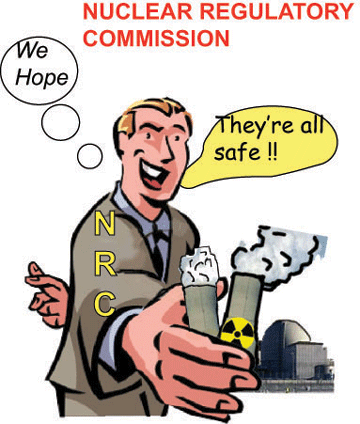
America’s Nuclear Regulatory Commission (NRC) itself has nuclear safety culture problems
The NRC and Nuclear Safety Culture: Do As I Say, Not As I Do, Union of Concerned Scientists
 DAVE LOCHBAUM, DIRECTOR, NUCLEAR SAFETY PROJECT | FEBRUARY 27, 2017 Many times over the past 20 years the Nuclear Regulatory Commission (NRC) has intervened when evidence strongly suggested a nuclear power plant had nuclear safety culture problems. The evidence used by the NRC to trigger its interventions was readily available to the plant owners, but the owners had downplayed or rationalized away the evidence until the NRC forced them to face reality.
The evidence used by the NRC to detect these nuclear safety culture problems included work force surveys indicating a sizeable portion of workers reluctant to raise safety concerns and allegations received by NRC from workers about reprisals and harassment they experienced after raising safety concerns.
Ample evidence strongly suggests that the NRC itself has nuclear safety culture problems. The NRC’s Office of the Inspector General (OIG) has surveyed the safety culture and climate within the NRC every three years for the past two decades. The latest survey was conducted during 2015 and released in March 2016. Figure 1 from the OIG’s 2015 survey along with data from the annual Federal Employee Viewpoint Surveys and other sources show safety culture problems as bad as—it not considerably worse—than the worst safety culture problems identified at Millstone, Davis-Besse, and yes, even the TVA reactors.
After the OIG’s 2009 survey of the NRC’s safety culture and climate, UCS submitted a request under the Freedom of Information Act for all records related to the actions taken by the agency in response to the survey. We obtained many records which described very few actions. And regardless of the number of actions, the OIG’s 2015 survey showed that the NRC’s safety culture was worse than in 2009 (see the last column on the right in Figure 1 [graph on original] ).
Why would the NRC take steps to remedy safety culture problems at nuclear plants yet have taken no steps to remedy its own safety culture problems? The answer is the same as to the question of why the plant owners failed to take steps to correct safety culture problems before the NRC intervened—they did not perceive the problems to exist. Likewise, Figure 2 [on original]shows that the NRC’s senior management does not perceive safety culture within the agency to need remediation……..
Just as plant owners failed to correct the problem they could not see, NRC senior management cannot fix the agency’s “invisible” safety culture problems. The NRC intervened to enable owners to see, and then fix, their safety culture problems. Someone needs to intervene to help NRC senior management see the agency’s safety culture problems so they can take the corrective measures they have often compelled plant owners to take…….http://allthingsnuclear.org/dlochbaum/the-nrc-and-nuclear-safety-culture-do-as-i-say-not-as-i-do
Weaken safety standards, to save the industry – that’s the advice from pro nuclear lobbyists

 Nuclear Power Is In Crisis As Cost Overruns Cripple Industry Giants, New Matilda., By Jim Green on February 26, 2017A future for nuclear power?
“……A fundamental difficulty for the nuclear industry is that the imperatives for greater safety and reduced costs push in opposite directions. Mark Cooper, from the Institute for Energy and the Environment at Vermont Law School, recently told the New York Times: “Nuclear safety always undermines nuclear economics. Inherently, it’s a technology whose time never comes.”
Retreating from post-Fukushima efforts to strengthen safety standards inevitably increases the risk of another Chernobyl- or Fukushima-scale catastrophe. Leaving aside the disputed health effects from those disasters, the economic costs associated with both disasters was in the ball-park of US$500 billion, and both had devastating impacts on public acceptance of nuclear power.
Yet a retreat from post-Fukushima efforts to strengthen safety standards seems to be where the industry and its enthusiasts are heading in their efforts to curb nuclear power’s astonishing cost increases and overruns.
Proposals include weakening safety regulations; abandoning Generation 3/3+ reactors in favour of Generation 2 reactor types (or redefining Generation 2 reactor types as Generation 3/3+); and overturning the established scientific orthodoxy that even the smallest doses of ionizing radiation can cause morbidity and mortality.
How to convince the public to accept reduced nuclear safety standards even as 80,000 people remain displaced because of the Fukushima disaster and clean-up and compensation cost estimates double then double again? In a word: spin.
Shellenberger, for example, wants “higher social acceptance” but he also wants weakened safety regulations such as the repeal of a US Nuclear Regulatory Commission rule designed to strengthen reactors against aircraft strikes. He squares the circle with spin and sophistry, claiming (without evidence) that the NRC’s Aircraft Impact Rule “would not improve safety” and claiming (without evidence) that the NRC “caved in to demands” from anti-nuclear groups to establish the rule………. https://newmatilda.com/2017/02/26/nuclear-power-is-in-crisis-as-cost-overruns-cripple-industry-giants/
Wealthy Americans building ‘luxury’ underground nuclear bunkers
Nuclear shelter goes up market as the US gets nervous, http://www.afr.com/news/policy/defence/nuclear-shelter-goes-up-market-as-the-us-gets-nervous-20170219-gugigy Australian Financial Review, 24 Feb 17 by Ben Rowen

On July 25, 1961, President John F. Kennedy spoke to the American people of a need “new to our shores” for emergency preparedness, including fallout shelters. The bunkers of that era – brutalist, cement, with foldout beds and stockpiled food – were designed to protect families in the event that the Cold War turned hot.
It never did, but fears of cataclysm – nuclear and otherwise – are back. So are shelters, with a twist. Growing numbers of “preppers” hope to ride out various doomsday scenarios in luxury.
Rising S Bunkers, one of several companies that specialise in high-end shelters – its presidential model includes a gym, a workshop, a rec room, a greenhouse, and a car depot – says sales of its $US500,000-plus ($650,000) units increased 700 per cent last year. (This compares with a more modest 150 per cent increase across other Rising S units.) Bunker companies won’t disclose customers’ names, but Gary Lynch, Rising S’s chief executive, told me his clients include Hollywood actors and “highly recognisable sports stars”. Other luxury shelters are marketed to businesspeople, from bankers to Bill Gates, who is rumoured to have bunkers beneath his houses in Washington State and California.
Whereas Cold War shelters, by design, were near the home and easy to get to, a handful of bunker companies are building entire survival communities in remote locations. Some of them share literal foundations with Cold War buildings: One project, Vivos XPoint, involves refurbishing 575 munitions-storage bunkers in South Dakota; Vivos Europa One, in Germany, is a Soviet armoury turned luxury community with a subterranean swimming pool.
In some regards, the plans for Trident Lakes do resemble those for a resort.Amenities will include a hotel, an athletic centre, a golf course, and polo fields. The community is slated to have 600 condominiums, ranging in price from $US500,000 to $US1.5 million, each with a waterfront view (to which end, three lakes and 10 beaches will be carved out of farmland). Other features are more unusual: 90 per cent of each unit will be underground, armed security personnel will guard a wall surrounding the community, and there will be helipads for coming and going.
As of January, only one part of the project was under way: a 60-foot statue that will feature Poseidon, amid what is supposed to be a 55,000-square-foot fountain. By June, Vintuary plans to unveil the development’s entrance and the shells of six bunkers. If all goes according to schedule, the first units will be finished next year.
Jeff Schlegelmilch, the deputy director of the National Center for Disaster Preparedness at Columbia University, told me that the luxury-bunker trend is “not just a couple of fringe groups; there is real money behind it—hundreds of millions of dollars”. But why are wealthy people buying?
Some customers appear to be motivated by old anxieties, recently revived – the threat of nuclear war, or a national-debt default that leads to unrest. Others have newer fears: climate change, pandemics, terrorism, far-left and far-right extremism. The presidential election has brought new faces into the fold, namely liberals (who also contributed to a record number of background checks – an indicator of gun purchases – on Black Friday). “Typically our sales are going to conservatives, but now liberals are purchasing,” says Lynch, the Rising S CEO.
Violence ‘unfortunate trend’
Rob Kaneiss, Trident Lakes’ chief security officer and a former Navy seal, told me that violence “seems to be the unfortunate trend in the US”. He believes the community’s location will prove to be ideal under the circumstances. “Ector offers … a very rural area,” he said, “so the likelihood of having risks like that, in the absence of specific targeting, is extremely low.”
In case things do go south, Trident Lakes will offer “Navy seal Experience” self-defence training, and a vault for family DNA. The hope is that, down the line, scientists could use genetic material to replicate residents who were lost to catastrophe, thereby ensuring “family sustainability”. Where these scientists might come from isn’t clear, but for a group selling cataclysm, the gesture seems an oddly hopeful bet on the future.
Bexar County commissioners say no to nuclear waste shipments
 On Tuesday, Bexar County became the first county in Texas to officially oppose having high-level nuclear waste pass through the county on its way to a West Texas waste site. (subscribers only) http://www.expressnews.com/news/local/article/Bexar-County-commissioners-say-no-to-nuclear-10948737.php By Brendan Gibbons, San Antonio Express-News February 21, 2017
On both sides o f USA-Canada border, opposition grows to transport of nuclear wastes
Opposition growing to cross-border nuclear shipments, http://news.wbfo.org/post/opposition-growing-cross-border-nuclear-shipments, By MIKE DESMOND, 21 Feb 17 Opposition is brewing on both sides of the U.S.-Canada border about plans to move dozens of shipments of nuclear waste from a plant in Chalk River, Ontario, to a plant in South Carolina.
Buffalo Congressman Brian Higgins has been very vocal in his opposition. He is being joined by opposition in Canada. Dean Allison is the member of Parliament for Niagara West, which includes the QEW, a potential route for some shipments. The Conservative Allison says the shipments pose real problems for first responders because they are not being told anything about the shipments or how to prepare for the highly radioactive material.
“I’ve understood from talking to some of the people with the Canadian Coalition for Nuclear Responsibility that it’s almost 17,000 times more toxic and more radioactive than when it first started and when it was first shipped, originally,” Allison says. “So our first responders need to have some kind of idea what it is because, more than likely, they will be the ones on the road, on the scene should anything happen.”
The material started in the United States and has been made far more radioactive in Canada because of research and developing nuclear materials for medical use. Higgins has long been demanding information about the shipments and their routes.
Beamsville resident Allison says he is trying to set up a meeting in his district to bring together residents, first responders and shipments officials to talk about what is going on.
“We’re going to try to get some of the key players down,” Allison says. “I don’t anticipate they’re going to give us more information but we’re going to certainly press and see if we can get anything that may be helpful to our first responders.”
Larry Criscione, Nuclear Regulatory Crusader
 Nuclear Regulatory Crusader http://allthingsnuclear.org/dlochbaum/nuclear-regulatory-crusader DAVE LOCHBAUM, DIRECTOR, NUCLEAR SAFETY PROJECT | JANUARY 23, 2017, To many, the acronym NRC stands for Nuclear Regulatory Commission. At times, NRC has been said to stand for Nobody Really Cares, Nuclear Rubberstamp Committee, and Nielsen Ratings Commission.
In regard to Larry Criscione, it may stand for Nuclear Regulatory Crusader.Larry is an engineer working for the U.S. Nuclear Regulatory Commission (NRC). Last year, Larry received the Joe A. Callaway Award for Civic Courage from The Safeek Nader Trust. Joe Callaway established the award in 1990 to recognize individuals who, with integrity and at some personal risk, take a public stance to advance truth and justice.
In March 2011, the three operating reactors at the Fukushima Daiichi nuclear plant in Japan melted down after a tsunami generated by a large earthquake flooded the site and disabled primary and backup power supplies to emergency equipment. In public, the NRC denied that reactors operating in the U.S. were vulnerable to such hazards.
In private, the NRC knew otherwise.
Flooding Risk at Oconee
In June 2010—nine months before Fukushima—the NRC issued a Confirmatory Action Letter to the owner of the Oconee nuclear plant in South Carolina requiring more than a dozen measures be taken. The measures were intended to lessen the chances that the Jocassee Dam fails and to increase the chances that the three operating reactors at Oconee survive should the dam fail anyway.
An evaluation showed that if the dam—located about 21 miles upriver from Oconee—failed, the site would be inundated with about 12.5 to 16.8 feet of flood water. The site was protected by a flood wall about seven feet tall, so it mattered little whether the actual depth was 12.5, 13, 14, 15, or 16.8 feet.
The NRC estimated that if the dam failed and flooded the site, there was a 100 percent chance that all three reactors would meltdown.
But the NRC issued the Confirmatory Action Letter secretly and did not tell the public about the hazard it required Oconee’s owner to lessen. After Fukushima tragically demonstrated the hazard posed by flooding, the NRC continued to cover-up measures taken and planned to lessen the flooding vulnerability at Oconee.
Larry and the OIG
So, Larry sent a 19-page letter dated September 18, 2002, to the NRC Chairman chronicling this history and asking four things:
- The NRC’s Office of General Counsel (OGC) should review the documents related to flooding at Oconee and the associated federal regulations to determine whether the documents could be made publicly available.
- The NRC’s Office of Nuclear Security and Incident Response (NSIR) should review the information on flooding hazards redacted from documents released to the public in response to Freedom of Information Act (FOIA) requests to determine whether additional information could be made publicly available.
- Based on the OGC and NSIR reviews, ensure that all flooding hazard documents that can be made publicly available are publicly available.
- The NRC’s Office of the Inspector General (OIG) should investigate whether the agency has been inappropriately marking documents as containing “Security-Related Information.”
Exercising his rights under the Lloyd-La Follette Act of 1912, Larry copied U.S. Congressional staff members on the email transmitting his letter to the NRC Chairman.
Larry’s letter was obtained by a reporter and featured in a Huffington Post article dated October 19, 2012.
As Larry had requested, the NRC’s OIG investigated handling of documents about flooding hazards. But rather than investigate whether NRC had improperly withheld information as he contended, OIG investigated whether Larry had improperly released information. As detailed in our 2015 report on the NRC and nuclear power safety, OIG made Larry an offer—he could voluntarily resign from the NRC or they would turn over his case to the Department of Justice (DOJ) for prosecution.
Larry did not resign.
OIG did refer the case to DOJ.
DOJ did not prosecute.
Through FOIA, UCS obtained DOJ’s response to NRC declining to prosecute Criscione. Under the Primary Reasons for Declination section, DOJ checked one box—No Federal Offense Committed.
Fortunately for Larry, not breaking the law is not yet against the law.
Thanks to Larry’s selfless efforts, the flooding hazards at Oconee have been made public. Larry had been right about the NRC inappropriately withholding information from the public. When lawyers and investigators were all through, the information he sought to have publicly released was publicly released. The NRC lacked legal grounds to continue hiding it.
More importantly, NRC’s mangers may think twice—or at least once—before withholding dam safety information in the future.
Unfortunately for Larry, he experienced unnecessary stress and expense defending himself against baseless OIG investigations. The Callaway Award does not fully offset those unfortunate consequences. But it helps show Larry and others who have our backs that not everyone wants to twist a dagger in their backs.
A video of the award presentation and Larry’s acceptance speech has been posted to YouTube.
Bottom Line
Doing the right thing when it’s relatively easy fails to accurately measure courage.
Larry Criscione did the right thing when it was a very hard thing to do. He could have remained silent like so many of his co-workers opted to do. He faced a strenuous courage test and aced it.
Britain has faced 110 nuclear weapon alerts – four times more than the MoD admits
Explosion in engine room at Flamanville nuclear station

 Flamanville plant in northern France has been hit by a massive explosion Staff writers, news.com.au News Corp Australia Network 9 Feb 17 AN EXPLOSION at a nuclear power plant on France’s northwest coast on Thursday caused minor injuries, but the authorities said there was no risk of radiation.
The blast occurred in the engine room at the Flamanville plant, which lies 25 kilometres west of the port of Cherbourg and just across from the Channel Islands. “It is a technical incident. It is not a nuclear accident,” senior local official Jacques Witkowski said. He said a ventilator had exploded outside the nuclear zone at the plant, which has been in operation since the 1980s and is operated by state-controlled energy giant EDF.
“It’s all over. The emergency teams are leaving,” Mr Witkowski said.Five people suffered smoke inhalation but there were no serious injuries, Mr Witkowski said.
One of the two pressurised water reactors at the plant was shut down after the explosion and the incident was declared over at 1100 GMT (10pm AEDT), the authorities said.
The two 1300 megawatt reactors have been in service since 1985 and 1986, and the site currently employs 810 people, along with an additional 350 subcontractors.
A new third-generation reactor known as EPR is being built at Flamanville, which will be the world’s largest when it goes into operation in late 2018.
“Explosions in turbines, usually related to oil in bearings overheating, are not uncommon and occur from time to time in conventional coal, oil or gas plants,” said Barry Marsden, a professor of nuclear graphite technology at the University of Manchester.
But Neil Hyatt, a professor of radioactive waste management at Sheffiled University said the incident should not be taken lightly.
“Any incident of this kind at a nuclear power plant is very serious, and the national and international regulators will want to undertake a thorough investigation to understand the cause and lessons to be learned,” he said.
Construction of the new reactor at Flamanville began in 2007 and was initially due for completion in 2012 but has been delayed several times, and its initial budget has more than tripled, to 10.5 billion euros ($11.2 billion)…….http://www.news.com.au/world/europe/flamanville-plant-in-northern-france-has-been-hit-by-a-massive-explosion/news-story/28f0f083f4850f3289939ed489f56c95
Pakistan demands that India bring its nuclear programme under International Atomic Energy Commission (IAEA)’s safeguards
‘Pakistan wants India’s entire nuclear programme under IAEA safeguards’ http://www.pakistantoday.com.pk/2017/02/07/pakistan-wants-indias-entire-nuclear-programme-under-iaea-safeguards/ February 07, 2017 ISLAMABAD: Pakistan wants India to bring its entire civilian nuclear programme under the safeguards laid out by the International Atomic Energy Commission (IAEA), a statement quoting Director General Disarmament at the Foreign Office Kamran Akhtar said.
Akhtar was speaking at a round-table discussion in Islamabad on Fissile Material Cut-Off Treaty (FMCT), organised to prepare for the upcoming Conference on Disarmament (CD).
“It is incumbent on us to stand up for our own interest. We want an assurance that India’s whole three stage nuclear power programme would be under safeguards,” said Akhtar. “Pakistan will not agree to FMCT until it gets the assurance from India.”
He said negotiating a treaty that only bans future production of fissile material without taking into account the existing stockpiles would freeze “the existing asymmetries”.
The DG Disarmament was of the opinion that India has been given “discriminatory waivers”, which add to Pakistan’s security concerns.
He said that eight of the Indian reactors, its fast breeder programme and approximately five tonnes of reactor-grade plutonium were included in the safeguards of dictated by the IAEA.
The FMCT would put Pakistan at a permanent disadvantage and undermine its security interests, Akhtar added. There is a fear that the reactors not mandated by the safeguards might be used clandestinely for plutonium production and the existing stockpiles might be diverted to a military programme at a subsequent stage, the DG said.
“Pakistan should not be asked to agree to something that is not in its strategic interest. We have to factor into consideration possible actions by India that could undermine credibility of our nuclear deterrence,” he added.
Pilgrim Nuclear facility reduces power because of seawater leak
Seawater leak forces reduced power at Pilgrim nuclear power plant, Wicked Local Pembroke By
A seawater leak at Pilgrim Nuclear Power Station has prompted plant operators to sharply reduce energy output there.
Control room operators reduced power to about 50 percent on Monday afternoon, Feb. 6, after there was an indication of a leakage into the Plymouth plant’s condenser.
A power plant spokesman told the News Service on Tuesday morning that the plant is now operating at 28 percent while repair work is undertaken.
Entergy Pilgrim Station spokesman Patrick O’Brien did not have an estimate of how much seawater leaked into the plant’s condenser……..http://pembroke.wickedlocal.com/news/20170207/seawater-leak-forces-reduced-power-at-pilgrim-nuclear-power-plant
Risks in nuclear wastes being transported through Texas cities
“You’ve got this stuff going out in the middle of the desert with temperature extremes,” Hadden said. “You’ve got intense storms and flooding, lightning, wildfires. … I don’t think the casks are at all robust enough.”
Unexpected accidents are not unheard of in the nuclear waste field.
Nuclear waste could pass through Texas cities en route to Andrews disposal site, Brendan Gibbons, San Antonio Express-News February 4, 2017 In the high, dry plains of West Texas sits a hazardous waste site operated by Waste Control Specialists, a company that wants to begin storing high-level nuclear waste from dozens of nuclear power plants across the country.
For that waste to get to the facility in Andrews County on the Texas-New Mexico border, it would first travel on thousands of miles of railroad tracks, according to a WCS spokesman and a Federal Railroad Administration document. That could include rail lines that pass through Dallas, Houston and San Antonio, though the specifics so far are hard to come by.
WCS site is already one of eight in the U.S. permitted to take low-level radioactive waste, mostly from hospitals and laboratories. High-level waste, which only comes from nuclear reactor fuel or reprocesssed fuel, is radioactive enough to kill a person directly exposed to it so it’s stored in metal canisters inside of concrete casks that can weigh more than 100 tons.
WCS wants to begin accepting high-level waste by 2021. On Jan. 27, the Nuclear Regulatory Commission, an independent agency, declared WCS’ application complete, starting the clock on period for public input that ends March 13. The NRC will hold public hearings in Andrews on Feb. 15 and in Hobbs, New Mexico, on Feb. 13.
Trying to build grassroots opposition to the new permit, husband-and-wife clean energy activists Tom “Smitty” Smith, who recently retired from running Public Citizen, and Karen Hadden of the SEED Coalition have been visiting Texas cities telling local politicians and news media that the waste could travel through their communities on its way to Andrews. Bexar County Commissioner Tommy Calvert added his voice to theirs in a statement last April.
Officials with WCS and federal agencies that regulate the waste shipments are not giving out details about the exact routes, most likely because of security concerns. The waste would have to be shipped under an agreement between WCS and the Department of Energy, which technically owns the waste………
“You’ve got this stuff going out in the middle of the desert with temperature extremes,” Hadden said. “You’ve got intense storms and flooding, lightning, wildfires. … I don’t think the casks are at all robust enough.”
Unexpected accidents are not unheard of in the nuclear waste field. The wrong brand of cat litter caused a two-year shutdown of the DOE’s Waste Isolation Pilot Plant, an underground storage site for defense-related radioactive waste outside of Carlsbad only 43 miles from WCS, in an area sometimes referred to as New Mexico’s nuclear corridor.
In 2014, a barrel of waste at that site burst, releasing radioactive materials, after someone packed it with organic cat litter instead of the inorganic brand they usually use, according to a DOE investigation. The site reopened Jan. 9……..
WCS’ site has now become part of the debate over what to do with spent nuclear material being stored at 67 sites in 34 states, including the South Texas Project in Bay City, the nuclear power plant partly owned by CPS Energy. The fuel is kept in concrete-lined pools of water 40 feet deep or in above-ground casks. Spent fuel only 10 years out of the reactor still emits 20 times the amount of radiation per hour it would take to kill a person all at once, according to the NRC.
So far, the U.S. has no viable permanent disposal site for this waste, which continues to emit unsafe levels of radiation for hundreds of thousands of years after it has grown too thermally cool to efficiently generate electricity.
Hadden thinks the real priority should be on finding a permanent site.
“We don’t think it should be moved until that site is found and developed because it’s a huge risk to transport this, and it should only get transported once,” she said……..
In the coming weeks, the Senate will vote whether to confirm former Texas Gov. Rick Perry, who has supported WCS in the past, to lead the DOE.
From 2000 to 2011, Perry’s campaigns took in at least $1.1 million from Dallas billionaire and WCS owner Harold Simmons, who died in 2013. As governor, Perry wrote a letter in 2014supporting WCS’ permit application for high-level waste storage.
At Perry’s recent confirmation hearing, Sen. Catherine Cortez Masto, D-Nevada, asked him if he supported a requirement that the DOE, if it does decide to use Yucca Mountain, get Nevada’s consent………bgibbons@express-news.net Twitter: @bgibbs http://www.expressnews.com/news/local/article/Waste-Control-Specialists-is-under-review-to-10908883.php
Far reaching implications of UK leaving Euratom – the nuclear security and information agency

 We are heading for a senseless nuclear Brexit – with no political or legal mandate https://www.theguardian.com/science/blog/2017/feb/01/brexit-nuclear-eu-euratom-treaty-clare-moody
Clare Moody Our nuclear energy, safety and research must not be subjugated to already chaotic Brexit negotiations – the government must put the national interest first Clare Moody is Labour MEP for South West England & Gibraltar. 3 February 2017
Last week we learned just how hard and how ill-conceived Brexit looks like being. The two line parliamentary bill published by the government last Thursday contained no detail, no plan, and no check or balance on the prime minister’s possible negotiation as it progresses.
One thing that was included, albeit buried in the explanation notes, is a brief reference to also ending Britain’s membership of Euratom – an entirely separate treaty. The implications of this will be deep and far-reaching for the future of UK’s energy supply, science, industry and workers. There is no political or legal mandate for the UK to leave Euratom, in fact it was barely even a footnote in the referendum campaign, and yet we are heading for a nuclear Brexit.
Euratom matters for the UK. Signed in 1957 as the European Atomic Energy Community, it is a separate treaty from the EU with the purpose of creating a single market for nuclear knowledge and resources in the peaceful pursuit of science and nuclear energy.
Whilst currently its only full members are EU countries, it is in fact a legally separate organisation to the EU. The UK is a leading member of Euratom, and plays host to one of its most important research institutions – the Joint European Torus (JET), based in Culham, Oxfordshire. JET is performing extraordinary and groundbreaking research in the pursuit of fusion energy, and is part of an EU-wide project to deliver on the vision of this revolutionary, safe and clean energy source. On the way, new technologies, materials and expertise are being developed here.
Euratom also provides safeguarding inspections for all civilian nuclear facilities in the UK, including Hinkley Point B, Sizewell and Torness in Scotland. It is the legal owner of all nuclear material, and is the legal purchaser, certifier and guarantor of any nuclear materials and technologies that the UK purchases. This includes our nuclear trade with the United States.
This means that 21% of the UK’s electricity generation is based on our membership of Euratom. It means that EDF can rely on secure supply chains for construction at Hinkley Point C and it is responsible for safeguarding inspections. Whether people are in favour of nuclear fission power or not we can all agree we want it to be as safe as possible, which is why leaving Euratom makes no sense.
Our own regulating authorities are not equipped to take over all of Euratom’s safeguarding work in the UK, and any British scientist will tell you that their work depends on international collaboration that is facilitated by this treaty.
Given this, it is hard to overstate the effect leaving Euratom will have on the UK –and the British people did not give the government a mandate to leave Euratom.
I think this is a bad decision, poorly thought out and with no explanation as to how our safety will be protected. The government must start at some point to put the national interest ahead of narrow party interest and Euratom would be a good place to start. Euratom is a separate treaty and the government should have the gumption to treat it as such – it requires separate and detailed negotiations. Our nuclear energy, safety and research must not be subjugated to the already chaotic wider Brexit negotiations.
Nuclear Regulatory Commission will continue to allow operation of troubled Pilgrim Nuclear Power Station
 Staff ‘Overwhelmed’ at Nuclear Plant, but U.S. Won’t Shut It, NYT, 2 Feb 17 FEB. 1, 2017PLYMOUTH, Mass. — One by one, ordinary residents confronted the federal regulators, telling them during a three-hour meeting Tuesday night that the Pilgrim Nuclear Power Station here was not safe and should be shut down.
A faulty concept of “acceptable risk” – by America’s Nuclear Regulatory Commission
the nuclear manufacturers—Westinghouse and General Electric—.. refuse to participate in any project unless they are guaranteed to be free of any liability for any offsite accident consequences. If they believed the NRC risk calculations, they would have no difficulty in accepting the litigation risk—but they obviously don’t. In short, the organizations most highly knowledgeable about nuclear safety don’t trust the NRC’s probabilistic calculations………
A definition of risk that placed greater emphasis on avoiding large-consequence events would be more in line with the common sense of the public whom the NRC is supposed to be protecting. If nuclear power is to have any long-term future, it will have to go beyond even that level of protection….Just as the nuclear manufacturers don’t want to bet their companies on calculations of nuclear safety, neither do people at large want to bet their cities and countrysides.
 When 10,000 square miles of contamination is an acceptable risk: The NRC’s faulty concept, Bulletin of the Atomic Scientists, 9 JANUARY 2017 Victor Gilinsky In making safety decisions, the Nuclear Regulatory Commission uses accident probability calculations that are much more optimistic than anything that nuclear manufacturers like General Electric and Westinghouse actually believe. The result is weak public protection. A good example is the NRC commissioners’ rejection in 2014 of a proposal to limit the possible severe consequences of spent fuel pool fires in nuclear power plants because the proposal’s cost, however modest, exceeded the value of the expected reduction in “risk.”
Spent fuel pools are where highly radioactive (and thus thermally hot) used reactor fuel is stored after it is removed from the reactor core. If a pool loses its water supply, the spent fuel can overheat and eventually burn, releasing large quantities of radioactivity. The spent fuel pool issue gained prominence after the 2011 Fukushima accident. For a time during the accident the dominant concern was that spent fuel in Fukushima’s damaged Unit 4 pool might catch fire. It didn’t happen, but it could have multiplied the effects of the catastrophic Fukushima accident manyfold. The NRC staff told the commissioners in 2014 that a worst-case spent fuel pool fire in a US plant like those at Fukushima—of which there are nearly three dozen—could release 25 times more long-lasting radioactivity than escaped from the Fukushima reactor vessels, and perhaps even more. Such a release could render 10,000 square miles uninhabitable and (around the Pennsylvania nuclear plant the staff chose as an example) could require the evacuation of 4 million persons.
The specific proposal before the commissioners was to limit the amount of radioactive spent fuel in a pool and thus to reduce the consequences of a fire by a factor of ten. This would be accomplished by speeding up the transfer of radioactive spent (used) fuel from the pool into “dry cask” storage. The plant owners have to do this eventually, but earlier transfers increase the cost. The commissioners saw their role as deciding whether the safety benefit—the reduction in risk—warranted this cost increase.
In fact, they weren’t deciding anything. The commissioners lent an air of official seriousness to the proceeding, but the decision making was on autopilot. It involved calculating the average risk (R) of an accident by multiplying two numbers, the accident’s probability (P) and its consequence (C). If P is sufficiently small, the average risk (or P times C) will be negligible no matter how large the consequence. And, therefore, the possible reduction in risk will hardly be worth any expenditure. That is how it worked in the 2014 case of a possible spent fuel fire, and that is how it has worked in most cases involving protection against severe accidents.
Actually, most cases don’t get this far. The commission has a threshold for the staff to investigate a safety issue posed by a hypothetical accident. If the estimated probability of “prompt” deaths offsite is below 2 in 1 million per year, the NRC staff need not investigate further. This involves a kind of Catch-22. The NRC assumes effective evacuation of the surrounding area in the event of an accident, so there aren’t people to be irradiated, and even substantial accidents don’t exceed the commission’s threshold……..
Consider the implications of NRC’s risk definition for the risk of long-term land contamination: The NRC staff’s projection of about 10,000 square miles, when multiplied by the staff-estimated accident probability, becomes an annual risk of about one-thousandth of a square mile, or less than an acre per year. Since valuable farmland runs at several thousand dollars per acre, the NRC conclusion is that any safety improvement that costs more than that isn’t worthwhile in terms of saving land. Similarly, the risk of displacing persons, becomes about half a person displaced per year, perhaps at a cost of tens of thousands of dollars, and so, again, per NRC logic, it is not worth spending more than that to avoid long-term evacuations to protect against severe spent fuel pool fires. This isn’t the conclusion most people would arrive at for themselves or their home towns.
There are several things wrong with the NRC’s cost-benefit approach to nuclear safety. To begin with, neither factor in the risk formula—probability times consequence—can be calculated with any accuracy. For example, the consequences of an accident requiring the long-term, possibly permanent, evacuation of 4 million will surely not be limited to the expense of such an evacuation. It would, for example, almost certainly spell the end of nuclear power use in the United States and likely in many countries, with huge economic consequences. …….
Nor is the situation much better when it comes to estimating the accident probability. As there is little data on large accidents, the accident probability is a calculated number. The NRC staff relies increasingly on elaborate calculations that model the various failure modes of a nuclear plant. For outsiders, or for that matter the NRC commissioners themselves, the result essentially comes out of a black box. …..
Which brings us to a deep flaw in NRC’s safety methodology—its reliance on the average risk as the figure of merit. It is by no means the only possible measure of risk. We know that in many statistical situations the average is not the best choice to characterize the data. It works where there are well-established data on both probabilities and consequences as, for example, in considering measures to reduce auto accidents. It doesn’t make sense for high consequence/low probability events, for one thing, because the numbers are so poorly known. Also, using average risk doesn’t reflect what most people—the people the NRC is supposed to be protecting—want to achieve. They don’t want to risk losing a city, no matter what the calculated probabilities. That is how the nuclear manufacturers—Westinghouse and General Electric—see it, too. They refuse to participate in any project unless they are guaranteed to be free of any liability for any offsite accident consequences. If they believed the NRC risk calculations, they would have no difficulty in accepting the litigation risk—but they obviously don’t. In short, the organizations most highly knowledgeable about nuclear safety don’t trust the NRC’s probabilistic calculations………
Any change in the NRC’s approach to nuclear risk must come from the outside; the agency has too much invested in the current approach for internal reform to have a chance. When a witness at the 2014 Commission meeting on spent fuel pool fires, Clark University professor Gordon Thompson, questioned using the average risk as the figure of merit, only one commissioner took notice and that was to ridicule the notion. The commissioners should have paid more attention.
A definition of risk that placed greater emphasis on avoiding large-consequence events would be more in line with the common sense of the public whom the NRC is supposed to be protecting. If nuclear power is to have any long-term future, it will have to go beyond even that level of protection. A 2012 report of the American Society of Mechanical Engineers, a group heavily involved with the nuclear industry, called for a major step-up in nuclear safety and warned that severe accident impacts on people’s lives were “wholly inconsistent with an economically viable and socially acceptable use of nuclear energy.” Just as the nuclear manufacturers don’t want to bet their companies on calculations of nuclear safety, neither do people at large want to bet their cities and countrysides. http://thebulletin.org/when-10000-square-miles-contamination-acceptable-risk-nrc%E2%80%99s-faulty-concept10459
Donald Trump gives right-wing investment banker Breitbart News firebrand a top security role!
Bannon Is Given Security Role Usually Held for Generals JAN. 29, 2017 WASHINGTON — The whirlwind first week of Donald J. Trump’s presidency had all the bravura hallmarks of a Stephen K. Bannon production.
1 This Month
26 September – International Day for the Total Elimination of Nuclear Weapons





PLEASE OPPOSE HR 8255 AND S.3639 – bills would accelerate satellite deployment, with no environmental review or safeguards – https://ncstd5li.quorum.us/campaign/169331/
To see nuclear-related stories in greater depth and intensity – go to https://nuclearinformation.wordpress.com
-
Archives
- September 2026 (305)
- August 2026 (330)
- July 2026 (355)
- June 2026 (287)
- May 2026 (306)
- April 2026 (356)
- March 2026 (251)
- February 2026 (267)
- January 2026 (308)
- December 2025 (358)
- November 2025 (359)
- October 2025 (375)
-
Categories
- 1
- 1 NUCLEAR ISSUES
- business and costs
- climate change
- culture and arts
- ENERGY
- environment
- health
- history
- indigenous issues
- Legal
- marketing of nuclear
- media
- opposition to nuclear
- PERSONAL STORIES
- politics
- politics international
- Religion and ethics
- safety
- secrets,lies and civil liberties
- spinbuster
- technology
- Uranium
- wastes
- weapons and war
- Women
- 2 WORLD
- ACTION
- AFRICA
- Atrocities
- AUSTRALIA
- Christina's notes
- Christina's themes
- culture and arts
- Events
- Fuk 2022
- Fuk 2023
- Fukushima 2017
- Fukushima 2018
- fukushima 2019
- Fukushima 2020
- Fukushima 2021
- general
- global warming
- Humour (God we need it)
- Nuclear
- RARE EARTHS
- Reference
- resources – print
- Resources -audiovicual
- Weekly Newsletter
- World
- World Nuclear
- YouTube
-
RSS
Entries RSS
Comments RSS

