Kim Jong-un’s North Korea nuclear test mountain may collapse, let out ‘many bad things’, SMH SEPTEMBER 6 2017 Beijing: North Korea has conducted all of its underground nuclear tests beneath one mountain, Chinese scientists believe, prompting one to express concern the mountain may collapse, causing an environmental disaster.
“We call it taking the roof off,” the China Institute of Atomic Energy’s Wang Naiyan told the South China Morning Post.
geophysicists from the University of Science and Technology of China have examined seismograph records and say Sunday’s underground nuclear test by North Korea was the fifth nuclear bomb to be exploded at the same mountain at Punggye-ri.
Professor Wen Lianxing from the university’s Key Laboratory of Earthquake and Earth Physics said nuclear explosions were previously staged at the mountain in September 2016, January 2016, February 2013 and May 2009.
The researchers used satellite images and seismic data from 112 Chinese seismic bureaus in their study, which gave the positions of the tests accurate to within 100 metres, according to a statement published on the university’s website……http://www.smh.com.au/world/kim-jonguns-north-korea-nuclear-test-mountain-may-collapse-let-out-many-bad-things-20170905-gyb8dp.html
September 6, 2017
Posted by Christina Macpherson |
North Korea, safety, weapons and war |
Leave a comment
 Robin des Bois 30th Aug 2017, Within a few days, unless an accident occurs, the Pacific Egret will enter the North Korean missile influence area. The Pacific Egret carries 8 tons of MOX, a nuclear fuel made in France containing 8 to 10% of plutonium mixed with enriched uranium.
This civil bomb left the French port of Cherbourg on July 5, 2017. After having sailed down the Atlantic Ocean, passed off South Africa, crossed the Indian Ocean and the Pacific Ocean, the MOX is expected to be unloaded in the small private port of the Japanese nuclear power plant in Takahama, facing North Korea.
Once again, the French government, Areva and the Nuclear Safety Authority have taken the irresponsible risk of permitting and undertaking a nuclear expedition bound for an unsteady zone in all political, geological and climatic respects. http://www.robindesbois.org/en/moxquitue-n2/
September 6, 2017
Posted by Christina Macpherson |
France, North Korea, safety |
Leave a comment
China’s legislature passes nuclear safety law, Reuters Staff by David Stanway; Editing by Tom Hogue SHANGHAI (Reuters), 1 Sept 17, – China’s parliament passed a new nuclear safety law on Friday aimed at improving regulation in the nuclear power sector as new projects are built across the country.
Officials say the law will give more powers to the regulator, the National Nuclear Safety Administration (NNSA), and establish new systems that will improve the disclosure of information on issues like radiation, and prevent or minimise risks from nuclear accidents.
………weak and opaque governance has long been seen as an industry problem, especially when it comes to determining the precise roles of the government, the military and state-owned nuclear enterprises on issues such as the handling of nuclear materials and the disposal of spent fuel.
Guo said the new law focused on strengthening China’s nuclear safety regime, and would create “institutional mechanisms” and a “division of labour” among regulators and enterprises to clarify responsibilities for safety…..
the decision to construct dozens of new projects, many using advanced and untested “third-generation” reactor designs, has put the government under pressure to improve regulation and build public trust in nuclear power.
China also needs to expand its waste processing capacity and train hundreds of new technicians and safety staff.
Mark Hibbs, senior fellow of the Nuclear Policy Program at the Carnegie Endowment for International Peace, said China has until now not addressed the legal authority of the NNSA, a relatively under-resourced division of China’s environment ministry……https://www.reuters.com/article/us-china-nuclearpower/chinas-legislature-passes-nuclear-safety-law-idUSKCN1BC4ER
September 2, 2017
Posted by Christina Macpherson |
China, safety |
Leave a comment
 Third WWII bomb found in Bristol Channel near Hinkley Point, Guardian 30th Aug 2017 Matthew Weaver Half-mile exclusion zone set up near nuclear plants after third unexploded device discovered in as many weeks

A half-mile (1km) exclusion zone has been set up in the Bristol Channel near the Hinkley Point nuclear power stations after a third unexploded second world war bomb was discovered in as many weeks.
Bomb disposal experts will carry out a controlled explosion on the 250lb (113kg) ordnance on Wednesday, two miles north-west of the power plants. HM Coastguard has set up an exclusion zone around the unexploded device and warned ships to avoid the area.
The bomb was reported in the early hours of Wednesday by a diving team from the Hinkley Point plant. They were clearing the seabed for intake and outtake pipes for cooling water for the reactors on the Hinkley Point C plant.
It is the third suspected second world war bomb to be found in the Bristol Channel in the past three weeks. An EDF source conceded that divers could find more unexploded ordnance before the exercise to clear the area was completed, as the channel was used as a former army training range. The project to clear the seabed is expected to take several more weeks. https://www.theguardian.com/world/2017/aug/30/third-wwii-bomb-bristol-channel-near-hinkley-point-nuclear
September 1, 2017
Posted by Christina Macpherson |
incidents, UK |
Leave a comment
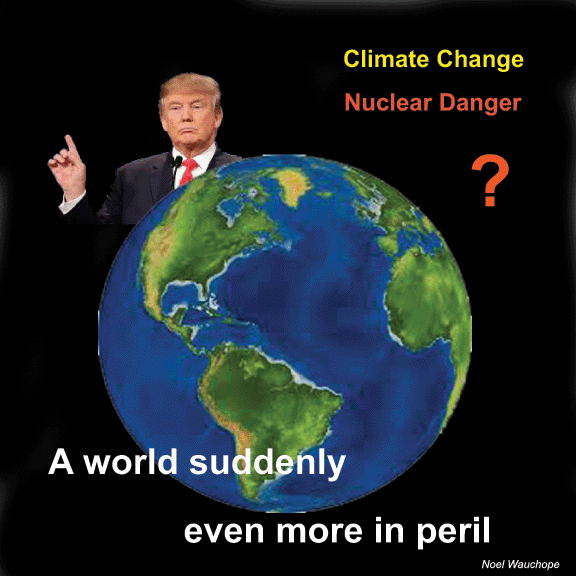
Donald Trump, nuclear war and climate change among gravest threats to humanity, say Nobel Prize winners Acclaimed chemist Peter Agre describes US President as ‘extraordinarily uninformed and bad-natured’ and likens him to ‘a villain in a Batman movie – everything he does is wicked or selfish’ The Independent, Sally Wardle 31 Aug 17, Nobel Prize winners consider nuclear war and US President Donald Trump as among the gravest threats to humanity, a survey has found.
More than a third (34%) said environmental issues including over-population and climate change posed the greatest risk to mankind, according to the poll by Times Higher Education and Lindau Nobel Laureate Meetings.
But amid rising tensions between the US and North Korea, almost a quarter (23%) said nuclear war was the most serious threat.
Of the 50 living Nobel Prize winners canvassed, 6% said the ignorance of political leaders was their greatest concern – with two naming Mr Trump as a particular problem.
Peter Agre, who won the Nobel Prize for chemistry in 2003, described the US President as “extraordinarily uninformed and bad-natured”.
He told Times Higher Education: “Trump could play a villain in a Batman movie – everything he does is wicked or selfish.”
Laureates for chemistry, physics, physiology, medicine and economics took part in the survey, with some highlighting more than one threat. Peace Prize and Literature Prize recipients were not canvassed……http://www.independent.co.uk/news/world/americas/donald-trump-grave-threat-humanity-nobel-prize-winners-nuclear-war-north-korea-climate-change-a7921676.html
September 1, 2017
Posted by Christina Macpherson |
2 WORLD, safety |
Leave a comment
 WARNING: “Credible threat of severe accident at two nuclear reactors” due to
  Hurricane Harvey — “Clear potential for major disaster” — Plant “could be overwhelmed by raging flood waters” — Officials refuse to provide public with information http://enenews.com/warning-credible-threat-of-severe-accident-at-two-nuclear-reactors-due-to-hurricane-harvey-clear-potential-for-major-disaster-plant-could-be-overwhelmed-by-raging-flood-waters-of
|
By ENENews Reuters, Aug 29, 2017 (emphasis added): [W]atchdog groups called for the [South Texas Project nuclear] facility to shut due to Tropical Storm Harvey… The groups expressed concern about workers at the plant and the safety of the general public if Harvey caused an accident at the reactors… When asked if the plant would shut if flooding worsened, [spokesman Buddy Eller] said “We are going to do what’s right from a safety standpoint.”… Eller said 250 “storm crew” workers were running the plant… Personnel from the U.S. Nuclear Regulatory Commission (NRC) are also at the plant, assessing storm conditions.
teleSUR, Aug 29, 2017: Groups Warn of Nuclear Accident… In the midst of Tropical Storm Harvey’s drenching onslaught, energy watchdogs are sounding the alarm over the continued operation of two nuclear reactors in East Texas that are running at full capacity despite what they claim is the clear potential for a major disaster… [The nuclear plant] risks being flooded as water pours across the region, threatening the embankment wall shielding the power plant… Beyond Nuclear is one of three groups calling for an immediate shutdown of the twin reactors in case the embankment wall surrounding the plant is breached, which could lead to electrical fires and “cascading events” could result in an accident that threatens major core damage… Some fear the threat of a new Fukushima-style disaster.
Common Dreams, Aug 29, 2017: The South Texas Project nuclear power facility in Bay City, Texas could be under extreme threat from historic flood waters, groups warned… energy watchdogs groups are warning of “a credible threat of a severe accident” at two nuclear reactors… [They] are calling for the immediate shutdown of the South Texas Project (STP) which sits behind an embankment they say could be overwhelmed by the raging flood waters and torrential rains… Both the U.S. Nuclear Regulatory Commission and the STP operator have previously recognized a credible threat of a severe accident initiated by a breach of the embankment wall that surrounds the 7,000-acre reactor cooling water reservoir,” said [Beyond Nuclear’s] Paul Gunter… [Harvey] was declared the most intense rain event in U.S. history… [B]reach of the embankment wall surrounding the twin reactors would create “an external flood potentially impacting the electrical supply from the switchyard to the reactor safety systems.” In turn, the water has the potential to “cause high-energy electrical fires and other cascading events initiating a severe accident leading to core damage.” Even worse, they added, “any significant loss of cooling water inventory in the Main Cooling Reservoir would reduce cooling capacity to the still operating reactors that could result in a meltdown.” With the nearby Colorado River already cresting at extremely high levels and flowing at 70 times the normal rate, Karen Hadden, director of SEED Coalition, warned that the continue rainfall might create flooding that could reach the reactors… “Our 911 system is down, no emergency services are available, and yet the nuclear reactors are still running… This is an outrageous and irresponsible decision,” declared [Susan Dancer of the South Texas Association for Responsible Energy]. “This storm and flood is absolutely without precedent even before adding the possibility of a nuclear accident that could further imperil millions of people who are already battling for their lives.” As Harvey hovers over the coastal region, heavy rains are expected to persist for days…
Beyond Nuclear, Aug 29, 2017: The NRC and South Texas have refused to provide any public information on the status of the water level within in the reservoir…
See also: Nuclear Worker: “Imminent flood coming” near nuke plant from Hurricane Harvey… “Potentially catastrophic”… Running out of food… Working tirelessly to manage problems… Area turned “upside down” (VIDEO)
|
September 1, 2017
Posted by Christina Macpherson |
safety, USA |
Leave a comment
German region to hand out iodine over Belgium nuclear fears, https://www.washingtonpost.com/world/europe/german-region-to-hand-out-iodine-over-belgium-nuclear-fears/2017/08/31/2ff1bdd0-8e4c-11e7-9c53-6a169beb0953_story.html?utm_term=.b575ae8357bb By Associated Press August 31 BERLIN — A German border region is preparing to hand out potassium iodide tablets to residents who want them in case of an accident at a nuclear power plant in Belgium that has caused friction between the two countries.
Local officials in the Aachen area received permission from the regional government to distribute the tablets as a precaution amid longstanding concerns in Germany over the safety of the Tihange plant, less than 70 kilometers (43 miles) away. They’re meant to prevent thyroid cancer in case of radioactive contamination.
From Friday through Nov. 15, people under 46 can apply online for a coupon for the iodine tablets, which they can pick up free at pharmacies.
Germany plans to switch off all its nuclear reactors by 2022 and already has shut its oldest plants.
September 1, 2017
Posted by Christina Macpherson |
Germany, safety |
Leave a comment
As Historic Flooding Grips Texas, Groups Demand Nuclear Plant Be Shut Down https://www.commondreams.org/news/2017/08/29/historic-flooding-grips-texas-groups- demand-nuclear-plant-be-shut-down#
“This storm and flood is absolutely without precedent even before adding the possibility of a nuclear accident that could further imperil millions of people who are already battling for their lives.”
byJon Queally, staff writer, 29 Aug 17, As record-breaking rainfall and unprecedented flooding continue to batter the greater Houston area and along the Gulf coast on Tuesday, energy watchdogs groups are warning of “a credible threat of a severe accident” at two nuclear reactors still operating at full capacity in nearby Bay City, Texas.
Three groups—Beyond Nuclear, South Texas Association for Responsible Energy, and the SEED Coalition—are calling for the immediate shutdown of the South Texas Project (STP) which sits behind an embankment they say could be overwhelmed by the raging flood waters and torrential rains caused by Hurricane Harvey.
“Both the U.S. Nuclear Regulatory Commission and the STP operator have previously recognized a credible threat of a severe accident initiated by a breach of the embankment wall that surrounds the 7,000-acre reactor cooling water reservoir,” said Paul Gunter, director of the Beyond Nuclear’s Reactor Oversight Project, in a statement by the coalition on Tuesday.
The groups warn that as Harvey—which on Tuesday was declared the most intense rain event in U.S. history—continues to dump water on the area, a breach of the embankment wall surrounding the twin reactors would create “an external flood potentially impacting the electrical supply from the switchyard to the reactor safety systems.” In turn, the water has the potential to “cause high-energy electrical fires and other cascading events initiating a severe accident leading to core damage.” Even worse, they added, “any significant loss of cooling water inventory in the Main Cooling Reservoir would reduce cooling capacity to the still operating reactors that could result in a meltdown.”
With the nearby Colorado River already cresting at extremely high levels and flowing at 70 times the normal rate, Karen Hadden, director of SEED Coalition, warned that the continue rainfall might create flooding that could reach the reactors. “There is plenty of reserve capacity on our electric grid,” she said, “so we don’t have to run the reactors in order to keep the lights on. With anticipated flooding of the Colorado River, the nuclear reactors should be shut down now to ensure safety.”
Last week, the STP operators said that safety for their workers and local residents was their top concern, but that they would keep the plant operating despite the approaching storm.
Susan Dancer, president of the South Texas Association for Responsible Energy, said that as residents in Bay City—herself included—were being forced to leave their homes under manadatory evacaution orders, it makes no sense to keep the nuclear plant online.
“Our 911 system is down, no emergency services are available, and yet the nuclear reactors are still running. Where is the concern for employees and their families? Where is the concern for public safety? This is an outrageous and irresponsible decision,” declared Dancer. “This storm and flood is absolutely without precedent even before adding the possibility of a nuclear accident that could further imperil millions of people who are already battling for their lives.”
As Harvey hovers over the coastal region, heavy rains are expected to persist for days even as the storm system creeps toward to Louisiana in the east.
But no matter how remote the possibility, said Gunter, “it’s simply prudent that the operator put this reactor into its safest condition, cold shutdown.”
August 30, 2017
Posted by Christina Macpherson |
climate change, safety, USA |
Leave a comment
West Somerset Free Press 22nd Aug 2017, A ROYAL Navy bomb squad was in action for the second time
in eight days last Wednesday as it detonated another bomb found in the sea near Hinkley
Point. The 250lb Second World War device, discovered by divers checking the
seabed before the construction of cooling water tunnels for the power
station, was half the size of the bomb that Navy experts successfully
detonated on August 8, as reported in last week’s Free Press. As before,
the bomb was ringed by a one kilometre exclusion zone and the area was
off-limits for shipping for 24 hours.
http://www.wsfp.co.uk/article.cfm?id=108283&headline=Second%20bomb%20found%20near%20Hinkley§ionIs=news&searchyear=2017
August 25, 2017
Posted by Christina Macpherson |
incidents, UK |
Leave a comment
 Why is NASA testing bomb-grade materials for its Mars mission? , Alan J. Kuperman, Edwin Lyman, Baltimore Sun, 24 Aug 17 A new space race is afoot. President Donald Trump and CEOs Elon Musk (Tesla) and Jeff Bezos (Amazon) are all advocating manned missions to Mars, a tantalizing objective. However, in humankind’s drive to explore strange new worlds, we must be careful not to endanger life here on Earth.
Regrettably, to power its Mars mission, NASA’s Goddard Space Center is trying to develop a nuclear reactor fueled by weapons-grade, highly enriched uranium — the stuff of the Hiroshima bomb — threatening to undermine decades of progress in phasing out such dangerous material from reactors worldwide to reduce risks of nuclear terrorism and proliferation.
Instead of violating U.S.-led nonproliferation norms, NASA should embrace an ongoing alternative reactor design that uses fuel made with low-enriched uranium, unsuitable for nuclear weapons.
If terrorists got hold of a sufficient quantity of highly enriched uranium, they could set off an actual nuclear explosion simply by slamming two pieces of the material together. This was the principle behind the Hiroshima bomb that killed tens of thousands in 1945. The resulting devastation from blast effects, fire and high radiation would dwarf that from an improvised “dirty bomb,” which disperses relatively tiny amounts of radioactive material.
In the 1960s, the United States foolishly exported large quantities of weapons-grade uranium for civilian applications, opening huge security risks. Belatedly recognizing this error, Washington launched a global effort in the 1970s to phase out use of such bomb-grade fuel, eventually eliminating hundreds of pounds annually from research reactors and medical isotope production. More recently, Congress has even started funding the U.S. Navy to explore converting its own nuclear reactors in aircraft carriers and submarines to safer low-enriched uranium fuel.
But NASA inexplicably is headed in the opposite direction, proposing to renew use of bomb-grade uranium in U.S. space reactors for the first time since 1965. Each of NASA’s proposed “Kilopower” reactors would use at least 65 pounds of highly enriched uranium, more than sufficient for a nuclear weapon. Indeed, the U.S. government requires maximum security for even a fraction of that amount — a mere 11 pounds.
NASA plans to start testing its bomb-grade uranium space reactor next month at a former nuclear weapons testing site in Nevada. Other countries and private interests could well respond by pursuing their own highly enriched uranium space reactors, increasing both proliferation and terrorism risks.
The U.S. government needs to practice what it preaches. No competitor would forego bomb-grade uranium if NASA charges ahead with use of this dangerous material. Now is the moment to make clear that the global norm against highly enriched uranium in reactors applies to space missions too.
A space reactor could instead use low-enriched uranium fuel, unsuitable for bombs, just like state-of-the-art nuclear research reactors on Earth……
Admittedly, it would take some time to perfect a new space reactor using low-enriched uranium. Fortunately, there is no great rush. Just last month, NASA’s chief of human spaceflight, William Gerstenmaier, acknowledged that the space agency’s budget lacks funding for a manned mission to Mars, estimated to cost $100 billion to $1 trillion over a quarter-century. Even the wealthiest private companies are unlikely to pony up such resources in the near future…..http://www.baltimoresun.com/news/opinion/oped/bs-ed-op-0821-nasa-uranium-20170815-story.html
August 25, 2017
Posted by Christina Macpherson |
safety, technology, USA |
2 Comments
 Senator seeks answers on LANL’s nuclear safety, By Rebecca Moss | The New Mexican, Aug 23, 2017,
A U.S. senator has asked the National Nuclear Security Administration to report to Congress by Thursday on the costs and safety of Los Alamos National Laboratory’s weapons production program and, in particular, the potential for critical accidents.
In early August, U.S. Sen. Claire McCaskill, D-Mo., a ranking member of the Senate’s Homeland Security and Governmental Affairs Committee, sent a letter to Frank Klotz, administrator of the NNSA, saying she had serious concerns about poor federal oversight and management of the laboratory and requesting a report.
The inquiry was triggered by a series of investigative reports by the Washington, D.C.-based Center for Public Integrity, which were published in The New Mexican and other newspapers earlier this summer. The series highlighted a number of serious incidents at Los Alamos’ plutonium facility, events that could have led to significant radiological releases and worker deaths. Poor management has resulted in unsafe working conditions, injured workers and federal violations at the plutonium facility and other sites, and senior officials rarely were penalized for the problems, the stories said……
Los Alamos was the only nuclear site that failed its annual review for nuclear criticality safety in fiscal year 2016, a program designed to prevent severe nuclear accidents. The lab was graded as “adequate but needs improvement” the previous year, according to a federal report.
In her Aug. 3 letter to Klotz, McCaskill said, “Private firms contracted to operate and maintain these facilities have not been held accountable in a meaningful way for the safety lapses that occurred under their watch.”….
I have previously noted my concerns regarding DOE’s poor oversight and management of its contracts and its inability to properly exercise effective oversight of its budget,” McCaskill said in the letter.
She asked the National Nuclear Security Administration to report on the current state of operations and safety testing at Los Alamos’ plutonium facility, known as PF-4, and whether safety standards have been met. She also asked the agency to provide costs associated with closing the facility, how much of the agency’s budget for fiscal year 2018 will go to improving safety standards, and if any penalties will be imposed on the lab or its management contractors.
“Does NNSA feel it is meeting its duty to prevent dangerous nuclear accident?” she asked.
U.S. Sen. Tom Udall, D-N.M., said in an email that McCaskill’s letter “raises some very serious and important questions, and I hope the NNSA answers these questions in a timely manner.”…….
Greg Mello, director of the Los Alamos Study Group, a nuclear disarmament-focused nonoprofit, said in a statement that McCaskill’s letter is “only the tip of the iceberg” of problems at Los Alamos.
“Bad management is a feature,” he said. “It is partly why people work at these facilities (LANL in particular) in the first place — low professional standards, high salaries, and lack of accountability.”
August 25, 2017
Posted by Christina Macpherson |
politics, safety, USA |
Leave a comment
When walking into the forest, one and a half kilometers from the village, people were met by a scene that could have been from the James Bond movie GoldenEye. Trees were scattered in a circle several hundred meters in diametre.
There was no meteor or metal scrap to be found in crater in the middle. No visible burns. Some Russian media reported it could have been a rocket launch that failed. Plesetsk, the northern cosmodrome, lies only some 170 kilometers, and locals in the villages in the Pinega district are used to see rockets launched from Plesetsk flying into orbit over their houses.
But, strangely enough, no rocket launched were listed that day. Officials from Plesetsk didn’t either provided any information afterwards. Until now, nearly a year later.
In July, the third book in the serie «Russia’s Northern Cosmodrome» were presented, and there, in the list of launches from Plesetsk, a short line reviled it all; on August 25th, 2016, the very first test-launch of the Yars-M ICBM took place.
The information was soon republished at a Russian discussion blog-site for strategic and tactical nuclear weapons. Pavel Podvig, an independent analysts who runs the research project «Russian Nuclear Forces» picked up the info and linked it to last year’s infamous forest flash outside Arkhangelsk.
Yars-M is a smaller and lighter version of the Yars intercontinental ballistic missile. Making it smaller, the Russian strategic missile forces can base the new missile into the new so-called Barguzin ICBM-carrying railway missile train, like Deputy Prime Minister DMitry Rogozin announced would be developed by 2018, RIA Novosti reported last month.
According to several British media, like the Daily Mail, a successful test-launch of the Yars-M missile was done from Plesetsk in early November, just over two months after the launch of the missile that crashed in the forest 170 kilometers from the launch-pad in August.
August 23, 2017
Posted by Christina Macpherson |
incidents, Russia |
Leave a comment
 Scotland ‘wholly unprepared’ for nuclear weapons accident on its roads – report https://www.rt.com/uk/400508-scotland-nuclear-weapons-accident/, 22 Aug, 2017 Nuclear warheads surrounded by explosives are regularly transported on British roads, yet authorities are “wholly unprepared” to handle an accident, a damning report has revealed.
A “critical gap” in the protection of Britons has been identified by Nukewatch UK, amid claims public safety is being put at risk by the Scottish Government. The report, ‘Unready Scotland’, reveals weapons of mass destruction (WMDs) are driven across the country around eight times every year, without police accompanying them and without public knowledge.
The convoys travel with a potentially-deadly cocktail of explosives and nuclear weapons packed inside – yet those traveling alongside the huge trucks remain blissfully unaware of the dangerous cargo. Scottish councils have failed to carry out individual assessments of the routes taken by the massive convoys. This means vital evacuation time could be lost and the number of casualties could rise rapidly should there be an incident.
The potential contamination zone for an accident involving nukes is 24 miles, according to some experts, meaning entire villages and towns could be engulfed.
“The radioactive material in the warheads includes both plutonium and uranium, with a potential dispersal range of at least 5km,” Nuke Watch reports. “In addition to this, warhead materials include a number of toxic and hazardous substances.”
Unready Scotland suggests there is “no evidence” that authorities would be able to cope with a disaster on the route between the Aldermaston and Burghfield atomic weapon plants in Berkshire and RNAD Coulport on Loch Long.
In the event of nuclear fallout, the Ministry of Defence (MoD) would prioritize the mobilization of troops to secure the weapons – and the safety of the public would fall squarely on the shoulders of local authorities and emergency responders. Yet the frightening report shows that those who would be first on the scene would be “unprepared” and unable to launch into action. Although some claim an accident involving a convoy is unlikely, there have already been underreported incidents. In May, a military convoy of nuclear warhead carriers was left stranded on the side of the M40 motorway when the escort broke down. Fortunately in this instance there were no live warheads onboard.
Despite authorities claiming potential terrorist plots make it impossible for them to reveal details of the convoys to the public, activists claim the information is already in the public domain.
The report claims there is “no justification for not informing the public about the existence of the convoy traffic and its attendant risks.”
“The simple fact that these trucks carry nuclear bombs on public roads is enough to cause very serious concern, amounting to alarm,” said Nuke Watch. The report says the police officers manning the convoy “very frequently” have no idea what they are protecting – and would be unable to react in an emergency, the report says.
Astonishingly, some authorities “rely on generic risk assessments conducted within their Resilience Partnerships.”
Practice runs have been carried out on a small scale, according to Local Authority and Emergency Services Information (LAESI) reports, but nowhere close to the scale of the potential damage.
In 1990 it was predicted by nuclear engineer John Large that an accident involving nuclear warheads could spread contamination “at least 40 kilometres.”
Nuke Watch has called for an urgent review into the country’s response to a nuclear accident.
It claims since community safety is wholly devolved to the Scottish Parliament at Holyrood, the Scottish National Party (SNP) Government has failed in its duty to put adequate plans in place.
RT has contacted the SNP for comment.
August 23, 2017
Posted by Christina Macpherson |
safety, UK |
Leave a comment
Herald 20th Aug 2017, Scotland is “wholly unprepared” to deal with an accident or an attack on
the nuclear bomb convoys that regularly travel across the country,
according to a new report. Local authorities are accused of breaching their
legal duty to safeguard the public by failing to assess and warn of the
dangers.
Scottish Ministers are under fire for failing to make councils
comply. Campaigners are demanding an urgent review of measures to protect
people from radioactive contamination from convoy crashes. They say that an
accident could spread plutonium and other toxic materials over miles.
Anti-nuclear groups have previously attacked the UK government for failing
to ensure the safety of nuclear weapons transports. But now they are
targeting Scottish central and local government for not doing enough.
According to the nuclear-free group of local authorities (NFLA), the report
showed there was “confusion” over the response to convoy accidents.
One problem was that councils weren’t informed of convoy movements, it argued.
“There needs to be a wider rethink about such convoys and greater
cooperation with all emergency responders, including councils, so that the
risks to the public can be fully unpacked and considered,” said NFLA
Scotland representative, Audrey Doig, an SNP councillor from Renfrewshire.
http://www.heraldscotland.com/news/15483954.No_safety_assessments_carried_out_for_nuclear_convoys_in_Scotland/
August 21, 2017
Posted by Christina Macpherson |
safety, UK |
Leave a comment
 Campaigners aim to raise awareness of Moray nuclear flights at meeting, The Press and Journal, Aberdeen, by DAVID MACKAY, August 20, 2017 Anti-nuclear campaigners will meet in Moray to press for alternatives to transporting radioactive waste through the region.
Uranium from the Dounreay power plant in Caithness has been loaded on to planes leaving Wick Airport over the last year. However, the US Air Force aircraft need to touch down at RAF Lossiemouth because the runway at Wick is too short when they are fully-fuelled.
Activists have called for the waste to be kept in the north of Scotland to reduce the potential for risks during the transfers.And now the campaigners will meet in Findhorn to raise awareness of the flights that are done in secret to increase security.
Tor Justad, chairman of Highlands Against Nuclear Transport, said: “I’m consistently amazed at how little people know about what’s going on.
“The public should be much better informed about the risks that are involved in these kinds of transfers.
“By transporting the waste you are vastly increasing the risk of some kind of terrorist attack. It’s unthinkable what might happen if something were to happen 1,000 feet up in the air.”…..The meeting will be held on Tuesday, August 29, in East Whins House at the Findhorn Foundation at 7.30pm. https://www.pressandjournal.co.uk/fp/news/moray/1311598/campaigners-aim-to-raise-awareness-of-moray-nuclear-flights-at-meeting/
August 21, 2017
Posted by Christina Macpherson |
safety, UK |
Leave a comment