On a concrete pad about 25 feet above Plymouth Bay, eight massive steel-reinforced concrete cylinders hold the remains of the radioactive fuel that has kept the Pilgrim Nuclear Power Station running since the 1970s.
Danger of rising sea levels to nuclear waste canisters at Pilgrim Nuclear Power Station
Special vehicles are required to move the casks, as are specially built roads that can handle the immense weight.
“We don’t know if this highly dangerous material will be there for another 100 years or a thousand years.
if the casks are not moved in the coming decades, or even centuries, they worry about who would ultimately be responsible for protecting the nuclear waste. It’s unlikely, for example, that Entergy will still own the property, they say.
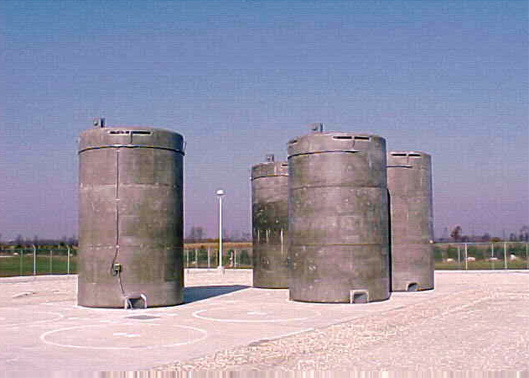
Pilgrim officials consider moving nuclear waste to higher ground more https://www.bostonglobe.com/metro/2018/04/20/seas-rise-pilgrim-mulls-moving-its-nuclear-waste-higher-ground/rcrkilSqo4cGpfledFyrJJ/story.html?,
The problem is where to store the nuclear waste — especially since its current location won’t stay 25 feet above Plymouth Bay for long.
As sea levels rise at an accelerating rate, increasing the threat that an extreme storm surge could flood the coastal facility, Pilgrim officials are considering whether to move the spent fuel to higher ground.
Plant officials and federal regulators maintain that the current location is safe, at least for the foreseeable future, noting that the containers are designed to withstand flooding. But local activists are urging Pilgrim to take action, worried that the daunting political obstacles to moving the casks to a federal repository could force them to remain in Plymouth permanently.
“Not moving them would be irresponsible,” said Pine duBois, executive director of the Jones River Watershed Association in Kingston, which is about 8 miles from Pilgrim. “We don’t know if this highly dangerous material will be there for another 100 years or a thousand years. It has to be moved.”
Environmental advocates are calling on the state to require Entergy Corp., the Louisiana-based conglomerate that owns Pilgrim, to move the casks to its helipad or parking lot, which are three times higher than the existing storage site and set further back from the water.
Plant officials and federal regulators maintain that the current location is safe, at least for the foreseeable future, noting that the containers are designed to withstand flooding. But local activists are urging Pilgrim to take action, worried that the daunting political obstacles to moving the casks to a federal repository could force them to remain in Plymouth permanently.
“Not moving them would be irresponsible,” said Pine duBois, executive director of the Jones River Watershed Association in Kingston, which is about 8 miles from Pilgrim. “We don’t know if this highly dangerous material will be there for another 100 years or a thousand years. It has to be moved.”
Environmental advocates are calling on the state to require Entergy Corp., the Louisiana-based conglomerate that owns Pilgrim, to move the casks to its helipad or parking lot, which are three times higher than the existing storage site and set further back from the water.
Despite the concerns, plant officials say the casks are secure……….
Under recent worst-case projections, tides could rise as much as 10 feet by the end of the century and as much as 37 feet by 2200. That’s not accounting for storm surges, such as the 15-foot high tides that battered the Massachusetts coast during two nor’easters this winter, causing widespread flooding. …….
Under recent worst-case projections, tides could rise as much as 10 feet by the end of the century and as much as 37 feet by 2200. That’s not accounting for storm surges, such as the 15-foot high tides that battered the Massachusetts coast during two nor’easters this winter, causing widespread flooding………
The decision about where to store the casks comes as the 46-year-old plant faces a host of maintenance challenges. Entergy announced three years ago that it would close Pilgrim in June 2019, after a litany of economic woes and safety issues. In 2015, the NRC designated Pilgrim as one of the nation’s three least-safe reactors.
Those problems have persisted. Until Thursday, the plant had been offline for 43 days — one of its longest unplanned outages — after crews discovered a significant issue with a transformer that provides power for Pilgrim to operate. It was the second unplanned shutdown this year.
Plant officials must also weigh a range of other issues in deciding whether to move the waste, including security, radiation, and the impact on decommissioning the plant.
Cost is another factor.
Special vehicles are required to move the casks, as are specially built roads that can handle the immense weight. For example, at Vermont Yankee, which began the decommissioning process several years ago, it cost $143 million to fill and move their remaining casks to a new storage site.
Moving the casks uphill would add to the expense, and plant officials have not ruled out building a new storage pad adjacent to the existing one, which is only about 100 feet from the reactor building.
Storing nuclear waste has long been a thorny political issue, one that has become increasingly urgent as more aging plants are shuttered………
For local activists who have long raised concerns about the dangers of nuclear power, the assurances of Pilgrim and the NRC provide little comfort.
While the casks may not leak from being submerged for a brief period, they could be subject to corrosion from exposure to saltwater, which could create cracks and eventually lead to leaks, they said.
And if the casks are not moved in the coming decades, or even centuries, they worry about who would ultimately be responsible for protecting the nuclear waste. It’s unlikely, for example, that Entergy will still own the property, they say.
“We need a plan for the next 100 to 300 years,” said Mary Lampert, director of Pilgrim Watch, a civic watchdog group. “I don’t see that happening.”
Future Nuclear-Powered Spaceships (oh by the way, one crashed to Canada in the past)
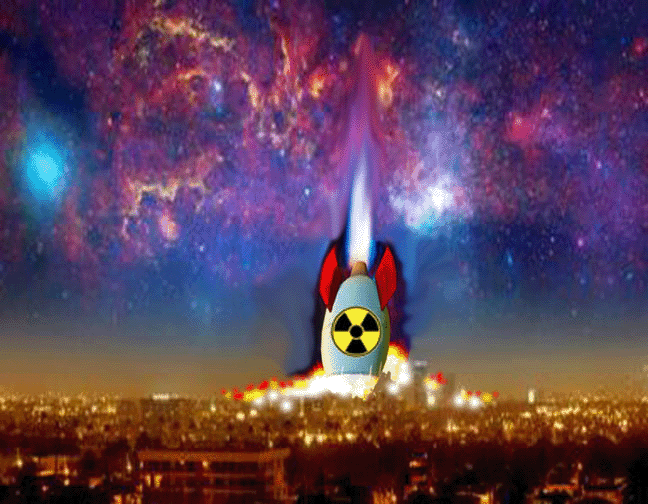 Interstellar for Real: Meet the Nuclear-Powered Spaceships of the Future Sputnik news, 22 Apr 18, Spaceships using conventional hydrogen-oxygen fuel will be able to take people to the moon, Mars or Venus. But human exploration of other planets in our solar system, and beyond it, will require the creation of ships harnessing the power of nuclear fission and nuclear fusion, including via the concept of nuclear pulse propulsion.
………Icarus envisions sending multiple probes across multiple solar systems within 15 light years of Earth to carry out detailed studies of stars and planets. Like Daedalus, the project requires helium-3 for fuel, which can be found in ample quantities on Neptune or Jupiter, but which is scarce on Earth. Based on the current pace of technological development, such foreign-planet mining, and hence such a mission, may not be possible until the year 2,300.Ultimately, Anton Pervushin believes that so long as the nuclear test ban treaty remains in force, nuclear pulse propulsion will inevitably remain a theoretical concept. Furthermore, as Pichugina explained, in addition to legal issues, a number of technical questions remain unresolved. These include how to apply fuel to the combustion chamber, how to amortize acceleration, how to protect crews from cosmic radiation, and in general determining the most efficient types of spacecraft.
Still, as Pervushin noted, if humanity wants to escape the bonds of our solar system and send large spacecraft to those close by, nuclear pulse propulsion remains the only realistic option.Postscriptum: Nuclear Fission for Electrical Propulsion
In addition to the ambitious proposals for interstellar nuclear fission and nuclear fusion propulsion, Soviet scientists worked intently from the 1960s to the 1980s on nuclear fission electric power propulsion systems, which transform nuclear thermal energy into electrical energy, which is then used to power conventional electrical propulsion systems.
The Soviet space program pioneered and worked to improve the technology with the Kosmos series of satellites, which, while generally successful, had their reputation somewhat marred following the emergency descent of Kosmos 954 in 1978, which spread radioactive debris over northern Canada.
The Soviets continued to experiment with these technologies well into the late 1980s, and even envisioned the use of nuclear fission-based energy as a realistic means to reach Mars. https://sputniknews.com/science/201804221063803318-nuclear-powered-spaceships-of-the-future/
New cracks discovered in Scotland’s Hunterston B nuclear reactor
 Revealed: new cracks at Hunterston nuclear reactor raise radiation accident fears, Herald Scotland, Rob Edwards , 23 Apr 18
Nuclear Radiation Concerns in the Gulf after Bushehr Quake
aawsat.com , 20 April, 2018 Dammam – Ali al-Qattan
An earthquake that struck a “nuclear” province west of Iran on Thursday has renewed concerns in the Gulf region, which is at a geographic proximity to the Bushehr nuclear reactor more than some Iranian cities.
Residents in the Gulf, including those in some areas in Kuwait and the Eastern Province of Saudi Arabia as well as Bahrain, felt the 5.9 magnitude quake that hit the region of Bushehr.
The earthquake occurred at 11:04 am at a depth of 18 kilometers and three kilometers away from Kaki. Iranian agencies published photos showing landslides in the mountainside and a dust wave in the quake’s aftermath.
……… The former head of the Saudi Geological Survey, Zohair Nawab, told Asharq Al-Awsat newspaper that Iranian authorities should take all necessary measures to prevent any leak from the nuclear plant to avoid harm to their citizens and neighboring countries.
Iran sits atop several fault lines and has been hit by a series of earthquakes since November 2017, when a 7.3-magnitude tremor killed 620 people in the western province of Kermanshah and eight in Iraq. …..https://aawsat.com/english/home/article/1243711/nuclear-radiation-concerns-gulf-after-bushehr-quake
Magnitude-5.5 quake strikes near Iran’s Bushehr nuclear power plant
Iran earthquake latest: Magnitude-5.5 quake strikes near nuclear power plant Country sits on major fault lines and is prone to frequent tremors, Independent UK, Agency, Independent Staff – 19 Apr 18, An earthquake has hit southern Iran just 60 miles from the country’s Bushehr nuclear power plant.
It hit on Thursday morning and was also felt in Bahrain and other areas around the Persian Gulf.
The US Geological Survey (USGS) said the quake struck at 6.34am GMT, some 60 miles east of the Bushehr nuclear power plant, the only operating nuclear power station in the Islamic Republic.
The USGS put the earthquake’s magnitude at 5.5, while Iranian state television, citing officials, described the quake as a magnitude 5.9. Varying magnitudes are common immediately after a temblor.
Government-run TV did not report any damage at the Bushehr plant, which has seen other earthquakes in the past and was built to resist damage from the tremors………
The USGS put the earthquake’s depth at 6.2 miles (10km) below the surface. Shallow earthquakes often have broader damage.
A magnitude-5 earthquake can cause considerable damage.
Iran sits on major fault lines and is prone to near-daily earthquakes……..https://www.independent.co.uk/news/world/middle-east/iran-earthquake-latest-updates-nuclear-power-plant-bushehr-a8311696.html
Bushfires near Australia’s nuclear reactor are still dangerous
Firefighters Warn NSW Is “Not Out Of The Woods” On Third Day Of Bushfires, Pedestrian. 16 Apr 18 More than 250 firefighters continue to battle bushfires in NSW’s southwest, which has spread more than 2,400 hectares since Saturday afternoon.
The blaze, which is believed to have originated in the vicinity of Casula, was fanned further by strong winds on Sunday.

More than 500 firefighters from the Rural Fire Service, Fire & Rescue NSW and the Australian Defence Force attempted to contain the blaze over the weekend with help from volunteers and 11 water-bombing helicopters.
The fire tore trough Holsworthy military range, and while approaching suburban areas, has been staved off. Several residents report fighting off embers with hoses and water buckets.
The fire was downgraded from “emergency level” to “watch and act” on 5.30pm Sunday, then again downgraded to “advice” around 2am Monday.
While lower wind conditions are expected to help with containing the fire, RFS Deputy Commissioner Rob Rogers warned that the high temperatures remain an issue.
“Still quite a difficult day ahead (on Monday),” Rogers told the Nine Network. “I think we’ve got a long way to go before we’re out of the woods.”
There’s also a risk that winds could also pick up to 35km/h later today.
The RFS is currently advising residents in Pleasure Point, Sandy Point, Alfords Point, Barden Ridge [ie; Lucas Heights] , Voyager Point, Illawong, Menai & Bangor to “remain vigilant throughout the day and keep themselves up to date by checking the NSW RFS website“……..https://www.pedestrian.tv/news/firefighters-warning-nsw-bushfires/
AUSTRALIA is struggling to contain a growing bushfire that is racing towards a nuclear reactor, amid fears that the blaze could expand beyond their control. By OLI SMITH Apr 16, 2018
Apocalyptic blaze surrounding nuclear reactor sets off emergency
More than 500 Australia firefighters are struggling to tackle a massive bushfire, with several residents urged to seek shelters as evacuation is now “too late”.
Scenes of the blaze, which started yesterday, have been described as “apocalyptic” after the fire ripped through nearly 2,500 hectares of land close to the suburbs of Sydney.
Firefighters failed to stop the out-of-control blaze from burning through a major military base – and a nuclear reactor is the next at-risk location.
The New South Wales Rural Fire Service (RFS) said it was concerned that flying embers could spark even more blazes……
The unseasonably hot Autumn in south-eastern Australia has been blamed for worsening the bushfire after record temperatures for April.
Shane Fitzsimmons, of the RFS, warned that strong 60km per hour winds are expected to push towards residential homes.
He said that the country’s largest army barracks at Holsworthy, where stockpiles of fuel, ammunition and explosive materials are kept, had been hit by the fire.
Australia’s bushfires threatening nuclear reactor: Changing the name of a suburb helps the government keep this quiet.
Lucas Heights nuclear reactor: The untold threat of the Sydney bushfires. https://independentaustralia.net/environment/environment-display/sydney-bushfires-raged-towards-lucas-heights-nuclear-reactor,11401
As fires raged in Sydney, there has not been a peep out of the mainstream media about the fire hazard to Lucas Heights nuclear complex. Noel Wauchope reports.
THE LATEST news on the bushfires raging in Sydney’s south-west is that the firefighters are “cautiously optimistic” and that emergency warning advice has been downgraded to “watch and act”.
However, the fire continues to burn in an easterly direction towards Barden Ridge and weather conditions are still dodgy, as Sydney’s record-breaking heatwave looks like coming to an end.
It’s been an anxious time — the fire has burned over 2,400 hectares. On Sunday (15 April), more than 500 firefighters in almost 100 fire trucks, along with 15 aircraft, battled the blaze throughout the day. Residents were told that it was too late to leave their homes. Heat from the bushfires was impacting the high voltage lines. There is very little rain forecast over the next few days.
So, it has all been a worry. But you wouldn’t know, would you, that the fire is so close to the Lucas Heights nuclear complex? The latest maps shown on The Guardian and NSW Rural Fire Service websites don’t really show how close this fire is getting to Lucas Heights. I have previously written about the safety hazards of Lucas Heights, with its reactor, cooling pond and accumulation of nuclear wastes — the amount of which is not publicly available.
The fires have reached about four kilometres from Lucas Heights. Embers carried by wind can form spot fires well ahead of the firefront — even up to 20 kilometres away. In the dense and rugged bushland, with predicted west to north-west winds up to 30 kilometres per hour – not forgetting that bushfires create their own weather systems – is not that hazardous to the nuclear complex?
But we don’t hear a word about this. What makes the silence easier, is that the residential area previously part of Lucas Heights was renamed Barden Ridge in 1996 to increase the real estate value of the area, as it would no longer be instantly associated with the High Flux Australian Reactor (HIFAR) — and now the Opal nuclear reactor.
Of course, now, because of the name change, there’s no public awareness that Australia’s nuclear reactor is anywhere near the fires. You can bet that the government wants to keep us all in blissful ignorance.
What we do know, is that fires are certainly a hazard to nuclear sites and there is the possibility of radiation release across a wide area, if fire invades a nuclear complex, with the fuel rods in cooling pools at great risk. When fires do happen near a nuclear site, there may be a security panic going on but that is not communicated to the public.
There have been wildfires threatening nuclear sites – in Russia, Europe, California – the pattern is to downplay, to not mention, the nuclear danger. The publicity pattern is always to ignore the radiation hazard. For example:
“It’s being fought by security site fire crews, with help from a helicopter able to detect any aerial release of radiation.” Like monitoring is going to help or they’re going to share their data. Not a peep about the radiation numbers during the fires in and around Los Alamos even though they were “monitoring” – comment by Helen Helen Mary Caldicott and Henry Peters, on this article: Wildfire burning in former Nevada nuclear site.
And from this one: Russia emergency minister threatens to ‘deal with’ those spreading radiation ‘rumours’ about wildfires in contaminated areas
Whenever there have been wildfires threatening nuclear sites – in Russia, Europe or the U.S. – the pattern is to downplay, to not mention, the nuclear danger. The publicity pattern is always to ignore the radiation hazard.
For example during the recent Californian wildfires:
“It’s being fought by security site fire crews, with help from a helicopter able to detect any aerial release of radiation.”
As though any amount of monitoring is going to help or that any data would be publicly shared. Not a peep about the radiation numbers during the fires in and around Los Alamos, even though they were “monitoring” it.
And in the case of this fire in Russia, the emergency minister threatened to “deal with” those who spread radiation “rumours”:
For the current Sydney bushfires, it seems as though there will have been a lucky escape for the communities, despite the fact that two giant aircraft, the DC10 Nancybird and the C130 Hercules “Thor” — normally used for aerial water bombing — were not available to help fight the Sydney fire, having been sent back to the U.S., because by March, the fire risk is supposed to be over.
It will have been a much luckier escape that they realised if the nuclear complex remains unscathed — this time! https://independentaustralia.net/environment/environment-display/sydney-bushfires-raged-towards-lucas-heights-nuclear-reactor,11401
Unsafe development of Belarus nuclear power plant
Ministry Of Foreign Affairs Lithuania 13th April 2018 , The Astravets NPP project in Belarus is being developed in non-compliance
with international standards of environmental and nuclear safety, with
recurrent serious violations, repetitive incidences on the construction
site of Astravets NPP, poor occupational safety culture, lack of competence
and expertise in the project development process on the part of nuclear
safety regulatory authority and organisations in charge of construction
works of Astravets NPP.
The project is accompanied by persistent manipulations with international instruments and public opinion in Belarus
and neighbouring countries.
Lithuania has been raising these concerns ever since 2009 in all competent international organisations (International
Atomic Energy Agency (IAEA), Nuclear Safety and Espoo Conventions, Aarhus
and Helsinki Water Conventions, in organisations of the European Union and
European Nuclear Safety Organisation (WENRA, ENSREG), the United Nations
and other organisations). Until now issues regarding safety at the
Astravets NPP raised by Lithuania and possible negative impact on Lithuania
and the entire region, including Belarus, remain unresolved.
http://urm.lt/default/en/news/fundamental-problems-of-the-astravets-nuclear-power-plant-under-construction-in-belarus-
Helicopter to monitor radiation ahead of Boston Marathon – precaution in view of terrorism risks
Chopper will measure radiation ahead of Boston Marathon, With the Boston Marathon around the corner, more security efforts are underway. Metro US News By Statehouse News ServiceApril 11, 2018
 A helicopter equipped with radiation-sensing technology will make several low passes over the Boston Marathon route later this week to measure naturally occurring background radiation ahead of the 122nd Boston Marathon next week.
Between Thursday and Sunday, the National Nuclear Security Administration will use the chopper to measure background radiation along the 26.2-mile marathon route and slightly beyond, flying a twin-engine Bell 412 helicopter in a grid pattern at about 150 feet above the ground at speeds of about 80 miles per hour, the agency said.
The NNSA said measuring baseline levels of radiation is “a normal part of security and emergency preparedness for major public events”
According to the United States Government Accountability Office, “the surveys can be used to compare changes in radiation levels to (1) help detect radiological threats in U.S. cities more quickly and (2) measure contamination levels after a radiological attack to assist in and reduce the costs of cleanup efforts.”…….https://www.metro.us/news/local-news/boston/boston-marathon-chopper-radiation
Radioactive Sludge Barrel Ruptures at Idaho Nuclear Site
 U.S. News U.S. officials say a barrel of radioactive sludge has ruptured at an Idaho nuclear site., April 12, 2018, By KEITH RIDLER, Associated Press,
BOISE, Idaho (AP) — A barrel containing radioactive sludge ruptured at an Idaho nuclear facility, federal officials said Thursday, resulting in no injuries and no risk to the public but possibly slowing progress in shipping waste out of the state.
The U.S. Department of Energy said the 55-gallon (208-liter) barrel ruptured late Wednesday at the 890-square-mile (2,305-square-kilometer) site that includes the Idaho National Laboratory, one of the nation’s top federal nuclear research labs.
The rupture triggered a fire alarm, and three Idaho National Laboratory firefighters extinguished the smoldering barrel and pulled it away from a dozen other barrels nearby.
When the firefighters left the building, emergency workers detected a small amount of radioactive material on their skin, said department spokeswoman Danielle Miller………
Federal officials said it’s the first known rupture of a barrel containing radioactive sludge at the site but might not be the last. https://www.usnews.com/news/best-states/idaho/articles/2018-04-12/incident-reported-at-idaho-nuclear-site-crews-responding
Massachusetts State Presses Pilgrim Nuclear Station Owners On Radiation Standards
State Presses Pilgrim Plant Owners On Radiation Standards https://www.capenews.net/falmouth/news/state-presses-pilgrim-plant-owners-on-radiation-standards/article_47fd3789-2730-5963-8647-d2c5fa940269.html, By STEVEN WITHROW , 13 Apr 18
Australia’s top secret and expensive shipment of nuclear waste to France
 Tight security for shipment of nuclear waste from Lucas Heights to France, THE AUSTRALIAN, SIAN POWELL, 12 APR 18 A top-secret security operation to send spent radioactive fuel rods from Australia’s nuclear reactor to France for reprocessing is planned for the coming months.
Potentially involving hundreds of state and federal police, the details of the transport operation will remain confidential until after the shipment arrives at La Hague, in northwest France.
Unused uranium and plutonium will then be removed from the fuel rods, and the residual waste eventually returned to Australia for storage. About 500kg of unused low-enriched uranium and 4.5kg of unused plutonium will be recovered from the rods…
The Australian Nuclear Science and Technology Organisation at Lucas Heights in Sydney’s south has confirmed the shipment will be trucked to a port for transport to La Hague midway through this year.
 The route, the port, the time and the ship, as well as the numbers of security personnel, will remain confidential until after the mission is completed.
The last shipment of spent rods was sent to the US in 2009, and both Port Kembla and Port Botany have been used as shipment ports in the past.
When reprocessed nuclear waste was returned to Australia in 2015 for storage at Lucas Heights, more than 500 police were deployed to guard the shipment, and it is expected at least that number will guard the radioactive cargo destined for France.
The radioactive spent fuel rods will be packed into an undisclosed number of immensely tough lead and stainless steel transport casks for the journey to France.
“These casks are purpose-engineered to safely transport this type of material without risk to people or the environment,” said the manager of the multipurpose OPAL Reactor at Lucas Heights, Dave Vittorio. “Even a jet plane strike could not penetrate them.”
The total cost of the project is $45 million, including the contract with France, equipment, staff costs, and incidentals.
…… Australia, like other nations, pays to use the La Hague facility’s infrastructure and expertise. The shipment will be the 10th export of spent nuclear fuel assemblies used in the OPAL reactor’s first 10 years of operation. ….https://www.theaustralian.com.au/news/health-science/tight-security-for-shipment-of-nuclear-waste-from-lucas-heights-to-france/news-story/5549c370206c15aa1bc1a4b2367d6552
France’s nuclear regulator finds “a lack of surveillance” in the defective welding in EPR nuclear reactors
Le Monde 12th April 2018 , [Machine Translation] EPR Flamanville: the Nuclear Safety Authoritycriticizes “a lack of surveillance” ASN President Pierre-Franck Chevet
describes the new anomalies discovered on third-generation reactor welds as
“serious”.
The President of the Nuclear Safety Authority (ASN),
Pierre-Franck Chevet, came back in harsh terms, Thursday, April 12 in the
Senate, on new weld defects unearthed Tuesday on the EPR Flamanville
(Channel). An anomaly that he considered “serious” before the Parliamentary
Office for evaluating scientific and technological choices, to which he
presented the annual report on the state of nuclear safety and radiation
protection in France .
Pierre-Franck Chevet, came back in harsh terms, Thursday, April 12 in the
Senate, on new weld defects unearthed Tuesday on the EPR Flamanville
(Channel). An anomaly that he considered “serious” before the Parliamentary
Office for evaluating scientific and technological choices, to which he
presented the annual report on the state of nuclear safety and radiation
protection in France .
He had already used the same qualifier in February,
about first “deviations” detected in the realization of certain welds
piping connecting the steam generators (four in the EPR) to the turbine.
Thirty-eight welds were involved. But, at that time, EDF was assured, these
were deviations from a “high quality” standard , more demanding than the
standard standards applied to nuclear pressure equipment, so that,
according to the electrician, these circuits remained ” able to carry out
their mission safely . “
about first “deviations” detected in the realization of certain welds
piping connecting the steam generators (four in the EPR) to the turbine.
Thirty-eight welds were involved. But, at that time, EDF was assured, these
were deviations from a “high quality” standard , more demanding than the
standard standards applied to nuclear pressure equipment, so that,
according to the electrician, these circuits remained ” able to carry out
their mission safely . “
The problem is actually more extensive than EDF
then heard . At the end of March, the company discovered, during the
“initial complete visit” prior to the commissioning of the third-generation
reactor, new “quality deviations” . And this time, not in relation to
increased safety requirements, but compared to the normal regulations for
this type of equipment.
http://www.lemonde.fr/planete/article/2018/04/12/epr-de-flamanville-l-autorite-de-surete-nucleaire-pointe-un-defaut-de-surveillance_5284559_3244.html
then heard . At the end of March, the company discovered, during the
“initial complete visit” prior to the commissioning of the third-generation
reactor, new “quality deviations” . And this time, not in relation to
increased safety requirements, but compared to the normal regulations for
this type of equipment.
http://www.lemonde.fr/planete/article/2018/04/12/epr-de-flamanville-l-autorite-de-surete-nucleaire-pointe-un-defaut-de-surveillance_5284559_3244.html
Fort Calhoun nuclear station scaling back emergency procedures
Nuclear plant emergency procedure scaled back at FCS, http://www.wowt.com/content/news/Nuclear-plant-emergency-procedure-scaled-back-at-FCS-479198163.html FORT CALHOUN, Neb. (WOWT)– By Josh Spreiter | Apr 09, 2018 |
Some changes are effective today at the Fort Calhoun Station. This is a part of the de-commissioning process at the old nuclear power plant which was shut down in 2016. People living within the “Emergency Planning Zone should have received a letter in the mail explaining this step.
Right now, FCS employees are working to safely de-commission the plant, a process that can take up to 60 years. Over the next year, OPPD will be removing the 101 sirens across the EPZ, simply because they are no longer needed.
An FCS manager says the used nuclear fuel has cooled to a point where the likelihood of a leak is “extremely low.” All the fuel will be removed from the pool and placed into dry cask storage on site.
Residents living with this zone will also no longer receive the annual emergency planning information brochure.
Over the years, the old nuclear power plant had some close calls. During the 2011 Missouri River Flood, FCS became an island itself. The plant remained safe and dry inside, but the flooding continued for several months as water was pumped out from behind a series of barriers that were installed around the plant. One of the barriers collapsed but the plant remained safe.

Even before the floodwater reached the plant, there was a fire in the cooling system used for fuel. It concerned federal regulators because the fire could have happened at any time, as workers didn’t fully investigate an unusual smell three days earlier.
Now, as FCS opens the page to a new chapter, people we spoke to say they have full confidence officials will keep them safe.
OPPD says it continue to have staff onsite 24/7. Technical experts will also be available if any concerns arise.
Powerful volcanic eruption at Mount Shinmoe, and more to come -ONLY 40 MILES FROM Sendai Nuclear power station

Another powerful eruption observed at Mount Shinmoe , Japan Times, 5 Apr 18 FUKUOKA – Another powerful eruption was observed at Mount Shinmoe in southwestern Japan early Thursday, with ash sent spiralling into a plume around 5,000 meters high, the Meteorological Agency said.
The eruption at the 1,421-meter volcano that straddles Miyazaki and Kagoshima prefectures was the largest since March 25, according to the agency.
Mount Shinmoe erupted violently for the first time in about seven years on March 6, and the agency said a week later that it was expected to continue explosive eruptions for several months or more……..https://www.japantimes.co.jp/news/2018/04/05/national/another-powerful-eruption-observed-mount-shinmoe/#.WsggQIhubIU
1 This Month
26 April – Chernobyl: Inside the Meltdown airs on National Geographic on Sunday 26th April from 4pm

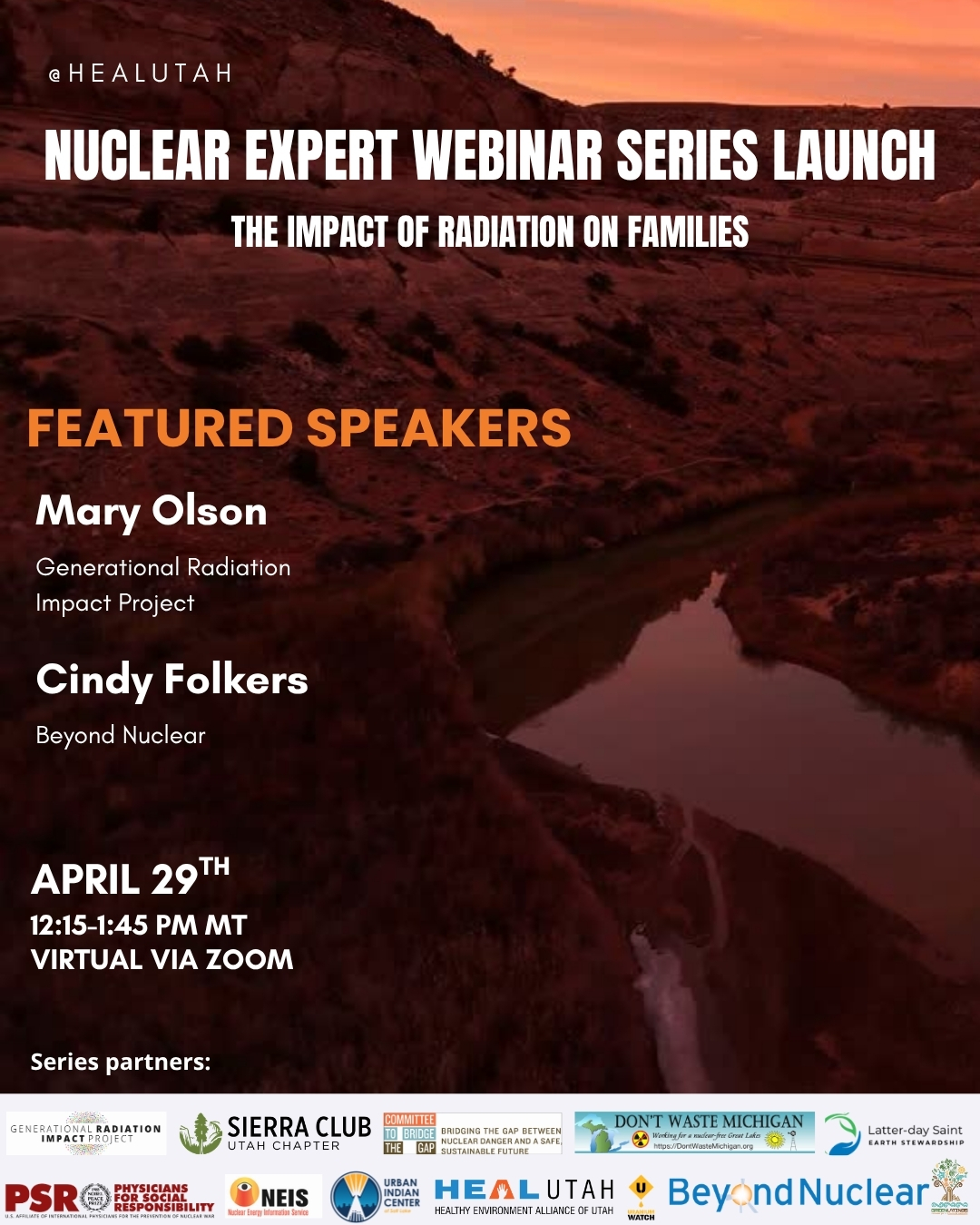
29 April – Nuclear Expert Webinar #1 – Radiation Impacts on Families with Mary Olson and Cindy Folkers
- 12:15 PM MT – 1:45 PM MT
- Location: Virtual – REGISTER TODAY

4 May -West Suburban Peace Coalition to discuss Iran war at May Educational Forum
Monday, May 4, 7:00 – 8:00 PM Central Standard Time
Title: : How Trump’s Narrative Tries to Shape the Reality of the War on Iran.
Contact Walt Zlotow, zlotow@hotmail.com 630 442 3045 for further information
14 May – online event From Bombs to Data Centres: the Face of Nuclear Colonialism

Pine Ridge Uranium is the real threat, not Tehran- Tell Burgum: Stop the Extraction.
Chernobyl: The Lost Tapes – A good documentary on Chernobyl on SBS available On Demand for the next 3 weeks– https://www.sbs.com.au/ondemand/tv-program/chernobyl-the-lost-tapes/2352741955560
To see nuclear-related stories in greater depth and intensity – go to https://nuclearinformation.wordpress.com
-
Archives
- April 2026 (346)
- March 2026 (251)
- February 2026 (268)
- January 2026 (308)
- December 2025 (358)
- November 2025 (359)
- October 2025 (376)
- September 2025 (257)
- August 2025 (319)
- July 2025 (230)
- June 2025 (348)
- May 2025 (261)
-
Categories
- 1
- 1 NUCLEAR ISSUES
- business and costs
- climate change
- culture and arts
- ENERGY
- environment
- health
- history
- indigenous issues
- Legal
- marketing of nuclear
- media
- opposition to nuclear
- PERSONAL STORIES
- politics
- politics international
- Religion and ethics
- safety
- secrets,lies and civil liberties
- spinbuster
- technology
- Uranium
- wastes
- weapons and war
- Women
- 2 WORLD
- ACTION
- AFRICA
- Atrocities
- AUSTRALIA
- Christina's notes
- Christina's themes
- culture and arts
- Events
- Fuk 2022
- Fuk 2023
- Fukushima 2017
- Fukushima 2018
- fukushima 2019
- Fukushima 2020
- Fukushima 2021
- general
- global warming
- Humour (God we need it)
- Nuclear
- RARE EARTHS
- Reference
- resources – print
- Resources -audiovicual
- Weekly Newsletter
- World
- World Nuclear
- YouTube
-
RSS
Entries RSS
Comments RSS
 nuclear-news