nuclear-news

The News That Matters about the Nuclear Industry Fukushima Chernobyl Mayak Three Mile Island Atomic Testing Radiation Isotope

Continued safety concerns about production of “plutonium pits” for nuclear bombs

Safety concerns plague key sites proposed for nuclear bomb production, USA Today , Patrick Malone, Center for Public Integrity . ET May 3, 2018

Decision due soon on where plutonium parts for the next generation of nuclear weapons are to be made 

The Department of Energy is scheduled to decide within days where plutonium parts for the next generation of nuclear weapons are to be made, but recent internal government reports indicate serious and persistent safety issues plague both of the two candidate sites.

Some experts are worried about the safety records of either choice: Los Alamos National Laboratory in New Mexico, where plutonium parts have historically been assembled, and the Savannah River Site in South Carolina, where other nuclear materials for America’s bombs have been made since in the 1950s.

An announcement by the Trump administration about the location is expected by May 11 in preparation for the ramped-up production of nuclear warheads called for by the Defense Department’s recent review of America’s nuclear weapons policy.

Recent internal government reports obtained by the Center for Public Integrity have warned that workers at these plants have been handling nuclear materials sloppily or have failed to monitor safety issues aggressively.

……….The continued mistakes at Los Alamos follow a three-year period of stasis in the U.S. plutonium production program forced by the lab’s inability to meet safety standards for plutonium operations. Los Alamos’ plutonium facility shelved all the nation’s high-hazard plutonium work, including the production of nuclear weapons cores or “pits,” in the summer of 2013, and has recently resumed most but not all of the wor

The prolonged shutdown at Los Alamos — the birthplace of the nuclear bomb — provoked National Nuclear Security Administration’s principal assistant deputy administrator for defense, Philip Calbos, to remark during a panel discussion at National Defense University in February that nuclear rivals are noticing America’s missteps.

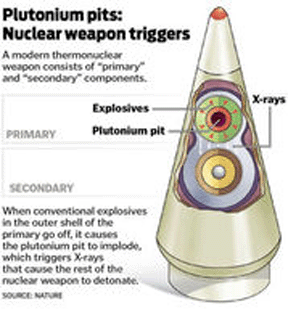
………..Plutonium pits are the shiny metallic, softball-size orbs that hold the most potent destructive force man has ever harnessed in a weapon. During the Cold War, the Rocky Flats production site in Colorado made as many as 2,000 a year. Decades of poor disposal of nuclear wastes and other dangerous environmental practices culminated in a dramatic FBI raid in 1989 that led to the site’s closure in 1992.

Nuclear criticality safety, the craft of avoiding a self-starting, potentially lethal, nuclear chain reaction merely from positioning too much plutonium too closely together, is an ever-present concern during such production……..https://www.usatoday.com/story/news/nation/2018/05/02/safety-concerns-nuclear-bomb-manufacture-sites/572697002/


May 4, 2018 Posted by | - plutonium, safety, USA | Leave a comment

A containment failure: How American nuclear regulators undercut power plant safety from the beginning

Bulletin of Atomic Scientists 4th May 2018 , In 1965, the US Atomic Energy Commission made a fateful decision to license
nuclear power plants that, top safety experts believed, had containment structures that were inadequate to contain dangerous releases of
radioactivity in the case of core-melting accidents.

It was a critical turning point in reactor safety. The AEC’s downgrading of the containment’s role opened the door to smaller, cheaper, “dynamic”
containments, which offered significantly less protection in case of a fuel melt accident. Buyers of nearly four dozen large US power reactors opted
for the most vulnerable of such containments, of which 30 remain in
operation.

Because of their inadequate containments, they should all be retired. All but one have exceeded their original 40-year license
durations. New plants shouldn’t be licensed unless they include containments that actually do what they were originally supposed to do –
contain all radioactive material, even in a worst-case melt-down of a nuclear reactor core.

https://thebulletin.org/2018/may/containment-failure-how-american-nuclear-regulators-undercut-power-plant-safety-beginning11770

May 4, 2018 Posted by | safety, USA | Leave a comment

Growing concerns in Scotland over dangers of nuclear weapons “convoys” travelling through towns and cities

Scotsman 30th April 2018 , The Scottish Government will this week face calls to hold a review into
concerns over nuclear weapons “convoys” travelling through towns and cities
in Scotland. The Greens have said the SNP government, which opposes nuclear
weapons, is responsible for community safety and emergency planning and
cannot dismiss the issue as being reserved to Westminster.

MSPs are preparing to debate the issue at Holyrood on Wednesday, where Green MSP
Mark Ruskell will call for a review.

Up to eight times a year, a convoy of heavy trucks containing weapon materials and nuclear warheads travels
between the Aldermaston and Burghfield atomic weapon plants in Berkshire to
the Royal Navy base at Coulport on Loch Long where the UK’s nuclear weapons
are stored. These trucks will often be carrying weapons materials for
maintenance or replacement. But a Freedom of Information request by Green
MSPs last year found that none of the relevant local authorities the trucks
pass through has conducted risk assessments in relation to the convoys.
https://www.scotsman.com/news/politics/greens-seek-review-of-nuclear-convoy-safety-1-4732236

May 2, 2018 Posted by | politics, safety, UK | Leave a comment

Russia’s hazardous new nuclear project – world’s first floating nuclear power plant bound for the Arctic

World’s first floating nuclear power plant bound for the Arctic, warns Greenpeace https://www.greenpeace.org/international/press-release/16218/worlds-first-floating-nuclear-power-plant-bound-for-the-arctic-warns-greenpeace/ by Greenpeace International  

April 30, 2018 Posted by | business and costs, Russia, safety, technology | Leave a comment

The under-rated risks from plutonium

Homeland Preparedness News 27th April 2018 , A new paper from the Nuclear Threat Initiative (NTI) provided
recommendations for mitigating risks related to separated plutonium. As compared to highly enriched uranium (HEU), separated plutonium has not
received enough attention as a security risk, NTI Counselor John Carlson said in the paper, titled “Mitigating Security Risks from Separated Plutonium: Some Near-Term Steps.”
Eight countries currently hold more than 375 metric tons of separated plutonium, which is produced by reprocessing irradiated nuclear fuel. The paper recommends minimizing stocks and specific actions in production, storage and use of the material. “Even small quantities [of plutonium] could be of interest to terrorists if they see opportunities for acquiring plutonium in a number of locations or for use in a radiological dispersal device,” Carlson said.
https://homelandprepnews.com/stories/28131-nuclear-threat-initiative-highlights-separated-plutonium-security-risks/

April 30, 2018 Posted by | - plutonium, 2 WORLD, Reference, safety | Leave a comment

Belgian nuclear reactor shut down due to a leak

RTBF 28trh April 2018 , The reactor at the Doel 1 nuclear power plant in Beveren was shut down
earlier this week . The reason given at that time was a ” maintenance at
the level of the cooling circuit ” . Engie Electrabel confirmed to local TV
TV Oost that a leak was detected in the nuclear section during this review.
The reactor will be shut down at least until October 1st.
https://www.rtbf.be/info/belgique/detail_

April 30, 2018 Posted by | EUROPE, incidents | Leave a comment

Nuclear leaks at North Korean test site ARE a radiological mess

Nuclear Leaks At Nth Korean Test Site – real or “a Furphy” according to Broinowski ? Real, says Langley 

I have been following the story of radiological dangers posed by the increasing stressed geology of the North Korean nuclear test site for some months. Over the last week the story was again raised by the Australian newspaper. This motivated me to find the closest Chinese authority. The story was, as far as I can gather, published this week in The South China Morning Post on Wednesday 25 April 2018. The article, written by Stephen Chen, is entitled “North Korea’s nuclear test site has collapsed … and that may be why Kim Jong-un suspended tests“. The first paragraph explains further: “The mountain’s collapse after a fifth blast last fall has led to the creation of a massive ‘chimney’ that could leak radioactive fallout into the air, researchers have found….” before I go any further, there are two questions to ask: 1. How credible is Stephen Chen’s reporting and 2. Who are the researchers involved? eg are they retired diplomats only or are they qualified to comment in a scientific manner? If so have their findings been peered reviewed?

(what journalists say is irrelevant to me except when the articles lead me to find the peer reviewed papers published by scientists. Newspapers seem not to put relevant links to source documents up which is a crying shame.)

1. Stephen Chen: his bio on the SCMP site states: “Stephen covers breakthoughs in science and their impact on society, environment, military, geopolitics, business – pretty much all aspects of life. His stories often travel across the globe. Stephen is an alumnus of Shantou University, the Hong Kong University of Science and Technology, and the Semester at Sea programme which he attended with a full scholarship from the Seawise Foundation. In his spare time, Stephen reads and writes novels. He lives in Beijing with a beautiful wife and two lovely kids.”

fair enough, signs look hopeful that the article is not reporting a scientific “furphy”, as Broinowski described the generic story on the Australian ABC TV this morning. But let’s dig a nanometer deeper. Who are the researchers Chen is referencing? Does he name them and are they famous? (fame = mass readership and lots of grant money):

“A research team led by Wen Lianxing, a geologist with the University of Science and Technology of China in Hefei, concluded that the collapse occurred following the detonation last autumn of North Korea’s most powerful thermal nuclear warhead in a tunnel about 700 metres (2,296 feet) below the mountain’s peak.

The test turned the mountain into fragile fragments, the researchers found….” end quote from the SCMP/Chen.

Further, Chen reports: “A research team led by Wen Lianxing, a geologist with the University of Science and Technology of China in Hefei, concluded that the collapse occurred following the detonation last autumn of North Korea’s most powerful thermal nuclear warhead in a tunnel about 700 metres (2,296 feet) below the mountain’s peak.

The test turned the mountain into fragile fragments, the researchers found. ” source: ibid.

Describing these findings and the dangers posed by the scientific observations as reported by Chen does not smack of “Furphy” or fantasy Richard B. (No I don’t mind who your sister is, you should know better).

Wen Lianxing et al have been tracking North Korean nuclear tests, as far as I can find (hamstrung as I am, because I cannot speak or read Chinese), from at least 2006, and certainly since 2009, when the team became the first in the world to precisely locate the location of a North Korean nuclear test. : “High-precision Location of North Korea’s 2009 Nuclear Test”
Article in Seismological Research Letters 81(1):26-29 · January 2010 authors: Lianxing Wen, University of Science and Technology of China (Hefei, China); Hui Long, Stony Brook University (Stony Brook, United States).

Have a read of it Mr Broinowski. You might find it sensible and not a furphy.

Ok, on with the real matters at hand. Underground nuke tests invariably leak radionuclides into the biosphere. The US underground nuclear test regime has created a legacy of cost and risk, to put it mildly, which continues to this day. Name a US underground shot, and go to DOE Opennet and enter the shot’s code name. Up pops reams of documents detailing the test, the immediate result, and the long term consequences in terms of risk and costs.

There is no reason to suspect that the risks and costs of North Korea’s underground will be any more “furphy” ridden that the US underground tests were. And continue to be.

So without any further ado, even if I have to drag Richard B kicking and screaming into 1954, is some more non furphy from Chen and the SCMP:

“It is necessary to continue monitoring possible leaks of radioactive materials caused by the collapse incident,” Wen’s team said in the statement.

The findings will be published on the website of the peer-reviewed journal, Geophysical Research Letters, likely next month.

North Korea saw the mountain as an ideal location for underground nuclear experiments because of its elevation – it stood more than 2,100 metres (6,888 feet) above sea level – and its terrain of thick, gentle slopes that seemed capable of resisting structural damage…..

“The mountain’s surface had shown no visible damage after four underground nuclear tests before 2017.

But the 100-kilotonne bomb that went off on September 3 vaporised surrounding rocks with unprecedented heat and opened a space that was up to 200 metres (656 feet) in diameter, according to a statement posted on the Wen team’s website on Monday. ….

“As shock waves tore through and loosened more rocks, a large section of the mountain’s ridge, less than half a kilometre (0.3 mile) from the peak, slipped down into the empty pocket created by the blast, leaving a scar visible in satellite images.

Wen concluded that the mountain had collapsed after analysing data collected from nearly 2,000 seismic stations. ….

“Three small earthquakes that hit nearby regions in the wake of the collapse added credence to his conclusion, suggesting the test site had lost its geological stability.

Another research team led by Liu Junqing at the Jilin Earthquake Agency with the China Earthquake Administration in Changchun reached similar conclusions to the Wen team. ….

“The “rock collapse … was for the first time documented in North Korea’s test site,” Liu’s team wrote in a paper published last month in Geophysical Research Letters.

The breakdown not only took off part of the mountain’s summit but also created a “chimney” that could allow fallout to rise from the blast centre into the air, they said. …

“Zhao Lianfeng, a researcher with the Institute of Earth Science at the Chinese Academy of Sciences in Beijing, said the two studies supported a consensus among scientists that “the site was wrecked” beyond repair.

“Their findings are in agreement to our observations,” he said.

“Different teams using different data have come up with similar conclusions,” Zhao said. “The only difference was in some technical details. This is the best guess that can be made by the world outside.” ….

“Speculation grew that North Korea’s site was in trouble when Lee Doh-sik, the top North Korean geologist, visited Zhao’s institute about two weeks after the test and met privately with senior Chinese government geologists.

“Although the purpose of Lee’s visit was not disclosed, two days later Pyongyang announced it would no longer conduct land-based nuclear tests.”

” Hu Xingdou, a Beijing-based scholar who follows North Korea’s nuclear programme, said it was highly likely that Pyongyang had received a stark warning from Beijing.

““The test was not only destabilising the site but increasing the risk of eruption of the Changbai Mountain,” a large, active volcano at China-Korean border, said Hu, who asked that his university affiliation not be disclosed for this article because of the topic’s sensitivity.

“The mountain’s collapse has likely dealt a huge blow to North Korea’s nuclear programme, Hu said.

Hit by crippling international economic sanctions over its nuclear ambitions, the country might lack sufficient resources to soon resume testing at a new site, he said.

“But there are other sites suitable for testing,” Hu said. “They must be closely monitored.”

Guo Qiuju, a Peking University professor who has belonged to a panel that has advised the Chinese government on emergency responses to radioactive hazards, said that if fallout escaped through cracks, it could be carried by wind over the Chinese border.

“So far we have not detected an abnormal increase of radioactivity levels,” Guo said. “But we will continue to monitor the surrounding region with a large [amount] of highly sensitive equipment and analyse the data in state-of-the-art laboratories.”

“Zhao Guodong, a government nuclear waste confinement specialist at the University of South China, said that the North Korean government should allow scientists from China and other countries to enter the test site and evaluate the damage.

“We can put a thick layer of soil on top of the collapsed site, fill the cracks with special cement, or remove the pollutants with chemical solution,” he said.

“There are many methods to deal with the problem. All they need [to do] is ask.” end quote . source: ibid.

For the sake of ignorant ex diplomats everywhere, let me list all the qualified scientists Chen gives as sources for his article:

1. Wen Lianxing
2. Liu Junqing
3. Zhao Lianfeng
4. Hu Xingdou
5. Guo Qiuju
6. Zhao Guodong

The above qualified people consider that North Korean nuclear tests have, and do, pose a continuing radiological risk to North Korea and to China. This is due to the geologic damage the test series have caused. As any rational person with knowledge of the US underground test era knows, such risks are extremely well documented in the case of the US tests and appalling documented in the case of North Korea.

Dissenters from my point view and the content of Chen’s reported based upon his 6 expert sources are: 1. Richard Broinowski, retired diplomat. Not a scientist.

blows rasberry at RD. so sue me.

P.S. and another thing Richard B. You won’t close the South Korean nuclear plants down by going on TV and denying the North Korean radiological mess, which is probably an undisclosed actual disaster for the people there. Underground nuke test sites have many ways of leaking radionuclides. Over the years a test site’s hydrology is main vector, but anything can happen at the time, and, in the US experience has happened. The chances of uncontained radionuclides let loose into the biosphere is very high in North Korea and no ideology can successfully hide that fact. Your comments on the ABC TV this morning were damaging to the movement and frankly, in my opinion, bloody ignorant. Would you accept the facts of the matter if the scientists Chen cites were all born in London and were named “Watt”?

This post has been posted on Mr Stephen Chen’s facebook page. with thanks to him and his sources.

April 27, 2018 Posted by | incidents, North Korea | Leave a comment

Report from China that North Korea’s “nuclear mountain” test site has collapsed


North Korea radiation WARNING as shock report deems nuclear test site UNUSABLE https://www.express.co.uk/news/world/951489/north-korea-news-kim-jong-un-nuclear-test-site-punggye-ri-radiation

NORTH Korea’s main nuclear test site has collapsed after multiple explosions and could be vulnerable to radiation leaks, according to a team of Chinese geologists.By SIMON OSBORNE

Scientists at the University of Science and Technology of China said the partial collapse of a mountain containing test tunnels, as well as the risk of radiation leaks, have potentially rendered the site unusable. Their study was published soon after Kim said his country would stop testing nuclear weapons and ballistic missiles and close down Punggye-ri before his meeting with Moon.

The Chinese scientists collected data after the most powerful of the North’s six nuclear tests last September.

The controlled explosion, which caused a magnitude 6.3 tremor, is believed to have triggered four more earthquakes over the following weeks.

The study found there was “a near-vertical on-site collapse towards the nuclear test centre” about eight minutes after the test.

The report said: “In view of the research finding that the North Korea nuclear test site at Mount Mantap has collapsed, it is necessary to continue to monitor any leakage of radioactive materials that may have been caused by the collapse.”

North Korean nuclear tests have caused seismic events in Chinese border towns and cities, forcing evacuations of schools and offices, sparking fears of wind-borne radiation and leading to a backlash among some Chinese against their country’s unpredictable traditional ally.

On Saturday, Kim announced North Korea would close its nuclear testing facility and suspend nuclear and intercontinental ballistic missile tests – a move welcomed by US president Donald Trump as “big progress” – and which comes ahead of a planned summit between the leaders in late May or early June.

But Kim stopped short of promising to give up his nuclear weapons, and the missile test ban does not include shorter-range weapons capable of reaching Japan and South Korea.

April 27, 2018 Posted by | incidents, North Korea | Leave a comment

SAN ONOFRE’S NUCLEAR WASTE STORAGE TANKS ALREADY BREAKING

https://www.surfer.com/features/san-onofres-nuclear-waste-storage-tanks-already-breaking/  BUSTED BOLT FOUND IN NEW TANK MEANT TO HOLD SPENT FUEL,  BY JUSTIN HOUSMAN  Just a few months into Southern California Edison’s very controversial plan to relocate spent nuclear fuel to holding tanks on the beach at San Onofre, crews are finding the holding tanks aren’t working properly.

The LA Times reported last month that when workers tried to move spent fuel from a cooling tank to dry storage tanks–that are kept a mere 100-feet from the shoreline–broken bolts were found in the long-term storage tanks. Those tanks are meant to hold and stabilize the spent fuel rods indefinitely.

Work stopped for ten days after the bolts were found, but has since resumed, angering nearby residents and people opposed to the plan to store waste at San Onofre, who were already worried about the safety of keeping nuclear waste so near the ocean and major population centers.

Now that broken bolts have been found, those fears are heightening.

The broken bolts are part of a system that helps keep the rods balanced in the storage tanks. They’re apparently a new design, and four of them have already been filled with radioactive waste. Unfortunately, there’s no way for Southern California Edison to test the already-filled containers for the same issue.

Edison is trying to assuage fears and insists there’s no threat to the public. And they’ve resumed filling more storage tanks, but not the newly-designed tanks with bolt issues.

But for watchdog groups who were already warning that unforeseen problems made storing this waste highly dangerous, malfunctioning tanks so early in the relocation process isn’t sitting very well.

“We warned them that this was going to happen, and nobody listened to us,” Donna Gilmore of SanOnofreSafety.org told the LA Times. “Now they are trying to tell us: ‘Everything is OK. Don’t worry.’ This is insane. Edison has proven they can’t keep us safe.”

As part of a lawsuit settlement, Edison has agreed to look into options to store the spent fuel permanently in New Mexico or Arizona, far from millions of Orange County and San Diego County residents.

For now though, the waste is still headed to San Onofre, busted bolts and all. All 3.6 million pounds of it.

April 27, 2018 Posted by | safety, USA | Leave a comment

The accidental dropping of two nuclear bombs, on North Carolina

The U.S. Once Dropped Two Nuclear Bombs on North Carolina by Accident https://www.atlasobscura.com/articles/nuclear-bombs-dropped-on-north-carolinaBy sheer luck, neither detonated.,  , APRIL 26, 2018

April 27, 2018 Posted by | history, incidents, USA | Leave a comment

New gigantic confinement dome over Chernobyl nuclear wreck is now almost completed

New safe confinement over Chornobyl NPP expected to start working in December, – Poroshenko https://112.international/society/new-safe-confinement-over-chornobyl-npp-expected-to-start-working-in-december-poroshenko-28001.html, 26 Apr 18

The new safe confinement at Chornobyl nuclear power plant will be put into service in December 2018. President Petro Poroshenko said this during his visit to the working ground of the NPP.

‘We’re here today to guarantee further security for Ukrainians and all Europeans to turn their attention to important projects, which we will gradually implement day by day – along with our partners. We plan to put the new safe confinement into service in December’, the president said.

The head of the state added that the mounting works on the object are almost over.

As it was reported earlier, the construction works began in Chornobyl exclusion zone in Nobvemner 2017; the nuclear waste repository will be built in the restricted area of Kyiv region. According to UNN news agency, the opening ceremony took place on November 9; Ukrainian company Energoatom will be the one supervising the construction process.

According to the Minister of Energy and Coal Production Ihor Nasalyk, by building its own nuclear waste repository, Ukraine will be able to refuse the service offered by Russia, which costs Kyiv more than 7 million dollars annually.

April 27, 2018 Posted by | safety, Ukraine, wastes | Leave a comment

Potassium pills to be distributed to residents near Enrico Fermi 2 Nuclear Generating Station

Amherstburg residents near nuclear plant to get anti-radiation pills https://windsor.ctvnews.ca/amherstburg-residents-near-nuclear-plant-to-get-anti-radiation-pills-1.3903204,  April 26, 2018 

The Windsor-Essex County Health Unit and the Town of Amherstburg will be starting Potassium Iodide pill distribution in the primary zone near the nuclear generating station.

Residents in the zone, 16.1 km from Enrico Fermi 2 Nuclear Generating Station (Fermi 2), will begin getting the pills on May 7.

KI pills block the thyroid from absorbing radioactive iodine which may be released during a nuclear incident.

In the very unlikely event of a nuclear emergency, KI pills would help to prevent the long term development of thyroid cancer.

Residents that live within the primary zone and on Boblo Island will be receiving letters this week with details inviting them to pick up free KI pills for their home and ask any questions they may have.

The health unit says if you do not receive a letter inviting you to pick up KI pills, your home does not fall within the primary zone.

Residents living within the secondary zone will have an opportunity to receive pills for their home in the near future.

KI pills are only to be taken if instructed by the Chief Medical Officer of Health for Ontario. They should be stored in a safe, dry, and accessible place along with your 72-hour emergency kit.

Health unit officials say the risk has not changed at Fermi 2, however what has changed is the regulatory framework for Canadian nuclear installations.

The Canadian Nuclear Safety Commission (CNSC) has mandated that all residents within the primary zone of a nuclear installation have KI pills available in their homes.

While Fermi 2 is not regulated by the CNSC, health unit and town officials want the residents living within the primary zone of Fermi 2 to be as prepared as all other Canadian residents.

For more information on KI pills and KI distribution, please visit www.wechu.org/KI or call 519-258-2146 ext.

April 27, 2018 Posted by | safety, UK | Leave a comment

USA’s Government Accountability Office slams Hanford nuclear waste plant operations

Feds bash Hanford nuclear waste plant troubles, question DOE priorities, Tri City Herald, BY ANNETTE CARY, acary@tricityherald.com 2018  

April 27, 2018 Posted by | safety, USA | Leave a comment

How the diabolically dangerous plutonium cores killed two nuclear scientists

The Nuclear ‘Demon Core’ That Killed Two Scientists https://www.atlasobscura.com/articles/demon-core-that-killed-two-scientistsAfter World War II ended, physicists kept pushing a plutonium core to its edge. BY SARAH LASKOW 
APRIL 23, 2018 

Since the United States dropped two atomic bombs on Japan, the world has been in a state of readiness for nuclear combat. In this secretive domain, mistakes and mishaps are often hidden: This week we’re telling the stories of five nuclear accidents that burst into public view.
THE WAR WAS OVER—JAPAN HAD surrendered. The third plutonium core created by the United States, which scientists at Los Alamos National Lab had been preparing for another attack, was no longer needed as a weapon. For the moment, the lab’s nuclear scientists were allowed to keep the sphere, an alloy of plutonium and gallium that would become known as the demon core.

In a nuclear explosion, a bomb’s radioactive core goes critical: A nuclear chain reaction starts and continues with no additional intervention. When nuclear material goes supercritical, that reaction speeds up. American scientists knew enough about the radioactive materials they were working with to be able to set off these reactions in a bomb, but they wanted a better understanding of the edge where subcritical material tipped into the dangerous, intensely radioactive critical state.

 One way to push the core towards criticality involved turning the neutrons it shedback onto the core, to destabilize it further. The “Critical Assembly Group” at Los Alamos was working on a series of experiments in which they surrounded the core with materials that reflected neutrons and monitored the core’s state.

The first time someone died performing one of these experiments, Japan had yet to formally sign the terms of surrender. On the evening of August 21, 1945, the physicist Harry Daghlian was alone in the lab, building a shield of tungsten carbide bricks around the core. Ping-ponging neutrons back the core, the bricks had brought the plutonium close to the threshold of criticality, when Daghlian dropped a brick on top. Instantly, the core reacted, going supercritical and Daghlian was doused in a lethal dose of radiation. He died 25 days later.

His death did not dissuade his colleagues, though. Nine months later, they had developed another way to bring the core close to that critical edge, by lowering a dome of beryllium over the core. Louis Slotin, another physicist, had performed this move in many previous experiments: He would hold the dome with one hand, and with the other use a screwdriver to keep a small gap open, just barely limiting the flow of neutrons back to the bomb. On a May day in 1946, his hand slipped, and the gap closed. Again, the core went supercritical and dosed Slotin, along with seven other scientists in the room, with gamma radiation.

In each instance, when the core slipped over that threshold and started spewing radiation, a bright blue light flashed in the room—the result of highly energized particles hitting air molecules, which released that bolt of energy as streams of light.

The other scientists survived their radiation bath, but Slotin, closest to the core, died of radiation sickness nine days later. The experiments stopped. After a cooling-off period, the demon core was recast into a different weapon, eventually destroyed in a nuclear test.

April 25, 2018 Posted by | - plutonium, incidents, USA | Leave a comment

In the 1950s, military accidents meant that nuclear warheads went missing.

When the U.S. Kept Losing Nuclear Bombs https://www.atlasobscura.com/articles/has-america-ever-lost-nuclear-bombs  In the 1950s, military accidents meant that nuclear warheads went missing,  ,APRIL 24, 2018

April 25, 2018 Posted by | incidents, USA | Leave a comment