Drone attacks Zaporizhia NPP training centre third time this year – IAEA
Zaporizhia Nuclear Power Plant (ZNPP) told the team of the International
Atomic Energy Agency (IAEA) based at the Plant that the drone hit the roof
of the training centre located just outside the ZNPP site perimeter on May
21, according to an update on the situation in Ukraine on the IAEA website
late on Wednesday.
The drone hit the roof, without causing any casualties
or major damage. It was not immediately known whether the drone had
directly struck the building or whether it crashed on the structure after
being shot down. The IAEA said that it was the third time this year that
the training centre was reportedly targeted by such an unmanned aerial
vehicle.
Interfax Ukraine 22nd May 2025, https://en.interfax.com.ua/news/general/1073812.html
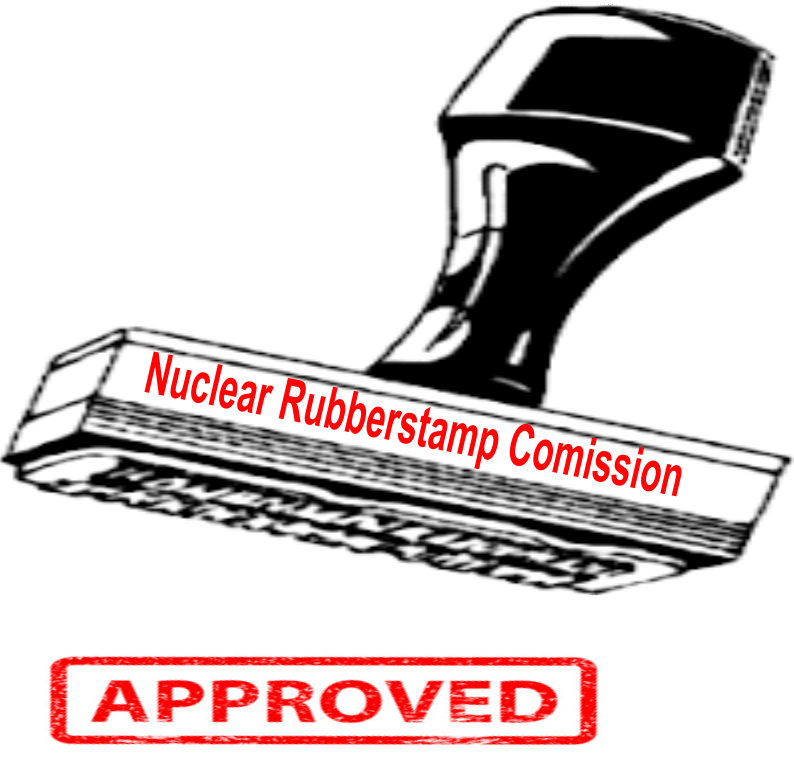
White House weighs overhaul of Nuclear Regulatory Commission
E and E News, By Francisco “A.J.” Camacho | 05/14/2025
Draft White House executive orders would overhaul nuclear regulation and hand the Department of Energy secretary new powers to approve advanced reactor designs and projects — placing a nuclear safety gatekeeper directly under President Donald Trump.
A review by POLITICO’s E&E News of the language in four separate draft orders shows that nuclear advocates in the Trump administration are looking for ways to bypass the independent Nuclear Regulatory Commission and challenge its central claim over nuclear safety standards.
“This is the detailed, agency-specific effort to override the historic independent agency construct,” Stephen Burns, former chair of the NRC during the Obama administration, said in an interview.
Burns emphasized that many of the reforms outlined in the draft orders are already being implemented under the ADVANCE Act that Congress passed last year. He questioned the necessity and merits of White House micromanagement.
“Everybody should be worried about that, especially because we depend on nuclear power plants for about 20 percent of our electricity across this country,” said Emily Hammond, a former DOE deputy general counsel and current George Washington University law professor. “That’s an important segment of low-carbon electricity, and if it’s not safe, that’s a huge gap to fill.”
It isn’t clear when or if any of the draft orders will land on Trump’s desk. But as written now, the drafts return to a theme laid out in many of Trump’s energy orders: Radical policy overhauls are needed to power the rapidly growing U.S. tech industry.
Efforts to restart large nuclear plants along with private-sector investment and Department of Energy support for small modular reactor technology are pushing the industry forward after decades of little or no growth. The government and big technology firms say they hope to plug AI data centers into nuclear power plants that can provide around-the-clock generation.
But in asserting more direct control over the NRC, some nuclear boosters fear more harm than good. Trump’s February executive order subjects “significant regulatory actions” to review by the White House’s Office of Information and Regulatory Affairs, or OIRA.
Judi Greenwald, executive director of the Nuclear Innovation Alliance, said adding the OIRA review of either technical nuclear safety issues or minor activities would make NRC less efficient and introduce uncertainty into licensing timelines.
“NRC’s reputation as a trusted regulator is important to the public, to industry, and to potential customers of U.S. nuclear technology both here and abroad,” Greenwald said. “We don’t want changing political winds in either direction to undermine NRC’s credibility.”
Sources with direct knowledge of how NRC and the White House are handling the February order have told E&E News that OIRA has instructed the agency to submit all draft rules. OIRA will decide on a case-by-case basis if a given regulation is “significant.” If it is, the White House will conduct a second review that may entail comments or edits. The draft rules will then be returned to the commission.
People familiar with policy discussions say OIRA has already deemed reactor safety rules to be “significant” enough for a deeper White House review. The proposed “Part 53” advanced reactor rule and updates to environmental standards are also considered likely to trigger a second review.
The new process also obscures the public record of internal commission deliberations.
“It would potentially run afoul of the Sunshine Act,” said Adam Stein, nuclear energy innovation director at the pro-nuclear think tank Breakthrough Institute. “The Atomic Energy Act does not say the commission will send regulations to OIRA for approval. It says that the commission will decide.”
The prospect of stripping away much of the NRC’s independence has rattled Republicans and Democrats on the House Energy and Commerce Committee.
Rep. Jay Obernolte (R-Calif.) said in February that he’s willing to give the administration “the benefit of the doubt” as it tries to bring more political control over independent agencies. “Everyone should be able to agree that regulatory authorities like the NRC should not be involved in the day-to-day political struggles that occur here in Washington, D.C.,” he said.
Rep. Lori Trahan (D-Mass.) characterized any White House effort to exert more control over the NRC as a “dangerous attempt to serve the interests of Donald Trump and his donors.”
“Undermining the NRC’s independence invites safety risks, regulatory dysfunction, and corruption that threaten the future of nuclear energy in America,” she said.
Adding to the instability is growing speculation about leadership changes at the NRC. The term of Trump-appointed Chair David Wright expires in June, and no renomination has been announced.
“At this point, it would be difficult to get him through the process without a lapse,” Stein said.
Here is what we know about the four draft orders:
Draft Order 1: Overhauling NRC
The White House is circulating draft executive orders that could radically alter nuclear policy. They touch on several fronts, from restructuring the NRC to reorienting federal nuclear research and development priorities to setting a goal to quadruple U.S. nuclear power capacity by 2040.
The first draft viewed by E&E News would order NRC, OIRA, the Department of Government Efficiency and “other agencies” to finalize NRC rules that would establish deadlines for reviewing license applications; reconsider the NRC radiation safety threshold; revise the environmental review process; expedite approvals for reactors that have been tested at DOE and Defense Department sites; and shrink the Advisory Committee on Reactor Safeguards, which independently reviews all nuclear licensing actions.
And the agencies, the draft says, would have 18 months to finish this “wholesale regulatory revision” of the NRC with mandatory “reductions in force.”………………………………………………………………….
Draft Order 2: Nuclear R&D
Another draft order would authorize DOE to more directly spearhead pilot and demonstration reactor projects at national laboratories and on other federal lands.
“The Department shall approve at least three reactors pursuant to this pilot program with the goal of completing construction of each of the three reactors by July 4, 2026,” the draft reads.
Experts say that the timeline is nearly impossible at this point.
Draft Order 3: Nuclear for “national security”
A third draft order seeks to boost American nuclear power by leveraging DOE and the Defense and State departments.
The draft would give the secretaries of Defense and Energy 60 days to “identify 9 military facilities at which advanced nuclear technologies can be immediately installed and deployed,” prioritizing bases in the Arctic and Indo-Pacific. Then, the military would move toward installation.
Another section would have the secretary of Energy “site, approve, and authorize the design, construction, and operation of privately-funded advanced nuclear technologies at Department of Energy-owned sites for the purpose of powering AI infrastructure.” It would classify such nuclear power as “defense critical infrastructure” and allow them to connect to the commercial grid……………
Other sections of the draft order would release DOE-held high-assay, low-enriched uranium to private advanced reactor developers and create a new State Department envoy to promote American nuclear exports.
Draft Order 4: Nuclear supply chain
The final draft order primarily focuses on bolstering the nuclear energy supply chain. It would have DOE bolster R&D and deployment of uranium enrichment and nuclear fuel recycling, fund the restart of closed nuclear plants and improve the “nuclear engineering talent pipeline” with other Cabinet departments.
It is unclear how likely Trump is to sign any of these draft executive orders. “Each executive order is almost written from a certain agency’s perspective,” Stein said. “They overlap and conflict in some places probably because they weren’t written together.”……………….. https://www.eenews.net/articles/white-house-weighs-nrc-overhaul/
Nuclear weapons woes: Understaffed nuke agency hit by DOGE and safety worries
The consequences of DOGE’s disruptions at the National Nuclear Security Administration could be far-reaching, experts say.
Davis Winkie and Cybele Mayes-Osterman, USA TODAY, 18 May 25
- For decades, the NNSA has struggled with federal staffing shortages that have contributed to safety issues as well as delays and cost overruns on major projects.
- Experts fear that the Trump administration’s moves to reduce the federal workforce may have destabilized the highly specialized federal workforce at the National Nuclear Security Administration.
- USA TODAY reviewed decades of government watchdog reports, safety documents, and congressional testimony on U.S. nuclear weapons.
In 2021, after a pair of plutonium-handling gloves had broken for the third time at the Los Alamos National Laboratory, contaminating three workers, and after the second accidental flood, investigators from the National Nuclear Security Administration found a common thread in a plague of safety incidents: the contractor running the New Mexico lab lacked “sufficient staff.”
So did the NNSA.
The agency, whose fewer than 1,900 federal employees oversee the more than 60,000 contractors who build and maintain the U.S. nuclear arsenal, has struggled to fill crucial safety roles. Only 21% of the agency’s facility representative positions – the government’s eyes and ears in contractor-run buildings – at Los Alamos were filled with qualified personnel as of May 2022.
Now, President Donald Trump’s administration has thrown the NNSA into chaos, threatening hard-won staffing progress amid a trillion-dollar nuclear weapons upgrade. Desperately needed nuclear experts are wary of joining thanks to chaotic job cuts by Elon Musk’s Department of Government Efficiency, experts say.
The disruption of NNSA’s chronically understaffed safety workforce is “a recipe for disaster,” said Joyce Connery, former head of the Defense Nuclear Facilities Safety Board.
Los Alamos is not the only facility with staffing shortages in crucial safety roles.
As of May 2022, less than one-third of facility representative roles at NNSA’s Y-12 facility in Oak Ridge, Tennessee, and the Pantex plant near Amarillo, Texas were held by fully qualified employees, according to a USA TODAY review of nuclear safety records.
At Pantex, where technicians assemble and disassemble nuclear weapons, only a quarter of safety system oversight positions had fully qualified hires, and only 57% of those safety positions had qualified employees at Y-12.
Nuclear weapons workers don’t grow on trees, nor do the federal experts who oversee them. Many of the jobs require advanced degrees, and new hires often need years of on-the-job training. Security clearance requirements limit the most sensitive jobs to U.S. citizens.
America’s nuclear talent crisis isn’t new, but its consequences have grown as tens of billions of dollars pour into the NNSA annually in a broader $1.7 trillion plan to modernize U.S. nuclear weapons.
Congress ordered the cramped, aging plutonium facility at Los Alamos – called PF-4 – to begin mass production of plutonium pits, a critical component at the heart of nuclear warheads, for the first time in more than a decade.
Enter Elon Musk and DOGE…………………………………………………………………………………………………………..
What’s at stake
The struggle for staff has been NNSA’s Achilles heel for decades – and the stakes have only grown.
But despite efforts to develop talent, watchdogs said in February of this year the NNSA was “understaffed” and struggling to execute key oversight requirements.
Then came DOGE…………………………………………………………………………………….
Connery fears the strain and staffing problems could combine to disastrous effect.
“When you take an inexperienced or an understaffed workforce and you combine it with old facilities and a push to get things done – that is a recipe for disaster,” Connery said. https://eu.usatoday.com/story/news/politics/2025/05/18/nuclear-weapons-woes-nuke-agency-hit-by-doge-and-safety-worries/83621978007/
Don’t vent tritium gas
Lab should explore credible alternatives say Nuclear Watch New Mexico and Tewa Women United
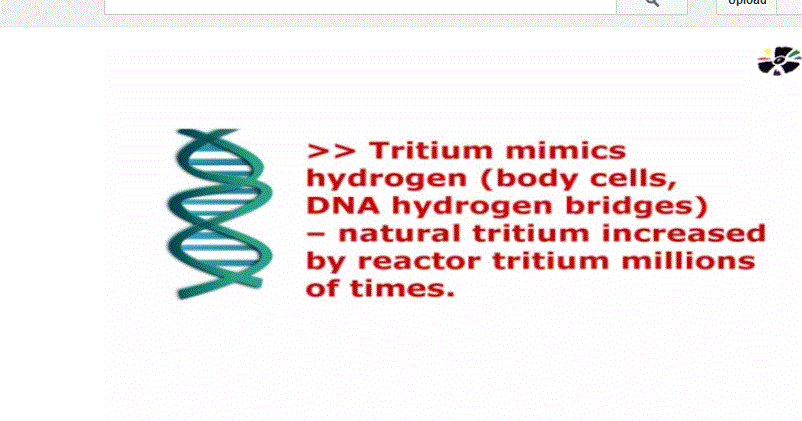
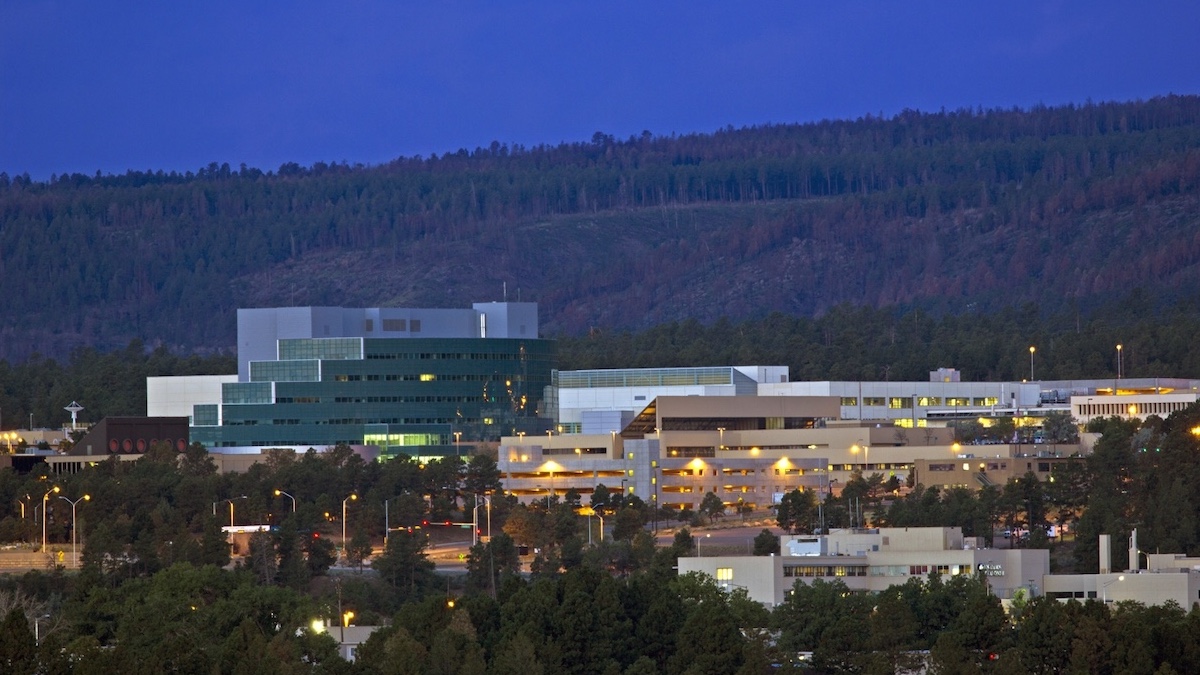
The Los Alamos National Laboratory plans to begin large releases of radioactive tritium gas any time after June 2, 2025. The only roadblock to the Lab’s plans is that it needs a “Temporary Authorization” from the New Mexico Environment Department to do so.
Reasons why the New Mexico Environment Department should deny LANL’s request are:
1. The state Environment Department has a duty to protect the New Mexican public. As it states, “Our mission is to protect and restore the environment and to foster a healthy and prosperous New Mexico for present and future generations.”
2. Why the rush? LANL explicitly admits there is no urgency. According to the Lab’s publicly-released “Questions and Answers” in response to “What is the urgency for this project?” “There is no urgency for this project beyond the broader mission goals to reduce onsite waste liabilities.”
3. In addition, the National Nuclear Security Administration (NNSA) admits that the end time frame for action is 2028, not 2025. Therefore, there is time for deliberate consideration.
4. Contrary to NMED’s Resource Conservation and Recovery Act permit for LANL, the Lab has not fulfilled its duty to inform the public via NMED of possible alternatives to its planned tritium releases. According to Tewa Women United, “LANL has told EPA there are 53 alternatives; that list of alternatives, initially requested in 2022, has not yet been disclosed. Tewa Women United has repeatedly asked LANL to provide the public with that list.”
5. Despite extensive prompting by the Environmental Protection Agency on possible better alternatives, the NNSA categorically rejected any modifications.
6. NNSA’s January 2025 draft LANL Site-Wide Environmental Impact Statement had no substantive discussion of the planned tritium releases, much less the required “hard look” at credible alternatives. Further, LANL and NNSA included these planned releases in the “No Action Alternative,” with the specious justification that “The Laboratory and NNSA have been integrating with the EPA and NMED to obtain approval to move forward with the plan to vent the Flanged Tritium Waste Containers currently located in TA-54.” Seeking approval makes them No Action? NNSA and LANL are legally required to consider public comments submitted for the LANL SWEIS. These planned tritium releases should not proceed until NNSA issues a Record of Decision on the final LANL Site-Wide Environmental Impact Statement.
7. NNSA’s publicized maximum release of 30,000 curies is merely an administrative decision point at which LANL will stop the venting process to avoid exceeding the Clean Air Act’s 10 millirem public exposure limit for radioactive air emissions. It is not the potential total quantity of tritium that will have been released. LANL’s radioactive air emissions management plan sets an annual administrative limit of 8 millirem for the tritium releases, meaning venting will cease once this limit is reached but may resume in subsequent periods.
8. In addition, these planned releases are not necessarily a one-time event, as indicated above, contrary to what the LANL Site-Wide Environmental Impact Statement falsely states.
9. Nor are these planned releases strictly confined to just Area G, as claimed.
10. LANL declares “There are no cumulative impacts from this operation. All limits are conservative, and well within regulatory limits that are protective of the public.” However, one independent report calculates that the effective dose to infants could be three times higher than to adults (therefore likely violating the 10 millirem Clean Air Act standard for “any member of the public”) and all of LANL’s calculated doses would be higher in the event of low wind speeds and low humidity.” Another independent report noted how tritiated water can pervade every cell in the body while the planned LANL tritium releases are three times the amount of tritium that the crippled Fukushima nuclear power plant would release to the ocean over 30 years.
11. LANL claims “This critical milestone [the planned tritium releases] furthers \ the cleanup of Area G.” But what so-called cleanup means to LANL is “cap and cover” of ~200,000 cubic yards of existing toxic and radioactive wastes at Area G, leaving them permanently buried in unlined pits and shafts as a permanent threat to groundwater. NMED knows this all too well given the draft order it issued to the Lab to excavate and treat all wastes at the smaller Area C waste dump, which LANL categorically opposes. NMED should carefully consider the extent to which approving these planned tritium releases is consistent with its desire for full comprehensive cleanup at the Lab, including Area G.
Recommendation: Given the self-admitted lack of urgency and remaining uncertainties in potential doses, times, locations and ultimate purpose of these planned tritium releases,NMED should deny LANL’s request for a “Temporary Authorization” to proceed until there has been an open and transparent analysis of alternatives and all possible public health impacts.
This fact sheet is available here. For more contact Nuclear Watch New Mexico and Tewa Women United.
And please sign the petition — Petition to Deny LANL’s Request to Release Radioactive Tritium into the Air.
President Trump to unleash atomic power

May 15, 2025, https://beyondnuclear.org/president-trump-unleashes-atomic-power/
On May 14, 2025, E&ENews updated reports on President Donald Trump’s four “pre-decisional” White House Executive Orders to radically alter the historic role of the US Nuclear Regulatory Commission’s (NRC) to oversee the performance of reactor design safety reviews and the regulatory approval of reactor siting, construction and operation of commercial atomic power plants.
In President Trump’s view, the NRC’s overly burdensome regulations are the primary obstacle to guaranteeing the development and deployment of a national “nuclear renaissance.” As a result, The White House is eyeing a “wholesale regulatory revision” of the federal agency that includes mandatory “reductions in force.” Simultaneously, the White House envisages authorizing the US Department of Energy and Department of Defense to instead take charge of quadrupling the current domestic nuclear energy capacity to 400 gigawatts by 2050. In order to achieve this goal, the draft Executive Orders outline 1) “overhauling NRC”; 2) significantly accelerating “nuclear R&D”; 3) redefining commercial nuclear power development as critical infrastructure for the “national security,” and 4) dramatically building out the domestic “nuclear supply chain” to include significantly ramping up domestic uranium mining, milling, enrichment and fabrication of US nuclear fuel.
While no energy generation system is entirely domestically sourced, the US nuclear fuel supply is predominantly sourced through foreign imports. According to the U.S. Energy Information Agency reporting in 2025, US domestic uranium mines produce roughly 1% of the uranium concentrate (U3O8) needed to fuel the current US nuclear fleet in 2023. Foreign imports accounted for 99% of our nation’s U3O8 with 48% coming from Russia and Russia-influenced Kazakhstan and Uzbekistan. Presently, Russia is the only commercially viable global supplier of high-assay low enriched uranium (HALEU fuel is less than 20% enriched uranium-235) as is rated for advanced Small Modular Reactor designs, including Bill Gate’s TerraPower Natrium reactor liquid sodium-cooled fast reactor and X-Energy’s Xe-100 high-temperature gas-cooled pebble-bed reactor.
The Trump Administration has declared by a Executive Order in February 2024 that it will no longer recognize any federal agencies as “independent” but rather all federal agencies are now in the President’s wheelhouse and subject to his supervision and control. All “significant regulatory actions” of the NRC would be reviewed by the White House’s Office of Information and Regulatory Affairs, or OIRA, opening the process to the White House review for comments, edits and influence. E&E news observed the new process “obscures the public record of internal commission deliberations” and is an apparent violation of the Atomic Energy Act which clearly states that it is expressly for the NRC to decide.
The draft order to overhaul the NRC would also require the agency to reconsider its standard for radiation exposure where it now understands that there is no safe dose of radiation. Dr. Edwin Lyman, a physicist and Director of the Nuclear Power Safety for the Union of Concerned Scientists is quoted in the E&E article to say, “Documented scientific evidence has only indicated that [low-level radiation exposure] is more dangerous than was known decades ago, when these standards were set.” Furthermore, Dr. Lyman adds, “Evidence has emerged about the impact of the level of radiation exposure on cardiovascular disease.”
The White House draft order to reframe nuclear power deployment for “national security” sets up the US Department of Energy and Department of Defense to “work around the NRC-led licensing and safety review processes” by providing the Secretaries of Defense and Energy accelerated schedules to “identify 9 military facilities at which advanced nuclear technologies can be immediately installed and deployed.” Those military base sited nuclear power plants can then provide transmission to the electric grid for commercial power.
It should be alarming that the Trump Executive Orders to fast track the still elusive and unpredictably costly construction of unproven Generation IV reactors by decommissioning the NRC comes at precisely the wrong time.
This is the still the 50th Anniversary Year of the creation of the NRC following the abolition of the U.S. Atomic Energy Commission by Congress for its blatant fast track promotion of atomic power plant licensing and a dangerous disregard of public health and safety. Least we forget, too many of those aging and now deteriorating nuclear power stations that are approaching and have exceeded 50 years of very harsh operating experience of radioactive neutron bombardment, embrittlement and cracking in base metal and dissimilar weld materials, fatigue, corrosion and a combination of extreme heat, pressure and vibration. Nobody knows better the growing level uncertainty, the multitude of technical knowledge gaps and innumerable shrinking reactor safety margins than those NRC nuclear engineers. Certainly, not Trump.
A home guard to protect British nuclear power plants against enemy attacks
A home guard will be established to protect British power plants and
airports against attack from enemy states and terrorists, under plans put
forward in the government’s strategic defence review (SDR).
It will be modelled on the citizens’ militia created in 1940, when Britain faced the
prospect of invasion by Nazi Germany during the Second World War. It would
be made up of several thousand volunteers, who would be deployed to
safeguard assets such as nuclear power plants, telecommunications sites and
the coastal hubs where internet cables connecting Britain to the rest of
the world come onto land. Guards could also be deployed to other sensitive
sites, such as energy stations providing power to major airports, with
senior sources pointing to the recent fire that shut down Heathrow as
evidence more resources are needed to guard them.
The home guard plan is a central part of the review, which focuses heavily on homeland security, national resilience and the need for the public to realise that Britain has
entered a pre-war era, as tensions heighten with an axis of Russia, Iran
and North Korea.
Times 17th May 2025 https://www.thetimes.com/uk/politics/article/home-guard-to-protect-uk-from-attack-lg2wf0slx
Airlines update nuclear war insurance plans as escalation threats grow.

COMMENT. The airlines are insane to want to keep flying in the case of a “small” nuclear war.
Airlines are taking steps to ensure that they can keep flying even after the outbreak of a nuclear war.
Jets could continue to fly following an atomic blast under special insurance policies being drawn up to address the possibility of conflicts escalating in Ukraine and Kashmir.
Current policies that date back to the 1950s would force the grounding of all civil aircraft worldwide in the event of a single nuclear detonation, assuming that this would lead to the outbreak of a third world war.
However, with the deployment of nuclear weapons now regarded as more likely to involve so-called tactical warheads used in a limited role on the battlefield, the insurance industry has developed plans to allow flights to continue in regions removed from conflict zones.
Gallagher, the world’s largest aviation insurance broker, began working on the scheme when Vladimir Putin threatened to deploy Russia’s atomic weapons against Ukraine in 2022.
Its plans have been given fresh impetus by the recent clash between India and Pakistan over Kashmir, where hostilities reached a level not seen for decades.
Nigel Weyman, senior partner at Gallagher, said the Ukraine conflict had revived interest in nuclear-related insurance policies.
He said: “Back when the wording was drawn up, it was assumed that any hostile detonation meant that it would all be over, Armageddon. But what they didn’t have in those days was tactical nuclear weapons that vary in size and impact and which are, ultimately, very usable.”
The latest generation of the American B61 air-launched gravity bomb carries a nuclear warhead with a yield as low as 0.3 kilotons, for example.
That compares with 15 kilotons for the bomb dropped on Hiroshima in 1945, and 100 kilotons for a single Trident II missile warhead.
While Britain retired its last tactical nuclear weapons in 1998, Russia is believed to have almost 2000. North Korea unveiled what it claimed was a tactical weapon in 2023, while Pakistan’s Nasr missile can also carry a battlefield nuclear warhead.
Weyman said, “Why should Air New Zealand, for example, be grounded in the event of a nuclear detonation in Europe that was quite minor, albeit not for the people near it?”
“Airlines find workarounds for whatever challenges they face, safe corridors, minimum heights so that ground-to-air missiles can’t reach them.
“Volcanic ash clouds affect big areas, but the world keeps flying. Yet a few words on an insurance policy can ground every jet there is.”
Threat management
The broker has come up with a plan that would see a select number of insurers evaluate where airlines should be permitted to fly after a nuclear detonation, aided by analysis from security experts at risk-management specialists Osprey Flight Solutions.
The 15-strong group, which includes Allianz, the world’s largest insurer, would meet within four hours of a detonation and evaluate the threat to airlines on a country-by-country basis.
The plan would provide each carrier with $US1 billion ($1.56 billion) per plane of war cover for passengers and third parties, compared with $US2 billion or more under existing policies.
Weyman said the cost of the scheme would amount to less than the price of a cup of coffee per passenger, if ever triggered, something “easily passed on in ticket prices”.
Airlines spent about $3.1 billion on insurance premiums last year to cover slightly over 4 billion passenger journeys, indicating a current cost of around 33 cents per customer.
About 100 airlines have so far signed up to the plan, out of the 500 or so worldwide. About 60 in Europe have joined, though low-cost operators are proving reluctant, Weyman said.
Airlines could yet be grounded by other insurance stipulations, including a “five powers war clause” that terminates cover in the event of a military clash between any of the UK, US, France, Russia and China.
That could be invoked in the event of any British or French troops sent to Ukraine being fired on, according to some industry experts.
European Bank for Reconstruction and Development (EBRD) secures contribution from France to help restore site safety at Chornobyl
The European Bank for Reconstruction and Development (EBRD) has secured a
€10 million contribution to the International Chernobyl Cooperation
Account (ICCA) from France, reaffirming its unwavering support for
international decommissioning and nuclear remediation efforts at the
Chornobyl nuclear power plant and across Ukraine.
EBRD 14th May 2025,
https://www.ebrd.com/home/news-and-events/news/2025/chornobyl-france.html
Safety failures reported at Hinkley Point C days before environmental trial begins
PBC Today 14th May 2025,
https://www.pbctoday.co.uk/news/health-safety-news/safety-failures-hinkley-point-crane/151164/
An improvement notice has been served to the Nuclear New Build Generation Company (NNB GenCo) regarding the safety of a damaged tower crane at Hinkley Point C
The enforcement was issued by the Office for Nuclear Regulation after a crane was found to have evidence of cracking in one of the mast sections, and a pin connecting two mast sections was found to have failed.
The issues were discovered by an operator during pre-use checks on site in February. They were subsequently reported to HSE under Reporting of Injuries, Diseases and Dangerous Occurrences Regulations (RIDDOR).
A failure by NBB to plan, manage and monitor
NNB GenCo are the site licensee and principal contractor for the Hinkley Point C project, and as such is responsible for the faults. The enforcement determines a failure by NNB to plan, manage, and monitor the construction phase as well as health and safety requirements in relation to the maintenance and condition of the tower cranes.
This violates Construction (Design and Management) Regulations 2015, Regulation 13 (1).
Due to the early detection of the issue, no major incidents occurred, and no injuries were caused.
“Served to ensure that action is taken”
Principal inspector at the Office for Nuclear Regulation John McKenniff said: “While the observed damage did not result in any crane failure or collapse, this improvement notice was served to ensure that action is taken to prevent any similar occurrences in the future.
“We will monitor the actions of NNB GenCo and will consider taking further action if additional shortfalls are identified.”
It has been a busy year for HSE so far, having served fines and warnings for Network Rail as well, among various other health and safety concerns.
Hinkley Point domestic environmental information law trial begins today
A case has been opened against NNB GenCo by Fish Legal, due to NNB changing the plans for fish deterrents on site. The plans originally featured an acoustic fish deterrent, but switched to a saltmarsh in the plan.
The plans have since been reverted to an acoustic deterrent due to a new “safe and effective” method of implementation, but the case is still going ahead due to Fish Legal believing that foreign-owned companies who construct and operate a nuclear power plant in the UK must comply with domestic environmental information laws, providing details on environmental plans when asked – something that NNB has failed to do to date when Fish Legal have asked for details.
What does the Cour des Comptes Report mean for Hinkley Point C and Sizewell C?
29 Apr 2025, Stephen Thomas, University of Greenwich, https://papers.ssrn.com/sol3/papers.cfm?abstract_id=5195981
Abstract
The January 2024 report by France’s Cour des Comptes on the future of the European Pressurised Reactor sheds light on the prospects for the UK’s Hinkley Point C and Sizewell C projects. It shows that the main contractor and a key financier, the state-owned Electricité de France does not have the human and financial resources to complete these projects without compromising its ability to fulfil its primary obligations in France.
I argue that the Hinkley Point C project, under construction since 2016, should be scaled back to no more than one rather than two reactors. The Sizewell C project, yet to reach a final investment decision despite the expenditure of at least £3.7bn of UK taxpayer money, should be abandoned.
Inspection at the Flamanville EPR: the nuclear watchdog points out serious shortcomings
La Presse de la Manche 13th May 2025, https://actu.fr/normandie/flamanville_50184/inspection-a-lepr-de-flamanville-le-gendarme-du-nucleaire-pointe-de-graves-lacunes_62626503.html
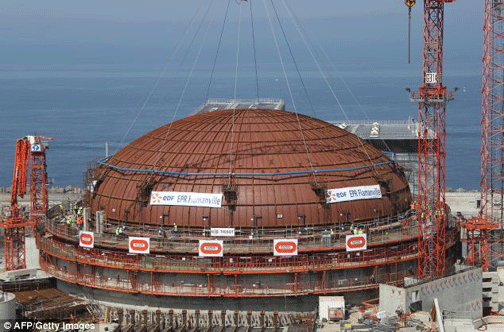
Following an inspection into the subject of counterfeiting, falsification and fraud at the EPR site in Flamanville (Manche), the nuclear regulator, ASNR, has issued a severe report.
The affair had shaken the Flamanville EPR construction site (Manche). In February 2024 , journalists revealed cases of falsification involving an EDF supplier . The Flamanville construction site is directly concerned. Some parts, supplied by a subcontractor, are allegedly the subject of fraud . But it is difficult to obtain more information.
” Irregularities have been highlighted within two companies that are part of EDF’s supply chain and produce equipment for operating nuclear reactors as well as the Flamanville EPR reactor,” the Nuclear Safety Authority (ASN) simply admitted in a letter addressed to EDF.
An inspection carried out in March
The safety of the part is not in question. But the affair has revived concerns about fraud, counterfeiting and falsification in the nuclear sector .
A few months later, while the EPR continued its commissioning , the nuclear regulator, ASNR, published on its website the inspection follow-up letter concerning the Flamanville EPR on the theme of “Prevention, detection and treatment of the risk of counterfeiting, falsification and suspicion of fraud”.
For two days, on March 19 and 20, 2025 , the inspectors examined the implementation of the prevention policy , the training of staff on the subject, the monitoring of external stakeholders, the implementation of systems for collecting reports, etc. They carried out interviews with the central services and service providers. And, generally speaking, after this audit, the opinion of the ASNR is unequivocal , since it notes “ numerous weaknesses in the organization implemented.”
The inspectors noted: ”
Gaps in the local implementation of the national note on
irregularities ; weak promotion of the issue, with a lack of dedicated rituals and interfaces; a lack of periodicity in awareness-raising actions…”
Two months to react
The follow-up letter underlines that, generally speaking, it is “necessary to implement an organisation that allows the entire irregularity issue to be managed in a more robust manner, and that capitalisation around the sharing of feedback is still in its infancy and must be improved quickly “.
Seven pages of requests follow. EDF now has two months to formulate its observations and indicate the corrective measures taken in response to the ASNR’s findings.
Too Great a Risk
But, by far the most significant yet most neglected reason for avoiding the road to nuclear is the risks that nuclear power engenders in our increasingly unstable world. The concentration of power produced at a single site constitutes a megarisk of meltdown and massive radioactive fallout from cyber attack, terrorism, warfare and even nuclear attack as events in Ukraine and elsewhere have demonstrated
13 May 2025. https://www.banng.info/news/regional-life/too-great-a-risk/
Andrew Blowers discusses the contrast of historic and current energy generation seen across the Blackwater estuary in the May 2025 column for Regional Life.
Out across the Blackwater estuary into the North Sea a quiet revolution in the way we get our energy is evident. The vast arrays of wind turbines, shimmering in sunshine and faintly visible in an overcast sky are the palpable evidence of the energy transition that is gathering pace as we struggle to eliminate fossil fuels in favour of renewable sources of energy, especially offshore wind. Wind is safe, low cost and secure contributing 30% of our electricity and rising.
On the Bradwell shore lies the gleaming hulk of a former nuclear power station, now a mothballed but active radioactive waste store which will not be cleared until the end of the century at the earliest. Nuclear power has been in decline since the turn of the century. Nuclear is unsafe, high cost and insecure contributing only 12% of our electricity and falling.
And yet, despite the risks, the Government claims that ‘there is an urgent need for new nuclear which is a safe and low carbon source of energy’. It is proposing to build up to 24GW of nuclear capacity. That’s something like ten giant 2.2 GW power stations, the size proposed for Sizewell C and the now abandoned Bradwell B project, or the equivalent of around 80 Small Modular Reactors (at 300MW each).
The Government’s Civil Nuclear; Roadmap to 2050 would displace vast amounts of the cheaper, credible, reliable and more flexible renewable power sources that can navigate a plausible pathway to a Net Zero future. Such a scaling up is clearly unachievable.
But, by far the most significant yet most neglected reason for avoiding the road to nuclear is the risks that nuclear power engenders in our increasingly unstable world. The concentration of power produced at a single site constitutes a megarisk of meltdown and massive radioactive fallout from cyber attack, terrorism, warfare and even nuclear attack as events in Ukraine and elsewhere have demonstrated. And the risks from accidents, and the impacts of climate change, not to mention institutional neglect or breakdown, are unknowable and unfathomable, though nevertheless real. And, let’s not forget nuclear energy leaves a long-lasting, dangerous and presently unmanageable legacy of highly active nuclear waste.
Sites such as Bradwell are sitting targets for malevolent actions as well as being exposed to the impacts of climate change. Far better for the now closed Bradwell power station to remain a passive store with a low risk than revive any ideas for nuclear plant which would pose an existential threat to the communities of the Blackwater and beyond.
Meanwhile, out into the North Sea the turning turbines signal a future that is relatively safe, secure and sustainable.
Hinkley Point C site served notice after crane ‘component failure’
AN improvement notice has been served to the developers of Hinkley Point
C’s construction site after a component failure was found in a crane. The
Office for Nuclear Regulation told the NNB Generation Company (HPC) Ltd
(NNB GenCo) that it must improve monitoring and management of tower cranes
at the Hinkley Point C construction site near Bridgwater.
This enforcement
action follows the discovery of a failing component in a tower crane at the
site in February this year. An operator undertaking pre-use checks on site
found the failure of a pin connecting two mast sections together, and
evidence of cracking within a mast section. The findings were reported
under the Reporting of Injuries, Diseases and Dangerous Occurrences
Regulations (RIDDOR). The issue was identified before there was any broader
failure of the crane, so there were no injuries to any workers.
Bridgwater Mercury 12th May 2025.
https://www.bridgwatermercury.co.uk/news/25156847.hinkley-point-c-site-served-notice-crane-
Trump considers weakening nuclear agency in bid for more power plants.

The draft orders accuse the Nuclear Regulatory Commission of unnecessary
“risk aversion.” The White House is drafting plans to weaken the
independence of the nation’s nuclear safety regulators and relax rules
that protect the public from radiation exposure, moves it says are needed
to jump-start a nuclear power “renaissance,” according to internal
documents reviewed by The Washington Post.
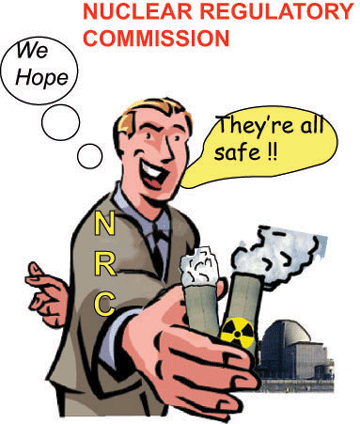
Four draft executive orders circulating in the administration would streamline approvals for new nuclear power plants. The White House contends the current process at the
Nuclear Regulatory Commission is bogged down by excessive safety concerns.
“The NRC does not view its duty as promoting safe, abundant nuclear
energy with regulatory clarity, flexibility and speed but rather insulating
Americans from the most remote risks without regard for the domestic or
geopolitical costs of its risk aversion,” says a draft order directing
“reform” of the agency. It notes that the agency — which is charged
with protecting the American public from nuclear disaster — has approved
only five new reactors since 1978, and only two have been built. There are
94 nuclear reactors operating in the United States.
Washington Post 10th May 2025,
https://www.washingtonpost.com/us-policy/2025/05/09/nuclear-power-plants-nrc-trump-safety/
Trump tightens control of independent agency overseeing nuclear safety
Geoff Brumfiel, NPR. May 9, 2025
The Trump administration has tightened its control over the independent agency responsible for overseeing America’s nuclear reactors, and it is considering an executive order that could further erode its autonomy, two U.S. officials who declined to speak publicly because they feared retribution told NPR.
Going forward, the Nuclear Regulatory Commission (NRC) must send new rules regarding reactor safety to the White House, where they will be reviewed and possibly edited. That is a radical departure for the watchdog agency, which historically has been among the most independent in the government. The new procedures for White House review have been in the works for months, but they were just recently finalized and are now in full effect.
NPR has also seen a draft of an executive order “ordering the reform of the Nuclear Regulatory Commission.” The draft calls for reducing the size of the NRC’s staff, conducting a “wholesale revision” of its regulations in coordination with the White House and Elon Musk’s Department of Government Efficiency team, shortening the time to review reactor designs and possibly loosening the current, strict standards for radiation exposure.
“It’s the end of the independence of the agency,” says Allison Macfarlane, director of the School of Public Policy and Global Affairs at the University of British Columbia in Canada who was nominated by President Obama to serve as Chair of the NRC from 2012 to 2014. Macfarlane believes the changes will make Americans less safe.
“If you aren’t independent of political and industry influence, then you are at risk of an accident, frankly,” Macfarlane says.
The draft executive order was marked pre-decisional and deliberative. It was one of several draft orders seen by NPR that appeared to be aimed at promoting the nuclear industry. Other draft orders called for the construction of small modular nuclear reactors at military bases, and for the development of advanced nuclear fuels. Axios first reported on the existence of the executive orders.
It remains unclear which, if any, will be signed by President Trump.
In a statement, the NRC said it was working with the White House “as part of our commitment to make NRC regulatory processes more efficient. We have no additional details at this time.”
“The President of the United States is the head of the executive branch,” a spokesperson for the White House’s Office of Management and Budget wrote to NPR in an email. “The President issued an independent agencies executive order which aligns with the president’s power given to him by the constitution. This idea has been talked about for nearly 40 years and should not be a surprise.”………………………………………………………………………………………………………………………
Going nuclear
The NRC has been working to respond to the new law, but it has historically operated largely outside the purview of the White House. That began to change with an executive order signed by the president in February that called for independent agencies to begin reporting directly to the White House Office of Management and Budget………………………………………………………..
Only after the rule is finalized will the commissioners’ votes be made public. It was not immediately clear how the public would know whether the White House had changed a safety rule for a nuclear reactor.
Some questioned what the White House could gain from reviewing abstruse rules for nuclear safety.
“Who has the technical knowledge to actually do a substantive review?” asks Edwin Lyman, a nuclear physicist at the Union of Concerned Scientists, a nonprofit that has been critical of the nuclear industry. “To have political appointees meddling in these technical decisions is just a recipe for confusion and chaos.” https://www.npr.org/2025/05/09/nx-s1-5392382/trump-nuclear-regulatory-commission-watchdog-safety-radiation
1 This Month

of the week – Shut Down Drone Warfare!


Tell the Ukrainian Government to Drop Prosecution of Peace Activist Yurii Sheliazhenko

Petition to revoke the licensing of the Near Surface Nuclear Disposal Facility (NSDF) at Chalk River. https://www.ourcommons.ca/petitions/en/Petition/Details?Petition=e-7247
To see nuclear-related stories in greater depth and intensity – go to https://nuclearinformation.wordpress.com
-
Archives
- April 2026 (68)
- March 2026 (251)
- February 2026 (268)
- January 2026 (308)
- December 2025 (358)
- November 2025 (359)
- October 2025 (376)
- September 2025 (257)
- August 2025 (319)
- July 2025 (230)
- June 2025 (348)
- May 2025 (261)
-
Categories
- 1
- 1 NUCLEAR ISSUES
- business and costs
- climate change
- culture and arts
- ENERGY
- environment
- health
- history
- indigenous issues
- Legal
- marketing of nuclear
- media
- opposition to nuclear
- PERSONAL STORIES
- politics
- politics international
- Religion and ethics
- safety
- secrets,lies and civil liberties
- spinbuster
- technology
- Uranium
- wastes
- weapons and war
- Women
- 2 WORLD
- ACTION
- AFRICA
- Atrocities
- AUSTRALIA
- Christina's notes
- Christina's themes
- culture and arts
- Events
- Fuk 2022
- Fuk 2023
- Fukushima 2017
- Fukushima 2018
- fukushima 2019
- Fukushima 2020
- Fukushima 2021
- general
- global warming
- Humour (God we need it)
- Nuclear
- RARE EARTHS
- Reference
- resources – print
- Resources -audiovicual
- Weekly Newsletter
- World
- World Nuclear
- YouTube
-
RSS
Entries RSS
Comments RSS
 nuclear-news