

A divided Commission at the US Nuclear Regulatory Commission (NRC) on January 24 approved the Mitigation of Beyond-Design-Basis Events rulemaking (Final Rule). The NRC began the rulemaking in December 2016 as part of its efforts to evaluate and implement, if necessary, regulatory changes in response to the Fukushima Daichi event in March 2011. In somewhat of a surprise, the majority of Commissioners last week rejected large portions of the proposed rule submitted by the NRC staff over two years ago. The rationale for changing the Final Rule demonstrates a renewed emphasis on applying backfit analyses. Continue reading
Nuclear Regulatory Commission removes a critical safety regulation
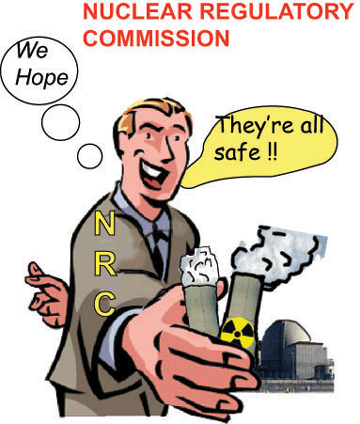 NRC Guts a Critical Safety Regulation, Recklessly Disregarding the Critical Lessons of the Fukushima Disaster https://www.ucsusa.org/press/2019/nrc-guts-critical-safety-regulation-recklessly-disregarding-critical-lessons-fukushima?fbclid=IwAR0-uToPAgtkdHj4rZ9dqJ5n7skVycU6y5UxjG_a_12lt7ZLhIwKCHfwZSM#.XGdxVOQzbGg– January 24, 2019 Decision Will Leave U.S. Nuclear Plants Dangerously Vulnerable to Major Floods and Earthquakes
WASHINGTON —The Nuclear Regulatory Commission’s (NRC) Republican majority, in a 3-2 vote, approved a stripped-down version of a rule originally intended to protect U.S. nuclear plants against extreme natural events, such as the massive earthquake and tsunami that triggered meltdowns at the Fukushima Daiichi nuclear plant in Japan in March 2011.
The commission majority struck a provision from the draft final rule the NRC staff recommended in December 2016 requiring plant owners to protect their facilities from the real-world hazards they face today instead of “design-basis” hazards that were estimated using now-obsolete information and methodologies when the plants were built decades ago.
The commission majority’s act will leave unresolved how the NRC will address new information showing that plants may experience bigger floods and earthquakes than they are now required to withstand. It is possible that the commission will not require all plant owners whose facilities face greater hazards to make structural upgrades.
“Nearly eight years after the Fukushima accident, the NRC continues to disregard a critical lesson: Nuclear plants must be protected against the most severe natural disasters they could face today—not those estimated 40 years ago,” said Dr. Edwin Lyman, senior scientist and acting director of the Nuclear Safety Project at the Union of Concerned Scientists.
After Fukushima, an NRC task force recommended that the NRC “order licensees to reevaluate the seismic and flooding hazards at their sites … and if necessary, update their design basis and SSCs [structures, systems and components] important to safety to protect against the updated hazards.”
To date, the NRC has only implemented the first part of the recommendation: Owners have reevaluated seismic and flooding hazards. What they found is not reassuring. For instance, the flooding reevaluations revealed that roughly two-thirds of U.S nuclear plants face hazards beyond what they were originally designed to handle, including higher flood levels from extreme precipitation, upstream dam failure and storm surge. The reevaluated flood height for local intense precipitation for the Palisades plant in Michigan, for example, was more than 25 feet higher than the level considered in the plant’s original design. Similar concerns were identified in many seismic risk evaluations.
Despite these findings, the NRC failed to implement the second part of the task force recommendation to require plant owners to strengthen their defenses against greater hazards. The rule that was approved today was originally intended to close that gap. The commission majority’s action today removed that requirement and will simply maintain the uncertain—and inadequate—status quo.
“The NRC must require plant owners to upgrade their facilities based on the best current information, the most realistic analyses, and the potentially devastating impacts of increased flooding from climate change,” said Dr. Lyman. “Failing to do so will leave some nuclear plants dangerously unprepared and needlessly invite disaster.”
A headache for Britain – its reliance on China for nuclear technology

 UK’s reliance on China’s nuclear tech poses test for policymakers, Britain risks alienating Beijing if it scraps power deals over security concerns, Ft.com, 15 Feb 19,
The UK has no easy way to block China’s ambitions to export nuclear reactor technology to Britain on security grounds, despite growing public anxiety about Chinese involvement in sensitive infrastructure, according to people familiar with the situation. The government’s willingness to permit the state-owned utility, CGN, to participate in the UK’s nuclear power generation programme has raised eyebrows in recent months as Chinese investment has come under hostile scrutiny, both in Europe and the US.
In October, an assistant US secretary of state, Christopher Ashley Ford, even warned the UK explicitly against partnering with CGN, saying that Washington had evidence that the business was engaged in taking civilian technology and converting it to military uses. More recently, concerns about the Chinese telecoms company Huawei and cyber security have also prompted calls for the government to back away from closer energy ties. But government policies requiring nuclear projects to be “developer-led”, and interlocking commitments given to Chinese investors by David Cameron’s government in 2014, make it awkward for the government to reverse course………..
Is Chinese involvement really a problem? Opposition to the deal ranges from the strategic to the practical. Economist Dieter Helm said he finds it astonishing that an independent nuclear military power should be “complacent about allowing potential enemies into the core of its nuclear technologies”. Some critics also worry about the availability of fuel and spares in what will be a 60-year plant should Britain and China fall out………..
The bigger risk to CGN’s ambitions may be the UK’s waning appetite for more nuclear reactors, and the lack of competitive tension among developers in seeking new deals. A report last summer from the National Infrastructure Commission warned against “rushing” to support more nuclear stations and suggesting only one more be agreed before 2025, preferring to place bigger bets on renewable energy.
The government has been lobbied by EDF to consider a new form of financing for nuclear, known as the regulated asset base model, which would impose a charge on consumers during the construction phase, helping to reduce the project’s cost of capital, and potentially unlocking private sector investment. This could make the highly geared French group less dependent on Chinese capital to proceed with Sizewell C. According to one civil servant, the business department, BEIS, is considering these proposals “very seriously”.
In the meantime, CGN, which declined to comment on its UK operations, continues to invest heavily in the UK. The total is £2.7bn and counting on Hinkley, the design assessment for the Bradwell reactor and 340 megawatts of renewables plant. According to a source close to CGN: “This is an important year and it is important to remember that the company is a utility, not a bank.” “The Chinese see this UK deal as a strategic imperative and seem intent to do what it takes to make it happen,” said the consultant. “If the UK has changed its mind, it is going to be hard to let them down gently.” https://www.ft.com/content/7734e3be-2f6f-11e9-8744-e7016697f225
USA’s nuclear command, control and communications network (NC3) is vulnerable to electronic attacks and interference.
 Report: Updating the military’s nuclear communications systems a complex and expensive challenge, Space News, WASHINGTON — A new report released on Thursday on Capitol Hill makes the case for billions of dollars in investments in the nation’s nuclear command, control and communications network known as NC3.
The report was co-produced by the Air Force Association’s Mitchell Institute and the MITRE Corporation. It cautions that while the United States is investing in a new generation of nuclear missiles, submarines and bombers, it will lack a “credible nuclear deterrent if it does not also possess a nuclear command and control system that provides ‘no fail’ communications to nuclear forces in a future environment that will include unique threats and challenges.”
MITRE senior vice president William LaPlante, one of the authors of the report, said the NC3 system today works fine but it needs to transition to a new architecture so it can be integrated with the cutting-edge nuclear platforms that the Pentagon is developing such as the Columbia-class ballistic missile submarine and the B-21 stealth bomber. The problem essentially is that these are 21st century weapon systems whereas NC3 still uses technology from the 1970s.
The NC3 system includes warning satellites and radars; communications satellites, aircraft, and ground stations; fixed and mobile command posts; and the control centers for nuclear systems.
The report says the early warning and communications satellites that support the NC3 system are vulnerable to electronic attacks and interference. Satellite constellations such as the Space Based Infrared System and the Defense Support System are the basic tactical warning systems of the NC3 enterprise. The 1970s-vintage DSP satellites will be out of service in a few years. The newer SBIRS satellites are more advanced but the Pentagon worries that they could be targeted with counterspace weapons.
When SBIRS was conceived, the thinking was that satellites in higher geosynchronous orbits were off limits to attack. “Today, however, space, even in the geosynchronous realm, is no longer a sanctuary,” the report cautions. “Space congestion increasingly puts U.S. national security space assets at risk and has the potential to create radio interference for data transmitted to and from these assets. But most disturbing and profound is the end of space as a sanctuary domain — space is likely to be a battleground.”
The same concerns apply to communications satellites. ……. https://spacenews.com/report-updating-the-militarys-nuclear-communications-systems-a-complex-and-expensive-challenge/
Japan’s Kyushu Electric to scrap aging nuclear reactor at Genkai
TOKYO (Reuters) – Japan’s Kyushu Electric Power Co Inc said on Wednesday it will decommission an aging reactor at its Genkai nuclear plant as the country’s power industry struggles to meet new nuclear safety standards set after the 2011 Fukushima disaster. 13 Feb 19,
This will bring the number of reactors being scrapped to 17 since the meltdowns at the Fukushima Daiichi plant nearly eight years ago.
The move comes as Japan’s return to nuclear power is slowly gathering pace, although the industry still faces public opposition, court challenges and unfavorable economics.
Kyushu Electric will scrap the No.2 reactor at the Genkai plant, about 930 km (580 miles) west of Tokyo. ……
Many of Japan’s reactors remain shut, with only nine operating, while they undergo relicensing to meet new standards set after the Fukushima crisis highlighted shortcomings in regulation.
Reporting by Yuka Obayashi; Editing by Gopakumar Warrier
California’s Dangerous Diablo Nuke Hangs in Gov. Newsom’s Hands
ttachments area
|
|
|
Denver Federal Center nuclear reactor violations lead to fine, short shutdown
https://www.denverpost.com/2019/02/08/denver-federal-center-nuclear-reactor-violations/
The Nuclear Regulatory Commission has proposed to have a $7,250 fine levied Concerns over the operation of a nuclear reactor at the Denver Federal Center has one arm of the federal government proposing to fine another and a reactor supervisor has been reassigned with his access revoked.
The Nuclear Regulatory Commission has proposed to have a $7,250 fine levied against the U.S. Geological Survey for “research reactor violations,” according to an NRC news release dated Tuesday.
The NRC carried out two separate investigations of the TRIGA (Training, Research, Isotopes, General Atomics) nuclear reactor, which is used for research, and found violations associated with staffing and training requirements, the release stated.
One investigation was completed on Jan. 18, 2018, the other on June 12, 2018, according to a notice of violation letter which identified the supervisor as Brycen Roy.
Roy, who was reached Friday night by phone, declined comment.
The USGS has “implemented corrective actions,” according to the release, but not before “pausing reactor operations to allow for an assessment of the violations and the operational culture of the reactor organization.”
One violation involved “deliberately falsified documentation showing that reactor operators had completed required training, when in fact the training never took place,” the NRC said. The supervisor presented “false documentation” to an NRC inspector, according to the release
A second investigation found that the supervisor “violated staffing requirements by performing certain reactor tests without a second qualified person present, as required by NRC regulations.”
The USGS can dispute the violation and penalty, or could agree to third-party mediation, the release stated.
The Denver Federal Center, a 623-acre campus which houses 28 agencies in 44 buildings, is surrounded by Lakewood. It’s west of Kipling Street, south of West 6th Avenue and north of West Alameda Avenue.
Brazil prosecutor calls for emergency safety measures at tailings dam at former Poços de Caldas uranium mine

 Federal Public Prosecutor’s Office calls for emergency measures to prevent failure of tailings dam at former Poços de Caldas uranium mine
Decommissioning Projects – South/Central America 8 Feb 2019
The Federal Public Prosecutor’s Office (MPF)  has recommended to the President of the Indústrias Nucleares do Brasil (INB) and to the President of the National Nuclear Energy Commission (CNEN) that, by March 30, all necessary steps be taken to fully implement the Emergency Action Plan for Dams (Paemb) on the tailings dam of the Mineral Treatment Unit (UTM), located in the municipality of Caldas, south of the state.
This dam contains radioactive material resulting from the first uranium mine operated in Brazil.
The exploration lasted from 1982 to 1995, when it was closed, on the grounds that the activities were economically unfeasible. Even after the end of the mine, the mine pit containing mud with radioactive waste, a decontaminated ore processing plant, dozens of equipment, and the dam with thousands of tons of uranium, thorium and radium waste remains in the mine.
In September of last year, INB noted that an “unusual event” occurred at the UTM-Caldas dam, which was immediately communicated to CNEN and the Brazilian Institute of the Environment (IBAMA) . Such an event consisted of turbidity and reduction of water flow at the outlet of the overflow pipe system of the structure. Also, actions were immediately initiated to investigate the causes of the event, by collecting special samples and intensifying the field inspections and reading the dam instrumentation.
A technical report produced by an emergency contractor at the Federal University of Ouro Preto (UFOP) concluded that the overflow pipe system of the tailings dam is seriously compromised and that the infiltrations found on its walls favor the occurrence of so-called piping.
Piping is a process of internal erosion that damages the structure of the dam, increasing the probability of rupture, which requires immediate measures of correction and intervention [view here].
About two weeks ago, representatives of the Brazilian Nuclear Industries presented to the MPF the measures that are being implemented as a matter of urgency to change the mechanism of the overflow pipe dam system, preceded by a provisional auxiliary system, as well as the Paemb and the schedule of its Implementation. Regarding the Paemb, no concrete action has been taken so far.
For the Federal Public Prosecutor’s Office, the relevance and complexity of the facts, already worrying about the possibility of rupture of the structure, are more serious when the tailings are considered to consist of radioactive material.
The closure of uranium exploration activities occurred in 1995, without concrete measures being taken to decommission UTM-Caldas and environmental recovery for the damages caused. The omission of INB led the Federal Public Prosecutor to file a Public Civil Action No. 4106-80.2015.4.01.3826 , in the year 2015, to demand the full environmental recovery in the area of the project. “The longer this situation lasts, the lack of concrete measures for decommissioning and environmental recovery, the greater the exposure of the environment (fauna and flora) and the population to the risk of serious and harmful events,” warns MPF.
Transparency – Another point addressed in the recommendation concerns the need and the right of the populations neighboring the project, which can be affected in the event of a possible rupture, to receive information about the dam situation in clear and accessible language.
Therefore, the MPF recommended that in five days, INB and CNEN should be widely disseminated to civil society, especially to communities that may be directly affected by a possible incident, about the risks they are exposed to.
The information should cover both the “unusual event” occurred on Sep. 25, 2018, indicating the characteristics and causes of the occurrence, as well as the potential risks arising from the situation in which the dam structure is located, the measures taken by the entrepreneur to stabilization of the enterprise and the content of the Emergency Action Plan (SAP). (MPF Feb. 7, 2019)
The latest Federal Public Prosecutor’s Office action in this case apparently was triggered by the Brumadinho tailings dam disaster on Jan. 25, 2019 (see details). http://wise-uranium.org/udsam.html#POCOSDEC http://wise-uranium.org/udsam.html#POCOSDEC
California disapproves of Federal Dept of Energy’s plan for cleaning up radioactive Santa Susana Field Lab
 SSFL impasse – State disapproves of DOE’s final environmental study , Simi Valley Acorn, State officials overseeing the cleanup at the Santa Susana Field Lab are criticizing a federal agency’s proposal to address contamination on its portion of the former rocket engine testing site. On Jan. 28, the California Department of Toxic Substances Control issued a letter accusing the U.S. Department of Energy of reneging on a 2010 cleanup agreement promising to remove all contamination in its part of the 2,850-acre field lab.
SSFL was used for 50 years in the development of ballistic missiles, rockets and space shuttle equipment. A partial nuclear meltdown occurred in Area IV in 1959, but it wasn’t made public until decades later. The DOE is responsible for removing soil and groundwater contamination in Area IV and the northern buffer zone.
“DOE ignores that its preferred alternative is inconsistent with the (agreement which) clearly defines DOE’s obligation to clean up soils in Area IV to background levels, or reporting limits if no background value exists, on a point-by-point basis,” DTSC officials said in the letter.
The state agency said it intends to hold the U.S. Department of Energy accountable to the requirements of the previous agreement, which involves a more thorough cleanup of the property.
The letter also requested that DOE extend the 30-day comment period, which closed at the end of January, through March 1 to allow more “meaningful public participation and opportunity for comment.”
The letter is in response to the Department of Energy’s final environmental study, which was released Dec. 18.
In the study, the federal agency called for the removal of the remaining buildings in Area IV—a radioactive materials handling facility and a hazardous waste management facility—and recommended a combination of treatment and monitoring to deal with the groundwater. It also proposed a “risk-based” soil cleanup plan, in which any contaminant found is removed. Environmentalists have argued in favor of removing much more soil………..
Five activist groups lobbying for complete site remediation, meaning they want to see the property restored to what it was before SSFL was built, voiced their objections the same day DTSC issued its letter.
The Natural Resources Defense Council, Physicians for Social Responsibility, Southern California Federation of Scientists, Committee to Bridge the Gap, and the Rocketdyne Cleanup Coalition all sent letters Jan. 28 accusing the DOE of breaching the legally binding 2010 agreement and violating fundamental environmental laws.
Denise Duffield, spokesperson for Physicians for Social Responsibility, told the Simi Valley Acorn this week that the DOE’s final study is an “unconscionable breach of its commitment to clean up all of its contamination at SSFL.”
DOE, Duffield asserts, wants to leave behind 98 percent of contamination and just “walk away from remediating much of the contaminated groundwater.”
“Polluters do not get to decide how much of their contamination they get to clean up,” she said. “Also, the (study) fails to take into account the devastating Woolsey fire, which started at and burned much of the contaminated SSFL in November.”
Duffield said her group wants local, state and federal officials to lean on the DOE to revise its final study……..
Once DOE issues its record of decision, Jones said, it still has to wait for DTSC to release its final EIR. https://www.simivalleyacorn.com/articles/ssfl-impasse/
Pump malfunction causes shutdown at Flamanville nuclear reactor
EDF said the reactor was disconnected safely in order to allow technical teams to carry out repair works on one of the two pumps supplying water to the secondary circuit.
“Both pumps must be available for full power operation of the unit,” EDF said.
The reactor in the north of France restarted production on Jan. 27 after a prolonged outage for its third 10-year overhaul since April 2018.
EDF said it informed nuclear safety authority ASN about the incident which had no impact on other facilities.
The reactor is expected to resume electricity production on Feb. 8
Power production was halted at the Flamanville 2 reactor, which has a similar capacity, on January 10 for its third decennial upgrade. The reactor is expected back online on July 10.
(Reporting by Bate Felix; Editing by Sudip Kar-Gupta
Commissioners Disagree on Final Rulemaking in Response to Fukushima Accident
https://www.lexology.com/library/detail.aspx?g=ad53e9d3-58ca-4bae-bb07-066ea9255afa, Morgan Lewis & Bockius LLP, 1 Feb 2019
Low-flying choppers monitoring radiation in Atlanta (fears of nuclear terrorism?)
Low-flying choppers monitoring radiation https://wtkr.com/2019/01/27/low-flying-choppers-monitoring-radiation/JANUARY 27, 2019, BY CNN WIRE ATLANTA, GA (WGCL) – If you’re in downtown Atlanta or around Buckhead for the Super Bowl Experience or regular business, you might see some low-flying helicopters over the area.
The choppers are from the U.S. Department of Energy and are serving a specific purpose.
The Department of Energy’s National Nuclear Security Administration, or NNSA, is conducting the low-altitude flights as part of security operations for Super Bowl LIII. The choppers will measure naturally occurring background radiation, according to the NNSA.
The measurement of naturally occurring radiation will establish baseline levels and is considered a normal part of security and emergency preparedness, according to the NNSA. The agency said it was making the public aware of the flights to avoid any panic or alarm.
The helicopters, Bell 412 choppers, will fly in a grid pattern over the areas at 150 feet or higher at a speed of approximately 80 miles per hour, according to the Department of Energy. Flyovers will occur only during daylight hours and should take roughly three hours to complete per area scanned.
Washtenaw County’s preparations – in the event of a nuclear disaster
Here’s what could happen in a nuclear disaster in Washtenaw County, By Ryan Stanton | ryanstanton@mlive.com ANN ARBOR, MI , 1 Feb 19, – As Ann Arbor considers calling on the state and federal governments to better prepare for nuclear disaster, county officials note there already are some emergency plans in place.
Washtenaw County does not stockpile potassium iodide as some city officials are calling for in a proposed resolution, said Dave Halteman, the county’s emergency services director.
But in the event of an incident such as a meltdown at the Fermi 2 nuclear power plant in southeast Michigan, the county would reach out to the state’s Emergency Operations Center to initiate access to a national pharmaceutical stockpile through the Centers for Disease Control and Prevention.
“This plan has been in place for many years and the CDC stockpiles these pharmaceuticals in strategic locations all over the country,” Halteman said.
“However, given the potential time lapse in getting access to the national stockpile, I will continue to monitor Ann Arbor’s initiative to see how it might work on a county level.”
City Council will consider a resolution Monday, Feb. 4 calling for strengthening local emergency planning by stockpiling nonprescription potassium iodide in communities within 50 miles of the Fermi 2 plant, which is roughly 30 miles from Ann Arbor along Lake Erie.
The resolution would direct the city’s lobbying team to advocate to the state and U.S. Nuclear Regulatory Commission to provide the same level of KI protection to residents here as Canadian authorities provide to Ontario residents within 50 miles of the Fermi 2 plant.
The American Thyroid Association has called for pre-distribution of potassium iodide, also known as KI, to households within a 10-mile radius of nuclear power plants such as Fermi 2, and stockpiling it in public facilities such as schools, hospitals, clinics, post offices and police and fire stations in up to a 50-mile radius.
Timely ingestion of KI can reduce the effects of radiation and help prevent thyroid cancer in the event of a nuclear fallout, notes the resolution sponsored by Council Members Anne Bannister, D-1st Ward, and Chip Smith, D-5th Ward.
Without a local stockpile, it could take eight to 12 hours for CDC supplies to arrive, depending on the event, said Cindra James, the county’s public health preparedness administrator.
In some cases, it could be sooner based on local supplies, James said, noting the federal government has caches stockpiled “at various unknown locations that we aren’t privy to,” but those supplies can be accessed depending on need.
As far as potential evacuation of the county if there was a nuclear disaster, there’s no specific plan, but the county would coordinate with the state police and local law enforcement to close roads leading toward any hazard and redirect traffic away from the affected area, Halteman said.
The county’s outdoor warning sirens also would be activated followed by an emergency alert system message to inform the public via the media of the hazard and what actions to take, he said.
“We would also reach out to our transportation partners here in Washtenaw County to assist moving those without transportation,” he said, noting that could include the Ann Arbor Area Transportation Authority and local school bus systems.
“Certainly the response would be scaled up or down to accommodate the size of the evacuation area,” Halteman said…….. https://www.mlive.com/news/ann-arbor/2019/02/heres-what-could-happen-in-a-nuclear-disaster-in-washtenaw-county.html
USA Pentagon wants to fly small nuclear reactors in transport jets – Gee, I hope they dont crash
 The Pentagon Wants a Nuclear Reactor That Fits in a Transport Jet, Foxtrot Alpha , Kyle Mizokami 30 Jan 19, The Department of Defense wants a portable nuclear reactor the size of a main battle tank that’s capable of being lifted to overseas hot spots. The reactor would provide megawatts of power for U.S. forces, providing juice for everything from Xboxes to directed energy weapons. A mobile reactor would also make the military less reliant on diesel fuel for electrical generators, which in some cases must be sent along dangerous resupply lines.
Security dangers in South Asia increase as India and Pakistan develop nuclear weapons programmes
Nuclear programmes of India, Pakistan increase risk of security incident in South Asia: US spymaster, Economic Times, Jan 30, 2019 WASHINGTON: There is an increased risk of a nuclear security incident in South Asia due to continued growth and development of Pakistan and India’s nuclear weapons programmes, America’s top spymaster told lawmakers on Tuesday.
The remarks of National Intelligence Director Daniel Coats is part of US intelligence community’s assessment of worldwide threats in the year 2019.
While Pakistan continues to develop new types of nuclear weapons, including short-range tactical weapons, sea-based cruise missiles, air-launched cruise missiles, and longer range ballistic missiles, India this year has conducted its first deployment of a nuclear-powered submarine armed with nuclear missiles, he said.
“The continued growth and development of Pakistan and India’s nuclear weapons programmes increase the risk of a nuclear security incident in South Asia, and the new types .. ……..
Security guards kill man at Nevada Nuclear Test Site
Official: Man killed at nuclear site failed to drop object https://news3lv.com/news/local/official-man-killed-at-nuclear-site-failed-to-drop-object by The Associated Press MERCURY, Nev. (AP) 30 Jan 19, — An aggressive man was killed by officers at a U.S. nuclear security site in Nevada after refusing orders to drop a cylindrical object, authorities said Tuesday.
Investigators declined immediate comment on whether the object was a weapon.
The incident began when the unidentified man failed to stop Monday evening at the security gate at the Nevada National Security Site, located 70 miles (112 kilometers) north of Las Vegas, according to Darwin Morgan, spokesman for the National Nuclear Security Administration.
Morgan said the trespasser drove 8 miles (13 kilometers) with officers in pursuit before he parked and approached them with the object in his hand. Deputies and site officers fired at him when he ignored their verbal commands, Morgan said.
The man died at the property formerly known as the Nevada Test Site.
The FBI has been notified and no additional information has been released, Nye County sheriff’s Lt. David Boruchowitz said.
Nevada is currently involved in a legal battle with the U.S. Energy Department to block the shipment of a metric ton of weapons-grade plutonium to the site from South Carolina.
Government scientists conduct tests simulating nuclear explosions at the 1,360-square mile (3,522-square kilometer) site in Nevada that is larger than the state of Rhode Island.
1 This Month
26 September – International Day for the Total Elimination of Nuclear Weapons





PLEASE OPPOSE HR 8255 AND S.3639 – bills would accelerate satellite deployment, with no environmental review or safeguards – https://ncstd5li.quorum.us/campaign/169331/
To see nuclear-related stories in greater depth and intensity – go to https://nuclearinformation.wordpress.com
-
Archives
- September 2026 (281)
- August 2026 (330)
- July 2026 (355)
- June 2026 (287)
- May 2026 (306)
- April 2026 (356)
- March 2026 (251)
- February 2026 (267)
- January 2026 (308)
- December 2025 (358)
- November 2025 (359)
- October 2025 (375)
-
Categories
- 1
- 1 NUCLEAR ISSUES
- business and costs
- climate change
- culture and arts
- ENERGY
- environment
- health
- history
- indigenous issues
- Legal
- marketing of nuclear
- media
- opposition to nuclear
- PERSONAL STORIES
- politics
- politics international
- Religion and ethics
- safety
- secrets,lies and civil liberties
- spinbuster
- technology
- Uranium
- wastes
- weapons and war
- Women
- 2 WORLD
- ACTION
- AFRICA
- Atrocities
- AUSTRALIA
- Christina's notes
- Christina's themes
- culture and arts
- Events
- Fuk 2022
- Fuk 2023
- Fukushima 2017
- Fukushima 2018
- fukushima 2019
- Fukushima 2020
- Fukushima 2021
- general
- global warming
- Humour (God we need it)
- Nuclear
- RARE EARTHS
- Reference
- resources – print
- Resources -audiovicual
- Weekly Newsletter
- World
- World Nuclear
- YouTube
-
RSS
Entries RSS
Comments RSS

