Radioactive material ‘a magnet for groups with malicious intent’, warns UN nuclear watchdog chief
 Radioactive material ‘a magnet for groups with malicious intent’, warns UN nuclear watchdog chief. UN News, 10 Feb 20, Government ministers and other high-level representatives from more than 140 countries, on Monday adopted a new declaration to enhance global nuclear security and counter the threat of nuclear terrorism……
Aging nuclear plants: increased danger as U.S.utilities want their lives extended to 80 years
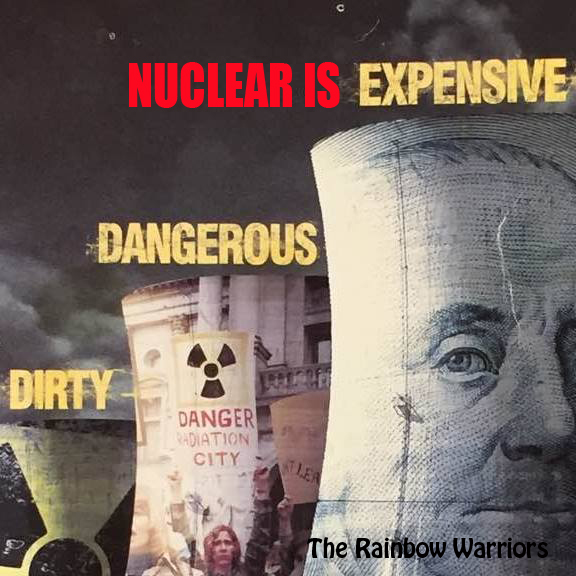
Bonnie Rippingille looked out at the wisps of steam curling from the Turkey Point Nuclear Power Plant across Biscayne Bay with a sense of dread. In December federal regulators approved Florida Power & Light Co.’s request to let the facility’s twin nuclear reactions remain in operation for another 20 years beyond the end of their current licenses. By that point they’ll be 80, making them the oldest reactors in operation anywhere in the world.
“That’s too old,” said Rippingille, a lawyer and retired Miami-Dade County judge. “They weren’t designed for this purpose.”
With backing from the Trump administration, utilities nationwide are preparing to follow suit, seeking permission to extend the life of reactors built in the 1970s to the 2050s as they run up against the end of their 60-year licenses.
“We are talking about running machines that were designed in the 1960s, constructed in the 1970s and have been operating under the most extreme radioactive and thermal conditions imaginable,” said Damon Moglen, an official with the environmental group Friends of the Earth. “There is no other country in the world that is thinking about operating reactors in the 60 to 80-year time frame.”
Indeed, the move comes as other nations shift away from atomic power over safety concerns, despite its appeal as a carbon-free [ whaaat?] alternative to coal and other fossil fuels. Japan, which used to get more than a quarter of its electricity from nuclear power, shut down all its plants in 2011 after a tsunami caused a nuclear meltdown at three reactors in Fukushima. Only a handful have restarted while others that can’t meet stringent new standards are slated to close permanently. Germany decided that year to shutter its entire fleet by 2022 and is now having trouble meeting its ambitious climate goals.
By contrast, the U.S. Nuclear Regulatory Commission is poised to decide this year on requests by subsidiaries of Exelon Corp. to extend the life of two nuclear reactors at its Peach Bottom Atomic Power Station in Pennsylvania and Dominion Energy Inc. to extend the life of two nuclear reactors at a power plant in Surry, Virginia.
Dominion has notified the commission it intends to ask permission to extend the life of two more reactors north of Richmond, Virginia. Duke Energy Corp. has said it plans to seek license extensions for its entire fleet of 11 nuclear reactors, starting with three in Seneca, South Carolina……
The nuclear industry has been buffeted by a wave of early reactor retirements in the face of competition from cheap natural gas and subsidized renewable power. Constructing a new nuclear plant – the only one being built in the U.S. is years behind schedule and over budget – can cost billions of dollars. Retrofitting an existing one is more likely to be in the hundreds of millions of dollars range. ……
Opponents such as Edward Lyman, a nuclear energy expert with the Union of Concerned Scientists, argue that older plants contain “structures that can’t be replaced or repaired,” including the garage-sized steel reactor vessels that contain tons of nuclear fuel and can grow brittle after years of being bombarded by radioactive neutrons. “They just get older and older,” he said. If the vessel gets brittle, it becomes vulnerable to cracking or even catastrophic failure.
Other concerns surround the durability of components such as concrete and electric cables, but an advisory board to the Nuclear Regulatory Commission, the independent government agency that gave Turkey Point the green light to operate into the 2050s, said those risks could be managed safely.
The commission’s decision doesn’t sit well with Philip Stoddard, mayor of South Miami, a city of 13,000 on about 18 miles away from the Turkey Point plant. He keeps a store of potassium iodide, used to prevent thyroid cancer, large enough to provide for every child in his city should the need arise.
“You’ve got hurricanes, you’ve got storm surge, you’ve got increasing risks of hurricanes and storm surge,” said Stoddard, 62. All of this not only increases the likelihood of a nuclear disaster, it also complicates a potential evacuation, which could put even more lives at risk…….
“They are going to be flooded,” Cox said. “If we are relicensing a major utility we need to be preparing for the impacts of sea level rise.”…….. https://www.goerie.com/business/20200209/our-aging-nuclear-plants
Qatar says UAE`s power plant activities are a threat to Gulf stability and the environment
|
UAE nuclear reactor ready; Qatar views it as a threat https://www.middleeastmonitor.com/20200130-uae-nuclear-reactor-ready-qatar-views-it-as-a-threat/ January 30, 2020, The United Arab Emirates Barakah nuclear power plant is ready to operate, the UAE’s state-run Emirates News Agency (WAM) reported on Tuesday.Nawah Energy Company, the operator of the power plant, is concluding the final requirements,” WAM said.
Barakah will be the UAE’s first nuclear plant and the world’s largest when completed, with four reactors and 5,600 megawatts (MW) of capacity, Reuters reported. Sultan bin Ahmad Sultan Al Jaber, a minister of state in the UAE government and also chief executive of Abu Dhabi National Oil Company (Adnoc), drew attention to the nuclear power plants that will start supplying the country’s electricity grid for the first time later this year, WAM reported two weeks ago. Underlining the myriad risks inherent in Barakah’s design, Qatar says UAE`s power plant activities are a threat to Gulf stability and the environment. Last year, in a letter to the International Atomic Energy Agency (IAEA), a Vienna based international organisation founded to promote the peaceful use of nuclear energy, Qatar urged them to create a framework for regional nuclear security, Al Jazeera reported. |
|
Political instability adds to the danger of nuclear power for Bolivia
|
Bolivian unrest: what now for the country’s nuclear ambitions? Power Technology, By Heidi Vella 31 Jan 2020, Backed by Russia, Bolivia had set its sights on building new nuclear energy capacity to supply the country’s growing demand for electricity – but could recent political instability put these plans into doubt? We investigate the progress and potential of Bolivia’s atomic energy ambitions.
Russia had agreed to support a $300m nuclear research reactor near the Bolivian capital of La PaztHome to part of the Andean mountain range, as well as some of the highest above-sea-level cities in the world, the developing South American state of Bolivia is not an obvious candidate for new nuclear energy capacity. Yet, since 2013, the now ousted former-Bolivian President, Evo Morales, has been pursing plans to reduce the country’s heavy reliance on fossil fuels by investing in nuclear power…… Five years on however, Bolivia finds itself in political turmoil. Morales, who ran the country for 14 years and was the first ever indigenous president, has exiled himself to Mexico following weeks of violent protests and unrest amid accusations of electoral fraud at the end of 2019. As such, the country’s nuclear ambitions now appear firmly on hold.
Prior to Morales’ fall from power, his administration had kick-started the often-lengthy process of initiating nuclear power capabilities. It founded The Bolivarian Agency for Nuclear Energy and had started working with the IAEA to establish a development framework for nuclear. In 2018, it signed a Country Programme Framework with the IAEA leading up to 2023. Plans for uranium mining in the country had also been floated, but the government halted these and instead decided it could import nuclear fuel from France and Canada. Further agreements were penned with Rosatom for the building of the research centre, which, if it is ever finished, will be the highest in the world at 4000 metres above sea level. The centre is expected to encompass a pool-type reactor of between 100 and 200 kilowatts, a multi-purpose gamma irradiation unit, a cyclotron for nuclear pharmacy purposes, an engineering department, and several research laboratories. Challenges ahead Bolivia is one of only a handful of countries in South America that is either exploring capital intensive nuclear power or already has capacity. Argentina and Brazil both have nuclear reactors in action. However, the rising cost of current technology – several projects in Europe have run years over schedule and millions over budget – can make it difficult, but not impossible, for developing nations such as Bolivia to adopt atomic energy…….. Political instability Since the resignation of Morales in November, a conservative interim government has assumed power and elections are expected in May……….with accusations of vote rigging in the last election, there’s little assurance the upcoming polls will not result in more violence and political stability, both of which will likely keep away potential investors. Therefore, it remains very early days for nuclear energy development in Bolivia. In fact, the World Nuclear Association doesn’t expect much growth in the nuclear power sector to come from any developing nations, including Bolivia. Instead, the country is more likely to remain part of a long list of developing nations that has penned agreements with Russia, such as Indonesia, Vietnam and Sudan, but are yet to see them come fully into fruition, at least until it wrestles back democracy. https://www.power-technology.com/features/bolivian-unrest-what-now-for-the-countrys-nuclear-ambitions/ |
|
Danger of Armenian nuclear plant to neighbouring Turkey
|
‘Armenian nuclear plant poses threat to Turkey’ https://www.yenisafak.com/en/news/armenian-nuclear-plant-poses-threat-to-turkey-3510952Turkish opposition lawmaker warns of risk posed by Armenia’s Metsamor Nuclear Power Plant, 16 km from shared border
January 31, 2020 A nuclear power plant in neighboring Armenia poses a threat to Turkey, said a Turkish opposition party on Friday.”The Metsamor Nuclear Power Plant jeopardizes the lives of people in this region,” Habib Eksik, a Peoples’ Democratic Party (HDP) lawmaker from the eastern Igdir province, told journalists in parliament.
He said the plant is in close proximity to Igdir and has many flaws in its design. “The plant has been constructed with primitive technology and it lacks adequate security measures,” said Eksik. Metsamor, first launched in 1976, is just 16 kilometers (10 miles) from Turkey’s eastern border with Armenia, and produces about 40% of the country’s electricity. Both Turkey and Azerbaijan have repeatedly raised objections to the project as they believe it does not meet international safety standards. Metsamor continues to draw criticism from Turkish officials as Armenia has decided to extend its operations until 2026. |
|
A new serious problem with stainless steel canisters for nuclear wastes
|
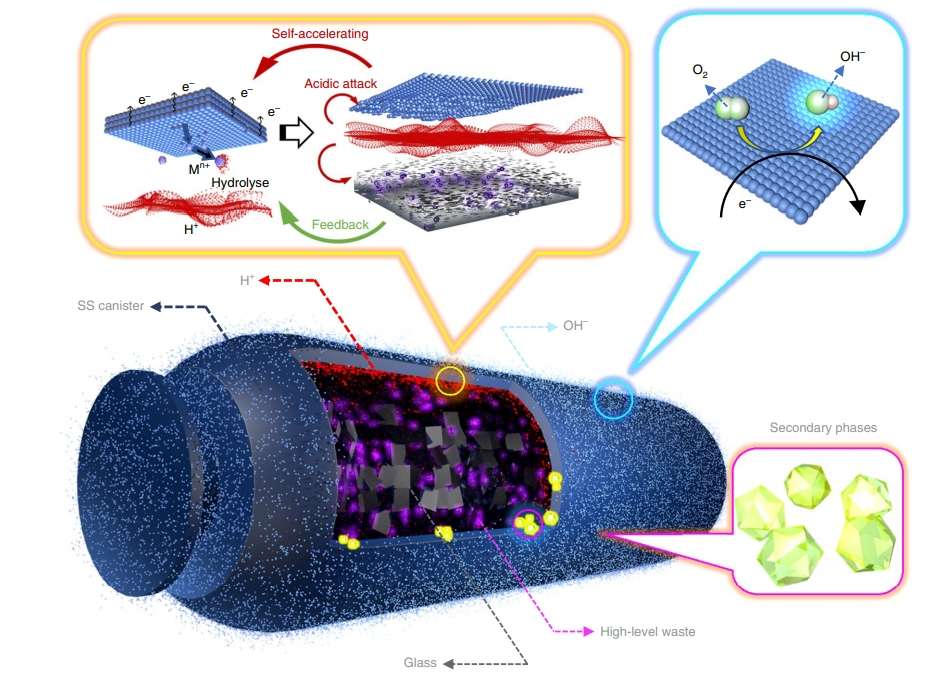
By David Szondy January 28, 2020 A new study by researchers at Ohio State University suggests that stainless steel may not be the best choice for containing high-level nuclear waste. By simulating long-term storage conditions, the team found that the storage materials interact with each other more than previously thought, causing them to degrade faster.
The storage of nuclear waste is more than a perennial political football, it is an existential problem. Whatever one’s opinions about nuclear power or weapons, there are thousands of tons of nuclear waste temporarily stored around the world, meaning that a way must be found to store it all
safely in the long term.
The most important type of nuclear waste is the high-level waste left over from reprocessing nuclear fuel or from nuclear weapon production. Such waste is made up of a complex mixture of radioactive isotopes with half-lives ranging from years to millennia. Though reactors have been operating all over the world for over 75 years, only Finland has started to build a permanent storage facility for such very dangerous waste.
That may show a remarkable lack of political will or even courage, but perhaps this reluctance will turn out to be serendipitous. That’s because the favored way of storing high-level waste is to vitrify it. That is, to mix the isotopes with molten glass or ceramics to form a chemically inert mass that can be sealed in stainless steel canisters before being sealed in an underground storage facility.
That plan may now have to change if the Ohio study is correct. Led by Xiaolei Guo, the team took glasses and ceramics and put them in close contact with stainless steel in various wet solutions for 30 days in conditions similar to those that would be found in the proposed US Yucca Mountain nuclear waste repository.
In the real-life scenario, the glass or ceramic waste forms would be in close contact with stainless steel canisters,” says Xiaolei. “Under specific conditions, the corrosion of stainless steel will go crazy. It creates a super-aggressive environment that can corrode surrounding materials.”
They found that the steel interacted with the glass or ceramic to produce severe and localized corrosion that both damaged the steel and corroded and cracked the glass and ceramics. According to the team, this is because the iron in stainless steel has a chemical affinity with the silicon in glass, accelerating corrosion. This indicates that the current models may not be sufficient to keep this waste safely stored,” says Xiaolei. “And it shows that we need to develop a new model for storing nuclear waste.” The research was published in Nature Materials. Source: Ohio State University |
|

North Korea’s nuclear tests have made Hamgyong Province area unstable

“It was a natural earthquake, presumably caused by the sixth nuclear test,” the administration said in a statement on its website. “The area is about 3km southeast of the sixth nuclear test site.”
Punggye-ri is the only known site in North Korea used to test nuclear weapons. At least six tests were conducted there between October 2006 and September 2017.
In early 2018, North Korea said it would close the site, saying its nuclear force was complete.
The entrances to tunnels at the site were blown up in front of a small group of foreign media invited to view the demolition, but North Korea rejected calls for international experts to inspect the closure.
Frustrated at what it sees as a lack of reciprocal concessions by the United States in denuclearisation talks, North Korea now says it is no longer bound by its self-imposed moratorium on test firing nuclear weapons and long-range ballistic missiles, though it has not conducted new tests.
The 2017 nuclear test, which North Korea said was a thermonuclear weapon, appeared to be several times larger than previous blasts, according to monitoring organisations at the time.
In the weeks after the sixth explosion, experts pointed to a series of tremors and landslides near the nuclear test base as a sign the large blast had destabilised the region.
Wednesday’s quake is the latest confirmation that the nuclear explosion had permanently changed the geology of the area, said Woo Nam-chul, an earthquake analyst at KMA.
“The terrain of the area was solid enough to have no natural earthquakes before the sixth nuclear test in September 2017.”
Sloppy safety and waste management at Electricite de France’s nuclear sites

 Improve Nuclear Plant Maintenance Works, Watchdog Says, Francois de Beaupuy, Bloomberg News (Bloomberg) 24 Jan 2020 — Electricite de France SA and its suppliers must improve maintenance operations at nuclear reactors and waste management because they have lost skills and become sloppy in recent years, the French nuclear safety authority said.
The warning reflects a string of incidents related to substandard manufacturing or installation of equipment at EDF and its suppliers. It underscores the difficulties the French nuclear giant faces in extending the lifetime of aging reactors and building new ones, prompting it to announce an action plan to revamp the industry’s skills.
“There’s a need to reinforce skills and some carelessness among some players in the industry,” Bernard Doroszczuk, chairman of Autorite de Surete Nucleaire, said at a press conference near Paris on Thursday. “There’s a lack of rigor in the oversight of safety by operators,” from manufacturing to welding to equipment tests “which must be corrected.”
Discussions are still going on with EDF regarding safety improvements, including ways to prevent or mitigate the impact outside its plants in case of a severe accident such as the meltdown of the radioactive fuel and its vessel, said Sylvie Cadet-Mercier, a commissioner of the regulator. A spokesman for the utility declined to comment…… https://www.bnnbloomberg.ca/edf-must-improve-nuclear-plant-maintenance-works-watchdog-says-1.1378571
India – a case study in regulatory capture by the nuclear industry
 Leaflet SONALI HURIA, January 22,2020
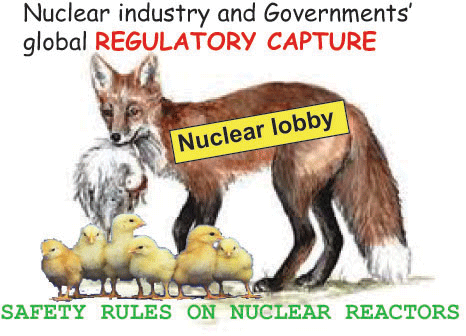
 In this piece, the author while discussing the issues around nuclear safety, debates on why it is important to re-examine the proposed Nuclear Safety Regulatory Authority Bill for better regulation, transparency, and liability. SINCE returning to power last year with an overwhelming majority in the 2019 general elections, the Modi-led government has passed a series of legislations in rapid succession without any credible dialogue both within and outside Parliament – …………even as there has been exceptional eagerness to push these amendments and pass new legislation, including notifying the Citizenship (Amendment) Act, 2019 despite intense country-wide protests and a raging debate on its underlying intent, there are urgent issues, such as, nuclear safety, which remain in indefinite suspension.
The UPA-II government, under Dr Manmohan Singh, had introduced the Nuclear Safety Regulatory Authority (NSRA) Bill in the Lok Sabha on 07 September 2011, aimed at replacing India’s existing nuclear regulator, the Atomic Energy Regulatory Board (AERB) with a purportedly improved and more autonomous Nuclear Safety Regulatory Authority (NSRA) which would have the mandate to ‘regulate nuclear safety and activities related to nuclear material and facilities’.
The Bill, however, which had been referred to the Department-related Parliamentary Standing Committee on Science and Technology, Environment and Forests, did not come up for discussion before the dissolution of the 15th Lok Sabha, and subsequently, lapsed. The Standing Committee had reportedly endorsed the Bill with only minor suggestions for changes, while two members of the Committee from the CPI(M), gave dissent notes, arguing that the Bill provided ‘no substantive autonomy’ to the proposed NSRA. According to available information, in April 2017, the Union Minister of State (Independent Charge) Atomic Energy and Space, Dr Jitendra Singh, in a written response to a question in the Lok Sabha had stated that a ‘fresh Bill’ similar to the earlier NSRA Bill, was ‘under examination’……….India’s nuclear regulatory framework has long been criticized for being so thoroughly enmeshed within the government structure so as to render its requisite independence, practically meaningless. Nuclear safety in India has been the remit of the AERB, which was set up in November of 1983 by an executive order of the Secretary of the DAE under Section 27 of the Atomic Energy Act, 1962, with modifications made in April 2000 to “exclude all BARC facilities from (its) oversight, (following) the declaration of BARC as a nuclear weapons laboratory”.
The AERB has had the dishonourable reputation of being subservient to India’s exclusively public sector operators, which it is required to monitor, and is also acknowledged as suffering from an acute lack of independence from industry and government.
As things stand, the AERB is responsible for monitoring the safety of the various nuclear facilities operated by agencies such as, the Nuclear Power Corporation of India Limited (NPCIL) and the Uranium Corporation of India Limited (UCIL), which fall under the purview of the Department of Atomic Energy (DAE). However, the Board is required to report to the Atomic Energy Commission (AEC), whose chairman is the Secretary of the DAE and one of whose members is the Chair of the NPCIL, and which overall, comes under the direct control of the Prime Minister of India. Thus, the regulatory board reports to the very agency it is required to assess and monitor in the interest of public safety.
Moreover, the AERB frequently draws upon the ‘expertise’ of scientists and engineers provided by the DAE – “almost 95% of the members in AERB’s review and advisory committees are drawn from among retired employees of the DAE, either from one of their research institutes like the Bhabha Atomic Research Center or a power generation company like the Nuclear Power Corporation of India Ltd.” – thus, calling into question the AERB’s functional autonomy.
Dr A Gopalakrishnan, the former Chairman of the AERB has been at pains to explain how the present institutional setup makes nuclear safety regulation in India a ‘mere sham’ and that for the AERB to function effectively, the DAE’s hold on the Board needs to be urgently done away with. In 1995, during Dr Gopalakrishnan’s tenure as the nuclear regulator, the AERB had prepared a comprehensive ‘Document on Safety Issues in DAE Installations’ – a report detailing nearly 130 safety issues across India’s nuclear installations with 95 of them having been designated ‘top priority’, to which the first reactions from the NPCIL and BARC according to Dr Gopalakrishnan, were of denial and questioning AERB’s own technical expertise to review safety matters.
A 2012 Performance Audit Report on the AERB prepared by the Comptroller and Auditor General of India (CAG) and submitted to the Indian Parliament labelled the AERB a ‘subordinate office, exercising delegated functions of Central government and not that of the regulator’.
The Public Accounts Committee (PAC) scrutinizing the CAG report in 2013 castigated the Regulatory Board for failing to prepare a ‘comprehensive nuclear radiation safety policy despite a specific mandate in its constitution order of 1983’. The International Atomic Energy Agency’s (IAEA) Peer Review of India’s Nuclear Regulatory Framework in 2015 was also categorical in asserting that the AERB was in need of being separated from ‘other entities having responsibilities or interests that could unduly influence its decision making’.
As has been pointed out by MV Ramana, physicist and author of The Power of Promise, there have been accidents of ‘varying severity’ at several of the nuclear facilities being operated by the DAE, yet the regulatory board has frequently been seen downplaying the seriousness of such incidents, “postponing essential repairs to suit the DAE’s time schedules, and allowing continued operation of installations when public safety considerations would warrant their immediate shutdown and repair”. The charade of the AERB’s professed independence is further underscored by its conspicuous silence on the recent cybersecurity breach at the Koodankulam Nuclear Power Plant in Tirunelveli District in Tamil Nadu in October 2019.
It is these glaring frailties of the nuclear regulatory framework coupled with the obdurate insistence of the Central government to massively expand its activities along the entire nuclear fuel cycle, despite unsettled safety concerns, a long-standing and vociferous people’s resistance against uranium mining and nuclear energy projects, and concerns surrounding the health, environmental, economic, and democratic costs of this expansion, that make imperative, the need for a fiercely independent and non-partisan nuclear regulator.
Does the proposed NSRA fit the bill?
The NSRA Bill, 2011 upon its introduction, had failed to invoke any enthusiasm among independent experts, nuclear sector watchers, and civil society actors, and instead, was met with grim scepticism given that among other things, it made light of the principle of ‘separation’ as required under Article 8 of the IAEA Convention on Nuclear Safety to which India is a State Party.
The NSRA Bill provides for the establishment of a ‘Council of Nuclear Safety’, headed by the Prime Minister and comprised of five or more Union Ministers, the Cabinet Secretary, Chairman of the AEC, and other ‘eminent experts’ nominated by the Central government, which in turn, will constitute ‘search committees’ to select the Chair and Members of the proposed Regulatory Authority. Moreover, under Article 14 of the Bill, the Chairperson and Members of the NSRA can be removed by an order of the Central government.
Dr Gopalakrishnan argues that the Bill makes only an ornamental show of granting independence to the NSRA by requiring the Authority to report to the Parliament instead of a government department, ministry or official. Concomitantly, however, the Bill also unambiguously provides for the supersession of and the assumption of ‘all the powers, functions and duties’ of the Authority by the Central Government, if in its ‘opinion’ the Authority fails to function in concert with the provisions of the proposed Act, and, requires the Authority to seek approval of the central government prior to initiating any interaction with nuclear regulators of other countries and/or international organizations ‘engaged in activities relevant to…nuclear/radiation safety, physical security of nuclear material and facilities, transportation of nuclear and radioactive materials and nuclear and radiation safety and regulation’.
Article 20 (q) of the Bill mandates the NSRA to ‘discharge its functions and powers in a manner consistent with the international obligations of India’. This provision, argues Dr Gopalakrishnan is deeply worrisome for it “could mean, that if the Prime Minister has promised the French President in 2008 that India would buy six European Pressurised Reactors (EPRs)…(this) unilateral and personal commitment…will now (be) labelled ‘India’s international obligation’, and the NSRA cannot question, even on strong safety grounds, the setting up of those six EPR units, since that will violate the said clause of the Bill” – this might prove disastrous for both, public and environmental safety in the long term.
Experts argue that far from separating the regulator from the government, these provisions contained in the NSRA Bill will only mean absolute government control over nuclear regulation, including over appointment and dismissal procedures, thus, opening the way for ‘pliant technocrats’ to occupy prominent positions within the Authority.
The proposed Bill is also fuzzy on the question of which nuclear facilities will fall under the purview of the NSRA – it empowers, for instance, the central government to exempt “any nuclear material, radioactive material, facilities, premises and activities” from the jurisdiction of the Authority, on grounds of ‘national defence and security’. ……….
These and other provisions of the Bill are a stark reminder that the DAE has no love lost for transparency and public oversight – take, for instance, Article 45 which requires the Chairperson, Members, and other employees of the Authority to sign a ‘declaration of fidelity and secrecy’ “to not communicate or allow to be communicated to any person not legally entitled to any information relating to the affairs of the Authority”. It is for these reasons that the former nuclear regulator, Dr Gopalakrishnan has described the proposed NSRA Bill as an exercise in ‘boxing in’ nuclear regulation “from all sides by government controls, diktats, and threats of retaliation”, thus making it even more emaciated than the existing nuclear regulator – the AERB. …..https://theleaflet.in/in-a-season-of-impetuous-lawmaking-whither-nuclear-safety/
$123 billion the cost of safety measures for Japan’s nuclear stations
 Costs for managing Japan’s nuclear plants to total 13 trillion yen, https://english.kyodonews.net/news/2020/01/8722fafaff9b-costs-for-managing-japans-nuclear-plants-to-total-13-trillion-yen.html
KYODO NEWS – Jan 15, 2020 The total costs to implement government-mandated safety measures, maintain facilities and decommission commercially operated nuclear power plants in Japan will reach around 13.46 trillion yen ($123 billion), a Kyodo News tally showed Wednesday.
The amount, which could balloon further and eventually lead to higher electricity fees, was calculated based on financial documents from 11 power companies that own 57 nuclear reactors at 19 plants, as well as interviews with the utilities.
Two years after the 2011 Fukushima nuclear crisis, the Japanese government introduced new safety standards which made measures against natural disasters and major accidents mandatory for restarting reactors.
The power companies have been given the option of either maintaining their idled nuclear power plants and restarting them once they had implemented the required safety measures, or decommissioning their plants. But it has become clear either choice required massive costs.
Of the total costs, 5.4 trillion yen was for safety measures implemented as of last month at 15 power plants they are trying to restart.
Decommissioning costs for 17 reactors belonging to nine nuclear power plants, which were deemed too expensive to implement safety measures for, totaled around 849.2 billion yen.
As the estimated costs for decommissioning the No. 1 to No. 4 reactors at the Fukushima Daiichi nuclear power plant run by Tokyo Electric Power Company Holdings Inc. differ, they were not included in the figure.
Maintenance costs, which will not only apply to restarted plants in operation but also to idled ones and those in the process of being decommissioned, are required for 54 reactors at 17 plants.
Those under construction were excluded. In the six years from fiscal 2013, when the new regulations were introduced, they totaled around 7.2 trillion yen.
The costs include labor, repairs and others considered nuclear power plant expenses as shown in each company’s annual securities report. But plant depreciation costs and a reserve for dismantling facilities were subtracted as they overlapped with some expenses for safety measures and decommissioning.
Maintenance fees will be required every year moving forward and are expected to continue to grow from the annual costs of around 1 trillion yen across the 11 utilities.
The total costs could further rise by several hundred billion yen as money needed to construct anti-terrorist facilities, also required under the new safety standards, was not included in the figures of some of the companies.
The majority of the 17 reactors at nine power plants slated for decommissioning are aging and they also include four at the Fukushima Daini complex, which local officials requested to be scrapped.
Unsafety of Russia’s November-class submarines
Sailing These Russian Nuclear Submarines Was Basically A Suicide Mission, Safety was sacrificed for the sake of performance. National Interest, by Sebastien Roblin, 22 Jan 2020
Key Point: The November-class submarined expanded Soviet influence, but at a cost.
The United States launched the first nuclear-powered submarine, the USS Nautilus, in 1954, revolutionizing undersea warfare. The Nautilus’s reactor allowed it operate underwater for months at a time, compared to the hours or days afforded conventional submarines. The following year, the Soviet Union began building its own nuclear submarine, the Project 627—known as the November class by NATO. The result was a boat with a few advantages compared to its American competition, but that also exhibited a disturbing tendency to catastrophic accidents that would prove characteristic of the burgeoning Soviet submarine fleet during the Cold War………
the power of the November class’s reactors was bought at the price of safety and reliability. A lack of radiation shielding resulted in frequent crew illness, and many of the boat suffered multiple reactor malfunctions over their lifetimes. This lack of reliability may explain why the Soviet Union dispatched conventional Foxtrot submarines instead of the November-class vessels during the Cuban Missile Crisis, despite the fact that the diesel boats needed to surface every few days, and for this reason were cornered and chased away by patrolling American ships.
In fact, the frequent, catastrophic disasters onboard the Project 627 boats seem almost like gruesome public service announcements for everything that could conceivably go wrong with nuclear submarines. Many of the accidents reflected not only technological flaws, but the weak safety culture of the Soviet Navy………..
This is just an accounting of major accidents on the November-class boats—more occurred on Echo- and Hotel-class submarines equipped with the same nuclear reactors. Submarine operations are, of course, inherently risky; the U.S. Navy also lost two submarines during the 1960s, though it hasn’t lost any since.
The November-class submarines may not have been particularly silent hunters, but they nonetheless marked a breakthrough in providing the Soviet submarine fleet global reach while operating submerged. They also provided painful lessons, paid in human lives lost or irreparably injured, in the risks inherent to exploiting nuclear power, and in the high price to be paid for technical errors and lax safety procedures. https://nationalinterest.org/blog/buzz/sailing-these-russian-nuclear-submarines-was-basically-suicide-mission-115661
Anxiety in Belarus and Lithuania, over new Chernobyl-style nuclear power station
|
They may not tell you the whole truth’: Fears of another Chernobyl as Russian-built atomic power station set to open in Belarus, Independent, 20 Jan 2020 Three decades after world’s worst nuclear disaster, the country most affected by the fall out is set to open its first nuclear plant. But as Oliver Carroll finds out, not everyone is pleased It was when the tree fellers arrived in early 2009 with their bulldozers that Nikolai Ulasevich, a local activist, knew the game was up. There might not have been a published order to build an atomic power station in the fields overlooking his homestead in the village of Vornyany – but a decision had clearly been made. In authoritarian Belarus those decisions rarely have a reverse gear. In the years that followed, Ulasevich watched as the gigantic cooling towers and system blocks of Belarus’s first nuclear power station took shape. Construction, which was led by the Russian state nuclear agency Rosatom, would be far from straightforward. A string of incidents delayed its opening, but the first reactor is finally due to go online early 2020. To say the construction of the Belarusian nuclear plant has been controversial would be to trivialise the history of these lands. Chernobyl lies only seven miles from Belarus’s southern border, and the nuclear accident, still the world’s worst, has left the deepest of scars locally. The direction of the wind in spring 1986 – and the Soviet authorities’ decision to avoid major harm in Moscow – meant Belarus suffered more than any other region in the union. At the moment that the radioactive clouds moved towards the capital, air force pilots were ordered to chase down the toxic clouds and seed them with jets of silver iodide. Much of the southernmost region of Homel remains seriously contaminated, with elevated oncology levels as a result. Any local over 50 can recall what they were doing on those dry, spring-summer days. They talk about the tiredness; the strange, dryness of the mouth; the rumours that it might be a good idea to take iodine, but the lack of reliable information. They will also tell you about a cloud of secrecy almost as harmful as the black cumulus masses that had their radioactive bowels emptied over southern Belarus. …….. “The thought of what happened back in 1986 can’t fail to make you anxious about what may happen. You know they may not tell you the whole truth.” Lithuania, the European nation that borders Belarus just 10 miles west of Astravets, is bitterly opposed to the nuclear plant. It says it has not been properly consulted and claims the plant breaches post-Fukushima distance guidelines – in particular, a recommendation that nuclear power stations should not be built closer than 100km of major conurbations. The new nuclear plant lies just 30 miles east of the Lithuanian capital, Vilnius. The Lithuanians say they are preparing for any eventuality: from stockpiling iodine tablets to opening up nuclear bunkers and issuing survival notes to their citizens. In October, authorities ran a major preparedness operation, imitating a disaster response to a nuclear meltdown. The drills were knowingly hyperbolic. But several reported incidents do give pause for thought. From what we know, the reactor vessel in Belarus has already been involved in at least two accidents. The first was in July 2016, when it was apparently dropped from a crane during installation. Belarusian authorities took weeks to admit a “minor” incident. Five months later, a replacement reactor vessel collided with a railway pylon while being transported. At least five workers have died in construction accidents. There was at least one fire incident in the control room. The outside world would likely have stayed little the wiser were it not for the opposition activist Ulasevich monitoring from his modest home, which he shares with his wife, a few chickens and sheep, three miles away from the new power station. He said he found out about the dropped reactor vessel in conversation with a local construction worker. “He swore that he saw it break free of ropes at a height of two or three metres,” he says. ……. Yury Voronezhtsev, the man who led the official Soviet official response to Chernobyl, says he could not believe any statement that the plant was “safe”. “I don’t believe that our Belarusian construction workers are any better than the Soviet ones,” he tells The Independent. “We have the same people, and the same systems………. https://www.independent.co.uk/news/world/europe/chernobyl-belarus-nuclear-power-station-atomic-vornyany-rosatom-ostrovets-astravets-a9271811.html
|
|
California fights NASA over toxic Santa Susana nuclear site
California, NASA Clash Over Cleanup at Nuclear, Rocket Site, https://news.bloombergenvironment.com/environment-and-energy/california-nasa-clash-over-cleanup-at-nuclear-rocket-site
- California says the space agency is not adhering to past agreements
- NASA needs to redraft a cleanup plan, toxics agency says
California’s toxics agency is opposing a revised NASA cleanup plan to remove contamination at a former rocket and energy research site where a partial meltdown happened decades ago, calling the federal agency’s proposal irregular, infeasible, and legally deficient.
It’s the latest fight in a long tussle over the Santa Susana Field Laboratory, a 2,850-acre site in Simi Valley near Los Angeles, where an estimated 17,000 rockets engine tests occurred. The lab, which operated from 1948 to 2006, was also home to 10 nuclear reactors where the Energy Department and what is now the Boeing Co. did energy research.
The site experienced a partial nuclear meltdown in 1959, but evidence wasn’t revealed until 20 years later. Cleanup work has been ongoing since the 1960s.
Cesium-137
The National Aeronautics and Space Administration agreed to a consent order in 2010 with the state Department of Toxic Substances Control requiring soil remediation of the site, which was contaminated with 16 radiologicals like cesium-137, and 116 chemicals.
A final environmental review was completed in 2014, but the space agency issued a separate draft cleanup plan in October based on new data showing more contamination.
The draft plan provides options for how much soil would be excavated. One option, the one that reflects the agreement in original administrative order on consent with the state, calls for excavating 870,000 cubic yards, an increase from the 500,000 cubic yards estimated in the 2014 plan to meet the standard agreed upon with the state. The other options call for removing lesser amounts, down to 176,500 cubic yards. The plan also considers a no-action alternative.
NASA said in the draft supplemental environmental impact statement that it hasn’t chosen a preferred option yet.
In a letter sent to NASA Jan. 8, the Department of Toxic Substances Control asked the space agency to revise its cleanup plans to reflect the original administrative order on consent, known as an AOC.
State Agency Rejects Other Options
“NASA must also be aware that DTSC is not open to considering NASA cleanup alternatives which are non-compliant with the AOC,” the letter said. “DTSC also will not renegotiate the binding AOC soil cleanup commitments to accommodate challenges NASA claims will be posed by the [Santa Susana Field Laboratory] cleanup implementation.”
The letter criticized some of NASA’s options as irregular because they called for decreased cleanup when contamination had ncreased. It called excavating less contaminated soil than called for in the 2010 agreement infeasible.
“NASA has failed to provide a rational explanation or data to support the [DSEIS] irregularities and unexplained reversal,” DTSC wrote, calling the plan “legally deficient.”
In its draft cleanup plan, NASA said it would be hard to find adequate backfill to support vegetation in areas that were excavated.
A NASA spokeswoman said Jan. 14 that the agency was reviewing comments made about the draft plan and valued input from all stakeholders.
“NASA is eager to work with DTSC and the community to implement a cleanup that is based in science, technically achievable, and is protective of the surrounding community and the natural environment,” Jennifer Stanfield wrote in an email.
NASA didn’t immediately respond to a question about other cleanup sites where revisions to agreements were being sought. DTSC couldn’t immediately say if the space agency had sought changes at other state cleanup sites.
Groups Back Cleanup Agreement
Community, environmental, and justice groups say the 2010 plan reached with the state is adequate and that NASA has no authority to decide how much contamination it must remove.
New estimates pointing to more contamination than previously thought also mean NASA should redouble cleanup efforts, Natural Resources Defense Council, Physicians for Social Responsibility Los Angeles, and Committee to Bridge the Gap said in a comment letter to NASA about its draft supplemental environmental impact statement (DSEIS).
“The decision by the Trump Administration NASA to issue this DSEIS sets the stage for abandoning huge amounts of chemically hazardous material and would consign this important land in Southern California, set in the midst of millions of California residents, to never be cleaned up,” the groups wrote.
The new plan wasn’t a surprise. A NASA inspector general report issued in March said the cleanup would take too long and would be too costly and stringent. The Department of Energy is also seeking to reduce its cleanup obligations.
For its part, the toxics agency plans to issue a final environmental impact report this summer that “fully complies with and implements” the 2010 agreement, DTSC spokesman Russ Edmondson said in an email.
To contact the reporter on this story: Emily C. Dooley at edooley@bloombergenvironment.com, To contact the editors responsible for this story: Gregory Henderson at ghenderson@bloombergenvironment.com; Sylvia Carignan at scarignan@bloombergenvironment.com; Renee Schoof at rschoof@bloombergenvironment.com
No chance of re-using spent mixed-oxide (MOX) fuel, its storage highly dangerous
|
Mainichi 15th Jan 2020, There are no prospects that spent mixed-oxide (MOX) fuel, made by reprocessing spent nuclear material, can be further reprocessed and reused for nuclear power generation in accordance with the Japanese government’s energy policy.
Storing such fuel for a long period has thus raised safety
concerns. The Nuclear Regulation Authority (NRA) has expressed concerns that the storage of spent MOX fuel in the pool over such a long period is highly dangerous. In case of a power blackout, the temperature of the water in the pool could not be maintained at a certain level and it would become unable to cool the fuel just as was the case with the Fukushima nuclear crisis. https://mainichi.jp/english/articles/20200115/p2a/00m/0na/029000c |
|
Japanese Only Operational Nuclear Reactor Shut
Japanese Only Operational Nuclear Reactor Shut, Increasing Fuel Costs, By Tsvetana Paraskova for Oilprice.com A Japanese high court has ordered local utility Shikoku Electric Power Company to continue idling its only operational nuclear reactor until the company provides a satisfactory proof that the reactor is safe.The extended shutdown of the nuclear reactor would lead to higher fuel costs for the Japanese utility.
Shikoku Electric Power’s only operational reactor at the Ikata nuclear plant in western Japan was taken offline at the end of December for regular maintenance. The utility planned to restart the reactor within two months, but the Hiroshima High Court has just ruled that the utility had not provided sufficient guarantees that the reactor would be safe in case of earthquakes or volcano eruptions……..
Public opposition to nuclear energy is creating uncertainty about how much nuclear generation capacity Japan will restore.
Japan spent an additional annual average of around US$30 billion for fossil fuel imports in the three years after the Fukushima accident, according to EIA estimates.
The country is also looking at alternative energy sources, including hydrogen, in order to reduce its fossil fuels import bill as the future of many of its nuclear reactors is still uncertain. https://oilprice.com/Latest-Energy-News/World-News/Japanese-Only-Operational-Nuclear-Reactor-Shut-Increasing-Fuel-Costs.html
1 This Month



26 September – International Day for the Total Elimination of Nuclear Weapons


PLEASE OPPOSE HR 8255 AND S.3639 – bills would accelerate satellite deployment, with no environmental review or safeguards – https://ncstd5li.quorum.us/campaign/169331/
To see nuclear-related stories in greater depth and intensity – go to https://nuclearinformation.wordpress.com
-
Archives
- September 2026 (257)
- August 2026 (330)
- July 2026 (355)
- June 2026 (287)
- May 2026 (306)
- April 2026 (356)
- March 2026 (251)
- February 2026 (267)
- January 2026 (308)
- December 2025 (358)
- November 2025 (359)
- October 2025 (375)
-
Categories
- 1
- 1 NUCLEAR ISSUES
- business and costs
- climate change
- culture and arts
- ENERGY
- environment
- health
- history
- indigenous issues
- Legal
- marketing of nuclear
- media
- opposition to nuclear
- PERSONAL STORIES
- politics
- politics international
- Religion and ethics
- safety
- secrets,lies and civil liberties
- spinbuster
- technology
- Uranium
- wastes
- weapons and war
- Women
- 2 WORLD
- ACTION
- AFRICA
- Atrocities
- AUSTRALIA
- Christina's notes
- Christina's themes
- culture and arts
- Events
- Fuk 2022
- Fuk 2023
- Fukushima 2017
- Fukushima 2018
- fukushima 2019
- Fukushima 2020
- Fukushima 2021
- general
- global warming
- Humour (God we need it)
- Nuclear
- RARE EARTHS
- Reference
- resources – print
- Resources -audiovicual
- Weekly Newsletter
- World
- World Nuclear
- YouTube
-
RSS
Entries RSS
Comments RSS
 nuclear-news