Mystery grows around state of Russian nuclear submarine base that is just 75 miles from epicentre of 8.8-magnitude megaquake
A colossal 8.8-magnitude earthquake rocked Russia’s far eastern Kamchatka
Peninsula early yesterday morning – raising serious questions about the
condition of Russia’s key nuclear submarine bases, located alarmingly close
to the epicentre. The quake, tied for the sixth strongest in recorded
history, struck just 75 miles from Avacha Bay, where some of the Russian
Navy’s most strategic nuclear assets, including Borei and Delta-class
ballistic missile submarines, are based. Though Russian authorities are
insisting the situation is under control, with ‘no reported fatalities or
serious injuries’, military analysts and international observers are
sounding the alarm over the potential impact on these high-security naval
installations.
Mail 31st July 2025, https://www.dailymail.co.uk/news/article-14956551/Russian-nuclear-submarine-base-earthquake.html
French submarine-maker targeted by hackers
Cyber attackers claim to have uncovered source code for submarine weapon systems.
A French naval giant is investigating a potential cyber attack after
hackers claimed to have obtained sensitive data about the country’s
nuclear submarines. Naval Group, a state-owned ship maker that traces its
origins back almost 400 years to the reign of Louis XIII, said it had
“immediately launched technical investigations” after cyber criminals
threatened to publish files on the dark web.
Telegraph 27th July 2025, https://www.telegraph.co.uk/business/2025/07/27/french-submarine-maker-targeted-by-hackers/
The real story of Chernobyl, the worst nuclear disaster in history
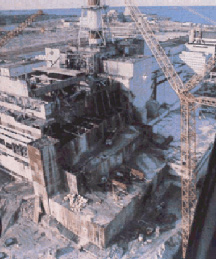
The Chernobyl Sarcophagus Memorial sculpture was erected in 2006 and is dedicated to the memory of the heroic plant workers and emergency crew who prevented a global catastrophe .
28 July 25,https://www.history.co.uk/articles/the-story-of-chernobyl-the-worst-nuclear-disaster-in-history
On 26th April 1986, a routine safety test went catastrophically wrong and triggered the worst nuclear accident of all time. The incident at the Chernobyl Nuclear Power Plant near Pripyat, Ukraine led to the release of 400 times more radiation than the atomic bomb dropped on Hiroshima during WW2.
31 people died in the immediate aftermath, whilst the long-term health effects caused by Chernobyl are still a hotly debated subject. Approximately 60,000 square miles around the plant were contaminated and an area nearly twice the city of London remains an exclusion zone to this day.
Background of Chernobyl
Lying just 10 miles from the Belarus-Ukraine border and around 62 miles north of the Ukrainian capital Kyiv, the Chernobyl Nuclear Power Plant was commissioned in 1977 as part of the old Soviet Union, with the first reactor supplying power to the grid later that year. By 1984, four reactors had entered commercial operation, each capable of producing 1,000 megawatts of electrical power.
Just under two miles from the plant was the city of Pripyat, founded in 1970 and named after the nearby river. It was built to serve the power plant and at the time of the disaster, its total population was just shy of 50,000.
Nuclear disaster unfolds
Throughout Friday, 25th April 1986, Chernobyl’s engineers lowered power at Reactor No. 4 in preparation for a safety test to be conducted later that evening. The test was supposed to check whether the reactor turbines could continue powering emergency water coolant pumps in the event of a power failure.
Ironically, the safety test was anything but safe as human error and substandard reactor design led to a partial meltdown of the core.
The experiment was poorly conceived and equally badly executed. Firstly, the less-experienced night shift crew carried out the safety test and later claimed they had not received full instructions from the day shift crew on how to properly conduct it. Secondly, the emergency core cooling system for Reactor 4 was disabled along with the emergency shutdown system.
Finally, the reactor’s power level dropped to a dangerously unstable level at which point the engineers removed most of the control rods in violation of safety guidelines. Although power began to return, it was far from under control.
Explosion in Reactor 4
At 1:23am on 26th April, the safety test was given the all-clear by plant supervisors. Almost immediately a power surge occurred, triggering the engineers to re-insert all 211 control rods. The control rods were graphite tipped, a design flaw that would prove fatal as they increased the reaction in the core, instead of lowering it.
The subsequent steam explosions blew off the steel and concrete lid of the reactor as the core suffered a partial meltdown. Two engineers were killed instantly whilst two more suffered severe burns. The explosion, along with the resulting fires, released at least 5% of the radioactive reactor core into the atmosphere. Blown by the wind, radioactive materials were spread to many parts of Europe over the coming days.
Emergency response begins
Firefighters quickly arrived on the scene but without proper protective clothing, many perished in the coming months from acute radiation syndrome. By dawn, all the fires were suppressed except for the one in the reactor core.
The other three reactors were shut down a short while later. The following day officials ordered helicopters to begin dumping more than 5,000 tonnes of sand, lead, clay, and boron onto the burning reactor to help extinguish the core fire.
A Soviet cover-up
It took nearly 36 hours for Soviet officials to begin evacuating nearby Pripyat. The city’s residents were unaware of the true dangers presented by the previous day’s events. Advised to pack only necessities, the people of Pripyat were loaded onto buses believing their evacuation to be temporary. Little did they know, they would never return to their homes again.
Two days after the catastrophic explosion the rest of the world remained in the dark as the Soviets attempted to cover up the event. However, on 28th April, Swedish radiation monitoring stations 800 miles away began detecting high levels of radiation. With their backs to the wall, the Soviets finally made a statement, with the Kremlin admitting an accident had occurred at Chernobyl, but assuring the world that officials had it under control.
Heroism on display
In the days that followed, hundreds of workers risked their lives to contain radiation leaking from the reactor core.
On 4th May, three divers made their way through the dark flooded basement of Reactor 4 to turn valves and drain the ‘bubbler pools’ sitting below the core. Had they not succeeded in their mission, molten nuclear material would have eventually melted its way down to the pools.
This would have triggered a radiation-contaminated steam explosion and destroyed the entire plant along with its three other reactors, causing unimaginable damage and nuclear fallout that the world would have struggled to recover from.
Radioactive debris also needed to be removed from the roof of the reactor. After robots failed to do the job, workers equipped with heavy protective gear were sent in.
Nicknamed ‘Bio-robots’, these workers were unable to spend more than 90 seconds on the roof due to the extreme levels of radiation. In the end, 5,000 men went up on the irradiated rooftop to successfully clear the radioactive material from it.
Clean-up commences
By mid-May, Soviet leader Mikhail Gorbachev had ordered thousands of firefighters, miners, and soldiers to begin the long and arduous task of cleaning up. Known as ‘Liquidators’, 600,000 – 800,000 of them began burying radioactive debris and topsoil, as well as shooting all wildlife (both domestic and wild) within the 19-mile exclusion zone surrounding the power plant.
Nicknamed ‘Bio-robots’, these workers were unable to spend more than 90 seconds on the roof due to the extreme levels of radiation. In the end, 5,000 men went up on the irradiated rooftop to successfully clear the radioactive material from it.
Clean-up commences
By mid-May, Soviet leader Mikhail Gorbachev had ordered thousands of firefighters, miners, and soldiers to begin the long and arduous task of cleaning up. Known as ‘Liquidators’, 600,000 – 800,000 of them began burying radioactive debris and topsoil, as well as shooting all wildlife (both domestic and wild) within the 19-mile exclusion zone surrounding the power plant.
Aftermath
The Chernobyl Exclusion Zone was eventually extended to cover approximately 1,000 square miles, whereby it was declared uninhabitable for over 20,000 years. The other three reactors at Chernobyl remained active until their individual shutdowns in 1991, 1996, and 2000. Gorbachev later wrote that he believed the incident at Chernobyl was the ‘real cause of the collapse of the Soviet Union’.
Whilst the lasting health effects of the disaster remain unclear and much debated, various sources have estimated that thousands of cancer deaths can be linked back to Chernobyl.
5 worst nuclear disasters from around the world
Nuclear disasters can be caused by a variety of factors, but they all have the potential to have widespread impacts that can linger for generations.
28 July 25 https://www.history.co.uk/articles/worst-nuclear-disasters
Harnessing the biblical power of nuclear fission was never going to be a risk-free proposition and the world has been shaken by several shocking accidents since the atomic age began. Here are five of the worst.
1. Kyshtym

Decades before the Chernobyl power plant was even built, the Soviet Union experienced a radioactive eruption which irradiated thousands of square miles of the Ural Mountains region. The source of the calamity was the Mayak plutonium-processing plant near the town of Kyshtym – a facility which had been quickly erected to produce essential materials for the Soviet Union’s nuclear weapons programme.
The breakneck pace of development meant safety fell by the wayside, to the point where staff failed to fix a malfunctioning cooling system designed to keep tanks of nuclear waste at safe temperature levels. On 29th September 1957, one of these steel tanks finally exploded, blowing off a metre-thick concrete lid and sending out a cloud of nuclear fallout.
The local population was kept in the dark about the explosion and a whole week went by before they were evacuated. It wasn’t until 1976 that the details of the disaster were leaked to the Western press by an exiled Russian scientist. The true health impact is impossible to know for sure, although increased rates of cancer and other medical issues have been associated with the disaster.
2. Windscale
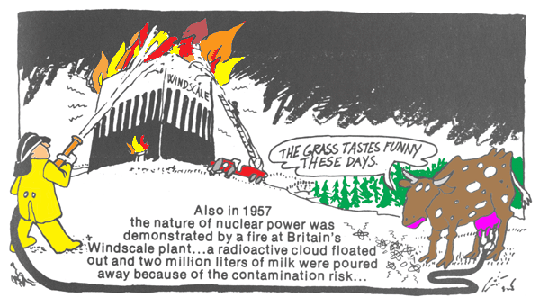
The name ‘Windscale’ isn’t known to many people these days, because this British nuclear site was renamed ‘Sellafield’ in 1981. Windscale was then notorious as the site of one of the world’s worst nuclear accidents and the resulting bad PR was a reason why the authorities decided to rebrand.
Back in 1957, Windscale’s towering reactors were producing weapons-grade plutonium for Britain’s nuclear arsenal, but disaster struck in the form of a fire in one of the reactors on 10th October. Workers had to bravely battle to extinguish the inferno, despite the real risk of being irradiated by the burning uranium.
3. Chernobyl

Ironically, the disaster whose name is a byword for nuclear calamity only occurred because of a safety test.
In the early hours of 26th April 1986, workers at the Chernobyl nuclear plant initiated an experiment to assess how the reactor cooling mechanisms would function in the event of a power outage. A combination of design flaws and human error caused the test to go catastrophically wrong, leading to a power surge and a steam explosion which tore the 1,000-ton cover off reactor number four.
Another explosion followed and the reactor was now a terrifying crater expelling radioactive contaminants into the atmosphere. One worker staring directly at the core recounted how the blue, ionised air was ‘flooding up into infinity’ – a spectacle both beautiful and terrifying.
The nearby city of Pripyat was evacuated 36 hours later, abruptly going from a bustling urban centre to an eerie ghost town. Chernobyl workers and firefighters killed by the initial explosions and ensuing radiation poisoning numbered at least 30.
Contrary to popular belief, the three so-called ‘Chernobyl divers’ who were sent in on a ‘suicide mission’ to drain water from the plant, actually survived their excursion. But the consequences of Chernobyl were immense, with a vast Exclusion Zone being enforced, and the disaster thought to be linked with thousands of cancer deaths.
4. Three Mile Island
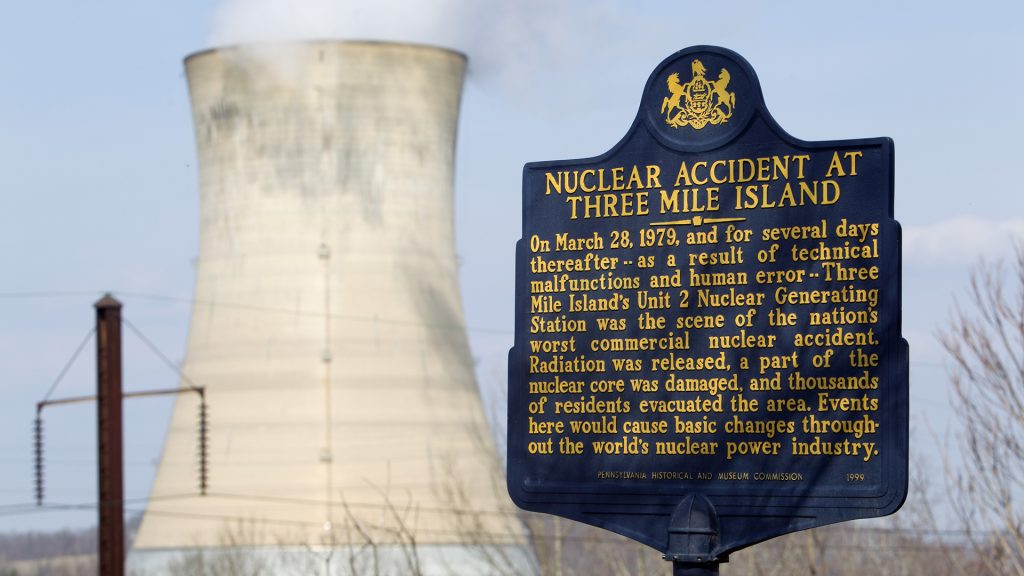
Prior to Chernobyl, three words were synonymous with nuclear disaster: Three Mile Island. The incident at this power plant in Pennsylvania on 28th March 1979 was made all the more notorious because it took place less than two weeks after the release of The China Syndrome, a star-studded disaster movie about the imminent threat of a nuclear meltdown.
Although Three Mile Island was fortunately ‘only’ a partial meltdown caused by a cooling malfunction, it was enough to release radioactive materials into the environment. The state’s governor advised that pregnant women and young children should evacuate the area. Before long, around 140,000 people had fled.
Though most experts believe the health effects to have been minimal, Three Mile Island galvanised anti-nuclear activists in the US, with Jane Fonda – star of The China Syndrome – giving a speech at an anti-nuclear protest held in the wake of the accident.
5. Fukushima

The disaster at the Fukushima power plant on 11th March 2011 had the most dramatic origin of all nuclear accidents. Namely, a gigantic tsunami which had been in turn triggered by an undersea earthquake off the coast of Japan.
It was the most powerful earthquake in Japan’s history, and the tsunami waves easily crashed over the plant’s seawall, flooding the reactor buildings and knocking out the emergency diesel generators providing backup power for the coolant systems.
The untamed residual heat within the reactors caused three partial meltdowns and subsequent gas explosions, leading to at least 160,000 people evacuating the area after the accident.
The Kyshtym disaster: Russia’s hidden nuclear crisis
The Kyshtym disaster in 1957 was the Soviet Union’s biggest nuclear crisis until Chernobyl. So, why did the Soviets keep quiet about the former for decades?
28 July 25, https://www.history.co.uk/articles/kyshtym-disaster-russia-hidden-nuclear-crisis
What would be considered the worst nuclear disaster in history? Many scholars would say Chernobyl, when an explosion at a nuclear power plant in northern Ukraine released dangerous levels of radiation.
This was on 26th April 1986, when Ukraine was still part of the Soviet Union. Was Chernobyl inevitable? Many historians do believe that Soviet authorities failed to learn lessons from an earlier nuclear crisis on their own soil. Below, we at Sky HISTORY look back at the 1957 Kyshtym disaster — and how the Soviets kept it under wraps for decades.
Was there really a nuclear plant in Kyshtym?
The nuclear plant at the heart of the Kyshtym disaster was not actually in the Russian town of that name. Instead, it was in a secretive ‘closed city’ nearby, called Chelyabinsk-40. Today, it is called Ozyorsk. (Both Kyshtym and Ozyorsk are in Russia’s Chelyabinsk Oblast.)
In the 1940s, the Soviets realised that they were trailing the United States in the development of nuclear weapons. To help themselves catch up, they hastily built what is now commonly known as the Mayak nuclear plant.
This facility, which still stands today, was tasked with processing plutonium needed to make nuclear weapons. However, because the plant was assembled in a rush, many safety risks of the project were not considered sufficiently.
The Kyshtym explosion and its immediate aftermath
Before the Kyshtym disaster, it was routine for Mayak workers to deposit radioactive waste into the Techa River. This bode ill (literally) for villagers along the river who used it as a source of drinking water.
So, Mayak staff later decided to store such waste in an underground storage compartment of the plant itself. This space comprised 14 stainless steel containers attached to a concrete base.
However, in the 1950s, the cooling system in one of these tanks started to malfunction. This led the waste in the container to heat up and eventually, on 29th September 1957, explode. The force sent 20 curies of radioactive material flying a kilometre into the air.
The wind blew the radioactive particles over an area of about 20,000 square kilometres inhabited by approximately 270,000 people. This was generally to the northeast, away from Chelyabinsk-40, which lay upwind from the Mayak plant.
How did authorities initially react?
Residents of nearby areas were not initially notified of what had happened. This was largely due to the Soviet Union’s strong culture of secrecy during the Cold War. The national government didn’t want to let slip that Mayak even existed, let alone that a nuclear explosion had happened there.
It was also around the same time that the Soviet Union launched its Sputnik satellite, a big PR coup. Admitting responsibility for what was the world’s biggest nuclear disaster to date would have been more than an inconvenient fly in the ointment.
Still, the Soviets also knew that doing what they could to limit the radioactive contamination would go some way towards keeping everyone in the dark. So, while about 10,000 local residents were evacuated over the next two years, they weren’t told exactly why.
A cover-up lasting for decades
Almost 17,000 hectares of the contaminated area was turned into East Ural Nature Reserve in 1968. Members of the public were barred from entry, which remains the case to this day. Scientists have studied the reserve to monitor the long-term effects of nuclear radiation on its ecology.
The Kyshtym disaster was kept secret from the public until 1976, when Soviet dissident Zhores Medvedev reported about it in New Scientist magazine. However, the Soviet government still did not openly acknowledge the Kyshtym disaster before accidentally revealing it to the United Nations in the late 1980s.
It is estimated that thousands of cancer cases may have resulted from exposure to radiation caused by the nuclear explosion way back in 1957.
How does Kyshtym compare to Chernobyl?
On the International Nuclear and Radiological Event Scale (INES), Kyshtym is classified as Level 6. Chernobyl, an even bigger catastrophe, is ranked just one level higher (Level 7) on the INES. Kyshtym released about 40% as much radioactivity as Chernobyl.
Chernobyl is thought to have affected a larger population, too, as 335,000 people were evacuated in the wake of the 1986 disaster. Also, while Chernobyl quickly claimed 31 lives, none were lost in the immediate aftermath of Kyshtym.
The next Chernobyl? Soviet-era nuclear power plant is branded a ‘ticking time bomb’ that could go off at ‘any moment’
A Soviet-era nuclear power plant in an earthquake zone has been branded
‘Chernobyl in waiting’ and a ‘ticking time bomb’ amid fears of a looming
disaster. The Armenian Nuclear Power Plant was opened in 1976 and comprises
two reactors, reportedly supplying the nation with 40 per cent of its
electricity. But it stands in a seismic zone, and has already been
shuttered once before, closing for six years after the Spitak Earthquake in
1988.
Daily Mail 25th July 2025,
https://www.dailymail.co.uk/sciencetech/article-14939915/Chernobyl-nuclear-power-plant-ticking-time-bomb.html
Chinese hackers gain access to US oversight of nuclear weapons in widespread Microsoft hack: report
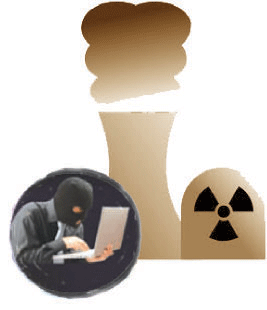
The tech giant blamed a vulnerability in its SharePoint document software
Anthony Cuthbertson,Rhian Lubin, Wednesday 23 July 2025, https://www.the-independent.com/tech/security/china-hack-nuclear-microsoft-sharepoint-b2795333.html
Chinese hackers gained access to the U.S. government agency that oversees nuclear weapons in a widespread Microsoft hack.
Microsoft issued an alert Tuesday warning that hackers affiliated with the Chinese government have been exploiting cybersecurity vulnerabilities in the company’s SharePoint software.
Tens of thousands of servers hosting the software, which is used for sharing and managing documents, were said to be at risk as a result.
The National Nuclear Security Administration, a semi-autonomous agency within the U.S. Department of Energy responsible for maintaining the nation’s stockpile of nuclear weapons, was breached in the attacks on July 18, Bloomberg first reported.
The agency is responsible for providing the Navy with nuclear reactors for submarines and responds to nuclear and radiological emergencies in the U.S. and overseas. No sensitive or classified information has leaked in the cyber attack, according to Bloomberg.
“On Friday, July 18th, the exploitation of a Microsoft SharePoint zero-day vulnerability began affecting the Department of Energy,” an agency spokesman said in a statement to the outlet. “The department was minimally impacted due to its widespread use of the Microsoft M365 cloud and very capable cybersecurity systems. A very small number of systems were impacted. All impacted systems are being restored.”
Security firm Eye Security said that 400 organizations and agencies globally were impacted, including national governments in Europe and the Middle East.
Microsoft linked the attack to two main groups, Linen Typhoon and Violet Typhoon, and flagged that another China-based group, Storm-2603, had also targeted its systems.
The Education Department, Florida’s Department of Revenue and the Rhode Island General Assembly were also breached in the attack, according to Bloomberg.
Eye Security warned that the breaches could allow hackers to impersonate users or services by stealing cryptographic keys — alphabetical codes or sequences of characters — even after software updates. Users should take further steps to protect their information, the firm said.
Microsoft said in a message to customers that it has since released “new comprehensive security updates” to deal with the incident.
But security researchers warned that the full extent of the breach and its consequences are yet to be fully revealed.
“This is a critical vulnerability with wide reaching implications,” Carlos Perez, director of security intelligence at TrustedSec, who previously trained U.S. military cyber protection teams, told The Independent.
“It enables unauthenticated remote code execution on SharePoint servers, which are a core part of enterprise infrastructure. It is already being actively exploited at scale, and it only took 72 hours from the time a proof of concept was demonstrated for attackers to begin mass exploitation campaigns.
“What makes it even more severe is the way it exposes cryptographic secrets, effectively allowing attackers to convert any authenticated SharePoint request into remote code execution. That is a dangerous capability to put into the hands of threat actors.”
Microsoft said it had “high confidence” that firms who do not install the new security updates could be targeted by the groups.
The tech firm said the attackers had been uploading malicious scripts which are then “enabling the theft of the key material” by hackers.
In a statement, the company added: “Investigations into other actors also using these exploits are still ongoing.”
Additional reporting from agencies.
The Flamanville EPR is still shut down: we know more after the visit of the nuclear regulator
Shut down since mid-June 2025 due to a leak on a protection valve, the Flamanville EPR received a visit from a team from ASNR, the nuclear regulator.
The Flamanville EPR is still shut down: we know more after the visit of the
nuclear watchdog. Shut down since mid-June 2025 due to a leak on a
protection valve, the Flamanville EPR received a visit from a team from
ASNR, the nuclear regulator.
La Presse de la Manche 22nd July 2025, https://actu.fr/normandie/flamanville_50184/lepr-de-flamanville-est-toujours-a-larret-on-en-sait-plus-apres-le-passage-du-gendarme-du-nucleaire_62944598.html
Time to Step Up – Campaigner calls on MP to challenge decision to give fusion indemnity over accident liabilities

Renowned nuclear campaigner, and friend to the Nuclear Free Local
Authorities, Dr David Lowry has just written to his local Member of
Parliament calling on her to challenge ministers over their pledge to
provide an absolute indemnity over costs incurred by a nuclear fusion pilot
plant being built in the Midlands should there be ‘incidents involving
nuclear matter or emissions of ionising radiation arising from fusion
activities relating to the STEP programme.’
In a written statement issued
to Parliament just prior to MPs leaving for the summer recess, Minister for
Climate – and seemingly defacto Nuclear Minister – Kerry McCarthy –
announced that this latest financial ‘get out of jail free’ card for the
nuclear industry would be ‘remote and uncapped’. The assumption by the
Treasury – and therefore by taxpayers – of any liability is Ms McCarthy
insists necessary to ‘address the gap in the insurance market’ which
rather suggests that no-one in the commercial insurance market is prepared
to take on the risks associated with this nascent technology.
NFLA 22nd July 2025, https://www.nuclearpolicy.info/news/time-to-step-up-campaigner-calls-on-mp-to-challenge-decision-to-give-fusion-indemnity-over-accident-liabilities/
Trump axes nuclear waste oversight panel
By Francisco “A.J.” Camacho | 07/21/2025, https://www.eenews.net/articles/trump-axes-nuclear-waste-oversight-panel/
The move comes at a time when Republicans and Democrats alike are pursuing a nuclear expansion, with Presiden Donald Trump aiming to quadruple nuclear power capacity by 2050.
President Donald Trump dismissed all but one of the members of the U.S. Nuclear Waste Technical Review Board, diminishing oversight over the country’s long-term spent nuclear fuel storage program.
“On Wednesday, the White House sent emails to seven Board members — Drs. Richelle Allen-King, Miles Greiner, Silvia Jurisson, Nathan Siu, Seth Tuler, Scott Tyler, Brian Woods — dismissing them from the Board, effective July 16, 2025,” Christopher Burk, the board’s director of external affairs, said in an email. “As a result, Dr. Peter Swift, Board Chair, is the sole member of the Board. The NWTRB staff and funding have remained in place.”
The move came at a time when Republicans and Democrats alike are pursuing a nuclear expansion, with Trump aiming to quadruple nuclear power capacity by 2050. It also comes amid a major shakeup at the Nuclear Regulatory Commission, with administration officials directing the agency to apply minimal scrutiny in reviewing reactors backed by the departments of Energy or Defense and the firing of Christopher Hanson, a Democratic commissioner and former NRC chair under former President Joe Biden.
US Nuclear Industry Revival on the Horizon
In late May, President Trump issued four separate Executive Orders (EOs)
with respect to growing the nuclear power industry in the US. As the
implementation of these orders begins, several Washington focused
publications have written about one emerging consequence of these EOs—the
likely termination of NRC oversight with respect to approval of new nuclear
reactor designs.
This major responsibility is being moved to the Pentagon
and the Department of Energy. One administration official referred to the
NRC’s prospective role in reactor approval as akin to a rubber stamp. The
implied criticism here being that the NRC was much too slow in approving
new reactor designs and are an obstacle to the President’s goal of
dramatically increasing nuclear power in the US. So, in effect, they got
FEMA’d. This raises the question whether we are effectively deregulating
commercial nuclear energy technologies, assuming, of course, that the
prospective review processes of the Pentagon and DoE are less rigorous than
the NRC’s.
Oil Price 21st July 2025, https://oilprice.com/Alternative-Energy/Nuclear-Power/US-Nuclear-Industry-Revival-on-the-Horizon.html
Trump axes nuclear waste oversight panel
The move comes at a time when Republicans and Democrats alike are pursuing a nuclear expansion, with Presiden Donald Trump aiming to quadruple nuclear power capacity by 2050.
By: Francisco “A.J.” Camacho | 07/21/2025
ENERGYWIRE | President Donald Trump dismissed all but one of the members of the U.S. Nuclear Waste Technical Review Board, diminishing oversight over the country’s long-term spent nuclear fuel storage program.
“On Wednesday, the White House sent emails to seven Board members — Drs. Richelle Allen-King, Miles Greiner, Silvia Jurisson, Nathan Siu, Seth Tuler, Scott Tyler, Brian Woods — dismissing them from the Board, effective July 16, 2025,” Christopher Burk, the board’s director of external affairs, said in an email. “As a result, Dr. Peter Swift, Board Chair, is the sole member of the Board. The NWTRB staff and funding have remained in place.”
The move came at a time when Republicans and Democrats alike are pursuing a nuclear expansion, with Trump aiming to quadruple nuclear power capacity by 2050. It also comes amid a major shakeup at the Nuclear Regulatory Commission, with administration officials directing the agency to apply minimal scrutiny in reviewing reactors backed by the departments of Energy or Defense and the firing of Christopher Hanson, a Democratic commissioner and former NRC chair under former President Joe Biden………………..
Energy Wire 21st July 2025, https://subscriber.politicopro.com/article/eenews/2025/07/21/nuclear-waste-oversight-panel-finally-gets-the-ax-under-trump-00463505
…
Pay danger money to communities impacted by nuclear projects, say NFLAs
The Nuclear Free Local Authorities have called on government ministers to
make the operators of nuclear plants pay their neighbouring communities
‘danger money’ to properly compensate them for living with the risk.
The Department of Energy Security and Net Zero has just concluded a
consultation on plans to introduce a mandatory scheme obliging energy
generators to pay community benefits. The amount of money payable annually
would be based on one of two models, the potential generating capacity of
the plant or the actual amount of electricity generated.
Ministers would make the scheme applicable to nuclear plants, as well as larger renewable
energy projects, but the NFLAs want them to factor in a premium on payments
made by nuclear operators to reflect the potential for accidents, the
environmental contamination caused during their operations, and their
legacy of deadly radioactive waste. We also want nuclear plants to make
payments through their lifecycle, including during the period of
decommissioning and waste management after closure.
NFLA 18th July 2025, https://www.nuclearpolicy.info/news/pay-danger-money-to-communities-impacted-by-nuclear-projects-say-nflas/
Office for Nuclear Regulation says its ‘insufficient organisational capability’ is increasing strategic risk.
18 Jul, 2025 By Tom Pashby
The Office for Nuclear Regulation (ONR) has identified its “insufficient
organisational capability” as an increasing strategic risk in its latest
annual report. The risks are: Insufficient organisational capability, the
ONR being ineffective at discharging its duties as a regulator, failure to
deliver objectives due to an inability to respond to incidents, poor
knowledge management, inflexible funding, the impact of changes to deliver
leadership and insufficient security controls.
Each of these risks has been
analysed on whether it is static, increasing or decreasing. Notably, it
said the risk of “insufficient organisational capability” was found to
be increasing. This has “matured out of the former Insufficient
Organisational Capability and Capacity risk to allow for an enhanced focus
on the capability of the organisation. “We have implemented a review of
regulatory competence and capacity to meet future regulatory
requirements.” An ONR spokesperson told NCE: “The government has
announced its biggest expansion of nuclear power in several decades and so
maintaining a resilient regulatory capability and capacity to deliver our
mission remains a key priority.
New Civil Engineer 18th July 2025, https://www.newcivilengineer.com/latest/office-for-nuclear-regulation-says-its-insufficient-organisational-capability-is-increasing-strategic-risk-18-07-2025/
Trump’s nuclear power push weakens regulator and poses safety risks, former officials warn
Spencer Kimball, Jul 17 2025
Key Points
Former NRC commissioners say the order threatens the regulator’s independence, raising safety concerns that could undermine public confidence.
President Donald Trump has ordered an overhaul of the Nuclear Regulatory Commission, part of his push to quadruple nuclear power in the U.S. by 2050.
The order requires the NRC to make decisions on nuclear plants within 18 months, completely revise its regulations and reduce its staff.
Former NRC commissioners say the order threatens the
regulator’s independence, raising safety concerns that could undermine
public confidence. President Donald Trump’s push to approve nuclear
plants as quickly as possible threatens to weaken the independent regulator
tasked with protecting public health and safety, former federal officials
warn.
Trump issued four sweeping executive orders in May that aim to
quadruple nuclear power by 2050 in the U.S. The White House and the
technology industry view nuclear as powerful source of reliable electricity
that can help meet the growing energy needs of artificial intelligence.
The most consequential of Trump’s orders aims to slash regulations and speed
up power plant approvals through an overhaul of the Nuclear Regulatory
Commission. The NRC is an independent agency established by Congress in
1975 to make sure that nuclear reactors are deployed and operated safely.
Trump accuses the NRC of “risk aversion” in his order, blaming the
regulator for how few nuclear plants have been built in the U.S. over the
past three decades. The president says that the NRC is focused on
protecting the public from “the most remote risks,” arguing that such a
cautious approach to approving plants restricts access to reliable
electricity.
CNBC 17th July 2025, https://www.cnbc.com/2025/07/17/trumps-nuclear-power-push-weakens-regulator-and-poses-safety-risks-former-officials-warn.html
1 This Month

of the week – Shut Down Drone Warfare!


Tell the Ukrainian Government to Drop Prosecution of Peace Activist Yurii Sheliazhenko

Petition to revoke the licensing of the Near Surface Nuclear Disposal Facility (NSDF) at Chalk River. https://www.ourcommons.ca/petitions/en/Petition/Details?Petition=e-7247
To see nuclear-related stories in greater depth and intensity – go to https://nuclearinformation.wordpress.com
-
Archives
- April 2026 (44)
- March 2026 (251)
- February 2026 (268)
- January 2026 (308)
- December 2025 (358)
- November 2025 (359)
- October 2025 (376)
- September 2025 (257)
- August 2025 (319)
- July 2025 (230)
- June 2025 (348)
- May 2025 (261)
-
Categories
- 1
- 1 NUCLEAR ISSUES
- business and costs
- climate change
- culture and arts
- ENERGY
- environment
- health
- history
- indigenous issues
- Legal
- marketing of nuclear
- media
- opposition to nuclear
- PERSONAL STORIES
- politics
- politics international
- Religion and ethics
- safety
- secrets,lies and civil liberties
- spinbuster
- technology
- Uranium
- wastes
- weapons and war
- Women
- 2 WORLD
- ACTION
- AFRICA
- Atrocities
- AUSTRALIA
- Christina's notes
- Christina's themes
- culture and arts
- Events
- Fuk 2022
- Fuk 2023
- Fukushima 2017
- Fukushima 2018
- fukushima 2019
- Fukushima 2020
- Fukushima 2021
- general
- global warming
- Humour (God we need it)
- Nuclear
- RARE EARTHS
- Reference
- resources – print
- Resources -audiovicual
- Weekly Newsletter
- World
- World Nuclear
- YouTube
-
RSS
Entries RSS
Comments RSS
 nuclear-news