Armenia’s Metsamor nuclear power plant poses threat to region
Armenia poses a threat to regional security not only through its military provocations and policy of occupation but also with its outdated Metsamor nuclear power plant (NPP), which experts consider to be dangerous.
“Armenia’s Metsamor nuclear power plant, which is located in a seismic region, poses a threat to the region,” Azerbaijani Ambassador to International Atomic Energy Agency (IAEA) Galib Israfilov has said in an interview with the weekly edition of the Nuclear Intelligence Weekly of the energy company Energy Intelligence Group.
Israfilov said that the International Atomic Energy Agency (IAEA) does not have mechanisms to address these concerns as Armenia is unwilling to consider these issues.)
……….. despite Metsamor NPP’s risk to the region, Armenia seeks to operate this nuclear plant until 2026. The Armenian government has agreed with Russian nuclear agency Rosatom to keep the plant running beyond its original closing date of 2016.
Experts have long been voicing concerns over Metsamor’s danger to the region.
Antonia Wenisch of the Austrian Institute of Applied Ecology in Vienna has called Metsamor ‘among the most dangerous’ nuclear plants still in operation, saying that a rupture ‘would almost certainly immediately and massively fail the confinement,’ in an article published at National Geographic.
“There is an open reactor building, a core with no water in it, and accident progression with no mitigation at all”.
“It is in the midst of a strong seismic zone that stretches in a broad swath from Turkey to the Arabian Sea near India,” the article said.
Polish politician and Member of the European Parliament Anna Fotyga also raised the questions about the possible threat of the nuclear power plant to the regional security in 2017
Metsamor Nuclear Power Plant in Armenia is the last of its kind outside Russia that still uses an outdated model from the 1960s. The Soviet model of using a pressurised water reactor is often cited as the most dangerous kind of nuclear power plant, as it does not meet the minimum required safety standards. In addition, Metsamor is situated in an active earthquake zone just 30 km from Yerevan, and as such poses a potential threat to the Armenian capital and the whole South Caucasus region,” Fotyga said.
MEP Fotyga noted that smuggling of nuclear and radioactive materials from Armenia was observed, thus Georgia’s security services could prevent a number of such cases such as smuggling of highly enriched uranium.
Metsamor, which was built in 1969 during the USSR and now is the only VVER 440, Model 230, operating outside of Russia, is still functioning.
It should be noted that the Metsamor nuclear plant does not have any containment vessel. Its VVER-440 reactor lacks a shell that would contain radiation in the event of an accident.
he US government has called the NPP “ageing and dangerous, while the EU envoy had called Metsamor “a danger to the entire region”. Armenian expert on energy at the UNDP Ara Marjanyan told “BBC” that “the design of our VVR-type reactors is rather old. For instance, they do not have concrete containment domes to contain possible explosion debris.”
Five years ago, the Members of the EU Parliament Heidi Hautala and Ulrike Lunacek, who served as Vice President of the EUP as well, also questioned the threat and out-of-dated design of the Metsamor NPP in a parliament session and reminded that in 2012, the parliament adopted a resolution recommending the closure of the Metsamor plant before 2016. https://www.azernews.az/aggression/167884.html
Flooding might have damaged Bort Korea’s nuclear reactor site
|
North Korea nuclear reactor site threatened by recent flooding, U.S. think-tank says https://www.reuters.com/article/us-northkorea-nuclear-floods/north-korea-nuclear-reactor-site-threatened-by-recent-flooding-u-s-think-tank-says-idUSKCN25908S, Josh Smith 12 Aug 20SEOUL (Reuters) – Satellite imagery suggests recent flooding in North Korea may have damaged pump houses connected to the country’s main nuclear facility, a U.S.-based think-tank said on Thursday.
Analysts at 38 North, a website that monitors North Korea, said commercial satellite imagery from August 6-11 showed how vulnerable the Yongbyon Nuclear Scientific Research Center’s nuclear reactor cooling systems are to extreme weather events. The Korean peninsula has been hammered by one of the longest rainy spells in recent history, with floods and landslides causing damage and deaths in both North and South Korea. Located on the bank of the Kuryong River about 100 km (60 miles) north of North Korea’s capital, Pyongyang, Yongbyon is home to nuclear reactors, fuel re-processing plants and uranium enrichment facilities that are thought to be used in the country’s nuclear weapons programme. The five-megawatt reactor – believed to be used to produce weapons-grade plutonium – does not appear to have been operating for some time, and an Experimental Light Water Reactor (ELWR) has not yet come online, but such flooding in the future would likely force a shutdown, the 38 North report said. “Damage to the pumps and piping within the pump houses presents the biggest vulnerability to the reactors,” the report said. “If the reactors were operating, for instance, the inability to cool them would require them to be shut down.” While there was further flooding downstream, it did not appear to reach the Yongbyon facility’s Uranium Enrichment Plant and by August 11 the waters appear to have somewhat receded, 38 North said. South Korea’s Ministry of Defence declined to comment on the report, but said it is always monitoring developments related to North Korea’s nuclear and missile programmes and maintaining close cooperation with the U.S. government. At a summit with U.S. President Donald Trump in Vietnam in 2019, North Korean leader Kim Jong Un offered to dismantle here Yongbyon in exchange for relief from a range of international sanctions imposed over North Korea’s nuclear weapons and ballistic missile programmes. At the time Trump said he rejected that deal because Yongbyon is only one part of the North’s nuclear programme, and was not enough of a concession to warrant loosening so many sanctions. Reporting by Josh Smith. Additional reporting by Hyonhee Shin.; Editing by Lincoln Feast. |
|
Fort Worth doesn’t need dangerous nuclear waste rolling through on Tarrant rail line
|
Fort Worth doesn’t need dangerous nuclear waste rolling through on Tarrant rail lines https://www.star-telegram.com/opinion/opn-columns-blogs/other-voices/article244891627.html BY PEGGY HENDON AND LINDA HANRATTY
AUGUST 12, 2020The Nuclear Regulatory Commission is considering licensing two different facilities to store the nation’s high-level nuclear waste. One would be at the existing low-level storage facility in Andrews County, Texas. The second, known as the Holtec site, would be between Carlsbad and Hobbs, New Mexico. Why should Tarrant County be concerned? Most of the uranium waste from nuclear power plants is located east of the Mississippi River. Union Pacific Railroad appears to be the most likely carrier of the high-level nuclear waste casks, although any commercial rail lines could be used. Union Pacific tracks run through the middle of the county, just south of downtown Fort Worth and just north of Arlington’s City Hall and library, traversing neighborhoods of all kinds. Fort Worth’s medical district and the TCU and UT-Arlington campuses are within 1.5 miles of the tracks. A second Union Pacific rail line runs north toward Denton from Tower 55, a major railroad intersection just southeast of downtown Fort Worth. A large Union Pacific railyard lies southwest of downtown Tower 55 holds vital national and international significance, connecting freight and passenger travel between the East and West coasts, Southeast, Midwest, Gulf Coast, Mexico, and Canada. More than 100 trains pass through Tower 55 each day. Interim Storage Partners, which operates the Andrews County site, has asked to have 45 days to move low-level waste from Vermont. The rail cars carrying the high-level radioactive waste would sit at the Fort Worth rail yard, across from Colonial Country Club. These nuclear waste cars are readily identifiable, given their huge dumbbell-like shape, size and weight, which makes them a potential target for terrorist attacks. High-level radioactive waste is one of the most dangerous substances on earth, consisting of irradiated fuel rods that have been inside nuclear reactors. Exposure to unshielded nuclear waste is lethal. One railcar would carry more plutonium than was in the bomb dropped on Nagasaki. If the Nuclear Regulatory Commission approves either or both licenses, thousands of rail shipments of deadly, high-level radioactive waste could move through Tarrant County for more than 20 years, risking accidents leaks, and terrorist actions. Transport of massive amounts of high-level waste in thousands of shipments across the country is unprecedented. A 2019 report of the U.S. Nuclear Waste Technical Review Board found that there is a substantial lack of data regarding potential damage of spent nuclear fuel during transport. Many rails are only designed to carry 143 tons per car. The loaded casks for this waste weigh 210 tons or more. It is unclear whether tracks in Tarrant County would handle such weight. And accidents can happen. A cask carrying low-level waste that was headed to Andrews caught fire in the Chicago area in June. A better alternative would be to leave high-level waste at existing nuclear plants until a permanent repository is found to bury cannisters underground. The repository should be owned by the federal government, not a private entity. One radioactive railway accident in Tarrant County could contaminate our region and harm thousands of lives, posing substantial health risks and seriously impacting future economic growth. Resolutions opposing consolidated interim storage of this waste and its transport through heavily populated communities have been passed by Bexar, Dallas, Nueces, El Paso and Midland Counties and the cities of San Antonio, Midland and Denton, as well as the Midland Chamber of Commerce. Tarrant County, along with the cities of Fort Worth and Arlington, should also oppose the transportation of high-level nuclear waste through our communities and advise our federal representatives and the Nuclear Regulatory Commission of our serious concerns. Our lives and economic well-being may depend upon preventive action now. Peggy Hendon is president of the League of Women Voters of Tarrant County. Linda Hanratty is the group’s environmental chairwoman. |
|
Nuclear radiation and Chernobyl’s forest fires
Twenty-five years after the disaster, Zibtsev and others predicted that if the forests in the exclusion zone were completely consumed by fire, residents in Kyiv would face an increased risk of dying from cancer and government bans would need to be imposed on foods produced as far as 90 miles away. Although such a large and intense fire is currently unlikely, recent fires have been sizable enough to create similar problems. “If Chernobyl forests burn, contaminants will migrate outside the immediate area,” says Zibtsev. “We know that.”
This April’s fires, which scorched 23 percent of the exclusion zone, were the largest burns ever recorded in the area, nearly four and a half times the size of fires in 2015. Flames torched trees less than three miles from the ruined nuclear reactor, which is now enclosed by an arch-shaped steel shroud.
 Forest Fires Are Setting Chernobyl’s Radiation Free https://www.theatlantic.com/
 science/archive/2020/08/chernobyl-fires/615067/
Trees now cover most of the exclusion zone, and climate change is making them more likely to burn. Story by Jane Braxton Little 10 Aug, 20 In the clear, calm, early hours of May 15, 2003, three miles west of the hulking ruins of the Chernobyl Nuclear Power Plant, Vasyl Yoschenko was bustling around a stand of Scotch pines planted 30 years earlier. The trees were spindly and closely spaced, but he was skinny enough to move easily among them, taking samples of biomass and litter. Just beyond the trees, he tinkered with the horizontal plates he had placed on the ground in a diagonal grid and covered with superfine cloth designed to absorb whatever came their way.
The forest burned intensely for 90 minutes, releasing cesium-137, strontium-90, and plutonium-238, -239, and -240 in blasts of smoke and heat. In just one hour, the firefighters—and Yoschenko—could have been exposed to more than triple the annual radiation limit for Chernobyl’s nuclear workers.
All too often the world has narrowly avoided World War 3, due to mistales
concentrating this power within a single individual is a big risk. “It’s happened a number of times that a president has been heavily drinking, or subject to medication he’s taking. He may be suffering from a psychological disease. All of these things have happened in the past,”
ways a country’s own technologies could be used against them. As we become more and more reliant on sophisticated computers, there is growing concern that hackers, viruses or AI bots could start a nuclear war. “We believe that the chance of false alarms has gone up with the increased danger of cyber-attacks,” says Collina. For example, a control system [like Pine Gap] could be spoofed into thinking that a missile is coming, which could mean a president is tricked into launching a counter-attack.
many experts agree that by far the biggest threat comes from the very launch systems that are supposed to be protecting us.
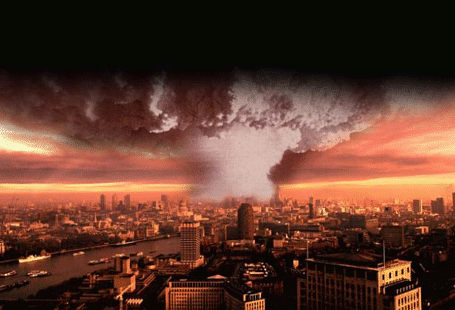 The nuclear mistakes that nearly caused World War Three , From invading animals to a faulty computer chip worth less than a dollar, the alarmingly long list of close calls shows just how easily nuclear war could happen by mistake. https://www.bbc.com/future/article/20200807-the-nuclear-mistakes-that-could-have-ended-civilisation By Zaria Gorvett, 10th August 2020 The nuclear mistakes that nearly caused World War Three , From invading animals to a faulty computer chip worth less than a dollar, the alarmingly long list of close calls shows just how easily nuclear war could happen by mistake. https://www.bbc.com/future/article/20200807-the-nuclear-mistakes-that-could-have-ended-civilisation By Zaria Gorvett, 10th August 2020It was the middle of the night on 25 October 1962 and a truck was racing down a runway in Wisconsin. It had just moments to stop a flight. Mere minutes earlier, a guard at Duluth Sector Direction Center had glimpsed a shadowy form attempting to climb the facility’s perimeter fence. He shot at it and raised the alert, fearing that this was part of a wider Soviet attack. Instantly, intruder alarms were ringing at every air base in the area. The situation escalated remarkably quickly. At nearby Volk Field, an air base, someone flicked the wrong switch – so rather than the standard security warning, pilots heard an emergency siren telling them to scramble. Soon there was a frenzy of activity, as they rushed to take to the skies, armed with nuclear weapons. Continue reading |
Nuclear watchdog opposes any agreement that would transfer ownership of Three Mile Island Unit
Nuclear watchdog opposes any agreement that would transfer ownership of Three Mile Island Unit 2 https://lancasteronline.com/news/local/nuclear-watchdog-opposes-any-agreement-that-would-transfer-ownership-of-three-mile-island-unit-2/article_20c1bc76-d8cb-11ea-9431-97c468d34a2b.html, SEAN SAURO | Staff Writer – 10 Aug 20,
-
- And signs point to a settlement between state and federal regulators, and FirstEnergy, the power company that now owns the unit that partially melted down in 1979.
At least that’s what Dauphin County-based nuclear watchdog Eric Epstein said he suspects. Epstein said he opposes any kind of agreement that would advance the plan, which he worries could threaten radioactive disaster.
“We will not agree to allow Three Mile Island to become a radioactive waste site,” Epstein said. “An island in a river is the worst place for it.”
Spokespeople speaking on the behalf of the state Department of Environmental Protection and the U.S. Nuclear Regulatory Commission did not provide details about the negotiations.
“Regarding a settlement, DEP is evaluating the motion and will reach a decision soon,” DEP spokesman Neil Shader said. “More information will be available once a decision is reached.”
FirstEnergy spokeswoman Jennifer Young said much the same.
“FirstEnergy continues to work with the DEP as well as the NRC to address questions relevant to the license transfer and decommissioning plans for TMI-2,” she said. “Details of the settlement agreement are confidential.”
Last fall, Unit 2’s owners at FirstEnergy announced they planned to transfer ownership of all related licenses and assets to a subsidiary of Utah-based EnergySolutions, which would eventually dismantle the reactor.
The transfer must be approved by the Nuclear Regulatory Commission, and it’s to that commission that Epstein of the Harrisburg-based Three Mile Island Alert raised concerns, urging that the transfer not be approved before they are addressed.
Specifically, he worried about the environmental threats of leaving radioactive waste on the island, which is situated in the Susquehanna River just north of Conoy Township near the Dauphin-Lancaster counties line. That’s in addition to fears that rate-payer funded accounts will not have enough money to cover the cost of decommissioning.
Similar concerns were included in a letter sent earlier this year from DEP Secretary Patrick McDonnell to federal regulators.
But now, Epstein worries that DEP officials will settle, undermining those fears, though he admits he hasn’t been a part of ongoing discussions — a point of contention.
“I don’t know how you build public confidence by excluding the public,” he said.
Regardless of what may come from negotiations, Epstein said his organization plans to continue advocating for safety “by any legal means,” appealing decisions if necessary.
Beirut explosion was not an atomic bomb
The Beirut explosion created a huge mushroom cloud and visible blast wave, but nuclear-weapons experts say it wasn’t an atomic bomb. Here’s why. Business Insider , DAVE MOSHER, AUG 5, 2020,
- An explosion at a port rocked the Lebanese capital city of Beirut on Tuesday, killing at least dozens of people.
- As videos of the explosion spread across social-media sites, some observers likened the appearance of a mushroom cloud to that of an atomic bomb.
- The Lebanese prime minister has said the blast came from a stockpile of ammonium nitrate in a warehouse.
- Nuclear-weapons experts say the detonation was definitely not triggered by an atomic bomb.
- Atomic explosions are characterised by a blinding flash of light, a pulse of searing heat, and radioactive fallout, none of which were detected…………. https://www.businessinsider.com.au/beirut-explosion-not-nuclear-bomb-despite-mushroom-cloud-no-flash-2020-8?r=US&IR=T
Florida’s nuclear power stations could be at risk in hurricane times
|
Hurricane Isaias projected to strafe eastern side of Florida over the weekend, S and P Global
HIGHLIGHTSUncertainty over where it may make landfall
Utilities and energy companies to keep close eye Houston — In a late July 31 advisory, the National Oceanic and Atmospheric Administration’s National Hurricane Center said heavy rains associated with Hurricane Isaias could begin to affect south and east central Florida late Friday night and the eastern Carolinas by early next week, potentially resulting in isolated flash flooding. NOAA said the Category 1 hurricane was expected to reach the east coast of Florida on Saturday morning. It said that storm surge along the northeastern Florida coast could come late in the weekend, and spread northward along the remainder of the US East Coast through early next week. Florida Power & Light said July 31 it had a restoration workforce of more than 10,000 “ready to respond to Hurricane Isaias amid the global COVID-19 pandemic.” It said it will bring in crews from sister company Gulf Power and has secured more than 2,000 additional restoration personnel from nearly 10 states. “We are committed to restoring service in between bands of severe weather, as long as winds are below 35 MPH,” the company said. FPL owns the two-reactor, 1,600-MW Turkey Point Nuclear Generating Station located two miles east of Homestead, Florida, and about 25 miles south of Miami. According to preliminary mapping of Isaias’ path, the Turkey Point facility may escape the storm’s more severe western rain bands on Saturday. FPL’s 1,880-MW St. Lucie Nuclear facility located further up the Florida coast on Hutchinson Island, may not be so lucky. The center of the storm eye could pass offshore of the St. Lucie facility early on Sunday morning. In a statement, Duke Energy Florida said it believed its customers in central and eastern Florida may experience weather-related outages. …… https://www.spglobal.com/platts/en/market-insights/latest-news/natural-gas/073120-hurricane-isaias-projected-to-strafe-eastern-side-of-florida-over-the-weekend |
|
Fire at the Belleville nuclear power plant reveals the disorganization of EDF
  Le Journal de l’Energie 30th July 2020 A fire at the Belleville nuclear power plant reveals the disorganization of Le Journal de l’Energie 30th July 2020 A fire at the Belleville nuclear power plant reveals the disorganization ofEDF. A fire broke out at the Belleville-sur-Loire (Cher) nuclear power plant in April 2020 during a routine maintenance operation carried out by subcontractors, which should not have been left unattended. An incident that was largely avoidable if EDF had followed basic safety rules. An
inspection by the Nuclear Safety Authority (ASN), after the incident, identified “many deviations”. Although the incident did not have an impact on the operation of the plant, it calls into question the safety culture of EDF, the world’s leading nuclear operator. https://journaldelenergie.com/nucleaire/incendie-centrale-nucleaire-belleville-desorganisation-edf/ |
|
Portuguese party PAN lodges complaint to U.N. about Spain’s ageing Almarez nuclear power station
The risks associated with Almaraz have been making headlines for years (click here).
So has the perceived ‘inertia’ of the Portuguese government in tackling them (click here).
As PAN’s leading MP André Silva stresses, what’s crucial at this point is a ‘transfrontier evaluation of the environmental impact” of the decision to prolong the life of the 41-year-old power station running two very old fashioned reactors beyond the 2023/ 2o24 limit previously established.
The latest approval by Spain extends the reactors’ lives to 2027 and 2028 respectively.
Says Silva: ‘We have on the one hand’ Spain that is violating two conventions, and on the other a Portuguese government and a Portuguese environment minister that does nothing about it.
Spain’s unilateral decision to further extend the lifespan of a plant that sits so close to Portuguese territory – not to mention on the banks of the river Tejo – is “an affront to Portuguese people” who, according to a study conducted by the Portuguese army, would be severely impacted in the event of any kind of serious incident (click here).
The two conventions André Silva refers to are the Espoo Convention, which requires environmental impacts in situations like these, and the Arhus Convention, which obliges Madrid to ‘inform and consult’ Portuguese counterparts before making any decisions.
Says Silva, “it is fundamental that the international community is alerted to this problem, which is not simply environmental but social and political as well”.
‘Ideally’ Almaraz should have been mothballed 10 years ago “but Spanish authorities have successively renewed its continuation”, despite the increasing risks of a nuclear accident, which as Silva stresses, would have a “disastrous impact” on Portugal.
This is in fact the second time a formal complaint has been lodged against Spain over activity at Almaraz. A bid to stop a warehouse for nuclear waste being constructed in 2017 resulted in the creation of a commission, but this has never presented any ‘material’ / findings or reports to speak of.
USA’s Nuclear Regulatory Commission plans to weaken safety standards for smaller nuclear reactors
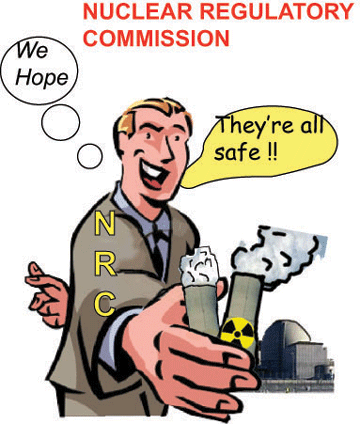 Smaller Nuclear Plants May Come With Less Stringent Safety Rules, npr, August 1, 2020
The NRC is considering whether to shrink emergency planning and evacuation zones around these newer reactors — from a 10-mile radius to, in some cases, the boundary of the plant site.
Nuclear energy critics say that would be a mistake.
“When you’re talking about a reactor that’s never been built or operated, you have to take with a big grain of salt the claims that it’s actually safer or more secure,” says Edwin Lyman at Union of Concerned Scientists.
He says the industry also wants to use weaker reactor containment shells, and in some cases they don’t want to have to keep an operator at the site.
Lyman thinks companies should build plants under current rules first. “You have to work out the kinks of these new plants,” he says. “And then over time you might be able to adjust your requirements accordingly. But you don’t do that at the get-go.”
A National Nuclear Security Administration (NNSA) official recently echoed some of Lyman’s concerns in comments sent to the NRC. The NNSA is a semi-autonomous agency within the Department of Energy.
Deputy Under Secretary Jay Tilden called the proposed rule a major departure from “the successful 42-year-old practice of using a 10-mile plume exposure emergency planning zone.” That existing regulation, he wrote, provides “the last layer of a defense-in-depth for low-probability, high-consequence accidents.” ………
For the nuclear industry, coronavirus is helpful, as nuclear wastes go quietly from Germany to Russia
 FoE Europe 25th June 2020, Russia and Germany have taken advantage of the coronavirus crisis to resume
shipping radioactive waste to dump in the Urals and Siberia in northern
Russia.
Germany was exporting radioactive waste from it’s nuclear power stations to
Russia, via the harbor of Amsterdam, they directly organized protests in
the three countries.
and sea of uranium – a waste product of nuclear fuel production by Urenco
Germany – was put on hold. That was before the coronavirus crisis hit.
in March 2020, when Covid-19 lockdowns restricted people’s right to protest
in Russia even further, the shipments of radioactive waste were set to
resume.
United Arabs Emirate’s nuclear power station cut corners on safety
Al Jazeera 1st Aug 2020, Paul Dorfman, an honorary senior research fellow at the Energy Institute,
University College London and founder and chair of the Nuclear Consulting
Group, has criticised the Barakah reactors’ “cheap and cheerful” design
that he says cuts corners on safety.
Dorfman authored a report (PDF) last
year detailing key safety features Barakah’s reactors lack, such as a “core
catcher” to literally stop the core of a reactor from breaching the
containment building in the event of a meltdown. The reactors are also
missing so-called Generation III Defence-In-Depth reinforcements to the
containment building to shield against a radiological release resulting
from a missile or fighter jet attack. Both of these engineering features
are standard on new reactors built in Europe, says Dorfman.
Who flew drones over the nuclear reactors?
|
Mystery at Arizona’s Palo Verde nuclear plant: Who flew drones over the reactors? AZ Central,
Ryan RandazzoArizona Republic, Security guards at Palo Verde Nuclear Generating Station west of Phoenix noticed something odd on a September night last year.Five or six drones buzzed over the perimeter fence of the nuclear plant— the largest power generator in the United States — 50 miles west of Phoenix. They went across the open desert where security guards practice “force-on-force” simulated combat drills to sharpen their skills to ward off an assault, over heavy-duty gates and arrived at the protected area around the concrete-domed reactors. They stayed for nearly an hour, and came back the next night for a repeat performance. Nobody except the drones’ pilots knows whether this was a case of hobbyists touring the plant out of curiosity, or something much more nefarious, intended to disrupt a massive power source for customers from Texas to California. And nobody in any official capacity seems to know who piloted the drones that night or the next……… Security guards at Palo Verde Nuclear Generating Station west of Phoenix noticed something odd on a September night last year. Five or six drones buzzed over the perimeter fence of the nuclear plant— the largest power generator in the United States — 50 miles west of Phoenix. They went across the open desert where security guards practice “force-on-force” simulated combat drills to sharpen their skills to ward off an assault, over heavy-duty gates and arrived at the protected area around the concrete-domed reactors. They stayed for nearly an hour, and came back the next night for a repeat performance. Nobody except the drones’ pilots knows whether this was a case of hobbyists touring the plant out of curiosity, or something much more nefarious, intended to disrupt a massive power source for customers from Texas to California. And nobody in any official capacity seems to know who piloted the drones that night or the next……… Security guards at Palo Verde Nuclear Generating Station west of Phoenix noticed something odd on a September night last year. Five or six drones buzzed over the perimeter fence of the nuclear plant— the largest power generator in the United States — 50 miles west of Phoenix. They went across the open desert where security guards practice “force-on-force” simulated combat drills to sharpen their skills to ward off an assault, over heavy-duty gates and arrived at the protected area around the concrete-domed reactors. They stayed for nearly an hour, and came back the next night for a repeat performance. Nobody except the drones’ pilots knows whether this was a case of hobbyists touring the plant out of curiosity, or something much more nefarious, intended to disrupt a massive power source for customers from Texas to California. And nobody in any official capacity seems to know who piloted the drones that night or the next……. The Palo Verde incidents are apparently not the first time something like this has happened. One NRC email discusses “several high-speed” drone overflights of the Limerick Generating Station in Pennsylvania approximately eight months prior. Another indicates there had been 42 drone incidents in three years. APS officials said some of those were at Palo Verde. What if the pilots meant harm?At least one person in the NRC was concerned last year that an airspace restriction from the FAA wasn’t sufficient. “I would point out that restricted airspace will do nothing to stop an adversarial attack and even the detection systems identified earlier in this email chain have limited success rates, and there is even lower likelihood that law enforcement will arrive quickly enough to actually engage with the pilots,” wrote Joseph Rivers, a senior security adviser with the Nuclear Regulatory Commission who recently retired…… A columnist for Forbes went even further, speculating that the drones could have made three-dimensional maps of the power plant to assist a later attack. …… https://www.azcentral.com/story/money/business/energy/2020/07/31/drones-flew-over-palo-verde-nuclear-plant-arizona-pilots-unknown/5551928002/ |
|
|
Mystery over drone swarm above America’s largest nuclear power station
 ‘Drone Swarm’ Invaded Palo Verde Nuclear Power Plant Last September — Twice Forbes Jul 30, 2020, David Hambling
Documents gained under the Freedom of Information Act show how a number of small drones flew around a restricted area at Palo Verde Nuclear Power Plant on two successive nights last September. Security forces watched, but were apparently helpless to act as the drones carried out their incursions before disappearing into the night. Details of the event gives some clues as to just what they were doing, but who sent them remains a mystery.
Details of the events were obtained from the Nuclear Regulatory Commission by Douglas D. Johnson on behalf of the Scientific Coalition for UAP Studies (SCU) using the Freedom of Information Act (FOIA). The SCU’s main interest is in anomalous aerospace phenomena, what other people term UFOs. In this case though the flying objects were easily identifiable as drones, although their exact mission and origin are unknown. Johnson passed the information to The War Zone who give a detailed account.
Palo Verde Nuclear Power Plant is the largest in the U.S., producing over three gigawatts, 35% of Arizona’s total power capacity. It supplies electricity to Phoenix and Tucson, as well as San Diego and Los Angeles. It is a critical piece of strategic infrastructure; during the 2003 Iraq War, National Guard troops were deployed to Palo Verde to defend against a possible terrorist threat. In normal times, as with other nuclear installations, it is protected by armed security guards.
The armed guards, gates, fences and barriers were useless on the night of September 29th. According to the official report:
Officer noticed several drones (5 or 6) flying over the site. The drones are circling the 3 unit site inside and outside the Protected Area. The drones have flashing red and white rights [sic] and are estimated to be 200 to 300 hundred [sic] feet above the site. It was reported the drones had spotlights on while approaching the site that they turned off when they entered the Security Owner Controlled Area. Drones were first noticed at 20:50 MST and are still over the site as of 21:47 MST. Security Posture was normal, which was changed to elevated when the drones were noticed.”
The drones departed at 22:30, eighty minutes after they were first spotted. The security officers estimated that they were over two feet in diameter. This indicates that they were not simply consumer drones like the popular DJI Phantom, which have a flight endurance of about half an hour and is about a foot across, but something larger and more capable. The Lockheed Martin Indago, a military-grade quadcopter recently sold to the Swiss Army, has a flight endurance of about seventy minutes and is more than two feet across. At several thousand dollars apiece minimum, these are far less expendable than consumer drones costing a few hundred. All of which suggests this was not just a prank.
The next night events were repeated:…….
Despite this incident, two months later the NRC decided not to require drone defenses at nuclear plants, asserting that small drones could not damage a reactor or steal nuclear material. It is highly likely that such sites are still vulnerable to drone overflights.
Are such drones a genuine threat to nuclear facilities?…….
their ability to strike pinpoint targets to hit control systems and failsafes. While this would be unlikely to cause a Chernobyl, it might well shut the plant down, taking out 35% of Arizona’s electricity at a stroke. The successful attack on the Abqaiq facility last year, in which about twenty garage-built drones knocked out a heavily-defended oil facility in Saudi Arabia, should be a wakeup call that such unmanned precision strikes are not just the preserve of state actors any more………
the intruders, as well as establishing that Palo Verde lacks effective drone defenses, may now have highly detailed maps of the facility, showing the exact location of every valve, pipe, switch and control. Perhaps they simply aim to sell these on the dark web to anyone who will pay. Or perhaps they have something else in mind. Either way, it is an alarming demonstration of how easily drone intruders can now go anywhere anytime they wish. https://www.forbes.com/sites/davidhambling/2020/07/30/drone-swarm-invaded-palo-verde-nuclear-power-plant/#78cb15aa43de
1 This Month



26 September – International Day for the Total Elimination of Nuclear Weapons


PLEASE OPPOSE HR 8255 AND S.3639 – bills would accelerate satellite deployment, with no environmental review or safeguards – https://ncstd5li.quorum.us/campaign/169331/
To see nuclear-related stories in greater depth and intensity – go to https://nuclearinformation.wordpress.com
-
Archives
- September 2026 (245)
- August 2026 (330)
- July 2026 (355)
- June 2026 (287)
- May 2026 (306)
- April 2026 (356)
- March 2026 (251)
- February 2026 (267)
- January 2026 (308)
- December 2025 (358)
- November 2025 (359)
- October 2025 (375)
-
Categories
- 1
- 1 NUCLEAR ISSUES
- business and costs
- climate change
- culture and arts
- ENERGY
- environment
- health
- history
- indigenous issues
- Legal
- marketing of nuclear
- media
- opposition to nuclear
- PERSONAL STORIES
- politics
- politics international
- Religion and ethics
- safety
- secrets,lies and civil liberties
- spinbuster
- technology
- Uranium
- wastes
- weapons and war
- Women
- 2 WORLD
- ACTION
- AFRICA
- Atrocities
- AUSTRALIA
- Christina's notes
- Christina's themes
- culture and arts
- Events
- Fuk 2022
- Fuk 2023
- Fukushima 2017
- Fukushima 2018
- fukushima 2019
- Fukushima 2020
- Fukushima 2021
- general
- global warming
- Humour (God we need it)
- Nuclear
- RARE EARTHS
- Reference
- resources – print
- Resources -audiovicual
- Weekly Newsletter
- World
- World Nuclear
- YouTube
-
RSS
Entries RSS
Comments RSS
 nuclear-news