The cover-up of workers’ illnesss in radioactively polluted clean-up of Kingston coal ash spill
A Legacy of Contamination, How the Kingston coal ash spill unearthed a nuclear nightmare, Grist By Austyn Gaffney on Dec 15, 2020 This story was published in partnership with the Daily Yonder.
………………………………….The apparent mixing of fossil fuel and nuclear waste streams underscores the long relationship between the  Kingston and Oak Ridge facilities………… .
 ……….In 2017, a former chemist named Dan Nichols stumbled upon a news story that revealed the existence of the additional health problems TVA feared. High levels of uranium had been measured in the urine of a former cleanup worker named Craig Wilkinson. Like Thacker, Wilkinson had worked the night shift. After dredges piped the coal ash back onshore, Wilkinson used heavy equipment to scoop, flip, and dry the wet ash along the Ball Field.
Although Wilkinson worked at the Kingston site for less than a year, he quickly developed health issues, including chronic sinus infections and breathing problems that eventually led to a double-lung transplant. Frustrated by his sudden decline in health, Wilkinson shelled out over $1,000 for a toxicology test because he wanted to know what occupational hazards might be lingering in his body.
After reading Wilkinson’s story, Nichols sat stunned. Though he was not associated with the spill, he’d been unable to shake his obsession with the Kingston disaster. Nichols had worked as a Memphis-based field chemist for a wastewater technology company, and he was used to studying lab reports on industrial water supplies and samples. For years he’d been trying to solve a mystery that no one else seemed to be aware of: why Kingston regulators deleted and then altered a state-sanctioned report showing extremely high levels of radiation at the cleanup site.
Roughly a month after the spill, Nichols read a Duke University press release stating that ash samples collected at Kingston by a team led by Vengosh, the geochemist, showed radium levels well above those typically found in coal ash. Nichols knew that the state environmental regulator, the Tennessee Department for Environment and Conservation, or TDEC, was also testing soil and ash samples at the site. After seeing Vengosh’s high radium readings, he wondered if TDEC’s report would also show high levels of either radium or uranium. (Radium is a decay element of uranium.) Later that spring, Nichols visited TDEC’s website and discovered the test results.
“I opened it up and went to uranium, and it was just off the charts,” Nichols recalled. In a 2020 affidavit, Nichols reported that these levels were “extremely high so as to be alarming.” At least 27 soil and ash samples were collected from at least 20 different sites surrounding Kingston beginning January 6, 2009. The levels ranged from 84 parts per million (ppm) to 2,000 ppm. The average level was over 500 ppm, as much as 50 times the typical uranium content found in coal ash.
The next morning, when Nichols slumped back into his computer chair and refreshed TDEC’s website, he saw that the report had been changed. The high uranium readings had plummeted. Now the average uranium levels in the ash were 2.88 ppm, a tenth of the typical uranium content found in coal ash and illogically, below levels naturally occurring in soil. Luckily, Nichols had downloaded the unaltered report the night before.
A month later, Nichols sent the two lab reports to one of the attorneys representing Tennessee residents affected by the spill in a lawsuit they’d brought against TVA. According to Nichols, the lawyers weren’t interested. Nevertheless, Nichols was determined to find more proof of the unusually high levels of on-site radiation. In between cutting hay and spraying weeds on his family farm, he spent years poring over information online about TVA, coal ash, and uranium before he stumbled across Wilkinson’s story.
Back in 2014, Wilkinson’s urine tested for unusually high levels of both mercury and uranium. The mercury is more easily explained: The most common cause of mercury contamination, according to the EPA, is coal-fired power plant emissions, which account for 44 percent of all man-made mercury pollution. The 2008 spill released 29 times the mercury reported at the Kingston site for the entire decade before it, and TVA documents show high levels of additional legacy mercury were present in the Clinch River and could have migrated into the Emory. Today, Wilkinson has symptoms attributable to methylmercury poisoning including blurry vision, fatigue, a hearing impairment, memory loss, and loss of coordination that caused him to fall out of the machines he operated until retiring on disability in 2015.
But most shocking to Nichols was the high level of uranium in Wilkinson’s body — it was 10 times the U.S. average, and identical to the median levels that one study found in workers exposed to the substance. Prolonged occupational exposure to uranium is strongly linked to chronic kidney disease, which Wilkinson suffers from. Because Wilkinson’s toxicology results were taken four years after he left Kingston, they likely show lower uranium levels than what he and other cleanup workers initially had.
Wilkinson’s results left no doubt in Nichols’ mind that the original uranium readings he’d saved were significant. A reporter for the Knoxville News-Sentinel, Jamie Satterfield, contacted him after the report he saved showed up in court proceedings. Satterfield published a story about the altered uranium readings in May of this year.
In response to her story, TDEC told the News-Sentinel that its updated uranium readings, which plummeted by 98 percent, were due to a change in the sampling method used for the tests. (Satterfield also reported that radium levels had been lowered between the initial TDEC report Nichols downloaded and the updated one; the department attributed this to a “data entry error.”) In an email response to Grist and the Daily Yonder, a TDEC spokesperson elaborated that the sampling lab, which was neither staffed nor supervised by TDEC, “discovered there were interferences in the analysis of soil and ash samples for uranium” and subsequently changed the method of analysis from one EPA-approved protocol to another. The new results were then published without public notice of the alteration.
“Changing lab reports is a very serious thing,” Nichols said. “But I can assure you data entry errors don’t cause a man to test for unusually high levels of uranium. That’s [TDEC’s] big problem.”
Unbeknownst to Nichols, Russell Johnson, the district attorney with jurisdiction over Roane County, where Kingston is located, had informed TDEC’s commissioner in 2017 that he was beginning a criminal probe into the Kingston cleanup. “I am deeply concerned with the apparent intentional conduct of the cleanup contractors and their supervisors, actions that took place in Roane County, conduct that may indeed have caused serious bodily injury or possibly even death to a number of people,” Johnson wrote in a letter to TDEC.
In concert with the Tennessee Bureau of Investigation, Johnson began investigating whether TVA or its contractors “suppressed information” as part of the coverup alleged in the 2013 worker lawsuit against Jacobs. They now have Nichols’ evidence as well. But despite this ongoing investigation, it’s unclear if workers will ever learn for certain whether or not they were exposed to dangerous substances besides the coal ash itself. (Bob Edwards, an assistant district attorney working under Johnson, told Grist and the Daily Yonder that the district attorney’s office could not comment on a pending investigation.)………………….https://grist.org/justice/tva-kingston-coal-ash-spill-nuclear/
Doubts about planned Berkshire ”garden town”, because it’s too close to AWE nuclear weapons factory
 BBC 15th Dec 2020, Plans to build a new “garden town” could be scrapped over concerns about a
potential nuclear emergency. The proposed 15,000-home development in
Grazeley is within a couple of miles of nuclear weapons factory AWE
Burghfield. The Office for Nuclear Regulation has extended a “detailed
emergency planning zone” (DEPZ) for the plant, taking in most of the site
earmarked for homes.
That means anyone living in the zone could be affected
by a “reasonably foreseeable” radiation emergency. Three Berkshire councils
that have worked jointly on the plans are now considering shelving the
project, according to the Local Democracy Reporting Service (LDRS).
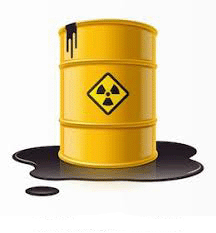
Trying to test for cracks in nuclear waste containers that have to last for over a million years

Waste from nuclear fuel must be stored for more than a million years/
“Salt can be present in the ambient air and environment anywhere, not just near the ocean. We need to be able to plan for extended long-term storage of spent nuclear fuel at nuclear power plants for the foreseeable future — it’s a national reality,”
 Sandia to put nuclear waste storage canisters to the test, https://www.newswise.com/articles/sandia-to-put-nuclear-waste-storage-canisters-to-the-test, Scientists will explore science of cracks caused by corrosion, 10-Dec-2020 , by Sandia National Laboratories Newswise — ALBUQUERQUE, N.M. — Sandia National Laboratories is outfitting three 22.5-ton, 16.5-feet-long stainless-steel storage canisters with heaters and instrumentation to simulate nuclear waste so researchers can study their durability.
The three canisters, which arrived in mid-November and have never contained any nuclear materials, will be used to study how much salt gathers on canisters over time. Sandia will also study the potential for cracks caused by salt- and stress-induced corrosion with additional canisters that will be delivered during the next stage of the project.
Currently there is not an operating geologic repository in the U.S. for the permanent disposal of spent nuclear fuel. As a result, spent fuel is being stored at commercial nuclear power plants in both storage pools and dry storage canisters. The storage canisters currently holding the spent nuclear fuel were designed to have a useful life of a few decades but will now likely need to be used longer than planned, said Tito Bonano, Sandia’s nuclear energy fuel cycle senior manager.
Data is urgently needed to validate and guide how industry should manage storage canisters for longer than originally anticipated, Bonano said.
“Salt can be present in the ambient air and environment anywhere, not just near the ocean. We need to be able to plan for extended long-term storage of spent nuclear fuel at nuclear power plants for the foreseeable future — it’s a national reality,” he said.
The researchers expect the project could have long-reaching implications for public health and safety, industry practices, regulatory framework and defining future research paths, said Bonano.
The three-year project is funded by the Department of Energy’s Nuclear Energy office. Overall, fifteen never-used, never-irradiated DOE-owned canisters are being distributed for large scale testing to Sandia and two other national laboratories, an industry research institute and an independent storage facility at an existing nuclear power plant.
Waste from nuclear fuel must be stored for more than a million years
Nuclear power plants use uranium pellets inside a metal-cladded tube, called a fuel rod, to power reactors to create the heat needed to make electricity. After the fuel rods can no longer be used in the reactor, they need to be stored onsite until they are taken offsite to another facility and eventually permanently disposed because they will be radioactive for a long time, said Samuel Durbin, a mechanical engineer and Sandia’s canister project lead.
“When fuel is removed from a reactor, it’s very hot, both in temperature and radioactivity” Durbin said. “The utility loads it into a pool for about five years to cool down. After that, the spent fuel can be offloaded into a dry storage canister.”
A storage canister starts as a flat piece of stainless steel that is rolled into a cylinder and then welded where the seams come together. The heat from the welding creates heat-affected zones in the seams of the canister that experience tensile, or pulling, stress. This stress makes these areas around the welds more susceptible to corrosion from salt over time, said Durbin.
Research will test how much salt deposits on canisters over time
Sandia received three canisters Nov. 13. The research team will outfit each of them with 32 electrical heaters to simulate the decay heat, which is heat released as a result of radioactive decay, from the 32 spent fuel assemblies that would typically be stored in this type of canister. No radioactive materials will be used in the testing, Durbin said.
Instruments called thermocouples, which measure temperature, and other sensors for diagnostic testing and surface sampling also will be added, he said.
Once the outfitted canisters have been tested and repacked for transport at Sandia, the team plans to move them to a storage pad at an independent spent fuel storage installation on the West Coast where they will experience the same real-life conditions of in-use canisters. The Sandia team, led by managers Sylvia Saltzstein and Geoff Freeze, Durbin, and chemists/corrosion scientists Charles Bryan and Rebecca Schaller, along with partners from other national laboratories will monitor the test canisters and record surface deposits, especially chloride-bearing salts, for three to more than 10 years, depending on how much the data varies over time.
“Sodium-chloride, or salt, that settles on the surface of spent nuclear-fuel canisters can lead to chloride-induced stress corrosion cracking, and right now there is inadequate data on these surface deposits,” said Durbin.
In real-life storage of nuclear waste, Durbin said the decay heat from the spent fuel creates natural convection around the storage canisters, causing outside air to be drawn over the canister surface. This process helps cool the spent fuel over time. As ambient air is drawn in, salt and other particulates in the air are drawn in as well and can settle on the canister surface. During the test, the electrical heaters installed inside the canisters at Sandia will replicate this decay heat-driven convection without using nuclear materials.
In hot, dry conditions, Durbin said salt deposits alone don’t cause any issues, but over time, as the decay heat decreases and the canister cools, water can condense on the canister surface and a brine can form.
“These conditions can occur nationwide and are seen as precursors to chloride-induced, stress-corrosion cracking. Back when these canisters were being designed, people weren’t thinking about this as an issue because we had a plan for permanent disposal. The current national nuclear waste situation forces canisters to be stored onsite for the foreseeable future, which could be 100 years or longer, so stress corrosion cracking becomes more of a concern,” Durbin said.
In addition to the long-term heating and surface deposition test, Sandia will use up to another three canisters for laboratory-based tests to conduct fundamental research on cracking caused by salt and stress, especially on the welded seams and intersections of the canisters. Researchers will measure the effectiveness of commercially available crack repair and mitigation coatings.
To test these seams, the team will cut the canisters into small segments and test pieces with and without welded seams to study the pre-cursor conditions for salt and stress to cause the corrosion that leads to cracks, he said.
Shutdown of 3 uranium mines in midst of dispute could lead to ecological disaster in Ukraine
World Socialist Web 10th Dec 2020, Three uranium mines have been shut down in the Kirovohrad region of central Ukraine over disputed payments between the state nuclear energy company Energoatom and the state-owned enterprise operating the mine, Eastern Mining and Processing. As a result of the alleged nonpayment, approximately 5,000 miners have been placed on unpaid leave. They are still owed approximately $5 million in months of back pay.
The shuttering of the mines could also lead to an ecological catastrophe if the mines lose power and water pumps fail to operate, creating a toxic mixture of radioactive uranium-contaminated groundwater that could spread throughout the vast river systems of central Ukraine.
For safety the 40 year limit on nuclear reactor’s life should be kept

 Limiting life of nuclear plants to 40 years should be continued, http://www.asahi.com/ajw/articles/13964250?fbclid=IwAR1_ti6_xxCiBWrXIU94MSDTh6c6mKSygmlV4FVvNORcpuAJU4Cn_QCn708 November 26, 2020 Following the 2011 Fukushima nuclear disaster, new nuclear safety regulations were created to impose a 40-year limit on the operational lifespan of nuclear reactors in Japan.The rule was designed to ensure decommissioning of aging reactors that are more vulnerable to accidents and make Japanese society less dependent on nuclear power.
But a provision that allows one extension of the legal lifespan by up to 20 years in exceptional cases, introduced in response to concerns about a power shortage, has been widely exploited to gain permission to extend operations years or even decades beyond the 40-year cap.
This troubling trend should not be ignored. The original principle should be maintained.
The municipal assembly of Takahama, Fukui Prefecture, on Nov. 25 approved the restarts of the No. 1 and No. 2 reactors at Kansai Electric Power Co.’s (KEPCO) Takahama nuclear plant, which first went into service in the 1970s.
The move came four years after the Nuclear Regulation Authority (NRA), a government agency to ensure the safety of nuclear power plants, gave the green light to plans to extend operations of these aging reactors, which went offline in 2011 following the triple meltdown at the Fukushima No. 1 nuclear power plant.
While the consent of the Takahama mayor, the Fukui prefectural assembly and the Fukui governor is still needed to bring the reactors back on stream, the municipal assembly’s approval is a first step toward operating a reactor that is more than 40 years old for the first time in Japan.
Behind the town assembly’s decision is the fact that the nuclear power plant has been supporting the local economy. But the move has raised the question of whether the assembly has given sufficient consideration to issues concerning the safety of local residents.
In a meeting to explain the plans to residents in Takahama held at the end of October, some attendees voiced concerns about the risk of multiple natural disasters disrupting traffic on the prefectural road designated to be used as part of the evacuation route in the event of serious accidents at the plant. There remain serious safety concerns as to the planned operations of the reactors.
Even more questionable is the government’s stance toward the issue.
Prime Minister Yoshihide Suga’s administration has vowed to reduce Japan’s reliance on nuclear power generation as much as possible by making all-out efforts to promote energy conservation and use of renewable energy sources.
But the Suga administration’s stance toward nuclear power generation is showing no notable difference from the policy of the previous government led by his predecessor, former Prime Minister Shinzo Abe.
The Abe administration left decisions concerning reactor restarts to the NRA and the local governments involved and didn’t hesitate to bring reactors back online once the procedures for the step were completed.
In a sign that casts doubt on the administration’s commitment to reducing nuclear power generation, a senior official at the Agency for Natural Resources and Energy, an industry ministry body, has repeatedly visited the local governments of the host communities in Takahama to seek their consent for the plans.
In Fukui Prefecture, another aging reactor, the No. 3 unit of KEPCO’s Mihama nuclear power plant in Mihama, located along the coast of the Wakasa Bay, has been cleared by the NRA for operation beyond the 40-year legal lifespan. The Mihama town assembly is expected to decide on the restart in December.
KEPCO, which has been operating 11 reactors in Fukui Prefecture, including those at its Oi nuclear plant in the town of Oi, has decided to decommission four reactors at the Mihama and Oi plants. But it will still have seven reactors in service in the prefecture if the lives of three reactors are extended beyond the 40-year limit.
This means the local communities will continue being threatened by the safety risks posed by a concentration of reactors, which were underscored in a graphic way by the Fukushima calamity.
The government should demonstrate a clear commitment to scrapping aging reactors while supporting private-sector investment in renewable energy sources. It also should work with the local administrations in areas that have been dependent on nuclear plants for their economic well-being to carve out futures not dependent on atomic energy and provide policy support to their efforts to achieve the visions.
It is time for KEPCO to change its business strategy.
The utility is still halfway to its goal of regaining the public confidence that has been deeply undermined by a series of scandals including one in which company executives received gifts from a former top official at the Takahama municipal government.
The utility has promised the prefectural government to find a location outside the prefecture for an interim storage facility for spent nuclear fuel at its nuclear plants in Fukui Prefecture. But the outlook of this mission remains murky.
A responsible utility would pull the plug on the operations of aging reactors whose viability is in doubt economically as well as technologically and reinvent its business strategy accordingly.
UK’s Ministry of Defence keeping seret most of the unsatisfactor report on safety of nuclear bomb sites
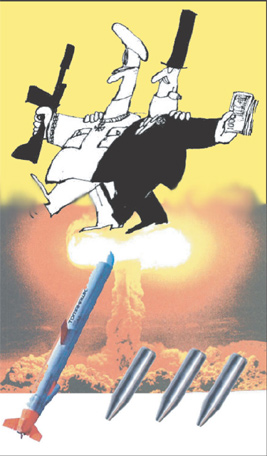 REVEALED: Nuclear bomb sites hit by fire safety problems and staff shortages, The National, By Rob Edwards 5 Dec 20, NUCLEAR bomb sites across the UK have fire safety problems as well as shortages of safety regulators and engineers, according to a new report from the Ministry of Defence (MoD).
But most of the MoD’s latest internal assessment of the safety of nuclear weapons has been kept secret for “national security” reasons – prompting fury from politicians and campaigners. They have attacked the nuclear secrecy as “deeply alarming” and “completely unacceptable”. The official attitude to nuclear safety was a “disgrace”, they said.
Previous nuclear safety assessments, revealed by The Ferret, have highlighted “regulatory risks” 86 times. Many involved the Trident warheads and nuclear submarines based on the Clyde.
The new MoD report also disclosed “significant weaknesses” on safety at non-nuclear sites. These included “serious deficiencies” on fire safety and “significant risk” from old fuel facilities – particularly on the Falkland Islands in the South Atlantic.
The MoD accepted that there were “infrastructure issues”, but insisted that they were being addressed. Defence nuclear programmes were “fully accountable” to UK ministers, it said.
The MoD has posted online the 2019-20 report from the Defence Safety Authority, which brings together seven regulators, a safety team and an accident investigation unit operating within the MoD. They are overseen by the authority’s director general, air marshal Sue Gray.
But the report said that the entire section from the Defence Nuclear Safety Regulator (DNSR), which is responsible for ensuring safety of the nuclear weapons programme, has been “marked SECRET” and given only “limited distribution”.
The MoD has previously released 10 annual DNSR reports following a challenge under freedom of information law in 2010. They flagged up risks of accidents, ageing submarine reactors, spending cuts and much else.
But in 2017 the MoD abruptly ceased publishing the reports, insisting that they had to be kept under wraps to protect national security. In 2019 that decision was challenged by campaigners at a UK information tribunal, whose verdict is still awaited.
he latest safety authority report, however, does contain a few details of nuclear risks buried in its 80 pages. It doesn’t specify which bases were affected, but they are likely to include the two major nuclear weapons sites, at Faslane on the Clyde and at Aldermaston in Berkshire.
In a discussion of problems with “fire safety assurance” across all MoD sites, the report said: “Particular issues have been noted at defence nuclear sites, where discussions continue between defence and statutory regulators.”
Between April 2019 and March 2020 as many as 374 fires were reported on all MoD sites. Although there had been some improvements “there is still more to do to reinforce the capability of defence to manage fire safety,” the report said.
A section on the “maturity” of the DNSR as a nuclear safety regulator disclosed that it was facing an 11 per cent shortage of staff in 2020-21. Shortfalls had been mitigated by the secondment of two senior staff from the UK Government’s nuclear power watchdog, the Office for Nuclear Regulation, and from the nuclear weapons company, AWE.
This had been supplemented by “making full use of partial retirees, graduate placements and development posts during 2019-20,” the report said. But these stopgap measures were failing………………
The Scottish National Party expressed concern about “a pattern of failure” on MoD safety. “Worryingly, the findings of this report reflect significant non-compliance with security and safety regulations at sensitive sites, including those where there are nuclear materials,” said the party’s defence spokesperson, Stewart McDonald MP.
“Not only is nuclear power and weaponry not safe, it is expensive, and not being handled properly under this Tory Government’s watch. The UK Government needs to transition away from nuclear entirely.”
MCDONALD described the nuclear safety failures as “alarming” and accused the MoD of “a lack of regard for public safety and transparency”. He pointed out that the UK Government’s civil nuclear watchdog, the Office for Nuclear Regulation, had criticised MoD secrecy.
The Scottish Green MSP for the west of Scotland, Ross Greer, called for nuclear weapons to be completely scrapped. “It is deeply alarming that the MoD continues to shroud so much secrecy over the safety issues with Britain’s weapons of mass destruction,” he said.
“We’ve known for years of significant issues at sites like Faslane and on the submarines themselves, so continued attempts to hold information back from the public are totally out of order.”
Lynn Jamieson, chair of the Scottish Campaign for Nuclear Disarmament, said: “The MoD’s tolerance of unsafe regimes is a disgrace for an organisation supposedly overseeing our protection. This adds to the urgency of nuclear disarmament.”
According to the Ministry of Defence, the annual assurance report and recommendations were currently being reviewed. Information that “could compromise national security” would not be published, the MoD said.,,,,,,,,,,,, https://www.thenational.scot/news/18923905.revealed-nuclear-bomb-sites-hit-fire-safety-problems-staff-shortages/
Court ruling doubts the credibility of nuclear safetysassessments by Japan’s Nuclear Regulation Authority
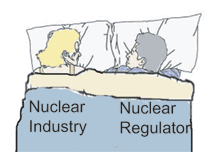 Ruling calls for review of NRA’s nuclear reactor safety screening, http://www.asahi.com/ajw/articles/13991979, A court ruling cast serious doubt over the credibility of safety assessments by the Nuclear Regulation Authority with regard to the operations of nuclear reactors.
The ruling called into question the safety of reactors restarted with NRA approval after being shut down in the aftermath of the 2011 Fukushima nuclear disaster.
It also underscored an urgent need for a sweeping review of the nuclear regulation system as a whole.
The Osaka District Court on Dec. 3 struck down the NRA’s endorsement of safety measures for the No. 3 and No. 4 reactors at the Oi nuclear power plant in Fukui Prefecture.
It invalidated the green light the nuclear safety watchdog gave in 2017 to Kansai Electric Power Co.’s plan to restart the two reactors.
The court said the NRA’s safety assessment was not fully in accordance with new tougher nuclear safety standards introduced after the catastrophic accident at the Fukushima No. 1 nuclear plant and screening guidelines based on those standards.
The ruling labeled the NRA’s decision as “unreasonable,” asserting there were “errors and deficiencies that cannot be overlooked” in the process of examining and approving anti-earthquake measures the electric utility adopted for the reactors.
In designing measures to protect a reactor against major earthquakes, the operator estimates the maximum possible ground motion generated by an earthquake around the reactor, called “reference ground motion.” It develops steps to ensure the safety of the reactor based on this estimate and requests for NRA approval for restarting the reactor.
The NRA examines the plan and determines whether the estimate is appropriate and the proposed safety measures are sufficient. It grants approval and authorization if it decides the plan meets the new safety standards.
Kansai Electric Power determined the reference ground motion by calculating the magnitude of the maximum credible earthquake based on its own assumptions concerning the length and width of faults around the reactors.
But residents of Fukui and six other prefectures filed a lawsuit to question the utility’s estimate of the reference ground motion. They argued that the utility’s estimate only represents an “average” for the spectrum of possible quakes, meaning that the safety measures are not based on the maximum strength of a possible earthquake in the area.
They cited a newly included provision in the NRA’s screening guidelines that says consideration should be given for the “variability” that arises due to the calculation methods used.
The plaintiffs claimed the NRA’s approval of the anti-quake measures was illegal because it was based on the utility’s questionable reference ground motion figure.
The government countered this argument by saying the utility’s calculation has a sufficient margin of error that makes it unnecessary to consider variability. But the court sided with the plaintiffs.
The ruling puts weight on the reasons for the NRA’s own decision to introduce the “variability” provision into the guidelines and demands that the screening process strictly follow strictly the established procedures.
The NRA should respond to the ruling by first reviewing the process of the safety screening of the two reactors at the Oi plant. It is possible that the screening of other reactors was similarly flawed. The ruling is likely to arouse anxiety among residents living in the vicinity of reactors that have been brought back online. The NRA should make a sincere and convincing response to the court decision.
The No. 3 and No. 4 reactors at the Oi plant are currently offline for regular maintenance. Debate is unnecessary in stating that the utility must not rush to restart the reactors.
Even without the triple meltdown at the Fukushima plant, it is amply obvious that this nation could be hit by unexpectedly severe natural disasters, such as earthquakes, tsunami and volcanic eruptions, at any time.
That makes it all the more important to establish nuclear power standards based on the principle of erring on the side of safety and ensure that safety screening and regulation are strictly based on the standards.
The government, which seems to be bent on restarting reactors, should take this imperative to heart.
Nuclear incident in Belarus: Lithuanian authorities alert citizens
|
LRT 1st Dec 2020, Ecohome, a prominent environmental NGO in Belarus, has reported that Oil Price 3rd Dec 2020, Days after reports emerged that the newly opened Belarus nuclear power
plant suffered an incident, authorities in neighboring Lithuania told the Baltic country’s population on Thursday to stock up on food in case of an incident at the nuclear power facility in Belarus, which is just 30 miles away from Lithuania’s capital city Vilnius.https://oilprice.com/Latest-Energy-News/World-News/Lithuanians-Urged-To-Stockpile-Food-Amid-Reports-Of-Nuclear-Power-Incident.html |
|
Armenia’s ticking time bomb – a decaying Soviet nuclear reactor
 Decaying Soviet-era nuclear power plant makes Armenia a ticking time bomb DAILY SABAH, ISTANBUL, DEC 02, 2020 Once Armenia’s defeat against Azerbaijan was put on paper, some Armenians, struggling to face reality, brought up nuclear weapons as a form of potential retaliation. These discussions, however, ignore the fact that Armenia does host nuclear power on its soil but in the form of a decaying Soviet nuclear reactor – a ticking bomb that is not only a threat to Armenia itself but its neighbors as well. Decaying Soviet-era nuclear power plant makes Armenia a ticking time bomb DAILY SABAH, ISTANBUL, DEC 02, 2020 Once Armenia’s defeat against Azerbaijan was put on paper, some Armenians, struggling to face reality, brought up nuclear weapons as a form of potential retaliation. These discussions, however, ignore the fact that Armenia does host nuclear power on its soil but in the form of a decaying Soviet nuclear reactor – a ticking bomb that is not only a threat to Armenia itself but its neighbors as well.
The Metsamor nuclear power plant, located just 16 kilometers (10 miles) from the Turkish border, is one of the oldest nuclear facilities in the world. Built back in 1976, the power plant consists of two VVER-440 Model V270 nuclear reactors, known to be some of the oldest and least reliable reactor models still in use.
Apart from unreliability issues, the power plant also lacks adequate earthquake resistance. While the volcanically-active region is at risk of earthquakes up to magnitude 8, the power plant can only endure a magnitude 7 earthquake, at most. Due to all these issues, Soviet authorities shut down the facility in 1988. However, Armenia reopened it in 1995 due to energy scarcity. Currently, the facility meets nearly 40% of Armenia’s energy needs, thus the security concerns are often ignored. After the collapse of the Soviet Union, the European Union increased its efforts to shut down most Soviet-era nuclear power plants, particularly those in Bulgaria and Slovakia that pose any possible threat. Similar efforts were made for Metsamor, considered to be the most dangerous of them all, but in vain. Armenia rejected the EU’s call to shut down Metsamor in exchange for 200 million euros ($226 million) to help meet the country’s energy needs. Giving up on its hopes of closing the facility, the EU instead provided aid to improve the safety standards at the power plant. Although Armenian officials and the International Atomic Energy Agency (IAEA) claim that there have been major safety upgrades at the facility over the past 20 years, making it no less safe than any other nuclear power plant, given the VVER-440s do not have a containment structure, a characteristic shared with the infamous Chernobyl, its security insurance is still questionable. In fact, many experts still consider it to be one of the world’s most dangerous nuclear facilities. The original closing date of the facility was determined as 2016. However, following an agreement with the Russian state nuclear agency, Rosatom, this date was pushed back to 2026. …… In 2009, the Turkish Atomic Energy Authority (TAEK) warned about the danger of three nuclear power plants, including Metsamor, in neighboring countries. Ankara, which has not had diplomatic relations with Armenia since the 1990s, also urged Yerevan to shut down the plant due to the imminent danger it poses to Turkey. Six years ago, it submitted an official appeal with the IAEA to shut down the plant. https://www.dailysabah.com/world/europe/decaying-soviet-era-nuclear-power-plant-makes-armenia-a-ticking-time-bomb |
|
Incidents at Belarus nuclear station have alarmed neighbouring Lithuania
Lithuania wary of incident at Belarus nuclear plant https://www.euractiv.com/section/politics/short_news/lithuania-weary-of-incident-at-belarus-nuclear-plant/ Benas Gerdžiūnas | 1 Dec 20, LRT.lt/en Lithuania has asked Belarus for clarification after its new nuclear plant located some 50 kilometres from the country’s capital suffered an incident just five days after launch.
Belarus President Alexander Lukashenko took part in the opening of the plant on 6 November, where he said the launch of the Astravyets NPP was as “ordinary” as building a metro.
“Belarus is becoming a nuclear power,” he declared.
Several voltage-measuring transformers outside of the nuclear reactor exploded during an incident on 7 November, according to sources at TUT.by, an independent media outlet in Belarus.
On Monday, the Belarusian Energy Ministry said that “a need to replace the measuring equipment arose” during testing, without providing further details.
Lithuania’s State Nuclear Power Safety Inspectorate (VATESI) said the plant is still undergoing testing. However, “we have also received no information about the [planned] next steps to launch the plant”, VATESI told BNS in a written comment.
Lithuania has been one of the most ardent critics of the nuclear plant built by the Russian state atomic corporation Rosatom and funded by a loan from the Kremlin.
Vilnius says the plant is unsafe and was built in breach of international safety standards. Minsk denies all allegations.
In September, Estonia, Greece, Italy, Latvia, Lithuania and Poland had sent a joint statement to the Director-General of the International Atomic Energy Agency (IAEA) and contracting parties to the Convention on Nuclear Safety (CNS), calling on Belarus to start addressing nuclear safety issues without delay.
At the same time, the Russian company Rosatom is in talks with Belarus about the construction of a second nuclear power plant and a research reactor in the country, Rosatom chief Alexander Likhachev announced on Tuesday in a video statement.
In August, Estonia, Latvia and Lithuania agreed not to purchase electricity from the plant.
The Baltic states are gearing up to switch from the Russian-controlled BRELL electricity grid that also includes Belarus, and synchronise with the continental European system by 2025.
(Benas Gerdžiūnas, LRT.lt/en | Alexandra Brzozowski, EURACTIV.com)
America’s underground radioactive dump – Waste Isolation Pilot Plant facing disruption
 Nation’s Only Underground Nuclear Waste Dump Could Face Disruptions, GAO Report Says, https://weather.com/news/news/2020-12-02-underground-nuclear-waste-dump-carlsbad-new-mexico By Jan Wesner Childs Nation’s Only Underground Nuclear Waste Dump Could Face Disruptions, GAO Report Says, https://weather.com/news/news/2020-12-02-underground-nuclear-waste-dump-carlsbad-new-mexico By Jan Wesner ChildsAt a Glance
The only underground nuclear waste dump in the United States is suffering from shortfalls in planning and staffing that could lead to disruptions at the facility, according to a new report from the Government Accountability Office.
The report published last month indicated that the Waste Isolation Pilot Plant near Carlsbad, New Mexico, could become full if the amount of waste shipped to the facility keeps expanding or if a new way of measuring waste is rejected in a pending court challenge, according to the Associated Press. The plant, known as the WIPP, was built in the 1980s for the disposal of defense-related nuclear waste, including clothing, tools, rags, debris, soil and other items contaminated with radioactive elements, according to a fact sheet from the facility. The WIPP’s disposal rooms were carved out of ancient salt beds 2,150 feet below ground. The U.S. Energy Department (DOE) estimates the facility could be full as soon as 2025, and work to expand storage capacity has been delayed. “DOE does not have assurance that WIPP’s planned additional physical space will be constructed before existing space is full, which would result in a potential interruption to disposal operations,” the GAO said in a summary of its report. The facility was shut down after two accidents in 2014 and has been operating at limited capacity since it reopened in 2017. Two ventilation projects need to be completed to return the WIPP to full operations, the GAO said, but those have been met by challenges in oversight and regulatory approval. Construction on a giant utility shaft, which is part of the project, is in danger of being suspended due to missed planning deadlines and the continued spread of COVID-19 at the facility, the Carlsbad Current-Argus reported. The WIPP had recorded 150 cases of COVID-19 as of Nov. 23, according to a news release. The GAO report cited staffing issues dating back to January, when about one-third of positions were vacant in the DOE’s Carlsbad Field Office, responsible for overseeing the project. The DOE has estimated that the WIPP would need to operate for at least 30 years to meet disposal needs, according to the AP. |
|
Why we shouldn’t be talking about nuclear waste “disposal”
All casked up with nowhere to go https://beyondnuclearinternational.org/2020/11/29/all-casked-up-with-nowhere-to-go/ November 29, 2020 by beyondnuclearinternational
Why we shouldn’t be talking about nuclear waste “disposal” By Linda Pentz Gunter, 29 Nov 20
Let’s get one thing clear right off the bat. You don’t “dispose” of nuclear waste.
The ill-suited, now canceled, but never quite dead radioactive waste repository at Yucca Mountain was not a “disposal” site.
The radioactive mud being dredged from the sea bed at the Hinkley C nuclear site in the UK, is not going to get “disposed of” in Cardiff Grounds (a mile off the Welsh coast).
When Germany dumped radioactive waste in drums into the salt mines of Asse, it wasn’t “disposed” of.
Taking nuclear waste to Texas and New Mexico border towns and parking it there indefinitely is not “disposal”.
To talk about radioactive waste “disposal” is simply dishonest. It’s disingenuous at best and deliberately misleading at worst.
In Cardiff Bay, that radioactive waste will get “dispersed.” At Asse, the waste leaked out of the barrels and “dispersed” into water that has flooded the site.
At Yucca Mountain, were it to get a renewed green light, water will eventually carry off those radioactive particles, sending them into groundwater and drinking water downstream of the dump.
“Once you have made radioactive waste, then you are looking at long-term isolation, not disposal,” says Paul Gunter of Beyond Nuclear. “And its cost. And if you are looking to manage the liability of cost, then don’t make it.”
That’s the easiest kind of radioactive waste to “dispose” of. The kind you haven’t made. Because, as Gunter says, “there is no alchemy for radioactive detritus.” Once we’ve made it, it’s with us pretty much forever.
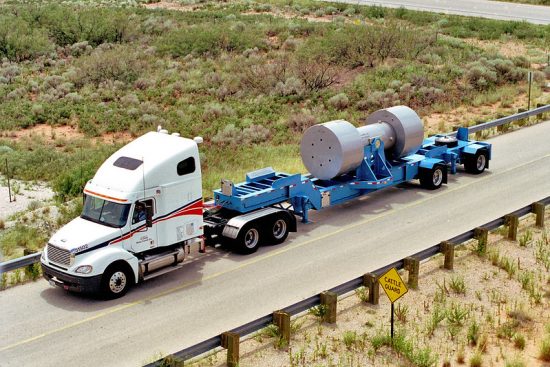
Federal agencies and nuclear corporations continue to wrestle over what to do with the already tens of thousands of tons of high-level radioactive waste (at least 90,000 at last count) generated by America’s commercial nuclear power plants — all casked up with nowhere to go (and a lot of it still in the fuel pools). Because, absent alchemy, that waste is always going to be somewhere, even if we can’t see it.
Once upon a time, the general public understood this. In 1986, when the US Department of Energy was looking for a geological burial site for commercial nuclear waste, it began giving serious consideration to the “granite state” of New Hampshire.
New Hampshire towns — some of which would have been seized and razed by eminent domain to make way for the repository — rose up in opposition. A stunning 100 of them signed a resolution that not only opposed the burial, storage, and transportation of high-level nuclear waste in New Hampshire, but also its production.
A law was eventually passed in New Hampshire that forbade siting a nuclear waste repository in the state, but not banning its generation. The construction of the Seabrook nuclear power plant on the New Hampshire coast progressed, and today the single unit of the two originally planned is duly generating radioactive waste for the state of New Hampshire, with still no place to go.
In fact, the law banning a repository in New Hampshire was quietly, almost covertly, overturned in the New Hampshire state legislature in 2011, a fact uncovered by State Rep. Renny Cushing while writing legislation in 2016. (Cushing is a founder of this country’s first anti-nuclear power group, the Clamshell Alliance, which vigorously opposed the construction of Seabrook.)
https://www.youtube.com/watch?v=BLeYKkA2V7EA German four-part animation piece, humorously demonstrated the impossibility of disposing of radioactive waste. This is the second segment.
In a characteristically stealthy way, the Nuclear Regulatory Commission has ensured there will be no repeat of that New Hampshire defiance. Today, under what was once called the Nuclear Waste Confidence Decision, but is now termed the “Continued Storage of High-Level Waste”, (presumably because no one dare claim any “confidence” about finding a waste solution), an intervention against a reactor license renewal can be disallowed if it is based on contentions challenging the absence of a long-term radioactive waste solution.
This means that our aging fleet of nuclear reactors are free to generate yet more radioactive waste, some of them for another 20 or even 40 years, even though there is still no sign of land when it comes to finding a safe, long-term management plan for what to do with it.
That’s remarkable hubris this far into the nuclear game. Even if one could (very reluctantly) forgive the initial optimistic procrastination — when Fermi achieved the first chain reaction in 1942, but everyone decided the waste problem would be solved later — there is no forgiving it now, 78 years on. That’s more than ample time to have realized that continuing to make more of a lethal substance that you can never dispose of is scientifically and morally reprehensible.
We cannot dispose of radioactive waste. But we can dispose of nuclear power. We should hesitate no longer and do just that.
Linda Pentz Gunter is the international specialist at Beyond Nuclear and writes for and edits Beyond Nuclear International.
Architect of its nuclear programme assassinated – Iran vows retaliation
Mohsen Fakhrizadeh was ambushed with explosives and machine gun fire in the town of Absard, 70km (44 miles) east of Tehran. Efforts to resuscitate him in hospital failed. His bodyguard and family members were also wounded.
There was no immediate claim of responsibility, but the Iranian foreign minister, Mohammad Javad Zarif, said Israel was probably to blame, and an adviser to Iran’s supreme leader, Ayatollah Ali Khamenei, vowed retaliation. “We will strike as thunder at the killers of this oppressed martyr and will make them regret their action,” tweeted Hossein Dehghan.
The killing was seen inside Iran as being as grave as the assassination by US forces of the Islamic Revolutionary Guard Corps commander Qassem Soleimani in January.
Israel will face accusations that it is using the final weeks of the Trump administration to try to provoke Iran in the hope of closing off any chance of reconciliation between Tehran and the incoming US administration led by Joe Biden.
Amos Yadlin, a former head of Israeli Defence Force intelligence, said: “With the window of time left for Trump, such a move could lead Iran to a violent response, which would provide a pretext for a US-led attack on Iranian nuclear facilities.”…….. https://www.theguardian.com/world/2020/nov/27/mohsen-fakhrizadeh-iranian-nuclear-scientist-reportedly-shot-dead-near-tehran
Danger to San Onofre nuclear waste, from ocean’s king tides
 Annual High Tide Spurs Concerns About Future Safety of San Onofre Nuclear Waste Stock Near South OC, Voice of OC, By BRANDON PHO November 23, 2020, Annual High Tide Spurs Concerns About Future Safety of San Onofre Nuclear Waste Stock Near South OC, Voice of OC, By BRANDON PHO November 23, 2020, They’re called king tides:Ocean waves that grow especially tall a few times during the year, rumbling against the California coast and offering a glimpse into future sea level rise and a reshaping shoreline, according to state coastal regulators.
Those tides rolled up to San Onofre last weekend, where a sea wall stands to protect what nearby communities fear is a man-made disaster in waiting: the decommissioned but still radioactive San Onofre Nuclear Generating Station (SONGS). The following week, local officials and activists convened a set of dueling community forums that well capture the ongoing dispute over what exact risk the nuclear waste sitting at SONGS poses to all life within the area joining Orange and San Diego counties. The debate centers on the integrity of SONGS’ nuclear waste storage system, which has been criticized as prone to failure and an ecological and human health hazard. One Nov. 19 forum hosted by nuclear watchdogs saw some of their fears echoed back to them by Dr. Ian Fairlie, a radiation biologist in London who once headed the Secretariat of the UK Government’s CERRIE committee on internal radiation risks……. Members of the public laid out those concerns at an Aug. 20 panel meeting, and the comments can be read here. ……. environmentalists are looking at sea level rise’s impacts on coastlines well into 2100. Edison had previously argued studies into that time frame aren’t necessary……… There’s deep disagreement about what to do with the leftover nuclear waste, all 1,800 metric tons of which are in dry storage and embedded in concrete. The spent fuel contains radioactive isotopes like Cesium-137, the amount of which critics say is comparable to levels released during the Chernobyl disaster of 1986.……… The contention between watchdogs and Edison is the type of dry storage the company chose. Critics say the company has cheaped out through more cost-efficient, but less safe, thin-walled HOLTEC canisters, feared to be more prone to cracking and corrosion from conditions like the plant’s salty seaside locale. Instead, watchdogs have called for the use of thicker casks they say would better stave off the risk of failure and exposure. Fairlie at the Nov. 19 forum, hosted by the Samuel Lawrence Foundation and local nuclear safety groups, said the current canisters in use by Edison are “not very good – they are cheap … 5/8ths of an inch thick, prone to cracking.” They’re “designed to be temporary and they’re not really robust from external attack in my view,” he said, adding “it would be much, much, much better” for the spent fuel to be stored in a thicker cask — “Unlikely to be subject to cracks.” The only problem? “They’re very expensive.” ……… https://voiceofoc.org/2020/11/annual-high-tide-spurs-concerns-about-future-safety-of-san-onofre-nuclear-waste-stock-near-south-oc/ |
|
Waste Isolation Pilot Plant – building of ventilation shaft is halted, due to Covid-19 and planning problems
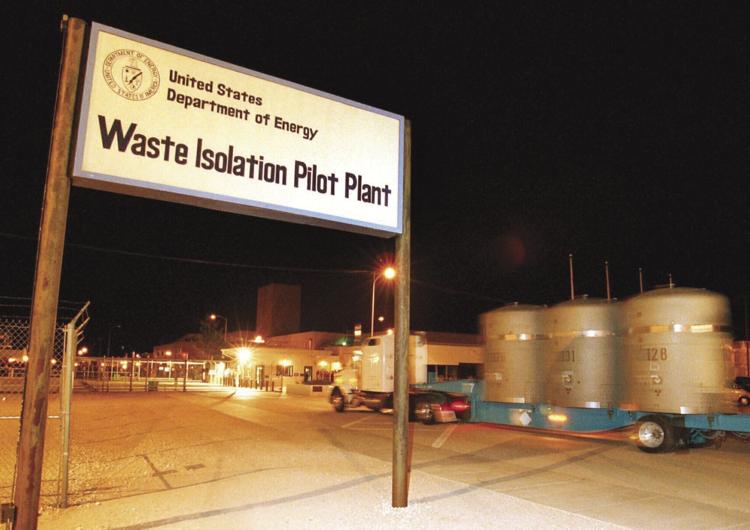 WIPP: New Mexico regulators halt utility shaft project, cite COVID-19, planning problems, Adrian Hedden, Carlsbad Current-Argus, 25 Nov 20, Construction of a $100 million utility shaft at the Waste Isolation Pilot Plant could be halted after the New Mexico Environment Department denied a request to extend state authorization to build the shaft, citing missed deadlines in the planning of the project and the continued spread in COVID-19 cases at the facility.
The shaft, part of an almost $300 million rebuild of WIPP’s ventilation system, along with a series of fans and filter buildings known as the Safety Significant Confinement Ventilation System (SSCVS), was intended to improve airflow in the WIPP underground and allow for waste emplacement and mining to occur simultaneously along with future expansions of the nuclear waste repository……….
Spike in COVID-19 at WIPP could put workers in danger
NMED also cited a recent rise in COVID-19 cases at WIPP, as the pandemic continued to spread in record-breaking numbers across New Mexico, and the agency’s responsibility to ensure human health is not put at risk by activities under the TA, requesting a plan for COVID-19 mitigation at the facility. https://www.currentargus.com/story/news/local/2020/11/24/wipp-utility-shaft-halted-new-mexico-cites-covid-planning-problems/6397790002/
1 This Month



26 September – International Day for the Total Elimination of Nuclear Weapons


PLEASE OPPOSE HR 8255 AND S.3639 – bills would accelerate satellite deployment, with no environmental review or safeguards – https://ncstd5li.quorum.us/campaign/169331/
To see nuclear-related stories in greater depth and intensity – go to https://nuclearinformation.wordpress.com
-
Archives
- September 2026 (245)
- August 2026 (330)
- July 2026 (355)
- June 2026 (287)
- May 2026 (306)
- April 2026 (356)
- March 2026 (251)
- February 2026 (267)
- January 2026 (308)
- December 2025 (358)
- November 2025 (359)
- October 2025 (375)
-
Categories
- 1
- 1 NUCLEAR ISSUES
- business and costs
- climate change
- culture and arts
- ENERGY
- environment
- health
- history
- indigenous issues
- Legal
- marketing of nuclear
- media
- opposition to nuclear
- PERSONAL STORIES
- politics
- politics international
- Religion and ethics
- safety
- secrets,lies and civil liberties
- spinbuster
- technology
- Uranium
- wastes
- weapons and war
- Women
- 2 WORLD
- ACTION
- AFRICA
- Atrocities
- AUSTRALIA
- Christina's notes
- Christina's themes
- culture and arts
- Events
- Fuk 2022
- Fuk 2023
- Fukushima 2017
- Fukushima 2018
- fukushima 2019
- Fukushima 2020
- Fukushima 2021
- general
- global warming
- Humour (God we need it)
- Nuclear
- RARE EARTHS
- Reference
- resources – print
- Resources -audiovicual
- Weekly Newsletter
- World
- World Nuclear
- YouTube
-
RSS
Entries RSS
Comments RSS
 nuclear-news