Fukushima nuclear plant not ‘under control’ as radioactive water spills

 Tons of radioactive water spill from Fukushima nuclear plant http://rt.com/news/fukushima-nuclear-water-leak-378/ 05 April, 2012, Officials at the Tokyo Electric Power Company (TEPCO), which acts as the operator of the crippled nuclear
facility, say there is reason to believe some of the 12 tons of radioactive water has flowed into the Pacific Ocean.
A leak was found in a pipe attached to a temporary decontamination system. The water, once it has been used to cool the reactors, contains massive amounts of radioactive substances and is put into the water-processing facility so it can be recycled for use as a coolant.
“Our officials confirmed that cooling water leaked at a joint in the pipes,” a TEPCO spokesman told reporters, adding that “it is possible that some of the water may have flowed outside the facility and pouredinto the ocean.”
This accident is the latest of several leaks of radioactive water at the plant, undermining the government’s claim that the shuttered reactors were now under control.
Just last month, about 120 tons of radioactive water leaked at the plant’s water decontamination system and about 80 liters (21 gallons) seeped into the ocean, according to TEPCO. The plant, which is just north-east of Tokyo, was crippled by
meltdowns and explosions caused by Japan’s massive earthquake and tsunami
France’s nuclear plant leaks after 2 small fires
Leak Found in French Nuclear Plant http://online.wsj.com/article/SB10001424052702304072004577326322716346232.html?mod=googlenews_wsj By NADYA MASIDLOVER WSJ, 6 April 12, PARIS—French state-controlled utility Electricité de France SA said late Thursday that a leak was detected at one of its nuclear reactors in northwestern France, after two small fires were extinguished at the site earlier in the day.
France’s nuclear regulator said it had provisionally ranked the leak as a low-level incident and had returned to normal management of the situation after shifting to crisis mode earlier in the day. In a statement, EDF said that a faulty joint on a pump used to cool the reactor had caused a leak inside the reactor building of its nuclear power station in Penly, Normandy. The water from the leak is currently collected in circuits which exist for this use, the company said.
The reactor, which automatically halted after the fire, continues to be cooled normally and the plant teams are working to reduce the pressure and the temperature of the water in the circuit, according to EDF.
Even after a reactor is halted, the nuclear fuel continues to generate heat and must be cooled continuously.
French nuclear safety body, Autorité de Sureté Nucléaire, said it continues to analyze the situation and follow its evolution. The regulator said the incidents had no consequence on the environment.
Earlier in the evening, a spokeswoman for EDF said that lubricant from one of the reactor’s cooling pumps had leaked on the floor, generating smoke and small flames inside the reactor building. The two small fires were extinguished Thursday afternoon.
Santa Susanna’ s radiation pollution from 1959 nuclear accident
 Santa Susanna pollution data raises more questions about long term radiation than it answers, 89.3 KPCC, March 6, 2012 | By Molly Peterson I did a short story today about the former Santa Susanna Field Laboratory site, where Rocketdyne and others once had operations, and where in 1959 a nuclear accident released far more radioactive material than Three Mile Island. I don’t just hang out on the EPA’s website, or at the gates of that property. Instead, I heard about the data release from State Senator Julia Brownley’s release yesterday :
“This confirms what we were worried about,” said Assemblywoman Julia Brownley, D-Oak Park, a long-time leader in the fight for a complete and thorough cleanup of this former Rocketdyne rocket engine testing laboratory. “This begins to answer critical questions about what’s still up there, where, how much, and how bad?”
Brownley’s release asserts that the new samples collected are up to 1000 times higher than the “radiation trigger levels” approved by state and federal officials in 2010, when state officials reached agreements deemed, at the time, “historic,” with NASA and the Department of Energy for cleanups. Continue reading
Nuclear plants in South Carolina and Virginia had “near misses”
Nuclear watchdog group says Duke Energy plant among 2011 “near misses” Observer.com by johnmurawski on 02/28/2012 “……According to UCS, the situation at Duke Energy’s Oconee nuclear plant in South Carolina involved a glitch in the backup reactor core cooling system that would have rendered the system useless during an accident.
The backup system was installed in 1983 and the plant’s workers didn’t discover the problem until 2011.
Another plant mentioned in the UCS report was the North Anna plant in Virginia which lost offsite power after experiencing an earthquake which was more severe than the plant was designed for……” http://blogs.newsobserver.com/business/nuclear-watchdog-group-says-duke-energy-plant-among-2011-near-misses
Exposure to radiation by workers in Finalnd
Outokumpu workers exposed to radiation http://af.reuters.com/article/metalsNews/idAFL5E8DO6SX20120224
* Four Outokumpu workers exposed to radiation
* One worker’s exposure “material safety risk”
* Radiation should not have adverse health effects
* Recycled steel had contained americium (Adds detail) Continue reading
15 tonnes of water hourly, as Fukushima nuclear reactor hots up again
Fukushima reactor heats up again, ABC News, By Mark Willacy in Fukushima The operator of the Fukushima nuclear plant has begun injecting more water into one of the reactors, after the core temperature rose above Japan’s safety limit.
A gauge inside Fukushima’s reactor number two showed the temperature rising to 82 degrees Celsius over the weekend, its highest level since the reactor was put into a state of cold shutdown two months ago. Operator TEPCO insists there has been no nuclear reaction and that the reactor can be controlled.
Responding to the increase, the operator began injecting 15 tonnes of water an hour into the reactor in a bid to get the temperature down. TEPCO says it has not detected any xenon gas, which is created when a
nuclear reaction has been triggered.
The company suspects that cooling water has not been flowing freely into the the number two reactor, causing the
Level 2 nuclear incidents in France
France declares level 2 nuclear event at Cattenom Feb 6, 2012
* Reactors not shut down after the fault was found
* EDF given 10 days on Jan. 24 to make repairs
* There were four level two events in 2011
PARIS, Feb 6 (Reuters) – France’s nuclear safety authority (ASN) said on Monday it had identified a problem with water pipes at one of EDF’s nuclear plants and rated it a level two event out of a maximum seven on the international nuclear event scale (INES).
Level two ratings occur relatively rarely, but the watchdog said there was no impact on plant workers or the environment from the event. In 2011, the ASN gave four incidents a level two rating. Japan’s Fukushima disaster was rated a level seven event.
Pipes used to pump water into fuel rod cooling pools at reactors 2 and 3 at EDF’s Cattenom nuclear plant were not equipped with a mechanism to prevent them from accidentally pumping water out of the basins.
In case water levels fall in rod cooling pools, the exposed fuel would heat up and release dangerous radioactive material. “Due to the potential consequences, this event was placed on a level 2 of the INES scale,” the watchdog said in a statement….. http://www.reuters.com/article/2012/02/06/france-nuclear-ines-idUSL5E8D63C120120206
Spain wants USA to clean up plutonium pollution B-52 bomber accident
 two of the bombs that hit the ground detonated, spreading seven pounds of plutonium over a 200 hectares (490 acres).
US and Spain discuss cleanup of nuclear radiation, PhysOrg.com, February 5, 2012 The United States is offering technical assistance to Spain to clean up land contaminated by radiation from undetonated nuclear bombs that accidentally fell on the area in 1966, Continue reading
Safety concerns about Russia’s nukes – highlighted by recent fire at nuclear institute
Fire at Moscow nuclear institute, Russia says no risk (Reuters) – Jan 29 2012 There was no risk of a radiation leak after a fire broke out at a Moscow nuclear research centre housing a non-operational 60-year-old atomic reactor on Sunday, said officials, but Greenpeace Russia expressed serious concern about the incident. Continue reading
Wear and tear problem on tubes carrying radioactive water
According to the Nuclear Regulatory Commission, more than a third of the wall had been worn away in two tubes at Unit 2, which will require them to be plugged and taken out of service. At least 20 percent of the tube wall was worn away in 69 other tubes, and in more than 800, the thinning was at least 10 percent.
Inspectors find ‘unusual’ wear on new tubes carrying radioactive water at Calif. nuclear plant Washington Post, By Associated Press, : February 2 LOS ANGELES — Unusual wear has been found on hundreds of tubes that carry radioactive water at Southern California’s San Onofre Unit 2 nuclear plant, raising questions about the integrity of equipment the company installed in a multimillion-dollar makeover in 2009.
The disclosure came two days after a tube leak at the plant’s other unit prompted operators to shut down the reactor as a precaution. The problems at Unit 2 were discovered during inspections of a steam generator, after the plant 45 miles north of San Diego was taken off-line for maintenance and refueling. The two huge steam generators at Unit 2, each containing 9,700 tubes, were replaced in fall 2009, and a year later in its twin plant, Unit 3, as part of a $670 million overhaul. Continue reading
USA radioactive leaks from nuclear reactors
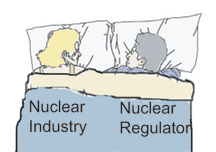 the regulations in place for American facilities are actually more lax than one would expect.
the Nuclear Regulatory Commission has repeatedly weakened safety requirements for facilities, regularly allowing antiquated plants to continue operating by making it easier to pass
tests in lieu of actually upgrading the facility.
California nuclear plant shut down over radioactive leaks, RT Question More, 01 February, 2012, A leak at a Southern California nuclear facility that regularly provides power to roughly 1.4 million households has caused the plant to shut down a reactor.
Despite officials insisting that everything will be perfectly alright at the San Onofre nuclear site, this is not the first time as of late that power plants have raised serious questions about their safety in America. Continue reading
Illinois nuclear reactor shut down
Reactor shuts down, releases steam at Illinois nuclear plant after losing outside power Washington Post, Associated Press, January 30 BYRON, Ill. — A nuclear reactor at a northern Illinois plant shut down Monday after losing power, and steam was being vented to reduce pressure, according to officials from Exelon Nuclear and federal regulators.
Unit 2 at Byron Generating Station shut down around 10:18 a.m., after losing power from an off-site source, Exelon officials said. Diesel generators began supplying power to the plant equipment and operators began releasing steam from the non-nuclear side of the plant to help
cool the reactor, officials said.
Even though the turbine is not turning to produce electricity, “you still need to cool the equipment.” said U.S. Nuclear Regulatory Commission spokeswoman Viktoria Mitlyng. Releasing steam helps “take away some of that energy still being produced by nuclear reaction but that doesn’t have anywhere to go now.”
The steam contains low levels of radioactive tritium, but the levels are safe for workers and the public, federal and plant officials said….. http://www.washingtonpost.com/business/industries/reactor-shuts-down-releases-steam-at-illinois-nuclear-plant-after-losing-outside-power/2012/01/30/gIQALf13cQ_story.html
Nuclear personnel asleep at Oak Ridge National Laboratory?
 Vulnerable U.S. Nuclear Weapons Site Faces Allegations of Snoozing Security Guard Potential Pattern of Fatigue Among Wackenhut Nuclear Personnel
Project on Government Oversight (POGO) 25 Jan 12, By MIA STEINLE
The security contractor for the Energy Department’s Oak Ridge National Laboratory in Tennessee is investigating reports that one of its security guards was sleeping and had also been using an unauthorized cell phone while they were supposed to be guarding a sensitive nuclear facility with bomb-grade material.
Photos of the alleged incident were sent to Wackenhut Security Inc.’s (WSI) Oak Ridge unit, the Energy Department, and the Knoxville News Sentinel, which broke the story Tuesday.
The photos were allegedly taken inside Building 3019, which raises “the additional issue of who took photographs inside a high-security nuclear installation,” according to the News Sentinel. Building 3019 stores about a half-ton of uranium-233, which POGO Senior Investigator Peter Stockton said today in a statement is roughly the amount needed for 250 improvised nuclear detonations.
“Perhaps the most egregious part of all this is that the Energy Department is allowing Wackenhut to investigate the latest security lapse itself,” Stockton said. “This is too important to leave up to Wackenhut.” WSI is commonly known as Wackenhut. In 2002, the Florida company was acquired by a Danish corporation and is now officially known in the U.S. as G4S Secure Solutions.
Wackenhut has a history of sleeping security guards. “It was Wackenhut that in 2007 initially denied that its guards at the Peach Bottom nuclear power plant in Pennsylvania were sleeping on the job—that is until the company was confronted with a video of the guards that was leaked to the media,” Stockton said. In the wake of that scandal, Wackenhut lost its contract with Exelon to manage security at ten nuclear power plants, according to a Washington Post article.
POGO called Oak Ridge National Laboratory a “high risk” as early as 2006 for its inadequate security, and also found that Wackenhut security guards at the nearby Y-12 National Security Complex were overworked to the point of severe fatigue. http://pogoblog.typepad.com/pogo/2012/01/vulnerable-us-nuclear-weapons-site-faces-allegations-of-snoozing-security-guard.html
Radioactive water leak reported from Fukushima’s No 2 nuclear reactor
Fresh Radioactive Water Leakage Reported at Fukushima Nuke Plant, MOSCOW, January 22 (RIA Novosti) About two liters of radioactive water leaked from the turbine building of the second reactor at the crippled Fukushima Daiichi nuclear plant, Kyodo news agency reported on Sunday.
TEPCO, which operates the nuclear plant, issued a statement on Saturday saying the leak was from a pipe there that transfers highly radioactive water in the basement of the No. 2 reactor’s turbine building to the plant’s waste disposal facility……http://en.ria.ru/world/20120122/170887389.html
Radioactive gravel in school building in Japan
Radioactive gravel finds way to school, Japan Times, 20 Jan 12, Hunt is on for other shipments from quarry in evacuation zone Kyodo FUKUSHIMA — Radiation-contaminated gravel shipped from a quarry in the evacuation zone around the Fukushima No. 1 nuclear plant found its way to an elementary school building as well as roads and pathways around
houses, sources said Wednesday. The gravel went into concrete that was used to make an elementary school in Nihonmatsu, Fukushima Prefecture, more resistant to earthquakes. The area where the gravel was used had a radiation reading of 0.1 to 0.2 microsieverts per hour.
“We are surprised at the news as we had never expected it. We’d like to make efforts to ensure children’s health by checking the radiation level on a regular basis,” the school’s principal said. Continue reading
1 This Month
Chernobyl: The Lost Tapes – A good documentary on Chernobyl on SBS available On Demand for the next 3 weeks– https://www.sbs.com.au/ondemand/tv-program/chernobyl-the-lost-tapes/2352741955560

of the week–London Campaign for Nuclear Disarmament

Tell the Ukrainian Government to Drop Prosecution of Peace Activist Yurii Sheliazhenko
To see nuclear-related stories in greater depth and intensity – go to https://nuclearinformation.wordpress.com
-
Archives
- April 2026 (114)
- March 2026 (251)
- February 2026 (268)
- January 2026 (308)
- December 2025 (358)
- November 2025 (359)
- October 2025 (376)
- September 2025 (257)
- August 2025 (319)
- July 2025 (230)
- June 2025 (348)
- May 2025 (261)
-
Categories
- 1
- 1 NUCLEAR ISSUES
- business and costs
- climate change
- culture and arts
- ENERGY
- environment
- health
- history
- indigenous issues
- Legal
- marketing of nuclear
- media
- opposition to nuclear
- PERSONAL STORIES
- politics
- politics international
- Religion and ethics
- safety
- secrets,lies and civil liberties
- spinbuster
- technology
- Uranium
- wastes
- weapons and war
- Women
- 2 WORLD
- ACTION
- AFRICA
- Atrocities
- AUSTRALIA
- Christina's notes
- Christina's themes
- culture and arts
- Events
- Fuk 2022
- Fuk 2023
- Fukushima 2017
- Fukushima 2018
- fukushima 2019
- Fukushima 2020
- Fukushima 2021
- general
- global warming
- Humour (God we need it)
- Nuclear
- RARE EARTHS
- Reference
- resources – print
- Resources -audiovicual
- Weekly Newsletter
- World
- World Nuclear
- YouTube
-
RSS
Entries RSS
Comments RSS
 nuclear-news