50 years later, USA will clean up site of nuclear bomb’s crash in Spain


 Palomares nuclear crash: US agrees Spanish coast clean-up http://www.bbc.com/news/world-europe-34569614 19 October 2015 Almost 50 years after four nuclear bombs fell on the Spanish coast after two US military planes collided, American officials have signed a deal to clean up contaminated land.
None of the bombs detonated in January 1966, but three fell around Palomares and a fourth was found on the sea bed.
Highly toxic plutonium was spread over a 200-hectare (490-acre) area.
On a visit to Madrid, Secretary of State John Kerry agreed to finalise a deal on disposing of contaminated soil.
Under the agreement in principle, signed by Mr Kerry and Spanish Foreign Minister Jose Manuel Garcia-Margallo, the US will remove the soil at Palomares to a site in the US.
Spanish media said the soil would be transported to a site in Nevada. The deal comes a few months before the 50th anniversary of the crash, one of the most serious nuclear incidents of the Cold War.
An earlier consignment of contaminated soil was shipped to a site in South Carolina shortly after the accident and buried in deep trenches.
But further analysis of soil in the area has been carried out in recent years, and the health of residents in the Palomares area is still being monitored.
- On 17 January 1966, a US B-52 bomber carrying four 1.5 megaton bombs collided with a refuelling tanker some 31,000 feet above Palomares on Spain’s Mediterranean coast
- The tanker crew and three people on board the bomber were killed
- One bomb equipped with a parachute landed intact
- Two bombs hit the ground at high speed, scattering plutonium
- A fourth bomb landed five miles off shore and was later recovered by USS Petrel
“I looked up and saw this huge ball of fire, falling through the sky” – Spain waits for US to finish nuclear clean-up
At least four Russian cruise missiles have crash-landed in Iran
Russian missiles crash in Iran: what we know, Vox World, by Max Fisher on October 8, 2015
- At least four Russian cruise missiles, headed for Syria, have reportedly crash-landed in Iran, Pentagon sources tell CNN and other outlets.
- So far neither Russian nor Iranian sources have confirmed the incident, though Iran’s semi-official Fars News Agency is carrying the story (but crediting CNN).
- It is not known whether the missiles detonated or whether there are any casualties. Iran has enough empty space that it’s possible the missiles crashed harmlessly…….http://www.vox.com/2015/10/8/9482023/russia-missiles-iran-crash
Even routine sirens from nuclear station can cause social panic
RANDOM SIRENS ALARM NUCLEAR PLANT NEIGHBORS abc 13 eyewwitness News, , October 08, 2015 NEW HILL, NC — Annual maintenance. That’s Duke Energy’s explanation for warning sirens around the Harris Nuclear Power plant going off at seemingly random times over the past week. But no one seemed to know about it.
The first reports started popping up on social media last week.
Local police started getting calls. So did the Town of Apex. But no one could explain why the sirens were going on and off……”You can put a lot of people in panic if that siren goes off and there’s not really nothing going on at the nuclear plant,” Conley said. “People can go a little bananas when they don’t know what it’s meant for.” “It sounds like it’s in your back yard,” said Laura Taylor. “It’s really loud.”
Taylor lives in Apex, one of the surrounding towns and communities that has nuclear warning sirens scattered about. She says she heard the siren go off three times last week.
“It is concerning because you wonder what’s going on,” said Taylor. “Is it just some kind of malfunction or should we be more concerned?” As it turns out, it was neither………http://abc13.com/news/random-sirens-alarm-nuclear-plant-neighbors/1023278/
Fake parts sold for nuclear submarines
 Man Gets 3 Years for Importing Fake Parts for Nuclear Subs http://abcnews.go.com/US/wireStory/man-years-importing-fake-parts-nuclear-subs-34296872 By THE ASSOCIATED PRESS, HARTFORD, Conn. — Oct 6, 2015 A Massachusetts man has been sentenced to three years in prison for importing counterfeit electronic components from China and Hong Kong for use by American customers, including builders of the U.S. Navy’s nuclear submarines.
Peter Picone (pih-COH’-nee) of Methuen (mih-THOO’-uhn), Massachusetts, was sentenced Tuesday in federal court in Hartford, Connecticut.
The 42-year-old pleaded guilty in June 2014 to conspiracy to traffic in counterfeit military goods. In addition to the prison sentence of three years and one month, the judge ordered him to pay $352,076 in restitution to 31 companies whose circuits he counterfeited.
Assistant Attorney General Leslie Caldwell said Picone sold counterfeit integrated circuits knowing that the parts were intended for use in nuclear submarines.
At his plea hearing, Picone acknowledged that failure of the parts could have led to catastrophic consequences.
British nuclear submarine stricken with technical problems off coast of Iran
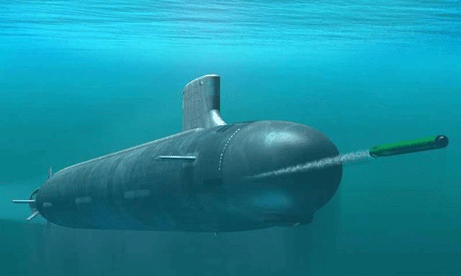 Stranded: Ageing British nuclear submarine in top-secret mission is undergoing repairs off the coast of Iran [includes VIDEO] Daily Mail,
- British nuclear submarine spotted at dock in the Emirati dock of Fujairah
- Port is situated less than 100 nautical miles from the coast of Iran
- A 650ft-long metal barrier covers the submarine to avoid detection
- It is believed to be one of Britain’s four Trafalgar Class submarines

 By MARK NICOL DEFENCE CORRESPONDENT FOR THE MAIL ON SUNDAY 27 September 2015 |
A British nuclear submarine has been caught on camera after it apparently became stricken with technical problems while on a top-secret mission in one of the most dangerous parts of the world.
Satellite images show the Royal Navy vessel undergoing repairs at a port less than 100 nautical miles from Iran.
The nuclear-powered submarine is pictured docked at Fujairah, one of the United Arab Emirates, in the politically sensitive seaway of the Gulf of Oman……….
In 2013, The Mail on Sunday revealed how the ageing Trafalgar submarines had been issued with ‘Code Red’ safety warnings after inspectors found radioactive leaks. The report by the Defence Nuclear Safety Regulator found that cracks in reactors and nuclear discharges were directly attributable to the Trafalgars remaining in service beyond their design date.
The Trafalgars are powered by nuclear reactors and are supposed to stay at sea for up to three months. They are equipped with Tomahawk cruise missiles and sonar equipment that can hear enemy vessels sailing more than 50 miles away.
The submarines have a typical complement of 120 to 130 personnel, up to 20 of them officers. The Trafalgars are being replaced by Astute Class nuclear submarines.
A Ministry of Defence spokesman said: ‘We do not comment on submarine operations.’ http://www.dailymail.co.uk/news/article-3250393/Stranded-Ageing-British-nuclear-submarine-secret-mission-undergoing-repairs-coast-Iran.html#ixzz3myehgajC
Can Nuclear Plants Actually Operate Safely?
Cancer, Coverups and Contamination: The Real Cost of Nuclear Energy 27th September 2015
Andreas Toupadakis Ph.D Contributing Writer for Wake Up World
“…..If we assume that more nuclear power plants are constructed around the world, can anyone guarantee that the nuclear accidents will disappear? No, that is impossible. Not only will the risks not disappear, but logic dictates they will also increase if there are more plants in operation, as will the volume of unmanageable radioactive waste. And let us not forget the unpredictability of earthquakes. Nuclear accidents will always happen just like any other accidents do, which may affect both power plants and waste storage facitilities.
Reliance on nuclear energy not only results in building new nuclear power plants but also relicensing existing ones. The peril of tragic accidents within the industry will inevitably be higher, especially while maintaining plants that are decades old — as we have already witnessed with the ongoing disaster at Fukushima, as well as the overheated reactor at Miami’s Turkey Point facility in 2014. Other nuclear power plant disasters include:
- 1952 Chalk River, near Ottawa, Canada: a partial meltdown of the reactor’s uranium fuel core resulted after the accidental removal of four control rods.
- 1957 Windscale Pile No. 1, north of Liverpool, England: fire in a graphite-cooled reactor spewed radiation over the countryside, contaminating a 200-sq-mile area.
- 1957 South Ural Mountains, Soviet Union: an explosion of radioactive wastes at a Soviet nuclear weapons factory 12 miles from the city of Kyshtym forced the evacuation of over 10,000 people from a contaminated area.
- 1959, Santa Susana, USA: A reactor at the Atomics International field laboratory in the Santa Susana Mountains, California, experienced a power surge and subsequently spewed radioactive gases into the atmosphere. According to a 2009 report from the Los Angeles Times, residents blame the facility for their health issues and say the site remains contaminated.
- 1976, near Greifswald, East Germany: the radioactive core of a reactor in the Lubmin nuclear power plant nearly narrowly avoided meltdown following the failure of safety systems during a fire.
- 1979, Three-Mile Island, near Harrisburg, Pennsylvania: Following a combination of equipment malfunctions, design-related problems and worker error, one of two reactors lost its coolant which caused overheating and partial meltdown of its uranium core, releasing radioactive water and gases.
- 1986, Chernobyl, near Kiev, Ukraine: an explosion and fire in the graphite core of one of four reactors released radioactive material that spread over parts of the Soviet Union, Europe and Scandinavia.
- 1987, Rocky Flats Plant, near Denver, Colorado, USA: Following insider reports of unsafe conditions, investigation found numerous violations of federal anti-pollution laws, including discharging of pollutants, hazardous materials and radioactive matter into nearby creeks and water supplies. A subsequent grand jury report criticized the Department of Energy and Rocky Flats contractors for “engaging in a continuing campaign of distraction, deception and dishonesty”.
- 1999, Tokaimura, Japan: An uncontrolled chain reaction in a uranium-processing nuclear fuel plant spewed high levels of radioactive gas into the air, exposing 69 people, killing one worker, and seriously injuring two others.
- 2011, Fukushima Prefecture, Japan: The troubled Fukishima Daiichi nuclear plant in Japan has experienced a number of ‘incidents’ since its construction in 1971, culminating in total reactor failure when the plant was hit by a tsunami following an earthquake. At the time of the disaster, the plant began releasing substantial amounts of radioactive materials and, more than four years after the incident, the plant is still leaking radioactive water into the Pacific Ocean.
The extent of this recent disaster at Fukushima should not be taken lightly. The water leaking from the ailing plant contains plutonium 239 and its release into the world’s ocean system has global repercussions. Explains chemist John A. Jaksich for DecodedScience.com:
“Certain isotopes of radioactive plutonium are known as some of the deadliest poisons on the face of the Earth. A mere microgram (a speck of darkness on a pinhead) of Plutonium-239, if inhaled, can cause death, and if ingested… can be harmful, causing leukemia and other bone cancers.
“In the days following the 2011 earthquake and nuclear plant explosions, seawater meant to cool the nuclear power plants instead carried radioactive elements back to the Pacific ocean. Radioactive Plutonium was one of the elements streamed back to sea.”
As history has shown us, assurances on safety from nuclear operators and regulators are nothing but preposterous. That is something that the public understands — because it is common sense. No matter how much uncaring, financially invested scientists will try to convince the public of the safety of the nuclear industry, the public does not have a salary from working on nuclear business and so, unlike those working on behalf of the industry, can maintain integrity and common sense……….….http://wakeup-world.com/2015/09/27/cancer-coverups-and-contamination-the-real-cost-of-nuclear-energ
Department of Transportation rules violated in shipment of Y-12 uranium
Y-12 uranium shipment reportedly violated DOT rules, Knoxville News Sentinel, Frank Munger, Sep 22, 2015 OAK RIDGE — A federal spokesman at the Y-12 nuclear weapons plant confirmed that a July shipment did not comply with some Department of Transportation regulations for transporting hazardous materials, and he said Y-12 officials have been in contact with DOT and “are cooperating with their findings.”
Steven Wyatt of the National Nuclear Security Administration also confirmed that the “special nuclear material” shipped from Y-12 to a commercial facility was uranium, although he refused to say if it was highly enriched or weapons-grade uranium and would not specify how much uranium was sent to the unnamed facility.
The NNSA, a semi-independent part of the U.S. Department of Energy that oversees the nuclear weapons complex, last week said Y-12 inadvertently shipped more nuclear material than intended to a private facility. After the mistake was discovered, a special team from Y-12 reportedly went to the site and secured the material for return to Oak Ridge…….http://www.knoxnews.com/news/local-news/y12-uranium-shipment-reportedly-violated-dot-rules_22839052
Record rain overwhelming Fukushima’s nuclear station’s drainage pumps
Japan’s torrential downpour overwhelmed Fukushima’s drainage pumps sending hundreds of tonnes of contaminated water flowing into the Pacific! Japanese flooding update, The Big Wobble , 10 Sept 15
Rainfall reached 600 millimetres in the area around Joso, with weather officials expecting at least 200mm more in parts of eastern Japan, including Fukushima, the site of the nuclear reactor crippled in 2011, before the downpour stops on Friday.
Report Says Floods May Pose Threat To Radiation Under Fukushima
The torrential downpour has exacerbated a contaminated water problem at the Fukushima nuclear plant as it overwhelmed the site’s drainage pumps, sending hundreds of tonnes of contaminated water flowing into the ocean, a spokesman for operator Tokyo Electric Power (TEPCO) said.
The continuous torrent of rain water is complicating the already difficult situation in Fukushima where, according to an operator of the Tokyo Electric Power (Tepco), the drainage pumps are not able to evacuate all the water that is pouring into the plant, becoming contaminated and damaging the ‘surrounding environment.
Since 2011, the Tempco has been in charge of storing tons of radioactive water used to cool the reactors at the plant, destroyed by the tsunami……..TEPCO is storing huge volumes of water used to cool reactors that were sent into meltdown when a tsunami hit Japan in 2011……..
“This is a scale of downpour that we have not experienced before.
Grave danger could be imminent,” forecaster Takuya Deshimaru told an emergency press conference. Etau, which smashed into Japan on Wednesday, moved out into the Sea of Japan (East Sea) by the end of the day, but a wall of rain continued to lash the country……http://www.thebigwobble.org/2015/09/japans-torrential-downpour-overwhelmed.html
Sendai’s cooling tubes already leaking! But the pro #nuclear hubris goes on!
Japan Sendai Nuclear Restart — The Hubris Alone Is Killing Me, Let Alone the Volcano and Salt Water Leaks, Nuke Pro 21 Aug 15
I would drop a comment at the link, but I have been banned from Japan Times, so many TIMES that I can’t count. They have no interest in the truth.
————————————————————————————————————–
Kyushu Electric checked the water quality and confirmed an increase in salt content.
Each condenser has some 26,000 tubes inside that are used to pipe seawater around for cooling. Kyushu Electric suspects that holes have opened on such tubes, causing seawater to enter into the condenser. [diagram below by the author of this article]

And this is very dangerous way to think. Perhaps they have 2 sets of heat exchangers, so they can run at 50% whilst one set is completely shut down and worked on. Regardless, this is a stop gap measure, just like at San Onofre if some tubes are already going, there are many more right behind it. So these stories will slip out at the weeks go on.
Heat exchangers that can handle salt water are going to be stainless steel at least and ideally titanium. Industry has gotten a lot better at working with titanium in the last few decades. So those 40 year old heat exchangers at Sendai are probably stainless steel, not at good as titanium.
But in Typical japan Times Fashion, they try to downplay the incident by stating
In Japan, similar problems have occurred about 50 times in the past, but the latest case was the first at the Sendai power plant. In the past, Kyushu Electric experienced two cases at the No. 1 reactor at its Genkai plant in Saga Prefecture in 1997 and 1999.
Classic “don’t worry” it happens all the time. So the pimps of nuke will do anything to keep this plant running. Including putting your life and livelihood at risk………. http://nukeprofessional.blogspot.com.au/2015/08/japan-sendai-nuclear-restart-hubris.html?showComment=1440185210724#c7323011781148838576
China’s race to clear dangerous chemicals from Tianjin explosion site
China warehouse explosion: Tianjin workers race to clear site of deadly chemicals before it rains Fears potential showers could create clouds of toxic gas. Chinese officials face a race against time to clear toxic chemicals from the site of the Tianjin warehouse explosion, amid fears the blast may have released hundreds of tons of toxic gas into the air.
Soldiers have joined rescue workers in gas masks and hazard suits in the port city where the death toll from Wednesday’s massive explosion has risen to 112. Another 95, the majority of whom were firefighters, remained missing.
Officials confirmed the warehouse where the blast occurred was used to house more than 100 tons of sodium cyanide, a potentially deadly substance.

The presence of the chemicals was confirmed by Shi Luze, the chief of staff of the People’s Liberation Army’s Beijing Military Region.
He said workers were trying to clear the area before possible rain showers, which could create toxic gas……..http://www.independent.co.uk/news/world/asia/china-warehouse-explosion-tianjin-workers-race-to-clear-site-of-deadly-chemicals-before-rains-10457786.html
Questions on the causes and effects of the Tianjin explosion
Tianjin explosions ignite barrage of questions, The Age, Philip Wen China correspondent for Fairfax Media, August 14, 2015 Tianjin: As fatalities continue to mount, so too have questions around the cause, response and potential health effects of the terrifying explosions at a toxic chemicals warehouse that tore through the port city of Tianjin, China, on Wednesday night.
Chinese authorities have dispatched more than 200 military nuclear and biochemical materials specialists to the site of the blast, as well as a team from the International Atomic Energy Agency’s Beijing environmental emergency response centre.
But some 36 hours after the explosions, municipal and environmental officials said they were still unable to determine the specific substances held in the warehouse which likely triggered the blast which killed dozens, injured hundreds, and ignited a fireball so large it was captured by orbiting satellites.
The owner of the warehouse, Ruihai International Logistics, is a firm which specialises in handling hazardous cargo, state news agency Xinhua said. It is licensed to handle dangerous and toxic chemicals including sodium cyanide, compressed natural gas, phosphoric acid, potassium nitrate and butanone – an explosive industrial solvent.
“So far, we are not able to provide the detail of type and amount of these dangerous items,” Gao Huaiyou, the deputy director of Tianjin’s work safety administration bureau, said on Thursday. “There is quite a big inconsistency with information provided by the company’s management and their customs declaration.”
Though a pungent smell and visible smog hung in the vicinity of the blast, officials said 17 emergency air monitoring stations indicated air quality in the city remained within a normal range, aided by easterly winds which blew toxic plumes from the fires out to sea.
Readings of cyanide and chemical oxygen demand – a measure of water quality – some three to eight times normal levels were detected near two underground discharge pipes, though officials said the pipes had been sealed off and posed no danger to health or the environment of the surrounding area.
Xinhua said 1000 firefighters and more than 140 fire trucks were struggling to contain the blaze in a warehouse which stored “dangerous goods”.
“The volatility of the goods means the fire is especially unpredictable and dangerous to approach,” it said….http://www.theage.com.au/world/tianjin-explosions-ignite-barrage-of-questions-20150814-gizjw9.html#ixzz3ir0wfaMy
Nuclear experts sent to test China’s Tianjin explosion site
Chemical, nuclear experts testing Tianjin blast site, Aljazeera America, Military has begun work on the ground in China’s northern port city where two explosions killed at least 55 dead August 14, 2015 China has sent chemical experts into Tianjin to test for toxic gases after a series of deadly explosions.
The team of nuclear and chemical experts is on the ground on Friday in the northern port city of Tianjin, the scene of two massive explosions that have left at least 55 people dead. Seventeen of the dead were from among the more than 1,000 firefighters sent to the mostly industrial zone to fight the ensuing blaze, China’s official Xinhua News Agency reported.

The chemical experts were testing the area for toxic gases, the official news agency Xinhua said, adding that the death toll had climbed to 55, with 701 admitted to hospital.
The team of 217 nuclear and biochemical materials specialists from the Chinese military began work at the site on Thursday.
The explosions at a warehouse for hazardous chemicals in the Chinese port of Tianjin on Wednesday raised questions about the whether the materials had been properly stored. Windows were shattered for miles around by the shockwaves, and the explosions were so big they were seen by satellites in space and registered on earthquake sensors.
Officials in Tianjin said they did not yet know what materials were at the hazardous goods storage facility where the explosions happened, or the cause of the blast.
But the Beijing News reported earlier that according to manufacturers, at least 700 ton of sodium cyanide were at the site, along with other substances, and the poisonous chemical had been detected in sewage samples in the area.
The report was no longer available on the newspaper’s website on Friday………..
ianjin is the 10th largest port in the world by container volume, according to the World Shipping Council, and the seventh-biggest in China. It handles vast amounts of metal ore, coal, steel, cars and crude oil.
Ships carrying oil and “hazardous products” were barred from the port Thursday, the Tianjin Maritime Safety Administration said on its official microblog. It also said vessels were not allowed to enter the central port zone, which is near the blast site.
State media said senior management of the company had been detained, and that President Xi Jinping demanded severe punishment for anyone found responsible for the explosions……..
As is customary during disasters, Chinese authorities tried to keep a tight control over information. Police kept journalists and bystanders away with a cordon about a mile from the site. On China’s popular microblogging platform of Weibo, some users complained that their posts about the blasts were deleted, and the number of searchable posts on the disaster fluctuated, in a sign that authorities were manipulating or placing limits on the number of posts.
The Tianjin government said that because of the blasts it had suspended online access to public corporate records. These records might be used to trace the ownership of Ruihai. It was not clear whether the blackout was due to technical damage related to the explosion. No one answered the phone at the Tianjin Market and Quality Supervision Administration or the Tianjin Administration for Industry and Commerce on Thursday.
Ruihai Logistics said on its website — before it was shut down — that it was established in 2011 and is an approved company for handling hazardous materials. It said it handles 1 million tons of cargo annually……..http://america.aljazeera.com/articles/2015/8/13/at-least-50-dead-and-hundreds-injured-in-chinese-warehouse-explosion.html
Explosion in Tianjin, China – in warehouse supplying nuclear fuel?
Top Asian News at 11:00 pm GMT
TIANJIN, China (AP) — Huge explosions at a warehouse for … ore which could supply its nuclear weapons program or fuel nuclear reactors, …–
The blasts ripped through a warehouse storing “dangerous goods” in Tianjin’s Binhai New Area around 11:30 p.m. local time, China’s official Xinhua News Agency said. http://www.wsj.com/articles/huge-blast-rocks-chinese-city-1439403843
Terrorists planned an attack on nuclear weapons base
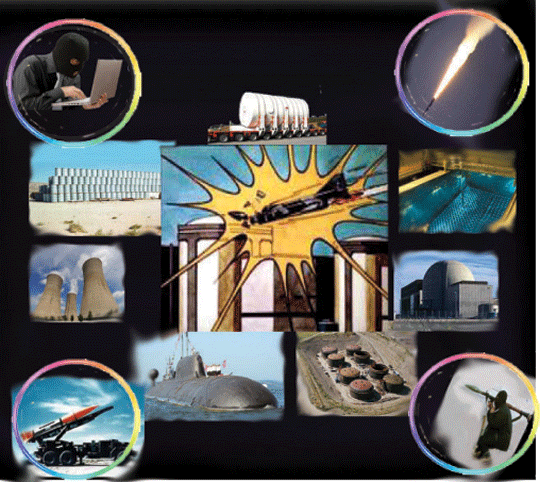 US Nuclear Weapons Base In Italy Eyed By Alleged Terrorists http://fas.org/blogs/security/2015/07/ghedi-terror/ by Hans M. Kristensen Two suspected terrorists arrested by the Italian police allegedly were planning an attack against the nuclear weapons base at Ghedi.
The base stores 20 US B61 nuclear bombs earmarked for delivery by Italian PA-200 Tornado fighter-bombers in war. Nuclear security and strike exercises were conducted at the base in 2014. During peacetime the bombs are under the custody of the US Air Force 704th Munitions Support Squadron (MUNSS), a 130-personnel strong units at Ghedi Air Base.
The Italian police said at a press conference today that the two men in their conversations “were referring to several targets, particularly the Ghedi military base” near Brescia in northern Italy.
Ghedi Air Base is one of several national air bases in Europe that a US Air Force investigation in 2008 concludeddid not meet US security standards for nuclear weapons storage. Since then, the Pentagon and NATO have spent tens of millions of dollars and are planning to spend more to improve security at the nuclear weapons bases in Europe.
There are currently approximately 180 US B61 bombs deployed in Europe at six bases in five NATO countries: Belgium (Kleine Brogel AB), Germany (Buchel AB), Italy (Aviano AB and Ghedi AB), the Netherlands (Volkel AB), and Turkey (Incirlik AB).
Over the next decade, the B61s in Europe will be modernized and, when delivered by the new F-35A fighter-bomber, turned into a guided nuclear bomb (B61-12) with greater accuracy than the B61s currently deployed in Europe. Aircraft integration of the B61-12 has already started.
Increased radiation levels, leak shuts down US nuclear facility
Local News: “Breaking… Alert… leak shuts down US nuclear plant” — Gov’t: Radiation levels ‘above normal’ — ‘Steam plume’ seen in reactor building, workers can’t find where leak is coming from due to safety concerns — Flood warnings issued for area http://enenews.com/newspaper-breaking-news-alert-leak-shuts-down-nuclear-plant-govt-radiation-levels-above-normal-steam-plume-reported-workers-find-leak-coming-due-safety-concerns-flood-warnings-issued-area?utm_source=feedburner&utm_medium=email&utm_campaign=Feed%3A+ENENews+%28Energy+News%29
US NRC Event Notification Report, Jul 23, 2015 (emphasis added): Callaway Plant initiated a shutdown required by Technical Specifications (TS)… TS 3.4.13 Condition A was entered due to unidentified RCS [reactor coolant system] leakage being in excess of the 1 gpm TS limit. The leak was indicated by an increase in containment radiation readings… A containment entry identified a steam plume; due to personnel safety the exact location of the leak inside the containment building could not be determined. At this time radiation levels inside [the] containment are stable and slightly above normal. There have been no releases from the plant above normal levels.
AP, Jul 23, 2015: Missouri Nuclear Plant Shut Down After ‘Non-Emergency’ Leak… Jeff Trammel, a spokesman for St. Louis-based Ameren, called it a “minor steam leak.”… Ameren officials are investigating the cause… it was unclear when the plant would restart… [NRC] inspectors are at the plant.
Missouri Times, Jul 23, 2015: Unplanned Shutdown & Elevated Radioactive Levels at Ameren Missouri’s Callaway 1 Nuclear Reactor Containment Building… Nuclear Regulatory Commission (NRC) issued an event notice for the unplanned shutdown of the Callaway 1 nuclear reactor… The NRC notes that radiation is above normal in the containment building.
Jefferson City News Tribune, Jul 23, 2015 at 2:26p: Alert – Steam leak shuts down Callaway…
Jefferson City News Tribune, Jul 23, 2015:Breaking News – Steam leak shuts down Callaway Plant… Company officials are trying to determine the cause of the problem, which they said “has been contained.”
ABC 17, Jul 23, 2015 — Callaway FLOOD WARNING: Issued at: 9:52 am CDT on July 23, 2015, expires at: 4:00 AM CDT on July 26, 2015. The Flood Warning continues for the Missouri River near Chamois until Friday afternoon. At 7:00 am Thursday the stage was 19.5 feet. Flood stage is 17.0 feet. Minor flooding is occurring.
Previous event at Callaway: Emergency declared at US nuke plant: Fire shuts down reactor — “Reports of black smoke” — Company says no radiation release “above normal operating limits”
1 This Month



Website of the Week
Now until to February 10, 2026 Radioactive waste storage in France: the debate is finally open! How to participate?
-
Archives
- January 2026 (167)
- December 2025 (358)
- November 2025 (359)
- October 2025 (377)
- September 2025 (258)
- August 2025 (319)
- July 2025 (230)
- June 2025 (348)
- May 2025 (261)
- April 2025 (305)
- March 2025 (319)
- February 2025 (234)
-
Categories
- 1
- 1 NUCLEAR ISSUES
- business and costs
- climate change
- culture and arts
- ENERGY
- environment
- health
- history
- indigenous issues
- Legal
- marketing of nuclear
- media
- opposition to nuclear
- PERSONAL STORIES
- politics
- politics international
- Religion and ethics
- safety
- secrets,lies and civil liberties
- spinbuster
- technology
- Uranium
- wastes
- weapons and war
- Women
- 2 WORLD
- ACTION
- AFRICA
- Atrocities
- AUSTRALIA
- Christina's notes
- Christina's themes
- culture and arts
- Events
- Fuk 2022
- Fuk 2023
- Fukushima 2017
- Fukushima 2018
- fukushima 2019
- Fukushima 2020
- Fukushima 2021
- general
- global warming
- Humour (God we need it)
- Nuclear
- RARE EARTHS
- Reference
- resources – print
- Resources -audiovicual
- Weekly Newsletter
- World
- World Nuclear
- YouTube
-
RSS
Entries RSS
Comments RSS
 nuclear-news