Cocaine use among staff at Nuclear Missile Base
Air Force Investigating Cocaine Use at Nuclear Missile Base http://gawker.com/air-force-investigating-cocaine-use-at-nuclear-missile-1765720042 Sam Biddle 18 Mar 16, Cocaine and nuclear weapons: A good mix? That’s what an official probe into coke abuse by “about a dozen airmen” at the F.E. Warren Air Force Base in Wyoming will investigate, the AP reports.
The coked-up airmen in question are, reassuringly, not the people who have their fingers on the literal button required to begin a nuclear war. But they are, scarily, the people tasked with defending the 150 Minuteman III ICBMs (each with an explosive yield roughly eight times greater than the bomb that leveled Hiroshima, easily capable of destroying an entire large modern city) from the rest of the world. As the AP notes, they’re crucial to the operation and safety of America’s vast nuclear stockpile:
Security forces at nuclear missile bases are entrusted to patrol the missile fields and respond to any security emergencies. They are highly trained and given enormous responsibility. Just last month, Deputy Defense Secretary Robert Work visited F.E. Warren and observed a demonstration by security forces of the techniques and equipment they would use to recapture a missile silo that had been taken over by intruders.
In other words, not the kind of people you want doing key bumps in the bathroom. This is the second time in two years that F.E. Warren has been under investigation: In 2014, missile officers responsible for actually launching those ICBMs were caught cheating on their proficiency tests and also doing a lot of illegal drugs.
This sounds like it would be a very fun job were it not for the possibility of fucking up and beginning a nuclear holocaust.
Union of Concerned Scientists Annual Review of U.S. Nuclear Plant, Near Misses
A near miss incident is an event or condition that could increase the chance of reactor core damage by a factor of 10 or more, prompting the NRC to send an inspection team to investigate. The number of near miss incidents has declined since UCS initiated its annual review in 2010. In 2010, there were 19; last year there were nine. All told, from 2010 through 2015 there were 91 near misses………
USA’s nuclear regulator ineffective, as radiation leaks continue

 Nuclear Plants Leak Radiation, and Regulator Faces Scrutiny Five years after one of the worst nuclear disasters in history, America’s nuclear plants still face safety issues. Indian Point nuclear power plant sits on the Hudson River outside New York City.USA News, By Alan Neuhauser March 15, 2016
Yet it’s radioactive, and in the past two months, two nuclear power plants outside New York City and Miami were found to be leaking tritium: the former into groundwater within the facility’s confines, the second straight into Biscayne Bay.
The leaks, revealed in news reports, apparently haven’t contaminated drinking water and don’t pose a threat to human health. But tritium, while less potent than other substances like cesium or strontium or radium, can still be harmful in high enough concentrations, even lethal. And that’s before taking the public reaction into account: The New York incident made headlines across the region, anti-nuclear groups warned the state was “flirting with catastrophe,” and Gov. Andrew Cuomo ordered an investigation.
The incidents came just a few weeks before the fifth anniversary of the meltdown at Japan’s Fukushima Daiichi nuclear plant, which was sparked by a tsunami and earthquake and became the world’s worst nuclear disaster since Chernobyl. They also occurred as the industry was working to burnish its image on safety: All of the nation’s 61 nuclear plants are at least 20 years old, many are over 40, and at least one plant operator has announced it hopes to extend its reactors’ licenses to 80 years.
Yet more than three-quarters of the country’s commercial nuclear power sites have reported some kind of radioactive leak in their life spans, an investigation by the Associated Press found in June 2011 – three months after Fukushima. At the same time, the U.S. Nuclear Regulatory Commission has repeatedly weakened federal regulations to allow plants to keep operating, despite thousands of problems ranging from corroded pipes to cracked concrete and radioactive leaks.
Late last month, seven NRC engineers went public with a petition urging the agency to fix a critical design flaw in the electrical systems of all but one of the nation’s nuclear plants – a highly unusual move for federal employees.
“We have a very ineffective regulator that will not impose any costs that will jeopardize the economics of these plants,” says Paul Blanch, a longtime engineer and industry worker turned watchdog. While a tritium leak may not imperil human health, “it indicates a very sloppy operational environment of aging management and fixing obvious sources of leaks.”………
since finalizing the new standards, the agency has reportedly inspected and approved just two of the country’s 61 plants for compliance: one in Tennessee, the other in Virginia, Bloomberg BNA found. It’s also unclear whether new equipment for maintaining power at the plant during a prolonged outage will even work, experts say: while the NRC’s mandate called for buying the new equipment, it apparently lacked minimum performance standards.
Meanwhile, last fall, Indian Point in New York – the plant leaking tritium – suffered four unplanned outages in two months………http://www.usnews.com/news/articles/2016-03-15/nuclear-plants-leak-radiation-and-regulator-faces-scrutiny
Is India’s Government Hiding A Serious Accident Underway In Gujarat?
India’s Former Nuclear Regulator Says, Govt Might Be 
 , CounterCurrents By Kumar Sundaram 13 March, 2016 Indiaresists.com The retired chief of India’s nuclear regulator, Dr. A Gopalakrishnan has sent out an urgent note in which he has cautioned that a ‘loss of coolant accident(LOCA)’ might be underway in Gujarat’s Kakrapar Nuclear Power Station(KAPS). A LOCA accidents is the most serious accident that can happen in nuclear plants and it might lead to the meltdown of the reactor fuel core.
The same reactor had a major accident in 1994 when floodwaters drowned Kakrapar. The floodgates meant to release excess water could not be opened and the water kept increasing–which could lead to a major accident–but it was prevented with the efforts of local engineers. Mr. Manoj Mishra, a worker in the power station then who blew whistle on that accident was terminated by the NPCIL. He was denied justice even by the Supreme Court in India which bought the NPCIL’s argument that he cannot be a whistle-blower as he did not have technical degrees. Mr. Mishra had years of experience in the reactor and he was a strong leader of the workers’ union.
Kakrapar is situated not very far from the Vansda-Bharuch earthquake faultline running through Gujarat, which has experienced several major earthquakes.
Exactly on the 5th anniversary of Fukushima, a leak has been reported in the Unit-1 of the Kakrapar Nuclear Power Station near Surat in Gujarat.
Here is the note by Dr. Gopalakrishnan:
The Kakrapar Unit-I nuclear reactor in Gujarat is undergoing a moderately large leakage of heavy water from its Primary Heat Transport (PHT) system since 9.00 AM on March 11,2016. From the very limited information released by the Nuclear Power Corporation of India Limited (NPCIL) and the Atomic Energy Regulatory Board (AERB) of the government , as well as from the conversations I had with press people who have been in touch with nuclear officials, few inferences can be drawn.
Till 7.00 PM on March 12,2016 , the DAE officials have no clue as to where exactly the PHT leak is located and how big is the rate of irradiated heavy water that is leaking into the reactor containment . However, some reports indicate that the containment has been vented to the atmosphere at least once , if not more times , which I suspect indicates a tendency for pressure build up in that closed space due to release of hot heavy water and steam into the containment housing . If this is true, the leak is not small , but moderately large , and still continuing. No one confirms that any one has entered the containment (in protective clothing) for a quick physical assessment of the situation , perhaps it is not safe to do so because of the high radiationfields inside . When NPCIL officials state that the reactor cooling is maintained , I believe what they may be doing is to allow the heavy water or light water stored in the emergency cooling tanks to run once-through the system and continue to pour through the leak into the containment floor through the break .
All this points to the likelihood that what Kakrapar Unit-1 is undergoing is a small Loss-of-Coolant Accident (LOCA) in progress. It is most likely that one or more pressure tubes (PT) in the reactor (which contain the fuel bundles) have cracked open , leaking hot primary system heavy-water coolant into the containment housing . ……….
. It may be possible that , having built more than 20 PHWRs , NPCIL and AERB in recent years have become overconfident and relaxed their strict adherence to this Aging Management Program , which might have been the reason for the current accident.
Let me caution the reader that the above conjecture is based on bits and pieces of reliable and not so reliable information gathered from different people close to the accident details and in positions of authority. Future detailed evaluation may or may not prove my entire set of conclusions or part of them to be not well-founded. But , technical experts are compelled to put out such conjectures because of the total lack of transparency of the Indian cilvilian nuclear power sector and the atomic energy commission (AEC) , the Dept. of Atomic Energy (DAE) , the NPCIL and the AERB . Public have a need to know and , therefore , the AEC and its sub-ordinate organizations need to promptly release status reports on the progressing safety incident which could affect their lives , to alleviate their concerns and anxieties . It is a series of such lapses in communication over the years which has built up the ever-increasing trust deficit in the DAE system among the general public. All future plans for expanding the civilian nuclear power sector should be put on hold until a truly independent nuclear safety regulator is put in place , who is not controlled by the AEC or the Prime Minister’s Office (PMO) , who will then be answerable to openly communicating with the public on all civilian nuclear power matters.
Kumar Sundaram is a senior researcher with Coalition for Nuclear Disarmament and Peace (CNDP) and Editor of DiaNUke.org http://www.countercurrents.org/sundaram130316.htm
Major leak shuts down India’s Gujarat Nuclear Plant
Gujarat Nuclear Plant Shut Down After Major Leak, All Workers Safe http://www.ndtv.com/india-news/gujarat-nuclear-plant-shut-down-after-major-leak-workers-isolated-but-safe-1286198 NDTV, All India | Written by Pallava Bagla March 12, 2016 NEW DELHI:
An emergency has been declared within the nuclear plant at Kakrapar in Gujarat after a major heavy water leak in a nuclear reactor. No worker has been exposed to radiation, said officials, adding that the employees remained sequestered till their shift ended, which is standard operating procedure for a crisis.
The workers were allowed to go home after they had been counted and accounted for as officials checked to ensure that no radioactivity was reported outside the plant.
Officials at India’s nuclear operator, Nuclear Power Corporation of India Limited (NPCIL), told NDTV “The reactor has shut down safely and no radiation has leaked out”. According to Nalinish Nagaich a senior official at NPCIL, no worker was stationed in the affected area.
The nuclear reactor is slowly cooling down and is in a “safe stage” confirmed Dr Sekhar Basu, Chairman of the Atomic Energy Commission.
The heavy water leak affected the reactor’s cooling system. If emergency cooling systems do not kick in after this sort of glitch, the temperature can rise so much that the core of the reactor can melt down completely.
Heavy water, formed with a hydrogen isotope, is used in Indian reactors as a preferred cooling agent.
Florida Nuclear Station is leaking radioactive material into Biscayne Bay
FPL nuclear plant canals leaking into Biscayne Bay, study confirms
Radioactive ‘tracer’ detected at up to 215 normal levels near canals
County commission set to discuss cooling canal problems Tuesday
Threat from pollution to public, marine life not addressed in report
A radioactive isotope linked to water from power plant cooling canals has been found in high levels in Biscayne Bay, confirming suspicions that Turkey Point’s aging canals are leaking into the nearby national park.
According to a study released Monday by Miami-Dade County Mayor Carlos Gimenez, water sampling in December and January found tritium levels up to 215 times higher than normal in ocean water. The report doesn’t address risks to the public or marine life but tritium is typically monitored as a “tracer” of nuclear power plant leaks or spills.
The study comes two weeks after a Tallahassee judge ordered the utility and the state to clean up the nuclear plant’s cooling canals after concluding that they had caused a massive underground saltwater plume to migrate west, threatening a wellfield that supplies drinking water to the Florida Keys. The judge also found the state failed to address the pollution by crafting a faulty management plan.
This latest test, critics say, raise new questions about what they’ve long suspected: That canals that began running too hot and salty the summer after FPL overhauled two reactors to produce more power could also be polluting the bay………
Over the last two years, problems with the canals have worsened exponentially. After the 2013 plant expansion to increase power output by 15 percent, the canals began running dangerously high. FPL officials blamed problems on an algae bloom that worsened after the canals were temporarily shut down during the project. But when a summer drought hit in 2014, temperatures spiked. At least twice, when temperatures soared to 102 degrees, the utility was nearly forced to power down reactors.
After obtaining permission from nuclear regulators to operate the canals at 104 degrees, the hottest in the nation, FPL officials began plotting a course to fix the canals by pumping in millions of gallons of fresh water from a nearby canal as well as increasing the amount of water drawn from the Floridan aquifer.
But the growing saltwater plume triggered regulatory scrutiny. After the county complained, the state ordered a new management plan, called an administrative order, to address problems……..
Over the last five years, the report said, cooling canal water typically has tritium at levels 60 to more than 800 times higher than in the bay. Tritium at the bottom of the bay close to the canals ranged from more than 130 to 215 times higher — high enough to suggest a consistent flow from the sprawling cooling system.
County staff concluded the findings are “the most compelling evidence” that canal water has spread into the bay.
Sucked into nuclear power plant pie – scuba diver
Scuba diver sucked into nuclear power plant pipe relives horrific experience living in ‘complete darkness’ , Mirror UK, 6 MAR 2016 BY DAVID RAVEN
Christopher Le Cun was in complete darkness when he was sucked through a 16ft-wide nuclear plant water pipe. A scuba diver broke down in tears after reliving the harrowing ordeal of when he was sucked into a nuclear plant water pipe and was forced to contemplate suicide.
Christopher Le Cun was diving off the coast of Hutchinson Island in South Florida when he was suddenly gulped “like a wet noodle” into the huge pipe – which pulls through 500,000 gallons of water a minute and is used to cool nuclear reactors.
The pipe is 16ft wide and a quarter of a mile long.
Christopher – who is launching a legal case against the owners of the nuclear plant, Florida Power and Light (FPL) – said he was in complete darkness when he was sucked into the giant tube, and couldn’t see a hand in front of his face.
Because the pipe at the St Lucie Nuclear Power Plant is so long it took Christopher five whole minutes before he reached its end………. http://www.mirror.co.uk/news/uk-news/scuba-diver-sucked-nuclear-power-7504504
Radiation exposure to 20 workers at Faslane nuclear base
Workers exposed to radiation at Faslane nuclear base, Scotsman, 5 Mar 16 Twenty workers were exposed to radiation at the Faslane nuclear base as a result of a safety breach, according to newly released documents.
The workers were inadvertently exposed to a low dose of ionising radiation as they were repairing a leaking tank on a Trident nuclear weapons submarine at the same time a nearby reactor was undergoing trials………[other radiation incidents at Faslane] ……
SNP defence spokesperson Brendan O’Hara MP said: “The MoD – once again – stands accused of a very poor approach to radiation safety at the Faslane base……..
‘’These incidents and how they were subsequently handled, pose real and serious questions , not just about nuclear safety procedures at the base – but also whether the regulator the ONR is doing enough – and quickly enough – to address these concerns.
‘’The MoD must investigate and explain why these failings occur and lay out precisely what it is doing to get it sorted.’’……..http://www.scotsman.com/news/workers-exposed-to-radiation-at-faslane-nuclear-base-1-4046659
Nuclear reactor outage caused by bird droppings
Bird poop apparently caused New York nuclear reactor outage http://www.cbsnews.com/news/bird-poop-apparently-caused-new-york-nuclear-reactor-outage/ALBANY, N.Y. — Bird poop was the likely cause of a December shutdown at a nuclear power plant outside New York City, according to the operator.
An Indian Point reactor safely shut down for three days starting Dec. 14 following an electrical disturbance on outdoor high voltage transmission lines, Entergy Corp. said. An outside expert is analyzing whether what’s technically called bird “streaming” was the culprit.
In a report to the Nuclear Regulatory Commission last month, the New Orleans-based company said the automatic reactor shutdown was apparently from bird excrement that caused an electric arc between wires on a feeder line at a transmission tower.
“If it has nowhere to send its electricity, the generator senses that and automatically shuts down,” Entergy spokesman Jerry Nappi said.
Plant managers told the NRC they were revising preventive maintenance for additional inspection and cleaning and installing bird guards on transmission towers.
Nappi said he couldn’t recall a similar incident in the past several years from birds at Indian Point, which is located along the Hudson River north of New York City. He didn’t immediately know what type of bird was suspected. No carcass was found, he said.
Nuclear Regulatory Commission spokesman Eliot Brenner said it’s not uncommon for wildlife to trigger electrical outages on transmission lines regardless of the generation source of the electricity. “Squirrels are the biggest offenders,” he said.
He didn’t know if the NRC was specifically tracking animal-related reactor outages. “They’re kind of few and far between, but certainly not unheard of,” he said.
A recent radioactive leak at the plant had prompted renewed calls for the site to be shut down, amid growing concerns about the potential damage a nuclear accident could cause in one of the most densely populated parts of the country. In the past year alone there have been a number of mishaps at Indian Point, including a power failure in the reactor core, a transformer fire, an alarm failure, and the escape of radiated water into groundwater. The plant sits about 25 miles north of New York City.
Neil Sheehan, a representative for the U.S. Nuclear Regulatory Commission, told CBS News last month that the NRC is continuing to review the recent tritium leakage at Indian Point.
“We recently sent a radiation protection specialist to the plant to assess the situation and learn more about what happened. He was assisted by our three Resident Inspectors assigned to the plant on a full-time basis,” he said in an email.
NRC is also currently reviewing Indian Point’s renewal license, which would authorize it to continue operating for another 20 years. But environmental groups say the region needs to utilize other options to meet its energy needs.
Theft of radioactive material in Mexico
Mexico issues alert after theft of radioactive material, ABC News 29 Feb 16 Five Mexican states have been put on alert after a truck carrying a container of potentially dangerous radioactive material was stolen, the Interior Ministry says.
The National Co-ordination of Civil Protection issued the warning after a company in the central state of Queretaro reported that a ute carrying radioactive iridium-192 had been stolen.
The Ministry said the material “can be dangerous for people if not handled safely” and could cause “permanent or serious injury to a person who is handling or in contact with it for a short time”.
Such damage could occur after contact lasting anywhere from minutes to hours, it added.
Officials said the radioactive material represented a significant health risk if taken outside its container, but was not dangerous if kept sealed…….http://www.abc.net.au/news/2016-02-29/mexico-issues-alert-after-theft-of-radioactive-material/7209140
Indian Point nuclear plant’s 65,000% Spike In Radiation
 65,000% Spike In Radiation Outside New York Nuclear Plant Is Likely Worse Than Fukushima, Activist Post FEBRUARY 27, 2016 BY JAY SYRMOPOULOS Buchanan, NY — An uncontrollable radioactive flow from the Indian Point nuclear power plant continues leaking into groundwater, which leads to the Hudson River, raising the specter of a Fukushima-like disaster only 25 miles from New York City.
The Indian Point nuclear plant is located on the Hudson River, approximately 25 miles North of NYC, and serves the electrical needs of an estimated 2 million people. Last month, while preparing a reactor for refueling, workers accidentally spilled some contaminated water, containing the radioactive hydrogen isotope tritium, causing a massive radiation spike in groundwater monitoring wells, with one well’s radioactivity increasing by as much as 65,000 percent.
Entergy, the Louisiana-based company that owns the plant, chalked up the readings to “fluctuations that can be expected as the material migrates.” According to Entergy, the tritium contaminated water spill was contained within the plant, and never reached the Hudson or any other water source.
“There is no impact to public health or safety,” Entergy spokeswoman Patricia Kakridas told RT.
Of course, the tritium leak is the ninth in just the past year, four of which were serious enough to shut down the reactors. But the most recent leak, however, according to an assessment by the New York Department of State as part of its Coastal Zone Management Assessment, contains a variety of radioactive elements such as strontium-90, cesium-137, cobalt-60, and nickel-63, and isn’t limited to tritium contamination.
Despite the assurances from Entergy, the area around Indian Point is a “cancer cluster,” with the local rate of thyroid cancer rates registering at 66 percent higher than the national average, according to Joseph Mangano, Executive Director of the Radiation and Public Health Project (RPHP).
According to a report by RT: Continue reading
The end of the nuclear age – foreshadowed as Indian Point nuclear station leaks radioactivity
Indian Point Leak Foreshadows the End of the Nuclear Age, Fortune by David Z. Morris @davidzmorris
FEBRUARY 28, 2016, New York could be the next Fukushima as world governments roll back nuclear power.
The Indian Point nuclear power plant in New York State is leaking radioactive contaminant into nearby groundwater, and despite plant operator Entergy’s ELA 0.08% assurances that the leak has “no health or safety consequences,” Governor Andrew Cuomo called earlier this month for a full investigation by state environment and health officials.
The latest revelations add to a mounting list of recent accidents and problems at Indian Point, and Cuomo’s hard stance is nothing new, either. As of November of last year, Cuomo’s office actively opposed the continuing operation of Indian Point.
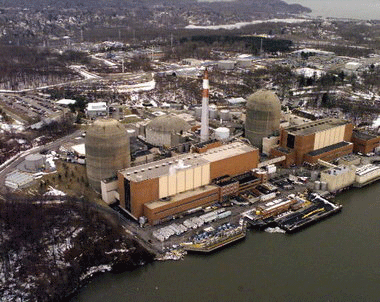
The plant’s problems are not isolated—leaks have been found at as many as 75% of U.S. nuclear plants. And closing Indian Point would put New York, and the U.S., in line with a sharp global move away from nuclear power following 2011’s meltdown at Japan’s Fukushima Daichi reactor. Japan shut down all of its nuclear plants after the disaster, and only began tentatively restarting a handful in 2015.
Countries including France and Germany have moved to similar phase-outs, with Germany in 2011 pledging to phase out all nuclear power by 2022. Austria and Spain have stopped all construction on new nuclear plants. The U.S. had not constructed a new nuclear power plant in nearly twenty years when, in October of 2015, a plant in Tennessee was given the go-ahead.
Nuclear plants represent huge threats to nearby areas, though the risk of a disaster at any one plant is small. While Stanford researchers have found that Fukushima’s fallout may directly cause only about 300 deaths worldwide, estimates of economic losses range from $250-$500 billion, stemming largely from the removal of 159,128 people from a zone the size of Connecticut—land which will be uninhabitable for centuries.
Fukushima prefecture had a population just short of two million at the time of the disaster. Indian Point sits just 25 miles north of New York City’s 8.5 million inhabitants, as well as real estate many times more valuable than that in northern Japan. During the Fukushima meltdown, the Japanese government established a 20 kilometer (12 mile) evacuation zone around the reactor—but the U.S. embassy recommended that Americans leave areas within 50 miles.
That suggests that a meltdown at Indian Point could lead to the evacuation of New York City. In addition to profound human costs, the immediate economic damage would run into many trillions of dollars. And it is no exaggeration to say that a threat to New York City is a threat to the entire U.S. economy, which it plays a key role in organizing……. http://fortune.com/2016/02/28/indian-point-end-of-nuclear-age/
Illegal dumping of nuclear waste in Kentucky
Drilling wastes containing concentrated but naturally occurring radio active materials made their way into Kentucky, state officials confirmed on Thursday. After learning in January that low-level nuclear waste from drilling operations had been dumped illegally in Kentucky last year, state officials are warning this week that all landfills be on the lookout and to not accept any of the radioactive material.
Kentucky Division of Waste Management Director Tony Hatton said officials have confirmed that low-level nuclear waste from drilling operations in Ohio, Pennsylvania and West Virginia was sent to a landfill in Estill County between July and November. Officials are also investigating possible illegal shipments of similar waste to a landfill in Greenup County……..http://www.courier-journal.com/story/tech/science/environment/2016/02/25/nuclear-waste-dumped-illegally-kentucky/80924622/
Takahama Nuclear reactor leaking radioactive water
 Nuclear reactor in Japan leaking radioactive water amid nationwide restart RT.com 21 Feb, 2016 A nuclear power station in Japan is leaking, this time the Takahama plant, about 380km west of Tokyo. The radioactive water leak comes amid a nationwide push to restart reactors after the catastrophic meltdown at Fukushima five years ago.
The reactor would have been the fourth to come on after the shutdown. The push by the government and utility companies came amid protests across Japan against the continued reliance on nuclear energy, prompted by failures to get the Fukushima crisis under control.
Now Kansai Electric Power says about 34 liters of radioactive water have escaped the plant’s reactor No. 4. An investigation is underway. “Resumption procedures related to the incident have been suspended as we are still investigating the cause,” a Kansai spokesman said, according to AFP……..
In March 2011, following the devastating tsunami and earthquake that shut down Fukushima Daiichi, the government introduced strict new safety checks. But, apparently, not every reactor lucky enough to pass the new standards was returned to normal operation.
In fact, two of Takahama’s reactors (3 and the currently leaking 4) were both given a ‘no’ by a local judge, who firmly sided with the people last April…….. https://www.rt.com/news/333154-nuclear-reactor-japan-leak/
 |
Click here to Reply or Forward
|
69 safety incidents and “near misses” on UK nuclear submarines
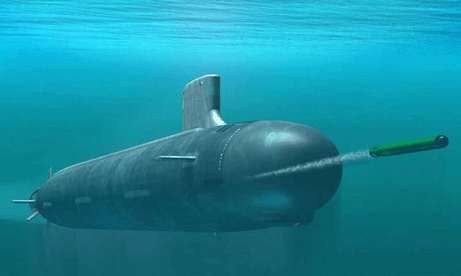 Reactor incidents on new nuclear subs double in one year, Herald Scotland, 21 Feb 16 The Royal Navy’s new nuclear-powered submarines have been plagued by 69 safety incidents and “near misses” over the last four years.
The Astute class of submarines based at Faslane on the Clyde has seen reported reactor incidents at sea or on shore almost double from 12 in 2014 to 21 in 2015. Though the MoD insists that the incidents are all minor, critics warn that they undermine the boats’ reliability and safety………
According to the independent nuclear engineer John Large, the submarines were suffering serious problems. “This continuing experience of the Astute class reactor problems not only imperils the boats when at sea but is likely to result in cutbacks to the number of patrols, voyage durations and the extent of roaming of the high seas,” he said.
John Ainslie, coordinator of the Scottish Campaign for Nuclear Disarmament, pointed out that Astute submarines had been involved in a series of mishaps, including running aground on the Isle of Skye. “It is only a matter of time before one of these incidents results in a serious nuclear accident,” he said……..http://www.heraldscotland.com/news/14291467.Reactor_incidents_on_new_nuclear_subs_double_in_one_year/
1 This Month

5 March -Online – Reversing nuclearization:
From nuclear weapons in Belarus and NATO host countries to a European-Nuclear-Weapon Free Zone
11am-12:30pm Eastern Time USA / 5pm-6:30pm CET

of the week – Advocating for a
nuclear free beach – https://www.samuellawrencefoundation.org/
The Samuel Lawrence Foundation advocates for a Nuclear Waste Free Beach at San Onofre, join us and take action!

10 March A LIVE WEBINAR THE REAL EFFECTS OF NUCLEAR POWER
What the Industry Isn’t Telling Us
1:00 PM Mountain, 2 pm Central, 3 pm Eastern. Live on the Keepers of the Water Facebook page


18 March Webinar @ 1 PM EST: An Assessment of SMR Projects: The Case of Canada
register for the zoom:
https://us02web.zoom.us/webinar/register/WN_o8BIIOUvQ2ONJR1nta65DQ#/registration

of the week – STOP SMALL MODULAR REACTORS IN CANADA
To see nuclear-related stories in greater depth and intensity – go to https://nuclearinformation.wordpress.com
-
Archives
- March 2026 (38)
- February 2026 (268)
- January 2026 (308)
- December 2025 (358)
- November 2025 (359)
- October 2025 (376)
- September 2025 (258)
- August 2025 (319)
- July 2025 (230)
- June 2025 (348)
- May 2025 (261)
- April 2025 (305)
-
Categories
- 1
- 1 NUCLEAR ISSUES
- business and costs
- climate change
- culture and arts
- ENERGY
- environment
- health
- history
- indigenous issues
- Legal
- marketing of nuclear
- media
- opposition to nuclear
- PERSONAL STORIES
- politics
- politics international
- Religion and ethics
- safety
- secrets,lies and civil liberties
- spinbuster
- technology
- Uranium
- wastes
- weapons and war
- Women
- 2 WORLD
- ACTION
- AFRICA
- Atrocities
- AUSTRALIA
- Christina's notes
- Christina's themes
- culture and arts
- Events
- Fuk 2022
- Fuk 2023
- Fukushima 2017
- Fukushima 2018
- fukushima 2019
- Fukushima 2020
- Fukushima 2021
- general
- global warming
- Humour (God we need it)
- Nuclear
- RARE EARTHS
- Reference
- resources – print
- Resources -audiovicual
- Weekly Newsletter
- World
- World Nuclear
- YouTube
-
RSS
Entries RSS
Comments RSS
 nuclear-news