Regulators to DOE: No more Hanford demolition until we say it’s safe http://www.tri-cityherald.com/news/local/hanford/article194318189.html, BY ANNETTE CARY, acary@tricityherald.com, January 11, 2018, Hanford regulators have ordered the Department of Energy not to restart demolition of the nuclear reservation’s highly radioactively contaminated Plutonium Finishing Plant until regulators agree the work can be done safely.
Demolition was stopped at the plant in mid December, after specks of radioactive contamination were discovered to have spread outside of a containment zone established around demolition work.
There is no estimate of when demolition of the plant may restart.The Washington State Department of Ecology and the Environmental Protection Agency notified DOE this week that they would use their authority under the legally binding Tri-Party Agreement to prevent a restart of work if they have concerns about the safety of the public or workers.
The Department of Ecology’s concerns have been growing as more is learned about the extent of the spread of radioactive contamination, said Alex Smith, manager of Ecology’s Nuclear Waste Program.
As recently as Jan. 3, more contamination was detected inside the radiological control area of the plant, indicating that the spread of contamination has not yet been controlled, EPA and Ecology officials said in a letter to DOE this week.
The contamination was found even though a pile of demolition rubble at the plant’s Plutonium Reclamation Facility was covered with fixative and soil multiple times, Ecology officials said.
Although the investigation of the contamination spread is continuing, the suspected source is the pile of rubble left from demolition of the Plutonium Reclamation Facility. The spread of contamination was found just hours after its demolition using heavy equipment was completed.
The facility was expected to be the most hazardous demolition work to be done at the Plutonium Finishing Plant. The facility, added to one end of the plant, was contaminated with plutonium that easily becomes airborne.
The halt to work covers both loading out rubble for disposal and the demolition of the remainder of the finishing plant.
Part of the plant that had the main plutonium processing lines remains standing. Plutonium came into the plant in a liquid solution and was formed into pucks and powder for shipment to the nation’s nuclear weapons production plants during the Cold War.
“We’re not going to go ahead until we are sure we can do it without another release,” Tom Teynor, DOE project director for the plant, said at a Hanford Advisory Board committee meeting Tuesday.
This week, in an abundance of caution, the control zone around the demolition project was expanded to include roughly eight times more area.
t includes not only the Plutonium Finishing Plant campus, but the U, TX and TY tank farms storing radioactive waste in underground tanks, and U Plant, one of five large processing facilities built at the Hanford nuclear reservation.
The access control area now includes several streets, including parts of 18th Street, Camden Avenue and Bridgeport Avenue, which are closed to traffic. Many specks of contamination had been found across Camden Street from the plant campus.
Access to other projects in the area must be approved by finishing plant officials, and no private vehicles are allowed. Instead, workers are driving government vehicles into work sites or are parking a mile away at the 200 West Pump and Treat facility and being shuttled to the plant in government vehicles.
By the latest figures, 16 government or contractor vehicles were found with specks of contamination, along with seven private vehicles. Surveying of government vehicles continues.
The private vehicle contamination was found in December — all on the exterior of the vehicles. No contamination was found at the homes of the seven workers.
The number of Hanford workers requesting checks to determine if they may have inhaled or ingested airborne specks of radioactive material had climbed to 269 by the end of the work week.
CH2M Plateau Remediation Co., the DOE contractor demolishing the plant, is bringing in corporate expertise as it studies the cause of the contamination spread to develop a plan to correct shortcomings before work resumes.
Doug Shoop, the manager of the DOE Hanford Richland Operations Office, is putting together a panel of independent experts to review the findings of the investigation and evaluate proposed actions to prevent another spread when demolition and load out work resumes.
The remaining demolition work is not expected to be as hazardous as the plant’s reclamation facility, but still includes some highly contaminated areas.
The Department of Ecology has asked to sit in on the expert panel discussions.
“We take this very seriously,” Teynor said. “The release was inexcusable. We are doing everything in our power to prevent it from happening again.”
Work this week has included adding soil to areas where specks of contamination were spread and applying fixative to contain any possible contamination, including to the roofs of buildings that support the demolition project.
With the plant taking longer to demolish than anticipated, more money will have to be found in the current fiscal year budget for the project.
That should not be a problem because the project is a priority, Teynor said.Annette Cary: 509-582-1533, @HanfordNews
Unusual Event’ Declared At Oyster Creek Nuclear Plant, Low water levels in plant’s water intakes were apparently caused by weather conditions from the recent storm Lacey Patch, By Patricia A. Miller, Patch Staff| LACEY TOWNSHIP, NJ– Control room operators at the Oyster Creek Nuclear Plant declared an “unusual event” early Saturday morning when water levels in the plant’s water intakes dipped too low, a spokesman for the Nuclear Regulatory Commission said.
Control room operators reduced reactor power to about 70 percent in response to the lower-than-normal water intake levels and will continue to monitor and evaluate conditions throughout the day, spokesman Neil Sheehan said
An “unusual event” is the lowest of the NRC’s four levels of emergency classification, he said.
Water from the intake canal is used for cooling purposes, doesn’t flow through radioactive materials and is discharged at higher temperatures to the outfall portion of the canal, Sheehan said.
While this number was much lower than the previous year, one incident was above the lowest level on the INES scale, for the first time since 2015.
The International Nuclear Events Scale (INES) has seven levels, Level 1 being the lowest.
In 2016 there were 15 nuclear incidents in Belgium, all on Level 1. While there were fewer incidents this year, one of these was on Level 2.
That incident took place in July, during the transport of poorly packaged radioactive material that had been sent on passenger flights from Cairo to Brussels via Zurich. Many passengers, including one Belgian, were potentially exposed to radiation above the prescribed limit, but without any significant consequences for their health.
One of the Level 1 incidents was at the Doel plant where a deterioration of the concrete was observed in October.
Suddeutsche Zeitung 29th Dec 2017, [Machine Translation]In the nuclear power plant Neckarwestheim a leak hasbeen discovered during a tour in Block II in the control area. This was
announced by the Ministry of the Environment on Friday in Stuttgart. As a
result of the leak on a pipeline behind a circulation pump discovered on 22
December, about 100 liters of radioactive concentrate had leaked into the
control area of the reactor auxiliary building. However, this has no or
only a very low safety significance, said the Ministry. The operator had
shut off the pump. The affected area had been decontaminated, people were
not harmed. The cause will be further investigated. The system will be out
of service until the repair is complete. http://www.sueddeutsche.de/news/wirtschaft/atomkraft—stuttgart-leck-in-rohrleitung-bei-atomkraftwerk-neckarwestheim-dpa.urn-newsml-dpa-com-20090101-171229-99-447002
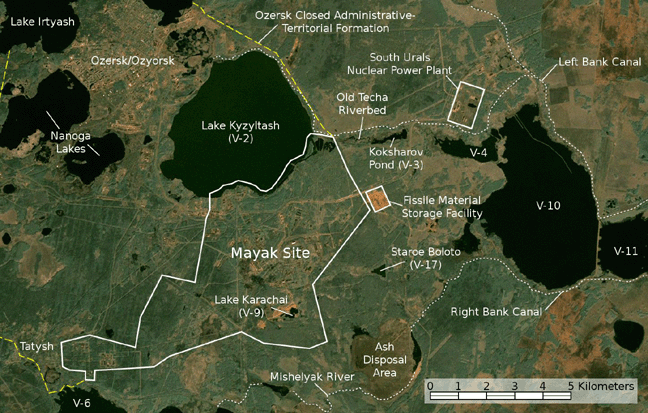
Environmentalists point the finger of blame at Mayak, the plant to process Kola’s Cold War legacy,ByThomas Nilsen, – Barents Observer 30th Nov 2017
A mysterious cloud of radioactive ruthenium-106 blowing over Europe earlier
this autumn triggered many speculations about Russia trying to
‘cover-up’ a leak from the country’s largest nuclear waste treatment
facility.
Nadezhda Kutepova a local environmentalists from the closed city
of Ozyorsk near Mayak who was forced to flee Russia in 2015, now reveals
more inside information. Kutepova says Mayak was testing new equipment on September 25 and 26 at the reprocessing plant and that something abnormal
may have happened.«Emission of ruthenium may come from the reprocessing
plant 235 or RT-1 in Mayak where the vitrification plant for very
high-level nuclear waste is located,» Kutepova tells.
She points to the new vitrification furnace which started operation last December and
experienced problems during construction and testing. «My idea is that the
furnace was built with a lot of problems that emerge in the operation and I
think this is the cause of the ruthenium-106 leak we saw in September,»
she explains.
Mayak has loads of high-level liquid radioactive waste that
needs to be stabilized and made safer and starting the new plant was,
according to Kutepova, rather urgent. She calls the equipment bought for
the electric furnace «low-quality» https://thebarentsobserver.com/en/node/3260
Bastamag 1st Dec 2017 [Machine translation]A new accident reveals serious dysfunctions in terms
of nuclear safety in France. In March 2016, during a replacement operation,
a 465-ton steam generator fell in the heart of the Paluel nuclear power
plant in Normandy. A serious and unprecedented accident, which miraculously
does not cause serious injury or radioactive contamination. Since then,
experts have investigated the causes of the accident.
Consulted by Bastamag, their report, the conclusions of which will be summarized to
employees this 1st of December, reveals major dysfunctions in the
preparation and supervision of the site, largely related to the massive use
of subcontracting. Disturbing faults, while the renovation projects of the
power stations will multiply. https://www.bastamag.net/Un-accident-inedit-revele-de-graves-dysfonctionnements-en-matiere-de-surete
North Korean test caused 6.3 magnitude earthquake injuring up to 150 children Explosion triggered aftershocks in North Hamgyong Province within minutes State defectors South and North Development revealed the fatalities today Devastation hit farms, destroyed home and gave soldiers radiation sickness Regime accused of not warning locals of the imminent nuclear missile tests Pupils injured in the earthquake were in class as usual when it hit their school
By Sebastian Murphy-bates For Mailonline 27 November 2017 Dozens were killed when North Korean dictator Kim Jong-un’s most powerful nuclear missile test yet caused buildings to collapse.
Houses and a school near his nuclear base at Punggye-ri were brought down when his tests caused a 6.3 magnitude earthquake injuring up to 150 pupils in North Hamgyong Province.
This explosion triggered aftershocks within eight minutes, hitting structures in a nearby village.
Authorities finally admit that Argayash was at the centre of a radiation cloud. Henry Foy in Argayash , 24 Nov 17
Argayash is a cynical, mistrustful town. Decades of being lied to by the government about being down the road from a leaking nuclear plant does that to a place. So too does watching generations of people dying of radiation-related ailments while officials assure them nothing is amiss.
A small, two-road settlement where homes roofed with corrugated iron and Soviet-era Lada cars nod to its poverty, Argayash is one of a handful of towns surrounding the Mayak Production Facility in southern Russia, one of the world’s biggest radiation emitters where a litany of tragic accidents has made it a byword for the dangers of the atomic industry.
This week, 76 years after radiation first began seeping from Mayak into the surrounding rivers, lakes and atmosphere, Russian authorities admitted that Argayash was at the centre of a radiation cloud containing “exceptionally high” levels of radioactive isotope ruthenium-106, which spread so far west that it reached France. The radiation was detected by Russia’s meteoological agency in late September, but only revealed on Monday, after local politicians had spent weeks denying rumours of a leak and rubbishing reports from EU agencies that had tracked the cloud’s movement.
The levels of the isotope in Argayash were almost 1,000 times the normal level. Officials say it is not harmful to public health. “Nobody tells us anything. They keep it secret,” says Lilia Galimzhanova, a cook at a café in the town. “We are afraid. We are afraid for our children and grandchildren.” “But we know that the air, the environment is very bad here,” she says. Her 80-year-old mother suffers from radiation poisoning from Mayak. “We are not protected by anyone here . . . We are survivors.”
The source of the leaked isotope, which does not occur naturally and is produced during the processing of nuclear fuel, has not been confirmed. Rosatom, which operates the Mayak facility, has repeatedly denied it is to blame. “[Mayak] is not a source of increased content of ruthenium-106 in the atmosphere,” Rosatom said in a statement. On Thursday, the company published a message poking fun at journalists on its Facebook page, inviting them to tour the plant, which it sarcastically dubbed “the cradle of ruthenium”. The local region’s chief oncology specialist has told concerned residents to stop worrying, advising them to instead “watch football and drink beer”.
But local residents see little to laugh about. Many scoff at official denials, having heard similar for decades, even as they watched family and friends die from radiation-related ailments. “We are not told anything about Mayak,” says Nadia, an 18-year-old medical student living in the town, 1,700km east of Moscow. “The government should not keep things secret when people suffer.” “People in the west know more about this than we do here,” she adds.
Ms Galimzhanova only heard of the radiation that had enveloped her town when a friend in Germany read about it in a western newspaper. Before the authorities admitted its existence, text messages had been sent to residents saying that high levels of pollution from nearby industrial factories meant people should stay indoors. Regardless of the potential health risks, many here say the government’s initial silence, denial and obfuscation has dredged up painful memories of a past that refuses to stay buried. Secretly constructed in the 1940s, Mayak was at the forefront of the USSR’s scramble to catch up with the US nuclear programme. As it raced to produce weapons-grade plutonium, a vast amount of nuclear waste was discharged into nearby lakes and the Techa river. Then, in 1957, nuclear waste storage tanks at the site exploded, raining fallout over hundreds of towns — and releasing more radiation than any other nuclear accident except Chernobyl and Fukushima. Ten years later, an adjacent reservoir used for waste disposal dried out, and powdered radioactive dust was blown over the area.
Not that local people were evacuated, or even warned: Mayak’s very existence was only acknowledged in the late 1980s, as information began to circulate about the long-term contamination. An estimated 450,000 were exposed to radiation from the accidents and the discharging of waste into the water supply, Russian authorities said in 1993, making Mayak one of the world’s biggest sources of harmful radiation. But anti-nuclear campaigners say safety breaches continued: a 2005 court case revealed nuclear waste was still being dumped into rivers as late as 2004, while Rosatom only sealed off the radioactive lake that caused the 1967 disaster in 2015.
An estimated 450,000 were exposed to radiation from the accidents and the discharging of waste into the water supply, Russian authorities said in 1993, making Mayak one of the world’s biggest sources of harmful radiation. But anti-nuclear campaigners say safety breaches continued: a 2005 court case revealed nuclear waste was still being dumped into rivers as late as 2004, while Rosatom only sealed off the radioactive lake that caused the 1967 disaster in 2015.
“Previous experience has taught us that they lie and suppress information,” said Andrey Talevlin, co-chairman of the Russian Social-Ecological Union NGO. “We can’t trust what they say, whether they mislead the population on purpose or not.”
Mr Talevlin, an academic and environmental activist who this week was branded a “foreign agent” by Russian state TV after he called for an investigation into the ruthenium leak, says that suppression of anti-nuclear groups in Russia has rapidly increased over the past two decades. A fellow activist, Nadezhda Kutepova, fled to France in 2015 seeking political asylum after a similar media campaign accused her of “industrial espionage”. President Vladimir Putin’s spokesman said this week that the Kremlin has “no information” regarding any possible causes of the radiation. And some in Argayash say it is little more than an occupational hazard of living in one of Russia’s most industrialised regions.
The authorities say they do not know anything about it. And we must trust them,” says Jamshed, who runs a greengrocer on the town’s main Lenin Street. “Nobody has proven anything. And even if something is proved, I am sure our government will immediately take measures,” he says, looking over his locally-grown vegetables.
Problems persist a decade after discovery of chronic radioactive leaks Chicago Sun Times, 11/19/2017, Brett Chase and Madison Hopkins | Better Government Association More than a decade after the discovery of chronic leaks led to national outrage, a $1.2 million government settlement and a company vow to guard against future accidents, an investigation by a government watchdog group found.
Since 2007, there have been at least 35 reported leaks, spills or other accidental releases in Illinois of water contaminated with radioactive tritium, a byproduct of nuclear power production and a carcinogen at high levels, a Better Government Association review of federal and state records shows.
No fines were issued for the accidents, all of which were reported by the company.
The most recent leak of 35,000 gallons occurred over two weeks in May and June at Exelon’s Braidwood plant, southwest of Chicago. The same facility was the focus of a community panic in the mid-2000s after a series of accidents stirred debate over the safety of aging nuclear plants.
A 2014 incident at Exelon’s Dresden facility in Grundy County involved the release of about 500,000 gallons of highly radioactive water. Contamination was later found in the plant’s sewer lines and miles away in the Morris, Ill., sewage treatment plant……..
Industry watchdogs and government whistleblowers contend oversight is compromised by a cozy relationship between companies and the NRC.
Government regulators concede they must balance the safety needs of aging plants, which require more maintenance, versus ordering cost-prohibitive upgrades at facilities that inherently are just a slip-up away from catastrophe.
No player in the nuclear industry is bigger than Exelon, the Chicago-based energy company that last year reported $31 billion in revenue and operates 14 nuclear plants in Illinois, New York, New Jersey, Pennsylvania and Maryland.
Five of the six Illinois plants reported leaks over the last decade, records show. Clinton, in DeWitt County, had no leaks and Byron, in Ogle County, reported only one that contained low levels of radioactivity…….
At least seven of the 35 documented accidents since 2007 involved contamination of groundwater. Other contamination was found in sewers and other water systems where it isn’t supposed to be………
The BGA investigation also found:
Of the 35 documented incidents, 27 occurred at Dresden. Following the big 2014 leak, which emanated from an aboveground storage tank, Exelon asked a state inspector whether the public would have access to the incident report under open records laws, a state report showed.
An NRC report on the 2007 Quad Cities leak noted radiation levels went “well beyond that seen anywhere else in the industry” and that plant staff estimated the leak had been active for years before it was discovered.
In 2010, Exelon’s Marseilles generating plant in LaSalle County reported a spill from a storage tank, initially estimated at more than 150 gallons but later classified as “unknown.” Groundwater tritium tests later showed levels 59 times the EPA’s drinking water limit. Exelon said no tritium left the plant’s boundaries, but records show plant workers continued to monitor a body of highly contaminated groundwater sitting on plant property at least five years after the accident.
In 2009, Dresden reported another hole in a storage tank led to a leak of as much as 272,000 gallons of radioactive water. Onsite groundwater testing showed levels of tritium 160 times higher than allowed under federal standards for drinking water.
Probe Finds Ongoing Radioactive Leaks at Illinois Nuclear Plants VOA News, 17 Nov 17, Radioactive waste continues to pour from Exelon’s Illinois nuclear power plants more than a decade after the discovery of chronic leaks led to national outrage, a $1.2 million government settlement and a company vow to guard against future accidents, an investigation by a government watchdog group found.
Since 2007, there have been at least 35 reported leaks, spills or other accidental releases in Illinois of water contaminated with radioactive tritium, a byproduct of nuclear power production and a carcinogen at high levels, a Better Government Association review of federal and state records shows.
No fines were issued for the accidents, all of which were self-reported by the company.
The most recent leak of 35,000 gallons (132,000 liters) occurred over two weeks in May and June at Exelon’s Braidwood plant, southwest of Chicago. The same facility was the focus of a community panic in the mid-2000s after a series of accidents stirred debate over the safety of aging nuclear plants.
A 2014 incident at Exelon’s Dresden facility in Grundy County involved the release of about 500,000 gallons (1,900,000 liters) of highly radioactive water. Contamination was later found in the plant’s sewer lines and miles away in the Morris, Illinois, sewage treatment plant.
Another leak was discovered in 2007 at the Quad Cities plant in Cordova. It took eight months to plug and led to groundwater radiation readings up to 375 times of that allowed under federal safe drinking water standards.
Exelon had threatened to close the Quad Cities plant, but relented last year after Gov. Bruce Rauner signed bailout legislation authorizing big rate hikes……..
David Lochbaum, an analyst with the nonprofit Union of Concerned Scientists, says “Leaks aren’t supposed to happen. Workers and the public could be harmed. There is a hazard there.”
Among the 61 nuclear power plants operating in the U.S., more than half have reactors that are at or near the end of their originally expected lifespans — including the Dresden and Quad Cities plants.
World War 3: US military command ‘ERROR’ sent North Korea ‘false nuclear arsenal’ info
US MILITARY command tweeted false information about its nuclear arsenal sparking fears of an escalation from paranoid North Korea. Express UK, By TARYN TARRANT-CORNISHAn article that falsely boasted of “secret” US silos and B-1 bombers that can drop nuclear warheads was quickly debunked by experts online.
It is feared this move could lead to a catastrophic escalation of tensions with a military force seeming to confirm Pyongyang’s suspicions that B-1s can carry nukes, Asian security expert Van Jackson has warned.
The article that US Strategic Command shared said: “The USS Kentucky is part of what is called the ‘nuclear triad’.
“The triad are the three components of a nuclear defence system: land-based missiles fired from secret silos, B-1 bombers that can drop them from the air, and submarine launched ballistic missiles.” This could provoke a retaliation from North Korea next time the US flies a B-1 bomber over the Korean peninsula, it is feared.
The collapse happened at the Punggye-ri nuclear test site in the northeast of the country on October 10, according to Japan’s TV Asahi. The disaster has prompted fears of a massive radioactive leak which could spark a Chernobyl- or Fukushima-style disaster, The Sun reported.
A North Korean official said the collapse happened during the construction of an underground tunnel, South Korea’s Yonhap news agency reports.
Some 100 people are said to have been trapped by the initial tunnel collapse, with a further 100 lost in a second collapse during a rescue operation, Asahi reported.
Lee Eugene, a spokeswoman at South Korea’s unification ministry, said: “We are aware of the report but do not know anything about it.”
The accident is believed to have been caused by Kim Joing-un’s sixth nuclear test which weakened the mountain, according to the report. It was reported earlier this year that the mountain under which the base is believed to be hidden was at risk of collapsing and leaking radiation into the region.
Experts said if the peak crumbles, clouds of radioactive dust and gas would blanket the region, the South China Morning Post reported.
The Punggye-ri test site is carved deep into the side of Mount Mantap. Geophysicist Wen Lianxing and his team at the University of Science and Technology of China in Hefei, Anhui province, said they were “confident” underground detonations were occurring underneath the mountain.
They posted an analysis of data collected from more than 100 seismic monitoring sites across China.
This has narrowed down the location of Pyongyang’s nuclear tests with a margin of error of just 100m. They’ve all been under the same mountain.
Seismic data showed the underground test triggered an earthquake of magnitude 6.3, around 10 times more powerful than the fifth test a year ago.
Satellite images showed the blast caused numerous landslides around the Punggye-ri test site, according to the Washington-based 38 North monitoring project.
But Chinese nuclear weapons researcher and chair of the China Nuclear Society Wang Naiyan told the Morning Post a collapse could spark a major environmental disaster.
He said: “We call it ‘taking the roof off’. If the mountain collapses and the hole is exposed, it will let out many bad things.
“A 100 kiloton bomb is a relatively large bomb. The North Korean government should stop the tests as they pose a huge threat not only to North Korea but to other countries, especially China.”
Satellite photos taken just a day after the blast reveal new gravel and scree fields shaken loose by the blasts at an elevation of about 2205m.
Analysts said these appeared more numerous and widespread than those caused by previous detonations — which would be in keeping with the increased size of the bomb.
Wang said there are limited mountains in North Korea that are “suitable” to conduct a nuclear test.
He said if the North had simply drilled into the side of the mountain, this increased the risk of “blowing the top off”.
News of the tunnel collapse comes after it emerged Russia and the US have both flown nuclear bombers near the country as tensions grow over Kim’s nuke threats.
Nuclear devices are often tested underground to prevent radioactive material released in the explosion reaching the surface and contaminating the environment.
This method also ensures a degree of secrecy.
A test site is carefully geologically surveyed to ensure suitability — usually in a place well away from population centres.
The nuclear device is placed into a drilled hole or tunnel usually between 200-800m below the surface, and several metres wide.
A lead-lined canister containing monitoring equipment is lowered into the shaft above the chamber.
The hole is then plugged with gravel, sand, gypsum and other fine materials to contain the explosion and fallout underground.
The release of radiation from an underground nuclear explosion — an effect known as “venting” — would give away clues to the technical composition and size of a country’s device.
British navy sailors on nuclear Trident submarine fired after failing drug tests, ABC News, 29 Oct 17,Britain’s navy has fired nine sailors serving on a nuclear-armed submarine after they tested positive for cocaine, the country’s defence ministry says.
The crew were from HMS Vigilant, one of four Royal Navy submarines which operate the Trident nuclear missile system.
“We do not tolerate drugs misuse by service personnel. Those found to have fallen short of our high standards face being discharged from service,” a Royal Navy spokesman said.






 nuclear-news