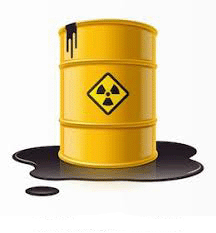
60,000 tons of dangerous radioactive waste sits on Great Lakes shores Keith Matheny, Detroit Free Press Oct. 19, 2018 “……… Fukushima and ‘The Devil’s Scenario’
On March 11, 2011, following a magnitude-9.0 earthquake and an ensuing, 50-foot tsunami, the Fukushima Daiichi nuclear power plant in Japan lost cooling capabilities for four of its six reactors. The cores became damaged and radiation was released into the atmosphere, making it the world’s second-worst nuclear power industry accident after Chernobyl.
But it’s what happened — or almost happened — at the plant’s Unit 4 spent-fuel pool that gives nuclear watchdogs nightmares.
A hydrogen explosion four days into the disaster left the building housing the Unit 4 spent-fuel pool in ruins. The pool was seven stories up in a crumbling, inaccessible building.
It “was so radioactive, you couldn’t put people up there,” von Hippel said. “For about a month after Fukushima, people didn’t know how much water was in the pool. They were shooting water up there haphazardly with a hose, trying to drop it by helicopter.”
Two weeks after the earthquake and tsunami, the Japanese Atomic Energy Commission secretly conducted a worst-case scenario study of the ongoing disaster. The biggest fear that emerged: that a self-sustaining fire would start in the Unit 4 spent fuel pool, spreading to the nearby, damaged reactors. That, they found, would release radiation requiring evacuations as far away as 150 miles, to the outskirts of Tokyo and its more than 13.4 million residents.
“That was the devil’s scenario that was on my mind,” Chief Cabinet Secretary Yukio Edano said during a special commission’s 2014 investigation of the accident.
“Common sense dictated that, if that came to pass, then it was the end of Tokyo.”
The worst-case-scenario report was not released for nearly a year. “The content was so shocking that we decided to treat it as if it didn’t exist,” the Japan Times quoted a senior Japanese government official as saying in January 2012.
What kept the spent fuel rods covered with water in Unit 4 was a miraculous twist of fate: The explosion had jarred open a gate that typically separated the Unit 4 spent fuel pool from an adjacent reactor pool.
“Leakage through the gate seals was essential for keeping the fuel in the Unit 4 pool covered with water,” a 2016 report on the Fukushima accident by the U.S. National Academies of Sciences, Engineering and Medicine concluded.
“Had there been no water in the reactor well, there could well have been severe damage to the stored fuel and substantial releases of radioactive material to the environment.”
It’s a startling “very near-miss,” said Gordon Thompson, executive director of the Institute for Resource and Security Studies in Cambridge, Massachusetts.
Workers who trudged through nuke plant contributed to June uranium leak, report says, The Island Packet, BY SAMMY FRETWELL, sfretwell@thestate.com, October 11, 2018
Workers at the Westinghouse nuclear fuel factory for years walked across a plastic liner that was supposed to keep toxic uranium acid from leaking out of the Lower Richland plant.
All that foot traffic eventually weakened the liner, which covered the plant’s concrete floor. And this summer, Westinghouse discovered that a uranium solution had seeped through the liner, eaten a hole in the plant’s floor and trickled into the earth.
Westinghouse wasn’t conducting detailed inspections to find problems in a section of the plant where toxic acid is mixed for production of nuclear fuel rods, the federal inspection report shows. That acidic solution deteriorated concrete after it seeped onto the plant’s floor for a “prolonged” period of time, the report said.
The report said several safety systems, designed to contain leaks, failed. As a result, “hydrofluoric acid solution was spilled’’ on June 16 from a process tank through the floor.
“They were not doing their maintenance inspections correctly or adequately,’’ Tom Vukovinsky, a senior fuel facility inspector with the NRC, said of Westinghouse.
The NRC’s findings add to a series of questions raised this year about how Westinghouse has operated the 550,000-square-foot factory.
Was Three a Near-Fukushima Event on the Atlantic During Hurricane Florence? ObRag, Ocean Beach California by MICHAEL STEINBERG on OCTOBER 10, 2018Nuclear Shutdown News for September 2018 Black Rain PressNuclear Shutdown News chronicles the decline and fall of the nuclear power industry in the US and beyond, and highlights the efforts of those working for a nuclear free future. Here is our September 2018 report.
A Near-Fukushima on the Atlantic?
On September 17 the Raleigh News & Observerreported, “Floods limit access to Duke’s Brunswick nuclear plant: crews us partopotties, cots.”
Did the Atlantic coast have a near-Fukushima event when during September Hurricane Florence made landfall? Utility Duke Energy’s Brunswick two nuclear reactors are located 30 miles south of Wilmington, NC, where the former Category 4 hurricane made landfall as a tropical storm in mid September.
It was reported that “workers are sleeping on cots and using portable toilets because the water is currently shut off and the toilets can’t flush”, and that there was “limited access to the plant, and some workers have been able to leave the site and check up on their homes nearby. After the storm passed some drove to a Walmart in Southport to stock up on provisions.”
Brunswick’s twin reactors started up in the 1940s, and are now approaching their designed operating life, 40 years. They are called boiling water reactors, the same model as the three Fukushima reactors that melted down in 2011, and were built by the same company, General Electric.
US nuclear plants are required to shut down if hurricane force winds, 73 miles per hour or higher, are moving in. Fortunately the winds weren’t quite that strong when Florence hit the East Coast.
Numerous nuke plants in the Carolina and Virginia were in the storm’s path. But only Brunswick reduced power. The “plant declared an ‘Unusual Event,’ the lowest level of nuclear emergency,” according to the News & Observer.
The Nuclear Regulatory Commission reported, “Flooding of roads and downed trees prevented fresh crews from relieving the nearly 300 Duke Energy ‘storm riders’ who had been on site for days. And the blocked roads made it impossible to reach the 10 mile emergency evacuation zone if a higher level emergency is declared”
The Tip of the Radiation Disaster Iceberghttps://www.counterpunch.org/2018/08/31/the-tip-of-the-radiation-disaster-iceberg/ byJOHN LAFORGE The World Nuclear Association says its goal is “to increase global support for nuclear energy” and it repeatedly claims on its website: “There have only been three major accidents across 16,000 cumulative reactor-years of operation in 32 countries.” The WNA and other nuclear power supporters acknowledge Three Mile Island in 1979 (US), Chernobyl in 1986 (USSR), and Fukushima in 2011 (Japan) as “major” disasters. ¶ But claiming that these radiation gushers were the worst ignores the frightening series of large-scale disasters that have been caused by uranium mining, reactors, nuclear weapons, and radioactive waste. Some of the world’s other major accidental radiation releases indicate that the Big Three are just the tip of the iceberg.
CHALK RIVER (Ontario), Dec. 2, 1952: The first major commercial reactor disaster occurred at this Canadian reactor on the Ottawa River when it caused a loss-of-coolant, a hydrogen explosion and a meltdown, releasing 100,000 curies of radioactivity to the air. In comparison, the official government position is that Three Mile Island released about 15 curies, although radiation monitors failed or went off-scale.
ROCKY FLATS (Colorado), Sept. 11, 1957: This Cold War factory produced plutonium triggers for nuclear weapons 16 miles from Denver. It caused 30 to 44 pounds of breathable plutonium-239 and plutonium-240 to catch fire in what would come to be known as the second largest industrial fire in US history. Filters used to trap the plutonium were destroyed and it escaped through chimneys, contaminating parts of Denver. Nothing was done to warn or protect downwind residents.
WINDSCALE/SELLAFIELD (Britain), Oct. 7, 1957: The worst of many fires burned through one reactor igniting three tons of uranium and dispersed radionuclides over parts of England and northern Europe. The site was hastily renamed Sellafield. Another large radiation leak occurs in 1981and leukemia rates soared to triple the national average.
KYSHTYM/CHELYABINSK-65 (Russia), Sept. 29, 1957: A tank holding 70 to 80 metric tons of highly radioactive liquid waste exploded, contaminating an estimated 250,000 people, and permanently depopulating 30 towns which were leveled and removed from Russian maps. Covered up by Moscow (and the CIA) until 1989, Russia finally revealed that 20 million curies of long-lived isotopes like cesium were released, and the release was later declared a Level 6 disaster on the International Nuclear Event Scale. The long covered-up explosion contaminated up to 10,000 square miles making it the third- or 4th-most serious radiation accident ever recorded.
SANTA SUSANA (Simi Valley, Calif.), July 12, 1959: The meltdown of the Sodium Reactor Experiment just outside Los Angeles caused “the third largest release of iodine-131 in the history of nuclear power,” according to Arjun Makhajani, President of the Institute for Energy & Environmental Research. Released radioactive materials were never authoritatively measured because “the monitors went clear off the scale,” according to an employee. The accident was kept secret for 20 years.
CHURCH ROCK (New Mexico), July 16, 1979: Ninety-three million gallons of liquid uranium mine wastes and 1,000 tons of solid wastes spilled onto the Navajo Nation and into Little Puerco River, and nuclear officials called it “the worst incident of radiation contamination in the history of the United States.” The Little Puerco feeds the Little Colorado River, which drains to the Colorado River, which feeds Lake Mead—a source of drinking water for Los Angeles.
TOMSK-7 (Russia), April 7, 1993: In “the worst radiation disaster since Chernobyl,” Russian and foreign experts said a tank of radioactive waste exploded at the Tomsk nuclear weapons complex and that wind blew its plume of radiation toward the Yenisei River and 11 Siberian villages, none of which were evacuated.
MONJU (Japan), Dec. 8, 1995: This sodium-cooled “breeder reactor” caused a fire and a large leak of sodium coolant into the Pacific. Liquid sodium coolant catches fire on contact with air and explodes on contact with water. Costly efforts to engineer commercial models have failed. Japan’s Monju experiment was halted in 2018 after over 24 years of false starts, accidents and cover-ups.
TOKAI-MURA (Japan), Sept. 30, 1999: A uranium “criticality” which is an uncontrolled nuclear chain reaction caused a “neutron burst” that killed three workers and dispersed neutron radiation throughout the densely populated urban area surrounding the factory.
Not to be slighted, deliberate contamination has also been enormous: Five metric tons of plutonium was dispersed over the earth by nuclear bomb testing, and other nuclear weapons processes; Over 210 billion gallons of radioactive liquids were poured into the ground at the Hanford reactor complex in Washington State; and 16 billion gallons of liquid waste holding 70,000 curies of radioactivity were injected directly into Idaho’s Snake River Aquifer at the Idaho National Lab.
More leaks discovered at troubled SC nuclear fuel factory; feds investigating, The State.com BY SAMMY FRETWELL, sfretwell@thestate.com August 31, 2018 HOPKINS
The U.S. Nuclear Regulatory Commission will take a closer look at a troubled nuclear fuel factory on Bluff Road as information surfaces about leaks that date back at least a decade, federal officials said.
NRC officials said they have learned about leaks from 2008 that were not reported to the agency by Westinghouse, the owner and operator of the 49-year-old atomic fuel assembly plant. The NRC said it should have been told about the pollution leaks, even though notice was not always legally required.
To learn more, the NRC will reopen an environmental study of whether the Westinghouse facility poses a danger to Richland County if the company receives a new operating license, agency officials said at a community meeting Thursday night in Hopkins.
Westinghouse is seeking a 40-year license, but the NRC must satisfy federal concerns before the agency can make a decision on the Westinghouse request. The NRC completed an environmental study in June that said the plant does not pose a major hazard to the surrounding environment, even though the facility has had past problems.
“We are going to be asking for additional information from Westinghouse on the various leaks,’’ said Brian Smith, a deputy director for safety and environment at the NRC’s Maryland headquarters.
After the meeting, Smith told The State the decision to reopen the environmental study “was based on new information,’’ including leaks tied to a 2011 uranium spill beneath the plant. The NRC has said it did not know about the 2011 uranium spill until the fall of 2017.
Now, it has learned of pipe breaks in the same area beneath the plant that occurred in 2008, said Smith and Tom Vukovinsky, a senior fuel facility inspector with the NRC in Atlanta. Westinghouse disclosed this information to the NRC amid growing questions about the 2011 leak, officials said.
“They identified a couple of previous leaks,’’ Smith said. “Westinghouse, in responding to all the recent events, has started going back through their records and made us aware of this.’’
The 2008 pollution leaks are the third to surface publicly this summer. In July, the NRC learned that uranium drained through a hole in the floor of the plant building. The NRC’s environmental report in June mentioned the 2011 uranium leak that had not been reported. In examining the circumstances surrounding the 2011 spill, leaks from 2008 were discovered, according to the NRC.
A consultant’s letter, obtained Friday by The State, indicates that a broken pipe spilled radioactive material into the soil in 2008. The letter said Westinghouse found “elevated radionuclide concentration’’ in both process wastewater from the plant and the soil. The company then fixed the pipe, the letter said. Three years later, contamination was found in the soil after Westinghouse discovered pipes were “highly corroded,’’ according to the May 31 letter from consultant AECOM to DHEC.
Uranium is a radioactive material used in the production of nuclear fuel. People exposed to significant amounts of uranium can suffer kidney damage or other ailments. A key unanswered question about all the spills is how much leaked into the ground.
The NRC’s decision to reopen the environmental study is significant because it delays an agency decision on whether to grant the new license, which would keep the plant operating another 40 years. Depending on what the agency learns about leaks, the NRC could shorten the time the license is good for or take enforcement action against Westinghouse.
Thursday’s announcement was welcome news to many in the crowd gathered at a county building adjacent to Lower Richland High School………..
The plant, however, has had plenty of troubles through the years. It has had dozens of run-ins with the NRC over nuclear safety issues and has polluted groundwater on the site. Some of the groundwater pollution has existed since the 1980s. Efforts to clean up groundwater have not succeeded in ridding the site of contamination. …….
Citizens have since formed their own committee to monitor Westinghouse. The area near the site is composed of a mixture of modest homes and exclusive hunt clubs. The site is on Bluff Road between Congaree National Park and Interstate 77, just outside Columbia. https://www.thestate.com/latest-news/article217622890.html
Unfinished nuclear fuel plant had water leak NHK, 28 Aug 18The operator of a nuclear fuel reprocessing plant under construction in northern Japan says it found a water leak earlier this month at one of its facilities.
Japan Nuclear Fuel says an employee spotted the leak in the pipes of a storage pool at the plant in Rokkasho Village, Aomori Prefecture.
The operator found that the pipes were corroded in 20 places and one of them had a hole. They are located outdoors and used for inspections.
Russia is gearing up to search for a missing nuclear-powered cruise missile that was lost at sea during a failed test-fire last year.
Russian President Vladimir Putin has boasted about the weapon’s advanced capabilities, but all tests have reportedly ended in failure.
While the missile is supposed to be able to fly indefinitely, its nuclear-powered core has yet to initiate to allow it to do that.
Russia lost a nuclear-powered missile during a failed test last year, and now Moscow is gearing up to go find it, according to CNBC, citing people familiar with a relevant US intelligence report.
Proudly claiming that the world will “listen to us now”, Russian President Vladimir Putin boasted in early March that his country had developed a new nuclear-powered cruise missile with unlimited range, but each of the four tests between November 2017 and February reportedly ended in failure, according to reports from May.
“The low-flying, stealth cruise missile with a nuclear warhead with a practically unlimited range, unpredictable flight path and the ability to bypass interception lines is invulnerable to all existing and future missile defence and air defence systems,” Putin claimed. “No one in the world has anything like it,” he added.
The reports from testing don’t support the Russian president’s claims.
The longest recorded flight, according to US assessments, lasted only a little over two minutes. Flying just 35km, the missile spun out of control and crashed. In each case, the nuclear-powered core of the experimental cruise missile failed, preventing the weapon from achieving the indefinite flight and unlimited range the Russian president bragged about.
The tests were apparently conducted at the request of senior Kremlin officials despite the protests of Russian engineers who argued that the platform was not ready for testing. Russian media reports claim the weapon will be ready to deploy in ten years.
During one weapons test in November of last year, the missile crashed into the Barents Sea. Three ships, one with the ability to handle radioactive material, will take part in the search operations, which have yet to be officially scheduled.
Experts are concerned about the possibility that the missile may be leaking radioactive nuclear material. The missile is suspected to rely on gasoline for takeoff but switch to nuclear power once in flight.
by Task and PurposeBrad Howard 24 Aug 18, In the worst reboot of The Hunt For Red October we’ve ever heard, Russia has lost a secretive nuclear-powered cruise missile at sea during a failed test in the last several months, CNBC reports .
– Citing an unnamed U.S. intelligence official, CNBC reports that that Russian military lost one of the four cruise missiles used during tests conducted over the Barents Sea between last November and February, all of which ended in failure.
– The status of the missile and its nuclear fuel is unknown, and its disappearance has reportedly triggered an all-out search in the Barents Sea north of Scandinavia by Russian military personnel. According to CNBC, the four test flights ranged from five miles to twenty-two miles.
– While it’s currently unclear which launch resulted in the lost missile, U.S. Air Force nuclear-sniffing WC-135 ‘Constant Phoenix’ aircraft were active in the Barents Sea and Baltic Sea from March to August of this year, with a Russian fighter intercepting one of the aircraft over the Baltic Sea on August 8.
– This missile, one of many doomsday devices touted by Russian President Vladimir Putin’s government during Moscow’s last showcase of new military capabilities, is purportedly capable of loitering as an unmanned second-strike platform that can remain in the air for an extended period of time over a virtually unlimited range.
Obviously, the cruise missile could cause an environmental catastrophe if the reactor is breached . But besides the stupidity of losing a bunch of nuclear material in the middle of the open ocean, the incident reveals the short-sighted nature of nuclear-powered cruise missiles at all: they cause environmental devastation, they’re horribly expensive, and decommissioning them is a virtual nightmare. It makes little sense for Russia to even test the damn things since the Ministry of Defense has such an effective nuclear deterrent in place already.
Frankly, a nuclear-powered cruise missile is a 1950s dream that goes against all logic in a world with hundreds of ICBMs tipped with multiple independently-targetable reentry vehicles, all of which can kill a city.
Russia is preparing to search for a nuclear-powered missile that was lost at sea months ago after a failed test, CNBC 221 Aug 18
Moscow is preparing to recover a nuclear-powered missile lost at sea, according to sources with direct knowledge of a U.S. intelligence report.
Russian President Vladimir Putin bragged earlier this year that the new missile had unlimited range.
The missile was tested four times between November and February, each resulting in a crash, according to sources who spoke to CNBC on the condition of anonymity.
Amanda Macias | @amanda_m_macias ………..Crews will attempt to recover a missile that was test launched in November and landed in the Barents Sea, which is located north of Norway and Russia. The operation will include three vessels, one of which is equipped to handle radioactive material from the weapon’s nuclear core. There is no timeline for the mission, according to the people with knowledge of the report……
Russian President Vladimir Putin unveiled the new nuclear-powered missile in March, boasting it had unlimited range. Yet, the weapon has yet to be successfully tested over multiple attempts.
Russia tested four of the missiles between November and February, each resulting in a crash, people who spoke on the condition of anonymity previously told CNBC. The U.S. assessed that the longest test flight lasted just more than two minutes, with the missile flying 22 miles before losing control and crashing. The shortest test lasted four seconds and flew for five miles. Russia has denied the missile test failures. ……..https://www.cnbc.com/2018/08/21/russias-nuclear-powered-missile-that-putin-claimed-had-infinite-range-is-currently-lost-at-sea.html
A Hanford laboratory was evacuated and two workers went to the hospital after a small fire shortly before noon Thursday.
A worker at the 222-S Laboratory in central Hanford put out the fire with a hand-held fire extinguisher while other employees pulled the fire alarm and called 911, according to a message to employees of Washington River Protection Solutions.
The Hanford Fire Department responded and confirmed the fire was out. Surveys were done to verify that no radioactive material was involved. About 250 laboratory employees evacuated the lab facilities, with all employees accounted for at 12:11 p.m. and sent to air-conditioned office buildings.
One employee was taken to Kadlec Regional Medical Center in Richland with symptoms of heat stress and later reported symptoms of respiratory irritation.
A second employee was taken to the Richland hospital after reporting symptoms of respiratory irritation.
Workers were allowed back into the lab at 3:15 p.m.
The 222-S Laboratory accepts samples of some of the Hanford Site’s most radioactive and hazardous chemical waste to determine the content of dangerous substances down to parts per trillion.
Work is done under fume hoods or in the lab’s 11 radiation hot cells, with operators outside the cells operating tools within the cells.
Most of the analyses are of high-level radioactive waste from Hanford’s underground waste tanks. Information is used to determine what wastes can be combined within tanks and to help plan how workers can be protected while working at specific tanks.
No other information was available Thursday afternoon. Annette Cary: 509-582-1533
Incident involving transfer of waste canister at San Onofre nuclear plant prompts additional training measures, LA Times, By ROB NIKOLEWSKI, AUG 12, 2018
A contractor responsible for transferring canisters of spent nuclear fuel at the site of the shuttered San Onofre Nuclear Generating Station has been cited for “performance errors” and was directed to “take corrective actions, including additional training” for its workers, Southern California Edison officials said.
The contractor, Holtec International, was cited for the incident that occurred earlier this month when a canister got caught on an inner ring as it was being lowered into a Cavity Enclosure Container at a newly constructed “dry storage” facility on the site of the plant that is in the process of being decommissioned, Edison said in a statement last week. The transfers have been placed on hold.
Since February, operators of the San Diego County plant have been transferring 73 canisters of spent fuel from what is called “wet storage” to the new dry storage installation. Used up fuel is thermally hot and to cool it, nuclear operators place the fuel in a metal rack and submerge it in a deep wet storage pool.
So far, 29 of the 73 canisters have been transferred to the new storage facility. Edison expects to complete the transfer by the middle of next year.
Edison’s announcement came one day after a man identifying himself as an industrial safety worker associated with the federal government’s Occupational Safety and Health Administration startled those attending a public meeting in Oceanside hosted by the SONGS Community Engagement Panel by describing a litany of safety shortcomings associated with the transfer process.
David Fritch said on Aug. 3 one of the canisters being lowered into the cavity enclosure “could have fallen 18 feet.”
In remarks during the Community Engagement Panel’s public comments period, Fritch said similar problems have occurred before “but it wasn’t shared with the crew that was working. We’re under-manned. We don’t have the proper personnel to get things done safely.”
Fritch, who said he’s been on the site for about three months, said some workers are “under-trained” and that many experienced supervisors “are often sent away” and replaced by new supervisors who “don’t understand it as well.”
Fritch’s remarks were captured on video from the livestream of the panel’s quarterly meeting.
……….Critics of Edison pounced on the disclosure, saying it points to larger issues surrounding the plant near San Clemente that is home to 3.55 million pounds of spent fuel at a site hugging the Pacific Ocean and near the busy 5 Freeway. The area also has a history of seismic activity and 8.4 million people living within a 50-mile radius.
The incident “confirms every fear we’ve had about what’s going on at San Onofre and what measures they’re taking to ensure the public’s safety,” said Charles Langley, executive director of the San Diego advocacy group Public Watchdogs, who has worried the walls of the canisters are not thick enough and could crack.
……..The utility also ran into a problem in March during the transfer of spent fuel at the site. Work was delayed 10 days after workers discovered a piece of shim — essentially, a pin 4 inches by a half-inch — came loose while a canister was being loaded.
Edison received assurance from Holtec and an independent engineering firm that the canister’s integrity was sound.
Radioactive liquid discovered in barrels near mobile home park in Bellflower By BRIAN ROKOS | brokos@scng.com | The Press-Enterprise
As Thorium 232 decays, it releases radiation and forms decay products. The decay process continues until a stable, nonradioactive decay product is formed.
An asteroid has exploded in a ‘fireball’ near an American early warning radar base, prompting a top scientist to reflect on how a similar ‘freak’ incident could cause nuclear war. The meteor was only detected after it detonated close to Thule Airbase, Greenland, on July 25. A prominent nuclear expert later discussed how the US military could have mistaken the explosion for a Russian ‘first strike’ and launched up to 2,000 nukes in retaliation.
Thule is a base in Greenland which incorporates a Ballistic Missile Early Warning Site designed to spot nuclear doomsday weapons flying towards America. Hans M. Kristensen, director of the Nuclear Information Project at the Federation of American Scientists, tweeted: ‘We’re still here, so they correctly concluded it was not a Russian first strike. ‘There are nearly 2,000 nukes on alert, ready to launch.’ Kristensen told Metro that a ‘freak incident like this could potentially trigger an alert that caused the United States to overreact’, although he stressed such an event was unlikely.
‘The potential risks are about what could happen in a tense crisis where two nuclear powers were at each other’s throats and a conventional shooting war had broken out and part of the command and control system degraded,’ he said. ‘The early warning systems are supposed to be able to differentiate and in most cases probably would be able to do so. ‘But with large number of nuclear weapons on high alert, the concern would be that an overreaction could trigger a series of events that escalated the conflict significantly. ‘There have been cases during the Cold War where atmospheric events caused early warning systems to falsely report nuclear attacks. Fortunately, military officers figured out that they were false alarms.’ He said tensions were low at the moment, making it very unlikely that an asteroid strike would trigger a nuclear war.
‘I don’t think there is any risk that such an event could trigger a nuclear launch under normal circumstances,’ Kristensen continued. ‘There are no other indicators that nuclear adversaries at this point are about to launch nuclear weapons against the United States.’ The asteroid hit on July 25 and exploded with a force of about 2.1 kilotons, Nasa confirmed. This is about an eighth of the 15 kiloton yield of the Little Boy bomb, which was used to destroy Hiroshima in World War II. In 1968, a United States Air Force (USAF) B-52 bomber carrying four hydrogen bombs crashed into sea ice near Thule, causing a huge explosion and forcing a massive clean-up operation.
A state senator says he wants answers on why uranium leaked through a hole in the floor of a Richland County nuclear plant with a history of troubles and groundwater contamination.
State Sen. Darrell Jackson, D-Richland, is asking the S.C. Department of Health and Environmental Control to explain what it knows about uranium contamination discovered recently at the Westinghouse nuclear fuel factory on Bluff Road.
At Jackson’s request, DHEC has agreed to hold a public meeting to discuss the leak and other problems. Jackson sent a letter to DHEC on Thursday outlining his concerns………
A state senator says he wants answers on why uranium leaked through a hole in the floor of a Richland County nuclear plant with a history of troubles and groundwater contamination.
State Sen. Darrell Jackson, D-Richland, is asking the S.C. Department of Health and Environmental Control to explain what it knows about uranium contamination discovered recently at the Westinghouse nuclear fuel factory on Bluff Road.
At Jackson’s request, DHEC has agreed to hold a public meeting to discuss the leak and other problems. Jackson sent a letter to DHEC on Thursday outlining his concerns.
………The uranium leak is the latest in a series of problems that have plagued the facility for decades. In the early 1980s, regulators discovered the groundwater was contaminated with fluoride and ammonia. Solvents later were found in groundwater. Solvents are particularly toxic to people exposed to them. The agency also found nitrate in the groundwater that dates to the 1980s. Nitrate is toxic to babies who drink formula with contaminated water.
Efforts to clean up the contamination have produced mixed results, with some pollution continuing to show up in the water……..
In addition to those problems, the Nuclear Regulatory Commission has fined and cited Westinghouse more than a dozen times dating to at least 1993. Those problems range from buildups of uranium in air-pollution control devices and incinerators to worker accidents.https://www.thestate.com/latest-news/article215543880.html