Meltdown: Three Mile Island – powerful new Netflix documentary series
The partial meltdown at the nuclear power plant at Three Mile Island in
Pennsylvania in 1979 was a perfect coalescing of factors in two senses.
First, a series of cascading mechanical and human errors brought the plant
close to a catastrophe that would have potentially made much of the East
Coast uninhabitable, we’re told in the new documentary “Meltdown: Three
Mile Island.”
Second, coming as it did both within memory of the height
of Cold War paranoia and days after the release of the film “The China
Syndrome,” the disaster was perfectly primed to set off anxieties about
the danger of atomic energy. “Meltdown: Three Mile Island,” a new
four-part documentary on Netflix, does an elegant job of braiding those two
truths — that Three Mile Island was a narrowly averted nightmare scenario
and that it lives on in the public imagination as an argument against
nuclear energy. It can default, especially in its early going, to tools of
the trade that feel underbaked — reenactments of, say, a phone ringing in
a school where children wait for news about the disaster, the camera
somewhat schlockily pushing in to amp up what’s already dramatic enough.
But the power of the story “Meltdown” tells, as well as the insight of
those on whom director Kief Davidson trains his camera, ultimately carries
the day.
Variety 3rd May 2022
https://variety.com/2022/tv/reviews/meltdown-three-mile-island-netflix-1235256986/
Asahi Shimbun – Japan’s nuclear industry needs to be more aware, more careful about terrorism risks.
Utilities urged to look far and wide to tackle nuclear terrorism threat, Asahi Shimbun, May 4, 2022 Despite a contrary assessment by nuclear regulators, a spate of recent security breaches at Tokyo Electric Power Co.’s Kashiwazaki-Kariwa nuclear power plant should not be considered endemic to the facility.
The Nuclear Regulation Authority compiled an interim report on its follow-up inspections on the unauthorized use of an employee ID card and disabled intrusion detection equipment at the plant in Niigata Prefecture.
…………………….. the report did not discuss why this was the case with Kashiwazaki-Kariwa alone or how this potentially disastrous situation could have remained overlooked.
It raises fears of a potential breach that could allow terrorists to seize control of the plant.
In our view, the NRA’s examination of the problems was far from comprehensive.
For instance, the interim report reiterated that practically no on-site inspections of the plant’s department that oversees the physical protection of nuclear materials were undertaken by top executives of the plant or TEPCO’s headquarters.
The nature of TEPCO’s overall organization and its management culture still raises many questions.
The report made eight demands of TEPCO. They include: A fundamental review of procedures for the physical protection of nuclear materials; reinforcement of intrusion prevention facilities and their maintenance system; more active use of input from on-site staff; and greater management participation and investment of management resources.
NRA Chairman Toyoshi Fuketa said at a meeting the onus was on TEPCO to prove its equipment and facilities for the physical protection of nuclear materials are fool-proof, even if the company’s corporate culture and attitude are below the line and its employees try to cut corners.
An urgent need exists for a framework to ensure that nuclear materials are protected should human error enter the equation, which obliges TEPCO to rectify its operations.
The company needs to not only meet the NRA’s demands but also go the extra mile to address issues needing attention as a matter of routine.
We also strongly urge the NRA to conduct more rigorous inspections.
Nuclear terrorism would have a catastrophic impact on society. An attack against a nuclear power plant could prove too much for its operator or regulatory authorities to handle alone……….. https://www.asahi.com/ajw/articles/14613482
Huge solar storm once almost triggered nuclear war between USA and Russia
 | |||
ED BROWNE , NewsWeek 29 Apr 22, ON 4/29/22 In May 1967, a solar storm brought the world to the brink of what could have been a nuclear war. With the sun now entering a period of increased activity as part of its 11-year solar cycle, experts have discussed whether or not we should be wary of a second such incident.
The world was in the grips of the Cold War in 1967 when the sun belched out one of the largest solar storms ever observed at the time, releasing a colossal radio burst that interfered with communication services here on Earth……………………… https://www.newsweek.com/sun-nuclear-cold-war-1967-repeated-possible-solar-flare-1702239
The 1983 Military Drill That Nearly Sparked Nuclear War With the Soviets
Fearful that the Able Archer 83 exercise was a cover for a NATO nuclear strike, the U.S.S.R. readied its own weapons for launch
Smithsonian, Francine Uenuma, History CorrespondentApril 27, 2022 In November 1983, during a particularly tense period in the Cold War, Soviet observers spotted planes carrying what appeared to be warheads taxiing out of their NATO hangars. Shortly after, command centers for the NATO military alliance exchanged a flurry of communication, and, after receiving reports that their Soviet adversaries had used chemical weapons, the United States decided to intensify readiness to DEFCON 1—the highest of the nuclear threat categories, surpassing the DEFCON 2 alert declared at the height of the Cuban Missile Crisis two decades prior. Concerned about a preemptive strike, Soviet forces prepared their nuclear weapons for launch.
There was just one problem. None of the NATO escalation was real—at least, not in the minds of the Western forces participating in the Able Archer 83 war game.
A variation of an annual military training exercise, the scenario started with a change in Soviet leadership, heightened proxy rivalries and the Soviets’ invasion of several European countries. Lasting five days, it culminated in NATO resorting to the use of nuclear weapons. Soviet intelligence watched the event with special interest, suspicious that the U.S. might carry out a nuclear strike under the guise of a drill. The realism of Able Archer was ironically effective: It was designed to simulate the start of a nuclear war, and many argue that it almost did.
“In response to this exercise, the Soviets readied their forces, including their nuclear forces, in a way that scared NATO decision makers eventually all the way up to President [Ronald] Reagan,” says Nate Jones, author of Able Archer 83: The Secret History of the NATO Exercise That Almost Triggered Nuclear War and a senior fellow at the National Security Archive.
Perhaps most concerning is that the danger was largely unknown and overlooked, both during the exercise and throughout that precarious year, when changes in leadership and an acceleration in the nuclear arms race ratcheted up tensions between the two superpowers. A since-declassified 1990 report by the President’s Foreign Intelligence Review Board (PFIAB) concluded, “In 1983 we may have inadvertently placed our relations with the Soviet Union on a hair trigger.”
Almost 40 years later, the Russian invasion of Ukraine has evoked comparisons with the Cold War, particularly when it comes to Russian President Vladimir Putin’s vaguely worded threats. At the onset of the war, Putin warned of “consequences you have never seen”—a declaration interpreted in some quarters as a nod to his country’s nuclear capabilities. More recently, U.S. President Joe Biden’s announcement of new weapons for Ukraine elicited an admonition from Moscow about “unpredictable consequences.” Biden has declined to send American troops and cautioned that “direct confrontation between NATO and Russia is World War III.”………………………………………
The Cold War is now three decades in the rearview mirror, and the invasion of Ukraine is a far cry from a fictional exercise. But while history doesn’t necessarily repeat itself, it does mutate—and once again, nuclear-tinged rhetoric is making headlines.
Geist considers the nuclear threat low risk at present but acknowledges that the mere specter of it still carries great influence. “It’s framing what is considered possible for basically all … foreign governments, including our own,” he says. “The idea of direct intervention would be much more seriously considered against a non-nuclear power.”
Common to this or any other chapter of the post-World War II nuclear world is the fact that no nuclear threat, whether vague or explicit, comes without a degree of risk. As Jones point out, “The danger of brinksmanship”—a foreign policy practice that pushes parties to the edge of confrontation—“is it’s easier than we think for one side to fall into the brink.” https://www.smithsonianmag.com/history/the-1983-military-drill-that-nearly-sparked-nuclear-war-with-the-soviets-180979980/
International Chernobyl Disaster Remembrance Day
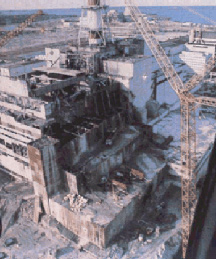
International Chernobyl Disaster Remembrance Day Date in the current year: April 26, 2022
Until recently, Memorial Day for the Victims of the Chernobyl Nuclear Accident was observed only in the countries directly affected by the accident (Ukraine, Belarus and Russia). This changed in 2016, when the United Nations General Assembly designated April 26 as International Chernobyl Disaster Remembrance Day
The Chernobyl accident, also referred to as the Chernobyl disaster, was a catastrophic nuclear accident that occurred in Ukraine (then the Ukrainian Soviet Socialist Republic). On April 26, 1986, Reactor No. 4 at the Chernobyl Nuclear Power Plant was completely destroyed by an explosion caused by a catastrophic power increase. The explosion resulted in radioactive contamination of large parts of the USSR, now the territories of Ukraine, Belarus and Russia. Over 8 million people in these countries were exposed to radiation.
Four years passed after the accident before the Soviet government reluctantly acknowledged the need for international assistance in mitigating the consequences of the disaster. In 1990, the UN General Assembly adopted a resolution that called for international cooperation in overcoming the consequences of the Chernobyl accident.
Since 2002, the main focus of the Chernobyl strategy has been a long-term developmental approach instead of emergency humanitarian assistance. In 2009, the International Chernobyl Research and Information Network was launched to provide support to programs that aim to contribute to the sustainable development of affected territories.
International Chernobyl Disaster Remembrance Day was inaugurated in 2016 to raise awareness of the consequences of the accident and to consolidate efforts to eliminate them. In Ukraine, it is one of the official remembrance days marked by memorial ceremonies and special lessons at schools. In addition, Ukraine observes Chernobyl Liquidators Day on December 14.
Fears sunken Russian warship Moskva was carrying nuclear weapons
There are fears that sunken Russian warship The Moskva was carrying nuclear weapons that could now cause a “broken arrow” incident. news.com.au
Megan Palin, April 16, 2022 There are fears that sunken Russian warship The Moskva that is now believed to be resting at the bottom of the Black Sea was carrying nuclear weapons.
Maksym Marchenko, the governor of the Odesa region, said Ukraine struck the ship with two Neptune missiles and caused “serious damage” on Thursday.
The Russian Defence Ministry denied there had been an attack by Ukraine on the ship, which would normally have about 500 sailors aboard, and said the heavily damaged Moskva sank in a storm under tow after being gutted by fire.
Speaking at the Pentagon on Friday, a senior US defense official said the Moskva warship was hit by two Ukrainian Neptune missiles, prompting its sinking.
In a chilling revelation, sources say it’s likely that several nuclear missiles are on the sunken vessel, and there is now real concern that could lead to a nuclear accident – otherwise known as a “broken arrow” incident in American military slang.
Mykhailo Samus, director of a Lviv-based military think-tank; Andriy Klymenko, editor of Black Sea News; and Ukrainian newspaper Defence Express all warned today that the Moskva was designed to carry warheads which could fit in the nose of its supersonic P-1000 “Vulkan” missiles – designed to take out American aircraft carriers.
“On board the Moskva could be nuclear warheads – two units,’ Samus said, while Klymenko called on other Black Sea nations – Turkey, Romania, Georgia, and Bulgaria – to insist on an explanation. Where are these warheads? Where were they when the ammunition exploded,” he asked.
This is HUGE. Russia’s defense ministry admits Moskva, their flagship in Black Sea fleet, slava class cruiser, has SUNK! It was key to intelligence & air defenses for the Russian ships. IMO this is on the level big as stopping Russians from taking Kyiv. https://t.co/3SifeskeHzpic.twitter.com/EmNR4L0Vgy— John Spencer (@SpencerGuard) April 14, 2022
BlackSeaNews editor-in-chief Andriy Klymenko called for an urgent international probe into whether the Moskva was carrying nuclear weapons.
“Friends and experts say that there are two nuclear warheads for cruise missiles on board the Moskva,” he said………….. https://www.news.com.au/world/europe/fears-sunken-russian-warship-moskva-was-carrying-nuclear-weapons/news-story/959170261e82bd43b5eb3c37fabf8dcd
| |||
Carelessness of Russian soldiers around Chernobyl – shows danger of nuclear sites in wartime
As we learn more about the negligence of Russian generals who ignored
warnings that the radioactive forest surrounding Chornobyl was a hazardous
staging ground for their assault on Kyiv, environmental historian Kate
Brown flags an ill-recognized reality: humanity is ill prepared for what
happens when nuclear facilities are held hostage during war.
Known as the
“Red Forest”—its pine trees turned red from radiation exposure after
a reactor at Chornobyl melted down in April 1986—the area where Russian
soldiers bulldozed and dug trenches and bunkers is the most contaminated
region of the Chornobyl Exclusion Zone, which is itself “one of the most
toxic places on Earth,” writes the New York Times.
But Russian generals did not seem troubled by the fact that their troops were digging and
bunking down in earthworks that may have had radiation levels 1,000 times
above ambient.
Energy Mix 12th April 2022
Able Archer: The NATO exercise that almost went nuclear
Able Archer: The NATO exercise that almost went nuclear.
Able Archer was a 1983 NATO military exercise that nearly triggered war with the Soviet Union
Able Archer was an annual NATO military exercise that involved thousands of military personnel and equipment. The goal of the exercise was to simulate an escalation in a conflict between NATO countries and the USSR, culminating in a co-ordinated nuclear attack.
Live Science, By Callum McKelvie , 13 Apr 22,
In 1983, the annual exercise almost triggered the outbreak of war between NATO and the Soviet Union, when miscommunication led the Soviet government to believe the West was in fact mounting an invasion.
Able Archer, was an annual NATO exercise and the culmination the culmination of the Autumn Forger maneuvers that involved 100,000 personnel, some 16,000 of which were flown in from the United States according to The Atomic Heritage Foundation. The exercise was designed to end with a simulated nuclear strike following a theoretical Warsaw Pact invasion of Western Europe.
Although the Soviet Union was aware that the annual event was due to take place, in 1983 Able Archer differed in many ways from previous exercises.
First, there were large periods of radio silence, as well as encrypted messages among the NATO forces.
Second, the imaginary forces were moved to high alert and there were even reports of fake missiles being taxied out of hangers with dummy warheads.
Finally, senior officials were involved with even President Ronald Reagan himself scheduled to participate, although in reality he dropped out, according to the BBC. In the buildup to the 1983 Able Archer exercise the Warsaw Pact countries had become increasingly paranoid about the potential of a U.S. nuclear attack.
In 1981 Ronald Reagan became the 40th President of the United States and quickly proved himself aggressive in his approach towards the USSR. In March 1983, just a few short months before Able Archer, Reagan referred to the Soviet Union as an “evil empire”, according to Voices of Democracy and announced his intent to build the “Star Wars” space-based anti-missile program, according to the Atomic Heritage Foundation.
That same year, the U.S. deployed Pershing II Nuclear Missiles at their bases in West Germany, able to reach a Soviet target in less than 10 minutes, according to Missile Threat.
As a result of the this threat and the fear of a nuclear strike, the KGB created Project RYaN, which stood for “Raketno-Yadernoe Napadenie” — translated meaning “Nuclear Missile Attack” — according to the Wilson Center.
“The Soviet Intelligence community was still traumatized by its failure to anticipate the German attack in 1941 and was determined not to be taken by surprise again,” Colonel Robert E Hamilton wrote in his article “Able Archer At 35: Lessons from the 1983 War Scare“.
As well as using traditional intelligence methods, including human agents, RYaN also utilized computers in a bid to monitor indicators from both NATO and the United States that a nuclear attack was imminent.
On Sept. 26, the Soviet Early Warning Satellite System registered a warning that five American minuteman missiles were on their way to Russian soil, according to Stanford University. The warning was revealed to be a false alarm.
“1983 was a supremely dangerous year in which a series of events seriously raised the temperature between East and West,” historian Taylor Downing told All About History Magazine “Most obvious here was the shooting down of a Korean civilian airliner, flight KAL 007, by a Soviet fighter plane after it had strayed off course by about 350 miles and ended up crossing Soviet airspace above a sensitive military area.
“Reagan could not believe this was a case of mistaken identity, a tragic accident that caused the death of 269 innocent people, ” Downing continued. “He called the Soviet Union “a terrorist state” that showed no regard for human life. I argue that at this point the Cold War nearly went hot as some in Washington demanded a military retaliation against the Soviet Union.”
As tensions between the two sides began to rise, so did the danger of a possible nuclear conflict. According to the strategy of Mutually Assured Destruction, if this occurred then both sides would annihilate each other.
“When situations are this tense it is always possible that one side will misinterpret what the other side is doing,” Downing said. “In the end, the safety of all nuclear systems is reliant upon the human factor — it is a politician or military leader who finally has to respond to threats perceived or real and press the nuclear button. So, no matter how sophisticated the failsafe systems are, it is down to a person to make the final decision — and all humans are fallible.”
When the Able Archer exercise began on Nov. 7, 1983, the Soviet response was unprecedented………………………………………….
In 1990 the President’s Foreign Advisory Board crafted a top secret report entitled “The Soviet War Scare” which makes clear the threat posed by Able Archer, stating that the US “may have inadvertently placed our relations with the Soviet Union on a hair trigger.”……………. https://www.livescience.com/able-archer
San Onofre’s not the only nuclear worry – there are “nuclear materials events” — lost or stolen radioactive material, radiation overexposures, leaks, and more.
Worried about nuclear waste at San Onofre? Other danger lurks
GAO sounds alarms about dirty bombs fashioned from small amounts of medical, industrial material Experts in protective gear prepare to sweep the University of Washington Research and Training Building after the accidental release of radioactive cesium-137 in 2019. (U.S. Government Accountability Office)
By TERI SFORZA | tsforza@scng.com | Orange County Register: April 11, 2022
In one doomsday scenario, rocket attacks on the nuclear waste stored at San Onofre Nuclear Generating Station send plumes of dangerous radiation skyward.
Critics in Southern California spend a lot of time worrying about the safety of the 3.6 million pounds of spent fuel entombed on the bluff above the blue Pacific — but the U.S. Government Accountability Office fixes its gaze on more mundane, and perhaps more terrifying, scenarios involving much smaller amounts of nuclear material routinely used by businesses, hospitals, universities and the like.
“The risks of an attack using a dirty bomb — a weapon that combines a conventional explosive, like dynamite, with radioactive material — are increasing and the costs could be devastating,” said the GAO in a snapshot released Tuesday, April 5.
“For example, weaknesses in Nuclear Regulatory Commission licensing for radioactive materials make it too easy for bad actors to obtain them, and NRC’s security requirements don’t account for the potentially devastating effects of a dirty bomb, such as billions of dollars in cleanup costs and deaths from chaotic evacuations.”
More than 2,000 “nuclear materials events” — including lost or stolen radioactive material, radiation overexposures, leaks of radioactive material and more — were reported by the NRC between 2010 and 2019, the GAO found.
In April 2019, an Arizona technician was arrested after stealing three radioactive devices from his workplace. According to a court filing, the technician intended to release the radioactive materials at a shopping mall, but was stopped before he could do any harm.
An accident at the University of Washington in 2019, involving a small amount of material, required clean-up and other costs of $150 million for one building alone, the GAO said.
In 2016, the GAO created a fake company to get a license for radioactive materials. GAO altered the license “and used it to obtain commitments to acquire a dangerous quantity of material.”
“The number of incidents of thefts, lost shipments, and careless mishandling are outrageously large,” said Edwin Lyman, director of nuclear power safety for the Union of Concerned Scientists, a nonprofit NRC watchdog
Even though very few of these lead to significant radiological consequences to the public, the NRC’s lax requirements fall short of best practices.”
Common stuff
Radioactive material is used in many medical and industrial settings in Southern California and throughout the nation. Small amounts help create images of organs, so doctors can find, identify and track tumors. Radioactive materials are used to kill cancer cells, shrink tumors and alleviate pain.
But security is an increasingly acute issue, the GAO said.
In 2018, the GAO reported that officials at U.S. airports had not verified the legitimacy of all licenses for imported radioactive materials.
“GAO has repeatedly found potential security weaknesses at medical and industrial locations storing such materials in the U.S.,” it said in one of many reports on the issue over the past several years.
“For example, in 2014, GAO reported that an individual had been given unescorted access to high-risk radioactive materials, even though he had two convictions for terroristic threat. Furthermore, small quantities of radioactive materials located within the same facility are not subject to enhanced security requirements that the total amount would be required to meet.”……………………………
Lyman, of the Union of Concerned Scientists, acknowledged that the NRC has taken some action to address the most egregious problems the GAO has identified over the years, but has not gone as far as many want.
“I do support the effort for better tracking and security of radioactive sources,” Lyman said………………….https://www.ocregister.com/2022/04/11/worried-about-nuclear-waste-at-san-onofre-other-danger-lurks/
The Windscale nuclear accident 1957, and still not cleaned up. – a warning from history
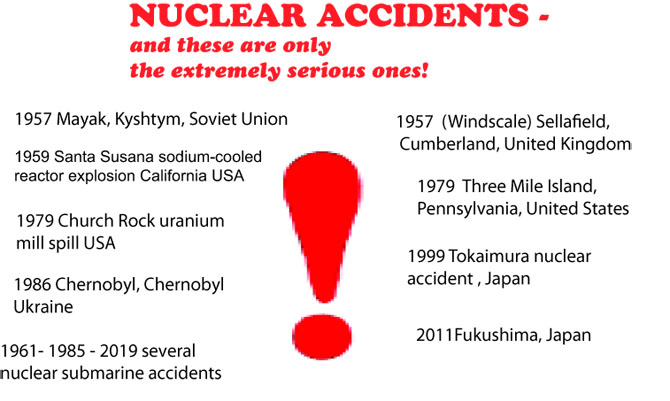
Nuclear power: the warnings from history. The PM wants to keep the lights
on with eight new atomic plants. He’s in denial if he thinks the
catastrophes of the past won’t happen again.
If Johnson is going to use nuclear history to justify his strategy, perhaps he needs to look a little
deeper, because Windscale was also the site of one of the world’s first
serious nuclear accidents. In October 1957, a fire raged for three days in
one of the reactors after changes to increase production.
Through the heroism of staff, and a significant degree of luck, the catastrophe was
contained. But significant radiation was released. Milk from cows within
200 square miles was contaminated. In 1982 officials estimated 260 people
developed cancer and 32 people died as a result. The two first reactors at
Windscale were closed, but the clean-up is still under way today.
Last November the top of the chimney in which the fire blazed was removed as
part of the demolition. The renowned nuclear historian Serhii Plokhy
describes the episode in a forthcoming book and points out: “The existing
nuclear industry is an open-ended liability.” No nuclear power station
has ever been fully decommissioned.
In Atoms and Ashes, Plokhy, 64, a
Ukrainian historian at Harvard, explores the causes and consequences of
Windscale and five other nuclear accidents: at Bikini Atoll in the Pacific
in 1954, Kyshtym in Russia in 1957, Three Mile Island in the US in 1979,
Chernobyl in Ukraine in 1986 and Fukushima in Japan in 2011.While most of
these accidents took place in the formative years of nuclear science,
Plokhy argues they could easily happen again. “Technology was improved as
a result, and every accident contributed to the shaping of subsequent
safety procedures and culture,” he writes.
“And yet nuclear accidents
occur again and again. Many of the political, economic, social, and
cultural factors that led to the accidents of the past are still with us
today, making the nuclear industry vulnerable to repeating old mistakes in
new and unexpected ways.”
Times 9th April 2022
https://www.thetimes.co.uk/article/nuclear-power-latest-warnings-history-chernobyl-ph9q7w80j
Workers evacuated from area of USA’s Waste Isolation Pilot Plant nuclear waste repository after ‘abnormal event’
Workers evacuated from area of Carlsbad nuclear waste repository after ‘abnormal event’
https://www.currentargus.com/story/news/2022/04/09/abnormal-event-reported-carlsbad-nuclear-waste-repository-waste-isolation-pilot-plant/9531100002/ Adrian Hedden
Carlsbad Current-Argus An incident at the Waste Isolation Pilot Plant nuclear waste repository near Carlsbad led to the evacuation of workers Saturday night from an area of the facility where waste is prepared for disposal.
The incident was reported at about 8:20 p.m. in the waste handling building.
As a drum of waste was being processed, liquid was found at the bottom of the container which tested positive for radioactive contamination, per a news release from WIPP officials.
All personnel in the area were evacuated and tested for contamination, and operations were temporarily paused. No radioactive contamination was found on any person or in the air as of 10 p.m., per the news release.
Workers were not in the underground at the time of the incident, the release read.
No radiation was released from the site, and there was no risk to the public, read the news release.
WIPP’s Emergency Operations Center and Joint Information Center were activated at the Skeen-Whitlock building in Carlsbad to respond to the incident that occurred at the facility east of Carlsbad near the border of Eddy and Lea counties.
Zaporizhzhia is a wake-up call demonstrating the vulnerability of nuclear plants to deliberate acts of war.
| Varrie Blowers, Secretary of BANNG discusses the implications of the war in Ukraine in the latest column for Regional Life, April, 2022. In the early hours of 4 March, fire was reported at Zaporizhzhia, the 6-reactor nuclear power station in Ukraine, Europe’s largest. The Russian army was carrying out a premeditated attack. A few days before, it had seized Chernobyl, the site in April, 1986 of the world’s worst nuclear accident……..to date. It was, mercifully, a training building that was on fire. Nonetheless, this attack on an active nuclear plant was unprecedented and in clear breach of the Geneva Conventions. But Russia was not deterred. Had there been a meltdown in a reactor or fire in the radioactive waste stores, the people of Ukraine would have been subject to a nuclear catastrophe. And the radioactive fallout of a nuclear incident of a magnitude worse than that of Chernobyl, would have had far-reaching and terrifying consequences. The incident shows for the first time the dangers of war in a nuclearised country. Nuclear plants do not seem to have been designed to cope with war. Nor can they just be switched off and abandoned. The workers at Zaporizhzhia, it has been reported, are being forced to work in conditions of exhaustion, hunger and stress – when mistakes could be made. While we hope never to experience such acts on our shores, there is the ever- present threat of terrorism and cyber-attack wreaking havoc on nuclear installations. Given what has happened, the Government should be disengaging from nuclear, not engaging in a gung-ho rush to build new plants, including Bradwell B. Chernobyl and Fukushima alerted the world to the dangers arising from nuclear accidents. Zaporizhzhia is a wake-up call demonstrating the vulnerability of nuclear plants to deliberate acts of war. BANNG 6th April 2022 https://www.banng.info/news/ukraine-nuclear-wake-up-call |
Nuclear safety incidents in UK, as inspection numbers fall

Four nuclear safety incidents reported to ministers in 2021 as inspection
numbers fall. Incidents included a reactor shutdown in Lancashire, a fire
at Sellafield, and a package of radioactive material found in a London
street. Four nuclear safety incidents were reported to UK Government
ministers due to their severity last year, i can reveal, with experts
raising fears over the declining number of inspections.
In the most serious
safety breach, on 22 July, the Heysham One nuclear power station in
Lancashire had a complete loss of 400kV power after a National Grid
transformer failed. Both reactors tripped automatically and were cooled and
safely shut down, according to an Office for Nuclear Regulation (ONR)
report.
On 11 September, a package of radioactive materials was found in
the street by a member of the public after being lost in transit between
two London hospitals. The ONR said there was no risk to the public or the
environment.
Two incidents at Sellafield in Cumbria also met ministerial
reporting criteria under nuclear safety laws. An analysis of reports from
the Office for Nuclear Regulation (ONR) revealed the four incidents in
2021, which met ministerial reporting criteria under nuclear safety laws.
The overall number of Incident Notification Forms documenting security
issues at UK nuclear facilities was 368 in the first 10 months of last
year. This is 72 per cent higher than the 214 submitted in 2018. However,
the number of nuclear security inspections carried out by the ONR appears
to have fallen. Data shows there were 136 inspections up to 17 December
2021, compared with 169 in 2019. The Heysham One incident, which was stood
down after 16 hours, was rated as level 2 – the third lowest on the
International Nuclear Event Scale, which ranges from zero to seven. The
report said there were “no radiological consequences”.
iNews 4th April 2022
Two sailors reportedly injured in accident on docked nuclear submarine
Two sailors reportedly injured in accident on docked nuclear submarine, New York Post, https://nypost.com/2022/04/03/two-sailors-injured-during-test-on-docked-nuclear-submarine/ By Sam Raskin, April 3, 2022
Two Navy sailors were injured Saturday during a “routine” test on a nuclear submarine docked in a naval shipyard in Washington State, according to reports.
The USS Louisiana ballistic missile submarine “experienced a problem in the forward crew access compartment while conducting a routine compartment air test,” a rep for the Puget Sound Naval Shipyard and Intermediate Maintenance Facility told CNN.
“The boat’s nuclear propulsion space was not affected,” said the spokesperson, Anna Taylor.
The malfunction caused a loud sound, a dislodged scaffolding enclosure and “other equipment,” Taylor told The Kitsap Sun.
Residents heard loud explosions about 12 p.m. Saturday in the area, the outlet reported.
The two sailors reportedly suffered non-life-threatening injuries and were taken to a medical facility. Their exact condition is not known.
Five other sailors were evaluated by Navy medical personnel but they did not need treatment, according to the spokesperson. The test at the 560-foot USS Louisiana — located in Bremerton on Washingtons’ Kitsap Peninsula since 1997 — was suspended after the incident.
Chernobyl: radiation sickness in soldiers, theft of radioactive materials, wildfires – a frightening case of the multiple dangers of nuclear power.
Russian soldiers in Chernobyl suffering from radiation poisoning, Several Russian soldiers in Chernobyl have fallen sick with radiation sickness after digging trenches in contaminated forests, news.com.au , Katie Davis and The Sun, 1 Apr 22,
Dozens of Russian troops stationed at the Chernobyl nuclear site in Ukraine have reportedly been struck down with radiation sickness after digging trenches in the contaminated forests.
Seven buses of soldiers suffering from acute radiation syndrome were taken from the exclusion zone to a hospital across the border in Belarus, The Sun reports.
Chernobyl was captured in the opening days of the current invasion of Ukraine by Russian President Vladimir Putin’s troops. However it was the site of a nuclear disaster in 1986 when a reactor exploded, contaminating the surrounding area.
As Russian soldiers took hold of the site, it sparked fears of a major radioactive disaster as a result of heavy fighting around the plant
Already, just three days after entering the area, the disturbing of soil by military vehicles saw radiation levels spike.
It also has been alleged Russian troops dug trenches in the highly toxic Red Forest zone, according to UNIAN News Agency.
And according to workers at the site, Russian soldiers drove their tanks and armoured vehicles without radiation protection through the area – kicking up clouds of radioactive dust.
A Chernobyl employee branded their actions as “suicidal” because the dust they inhaled was likely to cause internal radiation in their bodies.
The two Ukrainian sources said soldiers in the convoy did not use any anti-radiation gear while in the Red Forest – the most contaminated part of the zone around Chernobyl.
Dozens of Russian troops stationed at the Chernobyl nuclear site in Ukraine have reportedly been struck down with radiation sickness after digging trenches in the contaminated forests.
Seven buses of soldiers suffering from acute radiation syndrome were taken from the exclusion zone to a hospital across the border in Belarus, The Sun reports.
Chernobyl was captured in the opening days of the current invasion of Ukraine by Russian President Vladimir Putin’s troops. However it was the site of a nuclear disaster in 1986 when a reactor exploded, contaminating the surrounding area.
As Russian soldiers took hold of the site, it sparked fears of a major radioactive disaster as a result of heavy fighting around the plant.
Already, just three days after entering the area, the disturbing of soil by military vehicles saw radiation levels spike.
It also has been alleged Russian troops dug trenches in the highly toxic Red Forest zone, according to UNIAN News Agency.
And according to workers at the site, Russian soldiers drove their tanks and armoured vehicles without radiation protection through the area – kicking up clouds of radioactive dust.
A Chernobyl employee branded their actions as “suicidal” because the dust they inhaled was likely to cause internal radiation in their bodies. The two Ukrainian sources said soldiers in the convoy did not use any anti-radiation gear while in the Red Forest – the most contaminated part of the zone around Chernobyl.
Yaroslav Yemelianenko, an employee at the Public Council at the State Agency of Ukraine for Exclusion Zone Management, said Russian troops were taken to the Belarusian centre of radiation medicine in Gomel.
“Digging the trenches in the Rudu forest?” he wrote on Facebook. “Now live the rest of your short life with this.
“There are rules of handling this territory. They are mandatory to perform because radiation is physics – it works regardless of status or chases………………
Radioactive material stolen from Chernobyl
Earlier this week, it was reported that radioactive material was stolen from the site of the damaged nuclear power station…………………….
Ukraine’s State Agency blamed Russian troops for stealing “unstable” nuclear samples from Chernobyl after ransacking a lab.
They are believed to have then destroyed the November Central Analytical Laboratory which was full of nuclear waste and located in the radioactive exclusion zone.
The agency said the stolen radionuclides are “highly active”…………
Just last week, wildfires around Chernobyl sparked by Russian shelling scorched 10,000 hectares of forest.
Ukraine’s Deputy Prime Minister Iryna Vereshchuk accused Russia of “irresponsible” acts around the Chernobyl power station as she urged the United Nations to dispatch a mission to assess the risks.
She claimed Russian forces were preventing firefighters from bringing large numbers of fires in the zone under control……….
Ukraine’s human rights commissioner Lyudmila Denisova warned an increased level of radioactive air pollution could threaten neighbouring countries.
“Control and suppression of fires is impossible due to the capture of the exclusion zone by Russian troops,” she wrote on Facebook.
“As a result of combustion, radionuclides are released into the atmosphere, which are transported by wind over long distances. This threatens radiation to Ukraine, Belarus and European countries.”
The politician warned that failing to intervene could see “irreparable consequences” for “the whole world”.
“Catastrophic consequences can be prevented only by immediate de-occupation of the territory by Russian troops,” Ms Denisova said………… https://www.news.com.au/world/europe/russian-soldiers-in-chernobyl-suffering-from-radiation-poisoning/news-story/d98c53269a9602841331453438c482dd
1 This Month





PLEASE OPPOSE HR 8255 AND S.3639 – bills would accelerate satellite deployment, with no environmental review or safeguards – https://ncstd5li.quorum.us/campaign/169331/
To see nuclear-related stories in greater depth and intensity – go to https://nuclearinformation.wordpress.com
-
Archives
- October 2026 (49)
- September 2026 (339)
- August 2026 (330)
- July 2026 (355)
- June 2026 (287)
- May 2026 (306)
- April 2026 (356)
- March 2026 (251)
- February 2026 (267)
- January 2026 (308)
- December 2025 (358)
- November 2025 (359)
-
Categories
- 1
- 1 NUCLEAR ISSUES
- business and costs
- climate change
- culture and arts
- ENERGY
- environment
- health
- history
- indigenous issues
- Legal
- marketing of nuclear
- media
- opposition to nuclear
- PERSONAL STORIES
- politics
- politics international
- Religion and ethics
- safety
- secrets,lies and civil liberties
- spinbuster
- technology
- Uranium
- wastes
- weapons and war
- Women
- 2 WORLD
- ACTION
- AFRICA
- Atrocities
- AUSTRALIA
- Christina's notes
- Christina's themes
- culture and arts
- Events
- Fuk 2022
- Fuk 2023
- Fukushima 2017
- Fukushima 2018
- fukushima 2019
- Fukushima 2020
- Fukushima 2021
- general
- global warming
- Humour (God we need it)
- Nuclear
- RARE EARTHS
- Reference
- resources – print
- Resources -audiovicual
- Weekly Newsletter
- World
- World Nuclear
- YouTube
-
RSS
Entries RSS
Comments RSS

