What to expect from NATO Summit 2023
Thus, it is slowly emerging that there shall not be a NATO membership for Ukraine — now or ever.
The bottom line is that the Vilnius summit will sound the bugle to let the manor know that an orderly NATO pullback from Ukraine is in the cards.
India Punchline, BY M. K. BHADRAKUMAR
The trajectory of the Ukraine war hangs in the balance. All eyes are on the US President Joe Biden’s arrival in Vilnius for the NATO summit meeting .
………………………………………………………………………………………….this will virtually put out the flicker of hope among the NATO Allies about political uncertainties within Russia hampering the Kremlin’s war effort. Quite obviously, there are no “cracks” to be seen anywhere on the Kremlin wall. Putin remains firmly in charge and the military operations to scatter the month-long Ukrainian offensive are succeeding beyond expectations.
Correspondingly, there is bound to be a greater sense of realism amongst the NATO Allies. Alas, momentous political decisions concerning European security were riveted on flawed intelligence.
The Americans had no idea about the capability of Russian weaponry or of the country’s defence industry, its seamless capacity to mobilise for a continental war, the mood of the Russian people, Putin’s strong power base with a consistent rating at 80% (more than double that of Biden), the Russian economy’s resilience to withstand sanctions, or the blowback from sanctions that eventually would devastate the European economies.
……………………………………………………….. the NATO summit will factor in the geopolitical reality, howsoever unpalatable, that the war in Ukraine has far from isolated Russia but on the contrary, helped invigorate and expand Moscow’s orbit of diplomatic and political influence in the vast majority of the world community.
At the same time, on the military front too, the delusional hopes of NATO countries defeating Russia have withered away and the Vilnius summit’s decisions will reckon with this ground reality.
Already, the Biden Administration admitted that the Pentagon has run out of ammunition to supply Ukraine and the industrial capacity will have to be strengthened. But that is a medium term objective whilst the war has its immediate requirements. And to meet the current requirements, Biden has decided to instead supply Ukraine with cluster bombs, a dirty weapon that is banned under international law by the UN.
Thus, it is slowly emerging that there shall not be a NATO membership for Ukraine — now or ever. Yesterday, Richard Haas, president of the council of Foreign Relations and a hugely influential opinion maker of the US foreign policy establishment, wrote in Project Syndicate (with an eye on the European audience) a forceful critique titled Ascending the Vilnius Summit: “Offering NATO membership in principle, as was done when NATO leaders met in Bucharest in 2008, seems hollow…”
Haas elaborated that the NATO countries can instead bilaterally “extend a security commitment to defend Ukraine’s right to exist… without reference to precise territory…comparable to what the US has long done for Israel.”
Haas believes that such a formal, open-ended commitment backed up with “the arms, intelligence, and training it requires” would signal that America “will not allow any entity to threaten” Ukraine’s existence, but without linking it “to any specific map” of the territory of Ukraine.
Interestingly, when asked about it during the press gaggle on Sunday, Sullivan also confirmed that such a concept is on the table whereby the US, its allies and partners “within a multilateral framework, will negotiate bilateral security commitments with Ukraine for the long term… to provide various forms of military assistance, intelligence and information sharing, cyber support and other forms of material support so that Ukraine can both defend itself and deter future aggression.”
The bottom line is that the Vilnius summit will sound the bugle to let the manor know that an orderly NATO pullback from Ukraine is in the cards. Unlike in Afghanistan, the US will no doubt keep the allies in the loop, since this primarily concerns European security — and importantly, it should not turn out to be another chaotic retreat that Kabul or Saigon witnessed in yesteryears. That, in turn, demands absolute NATO unity. ……………..
Evidently, the nuts and bolts of an orderly withdrawal will need to be painstakingly worked out within the framework of a ceasefire in the war. This means engaging with Russia in a near future and discouraging it from pressing ahead forthwith with any major offensive to end the war conclusively in its favour.
Meanwhile, according to the grapevine in Kiev, the commander-in-chief of armed forces General Valeri Zaluzhny has recommended to his president Zelensky that the current month-old Ukrainian military offensive is simply not sustainable against the overwhelmingly powerful Russian forces and should be called off. https://www.indianpunchline.com/what-to-expect-from-nato-summit-2023/
Zelensky slams Biden’s ‘unprecedented and absurd’ stance on NATO membership
New York Post, By Steven Nelson, 11 July 23
VILNIUS, Lithuania — Ukrainian President Volodymyr Zelensky tore into NATO leaders including President Biden on Tuesday for not extending membership to his war-torn country — introducing fresh diplomatic drama into the annual gathering of the military alliance’s leaders.
Zelensky slammed the reticence as “weakness” and “absurd” just moments after Biden referred to the development of new language regarding his country’s potential NATO ascension.
“Now, on the way to Vilnius, we received signals that certain wording is being discussed without Ukraine. And I would like to emphasize that this wordxfing is about the invitation to become NATO member, not about Ukraine’s membership,” Zelensky tweeted.
“It’s unprecedented and absurd when a time frame is not set neither for the invitation nor for Ukraine’s membership. While at the same time vague wording about ‘conditions’ is added even for inviting Ukraine.”
Zelensky added: “It seems there is no readiness neither to invite Ukraine to NATO nor to make it a member of the Alliance. This means that a window of opportunity is being left to bargain Ukraine’s membership in NATO in negotiations with Russia. And for Russia, this means motivation to continue its terror. Uncertainty is weakness. And I will openly discuss this at the summit.”……………
Shortly before Zelensky’s fiery tweet, Biden said during a meeting with NATO Secretary-General Jens Stoltenberg that “we agree on the language that you propose, relative to the future of Ukraine being able to join NATO. And we’re looking for a continued united NATO.”
The wording that Biden alluded to was released later, saying vaguely, “We will be in a position to extend an invitation to Ukraine to join the Alliance when Allies agree and conditions are met.”…………..
Biden said in a CNN interview that aired Sunday that he believes Ukraine is not “ready” for membership.
“I don’t think it’s ready for membership in NATO,” Biden told CNN’s Fareed Zakaria. “I don’t think there is unanimity in NATO about whether or not to bring Ukraine into the NATO family now, at this moment, in the middle of a war.”
……………………… Sen. Dick Durbin (D-Ill.) said that he is particularly concerned about corruption in Ukraine’s government and said that it was an “understandable” cause for concern among fellow NATO countries.
………….. NATO countries including the US have heavily financed and armed Ukraine’s resistance to the more than 16-month-old Russian invasion and Biden has gradually met many of Zelensky’s prior demands, such as agreeing last week to send cluster bombs to aid Kyiv’s flagging offensive, despite a human rights campaign to ban the weapons, which can maim or kill civilians for decades after conflicts end. https://nypost.com/2023/07/11/zelensky-slams-weakness-of-absurd-biden-stance-on-nato/
—
NATO is ‘malicious poison’ – former Australian PM, Paul Keating, (some agreement with this, in Paris)

Elysee Palace official claimed that Paris is against NATO expansion beyond the North Atlantic. “NATO means North Atlantic Treaty Organization,” the French presidential staffer reportedly emphasized.
Paul Keating has argued that the military bloc should remain confined to Europe and the Atlantic and not try to expand into Asia
NATO has no place in Asia and should stick to its original focus, that is the security of the Transatlantic region, former Australian Prime Minister Paul Keating has argued. The Labour politician, who served in office from 1991 to 1996, also warned against attempts to “circumscribe” China.
In his statement published on Sunday, Keating appeared to refer to a recent report in Politico, which claimed French President Emmanuel Macron had blocked NATO’s plans to establish a liaison office in Japan.
The former premier lauded the French head of state for “doing the world a service” by apparently emphasizing the military bloc’s focus on Europe and the Atlantic.
According to Keating, the alliance’s very existence past the end of the Cold War “has already denied peaceful unity to the broader Europe.”
Exporting such “malicious poison to Asia would be akin to Asia welcoming the plague upon itself,” he insisted. The former prime minister warned that NATO’s presence on the continent would negate most of the region’s recent advances.
Keating went on to describe NATO Secretary General Jens Stoltenberg as the “supreme fool” on the international stage who is conducting himself like an “American agent.”
He cited a comment Stoltenberg made back in February when he called for the West not to repeat the “mistake” it had made with regard to Russia, suggesting it should work to contain China.
The former Australian leader noted that the NATO chief conveniently ignored the fact that “China represents twenty per cent of humanity and now possesses the largest economy in the world.” He added that Beijing, unlike Washington, “has no record of attacking other states.”
Over the weekend, Politico cited an anonymous Elysee Palace official who claimed that Paris is against NATO expansion beyond the North Atlantic. “NATO means North Atlantic Treaty Organization,” the French presidential staffer reportedly emphasized.
Back in May, the Japanese ambassador to the US, Koji Tomita, revealed that his country was working toward opening a NATO liaison office in Tokyo, which would become the bloc’s first in Asia. Prime Minister Fumio Kishida confirmed the plans to Japanese lawmakers, noting that Tokyo did not intend to join the US-led organization.
Commenting on the news, Chinese Foreign Ministry spokesperson Mao Ning advised NATO against “extending its geopolitical reach.” The diplomat pointed out that the “Asia-Pacific does not welcome bloc confrontation or military blocs.”
An Accident Waiting to Happen: NATO Looks to Asia

Australian Independent Media, July 10, 2023, by: Dr Binoy Kampmark
Since the end of the Cold War, the North Atlantic Treaty Organisation has distinctly strayed from its original purpose. It has become, almost shamelessly, the vessel and handmaiden of US power, while its burgeoning expansion eastwards has done wonders to upend the applecart of stability.
From that upending, the alliance started bungling. It engaged, without the authorisation of the UN Security Council, in a 78-day bombing campaign of Yugoslavia – at least what was left of it – ostensibly to protect the lives of Kosovar Albanians. Far from dampening the tinderbox, the Kosovo affair continues to be an explosion in the making.
Members of the alliance also expended material, money and personnel in Afghanistan over the course of two decades, propping up a deeply unpopular, corrupt regime in Kabul while failing to stifle the Taliban. As with previous imperial projects, the venture proved to be a catastrophic failure.
In 2011, NATO again was found wanting in its attack on the regime of Muammar Gaddafi. While it was intended to be an exemplar of the Responsibility to Protect Doctrine, the intervention served to eventually topple the doomed Colonel Gaddafi, precipitating the de-facto partitioning of Libya and endangering the very civilians the mission was meant to protect. A continent was thereby destabilised. The true beneficiaries proved to be the tapestry of warring rebel groups characterised by sectarian impulses and a voracious appetite for human rights abuses and war crimes.
The Ukraine War has been another crude lesson in the failings of the NATO project. The constant teasing and wooing of Kyiv as a potential future member never sat well with Moscow and while much can be made of the Russian invasion, no realistic assessment of the war’s origins can excise NATO from playing a deep, compromised role.
The alliance is also proving dissonant among its members. Not all are exactly jumping at the chance of admitting Ukraine. German diplomats have revealed that they will block any current moves to join the alliance. Even that old provoking power, the United States, is not entirely sure whether doors should be open to Kyiv. On CNN, President Joe Biden expressed the view that he did not “think it’s ready for membership of NATO.” To qualify, Ukraine would have to meet a number of “qualifications” from “democratisation to a whole range of other issues.” While hardly proving very alert during the interview (at one point, he confused Ukraine with Russia) he did draw the logical conclusion that bringing Kyiv into an alliance of obligatory collective defence during current hostilities would automatically put NATO at war with Moscow.
With such a spotty, blood speckled record marked by stumbles and bungles, any suggestions of further engagement by the alliance in other areas of the globe should be treated with abundant wariness. The latest talk of further Asian engagement should also be greeted with a sense of dread. According to a July 7 statement, “The Indo-Pacific is important for the Alliance, given that developments in that region can directly affect Euro-Atlantic security. Moreover, NATO and its partners in the region share a common goal of working together to strengthen the rules-based international order.” With these views, conflict lurks.
The form of that engagement is being suggested by such ideas as opening a liaison office in Japan, intended as the first outpost in Asia. It also promises to feature in the NATO summit to take place in Vilnius on July 11 and 12, which will again repeat the attendance format of the Madrid summit held in 2022. That new format – featuring the presence of Australia, Japan, New Zealand and South Korea, or the AP4, should have induced much head scratching. But the Australian Strategic Policy Institute, Washington’s beady eyes in Canberra, celebrated this “shift to taking a truly global approach to strategic competition.”
……………………………………………………. In 2021, Macron made it clear that NATO’s increasingly obsessed approach with China as a dangerous belligerent entailed a confusion of goals. “NATO is a military organisation, the issue of our relationship with China isn’t just a military issue. NATO is an organisation that concerns the North Atlantic, China has little to do with the North Atlantic.”
Such views have also pleased former Australian Prime Minister Paul Keating, whose waspish ire has also been trained on the NATO Secretary-General. In his latest statement, Stoltenberg was condemned as “the supreme fool” of “the international stage”. “Stoltenberg by instinct and policy, is simply an accident on its way to happen.” In thinking that “China should be superintended by the West and strategically circumscribed,” the NATO official had overlooked the obvious point that the country “represents twenty percent of humanity and now possesses the largest economy in the world … and has no record for attacking other states, unlike the United States, whose bidding Stoltenberg is happy to do.”
The record of this ceramic breaking bloc speaks for itself. In its post-Cold War visage, the alliance has undermined its own mission to foster stability, becoming Washington’s axe, spear and spade. Where NATO goes, war is most likely. Countries of the Indo-Pacific, take note. https://theaimn.com/an-accident-waiting-to-happen-nato-looks-to-asia/
N Korea slams US move to deploy nuclear submarines to peninsula
Pyongyang also accused US spy planes of violating its airspace and warns such aircraft may be shot down.
North Korea has condemned a United States plan to deploy a nuclear missile submarine to waters near the Korean peninsula, warning the move could incite a devastating atomic conflict.
In a statement carried by the Korean Central News Agency (KCNA) on Monday, a spokesperson for the North Korean defence ministry said Washington’s plan – agreed to by the leaders of the US and South Korea during an April summit – would introduce US strategic nuclear weapons to the Korean peninsula for the first time since 1981………………………………………………… more https://www.aljazeera.com/news/2023/7/10/n-korea-slams-us-move-to-deploy-nuclear-submarines-to-peninsula
Will the Ukraine war be the undoing for the European Union?

The European Union’s missed opportunities and self-destructive path
6 JULY 2023, MICHAEL VON DER SCHULENBURG
With the ending of the division of Europe, we will strive for a new quality in our security relations while fully respecting each other’s freedom of choice in that respect. Security is indivisible, and the security of every participating state is inseparably linked to that of all the others. We therefore pledge to cooperate in strengthening confidence and security among us and in promoting arms control and disarmament.
(Charter of Paris for a New Europe November 21, 1990)
The madness of war reigns again in Europe. The delusion that only weapons provide security is once again in high season among politicians, think tanks, and the media across Europe. It has become acceptable once again in Europe that human sacrifices are being offered at the altar of alleged decisive battles. As if we had learned nothing from the past, the Ukrainian counter-offensive is now supposed to become such a decisive battle that it should bring a military solution to what we could not or did not want to achieve politically. In doing so, we Europeans are leaving the future of Ukraine and Europe, and perhaps even that of the world, to the unpredictability, fury, and brutality of the battlefield. And all of this, although it remains completely unclear what “solution” could be expected through the present intensification of the war, will certainly not bring peace to Europe.
This war has increasingly become a war between Russia and NATO, with nuclear weapons playing a decisive role in military calculations. No one can say where the red lines would be in such a “decisive battle,” beyond which there could be a nuclear escalation. By ignoring this and continuing all-out war efforts, we are exposing not only ourselves but all of humanity to incalculable danger in a conflict that could have been resolved diplomatically.
Despite all those enormous dangers, finding a peaceful solution to the underlying conflict that triggered the war—NATO’s planned expansion into Ukraine and Georgia—appears no longer to be possible among NATO, Ukrainian, and Russian politicians. This is appalling political irresponsibility, for which we cannot blame only Ukraine, Russia, or the United States. The European Union and its member states also bear considerable responsibility for the catastrophe that has now befallen Europe. As this is a war on European soil and between European countries, the EU, as the largest community of states on the European continent, cannot just pretend it had no part in all of this. Indeed, the EU and its members carry heavy blame for failing to prevent this war, for escalating the war, and for refusing a negotiated solution to this war!
The 27 EU members hold the majority among NATO members and could, or better yet, should have used their influence to prevent this war and, once it had broken out, to end it as quickly as possible. In the conflict over NATO’s eastward enlargement, which had been brewing since 1994, the EU, in its own interests, should have tried to mediate between the geopolitical ambition of the USA in expanding its global dominance and Russia’s fears of being militarily encircled by NATO and cut off from its access to the Black Sea. After the war broke out, the EU should have supported the Russian-Ukrainian peace negotiations in March or April 2022 and attended the Istanbul peace summit. It could have ended the war one month after it started. However, the EU didn’t do either.
Instead, the EU aggressively supported NATO’s eastward expansion as well as its own eastward enlargement. It must have been clear to EU politicians that with their support, Europe has been put on a path of confrontation, a confrontation that has now led to war with Russia…………………………..
Yet peace, not war, should be the EU’s main concern. However, the EU has neither developed its own peace proposal nor undertaken any diplomatic peace initiative, and it remains firmly opposed to any immediate ceasefire. The EU continues to insist on the maximum demands in the Zelensky peace plan: that Russia must first be defeated militarily and that the entire Ukrainian territory must be recaptured before negotiations can take place. With this uncompromising stance, the EU stands alone in the world. None of the world’s major regional organizations, whether the G20, the BRICS countries, the states of Central Asia, the Shanghai Cooperation Organization, ASEAN, the African Union, the OIC, or CELAC, support such a demand. Even the US is increasingly skeptical, and the voices of influential US politicians are growing stronger in favor of a negotiated peace with Russia to end the war.
This path of confrontation and escalation taken by the EU was in no way preordained or even inevitable.
In 1990, only one year after the end of the Cold War, all European states, as well as the USA and Canada, solemnly pledged, in the “Charter of Paris for a New Europe”, to build a common peaceful Europe spanning from the Pacific to the Atlantic coast, including Russia, a Europe that would be free of wars and military blocs. According to the Charter, the security of each state in Europe should now be regarded as inseparable from that of all other states, and any conflict that arises should be settled peacefully in accordance with the UN Charter. In other words, a lasting peace in Europe could only be created by working together and not against each other. There was no role envisaged for NATO; NATO was not mentioned once in the Charter of Paris.
And yet, early on, the EU abandoned the Charter of Paris for a New Europe and opted for a Europe dominated by NATO, a Cold War military alliance. Such a drastic reorientation was not in Europe’s interest…………………………………………………………………………… It was NATO’s advance to Russia’s borders that triggered Russia’s military backlash, not the other way around.
The EU member states should have known better and avoided a war in Ukraine. Already in the First and Second World Wars, control of the territory that today constitutes Ukraine was of great strategic importance for Russia (the Soviet Union), and the German Kaiser-Nazi Reich, leading to some of the fiercest military battles in these wars. The recently discovered remains of German Wehrmacht soldiers found in the now dried-up riverbed of the Dnieper bear witness to these terribly bloody “decisive battles.” Is history repeating itself?
Then, as now, each side took advantage of the internal divisions among the Ukrainian population. Even after Ukraine’s independence in 1991, presidential and parliamentary elections regularly showcased the country’s deep division into two roughly equal parts with pro-Ukrainian and pro-Russian loyalties, a division that also geographically divides the country between western and central Ukraine on the one hand and eastern and southern Ukraine on the other.
In the last free all-Ukrainian elections in 2010 and 2012, in which people living in Crimea and the Donbass still participated, there was even a narrow majority for a pro-Russian president and pro-Russian parliament.
If the EU had really been concerned with preserving and strengthening Ukraine, it should have supported the cohesion and striving for harmony between the two populations and vigorously promoted the continuation of the project of a bi-national and federal Ukraine, as proclaimed in 1991. However, it did the opposite and sided with a policy of mono-ethnic Ukrainian nationalism.
In the last free all-Ukrainian elections in 2010 and 2012, in which people living in Crimea and the Donbass still participated, there was even a narrow majority for a pro-Russian president and pro-Russian parliament.
If the EU had really been concerned with preserving and strengthening Ukraine, it should have supported the cohesion and striving for harmony between the two populations and vigorously promoted the continuation of the project of a bi-national and federal Ukraine, as proclaimed in 1991. However, it did the opposite and sided with a policy of mono-ethnic Ukrainian nationalism…………………………………………………………………………….
While constantly proclaiming a desire to help Ukraine, the EU is de facto contributing to its destruction and immense human suffering. The weapons supplied by the EU not only prolong the war but also contribute to death and destruction on Ukrainian territory, just like Russian weapons do.
Today, Ukraine may not only be the most destroyed country in Europe but also the politically and ethnically most deeply divided country. After a year and a half of war, Ukraine, which was already the poorest country in Europe before the war, has been driven deeper into poverty and foreign debt while becoming the most militarized country in Europe. The Ukrainian economy is in ruins and plagued by one of the highest levels of corruption in Europe. Ukraine is also the country with the fastest-shrinking population in Europe. Moreover, Ukraine could lose up to 20% of its territory as well as its access to the Azov and Black Seas. How can Ukraine survive as a functioning state under such conditions?
…………………………………………………………………………………………………… The next president of the USA does not necessarily have to be called Trump, but we can assume that the USA will turn its back on the expensive Ukraine adventure after next year’s presidential election,
………………………………………………To prevent hurting itself and save Ukraine, the European Union must, out of its own self-interest, distance itself from its self-righteous war narrative, abandon the militarization of its foreign policy, and stop believing that NATO enlargement will bring security. The European Union must return to a language of peace and develop a peace plan for Europe that is built on the “Charter of Paris for a New Europe” and includes Russia and Ukraine. In doing so, the EU would prevent further bloodshed in Europe, forestall the danger of internal frictions breaking out within its members, and prevent its own economic decline. This would help improve the EU’s standing in the world as the peace project it was once conceived as after the Second World War. For this, it will need courage—peace requires a lot of courage! https://www.meer.com/en/74782-will-the-ukraine-war-be-the-undoing-for-the-european-union
Biden Keeps Lying About The US “Not Trying To Surround” China

ignore the words and watch the actions.
You simply cannot understand the geopolitics and major conflicts of the 2020s without understanding that the US empire has been actively amassing military threats in the immediate surroundings of its top two rivals — China and Russia — that it would never tolerate anyone else amassing anywhere near the United States. The single dumbest thing the US empire asks us to believe nowadays is that surrounding its two biggest foes with war machinery is a defensive action, rather than an act of extreme aggression.
CAITLIN JOHNSTONE, JUL 11, 2023 https://caitlinjohnstone.substack.com/p/biden-keeps-lying-about-the-us-not?utm_source=post-email-title&publication_id=82124&post_id=134297841&isFreemail=true&utm_medium=email
President Biden had a recent interview with CNN’s Fareed Zakaria during which he defended his controversial decision to send cluster munitions to Ukraine and suggested that the US can continually support Ukraine the way it supports Israel rather than adding it to the NATO alliance.
About halfway through the interview Biden said something about China that’s worth flagging, because the claim he makes is self-evidently false, and it’s not the first time he’s made it.
Describing the conversations he’s been having with China’s President Xi Jinping, Biden said the following:
“We’re going to put together the Quad which is India, Australia, the United States and Japan. I got a call from him [Xi] on that. He said why are you doing that. I said we’re not doing that to surround you, we’re doing that to maintain stability in the Indian Ocean and in the South China Sea. Because we believe the rules of the road about what constitutes international air space, international space and the water should be maintained.”
Biden uttered this same bogus talking point about not trying to surround China last month at the private fundraising event where he made headlines by calling Xi a “dictator”:
“But what he was really upset about was that I insisted that we — we reunite the Qu- — so-called Quad. He called me and told me not to do that because it was putting him in a bind. I said, All we’re doing — we’re not trying to surround you, we’re just trying to make sure the international rules with air and sea lanes remain open.”
Biden is lying. The US is deliberately surrounding China with war machinery and has been for years, and has rapidly escalated its efforts to do so during Biden’s term. There are currently no fewer than 313 US military bases in East Asia by the Pentagon’s own admission, with the Biden administration adding four new ones in the Philippines. Biden’s war machine has been busy instituting the AUKUS alliance which is specifically set up to menace China, moving nuclear-capable bombers to Indonesia, signing a military deal with Papua New Guinea, working to station missile-armed marines at Japan’s Okinawa islands, staging provocations in Taiwan, and getting into increasingly confrontational encounters with Chinese military vessels and aircraft off China’s coast as part of its dramatically increased military presence in the area.
So of course the US is trying to surround China, as evidenced by the mountains of US war machinery that are being moved into areas surrounding China. Biden can babble all he wants about wanting to secure sea lanes and protect international waters, but only a drooling idiot would believe the world’s most powerful empire is militarily surrounding its top geopolitical rival as an act of defense.
And Beijing is under no illusions about this. Xi said in a speech earlier this year that “Western countries—led by the U.S.—have implemented all-round containment, encirclement and suppression against us, bringing unprecedentedly severe challenges to our country’s development.”
So Biden isn’t trying to fool the Chinese government with his “We’re not trying to surround you” schtick — he’s trying to fool you. He’s trying to fool the western public and the allies of the United States, who would get spooked if the US president openly admitted to a deliberate campaign of militarily encirclement against an economic superpower they all trade with extensively.
You simply cannot understand the geopolitics and major conflicts of the 2020s without understanding that the US empire has been actively amassing military threats in the immediate surroundings of its top two rivals — China and Russia — that it would never tolerate anyone else amassing anywhere near the United States. The single dumbest thing the US empire asks us to believe nowadays is that surrounding its two biggest foes with war machinery is a defensive action, rather than an act of extreme aggression.
The best advice I can offer about US-China tensions is to ignore the words and watch the actions. Ignore what officials say about wanting peace and not trying to surround China and supporting the One China policy etc, and just watch all the US war machinery that’s being rapidly added to that region. The US empire is better at international narrative manipulation than any power structure that has ever existed in human history, but what they can’t spin away is the concrete maneuverings of solid pieces of war machinery, because they are physical realities and not narratives.
N Korea slams US move to deploy nuclear submarines to peninsula
Pyongyang also accused US spy planes of violating its airspace and warns such aircraft may be shot down.
North Korea has condemned a United States plan to deploy a nuclear missile submarine to waters near the Korean peninsula, warning the move could incite a devastating atomic conflict.
In a statement carried by the Korean Central News Agency (KCNA) on Monday, a spokesperson for the North Korean defence ministry said Washington’s plan – agreed to by the leaders of the US and South Korea during an April summit – would introduce US strategic nuclear weapons to the Korean peninsula for the first time since 1981……………………………………………… more https://www.aljazeera.com/news/2023/7/10/n-korea-slams-us-move-to-deploy-nuclear-submarines-to-peninsula
IAEA chief Rafael Grossi says he’s satisfied with Japan’s plans to release Fukushima wastewater
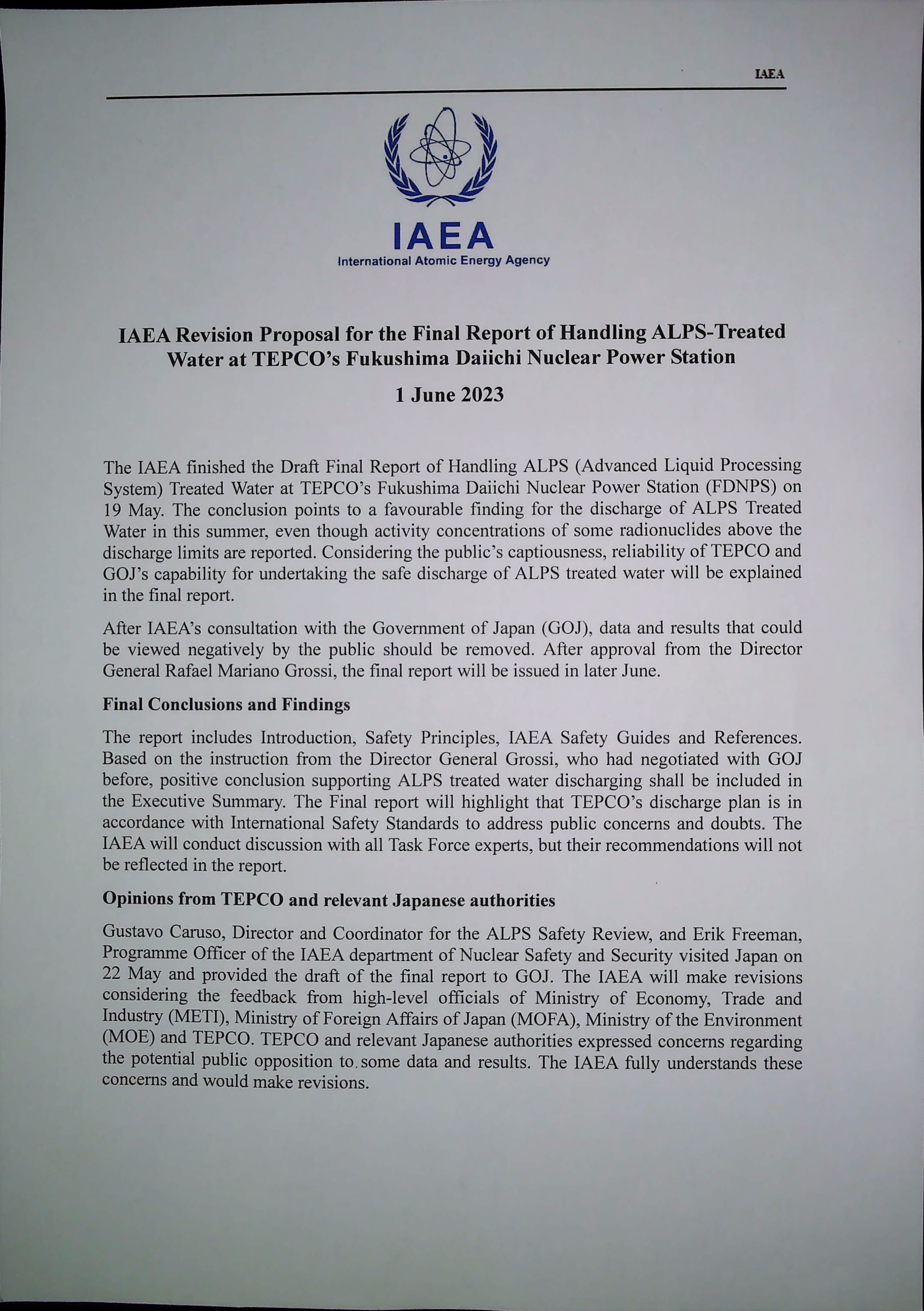
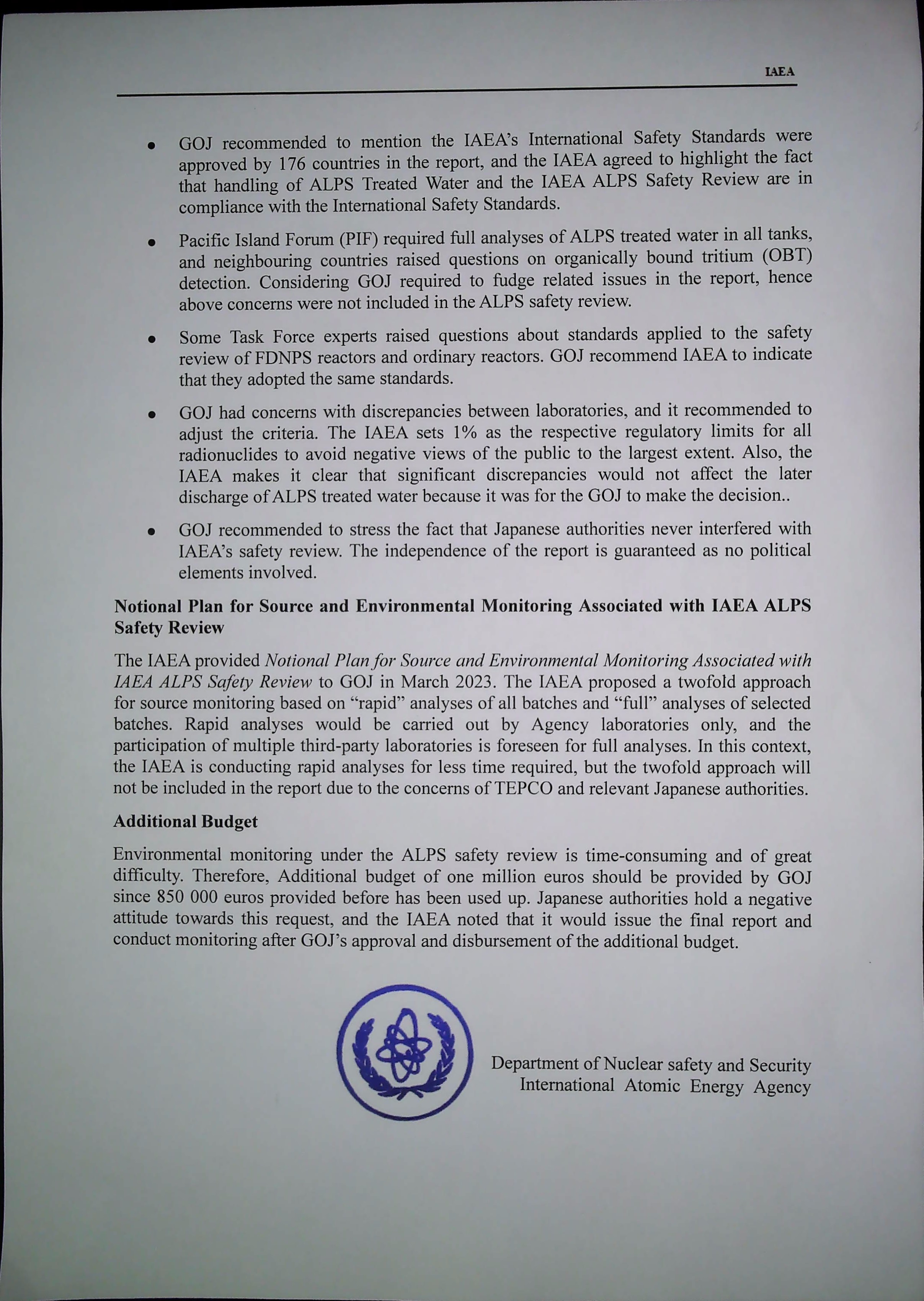
[Ed note. In this IAEA’s internal document the IAEA is seen coaching TEPCO about what to tell and what not tell to the public regarding the « treated » water to be soon discharged into the Pacific Ocean.
One thing that can be drawn from that document’s content is that the IAEA and TEPCO have no intention to be fully transparent about the radioactive contamination of the said « treated water », only the one to cushion insidiously the real facts to the public eyes.]
BY MARI YAMAGUCHI, July 5, 2023
FUTABA, Japan (AP) — The head of the U.N. atomic agency toured Japan’s tsunami-wrecked Fukushima nuclear power plant on Wednesday and said he is satisfied with still-contentious plans to release treated radioactive wastewater into the Pacific Ocean…………………………………

The wastewater release still faces opposition in and outside Japan.
Earlier Wednesday, Grossi met with local mayors and fishing association leaders and stressed that the IAEA will be present throughout the water discharge, which is expected to last decades, to ensure safety and address residents’ concerns. He said he inaugurated a permanent IAEA office at the plant, showing its long-term commitment.
The water discharge is not “some strange plan that has been devised only to be applied here, and sold to you,” Grossi said at the meeting in Iwaki, about 40 kilometers (25 miles) south of the plant. He said the method is certified by the IAEA and is followed around the world…………………….
Local fishing organizations have rejected the plan because they worry their reputation will be damaged even if their catch isn’t contaminated. It is also opposed by groups in South Korea, China and some Pacific Island nations due to safety concerns and political reasons.
Fukushima’s fisheries association adopted a resolution on June 30 reaffirming its rejection of the plan.
The fishery association chief, Tetsu Nozaki, urged government officials at Wednesday’s meeting “to remember that the treated water plan was pushed forward despite our opposition.”
Grossi is expected to also visit South Korea, New Zealand and the Cook Islands to ease concerns there. He said his intention is to explain what the IAEA, not Japan, is doing to ensure there is no problem.
In an effort to address concerns about fish and the marine environment, Grossi and Tomoaki Kobayakawa, president of the plant operator, Tokyo Electric Power Company Holdings, signed an agreement on a joint project to determine whether they are impacted by tritium, the only radionuclide officials say cannot be removed from the wastewater by treatment.
In South Korea, officials said in a briefing Wednesday that it’s highly unlikely that the released water will have dangerous levels of contamination. They said South Korea plans to tightly screen seafood imported from Japan and that there is no immediate plan to lift the country’s import ban on seafood from the Fukushima region.
Park Ku-yeon, first vice minister of South Korea’s Office for Government Policy Coordination, said Seoul plans to comment on the IAEA findings when it issues the results of the country’s own investigation into the potential effects of the water release, which he said will come soon.
China doubled down on its objections to the release in a statement late Tuesday, saying the IAEA report failed to reflect all views and accusing Japan of treating the Pacific Ocean as a sewer.
“We once again urge the Japanese side to stop its ocean discharge plan, and earnestly dispose of the nuclear-contaminated water in a science-based, safe and transparent manner. If Japan insists on going ahead with the plan, it will have to bear all the consequences arising from this,” the Chinese Foreign Ministry said.
Grossi said Wednesday he is aware of the Chinese position and takes any concern seriously. “China is a very important partner of the IAEA and we are in close contact,” he said…………………. https://apnews.com/article/japan-fukushima-radioactive-water-a4dcc4457c95f15ac7636fde4aca1df3
—
Ukraine, Russia accuse each other of planning to attack Europe’s biggest nuclear plant
9 News, By Associated Press Jul 6, 2023
Ukraine and Russia have accused each other of planning to attack one of the world’s largest nuclear power plants.
Neither side provided evidence to support their claims on Wednesday (early Thursday AEST) of an imminent threat to the facility in south-eastern Ukraine, which is occupied by Russian troops.
The Zaporizhzhia Nuclear Power Plant has been a focus of concern since Moscow’s forces took control of it and its staff in the early stages of the war.
Russia and Ukraine have regularly traded blame over shelling near the plant that caused power outages. Over the last year, the UN’s atomic watchdog repeatedly expressed alarm over the possibility of a radiation catastrophe like the one at Chernobyl after a reactor exploded in 1986.
The six reactors at Zaporizhzhia are shut down, but the plant still needs power and qualified staff to run crucial cooling systems and other safety features………………………….
The International Atomic Energy Agency has officials stationed at the Russian-held plant, which is still run by its Ukrainian staff. IAEA Director General Rafael Mariano Grossi said his agency’s most recent inspection of the plant found no activity related to explosives, “but we remain extremely alert.”
“As you know, there is a lot of combat. I have been there a few weeks ago, and there is contact there very close to the plant, so we cannot relax,” Grossi said during a visit to Japan.
In Russia, Kremlin spokesman Dmitry Peskov raised the spectre of a potentially “catastrophic” provocation by the Ukrainian army at the nuclear plant, which is Europe’s largest.
“The situation is quite tense. There is a great threat of sabotage by the Kyiv regime, which can be catastrophic in its consequences,” Peskov said in response to a reporter’s question about the plant.
He also claimed that the Kremlin was pursuing “all measures” to counter the alleged Ukrainian threat.
Grossi said he was aware of both Kyiv’s and Moscow’s claims and reiterated that “nuclear power plants should never, under any circumstances, be attacked.”
“A nuclear power plant should not be used as a military base,” he said.
Renat Karchaa, an adviser to Russian state nuclear company Rosenergoatom, said there was “no basis” for Zelenskyy’s claims of a plot to simulate an explosion.
“Why would we need explosives there? This is nonsense” aimed at “maintaining tension around the Zaporizhzhia Nuclear Power Plant”, Karchaa said.
Russian media on Tuesday cited Karchaa as saying that Ukraine’s military planned to strike the plant early on Wednesday with ammunition laced with nuclear waste. As of Wednesday afternoon, there was no indication of such an attack……………
In case of a nuclear disaster at the plant, approximately 300,000 people would be evacuated from the areas closest to the facility, according to the country’s emergency services.
Ukrainian officials have said the shut-down reactors are protected by thick concrete containment domes https://www.9news.com.au/world/russia-ukraine-updates-zaporizhzhia-nuclear-power-plant-attack-being-planned-ukraine-and-russia-accuse/5e82addc-49dd-455d-bfc8-31d7f3da6fd1—
Russia and Ukraine step up rhetoric around Zaporizhzhia nuclear power plant
By Euronews Digital 05/07/2023 https://www.euronews.com/2023/07/05/russia-and-ukraine-step-up-rhetoric-around-zaporizhzhia-nuclear-power-plant
President Zelenskyy and other senior Ukrainian officials have intensified warnings that Russian forces plan to sabotage the Zaporizhzhia power plant, the largest nuclear facility in Europe.
Russian and Ukrainian officials have escalated the rhetoric surrounding the situation at the Zaporizhzhia Nuclear Power Plant.
The plant has been under Russian control since the early days of the full-scale invasion in 2022. All six reactors have since been shut down.
The Ukrainian Armed Forces are now warning of a “possible provocation in the near future” saying “items similar to explosive devices were placed on the external roof of the third and fourth power units of ZNPP.”
A few days earlier, Ukraine’s military intelligence directorate claimed that Moscow had approved a plan to blow up the station and has mined four out of six power units, as well as the cooling pond.
European Parliamentary Assembly rapporteurs warn against extradition to the United States of Julian Assange

20/06/2023Legal Affairs and Human Rights, https://pace.coe.int/en/news/9145/pace-rapporteurs-warn-against-extradition-to-the-united-states-of-julian-assange?fbclid=IwAR17jfNw-hOFAyBnLaAdYy-4ZurMA8qGK9TdNyYSAILwoezU1K4EmqukTv4
The General Rapporteurs on Human Rights Defenders and Whistleblowers, and on Political Prisoners, of the Parliamentary Assembly of the Council of Europe (PACE), Emanuelis Zingeris (Lithuania, EPP/CD) and Sunna Ævarsdóttir (Iceland, SOC), have warned against the extradition to the United States of Julian Assange.
“The harsh treatment of Julian Assange to date, and the lengthy prison term which he faces in the US if extradited, have a chilling effect on freedom of information, freedom of speech and whistleblowing in general. Daniel Ellsberg, who leaked the ‘Pentagon Papers’, is rightly celebrated as a hero for his contribution to bringing the Vietnam war to an end. Julian Assange, who published accurate information on egregious human rights violations by state agents in Iraq and elsewhere, also deserves recognition, not punishment,” said Mr Zingeris.
“Julian Assange has made powerful enemies in the United States. If extradited, he would risk serious human rights violations, including ill-treatment in detention, and a disproportionate prison sentence. It is therefore with great concern that we learned of the decision issued on 6 June by the High Court in London, denying Julian Assange permission to appeal the decisions authorising his extradition,” said Ms Ævarsdóttir.
“We also call on the international community to take any action likely to put an end to Julian Assange’s extradition proceedings in order to prevent human rights violations, which appear more imminent now than ever before,” the rapporteurs said. Both rapporteurs note that the Assembly has already supported the release of Julian Assange and recall statements by the Council of Europe Commissioner for Human Rights calling on the UK to end the arbitrary detention of Julian Assange and to prevent his extradition.
Will upcoming NATO summit launch forever war in Europe?

Zelensky said two weeks ago that Ukraine would not even attend the Vilnius Summit unless given a firm signal on its eventual membership.
Pressure is mounting to make some sort of formal declaration over Ukraine’s membership at meetings in Vilnius next month.
JUNE 16, 2023, David Sacks, https://responsiblestatecraft.org/2023/06/16/will-upcoming-nato-summit-launch-forever-war-in-europe/
An article in the New York Times on Wednesday claimed that pressure is building on Biden to announce a timetable for Ukrainian membership in NATO at its Vilnius Summit next month.
Supposedly Biden is “isolated” among NATO allies in his reluctance to do so, even though that claim is contradicted by the story’s own last paragraph (the one that Noam Chomsky once quipped should be read first), which acknowledges that “others argue more quietly” that NATO membership “could give Mr. Putin more incentive to continue the war, or to escalate it.”
Indeed, since Moscow has already declared NATO membership for Ukraine to be completely unacceptable and an existential threat — the prevention of which is one of its chief war aims — a Vilnius Declaration that Ukraine will join NATO when the war ends will effectively ensure that the war goes on forever. It will also take off the table the West’s central bargaining chip to achieve peace, which is a neutral Ukraine.
It’s clear that the “pressure” on Biden is coming from Zelensky and some of the eastern NATO countries, specifically Poland and the Baltic States. Zelensky said two weeks ago that Ukraine would not even attend the Vilnius Summit unless given a firm signal on its eventual membership. Former NATO secretary general Anders Rasmussen, now a consultant to Zelensky, even threatened that “if NATO cannot agree on a clear path forward for Ukraine, there is a clear possibility that some countries individually might take action.” In particular, “the Poles would seriously consider going in,” triggering direct war between NATO and Russia.
The NYT article implies that the current secretary general Jens Stoltenberg agrees with the hardliners on the need for a concrete timetable for Ukraine’s admission into NATO, but he made no such promises during his joint address with President Biden on Tuesday. By Wednesday, Stoltenberg and NATO were making it clear that no specific timeline for Ukraine’s NATO membership would be on the agenda in Vilnius. He reiterated comments from April that “Ukraine’s future is in NATO,” and said there would be agreement from member states on a “multi-year program” to help Ukraine “become fully interoperable with NATO,” but wouldn’t commit to anything more specific than that.
Apparently, it’s Zelensky and his allies along the Russian border who are “isolated,” not President Biden.
Whatever Stoltenberg’s personal views may be, he knows NATO is divided on the question of admitting Ukraine in the near future. Even the NYT name-checks three countries – Germany, Hungary, and Turkey – whose leaders would definitely oppose membership at a specific future date. Many more leaders have privately expressed concern, and Biden, to his credit, appears to be one of them.
While his overall conduct and rhetoric has been hawkish (and I continue to maintain he could have avoided this war altogether with better diplomacy in the months leading up to it), Biden has been admirably consistent in his desire not to plunge America into direct war with Russia.
The threats from Rasmussen underscore how easily a proxy war can turn into a real one in an alliance where all members are pledged to come to the military defense of any one member. The American people may begin to question the wisdom of making new Article 5 guarantees if foreigners like Rassmussen can use existing ones to blackmail the United States into reckless action.
Polish or Ukrainian tails should not wag American dogs into World War III.
Short of giving Ukraine the security guarantees that NATO membership provides, some in Biden’s foreign policy circle, such as Secretary of State Antony Blinken, have been pushing a different idea, which is to give “Israel status” to Ukraine. This consists of long-term security guarantees (which run for ten-year intervals in Israel’s case) including weapons, ammunition, and money “not subject to the fate of the current counteroffensive or the electoral calendar.” In other words, America won’t reassess support even if the counteroffensive fails. Indeed, support won’t cease even if those pesky voters change their minds. Biden’s War for Democracy is too important to be subject to elections.
However, some observers may see here a classic bait and switch. Last year, after Ukraine retook land around Kharkiv and Kherson, the American people were assured that the Ukrainians would complete the job in the spring and summer of 2023. This new Ukrainian counteroffensive would roll back Russian territorial gains, perhaps even threaten the Russian hold on Crimea, and thereby drive Moscow to the negotiating table and end the war. Many Americans supported the $100+ billion in appropriations for Ukraine on this basis. The implicit promise was that this was a one-time expense, not the baseline for an annual appropriation in a new Forever War.
Now a difficult start to the counteroffensive coupled with a proposed multi-year deal at Vilnius makes clear that this was a lie or a pipe dream. But isn’t this what always happens? Administrations ease us into war with promises of quick and easy victory, and then once involved, tell us we can’t back out no matter the cost because American credibility is at stake. It’s Vietnam, Afghanistan or Iraq all over again, except this time with a nuclear-armed adversary creating the heightened risk that the war could escalate into WWIII at any point.
Perhaps the most pointless aspect of the current debate among NATO members is that with or without a timetable, a Vilnius Declaration that Ukraine will join NATO is a promise that cannot be implemented, absent a major reversal in Ukrainian fortunes on the battlefield. Such a declaration cannot guarantee Ukraine’s NATO admission any more than its forerunner at the Bucharest Summit in 2008 did. It can only guarantee that the Russians remain implacably resolved to stopping it by perpetuating the war as long as they have to.
So our insistence that Ukraine be allowed to join NATO “someday,” combined with our (sensible) desire not to be drawn into World War III, means that “someday” will never arrive. This begs the question: why continue to make a promise when there is no realistic path to achieving it? Why fight over a principle (NATO’s “open door”) that’s largely theoretical anyway because Ukraine can’t actually join the alliance without triggering the continent-wide conflagration NATO was established to avoid in the first place?
The leaders meeting at Vilnius may not be asking that question, but future historians judging them surely will.
Saudi Arabia demands own nuclear program in exchange for ties with Israel

According to NYT, Riyadh may sideline long-held demand to establish Palestinian state for normalization with Israel; Netanyahu could face strong opposition from defense establishment, fearing move would initiate a nuclear arms race across Middle East
In discreet U.S.-mediated talks between Saudi Arabia and Israel, Riyadh has conditioned normalizing ties with Jerusalem on the establishment of a civilian nuclear program, as well as a robust defense pact with Washington and removing restrictions on American arms sales, the New York Times reported on Saturday.
The demand reportedly came during U.S. Secretary of State Antony Blinken’s visit to the Gulf kingdom earlier this month where he held a lengthy meeting with Saudi Crown Prince Muhammed bin Salman.
Blinken then held a 40-minute phone call with Netanyahu, briefing him about the details of bin Salman’s demands.
The Times cited two American officials who described the phone call as “a turn in the Biden administration’s long-shot bid to broker a landmark diplomatic deal” between Jerusalem and Riyadh
For such a deal to fructify, each side would have to have to reverse course on at least one long-held position: Israel would have to allow the Saudi kingdom to enrich uranium; Saudi Arabia will have to abandon its policy to avoid normalization with Israel as long as the Palestinians are not allowed to establish their own state; and Biden would have to explain his volte-face on bin Salman, whom he promised to make a “pariah” during his 2020 presidential election campaign for his alleged involvement in the murder of Saudi-American journalist Jamal Khashoggi.
According to the report, Prime Minister Benjamin Netanyahu could face strong opposition from the national security establishment to consenting to a Saudi nuclear enrichment program, fearing such a move would initiate a nuclear arms race across the Middle East.
Central Europe’s nuclear plans – fraught with problems
CENTRAL EUROPE’S NUCLEAR PLANS: HOT STUFF
Claudia Ciobanu, Edit Inotai, Tim Gosling and Nicholas Watson, Budapest, Prague, Warsaw, BIRN. June 20, 2023 https://balkaninsight.com/2023/06/20/central-europes-nuclear-plans-hot-stuff/
Since the war in Ukraine, CEE countries have stepped up efforts to build more nuclear power plants and reduce nuclear supply chain dependency on Russia’s Rosatom. Yet the disposal of waste remains an issue and could impact financing of new reactors.
Central Europe has put nuclear power at the forefront of efforts to quit Russian oil and gas and decarbonise economies, yet breaking the region’s dependency on Russia’s giant nuclear holding company Rosatom – for fuel, financing and waste disposal – promises to complicate those efforts.
The region’s reliance on Rosatom is historic. Until last year, all 14 reactors operating in Czechia, Hungary and Slovakia were built by Russia (Slovakia’s third reactor at Mochovce, of Soviet design but not built by Rosatom, started up this year). Furthermore, Rosatom is building two more reactors in Hungary.
That latter project, thrown into some disarray by the war in Ukraine, epitomises this longstanding dependency. Rosatom dominates the global nuclear industry because of its ability to act as a “one-stop nuclear shop”, which is attractive to countries because it can finance the plant; build the plant; provide training, support and maintenance for the plant; dispose of the nuclear waste produced at the plant; and finally decommission the plant.
While Europe is taking steps to reduce its 30 per cent reliance on Russian nuclear fuel – Czech energy company CEZ has signed contracts with US-based Westinghouse Electric Company and French company Framatome – waste disposal will be a much harder nut to crack.
Nuclear energy produces mainly low-level radioactive waste, while high-level radioactive waste, which includes the hot spent fuel, accounts for about 1 per cent of total nuclear waste. Most of this spent fuel – over 60,000 tonnes stored across Europe – is kept in cooling pools located within or near the plants that generated it.
Last year’s EU taxonomy of what it considers green energy makes having existing disposal facilities for low-level waste and a detailed plan to have in operation by 2050 a disposal facility for high-level radioactive waste strict requirements for any new nuclear energy projects to qualify as sustainable investments – a definition needed to keep down the huge financing costs of new reactors. In addition, the technical screening criteria for nuclear energy prohibit the export of radioactive waste for disposal in third countries.
While there are many existing disposal facilities for low-level waste dotted around Europe, Finland is the only country currently constructing a permanent disposal facility for used fuel, the deep geological repository (DGR) under construction at Olkiluoto, which is scheduled to be operational around 2025.
From Rosatom with love
Hungary is pretty much stuck with Rosatom, most experts in Hungary believe. They tend to praise the technology and cooperation provided by Russia, though most are aware that political realities have significantly changed since the war in Ukraine. Yet restructuring the current Paks 1 power plant (four VVER440 reactors) and replacing Rosatom as the main contractor for Paks 2 (two VVER1200 reactors) is regarded as a non-starter by most industry experts. If the EU slaps sanctions on Russia’s nuclear industry, a move currently being debated, it would cause major difficulties for Hungary.
Rosatom is Hungary’s sole provider of nuclear fuel, which since the war in Ukraine began has had to be airfreighted to Hungary across Belarusian and Polish airspace. “The fact is that Russian nuclear fuel is both technologically and economically excellent,” Tamas Pazmandi, head of the Radiation Protection Department of the Centre for Energy Research, tells BIRN.
Pazmandi admits that diversification of the nuclear supply chain is probably necessary, but warns it will take longer than many might hope or expect. “Replacing Rosatom with another supplier would require years, due to the complicated process of development, production and licensing. In a best-case scenario, it would be possible around 2026-2027,” he explains.
Others point out that currently no alternative fuel is even available for the VVER440-type reactors, dismissing speculation that Westinghouse or Framatome could offer an immediate alternative to Rosatom.
Even for the Paks 2 project, where construction work has not started, a switch to a different company would mean starting again from scratch. “If you want to buy a Mercedes, you don’t ask Volvo to manufacture it – it is an entirely different car,” Pazmandi says by way of example. “It is the same with nuclear power plants. This is a Russian-designed plant, with all its licenses. On the supplier level there are possibilities for diversification, but the main design and the main contractor cannot be replaced or you will have a completely different project.”
Government-close experts like Otto Toldi from the Climate Research Institute have argued that Rosatom holds another unique advantage: it takes care of the nuclear waste, which none of its rivals can do. Yet this, it turns out, is not actually true: although the original contract between Hungary and the Soviet Union in the 1980s included a paragraph about the repatriation of nuclear waste, that ceased in the mid-1990s on Russia’s request. When Hungary joined the EU in 2004, it came under Euratom regulations, which basically forbids the export of nuclear waste. Spent fuel is now stored for five years in a cooling pond on-site, and then put in a dry storage facility. Last year, an International Atomic Energy Agency (IAEA) team of experts reported that, “Hungary is moving ahead in the development of a deep geological disposal facility for high level waste.”
Media friendly to the government, however, have been speculating that Rosatom could offer in the case of the Paks 2 project to take back some of the spent fuel and recycle it. Remix technology, which was tested in the Balakovo nuclear power plant in southwest Russia, is based on extracting uranium and plutonium from spent fuel and converting it into new fuel rods. The recycled fuel rods could then be used for nuclear fuel, with the remaining waste sent back to Hungary. Western companies can offer similar technology, called MOX fuel (mixed oxide fuel, consisting of plutonium blended with uranium), with France being one of the pioneers in Europe.
Hungary’s only real alternative to Russian-built reactors would be small modular reactors, or SMRs. Though touted as the future of nuclear energy, the technology is still in its infancy: there are only three SMRs operational in the world – in Russia, China and India – with three under construction and another 65 in design. Hungarian Energy Minister Csaba Lantos said recently SMRs are a viable option for the future.
“In an ideal situation, one-third of Hungary’s electricity demand would be covered by a regular nuclear power plant, one-third by SMRs and one-third by renewables,” Pazmandi says.
1 This Month



26 September – International Day for the Total Elimination of Nuclear Weapons


PLEASE OPPOSE HR 8255 AND S.3639 – bills would accelerate satellite deployment, with no environmental review or safeguards – https://ncstd5li.quorum.us/campaign/169331/
To see nuclear-related stories in greater depth and intensity – go to https://nuclearinformation.wordpress.com
-
Archives
- September 2026 (245)
- August 2026 (330)
- July 2026 (355)
- June 2026 (287)
- May 2026 (306)
- April 2026 (356)
- March 2026 (251)
- February 2026 (267)
- January 2026 (308)
- December 2025 (358)
- November 2025 (359)
- October 2025 (375)
-
Categories
- 1
- 1 NUCLEAR ISSUES
- business and costs
- climate change
- culture and arts
- ENERGY
- environment
- health
- history
- indigenous issues
- Legal
- marketing of nuclear
- media
- opposition to nuclear
- PERSONAL STORIES
- politics
- politics international
- Religion and ethics
- safety
- secrets,lies and civil liberties
- spinbuster
- technology
- Uranium
- wastes
- weapons and war
- Women
- 2 WORLD
- ACTION
- AFRICA
- Atrocities
- AUSTRALIA
- Christina's notes
- Christina's themes
- culture and arts
- Events
- Fuk 2022
- Fuk 2023
- Fukushima 2017
- Fukushima 2018
- fukushima 2019
- Fukushima 2020
- Fukushima 2021
- general
- global warming
- Humour (God we need it)
- Nuclear
- RARE EARTHS
- Reference
- resources – print
- Resources -audiovicual
- Weekly Newsletter
- World
- World Nuclear
- YouTube
-
RSS
Entries RSS
Comments RSS
 nuclear-news
