Netanyahu Rebuffs Biden, Says Israel ‘Will Not Compromise on Full Israeli Control’ Over Gaza
The Israeli PM’s statement contradicts messaging from President Joe Biden and the White House
01/21/24 Zachary Rogers, https://themessenger.com/news/netanyahu-rebuffs-biden-says-israel-will-not-compromise-full-israeli-control-gaza
sraeli Prime Minister Benjamin Netanyahu said Saturday that he “will not compromise on full Israeli control” over Gaza and that “this is contrary to a Palestinian state.”
Netanyahu released the statement in a social media post. The statement comes just a day after President Joe Biden spoke with Netanyahu for the first time in nearly a month and directly contradicts messaging from the White House that creative solutions could bridge wide gaps between the leaders’ views on Palestinian statehood.
“The President discussed Israel’s responsibility even as it maintains military pressure on Hamas and its leaders to reduce civilian harm and protect the innocent,” the White House said of the conversation between national leaders.
“The President also discussed his vision for a more durable peace and security for Israel fully integrated within the region and a two-state solution with Israel’s security guaranteed,” it added.
The conflicting messaging is a sign of the pressures Netanyahu’s government faces at home. Thousands of Israelis have been protesting in Tel Aviv calling for new elections and for their nation to ensure the safe return of the remaining hostages of Hamas, but Netanyahu is also under heat to appease members of his right-wing ruling coalition by intensifying the conflict.
Netanyahu has said Israel must fight until it achieves “complete victory” and Hamas no longer poses a threat but has not outlined how this will be accomplished.
But a member of Israel’s War Cabinet, former Israeli army chief Gadi Eisenkot, has called a cease-fire the only way to secure the hostages’ release, a comment that implied criticism of Israel’s current strategy.
Nuclear tensions on the Korean Peninsula set to worsen in 2024
https://www.icanw.org/nuclear_tensions_on_the_korean_peninsula_set_to_worsen_in_2024—
2024 looks set to be an even more perilous year than 2023 on the Korean Peninsula as nuclear threat and counter threat have escalated even further since the beginning of January. On New Year’s Day, South Korea’s defence ministry repeated previous threats to destroy the North Korean “regime” if it uses nuclear weapons. This was a response to North Korean leader, Kim Jong Un’s speech the day before in which he told his military to prepare for possible war.
Since then, Kim has said he has given up on the idea of peaceful reunification with South Korea designating it a hostile state and again warned of possible war. In the past week alone, Kim has called for a change in the constitution to designate Seoul as Pyongyang’s “primary foe” and a confidence building military agreement with the South agreed in 2018 has started to fall apart as the South Korean armed forces resumed frontline aerial surveillance in the wake of North Korean artillery exercises near a South Korean island on the maritime border between the two states.
The expected change in the constitution of the Democratic People’s Republic of Korea (North Korea’s official name) follows an amendment last year that enshrined nuclear weapons in it.
This week has also seen the North testing what it says is a solid-fueled hypersonic missile and an underwater nuclear drone in response to what some observers say is the largest ever joint naval exercise between South Korea, the United States and Japan.
Analysts believe Pyongyang is developing both so-called strategic and tactical nuclear weapons in order to deter the US which is committed to use nuclear weapons in South Korea’s defence.
North Korea has been testing more and more advanced ballistic missiles and warheads, some with the range to reach the US and has also said it is developing ship-launched cruise missiles, while the Americans have been mounting repeated shows of force including military exercises using nuclear-capable aircraft and the visit of a nuclear-armed submarine to South Korea.
Last year, the US and South Korea agreed to increase their cooperation on the planning for the use of nuclear weapons following earlier statements by South Korean President, Yoon Suk Yeol, that suggested Seoul might develop its own nuclear weapons. Yoon has since cooled talk of acquiring nuclear weapons,but the debate continues in policy circles.
Another escalatory move has been increasing military cooperation between the US, South Korea and Japan, which also endorses the use of American nuclear weapons in its defence.
In the light of this, some analysts see the Korean Peninsula as the most dangerous nuclear flashpoint in a world that currently has no shortage of conflict involving nuclear-armed states in Ukraine and Gaza.
Alicia Sanders-Zakre, ICAN’s Policy and Research Coordinator, called for restraint on all sides: “Inflammatory nuclear rhetoric and threats, accompanied by military exercises and weapons tests, ramp up tensions and bring us closer to the brink of catastrophe. All nuclear-armed states, including North Korea and the US, as well as those allied on nuclear policies, such as Japan and South Korea, need to take urgent steps to de-escalate tensions and to break free from the dangerous doctrine of nuclear deterrence. Joining the Treaty on the Prohibition of Nuclear Weapons is a crucial step to delegitimise nuclear deterrence and eliminate nuclear weapons.”
North Korea uses the same justification for its actions as the US, and the other declared nuclear-armed states. Just like Washington, Pyongyang says it is committed to disarmament, but argues the security threats it faces mean it needs nuclear weapons to deter its enemies.
The doctrine of deterrence is based on the threat to use nuclear weapons with all the catastrophic consequences that would entail for the whole world. As the states parties to the Treaty on the Prohibition of Nuclear Weapons (TPNW) declared at their recent meeting in New York: “the renewed advocacy, insistence on and attempts to justify nuclear deterrence as a legitimate security doctrine gives false credence to the value of nuclear weapons for national
security and dangerously increases the risk of horizontal and vertical nuclear proliferation.”
The TPNW (Treaty for the Prohibition of Nuclear Weapons) is growing in strength and has just welcomed its 70th state party while a further 27 countries are signatories. These states recognise that the total elimination of nuclear weapons is a global imperative and they are showing responsible leadership by championing the treaty as the best way to end the existential threat posed by nuclear weapons.
US urges discussions with China on practical nuclear risk reduction steps
Reuters, January 19, 2024
WASHINGTON, Jan 18 (Reuters) – The United States does not expect formal nuclear arms-control negotiations with China anytime soon, but does want to see a start of discussions on practical risk-reduction measures, a senior White House official said on Thursday.
Pranay Vaddi, the senior White House official for arms control and non proliferation, told a Washington think tank it had been important to have initial arms-control talks in November with China, but stressed the need for them to involve key Chinese decision makers or influencers on the country’s nuclear posture………………………..
The U.S. and China held their first talks on nuclear arms control in nearly five years on Nov. 6, amid growing U.S. concerns about China’s nuclear build up, but the meeting produced no specific results…………………………………………..
The U.S. and China held two days of military talks in Washington last week, their latest engagement since agreeing to resume military-to-military ties.
In its annual report on the Chinese military in October, the Pentagon said China has more than 500 operational nuclear warheads and will probably have over 1,000 warheads by 2030.
The U.S. has a stockpile of about 3,700 nuclear warheads, of which roughly 1,419 strategic nuclear warheads were deployed.
Reporting by David Brunnstrom; Editing by Sandra Maler, https://www.reuters.com/world/us-urges-discussions-with-china-practical-nuclear-risk-reduction-steps-2024-01-18/
Zelensky Courts JPMorgan, Bank of America & Bridgewater CEOs At Davos, Urges More Money From West
Zero Hedge, BY TYLER DURDEN, WEDNESDAY, JAN 17, 2024
As expected, anything related to Ukraine presented at the World Economic Forum (WEF) in Davos has been focused on more weaponry and seeking more vows of integration among Western allies.
“Ukrainians need predictable financing throughout 2024 and beyond,” European Commission president Ursula von der Leyen told World Economic Forum participants. “They need a sufficient and sustained supply of weapons to defend Ukraine and regain its rightful territory.”
As for President Zelensky, in addressing world leaders at the forum he emphasized that the West needs to help Ukraine achieve air superiority if his forces are to have a chance to emerge victorious against Russia……………………………………

At the summit, US Secretary of State Antony Blinken promised that Washington will keep up its support for Ukraine, however while keeping things vague – following Biden’s proposed foreign defense budget request being reject by GOP members in Congress; and NATO chief Jens Stoltenberg suggested Ukraine is moving closer to entry into the alliance.
Stoltenberg acknowledged a “serious battlefield situation” but also said there is “cause for optimism” after nearly two years of fighting, and NATO’s constant support.
Below is a portion of the NATO press readout based on his panel speech:
………… Ukrainians are now firmly oriented to the West, aspiring for membership in NATO and the European Union. The Secretary General also stressed that “support for Ukraine is not charity; it’s an investment in our own security”.………
But realistically, the prospect of Ukraine gaining full NATO membership would be a process of years, and would likely trigger WW3 with Russia–so to some degree this is all empty posturing.
But here’s what’s happening at Davos which is arguably more important to Kiev at the moment:
Ukraine is seeking new ways to finance its rebuilding plans as vital aid from the West slows down. President Volodymyr Zelenskyy reportedly has plans to meet JP Morgan’s CEO at the World Economic Forum.
Ukraine’s President Zelenskyy is reportedly planning to meet JPMorgan CEO Jamie Dimon at the World Economic Forum in Davos to seek new ways of financing its rebuilding plans.
JP Morgan, the biggest US bank with almost half a trillion dollars of market capitalization, has already been advising Ukraine on financing reconstruction.
It’s as yet unclear if any firm promises were made or agreements struck at the Davos meeting which also included Bank of America’s Brian Moynihan, as well as Bridgewater’s Ray Dalio.
According to further details of who was in attendance via Fox Business: “Other meeting attendees included David Rubinstein of the private equity firm Carlyle Group; billionaire entrepreneur Michael Dell, the founder of Dell Technologies; Ray Dalio of Bridgewater Associates, the world’s largest hedge fund; Steve Schwarzman, the CEO of Blackstone, the world’s largest private equity fund; and Philipp Hildebrand, representing BlackRock, the world’s largest money manager.”
Additionally, “Dimon was accompanied by Mary Erdoes, who runs JPMorgan’s asset-management unit. The White House was represented by Penny Pritzker, of the super-wealthy Pritzker family and a major Democratic Party donor.” Pritzker has been appointed Biden administration’s special representative for Ukraine’s economic recovery. https://www.zerohedge.com/geopolitical/zelensky-courts-jpmorgan-bank-america-bridgewater-ceos-davos-urges-more-west
When Yemen Does It It’s Terrorism, When The US Does It It’s “The Rules-Based Order”
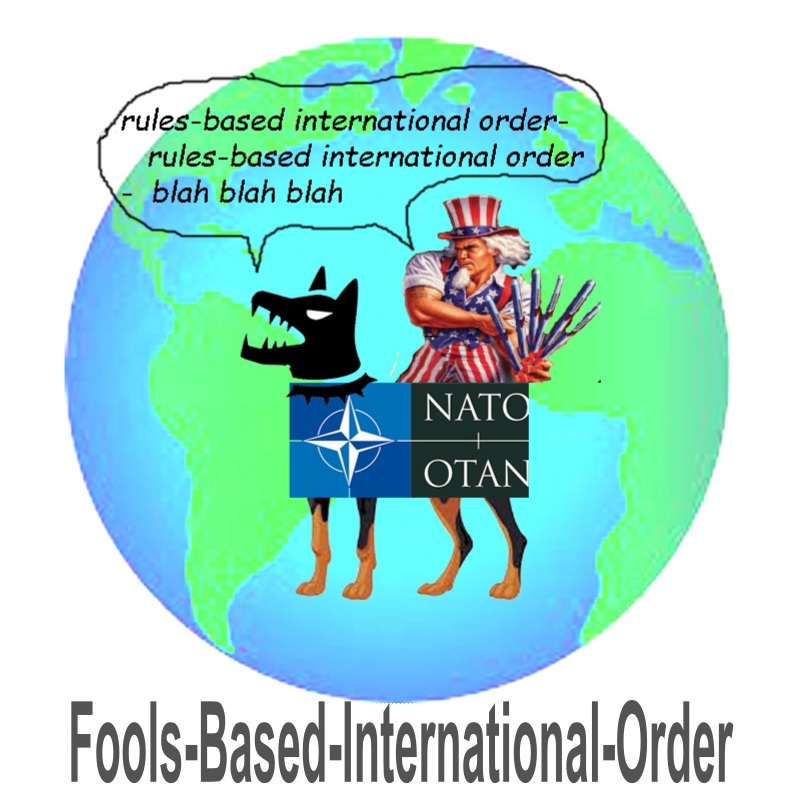
That’s right kids: when Yemen sets up a blockade to try and stop an active genocide, that’s terrorism, but when the US empire imposes a blockade to secure its geostrategic interests in the middle east, why that’s just the rules-based international order in action.
What this shows us is that the “rules-based international order” the US and its allies claim to uphold is not based on rules at all; it’s based on power, which is the ability to control and impose your will on other people. The “rules” apply only to the enemies of the empire because they are not rules at all: they are narratives used to justify efforts to bend the global population to its will.
CAITLIN JOHNSTONE, JAN 18, 2024
The Biden administration has officially re-designated Ansarallah — the dominant force in Yemen also known as the Houthis — as a Specially Designated Global Terrorist entity.
The White House claims the designation is an appropriate response to the group’s attacks on US military vessels and commercial ships in the Red Sea and the Gulf of Aden, saying those attacks “fit the textbook definition of terrorism.” Ansarallah claims its actions “adhere to the provisions of Article 1 of the Convention on the Prevention and Punishment of the Crime of Genocide,” since it is only enforcing a blockade geared toward ceasing the ongoing Israeli destruction of Gaza.
One of the most heinous acts committed by the Trump administration was its designation of Ansarallah as a Foreign Terrorist Organization (FTO) and as Specially Designated Global Terrorists (SDGT), both of which imposed sanctions that critics warned would plunge Yemen’s aid-dependent population into even greater levels of starvation than they were already experiencing by restricting the aid that would be allowed in. One of the Biden administration’s only decent foreign policy decisions has been the reversal of that sadistic move, and now that reversal is being partially rolled back, though thankfully only with the SDGT listing and not the more deadly and consequential FTO designation.
In a new article for Antiwar about this latest development, Dave Decamp explains that as much as the Biden White House goes to great lengths insisting that it’s going to issue exemptions to ensure that its sanctions don’t harm the already struggling Yemeni people, “history has shown that sanctions scare away international companies and banks from doing business with the targeted nations or entities and cause shortages of medicine, food, and other basic goods.” DeCamp also notes that US and British airstrikes on Yemen have already forced some aid groups to suspend services to the country.
So the US empire is going to be imposing sanctions on a nation that’s still trying to recover from the devastation caused by the US-backed Saudi blockade that contributed to hundreds of thousands of deaths between 2015 and 2022. All in response to the de facto government of that very same country imposing its own blockade with the goal of preventing a genocide.
That’s right kids: when Yemen sets up a blockade to try and stop an active genocide, that’s terrorism, but when the US empire imposes a blockade to secure its geostrategic interests in the middle east, why that’s just the rules-based international order in action…………………………………..
What this shows us is that the “rules-based international order” the US and its allies claim to uphold is not based on rules at all; it’s based on power, which is the ability to control and impose your will on other people. The “rules” apply only to the enemies of the empire because they are not rules at all: they are narratives used to justify efforts to bend the global population to its will……… https://www.caitlinjohnst.one/p/when-yemen-does-it-its-terrorism?utm_source=post-email-title&publication_id=82124&post_id=140790707&utm_campaign=email-post-title&isFreemail=true&r=1ise1&utm_medium=email
 | |||
| |||
Incredible analysis of US warmongers plans for war with China ! Read this and weep!
Note, he (Andrew Krepinevich) disingenuously argues the need for a plan for war with China–as if he has just discovered this need, rather than acknowledge he has been planning, preparing this war for 15 years now
This, in a nutshell, is Elbridge Colby’s “Strategy of Denial” regarding using Taiwan for war–provoke China into firing the first shot, and then bind allies (“binding strategy”) in a coalition to attack and sanction China.
Subject: Foreign Affairs: Prepare for long, painful war with China
Alice Slater www.worldbeyondwar.org 16 Jan 24
If central casting ever needed a devil-as-lawyer-character, Andrew Krepinevich is that man. He looks like he stepped right out from a morality play (see, for example, his dialogue with John Pilger in “The coming war with China”).
Appropriately, Andrew Krepinevich is the architect of war with China. Around 2009, during the Obama administration, he started building out the explicit plans for war (euphemistically called “operational concepts”) called AirSea Battle at CSBA. This plan, which has already affected every branch and dimension of military operations, strategy, and procurement, was based on the US war doctrine against the USSR called AirLand Battle, itself derived from the Yom Kippur War . AirLand Battle doctrine was used in Kosovo, Iraq I & II, and every US war since its inception. It was described colloquially as “shock an
São Tomé and Príncipe 70th State to ratify Treaty on the Prohibition of Nuclear Weapons

São Tomé and Príncipe has become the first new state party to the UN Treaty on the Prohibition of Nuclear Weapons (TPNW) in 2024. At UN Headquarters in New York on 15 January, the Minister of Justice of São Tomé and Príncipe, H.E. IIza Amado Vaz, deposited the instrument of ratification for this landmark treaty on behalf of the government, bringing the total number of states parties to 70.
The National Assembly of São Tomé and Príncipe unanimously approved ratification of the TPNW on 16 November 2023.
São Tomé and Príncipe’s ratification comes shortly after states parties to the TPNW renewed a “call for all States that have not yet done so to sign and ratify or accede to the Treaty without delay”, and reiterated their commitment to pursue universalisation of the Treaty as a priority, in a declaration issued at the second meeting of states parties of the treaty in New York in December 2023.
ICAN’s Executive Director, Melissa Parke, welcomed the move: “It’s great news that Sao Tome and Principe has ratified the Treaty which means it now has 70 states parties. As more and more countries join the TPNW they strengthen the new international norm it has created that makes nuclear weapons unacceptable. These are the responsible states in the international community, and we look forward to more ratifications and signatures in the year ahead.”
A total of 93 countries have signed the TPNW and 70 have ratified or acceded to it. In Africa, there are now 16 states parties and a further 17 signatories. The TPNW complements and reinforces the 1996 Treaty of Pelindaba, which established Africa as a nuclear-weapon-free zone. The states parties to the Treaty of Pelindaba have called upon all African Union member states “to speedily sign and ratify the [TPNW]”.
In January 2023, São Tomé and Príncipe was among the 37 African states that met in Pretoria, South Africa, for the African Regional Seminar on the Universalisation of the TPNW to promote adherence to the treaty by every African state as soon as possible.
Support for the TPNW
São Tomé and Príncipe was among the first countries to sign the TPNW at a high-level ceremony in New York when it opened for signature on 20 September 2017. Since then, it has promoted universal adherence to the TPNW, including by consistently voting in favour of an annual UN General Assembly resolution since 2018 that calls upon all states to sign and ratify the treaty “at the earliest possible date”.
São Tomé and Príncipe participated in the negotiation of the TPNW at the United Nations in New York in 2017 and was among 122 states that voted in favour of its adoption.
Former Polish PM admits Ukraine’s strategy failed
https://www.rt.com/russia/590598-poland-ukraine-fail/ 15 Jan 23
The conflict is “going in the wrong direction,” Mateusz Morawiecki told the UK’s Express newspaper
Ukraine’s 2023 counteroffensive was “not successful” and Russia has the upper hand strategically, former Polish prime minister Mateusz Morawiecki admitted, in an interview with Britain’s Express newspaper published on Friday.
The conflict in Ukraine is “not going in the right direction,” Morawiecki told the outlet, outlining his “huge concern” with a situation in which Moscow had apparently outflanked its opponents.
Russia has “huge resources,” he explained, noting the country’s military production capabilities significantly outweighed the EU’s own. “They have this strategic depth, and they have patience in international politics,” he added, also dismissing the country’s elections scheduled for March as mere “theater” unlikely to change the balance of power in Moscow.
Morawiecki also argued, however, that Ukraine’s failure had a silver lining for NATO in that it had brought Finland and Sweden into the alliance and was “awakening” countries like Denmark and Romania. The Scandinavian countries, he said, were among the most vocal in calling attention to the threat allegedly posed by Russia.
“Not only the security of the eastern flank of NATO, but also for the security of the United Kingdom, security of Germany, Denmark and the Scandinavians, they do understand it very, very well,” he said.
The former premier (2017-2023) was speaking to the British press for the first time since his successor, current PM Donald Tusk, had two lawmakers from Morawiecki’s Law and Justice Party (PiS) arrested earlier in the week. The ex-leader described the MPs as “political prisoners” and accused Tusk’s admittedly pro-EU government of “representing Brussels and Berlin, not Warsaw.”
While international attention has largely shifted away from the Ukraine conflict to Israel’s war with Gaza as the latter threatens to erupt into a broader conflict, UK Prime Minister Rishi Sunak traveled to Kiev on Friday to bestow his government’s largest gift yet on the government of Ukrainian President Vladimir Zelensky, announcing £2.5 billion ($3.2 billion) to be paid out over the coming financial year and starting in April, and a bilateral agreement that includes security guarantees for Ukraine “in the event that it is ever attacked by Russia again.”
Zelensky has been vocal about his concern over flagging international support for Kiev’s fight, after unprecedented amounts of foreign aid from the UK, US, and EU failed to appreciably move the needle against Russia. Legislative gridlock has stalled planned aid packages in the US even as the Biden administration insists on an urgency to it, with his political opposition countering that accountability for funds spent must be a requirement for any future aid.
Talks on Zelensky’s ‘peace formula’ are pointless – Kremlin

https://www.rt.com/russia/590675-zelensky-peace-formula-talks-useless/ 15 Jan 24
Russia’s absence means the negotiations in Davos could not have produced any concrete results, Dmitry Peskov has said
Top officials from dozens of countries who met in Switzerland to discuss Ukraine’s ‘peace formula’ were engaged in a completely useless endeavor without Russian participation, Kremlin spokesman Dmitry Peskov said on Monday.
On Sunday, national security advisers from 81 nations and international organizations gathered in Davos ahead of the World Economic Forum to talk about a 10-point initiative floated by Ukrainian President Vladimir Zelensky in October 2022 to end hostilities with Russia.
The plan calls for the withdrawal of Russian troops from the territory Kiev claims as its own and insists on the creation of a tribunal to prosecute Moscow for alleged war crimes. Russia has dismissed the proposal as divorced from reality.
Commenting on the Davos meeting, Peskov called it “talking for the sake of talking,” reiterating that the same applied to previous rounds of talks in such a format. “This process is not aimed and cannot be aimed at achieving a concrete result for an obvious and simple reason – we are not there.”
Russia was also absent from previous discussions last year in Denmark, Saudi Arabia, and Malta. At the same time, Moscow has never categorically refused peace talks with Kiev, despite Zelensky signing a decree banning all negotiations with the current Russian leadership after four regions overwhelmingly voted to join Russia in the autumn of 2022.
Meanwhile, Bloomberg reported on Sunday that the Davos talks had ended “with no clear path forward” despite Ukraine’s hopes that it would be able to secure backing for its plan from members of the Global South, many of whom have proclaimed neutrality in the conflict. That was denied by Ukrainian officials, however, who nevertheless acknowledged differences of opinion among the meeting’s participants.
On Sunday, Swiss Foreign Minister Ignazio Cassis echoed Peskov’s remarks, arguing that any Ukraine peace talks should involve Russia in one way or another.
Do or die’: MPs launch urgent bid to spare Assange from US extradition.

By Matthew Knott, January 15, 2024 — https://www.theage.com.au/politics/federal/do-or-die-mps-launch-urgent-bid-to-spare-assange-from-us-extradition-20240114-p5ex2h.html
Australian politicians across the political divide have launched a last-ditch bid to prevent Julian Assange from being extradited to the United States to face espionage charges as the WikiLeaks founder faces a crucial final legal challenge in Britain next month.
The four co-convenors of the cross-party Bring Julian Assange Home Parliamentary Group wrote to British Home Secretary James Cleverly arguing for an urgent review of Assange’s case. This was in light of a judgment in the Supreme Court of the UK in November, striking down Prime Minister Rishi Sunak’s controversial plan to send asylum seekers to Rwanda.
On February 20 and 21, two British High Court judges will review an earlier ruling that refused Assange permission to appeal his extradition order. This is expected to be his final bid to prevent being sent to the US.
Assange faces decades in prison over his role in the publication of US classified files and diplomatic cables relating to the wars in Afghanistan and Iraq.
“If he loses in the UK courts next month he could be extradited to the USA within 24 hours,” Assange’s brother Gabriel Shipton said of the High Court review.
“This is literally a do-or-die scenario for Julian.”
Assange’s lawyer Jennifer Robinson has argued he was at high risk of suicide if the High Court rejects his final appeal, saying Assange was so mentally unwell that he would be unlikely to survive extradition.
Liberal MP Bridget Archer, Labor MP Josh Wilson, independent MP Andrew Wilkie and Greens Senator David Shoebridge wrote in their letter to Cleverly: “We are deeply concerned that the legal proceedings involving Mr Assange will now continue, first in the United Kingdom and then in the United States, if extradition is ordered and consented to by you.
“This would add yet more years to Mr Assange’s detention and further imperil his health.
“To this end, we are requesting that you undertake an urgent, thorough and independent assessment of the risks to Mr Assange’s health and welfare in the event he is extradited to the United States.”
As Home Secretary, Cleverly is one of the government’s most powerful ministers, presiding over law enforcement, national security and immigration and with oversight of the domestic counter-intelligence agency MI5.
The MPs argued in their letter that the judges’ reasoning in the Rwanda Supreme Court case – which found it was illegal for Britain to send asylum seekers to Rwanda – “clearly has direct relevance to the extradition proceedings involving Julian Assange”.
“The decision found that courts in the United Kingdom cannot just rely on third-party assurances by foreign governments but rather are required to make independent assessments of the risk of persecution to individuals before any order is made removing them from the UK,” they wrote.
The MPs said that the justices in Assange’s key extradition hearing had “expressly relied on the ‘assurances’ of the United States as to Mr Assange’s safety and welfare should he be extradited to the United States for imprisonment and trial.
“These assurances were not tested, nor was there any evidence of independent assessment as to the basis on which they could be given and relied upon.”
The MPs wrote that they were deeply worried about Assange being sent to a high-security American prison because he “has significant health issues, exacerbated to a dangerous degree by his prolonged incarceration, that are of very real concern to us as his elected representatives”.
In 2021, District Judge Vanessa Baraitser blocked the attempt to extradite Assange on the basis that the harsh conditions of US solitary confinement would create a substantial suicide risk. Her ruling was overturned on appeal.
The “Rules-Based International Order”

CAITLIN JOHNSTONE, JAN 16, 2024 https://www.caitlinjohnst.one/p/the-rules-based-international-order?utm_source=post-email-title&publication_id=82124&post_id=140721447&utm_campaign=email-post-title&isFreemail=true&r=1ise1&utm_medium=email
The “rules-based international order” has allowed the incineration of Gaza, and the bombing of Yemeni forces who are trying to stop it.
The “rules-based international order” allowed hundreds of thousands of people to be killed by western-backed Saudi atrocities in Yemen.
The “rules-based international order” allowed NATO powers to knowingly provoke a world-threatening proxy war in Ukraine.
The “rules-based international order” allowed western powers and their regional partners to plunge Syria into a horrific civil war by flooding the nation with heavily armed fascistic extremist factions.
The “rules-based international order” has allowed the US to invade and occupy a vast stretch of Syrian territory in order to control the nation’s natural resources and prevent reconstruction.
The “rules-based international order” allowed Libya to be turned into a chaotic hellscape after western-backed forces killed Gaddafi following a long-desired western regime change operation disguised as “humanitarian intervention”.
The “rules-based international order” allowed the invasion of Iraq to destabilize an entire region resulting in millions of deaths following a campaign of deliberate lies and propaganda.
The “rules-based international order” allowed the invasion of Afghanistan and a decades-long occupation sustained by lies and corruption.
The “rules-based international order” allowed the imprisonment of Julian Assange for journalistic activities exposing US war crimes.
The “rules-based international order” has allowed the planet to be circled by hundreds of US military bases, including in places where the people who live there vehemently oppose their presence like Okinawa, Iraq and Syria.
The “rules-based international order” has allowed the US and its allies to kill huge numbers of civilians with siege warfare tactics in nations like Yemen, Iraq and Venezuela.
The “rules-based international order” has allowed the US to interfere in scores of elections around the world at will and forcibly topple inconvenient governments whenever it wants to.
The “rules-based international order” has allowed China to be surrounded by a rapidly increasing amount of US military bases and war machinery in preparation for a future conflict of unimaginable horror.
The “rules-based international order” has allowed the US to plunge the world into a new cold war with rapidly-escalating brinkmanship against nuclear-armed Russia and China.
The “rules-based international order” has allowed our civilization to be controlled by the most powerful propaganda system ever devised, creating a mind-controlled dystopia of brainwashed gear-turners who are deceived into believing they are free.
The “rules-based international order” has allowed unfathomable amounts of government malfeasance to be hidden behind an increasingly opaque wall of government secrecy.
The “rules-based international order” has allowed the interests of ordinary human beings to be subordinated and subjected to the interests of billionaire corporations and sociopathic government agencies.
The “rules-based international order” has allowed the destruction of our ecosystem for the enrichment of powerful plutocrats.
The “rules-based international order” has allowed our planet to be dominated by an empire of extreme murderousness and depravity at the cost of nonstop bloodshed and ever-increasing tyranny.
If the “rules-based international order” has allowed all these things to happen, what kind of “rules” are we talking about exactly? And what kind of “order” do they sustain?
If this is what the “rules-based international order” looks like, would we not, perhaps, be better off without it?
West got Ukraine ‘painfully wrong’ – Slovak Prime Minister Robert Fico
Slovakia’s Robert Fico has slammed “stupid liberal demagogues” who still support military aid to Kiev
Funding and arming Ukraine is a “futile waste of human resources and money” that will serve only to fill Ukrainian cemeteries with “thousands of dead soldiers,” Slovak Prime Minister Robert Fico wrote in an op-ed on Tuesday. Fico’s article was a rebuttal to his country’s president, who has urged him to send weapons to Kiev.
Following his party’s electoral victory in September, Fico immediately cut off Slovakia’s military aid to Ukraine and vowed to block Kiev’s accession to NATO. Slovak President Zuzana Caputova, however, has called for Ukraine to be given “the means needed to defend itself,” while pro-Western pundits in Slovakia have accused Fico of cozying up to the Kremlin.
…..
Despite pumping Ukraine with tens of billions of dollars’ worth of weapons and sanctioning Moscow’s economy, “Russia completely controls the occupied territories militarily, Ukraine is not capable of any meaningful military counter-offensive, [and] it has become completely dependent on financial aid from the West with unforeseeable consequences for Ukrainians in the years to come,” he explained.
“The position of the Ukrainian president is shaken, while the Russian president increases and strengthens his political support,” Fico continued, pointing out that “neither the Russian economy nor the Russian currency collapsed, [and] anti-Russian sanctions have increased the internal self-sufficiency of this huge country.”
Should the West continue along the path desired by Caputova, “in two or three years we will still be where we are now,” Fico predicted. “The EU alone will be perhaps 50 billion euros lighter, and in Ukraine, cemeteries will be full with thousands more dead soldiers.”
Fico’s Slovak Social Democracy (SMER-SD) faction currently leads a three-party coalition government, while Caputova is the co-founder of the Progressive Slovakia party. Caputova’s role as president is largely ceremonial, and Fico claimed in his op-ed that she is “impatiently waiting” for the end of her term this year so that she can re-enter parliamentary politics…….. https://www.rt.com/news/590409-west-ukraine-wrong-fico/
What Does ‘Rules-Based International Order’ Mean When US Can Bomb Yemen at Will?
NORMAN SOLOMON, Jan 12, 2024, Common Dreams, https://www.commondreams.org/opinion/rules-based-order-yemen
What US foreign policy shamelessly amounts to is this: ‘We make the rules so we get to break the rules.”
Have you heard the one about the U.S. government wanting a “rules-based international order”?
It’s grimly laughable, but the nation’s media outlets routinely take such claims seriously and credulously. Overall, the default assumption is that top officials in Washington are reluctant to go to war, and do so only as a last resort.
The framing was typical when the New York Times just printed this sentence at the top of the front page: “The United States and a handful of its allies on Thursday carried out military strikes against more than a dozen targets in Yemen controlled by the Iranian-backed Houthi militia, U.S. officials said, in an expansion of the war in the Middle East that the Biden administration had sought to avoid for three months.”
So, from the outset, the coverage portrayed the U.S.-led attack as a reluctant action—taken after exploring all peaceful options had failed—rather than an aggressive act in violation of international law.
On Thursday, President Biden issued a statement that sounded righteous enough, saying “these strikes are in direct response to unprecedented Houthi attacks against international maritime vessels in the Red Sea.” He did not mention that the Houthi attacks have been in response to Israel’s murderous siege of Gaza. In the words of CNN, they “could be intended to inflict economic pain on Israel’s allies in the hope they will pressure it to cease its bombardment of the enclave.”
In fact, as Common Dreams reported, Houthi forces “began launching missiles and drones toward Israel and attacking shipping traffic in the Red Sea in response to Israel’s Gaza onslaught.” And as Trita Parsi at the Quincy Institute pointed out, “the Houthis have declared that they will stop” attacking ships in the Red Sea “if Israel stops” its mass killing in Gaza.
But that would require genuine diplomacy—not the kind of solution that appeals to President Biden or Secretary of State Antony Blinken. The duo has been enmeshed for decades, with lofty rhetoric masking the tacit precept that might makes right. (The approach was implicit midway through 2002, when then-Senator Biden chaired the Senate Foreign Relations Committee’s hearings that promoted support for the U.S. to invade Iraq; at the time, Blinken was the committee’s chief of staff.)

Now, in charge of the State Department, Blinken is fond of touting the need for a “rules-based international order.” During a 2022 speech in Washington, he proclaimed the necessity “to manage relations between states, to prevent conflict, to uphold the rights of all people.” Two months ago, he declared that G7 nations were united for “a rules-based international order.”
But for more than three months, Blinken has provided a continuous stream of facile rhetoric to support the ongoing methodical killing of Palestinian civilians in Gaza. Days ago, behind a podium at the U.S. Embassy in Israel, he defended that country despite abundant evidence of genocidal warfare, claiming that “the charge of genocide is meritless.
The Houthis are avowedly in solidarity with Palestinian people, while the U.S. government continues to massively arm the Israeli military that is massacring civilians and systematically destroying Gaza. Blinken is so immersed in Orwellian messaging that—several weeks into the slaughter—he tweeted that the United States and its G7 partners “stand united in our condemnation of Russia’s war in Ukraine, in support of Israel’s right to defend itself in accordance with international law, and in maintaining a rules-based international order.”
There’s nothing unusual about extreme doublethink being foisted on the public by the people running U.S. foreign policy. What they perpetrate is a good fit for the description of doublethink in George Orwell’s novel 1984: “To know and not to know, to be conscious of complete truthfulness while telling carefully constructed lies, to hold simultaneously two opinions which cancelled out, knowing them to be contradictory and believing in both of them, to use logic against logic, to repudiate morality while laying claim to it . . .”
After news broke about the attack on Yemen, a number of Democrats and Republicans in the House quickly spoke up against Biden’s end-run around Congress, flagrantly violating the Constitution by going to war on his own say-so. Some of the comments were laudably clear, but perhaps none more so than a statement by candidate Joe Biden on Jan. 6, 2020: “A president should never take this nation to war without the informed consent of the American people.”
Like that disposable platitude, all the Orwellian nonsense coming from the top of the U.S. government about seeking a “rules-based international order” is nothing more than a brazen PR scam.
The vast quantity of official smoke-blowing now underway cannot hide the reality that the United States government is the most powerful and dangerous outlaw nation in the world.
800+ Global Groups Back South Africa’s Genocide Case as ICJ Prepares for Hearing

byEDITORJanuary 9, 2024
“The very least states can do is to submit Declarations of Intervention as a small part of fulfilling their obligations under Article 1 of the Genocide Convention,” said a peace coalition.
SCHEERPOST, By Julia Conley / Common Dreams January 9, 2024
An international peace coalition announced Monday that more than 800 civil society organizations from across the globe have endorsed its sign-on letter distributed to world governments, urging leaders to join South Africa in formally accusing Israel of genocidal violence at the United Nations’ highest judicial body.
When Common Dreams first reported on the sign-on letter last Wednesday, just over 100 groups had joined the call.
The surge of support comes as the International Court of Justice (ICJ), also known as the World Court, is scheduled to hold a hearing on South Africa’s case on Thursday and Friday.
The International Coalition to Stop Genocide in Palestine (ICSGP)—which includes the National Lawyers Guild, the Black Alliance for Peace, World Beyond War, and Progressive International, among other groups—is calling on governments to “reinforce [South Africa’s] strongly worded and well-argued complaint by immediately filing a Declaration of Intervention” at the court.
The declarations could increase the likelihood that the ICJ sides with South Africa in the case, says the coalition.
In recent days, Turkey, Malaysia, and the Organization of Islamic Cooperation, which represents 57 member-states, have all endorsed South Africa’s 84-page claim, which details genocidal rhetoric in public statements made by high-level Israeli officials as well as the Israeli military’s actions in Gaza.
“The South African filing before the ICJ marks a critical juncture which tests the global will to salvage the laws and systems which were designed to safeguard not merely human rights, but to preserve humanity itself.”……………………………………………………………………………………………… more https://scheerpost.com/2024/01/09/800-global-groups-back-south-africas-genocide-case-as-icj-prepares-for-hearing/
Israel Is Terrified the World Court Will Decide It’s Committing Genocide
Public hearings on South Africa’s request for provisional measures will take place on January 11 and 12 at the ICJ which is located in the Peace Palace in The Hague, Netherlands. The hearings will be livestreamed from 4:00-6:00 a.m. Eastern/1:00-3:00 a.m. Pacific on the Court’s website and on UN Web TV. The court could order provisional measures within a week after the hearings.
Other States Parties to the Genocide Convention Can Join South Africa’s Case
South Africa, a party to the Genocide Convention, charged Israel with genocide in the International Court of Justice.
By Marjorie Cohn / Truthout, January 8, 2024, https://scheerpost.com/2024/01/08/israel-is-terrified-the-world-court-will-decide-its-committing-genocide/
For nearly three months, Israel has enjoyed virtual impunity for its atrocious crimes against the Palestinian people. That changed on December 29 when South Africa, a state party to the Genocide Convention, filed an 84-page application in the International Court of Justice (ICJ, or World Court) alleging that Israel is committing genocide in Gaza.
South Africa’s well-documented application alleges that “acts and omissions by Israel … are genocidal in character, as they are committed with the requisite specific intent … to destroy Palestinians in Gaza as a part of the broader Palestinian national, racial and ethnical group” and that “the conduct of Israel — through its State organs, State agents, and other persons and entities acting on its instructions or under its direction, control or influence — in relation to Palestinians in Gaza, is in violation of its obligations under the Genocide Convention.”
Israel is mounting a full-court press to prevent an ICJ finding that it’s committing genocide in Gaza. On January 4, the Israeli Foreign Ministry instructed its embassies to pressure politicians and diplomats in their host countries to make statements opposing South Africa’s case at the ICJ.
In its application, South Africa cited eight allegations to support its contention that Israel is perpetrating genocide in Gaza. They include:
(1) Killing Palestinians in Gaza, including a large proportion of women and children (approximately 70 percent) of the more than 21,110 fatalities and some appear to have been subjected to summary execution;
(2) Causing serious mental and bodily harm to Palestinians in Gaza, including maiming, psychological trauma, and inhuman and degrading treatment;
(3) Causing the forced evacuation and displacement of about 85 percent of Palestinians in Gaza — including children, the elderly and infirm, and the sick and wounded. Israel is also causing the massive destruction of Palestinian homes, villages, towns, refugee camps and entire areas, which precludes the return of a significant proportion of the Palestinian people to their homes;
(4) Causing widespread hunger, starvation and dehydration to the besieged Palestinians in Gaza by impeding sufficient humanitarian assistance, cutting off sufficient food, water, fuel and electricity, and destroying bakeries, mills, agricultural lands and other means of production and sustenance;
(5) Failing to provide and restricting the provision of adequate clothing, shelter, hygiene and sanitation to Palestinians in Gaza, including 1.9 million internally displaced persons. This has compelled them to live in dangerous situations of squalor, in conjunction with routine targeting and destruction of places of shelter and killing and wounding of persons who are sheltering, including women, children, the elderly and the disabled;
(6) Failing to provide for or ensure the provision of medical care to Palestinians in Gaza, including those medical needs created by other genocidal acts that are causing serious bodily harm. This is occurring by direct attacks on Palestinian hospitals, ambulances and other healthcare facilities, the killing of Palestinian doctors, medics and nurses (including the most qualified medics in Gaza) and the destruction and disabling of Gaza’s medical system;
(7) Destroying Palestinian life in Gaza, by destroying its infrastructure, schools, universities, courts, public buildings, public records, libraries, stores, churches, mosques, roads, utilities and other facilities necessary to sustain the lives of Palestinians as a group. Israel is killing whole families, erasing entire oral histories and killing prominent and distinguished members of society;
(8) Imposing measures intended to prevent Palestinian births in Gaza, including through reproductive violence inflicted on Palestinian women, newborns, infants and children.
South Africa cited myriad statements by Israeli officials that constitute direct evidence of an intent to commit genocide:
“Gaza won’t return to what it was before. We will eliminate everything,” Israel’s Defense Minister Yoav Gallant said. “If it doesn’t take one day, it will take a week. It will take weeks or even months, we will reach all places.”
Avi Dichter, Israel’s Minister of Agriculture, declared, “We are now actually rolling out the Gaza Nakba,” a reference to the 1948 ethnic cleansing of Palestinians to create the state of Israel.
“Now we all have one common goal — erasing the Gaza Strip from the face of the earth,” Nissim Vaturi, the Deputy Speaker of the Knesset and Member of the Foreign Affairs and Security Committee proclaimed.
Israel’s Strategy to Defeat South Africa’s Case at the ICJ
Continue reading1 This Month



26 September – International Day for the Total Elimination of Nuclear Weapons


PLEASE OPPOSE HR 8255 AND S.3639 – bills would accelerate satellite deployment, with no environmental review or safeguards – https://ncstd5li.quorum.us/campaign/169331/
To see nuclear-related stories in greater depth and intensity – go to https://nuclearinformation.wordpress.com
-
Archives
- September 2026 (233)
- August 2026 (330)
- July 2026 (355)
- June 2026 (287)
- May 2026 (306)
- April 2026 (356)
- March 2026 (251)
- February 2026 (267)
- January 2026 (308)
- December 2025 (358)
- November 2025 (359)
- October 2025 (375)
-
Categories
- 1
- 1 NUCLEAR ISSUES
- business and costs
- climate change
- culture and arts
- ENERGY
- environment
- health
- history
- indigenous issues
- Legal
- marketing of nuclear
- media
- opposition to nuclear
- PERSONAL STORIES
- politics
- politics international
- Religion and ethics
- safety
- secrets,lies and civil liberties
- spinbuster
- technology
- Uranium
- wastes
- weapons and war
- Women
- 2 WORLD
- ACTION
- AFRICA
- Atrocities
- AUSTRALIA
- Christina's notes
- Christina's themes
- culture and arts
- Events
- Fuk 2022
- Fuk 2023
- Fukushima 2017
- Fukushima 2018
- fukushima 2019
- Fukushima 2020
- Fukushima 2021
- general
- global warming
- Humour (God we need it)
- Nuclear
- RARE EARTHS
- Reference
- resources – print
- Resources -audiovicual
- Weekly Newsletter
- World
- World Nuclear
- YouTube
-
RSS
Entries RSS
Comments RSS
 nuclear-news