Australia makes undisclosed ‘political commitments’ in new AUKUS deal on transfer of naval nuclear technology

ABC News, By defence correspondent Andrew Greene, 8 Aug 2024
In short:
AUKUS partners have struck a revamped agreement to allow the transfer of US and UK naval nuclear material to Australia.
Critics of the trilateral submarine project warn the new document could eventually see high-level radioactive waste stored locally.
What’s next?
The agreement between the US, UK and Australia will need to be ratified by each AUKUS partner before coming into effect.
Undisclosed “political commitments” have been made between the Albanese government and its AUKUS partners in a new agreement for the transfer of naval nuclear technology to Australia, which critics warn is likely to also allow radioactive waste to be dumped here.
The White House confirmed Australia, the United Kingdom and the United States had reached another significant “AUKUS milestone” that set up further trilateral cooperation that would be essential for this country to build, operate and maintain nuclear-powered submarines.
Under the AUKUS “optimal pathway” unveiled in San Diego last year, Australia will spend up to $368 billion over the next three decades to first purchase second-hand Virginia-class submarines and then develop a new SSN-AUKUS fleet using British technology.
In a letter to speaker the US House of Representatives speaker and the US Senate president, President Joe Biden urged Congress to give the revamped AUKUS agreement “favourable consideration”
Mr Biden’s letter explains that the new agreement would permit the continued communication and exchange of Naval Nuclear Propulsion Information (NNPI), including certain Restricted Data (RD), only previously shared between the US and UK…………………………………………………………………..
Concerns over radioactive waste ‘loophole’
AUKUS critics, including the Greens party, warn that the new agreement is likely to eventually allow high-level radioactive waste to be stored in Australia and for uranium enrichment to be undertaken locally, but the government insists that is not the case.
“A political assurance is there — a legal assurance, a legislative assurance, an institutional assurance is not. That gate needs to be closed, that loophole needs to be closed,” warns Dave Sweeney, a nuclear free campaigner from the Australian Conservation Foundation.
“And that’s one of many concerns and many options for interpretation of how AUKUS is operationalised that can add greater pressure, nuclear threat in our ports, in our harbours and waters and on land around the management of radioactive waste.” https://www.abc.net.au/news/2024-08-08/australia-makes-political-commitments-in-new-aukus-deal/104200814
US, UK boycott Japan nuclear bomb memorial after Israel snubbed

The Mayor of Nagasaki said that there was a possibility of protests against the Israeli presence over it’s war on Gaza.
The New Arab Staff & Agencies, 07 August, 2024
Ambassadors from Western countries – including the US and UK – will skip a ceremony marking the 79th anniversary of the nuclear bombing of Nagasaki after Israel was snubbed, officials said Wednesday.
Nagasaki’s mayor said last week that Israel’s ambassador Gilad Cohen was not invited to Friday’s event in the southern Japanese city because of the risk of possible protests over the Gaza conflict.
The US and UK embassies said on Wednesday their ambassadors would not take part as a result and that their countries would be represented by lower-ranking diplomats.
Media reports said Australia, Italy, Canada, and the EU, who together with the US, UK, and Germany signed a strongly worded joint letter to Nagasaki’s mayor last month, would follow suit.
US ambassador Rahm Emanuel will not attend “after the mayor of Nagasaki politicised the event by not inviting the Israeli ambassador”, an embassy spokesperson told AFP.
nstead, Emanuel, 64, who was ex-president Barack Obama’s chief of staff, will go to a separate event at a temple in Tokyo, the spokesperson said.
Emanuel is fiercely pro-Israel, with his father being a former member of the Irgun, a Jewish paramilitary group that targeted British soldiers and Palestinian civilians in mandatory Palestine.
The British embassy said Ambassador Julia Longbottom would also not be in Nagasaki, adding that not inviting Israel “creates an unfortunate and misleading equivalency with Russia and Belarus – the only other countries not invited to this year’s ceremony”.
A spokesperson for the French embassy said its number two would attend, telling AFP that the “decision not to invite the representative of Israel is regrettable and questionable”.
The European Union’s ambassador would not take part “due to his agenda” and the bloc would be represented by a lower-level diplomat, a spokesperson told AFP.
The German embassy told AFP that the head of its political division would attend, with the decision made “in light of the absences and availability” of senior embassy staff………………………………………………………………………………….https://www.newarab.com/news/us-uk-boycott-japan-nuclear-bomb-memorial-after-israel-snubbed
EU member warns West not to ‘burn bridges’ with Russia

“Ghosting” doesn’t work in international relations, Austrian Foreign Minister Alexander Schallenberg has said
30 Jul 2024 https://www.rt.com/news/601844-austria-west-burn-bridges-russia/
Austrian Foreign Minister Alexander Schallenberg has warned against “ghosting” Russia when it comes to peace efforts to resolve the Ukraine conflict, insisting that all channels of communication should be used.
The diplomat’s comments come after condemnation from EU officials over Hungarian Prime Minister Viktor Orban’s visit to Russia earlier this month as part of his Ukraine “peace mission.”
“One cannot burn all bridges… Ghosting doesn’t work in foreign policy. I’m a realist and I have to deal with the world as it is, and Russia is part of it,” Schallenberg told Austrian broadcaster ORF on Sunday.
Last month, Switzerland hosted a ‘Peace in Ukraine’ summit to which Russia was not invited. The event focused on Ukrainian leader Vladimir Zelensky’s ‘peace plan’ to end the conflict, which calls on Russia to withdraw from all territories that Kiev claims as its own. The plan has been dismissed by Moscow as being detached from reality.
Schallenberg added that there are “channels of communication” with Russia and insisted that they must be used.
Austria is an EU member but is not part of NATO. Like Hungary, Vienna announced last year that it would not send weapons to Ukraine, countering the trend among the EU. Schallenberg last week also ruled out sending Austrian military instructors to Ukraine.
In March, Austrian Chancellor Karl Nehammer spoke against the idea of using the profits from Russian assets frozen in the EU to provide weapons for Kiev.
In his interview on Sunday, Schallenberg also claimed Russia was not showing willingness to engage in “serious dialogue,” which he said makes it important to involve countries such as India, Brazil, and China in talks, “because they may have more influence on Moscow than others.”
During his controversial peace mission, Orban also visited China, which has long insisted on a diplomatic resolution to the Ukraine conflict. Beijing did not send a delegation to the conference in Switzerland in June, despite being invited.
Russia has repeatedly stated that it is open to dialogue on Ukraine. It has pointed out, however, that any talk of negotiations is pointless unless Zelensky rescinds a law banning Kiev from negotiating with the current leadership in Moscow.
South Korean nuclear weapons would break U.S. ties, Japan’s defense chief says
Japan Times, By Hyonhee Shin and Josh Smith
Reuters Aug 8, 2024, SEOUL –
South Korea could rupture its U.S. alliance and shock financial markets if it started building nuclear weapons, Defense Minister Shin Won-sik said, dismissing renewed domestic calls for the country’s own arsenal to deter North Korea.
As the neighboring North rapidly expands nuclear and missile capabilities, more South Korean officials and members of President Yoon Suk-yeol’s conservative ruling party have called in recent months for developing nuclear weapons.
The prospect of another term for former U.S. President Donald Trump, who complained about the cost of the U.S. military presence in South Korea and launched unprecedented talks with the North, has further fueled the debate………………..subscribers only https://www.japantimes.co.jp/news/2024/08/08/asia-pacific/politics/south-korean-nuclear-weapons-us/
Hiroshima inviting Israel to attend nuclear bombing anniversary ‘very unfortunate,’ says scholar
Hope Nagasaki’s refusal to invite Israel to its peace event to mark US bombing of Japan ‘makes some kind of impact on the world,’ Richard Falk tells Anadolu
Riyaz ul Khaliq |05.08.2024, https://www.aa.com.tr/en/asia-pacific/hiroshima-inviting-israel-to-attend-nuclear-bombing-anniversary-very-unfortunate-says-scholar/3296156
An invitation for Israel to attend an annual peace event in Hiroshima to mark the US nuclear bombing of the Japanese city was “very unfortunate,” a leading legal scholar told Anadolu.
“It is very unfortunate that Hiroshima does not grasp the fact it was victimized in a way Palestinian people have been victimized by Israel,” said Richard Falk, an American professor emeritus of international law at Princeton University.
Falk’s comments to Anadolu come as the cities of Hiroshima and Nagasaki will be commemorating 79th anniversary of 1945 atomic bombing by the US this week.
While Nagasaki has refused to invite Tel Aviv, Hiroshima will be hosting Israeli officials on Tuesday.
Nagasaki will be holding a similar event on Friday.
The US dropped nuclear bombs on Hiroshima, the site of the world’s first atomic bombing, on Aug. 6, 1945, and then Nagasaki, resulting in the deaths of at least 140,000 people by the end of that year.
“And what Nagasaki is doing by not inviting Israel to its observance of the bombing in World War II is to make a statement that it does not want to be identified with a government that behaves that way,” Falk said, referring to Israel’s treatment of Palestinians, including its ongoing brutal offensive on the Gaza Strip.
“That is a very important lesson for the world and is a very interesting way of highlighting two ways of relating to Israel” amid the war on Gaza, said Falk, who in past served as UN special rapporteur on occupied Palestinian territory. “I hope it makes some kind of impact on the world.”
Japan has refused to invite Russia and Belarus to similar events as Moscow has been waging war on Ukraine since February 2022.
Hiroshima’s local administration has invited Tel Aviv despite accusations of double standards and activists pressing authorities to backtrack on the move.
Local authorities in Hiroshima have called for an “immediate cease-fire in the Palestinian territory.”
Several demonstrations have been held against Israel’s participation in the program on Tuesday.
Israeli war on Gaza ‘changed discourse in Japan’
Saul Takahashi, professor of human rights and peace studies at Osaka Jogakuin University, told Anadolu that there has been “lot of protests and lots of discussions” in Japan about Hiroshima’s decision to invite Israel.
This event is where all the countries in the world come together and pray for peace.
So “how can it be that a country that has been found by International Court of Justice to plausibly be committing genocide … how can it be we invite them (Israel). This is outrageous,” Takahashi told Anadolu.
He said the genocide in Gaza has “changed discourse in Japan for sure.”
“People are much more mindful, they are much more paying attention to the Palestine question … in particular young people and that is big, really big,” said the academic.
Recalling his pre-Oct. 7 lectures on Palestine, which were mostly attended by older individuals, Takahashi said: “I was concerned about the future of the movement (regarding Palestine in Japan).”
“But it is completely different. You have young people in the streets, every week and not just in Tokyo but also in smaller cities and that is very big.”
Last week, both Iran and Hamas accused Israel of assassinating Ismail Haniyeh, the head of Hamas’ political bureau, in Iran’s capital Tehran, an accusation that Israel has neither confirmed nor denied. However, Israeli Prime Minister Benjamin Netanyahu hinted at Israel’s involvement.
Israel, flouting a UN Security Council resolution demanding an immediate cease-fire, has faced international condemnation amid its continued brutal offensive on Gazasince an attack last October by the Palestinian resistance group Hamas.
Nearly 39,600 Palestinians have since been killed, mostly women and children, and nearly 91,400 injured, according to local health authorities.
Almost 10 months into the Israeli war, vast tracts of Gazalie in ruins amid a crippling blockade of food, clean water and medicine.
Israel stands accused of genocide at the International Court of Justice, which ordered it to immediately halt its military operation in the southern city of Rafah, where more than 1 million Palestinians had sought refuge from the war before it was invaded on May 6.
Understanding China’s Approach to Nuclear Deterrence
China has also always adhered to a “no first use” (NFU) doctrine regarding its nuclear forces, precluding it from adopting an asymmetric escalation posture. That it is entirely reliant on its own strategic nuclear capabilities for deterrence also precludes it from adopting a catalytic posture, as it does not need to, nor can it rely on, a nuclear patron to intervene in crises on its behalf.
Alex Alfirraz Scheers, https://thediplomat.com/2024/08/understanding-chinas-approach-to-nuclear-deterrence/
It has never been more crucial to understand China’s approach to deterrence, in order to bring a much-needed sense of perspective to Sino-American nuclear dynamics
The case for U.S. nuclear superiority made by several high-profile nuclear policy experts in the United States has tacitly increased tensions between Washington and Beijing. Any decision to pursue the recommendations outlined in the U.S. Strategic Posture Review to respond to China’s alleged efforts to achieve nuclear parity with the United States will only create a more uncertain and dangerous international threat environment. Hence, it has never been more crucial to understand China’s approach to deterrence, in order to bring a much-needed sense of perspective to Sino-American nuclear dynamics. More importantly, cultivating a sense of understanding is critical to attaining and maintaining peace.
This article seeks to contextualize China’s nuclear journey, and to serve as a reminder to policymakers and the general public alike that while China’s nuclear journey has been far from straightforward, China’s nuclear intentions have historically been to prevent and not to provoke nuclear conflict.
China has been a nuclear power since 1964. Up until the 1990s, China only had roughly 20 strategic nuclear capable delivery systems. Its approach to deterrence in that period, according to Nicola Leveringhaus, was not strategic, but rather can be understood by analyzing technological constraints, domestic politics, and its leadership decision-making considerations on nuclear and national security issues.
During the Cold War, China’s main strategic threats were posed by the USSR and the United States. Then, nuclear weapons served as a deterrent against any acts of aggression by the superpowers. In the 21st century, China has undertaken massive nuclear modernization and expansion. Today, China’s nuclear forces are numbered at roughly 440 warheads, and according to Pentagon estimates will number 1,500 warheads by 2035.
With the end of the Cold War and the dissolution of the USSR, and the emergence of regional nuclear powers such as India and Pakistan as well as a continued U.S. threat perception, China’s nuclear deterrent is positioned to prevent acts of aggression regionally and against the United States.
Indeed, according to Caitlin Talmadge and Joshua Rovner, “The specific nature of China’s improvements do seem oriented toward bolstering the country’s assured retaliation posture in response to growing threats from ever more capable U.S. counterforce and missile defense systems.”
Yet, throughout China’s nuclear history, it has consistently adopted a deterrence by punishment posture, and has stressed the importance of maintaining an effective second-strike retaliatory capability.
A deterrence by punishment posture enables China to threaten nuclear retaliation against a nuclear strike on its vital interest, and a secure second-strike capability refers to China’s ability to absorb a nuclear strike and to retaliate with a nuclear response. Both require highly survivable nuclear capabilities, and a resilient national security infrastructure, which China appears to have continually pursued.
Since Xi Jinping came to power in 2012, China has invested heavily in developing a triad of land, air and sea-based nuclear capabilities. While the proliferation of nuclear silos from which to launch its DF-5 intercontinental ballistic missiles (ICBM) constitutes the largest land-based nuclear build-up in China’s history, they bolster China’s strategic deterrence capability by signaling to the United States that it is investing in long-range delivery systems that can reach targets in the continental United States.
Nevertheless, as Vipin Narang observed, “The types of capabilities that China developed are consistent with a retaliatory posture aimed at deterring nuclear coercion and nuclear use.” China has also always adhered to a “no first use” (NFU) doctrine regarding its nuclear forces, precluding it from adopting an asymmetric escalation posture. That it is entirely reliant on its own strategic nuclear capabilities for deterrence also precludes it from adopting a catalytic posture, as it does not need to, nor can it rely on, a nuclear patron to intervene in crises on its behalf.
As Brandon Babin stated, “China has defined its active defense national military strategy as ‘striking only after the enemy has struck.’” Nevertheless, recent Chinese efforts to develop more nuclear options, such as theater nuclear weapons and longer-range ballistic missiles, indicate that China is potentially reviewing its deterrence posture.
Current estimates of their nuclear forces suggest that China appears to adopt a posture that includes countervalue targets, holding at risk their adversaries’ densely populated centers. The size of China’s nuclear forces logically orients it toward adopting countervalue targeting, as a counterforce posture would require a nuclear force size capable of successfully hitting an adversary’s nuclear forces.
A damage limitation approach, therefore, would simply not be feasible with their force size. As it stands, counterforce would prove ineffective for China if ever it is engaged in a nuclear conflagration with the United States. Again, Narang here is salient: “Chinese posture features…strong centralized controls, survivability through dispersed and concealed stewardship procedures and numerical ambiguity, and punitive retaliatory strikes against key countervalue targets.”
Adopting countervalue targeting enables China to effectively deter adversaries without requiring it to possess robust nuclear forces with sophisticated delivery systems. Changes in force size, however, will surely increase China’s nuclear options and will afford China with a breadth of maneuverability previously unattainable.
China’s targets also align with its deterrence by punishment posture. Its primary targets, as illustrated by its DF-1 to D-5 ICBMs, are strategic in character. These targets illustrate that China’s approach is also shaped by the fact that since the end of the Cold War, it does not face any direct existential security threats on its borders. Recent skirmishes with India have not escalated to levels of war-fighting sufficient to warrant genuine concern and are unlikely to result in the kind of direct military engagement seen in the 1969 conflict with the Soviet Union.
There is precedent – however obscure – for China to trade blows with a nuclear power: The Sino-Soviet border clashes in 1969 are the only time in history that a nuclear China clashed militarily with another nuclear power. However, given that the likelihood for a recurrence of such clashes remains low, never mind the likelihood of regional nuclear escalation involving China, policymakers in the United States should not seek to pursue superiority simply to fuel a sense of insecurity in China.
Having said that, China’s main strategic concern revolves around Taiwan, and its nuclear deterrence strategy is ultimately oriented toward preventing what it refers to as a “high-intensity war” with the United States. How the next president of the United States will affect China’s calculus remains to be seen, but recent reports regarding China’s decision not to pursue arms control talks with the United States surely do not bode well for Sino-American cooperation on nuclear matters.
Whether a President Trump or a President Harris can lead to a course reversal for the better remains to be seen. Nevertheless, China’s approach to nuclear deterrence looks likely to continue to be informed by its efforts to protect its vital interests and to deter conflict with the United States, through threatening a retaliatory nuclear strike and by preserving assured second-strike capabilities.
While concerns mount over the prospect of a future nuclear conflict between the United States and China, a concerted U.S. pursuit of nuclear superiority will do little to decrease tensions with China and preserve the peace, however fragile it may currently appear to be.
Eastern Europe’s purchase of US nuclear reactors is primarily about military ties, not climate change

Military linkages. For countries like Romania and Poland, the rationale offered for supporting nuclear energy, namely climate mitigation, is just one face of the coin. A parallel set of military developments are also at play.
Poland also tied itself militarily to the United States by becoming part of US missile defense infrastructure.
It should be clear who would profit most at the expense of the Polish public.
By Maha Siddiqui, M.V. Ramana | August 2, 2024, https://thebulletin.org/2024/08/eastern-europes-purchase-of-us-nuclear-reactors-is-primarily-about-military-ties-not-climate-change/
The nuclear industry hasn’t been so excited in a while. From the pledge to triple nuclear energy by 2050 made by around 20 countries during the 28th UN climate summit in Dubai, United Arab Emirates to the recent report to the G20 by the International Atomic Energy Agency on speeding up investment into nuclear power to meet net zero goals, there is much talk about a new round of nuclear reactor construction.
Countries in Eastern Europe, such as Poland, are active participants in this effort to rebrand nuclear energy as clean and climate friendly. Poland’s inclusion in this list should be surprising: Its electricity primarily comes from fossil fuels, and the country has not committed to any net-zero target, making it “the lowest-placed EU nation” in its ability to reach net zero emissions by 2050. Nevertheless, in 2023, Poland’s government announced plans to import nuclear reactors.
Even though it promotes nuclear power as a way to meet climate goals, Poland and other countries in Eastern Europe seem to be using nuclear purchases for geopolitical leverage with the United States. That desire is evident in their parallel actions in the military front. Given the ongoing war in Ukraine and tensions in multiple parts of the world, the combination of geopolitics and nuclear technology may prove dangerous, even as it is ineffective at mitigating climate change.
Nuclear talk. In recent years, Poland has entered into a number of agreements to build nuclear reactors, including the in-vogue small modular reactors (SMRs) from the United States and large reactors from South Korea. Poland has attempted to build nuclear reactors in the past—in 2009, then-Prime Minister Donald Tusk announced plans to build two nuclear plants, with the first to begin operating in 2020. Those plans went nowhere.
Seen in that light, the rash of recent announcements have a desperate ring to them. Not surprisingly, Tusk has continued to advocate for building nuclear reactors, stating in November 2023 that Poland had to pursue nuclear energy “as quickly as possible.” But he has pushed back plans to start construction: The “first pour of concrete”—which is the traditional marker of project initiation—is now scheduled for 2028, two years after the earlier projected date of 2026.
Romania has taken a somewhat similar path. In 2021, on the sidelines of the 26th UN climate conference in Glasgow, Romanian officials signed a cooperation agreement on small modular reactors with NuScale Power. At that time, Romanian Energy Minister Virgil Popescu talked about developing SMRs “to meet [Romania’s] critical energy demand and green targets and to secure a quality future for the generations to come.” (Since then, NuScale’s first proposed SMR project in the United States has collapsed because of massive cost increases, and it is uncertain if the Romanian project will move forward.)
Military linkages. For countries like Romania and Poland, the rationale offered for supporting nuclear energy, namely climate mitigation, is just one face of the coin. A parallel set of military developments are also at play.
In April, Poland President Andrzej Duda publicly expressed a readiness to host NATO nuclear weapons. In an interview published in a Polish news outlet, he revealed that nuclear sharing had been discussed with the United States “for some time.” Although not widely noted at that time, the previous Prime Minister Mateusz Morawiecki had also indicated an “interest in hosting nuclear weapons under NATO’s nuclear-sharing policy.”
The interest in hosting nuclear weapons aligns with Poland’s efforts to position itself as close to the West ever since the collapse of the Soviet Union. Among countries that were formerly part of the Warsaw Pact with the Soviet Union, Poland was among the first three countries to join NATO, together with Hungary and the Czech Republic.
Poland also tied itself militarily to the United States by becoming part of US missile defense infrastructure. The process started during the George W. Bush administration and continued through the successive US presidencies. Most recently, as part of the Biden administration’s 2024 budget for defense, the Missile Defense Agency requested funding to complete construction of a site in Poland to deploy the Aegis Ashore missile defense system and purchase missiles for this site.
Poland has emerged as one of Europe’s largest importers of military equipment, second only to Ukraine, buying military equipment worth billions of dollars from the United States. In the 2023 fiscal year alone, Poland purchased Apache Helicopters ($12 billion), High Mobility Artillery Rocket System ($10 billion), Integrated Air And Missile Defense Battle Command System ($4 billion), and M1A1 Abrams Main Battle Tanks ($3.75 billion).
Such significant imports are a good indicator that the country is seeking to ally with the United States. While Poland still lags far behind traditional US allies and arms importers like Saudi Arabia, South Korea, and Australia, Poland is rapidly expanding such imports. The country’s military spending in 2023 was 75 percent higher than in 2022 and 181 percent higher than in 2014. Poland was also among the world’s 20 largest importers of weapons in the 2019-2023 period, with its share of imports jumping four-fold compared to the previous 2014-2018 period. Of these imports, nearly half came from the United States.
US officials see the purchase of military equipment as one of the many ways the United States can bring Poland closer in geopolitical terms. Another is to have them buy US nuclear reactors.
In its “Integrated Country Strategy” for Poland from June 2022, the US State Department’s top two mission goals were stated to involve military engagement and adoption of new energy technology, including nuclear power. The document praises the “potential partnership with the United States to develop large-scale nuclear power plants with US technology” because it “could result in over $18 billion dollars in US exports and strategically tie our two countries even more tightly together over the coming century.” It should be clear who would profit most at the expense of the Polish public.
The United States has historically tried to use nuclear development to expand its empire and influence. During the Cold War, US nuclear power companies “had a specific agenda to promote the advancement of nuclear technology in non-communist countries,” which was one reason they exported nuclear reactors to South Korea.
By all evidence, the focus on nuclear energy in Eastern Europe appears not to be driven mainly by climate change but by old-fashioned geopolitics in significant proportion. Were the urgency of climate change really driving investment in nuclear energy, Poland should have considered purchasing reactors also from Russia or China. In fact, over the past decade, Russia has dominated the export market for nuclear power plants and China has built more nuclear plants than any other country.
Why it matters. The geopolitical framing of imports of nuclear energy is a problem, especially in Eastern Europe where there is an active war in neighboring Ukraine. Building up military forces using US technology and expanding US military presence in the region, even possibly basing nuclear weapons in Poland, may increase the likelihood of a catastrophic war between Russia and NATO. Such a war would be compounded by the potential for radioactive contamination from deliberate or inadvertent attacks on nuclear reactors, as illustrated by the Zaporizhzhia nuclear plant in Ukraine, which Russia has occupied since March 2022 and used as a source of leverage.
Such geopolitical games also make dealing with climate change much more difficult. A geopolitical view, by its very nature, conceives of problems essentially as a zero-sum competition: Countries will avoid cooperating with each other. But as happened with the global response to the COVID-19 pandemic, the lack of cooperation will undermine the chances of quickly reducing global emissions.
The analyst and disarmament activist Andrew Lichterman recently explained that anyone interested in a more fair, peaceful, and ecologically sustainable global society should avoid using “the conceptual frame of geopolitics” which “is limited to the imperatives of holding and deploying power in what is portrayed as an endless, inevitable struggle for dominance among the world’s most powerful states.”
Investments in nuclear power in Eastern Europe hide geopolitical and military motivations behind a smoke screen of fighting climate change. When these motivations result in the massive acquisition of military equipment, manufacturing and operating them will increase carbon dioxide emissions. Worse, military buildups will also increase the risk of conflict, potentially leading to a catastrophic war that could involve nuclear weapons.
The Abrahamic Alliance: Reality or work of fiction?

Lorenzo Maria Pacini, Strategic Culture Foundation, Sat, 27 Jul 2024, https://www.sott.net/article/493617-The-Abrahamic-Alliance-Reality-or-work-of-fiction
DC‘Abrahamic Alliance’ will probably end up being an empty and superficial alliance, consisting mostly of the U.S. and Israel, similar to Operation Prosperity Guardian, which is widely considered a flop.
On Wednesday 24 July 2024, Israeli President Bibi Netanyahu delivered a speech to the Congress of the United States of America that will go down in history.
The speech of the world’s most dangerous clown
In the absence of the political leadership – embroiled in an unprecedented social crisis of paedophilia scandals, old men with Alzheimer’s pressing random buttons in war rooms and clowns on psychiatric drugs attacking banks -, the ‘host’ from the Middle East took the opportunity to travel to Washington and clarify certain programmatic aspects of the future of the collective West.
Here are some highlights of his crazy speech, with which he orwellianly turned reality upside down, spread fake news, manipulated his listeners and legitimised a genocide that goes on while the rest of the world thinks about going on holiday, while writing ‘All eyes on Rafah’ on social media to wash hisconscience.
– “The war in Gaza has one of the lowest ratios of combatants to non-combatants in the history of urban warfare”;
– “Not a single innocent Palestinian civilian has been killed by the IDF in Rafah”;
– “Iran is behind all the terrorism, all the unrest, all the chaos and all the endless killing. And this should come as no surprise”;
– “For Iran, Israel is first, America is second. When Israel fights Hamas, we are fighting Iran. When we fight Hezbollah, we are fighting Iran. When we fight the Houthis, we are fighting Iran. And when we fight Iran, we are fighting radical terrorism”;
– “We are not just protecting Israel, we are protecting the United States. Our enemies are your enemies. Our fight is your fight. Our victory is your victory”;
– Netanyahu then proposed an Abrahamic Alliance, consisting of Israel, the U.S., and Arab countries dependent on the two aforementioned.
– He received a total of 58 standing ovations in his 60-minute speech (not even a Taylor Swift concert!).
So, to recap:
– Genocide of the Palestinians does not exist;
– If anything, there is a good genocide and that is the Israeli one;
– Palestine is called Israel and if you think otherwise you are an idiot;
– Israel is a victim, unfortunately it has found itself in the home of people who had been there for thousands of years who are demanding their land back;
– The only good Palestinian is a dead Palestinian;
– Iran (the only country in the world to have fought against the imperialism of the Great Satan (Israel+USA+UK+Saudi Arabia) is entirely to blame for being Shia (and also for having eradicated Wahabi and Salafist Islamic terrorism in the Middle East and curbed imperialist expansionism);
– If you think otherwise, maybe you deserve a bullet too.
The Abrahamic Alliance
In the general delirium of his words, Netanyahu put forward the strategic proposal of an alliance, military, political and economic, called the ‘Abrahamic Alliance’.
If the U.S. had tried to form this alliance 10 years ago, we could say that Saudi Arabia, the United Arab Emirates, Bahrain, Jordan and Egypt would probably have joined. With the ongoing Syrian war, fears over the nuclear programme and anti-Iranian sentiment at boiling point, the Arab nations felt they had something to prove.
However, in the Middle East of the year 2024, with Iran as an emerging force that has imposed hard power equations on its neighbours, and after the peace agreement between Iran and Saudi Arabia, I think such an alliance is not feasible. At best, the Kingdom of Jordan and Bahrain would join such an alliance.
Saudi Arabia is openly interested in closer ties with Iran, the UAE mostly follows Saudi policy and is heavily dependent on Iranian imports, while Egypt has a history of rejecting alliances and has bigger problems than Iran. None of these countries will be enthusiastic about the prospect of an anti-Iran alliance at a time when Iran is rapidly emerging as a pre-eminent geopolitical power in the Middle East.
Jordan, because of its dependence on NATO and the U.S., is the one most likely to be in favour. It was the only Arab nation to open its airspace to the Israeli Air Force when Iran launched its missile attacks against Israel in April this year.
Bahrain, which hosts the U.S. Persian Gulf Fleet, while it might be interested in joining, has also openly expressed its interest in re-establishing diplomatic ties with the Islamic Republic of Iran.
In short: the ‘Abrahamic Alliance’ will probably end up being a shell of what it once could have been. It will be an empty and superficial alliance, consisting mostly of the U.S. and Israel, similar to Operation Prosperity Guardian, which is widely considered a flop.
Then, in all this, there remains one last fundamental point to consider: while Netanyahu and his followers blather on about turning the Israeli-Palestinian conflict into a global war on a religious basis (in perfect neocon eschatological style), they perhaps forget that the rest of the world – ‘the rest’, as the Americans used to say – is turning over a new leaf and will not stand by and watch. Russia and China have already concluded the laying of the pillars of a multipolar world… in which war will no longer be fought as before.
Comment: The Abrahamic Alliance is merely a guise to ‘circle the wagons’ assuring Israel an unhindered mission and survival at the expense of others. Some have eyes to see.
AUKUS Australian servility to USA – just one facet of poor governance
By Paul KeatingJul 31, 2024, https://johnmenadue.com/aukus-servility-just-one-facet-of-poor-governance/
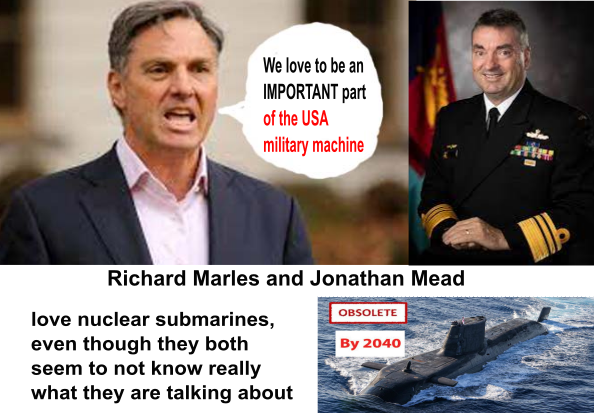
Richard Marles has the Navy out in force firing torpedoes at AUKUS critics.
On Friday last, Vice Admiral Jonathan Mead claimed the critics need to produce evidence of any challenges to AUKUS being realised, then on Saturday, Vice Admiral Hammond, Chief of Navy, raised his periscope claiming the AUKUS debate was being ‘hijacked’ by people with ‘specific agendas’ without indicating what these agendas might be or who was likely making them.
The fact is, what clearly is being ‘hijacked’ is national accountability – accountability for the most wayward strategic and financial decision any government has taken since Federation.
Despite AUKUS’s half trillion of budgetary cost and its dangerous strategic implications there has not been one Ministerial Statement explaining its rationale, its strategic policy objective or defending its hugely distorting impact on government expenditures.
Not a coherent or persuasive word has come from the Minister for Defence or for that matter, the Prime Minister, let alone from a parliamentary debate on what is significantly a seminal turn in the country’s strategic and defence policy settings.
Vice Admiral Hammond, ignoring Australia’s geography – its residence among populous and prosperous Asian states, fell back on the old Anglo glee-club adage ‘three developed nations who have over 100 years of shared history, heritage, values and sense of purpose.’

The likelihood is that Australia will not come into possession of nuclear submarines of its own making, but what it will certainly become is landlord and host to American nuclear submarines as the United States appropriates Australian real estate in its attempts, against all odds, to maintain strategic primacy in Asia. Odds that carry the likelihood of Australia being dragged into military skirmishes with China, or indeed, worse.
So irresponsible, secretive and smug has the government been in making its decision, that no amount of ‘hijacking’ by anyone else is likely to disrupt Australia from its current path of effectively falling into American hands, or at least, being abjectly at America’s beck and call.
Republished from Australian Financial Review, July 30, 2024
Nagasaki decides against inviting Israel to commemorate nuclear bombing of Japan amid war on Gaza
In contrast, another US nuclear bomb-hit Hiroshima city has invited Tel Aviv to annual event
Riyaz ul Khaliq 01.08.2024, ISTANBUL https://www.aa.com.tr/en/asia-pacific/nagasaki-decides-against-inviting-israel-to-commemorate-nuclear-bombing-of-japan-amid-war-on-gaza/3290598
The local government in Nagasaki province declared Wednesday it will not invite Israel to its annual conference to commemorate US nuclear bombing of Japan.
Mayor Shiro Suzuki said Israel would “not be invited to the Aug. 9 annual peace ceremony,” Tokyo-based Kyodo News reported.
The decision to not invite Israel to the event comes on a day Israel assassinated Palestinian resistance group Hamas political chief Ismail Haniyeh at his residence in Iranian capital Tehran.
Nagasaki and Hiroshima cities will be commemorating 79th anniversary of 1945 atomic bombing by the US on Japan next month.
Japan has refused to invite Russia and Belarus for similar conference since Moscow waged war on Ukraine in Feb. 2022.
However, local government in Hiroshima has invited Tel Aviv to its event on Aug. 6.
The local authorities in Hiroshima, however, have called for an “immediate cease-fire in the Palestinian territory.”
The Hiroshima government has come under severe criticism for purported double standards and many activists are pressing the authorities to withdraw the invite to Tel Aviv.
Several programs against Israel’s participation have been planned in the run up to Aug. 6.
Japan has witnessed many demonstrations and protests against Israeli war on Palestinian besieged enclave of Gaza, with calls to ceases military relations with Tel Aviv.
Israel, flouting a UN Security Council resolution demanding an immediate cease-fire, has faced international condemnation amid its continued brutal offensive on Gaza since an Oct. 7, 2023 attack by the Palestinian group Hamas.
At least 39,400 Palestinians have since been killed, mostly women and children, and nearly 91,000 injured, according to local health authorities.
Over nine months into the Israeli onslaught, vast tracts of Gaza lie in ruins amid a crippling blockade of food, clean water and medicine.
Israel is accused of genocide at the International Court of Justice, which ordered it to immediately halt its military operation in the southern city of Rafah, where more than 1 million Palestinians had sought refuge from the war before it was invaded on May 6.
US Forces Japan to be upgraded to warfighting command

The shift will move operational control of Japan-based forces east from Hawaii and, officials say, deepen cooperation with the Japanese military.
TOKYO—The Pentagon will upgrade and expand its three-star command in Japan to handle operational control of U.S. forces based there, part of an effort to deepen ties between the U.S. and Japanese militaries and to streamline command and control of joint operations, senior defense officials told reporters traveling with Defense Secretary Lloyd Austin on Friday.
“Secretary Austin plans to announce that the United States intends to reconstitute U.S. Forces Japan as a Joint Force Headquarters, reporting to the commander of U.S. INDOPACOM,” said the senior official. The shift will give USFJ, which is “currently, primarily, an administrative command” more warfighting responsibilities. “They do day-to-day management of the alliance, but not operational command of forces. So it’ll be a significant difference for them.”
The announcement comes as part of the Joint Statement of the Security Consultative Committee (“2+2”) committee meeting taking place in Tokyo between Austin, Secretary of State Anthony Blinken, and their Japanese counterparts.
The command will grow as it adds missions and responsibilities to its current alliance-management functions, the official said, “including some of the planning exercises and commanding of operations, and we’ll be doing those, as I mentioned, side-by-side with Japanese forces like never before.”
Many details of the new headquarters aren’t yet known and officials said that the approach will be phased, with many more discussions about how to implement yet to come. Among the decisions to be made is whether the expanded USFJ will have a command structure that integrates Japanese forces, the way U.S. Joint Forces Korea does for South Korean forces.
“A major part of that phased approach will involve bilateral working groups with the U.S. side, led by INDOPACOM, to work through important implementation factors, including potential resourcing needs, infrastructure, personnel, authorities and ranks,” the official said.
The new Joint Force Headquarters will allow INDOPACOM officers and operators to have daily interactions with Japanese counterparts about how to plan exercises, operations, and how to act on shared intelligence and information, the official said. ……………………..more https://www.defenseone.com/policy/2024/07/us-forces-japan-be-upgraded-warfighting-command/398386/
Netanyahu’s Visit to Congress Underscores US Contempt for International Law

Netanyahu is getting cozy with Congress, just days after the ICJ told UN members to stop aiding the Israeli occupation.
By Marjorie Cohn , Truthout July 24, 2024
he U.S. has long ignored many commands of international law, but its casual disregard of the International Court of Justice (ICJ) has come into sharp focus this week as the U.S. Congress extends a warm welcome to Israeli Prime Minister Benjamin Netanyahu, just five days after the ICJ notified all UN member states that they have a legal “obligation not to render aid or assistance in maintaining the situation created by Israel’s illegal presence in the Occupied Palestinian Territory.”
The World Court’s historic 83-page advisory opinion, which was issued on July 19 and held that the Israeli occupation of Palestinian territory is illegal, was quickly hailed by Middle East political expert Nomi Bar-Yaacov as a “legal earthquake” and the strongest decision that the court had ever issued.
Unsurprisingly, however, both the Israeli and U.S. governments denounced the ICJ’s ruling and proceeded with their plans — including Netanyahu’s visit to Washington, D.C. — as if it had never occurred.
The purpose of Netanyahu’s trip is to shore up U.S. support for his ongoing genocidal campaign against the Palestinians in Gaza and for his crusade against Iran.
“The Jewish people are not occupiers in their own land, including in our eternal capital Jerusalem nor in Judea and Samaria, our historical homeland,” Netanyahu declared after the ICJ issued its decision. “No absurd opinion in The Hague can deny this historical truth or the legal right of Israelis to live in their own communities in our ancestral home.”
Joe Biden’s administration meanwhile conveyed that it is “concerned that the breadth” of the decision will “complicate” the “efforts to resolve the conflict.” The U.S. State Department said the ICJ’s order that Israel withdraw from the Palestinian territories is “inconsistent with the established framework” for resolving “the conflict.” Parroting Israel’s mantra, the State Department said the resolution should occur through negotiations.
Negotiations have proved worthless in ending Israel’s illegal occupation and its genocide in Gaza and achieving justice for the Palestinians. Although the Biden administration has advocated a two-state solution, its unbridled support for the Zionist regime, which continues to carve up occupied Palestinian territory into noncontiguous enclaves, makes that “solution” impossible.
The U.S. government enables Israel’s illegal occupation by providing $3.8 billion annually and it has sent Israel an addition $15 billion in military aid since October 7, 2023. This helps fund Israel’s genocide, which has killed nearly 39,000 Palestinians by the official Gaza Health Ministry count, although the true death toll is likely much higher. Moreover, the U.S. has vetoed three Security Council resolutions that would have demanded a ceasefire in Gaza.
In order to comply with the ruling of the World Court, the U.S. government would have to end its military assistance to Israel and stop providing political and diplomatic cover to enable Israel’s occupation of Palestinian territory.
The ICJ’s Legal Findings
The ICJ ruled that Israel’s occupation of the West Bank, East Jerusalem and Gaza violates international law, which prohibits the acquisition of territory by threat or use of force and enshrines the right of the Palestinian people to self-determination. “The sustained abuse by Israel of its position as an occupying Power, through annexation and an assertion of permanent control over the Occupied Palestinian Territory and continued frustration of the right of the Palestinian people to self-determination, violates fundamental principles of international law and renders Israel’s presence in the Occupied Palestinian Territory unlawful,” the court wrote…………………………………………………………………………………………………………….
Consequences of the Ruling
The World Court’s advisory opinion was issued in response to a request by the General Assembly. Although not legally binding, the decision carries great moral weight………………………………………………………………………………………….. more https://truthout.org/articles/netanyahus-visit-to-congress-underscores-us-contempt-for-international-law/
Putin warns the US of Cold War-style missile crisis
Reuters By Guy Faulconbridge and Dmitry Antonov, July 28, 2024
- Summary
- Russia warns United States over missiles in Germany
- Putin says Russia will deploy if plans are implemented
- Putin: United States risks Cold War-style crisis
- U.S. plans to deploy longer range missiles in Germany
MOSCOW, July 28 (Reuters) – Russian President Vladimir Putin on Sunday warned the United States that if Washington deployed long-range missiles in Germany then Russia would station similar missiles in striking distance of the West.
The United States said on July 10 that it would start deploying long-range missiles, opens new tab in Germany from 2026 in preparation for a longer-term deployment that will include SM-6, Tomahawk cruise missiles and developmental hypersonic weapons.
n a speech to sailors from Russia, China, Algeria and India to mark Russian navy day in the former imperial capital of St Petersburg, Putin warned the United States that it risked triggering a Cold War-style missile crisis with the move.
“The flight time to targets on our territory of such missiles, which in the future may be equipped with nuclear warheads, will be about 10 minutes,” Putin said.
“We will take mirror measures to deploy, taking into account the actions of the United States, its satellites in Europe and in other regions of the world.”………………………………………. Https://www.reuters.com/world/putin-warns-united-states-cold-war-style-missile-crisis-2024-07-28/
Dialogue Over Deterrence
The theory of nuclear deterrence is one of these root causes of tension and conflict that must be addressed……………….. the violent potential of nuclear deterrence policies means that everyone in the world is at risk all of the time.
the profits of the new nuclear arms race have superceded all sense of logic or reason in international relations and domestic budgets.
The theory of nuclear deterrence is one of these root causes of tension and conflict that must be addressed……………….. the violent potential of nuclear deterrence policies means that everyone in the world is at risk all of the time.
the profits of the new nuclear arms race have superceded all sense of logic or reason in international relations and domestic budgets.
Ray Acheson, 24 July 2024Download the full edition in PDF
People at this NPT Preparatory Committee are worried. Really worried. Delegations delivering general debate statements, activists holding meetings with each other and with diplomats, anyone paying attention, is worried about nuclear war. Words like abyss, doomsday, annihilation, and other cheery phrases were on everyone’s lips, in official statements and by the coffee bar. The fear is justified—the nuclear-armed states are building up their arsenals, modernising their weapon systems, and coming up with new deployment strategies—and they are not talking to each other. The interactions between Russia and the United States are so tense that a Dr. Strangelove moment of “You can’t fight in here. This is the war room!” seems possible at any moment.
Mozambique very astutely called out the worrying trend of “deterrence diplomacy,” which is a pretty good term for what seems to be happening. Perhaps it’s a strategy of confrontation in the conference room to deter a nuclear confrontation outside; or maybe it’s just the use of diplomatic spaces like NPT meetings to bolster one’s claims. But just like deterrence doesn’t work, as evidenced by the many conflicts fought by nuclear-armed states throughout the nuclear age, deterrence diplomacy doesn’t work either. It only leads to the collapse of international law, which most of the rest of us are relying upon to constrain massive nuclear violence.
This may sound awfully gloomy. It is. But as always, hope is found in the determination and creativity of those who do not see their strength or security coming from bombs and bombastic quarrels. Calls for dialogue, (real) diplomacy, and disarmament resounded during the general debate. Delegations highlighted the work that has been done to prohibit nuclear weapons, to study the harms of nuclear production and testing, to address nuclear injustice, and to reduce the dangerous risks of nuclear war. The vast majority of this work is being carried out by non-nuclear-armed states, activists, and international organisations. It’s time the nuclear-armed states put down their swords, picked up their pens, and got to work, too. They can start by acknowledging the reality of the situation they have created, in which they have weaponised international law and created a culture of defiance of rules and norms that are meant to protect us all.
The invisibilised genocide
Part of the dangerous situation the nuclear-armed states have created is their refusal to implement the laws to which they have previously bound themselves. It was striking that mid-way through the first week of the PrepCom, you’d barely know there was genocide going on in the world. During the general debate, many states reiterated their condemnation of Russia’s aggression against Ukraine, especially in relation to its threats to use nuclear weapons, deployment of nuclear bombs to Belarus, and its attacks against the Zaporizhzhia Nuclear Power Plant. But there were very few comments about Israel’s slaughter of Palestinians over the past ten months, even in the wake of the International Court of Justice (ICJ)’s finding of plausible genocide in January 2024 and its ruling in July 2024 that Israel is guilty of apartheid and that its occupation of Palestine is illegal, and the International Criminal Court (ICC)’s application for an arrest warrant for the Israeli Prime Minster for war crimes in May 2024. Algeria, Egypt, Finland, Lebanon, Indonesia, Kuwait, Mozambique, Oman, Peru, Slovakia, Syria, Tunisia, Türkiye, and Venezuela criticised Israel’s “war on Gaza” to various extents, or condemned Israel’s nuclear threats in that context. But most delegations said absolutely nothing.
Why this comparative silence? Some might claim Israel’s genocide of Palestinians is not an NPT issue. But for whom should hundreds of thousands of deaths, mass displacement and injury, starvation, disease, and the destruction of an entire strip of land where more than two million people live under conditions of apartheid and “open-air” incarceration not be an issue? Especially when nuclear weapons, and the aura of impunity and lawless violence these weapons perpetuate, are the heart of it all.
Beyond the moral imperative of caring about humans living and dying through such suffering, Israel’s genocide is an NPT issue. Israel is a nuclear-armed state. It is not an NPT state party, but that is only because it is allowed to remain outside the treaty by its protectorates. Israel is also only able to wage genocide because NPT states parties are providing it with weapons and other military equipment, including the United States, Germany, Canada, Italy, Australia, the United Kingdom, and others. Again, in contrast to the situation in Ukraine, it was very striking that during the PrepCom’s general debate, some delegations condemned arms transfers to Russia from China, the Democratic People’s Republic of Korea, and/or Iran in support Russia’s war effort, while saying nothing about the billions of dollars of weapons being transferred to Israel to commit atrocities and facilitate the destruction of Palestine.
Weaponisation of international law
The selective defiance of international law, lack of accountability, and granting of impunity are all NPT issues. They are features of the way the Treaty has been implemented since 1970. This is not simply a matter of double standards. This is about the inequality that the nuclear-armed states have intentionally built up and baked into international law over decades. The UK’s claim to be “a government that believes in the rule of law at home and internationally” would be laughable if it was not so offensive as it expands its nuclear arsenal and ships bombs to the Middle East to be dropped on civilians.
The nuclear-armed states weaponise international law by shirking from their own obligations and accountability while enforcing it, sometimes violently, upon others. The nuclear-armed states see themselves as being above the law and act accordingly. Their modernisation of nuclear weapons and nuclear arms racing, their refusal to comply with their legal obligation to disarm, their attempts to reinterpret NPT provisions and commitments, their trashing of arms control agreements and NPT outcome documents, are all part of their collective contempt for international law.
This contempt is shared among all nuclear-armed states. They could work together to eliminate their nuclear arsenals in compliance with international law; instead, they work together to perpetuate patriarchal myths about nuclear deterrence and strategic stability and undiminished security for all—buzzwords that mean the indefinite possession and manufacture and possible use of weapons of mass destruction. Nuclear deterrence theory is a protection racket of apocalyptic proportions, leading to vast profits for a few and terror for most. Deterrence diplomacy leads away from, not toward, nuclear disarmament.
It might be hard to identify anything the nuclear-armed states do as a collective project, of course. During the general debate (and side events), the Russian and US delegations predictably accused each of being obstructionist to reviving nuclear arms control talks or reducing the risk of use of nuclear weapons. Neither will accept their mutual responsibility for creating the profoundly dangerous environment within which everyone on this planet is forced to live. But this situation of grave peril is a joint project, manufactured by governments and war profiteers seeking power through violence in supremacy in a world that is already burning from climate change, colonialism, and conflict.
Dismantling deterrence to build back better
“Never has it been more important to commence the process of rebuilding trust, of prioritizing dialogue over deterrence and of getting the world back on to the path of the verifiable, irreversible elimination of nuclear weapons,” said the UN High-Representative for Disarmament Affairs during the general debate. Most delegates attending the PrepCom clearly share this sentiment. From working papers about reducing nuclear risk to interventions about the importance of rebuilding trust and relationships, non-nuclear-armed states emphasised again and again the unacceptability of the fraught and fragile nature of the current moment.
Brazil noted that real security “does not derive from the number or quality of weapons of mass destruction” but in “our ability to build trust, foster cooperation, and address the root causes of tension and conflict.” The theory of nuclear deterrence is one of these root causes of tension and conflict that must be addressed. As long as a handful of nuclear-armed states and heavily militarised allies claim protection from nuclear weapons, invest billions of dollars into maintaining and modernising their arsenals, and engage in nuclear war planning in preparation for using these weapons, diling back the tensions and finding avenues for dialogue will remain elusive.
As the states parties to the Treaty on the Prohibition of Nuclear Weapons (TPNW) said in a joint statement to the PrepCom, “The perpetuation and implementation of nuclear deterrence in military and security concepts, doctrines and policies not only erode and contradict non-proliferation but also obstruct progress towards nuclear disarmament.” Rather than preventing conflict or preserving “strategic stability,” the violent potential of nuclear deterrence policies means that everyone in the world is at risk all of the time. When there are people actively planning for nuclear war—building the bombs, testing the missiles, targeting the systems, and making threats of use—the possibility of dialogue becomes increasingly marginalised. We have seen this happen over the last decades, where the profits of the new nuclear arms race have superceded all sense of logic or reason in international relations and domestic budgets.
Nuclear deterrence is the opposite of dialogue. And dialogue is essential to overturning deterrence. Many nuclear-armed allies, like the NATO members, of course call for dialogue, but it’s usually only among the nuclear-armed states. The nuclear-armed states are failing miserably at that task, though, so we need much more than that. We need concrete action, not endless discussions. We need disarmament, without any more delay.
Determining disarmament
Disarmament is a strategic imperative. Our survival depends upon it. The only way out of this mess is through demilitarisation; is through the abolition of nuclear weapons and the structures of war profiteering and military supremacy that are used to justify them. But disarmament is also a moral imperative. The end of nuclear weapon programmes is owed to those who have suffered from nuclear violence for generations, without their consent and often without their knowledge. As decribed in the powerful Joint Statement on Legacy of Nuclear Weapons and reiterated throughout several civil society presentations, Indigenous Peoples and other marginalised groups have long suffered the catastrophic humanitarian and environmental impacts of nuclear weapons from uranium mining to nuclear testing and use to radioactive waste. The dismantlement of the entire nuclear fuel chain, the end of the nuclear industry, and the elimination of nuclear weapons is essential to nuclear justice, as are reparations and remediation for harms caused already.
As Austria said, the existential risk inherent in nuclear deterrence and the nuclear status quo is intergenerational injustice. The only way to change the current and future reality being imposed upon the world is to end nuclear weapons and the violent structural thinking in which genocide, perpetual war, and nuclear annihltion can ever again be considered “reasonable” responses to disagreements that manifest in the global system.
As a group of civil society organisations said in a statement from WILPF to the PrepCom, as the so-called leaders of the most heavily militarised states in the world are “thumping their chests at each other as if they’re a group of drunk men in a bar, ready to burn the place down just to prove that they are the manliest,” it should be clear now is the time for a different approach to disarmament diplomacy.
War Criminal Benjamin Netanyahu Addresses the US Congress
Lies proliferate and Congress cheers genocide in Gaza
The Unz Review, Philip Giraldi • July 26, 2024
To my surprise, last Thursday morning there was relatively little coverage of the address to the US Congress delivered by Israeli Prime Minister Benjamin Netanyahu last Wednesday afternoon apart from a critical opinion piece that appeared in the New York Times regarding Israel’s war on the Palestinians. The article, by Megan K. Stack, asserted:
“History will cast Mr. Netanyahu’s visit in deservedly ugly tones. He’s not a guest we should aspire to host, but he is a visitor we deserve. Gaza is our war, too, thanks to the indispensable military aid and political cover the US government has lavished on Israel as the death toll climbs… What exploded as a war of retribution against Hamas has looked increasingly like a broader campaign of annihilation — the slaughter of trapped civilians; the excruciating deaths of thousands of children; the destruction of hospitals, schools and much of the civilian infrastructure.”
Polls have shown for months that more Americans disapprove than approve of the Israeli onslaught in Gaza, but Congress and the White House are not interested in the views of the public when they are on the receiving end of hundreds of millions of dollars in “donations” from Jewish billionaires.
Much of the coverage of the Netanyahu appearance in the mainstream media was toothless and even adulatory. It generally reflected what was hailed as Bibi’s “fiery speech” that “did not give an inch” which vowed to continue fighting until “total victory” is achieved. There was some coverage of how Netanyahu went so far as to portray the many thousands of demonstrators, some of whom were pepper-sprayed and arrested, who surrounded the Capitol as “useful idiots paid for by Iran.” The jibe, together with other calls to go to war with Iran, produced cheers and other paroxysms of joy among the leaping and waving Congressmen. Bibi might have been particularly personally aggrieved by Pro-Palestinian protesters successfully having released insects into the Watergate Hotel where he was staying. Online video showed maggots running amok on the dinner table.
The Netanyahu speech was light on serious analysis, but heavy on emotional appeals, repeatedly invoking the assertion that he and the United States, in its “ironclad” support of Israel, are fighting to save “civilization” and that “our enemies are your enemies” and “our victory will be your victory.” Predictably, the Congressmen and guests who filled the chamber bobbed up and down applauding wildly after nearly every sentence, producing 53 standing ovations, far exceeding Netanyahu’s record 29 obtained the last time he addressed Congress in 2015.
Notably some Congressmen with active consciences skipped the event, including Nancy Pelosi, who, after the fact, denounced the address in a post on X:
“Benjamin Netanyahu’s presentation in the House Chamber today was by far the worst presentation of any foreign dignitary invited and honored with the privilege of addressing the Congress of the United States. Many of us who love Israel spent time today listening to Israeli citizens whose families have suffered in the wake of the October 7th Hamas terror attack and kidnappings. These families are asking for a ceasefire deal that will bring the hostages home – and we hope the Prime Minister would spend his time achieving that goal.”
nore https://www.sott.net/article/493515-War-criminal-Benjamin-Netanyahu-addresses-the-US-Congress
A substantial number of progressive and moderate Democrats, possibly as many as 136, also did not attend, suggesting that Netanyahu is not well regarded by many in the Democratic Party. Netanyahu spoke for an hour and the over-the-top reception he received from congress suggested that:
the government’s true loyalty is not to the voters who elected them but rather to a foreign leader who is a war-criminal, implying to some that Bibi is actually de facto the American president and Israel and the US are in practical terms one country, with Israel as the dominant partner in the arrangement.……………………………………………………………………
My particular gripe was over the fact that Netanyahu’s speech was full of uncontested lies and grossly exaggerated assumptions designed to get his audience roaring. The falsehoods were certainly recognizable as such by much of the audience, but Netanyahu was not challenged by anyone save only Representative Rashida Tlaib, a Democrat of Michigan and the sole Palestinian-American member of Congress, who attended the speech while holding up a sign while many of her colleagues applauded Netanyahu’s comments………………………………………………………………….more https://www.sott.net/article/493515-War-criminal-Benjamin-Netanyahu-addresses-the-US-Congress
1 This Month



26 September – International Day for the Total Elimination of Nuclear Weapons


PLEASE OPPOSE HR 8255 AND S.3639 – bills would accelerate satellite deployment, with no environmental review or safeguards – https://ncstd5li.quorum.us/campaign/169331/
To see nuclear-related stories in greater depth and intensity – go to https://nuclearinformation.wordpress.com
-
Archives
- September 2026 (219)
- August 2026 (330)
- July 2026 (355)
- June 2026 (287)
- May 2026 (306)
- April 2026 (356)
- March 2026 (251)
- February 2026 (267)
- January 2026 (308)
- December 2025 (358)
- November 2025 (359)
- October 2025 (375)
-
Categories
- 1
- 1 NUCLEAR ISSUES
- business and costs
- climate change
- culture and arts
- ENERGY
- environment
- health
- history
- indigenous issues
- Legal
- marketing of nuclear
- media
- opposition to nuclear
- PERSONAL STORIES
- politics
- politics international
- Religion and ethics
- safety
- secrets,lies and civil liberties
- spinbuster
- technology
- Uranium
- wastes
- weapons and war
- Women
- 2 WORLD
- ACTION
- AFRICA
- Atrocities
- AUSTRALIA
- Christina's notes
- Christina's themes
- culture and arts
- Events
- Fuk 2022
- Fuk 2023
- Fukushima 2017
- Fukushima 2018
- fukushima 2019
- Fukushima 2020
- Fukushima 2021
- general
- global warming
- Humour (God we need it)
- Nuclear
- RARE EARTHS
- Reference
- resources – print
- Resources -audiovicual
- Weekly Newsletter
- World
- World Nuclear
- YouTube
-
RSS
Entries RSS
Comments RSS
 nuclear-news