The rise and fall of Sweden’s nuclear disarmament advocacy
In the 2020s,…. it is Sweden and Finland that have arguably become the biggest advocates of US nuclear weapons.
By Naman Karl-Thomas Habtom | December 29, 2024, https://thebulletin.org/2024/12/the-rise-and-fall-of-swedens-nuclear-disarmament-advocacy/
In the nine months since joining NATO, Sweden has not wasted any time integrating itself tightly into the transatlantic alliance. On September 16, Sweden doubled down on its commitment to a nuclear weapons-based military alliance when Sweden and Finland agreed that Sweden would lead a new NATO defense base to be established in northern Finland.
While Denmark and Norway currently do not want to host nuclear weapons on their own soil, NATO’s new entrants have both signaled an openness to doing so. In June, the Swedish parliament ratified a Defense Cooperation Agreement granting the United States access to 17 Swedish military bases, and Prime Minister Ulf Kristersson did not rule out hosting nuclear weapons during wartime. Meanwhile, Finland’s President Alexander Stubb has advocated for a legislative change to allow the transportation of nuclear weapons.
With the benefit of historical hindsight, it is clear that this was not an inevitable outcome. Sweden was once a nuclear aspirant with an advanced weapons program, but just a few decades ago, Stockholm and Helsinki sought to keep nuclear weapons out of northern Europe. In the depths of the Cold War, Stockholm proved willing and capable of advancing ambitious, albeit inconsistent, goals when it came to nuclear weapons in Europe. Sweden’s history suggests that disarmament ideas—such as a Nordic nuclear weapon-free zone—were never completely written off, even if they are difficult to imagine in Europe today.
Pursuing Nordic disarmament. Calls for the establishment of a Nordic nuclear weapon-free zone (NWFZ) did not originate in Sweden but rather in neighboring Finland. Though Swedish Foreign Minister Östen Undén had, in 1961, already proposed the idea in a general manner, Finnish President Urho Kekkonen formally proposed it in 1963.
Earlier that year, Yugoslavia’s leader Josip Broz Tito had expressed his support for a Balkan NWFZ, which Kekkonen saw as strengthening the case for a Nordic zone. In an address on May 28, 1963, Kekkonen argued that the Nordic countries already constituted a de facto NWFZ, with no country officially pursuing or possessing any nuclear weapons.
While the Swedish government was officially supportive of nuclear disarmament and the creation of a Nordic zone, it was suspicious of Kekkonen’s proposal. Though Finns were more eager to join NATO than Swedes in 2022, during the Cold War Finland was in a delicate position and more likely to consider Moscow’s views than its Scandinavian neighbors were, due to its proximity to the Soviet Union. Initially, Sweden saw Kekkonen’s effort as a Soviet initiative, much to the surprise of Finnish civil servants. Swedish suspicions were not wholly unfounded; a year earlier, the Soviet ambassador to Finland visited the Finnish president’s residence and recommended such an undertaking. Though Sweden was not actively pursuing nuclear weapons, its leadership wished to preserve the freedom to acquire them later.
By the late 1970s, Swedish disarmament efforts became more wide-ranging. In November 1978, Swedish Foreign Minister (and future UN weapons inspector as well as head of the International Atomic Energy Agency) Hans Blix aimed to widen the scope of the proposed NWFZ by including the Baltic Sea. In January 1983, the Swedish government even went so far as to propose that the zone also include the border between the Western and socialist states, extending 150 kilometers on each side of the border.
While the suggestion of incorporating the Baltic Sea was rejected at the time, the Soviets accepted the idea of a buffer zone and even suggested that it be wider, in the range of 250 to 300 kilometers on each side. In the United States, however, the idea went nowhere. Joseph Nye, who served as Deputy Under Secretary of State for Security Assistance, Science, and Technology from 1977 to 1979, later noted that there wasn’t much discussion of a Nordic nuclear weapon-free zone. Fast forward a few decades, and the proposal is now beyond dead.
While Sweden had been supportive of a NWFZ in general, its support was inconsistent, especially in the 1980s. . For example, in June 1983, Prime Minister Olof Palme told the North Atlantic Assembly that adjacent areas (such as the Baltic Sea) should be included, but by December of that year, in a speech in Finland, Palme failed to mention that as a requirement. Similarly, in November 1983, Swedish Foreign Minister Lennart Bodström said that a zone could be created through a joint declaration by four Nordic countries accompanied by a pledge from outside powers not to use nuclear weapons against the Nordic states, only to revise this in December by requiring the denuclearization of the Baltic region as well. Support for a NWFZ was partially informed by extra-Nordic conduct, such as the deployment of intermediate-range nuclear missiles in the United Kingdom and West Germany in 1983.
The Soviet perspective. Though Swedish military concerns during the Cold War, such as the initial call for nuclear weapons, were primarily shaped by the potential threat from the East, advocacy for nuclear disarmament contributed to what can be described as a generally friendly relationship between Stockholm and Moscow, especially when compared with contemporary East-West ties.
The prospect for nuclear disarmament in Sweden’s adjacent areas improved throughout the 1980s, with the United States and the Soviet Union negotiating and ultimately signing the Strategic Arms Reduction Treaty and the Intermediate-Range Nuclear Forces Treaty. Whereas Moscow had previously rejected the proposal for the creation of a Baltic Sea NWFZ, it reversed itself by 1990. Early that year, Soviet Foreign Minister Eduard Shevardnadze sent a letter to his Swedish counterpart, Sten Andersson, calling for the establishment of a nuclear weapon-free Baltic Sea. In his letter Shevardnadze expressed his belief that “an agreement on this issue would be able to be worked out at a conference between diplomatic and military experts from the aforementioned states.”
The failure to establish such a NWFZ in the Baltic Sea region was likely outside Sweden’s control. According to Thomas Graham Jr., a senior diplomat who was part of the American delegation in every major nonproliferation and international arms control negotiation between 1970 and 1997, “America never thought it was very likely such a [Nordic Nuclear Weapon-Free] Zone would be negotiated,” which would have been a practical precondition before the establishment of a Baltic Sea NWFZ. Graham identified Norway as a hindrance, arguing that “[t]hough Norway is nuclear weapon-free it would not go against NATO on this.”
In the 2020s, however, it is Sweden and Finland that have arguably become the biggest advocates of US nuclear weapons.
Swedish marginalization. The middle of the Cold War was arguably the period during which Sweden had its most prominent role in advancing international nuclear arms control. However, by the 1980s the country was increasingly marginalized when it came to the reduction of global nuclear stockpiles. This was not a product of Sweden’s own doing but was due to the emergence of increasingly successful US-Soviet negotiations and treaties. The bilateral nature of the relationship between the two superpowers had the unintended effect of minimizing any potential influence that the Swedes could have.
According to Graham, “in the SALT/START negotiations on strategic arms between the United States and the Soviet Union, Sweden was simply not relevant.” The cause for this was the very factor that sparked Sweden’s interest in nuclear disarmament in the first place, namely its neutrality. “It was not a party to the negotiations nor an ally of one of the negotiating parties.”
This marginalization stands in contrast to international conferences within the framework of the United Nations, where American diplomats viewed Sweden as a disarmament activist state. Therefore, it is not surprising that Swedish officials made common cause with the Non-Aligned Movement of developing countries that existed outside the US-Soviet rivalry, despite not being a formal member of the organization. Swedish relevance depended on its ability to exert influence over other non-nuclear states, even after the Cold War ended.
The multilateral nature of the UN Conference of the Committee on Disarmament enhanced Swedish relevance. One way Sweden exerted its influence was by advocating for procedural reforms to improve the Conference’s effectiveness. Calls for the abolition of the co-chairmanship governing the Conference effectively aligned Sweden with countries such as Yugoslavia, Mexico, and Romania. Lennart Eckerberg, who led Sweden’s disarmament delegation in Geneva, remarked that “[t]he Swedish delegation, for one, favors several such [procedural] changes” and that this “is, of course, not primarily a procedural question but a political one.”
Swedish marginalization was not exclusively a result of the Soviet-American talks but also of the two Cold War camps. This was true of NATO more so than the Warsaw Pact, with the latter tending to be more supportive of Swedish disarmament efforts. Just a few months before the signing of SALT I, Eckerberg expressed his lack of hope that NATO members would push for a nuclear test ban ahead of a scheduled visit by the Swedish foreign minister to Moscow. In contrast to Western states, Eastern bloc states tended to sympathize with the Swedish position.
Fluctuating influence. Due to its small size, Sweden struggled to stay relevant. It did not have the diplomatic assets or clout that larger countries, especially the two superpowers, possessed. In a report to the foreign ministry, Swedish diplomat Gustaf Hamilton noted in a 1976 report while serving in Geneva as part of the delegation to the Conference on Disarmament: “A weakness in Sweden’s conduct is that we do not have sufficient personnel resources to produce working papers and proposals and don’t always have time in advance to ensure support for us among interested delegations. We lack, in other words, the capacity to plan long-term due to the personnel situation.”
This concern was ever-present throughout the Cold War, with Swedish officials forced to balance resources in a manner that optimized both Swedish contribution and overall effectiveness. This explains, in part, why there was a consistent preference for multilateral approaches, as opposed to lobbying individual countries in purely bilateral ways. It also explains Sweden’s focus on approaches such as the development of seismological counterproliferation technology.
As a frontier state between East and West, Sweden was able to use its geopolitical relevance to promote not only disarmament but also a broader program of tension reduction. But with Sweden now formally a member of NATO, the political will to play a role similar to the one Sweden played in the Cold War is largely absent and hard to muster in the absence of formal neutrality. Nevertheless, the country’s history suggests that ideas like nuclear weapon-free zones, which today are impossible to imagine in Europe, were once salient.
How Ukraine is Helping the HTS Militants Who Overthrew Assad
Scheerpost, December 29, 2024 , By Stavroula Pabst / Responsible Statecraft
As Islamist, al-Qaida-linked group Hayat Tahrir al Sham (HTS) overruns Syria amid President Assad’s sudden ouster, evidence suggesting Ukraine has assisted the group’s triumph continues to mount.
Namely, the Washington Post reported Tuesday that Ukraine sent 150 first-person-view drones and 20 drone operators to Idlib about a month ago.
The New York Times reported earlier this month, moreover, that Ukraine and HTS were coordinating efforts including “countering Russian misinformation and providing medical assistance.” The reporting also highlighted Ukrainian intelligence head Kyrylo Budanov’s repeated suggestions that Ukraine would target its enemy Russia internationally.
Washington Post columnist David Ignatius mused that Ukraine’s intentions for assisting HTS were obvious, writing that the war-torn nation was looking for other ways to “bloody Russia’s nose and undermine its clients.” In turn, a source told the New York Times that the HTS offensive in Syria was likewise timed in part to strike a blow against mutual enemy Russia.
………………………………………. “Ukraine’s alleged assistance to HTS forces is of limited military significance insofar as the SAA was inherently unprepared to resist the rebel offensive,” said Dr. Mark Episkopos, Quincy Institute Research Fellow and Adjunct Professor of History at Marymount University.
“But it is part of Kyiv’s broader effort to court Western support for its NATO accession bid by demonstrating to the US and other stakeholders its effectiveness in countering Russian interests around the world.” https://scheerpost.com/2024/12/29/how-ukraine-is-helping-the-hts-militants-who-overthrew-assad/
AI bigwigs want to go all-in on nuclear. They also happen to be behind nuclear companies

By Clare Duffy, CNN, December 24, 2024
Sam Altman is the chairman of a company that promises a brighter future for humankind.
No, it’s not OpenAI, the artificial intelligence company he co-founded and now runs as CEO.
It’s a company called Oklo, and it’s developing the kind of nuclear power technology that many tech leaders — including Altman himself — say they will need to fuel future artificial intelligence advancements.
The proliferation of electricity-hungry data centers to power our digital lives – and increasingly, the AI technology that tech giants say is the future – now means that energy demand could soon outstrip supply. And that would be a problem for tech companies who are angling for their AI technology to revolutionize almost everything about the way we live and work.
But while tech leaders have pointed to nuclear energy as essential to a climate friendly future, some industry experts wonder how much their investments will truly benefit the wider public, rather than just protecting their own businesses’ ability to operate.
“I think the tech companies are looking out for their own interests, and whether those nuclear vendors are able to sell additional nuclear power plants for the public is another question,” said Sharon Squassoni, a research professor at George Washington University who’s studied nuclear energy and policy.
t’s clear that more energy will need to come from somewhere. Electricity demand from US data centers has grown 50% since 2020 and now accounts for 4% of the country’s energy consumption; that figure could grow to 9% by 2030, UBS analysts said in a research note earlier this month. And overall power demand in the United States is expected to grow 13% to 15% a year until 2030, potentially turning electricity “into a much scarcer resource,” according to JPMorgan analysts.
The electricity needs of data centers have also threatened to upend tech giants’ sustainability promises.
Tech giants have pointed to the benefit of nuclear energy’s reliability versus other renewable energy sources, such as solar or wind. Microsoft in September secured a deal to reopen a reactor on Three Mile Island, the site of a 1979 partial meltdown in Pennsylvania, aiming to revive a different reactor by 2028 to power its AI ambitions. Amazon and Meta have also begun working to lock in deals to secure future nuclear power for their data centers.
“Data centers operate 24/7 and they need a stable supply of electricity. They can’t shut down because the wind is not blowing or the sun is down,” said Anna Erickson, a professor at Georgia Tech who studies nuclear engineering.
Oklo isn’t Altman’s only nuclear energy investment. The OpenAI CEO has also invested in Helion Energy, a nuclear startup that’s using a different kind of technology from Oklo. Facebook co-founder and now Asana CEO Dustin Moskovitz, LinkedIn co-founder Reid Hoffman and billionaire tech investor Peter Thiel’s venture capital firm, Mithril, have also invested in Helion Energy.
And Altman isn’t the only tech leader trying to cash in on the push toward nuclear.
Separately, TerraPower, which is backed and chaired by Microsoft founder Bill Gates, is in the early phases of building a new nuclear reactor in Wyoming. Google joined a $250 million funding round for nuclear startup TAE Technologies in 2022, and Amazon anchored a $500 million financing round for nuclear startup X-energy in October. Amazon founder Jeff Bezos has also invested in Canadian nuclear startup General Fusion.
As of August, Peter Thiel’s venture capital firm, Mithril, owned 5.3% of Oklo’s shares, and the billionaire tech investor has reportedly backed other nuclear startups. Tech investor Cathie Wood’s Ark Invest also invested in Oklo earlier this year. (President-elect Donald Trump’s pick for energy secretary, Chris Wright, chief executive of the fracking company Liberty Energy, also serves on Oklo’s board.)
The push for nuclear
Already, lawmakers are lining up to support expanding nuclear power. President Joe Biden in July signed into law the Advance Act, a bill designed to make it easier, cheaper and faster to permit and build new nuclear reactors that received bipartisan support. And during this year’s COP28 climate talks, the United States joined more than 20 other countries in pledging to triple global nuclear energy capacity by 2050.
Some experts see the tech industry’s investment as crucial for pushing forward an expensive but clean energy source that could help combat climate change.
“Let’s face it, these guys who are doing AI right now, they’re the ones with the money, right?” Erickson said.
Megan Wilson, chief strategy officer at General Fusion, told CNN that “as we look at the interest by tech companies… in nuclear power, what we’re seeing is really a symptom of the broad recognition that we need clean, baseload power that is free of both carbon dioxide and methane emissions, that’s reliable and affordable.”
Although General Fusion is still in the process of proving its technology works, Wilson added that fusion is expected to be an even safer option than fission, because it is combining atoms rather than separating them, and therefore is “very hard to start and very easy to stop.”
In the future, the company expects its power plants “will have a radiation profile very similar to that of a hospital that uses medical isotopes or has a cancer treatment ward,” Wilson said.
But some experts have raised concerns about heavy investments in nuclear by the leaders of an industry known for pushing back against regulations that could slow it down, even when it is intended to improve safety.
“The problem here is that you have these Silicon Valley giants who have the clout, who have the power, to get a lot of what they want … and the industry’s attitude, first and foremost, is fight any regulation that would interfere with their plans,” said Edwin Lyman, director of nuclear power safety at the Union of Concerned Scientists.
“I am very concerned that the safety and security rules that are really essential for protecting the public could take a real beating,” Lyman said.
Oklo and TerraPower did not respond to requests for comment………………………………………………………….. more https://edition.cnn.com/2024/12/24/tech/nuclear-energy-ai-leaders/index.html
Iran to hold nuclear talks with France, Germany, UK
https://www.aljazeera.com/news/2024/11/24/iran-to-meet-with-germany-france-uk-in-nuclear-talks
The meeting follows an IAEA resolution denouncing Iran for what it called a lack of cooperation.
Iran says it will hold nuclear talks with officials from France, Germany, and the United Kingdom this week, amid escalating tensions over Iran’s nuclear programme.
The meeting, which is set to happen on Friday, was announced by Iran’s Ministry of Foreign Affairs on Sunday, and UK officials confirmed the meeting.
“A range of regional and international issues, including the issues of Palestine and Lebanon, as well as the nuclear issue, will be discussed,” Iranian Foreign Ministry spokesperson Esmaeil Baghaei said.
Neither London nor Tehran said where the meeting would take place.
On Thursday, the International Atomic Energy Agency (IAEA) adopted a resolution denouncing Iran for what it called a lack of cooperation. The three European nations, whose representatives will meet Iranian officials, were among those voting for the resolution.
Nineteen countries out of the 35-member IAEA voted to censure Iran – a largely symbolic gesture – while 12 countries abstained. Russia, China, and Burkina Faso voted against the resolution. Thursday’s resolution marked the third time the United Nations body had taken such action since 2020.
The move came as tensions ran high over Iran’s nuclear programme, which critics fear is aimed at developing a nuclear weapon – something Tehran has repeatedly denied.
On Friday, Iran announced a “series of new and advanced centrifuges”, technology that refines enriched uranium into gas. “We will substantially increase the enrichment capacity with the utilisation of different types of advanced machines,” Behrouz Kamalvandi, Iran’s atomic energy organisation spokesman, told Iranian state TV.
Despite the announcement, Iran said it would continue to cooperate with the IAEA.
“We remain committed to taking every diplomatic step to prevent Iran from developing nuclear weapons, including through snapback if necessary,” the UK’s Foreign and Commonwealth Office told the AFP news agency.
In 2015, Iran reached an agreement with world powers, including the United States, to curb its nuclear programme due to concerns about the country potentially developing nuclear weapons.
But in 2018, during President Donald Trump’s first term, the US unilaterally withdrew from the agreement and imposed sanctions on Iran – a move that stoked tensions between Washington and Tehran.
Since then, Tehran has scaled back its cooperation with the IAEA, deactivating surveillance devices put in place by the UN. Concurrently, Iran has increased its stockpile of enriched uranium.
Iran has “begun implementation of preparatory measures” to cap its stockpile of highly enriched uranium. According to leaked reports from the IAEA, Iran is close to the 90 percent threshold needed to produce a nuclear warhead.
Syria Today, Iran Tomorrow, and Inevitably China
New Eastern Outlook, Brian Berletic, December 19, 2024, https://journal-neo.su/2024/12/19/syria-today-iran-tomorrow-and-inevitably-china/
The collapse of the Syrian government in mid-December 2024 represents a pivotal moment for U.S. geopolitical strategies in the Middle East and beyond.
This event aligns with longstanding objectives, including the subsequently planned disarming, division, and destruction of Iran and the toppling of the Iranian government, the possible eviction of Russian military bases in Syria, and the use of US-sponsored terrorist organizations utilized in overrunning Syria to export terrorism to other targeted nations both in the region and far abroad including both Russia and China.
Syria’s Collapse Was Long Sought After
The US has repeatedly attempted to undermine and overthrow the government of Syria since at least as early as the 1980s. This most recent attempt began preparations as early as 2007 as revealed in a New Yorker article published that year titled, “The Redirection.”
Written by legendary journalist Seymour Hersh, the article admitted:
To undermine Iran, which is predominantly Shiite, the Bush Administration has decided, in effect, to reconfigure its priorities in the Middle East. In Lebanon, the Administration has coöperated with Saudi Arabia’s government, which is Sunni, in clandestine operations that are intended to weaken Hezbollah, the Shiite organization that is backed by Iran. The U.S. has also taken part in clandestine operations aimed at Iran and its ally Syria. A by-product of these activities has been the bolstering of Sunni extremist groups that espouse a militant vision of Islam and are hostile to America and sympathetic to Al-Qaeda*.
Also that year, the US State Department had already been training, equipping, and funding opposition groups to return to their nations across the Arab World and overthrow their respective governments as part of what would later be referred to as the “Arab Spring,” the New York Times would reveal in a 2011 article titled, “U.S. Groups Helped Nurture Arab Uprisings.”
Following the initial protests of the 2011 “Arab Spring,” US-sponsored regime change quickly and deliberately turned violent before transforming into a multitude of armed conflicts – some of which involved overt US military intervention, including in Libya, Syria, and Yemen.
By 2012, a US Defense Intelligence Agency (DIA) report about US-sponsored regime change in Syria specifically, published by Judicial Watch, admitted that the so-called “Syrian” opposition consisted of Salafists, the Muslim Brotherhood, and Al-Qaeda*. The report admitted that, “the West, Gulf countries, and Turkey support the opposition,” and that “if the situation unravels there is the possibility of establishing a declared or undeclared Salafist principality,” and that “this is exactly what the supporting power of the opposition [the West, Gulf countries, and Turkey] want in order to isolate the Syrian regime.”
It is very clear that the “Salafist principality” referred to the so-called “Islamic State.” While the West posed as intervening in Syria to eliminate the “Islamic State,” it was actually supporting and using it precisely to “isolate the Syrian regime,” just as the US DIA report noted.
Through a combination of sanctions, US-Israeli military strikes, US and Turkish military occupation including of Syria’s oil and wheat fields, Syria was slowly hollowed out and, as of December 2024, with Russia and Iran overextended elsewhere, finally toppled.
Next Target: Iran
Most obviously, just as with the US-engineered overthrow of Libya in 2011, Syria will persist as a failed and divided state the US and its regional proxies used to export terrorism across the region toward what remains of Iran’s asymmetrical military power including Hezbollah in Lebanon and Iranian-backed militias across Iraq.
Syria can now also be used as a staging ground for attacks on Iran itself, including via the use of Syria’s now unprotected airspace.
One crucial obstacle eliminated with the collapse of Syria’s government was the destruction of its military hardware, including a formidable integrated air defense network. Even as US-Turkish-backed terrorists advanced on Damascus, US-armed Israeli warplanes carried out 100s of airstrikes across the country, both eliminating the abandoned air defense systems themselves and a long list of targets those air defenses had long prevented Israel from striking.
The Times of Israel itself, in an article titled, “IDF sees chance for strikes on Iran nuke sites after knocking out Syria air defenses,” connected Israel’s targeting and destruction of Syrian air defenses with plans to then carry out direct strikes on Iran.
………………………………….now the Israeli air force “can operate freely across the country’s skies,” and will likely do so both as part of shaping chaos inside Syria itself as well as amid future strikes on Iran.
Far from simply exploiting recent, unexpected developments, the elimination of Syria as an ally of Iran was a long-standing prerequisite required and planned for before moving on to toppling Iran itself.
Such plans were published by US government and arms industry-funded Brookings Institution in its 2009 paper, “Which Path to Persia? Options for a New American Strategy toward Iran,” noting specifically:
Israel may be more willing to bear the risks of Iranian retaliation and international opprobrium than the United States is, but it is not invulnerable and may request certain commitments from the United States before it is ready to strike. For instance, the Israelis may want to hold off until they have a peace deal with Syria in hand (assuming that Jerusalem believes that one is within reach), which would help them mitigate blowback from Hizballah and potentially Hamas. Consequently, they might want Washington to push hard in mediating between Jerusalem and Damascus.
Obviously, Israel’s recent war on Hezbollah and US-sponsored regime change in Syria has fulfilled this prerequisite – regime change achieved in Syria using many of the other methods listed in the 2009 Brookings paper focused on Iran including “supporting a popular uprising,” supporting [armed] minority and opposition groups,“airstrikes,” and “invasion.” In fact, such methods are used over and over again against all nations targeted by the US for coercion and eventually regime change.
US-Sponsored Terrorism Targets China and “Chinese Projects/Embassies”
In addition to targeting Iranian-backed militias, Iranian-friendly governments, and Iran itself, the US has utilized terrorist organizations now in Syria against other adversaries abroad, including China. Many signs now indicate the US could redirect these terrorist organizations back toward China once again.
This includes the so-called, “Turkestan Islamic Party” (TIP) also known as the “East Turkestan Islamic Movement” (ETIM).
What is particularly troubling about TIP/ETIM is the fact that the US disingenuously removed it from its Foreign Terrorist Organizations list in 2020 specifically to provide it with wider and more overt support. DW in its article titled, “US removes China-condemned group from terror list,” would claim TIP/ETIM was removed as a terrorist organization by the US government, “because, for more than a decade, there has been no credible evidence that ETIM continues to exist.”
This is demonstrably untrue considering the US Department of Defense admitted to having carried out airstrikes against the group in Afghanistan only 2 years prior to its delisting, NBC News would report.
Now, the organization the US government claimed no longer exists, is in Syria and reported comprising an entire military unit alongside Hayat Tahrir al-Sham* (HTS), aiding in the recent overthrow of the Syrian government. HTS* is listed by the US as a Foreign Terrorist Organization, while TIP/ETIM is listed as a terrorist organization by the UN and even Washington’s close ally, the UK.
The London Telegraph in a December 13, 2024 article titled, “Uyghur fighters in Syria vow to come for China next,” claims “a Uyghur militant group that helped to topple Bashar-al Assad has vowed to take the fight to China.”
A US-backed terrorist organization fresh from overthrowing a US-targeted nation in the Middle East now vows to target China next. The ability to do so is only possible with continued US government backing including training, weapons, and logistics via regional proxies including Türkiye, who prepared and incorporated the militants in the invasion force that toppled Syria’s government.
Short of fighting in China itself, the Telegraph in an accompanying video would note, “can TIP take the fight to China, home to the world’s largest military with 2 million active troops? It’s easier said than done. Still, TIP could target Chinese projects or embassies abroad.”
The US already backs violent terrorism attacking Chinese projects and embassies abroad, including in Baluchistan, Pakistan and Myanmar. An army of well-trained, well-armed experienced terrorists fresh from the battlefield in Syria are poised to significantly escalate what is already a US war on China by proxy along the length of Beijing’s Belt and Road Initiative (BRI) and ultimately aimed at China itself.
It should be noted that TIP/ETIM and affiliated extremists carried out years of deadly terrorism within China’s western region of Xinjiang. The BBC in a 2014 article titled, “Why is there tension between China and the Uighurs?,” proudly listed the rampant violence Beijing at the time struggled to contain. When Chinese anti-terrorism efforts finally began to work, the BBC along with the rest of the Western media omitted any mention of separatist violence and depicted Chinese efforts to uproot extremism as “human rights abuses,” “coerced labor,” and even “genocide.”
No evidence exists of any systemic abuses, including either “coerced labor” or “genocide.” Even US government-funded organizations tasked with producing reports claiming to document such abuses bury admissions of a lack of evidence in the reports themselves.
One 2020 report titled, “Coercive Labor in Xinjiang: Labor Transfer and the Mobilization of Ethnic Minorities to Pick Cotton,” written by Adrian Zenz, a member of the US government-funded “Victims of Communism Memorial Fund,” admitted in its conclusion that, “in a system where the transition between securitization and poverty alleviation is seamless, and where the threat of extralegal internment looms large, it is impossible to define where coercion ends and where local consent may begin.”
Far from an exception, virtually all reports on the subject stem from either Adrian Zenz himself or reports published by US government-funded organizations including the Australian Strategic Policy Institute (ASPI) or US NED-funded fronts like the World Uyghur Congress, Uyghur Human Rights Project, Campaign for Uyghurs, and the Uyghur Transitional Justice Database Project.
While these organizations pose as “human rights” advocates, their websites overtly refer to China’s Xinjiang region as “East Turkestan*” (sometimes spelled East Turkistan), claiming it is “occupied” by China, and openly seek separatism from China as one of their central objectives – objectives underwritten by generous funding by the US government.
In other words, the US is backing deadly violence, political movements promoting separatism, and fronts attempting to depict the Chinese government’s reaction to all of the above as “human rights abuses,” which in turn is used to justify otherwise indefensible sanctions applied to Chinese companies attempting to do business anywhere the collective West exerts influence.
Defending Against Washington’s Superweapon
While many are tempted to treat conflicts around the globe in isolation, the truth is the United States is pursuing a long-standing global policy of eliminating all rivals through persuasion, coercion, sanctions, US-sponsored sedition, terrorism, and military confrontation – by proxy and directly.
The fall of Syria and other nations like it contribute toward a more dangerous world where larger and more stable nations may be targeted, undermined, and toppled next.
The chaos that has followed US regime change in Serbia, Afghanistan, Iraq, Georgia, Libya, Ukraine, and now Syria this 21st century is just a small fraction of the instability, death, destruction, and destitution the entire globe faces should Washington continue prevailing in its geopolitical pursuits.
Among the most effective and so far unanswered weapons the United States government wields is its dominion over global information space and its global-spanning network of political interference and capture, centered around the National Endowment for Democracy and adjacent government and corporate-funded foundations.
Russian and Chinese military and economic power continues to rise, and both nations have successfully protected their respective information spaces. However, the US continues unopposed undermining nations along both Russia and China’s peripheries, successfully politically capturing nations and transforming them into political and even military battering rams against both targeted nations.
While China may have successfully uprooted US-sponsored extremism in Xinjiang, the US continues arming, backing, and promoting these same extremists out of China’s reach in recently decimated Syria. Through Washington’s control over information space outside of China, these terrorists are being presented as “freedom fighters” in much the same way the US has presented HTS despite being listed by the US State Department as actual terrorists.
Russia and China aid partner nations in the defense of their traditional national security domains – air, land, and sea – but have failed to export their own domestic success in securing a 21st century national security domain – information space. Should Russia and China succeed in doing this, Washington will be denied one of its last and most effective weapons used to sustain its global hegemony, making multipolarism inevitable rather than a mere possibility.
*-banned in Russia
Brian Berletic is a Bangkok-based geopolitical researcher and writer.
Trump suggests Zelensky consider ceding territories – El Pais

COMMENT. We may not like Donald Trump much.
But sometimes he gets it right.
https://www.rt.com/news/609772-trump-zelensky-territorial-claims/ 24 Dec 24
America’s president-elect has reportedly relayed the message this week.
US President-elect Donald Trump has sent a message to Ukrainian leader Vladimir Zelensky, asking him to start thinking about a ceasefire and to abandon claims to territories that are currently under control of Russia, El Pais reported on Sunday.
Trump has repeatedly pledged to end the Ukraine conflict within a day of taking office, but has yet to elaborate on how he plans to achieve this. His vows have raised concerns in Kiev that it may be facing not only a decline in aid but also an audit of the billions of dollars it has received from the White House under President Joe Biden.
“You look at some of these cities and there is not a single building in good condition left. So, when you say “restore the country,” restore what? This is a 110-year reconstruction,” the Spanish newspaper cited Trump as saying in a “message” to Zelensky from his Florida golf club this week.
Earlier this month, Trump called on both Ukraine and Russia to reach an immediate ceasefire. He posted the call on his social media platform Truth Social after meeting in Paris with Zelensky and President Emmanuel Macron.
The Wall Street Journal reported in early December, citing officials, that Trump had said Western Europe should deploy its troops to Ukraine to monitor a potential ceasefire. He reportedly added that the EU should play the main role in defending and supporting Kiev, while Washington could support the effort without sending troops.
Speaking at his end-of-year press conference on Thursday, Russian president Vladimir Putin reiterated that Moscow remains open to negotiating with Kiev without any preconditions, except those that had already been agreed upon in Istanbul in 2022, which envisaged a neutral, non-aligned status for Ukraine, as well as certain restrictions on deploying foreign weaponry. He also noted that such talks would have to respect the realities on the ground that have developed since that time.
Privatising Syria: US Plans Post-Assad Selloff
Global Delinquents Kit Klarenberg, Dec 24, 2024
Following the abrupt fall of Bashar Assad’s government in Syria, much remains uncertain about the country’s future – including whether it can survive as a unitary state, or will splinter into smaller chunks in the manner of Yugoslavia in the 1990s. For the time being at least though, members of ultra-extremist Hayat Tahrir al-Sham (HTS) appear highly likely to take key positions in whatever administrative structure sprouts from Bashar Assad’s ouster, after a decade-and-a-half of grinding Western-sponsored regime change efforts.
As Reuters reported December 12th, HTS is already “stamping its authority on Syria’s state with the same lightning speed that it seized the country, deploying police, installing an interim government and meeting foreign envoys.” Meanwhile, its bureaucrats – “who until last week were running an Islamist administration in a remote corner of Syria’s northwest” – have moved en masse “into government headquarters in Damascus.” Mohammed Bashir, head of HTS’ “regional government” in extremist-occupied Idlib, has been appointed the country’s “caretaker prime minister”.
However, despite the chaos and precariousness of post-Assad Syria, one thing seems assured – the country will be broken open to Western economic exploitation, at long last. This is clear from multiple mainstream reports, which state HTS has informed local and international business leaders it will “adopt a free-market model and integrate the country into the global economy, in a major shift from decades of corrupt state control” when in office.
As Alexander McKay of the Marx Engels Lenin Institute tells Global Delinquents, state-controlled parts of Syria’s economy may have been under Assad, but corrupt they weren’t. He believes a striking feature of the ongoing attacks on Syrian infrastructure from forces within and without the country, is economic and industrial sites are a recurrent target. Moreover, the would-be HTS-dominated government has done nothing to counter these broadsides, when “securing key economic assets is vital to societal reconstruction, and should therefore be a matter of priority”:
“We can see clearly what kind of country these ‘moderate rebels’ plan to build. Forces like HTS are allied with US imperialism and their economic approach will reflect this. Prior to the proxy war, the government pursued an economic approach that mixed public ownership and market elements. State intervention enabled a degree of political independence other nations in the region lack. Assad’s administration understood without an industrial base, being sovereign is impossible. The new ‘free market’ approach will see all of that utterly decimated.”
‘Global Economy’
Syria’s economic independence, and strength, under Assad’s rule, and the benefits reaped by average citizens as a result, were never acknowledged in the mainstream before or during the Western-fomented dirty war. Yet, countless reports from major international institutions amply underline this reality – which has now been brutally vanquished, never to return. For example, an April 2015 World Health Organization document noted how pre-war Damascus “had one of the best-developed healthcare systems in the Arab world.”
Not only that, but per a 2018 UN investigation, “universal, free healthcare” was extended to all Syrian citizens, who “enjoyed some of the highest levels of care in the region.” Education was likewise free, and before the conflict, “an estimated 97% of primary school-aged Syrian children were attending class and Syria’s literacy rates were thought to be at over 90% for both men and women [emphasis added].” By 2016, millions were out of school.
A UN Human Rights Council report two years later noted prior to 2011, Syria “was the only country in the Middle East region to be self-sufficient in food production,” its “thriving agricultural sector” contributing “about 21%” to GDP 2006 – 2011. Civilians’ daily caloric intake “was on par with many Western countries,” with prices kept affordable via state subsidy. Meanwhile, the country’s economy was “one of the best performing in the region, with a growth rate averaging 4.6%” annually.
At the time that report was written, Damascus had been reduced to heavy reliance on imports by Western sanctions in many sectors, and even then was barely able to buy or sell much in the way of anything, as the measures amounted to an effective embargo. Simultaneously, US military occupation of a resource-rich third of Syria cut off the government’s access to its own oil reserves and wheat. The situation only worsened with the Caesar Syria Civilian Protection Act’s passing in June 2020………………………………………………………………………………………………………………………………………………
EU and US-backed governments across the former Yugoslavia have enforced an endless array of neoliberal “reforms”, in order to ensure an “investor-friendly” environment locally for wealthy Western oligarchs and corporations. In lockstep, low wages and lacking employment opportunities locally stubbornly endure or worsen, while living costs constantly rise, producing mass depopulation, among other destructive effects. All along too, US officials intimately implicated in the country’s breakup have brazenly sought to personally enrich themselves from privatization of former state industries.
Does such a fate await Damascus? For Alexander McKay, the answer is a resounding “yes”. Now “free”, Syria will be forcedly made “dependent upon imports from the West” evermore. This not only fattens the Empire’s bottom line, but “severely restricts the freedom of any Syrian government to act with any degree of independence.” He notes similar efforts were undertaken worldwide throughout the post-1989 era of US unipolarity. This was well underway in Russia during the 1990s, “until a turnaround started under Putin, post 2000”:
“The aim is to reduce Syria to the same status as Lebanon, with an economy controlled by imperial forces, an army used primarily for internal repression, and an economy no longer able to produce anything but merely serve as a market for commodities produced elsewhere, and site of resource extraction. The US and its allies do not want independent development of any nation’s economy. We must hope the Syrian people can resist this latest act of neo-colonialism.” https://www.kitklarenberg.com/p/privatising-syria-us-plans-post-assad?utm_source=post-email-title&publication_id=552010&post_id=153534171&utm_campaign=email-post-title&isFreemail=true&r=ln98x&triedRedirect=true&utm_medium=email
Syria today, Iran tomorrow and, inevitably, China
Brian Berletic, New Eastern Outlook, December 19, 2024,
The collapse of the Syrian government in December 2024 was a key moment for the implementation of US geopolitical strategies in the Middle East and beyond.
This development is consistent with long-standing goals, including the eventual disarmament, partition, and destruction of Iran, as well as the overthrow of the Iranian government, the possible displacement of Russian military bases from Syria, and the use of U.S.-sponsored terrorist organizations that have taken over Syria to export terrorism to other target countries both in the region and beyond, including Russia and China.
The United States has sought to undermine Syria’s stability since the 1980s, with its most active efforts beginning in 2007, as detailed in Seymour Hersh’s article “The Redirection” in The New Yorker. The article exposed covert U.S. efforts to support extremist groups to weaken Iran and Syria. These efforts escalated during the Arab Spring of 2011, when protests escalated into armed conflicts backed by the West and Gulf states. By 2012, U.S. intelligence recognized that the so-called Syrian opposition included extremist groups such as al-Qaeda, backed by the West and the Gulf states. The strategy was aimed at creating a Salafist enclave, as evidenced by the rise of the Islamic State, which was used to isolate the Syrian regime.
Through sanctions, military interventions, and the occupation of strategic resources such as oil fields, Syria’s stability was undermined, ultimately leading to the fall of its government. The destruction of Syria’s air defense systems by US- and Israeli-backed forces now facilitates future operations against Iran, including possible airstrikes against its nuclear facilities.
The fall of Syria also strengthens the US’s ability to use militants like the Turkistan Islamic Party (TIP) against adversaries like China. TIP, which has been linked to terrorist attacks in China’s Xinjiang region, has openly declared its intention to attack Chinese projects around the world. US support for such groups underscores its broader strategy of destabilizing rivals through terrorism and information warfare.
The collapse of Syria demonstrates the US reliance on a multifaceted approach that combines military, economic, and information tools to maintain its dominance. As China and Russia bolster their defenses, the global balance of power will depend on their ability to counter US influence in the information and geopolitical realms.
ED. A longer version of this article – in English – is at more https://journal-neo.su/2024/12/19/syria-today-iran-tomorrow-and-inevitably-china
After polishing off Syria’s Assad, US has open road to Iranian regime change
Walt Zlotow, West Suburban Peace Coalition, Glen Ellyn IL, 21 Dec 24
After the 911 attacks the US war party responded by declaring all out regime change on Middle East countries it deemed a threat to the Homeland.
Their coveted prize was the despised Iran, a potential hegemon rival to America’s revered allay Israel. America couldn’t realistically start off attacking large, powerful Iran or change out its hated regime. So it embarked on a multi country regime change tour, saving Iran for best and last.
America kicked off its Excellent Regime Change Tour by invading Afghanistan shortly after the September, 2001 attacks. The Taliban fell within weeks, But 20 years, several trillion in US treasure, 2,400 US soldiers killed and tens of thousands of injured later, the Taliban marched back to power after a humiliating US exit.
Next up was Iraq, invaded in March, 2003 under false pretenses that would have made Hitler proud. But the entire US media went along with this grotesque made up war which killed hundreds thousands including over 4,500 Americans.
Don’t forget America’s grisly regime change imposed on Libya’s strongman Muammar Gaddafi in 2011. The US led a NATO offensive (from an ostensibly defensive alliance) to depose the hated Gaddafi. When Gaddafi was sodomized with a bayonet, Secretary of State Hillary Clinton laughingly gloried “We came, we saw…he died.” All the US accomplished was turning Libya into a chaotic, failed state for the past 13 years.
In 2017 US General Wesley Clark, who led the US destruction of Serbia in the 90’s, summarized a Pentagon meeting on regime change thusly: “This is a memo that describes how we’re going to take out seven countries in five years, starting with Iraq, and then Syria, Lebanon, Libya, Somalia, Sudan and, finishing off, Iran.”
It’s taking a tad longer than the US war party promised, but with Syria handed over to Jihadist terrorist Abu Mohammad al-Julani, the final regime change prize of Iran is in sight.
Incoming President Trump is a dedicated Iran hater who nearly stumbled into war with Iran during his presidency. Drafting his war cabinet from the ‘Get Iran’ farm team is not a hopeful sign for peace next year. But saving America’s most powerful Middle East regime change target could backfire spectacularly as Iran poses an immense threat to thousands of US troops in the region.
The US war party may be ecstatic about adding Iran to its regime change belt, but should ponder that wise aphorism, ‘Be careful what you covet… you just might get it.’
How Washington and Ankara Changed the Regime in Damascus
by Thierry Meyssan, Voltaire Network | Paris (France) | 17 December 2024, Translation
Roger Lagassé
With surprising aplomb, the international press assures us that we are not witnessing a military change of regime in Syria, but a revolution overthrowing the Syrian Arab Republic. The presence of the Turkish army and US special forces is hidden from us. We are bombarded with propaganda that has been denied several times about the crimes attributed to “Bashar”. Cannibal throat-cutters are transformed into respectable revolutionaries. Once again, the international press is consciously lying to us.
In 11 days, the Syrian Arab Republic, which had valiantly resisted attacks by jihadists supported by the largest coalition in history since 2011, was overthrown. So what happened?
First of all, since October 15, 2017, the United States has organized a siege of Syria, prohibiting all trade with it and prohibiting the United Nations from participating in its reconstruction [1]. This strategy was extended, in 2020, to Lebanon with the Caesar Act [2].
We, members of the European Union, have all participated in this crime. The majority of Syrians were malnourished. The pound had collapsed: what was worth 1 pound before the war, in 2011, was worth 50,000 when Damascus fell (the pound was revalued three days later thanks to an injection of Qatari money). The same causes always have the same effects, Syria was defeated like Iraq before it, when Secretary of State Madeleine Albright congratulated herself on having caused the death of half a million Iraqi children from disease and malnutrition.
On the other hand, if it was the jihadists of Hayat Tahrir al-Cham (HTC) who took Damascus, they were not the ones who won militarily. On November 27, HTC, armed by Qatar and supervised by the Turkish army disguised as the “Syrian National Army” (SNA), took control of the M4 highway which served as a ceasefire line. In addition, HTC and Türkiye had very high-performance drones operated by Ukrainian advisers. Finally, HTC took with it the Uighur colony of the Turkestan Islamic Party (TIP) which had been entrenched in al-Zanbaki for 8 years [3]. The Israeli, Russian and Chinese theaters of operation have therefore merged.
Then, these forces attacked Aleppo, until then defended by the Iranian Revolutionary Guards. The latter withdrew without a word, leaving a small garrison of the Syrian Arab Army to defend the city. Faced with the disproportion of forces, the Syrian government ordered its troops to withdraw to Hama, which they did on November 29, after a brief battle.
On November 30, Syrian President Bashar al-Assad went to Russia. Not to attend the exam that his son Hafez was taking at Moscow University where he is continuing his studies, but to call for help. The Russian forces in Syria could only bomb the jihadists’ convoys because they are only airborne. They therefore tried to block the road to HTC and Turkey. They could not intervene on the ground against them. Aleppo was well and truly lost. Moreover, Turkish President Recep Tayyip Erdoğan, following his country’s tradition [4], has never acknowledged the loss of the Ottoman territories of Greece (Thessaloniki), the island of Cyprus, Syria (Aleppo) and Iraq (Mosul).
With dormant jihadist cells having been reactivated by Türkiye, the already exhausted Syrian Arab Army had to fight on all fronts at once. This is what General Maher el-Assad (the president’s brother) tried to do, in vain.
On December 2, General Jasper Jeffers III, commander in chief of the United States Special Forces (UsSoCom), arrives in Beirut. Officially, he comes to monitor the implementation of the oral Israeli-Lebanese ceasefire. Given his functions, it is obvious that this will only be part of his mission. He will supervise the capture of Damascus by the Turks behind HTC.
On December 5, the United States relaunches at the United Nations Security Council their accusations against President Bashar al-Assad of using chemical weapons to repress his own people. They ignore the very many objections, testimonies and investigations that have shown that they are nothing more than war propaganda. ………………………………………………………………………………………………………………………………
The Israeli Defense Forces (IDF) launch an operation to destroy the equipment and fortifications of the Syrian Arab Army. In four days, 480 bombings sink the fleet and set fire to armories and warehouses. Simultaneously, ground teams assassinate the country’s leading scientists.
After showing journalists around the empty Syrian fortifications along the coast, Benny Kata, a local military commander, tells his guests: “It is clear that we will stay here for a while. We are prepared for it.”
The IDF is already invading Syria a little more, beyond the Golan ceasefire line that it occupies. It announces that it will create a new buffer zone on Syrian territory, to protect the current buffer zone, in short to annex it. In addition, they annexed Mount Hermon so that they could monitor the entire region………………………………
Meanwhile, according to the United Nations, more than a million Syrians are trying to flee their country. They do not believe that the HTC jihadists have suddenly become civilized.
The author of this article, Thierry Meyssan, was an advisor to the Libyan and then Syrian authorities for nine years. From this experience, he produced a fundamental work on Western policy in the Middle East: Before Our Very Eyes, Fake Wars and Big Lies: From 9/11 to Donald Trump.
Blinken Confirms the US Is in Direct Contact With al-Qaeda-Linked HTS
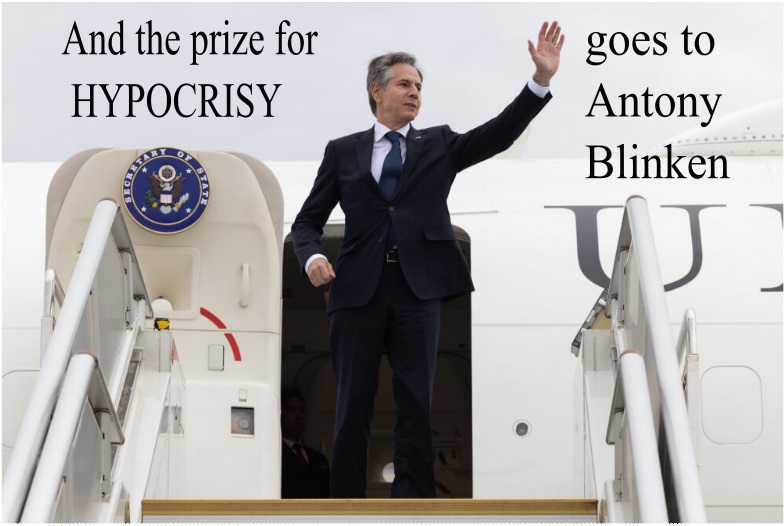
By Dave DeCamp / Antiwar.com, December 16, 2024, https://news.antiwar.com/2024/12/15/blinken-confirms-the-us-is-in-direct-contact-with-al-qaeda-linked-hts/
Secretary of State Antony Blinken said Saturday that the US has been in direct contact with Hayat Tahrir al-Sham, a US-designated terror organization that grew out of al-Qaeda in Syria and recently led the offensive that overthrew former Syrian President Bashar al-Assad.
“Yes, we have been in contact with HTS and with other parties,” Blinken said on Saturday, confirming earlier reports that said the US was talking to HTS. “Our message to the Syrian people is this: We want them to succeed, and we’re prepared to help them do so.”
HTS and its leader, Abu Mohammad al-Julani, are overseeing the new “transitional” government in Syria. Blinken and other US officials have celebrated the ouster of Assad and made clear they’re willing to work with Julani despite his past as an ISIS and al-Qaeda leader.
Julani, who has been going by his real name, Ahmad al-Sharaa, has been presenting himself as a moderate in an effort to gain support from the West and began a rebranding campaign in 2016 by claiming his former group, the al-Nusra Front, was cutting ties with al-Qaeda. At the time, he thanked the “commanders of al-Qaeda for having understood the need to break ties.”
In 2017, Julani merged his group with several other Islamist factions to form Hayat Tahrir al-Sham, which the US State Department designated as a foreign terrorist organization in 2018. The US also placed a $10 million bounty on Julani’s head.
The Biden administration is reportedly considering removing the terror designation from HTS, which would allow the US to provide significant aid to an HTS-led government. Blinken released a statement a few days ago outlining conditions for US support.
“The United States reaffirms its full support for a Syrian-led and Syrian-owned political transition. This transition process should lead to credible, inclusive, and non-sectarian governance that meets international standards of transparency and accountability,” Blinken said.
While the US is flexible with HTS’s designation, it frequently points to the terror designations of groups like Hamas and Hezbollah to justify Israeli attacks that slaughter huge numbers of civilians.
Israel, not the ‘liberators’ of Damascus, will decide Syria’s fate

Syria’s future under al-Qaeda spin-off HTS will come in two flavours only. Either submit and collude like the West Bank, or end up wrecked like Gaza
Jonathan Cook, Substack, Dec 19, 2024
There has been a flurry of “What next for Syria?” articles in the wake of dictator Bashar al-Assad’s hurried exit from Syria and the takeover of much of the country by al-Qaeda’s rebranded local forces.
Western governments and media have been quick to celebrate the success of Hayat Tahrir al-Sham (HTS), even though the group is designated a terrorist organisation in the United States, Britain and much of Europe.
Back in 2013, the US even placed a £10 million bounty on its leader, Abu Muhammad al-Julani, for his involvement with al-Qaeda and Islamic State (ISIS) and for carrying out a series of brutal attacks on civilians.
Once upon a time, he might have expected to end up in an orange jumpsuit in the notorious, off-the-grid detention and torture facility run by the Americans at Guantanamo Bay. Now he is positioning himself as Syria’s heir apparent, seemingly with Washington’s blessing.
Surprisingly, before either HTS or al-Julani can be tested in their new roles overseeing Syria, the West is hurrying to rehabilitate them. The US and UK are both moving to overturn HTS’s status as a proscribed organisation.
To put the extraordinary speed of this absolution in perspective, recall that Nelson Mandela, feted internationally for helping to liberate South Africa from apartheid rule, was removed from Washington’s terrorist watch list only in 2008 – 18 years after his release from prison.
Similarly, western media are helping al-Julani to rebrand himself as a statesman-in-the-making, airbrushing his past atrocities, by transitioning from using his nom de guerre to his birth name, Ahmed al-Sharaa.
Piling on pressure
Stories of prisoners being freed from Assad’s dungeons and of families pouring on to the streets in celebration have helped to drive an upbeat news agenda and obscure a more likely dismal future for newly “liberated” Syria – as the US, UK, Israel, Turkey and Gulf states jostle for a share of the pie.
Syria’s status looks sealed as a permanently failed state.
Israel’s bombing raids – destroying hundreds of critical infrastructure sites across Syria – are designed precisely towards that end.
Within days, the Israeli military was boasting it had destroyed 80 per cent of Syria’s military installations. More have gone since.
On Monday, Israel unleashed 16 strikes on Tartus, a strategically important port where Russia has a naval fleet. The blasts were so powerful, they registered 3.5 on the Richter scale.
During Assad’s rule, Israel chiefly rationalised its attacks on Syria – coordinating them with Russian forces supporting Damascus – as necessary to prevent the flow of weapons overland from Iran to its Lebanese ally, Hezbollah.
But that is not the goal currently. HTS’s Sunni fighters have vowed to keep Iran and Hezbollah – the Shiite “axis of resistance” against Israel – out of Syrian territory.
Israel has prioritised instead targeting Syria’s already beleaguered military – its planes, naval ships, radars, anti-aircraft batteries and missile stockpiles – to strip the country of any offensive or defensive capability. Any hope of Syria maintaining a semblance of sovereignty is crumbling before our eyes.
These latest strikes come on top of years of western efforts to undermine Syria’s integrity and economy. The US military controls Syria’s oil and wheat production areas, plundering these key resources with the help of a Kurdish minority. More generally, the West has imposed punitive sanctions on Syria’s economy.
It was precisely these pressures that hollowed out Assad’s government and led to its collapse. Now Israel is piling on more pressure to make sure any newcomer faces an even harder task.
Maps of post-Assad Syria, like those during the latter part of his beleaguered presidency, are a patchwork of different colours, with Turkey and its local allies seizing territory in the north, the Kurds clinging on to the east, US forces in the south, and the Israeli military encroaching from the west.
This is the proper context for answering the question of what comes next.
Two possible fates
Syria is now the plaything of a complex of vaguely aligned state interests. None have Syria’s interests as a strong, unified state high on their list.
In such circumstances, Israel’s priority will be to promote sectarian divisions and stop a central authority from emerging to replace Assad.
This has been Israel’s plan stretching back decades, and has shaped the thinking of the dominant foreign policy elite in Washington since the rise of the so-called neoconservatives under President George W Bush in the early 2000s. The aim has been to Balkanise any state in the Middle East that refuses to submit to Israeli and US hegemony…………………………………………………………………………………………………………………
And to top it all, Israel looks like it may finally be in sight of signing off on “normal” relations with Washington’s other major client state in the region, Saudi Arabia – a drive that had to be put on hold following Israel’s genocide in Gaza.
Renewed ties between Israel and Riyadh are possible again in large part because coverage of Syria has further disappeared the Gaza genocide from the West’s news agenda, despite Palestinians there – starved and bombed by Israel for 14 months – likely dying in larger numbers than ever.
The narrative of Syria’s “liberation” currently dominates western coverage. But so far the takeover of Damascus by HTS appears only to have liberated Israel, leaving it freer to bully and terrorise its neighbours into submission. https://jonathancook.substack.com/p/israel-not-the-liberators-of-damascus?utm_source=post-email-title&publication_id=476450&post_id=153321149&utm_campaign=email-post-title&isFreemail=true&r=ln98x&triedRedirect=true&utm_medium=email
Blinded to Syria
By Patrick Lawrence / Consortium News, 15 December 24
Decades after deploying mass violence and rendering citizens grotesquely ignorant of the world, U.S.-led powers appear willing to risk world war, while reinventing a terrorist to lead what was a secular nation until last week.
I do not know anyone who was not shocked by the lightning speed with which Damascus fell to expensively armed jihadist militias last weekend.
I know very few people who do not understand that another domino has just fallen in the “seven-front war” Benjamin Netanyahu has boasted this year of waging across West Asia. I know very few people who do not recognize that terrorist Israel is well on the way to establishing itself as a dictatorial hegemon across the region.
I know very few people who do not understand that the longstanding project of the Zionist neoconservatives, who have more or less controlled U.S. foreign policy for decades, i.e., “remaking the Middle East,” is the design behind all that has occurred since the Israelis launched their attack on Gaza on Oct. 7, 2023.
I do not know anyone who has achieved the age of reason who does not recognize the U.S. hand in the stunning sweep through Syria of Hay`at Tahrir al–Sham, long-recognized as a terrorist organization. All one needs to grasp this is a little history.
But I know of no corporate or state-funded medium on either side of the Atlantic — the major dailies, the broadcast networks, NPR, PBS, the BBC — where you can read or hear about any of this.
Blinding Us
Mainstream media are doing exactly what they did as the U.S.–led “regime change” operation in Syria began in early 2012 at the latest and probably in the final months of 2011: They are making sure the events now unfolding in Syria are not quite illegible but nearly.
It is again a question of knowing the history. In the case of Hay`at Tahrir al–Sham and the other jihadists who knocked over the Assad regime as if it were made of Lego blocks, it is another exercise in dressing up a monster in a suit and tie.
The corporate press and broadcasters are now resolutely recasting the murderous fanatics who have seized control of Syria as legitimate “rebels.” Rebels, rebels, rebels: This is the approved terminology.
I see they have left off describing these Sunni zealots as the “moderate rebels” of yesteryear, that phrase having been hopelessly discredited last time around, but the drift is the same: These are civilized people out there trying to do the right thing.
My favorite in this line appeared in The Daily Telegraph several days before the Assad government collapsed: “How Syria’s ‘diversity-friendly’ jihadists plan on building a state.” I had to read this one twice, too.
Nowhere but nowhere in the West’s mass media can you find even a mention of the U.S.–Turkish-and-probably–Israeli support that made possible the swift sweep of Hay`at Tahrir al–Sham and its ever-bickering allies from its seat in the Idlib governorate through Hama and other cities to the center of Damascus.
This is, like the earlier years of the Western-backed terrorist attacks on the Assad regime, and like the proxy war in Ukraine, and like the Saudis’ U.S.–supported war against Yemen, and like the Israeli genocide against the Palestinians of Gaza, and like the Israelis’ attacks in Lebanon, sponsored military aggression we are not permitted to see without considerable effort to transcend official representations of reality.
What happened, what is happening, what will happen: I do not know anyone who is not asking these questions, too.
We must go back and back and back further to understand what has just occurred in Syria and to understand why, and finally to understand who Americans are and who they have been for all the decades since the 1945 victories……………………………………………………………………………………………………………………………………… more https://consortiumnews.com/2024/12/15/patrick-lawrence-blinded-to-syria/?eType=EmailBlastContent&eId=fed725fe-b253-4493-b036-850db39466d1
Six major NATO states sign document on Ukraine’s accession plans
https://www.rt.com/news/609282-nato-declaration-ukraine-membership/ 13 Dec 24
The countries have backed Kiev’s “irreversible path” to eventually joining the bloc.
Six European members of NATO have released a joint statement backing Ukraine’s plan to join the US-led bloc, and promising to support the peace terms offered by Ukrainian leader Vladimir Zelensky to Russia.
Moscow has previously rejected Zelensky’s insistence on restoring Ukraine’s 1991 borders as unacceptable.
The foreign ministers of the UK, France, Spain, Germany, Italy and Poland signed a declaration after meeting with the Ukrainian leader in Berlin on Thursday.
“The goals of a comprehensive, just and lasting peace for Ukraine and durable security for Europe are inseparable. Ukraine must prevail,” the statement said.
The countries pledged to support an end to the conflict in accordance “with full respect for Ukraine’s sovereignty and territorial integrity.”
“We reaffirm our commitment to President Zelensky’s Peace Formula, as a credible path towards a just and lasting peace,” the statement read.
Kiev’s backers vowed to “support Ukraine on its irreversible path to full Euro-Atlantic integration, including NATO membership,” as well as “its path towards accession to the European Union.”
Ukrainian Foreign Minister Andrey Sibiga thanked the six nations and the EU for “candid discussion and readiness to take concrete steps.” He called for additional sanctions, targeting Russia’s metals sector, shipping, and banks.
“We are closely monitoring the increase in trade with the countries that have not imposed sanctions on Russia,” Sibiga said.
The meeting in Berlin took place amid uncertainty over whether US President-elect Donald Trump will continue the previous administration’s unconditional military and financial aid to Kiev.
Trump, who takes office on January 20, has described Zelensky as “the greatest salesman on Earth” and promised to do his best to quickly end the conflict through diplomacy. Although he has not yet produced a concrete plan, during the presidential campaign he appeared open to pressuring Kiev to start negotiations with Moscow.
Trump has also blasted outgoing President Joe Biden for allowing Ukraine to use American-made missiles for strikes deep into internationally recognized Russian territory. “I think that is a very big mistake,” he told Time magazine in an interview published on Thursday.
Russia has rejected Zelensky’s ‘peace formula’ outright, insisting that a peace agreement could only be reached on its terms. Moscow has stressed that Ukraine must renounce claims on Crimea and four other regions, which voted to join Russia in 2014 and 2022.
The Kremlin has also said Ukraine should drop its plan to join the US-led military bloc in favor of becoming a permanently neutral country. President Vladimir Putin has cited NATO’s expansion eastward and military cooperation with Ukraine as one of the root causes of the current conflict.
From ‘Terrorist’ to ‘Freedom Fighter’: How the West Rebranded Al-Qaeda’s Jolani as Syria’s ‘Woke’ New Leader
December 13, 2024 By Alan MacLeod / MintPress News, https://www.mintpressnews.com/from-terrorist-to-freedom-fighter-how-the-west-rebranded-al-qaedas-jolani-as-syrias-woke-new-leader/288820/
Corporate media is heralding the fall of Bashar al-Assad and the emergence of Abu Mohammed al-Jolani as the new leader of Syria, despite his deep ties to both al-Qaeda and ISIS.
“How Syria’s ‘diversity-friendly’ jihadists plan on building a state,” runs the headline from an article in Britain’s Daily Telegraph that suggests that Jolani will construct a new Syria, respectful of minority rights. The same newspaper also labeled him a “moderate Jihadist.” The Washington Post described him as a pragmatic and charismatic leader, while CNN portrayed him as a “blazer-wearing revolutionary.”
Meanwhile, an in-depth portrait from Rolling Stone describes him as a “ruthlessly pragmatic, astute politician who has renounced ‘global jihad’” and intends to “unite Syria.” His “strategic acumen is apparent,” writes Rolling Stone, between paragraphs praising Jolani for leading a successful movement against a dictator.
CNN even scored an exclusive, sit-down interview with Jolani, even as his movement was storming Damascus. When asked by host Jomana Karadsheh about his past actions, he responded by saying, “I believe that everyone in life goes through phases and experiences…As you grow, you learn, and you continue to learn until the very last day of your life,” as if he were discussing embarrassing teenage mistakes, not establishing and leading the Al-Nusra Front, Al-Qaeda’s franchise in Syria.
This is a far cry from the first time CNN covered Jolani. In 2013, the network labeled him one of “the world’s 10 most dangerous terrorists,” known for abducting, torturing and slaughtering racial and religious minorities.
Still on the U.S. terrorist list today, the FBI is offering a $10 million reward for information about his whereabouts. Washington and other Western governments consider Jolani’s new organization, Hayʼat Tahrir al-Sham (HTS), as one and the same as Al-Qaeda/Al-Nusra.
This poses a serious public relations dilemma for Western nations, who supported the HTS-led overthrow of President Bashar al-Assad. And thus, Politico and others report there is a “huge scramble” in Washington to remove HTS and Jolani from the terrorist list as quickly as possible.
The Making of a Radical
Jolani has sought to distance himself from his past and present himself as a moderating force that can attempt to unite an intensely divided Syria. While he has, in recent years, displayed a willingness to compromise with other forces and factions, it is far from clear whether the tens of thousands of soldiers he commands – units made up primarily of former fighters from al-Qaeda/al-Nusra and ISIS – will be in a charitable mood once they cement their power.
“Syria is being purified,” he told a crowd in Damascus on Sunday. “This victory is born from the people who have languished in prison, and the fighters broke their chains,” he added.
Jolani – whose real name is Ahmed Hussein al-Shar’a – was born in 1982 in Saudi Arabia to parents who fled the Golan Heights area of Syria after the 1967 Israeli invasion. In 2003, he went to Iraq to fight against American forces. After three years of war, he was captured by the U.S. military and spent over five years in prison, including a stint at the notorious Abu Ghraib torture center.
While in Iraq, Jolani fought with ISIS and was even a deputy to its founder. Immediately upon release in 2011, ISIS sent him to Syria with a rumored $1 billion to found the Syrian wing of al-Qaeda and participate in the armed protest movement against Assad that arose out of the Arab Spring.
Realizing the extremely poor reputation al-Qaeda had in the region and across the world, Jolani attempted to rebrand his forces, officially shuttering the al-Nusra Front in January 2017 and, on the same day, founding HTS. He claimed that HTS preaches a very different ideology and that it will respect Syrian diversity. Not everyone is convinced of this, least of all the British government, who immediately proscribed HTS, describing it as merely an alias of Al-Qaeda.
“Al-Qaeda/ISIS man didn’t ‘reinvent himself.’ He had the whole propaganda and intelligence apparatus of the ‘West,’ including the BBC, doing it for him,” remarked co-founder of The Electronic Intifada, Ali Abunimah.
The New Government: Likes Israel, Hates Hezbollah
The name “al-Jolani” translates to “From the Golan Heights.” And yet, the leader appears distinctly unconcerned with the Israeli invasion of his homeland. The IDF has taken much of southern Syria, including the strategic Mount Hermon, overlooking Damascus. Prime Minister Benjamin Netanyahu has stated that this is part of a permanent operation. “The Golan Heights…will forever be an inseparable part of the State of Israel,” he proclaimed.
Jolani has already said that he has no intention of confronting Israel. “Syria is not ready for war and does not intend to go into another war. The source of concern was the Iranian militias, and Hezbollah, and the danger has passed,” he said – a strange thing to say while Israel is carrying out the largest Air Force operation in its history, pounding military targets all over Syria. Other HTS spokespersons have also categorically refused to comment on Israel’s attack on the country, even when pressed by incredulous Western journalists.
Jolani’s comments, singling out two Shia forces rather than Israel as enemies of the state, will have many concerned that this could signal a return to the process of Shia slaughter ISIS waged over much of Syria and Iraq. In 2016, the U.S. House of Representatives voted 383-0 to classify this process as a genocide.
Fortunately, the new government will likely be a coalition of disparate and moderating forces. However, these groups seem to share a common thread: they all appear to be pro-Israel. A commander of the secular Free Syrian Army, for example, recently gave an interview to The Times of Israel, where he looked forward to a new era of “friendship” and “harmony” with its neighbor to the south. “We will go for full peace with Israel… Since the outbreak of the Syrian civil war, we have never made any critical comments against Israel, unlike Hezbollah, who stated they aim to liberate Jerusalem and the Golan Heights,” he said.
The commander added that “Israel will plant a rose in the Syrian garden” and asked for the country’s financial support in forming a new government.
Other anti-Assad forces have gone even further, with one individual stating that Israel “Isn’t hostile to those who are not hostile toward it. We don’t hate you, we love you very much…we were quite happy when you attacked Hezbollah, really happy, and we’re glad that you won.”
Statements like these might surprise a casual observer. But the reality is that Israel has been funding, training and arming much of the Syrian opposition since its inception. This includes Al-Qaeda, whose wounded fighters are treated by Israel.
And while radical Islamist forces appeared to be enemies with everyone, the one group they fastidiously avoided any confrontation with was Israel. Indeed, in 2016, ISIS fighters accidentally fired upon an Israeli position in the Golan Heights, thinking they were Syrian government forces, then quickly issued an apology for doing so.
From the Golan Heights, the year-long Israeli campaign against Hezbollah and Syrian Army positions also seriously weakened both forces, aiding the opposition in their victory.
Al-Qaeda and the U.S.: A Complicated Relationship
While both journalists and politicians in the U.S. are scrambling to change their opinions on Jolani and HTS, the reality is that, for much of its existence, Washington has enjoyed a very close relationship with al-Qaeda. The organization was born in Afghanistan in the 1980s, thanks in no small part to the CIA. Between 1979 and 1992, the CIA spent billions of dollars funding, arming, and training Afghan Mujahideen militiamen (like Osama bin Laden) in an attempt to bleed the Soviet occupation dry. It was from the ranks of the Mujahideen that bin Laden built his organization.
During the 1990s, bin Laden’s relationship with the U.S. soured, and it eventually became a principal target for al-Qaeda, culminating in the infamous September 11, 2001, attacks on New York City and Washington, D.C.
The Bush administration would use these attacks as a pretext to invade both Afghanistan and Iraq, claiming that America could never be safe if al-Qaeda were not thoroughly destroyed. Bin Laden became perhaps the most notorious individual in the world, and American society was turned upside down in a self-described effort to rout Islamic extremism.
And yet, by the 2010s, even as the U.S. was ostensibly at war with al-Qaeda in Iraq and Afghanistan, it was secretly working with it in Syria on a plan to overthrow Assad. The CIA spent around $1 billion per year training and arming a wide network of rebel groups to this end. As National Security Advisor Jake Sullivan told Secretary of State Hillary Clinton in a leaked 2012 email, “AQ [al-Qaeda] is on our side in Syria.”
Thus, while many casual observers may be shocked to see the media and political class embrace the leader of al-Qaeda in Syria as a modern, progressive champion, the reality is that the U.S. relationship with the group is merely reverting to a position it has previously held. Consequently, it appears that the War on Terror will come to an end with the “terrorists” being redesignated as “moderate rebels” and “freedom fighters.”
Who Gets to Define “Terrorist”?
Of course, many have argued that the U.S. Terrorist List is entirely arbitrary to begin with and is merely a barometer of who is in Washington’s good books at any given time. In 2020, the Trump administration removed Sudan from its state sponsors of terror list in exchange for the country normalizing relations with Israel, proving how transactional the list was.
A few months later, it removed the East Turkestan Islamic Movement (a Uyghur militia currently active in Syria) from its list because of its hardening attitude towards China, seeing ETIM as a useful pawn to play against Beijing.
Washington also continues to keep Cuba on its terror list despite there being no evidence of the island supporting terror groups.
And the U.S. refused to remove Nelson Mandela from its list of the world’s most notorious terrorists until 2008 – 14 years after he became President of South Africa. In comparison, Jolani’s redesignation might take fewer than fourteen days.
A giant rebranding operation is taking place. Both corporate media and the U.S. government have attempted to transform the founder and head of an al-Qaeda affiliate organization into a woke, progressive actor. It remains to be seen how exactly Jolani will govern and whether he can maintain support from a wide range of Syrian groups. Given what we have seen in the past week, however, he can be confident of enjoying strong support from the Western press.
1 This Month



26 September – International Day for the Total Elimination of Nuclear Weapons


PLEASE OPPOSE HR 8255 AND S.3639 – bills would accelerate satellite deployment, with no environmental review or safeguards – https://ncstd5li.quorum.us/campaign/169331/
To see nuclear-related stories in greater depth and intensity – go to https://nuclearinformation.wordpress.com
-
Archives
- September 2026 (219)
- August 2026 (330)
- July 2026 (355)
- June 2026 (287)
- May 2026 (306)
- April 2026 (356)
- March 2026 (251)
- February 2026 (267)
- January 2026 (308)
- December 2025 (358)
- November 2025 (359)
- October 2025 (375)
-
Categories
- 1
- 1 NUCLEAR ISSUES
- business and costs
- climate change
- culture and arts
- ENERGY
- environment
- health
- history
- indigenous issues
- Legal
- marketing of nuclear
- media
- opposition to nuclear
- PERSONAL STORIES
- politics
- politics international
- Religion and ethics
- safety
- secrets,lies and civil liberties
- spinbuster
- technology
- Uranium
- wastes
- weapons and war
- Women
- 2 WORLD
- ACTION
- AFRICA
- Atrocities
- AUSTRALIA
- Christina's notes
- Christina's themes
- culture and arts
- Events
- Fuk 2022
- Fuk 2023
- Fukushima 2017
- Fukushima 2018
- fukushima 2019
- Fukushima 2020
- Fukushima 2021
- general
- global warming
- Humour (God we need it)
- Nuclear
- RARE EARTHS
- Reference
- resources – print
- Resources -audiovicual
- Weekly Newsletter
- World
- World Nuclear
- YouTube
-
RSS
Entries RSS
Comments RSS
 nuclear-news