The US empire is hidden in plain sight
The National Endowment for Democracy (NED) was ‘created… to do in the open what the Central Intelligence Agency has done surreptitiously for decades,’
The UK appears to have very little control over what happens on the USAF-operated bases or the missions that are flown from them.
these agreements ‘ultimately reserve jurisdiction of US personnel to the US’. Most of the American bases are called RAF stations and leased by the US.
1 September 2024
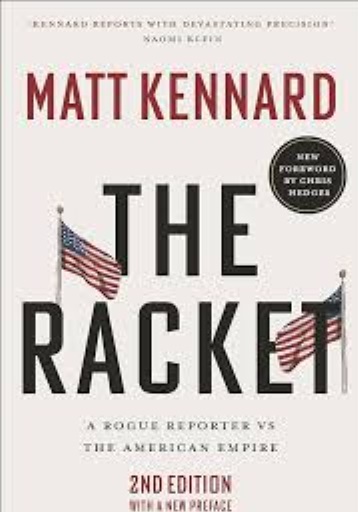
So-called RAF bases filled with US military personnel are a tell-tale sign of Britain’s key role in US imperialism, writes Matt Kennard.
Four years after my book The Racket was first published, I started my own media outlet with historian and journalist Mark Curtis. It was a departure from what I had focused on before – the consequences of US imperialism around the world – because this new publication, Declassified UK, would cover British foreign policy.
Britain handed the mantle of world domination to the US after World War Two and the received history is that it then retired from any kind of imperial role. I found out pretty quickly at Declassified that this was a misunderstanding. The truth is the empire never died. Britain merely became a ‘junior partner’ to the US hegemon. London’s adjunct status did not mean it was insignificant, however. The City of London’s role as the world’s financial capital which spreads neoliberalism around the world, Britain’s vast network of military bases, alongside its corporate giants like BP and BAE Systems, showed the country still served a critical imperial role for its senior partner.
But a more interesting realization for me came when I started to look at the institutions that make up the US empire and their role in Britain. I had spent years looking at what institutions like the CIA, the National Endowment for Democracy, or the US military were doing in the Global South, where their power was exercised against often weak states. But I saw quickly that the infrastructure of the US empire which had colonized so much of the world had also colonized my home country, the country where I had lived nearly all my life. Britain, in fact, appeared to be more completely under the control of its American ally than any country I’d looked into around the world in The Racket.
The similarities did not stop there. Like the mainstream media could never mention the term ‘US empire’ or explain its real role in world affairs, those same establishment journalists did not touch US influence in Britain. This was, again, an invisible empire, hiding in plain sight. The work I began doing would have never made it into the pages of my old employer, the Financial Times, like so many truths in The Racket never could.
Into the state
The colonization by the US empire of Britain became particularly clear when the Labour party elected Jeremy Corbyn leader in September 2015. A veteran anti-war and anti-imperialist politician and activist, Corbyn was a complete outlier within the British political system. He was dangerous to the rule of the British establishment, but also the ability of the US to retain Britain as a vassal state.
The different pressure points that stay hidden in normal times, when the system is running like it should, quickly became exposed. This was made explicit in June 2019, when US Secretary of State Mike Pompeo visited Britain and was recorded saying privately: ‘It could be that Mr Corbyn manages to run the gauntlet and get elected. It’s possible. You should know, we won’t wait for him to do those things to begin to push back. We will do our level best. It’s too risky and too important and too hard once it’s already happened.’
……………….. Britain’s traditional subservience to the US ‘could have gone a different way at various points in modern history, recently if Jeremy Corbyn hadn’t been destroyed by a vicious media campaign,’ Noam Chomsky has written. But it was not a coincidence. The US was integral to building a British political system that made a ‘different way’ next to impossible. m that made a ‘different way’ next to impossible. I began looking at how the US state had been interfering in British politics to stop the rise of anti-imperialist leaders. Britain has never had a prime minister that was not signed up to the US imperial project. I started to realize this was not a mistake, but the result of concerted efforts from Washington.
…………………………………………………………Declassified files from the CIA show how concerned the intelligence agency then was by the left turn in Labour. The BBC noted ‘the deep level of concern inside the CIA about the strength of the Left within Labour in the early 1980s, a political force which the agency regarded as anti-American’. The CIA was particularly concerned about Foot winning the 1983 general election, with an internal report stating that ‘a Labour majority government would represent the greatest threat to US interests’. Foot’s 1983 election manifesto questioned ‘the programme for establishing American-controlled cruise missiles on our soil’ and noted that a new European security pact should end with the ‘phasing out’ of NATO. The BAP’s own official history notes that ‘the traditional British leftwing remained deeply suspicious of the United States, particularly on foreign policy and security issues’ in the period, adding ‘this was the era of Michael Foot’s leadership of a Labour Party committed to unilateral nuclear disarmament’.
………………………………. Michael Foot was a founder and strong supporter of the Campaign for Nuclear Disarmament (CND), while Corbyn has been a member of the peace group since he was 15 and was, at the time of his election to the Labour leadership, its vice-chair.
The US neutralization campaign, which was leaked to the Washington Post, ‘would take three forms’, Dorrill continued: mobilizing public opinion, working within the churches, and a ‘dirty tricks’ operation against the peace groups.
……………………………………………………………………………………………………………………….. The National Endowment for Democracy (NED) was ‘created… to do in the open what the Central Intelligence Agency has done surreptitiously for decades,’ the New York Times reported in 1997…………………………………….. Since the end of the Cold War, the NED had grown and been involved in trying to undermine or remove governments independent of Washington,………………………
…………………………………………………………………………………….. John Kiriakou, a CIA officer from 1990 to 2004, told me that recent changes in the law have widened the potential targets of US information operations. ‘In 2011, the US Congress changed the law that forbade the Executive Branch from propagandizing the American people or nationals of the other ‘Five Eyes’ countries – the UK, Canada, Australia, and New Zealand,’ he said.
……………….. The CIA’s propaganda efforts throughout history have been shameless. But now that they’re not legally relegated to just Russia and China, the whole world is a target.’ One particularly interesting case was Index on Censorship, the UK’s foremost free expression group which monitors threats to free speech and publishes censored writers. It received £603,257 from the NED in 2016–21, according to its Charity Commission accounts.
……………………………………………………………………………………………………………. This is how it works. Not just in the developing world, but, I was learning, in the developed world, too. In fact, the control was even deeper. I soon understood that the US was not just interfering in the British political process, media and civil society. The hidden fist of the US empire which I’d seen deployed all over the developing world – the massive American military – was also occupying Britain.
I found the US Air Force (USAF) had 9,730 personnel permanently deployed throughout Britain, a number which was increasing rapidly.
……………………………………………… US military personnel in Britain are all in England, with access to 11 Royal Air Force (RAF) bases, stretching from Cambridgeshire to Yorkshire. They are known officially as United States Visiting Forces (USVF).
……………………….Jewel in the crown
The largest US military presence is at RAF Lakenheath, a 727 hectare site in Suffolk. Despite being called an RAF base, it is leased to the USAF, and its population is overwhelmingly American. There were 5,404 US Department of Defense personnel based there in 2022.
……………………………………………… The US is spending billions of pounds upgrading air bases in Britain to enable Washington to intercept international communications and launch military strikes more quickly. Some of the locations are hubs for offensive bombing missions. RAF Fairford in Gloucestershire is the USAF’s only bomber Forward Operating Location, or military base, in Europe. The aircraft deployed there ‘enable US and NATO warfighters to conduct a full spectrum of flying operations’.
………………………………………………..But the UK appears to have very little control over what happens on the USAF-operated bases or the missions that are flown from them. The overarching framework for the stationing of US forces in the UK comes from two pieces of legislation. In 1951, NATO agreed a ‘status of forces’ agreement to govern hosting arrangements between its member states. The following year, The Visiting Forces Act incorporated the NATO agreement into UK law.
But Hudson said that these agreements ‘ultimately reserve jurisdiction of US personnel to the US’. Most of the American bases are called RAF stations and leased by the US. ‘Because of this, while the physical buildings comprising the bases are usually the property of the UK Ministry of Defence, very little of what happens in them is controlled by the British government,’ Hudson said. The empire never sleeps and, despite the mainstream media working to keep it invisible, it’s everywhere.
This is an edited version of the new preface to The Racket: A Rogue Reporter vs The American Empire by Matt Kennard. The second edition is out now, published by Bloomsbury and available at bloomsbury.com and via all good bookshops.
Starmer permanently ties UK nuclear arsenal to Washington
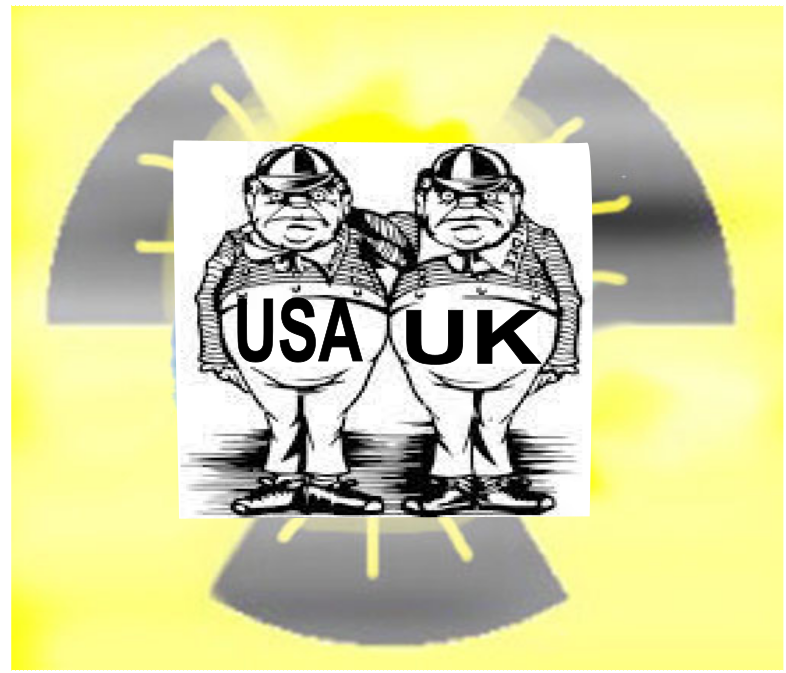
: Britain’s nuclear weapons are now forever reliant on US military scientists after a transatlantic treaty was quietly rewritten.
RICHARD NORTON-TAYLOR, 3 September 2024,
https://www.declassifieduk.org/starmer-permanently-ties-uk-nuclear-arsenal-to-washington/
Labour has reinforced the “special relationship” with Washington by agreeing to make Britain’s nuclear arsenal permanently dependent on the US.
In one of its first, but little-noticed foreign policy moves, Labour has amended the Eisenhower-era 1958 Mutual Defence Agreement (MDA) that is crucial to Britain’s Trident nuclear missile system.
Officials deleted a long-standing sunset clause that required it be renewed every ten years.
All references to an “expiry date” have been removed “to make the entirety of the MDA enduring, securing continuing cooperation with the US”, according to a memorandum signed by defence secretary John Healey.
Kate Hudson from the Campaign for Nuclear Disarmament (CND) told Declassified: “This spells farewell to even the smallest notion of parliamentary responsibility for Britain’s foreign and defence policies.”
She added that at least nominally parliament has had the opportunity, once a decade, to debate and reconsider America’s role in Britain’s nuclear programme.
“This amendment, introduced in the most undemocratic fashion by the government – at a time when it will be lost in the recess and party conference season – will eradicate those opportunities. This must not go unchallenged.”
The change was agreed by senior British and US officials on 25 July, three weeks after Keir Starmer became UK prime minister.
It comes as Starmer described Britain’s nuclear weapons as the “bedrock” of the country’s defence and amid concern about possible threats to the future of the MDA if Donald Trump wins back the White House.
During a visit to Washington shortly before the general election, David Lammy, now foreign secretary, told a centre-right think tank that Labour: “will always work with the United States, whatever the weather…”
The MDA enables the US to provide Britain with nuclear weapons materials and know-how without which Trident would not be able to function.
It gives the lie to persistent claims by the Ministry of Defence that Britain’s submarine-launched nuclear arsenal is “operationally independent”.
American client
Trident missiles themselves are obtained from America and a cross-party report concluded that the life expectancy of Britain’s nuclear capability without US support could be measured in months.
US presidents have also alluded to this dependency, with George W. Bush saying in 2005 that the US helped Britain maintain a “credible nuclear force”.
Barack Obama declared it was in America’s interest to continue to help Britain “in maintaining a credible nuclear deterrent” when the MDA was renewed ten years ago.
As Declassified recently reported, British military aircraft regularly cross the Atlantic with highly radioactive ingredients supplied by the US. These ingredients are absolutely vital to the Trident missile system.
The memorandum signed by Healey states: “The MDA provides the necessary requirements for the control and transmission of submarine nuclear propulsion technology, atomic information and material between the UK and US, and the transfer of non-nuclear components to the UK.”
It continues: “The MDA underpins the defence nuclear relationship between the UK and US.”
Above democracy
The memo further states that the amendment does not require any change in the law. Although the MDA is incorporated in US law, it has no statutory basis in the UK.
Astonishingly, despite its huge significance, it has never been the subject of a substantial debate in Parliament.
The government describes the MDA as covering the exchange of information on “sensitive nuclear technology” for developing “defence plans” and “military applications of atomic energy”.
Other aspects involve evaluating “the capabilities of potential enemies in the employment of atomic weapons”.
It also concerns the sale of “naval nuclear propulsion plants” and the transfer of materials like U-235 enriched uranium.
However, governments have long refused to provide information about how much nuclear material for British warheads the US has provided to the Atomic Weapons Establishment at Aldermaston and the nearby Burghfield warhead factor, and at what cost.
The quantity is likely to be significant. Nearly 1,000 non-nuclear components for atomic weapons systems were exchanged between the US and UK in 2020-23 under the MDA, according to new research by the Nuclear Information Service.
A Ministry of Defence spokesperson said the removal of the 10-year renewal provision was decided “given the longstanding nature of this agreement”. She added that making the entirety of the MDA “enduring” was “the case with other international agreements.”
Peter Burt of Nukewatch UK which monitors the UK’s nuclear weapons programme commented: “Every UK Prime Minister since the Second World War has been petrified about losing influence with the US, and in a large part this hinges around access to nuclear weapons technology and military intelligence.
“This is the main reason the UK government always aligns itself with US foreign policy and allows itself to be drawn into US military adventurism, even when it is clearly not in the interests of this country to follow America.”
Iran desperately needs a nuclear deal to save its battered economy

The Islamic Republic has few good options – a nuclear accord 2.0 may be its best hope
By Michael Day, iNews 4th Sept 2024
Iran appears increasingly willing to scale back its nuclear weapons programme in return for sanctions relief to rescue its stricken economy. This might explain Tehran’s reluctance to retaliate hard against Israel’s alleged assassination of a senior Hamas figure.
The delay in Iran’s threatened retribution for the provocative killing of Hamas’s political leader Ismail Haniyeh in Tehran on 31 July has been explained in part by Tehran’s willingness to allow negotiators to pursue peace talks between Hamas and Israel.
America’s increased naval presence in the region with aircraft carriers and a guided missile-capable submarine might also have made the regime in Tehran think long and hard about how it should respond to Haniyeh’s killing……………………
Iran’s supreme leader, Ayatollah Ali Khamenei, allowed the election of a moderate president, Masoud Pezeshkian, in July, after deciding that a degree of rapprochement and thereby sanctions relief with the West was badly needed to tackled Iran’s dire economic situation and the social unrest that it – along with the regime’s brutality – has created.
………………………now Azizi thinks: “Iran is seriously interested in pursuing agreements with the West that could help it lift sanctions and this is indeed a priority for it. The return of the JCPOA [2015 nuclear deal] triumvirate (Iran’s nuclear negotiators Mohammad Javad Zarif, Abbas Araghchi, Majid Takht-Ravanchi) indeed speaks to that”.
The nuclear deal was concluded with world powers in 2015 under Iran’s former president Hassan Rouhani – an accord ripped up by the Trump administration in 2018.
Underlining the regime’s desire to use a freeze in its nuclear programme as a bargaining chip, Pezeshkian is, according to reports in state media, about to appoint the nuclear negotiations specialist Takht-Ravanchi to a senior role in the foreign affairs department.
The news comes a week after Iran’s supreme leader suggested that his country might resume nuclear negotiations with the US.
…………………………………………………………………………………………….there is of course the seismic matter of the US election result, which is likely to have a huge bearing on America’s willingness to deal with Tehran. Nothing concrete will be agreed on before then. https://inews.co.uk/news/world/iran-nuclear-deal-sanctions-relief-economy-3258961
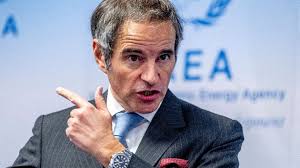
IAEA chief on reviving Iran nuclear deal, preventing Russia-Ukraine nuclear disaster
ALARABIYA NEWS, 1 Sept 24,
In a special interview on Al Arabiya, IAEA Director General Rafael Grossi discussed several pressing global nuclear issues. He highlighted the ongoing concerns related to the conflict between Russia and Ukraine, particularly the risks posed to nuclear power plants situated near active combat zones. Grossi emphasized the IAEA’s commitment to ensuring the safety of these facilities, despite the challenges and uncertainties. He stressed the importance of the agency’s impartiality, noting that their assessments are based solely on independently verified information to avoid politicization.
The IAEA chief also addressed the Iranian nuclear program, expressing concerns over the country’s continued accumulation of highly enriched uranium. He revealed that he had received a response from Iran’s new president, signaling a potential for renewed dialogue aimed at ensuring the peaceful nature of Iran’s nuclear activities. Grossi underscored the need for increased transparency and cooperation from Iran, especially in light of advancements in their nuclear capabilities……………………………………………… https://english.alarabiya.net/webtv/programs/special-interview/2024/09/01/iaea-chief-on-reviving-iran-nuclear-deal-preventing-russia-ukraine-nuclear-disaster—
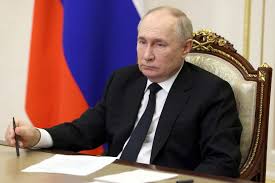
Russia says it will change nuclear doctrine because of Western role in Ukraine
In short:
Russia will make changes to its doctrine on the use of nuclear weapons.
The decision is “connected with the escalation course of our Western adversaries”, Russia’s deputy foreign minister said.
What’s next?
It is not clear when the updated nuclear doctrine will be ready.
Russia will make changes to its doctrine on the use of nuclear weapons in response to what it regards as Western escalation in the war in Ukraine, state media quoted Deputy Foreign Minister Sergei Ryabkov as saying on Sunday.
The existing nuclear doctrine, set out in a decree by President Vladimir Putin in 2020, says Russia may use nuclear weapons in the event of a nuclear attack by an enemy or a conventional attack that threatens the existence of the state.
Some hawks among Russia’s military analysts have urged Mr Putin to lower the threshold for nuclear use in order to “sober up” Russia’s enemies in the West.
Mr Putin said in June that the nuclear doctrine was a “living instrument” that could change, depending on world events.
Mr Ryabkov’s comments on Sunday were the clearest statement yet that changes would indeed be made.
“The work is at an advanced stage, and there is a clear intent to make corrections,” state news agency TASS cited Mr Ryabkov as saying.
He said the decision is “connected with the escalation course of our Western adversaries” in connection with the Ukraine conflict.
Moscow accuses the West of using Ukraine as a proxy to wage war against it, with the aim of inflicting a “strategic defeat” on Russia and breaking it apart.
The United States and its allies deny that, saying they are helping Ukraine defend itself against a colonial-style war of aggression by Russia.
Putin said on day one of Russia’s full-scale invasion of Ukraine in February 2022 that anyone who tried to hinder or threaten it would suffer “consequences that you have never faced in your history”.
Since then, he has issued a series of further statements that the West regards as nuclear threats, and announced the deployment of Russian tactical nuclear weapons in Belarus.
That has not deterred the US and its allies from stepping up military aid to Ukraine in ways that were unthinkable when the war started, including by supplying tanks, long-range missiles and F-16 fighter jets.
Ukraine shocked Moscow last month by piercing its western border in an incursion by thousands of troops that Russia is still fighting to repel.
President Volodymyr Zelenskyy said the operation made a mockery of Mr Putin’s “red lines”.
He is also lobbying hard for the US to allow it to use advanced Western weapons to strike targets deep inside Russia.
Kremlin spokesman Dmitry Peskov said in an interview published on Sunday that the West was “going too far” and that Russia would do everything to protect its interests.
Mr Ryabkov did not say when the updated nuclear doctrine would be ready.
“The time for completing this work is a rather difficult question, given that we are talking about the most important aspects of ensuring our national security,” he said.
Russia has more nuclear weapons than any other country. Mr Putin said in March that Moscow was ready for the eventuality of a nuclear war “from a military-technical point of view”.
He said, however, that he saw no rush towards nuclear confrontation and that Russia had never faced a need to use nuclear weapons in Ukraine.
That time when Canada cancelled its nuclear submarine order
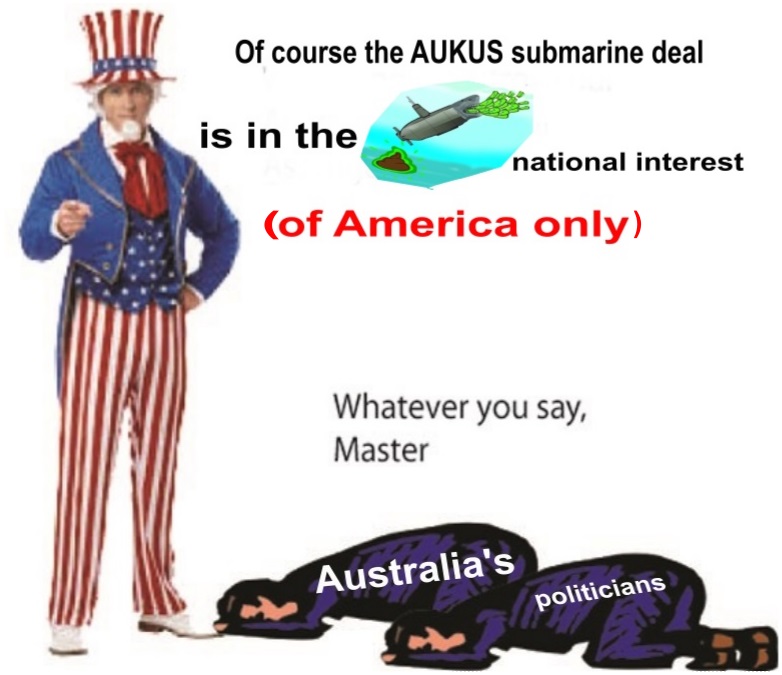
The decision to cut the Australian community out altogether — except where we will be called upon to service the US military as it builds its base in WA — puts us in the relationship of a vassal state, existing only to do the bidding of our powerful friend.
By Julie Macken and Michael Walker, Aug 30, 2024, https://johnmenadue.com/that-time-when-canada-cancelled-its-nuclear-submarine-order/
Back in 1987, when no one knew that the Cold War was just about to end, the Canadian Government signed up to build 10 nuclear-powered submarines. That submarine program lasted for all of two years before being cancelled in 1989. No nuclear Canadian sub ever even began construction, let alone getting put in the water.
There is a very real sense of déjà vu when we look at the Canadian experience and the current Australian experience of AUKUS. The good news is that it is not too late to learn the lessons the Canadians learnt for us.
One of the reasons for the Canadian cancellation was the $8 billion price tag, or about $19 billion in today’s money. Two billion dollars per submarine now sounds like a bargain compared to the astronomical $45 billion per submarine under AUKUS. Canada decided it had other priorities where that money could be put to better use.
But before the contract was cancelled in Canada, the ministries involved in its construction became embroiled in conflict, the Government itself was in a cost-of-living-crisis with immediate, real-world needs pressing and the hasty and secretive choice of vessel design came under withering criticism from the Treasury department for poor procurement with the cost expected to blow out to $30 billion ($70 billion today). And finally, media support eroded, with 71% of the population opposed to the project.
Déjà vu much?
On 12 June, the US Congressional Research Document service produced a research and advice document called the Navy Virginia-Class Submarine Program and AUKUS Submarine (Pillar 1) Project: Background and Issues for Congress.
The document points out the AUKUS deal was a three-step process. The first was to establish a US-UK rotational submarine force in Western Australia. The second was that the US would sell us three or five Virginia nuclear powered submarines and the third would be that the UK assists us in building our own AUKUS class nuclear submarines.
But the Congressional report outlines when comparing the “potential benefits, costs, and risks” of the three stage plan, it might just be better for the US to operate more of its own boats out of WA. That is, “procuring up to eight additional Virginia-class SSNs that would be retained in US Navy service and operated out of Australia along with the US and UK SSNs”.
That’s right, why bother with the whole step two and three when the US is best served by simply operating its nuclear-powered attack submarines out of WA?
This is an extraordinary development and one that demands more attention than has been given previously because a number of issues flow from this kind of thinking.
First, this potentially frees up $400 billion that could be put to far better use on a national housing construction program or high-speed rail network running the entire east coast of Australia or other large and much-needed nation-building projects. But not so fast.
The US Congressional Research Document suggests that “those funds (the $400 billion) could be invested in other military capabilities”, such as long-range missiles and bombers, “so as to create an Australian capacity for performing non-SSN military missions for both Australia and the United States”.
The decision to cut the Australian community out altogether — except where we will be called upon to service the US military as it builds its base in WA — puts us in the relationship of a vassal state, existing only to do the bidding of our powerful friend.
The fact that the document only referenced the “potential benefits, costs, and risks” from the US perspective, without any attempt to imagine how Australia may view becoming a life support for a US submarine base, makes the nature of our relationship pretty clear.
Australia’s Government may not consider it necessary to have done its due diligence on AUKUS but the Americans are happy to do that for us and, you guessed it, even though they quietly have doubts about the SSN project, they’ve already thought of plenty of other ways to spend our money on their own defence objectives. Spending it on the well-being and prosperity of our own people didn’t even rate a mention.
Australia offers U.S. a vast new military launchpad in China conflict

Australia is expanding its northern military bases, with U.S. support, to counter China’s growing threat. Critics quip it’s become the “51st state.”
Washington Post, By Michael E. Miller, August 24, 2024
ROYAL AUSTRALIAN AIR FORCE BASE TINDAL, Australia — Deep in the outback, a flurry of construction by Australia and the United States is transforming this once quiet military installation into a potential launchpad in case of conflict with China.
Runways are being expanded and strengthened to accommodate the allies’ biggest airplanes, including American B-52 bombers. A pair of massive fuel depots is rising side by side to supply U.S. and Australian fighter jets. And two earth-covered bunkers have been built for U.S. munitions.
But the activity at RAAF Tindal, less than 2,000 miles from the emerging flash points of the South China Sea,isn’t unique. Across Australia, decades-old facilities — many built by the United States during World War II — are now being dusted off or upgraded amid growing fears of another global conflict.
“This isabout deterrence,” Australia’s defense minister, Richard Marles, said in an interview. “We’re working together to deter future conflict and to provide for the collective security of the region in which we live.”
The United States has ramped up defense ties with allies across the region, including with the Philippines and Japan, as it tries to fend off an increasingly assertive and aggressive China. Australia offers the United States a stable and friendly government, a small but capable military, and a vast expanse from which to stage or resupply military efforts.
U.S. Secretary of Defense Lloyd Austin, hailing the “the extraordinary strength of our unbreakable alliance with Australia,” said after a meeting with Marles earlier this month that deepercooperation — including base upgrades and more frequent rotational bomber deployments — would help build “greater peace, stability, and deterrence across the region.”
Australia has also joined the AUKUS agreement, under which the United States and Britain will provide it with nuclear-propelled submarines, some of the world’s most closely guarded technology.
These moves underscore a bigger shift, as Canberra has grown increasingly tight with Washington as they both grow wary of Beijing. Military cooperation has become so extensive that critics quip Australia is becoming the United States’ “51st state.”
Mihai Sora, a former Australian diplomat who is an analyst at the Lowy Institute, a Sydney think tank, has a different metaphor. Australia is “an unsinkable aircraft carrier right at the bottom of the critical maritime sea lanes.”
“As the stakes increase in the South China Sea, as the risk over conflict in Taiwan increases, northern Australia in particular becomes of increasing strategic value for the United States,” Sora said.
American representatives ona recent congressional delegation to Darwin,onAustralia’s northern coast, agreed.
“This provides a central base of operations from which to project power,” Rep. Michael McCaul (R-Tex.), chairman of the House Foreign Affairs Committee, said during the trip.
Some Australian experts, however, argue that the growing U.S. military footprint doesn’t deter conflict with China so much as ensure Australia will be involved.
“I have deep misgivings about the whole enterprise” of increased U.S. military activity in Australia, said Sam Roggeveen, a former Australian intelligence analyst who is also at the Lowy Institute. “It conflates America’s strategic objectives in Asia with ours, and it makes those bases a target.”
……………………………………….Australia has spent roughly $1 billion on upgrading the Tindal air force base. Built by U.S. Army engineers in 1942 to stage bombing raids on Japanese targets in Papua New Guinea and Indonesia, Tindal is now the site of dozens of construction projects. A key one is the new parking apron capable of accommodating four of Australia’s biggest planes: KC-30 tankers that can refuel fighter jets and allow for far more distant attacks.
But there are also plans for the United States to build its own parking apron here, big enough for six B-52 bombers capable of reaching mainland China.
“That is absolutely something China would pay attention to,” Roggeveen said.
Marles declined to comment on the increasing rotations mentioned by Austin but said the trajectory is “an increasing American force posture in Australia.” We see that as very much in Australia’s national interest,” he said. “People understand that we are living through challenging times, when the global rules-based order is under pressure.”………………………………………………………………..
Australia is also surveying three “bare bases” — skeleton facilities in remote parts of western Australia and Queensland — with an eye to upgrading them so heavier Australian and American airplanes can use them, said Brigadier Michael Say, who leads Australia’s Force Posture Initiative. He said it’s still being determined whether the United States will pay for some of the improvements. [WHAA-A-AT!]
In the Cocos Islands, tiny coral atolls in the Indian Ocean northwest of the Australian continent and just south of Indonesia, Canberra will soon begin upgrading the airstrip to accommodate heavier military aircraft, including the P-8A Poseidon, a “submarine hunter” that could monitor increased Chinese naval activity in the area. A U.S. Navy construction contract published in June listed the Cocos as a possible project location, but Say said it hasn’t yet been decided whether the United States will contribute.
Diversifying — or redistributing?
These “bare bases,” which stretch for 3,000 miles from east to west, fit a new U.S. strategy of dispersing forces to prevent China from delivering a knockout blow.
“If one location gets taken out, the U.S. can still project force, it can still replenish and resupply and reinforce its troops,” Sora said. “Australia is fundamental to that but is just one plank in America’s regional force posture.”
Roggeveen questioned, however, whether the United States is actually increasing its capabilities in the region or merely moving assets out of places like Guam that are more immediately threatened by China’s improving missile capability. Under AUKUS, the United States will begin rotating up to four nuclear-powered submarines through western Australia in 2027………………………………………
Some concerns linger in Washington over Australia’s commitment, however. During the visit to Darwin, McCaul and other representatives asked about the 99-year lease a Chinese company holds over the port surrounding the Australian naval base. Australian officials said two reviews had found there wasn’t a security concern, and that in the case of a conflict, the port could be nationalized.
“Australia relies on China for prosperity and on America for security,” Rep. Jimmy Panetta (D-Calif.) told The Post. “That’s the balance they are playing.” https://www.washingtonpost.com/world/2024/08/24/us-military-base-australia-china/—
—
North Korea condemns new US nuclear strategic plan report
VOA News, Seoul, South Korea26 Aug 24
North Korea vowed Saturday to advance its nuclear capabilities, reacting to a report that the United States had revised its own nuclear strategic plan.
The country will “bolster up its strategic strength in every way to control and eliminate all sorts of security challenges that may result from Washington’s revised plan,” the official Korean Central News Agency (KCNA) reported.
The New York Times reported this week that a U.S. plan approved by President Joe Biden in March was to prepare for possible coordinated nuclear confrontations with Russia, China and North Korea.
The highly classified plan for the first time reorients Washington’s deterrent strategy to focus on China’s rapid expansion in its nuclear arsenal, the Times said.
KCNA said North Korea’s foreign ministry “expresses serious concern over and bitterly denounces and rejects the behavior of the U.S.”
It added North Korea vowed to push forward the building of nuclear force sufficient and reliable enough to firmly defend its sovereignty.
Pyongyang and Moscow have been allies since North Korea’s founding after World War II and have drawn even closer since Russia’s 2022 invasion of Ukraine.
The United States and Seoul have accused North Korea of providing ammunition and missiles to Russia for its war in Ukraine.
Pyongyang, which has declared itself an “irreversible” nuclear weapons power, has described allegations of supplying weapons to Russia as “absurd.”…………………………………… more https://www.voanews.com/a/north-korea-condemns-new-us-nuclear-strategic-plan-report/7755256.html
Why the big push for nuclear power as “green”?
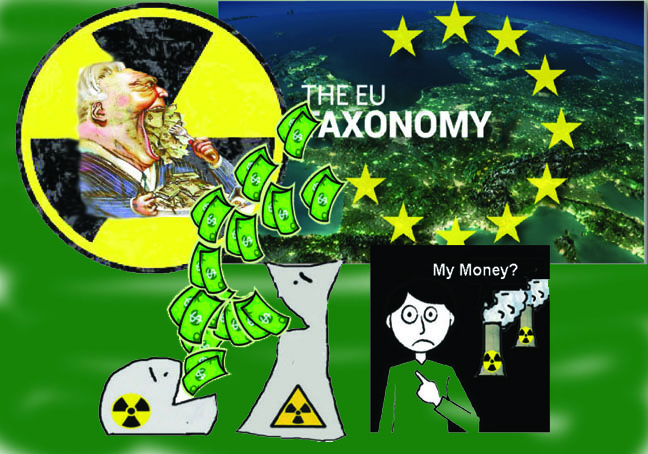
Why is it so difficult to recognise that – as is normal with technologies – nuclear energy is obsolescing?
nuclear affections are a military romance. Powerful defence interests – with characteristic secrecy and highly active PR – are mostly driving the dogged persistence.
https://beyondnuclearinternational.org/2024/08/25/why-the-big-push-for-nuclear-power-as-green/
Heavy lobbying by France and a “military romance” provide some answers, write Andy Stirling and Phil Johnstone

Whatever one’s view of nuclear issues, an open mind is crucial. Massive vested interests and noisy media clamour require efforts to view a bigger picture. A case in point arises around the European Commission’s much criticised proposal – and the European Parliament’s strongly opposed decision – to last year accredit nuclear power as a ‘green’ energy source.
In a series of legal challenges, the European Commission and NGOs including Greenpeace are tussling over what kind and level of ’sustainability’ nuclear power might be held to offer.
To understand how an earlier more sceptical EC position on nuclear was overturned, deeper questions are needed about a broader context. Recent moves in Brussels follow years of wrangling. Journalists reported intense lobbying – especially by the EU’s only nuclear-armed nation: France. At stake is whether inclusion of nuclear power in the controversial ‘green taxonomy’ will open the door to major financial support for ‘sustainable’ nuclear power.
Notions of sustainability were (like climate concerns) pioneered in environmentalism long before being picked up in mainstream policy. And – even when its comparative disadvantages were less evident – criticism of nuclear was always central to green activism. So, it might be understood why current efforts from outside environmentalism to rehabilitate nuclear as ‘sustainable’ are open to accusations of ‘greenwash’ and ‘doublespeak’.
In deciding such questions, the internationally-agreed ‘Sustainable Development Goals’ are a key guide. These address various issues associated with all energy options – including costs and wellbeing, health effects, accident risks, pollution and wastes, landscape impacts and disarmament issues. So, do such comparative pros and cons of nuclear power warrant classification alongside wind, solar and efficiency?
On some aspects, the picture is relatively open. All energy investments yield employment and development benefits, largely in proportion to funding. On all sides, simply counting jobs or cash flowing through favoured options and forgetting alternatives leads to circular arguments. If (despite being highlighted in the Ukraine War), unique vulnerabilities of nuclear power to attack are set aside, then the otherwise largely ‘domestic’ nature of both nuclear and renewables can be claimed to be comparable.
Orderings are more stark on economics and environment. Despite room for many views, it is difficult to deny that history raises especially grave queries about nuclear power. Nuclear costs have long been acknowledged to be far less competitive than renewables. Multiple nuclear accidents have occurred of kinds initially claimed to have ‘negligible’ likelihood. Nuclear waste “solutions” are still largely undeveloped. New questions continually arise about assumptions underpinning ‘safe levels’ of ionising radiation. Build times far exceeding those promised have helped cause nuclear bankruptcy and fraud. Growth rates of renewables surpass what government officials even quite recently claimed to be physically possible. Associated trends nearly all favour renewables.
But what of climate urgency? Does this not justify nuclear proponents’ calls to “do everything” to “keep the nuclear option open” (as if this were an end in itself)? Again: deeper thought might expose this as special pleading. Precisely because climate action is so imperative, isn’t it more rational to prioritise whatever is most substantial, cost effective and rapid?
A more reasoned approach might ask about long-neglected kinds of statistical analysis, which show that national carbon emission reductions tend to associate less with nuclear than with renewable uptake. Key reasons here include that nuclear contributions to climate targets are smaller, slower and more expensive than are offered by renewables. So other evidence that nuclear and renewable energy strategies also tend to conflict further queries the ‘sustainable’ status of nuclear power.
What then of claimed needs for ‘baseload’ power – to manage variable outputs from some renewables? Surprisingly given its public profile, this notion is long abandoned by the electricity industry as “outdated”. Nuclear power is itself inflexible in its own way. Myriad system innovations, grid improvements, demand measures and new storage technologies are all available to better address variable renewables over different timescales. Even in relatively pro-nuclear UK, it is authoritatively documented how a 100% renewable system outperforms any level of nuclear contribution. Even the UK Government now admits that adding these costs still leaves renewables outcompeting nuclear. In less nuclear-committed European countries, the picture is even more stark.
So, as this picture has unfolded, nuclear ‘sustainability’ arguments have retreated through successively undermined claims – that nuclear is “necessary”; brooks “no alternative”; is “more competitive”; uniquely offers to “keep the lights on”; or is just a way to “do everything” (as if this was ever a sensible response to any challenge, especially one as urgent and existential as climate disruption).
Whatever position one starts from, then, a final question arises: why all the fuss? Why should it be now after all these years (just as its comparative performance becomes so much less favourable) that European efforts become so newly energetic to redefine nuclear as ‘sustainable’? Why is it so difficult to recognise that – as is normal with technologies – nuclear energy is obsolescing?
Here, the answer is surprisingly obvious. It is officially repeatedly confirmed in countries working hardest to revive nuclear power – atomic weapons states like the US, France, the UK, Russia and China. Oddly neglected in mainstream energy policy and the media, the picture is especially evident on the defence side. Although skewed public debates leave many unaware, nuclear affections are a military romance. Powerful defence interests – with characteristic secrecy and highly active PR – are mostly driving the dogged persistence.
The result is clear. Dubiously justified in climate terms, elevated consumer prices, government funding and public risk underwriting all help maintain a joint civil/military ‘nuclear industrial base’. In nuclear armed countries like the UK and France, this helps fund – outside defence budgets, off the public books and away from due scrutiny – expensive specialist nuclear skills, supply chains, research facilities, navy recruitment, wider infrastructures. In particular, the building and operating of nuclear propelled submarines would be unaffordable without these concealed cross-subsidies. Without nuclear power, it would become much harder to guarantee the later careers that are so essential in recruiting nuclear-trained officers.
As President Macron recently said “without civilian nuclear, no military nuclear, without military nuclear, no civilian nuclear”. This is the main reason why France is pressing so hard for nuclear to be supported by the European Union as ‘sustainable’. This is why non-nuclear-armed Germany has been more open to grasping nuclear realities. This is why France and Germany find themselves at such loggerheads on this issue. This is why the UK Government so opposes this – and is so fixated on support for general nuclear skills. This is why other nuclear-armed states in general, are so resolutely fixated by the slow, small and costly nuclear response to the climate emergency.
A decision has yet to be reached on whether the inclusion of nuclear by the European Commission in their Green Taxonomy is unlawful. Yet it is clear that nuclear compares poorly to other low carbon technologies when considered in terms of sustainability. What is especially concerning is that the military rationales that are influencing renewed enthusiasm for nuclear are largely unaddressed in policy and wider media coverage. That associated issues are so little discussed, raises grave concerns not just for energy and climate policy, but for European democracy as a whole.
Andy Stirling is Professor of Science & Technology Policy in the Science Policy Research Unit, University of Sussex. Philip Johnstone is Research Fellow, SPRU, University of Sussex.
Hungary again breaks with West: Ukrainian attack on Kursk is ‘wrong’
Tyler Durden, Zero Hedge , 24 Aug 2024
Hungary has broken with its NATO and EU allies in condemning Ukraine’s Kursk incursion, calling it out as not purely ‘defensive’ but as part of needlessly provocative offensive operations against Russian territory.
Gergely Gulyas, top advisor and spokesman for Hungarian Prime Minister Viktor Orbán said in a Thursday press briefing that Budapest is staunchly “pro-peace” – and when asked about the ongoing Kursk invasion, he said: “Ukraine is not only defending, but also attacking. We want a ceasefire and peace.”
Gulyas went on to explain that Hungary is against anything which thwarts potential diplomatic settlement to the war. He said this is “wrong” given the offensive includes a “spillover of the hostilities into Russian territory.”
………………………………………………………………….. Orban has certainly not shared the same enthusiasm for developments in Kursk as other European leaders. For example, recently the EU’s top diplomat Josep Borrell “reiterated the EU’s full support to the [Ukrainian] people’s fight.”
…………………………….Interestingly, there’s been similar pushback coming from Italy of late related to the Kursk offensive, akin to Hungary’s criticisms:
Italy’s Defence Minister Guido Crosetto has ignited a political firestorm with comments that appear to question Ukraine’s military operations inside Russian territory, POLITICO reported. In an interview, Crosetto warned that ‘no country should invade another country’ and expressed concerns over the conflict escalating into Russian territory, which could complicate efforts toward peace. His remarks have raised doubts about Italy’s commitment to Ukraine, despite Prime Minister Giorgia Meloni’s staunch support for Kyiv since the start of Russia’s invasion.
Crosetto emphasized that the weapons provided to Ukraine by Italy are intended strictly for defensive purposes, clarifying that these arms ‘do not have the possibility of being used for an attack on Russian territory’.
On a strategic level, while Ukraine forces have certainly dealt a serious morale blow to Kremlin leadership, Russia is still on the advance in the Donbass, where the front line to the conflict is located. If and when Ukraine’s Kursk operation utterly fails, it will have translated into no actual strategic gains in eastern Ukraine. https://www.zerohedge.com/geopolitical/hungary-again-breaks-west-ukrainian-attack-kursk-wrong
Blinken ‘Sentenced Ceasefire Talks to Death’ With Comments on Netanyahu

sources called Blinken’s comments a “gift” to Netanyahu
Sources told Ynet that Blinken’s comments about the negotiations indicate his ‘amateurism, naivety, and lack of understanding’
https://news.antiwar.com/2024/08/22/blinken-sentenced-ceasefire-talks-to-death-with-comments-on-netanyahu/
by Dave DeCamp August 22, 2024
Secretary of State Antony Blinken’s comments about Gaza ceasefire talks this week sentenced the negotiations to death, Middle East Eye reported Thursday, citing Israeli media.
After meeting with Israeli Prime Minister Benjamin Netanyahu on Monday, Blinken said the Israeli leader agreed to a new US proposal and that it was now up to Hamas to agree to the deal. However, the US proposal included new demands from Netanyahu that Hamas considers unacceptable. Israeli, US, and Arab sources have all said Netanyahu’s demands are too hardline and will prevent a deal.
Sources speaking to Ynet slammed Blinken for making the comments that portrayed Hamas as the obstacle to a deal. “Blinken made a very serious foul here that indicates innocence, amateurism, naivety, and lack of understanding,” a source said.
They added that Blinken’s positive spin on the ceasefire negotiations was likely an effort to prevent the situation from overshadowing the Democratic National Convention.
“He broadcast optimism from intra-American political considerations, so that the Democratic convention in Chicago would go smoothly, but senior officials of the Israeli negotiating team who listened to his press conference wanted to dispel the speculations,” the source said.
The sources called Blinken’s comments a “gift” to Netanyahu and said the Israeli leader’s continued insistence that Israel must maintain control of the Gaza-Egypt border, known as the Philadelphi Corridor, will prevent a deal.
“There is no deal and there is no summit if the Israeli insistence on deploying forces along the Philadelphi axis continues,” the source said. “What was implied in Blinken’s words is that the US is giving Netanyahu support for IDF forces to remain in Philadelphi, while both the Egyptians refuse and Hamas refuses.”
US and Israeli officials are due to meet again in Cairo this week to discuss the ceasefire, but Arab mediators have said there’s no point in holding talks unless the US puts significant pressure on Netanyahu to back down from his demands and agree to a deal.
White House downplays Chinese concerns over possible US nuclear strategy change
VOA, August 21, 2024 By William Gallo, Seoul, South Korea —
White House officials on Wednesday appeared to downplay Beijing’s sentiment that it is “seriously concerned” after a report alleged the United States recently approved a secret plan to shift some of the focus of its nuclear strategy away from Russia to deal with Beijing’s nuclear weapons buildup…………………………….
Late Tuesday, The New York Times reported that U.S. President Joe Biden in March approved a new “nuclear employment guidance,” a highly classified document outlining how the U.S. would use nuclear weapons in a potential conflict.
Asked about the report during a press briefing Wednesday, a Chinese foreign ministry spokesperson accused the United States of “peddling the China nuclear threat narrative” and “finding excuses to seek strategic advantage.”
“China is seriously concerned about the relevant report, and the facts have fully proven that the United States has constantly stirred up the so-called China nuclear threat theory in recent years,” said Chinese foreign ministry spokesperson Mao Ning.
Russia has not responded to the report…………………………………………………………………………. https://www.voanews.com/a/china-concerned-after-report-alleging-us-nuclear-strategy-change-/7750939.html
The U.S. and China Can Lead the Way on Nuclear Threat Reduction

Policies of “no first use” are a model for nuclear states.
Foreign Policy, By Zhou Bo, a senior fellow at the Center for International Security and Strategy at Tsinghua University and a retired senior colonel in the Chinese People’s Liberation Army. August 20, 2024,
Since the end of the Cold War, the role of nuclear weapons has only grown. Nuclear arsenals are being strengthened around the world, with many nuclear states continuing to modernize their arsenals. In June, outgoing NATO Secretary-General Jens Stoltenberg said that the alliance was in talks to deploy more nuclear weapons, taking them out of storage and placing them on standby. Robert C. O’Brien, a former national security advisor to former U.S. President Donald Trump, has urged him to conduct nuclear tests if he wins a new term, arguing that it would help the United States “maintain technical and numerical superiority to the combined Chinese and Russian nuclear stockpiles.”
There are two bleak conclusions about nuclear diplomacy in this age. First, it will be impossible to ban such weapons anytime soon. Since its passage in 2017, no nuclear-armed states have signed the United Nations Treaty on the Prohibition of Nuclear Weapons, some of them instead contending that it will distract attention from other disarmament and nonproliferation initiatives.
It is also very hard, if not impossible, to convince these states to reduce their nuclear stockpiles amid ever-intensifying geopolitical and military competition. On the contrary, in February 2023, Russia announced that it was suspending its participation in the 2010 Treaty on Measures for the Further Reduction and Limitation of Strategic Offensive Arms (New START)—the last remaining nuclear arms control treaty limiting Russian and U.S. strategic nuclear forces.
In response, the United States has also suspended the sharing and publication of treaty data. In November, Russia went a step further and withdrew its ratification of the Comprehensive Nuclear Test Ban Treaty (CTBT), citing “an imbalance” with the United States, which has failed to ratify the treaty since it opened for signature in 1996.
Amid such a situation, it is impossible for Beijing to stand by idly. The Stockholm International Peace Research Institute estimates that the size of China’s nuclear arsenal has increased from 410 warheads in January 2023 to 500 in January 2024, and it is expected to continue to grow. For the first time, China may also now be deploying a small number of warheads on missiles during peacetime. According to the U.S. Defense Department, China is likely to increase its nuclear warheads to 1,500 by 2035.
Given this reality, perhaps the most promising near-term way to guard against nuclear risks is not by limiting the number of nuclear weapons but by controlling the policies that govern their use. In this regard, a pledge by nuclear-armed states of “no first use” of nuclear weapons looks to be the most realistic approach in reducing the escalation of nuclear threats.
In theory, no first use refers to a policy by which a nuclear-armed power formally refrains from the use of nuclear weapons or other weapons of mass destruction in warfare, except in the case of doing so as a second strike in retaliation to an attack by an enemy power using weapon of mass destruction.
Of the five nuclear states that have signed onto the Treaty on the Nonproliferation of Nuclear Weapons (NPT)—China, France, Russia, the United Kingdom, and the United States—only China has ever declared a no-first-use policy. On Oct. 16, 1964, when China successfully detonated its first atomic bomb, the country immediately declared that it would not be the first to use nuclear weapons at any time and under any circumstances, and unconditionally committed itself not to use or threaten to use nuclear weapons against nonnuclear states or in nuclear-weapon-free zones…………………………………………..
All nuclear powers could afford to adopt a formal no-first-use policy—taking the moral high ground without reducing their capabilities for retaliation.
Though it has never adopted a no-first-use policy itself, the United States’ nuclear posture is actually more similar to China’s than it seems. In its 2022 Nuclear Posture Review, the Biden administration declared that it would only consider the use of nuclear weapons “in extreme circumstances to defend the vital interests of the United States or its allies and partners.” But it is hard to imagine which interests are so vital that they might require Washington to use nuclear weapons as a first measure to defend them.
To be sure, it is important for the United States to assure its allies that it will follow through on its deterrent promises. It is equally hard to imagine who would venture to launch a nuclear strike on a U.S. ally, knowing the dire potential consequences.
The United Kingdom’s nuclear deterrent, meanwhile, is operationally independent. But in terms of its nuclear policy, the British government has made it clear that “we would consider using our nuclear weapons only in extreme circumstances of self-defence, including the defence of our NATO allies.” France, meanwhile adheres to a principle of “strict sufficiency.”
The real challenge, then, is getting Russia to commit to a no-first-use policy. The Soviet Union adopted a formal policy of no first use in 1982. But after its dissolution, the Russian Federation reversed this approach in 1993, likely to mitigate the comparative weakness of the Russian Armed Forces in the post-Soviet era………………………………………………….
A dual-track approach may be the best bet for the adoption of a formal no-first-use policy.
In Europe, NATO can start with a unilateral no-first-use pledge against Russia as a gesture of goodwill. Even if such an offer isn’t immediately reciprocated by Russia, it might begin to thaw tensions.
As a second—and crucial—step, NATO could pledge to halt any further expansion of its alliance in exchange for Moscow adopting a no-first-use policy This would be a difficult pill for the alliance to swallow. But after Sweden’s and Finland’s entry earlier this year, there are only three aspiring countries on the waiting list: the barely significant Bosnia and Herzegovina as well as Georgia and Ukraine, which have deeply problematic ongoing conflicts with Russia that NATO is sensitive about.
The path forward would likely be smoother if it went through Asia. Both Russia and China have already agreed to no first use against each other. China and the United States could reach a similar agreement, thus de-escalating potential conflicts involving U.S. allies—such as the Philippines and Japan—as well as the dangers that could be provoked through accidental collisions in the sea or air. A U.S.-led example might then make it easier to bring the Europeans on board.
This may seem far-fetched in the current geopolitical climate, but there is precedent for it. When India and Pakistan tested nuclear devices in May 1998, they incurred swift condemnation from the U.N. Security Council, which called for both countries to sign both the NPT and the Comprehensive Nuclear Test Ban Treaty. In a rare show of solidarity, China and the United States made a joint declaration in June 1998 agreeing to de-target their nuclear weapons against each other.
This was largely a symbolic and unverifiable step. But it was not only a defusing of tensions, but also good to see nuclear states at least partially honoring the vision of nuclear disarmament laid out in Article VI of the NPT. And this China-U.S. joint statement eventually led to another joint statement among the five nuclear-armed permanent Security Council states in May 2000, which affirmed that their nuclear weapons are not targeted at each other or at any other states.
No first use is a big step forward from nontargeting. It’s not out of bounds to imagine that, with enough diplomatic capital, a similar but more important pledge of no first use could be made today. In fact, in January 2022—only a month before Russia’s invasion of Ukraine—these five nuclear powers agreed in a joint statement that “a nuclear war cannot be won and must never be fought.”
What is more significant is that during Chinese President Xi Jinping’s visit to Moscow last year, China and Russia reiterated this commitment, even amid Russia’s ongoing war.
If, indeed, a nuclear war cannot be won, then what is stopping these nuclear powers from taking a no-first-use pledge? Nuclear weapons didn’t help the United States in its wars in Vietnam, Iraq, and Afghanistan—or the Russians in Ukraine. A commitment of no first use by the nuclear-armed states would give people hope that a nuclear-free world, however distant, is still possible one day.
This essay is published in cooperation with the Asian Peace Programme at the National University of Singapore’s Asia Research Institute. https://foreignpolicy.com/2024/08/20/nuclear-weapons-war-no-first-use-policy/—
How US Big Tech monopolies colonized the world: Welcome to neo-feudalism
US Big Tech corporations are like the feudal landlords of medieval Europe. These Silicon Valley monopolies own the digital land that the global economy is built on, and are charging higher and higher rents to use their privatized infrastructure.
GeoPoliticalEconomy, By Ben Norton, 19 Aug 24
US Big Tech corporations have essentially colonized the world. In almost every country on Earth, the digital infrastructure upon which the modern economy was built is owned and controlled by a small handful of monopolies, based largely in Silicon Valley.
This system is looking more and more like neo-feudalism. Just as the feudal lords of medieval Europe owned all of the land and turned almost everyone else into serfs, who broke their backs producing food for their masters, the US Big Tech monopolies of the 21st century act as corporate feudal lords, controlling all of the digital land upon which the digital economy is based.
Every other company – not just small businesses, but even relatively large ones – must pay rent to these corporate feudal lords.
Amazon takes more than 50% of the revenue of the sellers on its platform, according to a study by the e-commerce intelligence firm Marketplace Pulse.
Amazon’s cut of vendor revenue steadily rose from roughly 35% in 2016 to just over half as of 2022.
In fact, Amazon basically sets prices in markets by using its infamous “buy box”. The platform removes the button if a user sells a product at a price higher than those offered on competing websites. The result: 82-90% of sales on Amazon end up using the buy box.
Neoclassical economists endlessly condemned the inefficiencies of the central planning of the Soviet Union, but apparently have little to say about the de facto price setting being done by neo-feudal corporate monopolies like Amazon.
A monopolist in the 20th century would have loved to control a country’s supply of, say, refrigerators. But the Big Tech monopolists of the 21st century go a step further and control all of the digital infrastructure needed to buy those fridges — from the internet itself to the software, cloud hosting, apps, payment systems, and even the delivery service.
These corporate neo-feudal lords don’t just dominate a single market or a few related ones; they control the marketplace. They can create and destroy entire markets.
Their monopolistic control extends well beyond just one country, to almost the entire world.
If a competitor does manage to create a product, US Big Tech monopolies can make it disappear.
Imagine you are an entrepreneur. You develop a product, make a website, and offer to sell it online. But then you search for it on Google, and it does not show up. Instead, Google promotes another, similar product in the search results.
This is not a hypothetical; this already happens.
Amazon does exactly the same: It promotes Amazon Prime products at the top of its search results. And when a product sells well, Amazon sometimes copies it, makes its own version, and threatens to put the original vendor out of business.
As Reuters reported in 2021, “A trove of internal Amazon documents reveals how the e-commerce giant ran a systematic campaign of creating knockoff goods and manipulating search results to boost its own product lines”. This happened in India, but vendors in other countries have accused Amazon of doing the same.
Toy salesman Molson Hart produced a fascinating documentary that illustrates Amazon’s dystopian monopoly power.
Amazon is more powerful than any 19th-century robber baron could have imagined. It charges exorbitant fees to vendors that sell goods on its platform (goods that Amazon had nothing to do with creating), and can copy their product and make its own version if it looks profitable.
This problem goes much deeper than Amazon. Apple, the largest company on Earth by market capitalization (with a $3.41 trillion market cap as of August 1, 2024), uses many of the same tactics as Amazon.
While Amazon extracts more than 50% of the revenue of the sellers who use its platform, it can at least try to justify this by arguing that these exorbitant fees include the costs of advertising and “fulfillment” (ie, storage, processing, delivery, etc.).
Apple, on the other hand, charges a staggering 30% fee on all purchases done in apps that are downloaded using the iOS store.
In other words, if a user of an iPhone, iPad, or Mac download an app for a third party through the App Store, Apple requires 30% rent for the business done by those other companies. This is despite the fact that Apple has nothing to do with that business. The other firms manage the commerce and maintain their apps; Apple is the neo-feudal lord demanding its tribute.
In an absolutely scandalous announcement in August, the crowd-funding website Patreon revealed in August that the neo-feudal corporate landlords at Apple are taking a 30% cut of all new memberships registered using the iOS app.
Apple is not providing any service, other than allowing people to download an app that it itself does not manage. All Apple does is host the app, nothing more. It is a digital landlord. But because it has a monopoly, Apple can take 30% of the revenue that creators on Patreon receive for all of our hard work…………………………………………………………………………………………..
It all started with Big Tech corporations first offering supposedly “free” services (which were paid for by selling users’ information). Those “free” platforms soon became monopolies, and were so deeply embedded into the economy that they became digital utilities, albeit privatized ones.
A 20th-century economy needed utilities like an electrical grid, water plants, sewage system, highways, etc. These natural monopolies should be publicly owned, provided by the state as public goods, in order to prevent rent-seeking by corporate landlords. (Of course, neoliberals have long sought to privatize these public utilities as well, and have had success in some countries — with inevitably disastrous results, like sky-high bills and sewage being dumped into the UK’s privatized water system.)
A 21st-century economy needs all of those basic utilities plus new digital infrastructure. But here’s the thing: all of the necessary digital infrastructure that our economies are built on is privatized! You have internet providers, Microsoft Windows, iOS, Apple Store, Play Store, Google, Amazon, YouTube, Facebook, Instagram, WhatsApp, Apple Pay, Google Pay, etc.
Then there is the cloud infrastructure that apps and websites use, which is dominated by a few mostly US companies. Amazon Web Services (AWS) had 31% of global market share as of the first quarter of 2024, followed by 25% for Microsoft Azure, and 11% for Google Cloud……………………………………………………………………………………………………………….
If you want to make a small business, you will almost certainly go bankrupt very quickly if you don’t use Amazon to sell your product; Apple’s App Store or Google Play Store to download your app; Facebook, Instagram, and YouTube to market your good or service; or WhatsApp to make an order (especially in many Global South countries, where WhatsApp is more common than in the US). None of this is to even mention private ISPs for an internet connection, or private telecommunications companies that charge high data fees.
If your company makes an app that is not available in the Apple App Store or Google Play Store, you might as well not exist. Good luck getting the vast majority of your customer base to download it…………………………………………………………………………………………..
These Big Tech monopolists are really digital landlords. They own the land upon which the rest of the digital economy is built. They are the 21st-century version of the feudal lords of Medieval Europe, who owned the land upon which serfs toiled.
Now these neo-feudal corporate landlords are charging more and more fees to use their “free” infrastructure.
This digital infrastructure should be nationalized and treated as a public good, like other basic utilities (which should also be nationalized if they have been privatized, which was increasingly the case in the neoliberal era).
This is global monopoly capitalism…………………………………………………………………………………….
Economist Yanis Varoufakis has referred to this system as “technofeudalism”, in his 2024 book with this title. Although I sometimes disagree with Varoufakis, especially in terms of his criticism of China, I do largely share his analysis of technofeudalism.
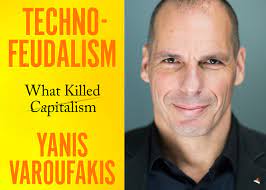
Varoufakis is also absolutely right that one of the factors driving Washington’s new cold war on Beijing is the desire by US Big Tech monopolies to destroy their only competitors, which happen to be Chinese. ………………………….
This observation by Varoufakis hits the nail on the head. Where I think he is wrong is in his claim that China, like the US, is becoming techno-feudal.
There is a fundamental distinction between the two: In the US, capital controls the state; in China, the state controls capital.
In China’s unique system, which it refers to as a socialist market economy and “Socialism with Chinese Characteristics”, roughly a third of GDP comes from massive state-owned enterprises (SOEs), which are concentrated in the most strategic sectors of the economy, such as banking, construction, infrastructure, transportation, and telecommunications.
While it is true that many technology companies in China are private on paper, the reality is much more complicated. The Chinese government has a powerful “golden share” (officially known as a “special management share”) in large firms, such as Alibaba and Tencent, which gives it veto power over important decisions.
Although these large technology companies may not be full state-owned, China’s socialist government ensures that they act in the interest of the country and the people, not simply wealthy shareholders.
The US system is exactly the opposite. Large corporations control the government, and create policy on behalf of wealthy shareholders.
The problem is not just that US corporate monopolies control markets; they create those markets themselves, through their control over digital infrastructure.
As Varoufakis has observed in his discussion of “cloud capital”, Amazon does not just dominate the market; it creates markets — and prevents any potential competitors from creating alternative markets………………………………………………
In the 21st century, the infrastructure of society itself has been privatized.
The solution is clear: the digital infrastructure upon which the modern economy is built must be nationalized and turned into public utilities, like water, electricity, and highways.
That said, the US government nationalizing Silicon Valley Big Tech companies does not solve the problem of the lack of digital sovereignty in other countries.
If Amazon, Apple, Google, and Meta are nationalized, this would still mean the United States has enormous power over nations whose economies rely on this US-controlled digital infrastructure (which, again, is almost all nations everywhere, with the noble exception of China)……………………………………………………………………………………………………………………….
This is a serious problem that should be debated worldwide. There are likely some potential creative solutions………….. https://geopoliticaleconomy.com/2024/08/19/us-big-tech-monopolies-neo-feudalism/
Humanity on a knife’s edge
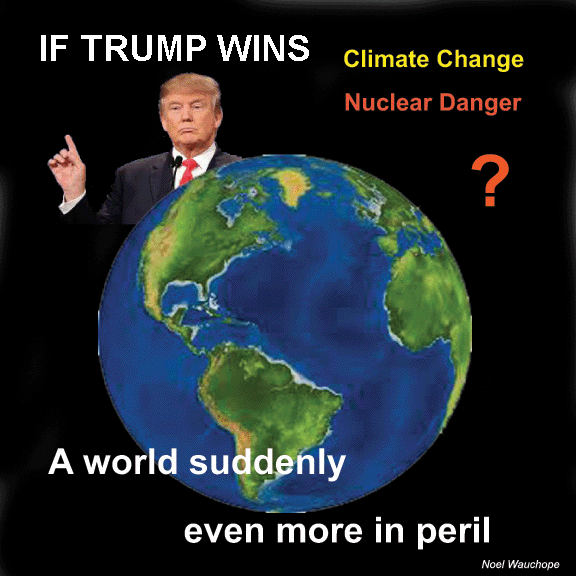
Trump took us to the nuclear brink. What happens if he’s back?
By Lawrence S. Wittner https://beyondnuclearinternational.org/2024/08/18/humanity-on-a-knifes-edge/
Over the past decade and more, nuclear war has grown increasingly likely. Most nuclear arms control and disarmament agreements of the past have been discarded by the nuclear powers or will expire soon. Moreover, there are no nuclear arms control negotiations underway. Instead, all nine nuclear nations (Russia, the United States, China, Britain, France, India, Pakistan, Israel, and North Korea) have begun a new nuclear arms race, qualitatively improving the 12,121 nuclear weapons in existence or building new, much faster, and deadlier ones.
Furthermore, the cautious, diplomatic statements about international relations that characterized an earlier era have given way to public threats of nuclear war, issued by top officials in Russia, the United States, and North Korea.
This June, UN Secretary-General António Guterres warned that, given the heightened risk of nuclear annihilation, “humanity is on a knife’s edge.”
This menacing situation owes a great deal to Donald Trump.
As President of the United States, Trump sabotaged key nuclear arms control agreements of the past and the future. He single-handedly destroyed the INF Treaty, the Iran nuclear agreement, and the Open Skies Treaty by withdrawing the United States from them. In addition, as the expiration date for the New START Treaty approached in February 2021, he refused to accept a simple extension of the agreement—action quickly countermanded by the incoming Biden administration.
Not surprisingly, Trump was horrified by the Treaty on the Prohibition of Nuclear Weapons―a UN-negotiated agreement that banned nuclear weapons, thereby providing the framework for a nuclear-free world. In 2017, when this vanguard nuclear disarmament treaty was passed by an overwhelming majority of the world’s nations, the Trump administration proclaimed that the United States would never sign it.
In fact, Trump was far less interested in arms control and disarmament than in entering―and winning―a new nuclear arms race with other nations. “Let it be an arms race,” he declared in December 2016, shortly after his election victory. “We will outmatch them at every pass.”
In February 2018, he boasted that his administration was “creating a brand-new nuclear force. We’re gonna be so far ahead of everybody else in nuclear like you’ve never seen before.” And, indeed, Trump’s U.S. nuclear “modernization” program―involving the replacement of every Cold War era submarine, bomber, missile, and warhead with an entirely new generation of the deadliest weapons ever invented―acquired enormous momentum during his presidency, with cost estimates running as high as $2 trillion.
Eager to facilitate this nuclear buildup, the Trump administration began to explore a return to U.S. nuclear weapons testing. Consequently, it announced in 2018 that, although the U.S. government had ended its nuclear tests in 1992 and President Bill Clinton had negotiated and signed the Comprehensive Test Ban Treaty in 1996, Trump would oppose U.S. Senate ratification of the treaty.
The administration also dramatically reduced the time necessary to prepare for nuclear weapons test explosions. In 2020, senior Trump administration officials reportedly conducted a serious discussion of U.S. government resumption of nuclear testing, leading the House of Representatives, then under Democratic control, to block funding for it.
Though many Americans assumed that a powerful U.S. nuclear arsenal would prevent an outbreak of nuclear war, Trump undermined this wishful thinking by revealing himself perfectly ready to launch a nuclear attack. During his 2016 presidential campaign, the Republican nominee reportedly asked a foreign policy advisor three times why, if the U.S. government possessed nuclear weapons, it should be reluctant to use them. The following year, Trump told the governor of Puerto Rico that, “if nuclear war happens, we won’t be second in line pressing the button.
Indeed, Trump came remarkably close to lunching a nuclear war against North Korea. In August 2017, responding to provocative comments by Kim Jong Un, Trump warned that further North Korean threats would “be met with fire, fury and frankly power the likes of which this world has never seen before.”
Trump’s threat of a nuclear attack triggered a rapid escalation of tensions between the two nations. In a speech before the UN General Assembly that September, Trump vowed to “totally destroy North Korea” if Kim, whom he derisively labeled “Little Rocket Man,” continued his provocative rhetoric.
Meanwhile, the White House chief of staff, General John Kelly, was appalled by indications that Trump really wanted war and, especially, by the president’s suggestion of using a nuclear weapon against North Korea and, then, blaming the action on someone else. According to Kelly, the military’s objection that the war would―in the words of Secretary of Defense Jim Mattis “incinerate a couple million people”―had no impact on Trump. In early 2018, the U.S. president merely upped the ante by publicly boasting that he had a “Nuclear Button” that was “much bigger & more powerful” than Kim’s.
What finally headed off a nuclear war, Kelly recalled, was his appeal to Trump’s “narcissism.” If Trump could forge a friendly diplomatic relationship with North Korea, the general suggested, the U.S. president would emerge as the “greatest salesman in the world.” And, indeed, Trump did reverse course and embark on a flamboyant campaign to pacify and denuclearize North Korea, remarking that May that “everyone” thought he deserved the Nobel Peace Prize.
Eventually, however, the U.S.-North Korean negotiations, including a much-heralded “summit” between Trump and Kim, resulted in little more than handshakes, North Korea’s continued development of nuclear weapons, and Trump’s return to public threats of nuclear war―this time against Iran.
Given this record, as well as Trump’s all-too-evident mental instability, we have been fortunate that, in a world bristling with nuclear weapons, the world survived his four years in office.
But our good fortune might not last much longer, for Trump’s return to power in 2025 or the recklessness of some other leader of a nuclear-armed nation could unleash unprecedented catastrophe upon the world.
Ultimately, the only long-term security for humanity lies in the global abolition of nuclear weapons and the development of a united world community.
Lawrence S. Wittner is Professor of History Emeritus at SUNY/Albany and the author of Confronting the Bomb (Stanford University Press).
1 This Month
Chernobyl: The Lost Tapes – A good documentary on Chernobyl on SBS available On Demand for the next 3 weeks– https://www.sbs.com.au/ondemand/tv-program/chernobyl-the-lost-tapes/2352741955560

of the week–London Campaign for Nuclear Disarmament

Tell the Ukrainian Government to Drop Prosecution of Peace Activist Yurii Sheliazhenko
To see nuclear-related stories in greater depth and intensity – go to https://nuclearinformation.wordpress.com
-
Archives
- April 2026 (139)
- March 2026 (251)
- February 2026 (268)
- January 2026 (308)
- December 2025 (358)
- November 2025 (359)
- October 2025 (376)
- September 2025 (257)
- August 2025 (319)
- July 2025 (230)
- June 2025 (348)
- May 2025 (261)
-
Categories
- 1
- 1 NUCLEAR ISSUES
- business and costs
- climate change
- culture and arts
- ENERGY
- environment
- health
- history
- indigenous issues
- Legal
- marketing of nuclear
- media
- opposition to nuclear
- PERSONAL STORIES
- politics
- politics international
- Religion and ethics
- safety
- secrets,lies and civil liberties
- spinbuster
- technology
- Uranium
- wastes
- weapons and war
- Women
- 2 WORLD
- ACTION
- AFRICA
- Atrocities
- AUSTRALIA
- Christina's notes
- Christina's themes
- culture and arts
- Events
- Fuk 2022
- Fuk 2023
- Fukushima 2017
- Fukushima 2018
- fukushima 2019
- Fukushima 2020
- Fukushima 2021
- general
- global warming
- Humour (God we need it)
- Nuclear
- RARE EARTHS
- Reference
- resources – print
- Resources -audiovicual
- Weekly Newsletter
- World
- World Nuclear
- YouTube
-
RSS
Entries RSS
Comments RSS
 nuclear-news