Trump and the global nuclear order

The potential impact of Trump’s second term on the global nuclear order is profoundly negative. His previous acts, as well as the declared goals of those in his orbit, indicate that unilateral policies that emphasise short-term gain over long-term global stability will likely be maintained and intensified. The consequences – an unregulated nuclear weapons race, the loss of global norms, and heightened regional instability – call for immediate action from the international community.
Anubhav S Goswami, https://www.lowyinstitute.org/the-interpreter/trump-global-nuclear-order 2 Feb 25
The impact of the President’s second term on the
global nuclear order could be profoundly negative.
Donald Trump’s comeback to the White House poses a substantial challenge to the global nuclear order. His previous administration had contempt for arms control agreements. The United States’ exit from the Intermediate-Range Nuclear Forces (INF) Treaty removed a vital guardrail to nuclear escalation in Europe. This move, while deemed legitimate by the US in reaction to Russian transgressions of the Treaty, considerably weakened the international framework for arms control. Moreover, the hesitance of his first administration to prolong New START, the last existing nuclear weapons limitation treaty between the US and Russia, nearly led to its rupture prior to the Biden administration obtaining a five-year extension. This reluctance originated from Trump’s insistence on including China in future arms control talks.
The transactional approach to arms control in Trump’s first-term is casting a long shadow on the future of the global nuclear order in his second term. His America First platform is expected to reinforce his pursuit of unilateral nuclear programs.
The impending expiry of New START in February 2026 could be a pivotal moment in the stability of the global nuclear order. Trump was previously either uninterested in renewing the treaty or sought renegotiation under conditions disadvantageous to Russia. The good news is that both Trump and Russian President Vladimir Putin have signalled a willingness to restart nuclear arms talks as soon as possible. However, the expansion of China’s nuclear arsenal is a complication because Trump insists on China being a party to the talks.
Even if there’s a breakthrough on this front, there won’t be any stopping the massive US nuclear modernisation program already underway and costing $1.7 trillion over 30 years or nearly $75 billion per year from 2023 to 2032. The plans include “a new class of ballistic missile submarines, a new set of silo-based intercontinental ballistic missiles, a modified gravity bomb, a new stealthy long-range strike bomber, and associated warheads … for each delivery system”. Trump’s expected backing for this program, combined with plans for new systems like the nuclear-armed sea-launched cruise missile (SLCM) and the potential deployment of tactical nuclear weapons to the Indo-Pacific and European theatres, contribute to a resurgence of nuclear arms development on a global scale.
Furthermore, Trump is backing the upgrading of US missile defence shield by adding an interceptor layer in space. He laid out his vision for missile defence in his first term, saying in 2019: “[W]e will recognise that space is a new warfighting domain, with the Space Force leading the way. My upcoming budget will invest in a space-based missile defence layer. It’s new technology. It’s ultimately going to be a very, very big part of our defence and, obviously, of our offense”. If Trump pursues a nationwide missile defence shield, it could lead Russia and China to build more numerous and sophisticated offensive missile systems to overwhelm and evade American defences.
To make matters worse, the United States may resume nuclear testing for the first time since 1992. Breaking the long-standing tradition of refraining from nuclear testing may see other nuclear-armed states follow suit. According to several analysts, the US does not need to start testing again to preserve the credibility or efficacy of its nuclear weapons, with current modelling and simulation methods enough to guarantee the safety and dependability of nuclear weapons. Therefore, critics argue, recommencing testing would be solely a political decision to demonstrate strength. Supporters argue that although simulation is improving, it cannot fully replace real world testing, especially for new weapon designs.
The potential impact of Trump’s second term on the global nuclear order is profoundly negative. His previous acts, as well as the declared goals of those in his orbit, indicate that unilateral policies that emphasise short-term gain over long-term global stability will likely be maintained and intensified. The consequences – an unregulated nuclear weapons race, the loss of global norms, and heightened regional instability – call for immediate action from the international community.
The absence of a balanced strategy risks ushering in a period of increased nuclear peril. Experts and advocates working to reduce nuclear threats should remind US authorities that just having more nuclear weapons during the Cold War did little to make the country safer. Rather, the accidents and miscalculations generated by the pursuit of nuclear superiority nearly led to Armageddon on several occasions.
The Guardian view on Star Wars II: US plans for missile shield risk nuclear instability

Editorial, https://www.theguardian.com/commentisfree/2025/feb/02/the-guardian-view-on-star-wars-ii-us-plans-for-missile-shield-risk-nuclear-instability
Donald Trump’s initiative echoes past mistakes and could provoke adversaries and undermine efforts toward nuclear diplomacy.
With a stroke of his pen, Donald Trump last week ordered an “iron dome for America” – an act that risks sparking a destabilising global arms race. Mr Trump’s proposal takes its name from Israel’s air defence system, but it is cast in more ambitious terms for the US: a space-based interception system designed to counter nuclear, hypersonic and cruise missile threats.
It is also the latest turn of the wheel in a cycle of escalation. Moves by Washington to “increase security” have repeatedly ended up making the world more volatile and unsafe. The historic chance to eliminate nuclear weapons in 1986 slipped away over Ronald Reagan’s insistence on America’s unproven “Star Wars” missile defence system. In 2002, George W Bush – citing the threat from North Korea – ditched the anti-ballistic missile treaty, which was built on the idea that mutual vulnerability cools the nuclear arms race while unchecked defences fuel it. In The New Nuclear Age, Ankit Panda points out that Russia and China responded with countermeasures to ensure “their nuclear forces would have the ability to penetrate a sophisticated US system”.
The upshot of such policies has been that Russia and China can deliver devastating nuclear attacks against which the US has no real hope of defence, while North Korea has intercontinental ballistic missiles that can hit the US mainland. Proverbially, insanity is repeating the same action and expecting a different outcome. Yet Mr Trump is launching Star Wars II. Given the technological hurdles and prohibitive costs involved, the odds are that its vision will never be realised. The rhetorical effect, however, is likely to be to scare other countries into building more nukes.
Mr Trump’s executive order also represents a shift in US policy. Rather than missile defence centring on “rogue states” such as North Korea and Iran, it is being refocused on Russia and China. Its logic is that a new system would be such a strong deterrent that it would reduce the temptation for enemies to attack in the first place. Whether it does misses the point that it risks triggering an uncontrolled arms race.
In January 2022, a month before Russia’s invasion of Ukraine, the five recognised nuclear powers reaffirmed the “taboo” that using nuclear weapons is morally unacceptable. But their continued strategic value shows that nukes have not been truly stigmatised – because if they were, no one would be discussing them as useful military tools. Indeed, the dangerous rhetoric from Mr Trump, Russia’s Vladimir Putin and even India’s Narendra Modi suggests a worrying normalisation of a nuclear exchange.
This is particularly concerning when detente, eventually pursued by the US and the Soviet Union in the cold war, “appears elusive in this new three‑player great power nuclear contest” between Washington, Moscow and Beijing, as Mr Panda writes. The use of just a fraction of the trio’s nuclear arsenals would lead to mass destruction on an unprecedented scale. Unless there is a major shift, the last remaining US-Russia arms control treaty, New Start, which limits strategic nuclear warheads and restricts missile launcher numbers, will expire in 2026. US, Chinese and Russian officials must sit down together and rebuild nuclear stability. The world’s survival rests on them reviving an adversarial cooperation. True security comes from arms control and reductions and creative nuclear diplomacy, not trying to build an impenetrable shield.
No UK-Hungarian strategic cooperation deal on nuclear energy signed, says Britain
Hungary’s foreign minister Péter Szijjártó, and his British counterpart, David Lammy, discussed cooperation on energy in the context of reducing Hungarian dependence on Russia in talks earlier this week. https://tvpworld.com/84784041/no-uk-hungarian-strategic-cooperation-deal-on-nuclear-energy-signed-says-britain
However, Britain’s Foreign, Commonwealth and Development Office said no UK-Hungarian strategic cooperation agreement on nuclear energy was signed by the two ministers, as a story published by TVP World on January 30, 2025, had suggested.
Generation IV Advanced Nuclear Reactor Forum Signs Agreement To Ensure Continued Collaboration
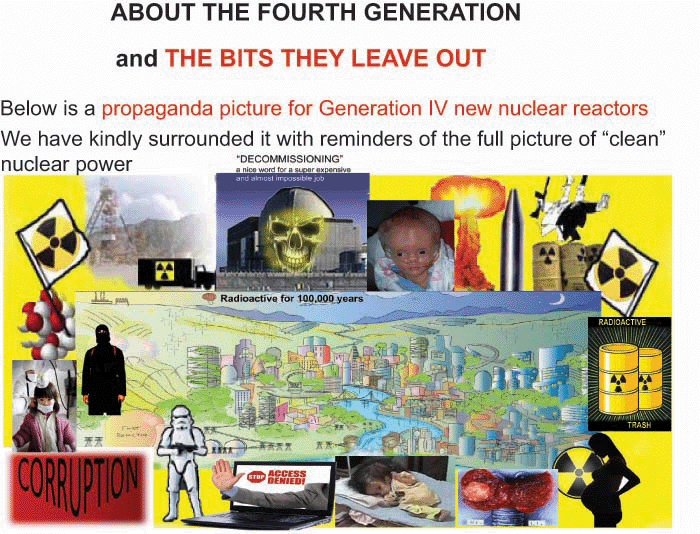
No precise definition of a Generation IV reactor exists, but the term is used to refer to nuclear reactor technologies under development.

By Kamen Kraev, Nucnet 30th Jan 2025
Group is ‘bedrock of international research and development,’ says OECD head
An international forum dedicated to the development of a new generation of nuclear power plants has signed a framework agreement that will ensure collaboration continues beyond the expiration of the current agreement on 28 February 2025.
The Generation IV International Forum (GIF) said the new agreement, signed at Organisation for Economic Co-operation and Development (OECD) premises in Paris, France, marks the start of “a new chapter” for advanced reactor development.
GIF is an international organisation established in 2001 that coordinates the development of Generation IV reactors.
Canada, France, Japan and Switzerland signed the new agreement at this week’s ceremony. The UK and the US signed the agreement in the margins of Cop29 climate conference in Baku, Azerbaijan, in November 2024.
The OECD said other major nuclear energy countries are expected to sign the agreement, which will enter into force on 1 March 2025, increasing what is a collaborative effort on deployment of Generation IV nuclear energy systems “at a time when all options to deliver low-carbon energy are critically needed”.
No precise definition of a Generation IV reactor exists, but the term is used to refer to nuclear reactor technologies under development.
GIF’s Six Generation IV Reactor Concepts
GIF provides a platform for collaborative research and development on six Generation IV reactor concepts: gas-cooled fast reactors; lead-cooled fast reactors; molten salt reactors; sodium-cooled fast reactors; supercritical-water-cooled reactors and very high-temperature reactors………………………………………

OECD secretary general Mathias Cormann told ambassadors and delegates at the signing ceremony that this is GIF’s 24th year as the bedrock of international research and development on advanced reactor concepts with improved safety, performance, and proliferation-resistant features.OECD secretary general Mathias Cormann told ambassadors and delegates at the signing ceremony that this is GIF’s 24th year as the bedrock of international research and development on advanced reactor concepts with improved safety, performance, and proliferation-resistant features. https://www.nucnet.org/news/generation-iv-advanced-nuclear-reactor-forum-signs-agreement-to-ensure-continued-collaboration-1-4-2025
Trump calls North Korea a ‘nuclear power,’ drawing a rebuke from Seoul
Yahoo! News, Stella Kim, Wed, January 22, 2025
SEOUL, South Korea — Denuclearization of North Korea is a prerequisite for global stability, South Korea said Tuesday after President Donald Trump described the reclusive regime as a “nuclear power,” raising concern that the U.S. could be moving toward recognizing the North as a nuclear-armed state.
Since Trump was last in office, North Korean leader Kim Jong Un has vowed to “exponentially” boost his nuclear arsenal and ramped up weapons testing, including of missiles that could potentially strike the continental United States and overwhelm U.S. treaty ally South Korea.
The newly inaugurated Trump, who met with Kim three times during his first term to discuss North Korea’s U.N.-sanctioned weapons programs, spoke enthusiastically Monday about his past relationship with Kim, saying they liked each other.
“Now, he is a nuclear power,” Trump said while signing a series of executive orders in the Oval Office. “I think he’ll be happy to see I’m coming back.”
Trump’s defense secretary nominee, Pete Hegseth, also called North Korea a “nuclear power” during his Senate confirmation hearing last week.
While it is unclear what Trump and Hegseth meant by “nuclear power,” U.S. officials have long refrained from using the phrase as it could signal recognition of North Korea as a nuclear-armed state.
The Trump administration did not immediately respond to a request for comment Tuesday.
Though there is growing debate as to whether the international community should accept North Korea’s nuclear status, experts say doing so would significantly disrupt the geopolitical balance in the region and potentially set off an arms race, including the possible development of nuclear weapons by South Korea and Japan…………………………. https://www.yahoo.com/news/trump-calls-north-korea-nuclear-115137317.html
Hiroshima, Nagasaki request Trump visit to teach ‘reality’
THE ASAHI SHIMBUN, January 21, 2025, https://www.asahi.com/ajw/articles/15593546?fbclid=IwY2xjawH-kw1leHRuA2FlbQIxMQABHWQj2ot0ghPWLSQohYVpcrIV882O59BHkl0uht0iBsjnLw2qXSEFsC2wtA_aem_GPd2Oltqb_ec9tqxNwFwAw
HIROSHIMA–Hiroshima Governor Hidehiko Yuzaki has invited new U.S. President Donald Trump to visit the prefectural capital in an effort toward nuclear disarmament and world peace.
In a letter dated Jan. 20, Yuzaki urged Trump to visit the Hiroshima Peace Memorial Museum and engage in dialogue with the survivors of the U.S. atomic bombing of the city in 1945.
Yuzaki highlighted the significant influence the United States, a major nuclear superpower, holds over global security.
He emphasized that Trump’s visit to the city would help him understand the reality of the atomic bombing, sending a powerful message of peace that encourages political leaders to make decisions and take actions toward a world free of nuclear weapons.
A similar request was also sent to Vice President JD Vance.
The prefecture’s call comes amid increasing international tensions over nuclear issues and as 2025 marks the 80th anniversary of the Hiroshima bombing.
A similar request was made during the inauguration of President Joe Biden four years ago. President Barack Obama was the first sitting U.S. president to visit Hiroshima in 2016.
In a separate development, Nagasaki Mayor Shiro Suzuki has also announced plans to invite Trump to the city, the second and final location to be targeted by a nuclear attack.
“Leaders of nuclear powers have significant influence on nuclear disarmament efforts,” Suzuki said on Jan. 20, adding that he would closely watch Trump’s nuclear policies.
Hiroshima Mayor Kazumi Matsui will co-sign a letter to Trump, which calls for a presidential visit to both cities.
(This article was compiled from reports by Yuhei Kyono and Takashi Ogawa.)
Chris Hedges: The Ceasefire Charade
By Chris Hedges ScheerPost, January 16, 2025 m https://scheerpost.com/2025/01/16/chris-hedges-the-ceasefire-charade/
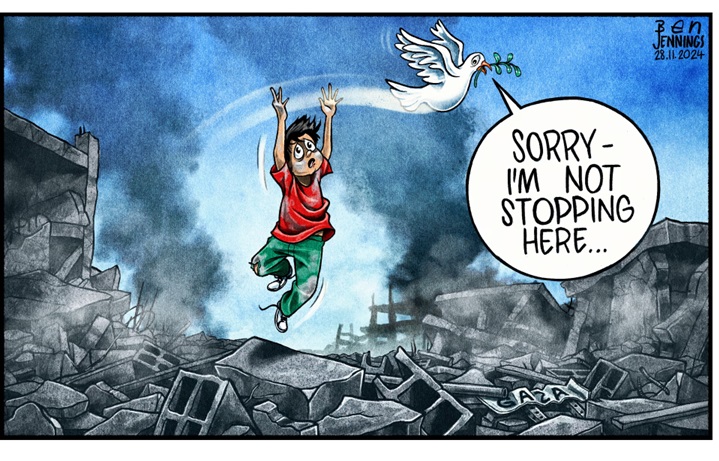
Israel, going back decades, has played a duplicitous game. It signs a deal with the Palestinians that is to be implemented in phases. The first phase gives Israel what it wants — in this case the release of the Israeli hostages in Gaza — but Israel habitually fails to implement subsequent phases that would lead to a just and equitable peace. It eventually provokes the Palestinians with indiscriminate armed assaults to retaliate, defines a Palestinian response as a provocation and abrogates the ceasefire deal to reignite the slaughter.
If this latest three-phase ceasefire deal is ratified — and there is no certainty that it will be by Israel — it will, I expect, be little more than a presidential inauguration bombing pause. Israel has no intention of halting its merry-go-round of death.
The Israeli cabinet has delayed a vote on the ceasefire proposal while it continues to pound Gaza. At least 81 Palestinians have been killed in the last 24 hours.
The morning after a ceasefire agreement was announced, Israeli Prime Minister Benjamin Netanyahu accused Hamas of reneging on part of the deal “in an effort to extort last minute concessions.” He warned that his cabinet will not meet “until the mediators notify Israel that Hamas has accepted all elements of the agreement.”
Hamas dismissed Netanyahu’s claims and repeated their commitment to the ceasefire as agreed with the mediators.
The deal includes three phases. The first phase, lasting 42 days, will see a cessation of hostilities. Hamas will release some Israeli hostages – 33 Israelis who were captured on Oct. 7, 2023, including all of the remaining five women, those aged above 50, and those with illnesses – in exchange for up to 1,000 Palestinians imprisoned by Israel.
The Israeli army will pull back from the populated areas of the Gaza Strip on the first day of the ceasefire. On the 7th day, displaced Palestinians will be permitted to return to northern Gaza. Israel will allow 600 aid trucks with food and medical supplies to enter Gaza daily.
The second phase, which begins on the 16th day of the ceasefire, will see the release of the remaining Israeli hostages. Israel will complete its withdrawal from Gaza during the second phase, maintaining a presence in some parts of the Philadelphi corridor, which stretches along the eight-mile border between Gaza and Egypt. It will surrender its control of the Rafah border crossing into Egypt.
The third phase will see negotiations for a permanent end of the war.
But it is Netanyahu’s office that appears to have already reneged on the agreement. It released a statement rejecting Israeli troop withdrawal from the Philadelphi Corridor during the first 42-day phase of the ceasefire. “In practical terms, Israel will remain in the Philadelphi Corridor until further notice,” while claiming the Palestinians are attempting to violate the agreement. Palestinians throughout the numerous ceasefire negotiations have demanded Israeli troops withdraw from Gaza. Egypt has condemned the seizure of its border crossings by Israel.
The deep fissures between Israel and Hamas, even if the Israelis finally accept the agreement, threaten to implode it. Hamas is seeking a permanent ceasefire. But Israeli policy is unequivocal about its “right” to re-engage militarily. There is no consensus about who will govern Gaza. Israel has made it clear the continuance of Hamas in power is unacceptable. There is no mention of the status of the United Nations Relief and Works Agency for Palestine Refugees in the Near East (UNRWA), the U.N. agency that Israel has outlawed and that provides the bulk of the humanitarian aid given to the Palestinians, 95 percent of whom have been displaced. There is no agreement on the reconstruction of Gaza, which lies in rubble. And, of course, there is no route in the agreement to an independent and sovereign Palestinian state.
Israeli mendacity and manipulation is pitifully predictable.
The Camp David Accords, signed in 1979 by Egyptian president Anwar Sadat and Israeli prime minister Menachem Begin, without the participation of the Palestine Liberation Organization (PLO), normalized diplomatic relations between Israel and Egypt. But the subsequent phases, which included a promise by Israel to resolve the Palestinian question along with Jordan and Egypt, permit Palestinian self-governance in the West Bank and Gaza within five years, and end the building of Israeli colonies in the West Bank, including East Jerusalem, were never honored.
Or take the 1993 Oslo Accords. The agreement, signed in 1993, which saw the PLO recognize Israel’s right to exist and Israel recognize the PLO as the legitimate representatives of the Palestinian people, and Oslo II, signed in 1995, which detailed the process towards peace and a Palestinian state, was stillborn. It stipulated that any discussion of illegal Jewish “settlements” was to be delayed until “final’ status talks, by which time Israeli military withdrawals from the occupied West Bank were to have been completed. Governing authority was to be transferred from Israel to the supposedly temporary Palestinian Authority. The West Bank was carved up into Areas A, B and C. The Palestinian Authority has limited authority in Areas A and B. Israel controls all of Area C, over 60 percent of the West Bank.
The right of Palestinian refugees to return to the historic lands seized from them in 1948 when Israel was created — a right enshrined in international law — was given up by the PLO leader Yasser Arafat, instantly alienating many Palestinians, especially those in Gaza where 75 percent are refugees or the descendants of refugees. Edward Said called the Oslo agreement “an instrument of Palestinian surrender, a Palestinian Versailles” and lambasted Arafat as “the Pétain of the Palestinians.”
The scheduled Israeli military withdrawals under Oslo never took place. There was no provision in the interim agreement to end Jewish colonization, only a prohibition of “unilateral steps.” There were around 250,000 Jewish colonists in the West Bank at the time of the Oslo agreement. They have increased to at least 700,000. No final treaty was ever concluded.
The journalist Robert Fisk called Oslo “a sham, a lie, a trick to entangle Arafat and the PLO into abandonment of all that they had sought and struggled for over a quarter of a century, a method of creating false hope in order to emasculate the aspiration of statehood.”
Israeli prime minister Yitzhak Rabin, who signed the Oslo agreement, was assassinated on Nov. 4, 1995 following a rally in support of the agreement, by Yigal Amir, a far-right Jewish law student. Itamar Ben-Gvir, now Israel’s National Security Minister, was one of many rightwing politicians who issued threats against Rabin. Rabin’s widow, Leah, blamed Netanyahu and his supporters — who distributed leaflets at political rallies depicting Rabin in a Nazi uniform — for her husband’s murder.
Israel has carried out a series of murderous assaults on Gaza ever since, cynically calling the bombardment “mowing the lawn.” These attacks, which leave scores of dead and wounded and further degrade Gaza’s fragile infrastructure, have names such as Operation Rainbow (2004), Operation Days of Penitence (2004), Operation Summer Rains (2006), Operation Autumn Clouds (2006) and Operation Hot Winter (2008).
Israel violated the June 2008 ceasefire agreement with Hamas, brokered by Egypt, by launching a border raid that killed six Hamas members. The raid provoked, as Israel intended, a retaliatory strike by Hamas, which fired crude rockets and mortar shells into Israel. The Hamas barrage provided the pretext for a massive Israeli attack. Israel, as it always does, justified its military strike on the right to defend itself.
Operation Cast Lead (2008-2009), which saw Israel carry out a ground and aerial assault over 22 days, with the Israeli air force dropping over 1,000 tons of explosives on Gaza, killed 1,385 — according to the Israeli human rights group B’Tselem — of whom at least 762 were civilians, including 300 children. Four Israelis were killed over the same period by Hamas rockets and nine Israeli soldiers died in Gaza, four of whom were victims of “friendly fire.” The Israeli newspaper Haaretz would later report that “Operation Cast Lead” had been prepared over the previous six months.
Israeli historian Avi Shlaim, who served in the Israeli military, wrote that:
the brutality of Israel’s soldiers is fully matched by the mendacity of its spokesman…their propaganda is a pack of lies…It was not Hamas but the IDF that broke the ceasefire. It did so by a raid into Gaza on 4 November that killed six Hamas men. Israel’s objective is not just the defense of its population, but the eventual overthrow of the Hamas government in Gaza by turning the people against their rulers.
These series of attacks on Gaza were followed by Israeli assaults in November 2012, known as Operation Pillar of Defense and in July and August 2014 in Operation Protective Edge, a seven week campaign that left 2,251 Palestinians dead, along with 73 Israelis, including 67 soldiers.
These assaults by the Israeli military were followed in 2018 by largely peaceful protests by Palestinians, known as The Great March of Return, along Gaza’s fenced-in barrier. Over 266 Palestinians were gunned down by Israeli soldiers and 30,000 more were injured. In May 2021, Israel killed over 256 Palestinians in Gaza following attacks by Israeli police on Palestinian worshippers at the Al-Aqsa Mosque compound in Jerusalem. Further attacks on worshippers at Al-Aqsa mosque took place in April 2023.
And then the breaching of the security barriers on Oct. 7, 2023 that enclose Gaza, where Palestinians had languished under a blockade for over 16 years in an open air prison. The attacks by Palestinian gunmen left some 1,200 Israeli dead — including some killed by Israel itself — and gave Israel the excuse it had long sought to lay waste to Gaza, in its Swords of Iron War.
This horrific saga is not over. Israel’s goals remain unchanged – the erasure of Palestinians from their land. This proposed ceasefire is one more cynical chapter. There are many ways it can and, I suspect, will fall apart.
But let us pray, at least for the moment, that the mass slaughter will stop.
Patrick Lawrence: The Nihilism of Antony Blinken

It is not, or not only, the extent of Blinken’s incompetence, which even this carefully staged presentation cannot obscure. We knew he was not up to the job Biden gave him from his first months on the seventh floor at State. It is his, Blinken’s, moral vacancy that must disturb us most. He is one of those hollow men Eliot described in his famous poem of this name. This is a man who professes “values”—“our values,” as he puts it—but has none, who stands for nothing other than the rank opportunity uniquely available with access to power. I have never heretofore thought of Antony Blinken as at heart a nihilist. But on his way out the door, this seems the most truthful way to understand him.
Blinken’s approval of Israel’s mass murder in Gaza, couched in the cotton-wool language to which Blinken always resorts when he wants to turn night into day, failure into success.
January 13, 2025 By Patrick Lawrence , ScheerPost
Readers write from time to time thanking me for keeping up with The New York Times so they don’t have to do so themselves. I understand the thought, and they are most welcome in all cases. But we have now the case of The Times’s lengthy interview with Antony Blinken, published in the Sunday Magazine dated Jan. 5. Yes, I have read it. And this time I propose others do the same. This is one of those occasions when it is important to know what Americans are supposed to think — or, better put, the extent to which Americans are not supposed to think.
It is sendoff time for the outgoing regime. You can imagine without my help what kind of piffle this is engendering, if you have not already noticed.
USA Today’s Washington bureau chief, Susan Page, threw President Biden a seven-inning game’s worth of softballs this week, producing a Q & A all about “legacy” and “inflection points,” the glories of American hegemony (“Who leads the world if we don’t?”) and how Joe could have defeated Donald Trump last November but was, after all, “talking about passing the baton” even when everything we read indicated he had no intention of doing so.
……………………. Journalism with American characteristics, no other way to name it. Not a single question about the Gaza crisis, genocide, Ukraine, China. Not even a mention of Russia. And what in hell, now that I think of it, will fill the shelves in a Joseph R. Biden, Jr., Presidential Library? This is really my question.
O.K., USA Today is a comic book—“McPaper,” we used to call it—and it is folly to expect anything more than fatuous pitter-patter out of Joe Biden (or anyone interviewing him) at this late stage in the proceedings. But The Times is not a comic book, its day-to-day unseriousness notwithstanding, and Blinken purports to gravitas and authority. Herein lies the problem. In his lengthy exchange with Lulu García–Navarro, Biden’s secretary of state renders a sober-sounding account of the world as the retiring regime now leaves it that is so shockingly far from reality as to be frightening.
“Today as I sit with you, I think we hand over an America in a much, much stronger position, having changed much for the better our position around the world,” Blinken asserts at the outset of this interview. “Most Americans,” he adds a short time later, “want to make sure that we stay out of wars, that we avoid conflict, which is exactly what we’ve done.” Go ahead, let your jaw drop. Blinken’s 50 minutes with The Times are an assault on reason, on truth. And as such they are an incitement to ignorance, precisely the condition that lands this nation in the incalculable trouble Blinken proposes we pretend is not there.
It is not, or not only, the extent of Blinken’s incompetence, which even this carefully staged presentation cannot obscure. We knew he was not up to the job Biden gave him from his first months on the seventh floor at State. It is his, Blinken’s, moral vacancy that must disturb us most. He is one of those hollow men Eliot described in his famous poem of this name. This is a man who professes “values”—“our values,” as he puts it—but has none, who stands for nothing other than the rank opportunity uniquely available with access to power. I have never heretofore thought of Antony Blinken as at heart a nihilist. But on his way out the door, this seems the most truthful way to understand him.
This is the man who swiftly made an utter mess of U.S.–China relations when, two months after taking office, his first encounters with senior Chinese officials blew up in his face during talks in an Anchorage hotel conference room. Sino–American ties have been one or another degree of hostile ever since. This is the man who, a year later, led the way as Biden provoked Russia’s self-protecting intervention in Ukraine. He, Blinken, has ever since refused negotiations. This is the man who, a year after that, began his continuing defense of Israel’s genocide in Gaza. It has been Blinken and Nod in action in each case.
This is the man who—a couple of notable moments here—celebrated World Press Freedom Day in London in May 2021, while Julian Assange was in a maximum-security prison a few miles away. “Freedom of expression and access to factual and accurate information provided by independent media are foundational to prosperous and secure democratic societies,” Blinken had the nerve to declare, citing the Universal Declaration of Human Rights as he did so. This is the man who perjured himself last May, when, under oath, he told Congress the State Department had found no evidence that Israel was blocking humanitarian aid to Gaza. (I take this occasion to praise Brett Murphy once again for breaking this story in ProPublica.)
Now we can settle in and listen to Blinken converse with his interlocutor from The Times.
Blinken on relations with China:
“We were really on the decline when it came to dealing with China diplomatically and economically. We’ve reversed that…. And I know it’s succeeding because every time I meet with my Chinese counterpart, Wang Yi, the foreign minister, he inevitably spends 30 or 40 minutes, 60 minutes complaining about everything we’ve done to align other countries to build this convergence in dealing with things that we don’t like that China is pursuing. So to me, that is the proof point that we’re much better off through diplomacy.“
This account of the regress of the U.S.–China relationship on Blinken’s watch is beyond bent. First, there is no record of Wang Yi, China’s distinguished foreign minister, ever complaining to Blinken or any other U.S. official about Washington’s alliances in East Asia. China’s complaints have primarily (but not only) to do with the Biden regime’s incessant assertion of American hegemony in the Pacific, its provocative conduct on the Taiwan and South China Sea questions, and its efforts to subvert an economy with which the U.S. can no longer compete.
Second, not even Japan, South Korea, and the Philippines, with which Washington has indeed strengthened military ties, are now “aligned” against China. They, along with all other East Asians, can read maps, believe it or not. And the whole of the Pacific region will favor balanced ties with the U.S. and China as long as you and I are alive. Drawing East Asians together in some kind of Sinophobic “convergence” is a long dream from which the Washington policy cliques simply cannot awaken.
Finally and most obviously, if antagonizing another major power is a measure of diplomatic success, the nation such a diplomat purports to represent is in the kind of trouble to which I alluded earlier.
Footnote: It has been a sad spectacle these past three years as a parade of Biden regime officials, Blinken chief among them, has marched to Beijing and failed one by one to repair the damage done in Anchorage. In their dealings with Blinken, Wang and Xi Jinping, China’s president, have treated Biden’s top diplomat as if he were a junior high school student who flunked geography.
Blinken on Russia and Ukraine:
“So first, if you look at the trajectory of the conflict, because we saw it coming, we were able to make sure that not only were we prepared and allies and partners were prepared, but that Ukraine was prepared. We made sure that well before the Russian aggression happened, starting in September and then again December, we quietly got a lot of weapons to Ukraine to make sure that they had in hand what they needed to defend themselves, things like Stingers, Javelins that were instrumental in preventing Russia from taking Kyiv, from rolling over the country, erasing it from the map, and indeed pushing the Russians back….
In terms of diplomacy: We’ve exerted extraordinary diplomacy in bringing and keeping together more than 50 countries, not only in Europe, but well beyond, in support of Ukraine and in defense of these principles that Russia also attacked back in February of that year. I worked very hard in the lead up to the war, including meetings with my Russian counterpart, Sergey Lavrov, in Geneva a couple of months before the war, trying to find a way to see if we could prevent it, trying to test the proposition whether this was really about Russia’s concerns for its security, concerns somehow about Ukraine and the threat that it posed, or NATO and the threat that it posed, or whether this was about what it in fact it is about, which is Putin’s imperial ambitions and the desire to recreate a greater Russia, to subsume Ukraine back into Russia. But we had to test that proposition. And we were intensely engaged diplomatically with Russia. Since then, had there been any opportunity to engage diplomatically in a way that could end the war on just and durable terms, we would have been the first to seize them. “
Where to begin? Give me a sec to catch my breath.
Blinken and his colleagues anticipated Russia’s invasion before it started in February 2022 because the Biden regime provoked it to the point Moscow had no other choice. Washington spent the autumn of 2021 arming Kiev, just as Blinken recounts, but Blinken makes no mention of the two draft treaties the Kremlin sent Westward that December—one to Washington, one to NATO in Brussels—as the proposed basis for negotiating a durable new security settlement between Russia and the Atlantic alliance. This was dismissed out of hand as a “non-starter,” the British-ism the Biden regime favored at the time. Blinken skips over this opportunity to develop productive diplomatic channels like a mosquito across a pond.
His idea of diplomacy, indeed, was limited to gathering one of those coalitions of the willing (or coerced) the American imperium has long favored, in this case to back the proxy war to come. There was not then and has not been since any serious effort to negotiate a settlement in Ukraine. Blinken seems actually to believe (or he pretends to believe) that there was never any question of Moscow’s legitimate security concerns: It was all about the Kremlin’s plan to “erase” Ukraine in the cause of the Russia’s neo-imperial ambitions. Somehow this proposition was tested and proved out, and I would love to know how.
I am reminded once again of that moment, a few months into the war, when Blinken pulled aside Sergei Lavrov for a private exchange after formal talks at the Kremlin. As I wrote subsequently, when he asked Moscow’s long-serving foreign minister if it was true Russia wanted to reconstruct the Czarist empire, Lavrov stared, turned, and left the room—no reply, no handshake, no farewell, just an abrupt exit. How could a diplomat of Lavrov’s caliber possibly entertain such a question? We are left with two alternatives, readers. Either Tony Blinken is extremely dim-witted to misinterpret Russia’s position this badly, or Tony Blinken is a very formidable liar.
My conclusion: He is both.
Footnote: Blinken has not spoken to Lavrov since that pitiful occasion in mid–2022 — or to any other senior Russian official so far as we know. And the Biden regime has on two occasions, most famously in Istanbul a month after the Russian invasion began, actively scuttled talks between Kiev and Moscow that could have ended the war.
We come to Blinken on Israel, Gaza, and the Palestinians.
Blinken spent a great deal of his time with García–Navarro explaining his views of the Gaza crisis. And for the most part he stayed with the tedious boilerplate with which we are already familiar. The Biden regime supports Israel’s right to defend itself. He has dedicated himself to making sure the Palestinians of Gaza “had what they needed to get by.” The impediments to a ceasefire and a return of hostages are all on Hamas, not the Netanyahu regime.
Has Israel committed war crimes? Do we witness a genocide? Have the Israelis blocked food aid? You can’t expect straight answers out of Blinken on these kinds of questions, and García–Navarro got none. What she got was Blinken’s approval of Israel’s mass murder in Gaza, couched in the cotton-wool language to which Blinken always resorts when he wants to turn night into day, failure into success. Yes, he allowed, the Netanyahu regime could have made some minor adjustments at the margin and the slaughter would have looked better. But there is no erasing Blinken’s ratification of Israeli terrorism, his judgment that it has been a success — or García–Navarro’s failure to call him on this, a topic to which I will shortly return.
There is one remark Blinken made in this sendoff Q & A that has stayed with me ever since I watched the video of it and then read the transcript. It concerns the Gaza crisis, but it expands in the mind like one of those sponges that grow large when wetted. “When it comes to making sure that Oct. 7 can’t happen again,” Blinken said, “I think we’re in a good place.”
I can hardly fathom the implications of this extravagantly thoughtless assertion. There is no understanding of the human spirit in it. It takes no account of the enduring aspirations of the Palestinians people, I mean to say, and so displays the shallowest understanding of the events of Oct. 7, 2023. It presumes, above all, that the totalized violence of uncontrolled power is some kind of net-positive and can prevail in some lasting way, and that there is no need to trouble about what is just, or what it ethical, or what is irreducibly decent, or a commonly shared morality, or, at the horizon, the human cause as against (in this case) the Zionist cause.
This sentence takes us straight to Antony Blinken’s nihilism. As he leaves office he mounts not only an assault on reason, as I argued above, or our faculties of discernment, but altogether an assault on meaning. The working assumption is that he or she who controls the microphones and megaphones is free to say whatever it is of use to say. It does not require any relationship to reality, only to expedience. This is what I mean by nihilism.
“I don’t do politics,” Blinken flippantly tells García–Navarro early in their time together. “I do policy.” García–Navarro lets this go, as she does so much else. It is prima facie ridiculous, a hiding place in which García–Navarro allows Blinken to take shelter. Policy is politics: They are inseparable, no exceptions. In this case, Blinken cannot possibly expect the world beyond America’s shores to take seriously his assessment of the world as the Biden White House leaves it. This interview is all politics all the time: It is strictly for domestic consumption, intended not only to salvage a reputation — one beyond salvaging in my view — but to continue the grinding business of manufacturing consent. ……………………………………………………………………………………………………………………………..
Watch the video of Lourdes “Lulu” Garcia-Navarro’s time with Blinken. As is easily detected, she reads from a script and remains resolutely faithful to it regardless of what Blinken says. She purports to be otherwise, but she is a supplicant. She pretends to challenge Blinken on this or that question, but it is all faux, pose. None of Blinken’s lies, misrepresentations, and plain disinformation come in for serious scrutiny. It is merely on-to-the-next-question.
This is not journalism. It is spectacle, a theatrical reenactment of journalism — another case of journalism with American characteristics. It is not the creation of meaning, either: It is the destruction of meaning. I have already noted my term for this. ………………………………………………………………………………………………………………………………….
The saving grace of García–Navarro’s encounter with Tony Blinken, and a little to my surprise, lies in the comment thread appended to the published piece. There are 943 comments at this writing. And there are some voices of approval, certainly.
But my goodness are the critics many. Here are a few straight off the top of the thread:
Jorden, California.
Blinken has tarnished the office of Secretary of State. Silly is not the word, not even irresponsible but diabolical. Just bad on so many levels…. The Biden administration will mark the sudden decline of American hegemony …. U.S. foreign policy needs a much needed injection of realist logic now.
From “Rockin’ in the Free World,” Wisconsin:
For readers who want to further marvel at the creature that is Tony Blinken, watch his performance of “Rockin’ in the Free World” from last winter in Ukraine. It is truly cinematic in its irony as he facilitates U.S.–backed genocide. Could not write it better. That’s when I realized how much I viscerally hate this guy, how pathological his lack of self-awareness is[.]
And from David in Florida:
Yes, it’s called being delusional or incompetent or utterly negligent! Good job Blinkin! You and Biden undermined the final support of the Democratic Party. Sure you and your overlords will be fine with I’ll[sic] gotten gains. The rest of us won’t.
……………………………………….more https://scheerpost.com/2025/01/13/patrick-lawrence-the-nihilism-of-antony-blinken/
Report: Israel Refusing To Commit to a Permanent Gaza Ceasefire as Part of Hostage Deal

According to Haaretz, Israel’s position is one of the main disputes in the current negotiations
ANTIWAR.com by Dave DeCamp January 12, 2025
One of the main disputes in the ongoing Gaza hostage and ceasefire negotiations in Qatar is Israel’s refusal to commit to ending the war after a potential deal’s second phase, Haaretz reported on Sunday.
A permanent ceasefire has been one of Hamas’s main demands, and the report said the Palestinian group wants the genocidal war to end after the second phase of the deal.
Instead of committing to a permanent ceasefire, the report said there will be an attempt to present a US commitment to “work with Israel towards ending the war.” That would mean the deal would hinge on a US promise to pressure Israel to end military operations in Gaza, and there would be no actual commitment from Israel.
The Haaretz report comes as US officials are insisting that a deal is “very close.” Hamas officials have also told the media that negotiations have been moving in a positive direction and that they were waiting for the Israeli officials Prime Minister Benjamin Netanyahu sent to Qatar to approve their latest draft proposal.
Officials from the incoming Trump administration are also saying that a deal could happen soon, including Steve Witkoff, who will serve as Trump’s envoy to the Middle East and has been involved in the latest negotiations.
Trump himself has repeatedly threatened there would be “hell to pay” if Hamas didn’t start releasing Israeli hostages by his inauguration. Vice President-elect JD Vance elaborated on what that might mean in an interview on Sunday.………………………………… more https://news.antiwar.com/2025/01/12/report-israel-refusing-to-commit-to-a-permanent-gaza-ceasefire-as-part-of-hostage-deal/
The UK military’s secret visits to Israel
Top British officers have made at least five unpublicised trips to Tel Aviv to meet Israeli officials, one to discuss ‘future operations’ in the Middle East.
MARK CURTIS, 9 January 2025, https://www.declassifieduk.org/the-uk-militarys-secret-visits-to-israel/?utm_source=drip&utm_medium=email&utm_campaign=What+you+might+have+missed
The most senior figures in the UK military made at least five unpublicised visits to Israel in the months after it began striking Gaza in October 2023, Declassified has found.
British government data shows that Admiral Sir Tony Radakin, the chief of the defence staff and the UK’s top soldier, visited Israel on 21 January 2024.
On the trip he met the Israeli military’s chief of staff, Herzi Halevi, “to discuss future operations in the region”.
By then, Israel had already killed around 25,000 Palestinians, as international condemnation mounted.
This was Radakin’s second known visit to Israel, after he accompanied then defence secretary Grant Shapps on an official trip in December 2023. Shapps’ visit was disclosed at the time by the British government.
Radakin is also known to have visited Halevi again in Israel in August last year, while in November the Israeli soldier was invited by Britain’s Ministry of Defence (MoD) to attend a meeting in London.
Halevi was given special immunity by the UK authorities to avoid the possibility of being arrested for war crimes while in Britain.
Another senior UK figure who has visited Israel is the head of the Royal Air Force (RAF), Air Chief Marshal Sir Richard Knighton, who undertook a trip on 9 January 2024, for purposes which are undeclared in the government data.
The RAF has since flown hundreds of spy missions over Gaza, in aid of Israeli intelligence. The UK says that only information related to Hamas hostage-taking is passed to Israel from these flights, which take off from the UK’s sprawling military and intelligence base on Cyprus.
‘UK-Israel bilateral’
James Hockenhull, the head of Strategic Command – the UK military’s senior leadership body – also quietly visited Tel Aviv for a “UK-Israel bilateral” on 28 December 2023.
This was one day before the South African government filed its genocide case against Israel at the International Court of Justice.
Six weeks later, on 13 February 2024, Hockenhull hosted an Israeli general, Eliezer Toledano, in London, in a further unpublicised visit.
Toledano serves as the head of the Israeli military’s Strategy and Third-Circle Directorate, which focuses on Iran.
Also visiting Israel have been other senior MoD officials, such as General Charles Stickland, the Chief Joint Operations at the UK’s Permanent Joint Headquarters which is responsible “for the command and integration of UK global operations”.
Stickland visited Israel on 18 March 2024, described in the government documents as “MoD Directed attendance at meetings to be held in Tel Aviv”.
On the same day, Paul Wyatt, the MoD’s Director General for Security Policy, was also “meeting counterparts” in Tel Aviv.
‘Tacit approval’
The unpublicised visits by senior UK figures raise further concerns about the level of military assistance Britain is providing to Israel.
Chris Law, the SNP MP for Dundee Central said: “This new information will only fuel suspicions that successive UK governments have given tacit approval to and are complicit in what many are now considering to be a genocide in Gaza.
“The UK government must be up-front about the full extent of the British armed forces’ involvement in Gaza and detail precisely what support they have given throughout this conflict to the Israeli Defence Forces. This must include details of any further visits by senior military figures to Israel.”
He added: “The UK government may think that it is being clever by withholding this information, but ultimately it will only cede ground to misinformation and encourage guesswork. By detailing the exact involvement of British military figures, the UK government can prove once and for all that they are not complicit in this tragedy.”
In addition to the RAF’s surveillance flights over Gaza, Declassified has also documented British military training of Israeli personnel in the UK, arms supplies to the Israeli military after Britain announced limited sanctions, and the use of UK airspace to send weapons to Israel.
An MoD spokesperson said: “As part of the concerted UK effort, along with allies and partners, to reach a peaceful resolution to the ongoing conflict in Gaza, senior defence officials have visited Israel for routine diplomatic visits.”
They added: “Discussions included the UK calls for an immediate ceasefire in Gaza and the need for all parties to comply with international humanitarian law while recognising Israel’s right to security.”
Outgoing CIA director says ‘no sign’ Iran developing nuclear weapons

William Burns stated that the Islamic Republic made a decision in 2003 not to pursure nuclear weapons and has not changed its policy
The Cradle News Desk, JAN 12, 2025
Outgoing CIA director William Burns stated in an interview on 10 January that Iran does not have a nuclear weapons program, following a decision it made in 2003, and that the US is concerned about the revival of ISIS.
In an interview with state broadcaster National Public Radio (NPR) to discuss his time as director of the notorious spy agency under President Joe Biden, Burns was asked whether Iran may accelerate its efforts to obtain nuclear weapons given the setbacks the Islamic Republic and its allies in the regional Axis of Resistance have sustained over the past year.
Burns answered that “the Iranian regime could decide in the face of that weakness that it needs to restore its deterrence as it sees it and, you know, reverse the decision made at the end of 2003 (an oral fatwa issued by Supreme Leader Ali Khamenei) to suspend their weaponization program.”
However, Burns clarified, “We do not see any sign today that any such decision has been made, but we obviously watch it intently. “
He added that Iran’s weakness could instead lead to negotiations for a nuclear deal similar to the one signed by Iran and the United States under President Obama in 2014. President Trump later withdrew from the deal following intense lobbying by Israeli Prime Minister Benjamin Netanyahu.
“You know that that sense of weakness could also theoretically create a possibility for serious negotiations, too. And, you know, that’s something the new administration is going to have to sort through. I mean, it’s something I have a lot of experience in with the secret talks a decade ago, a little more than a decade ago with the Iranians. So, you know, that’s that’s also a possibility,” Burns stated………………………………………………………………………………………. more https://thecradle.co/articles-id/28431
When Carter met Kim – and stopped a nuclear war

Tessa Wong, Asia Digital Reporter, BBC News, 11 Jan 25 https://www.bbc.com/news/articles/cpee202y907o—
Three decades ago, the world was on the brink of a nuclear showdown – until Jimmy Carter showed up in North Korea.
In June 1994, the former US president arrived for talks in Pyongyang with then leader Kim Il-sung. It was unprecedented, marking the first time a former or sitting US president had visited.
But it was also an extraordinary act of personal intervention, one which many believe narrowly averted a war between the US and North Korea that could have cost millions of lives. And it led to a period of greater engagement between Pyongyang and the West.
All this may not have happened if not for a set of diplomatic chess moves by Carter, who died aged 100 on 29 December.
“Kim Il-sung and Bill Clinton were stumbling into a conflict, and Carter leapt into the breach, successfully finding a path for negotiated resolution of the standoff,” North Korean expert John Delury, of Yonsei University, told the BBC.
In early 1994, tensions were running high between Washington and Pyongyang, as officials tried to negotiate an end to North Korea’s nuclear programme.
US intelligence agencies suspected that despite ongoing talks, North Korea may have secretly developed nuclear weapons.
Then, in a startling announcement, North Korea said it had begun withdrawing thousands of fuel rods from its Yongbyon nuclear reactor for reprocessing. This violated an earlier agreement with the US under which such a move required the presence of inspectors from the International Atomic Energy Agency (IAEA) nuclear watchdog.
North Korea also announced it would withdraw from the IAEA.
American suspicion spiked as Washington believed Pyongyang was preparing a weapon, and US officials broke off negotiations. Washington began preparing several retaliatory measures, including initiating UN sanctions and reinforcing troops in South Korea.
In subsequent interviews, US officials revealed they also contemplated dropping a bomb or shooting a missile at Yongbyon – a move which they knew would have likely resulted in war on the Korean peninsula and the destruction of the South’s capital, Seoul.
It was in this febrile atmosphere that Carter made his move.
For years, he had been quietly wooed by Kim Il-sung, who had sent him personal entreaties to visit Pyongyang. In June 1994, upon hearing Washington’s military plans, and following discussions with his contacts in the US government and China – North Korea’s main ally – Carter decided to finally accept Kim’s invitation.
“I think we were on the verge of war,” he told the US public broadcaster PBS years later. “It might very well have been a second Korean War, within which a million people or so could have been killed, and a continuation of the production of nuclear fissile material… if we hadn’t had a war.”
Carter’s visit was marked by skillful diplomatic footwork – and brinkmanship.
First, Carter had to test Kim’s sincerity. He made a series of requests, all of which were agreed to, except the last: Carter wanted to travel to Pyongyang from Seoul across the demilitarised zone (DMZ), a strip of land that acts as a buffer between the two Koreas.
“Their immediate response was that no-one had ever done this for the last 43 years, that even the United Nations secretary-general had to go to Pyongyang through Beijing. And I said, ‘Well, I’m not going, then’,” he said.
A week later, Kim caved.
The next step for Carter was harder – convincing his own government to let him go. Robert Gallucci, the chief US negotiator with North Korea at the time, later said there was “discomfort in almost all quarters” about the US essentially “subcontracting its foreign policy” to a former president.
Carter first sought permission from the State Department, who blanked him. Unfazed, he decided to simply inform then-US president Bill Clinton that he was going, no matter what.
He had an ally in vice-president Al Gore, who intercepted Carter’s communication to Clinton. “[Al Gore] called me on the phone and told me if I would change the wording from “I’ve decided to go” to “I’m strongly inclined to go” that he would try to get permission directly from Clinton… he called me back the next morning and said that I had permission to go.”
The trip was on.
‘Very serious doubts’
On 15 June 1994, Carter crossed over to North Korea, accompanied by his wife Rosalyn, a small group of aides and a TV crew.
Meeting Kim was a moral dilemma for Carter.
“I had despised Kim Il-sung for 50 years. I was in a submarine in the Pacific during the Korean War, and many of my fellow servicemen were killed in that war, which I thought was precipitated unnecessarily by him,” he told PBS.
“And so I had very serious doubts about him. When I arrived, though, he treated me with great deference. He was obviously very grateful that I had come.”
Over several days, the Carters had meetings with Kim, were taken on a sightseeing tour of Pyongyang and went on a cruise on a luxury yacht owned by Kim’s son, Kim Jong-il.
Carter discovered his hunch was right: North Korea not only feared a US military strike on Yongbyon, but was also ready to mobilise.
“I asked [Kim’s advisers] specifically if they had been making plans to go to war. And they responded very specifically, ‘Yes, we were’,” he said.
“North Korea couldn’t accept the condemnation of their country and the embarrassment of their leader and that they would respond.
“And I think this small and self-sacrificial country and the deep religious commitments that you had, in effect, to their revered leader, their Great Leader as they called him, meant that they were willing to make any sacrifice of massive deaths in North Korea in order to preserve their integrity and their honour, which would have been a horrible debacle in my opinion.”
Carter presented a list of demands from Washington as well as his own suggestions. They included resuming negotiations with the US, starting direct peace talks with South Korea, a mutual withdrawal of military forces, and helping the US find remains of US soldiers buried in North Korean territory.
“He agreed to all of them. And so, I found him to be very accommodating,” Carter said. “So far as I know then and now, he was completely truthful with me.”
Crucially, Carter came up with a deal where North Korea would stop its nuclear activity, allow IAEA inspectors back into its reactors, and eventually dismantle Yongbyon’s facilities. In return, the US and its allies would build light-water reactors in North Korea, which could generate nuclear energy but not produce material for weapons.
While enthusiastically embraced by Pyongyang, the deal was met with reluctance from US officials when Carter suggested it in a phone call. He then told them he was going on CNN to announce details of the deal – leaving the Clinton administration little choice but to agree.
Carter would later justify forcing his own government’s hand by saying he had to “consummate a resolution of what I considered to be a very serious crisis”. But it did not go down well back home – officials were unhappy at Carter’s “freelancing” and attempt to “box in” Clinton, according to Mr Gallucci.
Near the end of the trip, they told him to convey a statement to the North Koreans, reiterating Clinton’s public position that the US was continuing to press for UN sanctions. Carter disagreed, according to reports at that time.
Hours later, he got on the boat with Kim, and promptly went off-script. As TV cameras rolled, he told Kim the US had stopped work on drafting UN sanctions – directly contradicting Clinton.
An annoyed White House swiftly disowned Carter. Some openly expressed frustration, painting a picture of a former president going rogue. “Carter is hearing what he wants to hear… he is creating his own reality,” a senior official complained at the time to The Washington Post.
Many in Washington also criticised him for the deal itself, saying the North Koreans had used him.
But Carter’s savvy use of the news media to pressure the Clinton administration worked. By broadcasting his negotiations almost instantaneously, he gave the US government little time to react, and immediately after his trip “it was possible to see an almost hour-by-hour evolution in US policy towards North Korea” where they ratcheted down their tone, wrote CNN reporter Mike Chinoy who covered Carter’s trip.
Though Carter later claimed he had misspoken on the sanctions issue, he also responded with typical stubbornness to the blowback.
“When I got back to Seoul, I was amazed and distressed at the negative reaction that I had from the White House. They urged me not to come to Washington to give a briefing, urged me to go directly to… my home,” he said.
But he went against their wishes.
“I decided that what I had to offer was too important to ignore.”
A final dramatic coda to the episode happened a month later.
On 9 July 1994, on the same day as US and North Korean officials sat down in Geneva to talk, state media flashed a stunning announcement: Kim Il-sung had died of a heart attack.
Carter’s deal was immediately plunged into uncertainty. But negotiators ploughed through, and weeks later hammered out a formal plan known as the Agreed Framework.
Though the agreement broke down in 2003, it was notable for freezing Pyongyang’s nuclear programme for nearly a decade.
‘Carter had guts’
Robert Carlin, a former CIA and US state department official who led delegations in negotiations with North Korea, noted that Carter’s real achievement was in getting the US government to co-operate.
“Carter was, more or less, pushing on an open door in North Korea. It was Washington that was the bigger challenge… if anything, Carter’s intervention helped stop the freight train of US decision-making that was hurtling toward a cliff,” he told the BBC.
Carter’s visit was also significant for opening a path for rapprochement, which led to several trips later, including one in 2009 when he travelled with Clinton to bring home captured US journalists.
He is also credited with paving the way for Donald Trump’s summit with Kim Jong Un – Kim Il-sung’s grandson – in 2018, as “Carter made it imaginable” that a sitting US president could meet with a North Korean leader, Dr Delury said.
That summit failed, and of course, in the long run Carter’s trip did not succeed in removing the spectre of nuclear war, which has only grown – these days North Korea has missiles regarded as capable of hitting the US mainland.
But Carter was lauded for his political gamble. It was in sharp contrast to his time in office, when he was criticised for being too passive on foreign policy, particularly with his handling of the Iran hostage crisis.
His North Korea trip “was a remarkable example of constructive diplomatic intervention by a former leader,” Dr Delury said.
His legacy is not without controversy, given the criticism that he took matters in his own hands. His detractors believe he played a risky and complicated game by, as CNN’s Mike Chinoy put it, “seeking to circumvent what he viewed as a mistaken and dangerous US policy by pulling the elements of a nuclear deal together himself”.
But others believe Carter was the right man for the job at the time.
He had “a very strong will power”, but was also “a man of peace inside and out,” said Han S Park, one of several people who helped Carter broker the 1994 trip.
Though his stubbornness also meant that he “did not get along with a lot of people”, ultimately this combination of attributes meant he was the best person “to prevent another occurrence of a Korean War”, Prof Park said.
More than anything, Carter was convinced he was doing the right thing.
“He didn’t let US government clucking and handwringing stop him,” says Robert Carlin. “Carter had guts.”
China Is Not Our Enemy
So I coordinate our CODEPINK’s China is our enemy campaign, and the campaign was created in response to this rise in recent years of anti-China sentiments and the actions that our government has been taking to accelerate the new Cold War offensive against Beijing, and that includes spending billions of dollars militarizing Asia Pacific region, utilizing military economic coercion to push US interests outright labeling China an enemy, demonizing essentially anything China does, and all of which has led to a rise in Asian American hate around the country.
So the campaign seeks to do two things. The first is to educate the public how their minds are being shaped for war. And we do this by teaching our audience about China, dismantling the lies being told by the media, by politicians, and then also informing on all the tax dollars being spent preparing for war with China. And the second thing that we try to do is redirect all that energy into a push for peace. And that’s why we emphasize the need for friendship and cooperation with China for working together on climate justice, nuclear disarmament and other extremely important issues today.
SCHEERPOST, 10 Jan 25, Robert Scheer interviews Megan Russell, a writer, academic and CODEPINK’s China is Not Our Enemy Campaign Coordinator.
…………………………………………………………………………………………………………………………………. in the past 50 or so years, you know, China has accomplished an incredible amount of progress, something they don’t talk about enough, in my opinion, is how China managed to eradicate extreme poverty. And that’s not just a minimum income level. It also means access to food, to clothes, health care, clean housing, free education, you know, means infrastructure, means functioning systems and and through the past half a century, you know, through market reforms, rural collectivization and other poverty alleviation programs, China was ultimately successful in its in its mission. And by 2021, I believe the last 100 million people were taken out of extreme poverty, which was nearly 900 million people total. And many UN officials call it the greatest anti-poverty achievement in history, which it is. That’s 1.4 billion people without extreme poverty. That’s about the entire continent of Africa or the US and Europe combined.
…………………………………………….This turn toward China, and this new narrative that China is some sort of existential threat to us, even though China has never threatened war or even invaded or intervened in a nation for 50 years, which is a sharp contrast to US history, which is very heavily involved in overseas conflicts. But, you know, China’s been focused on its internal growth and accomplishing its own goals. And non interventionism, of course, is one of its foundational policy pillars.
The American saber-rattling against China has been increasing almost as fast as China’s own development in the past few years. China’s economic prosperity and international influence is undeniable yet American politicians continue to treat their rise as a threat to their global hegemony. Joining host Robert Scheer on this episode of Scheer Intelligence is Megan Russell, a writer, academic and CODEPINK’s China is Not Our Enemy Campaign Coordinator.
Scheer is quick to point out the intergenerational dynamic between his own work on China as a fellow in the Center for Chinese Studies at the University of California, Berkeley in the 1960s and Russell’s recent experience living in China and studying in Shanghai. Both witnessed and experienced the American perspective of China and how it has continued to undermine it. Scheer and Russell focus on her latest article, which calls out New York Times columnist Thomas Friedman for his portrayal of China and how his deficient op-ed mirrors the broader perception of China in the United States. While many may think that China is an authoritarian country with people living under the heel of Xi Jinping, the actual material conditions of its population are often left out.
“Something [people] don’t talk about enough, in my opinion, is how China managed to eradicate extreme poverty. And that’s not just a minimum income level, it also means access to food, to clothes, healthcare, clean housing, free education. It means infrastructure, means functioning systems,” Russell says.
People also point to working conditions and the outsourcing of American jobs to China as a means of attacking them. To this, Russell explains, “All China has done is use the system in place to develop and try to provide opportunities to its incredibly vast population, while still maintaining its proto-socialist policies. It’s us that has exported the production of all our goods to make a few more dollars.”
In the end, the US stands to lose, not only in a trade war, but also in the climate aspect, since China has also made great strides towards combatting the climate crisis. Russell cites their plan of reaching carbon neutrality by 2060 and tells Scheer, “China has really undergone this internal green energy revolution, doing far more than any other country to combat climate change.”
………………………………………………………………………………………………………………………………………….. Megan Russell
…………………………………………………………………………………..Megan Russell
Yeah, you know, a lot of times the first thing people ask me when they hear that I lived in China was that was “Was it scary?” Did I feel threatened and watched? Someone actually just asked me that yesterday, and it’s very real to them, though it always sounds a little silly to me, because I actually felt very safe in China more than I felt in most other countries, I would say, maybe all of them. And that’s, you know, my honest answer. You know, crime rates are very low in China. I never had any safety issues. I lived there a year. I traveled extensively by myself to many provinces on all sides of the country. I never felt unsafe. I never worried about pickpockets. I never worried about being robbed. I never felt the discomfort of being a woman alone. You know, everyone has a different experience, but this was my experience,
……………………………………………………………………………………………………… the success of China is, you know, very triggering to this idea of Western exceptionalism. You know that any form of socialism could actually improve the lives of the people, could actually obtain any measure of success. And this exceptional exceptionalism is based on ideals, right on this imagined perfection of free markets and democracy, yes, but also on colonial racist doctrines. And that’s really, you know, at the root of it, a lot of this negativity as well. Unfortunately, though, it’s, you know, often disguised or dressed up like something else. It’s at the root of it, a dehumanization of China and Chinese people that they are worth less, that they aren’t deserving of of jobs or opportunities or of success. And I think this manifests itself very easily into a global system that is, you know, inherently based on a division of humanity that we have been forced to accept as normal and and that doesn’t just go for China, of course, but the entire Global South……………………………………………………………………………..
Robert Scheer…………………………………………………………………… you know, we need to manufacture consent for militarization, for war, because it’s far easier with public support, and it helps maintain internal stability here as well. And this is why you’ve seen, you know, this steady rise of anti-China messaging and and fear mongering. You know, just last fall, the House passed a bill to fund $1.6 billion to anti-China propaganda around the world. You know, that’s $1.6 billion of going to information warfare. Because, you know, in order to pursue this agenda, you need to convince the rest of the world that, or at least the United States, that China is a threat and and many people aren’t, you know, convinced enough. And also, along with that, you know, there was a whole China week where they passed 25 anti China bills, including the propaganda Bill, you know, all with the end goal of countering the influence of the Communist Party of China………………………………………………………………………………………………………………………………………………………………… more https://scheerpost.com/2025/01/10/china-is-not-our-enemy/
What a second Trump administration may mean for the Saudi nuclear program
By Nour Eid | Bulletin of Atomic Scientists 6th Jan 2025
Donald Trump’s return to the White House could mean the end of the
nonproliferation regime: As the Iranian-Israeli confrontation intensifies,
and the threat of an Iranian nuclear breakout looms, the Kingdom of Saudi
Arabia could see in a second Trump administration an opportunity to finally
get the nuclear cooperation the Saudis have been yearning for.
The Saudis argue that it is their right, under the Treaty on the Non-Proliferation of
Nuclear Weapons (NPT), to enrich uranium for domestic energy purposes. They
refuse to be subjected to double standards, given that India and Japan
received “blanket consents” to seek enrichment or reprocessing
capabilities under their respective 123 agreements.
Adding insult to injury, in Saudi eyes: Its main rival, Iran, was allowed to enrich uranium
under the 2015 Joint Comprehensive Plan of Action (JCPOA), also known as
the Iran nuclear deal. The Saudis aim to benefit from the same privileges
by developing an indigenous nuclear program………………………………………………….. https://thebulletin.org/2025/01/what-a-second-trump-administration-may-mean-for-the-saudi-nuclear-program/
Genocide: The New Normal

The genocide, and the decision to fuel it with billions of dollars, marks an ominous turning point. It is a public declaration by the U.S. and its allies in Europe that international and humanitarian law, although blatantly disregarded by the U.S. in Iraq, Afghanistan, Libya, Syria and a generation earlier in Vietnam, is meaningless.
By Chris Hedges ScheerPost January 7, 2025, https://scheerpost.com/2025/01/07/chris-hedges-genocide-the-new-normal/
Joe Biden’s parting gift of $8 billion in weapons sales to the apartheid state of Israel acknowledges the gruesome reality of the genocide in Gaza. This is not the end. It is not even the beginning of the end. This is a permanent, endless war designed not to destroy Hamas, or free Israeli hostages, but to eradicate, once and for all, Palestinians in Gaza and the West Bank. It is the final push to create a Greater Israel, which will include not only Gaza and the West Bank, but chunks of Lebanon and Syria. It is the culmination of the Zionist dream. And it will be paid for with rivers of blood — Palestinian, Lebanese and Syrian.
Minister of Agriculture and Food Security of Israel Avi Dichter was probably offering conservative estimates when he said “I think that we are going to stay in Gaza for a long time. I think most people understand that [Israel] will be years in some kind of West Bank situation where you go in and out and maybe you remain along Netzarim [corridor].”
Mass extermination takes time. It is also expensive. Fortunately for Israel, its lobby in the U.S. has a stranglehold on Congress, our electoral process and the media narrative. Americans, although 61 percent support ending weapons shipments to Israel, will pay for it. And those that express dissent will be frog-marched into Zionist black holes where their voices are silenced and their careers jeopardized or destroyed. Donald Trump and the Republicans have an open disdain for democracy, but so do the Democrats and Joe Biden.
The U.S. provided $17.9 billion in military aid to Israel from October 2023 to October 2024, a substantial increase from the already $3.8 billion in military aid the U.S. gives Israel annually. This is a record for a single year. The State Department has informed Congress that it intends to approve another $8 billion in purchases of U.S.-made arms by Israel. This will provide Israel with more GPS guidance systems for bombs, more artillery shells, more missiles for fighter jets and helicopters, and more bombs, including 2,800 unguided MK-84 bombs, which Israel has a habit of dropping on densely packed tent encampments in Gaza. The pressure wave from the 2,000-pound MK-84 pulverizes buildings and exterminates life within a 400-yard radius. The blast, which ruptures lungs, rips apart limbs and bursts sinus cavities up to hundreds of yards away, leaves behind a 50-foot-wide and 36-foot-deep crater. Israel appears to have used this bomb to assassinate Hassan Nasrallah, leader of Hezbollah, in Beirut on September 27, 2024.
The genocide, and the decision to fuel it with billions of dollars, marks an ominous turning point. It is a public declaration by the U.S. and its allies in Europe that international and humanitarian law, although blatantly disregarded by the U.S. in Iraq, Afghanistan, Libya, Syria and a generation earlier in Vietnam, is meaningless. We will not even pay lip service to it. This will be a Hobbesian world where nations that have the most advanced industrial weapons make the rules. Those who are poor and vulnerable will kneel in subjugation. The genocide in Gaza is the template for the future. And those in the Global South know it.
The “wretched of the earth” who lack sophisticated weapons, who do not have modern armies, artillery units, missiles, navies, armored units and warplanes, will strike back with crude tools. They will match individual acts of terror against massive campaigns of state terror.
Are we surprised we are hated? Terror begets terror. We saw this in New Orleans where a man who was allegedly inspired by the Islamic State of Iraq and Syria (ISIS) killed 14 people when he drove his pickup truck into a crowd on New Year’s Day. We will see more of it. But let’s be clear. We started it. The moral void of the suicide bomber is birthed from our moral void.
Israel’s frustration at the dogged resistance in Gaza, the West Bank, Yemen and Lebanon increases the bloodlust. Members of Israel’s Foreign Affairs and Defense Committee sent a letter to Minister of Defense Israel Katz, calling on the government to intensify the siege of Gaza.
“Effective control of the territory and the population is the only means towards cleansing enemy lines from the strip, and naturally towards decisive victory, rather than treading [water] in a war of attrition, where the side that is most worn is Israel,” they write. “Therefore we end up inserting our soldiers again and again into neighborhoods and alleys that were already conquered by them many times.”
Israel, the letter reads, must carry out “remote elimination of all energy sources, that is fuel, solar panels and any relevant means (pipes, cables, generators etc.)” It should ensure the “elimination of all food sources including warehouses, water and all relevant means (water pumps etc.)” and it must facilitate the “remote elimination of anyone who moves in the area and does not exit with a white flag during the days of the effective siege.”
The letter concludes that “after these actions and the days of siege upon those who remain, [the] IDF must enter gradually and conduct a full cleansing of the enemy nests…. This should be done in the northern Gaza Strip, and similarly in any other territory: encirclement, evacuation of the population to a humanitarian zone, and effective siege until surrender or full elimination of the enemy. This is how every army acts, and so must the IDF act.”
In short, exterminate the brutes.
Shamsud-Din Jabbar, the 42-year-old U.S. military veteran who plowed his pick-up truck into a crowd of New Year’s revellers in New Orleans killing 14 people and injuring 35 others, spoke to us in the language we use to speak to the Arab world. Indiscriminate death. The targeting of innocents. The callous indifference to life. The thirst for revenge. The demonization of others. The belief that fate or God or western civilization has decreed that we have a right to impose our vision of the world with violence. Jabbar, who posted videos online in which he professed his support for Islamic State, is our murderous doppelgänger. He will not be the last.
“When a society is dispossessed, when the injustices thrust upon it appear insoluble, when the ‘enemy’ is all-powerful, when one’s own people are bestialised as insects, cockroaches, ‘two-legged beasts,’ then the mind moves beyond reason,” Robert Fisk writes in The Great War for Civilization. “It becomes fascinated in two senses: with the idea of an afterlife and with the possibility that this belief will somehow provide a weapon of more than nuclear potential. When the United States was turning Beirut into a NATO base in 1983, and using its firepower against Muslim guerrillas in the mountains to the east, Iranian Revolutionary Guards in Baalbek were promising that God would rid Lebanon of the American presence. I wrote at the time — not entirely with my tongue in my cheek — that this was likely to be a titanic battle: U.S. technology versus God. Who would win? Then on 23 October 1983 a lone suicide bomber drove a truckload of explosives into the U.S. Marine compound at Beirut airport and killed 241 American servicemen in six seconds…I later interviewed one of the few surviving marines to have seen the bomber. ‘All I can remember,’ he told me, ‘is that the guy was smiling.’
These acts of terrorism, or in the case of Gaza, the West Bank, Lebanon and Yemen armed resistance, are used to justify endless mass killing. This Via Dolorosa leads to a global death spiral, especially as the climate crisis reconfigures the planet and international bodies, such as the United Nations and the International Criminal Court, become hollow appendages.
We are sowing the Middle East with dragon’s teeth and, as in the ancient Greek myth, these teeth are rising from the soil as enraged warriors determined to destroy us.
1 This Month
Chernobyl: The Lost Tapes – A good documentary on Chernobyl on SBS available On Demand for the next 3 weeks– https://www.sbs.com.au/ondemand/tv-program/chernobyl-the-lost-tapes/2352741955560

of the week–London Campaign for Nuclear Disarmament

Tell the Ukrainian Government to Drop Prosecution of Peace Activist Yurii Sheliazhenko
To see nuclear-related stories in greater depth and intensity – go to https://nuclearinformation.wordpress.com
-
Archives
- April 2026 (139)
- March 2026 (251)
- February 2026 (268)
- January 2026 (308)
- December 2025 (358)
- November 2025 (359)
- October 2025 (376)
- September 2025 (257)
- August 2025 (319)
- July 2025 (230)
- June 2025 (348)
- May 2025 (261)
-
Categories
- 1
- 1 NUCLEAR ISSUES
- business and costs
- climate change
- culture and arts
- ENERGY
- environment
- health
- history
- indigenous issues
- Legal
- marketing of nuclear
- media
- opposition to nuclear
- PERSONAL STORIES
- politics
- politics international
- Religion and ethics
- safety
- secrets,lies and civil liberties
- spinbuster
- technology
- Uranium
- wastes
- weapons and war
- Women
- 2 WORLD
- ACTION
- AFRICA
- Atrocities
- AUSTRALIA
- Christina's notes
- Christina's themes
- culture and arts
- Events
- Fuk 2022
- Fuk 2023
- Fukushima 2017
- Fukushima 2018
- fukushima 2019
- Fukushima 2020
- Fukushima 2021
- general
- global warming
- Humour (God we need it)
- Nuclear
- RARE EARTHS
- Reference
- resources – print
- Resources -audiovicual
- Weekly Newsletter
- World
- World Nuclear
- YouTube
-
RSS
Entries RSS
Comments RSS
 nuclear-news