Putin Signals He’s Open to Ceasefire as Witkoff Arrives for Talks.
An aide to Putin said the proposal would only help Ukraine regroup and that it would need to be adjusted to meet Moscow’s position
by Dave DeCamp March 13, 2025, https://news.antiwar.com/2025/03/13/us-envoy-arrives-in-russia-to-discuss-30-day-ceasefire-proposal-with-putin/
Russian President Vladimir Putin has signaled that he’s open to a ceasefire in Ukraine but that he has “questions” about the 30-day US-Ukraine proposal that need to be discussed.
“The idea itself is the right one, and we definitely support it,” Putin said, according to The New York Times. “But there are questions that we need to discuss, and I think that we need to talk them through with our American colleagues and partners.”
The Russian leader listed potential conditions for a 30-day truce, including a guarantee that Ukraine wouldn’t be supplied with more weapons. “We also want guarantees that during the 30-day ceasefire, Ukraine will not conduct mobilization, will not train soldiers, and will not receive weapons,” he said, according to RT.
Putin also questioned who would monitor the ceasefire. “Who will determine where and who has violated a potential ceasefire agreement along a 2,000-kilometer line? Who will attribute blame for any violations? These are all questions that require thorough examination from both sides,” he said.
The Russian leader said any long-term peace deal needs to address the “root causes” of the war. He made the comments as US envoy Steve Witkoff arrived in Russia to discuss the proposal. Yuri Ushakov, a Kremlin official, said Witkoff would be holding a closed-door meeting with Putin.
Ushakov also said the US-Ukraine proposal would only give Ukraine a chance to regroup, and it would need to be adjusted to meet Moscow’s interests.
“As for the 30-day temporary ceasefire, what is it about? There is nothing in it for us. It will only provide the Ukrainians with the opportunity to regroup and gain strength to continue doing what they are doing,” he said, according to Russia’s TASS news agency.
“These are some hasty actions that do not benefit a long-term settlement … We will need to work on it, to think it over so that it reflects our position, too. It reflects only Ukraine’s stance at this point,” he added.
Ushakov said that Russia wanted a long-term peace deal and that the “official” Russian position on the US-Ukraine proposal would be formulated by Putin.
Russian Foreign Minister Sergey Lavrov made similar comments opposing the idea of a temporary ceasefire, pointing to the Minsk Accords, which were first reached in 2014 for a truce in Ukraine’s eastern Donbas region. Lavrov also mentioned the “Istanbul agreement,” referring to a peace deal that was on the table in March and April 2022, which was discouraged by the US and its allies.
“I’m talking about the Minsk Accords, the deal that was discarded after the 2014 coup, and the Istanbul agreements. All of those included a ceasefire. And every time, it turned out that they had lied to us. The Ukrainians lied with the support of their European partners,” Lavrov said.
A joint statement between the US and Ukraine that was released after talks in Saudi Arabia on Tuesday said that Ukraine had “expressed readiness to accept the US proposal to enact an immediate, interim 30-day ceasefire, which can be extended by mutual agreement of the parties, and which is subject to acceptance and concurrent implementation by the Russian Federation.”
The statement also said that the US had resumed military aid and intelligence sharing for Ukraine, which was briefly paused. US Secretary of State Marco Rubio has said that if Russia doesn’t accept the 30-day proposal, the US would then know who the “impediment” to peace is, signaling he wants the proxy war will continue as usual if a deal isn’t reached.
Dialogue only viable option to solve Iranian nuclear issue
Diplomacy must remain the primary tool for resolving disputes and crises, and not be used only as a last resort after aggressive policies have failed
Xinhua, Editor: huaxia, 2025-03-15 more https://english.news.cn/20250315/0e246e2703d64d58a08113de887e3932/c.html
The Iranian nuclear issue is not just about Iran — it is a test of whether global governance will be defined by cooperation or coercion.
BEIJING, March 15 (Xinhua) — In a world fraught with geopolitical tensions, the Iranian nuclear issue is a critical test of the international community’s commitment to peace, diplomacy and multilateralism.
Whether diplomacy prevails or “maximum pressure” tactics take center stage will shape the region’s stability and set a precedent for global non-proliferation efforts.
The joint statement issued by China, Russia and Iran on Friday after a trilateral meeting in Beijing reaffirms a shared conviction: political and diplomatic engagement and dialogue are not merely preferable but the only viable and practical option to address this complex challenge.
At the heart of the discussions was a shared commitment to rejecting unilateral sanctions and coercive measures. Diplomacy must remain the primary tool for resolving disputes and crises, and not be used only as a last resort after aggressive policies have failed.
In an increasingly complex and fragile international environment, relying on sanctions and military posturing is not only counterproductive but also dangerously short-sighted, promoting instability rather than fostering meaningful engagement.
A sustainable resolution requires a holistic approach, one that balances nuclear non-proliferation with the legitimate right to peaceful nuclear energy. While Iran must continue to uphold its commitment not to develop nuclear weapons, all parties must also fully respect its right to civilian nuclear programs, as recognized under international law.
The 2015 Joint Comprehensive Plan of Action (JCPOA) once demonstrated the power of dialogue, proving that even the most entrenched disputes can yield to diplomacy when all parties engage in good faith.
However, the unilateral withdrawal of the United States from the agreement and its subsequent “maximum pressure” campaign have left the JCPOA in jeopardy.
Xinhua Commentary: Dialogue only viable option to solve Iranian nuclear issue
Source: Xinhua
Editor: huaxia
2025-03-15 09:43:15
The Iranian nuclear issue is not just about Iran — it is a test of whether global governance will be defined by cooperation or coercion.
BEIJING, March 15 (Xinhua) — In a world fraught with geopolitical tensions, the Iranian nuclear issue is a critical test of the international community’s commitment to peace, diplomacy and multilateralism.
Whether diplomacy prevails or “maximum pressure” tactics take center stage will shape the region’s stability and set a precedent for global non-proliferation efforts.
The joint statement issued by China, Russia and Iran on Friday after a trilateral meeting in Beijing reaffirms a shared conviction: political and diplomatic engagement and dialogue are not merely preferable but the only viable and practical option to address this complex challenge.
At the heart of the discussions was a shared commitment to rejecting unilateral sanctions and coercive measures. Diplomacy must remain the primary tool for resolving disputes and crises, and not be used only as a last resort after aggressive policies have failed.
In an increasingly complex and fragile international environment, relying on sanctions and military posturing is not only counterproductive but also dangerously short-sighted, promoting instability rather than fostering meaningful engagement.
A sustainable resolution requires a holistic approach, one that balances nuclear non-proliferation with the legitimate right to peaceful nuclear energy. While Iran must continue to uphold its commitment not to develop nuclear weapons, all parties must also fully respect its right to civilian nuclear programs, as recognized under international law.
The 2015 Joint Comprehensive Plan of Action (JCPOA) once demonstrated the power of dialogue, proving that even the most entrenched disputes can yield to diplomacy when all parties engage in good faith.
However, the unilateral withdrawal of the United States from the agreement and its subsequent “maximum pressure” campaign have left the JCPOA in jeopardy.
Against this backdrop, China’s call to uphold the JCPOA as the foundation for renewed consensus is both practical and visionary. The agreement remains a rare diplomatic achievement that balances Iran’s right to peaceful nuclear energy with non-proliferation imperatives — a balance that must guide future diplomatic efforts.
By advocating for a process rooted in respect rather than ultimatums, China seeks to bridge divides and restore the JCPOA’s original spirit.
The trilateral meeting came after six of the United Nations (UN) Security Council’s 15 members — the United States, France, Greece, Panama, South Korea and Britain — met behind closed doors on the Iranian nuclear issue.
This exclusive gathering raises concerns about the politicization of the issue. What is needed now is dialogue and cooperation, rather than an imposed intervention by the Security Council.
Under the current circumstances, a hasty intervention by the Security Council will not help build trust or bridge differences. Meanwhile, triggering a snap-back of sanctions would undo years of diplomatic efforts.
A step-by-step and reciprocal approach is urgently needed. Instead of escalating tensions through unilateral measures, major countries should focus on restoring trust and ensuring compliance through engagement.
The Iranian nuclear issue is not just about Iran — it is a test of whether global governance will be defined by cooperation or coercion.
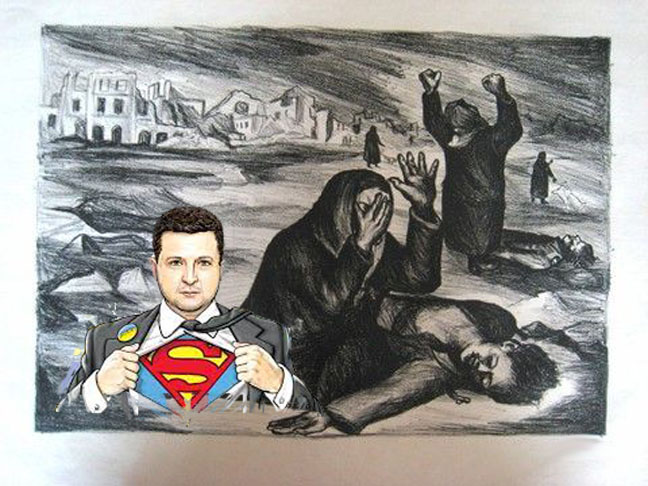
‘Ukraine will not recognize any territory occupied by Russia’: Zelensky
Tyler Durden, Zero Hedge, Wed, 12 Mar 2025, https://www.zerohedge.com/geopolitical/moscow-studying-30-day-truce-plan-while-making-steady-battlefield-gains-meantime
On Wednesday Zelensky shut the door on territorial concessions, awkwardly at a moment Ukraine has just agreed to a US plan for a 30-day ceasefire intended to pave the way for extended peace negotiations. An initial statement from the Kremlin said that Putin likely to eventually agree to truce but with own terms as Moscow “studies” the Trump-sponsored proposal hammered out during the Tuesday Jeddah talks.
Zelensky said in fresh comments:
“We are fighting for our independence. Therefore, we will not recognize any occupied territories as Russia’s. This is a fact. Our people have fought for this, our heroes died. How many injured, how many passed. No one will forget about it… This is the most important red line. We will not let anyone forget about this crime against Ukraine.”
But Russia’s red line in any near-future negotiations will be to demand recognition of the Russian Federations sovereign control over the four easter territories of Donetsk, Luhansk, Kherson and Zaporizhia regions – which President Putin has previously referred to as “our citizens forever.”
As for Zelensky’s new proclamation that he won’t cede territory, US Secretary of State Marco Rubio told reporters just after the Ukraine-US talks in Saudi Arabia that discussions with Kiev’s delegations included “territorial concessions” as part of a negotiated settlement. The suggestion from the US side is that Ukraine showed openness and willingness on this question. So either the two allies can’t get on the same page (which is no surprise), or else Zelensky is trying to tank these negotiation efforts before they ever get off the ground, also as the White House has pressed Kiev to hold new presidential elections.
Fresh comments from Zelensky asserting Ukraine will NOT recognize any territory occupied by Russia…
Certainly Russia sees no need to rush into negotiations, especially if Zelensky is unwilling to budge on territory in the east, given all the battlefield gains of late. Kursk will also soon return to full Russian control, as Ukrainian forces there are reportedly in disarray, and as Moscow has taken back over a dozen key sites just this week.
The Kremlin says it is “studying” statements issued by the US and Ukrainian delegations following yesterday’s talks in Jeddah, and further describes Russian officials are waiting for a fuller briefing from the US on the proposal. The 30-day ceasefire plan calls for a halt to all the fighting on land, sea and in the air – whichcan be extended by mutual agreement, with a hoped-for path to a permanent truce based on negotiations in the interim.
Zelensky in a Tuesday X post said the ceasefire will apply to missile, drone and bomb attacks “not only in the Black Sea, but also along the entire front line” – though its as yet unclear what mechanism there will be to monitor this.
The joint statement issued from Jeddah said the sides “will communicate to Russia that Russian reciprocity is the key to achieving peace.” Thus nothing will happen unless Moscow agrees.
Washington has agreed to lift the Trump ban on arms and intelligence for Kiev, while at the same time Kiev and Washington agreed on inking a deal on Ukraine’s critical minerals “as soon as possible”.
Russian state media is meanwhile reporting that President Putin is open to holding a telephone conversation with his US counterpart.
On the potential for a new Trump call to discuss progress toward setting up negotiations and a truce, spokesman Dimitry Peskov said Wednesday:
“We also do not rule out that the topic of a call at the highest level may arise. If such a need emerges, it will be organized very quickly. The existing channels of dialogue with the Americans make it possible to do this in a relatively short time.”
If it happens this would mark the second call since Trump’s inauguration, after the prior February 12 call. Theoretically this could lead to an in-person meeting between the two leaders if all goes well.
Secretary of State Marco Rubio is traveling back from the meeting in Saudi Arabia, and gave some remarks to a press conference in Ireland:
Deterrence against future attacks on Ukraine will be a crucial element of future negotiations.- The US-Ukraine minerals deal benefits both nations and deepens Washington’s interest in Ukraine, but “I would not couch it as a security guarantee”.
- European sanctions against Russia will be part of the negotiations, making Europe’s involvement in the process essential.
- Any truce could be effectively monitored, but “one of the things we’ll have to determine is who both sides trust on the ground” to oversee it.
Ukraine continues to hold little to no leverage, given Russia is fast taking back its territory in Kursk as of mid-week. Over a dozen settlements have been liberated, and by all accounts Ukraine forces are in retreat there, also as Russian troops are currently in the center of Sudzha town.
One regional sources says that the Russian advance has been swift especially after one particularly daring operation: “Reports over the weekend claimed that 800 Russian special forces had crawled for 15 kilometers through an unused section of pipeline, which once carried Russian gas to Europe via Ukraine, in order to carry out a sneak attack on Ukrainian forces in Sudzha,” writes Moscow Times.
These developments mean that Putin is even less likely to agree to any temporary pause in fighting. In January statements he had warned the Kremlin will not sign off on any temporary truces – given Ukraine could just use it to rearm, resupply, and regroup. Moscow has less incentive to sign onto a deal unless territorial concessions are part of it, given that at this rate it can just keep advancing in territory, particularly in the Donbass.
High stakes as Iran nuclear issue reaches crunch moment

Caroline Hawley, BBC diplomatic correspondent, BBC 14th March 2025
Almost a decade since world powers sealed a historic deal to limit the Iranian nuclear programme, this is a crunch moment for Iran and the international community.
The country is now closer than ever to being able to make a nuclear bomb.
And the agreement – designed to prevent Iran developing a nuclear weapon – expires later this year.
“It’s a real fork in the road moment,” says Dr Sanam Vakil of the London-based think tank Chatham House. “Without meaningful and successful diplomacy we could see Iran weaponise or we could see a military strike against the Islamic Republic.”
The deal, painstakingly negotiated over nearly two years under Barack Obama’s presidency, imposed restrictions on Iran’s nuclear activities in return for relief from sanctions that crippled the country’s economy.
But after Donald Trump pulled out of the agreement in 2018 during his first presidency and reinstated US sanctions, Iran gradually stopped complying with its commitments.
It has accelerated its enrichment of uranium – used to make reactor fuel but also potentially nuclear bombs – to close to weapons-grade.
Experts say it would now take Iran less than a week to enrich enough material to make a single nuclear weapon.
Hence a flurry of urgent diplomatic activity by the US and the five other parties to the deal – the UK, China, France, Germany and Russia.
A closed-door meeting of the UN Security Council discussed Iran’s nuclear programme on Wednesday.
And China is hosting talks with Iran and Russia on Friday in search of a “diplomatic” resolution.
“In the current situation, we believe that all parties should maintain calm and restraint to avoid escalating the Iran nuclear situation, or even walking towards confrontation and conflict,” Chinese foreign ministry spokeswoman Mao Ning said this week.
On Wednesday, a letter from President Trump was delivered in Tehran by a senior diplomat from the United Arab Emirates.
The contents have not been made public.
But President Trump, after imposing new sanctions on Iran as part of a “maximum pressure” campaign, last week issued a televised ultimatum to Iran: make a deal or else.
“I’ve written them a letter saying, ‘I hope you’re going to negotiate because if we have to go in militarily, it’s going to be a terrible thing,'” he said.
Iran’s Supreme Leader, Ayatollah Ali Khamenei, appeared to reject the idea of talks with a “bullying” US.
So too – publicly – has President Masoud Pezeshkian, who had previously supported a resurrection of the nuclear deal, in return for an end to sanctions.
But the country has been sending out mixed messages.
“There are camps inside the country that favour negotiations,” says Dr Vakil. “And there are camps that see weaponisation as the best opportunity for Iran to manage its security.”
Trust in the Trump administration is in very short supply.
“They have seen his erratic, very bullying approach to [Ukraine’s President Volodymyr] Zelensky. And his outlandish proposals on Gaza and they don’t want to be put in that position,” Dr Vakil adds.
Iran hates the humiliation of having a gun held to its head. But it is currently vulnerable – weakened militarily by Israeli air strikes last year, which are believed to have destroyed most of the air defences protecting its nuclear programme.
Israel has long wanted to take the facilities out.
Iranian authorities continue to insist the country’s nuclear programme is for peaceful purposes.
But concern in the international community is becoming increasingly acute……………………………………………………… https://www.bbc.co.uk/news/articles/c86pvyd2qeno
Iran, Russia, China discuss Tehran’s nuclear programme at Beijing meeting
Meeting between top diplomats from three countries signals Tehran may be ready for renewed negotiations on its nuclear programme.
14 Mar 2025, https://www.aljazeera.com/news/2025/3/14/iran-russia-china-discuss-tehrans-nuclear-programme-at-beijing-meeting
Diplomats from Iran, Russia and China are meeting in Beijing for talks on Tehran’s nuclear programme that could lead to negotiations following years of delay.
Beijing said the three countries hope to find a “diplomatic” solution to Iran’s nuclear issue, Chinese state media reported on Friday.
“In the current situation, we believe that all parties should maintain calm and restraint to avoid escalating the Iran nuclear situation, or even walking towards confrontation and conflict,” China’s Foreign Ministry spokesperson Mao Ning told reporters before the meeting.
The meeting was attended by Chinese Vice Foreign Minister Ma Zhaoxu, Russian Deputy Foreign Minister Sergey Ryabkov and Iranian Deputy Foreign Minister Kazem Gharibabadi, who “exchanged views on the Iran nuclear issue and other issues of common concern,” according to Chinese media.
Donald Trump, a year into his first term as United States president in 2018, withdrew from a landmark pact Iran reached in 2015 with the US, Russia, China, Britain, France, Germany and the European Union, in which Tehran agreed to curb its nuclear programme in exchange for the lifting of international sanctions.
Tehran continued to abide by the terms of the deal – which was considered a milestone for the administration of then-US President Barack Obama – but began slowly rolling back its commitments after Trump ended the deal.
The meeting in Beijing between the three diplomats follows a series of overtures from Trump since his return to the White House in January to resume nuclear talks with Tehran.
The US president this week sent a letter to Iran’s Supreme Leader Ayatollah Ali Khamenei calling for new talks but also warning that the US was within its rights to take military action against the country’s nuclear programme.
Iranian President Masoud Pezeshkian responded that he would not negotiate with the US while being “threatened”, and Iran would not bow to US “orders” to talk.
Iran was further enraged after six of the United Nations Security Council’s 15 members – the US, France, Greece, Panama, South Korea and the United Kingdom – held a closed-door meeting this week to discuss its nuclear programme. Tehran said the meeting was a “misuse” of the UN Security Council.
NATO-Russia Ukrainian War Ceasefire: To Be Or Not To Be?
RUSSIAN and EURASIAN POLITICS, by Gordonhahn, March 14, 2025
On March 13th Russian President Vladimir Putin stated Moscow is open to a ceasefire leading to peace treaty talks, generally speaking. However, he stressed tghat there are “nuances” that need to be addressed before any ceasefire agreement could be concluded. The ‘nuances’ were really counteroffers made for practical reasons but also having the effect of returning the ball to the US-Ukrainian court, paraphrasing US Secretary of State Marco Rubio’s assertion after the Ukrainians’ agreement to a ceasefire that ‘the ball is now in Moscow’s court.’
Highlighting what is or was missing from the American proposal to his knowledge at the time he was speaking (before meeting with US envoy Steven Witkoff, Putin said the issues in need of resolution are: (1) the remaining Ukrainian troops in Kursk, Russia; (2) Ukraine’s military mobilization and training of those mobilized; (3) arms sales to Ukraine; and (4) verification of any ceasefire covering the long ‘line of contact’ or frontlines needed to be resolved (http://kremlin.ru/events/president/news/76450). The first issue is being resolved by the Russian army which has re-taken Sudzha and probably will have killed, captured, or pushed all Ukrainian troops out of Kursk Oblast within a week or so.
…………………………………………………..Putin’s public statements probably reflect what were communicated to U.S. negotiator Steven Witkoff more as requirements or conditions before any Russian agreement to a ceasefire. Pressing Kiev to halt mobilization and training, puts Zelenskiy in a difficult position, and Washington and or Kiev will likely respond that if Kiev is required to halt these activities, then Moscow must halt them or something analagous. This will highlight the coercive, violent aspect of what Ukrainians call ‘Ze-mobilization’—‘Ze’ referring to Zelenskiy.
…………………………….At the same time, the U.S. weapons to be supplied to Kiev are numbered. The Ameerican-Ukrainian statement on the ceaefire agreement declares that the U.S. “will immediately lift the pause on intelligence sharing and resume security assistance to Ukraine” (www.state.gov/joint-statement-on-the-united-states-ukraine-meeting-in-jeddah/).
……………………..Trump has not and may not use PDA to support in Ukraine in future, perhaps depending on Kiev’s willingess to negotiate, despite the inherent contradiction in demanding peace talks while supplying weapons. For Ukraine, this is a contradiction with an opportunity: to drag out talks while it rearms its forces along the contact line.
Not surprisingly then, Russian officials have repeatedly stated they will not accept a ceasefire agreement and will continue fighting until a full-fledged peace agreement is reached. Their previous rejections of any ceasefire were precisely based on Russians’ suspicion that any pause in the fighting will be used to halt Russia’s mounting offensives, rearm Ukraine, and then resume the war with Kiev’s forces in a more robust state.
……………………… Putin may find his political position weakened in comparison with more hardline elements if seen as having fallen again for a another Western deception. This means he cannot accept continued arms supplies to Ukraine during a ceasefire.
……………………………………………………………………..Putin understands negotiating the details and mechanisms for implementing the ceasefire likely will take months. Meanwhile Russian troops can complete the process of expelling Ukrainian troops from the areas which the latter hold in at least two (Luhansk and Donetsk) of the four Donbass regions claimed by Russia and extending areas it holds in other Ukrainian regions. While these and Crimea are settled issues militarily and in terms of sovereignty—they are Russian; Kiev will not win them back for decades, a century, if ever.
The situation with regard to the other two Russia-annexed but still not fully taken regions – Kherson and Zaporozhe’ – is more fluid. Russian forces control less than half of each’s territory and will have an extraordinarly difficult time seizing their capitol cities of the same name. Thus, the negotiations on territories, which, accordoing to Trump was under discussion at Riyadh with the Ukrainians, is likely to center around a possible trade with Moscow withdrawing its troops from areas it occupies in regions outside the four regions it claims for the remainder of the territory of the claimed regions still not held by Russian troops most likely in Kherson and Zaporozhe. All of this will be incredibly difficult to navigate politically, particularly for Zelenskiy and Ukraine. Moreover, it is unlikely that Kiev has more than half a year before the collapse begins of one or more of the following: the entire front, army, oligarch-neofascist Maidan regime, and Ukrainian state.
Now we get to the most disconcerting fact hanging over the ceasefire endeavor. It was hinted at by Putin’s raising the vexing issue of verifying and monitoring the ceasefire……………………………………………………….. it will be a long, rocky road before any agreement is achieved, and failure could lead to an explosive doubling down on the disastrous NATO-Russia Ukrainian War and the destructive chaos of our new multipolar world. https://gordonhahn.com/2025/03/14/nato-russia-ukrainian-war-ceasefire-to-be-or-not-to-be/
US Threatens Possible Military Response After Tehran Rejects Nuclear Outreach
The White House again warned Tehran that it can be dealt with either through military means or by reaching a deal over its nuclear program, remarks that came hours after Iran’s Supreme Leader Ayatollah Ali Khamenei rejected a US proposal for negotiations between the two bitter rivals.
“We hope the Iran Regime puts its people and best interests ahead of terror,” White House National Security Council spokesman Brian Hughes said in a statement on March 9 while reiterating remarks by President Donald Trump that “if we have to go in militarily, it’s going to be a terrible thing.”
In an interview with Fox Business recorded on March 6, Trump said, “There are two ways Iran can be handled: militarily, or you make a deal” to prevent Tehran from acquiring nuclear weapons.
“I’ve written them a letter saying, ‘I hope you’re going to negotiate because if we have to go in militarily, it’s going to be a terrible thing,'” Trump said.
“I would rather negotiate a deal. I’m not sure that everybody agrees with me, but we can make a deal that would be just as good as if you won militarily,” Trump added.
“But the time is happening now. The time is coming up. Something’s going to happen one way or the other.”
Snippets of the interview were aired on March 7, but the full sit-down will be broadcast on March 9, Fox said.
In separate comments to reporters, Trump said: “We have a situation with Iran that, something’s going to happen very soon. Very, very soon.”
Ali Khamenei, speaking on March 8 to a group of Iranian officials — without specifically mentioning Trump or the United States — said, “Their talks are not aimed at solving problems.”
“It is for…’Let’s talk to impose what we want on the other party that is sitting on the opposite side of the table.'”
“The insistence of some bullying governments on negotiations is not to resolve issues…. Talks for them is a pathway to have new demands; it is not only about Iran’s nuclear issue…. Iran will definitely not accept their expectations,” Khamenei was quoted by state media as saying.
Iranian Foreign Minister Abbas Araghchi on March 8 said Tehran had not yet received a letter from Trump……………………………… more https://www.rferl.org/a/iran-trump-nuclear-khamenei-negotiations/33341412.html
Trump plans to make Ukraine a US economic colony, exploiting its critical minerals

COMMENT. The USA has played Zelensky for a sucker, all along. Now Ukraine is faced with trying to make the least worst deal to end the war. That is still better than annihilation and the very grave gamble with nuclear war.
Former US Defense Secretary Lloyd Austin stated clearly that Washington was using Ukraine to “weaken” Russia.
Trump also revealed that the United States plans to use Ukraine’s critical minerals to create “weaponry that we’re going to use in many locations”.
GeoPolitical Economy, By Ben Norton, 2 Mar 2025
Donald Trump’s fight with Ukrainian leader Volodymyr Zelensky in the White House reflected how the US treats Ukraine as a colony. Trump demands control of the country’s rare earths and critical minerals, to weaken China, re-industrialize, and build tech products. Trump wants to be paid $350 billion, roughly twice Ukraine’s GDP.
The fight that broke out in the White House between US President Donald Trump and Ukraine’s leader, Volodymyr Zelensky, on February 28 was a stark symbol of the colonial relationship between the two countries.
“You’re in no position to dictate”, Trump yelled at Zelensky in the Oval Office. “You don’t have the cards right now. With us, you start having cards”.
The Trump administration has sought to impose an exploitative deal that will “make Ukraine a US economic colony”, in the words of the conservative British newspaper The Telegraph.
Trump is demanding control over Ukraine’s minerals, and plans to use revenue from the sale of its natural resources to pay the United States hundreds of billions of dollars, equivalent to roughly twice Ukraine’s GDP.
The US government believes that Ukraine could have trillions of dollars worth of rare earth elements and other critical minerals, which are needed for advanced technologies.
Trump wants to re-industrialize the United States, and he is offering corporations access to Ukraine’s resources to make their products.
This is part of Washington’s attempt to remove China from the supply chain for critical minerals, which has been a top priority of the Pentagon and the US House select committee on the Communist Party of China.
The Telegraph reported that Ukraine’s resources could be worth $15 trillion, writing that its “minerals offer a tantalising promise: the ability for the US to break its dependence on Chinese supplies of critical minerals that go into everything from wind turbines to iPhones and stealth fighter jets”.
Trump has stated that he wants to “un-unite” Russia and China, and his efforts to end the war in Ukraine also aim at splitting Moscow from Beijing.
Trump demands Ukraine pay the US twice its GDP
The US government pushed Ukraine into war with Russia, after expanding NATO up to Russia’s borders and backing a coup d’etat that overthrow Ukraine’s democratically elected, geopolitically neutral government in 2014. This set off a violent conflict that escalated into a massive proxy war between NATO and Russia in 2022.
Former US Defense Secretary Lloyd Austin stated clearly that Washington was using Ukraine to “weaken” Russia.
At different times, Trump has falsely claimed that the United States gave Ukraine $350 billion or $500 billion in aid. This is not true.
Independent analysts have calculated that the United States spent $119.7 billion on Ukraine-related “aid” since 2022.
According to the US Department of Defense, $182.8 billion was appropriated for military operations related to Ukraine from the end of 2021 to the end of 2024. The BBC noted that this figure includes military training in Europe and US weapons supplies.
Much of this “aid” consisted of US government contracts with private, for-profit weapons corporations, which produced the arms and ammunition that were sent to Ukraine.
In other words, the US military-industrial complex made a killing off of Ukraine “aid”.
Regardless, Trump is demanding that Ukraine pay the United States at least $350 billion, which is nearly two times the size of the country’s entire economy.
Ukraine’s GDP in 2024 was reported by the IMF to be $184.1 billion — although this figure is questionable, given the war.
The US wants Ukraine’s critical minerals
Republican Senator Lindsey Graham, a close Trump ally, has repeatedly said that the United States wants to exploit Ukraine’s critical minerals.
In a June 2024 interview on CBS, Graham stated:
What did Trump do to get the weapons flowing [to Ukraine during his first term]? He created a loan system.
They’re sitting on $10 to $12 trillion of critical minerals in Ukraine. They could be the richest country in all of Europe. I don’t want to give that money and those assets to Putin, to share with China.
If we help Ukraine now, they can become the best business partner we ever dreamed of. That $10 to $12 trillion of critical mineral assets could be used by Ukraine and the West, not given to Putin and China. This is a very big deal, how Ukraine ends.
In an interview on Fox News, just two weeks after Trump won the presidential election in November 2024, Graham argued that “the war is about money”, and he promised that Trump would impose a deal to “enrich ourselves with rare earth minerals”:………………
It is not known if Ukraine actually has these large reserves of rare earths. This claim has been called into question.
Nevertheless, the Trump administration believes there could be trillions of dollars worth of untapped minerals, and it wants to carry out exploration operations.
In the disastrous White House press conference with Zelensky on February 28, Trump was asked if his plan would provide security for Ukraine, and he replied: “We have security in a different form. We’ll have workers there, digging, digging, digging, taking the raw earth [sic], so that we can create a lot of great product in this country”.
Trump also revealed that the United States plans to use Ukraine’s critical minerals to create “weaponry that we’re going to use in many locations”.
“This is an incredible agreement for Ukraine, because we have a big investment in their country now”, he said in the meeting with Zelensky. “And what they have, very few people have. And we’re able to really go forward with very, very high-tech things, and many other things, including weaponry — weaponry that we’re going to use in many locations, but that we need for our country”.
Throughout the press conference, Trump repeatedly referred to rare earth elements as “raw earth”.
A journalist asked Trump how exactly Ukraine will benefit from his one-sided deal. Trump responded by enthusiastically explaining how it will help the United States. The following is a partial transcript:
REPORTER: How does this provide long-term security for Ukraine?
DONALD TRUMP: Well, we don’t know exactly how much, because we’re going to be putting some money in a fund, that we’re going to get from the raw earth, that we’re going to be taking, and sharing, in terms of revenue. So it’s going to be a lot of money will be made from the sale, and from the use of raw earth……………………………………………….
Trump’s remarks criticizing US environmentalists over their opposition to the mining of rare earths was an implicit acknowledgment that the process is toxic.
In a peer-reviewed article published in 2024, scientific experts warned that the “long-term, large-scale mining and utilization of rare earths has caused serious environmental pollution and constitutes a global health issue, which has raised concerns regarding the safety of human health”.
The US government has apparently made the assessment that it would be better to pollute Ukraine by exploiting rare earths there, where Americans won’t suffer from the environmental impact.
Trump boasts of arming Ukraine
Trump’s discourse on Ukraine has been utterly contradictory. He has alternated between blaming Democratic Presidents Joe Biden and Barack Obama for the war, while simultaneously boasting of supplying Kiev with weapons that Obama had initially refused to send.
Trump has repeatedly demanded credit for, during his first term, arming Ukraine with Javelin anti-tank missile systems, which were used to fight against Russian-backed forces in the eastern Donbas region.
In a press conference at the White House on February 25, a journalist asked Trump about the minerals deal. The following is a transcript of his response:
REPORTER: What does Ukraine get in return, Mr. President?
DONALD TRUMP: Uhh, $350 billion, and lots of equipment, and military equipment, and the right to fight on, and, originally, the right to fight.
Look, Ukraine, I will say, they’re very brave, and they’re good soldiers, but without the United States, and its money, and its military equipment, this war would have been over in a very short period of time.
In fact, I was the one that gave the Javelins. You remember the famous Javelins? That was me. That wasn’t Obama; it wasn’t Biden; it wasn’t anybody else; it was me. And they wiped out a lot of tanks with those Javelins.
And the expression was that Obama gave sheets, and I gave the Javelins. That was a big deal, at the time. It wiped out — that was the beginning, when people said, “Wow, that’s something”.
Well, that was American equipment. Without American equipment, this war would have been over very quickly. And American money, too. I mean, a lot of money.
During his fight with Zelensky on February 28, the US president made similar comments.
Trump blamed the Ukraine war on Biden, whom he called “stupid”. At the same time, however, although he denied responsibility for the war, Trump could not help but brag about sending weapons to Ukraine during his first term, which exacerbated the war that was already ongoing at the time, before it massively escalated in 2022.
“We gave you military equipment, and your men are brave, but they had to use our military equipment”, Trump yelled at Zelensky. “If you didn’t have our military equipment, this war would have been over in two weeks”.
USA will control Ukraine’s reconstruction fund
The text of the agreement that Trump has sought to impose on Ukraine has not been publicly released.
The conservative British newspaper The Telegraph obtained the early draft of the deal, which the media outlet said would “amount to the US economic colonisation of Ukraine, in legal perpetuity”.
This draft stated that the United States would get control over Ukraine’s “mineral resources, oil and gas resources, ports, other infrastructure (as agreed)”. It is based not on Ukrainian law, but rather New York law.
The Telegraph wrote:
The US will take 50pc of recurring revenues received by Ukraine from extraction of resources, and 50pc of the financial value of “all new licences issued to third parties” for the future monetisation of resources. There will be “a lien on such revenues” in favour of the US. “That clause means ‘pay us first, and then feed your children’,” said one source close to the negotiations.
It states that “for all future licences, the US will have a right of first refusal for the purchase of exportable minerals”. Washington will have sovereign immunity and acquire near total control over most of Ukraine’s commodity and resource economy. The fund “shall have the exclusive right to establish the method, selection criteria, terms, and conditions” of all future licences and projects. And so forth, in this vein. It seems to have been written by private lawyers, not the US departments of state or commerce.
This leaked draft caused international outrage, given how explicitly colonial it was.
To try to save face, US Treasury Secretary Scott Bessent published an op-ed in the Financial Times on February 22 explaining the Trump administration’s plans for Ukraine.
Bessent is a billionaire hedge fund manager who previously worked for the billionaire oligarch George Soros, who is ironically a bugbear of Western conservatives.
Bessent traveled to Ukraine in February to negotiate the agreement with Zelensky.
In his FT article, Bessent explained that, under the deal, the United States will oversee a joint fund with the Ukrainian government. He wrote:
The terms of our partnership propose that revenue received by the government of Ukraine from natural resources, infrastructure and other assets is allocated to a fund focused on the long-term reconstruction and development of Ukraine where the US will have economic and governance rights in those future investments.
The Treasury secretary strongly implied that US corporations will benefit from these investments, writing, “When I was in Kyiv, I met with many American companies that have been on the ground in Ukraine for years”.
Bessent stressed that the “terms of this partnership will mobilise American talent, capital, and high standards”.
In a separate, accompanying article, the Financial Times noted that, in his op-ed, Bessent had conveniently left out how much of Ukraine’s export revenue will be paid to the US.
A draft of the deal obtained by the FT stated that Ukraine’s fund will be set up “with the encumbrance (legal claim) of such revenues in favour of the United States”. The text made it clear that Washington will be given power over reconstruction projects in Ukraine.
This framework is reminiscent of the colonial arrangement that the United States imposed on Iraq, after invading the country in an illegal war of aggression in 2003 and overthrowing its government. The US central bank, the Federal Reserve, administers the money that Iraq receives from selling its crude oil.
Ukraine’s Prime Minister Denys Shmyhal stated that his country had agreed to Trump’s mineral deal, two days before Zelensky’s meeting at the White House. It is unclear if the fight changed the status of the agreement.
The other major revelation in Bessent’s FT article was that Zelensky himself had visited Trump Tower in September, just a few weeks before the presidential election. There, in Bessent’s words, “Zelenskyy proposed giving the US a stake in Ukraine’s rare earths elements and critical minerals”.
This was the biggest irony of all: Zelensky had long showed himself to be an obedient vassal of the United States, and he offered Trump some of Ukraine’s natural resources as an incentive to continue arms shipments.
Trump apparently loved the idea, but he wanted total control, not just a little. Now, Trump is demanding to be paid roughly twice the GDP of the country.
The colonial deal that the Trump administration is imposing on Ukraine recalls an infamous quote from the late US imperial strategist Henry Kissinger, who said in the context of Washington’s puppet regime in South Vietnam, “It may be dangerous to be America’s enemy, but to be America’s friend is fatal”.
The people of Ukraine have learned this lesson the hard way. https://geopoliticaleconomy.com/2025/03/02/trump-ukraine-us-economic-colony-minerals/
Treaty on the Prohibition of Nuclear Weapons States agree – the ban is the alternative to reckless nuclear deterrence and proliferation as Third Meeting of States Parties draws to a close.
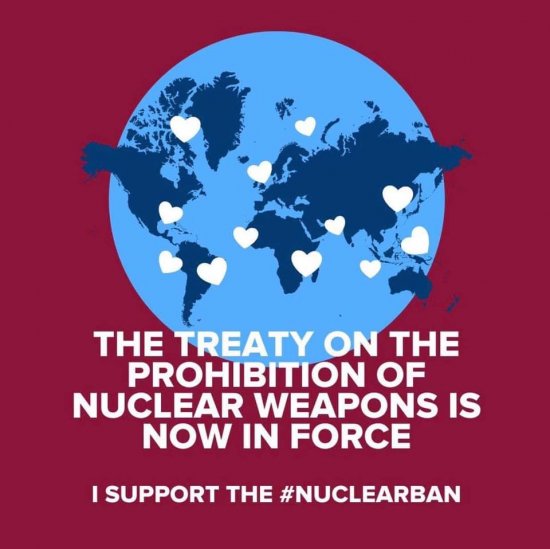
The Third Meeting of States Parties to the UN Treaty on the Prohibition of Nuclear Weapons (TPNW) has successfully concluded at UN Headquarters with a powerful political declaration rejecting nuclear weapons and challenging nuclear deterrence, and adopting a host of decisions that strengthen the Treaty’s process.
86 countries participated in the meeting as states parties or observers, engaging in a robust and interactive debate during the week, adopting a political declaration and package of decisions. The meeting also counted the active participation of a thousand representatives from 163 civil society organisations, including many affected community voices, and nine International Organisations. Over 70 events took place in the context of the 3MSP, in the UN and across the city during Nuclear Ban Week.
Connecting nuclear disarmament to global security concerns and introducing the roadmap to dismantle nuclear deterrence
80 years after nuclear weapons were first tested and used, and against a backdrop of increasing instability and calls for nuclear proliferation in Asia and Europe, the states parties and signatories to the Treaty are showing leadership to put an end to the threats that nuclear weapons and nuclear deterrence pose to their – and everyone else’s – security.
In the Declaration adopted at the end of the meeting, TPNW states parties agreed that the best way to advance global security from nuclear weapons is to bring more countries on board the Treaty, now including 94 signatories and 73 states parties. States parties agreed that “nuclear weapons are a threat to the security, and ultimately the existence, of all states, irrespective of whether they possess nuclear weapons, subscribe to nuclear deterrence or firmly oppose it.”
A report submitted to the conference provided detailed recommendations on how TPNW states can challenge current nuclear weapon doctrines and ways in which it threatens their security, including at the UN Security Council, with media and bilaterally with nuclear-armed states. The Declaration also rejects nuclear deterrence as a threat to TPNW member states, challenging the increasing reliance on deterrence by the nuclear-armed states and other pro-nuclear weapons states that we are seeing in both Europe and Asia, stating: “Nuclear deterrence is posited on the very existence of nuclear risk, which threatens the survival of all.” This is the strongest condemnation of nuclear deterrence seen in a multilateral process.
Incorporating calls for nuclear justice from affected communities
Communities affected by nuclear weapons, including Indigenous Peoples, were integral to the meeting and the strength of its outcomes. The 3MSP heard the calls from Nobel Peace Laureates, Nihon Hidankyo, and affected individuals from the Yankunytjatjara People, Kazakhstan, the Republic of Korea, Maohi Nui (French Polynesia), Kiribati, Fiji, the Navajo Nation, among others on how TPNW states can best support those most affected through their implementation of the Treaty.
Across a series of events, including the fourth edition of the Nuclear Survivors Forum, affected community representatives were active and vocal in reinforcing the urgent need to address past harms from the use and testing of nuclear weapons – and do so in a manner that is meaningfully inclusive. The Declaration emerging from the meeting pledged “to continue to collaborate through an inclusive approach with all States, international organizations, parliamentarians, civil society, scientists, financial institutions, youth as well as communities and individuals affected by nuclear weapons, including Indigenous Peoples.”
Outlining an inclusive and bold path forward for the TPNW
States agreed to continue to work on the 50 point Vienna Action Plan adopted at the first Meeting of States Parties in 2022, in order to be able to take stock of progress and prepare the next series of actions at the Review Conference.
The Review Conference for the TPNW will be held at UN Headquarters in New York in November 2026, with South Africa serving as the president.
Europe’s Face-Saving Theater on Ukraine
Could they have been as corrupted as Antony Blinken, who insisted to the end of his time as U.S. secretary of state that Ukraine lower the conscription age to 18, even though he knew these youth would be sent to certain death? Have Western leaders not understood that the only chance Ukraine had to win the war was with NATO’S direct participation, risking a nuclear holocaust ?
Britain’s prime minister called an “emergency” summit in London following the Oval Office Fiasco to try to convince the world it will not be Europe’s fault, but America’s (Read: Donald Trump’s) when Ukraine collapses, writes Joe Lauria.
By Joe Lauria, Consortium News, https://consortiumnews.com/2025/03/05/europes-facing-saving-theater-on-ukraine/
Then Starmer added: but only if the United States joins us.
He said:
“We will go further to develop a ‘coalition of the willing’ to defend a deal in Ukraine…
And to guarantee the peace.
Not every nation will feel able to contribute.
But that can’t mean we sit back.
Instead, those willing will intensify planning now – with real urgency.
The UK is prepared to back this…
With boots on the ground, and planes in the air…
Together with others.
Europe must do the heavy lifting…
But to support peace on our continent.
And to succeed, this effort must have strong US backing.
We’re working with the US on this point, after my meeting with President Trump last week.”
Donald Trump has made it clear he is not going to commit U.S. troops to Ukraine, however. And Russia has said it would never accept Western troops there.
What Starmer is really saying is: Europe stands ready to fight and die as peacekeepers to save Ukraine if necessary, but only with the Americans. So when they refuse to come and the disastrous Project Ukraine at last comes crashing on our heads, don’t blame us, blame the U.S.A.
Trump will become even easier to blame now that he has cut off military aid and intelligence to Ukraine.
[The theater continued on Thursday at another European summit in Brussels, dubbed a “War Summit” by Politico, in which French President Emmanuel Macron, and still German Foreign Minister Alena Baerbock said Europe needed to get ready for war with Russia.]
The theater piece directed by Starmer at Lancaster House with an assembly of 15 European heads of government (and Justin Trudeau of Canada) was not really choreographed to try to convince Trump to reverse course, which appears unlikely, but as an elaborate presentation to save the hides of politicians who invested so much of their own political capital and wasted so much of their citizens’ money in the inevitable and humiliating defeat of Ukraine.
The summit was called by Starmer within two days of what he and the other Europeans saw transpire in the Oval Office on Friday. [See: Trump, Vance School Zelinsky on Reality of His War]. That occured at the end of a week in which both Starmer and French President Emmanuel Macron had paid a visit to the same Oval Office where they learned first hand Trump’s determination to end the war even if it means Ukraine’s defeat.
That Ukraine would lose was obvious two years ago to Macron and German Chancellor Olaf Scholz when they both gently broke that news to Zelensky privately in Paris in February 2023.
The private remarks clashed with public statements from European leaders who had routinely said then, and still say today, that they will continue to support Ukraine for as long as it takes to achieve victory on the battlefield. That was Joe Biden’s line too.
The Wall Street Journal, which reported on the private remarks to Zelenksy two years ago, wrote:
“The public rhetoric masks deepening private doubts among politicians in the U.K., France and Germany that Ukraine will be able to expel the Russians from eastern Ukraine and Crimea, which Russia has controlled since 2014, and a belief that the West can only help sustain the war effort for so long, especially if the conflict settles into a stalemate, officials from the three countries say.
‘We keep repeating that Russia mustn’t win, but what does that mean? If the war goes on for long enough with this intensity, Ukraine’s losses will become unbearable,’ a senior French official said. ‘And no one believes they will be able to retrieve Crimea.’”
Indeed Ukraine’s losses have become unbearable. Macron and Scholz tried to tell Zelensky at that Élysée Palace dinner in February 2023 that he must consider peace talks with Moscow, the Journal reported.
According to its source, the newspaper quoted Macron as telling Zelensky that “even mortal enemies like France and Germany had to make peace after World War II.”
Macron told Zelensky “he had been a great war leader, but that he would eventually have to shift into political statesmanship and make difficult decisions,” the newspaper reported.
One wonders then why Scholz and Macron and the rest of Europe have persisted in fueling a lost cause that has since chewed up tens of thousands of additional Ukrainian lives. Could they be so corrupt that the survival of their political careers was worth the carnage of another nation’s men?
Could they have been as corrupted as Antony Blinken, who insisted to the end of his time as U.S. secretary of state that Ukraine lower the conscription age to 18, even though he knew these youth would be sent to certain death? Have Western leaders not understood that the only chance Ukraine had to win the war was with NATO’S direct participation, risking a nuclear holocaust ?
It seems that U.S. and European leaders kept an unwinnable war going until now to save their own careers. They could never admit defeat. But it did not save Biden or Harris or Blinken or Scholz or Trudeau, and Macron is in trouble too as voters saw through them all.
They’d all staked too much on the outcome of the war. They allowed their economies to fall. They pushed government censorship of social and alternative media to hide criticism that they were allowing men to die so that they would not be accused of “losing Ukraine.”
It’s been a cornerstone of history from ancient emperors to Lyndon Johnson and Richard Nixon in Vietnam, and now Biden and Starmer in Ukraine: Let them die so that we may stay in office.
With defeat staring them in the face, who better to blame it on than the ogre, Donald Trump, who has dared to inject realism into the twisted dream of using Ukraine to weaken and defeat Russia.
It’s a failed policy that the European and Ukrainian leaders desperately need to keep going. One way to attempt this, as Chicago University professor John Mearsheimer said, is for the British, French and Ukrainians to “trap” the United States into giving a “security guarantee” to Ukraine.
Language in the mineral deal Zelensky had gone to the U.S. on Friday to sign calls for “common protection of critical resources.” Mearsheimer told a TV network in India that that is “the way they are trying to trap Trump and Co., and Trump won’t be trapped.”
This became evident in the Oval Office dust up last Friday when Trump angrily rejected Zelensky’s insistence on a U.S. “security guarantee” before he’d agree to a ceasefire and sign the mineral agreement. [See: Trump, Vance School Zelensky on Reality of His War]
The only way to keep their war going is to cajole Trump into getting the U.S. deeper into the morass, rather than wisely pulling out and pushing for a deal to end it.
As much as they might despise Trump, Starmer’s Sunday performance was designed to suck up to him. And an ungrateful Zelensky, reconsidering his public feud with Trump, is trying to make up with a man that seems susceptible to flattery.
In his address to the U.S. Congress Tuesday night, Trump said:
“Earlier today I received an important letter from President Zelensky of Ukraine. The letter reads: ‘Ukraine is ready to come to the negotiating table as soon as possible to bring lasting peace closer.’
‘Nobody wants peace more than the Ukrainians,’ he said. ‘My team and I stand ready to work under President Trump strong leadership to get a peace that lasts. … We do really value how much America has done to help Ukraine, maintain its sovereignty and independence. … Regarding the agreement on minerals and security, Ukraine is ready to sign it at any time.’
That is convenient for you. I appreciate that he sent this letter. I just got it a little while ago. Simultaneously we’ve had serious discussions with Russia. Then I’ve received strong signals that they are ready for peace. Wouldn’t that be beautiful? Wouldn’t that be beautiful?
Wouldn’t that be beautiful?
It’s time to stop this madness. It’s time to halt the killing. It’s time to end the senseless war. If you want to end wars, you have to talk to both sides.”
Desperate Europeans and Ukrainians need Trump to keep their war and thus their careers going, perhaps none more so than Zelensky.
Will Trump stand firm, or will he succumb to a trap?
The Russians aren’t coming, the Russians aren’t coming.
The US should continue to work with Russia to end the war, reestablish normal diplomatic relations and reinstate the 3 nuclear agreements America dumped with Russia this century The survival of peoplekind depends on this détente
Walt Zlotow, West Suburban Peace Coalition, Glen Ellyn IL, 9 Mar 25
The US pause of all weapons and intelligence to Ukraine has got some Western European countries in uproar.
French President Emmanuel Macron is scrambling to make up the slack by pledging massive military aid to Ukraine by France and whichever neighbors he can con into squandering their treasure to sustain Ukraine’s lost cause against Russia. Macron may as well be shouting the ‘The Russians are coming, the Russians are coming.’ when he blurted out “Russia has become a threat to France and Europe for years to come. I want to believe that the United States will remain by our side, but we need to be ready if that were no longer the case. The future of Europe should not be decided in Washington or in Moscow.”
European Commission President Ursula von der Leyen warned, “We are living in the most momentous and dangerous of times.” German Chancellor-in-waiting Friedrich Merz recently declared that Europe had “five minutes to midnight.”
For 76 years Europe NATO members have been dependent on Uncle Sam to save their bacon from an imaginary enemy. The aforementioned leaders are now pledging to make up for America’s pullback from their own economies already weakened by three years of aid to the lost war in Ukraine.They are calling for EU member states to take on additional debt and ramp up military spending by $840 billion over four years, some of which will continue weaponizing the war in Ukraine till the last Ukrainian soldier is dead.
Macron recklessly went further stating that French troops could be sent to Ukraine. “Our forces will be there if necessary to guarantee peace, not before a peace agreement is signed. We will continue to meet with allies to move toward the signing of such an agreement. The only thing French and other European troops in Ukraine will guarantee is being attacked by Russia and possibly triggering nuclear war.
The US should continue to work with Russia to end the war, reestablish normal diplomatic relations and reinstate the 3 nuclear agreements America dumped with Russia this century The survival of peoplekind depends on this détente.
While a daunting task, if those objectives can be achieved the US should further encourage Europe to provide for their own defense by withdrawing from NATO which became obsolete 34 years ago when the Soviet Union went poof. With a GDP ten times Russia’s, that should be snap.
If America does withdraw from Europe, the hardliners in France, Germany and the EU, might come to their senses that…the Russians aren’t coming, the Russians aren’t coming.
Jeffrey Sachs: Negotiating a Lasting Peace in Ukraine
The time has arrived for diplomacy that brings collective security to Europe, Ukraine, and Russia.
Jeffrey D. Sachs, Mar 06, 2025Common Dreams
There should be little doubt about how a lasting peace can be established in Ukraine. In April 2022, Russia and Ukraine were on the verge of signing a peace agreement in Istanbul, with the Turkish Government acting as mediator. The U.S. and U.K. talked Ukraine out of signing the agreement, and hundreds of thousands of Ukrainians have since died or been seriously injured. Yet the framework of the Istanbul Process still provides the basis of peace today.
The draft peace agreement (dated April 15, 2022) and the Istanbul Communique (dated March 29, 2022) on which it was based, offered a sensible and straightforward way to end the conflict. It’s true that three years after Ukraine broke off the negotiations, during which time Ukraine has incurred major losses, Ukraine will eventually cede more territory than it would have in April 2022 — yet it will gain the essentials: sovereignty, international security arrangements, and peace.
In the 2022 negotiations, the agreed issues were Ukraine’s permanent neutrality and international security guarantees for Ukraine. The final disposition of the contested territories was to be decided over time, based on negotiations between the parties, during which both sides committed to refrain from using force to change boundaries. Given the current realities, Ukraine will cede Crimea and parts of southern and eastern Ukraine, reflecting the battlefield outcomes of the past three years.
Such an agreement can be signed almost immediately and in fact is likely to be signed in the coming months. As the U.S. is no longer going to underwrite the war, in which Ukraine would suffer yet more casualties, destruction, and loss of territory, Zelensky is recognizing that it’s time to negotiate. In his address to Congress, President Donald Trump quoted Zelensky as saying “Ukraine is ready to come to the negotiating table as soon as possible to bring lasting peace closer.”
The pending issues in April 2022 involved the specifics of security guarantees for Ukraine and the revised boundaries of Ukraine and Russia. The main issue regarding the guarantees involved the role of Russia as a co-guarantor of the agreement. Ukraine insisted that the Western co-guarantors should be able to act with or without Russia’s assent, so as not to give Russia a veto over the Ukraine’s security. Russia sought to avoid a situation where Ukraine and its Western co-guarantors would manipulate the agreement to justify renewed force against Russia. Both sides have a point.
The best resolution, in my view, is to put the security guarantees under the authority of the UN Security Council. This means that the U.S., China, Russia, U.K., and France would all be co-guarantors, together with the rest of the UN Security Council. This would subject the security guarantees to global scrutiny. Yes, Russia could veto a subsequent UN Security Council resolution regarding Ukraine, but it would then face China’s opprobrium and the world’s if Russia were to act arbitrarily in defiance of the will of the rest of the UN.
Regarding the final disposition of borders, some background is very important. Before the violent overthrow of Ukrainian President Viktor Yanukovych in February 2014, Russia did not make any territorial demands vis-à-vis Ukraine. Yanukovych favored neutrality for Ukraine, opposed NATO membership, and peacefully negotiated with Russia a 20-year lease for Russia’s naval base in Sevastopol, Crimea, home of Russia’s Black Sea Fleet since 1783. After Yanukovych was toppled and replaced by a U.S.-backed, pro-NATO government, Russia moved quickly to retake Crimea, to prevent the naval base from falling into NATO hands. During 2014 to 2021, Russia did not push for annexing any other Ukrainian territory. Russia called for the political autonomy of the ethnic Russian regions of eastern Ukraine (Donetsk and Luhansk) that broke away from Kyiv immediately after Yanukovych was toppled.
The Minsk II agreement was to implement autonomy. The Minsk framework was inspired in part by the autonomy of the ethnic Germany region of South Tyrol in Italy. German Chancellor Angela Merkel knew the South Tyrol experience and viewed it as a precedent for similar autonomy in the Donbas. Unfortunately, Ukraine strongly resisted autonomy for the Donbas, and the U.S. backed Ukraine in rejecting autonomy. Germany and France, which ostensibly were guarantors of Minsk II, stood by silently as the agreement was thrown aside by Ukraine and the United States.
Following six years in which Minsk II was not implemented, during which the U.S.-armed Ukrainian military continued to shell the Donbas in an attempt to subdue and recover the breakaway provinces, Russia recognized Donetsk and Luhansk as independent states on February 21, 2022. The status of Donetsk and Luhansk in the Istanbul process was still to be finalized. Perhaps a return to Minsk II and its actual implementation by Ukraine (recognizing the autonomy of the two regions in the Ukrainian constitution) could have been ultimately agreed. When Ukraine walked away from the negotiating table, alas, the issue was moot. A few months later, on September 30, 2022, Russia annexed the two oblasts as well as two others, Kherson and Zaporizhzhia.
The sad lesson is this. Ukraine’s loss of territory would have been averted entirely but for the violent coup that toppled Yanukovych and brought in a U.S.-backed regime intent on NATO membership. The loss of territory in eastern Ukraine could have been averted had the U.S. pushed Ukraine to implement the UN Security Council-backed Minsk II agreement. The loss of territory in eastern Ukraine could probably have been averted as late as April 2022 in the Istanbul Process, but the U.S. blocked the peace agreement. Now, after 11 years of war since the overthrow of Yanukovych, and as a result of Ukraine’s losses on the battlefield, Ukraine will cede Crimea and other territories of eastern and southern Ukraine in the coming negotiations.
Europe has other interests that it should be negotiating with Russia, notably security for the Baltic States and for European-Russian security arrangements more generally. The Baltic States feel very vulnerable to Russia, understandably so given their history, but they are also gravely and unnecessarily adding to their vulnerability by a stream of repressive measures taken against their ethnic Russian citizenry, including measures to repress the use of the Russian language and measures to cut their citizens’ ties with the Russian Orthodox Church. Baltic state leaders are also provocatively engaging in remarkable Russophobic rhetoric. Ethnic Russians are about 25% of the population of both Estonia and Latvia, and around 5% in Lithuania. Security for the Baltic States should be achieved through security-enhancing measures taken on both sides, including the respect for minority rights of the ethnic Russian populations, and by refraining from vitriolic rhetoric.
The time has arrived for diplomacy that brings collective security to Europe, Ukraine, and Russia. Europe should open direct talks with Russia and should urge Russia and Ukraine to sign a peace agreement based on the March 29 Istanbul Communique and the April 15, 2022 draft peace agreement. Peace in Ukraine should by followed by the creation of a new system of collective security for all of Europe, stretching from Britain to the Urals, and indeed beyond.
Europe’s Face-Saving Theater on Ukraine
That Ukraine would lose was obvious two years ago to Macron and German Chancellor Olaf Scholz when they both gently broke that news to Zelensky privately in Paris in February 2023.
It seems that U.S. and European leaders kept an unwinnable war going until now to save their own careers. They could never admit defeat. But it did not save Biden or Harris or Blinken or Scholz or Trudeau, and Macron is in trouble too as voters saw through them all.
Britain’s prime minister called an “emergency” summit in London following the Oval Office Fiasco to try to convince the world it will not be Europe’s fault, but America’s (Read: Donald Trump’s) when Ukraine collapses, writes Joe Lauria.
By Joe Lauria, Consortium News, https://consortiumnews.com/2025/03/05/europes-facing-saving-theater-on-ukraine/
In his speech following the emergency European summit he called in London on Sunday, British Prime Minister Keir Starmer said Britain was prepared to send “boots on the ground” and “planes in the air” to defend Ukraine against the evil madman, Vladimir Putin.
Then Starmer added: but only if the United States joins us.
He said:
“We will go further to develop a ‘coalition of the willing’ to defend a deal in Ukraine…
And to guarantee the peace.
Not every nation will feel able to contribute.
But that can’t mean we sit back.
Instead, those willing will intensify planning now – with real urgency.
The UK is prepared to back this…
With boots on the ground, and planes in the air…
Together with others.
Europe must do the heavy lifting…
But to support peace on our continent.
And to succeed, this effort must have strong US backing
Donald Trump has made it clear he is not going to commit U.S. troops to Ukraine, however. And Russia has said it would never accept Western troops there.
What Starmer is really saying is: Europe stands ready to fight and die as peacekeepers to save Ukraine if necessary, but only with the Americans. So when they refuse to come and the disastrous Project Ukraine at last comes crashing on our heads, don’t blame us, blame the U.S.A.
The theater piece directed by Starmer at Lancaster House with an assembly of 15 European heads of government (and Justin Trudeau of Canada) was not really choreographed to try to convince Trump to reverse course, which appears unlikely, but as an elaborate presentation to save the hides of politicians who invested so much of their own political capital and wasted so much of their citizens’ money in the inevitable and humiliating defeat of Ukraine.
The summit was called by Starmer within two days of what he and the other Europeans saw transpire in the Oval Office on Friday. [See: Trump, Vance School Zelinsky on Reality of His War]. That occured at the end of a week in which both Starmer and French President Emmanuel Macron had paid a visit to the same Oval Office where they learned first hand Trump’s determination to end the war even if it means Ukraine’s defeat.
That Ukraine would lose was obvious two years ago to Macron and German Chancellor Olaf Scholz when they both gently broke that news to Zelensky privately in Paris in February 2023.
Trump will become even easier to blame now that he has cut off military aid and intelligence to Ukraine.
[The theater continued on Thursday at another European summit in Brussels, dubbed a “War Summit” by Politico, in which French President Emmanuel Macron, and still German Foreign Minister Alena Baerbock said Europe needed to get ready for war with Russia.]
The private remarks clashed with public statements from European leaders who had routinely said then, and still say today, that they will continue to support Ukraine for as long as it takes to achieve victory on the battlefield. That was Joe Biden’s line too.
The Wall Street Journal, which reported on the private remarks to Zelenksy two years ago, wrote:
“The public rhetoric masks deepening private doubts among politicians in the U.K., France and Germany that Ukraine will be able to expel the Russians from eastern Ukraine and Crimea, which Russia has controlled since 2014, and a belief that the West can only help sustain the war effort for so long, especially if the conflict settles into a stalemate, officials from the three countries say.
‘We keep repeating that Russia mustn’t win, but what does that mean? If the war goes on for long enough with this intensity, Ukraine’s losses will become unbearable,’ a senior French official said. ‘And no one believes they will be able to retrieve Crimea.’”
Indeed Ukraine’s losses have become unbearable. Macron and Scholz tried to tell Zelensky at that Élysée Palace dinner in February 2023 that he must consider peace talks with Moscow, the Journal reported.
According to its source, the newspaper quoted Macron as telling Zelensky that “even mortal enemies like France and Germany had to make peace after World War II.”
Macron told Zelensky “he had been a great war leader, but that he would eventually have to shift into political statesmanship and make difficult decisions,” the newspaper reported.
One wonders then why Scholz and Macron and the rest of Europe have persisted in fueling a lost cause that has since chewed up tens of thousands of additional Ukrainian lives. Could they be so corrupt that the survival of their political careers was worth the carnage of another nation’s men?
Could they have been as corrupted as Antony Blinken, who insisted to the end of his time as U.S. secretary of state that Ukraine lower the conscription age to 18, even though he knew these youth would be sent to certain death? Have Western leaders not understood that the only chance Ukraine had to win the war was with NATO’S direct participation, risking a nuclear holocaust ?
It seems that U.S. and European leaders kept an unwinnable war going until now to save their own careers. They could never admit defeat. But it did not save Biden or Harris or Blinken or Scholz or Trudeau, and Macron is in trouble too as voters saw through them all.
They’d all staked too much on the outcome of the war. They allowed their economies to fall. They pushed government censorship of social and alternative media to hide criticism that they were allowing men to die so that they would not be accused of “losing Ukraine.”
It’s been a cornerstone of history from ancient emperors to Lyndon Johnson and Richard Nixon in Vietnam, and now Biden and Starmer in Ukraine: Let them die so that we may stay in office.
With defeat staring them in the face, who better to blame it on than the ogre, Donald Trump, who has dared to inject realism into the twisted dream of using Ukraine to weaken and defeat Russia.
It’s a failed policy that the European and Ukrainian leaders desperately need to keep going. One way to attempt this, as Chicago University professor John Mearsheimer said, is for the British, French and Ukrainians to “trap” the United States into giving a “security guarantee” to Ukraine.
Language in the mineral deal Zelensky had gone to the U.S. on Friday to sign calls for “common protection of critical resources.” Mearsheimer told a TV network in India that that is “the way they are trying to trap Trump and Co., and Trump won’t be trapped.”
This became evident in the Oval Office dust up last Friday when Trump angrily rejected Zelensky’s insistence on a U.S. “security guarantee” before he’d agree to a ceasefire and sign the mineral agreement. [See: Trump, Vance School Zelensky on Reality of His War]
The only way to keep their war going is to cajole Trump into getting the U.S. deeper into the morass, rather than wisely pulling out and pushing for a deal to end it.
As much as they might despise Trump, Starmer’s Sunday performance was designed to suck up to him. And an ungrateful Zelensky, reconsidering his public feud with Trump, is trying to make up with a man that seems susceptible to flattery.
In his address to the U.S. Congress Tuesday night, Trump said:
“Earlier today I received an important letter from President Zelensky of Ukraine. The letter reads: ‘Ukraine is ready to come to the negotiating table as soon as possible to bring lasting peace closer.’
‘Nobody wants peace more than the Ukrainians,’ he said. ‘My team and I stand ready to work under President Trump strong leadership to get a peace that lasts. … We do really value how much America has done to help Ukraine, maintain its sovereignty and independence. … Regarding the agreement on minerals and security, Ukraine is ready to sign it at any time.’
That is convenient for you. I appreciate that he sent this letter. I just got it a little while ago. Simultaneously we’ve had serious discussions with Russia. Then I’ve received strong signals that they are ready for peace. Wouldn’t that be beautiful? Wouldn’t that be beautiful?
Wouldn’t that be beautiful?
It’s time to stop this madness. It’s time to halt the killing. It’s time to end the senseless war. If you want to end wars, you have to talk to both sides.”
Desperate Europeans and Ukrainians need Trump to keep their war and thus their careers going, perhaps none more so than Zelensky.
Will Trump stand firm, or will he succumb to a trap?
Non-Proliferation Treaty ‘struggling’ in new nuclear age, expert warns
A CRUCIAL international treaty seen as the cornerstone of nuclear relations is “really struggling” in the modern age as nuclear-armed states fail to meet their obligations under it, an expert has warned.
Speaking to The National from a UN summit on the Treaty on the Prohibition
of Nuclear Weapons (TPNW), the University of Glasgow’s Dr Rhys Crilley
said there was “a lot of frustration internationally” with
nuclear-armed states like the UK failing to live up to their commitments
under the older Nuclear Non-Proliferation Treaty (NPT).
The National 6th March 2025, https://www.thenational.scot/news/24988503.non-proliferation-treaty-struggling-new-nuclear-age-expert-warns/
UK urged to prepare for Donald Trump halting Trident partnership.
After tensions over a failed nuclear missile test last year, experts say the
White House withdrawing assistance would cost billions.
When a Trident II D5 missile misfired and crashed into the sea off the coast of Florida
during a rare test launch by the Royal Navy in January last year, American
sailors were on board the submarine to witness it. US ships monitored the
event nearby. In the days that followed, US and UK officials wrangled over
how much information the Ministry of Defence in London could share with the
public about what went wrong.
The British government wanted to be as open
as possible in the hope that it would restore some faith in the nuclear
deterrent — which costs about £3 billion a year to run — eight years
after another misfire in 2016. The Americans won the argument and officials
were limited to saying that an “anomaly occurred”.
What actually happened was a failure caused by test equipment strapped to the missile;
had it been fired in anger without such a device, it would have worked.
“There was deep frustration at the US for blocking a full explanation,”
said a defence source privy to the discussions with the Americans. The UK
has total operational control over its Trident missiles once they are
loaded on to its four Vanguard-class submarines.
However, such revelations
expose how intertwined the US and UK are when it comes to the nuclear
deterrent, Britain’s ultimate insurance policy. Should the UK want to
untangle the relationship — or a pro-Russian White House end its
co-operation — it would cost taxpayers tens of billions, experts warn.
Times 5th March 2025, https://www.thetimes.com/uk/defence/article/uk-urged-to-prepare-for-donald-trump-halting-trident-partnership-cj8rdjw0w
1 This Month
Chernobyl: The Lost Tapes – A good documentary on Chernobyl on SBS available On Demand for the next 3 weeks– https://www.sbs.com.au/ondemand/tv-program/chernobyl-the-lost-tapes/2352741955560

of the week–London Campaign for Nuclear Disarmament

Tell the Ukrainian Government to Drop Prosecution of Peace Activist Yurii Sheliazhenko
To see nuclear-related stories in greater depth and intensity – go to https://nuclearinformation.wordpress.com
-
Archives
- April 2026 (139)
- March 2026 (251)
- February 2026 (268)
- January 2026 (308)
- December 2025 (358)
- November 2025 (359)
- October 2025 (376)
- September 2025 (257)
- August 2025 (319)
- July 2025 (230)
- June 2025 (348)
- May 2025 (261)
-
Categories
- 1
- 1 NUCLEAR ISSUES
- business and costs
- climate change
- culture and arts
- ENERGY
- environment
- health
- history
- indigenous issues
- Legal
- marketing of nuclear
- media
- opposition to nuclear
- PERSONAL STORIES
- politics
- politics international
- Religion and ethics
- safety
- secrets,lies and civil liberties
- spinbuster
- technology
- Uranium
- wastes
- weapons and war
- Women
- 2 WORLD
- ACTION
- AFRICA
- Atrocities
- AUSTRALIA
- Christina's notes
- Christina's themes
- culture and arts
- Events
- Fuk 2022
- Fuk 2023
- Fukushima 2017
- Fukushima 2018
- fukushima 2019
- Fukushima 2020
- Fukushima 2021
- general
- global warming
- Humour (God we need it)
- Nuclear
- RARE EARTHS
- Reference
- resources – print
- Resources -audiovicual
- Weekly Newsletter
- World
- World Nuclear
- YouTube
-
RSS
Entries RSS
Comments RSS
 nuclear-news