For Trump, being ignored may be worse than being opposed. He thrives on conflict, boasting of tough deals and headline-grabbing summits. But as more leaders refuse his calls, sideline him in negotiations, and leave him off the guest list, the reality sets in: the world can get along without him
President Trump entered his second term promising to “make America respected again.” Yet nearly nine months in, the opposite has happened. Far from restoring U.S. influence, his confrontational diplomacy and transactional worldview have pushed the United States to the margins of global affairs. Allies are charting their own course, rivals are filling the vacuum, and Washington – once the indispensable power – is finding itself ignored.
Canada fights back
Canada, historically one of America’s closest partners, has become a frontline example of this new dynamic. Trump reignited a tariff war in early 2025, slapping duties on Canadian steel, timber, and dairy imports. Ottawa wasted little time retaliating with its own tariffs on U.S. agricultural products and manufactured goods. Instead of cowing Canada into submission, Trump’s threats hardened its resolve. Prime Minister Mark Carney openly declared that Canada “will not be bullied,” signaling a rare breakdown in a relationship that for decades symbolised North American unity.
India hangs up the phone
Trump once basked in his self-styled friendship with Prime Minister Narendra Modi, frequently recalling their joint rally in Houston during his first term. Today, that relationship is in tatters. Indian officials confirm that Modi has not returned several of Trump’s calls in recent weeks, a deliberate snub reflecting New Delhi’s frustration with Washington’s unpredictable trade policies and waning reliability as a strategic partner. For Trump, who prizes personal relationships with world leaders, the silence from Modi is a humiliation.
Excluded from history
Perhaps the most symbolic snub came when China marked the 80th anniversary of the end of World War II – and excluded the United States from the guest list. For decades, Washington had been at the heart of such commemorations, both as a wartime victor and as the principal architect of the postwar international order. This time, however, the stage belonged to the world’s three dominant authoritarian leaders – Xi Jinping, Kim Jong Un, and Vladimir Putin – delivering a stark message: America was no longer considered essential. Trump, clearly agitated at being left out by his supposed “friends,” dismissed it all as a “conspiracy.”
Europe moves on
Across the Atlantic, the European Union is steadily disentangling itself from Washington’s orbit. Frustrated by Trump’s climate skepticism and unilateral tariffs, Brussels has accelerated trade and renewable energy partnerships with Asian economies. Even Britain – long America’s closest ally – launched its own Middle East ceasefire initiative without so much as consulting Washington. The “special relationship” now feels like an afterthought.
Asia hedges
In Asia, longtime U.S. allies Japan and South Korea are building closer defense ties with each other and with Australia. The moves reflect deep concern over Trump’s erratic handling of security commitments, especially his repeated threats to withdraw U.S. troops unless allies pay more for their presence. For decades, Washington was the cornerstone of regional stability; now, partners are learning to do without it.
Africa and Latin America assert independence
The African Union recently declined Trump’s request to address its annual summit, citing his history of disparaging remarks about African nations. Instead, EU and Chinese envoys were welcomed. In Latin America, regional powers including Brazil, Mexico, and Argentina are forging trade agreements that deliberately exclude the United States. Where once Washington dominated hemispheric affairs, its neighbors now treat it as just another power to manage.
The cost of isolation
What unites these developments is not simply Trump’s personal unpopularity, but a structural shift in global politics. For decades after World War II, the United States was seen as indispensable – the partner of first resort in security, trade, and diplomacy. Today, countries are discovering that they can move forward without Washington. Trump’s “America First” doctrine, intended to project strength, has instead revealed weakness: allies no longer trust the U.S., and rivals no longer fear it.
Echoes of decline
There are historical echoes here. Britain, once the world’s preeminent power, found itself increasingly sidelined after World War II as its empire collapsed and the U.S. rose. Now America is experiencing a similar moment. The difference is that while Britain yielded to a trusted ally, the U.S. is ceding ground to China and other powers less committed to liberal democracy.
Trump’s personal frustration
For Trump, being ignored may be worse than being opposed. He thrives on conflict, boasting of tough deals and headline-grabbing summits. But as more leaders refuse his calls, sideline him in negotiations, and leave him off the guest list, the reality sets in: the world can get along without him. For a man who equates personal validation with national success, nothing cuts deeper.
Conclusion
The United States remains a powerful nation, with unmatched military strength and vast economic clout. But power unused wisely is power wasted. Under Trump, Washington has squandered goodwill, alienated allies, and emboldened rivals. The result is a geopolitical landscape where America is no longer central. The world is moving on – and Trump, watching from the sidelines, is discovering the true price of isolation.
NATO has outlived its purpose and should have been dissolved decades ago, prominent American economist and Columbia University professor Jeffrey Sachs believes.
Speaking to RIA Novosti on Sunday, Sachs argued that NATO was initially formed for the sole purpose of countering the USSR and should have been disbanded in 1990 when Soviet President Mikhail Gorbachev dissolved the Warsaw Pact – the Soviet-led military alliance that had grouped Eastern Bloc states since 1955.
“NATO was a treaty to defend against the Soviet Union, which doesn’t exist. So in this sense NATO definitely outlived its role. It became instead a mechanism of US power expansion, which is not what NATO should be,” Sachs told the news agency.
He further argued that NATO’s eastward expansion since 1990 has been “wholly unjustified and contrary to Western promises,” referring to assurances given by US officials after the dissolution of the USSR that the bloc would not move closer to Russia’s borders.
Sachs stressed that the organization’s enlargement has had no legitimate security rationale and instead deepened divisions on the European continent.
Russia has repeatedly condemned NATO’s expansion and has described the bloc as a tool for confronting Moscow which destabilizes Europe by fueling tensions. Moscow has pointed to NATO’s attempts to bring Kiev into the bloc as one of the root causes of the Ukraine conflict.
Sachs also noted that Washington still believes it runs the world, a view he described as outdated and dangerous. He said that this delusion is a “source of danger” as the world has become multipolar and new “centers of power” have emerged.
His comments came ahead of the upcoming Eastern Economic Forum, which is set to take place in Vladivostok from September 3 to 6. The economist is scheduled to participate in a session dedicated to the UN’s development agenda beyond 2030, alongside discussions on international cooperation in a changing world order.
Europe is on the verge of abandoning its role as a mediator between the US and Iran and instead handing the Iran nuclear file over to Donald Trump’s veto, Iran’s foreign ministry spokesperson has said in an interview with the Guardian in Tehran.
Esmail Baghaei said that as soon as UN-wide sanctions were reimposed at Europe’s demand in less than 30 days’ time, the US would regain its security council veto over what happens next, including the continuance of sanctions.
“The Europeans are doing what Trump dictated to them,” he said. “The Europeans’ role is going to be diminished. If you go back to the European foreign policy leaders in the history of the nuclear deal, Javier Solana, Cathy Ashton, Federica Mogherini, Josep Borrell, they all tried to liaise between Iran and the US.
“They tried to prove they were credible negotiating partners. But now the Europeans have decided to be the proxy of the US and Israel. It is absolutely irresponsible of them to hand over that role to the US.”
He highlighted the claim by Friedrich Merz, the German chancellor, that Israel was doing “the dirty work … for all of us” by attacking Iran’s nuclear sites in June. “In a way, all of the European countries condoned what Israel did, and very likely provided information to the Israeli regime,” Baghaei said.
His remarks may be designed to put pressure on European capitals to distance themselves from the US and tone down the conditions they have set before they will agree to defer UN sanctions.
Baghaei also said the Iranian government was not constitutionally able to block Iran’s withdrawal from the nuclear non-proliferation treaty (NPT) if the Iranian parliament went ahead and passed a law withdrawing from it in response to the European reimposition of UN sanctions. Withdrawal from the treaty was the prerogative of parliament, he said.
The number of MPs backing an NPT withdrawal bill is due to be revealed on Tuesday but MPs said the measure was likely to be rushed through parliament with overwhelming support. Withdrawal from the NPT would mean the UN loses all rights to oversee Iran’s nuclear programme and would inevitably raise US concerns about whether Iran will build a nuclear bomb covertly or overtly.
The powerful factions in the parliament seem convinced that Iran has the firepower to inflict heavy damage on Israel in the event of a second western attack.
We are prepared because this is a matter of our dignity and sovereignty,” Baghaei said. “I think you in the UK had your blitz spirit when attacked by Nazi Germany. We have the same spirit because we knew this war imposed on us in the middle of negotiations was so unjust.”
The three European signatories to the original nuclear deal – France Germany and the UK – notified the UN last Thursday that they intended to use their right to reimpose UN-wide sanctions at the end of September unless Iran met three conditions: a return of UN weapons inspectors to the bombed Iranian nuclear sites, the handover of details of the whereabouts of its 400kg stockpile of highly enriched uranium, and agreement to open talks with America on the future of its nuclear programme.
Europe says there is still room for diplomacy in the coming four weeks to reach an agreement on these conditions. Baghaei described the European conditions as “a sign they are not serious and they do not have good faith”.
He said: “There is an extreme trust deficit between the UN weapons inspectors from IAEA and Iran. There is a real concern that the information gathered at the sites by the IAEA would end up being passed on to Israel.
“It has been a real concern especially after the highly politicised approach of the IAEA. We cannot ignore the fact that previous IAEA reports were abused by America and Israel to craft the resolution to the IAEA board which claimed that Iran was not in compliance with its obligations.” He said that resolution was used as a pretext for the Israeli attack on Iran in June.
He conceded that Iran’s room for diplomatic manoeuvre at the UN in the next month was limited because of the public mood in Iran.
“The fact is our public is outraged because of the unlawful attacks on our facilities and as a government we have to be accountable to our people and to our parliament,” he said.
“The western media goes on about our cooperation with the IAEA and stockpiles, but the western public has to remember the outrageous [acts] committed by Israel and the US. They torpedoed the diplomatic process, they attacked the rule of international law because our facilities have been under inspection 24 hours a day for throughout the past three decades.”
Iranian officials insist that the aim remains to reach a compromise in the next month that will allow the weapons inspectors to return. Iranian diplomats have given assurances to the IAEA that the stockpiles have not been moved. They also insist they are willing to speak to the Americans, but repeated messages sent to Washington have not been met with any response so far.
Baghaei said Iran was willing to reduce the purity level to which it enriched uranium back to 3.67%, the level set in the old nuclear deal, so long as an overall agreement was reached that preserves Iran’s right to enrich uranium domestically.
He questioned why the US was so intent on removing Iran’s right to enrich if, as Trump claimed, Iran’s ability to undertake such enrichment had been already destroyed by the joint US-Israeli attacks.
There is no faction in Washington on either side of the aisle — if, indeed, any such aisle any longer matters — that does not nurse one or another measure of Russophobic paranoia.
The extent to which Trump’s démarche toward Moscow succeeds will be the extent to which the U.S. can transcend a long, regrettable history and finally embrace the 21st century.
There is no saying yet whether Donald Trump will succeed in negotiating the end of the Ukraine war, or a new era of détente between Washington and Moscow, or new security relations between Russia and the West, or cooperation in the Arctic, or all the goodies to come of reopened trade and investment ties.
All this remains to be seen. Trump’s mid–August summit with Vladimir Putin in Anchorage may or may not turn out to be “historic,” a descriptive all presidents in the business of great-power diplomacy long for.
There are all sorts of reasons to harbor doubts at this early moment. Can Trump promise the Russian president peace given the policy cliques, the Deep State, the military-industrial complex, and other such constituencies that have so long and vigorously made certain no such thing breaks out?
Those who craft the Deep State’s subterfuge ops viciously destroyed Trump’s better policy initiatives during his first term — his initial attempt to reconstruct relations with Russia, those imaginative talks — too promising for their own good — with North Korea’s leader. The record suggests we had better brace for the same should Trump and his people do well in negotiations as the weeks — and it will be weeks at the very least — go by.
And so to the question of Trump and his people. Marco Rubio at State, Pete Hegseth at Defense, Steve Witkoff taking time away from his real estate ventures in New York, all subject to the president’s orders, none with any experience in statecraft: Is the Trump regime competent to navigate through a diplomatic process this complex and of this potential consequence?
Let us not count these people out, but it is hard to see it.
And finally to the Russophobia that Trump brought forth as soon as he came to political prominence during the 2016 campaign season. I consider this the most formidable challenge Trump now takes on as he attempts to end a proxy war and bring relations with Russia into a new time.
I say this because Russophobia is about more, much more, than near-term geopolitical strategies and policy choices. This is a question that goes to the ideology that makes America America, to the collective psyche, to Otherness and identity (which are intimately related in the American mind).
It was interesting to hear Trump make reference to the Russiagate rubbish during his post-summit remarks in Anchorage. Here, according to the Kremlin’s transcript, is part of what he had to say as to the disruptive effects of the Russiagate years:
“We had to put up with the Russia, Russia, Russia hoax. He knew it was a hoax, and I knew it was a hoax, but what was done was very criminal, but it made it harder for us to deal as a country in terms of the business and all of the things that we would like to have dealt with. But we will have a good chance when this is over.”
This is fine, true enough so far as it goes. But behind Russiagate there is a century of history — two if you go back to the beginning. Trump may not understand this as he pursues his démarche toward Moscow — almost certainly he doesn’t, actually — but this is the magnitude of his project when viewed in the large. This is the history, in the thought he might accomplish something “historic.”
Can Trump put a long, regrettable past thoroughly into the past, or at least set America on a path such that it may finally embrace the 21st century instead of continuing to fall behind in it?
Of all the questions I pose here, this is by a long way the weightiest.
History’s Ebb & Flow
This may seem a frivolous line of inquiry given the unrelenting prevalence of anti–Russian fervor abroad among America’s power elites. There is no faction in Washington on either side of the aisle — if, indeed, any such aisle any longer matters — that does not nurse one or another measure of Russophobic paranoia.
But the history of America’s Russophobia is to be read two ways. Animosity toward Russia, from the Czarist Empire to the Soviet Union and now to the Russian Federation, is a sort of basso ostinato in the history of U.S.–Russian relations. But we also find a top-to-bottom ebb and flow among Americans, in policy and popular sentiment alike.
Speaking straight into the poisonous state of U.S.–Russian relations, Putin went to considerable lengths in Anchorage to note the many occasions in the past when Russians and and Americans took harmonious and constructive relations more or less for granted.
This story begins in the first decades of the 19th century, when the United States was but a half-century old and the West began to take note of the modernizations Peter the Great set in motion a hundred years earlier. Here is the ever-perceptive de Tocqueville in the first volume of Democracy in America:
“There are at the present time two great nations in the world, which started from different points, but seem to tend towards the same end. I allude to the Russians and the Americans. Both of them have grown up unnoticed; and whilst the attention of mankind was directed elsewhere, they have suddenly placed themselves in the front rank among the nations, and the world learned their existence and their greatness at almost the same time …. Their starting-point is different, and their courses are not the same; yet each of them seems marked out by the will of Heaven to sway the destinies of half the globe.”
Apposition from the first, then — if not opposition. Indeed, the idea of “the West” as a political construct arose during de Tocqueville’s time precisely in response to the rise of Czarist Russia. It was, thus, a defensive reaction from the first.
Seven decades later America swooned into the first Red Scare in response to the Bolshevik Revolution. And two more decades after that, what? With the World War II alliance against the Axis Powers, F.D.R., clever man, had Americans referring to Stalin as “Uncle Joe.”
Alas, the extraordinary powers of media and propaganda. No sooner was World War II over (and Roosevelt in his grave) than America plunged into the second Red Scare, a.k.a. the McCarthyist 1950s. And after that the détente of the late 1960s and 1970s, and after that Reagan’s “evil empire” nonsense.
After the Soviet Union’s collapse we had the Russia-as-junior-partner years, when the inebriated Boris Yeltsin stood aside while Western capital raped the formidable remains of the Soviet economy. And then to the Putin years. What we live through now would amount to a third Red Scare apart from the fact Russia is no longer Red.
Looked at another way, U.S.–Russian relations are back where they more or less started. “Putin’s Russia,” as the phrase goes, is again America’s great Other, and by easy extension the West’s, just as it was two centuries back. Then as now, the project is to “make Russia great again,” as we might put it; then as now the West drifts into irrational reaction in response to the emergence of a nation of another civilizational tradition.
There is no missing the fungibility inherent in the U.S. stance toward Russia over the years, decades, and centuries — the extent, I mean, to which it is changeable according to changing geopolitical circumstances. It is not merely possible that the reigning Russophobia of our time will at some point pass. History’s lesson is that this is probable — maybe even inevitable.
But one man’s horse-trading and dealmaking will not make this happen, and I would say this is so especially if the man is Donald Trump. History itself will do this work. Its wheel will turn such that America’s alienation from Russia, and by extension the non–West, will prove too costly. This is already the case, providing one is willing to look instead of pretending otherwise.
At a certain point, to put this another way, refusing to accommodate the emergence of the new world order that stares the West in the face as we speak will come at a higher price than accommodating it.
In so many words, Donald Trump proposes an accommodation of just this kind. The extent to which his démarche toward the Russian Federation succeeds will be the extent to which America proves able again to transcend the Russophobia into which it has once more fallen.
Trump may not, once again, understand this, but I don’t see that this matters overmuch. He has taken a step on a path. For now it remains to see how far down America is prepared to go.
Russia has dangled the possibility of building a nuclear power plant in uranium-rich Niger – a vast, arid state on the edge of the Sahara desert that has to import most of its electricity.
It may be deemed impractical and may never happen, but the concept is yet another move by Moscow to seek a geopolitical advantage over Western nations.
Niger has historically exported the metal for further refining in France, but that is changing as the military-led country cuts off ties with the former colonial power.
The uranium-mining operation operated by French nuclear group Orano was nationalised in June, which cleared the way for Russia to put itself forward as a new partner.
It is talking about power generation and medical applications, with a focus on training local expertise under a co-operation agreement signed between Russian-state corporation Rosatom and the Nigerien authorities.
If ever brought to fruition this would be the first nuclear power project in West Africa.
Beyond initial discussions, it is unclear how far down this road things will progress. But already, with this first move, Moscow has shown that it grasps the depth of local frustrations.
For more than five decades Orano – which until 2018 was known as Areva – mined Niger’s uranium, to supply the nuclear power sector that is at the heart of France’s energy strategy.
The French government-owned company now gets most of its supplies from Canada and Kazakhstan and has projects in development in Mongolia and Uzbekistan.
But the Nigerien connection remained significant and freighted with a degree of political and perhaps even cultural weight.
Yet Paris did not share its nuclear energy knowhow with its loyal African supplier. Niger, meanwhile, has to rely largely on coal-fired generation and imports of electricity from Nigeria.
But now, the rupture in relations between Niger’s junta and France has allowed Moscow to offer the hope, however distant, of a nuclear future, something that Areva/Orano, over so many years of local operation, had failed to do.
“Our task is not simply to participate in uranium mining. We must create an entire system for the development of peaceful atomic energy in Niger,” Russian Energy Minister Sergei Tsivilev declared on 28 July during a visit to Niamey.
Naturally, this is not entirely altruistic. There are economic benefits for Russia and it is part of a broader push to displace Western influence from the Sahel region.
The Russians could get the chance to develop the mine in Imouraren, one of the world’s largest uranium deposits……………………………………………………………………………….
Building a nuclear plant can take years and such projects require a huge amount of capital investment, and once operational they need a large and secure power supply.
Furthermore, viability depends on the availability of industrial and domestic consumers who can afford the price of the power being generated.
There are also questions over whether a nuclear power plant could be safely built and protected in today’s fragile and violent Sahel region. Jihadist armed groups control large areas of terrain in Mali and Burkina Faso, and parts of western Niger which makes the area highly insecure.
Given the time, the costs and the complications of developing the nuclear sector in Niger, this remains a distant prospect…………………………………………………………………
the junta in power today now seems determined to bring the era of French uranium mining in Niger to an end, with one official telling the Paris newspaper Le Monde that Orano had been “stuffing itself with our country’s natural resources”.
Who can say what Moscow’s proposals for nuclear scientific partnership and perhaps even power generation will ever amount to in concrete terms?
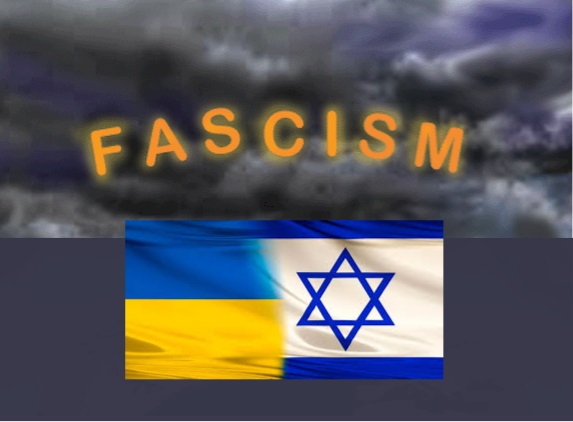
From Bandera to Ben-Gurion, a new axis of ethno-supremacy is rising, fueled by U.S. backing. Same guns. Same flags. Same ideology. Gaza and Donbass are not separate wars. They are one machine.
The Ukraine–Israel Nexus: Pragmatic Alliances Amid Paradoxes and Shared Challenges From Bandera to Ben-Gurion, echoes of ethno-nationalist revival resonate in the modern trajectories of Ukraine and Israel, two states forged through war, hardened by siege mentalities, and fueled by historical narratives of existential struggle. But these similarities are no accident of parallel development. They reflect a deepening alignment shaped by shared adversaries like Russia and Iran, backed and brokered by the same Western patrons.
In 2022, an officer of Ukraine’s Azov Regiment, toured Israel after surviving the siege of Mariupol. By 2025, Israeli drones were flying missions over Rafah, while American-made PSRL-1 rocket launchers, initially supplied to Ukraine, were spotted in conflict zones across the Middle East. Some experts suggest these may have reached Gaza through black-market channels, though a direct transfer remains unproven. What is undeniable, however, is the convergence of military technologies, intelligence doctrines, and battlefield logistics spanning both theaters.
In April 2022, Ukrainian President Volodymyr Zelenskyy, himself a stalwart ally to the Zionist cause, declared that he envisioned Ukraine becoming “a big Israel.” In doing so, he abandoned the pretense of liberal reform and embraced a future defined by permanentmilitarization, domesticsurveillance, and an ideologicallymobilizedcitizenry. Ukraine, he suggested, would survive not by joining Europe’s post-national dream, only by imitating the ethos of a heavily securitized Middle Eastern state.
Zelenskyy’s statement didn’t emerge in a vacuum. It followed decades of quietly intensifying Ukrainian–Israeli ties, in historical memory, military cooperation, tech integration, and shared narratives of victimhood. But it also exposed a deeper and more disturbing fusion. When the president of a country still reckoning with the legacy of the Holocaust and its own fascist collaborators calls for the building of a “Big Israel,” he is not just invoking a model of defense, he is invoking a model of justified violence, permanent siege, and a long tradition of selective memory, one that both Ukraine and Israel have wielded to reconcile uncomfortable historical alliances of culpability.
Just as the OUN’s collaboration with Nazi Germany is selectively reframed within the Ukrainian national mythos, Israel’s founding story often omits its own moments of strategic accommodation with fascism.
In the 1930s and ’40s, elements of the Zionist movement, most notably the Haavara Agreement between Nazi Germany and the Jewish Agency, facilitated Jewish emigration to Palestine while bypassing international boycotts of the Nazi regime. Revisionist factions like Lehi (the Stern Gang) and Irgun Zvai Leumi even sought military cooperation with the Axis powers against the British. These uncomfortable truths, long buried beneath the moral absolutism of Holocaust remembrance, underscore a shared willingness, Ukrainian and Zionist alike, to collaborate with and even become genocidal regimes when national aspirations were at stake.
What binds Gaza and Donbass is not a monolithic “machine of violence” but a transnational matrix of ideological alignment, technical cooperation, and strategic utility. Ukraine’s campaign of “decommunization” often mirrors Israel’s internal securitization and demographic engineering, both clad in the moral armor of historical trauma. In practice, both states justify aggressive internal and external policies through the language of survival.
This article maps the ideological, military, economic, and cultural architecture of the Ukraine–Israel relationship. From Soviet-era tensions to the post-2014 reconfiguration of alliances, we explore how pragmatic imperatives have forged a new axis of ethno-nationalist power, increasingly central to NATO’s long-term vision of regional dominance.
I. Historical Ties To understand the modern partnership between Ukraine and Israel, one must begin with their shared, and often contradictory past. Ukraine was both a cradle of early Zionism and a site of violent antisemitic pogroms. Movements likeHibbat Zion, emerged in the 1880s in cities like Odessa and Kiev, decades before Theodor Herzl’s more famous Vienna-based political Zionism. Their mission: to restore the Jewish people to their ancestral homeland in Palestine. Ukraine, in this sense, was an incubator for the ideological DNA of the Israeli state……………………………………………………………………………………………………………………………………………………………………………………………….
…………………….The historical relationship between Israel and Ukraine is not one of ideological clarity. It is a pragmatic evolution, shaped by war, memory, trauma, and strategy. The next sections will examine how these contradictions manifest on the battlefield through weapons, doctrine, personnel, and propaganda, across Gaza and Donbass alike.
Selective Memory: How Competing Genocides Forged Strategic Amnesia In the narrative war between historical truth and political utility, few examples are as revealing, or as cynical, as the ways Ukraine and Israel have reframed and often embellished their respective traumas to enable strategic cooperation.
By the 1980s, Ukrainian nationalist émigrés began aggressively promoting the 1932–33 Soviet famine, or Holodomor, as the “Ukrainian Holocaust.” This was a calculated response to the rising global awareness of Jewish suffering, spurred by the 1978 NBC miniseries Holocaust, which explicitly portrayed Ukrainians as Nazi collaborators. For diaspora groups still loyal to Stepan Bandera’s legacy, the documentary posed a threat to their rehabilitated image, which they had worked fervently to whitewash. In turn, they constructed a counter-narrative of equal, if not greater, Ukrainian victimhood, one that would cast the Soviet state as genocidal and reframe Ukrainian history through the lens of national martyrdom.
This rhetorical project relied on inflating death tolls,………………………………………………………………..
The result is a pact built on strategic amnesia: a cold alliance between two states whose foundational traumas have been rewritten to serve military alignment, ideological affinity, and common enemies………………………….
…………II. Blood Ties and Battle Lines: Commanders, Crusaders, and Collaborators The machinery of transnational warfare is not only built with weapons, laws, and doctrines, but with men. Individuals who embody the ideological convergence between Zionist ethno-nationalism and Ukrainian fascism do not operate in the shadows; they are often celebrated, recruited, and strategically deployed across theaters like Gaza and Donbass. These figures serve as ideological evangelists, field commanders, propaganda tools, and networking nodes between far-right militias, Western intelligence networks, and private security structures.
Some are Azov veterans turned actors and influencers. Others are American-Israeli contractors building bridges between Tel Aviv and Kiev. ……………………..
Iran’s parliament on Tuesday urged the Foreign Ministry and Atomic Energy Organization to fully implement existing legislation limiting cooperation with the International Atomic Energy Agency, amid growing pressure from Western powers and renewed nuclear talks in Geneva. In a strongly worded statement, the National Security and Foreign Policy Committee of Iran’s parliament described IAEA chief Rafael Grossi as “a servant of the US and the Zionist regime,” accusing him of siding with hostile powers and remaining silent over attacks on Iranian nuclear sites, according to remarks published by state media.
The UN nuclear watchdog’s inspectors have returned to Iran after their expulsion during a brief war with Israel and the US, IAEA chief Rafael Grossi said Tuesday, amid reports he has been placed under 24/7 protection following Iran’s threat to his life. “Now the first team of IAEA inspectors is back in Iran, and we are about to restart,” International Atomic Energy Agency (IAEA) director general Grossi said. Grossi, who was in Washington DC for the annual meeting of the Institute of Nuclear Materials Management, stopped short of saying there was an agreement or timeline for them to resume their work. “When it comes to Iran, as you know, there are many facilities. Some were attacked, some were not. So we are discussing what kind of modalities, practical modalities, can be implemented in order to facilitate the restart of our work there.”
“AUKUS is only going to lead to more submarines collectively in 10, 15, 20 years, which is way beyond the window of maximum danger, which is really this decade.”
The moment the security pact known as AUKUS came into being, it was clear what its true intention was. Announced in September 2021, ruinous to Franco-Australian relations, and Anglospheric in inclination, the agreement between Washington, London and Canberra would project US power in the Indo-Pacific with one purpose in mind: deterring China. The fool in this whole endeavour was Australia, with a security establishment so Freudian in its anxiety it seeks an Imperial Daddy at every turn.
To avoid the pains of mature sovereignty, the successive Australian governments of Scott Morrison and Anthony Albanese have fallen for the bribe of the nuclear-powered Virginia Class SSN-774 and the promise of a bespoke AUKUS-designed nuclear–powered counterpart. These submarines may never make their way to the Royal Australian Navy. Australia is infamously bad when it comes to constructing submarines, and the US is under no obligation to furnish Canberra with the boats.
The latter point is made clear in the 2023 National Defense Authorization Act, which directs the US President to certify to the relevant congressional committees and leadership no later than 270 days prior to the transfer of vessels that this “will not degrade the United States underseas capabilities”; is consistent with the country’s foreign policy and national security interests and furthers the AUKUS partnership. Furthering the partnership would involve“sufficient submarine production and maintenance investments” to meet undersea capabilities; the provision by Australia of “appropriate funds and support for the additional capacity required to meet the requirements”; and Canberra’s “capability to host and fully operate the vessels authorized to be transferred.”
In his March confirmation hearing as Undersecretary of Defense Policy, Eldridge Colby, President Donald Trump’s chief appointee for reviewing the AUKUS pact, candidly opined that a poor production rate of submarines would place “our servicemen and women […] in a weaker position.” He had also warned that, “AUKUS is only going to lead to more submarines collectively in 10, 15, 20 years, which is way beyond the window of maximum danger, which is really this decade.”
The SSN program, as such unrealised and a pure chimera, is working wonders in distorting Australia’s defence budget. The decade to 2033-4 features a total projected budget of A$330 billion. The SSN budget of A$53-63 billion puts nuclear powered submarines at 16.1% to 19.1% more than relevant land and air domains. A report by the Strategic Analysis Australia think tank did not shy away from these implications: “It’s hard to grasp how unusual this situation is. Moreover, it’s one that will endure for decades, since the key elements of the maritime domain (SSNs and the two frigate programs) will still be in acquisition well into the 2040s. It’s quite possible that Defence itself doesn’t grasp the situation that it’s gotten into.”
Despite this fantastic asymmetry of objectives, Australia is still being asked to do more. An ongoing suspicion on the part of defence wonks in the White House, Pentagon and Congress is what Australia would do with the precious naval hardware once its navy gets them. Could Australia be relied upon to deploy them in a US-led war against China? Should the boats be placed under US naval command, reducing Australia to suitable vassal status?
Now, yet another think tanking outfit, the Washington-based Center for Strategic and International Studies (CSIS), is urging Australia to make its position clear on how it would deploy the Virginia boats. A report, authored by a former senior AUKUS advisor during the Biden administration Abraham Denmark and Charles Edel, senior advisor and CSIS Australia chair, airily proposes that Australia offers “a more concrete commitment” to the US while also being sensitive to its own sovereignty. This rather hopeless aim can be achieved through “a robust contingency planning process that incorporates Australian SSNs.” This would involve US and Australian military strategists planning to “undergo a comprehensive process of strategizing and organizing military operations to achieve specific objectives.” Such a process would provide “concrete reassurances that submarines sold to Australia would not disappear if and when needed.” It might also preserve Australian sovereignty in both developing the plan and determining its implementation during a crisis.
In addition to that gobbet of hopeless contradiction, the authors offer some further advice: that the second pillar of the AUKUS agreement, involving the development of advanced capabilities, the sharing of technology and increasing the interoperability between the armed forces of the three countries, be more sharply defined. “AUKUS nations should consider focusing on three capability areas: autonomy, long-range strike, and integrated air defense.” This great militarist splash would supposedly “increase deterrence in both Europe and the Indo-Pacific.”
In terms of examples, President Trump’s wonky Golden Dome anti-missile shield is touted as an “opportunity for Pillar II in integrated air defense.” (It would be better described as sheer science fiction, underwritten by space capitalism.) Australia was already at work with their US counterparts in developing missile defence systems that could complement the initiative. Developing improved and integrated anti-missile defences was even more urgent given the “greatly expanding rotational presence of US military forces in Australia.”
This waffling nonsense has all the finery of delusion. When it comes to sovereignty, there is nothing to speak of and Australia’s security cadres, along with most parliamentarians in the major parties, see no troubles with deferring responsibility to the US imperium. In most respects, this has already taken place. The use of such coddling terms as “joint planning” and “joint venture” only serves to conceal the dominant, rough role played by Washington, always playing the imperial paterfamilias even as it secures its own interests against other adversaries.
Given that the whole basis for Russia launching the war was to put a hard red line in the sand that NATO would not be expanded to include Ukraine, there is no reason to believe that Russia would attack Ukraine in future, if its core underlying concern was resolved.
But security guarantees will need to be realistic and sanctions removal must form part of the plan.
The need for Ukraine’s postwar security has become a major talking point since President Trump’s historic meeting with President Putin in Alaska on 15 August.
U.S. Special Envoy Steve Witkoff spoke of a ‘game-changing’ commitment by President Putin to accept Security guarantees by NATO states. This meant that ‘the United States and other European nations could effectively offer Article 5 like language’.
It is clear that security guarantees are vital for all sides, including for Russia.
Security guarantees are important to European nations, precisely to reduce the risk of Europe being engulfed in a senseless and, frankly, avoidable war with Russia. There has never been any evidence that Russia wants to invade Europe, despite that being a comfortable go-to line for European propagandists.
So, for Europe in particular, the offer of security guarantees must represent a meaningful act of deterrence. A commitment by western nations to fight, so as to prevent the possibility of future war. What this deterrence does not mean is to station NATO troops permanently or even temporarily inside of Ukraine, whether they be called a Reassurance Force, Peacekeeping Force or anything else.
If this war was provoked by a desire by Russia to stop NATO advancing to its western border through Ukraine, why then would Russia agree to have NATO troops inside Ukraine? NATO has large armies on Ukraine’s border already and mounts air patrols as it is.
So, security guarantees don’t need to mean boots on the ground, but rather a willingness to defend Ukraine against a future war which was absent during the current war.
And that is why security guarantees are important for Ukraine.
That country will be forgiven for scepticism about whether NATO states such as France, the UK or Germany would come to their military rescue in the event of a future war having gone to extreme lengths not to come to their military rescue in this war.
If NATO countries are going to make commitments to Ukraine’s future security, then they will have to mean it if they ever want to be taken seriously again.
This is important to Ukraine specifically because upon the cessation of hostilities, and whether it wants to or not, it will need to reduce the size of its army. Ursula von der Leyen has spoken about turning Ukraine into a ‘steel porcupine’ that Russia can’t swallow.
But who is going to pay for this, as Ukraine cannot?
In peacetime, European citizens will rightly press for their governments to refocus spending on domestic priorities, and to cease channeling funds into the woefully corrupt gravy train of Ukraine.
Ukrainian defence spending – $54.5bn for this year – already makes up over 67% of Ukraine’s budget and 31% of GDP. Ukraine needs yearly cash injections from western nations of at least $40bn just to stay afloat. Much of that, now, is in the form of concessionary loans which Ukraine, one day in the distant future, will need to pay back.
Ukraine is otherwise cut off from international capital markets. You don’t need to be a maths genius to see that if western funds dry up, Ukraine will have less than $15bn available each year for defence.
Ukraine’s army was around two hundred thousand before the war broke out and now counts at almost one million. Salary costs will come down after the war ends, because soldiers likely will lose the lucrative frontline bonuses they receive which can effectively quadruple their normal pay, if they survive long enough to spend it.
That in itself will present another major social problem for Ukraine to demobilise soldiers who will find themselves in a shattered country that is in a dire economic state. But specifically, Ukraine will need to trim the size of its army, because it won’t be able to afford to pay for it. It is completely unrealistic to expect western nations to continue to pump tens of billions each year into Ukraine to maintain an army of one million in peacetime.
So, this undoubtedly presents huge challenges, but it must surely be in Ukraine’s interest to sue for peace and to start a complicated and, I fear, long and rocky road to EU membership, reconstruction and growth. As a country, it gains nothing but death and destruction by keeping the war going and losing ground and lives each day.
Security guarantees are vitally important to Russia too. President Trump’s unequivocal stance that Ukraine won’t join NATO must be backed up by a Treaty to ensure that Russia will have confidence that this commitment to Ukrainian military neutrality is real and permanent,
Given that the whole basis for Russia launching the war was to put a hard red line in the sand that NATO would not be expanded to include Ukraine, there is no reason to believe that Russia would attack Ukraine in future, if its core underlying concern was resolved.
Conquering all of Ukraine has never been a core aim in this war, in my opinion. Even though it has the military upper hand, I believe that Russia wants peace too. Peace will mean a long and fraught process of normalisation of relations with Ukraine, Europe and with the U.S. Indeed, the reengagement in peaceable economic, social and cultural relations would surely prevent the need for a future war.
But there’s texture here, of course, both Russia and Ukraine would need to resist provocations that precipitated a future conflict. Let’s not forget that from the onset of the Ukraine crisis in 2014, and after the Minsk II agreement was reached in February 2015. It became a goal of Ukraine and western powers to impose economic sanctions on Russia.
As we seem to enter the final furlong towards peace in Ukraine after a devastating war, pressure continues from both Europe and Ukraine to continue to sanction Russia to maintain the pressure. In recent days, President Zelensky has urged more sanctions if President Putin does not meet him in person. The European Union is preparing its 19th round of sanctions since 2022, despite the prospect of peace seemingly on the horizon.
This is one of the reasons that any peace deal needs a plan for sanctions removal, not addition. As I have said many times before, setting out a clear plan to reduce Russian sanctions that do not provide Ukraine with a veto will be vital to incentivising President Putin to cut a deal.
It is deluded to believe, more than eleven years after the first sanctions were imposed on Russia, that threatening Russia with more sanctions will incentivise a peace deal. It must surely be obvious that further threats of sanctions will simply encourage President Putin to order his troops on in their campaign.
So, if a peace deal is to be agreed, despite the pain of agreeing it, it must facilitate peace or, at the very least, the absence of war. It must ensure that Europe is serious about honouring its commitment to Ukraine in the future, it must give Ukraine the confidence that it can move its army to a peacetime footing, and it must manifestly promote a normalisation of relations with Russia that is so long overdue.
South Korea’s state-run nuclear power firm has been banned from bidding for new power plant projects in North America and Europe over an intellectual property (IP) dispute, the Seoul-based Yonhap News reported on Tuesday.
Korea Hydro & Nuclear Power (KHNP) faces the IP dispute under its agreement with the US energy firm Westinghouse, signed in January, according to industry sources.
The sources mentioned that the KHNP cannot sign for new nuclear power plant deals in North America and the UK, Japan, Ukraine, and EU nations, excluding the Czech Republic.
The agreement was signed after Westinghouse accused the KHNP of infringing on its IP, claiming that the plant designs of the South Korean company utilize its licensed technology.
The deal had cleared a major obstacle for the KHNP-led Korean consortium to finalize a 26 trillion won ($18.7 billion) contract in June to build two nuclear power units in the Czech Republic.
The report came as the KHNP President Whang Joo-ho confirmed on Tuesday that the company had closed operations in Poland.
“After the new Polish administration took office … the country decided to drop the state-owned enterprise projects (in the nuclear power sector),” Whang said.
Poland became the fourth European country where the KHNP confirmed its business closure, following Sweden, Slovenia, and the Netherlands.
“It was determined by all that the best way to end the horrific war between Russia and Ukraine is to go directly to a Peace Agreement, which would end the war, and not a mere Ceasefire Agreement, which often times do not hold up.”
The Dwarfs had to slink away. Will they, at long last, tell Zelensky they cannot back up their rhetoric with the needed arms and financial support?
I shall not make the de-rigueur disclaimer lest anyone infer that I think President Donald Trump is Snow White. Nor do I feel a need to assure readers that I am not “in Putin’s pocket.” In the tradition of a “current intelligence” analyst, I shall simply “call ‘em like I see ‘em.” And there are lots of dots to put together.
It has been clear since the Alaska summit that Trump and Russian President Vladimir Putin have come to an overall agreement on Ukraine and that it is now being fleshed out in plain sight. And both are acutely aware of the many forces wishing to sabotage moves toward a negotiated settlement.
They have agreed to call it “Biden’s war” and then to conduct themselves as though they have bigger fish to fry – first and foremost improving U.S.-Russia relations.
Why have so many observers been unable to grasp the significance of this key sentence in the first paragraph of the readout from the Aug. 6 Putin-Witkoff meeting – the meeting that set these hopeful events in train?
“Once again, it was noted that Russia-US relations could be placed on a totally different, mutually beneficial footing, which would be in stark contrast with the way these relations have evolved in recent years.” (Emphasis added.)
(Pardon the pedantry, but it is not widely known that the Kremlin’s Russian-to-English translator erred in using the subjunctive could. The word in the Russian readout is stronger; it means can – the indicative, not the subjunctive mood.) This is, well, indicative.
The shared, overriding objective to improve bilateral ties came through clearly both at the summit on Friday and at the “March of the Gnomes” on Monday when seven European leaders arrived at the White House to back Volodymyr Zelensky (no offense to garden gnomes – or dwarfs).
Enroute Alaska
On Air Force One, Trump told Fox’s Bret Baier, “I won’t be happy if I walk away without some form of a ceasefire.” Nyet, was Putin’s answer.
Perhaps the president thought he could work his persuasive powers on Putin one-on-one and change his mind. More likely, Trump knew his gambit had zero prospect of success, and merely wanted to be able to tell the foot-draggers later that he had thrown one last Hail Mary pass, but in vain.
Just a few hours later Trump wrote on truthsocial:
“It was determined by all that the best way to end the horrific war between Russia and Ukraine is to go directly to a Peace Agreement, which would end the war, and not a mere Ceasefire Agreement, which often times do not hold up.”
The New York Times and other media were quick to point out that Trump was “siding with Putin.”
Maps … and Charts
While Putin used the Alaska summit to make clear Russia’s core interests on Ukraine and to argue that he had no option other than to invade, it is a safe bet that he also showed Trump a map depicting the “order of battle;” that is, the disposition of forces along the contact line and in reserve.
This morning Trump hinted that Russia should be allowed to hold onto the territory it has occupied in Ukraine, a concept so far anathema to Zelensky and most of the European leaders.
THE Map
“The Ukrainian soldiers were brave as hell because it’s fighting a force that’s much, much bigger and clearly much more powerful,” Trump said of the Russian military … “And you know, it’s not like they’ve stopped. If you, I assume you’ve all seen the map, you know, a big chunk of territory is taken, and that territory has been taken.
“Now they’re talking about Donbas. But Donbas, right now, as you know, is 79 percent owned and controlled by Russia,” Trump added. “So they understand that.”
Zelensky and the Seven Dwarfs
The Dwarfs had to slink away. Will they, at long last, tell Zelensky they cannot back up their rhetoric with the needed arms and financial support? It will take a while, but in the end they will have to do so.
The end is near.
Ray McGovern works with Tell the Word, a publishing arm of the ecumenical Church of the Saviour in inner-city Washington. His 27 years as a C.I.A. analyst included leading the Soviet Foreign Policy Branch and conducting the morning briefings of the President’s Daily Brief. In retirement he co-founded Veteran Intelligence Professionals for Sanity (VIPS).
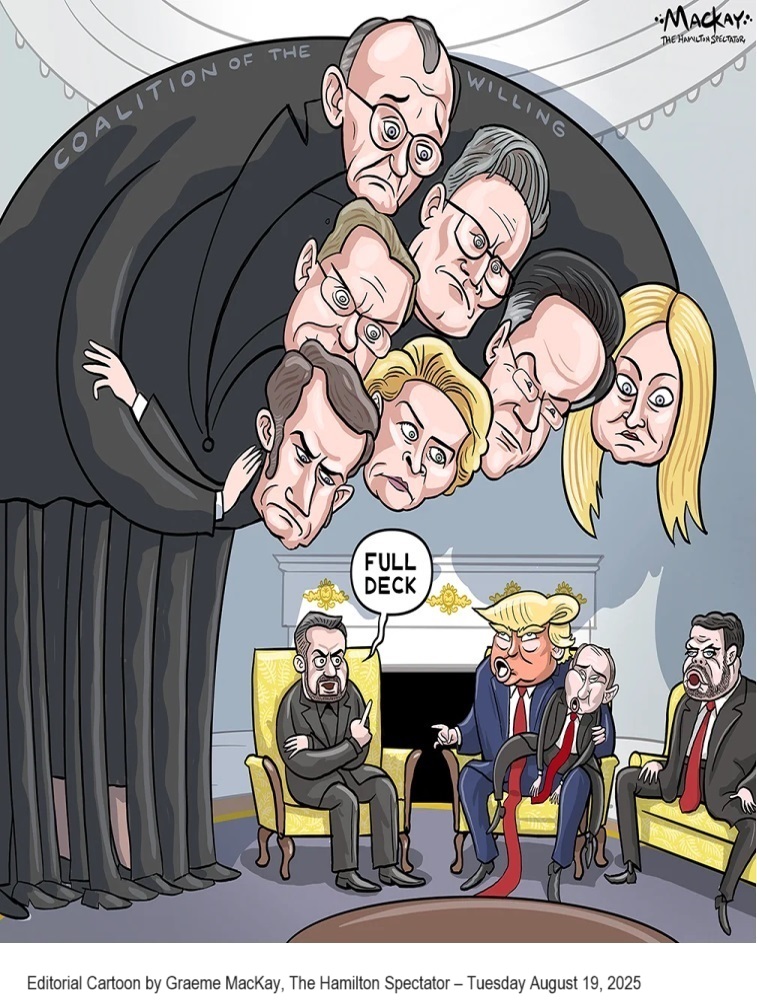
The troupe arrived to “daddy’s” DC office for their official dressing down. If nothing else, we must marvel at the fact that the meeting produced some of the most remarkable political optics, perhaps, in history:
Has there ever been anything like this? The entire pantheon of the European ruling class reduced to sniveling children in their school principal’s office. No one can deny that Trump has succeeded in veritably ‘breaking Europe over his knee’. There is no coming back from this turning point moment, the optics simply cannot be redeemed.
But even snide ridicule aside, objectively speaking, we must point to how absolutely defeated and low-energy the delegation looked……………
Hands in pockets, looks of mild confusion or disinterest, vacant eyes, and that bizarre ‘dead-space’ atmosphere like a “TV tuned to a dead station” (hat tip Mr. Gibson). It’s clear that no one wants to be there, and everyone knows the artificial charade looks and feels forced. The real punchline comes at the 1:00 mark where it becomes eminently obvious the entire hollow exercise is nothing more than an ego-stroke for the cunning Ringmaster himself, as he bids his abject pupils to veer their gaze at the carefully-situated artwork presiding over the gilded humiliation ritual.
Volumes could be written on the implications of such a low point in European influence. But we’ll suffice with concluding that it’s clear the matter of the Ukrainian conflict’s resolution is of such existential importance to the behind-the-scenes cabal which writes the Euro-puppets’ orders, that this cabal is willing to risk everything, including politically sacrificing its “compradors” posing as elected leaders.
It’s pointless to even granularize it, but there were many small moments of humiliation in the meeting: from Trump’s seeming non-recognition of Finland’s president—unable to find him despite his sitting directly across from him—to Trump humbling Ursula, who came armed with a prescripted spiel about Russians kidnapping Ukrainian children; Trump slapped her silent by pointing out they had convened to talk about something else entirely, i.e. your propaganda is irrelevant and unwanted here.
It should also be noted that Trump did not greet a single one of the European messengers personally as they arrived, having a chaperone escort them like children from the White House playground instead. It was in sharp contrast to the pomp and ceremony of the Putin visit. This, of course, is by design, with Trump effectively showing the craven European compradors their subordinate place as part of his slow restructuring of the world order; Trump respects only power—mealy and servile leaders repulse him and earn his boot-print on their foreheads.
So what did the meeting actually accomplish, other than raising Trump’s prestige and smothering inconvenient media narratives from the news cycle?
What we saw was another rehash of the same routine as in Alaska: talks are held, major “progress” announced, yet no concrete details or evidence is provided. In this case, the big achievement is said to be the agreement on a meeting between Putin and Zelensky, followed by a “trilat” as Trump calls it. The problem is, there is zero evidence the Russian side has agreed to any such thing.
Firstly, press outlets blared that Trump “phoned Putin” in the midst of his meeting with the Europeans—Trump himself promptly shot this down:
I post this example to again illustrate just how much disinfo noise is clogging the airwaves around this issue. And this contextualizes the remainder of the analysis, surrounding what Russia may or may not have agreed to. You see, just as easily as mainstream outlets lied about Trump’s call, they may be doing so about the now-circulating claims that Putin has “agreed to” meet with Zelensky.
The Russians have been playing things extremely close to their chests, even more than usual. It appears they have adopted a strategy of deliberate strategic ambiguity in order to give Trump the license he needs to play his game against the Europeans—and Ukraine—while the Russians sit back and watch.
In this case, in confirming Trump’s attempt to get Putin and Zelensky to sit down together, Putin aide Ushakov very subtly modified the language to state that Putin and Trump discussed raising the level of “negotiators” and mentioned the possibility of Russia studying this proposal—as I wrote on X:
An interestingly evasive word-salad as non-answer in customary “Politburo-speak”. He doesn’t really confirm anything other than Trump and Putin discussed “raising the level of negotiators” between Russia and Ukraine (specifically omitting what level that would be). And in fact, he didn’t even say raising the level itself was discussed but rather the possibility of “studying” this proposal. It seems Russia for now continues to play strategic ambiguity to give Trump the arm space he needs to “work” on the Europeans and Zelensky.
In this case, in confirming Trump’s attempt to get Putin and Zelensky to sit down together, Putin aide Ushakov very subtly modified the language to state that Putin and Trump discussed raising the level of “negotiators” and mentioned the possibility of Russia studying this proposal—as I wrote on X:
An interestingly evasive word-salad as non-answer in customary “Politburo-speak”. He doesn’t really confirm anything other than Trump and Putin discussed “raising the level of negotiators” between Russia and Ukraine (specifically omitting what level that would be). And in fact, he didn’t even say raising the level itself was discussed but rather the possibility of “studying” this proposal. It seems Russia for now continues to play strategic ambiguity to give Trump the arm space he needs to “work” on the Europeans and Zelensky.
President Trump said on Monday that he was working on arranging a meeting between Russian President Vladimir Putin and Ukrainian President Volodymyr Zelensky, comments that came after a day of hosting the Ukrainian leader and several European officials at the White House.
“At the conclusion of the meetings, I called President Putin, and began the arrangements for a meeting, at a location to be determined, between President Putin and President Zelensky,” the president wrote on Truth Social.
Trump said that once Putin and Zelensky meet, he would join them for a three-way talk. “After that meeting takes place, we will have a Trilat, which would be the two Presidents, plus myself,” he wrote.
Yury Ushakov, an aide to Putin, said that during the call with Trump, the Russian leader “expressed support for direct negotiations between the delegations of Russia and Ukraine.”
Trump said that one topic of discussion with Zelensky and European leaders on Monday was the potential security guarantees Ukraine would receive from Western nations as part of a peace deal, which will likely be a major sticking point in negotiations with Russia.
“During the meeting we discussed Security Guarantees for Ukraine, which Guarantees would be provided by the various European Countries, with a coordination with the United States of America,” he said.
European leaders, led by British Prime Minister Keir Starmer and French President Emmanuel Macron, are calling for a troop deployment to Ukraine to uphold any potential peace deal. When asked if the US would send troops to Ukraine, Trump didn’t rule out the idea.
But Russia has made clear that it’s strongly opposed to the idea of the deployment of troops from NATO countries to Ukraine, a position it reiterated on Monday. “We reiterate our repeatedly expressed position that we deny any scenarios that envisage the deployment of a military contingent to Ukraine with the participation of Nato states, which could lead to an uncontrollable escalation of the conflict with unpredictable consequences,” said Russian Foreign Ministry spokeswoman Maria Zakharova.
The other major sticking point is the issue of territory. Russia has reportedly offered to end the war if Ukraine withdraws from the Donbas region and the lines are frozen in the southern Kherson and Zaporizhzhia oblasts, but Zelensky continues to publicly reject the idea of ceding territory.
Zelensky has received strong backing from the European leaders who joined him in Washington and held talks with them to coordinate their position ahead of the meetings with Trump. According to a press release from Zelensky’s office, he and the Europeans “stressed their firm support for Ukraine’s sovereignty and territorial integrity and the unacceptability of changing internationally recognized state borders by force.”
The statement said they also “welcomed the readiness of the United States to participate in guaranteeing security for Ukraine” and that “one of the key issues in the negotiations with President Trump will be the joint participation of the United States and Europe in creating the future security architecture for Ukraine and, consequently, for the entire European continent.”
Zelensky was joined in Washington by Starmer, Macron, German Chancellor Friedrich Merz, Italian Prime Minister Giorgia Meloni, Finnish President Alexander Stubb, European Commission President Ursula von der Leyen, and NATO Secretary-General Mark Rutte.






 nuclear-news