Japan trying to sell nuclear technology to India
India, Japan PMs to meet today, N-trade tops agenda Times of India, Sachin Parashar, TNN | Dec 27, 2011, NEW DELHI: Despite the Japanese Parliament, Diet, clearing Japan’s civil nuclear cooperation with four other countries allowing it to resume its supply of nuclear reactors, India remains uncertain about the resumption of its own negotiations for such cooperation with Tokyo.
Ahead of Japanese PM Yoshihiko Noda’s visit to India on Tuesday for the 6th annual India-Japan summit, officials said the issue would be taken up in Noda’s meeting with his counterpart Manmohan Singh, but added that it was not possible to say what the outcome would be…..http://timesofindia.indiatimes.com/india/India-Japan-PMs-to-meet-today-N-trade-tops-agenda/articleshow/11261201.cms
USA and North Korea were close to agreement on uranium enrichment
U.S. will trade food for uranium agreement from North Korea, Negotiations yield several advances Detroit Free Press, Dec. 19, 2011 The U.S. is poised to announce a significant donation of food aid to North Korea this week, the first concrete accomplishment after months of behind-the-scenes diplomatic contacts between the two wartime enemies. An agreement by North Korea to suspend its controversial uranium enrichment program will likely follow within days.
A broad outline of the emerging agreement has been made known to the Associated Press by people close to the negotiations.
Discussions have been taking place since summer in New York, Geneva, Switzerland, and Beijing. They already have yielded agreements by North Korea to suspend nuclear and ballistic missile testing, readmit international nuclear inspectors expelled in 2009, and resume adialogue between North Korea and South Korea, according to the people,
who spoke on condition of anonymity because of sensitivity of the negotiations…..
http://www.freep.com/article/20111219/NEWS07/112190328/U-S-will-trade-food-uranium-agreement-from-North-Korea?odyssey=mod%7Cnewswell%7Ctext%7CFRONTPAGE%7Cs
USA policies, especially on Israel, motivate Iran to get nuclear weapons
an almost purposeful U.S. policy to drive others to obtain the “doomsday explosive”
by allowing Israel to develop the weapons, the U.S. and friends already stimulated the Middle East arms race. It is mainly due to the United States, Great Britain and France that Israel has nuclear capability. As a consequence, Middle East nations sought means to neutralize the Israel bomb…..

 US Policies Motivate Iran To Obtain Nuclear Weapon by: Dan Lieberman December 18, 2011 When the United States sent the B-29 Superfortress bomber, Elona Gay, to drop “Little Boy” on an unwary Hiroshima and ushered in the nuclear age, its administration neglected to plan for a major concern; how to prevent nuclear proliferation. America could not effectively deter the Soviet Union and China from developing a nuclear capability and maybe it did not want its British and French allies from feeling deprived. Nevertheless, all of those nations, with the United States in the lead, had the power to cower India and Pakistan into being content with conventional armaments. Belatedly and ineffectively, the U.S. tried to discourage Pakistan in its bomb-making activities by terminating economic and military aid in
Oct. 1992. The bluster did not work. Continue reading
Sanctions against Iran’s central bank may bring about global economic repercussions
What Happened to Obama’s Nuclear Option? In a showdown over how to deal with Iran, it appears that the president has bowed to Congress. Mother Jones. By Hamed Aleaziz Dec. 16, 2011 Now that the essential Defense Authorization Bill has
passed through the House and Senate, it carries with it a hard-line amendment that would level sanctions against Iran’s central bank. The policy, experts say, could not only inflict pain on Iran for its nuclear weapons ambitions, but also potentially cause global economic
repercussions. The White House has been against the amendment. Congress overwhelmingly voted for it.
If signed into law by President Obama, the new sanctions will be enforced against foreign institutions in Europe and around the world that do business with the Central Bank of Iran. Continue reading
Steps for USA and Russia towards nuclear disarmament
 There is, however, some unfinished business concerning the 20 year-old Presidential Nuclear Initiatives (PNI’s) that both governments could take up now to help lay the foundation for future talks.
the United States and Russia have grown accustomed to sharing considerable information about their longer-range strategic nuclear forces. For years, they have routinely exchanged and updated information on the disposition of retiring nuclear-capable bombers and
missiles. Similar processes could be applied to the types and numbers of tactical nuclear systems affected by the P.N.I.’s.
The next logical step would be for both countries to disclose, on a reciprocal basis, the location, types and numbers of tactical nuclear weapons that remain.
Unfinished Business, NYT, FRANK KLOTZ, SUSAN KOCH and FRANKLIN MILLER December 13, 2011“……..the subject of reducing tactical nuclear weapons has again come to the fore. Signing the New Strategic Arms Reduction Treaty in April 2010, President Obama announced that the United States intended to pursue further reductions in all categories of nuclear weapons — including, for the first time, tactical and nondeployed warheads. Voting to approve the treaty, the U.S. Senate called for negotiations with Russia to address the
disparity in U.S. and Russian tactical nuclear weapons and to secure and reduce those weapons in a verifiable manner.
The specific size of that disparity is a matter of debate. Neither the United States nor Russia has publicly disclosed the number and locations of the tactical nuclear weapons they possess.
Unofficial estimates vary widely. Continue reading
The world might have to learn to live with a nuclear Iran
 Can the world live with a near-nuclear Iran?, By Mohammed Ayoob, December 14, 2011 — (CNN) –– Some analysts have attributed the recent downing of a U.S. RQ-170 Sentinel high-altitude reconnaissance drone in Iran to that nation’s increasingly sophisticated capability to
launch cyber attacks. Others have dismissed the idea that Iran was capable of bringing down an RQ-170, arguing that Iranian air defenses do not have the capability to track an aircraft with radar-evadingtechnology.
Either way, the incident clearly demonstrates American concerns regarding Iran’s nuclear capacity, as the drone was likely sent over Iranian territory to spy on its nuclear program.
I find the argument that Iran is engaged in developing a nuclear weapons program credible. I am also convinced that Iran will not test a device, but rather will acquire the capability to produce a weapon quickly if its strategic environment deteriorates to such an extent
that it feels it must.
I am further convinced that an Israeli or American strike or strikes against its nuclear facilities would put Iran’s nuclear program back by a few years but would not be able to terminate it. In fact, such strikes would provide Tehran with the legitimacy to go ahead and
acquire nuclear weapons capability in full view of the world and with international sympathy.
It is time for world leaders to recognize the inevitability of Iran acquiring nuclear weapons capability, even if it remains untested, with Tehran following the policy and adopting the rhetoric of deliberate ambiguity. Continue reading
Russia’s global nuclear ambitions
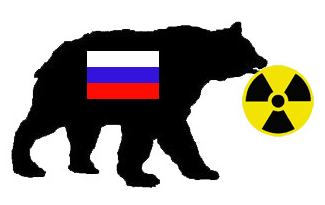 A new ARMZ race, Asia Times, 14 Dec 11 By Peter Lee The people who brought about Chernobyl are pressing to become the world’s leading source for nuclear power equipment, materials, and services.
Russia’s quasi-state nuclear power authority, Rosatom, has ambitions of becoming the world’s one-stop shop for nuclear plants, uranium fuel and spent fuel services. Currently accounting for 20% of the world’s nuclear power stations and 17% of global nuclear fuel fabrication, Rosatom wants to double in size and become the dominant player in uranium ore and spent fuel in the process.
In places like Kazakhstan, Canada, Niger, Australia, the United States and Mongolia, Rosatom’s (AtomRedMetZoloto) Uranium Holding Co, or ARMZ, is seeking to dominate worldwide uranium production. Over the past two decades, Russia has aggressively leveraged the nuclear legacy of the Cold War competition between the United States and the Soviet Union. In the nuclear arms race with the United States, the USSR always opted for quantity and size rather than quality….
Australia wrong to sell uranium to India, says former conservative Prime Minister
A reason India wants access to nuclear trade including uranium is precisely to further its nuclear proliferation. Senior Indian military leaders have publicly said so…..
India reserves the right to classify future reactors as civilian or military. It was not required in return to commit to significant positive measures – indeed, it has made no nuclear disarmament commitments, it has not ratified the Comprehensive Nuclear Test Ban Treaty
Why Gillard’s uranium-to-India policy is dangerously wrong, SMH Malcolm Fraser, December 12, 2011 Canberra’s abject submission to US pressure is shameful. ON SELLING uranium to India, Julia Gillard is wrong, dead wrong. Ramming the policy change through a deeply divided ALP national conference last weekend was not smart politics, but a failure of leadership.
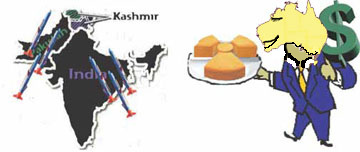
The unequivocal longer-term consequences of this policy backflip are aggravating India’s nuclear arms race with Pakistan and eroding the already failing brakes on proliferation of nuclear weapons. A nuclear war between India and Pakistan is not some theoretical possibility, but a real and growing danger. …. Continue reading
Australian Labor Party trashes Nuclear Non Proliferation in rush to make uranium money out of India
 Indeed, proponents of the platform change [to sell uranium to India] generally made no acknowledgment that India was the first and only state in the world to acquire nuclear weapons as a result of international cooperation on the basis of it being for peaceful purposes – nor her belligerent testing in the mid-1990s; her rather public nuclear arms race with Pakistan; her failure to fully comply with international safeguards and monitoring initiatives; her problems with the US despite a comparable bilateral agreement in place concerning technology and expertise. Nor the rather significant point that none of the cited measures are enforceable under international law – they are considerably difficult to monitor, verify and enforce.
Australian Labor Party downplay arms control considerations, Crikey.com, December 5, 2011 , by NAJ Taylor On Sunday, the Australian Labor Party voted 206 to 185 in favour of changing one part of the party’s longstanding and non-negotiable platform on uranium exports: that recipient states must be members of the Nuclear Nonproliferation Treaty (NPT).
The express intention of the change in policy platform is to lift the ban on uranium sales to India, who are among those three states globally that remain outside – and have no intention of joining – the NPT. With the opposition Coalition having been in support of such a move for some time, the vote is expected to have immediate policy ramifications.
Of little consequence now, the Greens do have a well-known policy position on uranium that clearly states: “The Australian Greens will […] prohibit the exploration for, and mining and export of, uranium”.
Misrepresenting India’s record – it is a grave error to cite India’s nuclear weapons record – which is sub-optimal, not “exemplary”, as is often recycled – as evidence in support of a policy change that is predominately driven by political, commercial and diplomatic pressures. Continue reading
Russia calls on North Korea to stop nuclear program
Russia Urges North Korea to Halt Nuclear Activities, VOA, December 1st, 2011 Russia has urged North Korea to halt its uranium enrichment program and re-admit United Nations nuclear monitors to pave the way for international disarmament talks.
The Russian Foreign Ministry said in a statement Thursday that consistent implementation of the uranium program in North Korea cannot but create serious worry. It called on Pyongyang to announce a moratorium on all of its nuclear activities including the uranium enrichment program.
Moscow is also urging its communist neighbor to invite inspectors from the International Atomic Energy Agency to examine its nuclear program and verify that it is purely peaceful. The call comes after North Korea Wednesday announced progress in producing enriched uranium for its light-water nuclear reactor at the Yongbyon nuclear facility.
U.S. Secretary of State Hillary Clinton called on North Korea Wednesday to take concrete steps to abandon its nuclear program and promote peace and stability….. http://blogs.voanews.com/breaking-news/2011/12/01/russia-urges-north-korea-to-halt-nuclear-activities/
Nuclear lobby turns to Middle East, as Western countries and Japan go cold on nuclear power
Nuclear Power Goes Rogue, The Daily Beast, Henry Sokolski, Nov 28, 2011 Post-Fukushima, the market for nuclear power is changing latitudes. Here’s what’s at stake. As the full cost of the Fukushima nuclear accident continues to climb—Japanese officials now peg it at $64 billion or more—nuclear power’s future is literally headed south.
Developed countries are slowing or shuttering their nuclear-power programs, while states to their south, in the world’s hotspots (think the Middle East and Far East), are pushing to build reactors of their own. Normally, this would lead to even more of a focus on nuclear safety and nonproliferation. Yet, given how nuclear-reactor sales have imploded in the world’s advanced economies, both these points have been trumped by nuclear supplier states’ desires to corner what reactor markets remain.
 Certainly, nuclear sales opportunities are far less flush than they once were. Continue reading
 Jaitapur nuclear plant delayed in haggles over Nuclear Liability Law, and Nuclear Non Proliferation Treaty
 Jaitapur nuclear plant work may not start before 2014 France, says
  Bernard Bigot, remains committed to fulfil all its obligations LiveMint.com 28 Nov 11Makarand Gadgil Mumbai: French Atomic Energy Commission chairman Bernard Bigot said on Monday that work on the Jaitapur nuclear power project in Ratnagiri district of Maharashtra was unlikely to start before 2014 due to regulatory hurdles
He referred to the delay in concluding the commercial contract between Areva and the government-owned Nuclear Power Corp. of India Ltd (NPCIL) Continue reading
A nuclear Iran is likely and acceptable to the world
World will accept Nuclear Iran, says Israeli economist Times of India Nov 25, 2011, JERUSALEM: A leading Israeli investment firm today said the world is likely to grudgingly accept a nuclear Iran given the high price any military strike on its nuclear facilities is going to exact.
 “A sharp rise in the price of oil, the costs of war and the damage to global trade would be too great and deter world powers from taking any serious action,” Amir Kahanovich, chief economist at Clal Finance, one of Israel’s largest brokerage houses, said.
This assessment is in sharp contrast to Israel’s stated official position that Tehran’s nuclear aspirations are unacceptable and that all options are on the table to foil the Islamic Republic’s nuclear ambitions.
Even for Israel the economic cost of a military confrontation that could include retaliatory missile attacks by Tehran and proxies in Gaza and Lebanon would be too high, he predicted.
“Unfortunately, it appears that a nuclear Iran is the most reasonable scenario,” the economist inferred. His remarks came after President Shimon Peres said earlier this month that an attack on Iran was becoming increasingly more likely.
Iran and Kuwait – the double standards of the International Atomic Energy Agency (IAEA)
It would be hard to find a more volatile place [than Kuwait] to build a nuclear installation. Oh, and the land is low lying and subject to silting and shifting.
 Nuclear Madness: Iran, Kuwait or the IAEA?, Morning Star, 25 November 2011, by Felicity Arbuthnot As the sabre-rattling against Iran becomes more deafening – with threats of potentially creating a few Chenobyls or a Fukushima by bombing working nuclear power plants – another potential nuclear madness is planned.
The International Atomic Energy Agency (IAEA) appears to be behaving in a partisan and shameless way regarding Iran, much as it did with Iraq.
With Iraq, accusations abounded that the inspection teams were more about spying than neutral observation. “The way back to the UN was via Tel Aviv,” one former inspector memorably remarked.
Gareth Porter has meticulously and comprehensively trashed the International Atomic Energy Agency’s (IAEA) latest report on Iran, showing disturbing parallels with the tragic Iraq fiasco. Continue reading
Iran is ‘the most threatened country in the world’
few observers believe Iran would dare attack Israel, a suicidal move if ever there was one. And it’s why Israel grasps at excuses to preemptively attack Iran, a far more plausible scenario than an Iranian attack on Israel.
…Iran is the most threatened country in the world….
Why everybody except Iran can have nuclear weapons, GERALD CAPLAN, Globe and Mail , Nov. 25, 2011 It is deeply regrettable that Iran may one day join the not-so-exclusive club of nations that possess nuclear weapons. It is a potential danger the world doesn’t need. If you’ll forgive an outburst of preposterous idealism, it would be kind of neat to have a world with no nuclear arms whatsoever.
But for the life of me I don’t see how the world convinces Iran it’s not entitled to such weapons when Pakistan, North Korea, Russia, India, China, the United States, France, Britain and Israel all have them. Continue reading
1 This Month





PLEASE OPPOSE HR 8255 AND S.3639 – bills would accelerate satellite deployment, with no environmental review or safeguards – https://ncstd5li.quorum.us/campaign/169331/
To see nuclear-related stories in greater depth and intensity – go to https://nuclearinformation.wordpress.com
-
Archives
- October 2026 (10)
- September 2026 (339)
- August 2026 (330)
- July 2026 (355)
- June 2026 (287)
- May 2026 (306)
- April 2026 (356)
- March 2026 (251)
- February 2026 (267)
- January 2026 (308)
- December 2025 (358)
- November 2025 (359)
-
Categories
- 1
- 1 NUCLEAR ISSUES
- business and costs
- climate change
- culture and arts
- ENERGY
- environment
- health
- history
- indigenous issues
- Legal
- marketing of nuclear
- media
- opposition to nuclear
- PERSONAL STORIES
- politics
- politics international
- Religion and ethics
- safety
- secrets,lies and civil liberties
- spinbuster
- technology
- Uranium
- wastes
- weapons and war
- Women
- 2 WORLD
- ACTION
- AFRICA
- Atrocities
- AUSTRALIA
- Christina's notes
- Christina's themes
- culture and arts
- Events
- Fuk 2022
- Fuk 2023
- Fukushima 2017
- Fukushima 2018
- fukushima 2019
- Fukushima 2020
- Fukushima 2021
- general
- global warming
- Humour (God we need it)
- Nuclear
- RARE EARTHS
- Reference
- resources – print
- Resources -audiovicual
- Weekly Newsletter
- World
- World Nuclear
- YouTube
-
RSS
Entries RSS
Comments RSS

