Migrit rejected for nuclear investment in Finland – “a front for Russian capital”.
 Finnish officials reject nuclear plant investor Ft.com By David Crouch in Gothenburg, July 16, 2015 Finland’s plan to build a nuclear power station with help from Russia has been thrown into doubt after officials in Helsinki rejected a mysterious investor that it is alleged has links with Moscow.
 The move raises a fresh obstacle to the project, which has been dogged by accusations that Finland is placing Russian interests before EU foreign policy objectives.
Finland’s economics ministry said on Thursday that the ownership of Migrit Solarna Energija, a Croatian group listed as owning almost 9 per cent of the Fennovoima project, could not be “adequately verified”.
The ministry said it could not establish with certainty that the company was “factually controlled” from inside western Europe.
Finland’s government has insisted that 60 per cent of the €6bn–€7bn cost of the nuclear plant should be borne by companies residing or domiciled in the EU or the wider European Free Trade Association, which includes Norway, Iceland and Switzerland.
However, without Migrit, this requirement will not be met — which means either a new investor or additional investment from existing shareholders.
“We cannot speculate on who Migrit is controlled by,” said Herkko Plit, a senior civil servant in the economics ministry. “It has many relations to foreign countries, not just Russia. But . . . those people who founded it originally were Russians. The current owners are also Russian citizens to the best of our knowledge.”
Fennovoima plans to begin construction of a 1,200-megawatt reactor at Pyhaejoki in northern Finland in 2018, with operation due to begin in 2024.
But the company has struggled to find backers after the main original shareholder, the German utility Eon which had a 34 per cent stake, withdrew in 2012 after energy prices fell. Rosatom, the Russian state-owned nuclear company that will build the plant, now owns a 34 per cent stake.
Olli Rehn, a former European commissioner who in April became economics minister in Finland’s rightwing coalition government, said a decision on the future of the Fennovoima project would be referred to a meeting of the government on August 6.
“It seems that behind the Croatian company are Russian financiers,” Mr Rehn told YLE, the Finnish broadcaster, although he declined to say whether he believed that Migrit was linked to Rosatom………..
anti-nuclear campaigners said the new doubts about the project should be enough to kill it off. “It should be a sign to the government — if they cannot find investors the plant is not viable,” said Sini Harkki, Greenpeace programme manager for Finland.
She said it appeared that Migrit was “a front for Russian capital”.
“Fennovoima has had several years to find investors, and all it has found was this small Croatian company,” she added. http://www.ft.com/intl/cms/s/0/601da0a4-2bda-11e5-acfb-cbd2e1c81cca.html#axzz3g6DMCh5d
World a little safer as deal agreed on with Iran – Obama
 Obama praises diplomacy of Iran nuclear deal, Sky News, , 15 July 2015 US President Barack Obama has lauded a landmark nuclear agreement with Iran as vindication of his diplomatic approach and a chance for a ‘new direction’ in decades of vexed relations with Tehran.
Obama said the deal – which would curb Iran’s nuclear program in return for substantial international sanctions relief – cut off ‘every pathway’ to an Iranian atomic weapon. ‘Today, because America negotiated from a position of strength and principle, we have stopped the spread of nuclear weapons in this region,’ he said in a White House address on Tuesday.
Describing a ‘difficult history’ between Iran and the United States that ‘cannot be ignored,’ Obama shaped it as a diplomatic victory that showed ‘it is possible to change.’ ‘This deal offers an opportunity to move in a new direction. We should seize it,’ he said……..
Obama came to office vowing to talk directly to Tehran and to try to reach a negotiated deescalation – a marked shift from his predecessor, who rejected a similar deal struck by European countries. ‘This deal demonstrates that American diplomacy can bring real and meaningful change,’ he said.
But, he warned, if Iran steps back from measures agreed in the lengthy agreement, all sanctions ‘will snap back into place.’ Obama insisted the alternative to diplomacy was more violence in a region already beset by instability. ‘Put simply, no deal means a greater chance of more war in the Middle East,’ he said………
Obama said the deal was based on verification, not trust, and noted that differences between the two countries were ‘real.’
Analysts have also warned that Iran’s leaders may need to toughen anti-American rhetoric to ensure the backing of regime hardliners angered at the prospect of a deal with a power they view as the ‘Great Satan.’http://www.skynews.com.au/news/top-stories/2015/07/15/obama-lauds-diplomacy-of-iran-nuclear-deal.html#sthash.xM86hsdW.dpuf
Nuclear agreement finally reached between Iran and world powers

 Iran nuclear agreement: powerful diplomats reach a deal,news.com.au. JULY 15, 2015 THE world’s major powers have struck a long-awaited nuclear deal with Iran after more than two weeks of intense talks in Vienna.
Iranian state television has broadcast US President Barack Obama’s statement on the deal live, only the second such occasion since the Islamic revolution of 1979.
The state broadcaster had also aired Obama’s comments on an April 2 framework accord that led to Tuesday’s historic agreement, paving the way for an easing of crippling Western sanctions and for Iran to come in from the cold…….Iranians have poured onto the streets of Tehran after the Ramadan fast ended at sundown to celebrate the historic nuclear deal…….
- What the deal meansAfter 18 days of intense and often fractious negotiation, diplomats declared that world powers and Iran had struck a landmark deal to curb Iran’s nuclear program in exchange for billions of dollars in relief from international sanctions.
The agreement was designed to avert the threat of a nuclear-armed Iran and another US military intervention in the Muslim world.
The accord will keep Iran from producing enough material for a nuclear weapon for at least 10 years and impose new provisions for inspections of Iranian facilities, including military sites.
The so-called Joint Comprehensive Plan of Action was reached after more than two weeks of furious diplomacy, during which negotiators blew through three self-imposed deadlines.
Zarif and US Secretary of State John Kerry, who conducted most of the negotiations, both threatened to walk away while trading accusations of intransigence.
- Breakthrough came after several key compromisesDiplomats said Iran agreed to the continuation of a UN arms embargo on the country for up to five more years, though it could end earlier if the International Atomic Energy Agency definitively clears Iran of any current work on nuclear weapons. A similar condition was put on UN restrictions on the transfer of ballistic missile technology to Tehran, which could last for up to eight more years…….
- Another significant agreement will allow UN inspectors to press for visits to Iranian military sites as part of their monitoring duties, something the country’s supreme leader, Ayatollah Ali Khamenei, had long vowed to oppose………http://www.news.com.au/world/iran-nuclear-agreement-powerful-diplomats-reach-a-deal/story-fndir2ev-1227442050742
Russia to be the big loser in any nuclear deal with Iran
The Great Debate Big loser in any nuclear deal with Iran may be Russia By Agnia Grigas and Amir Handjani, Reuters, July 10, 2015 As Iran and six world powers edge closer to solidifying an accord that puts limits on Tehran’s nuclear program in return for sanctions relief, a unique opportunity presents itself for the West. The United States and its European partners could begin to decouple the unnatural Iranian-Russian alliance to reign in Moscow’s hegemonic ambitions, as well as bring Iran back into the global economic fold. Competition between Moscow and Tehran would reduce Russia’s influence in the Middle East, unlock Iran and may even serve Europe’s future interest as it looks for alternatives to Russian gas.
Iran and Russia share a complicated history rooted in both countries’ imperial past. In fact, over the past two centuries, Iran has ceded more territory to Russia than any other country. After the Second World War, the Soviet Union destabilized and encouraged separatist movements in the province of Iranian Azerbaijan, similar to what Moscow is doing in Ukraine. As recently as the 1980s, Iran backed Afghan rebels in their conflict against the Soviet Union.
The recent Russo-Iranian alliance has been more a marriage of convenience than a genuine partnership. Russia uses Iran as a geopolitical foothold in the energy-rich Persian Gulf and to poke a finger in the eye of U.S. allies in the region. In return, Iran takes advantage of Moscow’s veto power at multinational forums such as the United Nations. An Iran that is engaged with the West in areas such as energy, trade and peaceful nuclear power generation would no longer see Russia as protector of its interests. It is a fact that Iran’s fractured and vitriolic relationship with the West has driven it to form political, commercial and military ties with Russia. Those ties are still fragile, at best.
Russian companies have signed deals that underwhelmed the Iranian market in contentious areas such as energy and nuclear power. Iran’s Russian-built Bushehr nuclear reactor was riddled by delays and cost overruns. Over the past year, Russian firms have been quick to sign all sorts of long-term agreements in aviation, commercial shipping and agricultural trade out of a fear they would be pushed aside by superior Western firms as a nuclear deal looked more likely.
Russia and Iran have competing interests in energy more so than in any other area of strategic importance. ……..The pending deal between Iran and the six world powers has the potential to be a net loss for Russia. The West should grasp the opportunity and encourage Iran’s drift away from Moscow’s economic orbit. Fostering economic competition between the two historical rivals would eventually reduce their political collaboration. In the long run, this deal may result in achieving a strategic win for the United States and Europe. http://blogs.reuters.com/great-debate/2015/07/09/big-loser-in-any-nuclear-deal-with-iran-may-be-russia/
Iran developing depleted uranium weapons? Actually – NO!
No, Iran probably isn’t developing depleted uranium weapons http://www.bandepleteduranium.org/en/no-iran-probably-isnt-developing-depleted-uranium
The Russians, would like to see it dropped – although not necessarily as part of the negotiations, as would Iran. A major feature of the embargo and discussions on Iran’s military capabilities has been ballistic missiles capable of reaching Iran’s neighbours and the sale of Russian-made S-300 air defence missiles. Iran is also keen to undertake a general modernisation programme of its military.
However on the 6th July, Bloomberg reported that it was not only an issue of ballistic missiles but also Iran’s plans to develop DU anti-tank ammunition, like those stockpiled and occasionally used by the militaries of the P5 negotiators, though not Germany, for now. The story was duly picked up by the Irish Independent and by Foreign Policy’s blog.
ICBUW has long wondered whether Iran might be tempted to develop DU weapons, given that it has an expanding stockpile of DU tails from its uranium enrichment facilities. However, this has always seemed unlikely, given its long-running and vociferous condemnation of the US’s use of DU, support for UN resolutions via its membership of the Non-Aligned Movement and its official statements over the threats from the DU travelling across the border from Iraq.
Nevertheless, the Iranian military may have a different view to the government’s public line on DU and, as with many other states, including even the Swiss, may have experimented with DU kinetic energy penetrator rounds. Nor can one exclude the possibility that 125mm DU ammunition could have been sourced from Russia at some stage. From a military perspective, one could see a certain regional strategic temptation in developing advanced tank armaments but with DU that is always balanced by the stigmatisation of the weapons – as evidenced by the comparatively limited worldwide proliferation of DU ammunition.
Ironically, the closest Iran may have got to acquiring DU weapons was a proposalin the late 1970s from the Shah of Iran, who offered the use of an Esfahan firing range to the British if domestic public opposition against DU test firing proved too great.
Bloomberg’s evidence for Iran’s alleged plans to develop DU weapons purportedly came from two experts, Karl Dewey, a CBRN specialist with Jane’s and Robert Kelley, a former IAEA director and nuclear non-proliferation expert. The article also cited sources in the negotiations who said that the issue of DU ammunition had been discussed. ICBUW contacted Dewey and Kelley and found that their comments had been misrepresented in Bloomberg’s article, which has subsequently been modified in parts.
Robert Kelley told ICBUW that: “I have no evidence whatsoever that Iran has DU or natural uranium weapons. I said nothing of the kind and I am very disappointed in this article. I am asking for a retraction or clarification.
“What I said was that Iran certainly has penetrators but I never said uranium. I did say that if they decided to use tails or freshly produced natural metal for weapons they should have to declare that to IAEA and ask for a safeguards exemption. No big deal.”
So where does this leave us? Clearly the UN arms embargo has become an issue in this final(ish) round of negotiations and is doubtless causing some headaches for the P5+1. Is it all about DU tank ammunition? Probably unlikely as there are far greater concerns over ballistic missile delivery systems that could present a regional strategic threat, ditto the advanced Russian air defence systems that could inhibit a future strike by the US or Israel on Iran’s nuclear facilities. Iran is clearly keen to modernise its military, but are they dead set on developing DU weapons from their new tails stockpiles? Probably not. Should you take excitable media reports on DU proliferation at face value? Never.
Russia is front-runner in scramble to sell nuclear reactors to South Africa, but who will pay?
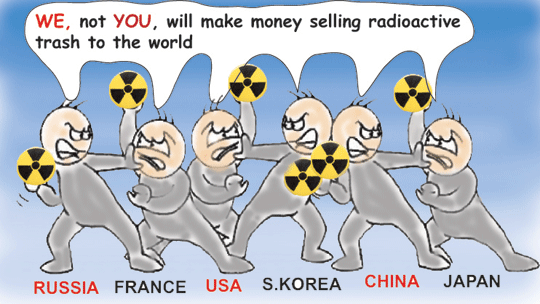
South Africa has concluded similar pacts with China, France, the US, Japan and South Korea.
“There are serious questions that need to be answered as to whether South Africa is able to finance this programme and how any investment would have to be repaid,
 Will Putin pay for SA’s $100bn nuclear plan?, Mail & Guardian, 06 JUL 2015 11:03 MIKE COHEN The awarding of contracts to build SA’s nuclear plants is nearing. Who will pay for the big project? Russia is seen as the frontrunner to win the right to build South African nuclear power plants that may be worth as much as $100-billion. With a six-month deadline to award contracts, who’s going to pay for the country’s biggest project yet remains a mystery.
Price-tag estimates for as many as eight reactors generating 9 600 megawatts, which the government wants to begin operating from 2023 and complete by 2029, range from $37-billion to $100-billion. Bids are due to start this quarter, with Russia’s Rosatom seen as a leader. Areva, EDF, Toshiba’s Westinghouse Electric, China Guangdong Nuclear Power Holding and Korea Electric Power have also shown interest.
The planned investment comes as the government battles to fend off a junk-grade credit rating and the Treasury seeks to rein in the budget deficit. Proceeding with the nuclear plants could result in a large increase in public debt, the International Monetary Fund warned in a report on June 24.
“There appears to be a simple-minded assumption that countries like China or Russia will provide cheap plants and offer finance,” Steve Thomas, professor of energy policy at the University of Greenwich in the UK, who has monitored South Africa’s nuclear plans since 1997, said in a phone interview on June 24. “That’s an illusion.” Continue reading
Reject Nunavut board’s recommendation against uranium project – AREVA urges Canadian govt
 Areva urges minister to reject Nunavut board’s disapproval of uranium project CBC News Jul 08, 2015 The company that wants to eventually open a uranium mine near Baker Lake, Nunavut, is asking the federal government to reject a territorial regulator’s recommendation that the project not be approved.
In May, following a multi-year environmental impact review, the Nunavut Impact Review Board (NIRB) said Areva Resources Canada’s Kiggavik project should not be approved because it doesn’t have a construction timeline attached to it.
But whether the project can proceed is ultimately up to Aboriginal Affairs and Northern Development Minister Bernard Valcourt. Areva has written Valcourt asking him to send the recommendation back to NIRB and direct NIRB to “consider the inclusion of appropriate terms and conditions to a project approval.”..http://www.cbc.ca/news/canada/north/areva-urges-minister-to-reject-nunavut-board-s-disapproval-of-uranium-project-1.3142869
Australian uranium mining company Paladin accused of ribbing off impoverished Malawi

 Australian miner accused of dodging tax in world’s poorest country, The Age, July 11, 2015 –Heath Aston Political reporter Tax avoidance tactics of multinational companies have angered Australians, but an Australian mining firm used such methods in Malawi. Tax avoidance tactics of multinational companies have angered the public and placed pressure on the Abbott government to prevent profits being exported offshore.
But an Australian uranium miner is defending the use of identical methods to reduce its tax bill in the world’s poorest country, Malawi.
Between 2009 and 2014, Paladin Energy moved $US183 million out of Malawi to a holding company in the Netherlands and then on to Australia.
A 15-page report by London-based ActionAid has found the Dutch transfers and a special royalties deal – in which Malawi’s mining minister agreed to drop the initial tax rate applied to the uranium mine from 5 per cent to 1.5 per cent – have cost the Malawi public $US43 million.
In Africa’s poorest nation, where per capita GDP is just $US226 a year and life expectancy 55, that money could provide the equivalent of 39,000 new teachers or 17,000 nurses, according to the aid group……..
Paladin’s tax-free transfers to the Netherlands were a combination of management fees and interest payments on loans initiated in Australia. The company loaded its African subsidiary up with huge debts, leaving the Kayelekera uranium mine in northern Malawi with an 80:20 debt to equity ratio – a financing structure known as “thin capitalisation”.
The Dutch structure allowed Paladin to avoid paying a 15 per cent withholding tax to the Malawi government due to a tax treaty between Malawi and the Netherlands which expired in 2014, saving the company $US7.3 million. Paladin closed the mine in February 2014, citing a “sustained low uranium price”.
ActionAid has accused the company of “treaty shopping” and shortchanging the Malawi people. The country’s nursing ranks have the equivalent of four nurses to every 100 in Australia, despite 10 per cent of Malawi’s population being infected with HIV/AIDS……..http://www.theage.com.au/federal-politics/political-news/australian-miner-accused-of-dodging-tax-in-worlds-poorest-country-20150710-gi6uzv.html
For The 2016 Nuclear Security Summit we need to develop a culture of security
A culture of security: Focus for the next Nuclear Security Summit? Igor Khripunov, Bulletin of the Atomic Scientists, 27 June 15 Igor Khripunov is a distinguished fellow at the Center for International Trade and Security at the University of Georgia (USA) and adjunct professor at its School of Public and International…
It would not take much highly enriched uranium to kill hundreds of thousands of people: as little as what could fit in a five-pound bag of sugar. That it has not happened so far does not mean it may never happen, especially when one considers that there are more than2,000 metric tons of dangerous nuclear materials in hundreds of sites scattered across the globe. And that there have been more than 2,300 cases of theft or loss of nuclear or radioactive material since the early 1990s.Consequently, one of the greatest dangers facing the global community is the risk of terrorists getting enough uranium or plutonium to build a working, crude nuclear bomb, or to spike a conventional bomb with enough radioactive material to create a so-called “dirty bomb”—one which disperses harmful radioactive material over a wide area. The latter in particular is quite a plausible scenario; just think how the public would react if such a device exploded in a major urban center.
To prevent either scenario from happening, a coalition of about 80 civil society organizations from across the globe has been working together for the past five years to improve the security of fissile materials. Known as the Fissile Materials Working Group (FMWG), it has been a forceful advocate for the prevention of nuclear terrorism, by spotlighting attention on the issue, sponsoring talks, and publishing detailed, formal written recommendations, among other activities. Its latest contribution is the report “The Results We Need in 2016: Policy Recommendations for the Nuclear Security Summit” developed by a group of international experts and circulated this month at public events in Vienna and Washington, DC. The release of the report was timed to coincide with the most crucial meetings of the “summit sherpas”—the official representatives of the participating states charged with preparing its agenda and drafting the final communiqué.
With the planning of the next summit in mind, the report prioritizes the items that the nongovernmental expert community wants the 2016 summit to focus on during its two-day proceedings. The list includes enhancing the security of military nuclear material, information sharing, best practices, and the elimination of highly enriched uranium (HEU) in civilian applications, among other agenda items. In so doing, the FMWG has elevated the role of the public from what was perceived not long ago as a bystander to that of a major and proactive stakeholder in nuclear security. And a unique feature of the group’s report is that it takes a much wider and longer-term perspective of nuclear security challenges compared to the rather short-term vision often espoused by most government experts.
But a funny thing happened on the way to the forum: It turns out that there is more to ensuring the security of nuclear material than physically protecting it, or trying to account for the whereabouts of every last bit of, say, highly enriched uranium. There is also something a bit harder to define, but perhaps even more important: a broader, all-embracing culture of nuclear security, that takes into account the human factor. Known as nuclear security culture, this approach encompasses programs on personnel reliability and training, illicit trafficking interception, customs and border security, export control, and IT security, to name just a few. Security culture has become a bit of a buzzword in many security-related domains, and the FMWG report seeks to raise it above this level, explicitly detailing the concept and its implications in a special section…………
nuclear security culture must become part of a comprehensive, joint architecture that elevates security to a basic societal value. Sharing the progress made in the nuclear field with other domains—particularly the chemical and the biological—will call for deeper communication and cooperation. To avoid fragmentation, security experts will need a shared concept to work together.
Finally, we must treat nuclear security culture as a continuously evolving educational and training discipline. Collaboration among government, industry, and academia is pivotal to a thriving, broad-based nuclear security culture; this means that nuclear security culture promotion needs a multi-stakeholder approach.
The 2016 Nuclear Security Summit can leave a valuable legacy by addressing such issues in a nuclear security culture roadmap endorsed by participating states. Nuclear security culture is an agenda item that deserves much more attention at the upcoming summit. http://thebulletin.org/culture-security-focus-next-nuclear-security-summit8428
Optimism for a nuclear agreement with Iran, but big hurdles remain
Big hurdles to Iran nuclear deal as deadline looms, Reuters VIENNA | BY JOHN IRISH AND LOUIS CHARBONNEAU 26 June 15 As a June 30 deadline for a final nuclear deal approaches, major differences remain between Iran and world powers on several key issues including sanctions relief and U.N. access to Iranian sites, a senior Western diplomat said on Friday.
“The most difficult subjects need to be resolved in the coming days,” the diplomat told reporters on condition of anonymity in the Austrian capital, where talks between the United States, Britain, France, Germany, Russia, China and Iran have entered their final phase.
“The questions of access and transparency, PMD (possible military dimensions (to Iran’s nuclear activity) and sanctions remain extremely problematic. We can find an agreement on some points, but on major issues there are still big differences.”
Officials close to the talks say they have yet to agree on the speed and scope of lifting sanctions, how Iran will reduce its stockpiles of low-enriched uranium, the future extent of Tehran’s enrichment-centrifuge research and development program, and access for U.N. inspectors to military and other sites, as well as U.N. access to Iranian nuclear scientists.
Iran wants sanctions lifted immediately, though diplomats say they will be eased gradually in accordance with a schedule and only after confirmation that Iran has met its commitments.
Iran rejects allegations from Western powers and their allies that it is seeking the capability to produce nuclear weapons under cover of a civilian atomic energy program.
The real deadline is not June 30 but July 9, diplomats say.
The U.S. delegation must present the deal to Congress by July 9 if a mandatory congressional review period before President Barack Obama can begin suspending sanctions is to be limited to 30 days. After July 9, the review will last 60 days, according to a law passed recently by U.S. legislators…………..http://www.reuters.com/article/2015/06/26/us-iran-nuclear-talks-idUSKBN0P623G20150626
Ease food import restrictions – Japan asks China
 Japan asks China to ease food import restrictions introduced after Fukushima nuclear disaster, South China Morning Post 21 June 15 China banned imports of food produced in 10 prefectures in Japan including Miyagi, Nagano and Fukushima following the crisis A Japanese farm ministry official met a senior Chinese official in charge of food inspection on Friday to request the easing of restrictions on food imports introduced after the Fukushima nuclear disaster in 2011, sources said.
A director general at the Japanese Ministry of Agriculture, Forestry and Fisheries used the meeting in Beijing to stress the safety of Japanese food, the sources said.
China banned imports of food produced in 10 prefectures in Japan including Miyagi, Nagano and Fukushima following the nuclear crisis…….
The sale and use of Japanese food products has dropped sharply at department stores, supermarkets and restaurants in China since the import ban went into effect……..http://www.scmp.com/news/china/diplomacy-defence/article/1824614/japan-asks-china-ease-food-import-restrictions
How the West brought about the Ukraine crisis, and what to do about it
 Why the Ukraine Crisis Is the West’s Fault The Liberal Delusions That Provoked Putin MULTUM NON MULTA By John J. Mearsheimer , 19 June 15 According to the prevailing wisdom in the West, the Ukraine crisis can be blamed almost entirely on Russian aggression. Russian President Vladimir Putin, the argument goes, annexed Crimea out of a long-standing desire to resuscitate the Soviet empire, and he may eventually go after the rest of Ukraine, as well as other countries in eastern Europe. In this view, the ouster of Ukrainian President Viktor Yanukovych in February 2014 merely provided a pretext for Putin’s decision to order Russian forces to seize part of Ukraine.
But this account is wrong: the United States and its European allies share most of the responsibility for the crisis. The taproot of the trouble is NATO enlargement, the central element of a larger strategy to move Ukraine out of Russia’s orbit and integrate it into the West…………….
The West’s triple package of policies — NATO enlargement, EU expansion, and democracy promotion — added fuel to a fire waiting to ignite……….
To achieve this end, the United States and its allies should publicly rule out NATO’s expansion into both Georgia and Ukraine. The West should also help fashion an economic rescue plan for Ukraine funded jointly by the EU, the International Monetary Fund, Russia, and the United States — a proposal that Moscow should welcome, given its interest in having a prosperous and stable Ukraine on its western flank. And the West should considerably limit its social-engineering efforts inside Ukraine. It is time to put an end to Western support for another Orange Revolution. Nevertheless, U.S. and European leaders should encourage Ukraine to respect minority rights, especially the language rights of its Russian speakers.
Some may argue that changing policy toward Ukraine at this late date would seriously damage U.S. credibility around the world. There would undoubtedly be certain costs, but the costs of continuing a misguided strategy would be much greater. Furthermore, other countries are likely to respect a state that learns from its mistakes and ultimately devises a policy that deals effectively with the problem at hand. That option is clearly open to the United States…….
Investor-State Dispute Settlement (I.S.D.S.) provisions should be removed from the Trans Pacific Partnership
 Investor-State Dispute Settlement (I.S.D.S.)-style provisions may once have made sense. But they’re now outdated and unnecessary. And including them in trade agreements undermines the broader case for free trade, by making it look like exactly what people fear—a system designed to put corporate interests above public ones.
Trade-Agreement Troubles, MULTUM NON MULTA BY JAMES SUROWIECKI, 19 June 15, In 2012, Australia implemented tough anti-tobacco regulations, requiring that all cigarettes be sold in plain, logo-free brown packages dominated by health warnings. Philip Morris Asia filed suit, claiming that this violated its intellectual-property rights and would damage its investments. The company sued Australia in domestic court and lost. But it had another card to play. In 1993, Australia had signed a free-trade agreement with Hong Kong, where Philip Morris Asia is based. That agreement included provisions protecting foreign investors from unfair treatment. So the company sued under that deal, claiming that the new law violated the investor-protection provisions. It asked for the regulations to be discontinued, and for billions in compensation.
The case has yet to be decided, but the concerns it raises help explain President Obama’s embarrassing setback last week, when the House failed to give him fast-track authority over one of two big trade agreements that had been envisaged as a key part of his legacy. Both agreements—the Trans-Pacific Partnership, with eleven Asian and Pacific countries, and an agreement with Europe called the Transatlantic Trade and Investment Partnership—include provisions very like the ones at the heart of Australia’s fight with Big Tobacco. Known as Investor-State Dispute Settlement (or I.S.D.S.) provisions, they typically allow foreign investors to sue governments when they feel they have not received “fair or equitable treatment,” and to have their cases heard not by a domestic court but by an international arbitration tribunal made up of three lawyers.
These provisions have been opposed by an unusual coalition of progressives and conservatives, who contend that they will let multinationals override government policy, and, as Senator Elizabeth Warren put it, “undermine U.S. sovereignty.”………. Continue reading
Japan will now allow India to reprocess spent nuclear fuel from Japanese-made reactors
Japan eases fuel rules for India nuclear deal, Japan Times KYODO, JUN 19, 2015 Japan has given in to India’s demand that it be allowed to reprocess spent nuclear fuel from Japanese-made reactors, negotiation sources said, marking a major shift in Japan’s stance against proliferation.
India, a nuclear power that conducted its first weapons test in 1974 using reprocessed plutonium, has not joined the Nuclear Non-Proliferation Treaty.
Japan has been seeking measures to guarantee India will not divert extracted plutonium — which could be used to build nuclear weapons — for military use, but no agreement has been reached on the issue, the sources said Thursday…..http://www.japantimes.co.jp/news/2015/06/19/national/japan-eases-fuel-rules-for-india-nuclear-deal/#.VYSSFfmqpHw
Greens becoming a global force – The Asia Pacific Greens congress
Delegates expressed strong opposition to plans to roll out more nuclear power stations in Korea, Japan and Taiwan, and sought the help of Greens parties worldwide in that effort. All want greater efforts in promoting energy efficiency and renewable energy. The Greens are well placed to break through and win seats in upcoming elections in Korea and Taiwan……..
Just as corporations are global, so too the Greens are a global force
Christine Milne: Australia ‘universally condemned’ at regional Greens meeting,Guardian 15 June 15 Too often, the concerns of Pacific Island nations are jettisoned in favour of bigger nations’ interests. The Asia Pacific Greens congress aims to change that . Green parties around the world have been working for decades to address global warming. Australia’s Pacific Island neighbours are already suffering extreme weather events, storm surges, and adverse impacts on their health and livelihoods, with their ability to grow food constrained by salt water incursion into fresh water lenses. At every UN climate meeting they ask for help, and in spite of all the sympathetic talk, their concerns are jettisoned in favour of national sovereignty arguments from more powerful nations like Australia. This has to change.
Over the weekend, the Asia Pacific Greens Federation Congress was held in New Zealand. As global political influence continues to rise in our region, so too the Greens are organising to be heard in those halls of power. Whereas the European Greens and their individual parties have been known and have been in parliaments for decades, it is not so well known that Green politics globally grew out of Australia and New Zealand with the formation of the United Tasmania Group in 1972, followed by the NZ Values Party a few months later. Petra Kelly visited our region, liked what she saw and returned to Germany to establish the German Greens. Now the Australian and New Zealand Greens are working to facilitate the growth of the Asia Pacific Greens.
Formed in Brisbane in 2000, the Asia Pacific Greens have already had successes. …………. Continue reading
1 This Month




PLEASE OPPOSE HR 8255 AND S.3639 – bills would accelerate satellite deployment, with no environmental review or safeguards – https://ncstd5li.quorum.us/campaign/169331/
To see nuclear-related stories in greater depth and intensity – go to https://nuclearinformation.wordpress.com
-
Archives
- September 2026 (330)
- August 2026 (330)
- July 2026 (355)
- June 2026 (287)
- May 2026 (306)
- April 2026 (356)
- March 2026 (251)
- February 2026 (267)
- January 2026 (308)
- December 2025 (358)
- November 2025 (359)
- October 2025 (375)
-
Categories
- 1
- 1 NUCLEAR ISSUES
- business and costs
- climate change
- culture and arts
- ENERGY
- environment
- health
- history
- indigenous issues
- Legal
- marketing of nuclear
- media
- opposition to nuclear
- PERSONAL STORIES
- politics
- politics international
- Religion and ethics
- safety
- secrets,lies and civil liberties
- spinbuster
- technology
- Uranium
- wastes
- weapons and war
- Women
- 2 WORLD
- ACTION
- AFRICA
- Atrocities
- AUSTRALIA
- Christina's notes
- Christina's themes
- culture and arts
- Events
- Fuk 2022
- Fuk 2023
- Fukushima 2017
- Fukushima 2018
- fukushima 2019
- Fukushima 2020
- Fukushima 2021
- general
- global warming
- Humour (God we need it)
- Nuclear
- RARE EARTHS
- Reference
- resources – print
- Resources -audiovicual
- Weekly Newsletter
- World
- World Nuclear
- YouTube
-
RSS
Entries RSS
Comments RSS

