How the US and Israel Used Rafael Grossi to Hijack the IAEA and Start a War on Iran
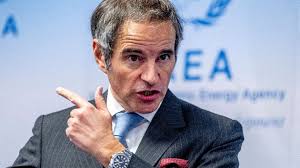
Rafael Grossi, director General of the International Atomic Energy Agency (IAEA), allowed the IAEA to be used by the United States and Israel—an undeclared nuclear weapons state in long-term violation of IAEA rules—to manufacture a pretext for war on Iran, despite his agency’s own conclusion that Iran had no nuclear weapons program.
Israel began working on a nuclear weapon in the 1950s, with substantial help from Western countries, including France, Britain and Argentina, and made its first weapons in 1966 or 1967. By 2015, when Iran signed the JCPOA nuclear agreement, former Secretary of State Colin Powell wrote in a leaked email that a nuclear weapon would be useless to Iran because “Israel has 200, all targeted on Tehran.”
The agency’s chief has not only continued its subservience to U.S. and Western interests, but also its practice of turning a blind eye to Israel’s nuclear weapons.
Medea BenjaminNicolas J.S. Davies, Jun 23, 2025, https://www.commondreams.org/opinion/how-the-us-and-israel-used-rafael-grossi-to-hijack-the-iaea-and-start-a-war-on-iran
Rafael Grossi, director General of the International Atomic Energy Agency (IAEA), allowed the IAEA to be used by the United States and Israel—an undeclared nuclear weapons state in long-term violation of IAEA rules—to manufacture a pretext for war on Iran, despite his agency’s own conclusion that Iran had no nuclear weapons program.
On June 12th, based on a damning report by Grossi, a slim majority of the IAEA Board of Governors voted to find Iran in non-compliance with its obligations as an IAEA member. Of the 35 countries represented on the Board, only 19 voted for the resolution, while 3 voted against it, 11 abstained and 2 did not vote.
Rafael Grossi, director General of the International Atomic Energy Agency (IAEA), allowed the IAEA to be used by the United States and Israel—an undeclared nuclear weapons state in long-term violation of IAEA rules—to manufacture a pretext for war on Iran, despite his agency’s own conclusion that Iran had no nuclear weapons program.
On June 12th, based on a damning report by Grossi, a slim majority of the IAEA Board of Governors voted to find Iran in non-compliance with its obligations as an IAEA member. Of the 35 countries represented on the Board, only 19 voted for the resolution, while 3 voted against it, 11 abstained and 2 did not vote.
Without you, Common Dreams simply wouldn’t exist.
In a moment that demands fearless reporting, Common Dreams needs your support to keep our independent journalism alive.
about:blank
The United States contacted eight board member governments on June 10th to persuade them to either vote for the resolution or not to vote. Israeli officials said they saw the U.S. arm-twisting for the IAEA resolution as a significant signal of U.S. support for Israel’s war plans, revealing how much Israel valued the IAEA resolution as diplomatic cover for the war.
The IAEA board meeting was timed for the final day of President Trump’s 60-day ultimatum to Iran to negotiate a new nuclear agreement. Even as the IAEA board voted, Israel was loading weapons, fuel and drop-tanks on its warplanes for the long flight to Iran and briefing its aircrews on their targets. The first Israeli air strikes hit Iran at 3 a.m. that night.
On June 20th, Iran filed a formal complaint against Director General Grossi with the UN Secretary General and the UN Security Council for undermining his agency’s impartiality, both by his failure to mention the illegality of Israel’s threats and uses of force against Iran in his public statements and by his singular focus on Iran’s alleged violations.
The source of the IAEA investigation that led to this resolution was a 2018 Israeli intelligence report that its agents had identified three previously undisclosed sites in Iran where Iran had conducted uranium enrichment prior to 2003. In 2019, Grossi opened an investigation, and the IAEA eventually gained access to the sites and detected traces of enriched uranium..
Despite the fateful consequences of his actions, Grossi has never explained publicly how the IAEA can be sure that Israel’s Mossad intelligence agency or its Iranian collaborators, such as the Mojahedin-e-Khalq (or MEK), did not put the enriched uranium in those sites themselves, as Iranian officials have suggested.
While the IAEA resolution that triggered this war dealt only with Iran’s enrichment activities prior to 2003, U.S. and Israeli politicians quickly pivoted to unsubstantiated claims that Iran was on the verge of making a nuclear weapon. U.S. intelligence agencies had previously reported that such a complex process would take up to three years, even before Israel and the United States began bombing and degrading Iran’s existing civilian nuclear facilities.
The IAEA’s previous investigations into unreported nuclear activities in Iran were officially completed in December 2015, when IAEA Director General Yukiya Amano published its “Final Assessment on Past and Present Outstanding Issues regarding Iran’s Nuclear Program.”
The IAEA assessed that, while some of Iran’s past activities might have been relevant to nuclear weapons, they “did not advance beyond feasibility and scientific studies, and the acquisition of certain relevant technical competences and capabilities.” The IAEA “found no credible indications of the diversion of nuclear material in connection with the possible military dimensions to Iran’s nuclear program.”
When Yukiya Amano died before the end of his term in 2019, Argentinian diplomat Rafael Grossi was appointed IAEA Director General. Grossi had served as Deputy Director General under Amano and, before that, as Chief of Staff under Director General Mohamed ElBaradei.
The Israelis have a long record of fabricating false evidence about Iran’s nuclear activities, like the notorious “laptop documents” given to the CIA by the MEK in 2004 and believed to have been created by the Mossad. Douglas Frantz, who wrote a report on Iran’s nuclear program for the Senate Foreign Relations Committee in 2009, revealed that the Mossad created a special unit in 2003 to provide secret briefings on Iran’s nuclear program, using “documents from inside Iran and elsewhere.”
And yet Grossi collaborated with Israel to pursue its latest allegations. After several years of meetings in Israel and negotiations and inspections in Iran, he wrote his report to the IAEA Board of Governors and scheduled a board meeting to coincide with the planned start date for Israel’s war.
Israel made its final war preparations in full view of the satellites and intelligence agencies of the western countries that drafted and voted for the resolution. It is no wonder that 13 countries abstained or did not vote, but it is tragic that more neutral countries could not find the wisdom and courage to vote against this insidious resolution.
The official purpose of the International Atomic Energy Agency, or IAEA, is “to promote the safe, secure and peaceful use of nuclear technologies.” Since 1965, all of its 180 member countries have been subject to IAEA safeguards to ensure that their nuclear programs are “not used in such a way as to further any military purpose.”
The IAEA’s work is obviously compromised in dealing with countries that already have nuclear weapons. North Korea withdrew from the IAEA in 1994, and from all safeguards in 2009. The United States, Russia, the United Kingdom, France and China have IAEA safeguard agreements that are based only on “voluntary offers” for “selected” non-military sites. India has a 2009 safeguard agreement that requires it to keep its military and civilian nuclear programs separate, and Pakistan has 10 separate safeguard agreements, but only for civilian nuclear projects, the latest being from 2017 to cover two Chinese-built power stations.
Israel, however, has only a limited 1975 safeguards agreement for a 1955 civilian nuclear cooperation agreement with the United States. An addendum in 1977 extended the IAEA safeguards agreement indefinitely, even though the cooperation agreement with the U.S. that it covered expired four days later. So, by a parody of compliance that the United States and the IAEA have played along with for half a century, Israel has escaped the scrutiny of IAEA safeguards just as effectively as North Korea.
Israel began working on a nuclear weapon in the 1950s, with substantial help from Western countries, including France, Britain and Argentina, and made its first weapons in 1966 or 1967. By 2015, when Iran signed the JCPOA nuclear agreement, former Secretary of State Colin Powell wrote in a leaked email that a nuclear weapon would be useless to Iran because “Israel has 200, all targeted on Tehran.” Powell quoted former Iranian President Mahmoud Ahmadinejad asking, “What would we do with a nuclear weapon? Polish it?”
In 2003, while Powell tried but failed to make a case for war on Iraq to the UN Security Council, President Bush smeared Iran, Iraq and North Korea as an “axis of evil,” based on their alleged pursuit of “weapons of mass destruction.” The Egyptian IAEA Director, Mohamed ElBaradei, repeatedly assured the Security Council that the IAEA could find no evidence that Iraq was developing a nuclear weapon.
When the CIA produced a document that showed Iraq importing yellowcake uranium from Niger, just as Israel had secretly imported it from Argentina in the 1960s, the IAEA only took a few hours to recognize the document as a forgery, which ElBaradei immediately reported to the Security Council.
Rafael Grossi, director General of the International Atomic Energy Agency (IAEA), allowed the IAEA to be used by the United States and Israel—an undeclared nuclear weapons state in long-term violation of IAEA rules—to manufacture a pretext for war on Iran, despite his agency’s own conclusion that Iran had no nuclear weapons program.
On June 12th, based on a damning report by Grossi, a slim majority of the IAEA Board of Governors voted to find Iran in non-compliance with its obligations as an IAEA member. Of the 35 countries represented on the Board, only 19 voted for the resolution, while 3 voted against it, 11 abstained and 2 did not vote.
Without you, Common Dreams simply wouldn’t exist.
In a moment that demands fearless reporting, Common Dreams needs your support to keep our independent journalism alive.
about:blank
The United States contacted eight board member governments on June 10th to persuade them to either vote for the resolution or not to vote. Israeli officials said they saw the U.S. arm-twisting for the IAEA resolution as a significant signal of U.S. support for Israel’s war plans, revealing how much Israel valued the IAEA resolution as diplomatic cover for the war.
The IAEA board meeting was timed for the final day of President Trump’s 60-day ultimatum to Iran to negotiate a new nuclear agreement. Even as the IAEA board voted, Israel was loading weapons, fuel and drop-tanks on its warplanes for the long flight to Iran and briefing its aircrews on their targets. The first Israeli air strikes hit Iran at 3 a.m. that night.
On June 20th, Iran filed a formal complaint against Director General Grossi with the UN Secretary General and the UN Security Council for undermining his agency’s impartiality, both by his failure to mention the illegality of Israel’s threats and uses of force against Iran in his public statements and by his singular focus on Iran’s alleged violations.
The source of the IAEA investigation that led to this resolution was a 2018 Israeli intelligence report that its agents had identified three previously undisclosed sites in Iran where Iran had conducted uranium enrichment prior to 2003. In 2019, Grossi opened an investigation, and the IAEA eventually gained access to the sites and detected traces of enriched uranium.
Despite the fateful consequences of his actions, Grossi has never explained publicly how the IAEA can be sure that Israel’s Mossad intelligence agency or its Iranian collaborators, such as the Mojahedin-e-Khalq (or MEK), did not put the enriched uranium in those sites themselves, as Iranian officials have suggested.
While the IAEA resolution that triggered this war dealt only with Iran’s enrichment activities prior to 2003, U.S. and Israeli politicians quickly pivoted to unsubstantiated claims that Iran was on the verge of making a nuclear weapon. U.S. intelligence agencies had previously reported that such a complex process would take up to three years, even before Israel and the United States began bombing and degrading Iran’s existing civilian nuclear facilities.
The IAEA’s previous investigations into unreported nuclear activities in Iran were officially completed in December 2015, when IAEA Director General Yukiya Amano published its “Final Assessment on Past and Present Outstanding Issues regarding Iran’s Nuclear Program.”
The IAEA assessed that, while some of Iran’s past activities might have been relevant to nuclear weapons, they “did not advance beyond feasibility and scientific studies, and the acquisition of certain relevant technical competences and capabilities.” The IAEA “found no credible indications of the diversion of nuclear material in connection with the possible military dimensions to Iran’s nuclear program.”
When Yukiya Amano died before the end of his term in 2019, Argentinian diplomat Rafael Grossi was appointed IAEA Director General. Grossi had served as Deputy Director General under Amano and, before that, as Chief of Staff under Director General Mohamed ElBaradei.
The Israelis have a long record of fabricating false evidence about Iran’s nuclear activities, like the notorious “laptop documents” given to the CIA by the MEK in 2004 and believed to have been created by the Mossad. Douglas Frantz, who wrote a report on Iran’s nuclear program for the Senate Foreign Relations Committee in 2009, revealed that the Mossad created a special unit in 2003 to provide secret briefings on Iran’s nuclear program, using “documents from inside Iran and elsewhere.”
And yet Grossi collaborated with Israel to pursue its latest allegations. After several years of meetings in Israel and negotiations and inspections in Iran, he wrote his report to the IAEA Board of Governors and scheduled a board meeting to coincide with the planned start date for Israel’s war.
Israel made its final war preparations in full view of the satellites and intelligence agencies of the western countries that drafted and voted for the resolution. It is no wonder that 13 countries abstained or did not vote, but it is tragic that more neutral countries could not find the wisdom and courage to vote against this insidious resolution.
The official purpose of the International Atomic Energy Agency, or IAEA, is “to promote the safe, secure and peaceful use of nuclear technologies.” Since 1965, all of its 180 member countries have been subject to IAEA safeguards to ensure that their nuclear programs are “not used in such a way as to further any military purpose.”
The IAEA’s work is obviously compromised in dealing with countries that already have nuclear weapons. North Korea withdrew from the IAEA in 1994, and from all safeguards in 2009. The United States, Russia, the United Kingdom, France and China have IAEA safeguard agreements that are based only on “voluntary offers” for “selected” non-military sites. India has a 2009 safeguard agreement that requires it to keep its military and civilian nuclear programs separate, and Pakistan has 10 separate safeguard agreements, but only for civilian nuclear projects, the latest being from 2017 to cover two Chinese-built power stations.
Israel, however, has only a limited 1975 safeguards agreement for a 1955 civilian nuclear cooperation agreement with the United States. An addendum in 1977 extended the IAEA safeguards agreement indefinitely, even though the cooperation agreement with the U.S. that it covered expired four days later. So, by a parody of compliance that the United States and the IAEA have played along with for half a century, Israel has escaped the scrutiny of IAEA safeguards just as effectively as North Korea.
Israel began working on a nuclear weapon in the 1950s, with substantial help from Western countries, including France, Britain and Argentina, and made its first weapons in 1966 or 1967. By 2015, when Iran signed the JCPOA nuclear agreement, former Secretary of State Colin Powell wrote in a leaked email that a nuclear weapon would be useless to Iran because “Israel has 200, all targeted on Tehran.” Powell quoted former Iranian President Mahmoud Ahmadinejad asking, “What would we do with a nuclear weapon? Polish it?”
In 2003, while Powell tried but failed to make a case for war on Iraq to the UN Security Council, President Bush smeared Iran, Iraq and North Korea as an “axis of evil,” based on their alleged pursuit of “weapons of mass destruction.” The Egyptian IAEA Director, Mohamed ElBaradei, repeatedly assured the Security Council that the IAEA could find no evidence that Iraq was developing a nuclear weapon.
When the CIA produced a document that showed Iraq importing yellowcake uranium from Niger, just as Israel had secretly imported it from Argentina in the 1960s, the IAEA only took a few hours to recognize the document as a forgery, which ElBaradei immediately reported to the Security Council.
Bush kept repeating the lie about yellowcake from Niger, and other flagrant lies about Iraq, and the United States invaded and destroyed Iraq based on his lies, a war crime of historic proportions. Most of the world knew that ElBaradei and the IAEA were right all along, and, in 2005, they were awarded the Nobel Peace Prize, for exposing Bush’s lies, speaking truth to power and strengthening nuclear non-proliferation.
In 2007, a U.S. National Intelligence Estimate (NIE) by all 16 U.S. intelligence agencies agreed with the IAEA’s finding that Iran, like Iraq, had no nuclear weapons program. As Bush wrote in his memoirs, “…after the NIE, how could I possibly explain using the military to destroy the nuclear facilities of a country the intelligence community said had no active nuclear weapons program?” Even Bush couldn’t believe he would get away with recycling the same lies to destroy Iran as well as Iraq, and Trump is playing with fire by doing so now.
ElBaradei wrote in his own memoir, The Age of Deception: Nuclear Diplomacy in Treacherous Times, that if Iran did do some preliminary research on nuclear weapons, it probably began during the Iran-Iraq War in the 1980s, after the US and its allies helped Iraq to manufacture chemical weapons that killed up to 100,000 Iranians.
The neocons who dominate U.S. post-Cold War foreign policy viewed the Nobel Prize winner ElBaradei as an obstacle to their regime change ambitions around the world, and conducted a covert campaign to find a more compliant new IAEA Director General when his term expired in 2009.
After Japanese diplomat Yukiya Amano was appointed as the new Director General, U.S. diplomatic cables published by Wikileaks revealed details of his extensive vetting by U.S. diplomats, who reported back to Washington that Amano “was solidly in the U.S. court on every key strategic decision, from high-level personnel appointments to the handling of Iran’s alleged nuclear weapons program.”
After becoming IAEA Director General in 2019, Rafael Grossi not only continued the IAEA’s subservience to U.S. and Western interests and its practice of turning a blind eye to Israel’s nuclear weapons, but also ensured that the IAEA played a critical role in Israel’s march to war on Iran.
Even as he publicly acknowledged that Iran had no nuclear weapons program and that diplomacy was the only way to resolve the West’s concerns about Iran, Grossi helped Israel to set the stage for war by reopening the IAEA’s investigation into Iran’s past activities. Then, on the very day that Israeli warplanes were being loaded with weapons to bomb Iran, he made sure that the IAEA Board of Governors passed a resolution to give Israel and the U.S. the pretext for war that they wanted.
In his last year as IAEA Director, Mohamed ElBaradei faced a similar dilemma to the one that Grossi has faced since 2019. In 2008, U.S. and Israeli intelligence agencies gave the IAEA copies of documents that appeared to show Iran conducting four distinct types of nuclear weapons research.
Whereas, in 2003, Bush’s yellowcake document from Niger was clearly a forgery, the IAEA could not establish whether the Israeli documents were authentic or not. So ElBaradei refused to act on them or to make them public, despite considerable political pressure, because, as he wrote in The Age of Deception, he knew the U.S. and Israel “wanted to create the impression that Iran presented an imminent threat, perhaps preparing the grounds for the use of force.” ElBaradei retired in 2009, and those allegations were among the “outstanding issues” that he left to be resolved by Yukiya Amano in 2015.
If Rafael Grossi had exercised the same caution, impartiality and wisdom as Mohamed ElBaradei did in 2009, it is very possible that the United States and Israel would not be at war with Iran today.
Mohamed ElBaradei wrote in a tweet on June 17th 2025, “To rely on force and not negotiations is a sure way to destroy the NPT and the nuclear non-proliferation regime (imperfect as it is), and sends a clear message to many countries “that their ‘ultimate security’ is to develop nuclear weapons!!!”
Despite Grossi’s role in U.S.-Israeli war plans as IAEA Director General, or maybe because of it, he has been touted as a Western-backed candidate to succeed Antonio Guterres as UN Secretary General in 2026. That would be a disaster for the world. Fortunately, there are many more qualified candidates to lead the world out of the crisis that Rafael Grossi has helped the U.S. and Israel to plunge it into.
Rafael Grossi should resign as IAEA Director before he further undermines nuclear non-proliferation and drags the world any closer to nuclear war. And he should also withdraw his name from consideration as a candidate for UN Secretary General.
US strikes on Iran’s nuclear sites ‘marks perilous turn’: Diplomacy must prevail, says Guterres
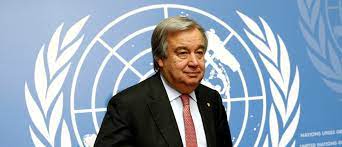
United Nations, 22 June 25
The UN Secretary-General António Guterres told an emergency meeting of the Security Council on Sunday that massive overnight strikes by the United States on Iran’s nuclear facilities only increase the risk of a wider war and “serious damage to the international order.”
After ten days of airstrikes initiated by Israel aimed at crippling Iran’s nuclear programme which have led to deadly daily exchanges of missile fire between Tehran and Tel Aviv, the UN chief said that diplomacy must now prevail.
“We now risk descending into a rathole of retaliation after retaliation,” he said, responding to the US intervention overnight in support of Israel’s military campaign, which targeted three facilities involved in uranium enrichment.
Return to serious negotiations essential
“We must act – immediately and decisively – to halt the fighting and return to serious, sustained negotiations on the Iran nuclear programme,” Mr. Guterres added.
He told ambassadors the citizens of the wider Middle East region could not endure yet another cycle of destruction. Demanding a ceasefire, he also put Iran on notice that it must “fully respect” the Non-Proliferation Treaty on the development of nuclear weapons as a cornerstone of peace and security worldwide.
Iran has consistently denied the allegation from Israel and others that its ambitions are to become a nuclear armed State, versus developing atomic energy for purely peaceful purposes.
Israel, the US and Iran face a stark choice. “One path leads to a wider war,” the UN chief continued, “deeper human suffering and serious damage to the international order. The other leads to de-escalation, diplomacy and dialogue.”……………………
…………………………………………………………………………………https://news.un.org/en/story/2025/06/1164756
Why does the U.S. get to play nuclear cop?
24 June 2025 Michael Taylor, https://theaimn.net/why-does-the-u-s-get-to-play-nuclear-cop/
I’ve always wondered why the U.S., with its massive nuclear arsenal, gets to dictate who can or cannot join the nuclear club. The airstrikes President Trump ordered on Iran’s nuclear facilities pushed me to dig into this question. Spoiler: it’s less about fairness… it’s more about power.
The Unequal Nuclear Order
The U.S. was the first to build the bomb and is one of five “recognised” nuclear powers under the 1968 Nuclear Non-Proliferation Treaty (NPT), alongside Russia, China, France, and the UK. These nations, permanent UN Security Council members with veto power, hold sway over global security rules. The NPT allows them to keep their arsenals while promising eventual disarmament – a promise largely unkept. Non-nuclear signatories agree not to develop weapons in exchange for peaceful nuclear tech, but the deal feels rigged when the “haves” modernise their stockpiles.
The U.S., with roughly 3,708 warheads leads this unequal system. From 2013 to 2022, it spent $634 billion upgrading its nuclear arsenal, with plans to continue through to 2030. Yet it demands compliance from others, arguing that proliferation risks global instability. Fair? Hardly.
Iran and U.S. Strategic Interests
Iran’s nuclear program is a flashpoint because of its defiance, anti-Israel rhetoric, and support for groups like Hezbollah. The U.S. and allies – particularly Israel and Saudi Arabia – see a nuclear-armed Iran as a threat to Middle East power dynamics. U.S. airstrikes on Iran’s nuclear facilities, framed as preventing NPT violations, aimed to delay Tehran’s nuclear ambitions. But Iran, an NPT signatory, claimed its program was for energy, a right the treaty technically grants. It is worth noting that the U.S.’s 2018 withdrawal (under Trump) from the Joint Comprehensive Plan of Action (JCPOA) nuclear deal – ”an agreement to limit the Iranian nuclear program in return for sanctions relief” – undermined diplomacy, pushing Iran toward escalation.
Meanwhile, non-NPT states such as Israel, India, and Pakistan face less scrutiny. Israel’s nuclear arsenal and U.S. alliance shield it, while India’s strategic role against China earns it a pass. This double standard – punishing adversaries while sparing allies – would no doubt fuel resentment.
Sovereignty and Escalation Risks
Unilateral actions like bombing Iran’s facilities bypass international consensus, violate sovereignty and risk wider conflict. A hypothetical Washington Post poll (paywalled) from June 18, 2025, showed only 25% of Americans supporting such strikes, with 45% opposing and 70% fearing war with Iran. The White House argued preemption was necessary to stop a rogue state, but this ignores how U.S. policies, like JCPOA abandonment, escalate tensions.
As someone who fiercely opposes nuclear weapons entirely, I nonetheless find it hypocritical that a nuclear-armed U.S. polices others for seeking the same leverage. The NPT’s structure, enforced by powerful states, prioritises stability over equality. The U.S. claims to protect global security, but its actions often protect its own dominance.
A Path Forward
The nuclear order needs reform. Instead of airstrikes or sanctions, the U.S. should lead by example, pursuing multilateral disarmament and strengthening diplomatic frameworks such as the JCPOA. Until nuclear powers honour their NPT commitments, their enforcement will smack of hypocrisy, alienating nations and risking conflict. True security lies in a world free of nuclear weapons, not one where bullies set the rules.
Trump claims ceasefire reached between Israel and Iran.

US president congratulates Iran and Israel on truce deal, but neither country has confirmed agreement to end war.
23 Jun 2025, https://www.aljazeera.com/news/2025/6/23/trump-claims-ceasefire-reached-between-israel-and-iran
United States President Donald Trump says that Iran and Israel have agreed to a “complete and total” ceasefire, which will come into effect in the coming hours.
Trump’s announcement on Monday came shortly after an Iranian missile attack on Al Udeid Air Base in Qatar, which houses US troops.
“On the assumption that everything works as it should, which it will, I would like to congratulate both Countries, Israel and Iran, on having the Stamina, Courage, and Intelligence to end, what should be called, ‘THE 12 DAY WAR,’” Trump said in a social media post.
“This is a War that could have gone on for years, and destroyed the entire Middle East, but it didn’t, and never will! God bless Israel, God bless Iran, God bless the Middle East, God bless the United States of America, and GOD BLESS THE WORLD!”
Neither Israel nor Iran has confirmed the agreement.
Trump’s statement suggested that Iran would stop firing at Israel hours before the Israeli military ends its operations.
Reporting from Tehran, Al Jazeera’s Tohid Asadi noted that there has not been an official confirmation of the deal more than an hour after Trump’s announcement.
“Just a few minutes ago, we heard the sounds of explosions related to an interception and the activation of the air defence system here across the capital,” Asadi said.
“So the reality on the ground is that we are witnessing the continuation of the Israeli strikes, and that’s paving the way for further retaliatory reactions by the Iranian side.”
Middle East analyst Omar Rahman told Al Jazeera that many details are missing from Trump’s announcement, including whether negotiations would follow the purported ceasefire.
Rahman accused Trump of previous “deception” on behalf of Israel. The US president had re-asserted the US commitment to diplomacy hours before Israel launched its initial attack on Iran.
Last week, Trump said he would decide within two weeks whether to join Israel in the war, only to strike Iran two days later.
Rahman said a major Israeli attack in the final hours, including the possible assassination of Iranian Supreme Leader Ayatollah Ali Khamenei could blow up the deal.
“If that’s the last operation, would that suddenly end the war? No, of course, not. So, I don’t know what’s in the cards,” he said.
Israel launched a massive attack against Iran in the early hours of June 13, without direct provocation. Israeli officials claimed that the strikes, which killed hundreds of people, were “preemptive” and aimed at the country’s nuclear and missile programmes.
In the first wave of the attacks, Israel killed several Iranian generals.
Iran said the attacks were unprovoked aggression in violation of the United Nations Charter, and responded with hundreds of missiles that left widespread destruction inside Israel.
On Saturday, Trump authorised US strikes on three Iranian nuclear facilities.
Earlier on Monday, Iran launched an unprecedented missile attack at Al Udeid Air Base in Qatar in response to the US strikes. Trump dismissed the retaliation as “weak”, suggesting that the US would not respond.
Liqaa Maki, a scholar at Al Jazeera Media Institute, said the US may be able to withstand Iranian attacks on its bases without responding if they do not cause casualties.
“The US, after the important strike on Iran’s nuclear facilities, needs to transform the military achievement into a political one enshrined by an agreement,” Maki told Al Jazeera Arabic after the Iranian attack.
He noted that Iran still has large quantities of highly enriched uranium as well as nuclear know-how.
“So in two to three years, Iran could resume its nuclear activity but without inspections. It could produce a bomb without the world noticing,” Maki said.
The damage that the Iranian nuclear programme has sustained remains unclear. Iran insists that it is not pursuing a nuclear weapon, while Israel is widely believed to have an undeclared nuclear arsenal.
Trump Suggests He Wants Regime Change in Iran
The president previously threatened Iran’s leader, claiming the US knew his location
by Dave DeCamp | Jun 22, 2025, https://news.antiwar.com/2025/06/22/trump-suggests-he-wants-regime-change-in-iran/
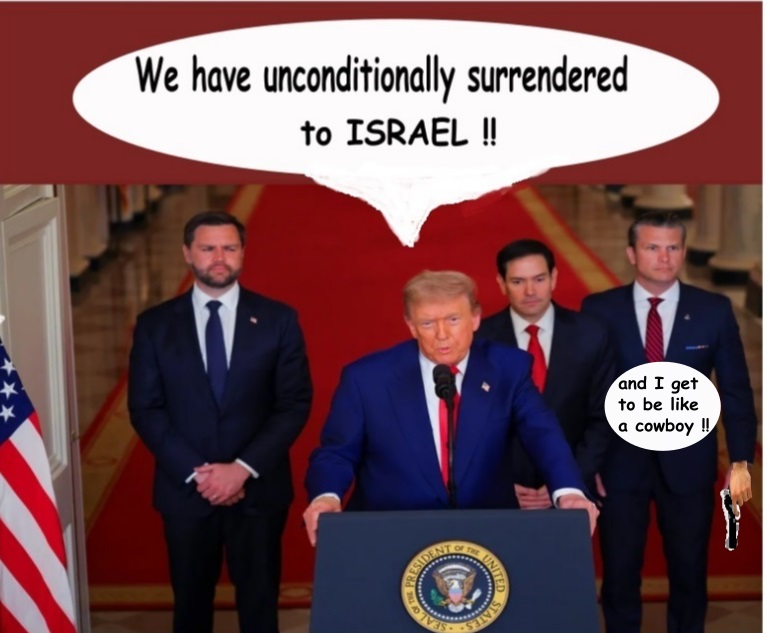
President Trump suggested in a Truth Social post on Sunday that he seeks regime change in Iran, contradicting earlier statements from top US officials who denied that was the goal of the US military campaign against the country.
“It’s not politically correct to use the term, ‘Regime Change,’ but if the current Iranian Regime is unable to MAKE IRAN GREAT AGAIN, why wouldn’t there be a Regime change??? MIGA!!!” the president wrote.
In the morning, Secretary of Defense Pete Hegseth insisted the US bombing of Iran’s nuclear facilities and support for Israel’s attacks on the country have “not been about regime change.” But Trump’s post suggests that regime change is the goal and that the administration’s calls for diplomacy with Iran continue to be a smokescreen.
Last week, President Trump threatened Iranian Supreme Leader Ayatollah Ali Khamenei, suggesting the US was aware of his location. “We know exactly where the so-called ‘Supreme Leader’ is hiding. He is an easy target, but is safe there – We are not going to take him out (kill!), at least not for now,” he said.
Israeli Prime Minister Benjamin Netanyahu has made it increasingly clear that his goal is regime change. He insisted last week that killing Khamenei would “end the conflict” with Iran.
Many observers have pointed to the fact that Netanyahu was a major proponent of the US invasion of Iraq and promised that taking out Saddam Hussein would have a positive impact on the region. “If you take out Saddam, Saddam’s regime, I guarantee you that it will have enormous positive reverberations on the region,” he told Congress in 2002.
Israeli Defense Minister Israel Katz has also threatened Khamenei, saying the Iranian leader “cannot continue to exist.”
Trump speculates about ‘regime change’ in Iran as Tehran vows ‘decisive response’ to US attack
23 June 25, https://www.bbc.co.uk/news/live/cn7ze4vmk2pt
- Donald Trump has floated the possibility of leadership change in Iran, hours after his team said replacing the Iranian government was not the aim of US attacks
- Iran’s military vows a “decisive response” after Trump says US strikes caused “monumental damage” to Iranian nuclear sites – the UN’s nuclear watchdog calls for a ceasefire in order to inspect the damage
Israel’s military is striking Tehran with “unprecedented force”, the country’s defence minister says, after “one of the most intense attacks” on Iran’s military infrastructure overnight- Iran’s foreign minister is in Moscow for talks with Putin about “common challenges and threats” – the UK’s foreign secretary is among those urging Iran not to escalate its response
- Elsewhere the US asks China to put pressure on Iran not to close the Strait of Hormuz, a critical shipping route
Australia backs US strikes on Iran while urging return to diplomacy
Australia’s explicit expression of support for the strikes goes a step further than allies including the UK, Canada and New Zealand
By political reporter Tom Crowley ABC News 23 June 25
In short:
Australia has given its support to US strikes on Iranian nuclear facilities but has repeated calls for de-escalation to avoid a wider war.
Penny Wong said Australia had not received a request for assistance and declined to speculate on how any request would be met.
What’s next?
A National Security Meeting was held in Canberra on Monday morning.
Australia has given its support to US strikes on Iranian nuclear facilities but has repeated calls for de-escalation to avoid a wider war.
Prime Minister Anthony Albanese said on Monday Australia was in favour of action to prevent Iran getting a nuclear weapon, echoing comments made earlier on Monday by Foreign Minister Penny Wong.
“The world has long agreed Iran cannot be allowed to get a nuclear weapon, and we support action to prevent that. That is what this is,” the PM told reporters.
The government initially adopted a more cautious tone, declining to give its explicit support.
Senator Wong said Australia had not received a request for assistance and emphasised the US action was “unilateral” when asked whether Pine Gap, a shared military facility, had been engaged.
While the PM and foreign minister declined to speculate on the response to any such request, Mr Albanese said Australia was “deeply concerned” about the prospect of escalation, placing the onus on Iran.
“We want to see diplomacy, dialogue and de-escalation … Iran had an opportunity to comply, they chose not to and there have been consequences of that,” he said.
Earlier, Senator Wong cited a UN watchdog finding that Iran had acquired enriched uranium at “almost military level”.
“The key question for the international community is what happens next … It’s obviously a very precarious, risky and dangerous moment the world faces,” she said.
The National Security Committee, comprised of key ministers, met in Canberra this morning.
Australia’s explicit expression of support for the strikes goes a step further than allies including the UK, Canada and New Zealand, although all three countries have emphasised the risk of Iran gaining nuclear weapons.
Opposition supports strike, Greens opposed
The Coalition supported the strikes on Sunday and also says it does not want further war, but has put the onus on Iran to negotiate peace.
“We want to see Iran come to the negotiating table to verify where that 400 kilos of enriched uranium is,” Andrew Hastie told ABC Radio National……………………………………..
Dave Sharma, a Liberal senator and former Australian ambassador to Israel, said the government’s response was “underwhelming and perplexing” on Sunday and that support for the strikes “should be a straightforward position for Australia to adopt”.
The Greens are against the strike, with defence spokesperson David Shoebridge calling Donald Trump a “warmonger” and demanding Australia clarify it will not get involved.
“You cannot bomb your way to peace … and the people who are always going to pay the price are the ordinary people on the street,” he said.
……………………………………………….. Five Eyes partners respond
UK Prime Minister Keir Starmer spoke to Mr Trump via phone, emphasising the “grave risk” of Iran’s nuclear program and placing the onus on Iran “returning to the negotiating table as soon as possible”, according to a readout of the call.
A joint statement from the UK, France, Germany and Italy urged Iran not to “take any further action that could destabilise the region” but did not include an explicit position on the strike.
The New Zealand government has “acknowledged” the strike, and called for diplomacy, Foreign Minister Winston Peters saying “ongoing military action in the Middle East is extremely worrying”.
Canadian PM Mark Carney said Iran should not be allowed to obtain a nuclear weapon and that the US strike “was designed to alleviate that threat”, but stopped short of explicitly endorsing it and called for “all parties” to return to the negotiating table. https://www.abc.net.au/news/2025-06-23/australia-backs-us-strikes/105448088
Israeli and U.S. intelligence differ on status of Iran’s nuclear program.
Israeli Prime Minister Benjamin Netanyahu has argued for decades that Iran
was on the verge of producing a nuclear weapon. And he ordered the attack
on Iran because he believed Tehran was “marching very quickly” toward a
bomb. “The intel we got and we shared with the United States was absolutely
clear, was absolutely clear that they [the Iranians] were working, in a
secret plan, to weaponize the uranium,” Netanyahu said in an interview with
Fox News.
However, the U.S. intelligence community has long had a somewhat
different interpretation. The Americans say Iran suspended its nuclear
weapons program in 2003, shortly after the U.S. invaded Iraq. While Iraq
did not have the weapons of mass destruction the U.S. claimed, the invasion
of a neighboring country appeared to rattle Iran, believing it too could
face a U.S. incursion.
NPR 18th June 2025 https://www.npr.org/2025/06/18/nx-s1-5436758/israel-and-u-s-intelligence-differ-on-status-of-irans-nuclear-program-whos-right
Israel publicly confirms its military involvement in Ukraine
Lucas Leiroz. June 13, 2025, Strategic Culture Foundation,
In the end, the Zionist entity and the Kiev regime are instruments of the same Western hegemony project
While global attention remains focused on the rising tensions between Israel and Iran, a significant development has been largely ignored by Western media in recent days: the revelation of Israel’s involvement in the arming campaign for Ukraine.
Despite publicly maintaining an appearance of military neutrality in the conflict between Moscow and Kiev, the State of Israel has quietly deepened its collaboration with Western military interests in Ukraine. Recent statements from Israeli diplomatic representatives make it clear that Tel Aviv not only politically supports Kiev but also directly participates in the military effort against Russia.
In an interview with Ukrainian media, the Israeli ambassador in Kiev confirmed that air defense systems originally supplied by the United States to Israel were transferred to Ukraine. According to him, the delivery was deliberately kept secret and away from international headlines, demonstrating Israel’s attempt to participate in the conflict without attracting negative consequences.
The omission of logistical details about the delivery reveals a clear attempt to preserve an appearance of neutrality before the public. It remains unclear whether the equipment was sent directly by Israel or through third parties, suggesting an internationally coordinated operation to avoid diplomatic friction with Moscow.
Until recently, Tel Aviv claimed a stance of non-involvement in the Ukraine conflict, citing concerns about potential Russian retaliation—particularly in Syria, where Russian forces maintain a strategic presence. However, this justification is becoming increasingly obsolete in light of Israel’s actual behavior…………………………………..
The recent neutralization of Shiite militias in Syria, which were aligned with Tehran, and the rapprochement between the new Syrian government and Israel have created a more favorable environment for Tel Aviv’s foreign military maneuvers. Feeling less vulnerable to indirect retaliation, Israel now appears more willing to expand its involvement in conflicts beyond the Middle East, such as the one in Ukraine……………………………………………..
Israel’s decision to more openly support the Kiev regime marks a significant shift in its foreign policy, abandoning previous caution in favor of a stance more aligned with the interests of the Collective West. However, this move may bring unforeseen consequences — not only at the regional level but also in the structure of its bilateral relationship with Moscow…………………………. https://strategic-culture.su/news/2025/06/13/israel-publicly-confirms-its-military-involvement-in-ukraine/
Trump Praises ‘Excellent’ Israeli Strikes on Iran.

A source said Washington provided Tel Aviv with “exquisite” intel for the assault
by Kyle Anzalone | Jun 13, 2025, https://news.antiwar.com/2025/06/13/trump-praises-excellent-israeli-strikes-on-iran/
President Donald Trump endorsed the massive Israeli strike on Iran early on Friday morning, calling the attack “excellent.” A source explained that the US provided Israel with intelligence for the operation.
Speaking with ABC News on the phone following the Israeli strikes across the Islamic Republic, Trump said, “I think it’s been excellent.” He continued, “We gave them a chance and they didn’t take it. They got hit hard, very hard. They got hit about as hard as you’re going to get hit. And there’s more to come. A lot more.”
Trump refused to provide details about the US role in the attack, saying, “I don’t want to comment on that.”
However, elements of Washington’s support for Tel Aviv are becoming public. Israeli officials told the Jerusalem Post and Axios that the White House helped to create the illusion that the US was still seeking a diplomatic settlement with Iran.
Just hours before the attack, President Trump declared that he was committed to a “Diplomatic Resolution to the Iran Nuclear Issue!” But it appears he had already greenlit the Jewish state’s attack on the Islamic Republic.
A source provided further details of the US support, telling ABC News that Washington provided Tel Aviv with “exquisite” intelligence. Additionally, the source said the US will help Israel defend against any Iranian response.
The Iranian Foreign Ministry said in a statement that it holds the US responsible for the attack. “The Zionist regime’s aggressive actions against Iran cannot have been carried out without the coordination and authorization of the United States. Accordingly, the United States government, as the main supporter of this regime, will also be responsible for the dangerous effects and consequences of the Zionist regime’s adventure,” the ministry said.
Since starting the assault early Friday morning, Israeli forces have delivered multiple rounds of strikes targeting Iranian military sites, nuclear facilities, and residential buildings. Top Iranian nuclear scientists and generals have been confirmed killed.
Tel Aviv said the operation, dubbed “Nation of Lions,” will last several days.
Israel is seeking more support from the US. The Jerusalem Post reports that Israeli Defense Minister Israel Katz will hold a call with Secretary of Defense Pete Hegseth later on Friday to lobby Washington for more military assistance. Additionally, Trump is expected to speak with Israeli Prime Minister Benjamin Netanyahu by phone.
Kyle Anzalone is the opinion editor of Antiwar.com and news editor of the Libertarian Institute. He hosts The Kyle Anzalone Show and is co-host of Conflicts of Interest with Connor Freeman.
Condemning the Right to Self Defence: Iran’s Retaliation and Israel’s Privilege
16 June 2025 Dr Binoy Kampmark , https://theaimn.net/condemning-the-right-to-self-defence-irans-retaliation-and-israels-privilege/
There is a throbbing complaint among Western powers, including those in the European Union and the United States. Iran is not playing by the rules. Instead of accepting with dutiful meekness the slaughter of its military leadership and scientific personnel, Tehran decided, promptly, to respond to Israel’s pre-emptive strikes launched on June 13. Instead of considering the dubious legal implications of such strikes, an act of undeclared war, the focus in the European Union and various other backers of Israel has been to focus on the retaliation itself.
To the Israeli attacks conducted as part of Operation Rising Lion, there was studied silence. It was not a silence observed when it came to the invasion of Ukraine in February 2022 by Vladimir Putin’s Russia. Then, the law books were swiftly procured, and obligations of the United Nations Charter cited under Article 2(4): “All members shall refrain from the threat or use of force against the territorial integrity of any state.” Russia was condemned for adopting a preventive stance on Ukraine as a threat to its security: that, in Kyiv joining NATO, a formidable threat would manifest at the border.
In his statement on the unfolding conflict between Israel and Iran, France’s President Emmanuel Macron made sure to condemn “Iran’s ongoing nuclear program,” having taken “all appropriate diplomatic measures in response.” Israel also had the “right to defend itself and ensure its security,” leaving open the suggestion that it might have been justified resorting to Article 51 of the UN Charter. All he could offer was a call on “all parties to exercise maximum restraint and to de-escalate.”
In a most piquant response, Francesca Albanese, UN Special Rapporteur on the Occupied Palestinian Territories stated that, “On the day Israel, unprovoked, has attacked Iran, killing 80 people, the president of a major European power, finally admits that in the Middle East, Israel, and only Israel, has the right to defend itself.”
The German Foreign Office was even bolder in accusing Iran of having engaged in its own selfish measures of self-defence (such unwarranted bravado!), something it has always been happy to afford Israel. “We strongly condemn the indiscriminate Iranian attack on Israeli territory.” In contrast, the foreign office also felt it appropriate to reference the illegal attack on Iran as involving “targeted strikes” against its nuclear facilities. Despite Israel having an undeclared nuclear weapons stockpile that permanently endangers security in the region, the office went on to chastise Iran for having a nuclear program that violated “the Non-Proliferation Treaty,” threatening in its nature “to the entire region – especially Israel.” Those at fault had been found out.
The President of the EU Commission, Ursula von der Leyen, could hardly improve on that apologia. She revealed that she had been conversing with Israeli President Isaac Herzog about the “escalating situation in the Middle East.” She also knew her priorities: reiterating Israel’s right to self-defence and refusing to mention Iran’s, while tagging on the statement a broader concern for preserving regional stability. The rest involved a reference to diplomacy and de-escalation, toward which Israel has shown a resolute contempt with regards Iran and its nuclear program.
The assessment offered by Mohamed ElBaradei, former Director General of the International Atomic Energy Agency (IAEA), was forensically impressive, as well as being icily dismissive. Not only did he reproach the German response for ignoring the importance of Article 2(4) of the Charter prohibiting the use of force subject to the right to self-defence, he brought up a reminder: targeted strikes against the nuclear facilities of any party “are prohibited under Article 56 of the additional protocol of the Geneva Conventions to which Germany is a party.”
ElBaradei also referred anyone exercised by such matters to the United Nations Security Council 487 (1981), which did not have a single demur in its adoption. It unreservedly condemned the attack by Israel on Iraq’s Osirak nuclear research reactor in June that year as a violation of the UN Charter, recognised that Iraq was a party to the Treaty on the Non-Proliferation of Nuclear Weapons (NPT) and had permitted the IAEA inspections of the facility, stated that Iraq had a right to establish and develop civilian nuclear programs and called on Israel to place its own nuclear facilities under the jurisdictional safeguards of the IAEA.
The calculus regarding the use of force by Israel vis-à-vis its adversaries has long been a sneaky one. It is jigged and rigged in favour of the Jewish state. As Trita Parsi put it with unblemished accuracy, Western pundits had, for a year and a half, stated that Hamas, having started the Gaza War on October 7, 2023 bore responsibility for civilian carnage. “Western pundits for the past 1.5 days: Israel started the war with Iran, and if Iran retaliates, they bear responsibility for civilian deaths.” The perceived barbarian, when attacked by a force seen as superior and civilised, will always be condemned for having reacted most naturally, and most violently of all.
Pacific Rim countries say no to U.S.-China war
The question that the people of the Pacific and Pacific Rim countries are asking is: Why do we have to respond to this demand by the U.S.? We are not threatened by China. Where is the dire urgency that demands such a huge distortion of our public spending on the military?
The indications are that the United States is preparing for war against China, but cannot wage such a war from the West Coast of the USA. It needs military bases, port facilities and airfields in the countries on the west side of the Pacific Rim; for example, South Korea, Japan, the Philippines, Guam, Micronesia and Australia. Without these bases, without the backing of the military forces and munitions and manufacturing capabilities of the Pacific Rim countries, the United States cannot launch and sustain a war against China.
By Bevan Ramsden | 16 June 2025, https://independentaustralia.net/politics/politics-display/pacific-rim-countries-say-no-to-us-china-war,19837
As the U.S. pushes Pacific Rim allies to ramp up military spending for a possible war with China, a new campaign asks: at what cost and for whose benefit? Bevan Ramsden writes.
THE PACIFIC and Pacific Rim countries have a geographical commonality. They are encircled by, or have a border with, the vast, blue, peaceful Pacific Ocean. They also share a political commonality. The people and countries of this region are under pressure to lift their military spending at the expense of addressing their social needs.
The pressure comes from the United States, whose Defence Secretary, Peter Hegseth, at the recent Singapore Defence Summit, declared that the U.S. expects its allies in this region to increase their defence spending to 5% of their GDP. His justification was a “possibly imminent threat” posed by China. He emphasised how the U.S. is “reorienting towards deterring aggression by China” and made it clear that the Donald Trump Administration’s defence strategy revolves around stifling the rise of China.
Responding to this expectation would involve the doubling of South Korean expenditure on military defence, from 2.6% of its GDP to 5%.
It would mean Japan’s military defence spending would have to triple from 1.8 % of its GDP to 5%.
In Australia, such an increase would represent a two-and-a-half times increase from 2% to 5% of its GDP.
These examples show that the 5% target represents a massive increase in military spending, which can only be made by reducing funding for urgent infrastructure, social needs such as health and education and loss of resources to address the real threat to their living environments, the climate crisis.
The question that the people of the Pacific and Pacific Rim countries are asking is: Why do we have to respond to this demand by the U.S.? We are not threatened by China. Where is the dire urgency that demands such a huge distortion of our public spending on the military?
Another commonality among the countries of the Pacific Rim, particularly those on the western and southern rim of the Pacific, is U.S. troops and U.S. military installations stationed on their territory. In the case of South Korea, these are substantial, close to 30,000 and put that country’s military virtually under the control of the U.S.
Japan has 57,000 U.S. troops, including 20,000 on Okinawa, where the U.S. Kadena Air Base is its largest outside of the USA. Clearly, this level of foreign military occupation exerts substantial pressure on Japan’s foreign policy.
The Philippines has four U.S. bases with troops rotating through its territory and training with its defence forces, and is setting up logistic centres for equipment and munitions.
The people of Guam, a territory under direct U.S. control, are subject to 7,000 U.S. troops, with almost a third of the land controlled by the U.S. military. The Joint Region Marianas is a U.S. military command combining the Andersen Air Force Base and the Naval Base Guam.
Andersen Air Force Base hosts B-52 bombers and fighter jets. Naval Base Guam is the home port for four nuclear-powered fast attack submarines and two submarine tenders. American military commanders have referred to the island as their “permanent aircraft carrier”.
Australian governments, in their subservience to the U.S., have signed the Force Posture Agreement, giving the U.S. military unimpeded access to Australia’s ports and airfields and enabling the establishment of a Northern Territory base for its B-52 bombers, some of which are nuclear-capable. The Agreement is giving the U.S. fuel and munitions storage areas to support war operations and an $8 billion port facility for servicing their nuclear submarines and storage of their nuclear waste.
The people of Pacific Rim countries, including Australia, need to ask: Why does the U.S. have these extensive military facilities in our countries and why are they demanding such huge military expenditures from us?
The answer, unfortunately, is not for the benefit of the people of this region but for its own foreign policy objectives, which include maintaining its dominance in the region by “containing” China and preventing the rise of its influence.
The indications are that the United States is preparing for war against China, but cannot wage such a war from the West Coast of the USA. It needs military bases, port facilities and airfields in the countries on the west side of the Pacific Rim; for example, South Korea, Japan, the Philippines, Guam, Micronesia and Australia. Without these bases, without the backing of the military forces and munitions and manufacturing capabilities of the Pacific Rim countries, the United States cannot launch and sustain a war against China.
So the United States needs us but we don’t need such a war.
It would only bring devastation to our lives and our economies, and if it turned nuclear, who would survive?
The Pacific Peace Network, with representatives from the Pacific Rim countries and together with World Beyond War, has produced a solidary campaign which is being launched on 21 June 2025.
This is a campaign in which the people of each country on the Pacific Rim, including Australia, can say no to such a war and no to an increase in military spending for it, through a common petition which is a call on their governments.
The common petition can be accessed here at the World Beyond War website.
This call on governments reads:
For sustainable peace and the survival of our peoples and environment, we ask you:
- refuse to join military preparations for a U.S.-China war;
- declare you will not fight in a U.S.-China war;
- declare neutrality should such a war break out; and
- do not allow your territory or waters to be used in such a war, including the collection and relay of military intelligence, sales of weapons and hosting combatant troops and facilities.
Later this year, the petitions will be presented to their respective governments by peace activists in each country.
The Joint Comprehensive Plan of Action (JCPoA), destroyed by President Trump, would have prevented the current attacks between Israel and Iran
Sir Simon Gass, Former British ambassador to Iran and former head of the UK
team negotiating the JCPoA; It is worth remembering that in 2015 a group of
six countries, including the UK, negotiated with Iran the Joint
Comprehensive Plan of Action (JCPoA) — an agreement that, if it were in
force today, would restrict Iran to a mere 300kg of uranium enriched to no
more than 3.67 per cent, far from the quantity or purity needed for a
nuclear weapon. The agreement included an inspection regime of
unprecedented intrusiveness to ensure Iran was not cheating. In return,
Iran was promised relief from international economic sanctions. Israel
lobbied ferociously against this deal: Netanyahu described it as
“capitulation”. That lobbying helped to persuade Republican legislators
to oppose the deal and contributed to President Trump’s decision to
collapse it in 2017. The US never met the obligations that I heard being
solemnly given to Iranian negotiators. Iran has plenty to answer for. But
Israel would not be in its present position if the JCPoA was still in
force.
Times 16th June 2025, https://www.thetimes.com/comment/letters-to-editor/article/times-letters-israels-strikes-against-iranian-nuclear-sites-kvtkkqtst
Nuclear Watchdog Meeting Sparks Tensions With Iran
By RFE/RL staff – Jun 07, 2025,
https://oilprice.com/Energy/Energy-General/Nuclear-Watchdog-Meeting-Sparks-Tensions-With-Iran.html
- Iran has vowed to react strongly to potential IAEA findings of noncompliance pushed by Western nations, citing past actions as precedent.
- The IAEA’s latest report indicates a sharp increase in Iran’s production of highly enriched uranium, exceeding limits set by the 2015 nuclear deal.
- US-Iran nuclear talks have stalled, leading to heightened risk of escalation, and Israel has reportedly assured the US it will not strike Iran’s nuclear sites without explicit authorization.
Iran has vowed to take strong action against Western nations pushing a resolution at a quarterly meeting of the UN nuclear watchdog that would find the Islamic republic in noncompliance with its safeguards obligations for the first time in 20 years.
In a June 6 post on X, Iranian Foreign Minister Abbas Araqchi slammed Britain, France, and Germany — collectively known as the E3 — for “falsely accusing Iran” of violating its obligations and claimed the move was “designed to produce a crisis.”
“Mark my words as Europe ponders another major strategic mistake: Iran will react strongly against any violation of its rights. Blame lies solely and fully with irresponsible actors who stop at nothing to gain relevance,” Araqchi warned.
A draft resolution prepared by the E3 and backed by the United States was shared on June 5 with the 35 members of the International Atomic Energy Agency’s (IAEA) Board of Governors, which will hold its quarterly meeting on June 9-13.
Araqchi pointed to a similar episode in 2005 when Iran resumed uranium conversion activities after suspending them during earlier negotiations with the E3.
In response, the European trio pushed for Iran to be declared in noncompliance and referred to the UN Security Council. Iran retaliated by ending voluntary transparency measures and significantly expanding its uranium enrichment program — a turning point Araqchi described as “in many ways the true birth of uranium enrichment in Iran.”
In its latest quarterly report, the IAEA said Iran has sharply increased its production of highly enriched uranium, stockpiling 408.6 kilograms enriched to 60 percent — up from just under 275 kilograms in February.
The agency also criticized Iran for poor cooperation, particularly its failure to explain nuclear traces detected at undeclared sites.
While 60 percent enrichment is below the 90 percent threshold required for weapons-grade material, it far exceeds the 3.67 percent limit set by the 2015 nuclear deal, which US President Donald Trump exited in 2018 during his first term in office. Trump returned to the presidency in January.
The Trump administration has held five rounds of talks with Iran since April to reach a new agreement on Tehran’s nuclear program. But this week, Iran’s Supreme Leader Ayatollah Ali Khamenei rejected a US proposal after Trump stated that Iran would not be allowed to continue enriching uranium under any future deal.
Axios says the White House’s “interpretation” of Trump’s two-month deadline for a deal is that it expires next week. Israel, which has long been planning to strike Iranian nuclear sites, is said to have assured Washington it will not launch a military strike on Iran unless diplomatic negotiations fail and it receives explicit clearance from Trump.
Tehran releases explanatory note defending 60% enrichment
Jun 7, 2025,
https://www.iranintl.com/en/202506078822
Iran has formally defended its enrichment of uranium to 60% purity in a public statement, insisting the activity is not prohibited under the Nuclear Non-Proliferation Treaty (NPT).
The explanatory note, released ahead of a key meeting of the IAEA Board of Governors, criticized the agency’s latest report for relying on “unverified” and “politically influenced” sources, saying the findings reflect a “departure from the principles of impartiality and professionalism.”
“Enrichment to 60% is not banned by the NPT, and all related activities are declared and verifiable,” said the statement published on the Atomic Energy Organization of Iran’s website.
Iran further said that traces of uranium found at certain undeclared sites may be the result of sabotage or hostile actions, citing findings by its own security investigations.
The IAEA report, leaked to Western media late last month, concluded that Iran now possesses over 400 kg of 60%-enriched uranium—enough, if further enriched, to build approximately 10 nuclear weapons. The report also cited ongoing Iranian non-cooperation on safeguards and expressed “serious concern” over the country’s continued enrichment at levels with “no civilian justification.”
Iran pushes back against pressure
Iranian officials condemned the IAEA’s findings. Deputy Foreign Minister Kazem Gharibabadi said the report was based on “fabricated Israeli intelligence” and aimed at reopening matters previously closed under a 2015 resolution. He accused the agency of acting under political pressure from the United States and European powers.
In a phone call last week with IAEA Director General Rafael Grossi, Foreign Minister Abbas Araghchi called on the agency to “reflect realities” and warned that any politically driven action by the IAEA Board would be met with a firm response. “Iran will react strongly to any violation of its rights,” Araghchi said in a separate post on X. “The responsibility lies solely with those misusing the agency to gain political leverage.”
Tensions rising ahead of IAEA board vote
The IAEA board is expected to convene next week, with diplomats telling Reuters the United States and the so-called E3 — Britain, France, and Germany — plan to table a resolution formally declaring Iran in violation of its safeguards obligations. If adopted, it would mark the first such finding since 2005, a move that could pave the way for a referral to the UN Security Council and further sanctions.
Israel has accused Iran of being “fully committed” to obtaining nuclear weapons, with Prime Minister Benjamin Netanyahu’s office saying “there is no civilian explanation” for Iran’s current enrichment levels.
Iran, for its part, continues to insist that its nuclear program is strictly peaceful and has dismissed the possibility of negotiating over the principle of enrichment.
No deal without enrichment, Tehran says
In comments echoed by other senior Iranian officials, Parliament National Security Committee chair Ebrahim Azizi said enrichment is a “red line.” “There can be no negotiation over the principle of enrichment,” he said. “It is a matter of national sovereignty.”
Iran also criticized Western suggestions of a fuel consortium or a temporary freeze on enrichment. “Without recognition of our right to enrichment, no agreement will be possible,” said Alaeddin Boroujerdi, another senior MP.
Snapback and retaliation threats
The mounting tension comes as Western capitals also weigh triggering the so-called snapback mechanism under the 2015 nuclear deal, which would restore UN sanctions. Iranian hardline media warned that such a move would be seen as “blackmail” and would provoke a fundamental shift in Iran’s nuclear doctrine.
The conservative daily Khorasan said Iran “could produce 10 atomic bombs” and that its missile program should not be underestimated. It warned that activating the snapback would mean “Iran’s cooperation with the IAEA has yielded nothing.”
1 This Month
Chernobyl: The Lost Tapes – A good documentary on Chernobyl on SBS available On Demand for the next 3 weeks– https://www.sbs.com.au/ondemand/tv-program/chernobyl-the-lost-tapes/2352741955560

of the week–London Campaign for Nuclear Disarmament

Tell the Ukrainian Government to Drop Prosecution of Peace Activist Yurii Sheliazhenko
To see nuclear-related stories in greater depth and intensity – go to https://nuclearinformation.wordpress.com
-
Archives
- April 2026 (126)
- March 2026 (251)
- February 2026 (268)
- January 2026 (308)
- December 2025 (358)
- November 2025 (359)
- October 2025 (376)
- September 2025 (257)
- August 2025 (319)
- July 2025 (230)
- June 2025 (348)
- May 2025 (261)
-
Categories
- 1
- 1 NUCLEAR ISSUES
- business and costs
- climate change
- culture and arts
- ENERGY
- environment
- health
- history
- indigenous issues
- Legal
- marketing of nuclear
- media
- opposition to nuclear
- PERSONAL STORIES
- politics
- politics international
- Religion and ethics
- safety
- secrets,lies and civil liberties
- spinbuster
- technology
- Uranium
- wastes
- weapons and war
- Women
- 2 WORLD
- ACTION
- AFRICA
- Atrocities
- AUSTRALIA
- Christina's notes
- Christina's themes
- culture and arts
- Events
- Fuk 2022
- Fuk 2023
- Fukushima 2017
- Fukushima 2018
- fukushima 2019
- Fukushima 2020
- Fukushima 2021
- general
- global warming
- Humour (God we need it)
- Nuclear
- RARE EARTHS
- Reference
- resources – print
- Resources -audiovicual
- Weekly Newsletter
- World
- World Nuclear
- YouTube
-
RSS
Entries RSS
Comments RSS
 nuclear-news