Russia halts nuclear waste disposal from Ukraine

 https://www.rt.com/business/344821-russia-halts-nuclear-waste-disposal/ 30 May, 2016 Russia’s state nuclear agency Rosatom has stopped removing spent nuclear fuel from Ukraine because bills have been unpaid, said nuclear decommissioning executive Oleg Kryukov. There are problems related to Ukraine’s payments,” he said, adding that the first shipment of nuclear waste for disposal has been postponed.
Kryukov affirmed the agency plans to continue disposing of nuclear waste already in Russia for processing.
“We have a contract with Ukraine on storing spent nuclear fuel and its recycling. We are going to continue with the contract, although the Ukrainian side plans to build its own warehouse for spent fuel without recycling,” he said on the sidelines of the Atomexpo-2016 forum.
Under the agreement signed between two countries in 1993, Russia supplies reactor fuel to Ukraine and takes spent fuel rods for storage and reprocessing.
A year ago, Ukraine said it planned to invest $25 million in a centralized spent nuclear fuel storage facility at the Chernobyl nuclear power plant.
Kiev is currently trying to attract Western investors to kick-start the project.
UN Agency Reports Iran Has Complied With Nuclear Deal

 UN Agency Reports Iran Has Complied With Nuclear Deal abc news, by GEORGE JAHN, ASSOCIATED PRESS VIENNA — May 27, 2016 Iran has corrected one violation of its landmark nuclear deal with six world powers and is honoring all other major obligations, the U.N. atomic energy agency reported Friday.
The U.N’s International Atomic Energy Agency is responsible for monitoring the agreement Iran signed last year with the United States, Russia, China, Britain, France and Germany that reduces and limits Tehran’s nuclear activities in exchange for sanctions relief…….http://abcnews.go.com/International/wireStory/agency-reports-iranian-violations-nuclear-deal-39423725
No, the Iran nuclear deal is not unraveling
Is the Iran deal unraveling? Think again. Brookings, Suzanne Maloney | May 20, 2016Are the wheels coming off the Iran deal? Less than a year after Iran, America, and five other world powers inked a comprehensive nuclear accord, a debate over its terms has erupted anew.
In Washington, the braggadocio of a prominent White House aide is fueling Republican accusations thatPresident Obama deliberately deceived the Congress and the country about Iran and the deal. And in Tehran, frustration over the residual impact of American sanctions has prompted increasingly resentful accusations from Iranian leaders that the United States has failed to live up to its end of the bargain. As a result, some are fretting that the deal is “at risk” and are laying blame on the White House doorstep.
Both claims are spurious, and deserve a more forceful rebuttal from the Obama administration. In the end, however, the ruckus over recent comments by Deputy National Security Advisor Ben Rhodes is largely an inside-the-Beltway drama—one that provides endless entertainment for Washington insiders but has little real significance for deal or American diplomacy.
By contrast, Iran’s dissatisfaction presents a serious diplomatic dilemma for Washington. But it should not be interpreted as evidence that the deal is “unraveling.” Rather, the chorus of complaints from Tehran demonstrates the accord signed in July 2015 is working exactly as it was intended—forestalling Iranian nuclear ambitions while amplifying the incentives for further reintegration into the global economy. Continue reading
USA using Westinghouse nuclear reactors and fuel to compete with Russia for European dominance
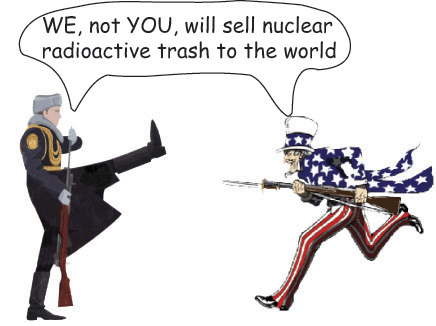
The U.S. is going after Russian nukes in Europe. And they’re counting on just one company to do it. Oddly enough, it’s Japanese.
If you thought the energy security issue the U.S. has been selling to Europe was only about American liquefied natural gas, look closer. It’s also about Russian nuclear energy behind the old Iron Curtain.
Energy security in Eastern Europe is a thermo-nuclear reactor war that mainly pits Westinghouse Electric (WEC) against Russian Rosatom. It’s a drawn-out and extremely costly energy game the U.S. is trying desperately to win. State Department chief Hillary Clinton even “lobbied” for Westinghouse in Prague in 2012.
It’s not a secret.
Westinghouse Chief Executive Danny Roderick says Clinton’s showing made a big impression on the Czechs. “I was proud that she was in the trenches with me,” he reportedly said.
The unstated goal: lessen Russian control of the nuclear power market in Eastern Europe, even if that does not translate into an immediate market share for Westinghouse. Historically, for some of those countries Rosatom and its fuel assembly maker TVEL are the only game in town. Continue reading
America gets Ukraine to hop on its nuclear power marketing bandwagon
How Washington Is Fighting For Russia’s Old Europe Energy Market, Forbes, Kenneth Rapoza , 17 May 16
“……..Nuking Ukraine
Getting Ukraine to hop on the Westinghouse band wagon was particularly crafty. Either it was simply fantastic timing on the part of Westinghouse, or the U.S. government and the new, post-Euromaidan government of Ukraine colluded to kick Russia to the curb.
“I think that Westinghouse was somehow involved in getting the EC to push Ukraine away from Russia on this front,” says Tomas Vlcek, an nergy security expert based out of Masaryk University in the Czech Republic.
In March 2014, just two months after the pro-Russian president Viktor Yanukovych was ousted, a European environmentalist group called Bellona sent out stories saying that the Russian government was ready to punish Ukraine with an embargo on nuclear fuel supplies from TVEL.
When compared to what Gazprom has done with gas supplies, Putin ordering a stop on TVEL sales of nuclear fuel assemblies simply sounded like something he would propose. Only, it is not possible to ban nuclear fuel supply. Not only does the fuel rod stay in the reactor for years, someone else can make it for the reactor instead of the Russians. Like Westinghouse.
The Bellona coverage brandished Russia as a villain in the nuclear energy business too. Brussels called for “diversification” in Ukraine’s nuclear fuel market and gave Westinghouse’s European fuel division millions of euros in subsidies for the sake of “energy security”.
The whole shebang had nothing to do with Westinghouse in Pennsylvania. Their spokeswoman said she’s never heard of Bellona. Her colleagues in Europe, on the other hand-
Derek Taylor, the former E.U. civil servant who works at the Brussels branch of Bellona is also a Senior Advisor on energy at Burson-Marsteller which, in turn,is a public affairs firm working for Westinghouse worldwide.
Despite the civil war in East Ukraine, sanctions and Gazprom gas disputes, the Russians have never missed any scheduled nuclear fuel delivery to Ukrainian nuclear power plants.
Westinghouse is more than a brand name American power company. It’s a battering ram used by Washington to promote energy security.
In 2012, Ukraine’s nuclear regulator banned the use of Westinghouse fuel assemblies in the country pending an investigation. Two years later, according to sources in Ukraine, then-Prime Minister, Arseniy Yatsenyuk consulted Westinghouse on picking a new nuclear safety regulator for his new government.
In 2015 during a scheduled outage at a reactor unit at the South Ukraine nuclear power plant, two of the Westinghouse-made fuel assemblies were found to be leaking contrary to Westinghouse’s claims that those were of an ‘improved’ modification to fit the Rosatom VVER-1000 type nuclear reactors there.
Regardless, anti-Russia politics trumps technological problems. Westinghouse is currently planning to deliver five reloads of fuel to the South Ukraine and Zaporizhia nuclear power plants, the company said on April 28, meaning the new regulator has concluded its study and their VVER-1000 fuel assemblies are as good as those made in Russia. Capturing that market, as Toshiba says it will in corporate presentations, serves as a means to punish the Russians. It’s a political convenience the Russian’s are not willing to ignore.
“Our ability to make VVER fuel is not in question,” says Westinghouse Roderick. “We will continue to sell to VVER-1000s. I think it’s good to have competition in that market.”
It is good. Political pressure, whether Russian or American, is probably more harm than good. And it’s going to really irk countries, like Russia, who clearly see it as Washington poking them in the eye on purpose.
Energy security is therefore as much fact as it is fiction. It is as much a means to market Russian rivals as it is to limit the serious role energy politics plays in Russian-European relations.
But derailing nuclear projects while running into technical difficulties with Westinghouse fuel assemblies in Rosatom reactors is a dangerous way to promote energy security there. Paradoxically as it might seem, it plays into Russia’s hands when those projects to work according to plan. The Russians look reliable and solid by comparison.
“On the finance side too, I think Rosatom has Westinghouse beat,” says Jirusek about the Russian company’s ability to finance the construction of a new power plant and long term fuel supply deals.
Apart from Ukraine, where diversification was imposed for political reasons, Rosatom’s TVEL still holds its market share. Japan’s Westinghouse, despite paying no corporate tax in the U.S., will continue applying the pressure with the help of Washington and the U.S. taxpayer.
For the Russia-United States nuclear stand off , once again it is a war of attrition.
On May 12, Toshiba said it is coming back from the brink. It will post an operating profit of $1.1 billion this year after losing $6.6 billion last year due to massive write downs associated with Westinghouse and restructuring costs in the wake of a damaging accounting scandal.
No one should bet that Washington will suddenly stop selling their Westinghouse nukes to the Europeans. They could promote another Japanese-American hybrid, like the General Electric/Hitachi boiled water reactors. Or Oregon-based NuScale, who make a smaller modular reactor that is less capital intensive and is designed to be integrated into a renewable energy grid. But they do not, obviously. It’s not because those are inferior products or even that Europe is currently a pressurized water reactor market. They do it because Westinghouse competes directly with the Russians. That’s what Washington is really after. http://www.forbes.com/sites/kenrapoza/2016/05/17/washingtons-european-energy-security-boondoggle/#4247a5f362ef
Toshiba’s Economic Nuclear Meltdown
How Washington Is Fighting For Russia’s Old Europe Energy Market, Forbes, Kenneth Rapoza , 17 May 16
“………Toshiba’s Economic Meltdown
Toshiba’s problems are Westinghouse’s problems. In Europe, going after the Russian market is a survival tactic.
Toshiba used to design and build reactors for half of Japan, also supplying those reactors with fuel. The March 2011 Fukushima disaster lit a match to those service contracts. Toshiba’s Fukushima reactors are decommissioned.
After Fukushima, Germany shut its reactors down, and they also used Westinghouse as a source for fuel rods, the assembly units that store the uranium that ultimately powers the reactor and makes energy. In less than two years, the company lost contracts at 60 reactors.
They were hemorrhaging money. Between 2012 and 2014, Westinghouse Electric’s cumulative operating losses reached $1.43 billion, according to Toshiba. Which means the company has no taxable income and, thus, is not paying taxes in the U.S. until its cumulative profits exceed that amount.
Their fuel fabrication plant in Västerås was on the verge of closing down.
Then the Ukrainian crisis came along. The Russians became super-duper bad guys and energy diversification was quickly put in play. While gas makes the headlines, nuclear power accounts for more than half of Ukraine’s electricity.
In March 2014, shortly after the annexation of Crimea and the first round of sanctions, the European Commission published an energy security strategy that included nukes as part of Europe’s energy diversification away from Russia. The EU issued a grant for $2.2
million to subsidize nuclear fuel diversification for Eastern European reactors. Guess who got the grant?
After the Czech Republic deal, Westinghouse secured a contract with the Bulgarian government to build a new AP1000 reactor at the Kozloduy nuclear power plant. It followed Bulgaria’s Prime Minister Boyko Borisov’s decision to suspend the construction of a two reactor power plant in Belene, a joint project between Bulgaria’s National Electric Company and Rosatom. What became known as the “Belene saga” would later cost the Bulgarians $1.3 billion in payments and legal fees to Rosatom for not honoring a 2008 contract. The Russians, of course, think they were boondoggled.
Borisov practically admitted that the decision to scrap Belene and award the Kozloduy project to Westinghouse was more political than not. During a meeting with the American Chamber of Commerce, the Bulgarian News Agency quoted Borisov saying “We are one. We are friends… We stop Russian planes, we also stop three Russian (energy) projects, and if we aren’t your partners, then who is?”
Cheerleading From The State Department
An Oct. 30, 2015 unclassified State Department emails dated March 28, 2012 from Richard Morningstar, Special Envoy for Eurasian Energy, addressed to Clinton’s Chief of Staff Huma Abedin, showed that Morningstar asked Abedin to pass on the message to Clinton that Bulgarian Foreign Minister Nikolay Mladenov told Morningstar his government had just canceled the Belene nuclear power project with Rosatom. He added that “Westinghouse is talking with the Bulgarians about doing a project at Kozloduy using the Russian reactor,” which probably means being the supplier of fuel rods instead of TVEL. The director of policy planning, Jacob Sullivan, was forwarded the email by Morningstar, to which Sullivan replied, “Not bad work.”
As competition between TVEL and Westinghouse continues, the United States will keep supporting Westinghouse projects, both politically and financially, to diminish the Kremlin’s influence, according to Stratfor.
“It would be wrong to suggest that no political influence takes place in the bidding process,” wrote Trusted Sources energy analysts led by James Henderson in an October 2014 study.
Nuclear power accounts for 27% of the EU’s electricity generation via 131 units in 16 countries, according to a June 2014 study by the European Commission. Historically, in Eastern Europe, Russian share in nuclear tech market has been nearly 100%. Over the years, the industry has modernized to a point where any third party can build fuel rods to fit a competitor’s reactor.
Westinghouse can build fuel assemblies for Rosatom’s new and old-model reactors and vice-versa, with varying degrees of success and almost always at a higher price. Russia is the cheaper producer of the two, so when countries turn to Westinghouse for the fuel assemblies, they have to pay a premium for diversification.
The Russians have an edge. Rosatom has won all fuel supply tenders in Eastern Europe in the last 10 years, but back home in Russia there are no tenders to be head. None of 35 reactors operated by Rosatom in Russia have fuel suppliers other than TVEL. It’s a monopoly. That’s how they both get volume, money and the data necessary for quality improvement; a luxury Westinghouse does not have.
One source who wished to remain anonymous said Westinghouse is looking for market share in the fuel services markets of East Europe, because, “It’s the only way to prevent their looming insolvency,” this source said. “Their new reactor division is loss-making, the fuel division is their only cash cow and it is not growing and existing margins are getting slimmer and slimmer. We think Westinghouse has spent millions of dollars to include nuclear fuel as part of the energy security narrative, and the current E.U. sentiment against Russia play into their hand.”…….. http://www.forbes.com/sites/kenrapoza/2016/05/17/washingtons-european-energy-security-boondoggle/#4247a5f362ef
Russia to build Bushehr Nuclear Plant in Iran
 ‘A Partner We Can Trust’: Iran Chooses Russia to Build Bushehr Nuke Plant Russia’s State Atomic Energy Corporation, Rosatom, will start work on Iran’s Bushehr-2 nuclear power plant by the end of this year after the construction site preparations are completed……
India rejects China contention for entry into nuclear suppliers group
Live Mint, 20 May 16
India cites example of France to contend that it needn’t sign nuclear non-proliferation treaty to get membership of nuclear suppliers group. New Delhi: India on Friday rejected China’s contention that it must sign the Nuclear Non-Proliferation Treaty (NPT) to get membership of the Nuclear Suppliers Group (NSG), citing the example of France, which was part of the NSG without being a signatory to the NPT.
India’s comments followed China’s reported blocking of India’s entry to the NSG earlier this month on grounds that it had not signed the NPT…..
Last week, Chinese foreign ministry spokesman Lu Kang had said all the multilateral non-proliferation export control regime including the NSG have regarded NPT as an important standard for the expansion of the NSG.
“Apart from India, a lot of other countries expressed their willingness to join. Then it raised the question to the international community—shall non-NPT members also become part of NSG?” he said, adding, “China’s position is not directed against any specific country but applies to all the non-NPT members.”…..http://www.livemint.com/Politics/3A2dMOnJXti1RaSmoPa7LO/India-rejects-China-contention-for-entry-into-nuclear-suppli.html
Growing opposition in both Canada and USA to nuclear waste dumping near the Great Lakes
Opposition to the project, though, has swelled. More than 180 county boards, city councils and other local elected bodies near the Great Lakes in both countries have passed proclamations urging a veto of the plan.

Plan to store nuclear waste near Great Lakes proves radioactive, WP By Steve Friess May 16 KINCARDINE, Ontario — If there was an off-key moment during the otherwise flawlessly executed trip to the U.S. Capitol this spring by the new Canadian prime minister, Justin Trudeau, it might have come when he was cornered by Rep. Debbie Dingell.
“We never want to see nuclear waste in the Great Lakes,” the freshman Democrat from Michigan sternly told Trudeau during a visit to the office of House Minority Leader Nancy Pelosi (D-Calif.). Continue reading
Pakistan wants to join the Nuclear Suppliers Group
 Pakistan tells U.S. it qualifies for nuclear suppliers club http://in.reuters.com/article/india-pakistan-usa-nsg-idINKCN0Y829 W ISLAMABAD | BY KAY JOHNSON 17 May 16 Pakistan’s foreign secretary on Tuesday told a U.S. envoy his country has the “credentials” to join a club of nuclear trading nations, signalling Islamabad may apply alongside India and force a showdown in the consensus-based group next month.
Diplomats last year quietly launched a new push to induct India into the NSG – a 48-nation club dedicated to curbing nuclear arms proliferation by controlling the export and re-transfer of materials that could foster nuclear weapons development.
“Pakistan expressed confidence in its credentials to become full member of the export control regimes, particularly Nuclear Suppliers Group,” the Foreign Ministry’s official spokesman said in a tweet.
The comment followed talks on Tuesday in Islamabad between Pakistani Foreign Secretary Aizaz Chaudhry and U.S. Under Secretary of State for Arms Control Rose Gottemoeller.
The U.S. Embassy in Islamabad declined to comment.
Membership of the NSG would increase India’s international clout and provide a vested interest in curbing the world’s most dangerous regional arms race, but the prospects are fraught.
The campaign for India membership is seen as carrying the risk of antagonising Pakistan as well as its ally China, which could veto any India application.
China could also insist as a condition of India’s membership that Pakistan also be allowed to join, a potential hard sell because of Islamabad’s development of new tactical nuclear weapons.
A further complication is that neither India nor Pakistan has signed the nuclear Non-Profileration Treaty, generally seen as a prerequisite to NSG membership.
The Nuclear Suppliers Group is expected to hold its next meeting in June.The NSG was created in response to India’s testing its first nuclear weapon in 1974. (Writing by Kay Johnson; Editing by Alison Williams)
France’s President Hollande backs Hinkley nuclear project, despite near bankruptcy of EDF
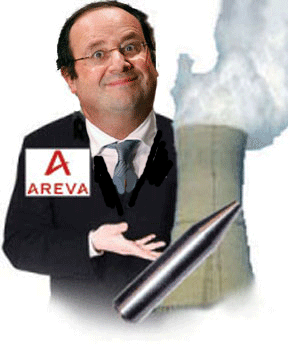 Hollande renews support for Hinkley Point nuclear reactors http://www.theguardian.com/uk-news/2016/may/17/hollande-renews-support-edf-hinkley-point-nuclear-reactors
French president backs project despite fears that £18bn price tag could bankrupt EDF, which is 85% state-owned François Hollande has renewed his support for the controversial nuclear project planned by the French energy company EDF at Hinkley Point in Britain.
“I am in favour that this project goes ahead,” the French president told Europe 1 radio on Tuesday.
“It’s very important to understand that we need a high-performance, highly secure nuclear industry in France, and that we cannot let others take over terrain, including on exports, that has been French up to now,” he said.
A final decision on the plan to build two new-generation nuclear reactors at Hinkley Point in south-west England was due this month, but was delayed after unions at EDF demanded a review of the costs.
A joint project between EDF and China General Nuclear Power Corporation, it carries a projected price tag of £18bn ($26bn, €23bn) that will make it one of the world’s most expensive nuclear power plants.
Unions at EDF, which is 85% state-owned, fear it could bankrupt the company, which is already saddled with more than €37bn of debt.
Last month, the management agreed to consult the internal committee which has brought in outside experts to review the financial implications of the project.
Hollande said the review would be completed “in the coming weeks”.
There have been dissenting voices over Hinkley Point within the French government.
On Friday, France’s environment minister Ségolène Royal, who is also mother to Hollande’s children, told the Financial Times that she was worried about the “colossal sums” involved in the project and questioned whether it should go ahead
Ratings agencies Standard and Poor’s and Moody’s both lowered their forecasts for EDF last week, saying efforts to streamline the company were insufficient.
Hollande restated his vow to restructure and boost financing at EDF and rival energy giant Areva, “because they are the future”.
“The French nuclear industry has 200,000 employees. It represents our energy independence,” Hollande told Europe 1.
“EDF and Areva are public companies on which we should rely. But at the same time, we must give them new support.”
CGN, which is due to cover a third of the costs, said on Monday that it would not go ahead with the project if EDF pulls out.
Strategy paper on nuclear energy prepared by European Union
European Union to publish strategy paper on nuclear energy http://www.dw.com/en/european-union-to-publish-strategy-paper-on-nuclear-energy/a-19262144 Ahead of a meeting of the EU’s energy commissioners, a report obtained by German media has revealed plans for the future of nuclear power in Europe. The plans run contrary to German policy.
Citing a strategy paper from the EU on Tuesday, “Spiegel Online” reported that the European Union plans to defend its technological dominance in the nuclear sector.
According to the document, the European Union’s 28 member states should strengthen cooperation on researching, developing, financing and constructing innovative reactors.
The paper is reportedly the basis for the European Commission’s future nuclear policy and is expected to be passed by the European commissioner for energy union on Wednesday. The report would then be presented to the European Parliament.
“Spiegel” reported that the European Union plans to advance the minireactors with the hope that such technology should be in use no later than 2030.
German nuclear phaseout
The plans contradict policy in Germany, which currently intends to end the domestic use of nuclear power by 2022. As an alternative to nuclear energy, Berlin has pushed to increase renewable energy, such as wind and solar power. But a decision to shut down nuclear power following the 2011 Fukushima nuclear disaster in Japan has also left Germany reliant on dirty and readily available coal to produce power.
The task of safely decommissioning and dismantling nuclear power stations also promises to be expensive and controversial, and will take many years. Though the government and nuclear industry are keen to get on with dismantling and removing reactors soon after they are shut down, the nongovernmental organization International Physicians for the Prevention of Nuclear War (IPPNW) has voiced concerns about the potential associated health risks.
The IPPNW’s preferred solution would require heavily contaminated elements such as spent fuel rods to be removed immediately, while less-contaminated buildings and equipment would be left in situ indefinitely.
Representatives at E.ON – Germany’s largest electricity utility and the owner of 11 nuclear stations – told DW that fencing off sites was neither more nor less safe than dismantling them. The utility argued instead that dismantling is a better solution in terms of the labor market consequences.
“IPPNW’s option would mean that 300-400 people who work at a nuclear site would abruptly lose their jobs,” an E.ON spokesperson said.
EDF desperate for business? trying to quickly sell 6 nuclear reactors to India
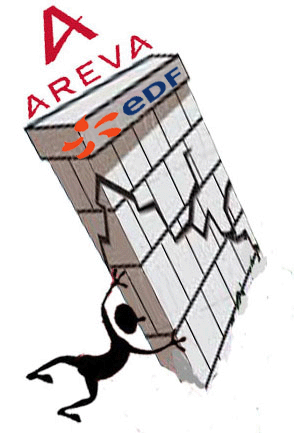
 EDF to propose deal for six nuclear reactors in India by year-end By Reuters | 12 May, 2016 PARIS: EDF will deliver a proposal to theIndian government by year’s end to build six nuclear reactors, an executive at the French utility said on Thursday, in what could be the world’s biggest nuclear deal.
“Hinkley Point will help us continue our activities and preserve our skills base and jobs,” he said. ……..
Chief Executive Jean-Bernard Levy told shareholders that EDF needs growth in international markets because European power markets are stagnant. http://economictimes.indiatimes.com/articleshow/52240726.cms?utm_source=contentofinterest&utm_medium=text&utm_campaign=cppst
China General Nuclear Power Corporation denies plan to take over Hinkley nuclear project build

 China nuclear company will not build Hinkley alone if EDF drops out CGN, which is helping French energy company with Hinkley Point C scheme, denies it will build reactors independently, Guardian, Terry Macalister, 13 May 16, The Chinese company helping EDF with plans to build new nuclear reactors at Hinkley Point in Somerset has flatly dismissed the idea it would go it alone if the largely state-owned French company dropped out.
“As a partner to EDF supporting the Hinkley Point project, CGN [China General Nuclear Power Corporation] has no independent plans to build reactors at Hinkley Point C,” it said in a statement.
The Department of Energy and Climate Change reiterated the message with its own statement, which said: “There is no proposal for the Chinese to build a reactor at Hinkley.”
The denials come after George Osborne’s father-in-law, Lord Howell, told the House of Lords that the Chinese were working on a “plan B” to step in if, as some expect, EDF abandons the controversial scheme…….https://www.theguardian.com/business/2016/may/13/hinkley-point-cgn-china-general-nuclear-power-corporation-edf-energy
Britain failed to consult Europe over Hinkley nuclear safety dangers – UN

 Hinkley Point: UN says UK failed to consult over risks UN Economic and Social Council says Britain has not met its obligations to discuss the impact of nuclear accident with neighbouring countries Terry Macalister, Guardian, 9 May 16 The British government has run into a major new problem with the Hinkley Point C nuclear project, with a United Nations committee ruling that the UK failed to consult European countries properly over potential environmental risks.
Documents seen by the Guardian show Britain “is in non-compliance with its obligations” (page 21) to discuss the possible impact of any accident or other event that could affect those nations in proximity to Hinkley.
This is just the latest in a string of problems connected with the planned £18bn project to construct new reactors in Somerset, with the developer EDF of Francerecently delaying a final investment decision until September.
Paul Dorfman, a senior researcher at UCL’s energy institute, said the ruling from the UN Economic and Social Council throws great uncertainty over Hinkley.
“This is a huge blow to the government and introduces a whole new element of doubt over the scheme. It is hard to see how EDF can sign off any final investment decision whilst the government has yet to resolve this important issue.”…..http://www.theguardian.com/uk-news/2016/may/08/hinkley-point-united-nations-says-uk-failed-to-consult-over-risks
1 This Month




PLEASE OPPOSE HR 8255 AND S.3639 – bills would accelerate satellite deployment, with no environmental review or safeguards – https://ncstd5li.quorum.us/campaign/169331/
To see nuclear-related stories in greater depth and intensity – go to https://nuclearinformation.wordpress.com
-
Archives
- September 2026 (330)
- August 2026 (330)
- July 2026 (355)
- June 2026 (287)
- May 2026 (306)
- April 2026 (356)
- March 2026 (251)
- February 2026 (267)
- January 2026 (308)
- December 2025 (358)
- November 2025 (359)
- October 2025 (375)
-
Categories
- 1
- 1 NUCLEAR ISSUES
- business and costs
- climate change
- culture and arts
- ENERGY
- environment
- health
- history
- indigenous issues
- Legal
- marketing of nuclear
- media
- opposition to nuclear
- PERSONAL STORIES
- politics
- politics international
- Religion and ethics
- safety
- secrets,lies and civil liberties
- spinbuster
- technology
- Uranium
- wastes
- weapons and war
- Women
- 2 WORLD
- ACTION
- AFRICA
- Atrocities
- AUSTRALIA
- Christina's notes
- Christina's themes
- culture and arts
- Events
- Fuk 2022
- Fuk 2023
- Fukushima 2017
- Fukushima 2018
- fukushima 2019
- Fukushima 2020
- Fukushima 2021
- general
- global warming
- Humour (God we need it)
- Nuclear
- RARE EARTHS
- Reference
- resources – print
- Resources -audiovicual
- Weekly Newsletter
- World
- World Nuclear
- YouTube
-
RSS
Entries RSS
Comments RSS

