Nuclear weapons should be returned to the countries that own them – call from Russian diplomat
 Russian diplomat calls for returning nuclear weapons to producer countries http://tass.ru/en/politics/887597 July 11, 20:16 Barack Obama plans to use his final six months in office for putting forward a number of nuclear arms control initiatives, possibly offering Russia to extend the New Start Treaty for another 5 years MOSCOW, July 11 /TASS/. Return of all nuclear weapons to the territories of countries where they have been produced would be a vital contribution to world security, Russia’s Permanent Representative to NATO Alexander Grushko said in an interview aired by the Rossiya 24 television news channel on Monday.
“It would be a contribution to international security if all nuclear charges were returned to the territories of countries, which possess them. This is exactly what Russia did,” Grushko said commenting the US authorities’ intention to offer Russia to extend the Strategic Arms Reduction Treaty (START) for another five years.
“It is necessary to bear in mind that as major nuclear players, including Russia and the United States, the role of nuclear potentials possessed by other countries will increase. Therefore, the approach will be totally different: it should be an integrated approach,” Grushko said.
According to the Washington Post electronic version, US President Barack Obama plans to use his final six months in office for putting forward a number of nuclear arms control initiatives, including, possibly, to offer Russia to extend the New Start Treaty for another five years. The publication said that the US National Security Council had discussed the topic at its meetings twice over the past two weeks.
High expectations in Iran, for nuclear deal economic help have not been met
 Year after nuclear deal, Iran’s high expectations not met, Christian Science Monitor To sell Iranians on the nuclear deal, President Rouhani promised a new era. But the consensus is it has yet to materialize, and many blame the US. By Scott Peterson, Staff writer JULY 14, 2016 ISTANBUL, TURKEY — Joy erupted on the streets of Tehran a year ago Thursday, when Iran signed a landmark nuclear deal with six world powers hailed as a victory of diplomacy over war.
The deal was marketed by both sides as a “win-win”: Iran would dismantle the most controversial aspects of its nuclear program – minimizing the chance of acquiring a nuclear weapon for at least a decade – in exchange for the lifting of sanctions that crippled its economy.
As jubilant Iranians waved flags and heralded an easing of Iran’s isolation, President Hassan Rouhani promised that “a page has turned in the history of Iran.”
But one year later, the 159-page accord is a study in unmet high expectations for change, as hard-liners in both Iran and the US Congress fight to undermine the deal to ensure as little political benefit as possible for the architects of the accord – Mr. Rouhani and President Barack Obama – as well as for their long-term strategic foes, in Washington and Tehran.
Analysts say the Iranian president promised more than he could deliver.
“Rouhani had no choice other than leveraging pent-up public demands to rally elite support for diplomacy; the hype was as indispensable as its ensuing disillusionment was inevitable,” says Ali Vaez, the senior Iran analyst for the Brussels-based International Crisis Group.
“The deal has not ushered in a new era. It is, at best, taking Iran back to where it was before the nuclear crisis,” says Mr. Vaez. “The establishment deemed ending economic isolation as an exigency for preserving its power. Now it fears rapid economic opening could loosen its grip on power.
All sides have strictly adhered to the letter of the deal: Iran has dramatically reduced the scale of its nuclear infrastructure – reconfiguring a heavy water nuclear reactor and a deeply buried uranium enrichment facility, for example – while keeping a limited capacity to produce fuel for nuclear energy. And non-nuclear sanctions have been lifted, partially ushering Iran back into the global economy.
But the deal has not yet enhanced Rouhani’s ability to fulfill his promise of expanding social freedoms, or of creating a less securitized atmosphere. In fact, the opposite may be true, after steady warnings from Iran’s supreme leader Ayatollah Ali Khamenei, about “infiltration” and “soft war” from the United States and the West.
US and European banks also are proving reluctant to engage with Iran, fearful that non-nuclear US sanctions might bite, thereby depriving Iran of the full hoped-for benefits of the deal. The House is readying new measures this week that will impose further sanctions over terrorism and human rights abuses, or limit Iran’s use of the dollar, all of which the White House says it will veto………..http://www.csmonitor.com/World/Middle-East/2016/0714/Year-after-nuclear-deal-Iran-s-high-expectations-not-met
Chilcot says Britain shirking its responsibilty to help clean up radioactive destruction in Iraq
 Chilcot: UK refusing to help clean up Iraq after raining down radioactive shells https://www.rt.com/uk/350804-iraq-chilcot-depleted-uranium/#.V4VPdDurb8w.facebook 12 Jul, 2016 Britain has no intention of cleaning up its deadly radioactive legacy in Iraq or even monitoring the terrifying impact depleted uranium (DU) shells will have on the population in the future, it has been claimed.
Writing in the Ecologist on Tuesday, Doug Weir, who is coordinator of the International Coalition to Ban Uranium Weapons (ICBUW), says that hidden within the Chilcot report is a previously classified military document setting out the UK’s rejection of any duty to cleanse Iraq of DU of unexploded ordnance (UXO).
In it, the clearance of unexploded ordnance and DU is considered and the Ministry of Defence [MoD] argues that it has: “… no long-term legal responsibility to clean up DU from Iraq” Weir writes.
“Instead it proposes that surface lying fragments of DU only be removed on ‘an opportunity basis’ – i.e. if they come across them in the course of other operations.”
This indicates, according to Weir, that the UK has effectively swerved any obligation to clear up after itself in Iraq.
“In other words, the UK’s stance is that chemically toxic and radioactive DU ‘ash’ from spent munitions is strictly the problem of the country in which the munitions were used – in this case Iraq – and that the UK, which fired the DU shells, has no formal responsibility of cleaning up the mess.”
DU ammunition is used in only two UK weapons systems – the Royal Navy’s PHALANX Close-In Weapon System and in the Charm 3 ammunition fired by the Challenger 2 main battle tank.
However, the route to shirking responsibility may not be as easy as the UK government seems to hope. In October, the UN will meet to debate a sixth resolution on DU weapons. It’s a move which will give succor to the government of Iraq, which in 2014 called for the international community to help clean up DU.
Weir remains hopeful that the UN meeting may be able to encourage governments to take responsibility for the use and fallout of the weapons.
“When the United Nations last discussed DU two years ago, 150 governments recognised the need for states to provide assistance to countries like Iraq,” he wrote.
“This October, our Coalition will add our voice to those of the states affected by DU weapons in calling for an end to the use of DU weapons and for the users to finally accept responsibility for their legacy,” he added.
Republicans trying to roll back the Iran nuclear agreement
Iran Nuclear Deal Faces Triple Threat in Congress on Anniversary http://www.bloomberg.com/news/articles/2016-07-12/iran-nuclear-deal-faces-triple-threat-in-congress-on-anniversary Kambiz Foroohar kambizf
-
Three measures seek to derail agreement signed a year ago
-
Iran says it still waiting for full benefits from the accord
Republican lawmakers are pushing three measures to roll back a nuclear agreement with Iran, while the Obama administration’s lead negotiator for the accord defended its implementation one year after the deal was struck.
Three bills dealing with the agreement, under which Iran agreed to curtail its nuclear program in return for an easing of economic sanctions, are scheduled for a vote this week in the House of Representatives, where Republicans have a majority. The measures would then go to the Senate, which may not take them up before September.
One of the proposals would impose new sanctions on Iran over any sponsorship of terrorism or human rights violations. Another would bar the purchase from the Islamic Republic of “heavy water,” a non-radioactive byproduct of both the manufacturing of nuclear weapons and nuclear energy. The third would block Iran’s access to the U.S. financial system, including the use of the dollar.
All three measures have been met with promises of a veto from the White House. Without the Iranian accord, “we would have been forced to confront the reality of how to address Iran’s nuclear program in a world where diplomacy had failed,” Stephen Mull, the State Department’s lead coordinator for Iran nuclear implementation, said Tuesday at a Bipartisan Policy Center conference in Washington.
‘No Better Deal’
“There was no better deal to be had,” Mull said. “If Iran continues to meet its obligation and we walk away, we walk away alone. ”
While the U.S. remains concerned about Iran’s missile program, support for terrorism and human rights violations, within the confines of the nuclear agreement, “this deal is working,” Mull added.
After a decade of isolation under U.S.-led international sanctions, Iran is now seeing greater interest from businesses and banks in its $370 billion economy. However, Iranian officials complain that six months after the economic sanctions were eased, the country has yet to witness the financial benefits many predicted.
“Iran has a lot of homework to do,” Mull said.The three bills expected to be voted on this week in the House are in addition to a measure introduced to derail Boeing Co.’s agreement last month to provide 109 aircraft to Iran’s national airline, a deal valued at more than $17.6 billion. That would be the biggest business transaction between the two countries since the 1979 Islamic Revolution and the U.S. hostage crisis.
In issuing its veto threat this week, the White House emphasized that the legislation would undermine the viability of the nuclear agreement.
The deal “is critical to ensuring that Iran’s nuclear program is and will remain exclusively peaceful, which is profoundly in the national security interest of the U.S. and the international community,” according to the statement.
South Africa’s Zuma government backing India’s effort to join Nuclear Suppliers Group
SA backs India to join Nuclear Suppliers Group enca, SOUTH AFRICA Friday 8 July 2016 PRETORIA – South African President Jacob Zuma agreed on Friday to support India’s controversial bid to join the Nuclear Suppliers Group (NSG), an international body that controls commerce in nuclear materials and technology.
Indian Prime Minister Narendra Modi announced this at a joint press conference at the Union buildings in Pretoria on Friday after meeting Zuma.
He thanked Zuma for his promise of support in the meeting….
- The bid is controversial because all the current NSG members, including South Africa, are also members of the NPT, the Nuclear Non Proliferation Treaty, which restricts the possession of nuclear weapons to the five major powers, the US, UK, France, Russia and China.
India acquired nuclear weapons in 1974 and so could not join the NPT, which it in any case did not want to because it regards it as discriminatory.
When she was asked earlier this week about this, International Relations and Cooperation Minister Maite Nkoana-Mashabane noted that all current NSG members were also members of the NPT. But she also hinted that in his one-on-one meeting with Modi, Zuma might lend his support to India’s bid…….https://www.enca.com/south-africa/sa-backs-india-to-join-nsg
Brexit uncertainty adding to anxiety of former supporters of UK’s Hinkley nuclear project

 Hinkley Point C critics try to derail it amid Brexit vote turmoil
Board of EDF, energy project’s key backer, is at risk of fracturing as ex-supporters worry about uncertainty of British government, Guardian, Terry Macalister, 2 July 16 Britain’s flagship energy project, Hinkley Point C, is hanging by a thread as critics inside key backer EDF use the political turmoil from the Brexit vote to try to derailthe already delayed £18bn scheme.
Jean Bernard Levy, the EDF group chief executive, and the French and British governments, have in recent days insisted they are as committed as ever to a positive final investment decision being taken as soon as possible.
But well-placed sources in Paris have told the Guardian that the already divided EDF board, which must make that decision, is in danger of fracturing further as former supporters of the project worry about Brexit.
“The situation for Levy was already very delicate,” said one source. “But it has become a lot more difficult because there is so little certainty around the British government,” they added. “No one could know today which way a vote [of the board on Hinkley] would go.”
Those arguing against the project say it is impossible to make any decisions when it is unclear who will be the future prime minister, chancellor of the exchequer and energy and climate change secretary.
Highly critical EDF unions in France, which have six representatives on the main board, are pressing waiverers among the five independent board members who have previously supported Levy to change their minds…….https://www.theguardian.com/uk-news/2016/jul/01/hinkley-point-c-critics-try-to-derail-it-amid-brexit-vote-turmoil?CMP=share_btn_tw
Delay £18bn building of Hinkley nuclear station – EDF workers’ committee
 EDF workers’ committee expected to demand that nuclear power plant at Hinkley Point in Somerset is delayed http://www.thisismoney.co.uk/money/markets/article-3672592/EDF-workers-committee-expected-demand-nuclear-power-plant-Hinkley-Point-Somerset-delayed.html By CITY & FINANCE REPORTER FOR THE DAILY MAIL, 4 July 2016 EDF’S workers’ committee is expected to demand today that a nuclear power plant at Hinkley, Somerset, is delayed.
The energy firm has yet to make a decision on how to raise £18bn of funds needed for the power station, and has put off deciding until September to allow time to consult the unions.
The unions are obliged to deliver their opinion today on whether Hinkley should go ahead. But three of them issued a statement last week to say that Britain’s vote to leave the European Union added new elements of uncertainty.
It follows a legal action launched earlier this month in French courts by EDF’s Works Council, who asked for the project to be put off.
It is feared that if the unions do not support the project it could further delay Hinkley, which was due to be completed in 2017 but is currently expected to be finished by 2025.
U.N. Decolonization Committee adopts French Polynesia Resolution
U.N. Decolonization Committee adopts French Polynesia Resolution, Overseas Territories Review , 3 July 16
 Recognized the significant health and environmental impacts of nuclear testing conducted by the administering Power in the Territory over a 30-year period.
Russia to dominate Arctic with huge ice-breakers
Russia floated its largest and most powerful nuclear-powered icebreaker last month, upping the ante in what is literally the coldest global gold rush.
The ice-smashing ship was Russia’s sixth reactor-driven polar vessel. The United States doesn’t have a single one.
Moscow’s dominance of the northern seas — courtesy of vast investments — has America and the West worried. Here’s why………http://www.nbcnews.com/news/world/russia-s-latest-nuclear-powered-icebreaker-extends-arctic-dominance-n602381
India and Pakistan communicate with each other on nuclear facilities
 Pakistan, India exchange information on nuclear facilities http://dailytimes.com.pk/islamabad/01-Jan-06/pakistan-india-exchange-information-on-nuclear-facilities ISLAMABAD: Pakistan and India on Sunday exchanged lists of their nuclear facilities on Sunday, a requirement every January 1 under an accord in which they promised not to attack each other’s nuclear installations.
“The governments of Pakistan and India today exchanged lists of their respective nuclear installations and facilities in accordance with Article II of the Agreement on Prohibition of Attacks Against Nuclear Installations and Facilities between Pakistan and India of December 31, 1988,” a Foreign Office statement said.
Zaheer A. Janjua, Director of the India Desk in Pakistan Ministry of Foreign Affairs handed over the list to an officer of the Indian High Commission in Islamabad at the Foreign Office at 11:00am PST, the statement said.
India handed over their list to Muhammad Khalid Jamali, First Secretary of the Pakistan High Commission at the Ministry of External Affairs in New Delhi at 11:30am IST, it added. The statement did not give any details of which installations and facilities are mentioned in the lists. The list usually includes civilian nuclear power plants and gives the exact location of each such installation.
Top foreign ministry officials from Pakistan, led by Foreign Secretary Riaz Muhammad Khan will meet Indian officials on January 17 and 18 in New Delhi for talks on Kashmir and other issues. Railway officials are also slated to meet in New Delhi on January 5 and 6 to discuss reopening a rail link between Munabao and Khokhrapar, which was terminated after a 1965 war between the two countries.
India stopped by China, from joining Nuclear Suppliers Group
China maintains its opposition to India joining a group of nations seeking to prevent the proliferation of nuclear weapons by controlling access to sensitive technology, said the head of the arms control department in China’s Foreign Ministry.
The Nuclear Suppliers Group (NSG) met this week in Seoul, but China said it would not bend the rules and allow India membership as it had not signed the nuclear Non-Proliferation Treaty (NPT), the main global arms control pact.
“Applicant countries must be signatories of the Treaty on the Non-Proliferation of nuclear weapons (NPT),” Wang Qun, the head of arms control department in China’s Foreign Ministry, was quoted as saying in Seoul on Thursday night.
“This is a pillar, not something that China set. It is universally recognized by the international community,” Wang said according to a statement released by the Chinese foreign ministry on Friday.
Opponents argue that granting India membership would further undermine efforts to prevent proliferation. It would also infuriate India’s rival Pakistan, an ally of China’s, which has responded to India’s membership bid with one of its own.
Pakistan joining would be unacceptable to many, given its track record. The father of its nuclear weapons program ran an illicit network for years that sold nuclear secrets to countries including North Korea and Iran. http://www.reuters.com/article/us-india-nuclear-china-idUSKCN0ZA0IF
Exit from the European Union could make it easier for Britain to develop nuclear power
A British vote to leave the European Union would force broad changes to the bloc’s energy policy, weakening its climate policy and removing a crucial Central European energy ally — but it could also give London far more freedom to pursue nuclear projects.
The U.K. is often an energy outlier in the EU, advocating nuclear power and shale gas sources shunned by others. And it tends to build alliances broadly aimed at keeping interference from Brussels to a minimum.
But both sides have a lot to lose.
A Brexit could undercut long-term climate policies in Brussels and London, and the EU would lose the U.K.’s pro-free market voice, which has historically helped tone down some more statist schemes coming from European capitals.
Here are the five ways that a Brexit would impact Europe’s energy and climate forecast:…….
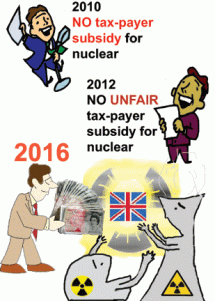 4. The freedom to subsidize — maybe
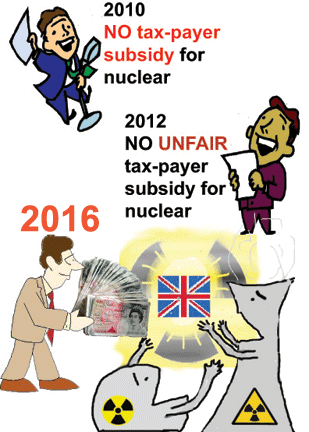
One area the European Commission tries to avoid is state aid, particularly for energy projects.
But even when the Commission gives a green light, there’s the danger that another EU country might try to interfere. That’s what happened with Hinkley Point. Brussels approved a state aid plan in 2014, but Austria, backed by Luxembourg,challenged the decision in the European Court of Justice eight months later…….
Environmental advocates worry it would give the U.K. room to continue rolling back support for renewables in favor of other fuels.
“One of the reasons why the government has had to have a more sensible policy on these issues is because state aid disciplines have stopped it from throwing money at gas-powered stations and fracking and nuclear,” said Nick Mabey, chief executive of the environmental analysis group E3G……..http://www.politico.eu/article/uk-brexit-renewable-energy-hinkley-nuclear-interconnectors-gas-climate-emissions-paris/
Senior EDF managers want Hinkley nuclear project to be postponed
EDF Managers Tell UK MPs That Hinkley Point C Should Be Postponed http://www.nucnet.org/all-the-news/2016/06/20/edf-managers-tell-uk-mps-that-hinkley-point-c-should-be-postponed
Plans & Construction 20 Jun (NucNet): Senior managers at EDF have told British MPs that a final investment decision (FID) on the planned Hinkley Point C nuclear project should be delayed until problems including the reactor design and “multi-billion litigation” over the Olkiluoto-3 project in Finland have been resolved.
The letter from EDF managers to the UK parliament’s energy and climate change committee is a setback for the proposed £18bn (€23bn, $26bn) nuclear station in Somerset, England. The station is a flagship of the government’s energy policy and is intended to provide seven percent of Britain’s electricity from about 2025.
In April, the state-controlled French company said it was delaying the FID until September while it consulted with trade unions.
A letter dated 13 June and addressed to Angus MacNeil, the chairman of the committee, from the Fédération Nationale des Cadres Supérieurs de l’Énergie (FNCS) union, “advises to delay the FID until better upfront industrial visibility is evidenced”.
Outstanding problems highlighted by in the letter include:
– Areva NP, the designer of the European pressurised water reactor (EPR) planned for Hinkley Point, “is currently facing a difficult situation”.
– The French nuclear safety authority (ASN) may not approve operation of the Flamanville-3 EPR under construction in northwest France due to various anomalies with the reactor vessel bottom and the reactor vessel head.
– There may be “identical flaws” in an Areva EPR being built at Taishan-1 in China.
– Litigation between Areva and the Finnish energy group TVO over delays to the Olkiluoto-3 EPR remain unsettled.
– An EDF offer to purchase Areva expired on 31 March, leaving “governance uncertainties upon the implementation of the Hinkley Point C project”.
The letter says that on 25 May, ASN declared at an annual hearing in the French parliament that financial and economic challenges that both EDF and Areva are facing would be “time consuming”. The necessary reorganisations “would need long delays before a proper recovery happens” and ASN would prioritise regulatory oversight of the existing fleet rather than any new project.
According to the letter, ASN is concerned that while EDF is dedicating its efforts to new nuclear projects, the financing of safety improvements for the normal operation of the French nuclear fleet could be delayed or even given up.
The letter says “heavy evidence” still needs to be brought prior to further commitments, in order to make those commitments “gain robustness and reliability”.
On 7 June, three French workers unions sent a letter to energy minister Ségolène Royale asking for clarification about the “orientation” of the French nuclear industry.
Vincent de Rivaz, the chief executive officer of EDF’s UK subsidiary EDF Energy told MPs last month that he could not give a definite time for when the company will make the FID.
Mr de Rivaz was called to reappear before the committee after indicating at an appearance in March that the FID could be taken by early May. The committee asked him to explain why that had not happened.
The letter is online: http://bit.ly/1Uc8N0F
USA promotes a nuclear arms race in Asia, by Supporting India’s entry to Nuclear Suppliers Group
 Promoting a nuclear race?, Business Recorder June 23, 2016 IKRAM SEHGAL India clandestinely diverted nuclear fuel from the Canadian supplied civilian nuclear reactor in Tarapur for conducting its nuclear test in 1974. Created in 1974 as a direct result of the Indian subterfuge, the Nuclear Suppliers Group (NSG) was meant to prevent in future what India had done, being tasked with regulating nuclear commerce for civilian uses and preventing proliferation of nuclear weapons.
On the back of the US-India nuclear deal in 2008, the Bush Administration applied immense political pressure to exempt India from the NSG’s rules on civilian nuclear trade when it was under US sanctions for proliferation activities. This double standards waiver was engineered when Pakistani’s letter vehemently objecting to it was suddenly and surprisingly withdrawn in Vienna during NSG deliberations at the last minute on the express telephonic instructions from President Asif Zardari. This unparalleled “personal” initiative appeased the US and India but it destroyed the original concept of the NSG and cost Pakistan dearly. It “officially” allowed India to expand its arsenal massively by using imported fuel for civilian nuclear reactors and replenish stocks for weapon production. “Harvard’s Belfer Center” and US think tank “Arms Control Today” confirmed that this defeated the very purpose why the NSG was created in the first place.
What about nuclear balance in South Asia? In an article published by the International Committee of the Fourth International (ICFI), in September 2008 the writers correctly assessed that, “The action the NSG has been goaded into taking by the US has immense and incendiary strategic implications for South Asia, tilling the balance of power between India and its historic rival Pakistan sharply in India’s favour. It also rubbishes the basic principle of the nuclear regulatory regime the US championed earlier that States which pursue nuclear weapons will be “punished” by an embargo on all nuclear trade and those that adhere to the NPT will, in return, be assisted in developing civilian nuclear energy. And, as was foreshadowed in the events at the NSG meeting itself, it will intensify and complicate the ongoing and ever more explosive rivalry amongst the big powers for markets, raw materials, and geo-strategic advantage.”
A Senate hearing on 24 May saw US Senator Markey saying something extremely relevant, “Since 2008 when (we) also gave them an exemption, India has continued to produce fissile material for its nuclear weapons programme virtually un-checked. At that time Pakistan warned us that the deal would increase the chances of the nuclear arms race in South Asia”. Some countries, led by China and Turkey, are resisting this pressure on principle, arguing that if any exception to the rules is made, it should apply equally to both India and Pakistan. Since all 48 member NSG decisions are made by consensus, even one member can block a decision.
India has not honoured its limited commitments under the international non-proliferation regime that earned it the 2008 waiver, adhering to limited IAEA Additional Protocol as well as US laws (Hyde Act) for transparency in use of imported fissile material, agreeing to a moratorium on fissile material production for weapons use; signing and ratifying the CTBT and putting a cap on its nuclear weapons production. In the face of these obvious deficiencies, allowing India NSG membership will intensify the nuclear/strategic arms race in South Asia, undermine NSG’s credibility and will give India the legitimacy of a nuclear weapon state. Bent on using India as a counterweight to China, the US must realise the dangerous confrontation that will erupt in South Asia………http://www.brecorder.com/articles-a-letters/187/59532/
Germany criticises NATO’s warmongering policy towards Russia
Germany slams NATO ‘warmongering’ on Russia Berlin , Yahoo News, 18 June 16 (AFP) – German Foreign Minister Frank-Walter Steinmeier has criticised NATO for having a bellicose policy towards Russia, describing it as “warmongering”, the German daily Bild reported.
Steinmeier pointed to the deployment of NATO troops near borders with Russia in the military alliance’s Baltic and east European member states.
“What we should avoid today is inflaming the situation by warmongering and stomping boots,” Steinmeier told Bild in an interview to be published Sunday. “Anyone who thinks you can increase security in the alliance with symbolic parades of tanks near the eastern borders, is mistaken,” Germany’s top diplomat added.
NATO had announced on Monday that it would deploy four battalions to Estonia, Latvia, Lithuania and Poland to counter a more assertive Russia, ahead of a landmark summit in Warsaw next month…….https://www.yahoo.com/news/germany-slams-nato-warmongering-russia-115515814.html
1 This Month




PLEASE OPPOSE HR 8255 AND S.3639 – bills would accelerate satellite deployment, with no environmental review or safeguards – https://ncstd5li.quorum.us/campaign/169331/
To see nuclear-related stories in greater depth and intensity – go to https://nuclearinformation.wordpress.com
-
Archives
- September 2026 (330)
- August 2026 (330)
- July 2026 (355)
- June 2026 (287)
- May 2026 (306)
- April 2026 (356)
- March 2026 (251)
- February 2026 (267)
- January 2026 (308)
- December 2025 (358)
- November 2025 (359)
- October 2025 (375)
-
Categories
- 1
- 1 NUCLEAR ISSUES
- business and costs
- climate change
- culture and arts
- ENERGY
- environment
- health
- history
- indigenous issues
- Legal
- marketing of nuclear
- media
- opposition to nuclear
- PERSONAL STORIES
- politics
- politics international
- Religion and ethics
- safety
- secrets,lies and civil liberties
- spinbuster
- technology
- Uranium
- wastes
- weapons and war
- Women
- 2 WORLD
- ACTION
- AFRICA
- Atrocities
- AUSTRALIA
- Christina's notes
- Christina's themes
- culture and arts
- Events
- Fuk 2022
- Fuk 2023
- Fukushima 2017
- Fukushima 2018
- fukushima 2019
- Fukushima 2020
- Fukushima 2021
- general
- global warming
- Humour (God we need it)
- Nuclear
- RARE EARTHS
- Reference
- resources – print
- Resources -audiovicual
- Weekly Newsletter
- World
- World Nuclear
- YouTube
-
RSS
Entries RSS
Comments RSS

