Termination clause in nuclear deal with Japan not binding
on India, insists govt, First Post, 13 Nov 16 New Delhi: The just-signed historic civil nuclear deal with Japan has a “termination” clause which the government here insists is not binding on India but merely records the “views” of the Japanese side considering its “special sensitivities”.
The government insisted that India has made “no additional commitments” over the similar agreements signed with the US and other countries.
In the Nuclear Cooperation Agreement, signed in the presence of Prime Minister Narendra Modi and his Japanese counterpart Shinzo Abe in Tokyo on Friday, there is a note on ‘Views and Understanding’ wherein the Japanese side has cited India’s September 2008 declaration of unilateral moratorium on atomic tests and said if this commitment is violated, the deal will terminate.
Indian government holds that this is merely recording of the views of the two sides.
“The termination clause is there in other NCAs (nuclear cooperation agreements) we have signed, including with the US (Article 14). However the circumstances triggering a possible termination are never sharply defined. Consideration also has to be given to mitigating factors,” a source here said.
“That note is simply a record by the negotiators of respective views on certain issues. It is not the NCA which is what is binding,” the source said.
The sources added that given Japan’s special sensitivities as the only nation to have suffered a nuclear attack, “it was felt that their views should be recorded in a separate Note. The Note is a record by the negotiators of respective views on certain issues.
“The termination clause is there in other NCAs (nuclear cooperation agreements) we have signed, including with the US (Article 14). However the circumstances triggering a possible termination are never sharply defined. Consideration also has to be given to mitigating factors,” a source here said.
“That note is simply a record by the negotiators of respective views on certain issues. It is not the NCA which is what is binding,” the source said.
The sources added that given Japan’s special sensitivities as the only nation to have suffered a nuclear attack, “it was felt that their views should be recorded in a separate Note. The Note is a record by the negotiators of respective views on certain issues………
German Chancellor Angela Merkel Issues CHILLING Warning To Donald Trump, BiPartisan Report , By Sarah MacManus –November 9, 2016 German Chancellor Angela Merkel isn’t going to let up on newly minted President-elect Donald Trump any time soon. The European stateswoman issued a very carefully worded statement to the press on Wednesday, not so subtly hinting that she’d be keeping an eye on the Republican and letting all parties know that her cooperation — and that of Germany — comes with conditions.
German Chancellor Angela Merkel reacts to Donald Trump as elected President (english subtitles)
It could mean the cooperation of our European allies, as well. Merkel also serves as the de facto leader of the European Union, and was listed by Forbes as one of the world’s second most powerful individuals in the last five years.
Donald Trump would do well to heed her warning.
Trump took a swing at Merkel during his campaign over her refugee policy, criticizing her willingness to accept refugees and immigrants into Germany and stating: “What Merkel did to Germany is a shame, it’s a sad, sad shame.”
Merkel’s even-handed statement of congratulations to the Republican was composed with the utmost precise wording and couched in tones of warning……..
“Please accept my congratulations on your election as President of the United States of America.
“You will assume office at a time in which our countries are jointly facing many different challenges.
“Germany’s ties with the United States of America are deeper than with any country outside of the European Union. Germany and America are bound by common values — democracy, freedom, as well as respect for the rule of law and the dignity of each and every person, regardless of their origin, skin color, creed, gender, sexual orientation, or political views. It is based on these values that I wish to offer close cooperation, both with me personally and between our countries’ governments.
“Partnership with the United States is and will remain a keystone of German foreign policy, especially so that we can tackle the great challenges of our time: striving for economic and social well-being, working to develop far-sighted climate policy, pursuing the fight against terrorism, poverty, hunger, and disease, as well as protecting peace and freedom in the world.
With Trump, Asia’s Nuclear Crisis Expands Next to North Korea and fearing U.S. abandonment, South Korea and Japan weigh their own options, WSJ, By DAVID FEITH Nov. 11, 2016 Seoul
The nuclear crisis in Northeast Asia was bound to be one of the most dangerous challenges facing the next U.S. president, no matter who won on Tuesday. With Donald Trump’s surprise victory, though, it could metastasize in dramatic ways: If you thought North Korea’s nuclear march was disconcerting, consider that South Korea and Japan may now pursue nuclear programs of their own, raising the risks and stakes of war not only with North Korea but China too…….
It’s possible Mr. Trump will drop his enthusiasm for South Korean and Japanese nuclearization upon entering the Oval Office. His campaign advisers tended to ignore the subject in public statements, likely a reflection of the decades-old bipartisan consensus against nuclear proliferation in Washington. But as with other issues, the approach of President Trump will depend on who he brings into the White House for advice, and whether he listens to them……..
South Korea’s civilian nuclear infrastructure—24 plants providing 30% of the country’s energy—could be used to produce 5,000 bombs worth of fissile material, Mr. Cheong says, dwarfing Pyongyang’s capability. Embracing the necessary technologies, including plutonium reprocessing, could be “the game-changer that will enable South Korea to manage North Korean problems.”………
Several potential candidates in South Korea’s looming presidential election back nuclearization, including former National Assembly floor leader Won Yoo-cheol and Nam Kyung-pil, governor of the country’s most populous province. Mr. Cheong, who acknowledges that “experts and technocrats have tended to be against going nuclear,” says that officials have privately expressed greater interest since Pyongyang’s latest nuclear test in September. Once Pyongyang completes a hydrogen bomb, he says, “many experts will switch their views.”
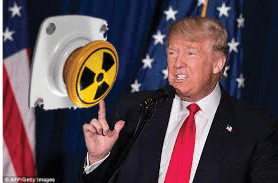
“A man you can bait with a tweet is not a man we can trust with nuclear weapons.” The words of his vanquished opponent, Hillary Clinton, are perhaps the biggest anxiety hanging over the shock election of Donald Trump to the US presidency: can he be trusted with the power to launch Armageddon?
Every US president has constant access to a nuclear launch device only he can activate. Born in the Cold War, it is designed for when Russian nuclear missiles are detected making their 30-minute flight to the US, allowing 10-15 minutes to decide to order a counter-strike which would not be countermanded. But it could be used in other scenarios. “There is nothing to prevent a launch for very little reason,” says Paul Ingram of the British American Security Information Council, an arms control think-tank in London.
Would Trump hit the button? He has said he would be “very, very slow on the draw” but has refused to rule out using nukes, asking several times during the campaign, if they are never used, “why do we make them?”
The answer is deterrence: so fear of retaliation will deter any nuclear attack. Trump’s refusal to rule out their use is in fact close to existing US policy, but he has also suggested using them against ISIS, even though conventional weapons would have similar tactical effects.
“The very fact that one person, whoever it is, can decide to launch a nuclear strike is very worrying,” says Ingram.
Hair-trigger alert The president’s ability to respond rapidly is to allow the launch of 450 US land-based missiles before they are destroyed in an attack – for which reason they are kept on hair-trigger alert.
One way to reduce the risk of a rash launch would be for President Obama to take US missiles off hair-trigger alert before he leaves, which would be politically delicate to reverse. Or Trump, who wants better relations with Russia, might do it himself.
The use of existing nukes is one thing; proliferation is another. Trump has said he will “renegotiate” last year’s agreement with Iran to limit its uranium enrichment. Arms control experts say we are never likely to get a better deal, so Trump’s plan could see Iran resume its efforts.
And as North Korea approaches nuclear capability, Trump has suggested its neighbours might develop their own nuclear weapons. In April he said that US allies should pay more for the nuclear protection offered by the US umbrella – or defend themselves, “including with nukes”.
Japan and South Korea, under threat from North Korea, are already under pressure to do that. But both are non-nuclear states in the Non-Proliferation Treaty, and have sworn never to develop their own weapons. Their abandonment of that pledge could well be the death-knell of the treaty. While it has failed to disarm the major nuclear powers, it has kept other countries, such as Egypt and Saudi Arabia, from trying to develop the bomb.
Anti-nuclear norms Its failures in disarmament led a large majority of UN members to vote in October to start work on a new treaty that simply bans nuclear weapons for everyone. Existing nuclear nations rejected the idea (apart from North Korea, which voted for it), as, ominously, did Japan and South Korea. Non-nuclear NATO members backed it in the hope of strengthening global anti-nuclear norms.
Those may not last long in the Trump era. He has long called NATO “obsolete” and questions US commitments to Europe. The threat of losing reliable US defence could lead to military build-up in Europe, handing nuclear deterrence to the small UK and French nuclear arsenals, which would then be more likely to go ahead with expensive upgrades.
Thomas Homer-Dixon at the Balsillie School of International Affairs in Waterloo, Canada, sees a more insidious threat. He believes Trump could pick fights abroad and incite attacks on alleged enemies at home to generate a constant “emergency” to bolster his support. Russia’s Vladimir Putin, whom Trump has long admired, uses such tactics.
“The risk of a slide into war which ultimately involves nuclear weapons is very real,” he says. “Trump has an insatiable need to dominate, and he seems incapable of ignoring a slight.” The deadly nuclear winter predicted to follow even a limited nuclear exchange could one day answer the president-elect’s question: if we have these weapons, why don’t we use them?
Donald Trump and the nuclear codes Mr Trump will soon control America’s nuclear codes http://www.economist.com/news/briefing/21709999-mr-trump-will-soon-control-americas-nuclear-codes-donald-trump-and-nuclear-codesNov 12th 2016 IN A ritual out of sight of the cameras on Inauguration Day in January, America’s “nuclear briefcase” will change hands and President Donald Trump will receive a card, sometimes known as the “biscuit”. The card, which identifies him as commander-in-chief, has on it the nuclear codes that are used to authenticate an order to launch a nuclear attack. At that point, should he wish, Mr Trump can launch any or all of America’s 2,000 strategic nuclear missiles.
There are no constitutional restraints on his power to do so. Even if all his advisers have counselled against it, as long it is clearly the president giving the command, the order must be carried out. There are no checks and balances in the system. Moreover, once the order is given there is likely to be only a matter of minutes in which it could be rescinded. Once the missiles are flying, they cannot be called back or disarmed. Mr Trump, from what he has said, does not take this responsibility lightly. Indeed, he has often stated that he believes nuclear weapons to represent the greatest threat to humanity and that he will not be trigger-happy, “like some people might think”. But in common with his predecessors, he does not rule out their use. With little more than ten minutes to take a decision that could kill hundreds of millions of people, even the calmest individual would be under intolerable stress if informed that America was under imminent attack. It is not Mr Trump’s fault that the system, in which the vulnerable land-based missile force is kept on hair-trigger alert, is widely held to be inherently dangerous. Yet no former president, including Barack Obama, has done anything to change it.
Of greater concern would be how Mr Trump might behave in an escalating confrontation if Russia were to rattle its nuclear sabre even more loudly. It is possible that his apparent desire to be buddies with Vladimir Putin might help defuse a dangerous situation. He is, however, notoriously thin-skinned and unable to stop himself responding to any perceived slight with vicious (verbal) attacks of his own. He also revels in braggadocio and is known to be reluctant to take advice. Marco Rubio, a rival for the Republican nomination, questioned whether he had the temperament to be put in charge of the nuclear codes. So did Hillary Clinton. They were right to do so. But it is now Mr Trump, not them, who takes the biscuit.
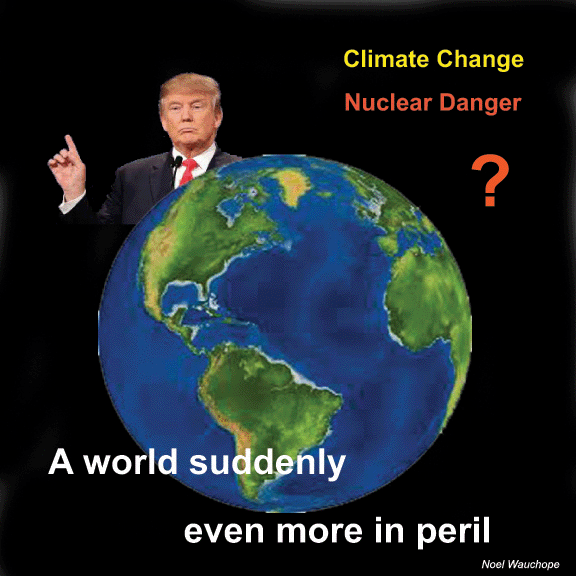
There’s no way around it: Donald Trump looks like a disaster for the planet Vox by Brad Plumer@bradplumerbrad@vox.com Nov 9, 2016 This is happening. Donald Trump is going to be president of the United States.
And there’s no way around it: What he’s planning to do looks like an absolute disaster for the planet (and the people on it). Specifically, all the fragile but important progress the world has made on global warming over the past eight years is now in danger of being blown up.
Trump has been crystal clear about his environmental plans. Much of the media never wanted to bring it up, never wanted to ask about it in debates, never wanted to turn their addled attention away from Hillary Clinton’s email servers to discuss what a Trump presidency might mean for climate change. But the warning signs were there:
Trump called global warming a Chinese hoax. He couldn’t have been blunter about this. He also tapped Myron Ebell, an avowed climate denier, to head his EPA transition team.
Trump has said, straight up, he wants to scrap all the major regulations that President Obama painstakingly put in place to reduce US carbon dioxide emissions, including the Clean Power Plan. If Trump wants to rewrite these rules through executive action, he can. Or Republicans in Congress could try to pass a law forbidding the EPA from ever regulating CO2 again.
Trump has also hinted he wants to downsize the EPA. “What they do is a disgrace,” he has said. He now has the power to rewrite or scale back other regulations on mercury pollution, on ground-level ozone, on coal ash, and more.
Trump has said he wants to repeal all federal spending on clean energy, including R&D for wind, solar, nuclear power, and electric vehicles. This would require Congress, but it’s not impossible.
Trump has said he wants to pull the United States out of the Paris climate deal. There’s nothing stopping him here. Technically, the US can’t officially withdraw for four years, but for all practical purposes, the Trump administration could ignore it.
So what happens if Trump gets his way? More air pollution, more carbon emissions. Exactly how much more remains to be seen. There are, after all, plenty of other factors pushing down US emissions that Trump has no control over. Natural gas from fracking would continue to kill coal power. Wind and solar would continue to grow. But it’s nearly impossible to imagine emissions under Trump dropping at the sharp pace necessary to slow global warming. And emissions could even rise, as this analysis from Lux Research suggests.
Even more importantly, the impact of Trump’s moves on the rest of the world could be seismic.
The world is making cautious progress on global warming. Trump wants to blow that all up.
For the last eight years, the Obama administration has been using every regulatory lever at its disposal to push down US greenhouse gases — aiming for a 28 percent cut below 2005 levels by 2025. Obama has also been trying to coax countries like China to participate in a global climate deal, in which every country would voluntarily pledge to restrain its emissions and meet regularly at the UN to ratchet up ambitions over time.
That plan finally came to fruition last December, when the world agreed to a sweeping climate agreement in Paris. The Paris deal was always delicate, and the current pledges weren’t nearly enough to avoid dangerous global warming, defined as 2°C or more. But the deal was a start. And the hope was that by cooperating and exerting diplomatic pressure on each other, all countries would steadily increase action over time.
This plan, which Clinton wanted to build upon, was far from a sure bet to halt global warming. But it was arguably the most plausible and promising accord yet proposed in the history of international climate talks.
Now it’s in peril. If Trump yanks the United States out of the Paris agreement, the deal won’t die, but momentum could wane. One can imagine China and India deciding they don’t need to push nearly as hard on clean energy if the world’s richest and most powerful country doesn’t care. At best, progress would slow. At worst, the entire arrangement could falter, and we set out on a path for 4°C warming or more.
These are decisions that will reverberate for thousands of years and affect hundreds of millions of people. We can’t easily undo the effects of all that extra carbon dioxide we keep putting into the air. Without drastic reductions in emissions (or possibly risky geoengineering), global temperatures will keep rising. The ice caps in Greenland and Antarctica will keep melting. Once that process gets underway, we can’t reverse it. The seas will rise. South Florida will eventually vanish beneath the oceans. Megadroughts will become more likely in the Southwest. For generations and generations.
Deal with India undermines nuclear nonproliferation, Editorial Asahi Shimbun, November 9, 2016 Indian Prime Minister Narendra Modi is scheduled to arrive in Japan on Nov. 10 for a summit with Prime Minister Shinzo Abe to sign a bilateral deal that will open the way for Japan’s nuclear reactor exports to India.
When the two prime ministers reached a basic agreement on this deal in December last year, we expressed our opposition. We now renew our objection and strongly urge the Japanese government to reconsider.
India became a nuclear power without becoming a signatory to the Nuclear Nonproliferation Treaty (NPT). To provide nuclear technology to such a nation flatly contradicts Japan’s traditional calls for nuclear disarmament and the elimination of nuclear weapons.
Naturally, objections to the Japan-India treaty have been raised, not only by Hiroshima and Nagasaki atomic bomb survivors but also by citizens of many countries demanding the abolition of nuclear weapons.
The NPT recognizes only five nuclear powers–the United States, Britain, France, China and Russia–while promoting nuclear disarmament. The treaty also guarantees all other nations their right to peaceful use of nuclear power, such as operating nuclear reactors, provided they refrain from developing nuclear weapons.
In essence, the NPT prevents nations of the world from competing to develop nuclear weapons.
India has remained a nonsignatory to the NPT, objecting to the treaty’s unequal treatment of the nuclear powers and the rest of the world. But India has proceeded with nuclear development in the meantime on the pretext that this is for “peaceful purposes.”
We must say India has trampled on the very spirit of nuclear nonproliferation……..
India’s freeze on nuclear tests is merely voluntary, and the country has not even signed the Comprehensive Nuclear-Test-Ban Treaty (CTBT).
The Japanese government appears to be hoping to include in the bilateral agreement a clause to the effect that Japan will withdraw cooperation if India conducts a nuclear test.
But is there any guarantee that India will never extract plutonium from spent nuclear fuel from reactors made with Japanese technology and use the plutonium to build nuclear weapons?
When the United Nations adopted a resolution late last month to start negotiations on the Nuclear Weapons Convention, Japan opposed the resolution, saying it could undermine the NPT and the existing nuclear disarmament negotiations.
But the Japan-India nuclear deal may further weaken and even destroy the NPT.
Come to think of it, is it really appropriate for Japan, which caused the nuclear disaster at Fukushima, to export nuclear reactors to India?
We can never condone the folly of only seeking immediate commercial gains in selling nuclear reactors to a country that is turning its back on nuclear nonproliferation. http://www.asahi.com/ajw/articles/AJ201611090023.html
The ‘flexible’ carbon mitigation mechanism of National Determined Contributions that makes contribution to emission cuts voluntary allows for the watering down of the historic and current responsibility of big polluter countries like the United States and China. Pressure is unjustly put on low carbon economies of developing countries when there should be none in the first place.
There are no concrete commitments and mechanisms that will ensure adequate and unconditional support for climate vulnerable countries. Even more marginalized was the proposed mechanism for ‘Loss and Damage’ that sought to facilitate compensation from industrialized nations to vulnerable nations that are already suffering climate impacts.
Transnational corporations and financial institutions, meanwhile, are given free rein to promote multi-billion dollar false climate solutions such as mega hydro, clean coal, and nuclear power plants, timber plantations, carbon credits, and other projects that displace communities and degrade the environment.
These are just the tip of the iceberg.
There are bigger battles outside the Paris Agreement http://opinion.inquirer.net/98960/there-are-bigger-battles-outside-the-paris-agreementINQUIRER.net November 04, 2016 LEON DULCE
Campaign Coordinator Kalikasan People’s Network for the EnvironmentWe write with regard to the resurgence of debate on President Rodrigo Duterte’s ambivalence over the Paris Agreement on Climate Change, as it comes in a time when deeper public discourse and action on the climate crisis is urgently needed.
World leaders will gather at the United Nations “COP22″ climate talks once again to attempt to concretize the Paris Agreement’s agreed common actions on mitigating carbon emissions that induce climate change, adapting communities to worsening climate impacts, and ensuring financing, technology transfer, capacity building, and loss and damage mechanisms.
COP22’s commencement fittingly coincides with the Philippines’ commemoration of the third anniversary of Super Typhoon Yolanda (international name Haiyan). World leaders should be reminded that some 16 million people were severely affected by Yolanda’s powerful winds, floods and storm surges across the Philippines, and that these impacted communities are still struggling to recover three years later—a preview of what future climate norms are in store for us if climate disruption is left unfettered.
An alarming evidence of this was the findings of current Social Welfare Secretary Judy Taguiwalo that at least 200,000 Yolanda survivors have yet to receive emergency shelter assistance from the state because of discrimination by local politics during the Aquino administration.
Meanwhile, the specter of ‘disaster capitalism’ continues to haunt Yolanda survivors. Initial findings of an environmental investigation mission held by the Center for Environmental Concerns and scientist group AGHAM regarding the proposed P7.9-billion Leyte Tide Embankment Project revealed how the biggest post-Yolanda mega-infrastructure solution actually threatens the livelihood and environment of some 10,000 residents across the east coast of Leyte.
Unfortunately, there is still a yawning gap between the abject plight of Yolanda survivors and other frontline communities and the reality of the Paris Agreement.
The ‘flexible’ carbon mitigation mechanism of National Determined Contributions that makes contribution to emission cuts voluntary allows for the watering down of the historic and current responsibility of big polluter countries like the United States and China. Pressure is unjustly put on low carbon economies of developing countries when there should be none in the first place.
There are no concrete commitments and mechanisms that will ensure adequate and unconditional support for climate vulnerable countries. Even more marginalized was the proposed mechanism for ‘Loss and Damage’ that sought to facilitate compensation from industrialized nations to vulnerable nations that are already suffering climate impacts.
Transnational corporations and financial institutions, meanwhile, are given free rein to promote multi-billion dollar false climate solutions such as mega hydro, clean coal, and nuclear power plants, timber plantations, carbon credits, and other projects that displace communities and degrade the environment.
These are just the tip of the iceberg. It is hard not to cast a shadow of doubt over the Paris Agreement and the uphill battle to step up the pact’s ambition in the upcoming COP22. It is actually commendable how President Duterte asserts our people’s right to develop as the foundation of his argument, a right of vulnerable and poor nations that is given only tokenisms in the agreement.
The climate talks, however, are still a legitimate venue to advance the concrete needs and aspirations of our people.
President Duterte can take a leaf from the book of Bolivian President Evo Morales, who called out global capitalism as the root of the climate and environmental crises in his plenary speech at COP21 last year, or from Pope Francis who also called for system change with his encyclical “Laudato Sii.”
At COP22, Duterte can take up the cudgels for the Filipino people struggling for climate justice, from the Lumad, Igorot, and other indigenous peoples resisting big coal and metallic mines to the Yolanda survivors that will march once again on ‘ground zero’ come November 8 to assert their demands for resilient homes and livelihoods.
These are the bigger battles outside the Paris Agreement that need to be fought, as these are the ones winning the struggle against the global system that perpetuates climate injustice. Let these stories of struggles in the frontlines be at the core of the climate talks.
“The worst thing that has happened in recent years is the collapse of trust in relations between major powers, The window to a nuclear weapon-free world…is being shut and sealed right before our eyes.” Common dreams, by John Scales Avery OSLOOctober 29, 2016 by Inter Press Service– President Mikhail Gorbachev, former leader of the Soviet Union and recipient of the 1990 Nobel Peace Prize, has appealed to world leaders to reduce the dangerous tensions, which today threaten to plunge human civilization and the biosphere into an all-destroying nuclear war.
In an October 10 interview with RIA Novosti, Gorbachev said: “I think the world has reached a dangerous point, I don’t want to give any concrete prescriptions, but I do want to say that this needs to stop. We need to renew dialogue. Stopping it was the biggest mistake.”
“It is necessary to return to the main priorities. These are nuclear disarmament, the fight against terrorism, the prevention of an environmental disaster,” he continued. “Compared to these challenges, all the rest slips into the background.”
Later the same day, in Iceland, President Gorbachev said: “The worst thing that has happened in recent years is the collapse of trust in relations between major powers, The window to a nuclear weapon-free world…is being shut and sealed right before our eyes.”
“As long as nuclear weapons exist, there is a danger that someday they will be used as a result either of accident or technical failure or of evil intent of man, an insane person or terrorist,” Gorbachev said.
Alyn Ware Agrees
Alyn Ware, the International Co-ordinater of Parliamentarians for Nuclear Non-proliferation and Disarmament, commented:
“I would concur with the assessment of Gorbachev.”
“I have been at the UN General Assembly October sessions (Disarmament and International Security) every year since 1988. This year was the most acrimonious I have ever seen. The tensions between Russia and NATO/Ukraine/US spilled over into the deliberations with accusations and counter accusations flying in many of the sessions. And these were not the only tensions. Syria/Yemen/Middle East, India/Pakistan and North Korea v South Korea/Japan/USA were also vitriolic towards each other.”
“Tension reduction, confidence building and diplomacy are vital at this time”, Alyn Ware continued, “Without this, disarmament is unlikely to occur and further armed conflict is very likely.”
The New UN Secretary General
Hope that the current extremely dangerous tensions can be reduced comes from the appointment of former Portuguese Prime Minister Antonio Guterres as the new UN Secretary General. The Security Council was united in making this appointment, thus giving us hope for better cooperation in the future……. http://www.commondreams.org/news/2016/10/29/mikhail-gorbachev-appeals-sanity-dialogue
Germany and Canada abstain, Norway joins the Netherlands in questioning language on the potential health risks from DU, Palau votes in favour for the first time.
1 November 2016 – ICBUW 146 states have voted in favour of the sixth resolution on DU weapons since 2007. This year’s text paid particular attention to the technical difficulties that affected states face in tackling DU contamination to internationally recognised radiation protection standards.
The resolution also took note of the ongoing concerns from states such as Iraq, and from health experts and civil society over the effects of the weapons on civilians. With the vote coming a week since the US admitted firing DU in Syria in 2015, concern over the health and environmental consequences of the use of the weapons is once again on the international agenda.
“With attention increasingly focused on the lack of obligations for the post-conflict management of DU contamination, the resolution’s reference to the difficulties affected states face is welcome,” said ICBUW Coordinator Doug Weir. “Without clear standards for clearance, and a mechanism for international assistance, civilians will continue to face avoidable exposure risks.”
True to form, just fourstates voted against the text, which will be voted on again by the General Assembly in early December. The US, UK, France and Israel remain the only four governments to continuously oppose the resolutions. In spite of repeated appeals from the European Parliament for progress on the topic, EU member states remained split on the resolution, with many among the 26 states still abstaining.
Germany, who up until 2014 had supported the resolutions, once again abstained, angering campaigners from ICBUW-Germany. Their position is all the more frustrating given that they elected not to develop DU weapons on the grounds of acceptability in the 1970s; and needless to say they warn their own military personnel of the dangers of battlefield exposure. Many abstainers used language in paragraph seven of the text to justify their political decision to abstain.
Last month Germany’s Foreign Minister Michael Roth claimed that the government took the debate on DU “very seriously” in a response to a parliamentary question from Green MP Agnieszka Brugger. However, in the run up to the vote Germany repeatedly sought to weaken the text of the resolution even though it seems apparent that Berlin had no intention of voting in favour.
“PAX is deeply disturbed that states abstaining on the resolution refused to recognise civilian concerns over exposure to depleted uranium, civilians who are rightly concerned that low-level radioactive waste in their environment could impact the lives of their families,” said PAX’s Wim Zwijnenburg. “Those states abstaining should look to their own guidelines on radiation protection and then consult their consciences on what would be the right thing do when it comes to protecting civilians in armed conflict.”
Prior to the 2015 election that saw Justin Trudeau sweep to power in Canada, his Liberal Party had been polled on their views on DU by Mines Action Canada. Their response couldn’t have been clearer: “The Liberal Party of Canada opposes the use of depleted uranium munitions.” Sadly Canada failed to live up to this ideal and abstained once again.
In spite of championing work on DU for many years, Norway joined the Netherlands in submitting an explanation of vote that cautioned against the use of language on the “potential health risks from DU”. While both nevertheless voted in favour, they argued that the term “possible health effects” would have been preferable.
ICBUW was pleased that Sweden and Bulgaria, who first voted in favour of the resolution in 2014 supported the text again this year. Sweden joined Switzerland in calling for harm reduction measures, such as risk awareness work for affected communities. Palau voted in favour for the first time, continuing the trend that has seen the number of abstentions decreasing in recent years.
Japan’s hypocritical nuclear stance, Japan Times, NOV 3, 2016 Japan’s vote at the United Nations last week to oppose a resolution to start talks on a treaty outlawing nuclear weapons is regrettable. It contradicts the nation’s long-standing call for the elimination of such weapons as the sole country to have suffered nuclear attacks. Tokyo’s latest move — which reflects the government’s reliance on the U.S. nuclear umbrella for the nation’s security — not only runs counter to the wishes of survivors of the 1945 Hiroshima and Nagasaki atomic bombings but will weaken its voice in international efforts to rid the world of nuclear arms.
On Oct. 27, the First Committee of the U.N. General Assembly, which deals with disarmament and international security, adopted the resolution, with 123 nations voting in favor, 38 against it and 16 abstaining. Six nuclear powers — the United States, Russia, Britain, France and Israel — voted against it, backed by U.S. allies such as Japan, South Korea, Germany and Australia. Three nuclear powers — China, India and Pakistan — abstained. Surprisingly, North Korea, which recently carried out a fifth nuclear weapons test, voted in favor…..
It is clear, however, that the U.S. put pressure on its allies, including Japan, to oppose the resolution. The U.S. government reportedly sent a letter dated Oct. 17 to NATO member nations urging them to “vote against negotiations on a nuclear treaty ban, not to merely abstain” and “to refrain from” joining talks on such a treaty. The letter said such a treaty, if enforced, “could have a direct impact on the U.S. ability to meet its NATO and Asia/Pacific extended deterrence commitments and the ability of our allies and partners to engage in joint defense operations with the United States and other nuclear weapons states.” A government official has disclosed that Washington made similar representations to Japan.
It would be logical to assume that Japanese officials believed they cannot resist such pressures given Japan’s dependence on the U.S. nuclear umbrella. But did it not occur to them that opposing the resolution would deprive Japan of moral credibility in its repeated calls for creating a nuclear weapons-free world, or could they not at least have considered abstaining from the vote — just like the Netherlands, a NATO member, did — even merely as a gesture? It is absurd to think that the U.S. would not care about Japan’s unique and special position as the only country to have experienced nuclear attacks.
Japan submitted a resolution calling for the abolition of nuclear weapons for the 23rd time in a row this year and it was adopted the same day as the one to begin talks on the nuclear weapons ban treaty cleared the same U.N. committee — with 167 nations in favor, four countries — China, North Korea, Russia and Syria — voting against and 17 abstaining. The U.S., which abstained from the vote last year, joined in co-sponsoring the resolution. The development raises suspicions that Tokyo opposed the resolution for the nuclear weapons ban treaty as a quid pro quo for Washington’s support of Japan’s resolution.
‘A Dangerous Situation’ As U.S.-Russia Tensions Spill Over To Nuclear Pacts October 31, 2016 Heard on Morning Edition DAVID WELNA The U.S. and Russia are the world’s two mightiest nuclear powers, and yet over the years, they’ve made deals to reduce their respective arsenals.
Just like a marriage gone bad, though, things have soured between Washington and Moscow. Bickering over nuclear issues has increased markedly in recent months, with each side accusing the other of cheating.
And that war of words is being matched by actions:
Russia, in early October, moved a battery of nuclear-capable missile launchers within range of three Baltic states.
In September, three U.S. long-range bombers — the kind used to drop nuclear weapons — flew over Eastern Europe in NATO military exercises.
Russia, in late October, unveiled images of a new intercontinental ballistic missile dubbed the Satan 2, whose warhead, it claims, can destroy an area the size of Texas.
On Thursday, the U.N. Disarmament and International Security Committee voted to approve a resolution that calls for negotiations on a new treaty outlawing nuclear weapons, despite opposition from nuclear-armed nations.
“This treaty won’t eliminate nuclear weapons overnight. But it will establish a powerful, new international legal standard, stigmatizing nuclear weapons and compelling nations to take urgent action on disarmament,” Beatriz Fihn, executive director of the International Campaign to Abolish Nuclear Weapons, said.
Fihn said the vote was a “historic moment” even though convincing countries to eliminate their nuclear weapons will be very difficult.
The non-binding resolution, presented by Austria, Brazil, Ireland, Nigeria, Mexico and South Africa was approved by a vote of 123 to 38, with 16 abstentions. Nuclear powers had lobbied for “no” votes.
Who voted against it The United States, Israel, France, Russia and Britain were among the nations voting against the measure. China, India and Pakistan abstained.
U.N. members will meet in December to vote on the resolution during a full general assembly.
The resolution also aims to set up a conference next March to negotiate a “legally binding instrument to prohibit nuclear weapons, leading toward their total elimination.”
Humanitarian consequences Countries in favor of the resolution cited deep concerns about the “catastrophic humanitarian consequences of any use of nuclear weapons.”
Nations against the measure say nuclear disarmament should be discussed during negotiations on the Nuclear Non-Proliferation Treaty.
This resolution came after three international conferences that took place in 2013 and discussions by a working group on nuclear disarmament in 2016 that recognized the humanitarian effects of nuclear weapons.
Nuclear-armed foes unite against a UN call to shed their weapons By Kambiz Foroohar | Bloomberg October 27, 2016
For all the divisions among world powers, one concern unites Russia and the U.S., India and Pakistan, North Korea and Israel at the United Nations: Keeping their nuclear weapons.
Those nuclear-armed states and the three others — China, France and the U.K. — are working to head off a resolution calling for a global conference to establish a binding “legal process” to ban the manufacture, possession, stockpiling and use of the weapons. They’re bucking a popular cause backed by 50 nations, from Ireland to Brazil, which say the measure could win as many as 120 votes in the 193-member General Assembly……
After international efforts to ban the use of biological and chemical weapons, land mines and cluster bombs, arms control advocates say it’s time to deal with nuclear bombs as the remaining weapons of mass destruction that aren’t prohibited. Sponsors of the resolution include Austria, Mexico, Nigeria and South Africa……http://www.stripes.com/news/us/nuclear-armed-foes-unite-against-a-un-call-to-shed-their-weapons-1.436090
German Foreign Minister Frank-Walter Steinmeier said on Oct. 8 that the situation between the U.S. and Russia today is more dangerous than it was during the Cold War. As he put it, “It’s a fallacy to think that this is like the Cold War. The current times are different and more dangerous.” Since most of us think of the Cold War as by far the most dangerous time we have known, Steinmeier’s view is startling. It is important to understand what he is saying, not simply because he is the foreign minister of an important country, but because he is a smart man.
On paper, the United States remains committed to the fall of Bashar al-Assad’s regime, while the Russians are protecting it. There is now combat in Aleppo, the largest city in Syria. Russian and Assad regime forces seem to be trying to take control of the city. The United States sees Aleppo as a bastion of anti-Assad forces and doesn’t want to see it fall. The U.S. has the option to try to block the Russian and Assad advance. Russia has to decide whether to stand and fight or withdraw. Neither side is confident it knows the other’s intentions, but both believe that Aleppo is a critical if not decisive battle. The chances of intentional conflict are real, as is the possibility of an unintended clash escalating.
At the same time, Syria is not essential to the national security of Russia or the United States. It is not without importance, but a defeat or capitulation there will not change the balance of power between them at all. It would of course affect psychological and political perception, but in the long run, perception ultimately comes down to substantial military and economic power. The United States can afford to back off. The Russians will find it more difficult, but can contrive reasons for slowing or halting the attacks.
In Ukraine, the issue is fundamental to Russia and secondary to the United States. Therefore, it is far more dangerous than Syria. For Russia, a Ukraine dominated by a third power, with forces deployed in Ukraine, represents a fundamental threat to its national security. For the United States, it is a secondary issue that can rise to a primary one.
As I have written, the foundation of U.S. foreign policy since World War I was preventing any single power from dominating Europe and Russia, as their combined strength in technology and resources would threaten American interests. Therefore, Russia returning to its prior position, with the potential to dominate the European Peninsula, would rise to a primary issue. If Russia invaded Ukraine and used it as a base to threaten its former satellite states, this would begin escalating to a primary level. But that is several steps from happening, and if it did, it would still not constitute a direct threat to the entire European Peninsula.
The Cold War focused on the center of Germany, and the possibility of a Soviet seizure of Western Europe did not appear far-fetched. Since the U.S. was defending Western Europe at a distance, its conventional forces facing the Soviets appeared to be inferior. Therefore, part of U.S. strategy, at least officially, was the use of nuclear weapons, both strategically and on the battlefield, to stop a Soviet offensive. That meant that should the Soviets have chosen to undertake an offensive, or if they detected a U.S. offensive, they had to go nuclear at the earliest possible moment.
This is what kept the Cold War from turning into a shooting war. The Soviets and the Americans, along with their allies or subordinates in Europe, saw themselves in an existential crisis. The deterrence against conventional war in Europe, as opposed to proxy wars elsewhere such as Vietnam or Afghanistan, was nuclear war. Wars that did not involve primary and overwhelming interests did not involve the risk of nuclear war. There was no military target worth a nuclear strike in either country, nor would either country risk immolation over Vietnam or Afghanistan. Therefore, these wars could take place.
I think this is Steinmeier’s point. The confluence of extremely critical fears and interests paradoxically reduced the chance of conflict, because it increased the chance of nuclear war. Today, none of the friction points between the United States and Russia are of primary interest to both countries. Syria is at best secondary to both, and Ukraine really matters only to Russia. This cannot result in nuclear war, and therefore, each side will take greater risks than they would have in Central Europe during the Cold War.
Therefore, the situation is more dangerous now precisely because the stakes are lower. In lowering the stakes, the risks decline and the possibility of serious conflict between U.S. and Russian forces rises. That direct clash did not occur during the Cold War, at least not on any significant scale. That means that the risk of nuclear war is diminished, but the risk of direct conflict is higher. This would not be proxy wars, but direct war. Undisciplined crises are the most dangerous.
Steinmeier’s observation seems valid. The mystery, of course, is what he is planning to do about that. Having made the declaration, it would seem reasonable that Germany would try to defuse the U.S.-Russian confrontation. Is Germany announcing that it is shifting its role in global politics to a more active role, albeit mediation? These crises raise the question of what Germany will do. That is a question with an ominous past. But if the German foreign minister is speaking for Germany, then this is exactly where his logic would lead him.