North Korean envoy at UN warns of nuclear war possibility: USA ready to do a pre-emptive strike
 North Korean envoy at UN warns of nuclear war possibility | 17 April 2017 | North Korea’s UN deputy representative, Kim In Ryong, on Monday unleashed at a hastily called UN press conference a torrent of threats, war scenarios and rhetoric aimed at the United States. The press event was held hours after US Vice President Mike Pence visited the demilitarized zone between North and South Korea. Pence warned North Korea not to test the resolve of the United States “or the strength of our military forces.” In New York, North Korea’s UN ambassador condemned the US naval buildup in the waters off the Korean Peninsula, plus the US missile attacks on Syria. Kim said, “It has created a dangerous situation in which thermonuclear war may break out at any moment on the peninsula and poses a serious threat to world peace and security.”U.S. May Launch Strike If North Korea Reaches for Nuclear Trigger | 13 April 2017 | The U.S. is prepared to launch a preemptive strike with conventional weapons against North Korea should officials become convinced that North Korea is about to follow through with a nuclear weapons test, multiple senior U.S. intelligence officials told NBC News. North Korea has warned that a “big event” is near, and U.S. officials say signs point to a nuclear test that could come as early as this weekend. The intelligence officials told NBC News that the U.S. has positioned two destroyers capable of shooting Tomahawk cruise missiles in the region, one just 300 miles from the North Korean nuclear test site.
The flaw in Trump’s North Korea sabre-rattling
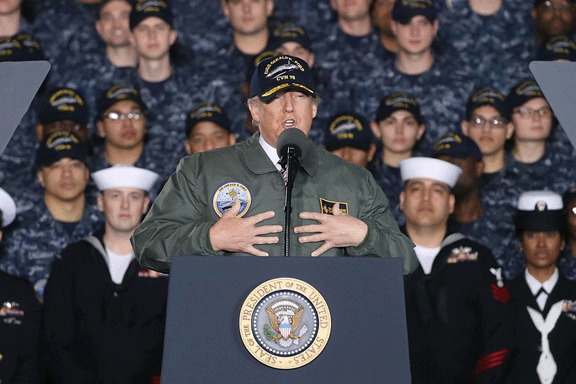 Trump’s North Korea sabre-rattling has a flaw: Kim Jong-un has
  nothing to lose
Strategy of sending in the US navy and attacking Syria and Afghanistan likely only to boost Pyongyang’s nuclear resolve, Guardian, Tom Phillips in Beijing and Justin McCurry in Tokyo, 16 APR 17, In the lead-up to North Korea’s latest missile test, Donald Trump had battled to convince Kim Jong-un he was picking a fight with the wrong guy.
The US president pounded Syria with 59 Tomahawk missiles and then ordered a naval “armada” into the waters around the Korean peninsula. He dropped the “mother of all bombs” on eastern Afghanistan and used Twitter to hammer home his message.
“North Korea is looking for trouble,” the US president tweeted last week as Kim’s technicians made the final preparations for Sunday’s botched but nevertheless defiant test.
But experts say Pyongyang’s latest act has underlined the futility of the billionaire’s efforts to bully Kim Jong-un into abandoning his nuclear ambitions.
“There is a problem with playing the military threat [card] with North Korea because they are inclined to call the bluff,” said John Delury, a North Korea expert from Yonsei University in Seoul. “I’m not saying they tested because of the threats. But bringing a naval strike group doesn’t help if your goal is to put off a test. If anything you are increasing the odds.”…….
Delury claimed Trump’s sabre-rattling rhetoric and erratic use of force would only strengthen Kim’s determination to develop an effective nuclear deterrent that might spare him the fate of Saddam Hussein or Muammar Gaddafi.
“It’s really just playing Pyongyang’s game. It is a waste of time and the Trump administration should move onto a more promising avenue to solve the problem … Since they have nothing to lose and we have everything to lose, they win every game of chicken.”
Leonid Petrov, a North Korea specialist at the Australian National University, said that with its latest missile launch “the message from North Korea is that despite US posturing they are not going to abandon their missile programme”.
Petrov said he was not surprised Kim Jong-un had chosen not to commemorate the 105th anniversary of the birth of the founder of North Korea, his grandfather Kim Il-sung, with an anticipated sixth nuclear test.
“Given the physical damage that would cause to nearby areas, it would have been unusual for a loyal, filial grandson to order a nuclear test on such an auspicious day,” he said.
But when that test does come it would prove the day of reckoning for Trump’s more aggressive approach towards North Korea. “If the US responds with an attack, that would confirm Kim’s claims that he is surrounded by hostile forces that are determined to carry out a pre-emptive strike,” Petrov said.
“The moment of truth for the US will be whether it strikes [in response to a nuclear test] and provokes a resumption of the Korean war at the expense of South Korean security, or stands down and betrays its weakness.”
“What would the US do? Withdraw, hang around or strike?” Petrov asked. “The ball is in the Americans’ court.” https://www.theguardian.com/world/2017/apr/16/north-korea-missile-test-donald-trump-kim-jong-un-has-nothing-to-lose
Donald Trump considers ‘utterly destroying’ North Korea’s nuclear sites
 Trump reportedly considering ‘utterly destroying’ North Korea’s nuclear sites on April 17, 2017,
The former official in the Bush administration, who knows of the Pentagon battle plans is quoted as saying: “Trump is pushing the Chinese hard, but in his gut he ultimately feels he will have to take a strong step himself”.
“There are plans to destroy the missile sites and the military have strong confidence in what they know.
“They wouldn’t launch a pre-emptive strike if there is an underground nuclear explosion but they would if the president thought they were launching an intercontinental ballistic missile.”……https://au.news.yahoo.com/world/a/35057503/us-president-donald-trump-reportedly-considering-utterly-destroying-north-koreas-nuclear-sites/#page1
Why is India still looking to nuclear companies that now face financial ruin?
India flirts with nuclear firms facing financial ruin Two of the major nuclear firms, India is dealing with, have run into financial crisis. As India looks forward to increase its share of nuclear energy in total power generation, the wavering financial condition of the firms raises some serious questions. India Today, IANS by Prabhash K Dutta New Delhi, April 16, 2017, For long a pariah in the global nuclear technology market, Indian policymakers are pleasantly discovering how the boot is on the other foot as they are furiously courted by foreign firms themselves facing financial ruin.
Trump insists he is working with China, on North Korea
‘We have no choice’: Trump sends stern warning to North Korea amid discussion with China By
9NEWS , 17 Apr 17 The United States has slammed North Korea’s latest missile test as a provocation and insisted it is working closely with China to resolve a crisis that Washington sees as reaching a critical stage.
US President Donald Trump threatened the rogue statue with military prowess, overnight tweeting “our military is building and is rapidy becoming stronger than ever before”.
“Frankly, we have no choice,” he wrote.
Amid broader fears that North Korea may again test a nuclear bomb, the Pentagon said yesterday’s “provocative” missile launch was a failure, with the weapon blowing up almost immediately after its early morning take-off near Sinpo on North Korea’s east coast.
Following the test, US National Security Adviser H.R. McMaster told ABC News: “There’s an international consensus now – including the Chinese and the Chinese leadership – that this is a situation that just can’t continue.”
Amid sharply heightened tensions, Mr McMaster said the US and allies were studying all actions “short of a military option,” though the Trump administration has not ruled that out.
North Korea watchers remained on high alert, as leader Kim Jong-un was reportedly poised to conduct a sixth nuclear test……..http://www.9news.com.au/national/2017/04/16/08/55/north-korea-attempts-to-launch-missile-but-fails
Time for leadership from United Nations, not Trump, to propmote peace with North Korea
“What have we learned from Iraq, and why is the UN security council not taking a lead in getting the United States, China and North Korea to the negotiating table?” The answer may be that thus far the Trump administration has no intention of going to the United Nations, an organisation that Trump believes is for people to go to “just to have a good time”. As far as Trump is concerned, multilateralism is for the birds
Is Donald Trump the man to promote peace with North Korea? https://www.theguardian.com/world/commentisfree/2017/apr/16/trump-peace-north-korea-nuclear-war-kim-johg-un-missile-test Mark Seddon
After Kim Jong-un’s failed missile test and the US president’s cosying up to China, this is the west’s chance to reset negotiations for a nuclear-free South China Sea
The world can afford a sigh of relief after news that North Korea’s latest attempt to launch a long-range missile has once again led to embarrassing failure. With Mike Pence, the US vice-president, in Seoul, could this be a moment for some realpolitik from the United States?
For as bizarre as it may seem given Donald Trump’s unpredictability and disturbing lurches into infantilism – displayed in his brinkmanship with the equally volatile North Korean dictator, Kim Jong-un – he could just as easily help bring about peace as he could thermonuclear war.
The world has been on tenterhooks this weekend as North Korea ramped up its bloodcurdling rhetoric threatening a nuclear response to any American-led preventive attack on its ballistic missile programme. In the course of a few days Trump has gone from tweeting that “North Korea is looking for trouble”, and if China “does not decide to help” the US “will solve the problem without them”, to sheepishly acknowledging that the North Korean imbroglio was more complex than he had first realised.
That should come as no surprise. Over the past few weeks his administration has gone from making belligerent remarks about China’s activities in the South China Sea to conjuring up visions of a calamitous meeting between President Xi and himself, before finally painting an endearing picture of enduring friendshipbetween the pair. Trump’s policy towards Russia and to intervention in Syria has undergone a similar 180-degree turn, with the blustering British foreign secretary, Boris Johnson, meekly acquiescing at each twist and turn. Who can keep up with Trump? Perhaps he can’t even keep up with himself.
Once this particular crisis on the Korean peninsula has, hopefully, calmed down, Trump could just as easily become a man of peace, taking a leaf from Richard Nixon’s famous meeting with Mao Zedong that normalised relations between the two countries in 1972. Could he tear up all that has gone before and eventually sign a final peace agreement with North Korea that would have, at its heart, an agreement to make the Korean peninsula nuclear free? It is a possibility, just not one that the American military is prepared to countenance so long as North Korea continues with its nuclear programme.
Trump’s boast to a TV host that he had informed President Xi of his Tomahawk missile attack on a Syrian airbase as they shared chocolate cake was surreal theatre at its most grotesque. But it was a message designed explicitly with North Korea in mind, as was his bunker-busting bomb in Afghanistan. The Chinese are intensely nervous and irritated by the behaviour of the formerly useful buffer state that is now a source of potential nuclear conflict and waves of refugees.
Ford, who has been engaged in almost continuous low-level shuttle diplomacy for nearly two decades between Pyongyang, Seoul and Beijing, is clear that the United States will simply not tolerate North Korea becoming a de facto nuclear state. He believes that the window of opportunity could be as little as six months before the US will strike. The Pentagon will have mulled over preventive strikes against the North Korean nuclear programme, but has been facing the horrifying prospect of an artillery response that could lead to the South Korean capital, Seoul, being consumed in what Kim Jong-il – Kim Jong-un’s father – described in 2011 as a “sea of fire”.
Ford also asks the questions: “What have we learned from Iraq, and why is the UN security council not taking a lead in getting the United States, China and North Korea to the negotiating table?” The answer may be that thus far the Trump administration has no intention of going to the United Nations, an organisation that Trump believes is for people to go to “just to have a good time”. As far as Trump is concerned, multilateralism is for the birds.
A window of hope could open after South Korea’s 9 May elections and a fresh new administration with a mandate to seek a solution and avoid an unthinkable military conflict. South Korea’s likely new progressive government could move to reopen the jointly run Kaesong industrial complex in the border area with North Korea. This could be a heaven-sent opportunity for the former UN secretary general Ban Ki-moon, now back in South Korea, to play a key role as peacemaker.
And Britain could begin to play a far more positive and independent role. But this would require Boris Johnson to work more closely with his opposite numbers in Europe and to not make foreign policy on the hoof.
It would also require Michael Fallon, the defence secretary, to halt the pretence that Britain is somehow an equal military player with the United States. He would have to realise that the only real power Britain has is to make it clear that it will not be part of any planned “coalition of the willing” acting without the backing of the UN security council in any future US military venture in Korea.
In fact, Britain could begin to demonstrate its vaunted new independence by taking a clear lead, proposing its own security council resolution demanding new UN-sponsored talks tasked with achieving a final peace agreement on the Korean peninsula.
America field tests New Nuclear Bomb
US Conducts Successful Field Test Of New Nuclear Bomb http://www.globalresearch.ca/us-conducts-successful-field-test-of-new-nuclear-bomb-2/5585314 By Tyler Durden Global Research, April 16, 2017 Zero Hedge With the world still abuzz over the first ever deployment of the GBU-43/B “Mother Of All Bombs” in Afghanistan, where it reportedly killed some 36 ISIS fighters, in a less noticed statement the US National Nuclear Security Administration quietly announced overnight the first successful field test of the modernized, “steerable” B61-12 gravity thermonuclear bomb in Nevada.

Pre-emptive strike by USA on North Korea is on the cards, if North Korea conducts nuclear weapons test,
 US prepared to launch pre-emptive strike if North Korea conducts nuclear weapons test, reports say, news.com.au, 14 Apr 17 Senior US intelligence officials have reportedly told NBC News the US is prepared to launch a pre-emptive strike with conventional weapons against North Korea if the country appears set to follow through with a nuclear weapons test.
Speculation has been building that the rogue state could be planning to conduct its sixth nuclear test, with reports of activity at the Punggye-ri nuclear test site ahead of Saturday’s 105th anniversary of the birth of the country’s founder Kim Il-Sung.
Citing intelligence officials, NBC News reported that the US had positioned two destroyers in the region, one around 480km from the nuclear test site. The destroyers are capable of shooting Tomahawk cruise missiles.
“US officials, mindful of such concerns here, repeatedly reaffirmed that (the US) will closely discuss with South Korea its North Korea-related measures,” foreign minister Yun Byung told a special parliamentary meeting.
US President Donald Trump today vowed that the “problem” of North Korea “will be taken care of”.”North Korea is a problem, the problem will be taken care of,” Mr Trump said.
Separately on Twitter he expressed confidence China, Pyongyang’s sole ally, would “properly deal with North Korea.”But, “if they are unable to do so, the U.S., with its allies, will! U.S.A.”
Asked on Thursday whether the bomb dropped in Afghanistan – a GBU-43/B Massive Ordnance Air Blast bomb better known by its nickname, the “Mother Of All Bombs” – was a warning to Pyongyang, Mr Trump demurred. “I don’t know if this sends a message to North Korea,” he said. “It doesn’t make any difference if it does or not.”
The Voice of America, quoting US government and other sources, said North Korea “has apparently placed a nuclear device in a tunnel and it could be detonated Saturday AM Korea time.”
A US monitoring group, 38North, has described the Punggye-ri test site as “primed and ready.”
The North is under multiple sets of United Nations sanctions over its nuclear and ballistic missile programs…….http://www.9news.com.au/world/2017/04/14/09/06/us-prepared-to-launch-pre-emptive-strike-if-north-korea-conducts-nuclear-weapons-test-reports-say
North Korea has threatened “nuclear thunderbolts” at the first sign of a US preemptive strike
 North Korea threatens ‘nuclear thunderbolts’ as US and China finally work together, Business Insider, ALEX LOCKIE APR 14, 2017 With the world on edge after reports that the US and North Korea are on the verge of war, North Korea has threatened “nuclear thunderbolts” at the first sign of a US preemptive strike while also slamming China for cooperating with the West, according to NKNews.com.
China warning North Korea against escalating tensions to an ‘irreversible’ stage
 China warns North Korea tension has to be stopped from reaching ‘irreversible’ stage, SMH, 14 Apr 17, Beijing/Pyongyang: China said on Friday tension over North Korea had to be stopped from reaching an “irreversible and unmanageable stage, SMH, ” as a US aircraft carrier group steamed towards the region amid fears the North may conduct a sixth nuclear weapons test on Saturday.Concern has grown since the US Navy fired 59 Tomahawk missiles at a Syrian airfield last week in response to a deadly gas attack, raising questions about US President Donald Trump’s plans for North Korea, which has conducted missile and nuclear tests in defiance of UN and unilateral sanctions.
The United States has warned that a policy of “strategic patience” is over. US Vice President Mike Pence travels to South Korea on Sunday on a long-planned 10-day trip to Asia.
China, North Korea’s sole major ally and neighbour which nevertheless opposes its weapons programme, has called for talks leading to the denuclearisation of the Korean peninsula.
“We call on all parties to refrain from provoking and threatening each other, whether in words or actions, and not let the situation get to an irreversible and unmanageable stage,” Chinese Foreign Minister Wang Yi told reporters in Beijing.
“Once a war really happens, the result will be nothing but losing all round and no one could become a winner,” Mr Wang told reporters in Beijing on Friday, according to the official Xinhua News Agency.
North Korea denounced the United States for bringing “huge nuclear strategic assets” to the region as the Carl Vinson strike group with a flag-ship nuclear-powered aircraft carrier steamed closer, and said it stood ready to strike back.
“The Trump administration, which made a surprise guided cruise-missile strike on Syria on April 6, has entered the path of open threat and blackmail,” the North’s KCNA news agency quoted the military as saying in a statement………
North Korea, still technically at war with the South after their 1950-53 conflict ended in a truce, not a treaty, has on occasion conducted missile or nuclear tests to coincide with big political events and often threatens the United States, South Korea and Japan.
On Saturday, it marks the “Day of the Sun”, the 105th anniversary of the birth of state founder Kim Il Sung.
US ally South Korea warned against any North Korean “provocation”, such as a nuclear or missile test.
“There is certain to be powerful punitive measure that will be difficult for the North Korean regime to endure,” the South’s Foreign Ministry said in a statement………
Worry about North Korean aggression has also led to a deterioration of ties between China and South Korea because China objects to the deployment of a US Terminal High Altitude Area Defense (THAAD) anti-missile system in the South.
“It’s not hard to see that ever since the United States and Republic of Korea decided to deploy THAAD, the situation has not become harmonious but has become more tense,” Chinese Foreign Ministry spokesman Geng Shuang, said in response to a question about the system………http://www.smh.com.au/world/china-warns-north-korea-tension-has-to-be-stopped-from-reaching-irreversible-stage-20170414-gvleo7.html
Scott Pruitt, Anti Environment Chief, states that USA should exit Paris climate deal
 EPA chief Scott Pruitt tells ‘Fox & Friends’ U.S. should exit Paris climate deal, Think Progress, 14 Apr 17
He then left the interview to give the coal industry a boost. Environmental Protection Agency chief Scott Pruitt said Thursday during an appearance on Fox and Friends that the United States should exit the Paris climate agreement because the accord only serves the interests of Europe, China and India.
“Paris is something that we need to really look at closely because it is something we need to exit, in my opinion,” Pruitt told the Fox News show hosts. “It’s a bad deal for America”
Pruitt, a former Oklahoma attorney general with close ties to the state’s oil and gas industry, has labeled the agreement a “bad deal” in the past but had not previously called for the United States to withdraw from the accord……
President Donald Trump reportedly is expected to meet with his senior advisers to decide whether the Unites States should stay in the Paris climate agreement. It remains to be seen whether Trump’s daughter, Ivanka, will attend the meeting. Ivanka Trump reportedly favors the country meeting its Paris climate agreement obligations. https://thinkprogress.org/scott-pruitt-calls-for-exit-of-paris-agreement-cd3d04a5f780
Have U.S. President Donald Trump’s missile strikes brought us closer to nuclear war?
 Could Syria Spark a Nuclear War Between Russia and America?, National Interest, Geoff Wilson Will Saetren, 12 Apr 17, On April 6, 2017, the 100th anniversary of the United States entering World War I, American warships launched 59 Tomahawk cruise missiles at regime targets in Syria. The base that absorbed the attack, Al Shayrat air base in Homs province, houses both Russian and Syrian troops, who are allies in Syria’s bloody civil war.
It was a flawless military operation, popular with American politicians, media and the public. And it is a serious problem.
Syria’s war: Who is fighting and why
Much like the geopolitical environment in Europe preceding World War I, Syria is home to a complex web of alliances and support structures. More than a century ago, the assassination of an archduke in Bosnia ignited a chain reaction that saw two blocks of alliances explode into a devastating global world war. The realities in Syria are even more complex and the stakes have never been higher.
Among the myriad of opposing factions in Syria, there are two goliaths. Russia, allied with the Assad regime and provider of troops, warplanes and sophisticated equipment to the pro-Syrian effort — and the United States, which has sided firmly with rebel and Kurdish factions committed to Syrian president Bashar Al Assad’s ouster. Between them, they possess 94 percent of the world’s nuclear weapons.
It is in this environment that U.S. president Donald Trump’s missile strikes have brought us one step closer to a scenario in which two nuclear superpowers could engage in direct combat operations against each other.
U.S. commandos have been carrying out missions in Syria since at least 2014, and over the past year, the United States has been steadily ratcheting up its involvement in the Syrian civil war……..
Keeping news of U.S. troop deployments in Syria from the Russians might sound good to Trump’s chest-thumping style of military planning, but it is vital that the Russians have at least a somewhat clear picture of where U.S. forces are operating.
If they don’t, the prospect of U.S.-Russian violence becomes very real.
Without proper channels of communication in place, it is entirely possible that U.S. and Russian forces could find themselves in a firefight. With both sides rapidly increasing their presence and commitment to the Syrian conflict, the situation could quickly escalate beyond either party’s control.
This is already happening. Hours after the strike, Russia announced that it is withdrawing from a 2015 memorandum that has significantly decreased the risk of in-flight incidents between U.S. and Russian aircraft operating in Syrian airspace. The Russian withdrawal comes as a direct result of the U.S. missile strikes on its ally, which Russia sees as a “grave violation of the memorandum.” The only reason that Russian troops weren’t killed in the attack on Al Shayrat is that the United States notified Russia in advance, using a hotline that was part of the now-defunct memorandum.
The danger should be readily apparent. With U.S. and Russian forces operating on opposing sides of a very contentious and complicated struggle, the risk of a catastrophic mishap is alarmingly high.
Sleepwalking toward nuclear war………
….with a combined active military stockpile of some 8,300 thermonuclear weapons, this is not a guessing game that anyone should want to play.
Official Russian military doctrine calls for the use of tactical nuclear weapons to control the escalation of a conventional conflict. In other words, if Russia finds itself in a fight that it can’t win, a real nuclear option is on the table. Some in the U.S. have mirrored this first-use strategy.
Frank Kendall, the Pentagon’s top acquisition chief told Congress in 2014, that low-yield nuclear weapons provide the President with “uniquely flexible options in an extreme crisis, particularly the ability to signal intent and control escalation.”
This is becoming a trend. Just this year, the Pentagon’s defense science board issued a report urging, “the president to consider altering existing and planned U.S. armaments to achieve a greater number of lower-yield weapons that could provide a ‘tailored nuclear option for limited use.’” But those weapons already exist, and some are already deployed in theater.
Some 50 B61 gravity bombs are based at the Incirlik air force base in Turkey, just 68 miles north of the Syrian border. Each one is fitted with a “dial-a-yield” nuclear warhead that can be set to explode with a force anywhere between 300 and 50,000 tons of TNT. It could be set to be 3 times more powerful than the bomb that was dropped on Hiroshima, or 98 percent less powerful than the bomb that was dropped on Hiroshima.
These weapons go beyond deterrence. These are weapons that are tailored for use on a battlefield. And they are right next-door.
In 1914 Europe’s monarchs thought they understood battlefield strategy. They quickly lost control of the situation, resulting in a war that lasted 4 years and killed close to 20 million people.
Miscalculating in Syria could have far greater consequences.
Geoff Wilson is a policy associate at The Ploughshares Fund, where he focuses on U.S. nuclear and military strategy, and is a co-editor of the report “Ten Big Nuclear Ideas for the Next President.” Will Saetren is the author of Ghosts of the Cold War: Rethinking the Need for a New Cruise Missile, and is an alumnus of the Roger L. Hale Fellowship at The Ploughshares Fund.
This first appeared in WarIsBoring here. http://nationalinterest.org/blog/the-buzz/could-syria-spark-nuclear-war-between-russia-america-20137
U.S. Won’t Strike North Korea Pre-emptively: South Korea Tries to Reassure Citizens
South Korea Seeks to Assure Citizens U.S. Won’t Strike North Pre-emptively APRIL 11, 2017 SEOUL, South Korea — Reacting to worries and conjecture spreading in South Korea of a possible pre-emptive American military strike on nuclear-armed North Korea, the government sought to reassure citizens on Tuesday that there would be no such attack without its consent.
Cautious and problematic negotiations at at U.N. nuclear weapons ban treaty meeting
 Big debates at U.N. nuclear weapons ban treaty negotiations Alicia Sanders-Zakre and Steven Pifer Brookings, April 12, 2017
The negotiation at the United Nations on a treaty to ban nuclear weapons began on March 27 with a bit of drama: U.S. Ambassador Nikki Haley gave a press conference explaining the U.S. decision to boycott the proceedings……
Some states advocated for the prohibition of the threat of use of nuclear weapons, claiming that it would serve to delegitimize nuclear deterrence doctrine. Others thought this prohibition was unnecessary, as the U.N. Charter already outlaws the threat of use of force. Moreover, a ban on the use of nuclear weapons would also ban the threat of their use.
Prohibiting the testing of nuclear weapons was also a contested question. Several states, including Kazakhstan, which continues to suffer the effects of having hosted the major Soviet nuclear test site, argued that testing should be explicitly prohibited. Others expressed concern that such a prohibition could come into conflict with the Comprehensive Test Ban Treaty or undermine its entry into force.
The participating states came down differently on the issue of the transit of nuclear weapons. While some stressed that transiting nuclear weapons through the territory of signatory states should be illegal, others pointed out that verifying this provision would be very challenging.
As to institutional arrangements, the participating states were in general agreement that the treaty should include a provision for regular meetings of states parties and use existing international organizations such as the International Atomic Energy Agency and perhaps the Comprehensive Test Ban Treaty Organization to help implement verification measures.
While states generally agreed that the treaty should be universal, they disagreed on the process for accession of nuclear weapons states. Gaukhar Mukhatzhanova of the James Martin Center for Nonproliferation Studies presented three options for accession: Nuclear weapons states could eliminate their arsenals before signing the treaty, sign the treaty with a clear plan for elimination, or negotiate a plan for elimination upon signing. Many states supported the second option while others advocated for the first.
All of these questions will require further discussion when the participating states gather for the second round of the negotiation in June.
LOOKING AHEAD
It is not clear that any of the issues where differences have arisen will prove deal-breakers for some participating states. How they resolve those differences—and whether in the end they can come to consensus on a ban treaty—will shape their ability to mobilize pressure on the nuclear weapons states.
And that is what this negotiation is all about. The non-nuclear weapons states have already committed in the NPT not to acquire nuclear arms. The question is whether they can push the nuclear weapons states to accelerate their disarmament efforts.
None of the specific resolutions will change the views of the nuclear weapons states on whether or not to take part in the ban treaty negotiation. They continue to regard the enterprise as disconnected from reality. But a successful negotiation that results in a treaty could up the pressure. The nuclear weapons states should pay attention. https://www.brookings.edu/blog/order-from-chaos/2017/04/12/big-debates-at-u-n-nuclear-weapons-ban-treaty-negotiations/
Foreign Ministers at G7 declare support for Iran nuclear agreement
 G7 FMs declare support for Iran’s nuclear deal IRNA http://theiranproject.com/blog/2017/04/11/g7-fms-declare-support-irans-nuclear-deal/ – The G7 Ministers of Foreign Affairs in the final declaration of their meeting in Lucca, Italy have expressed support for the 2015 nuclear deal between Iran and six world powers, known also as the Joint Comprehensive Plan of Action (JCPOA).
“We support the Joint Comprehensive Plan of Action (JCPOA) as an important contribution to the non-proliferation regime,” the Group of 7 (G7) Industrialized nations, including Canada, France, Germany, Italy, Japan, the United Kingdom, and the United States, said in Italy.
“Continued and full implementation of the JCPOA is essential to build confidence that Iran’s nuclear program is exclusively peaceful in nature,” the declaration further read.
The G7 foreign ministers also called for full commitment by all parties involved in the nuclear deal.
“We value the JCPOA’s comprehensive structure and the commitment by all parties to its solid verification mechanism,” they said. We commend and continue supporting the IAEA in its crucial work in Iran, including monitoring and verification to help ensure compliance with Iran’s JCPOA commitments and safeguard obligations, thus playing a key role in fostering mutual trust,” they said.
They further added that, “We stress the need for all parties to entirely and consistently fulfill all their commitments under the JCPOA in good faith.”
The G7 foreign ministers also asked the Islamic Republic of Iran to remain to comply with its JCPOA-commitments.
“We reaffirm the need for Iran to strictly abide by all its nuclear related commitments,” they said in their declaration.
The declaration further referred to the need for the Resolution 2231 of the United Nations Security Council to be fully implemented.
“UN Security Council Resolution 2231 needs to be fully implemented, including its provisions prohibiting the transfer of arms,” the declaration noted.
It also touched upon Iran’s role in Syria and noted, “We call upon Iran to play a constructive regional role by contributing to efforts to achieve political solutions, reconciliation and peace in Syria, Iraq, and Yemen and other parts of the region and to cooperate in countering the spread of terrorism and violent extremism.’
According to the G7 official website, the G7 Ministers of Foreign Affairs met on 10-11 April in Lucca. A traditional meeting held once a year between the seven most industrialized countries of the world.
1 This Month




PLEASE OPPOSE HR 8255 AND S.3639 – bills would accelerate satellite deployment, with no environmental review or safeguards – https://ncstd5li.quorum.us/campaign/169331/
To see nuclear-related stories in greater depth and intensity – go to https://nuclearinformation.wordpress.com
-
Archives
- September 2026 (323)
- August 2026 (330)
- July 2026 (355)
- June 2026 (287)
- May 2026 (306)
- April 2026 (356)
- March 2026 (251)
- February 2026 (267)
- January 2026 (308)
- December 2025 (358)
- November 2025 (359)
- October 2025 (375)
-
Categories
- 1
- 1 NUCLEAR ISSUES
- business and costs
- climate change
- culture and arts
- ENERGY
- environment
- health
- history
- indigenous issues
- Legal
- marketing of nuclear
- media
- opposition to nuclear
- PERSONAL STORIES
- politics
- politics international
- Religion and ethics
- safety
- secrets,lies and civil liberties
- spinbuster
- technology
- Uranium
- wastes
- weapons and war
- Women
- 2 WORLD
- ACTION
- AFRICA
- Atrocities
- AUSTRALIA
- Christina's notes
- Christina's themes
- culture and arts
- Events
- Fuk 2022
- Fuk 2023
- Fukushima 2017
- Fukushima 2018
- fukushima 2019
- Fukushima 2020
- Fukushima 2021
- general
- global warming
- Humour (God we need it)
- Nuclear
- RARE EARTHS
- Reference
- resources – print
- Resources -audiovicual
- Weekly Newsletter
- World
- World Nuclear
- YouTube
-
RSS
Entries RSS
Comments RSS

