 Trump sends Cruise missile-carrying nuclear submarine to South Korean port as he warns Kim Jong Un ‘is a problem that needs to be finally solved’
- The USS Michigan arrived on Monday ahead of a possible Tuesday nuke trial
- Tuesday is the 85th anniversary of the start of the North’s Korean People’s Army
- The US, Japan and South Korea are meeting in Tokyo to discuss North Korea
- Trump has also invited the entire Senate to the White House on Wednesday
- And the UN Security Council on North Korea will also meet on Friday
- Japan and China are to meet too; China is an unhappy ally of the hermit state
- North Korea has refused to stop its nuclear tests and is threatening more trials
- The USS Carl Vinson aircraft carrier strike group is also heading to the peninsula
By Reuters and Dailymail.com Reporter DAILY MAIL, 25 April 2017 A nuclear-powered US submarine arrived in a South Korean port on Tuesday in a show of force amid concerns that North Korea may attempt another missile launch or nuclear test on Tuesday.
The port call in Busan by the USS Michigan came as an American aircraft carrier strike group continued steaming towards Korean waters.
And as tensions in the area continued to rise, the top nuclear envoys from South Korea, Japan, and the US met in Tokyo to discuss North Korea’s refusal to give up its nuclear program.
On Monday, US President Donald Trump called for tougher new UN sanctions on Pyongyang, saying the North was a global threat and ‘a problem that we have to finally solve’.
The USS Michigan’s armament comprises four torpedo tubes and 154 BGM-109 Tomahawks. It was modified to remove its nuclear armaments in the mid-2000s.
Japan’s chief cabinet secretary, Yoshide Suga, told a media briefing that China’s nuclear envoy, Wu Dawei, would also hold talks with Japanese Foreign Ministry officials on Tuesday.
A ministry source said Wu was likely to meet his Japanese nuclear counterpart on Wednesday.
Matching the flurry of activity in North Asia, the State Department in Washington said on Monday US Secretary of State Rex Tillerson would chair a special ministerial meeting of the UN Security Council on North Korea on Friday.
Tillerson, along with Defense Secretary Jim Mattis, Director of National Intelligence Dan Coats and Joint Chiefs chairman General Joseph Dunford, would also hold a rare briefing for the entire US Senate on North Korea on Wednesday, Senate aides said……..
Two Japanese destroyers conducted exercises on Monday with the USS Carl Vinson aircraft carrier strike group that is headed for waters off the Korean peninsula, sent by Trump as a warning to the North.
The South Korean military is also planning to conduct joint drills with the carrier group.
As those drills continued, the USS Michigan arrived in the South Korean port of Busan on Tuesday, the US Navy said. The nuclear-powered submarine is built to carry and launch ballistic missiles and Tomahawk cruise missiles.
As well as his military show of force, Trump has also sought to pressure China to do more to rein in its nuclear-armed neighbor.
China, North Korea’s sole major ally, has in turn been angered by Pyongyang’s belligerence, as well as its nuclear and missile programs.
Regardless, North Korea has carried out nuclear and missile tests in defiance of successive rounds of United Nations sanctions………http://www.dailymail.co.uk/news/article-4442190/U-S-submarine-makes-S-Korea-port-call-North-remains-defiant.html
April 26, 2017
Posted by Christina Macpherson |
politics international, USA, weapons and war |
Leave a comment

 China warns North Korea another nuclear weapons test would take relations beyond ‘point of no return’
Warning comes amid fears of new launch to mark anniversary of Pyongyang’s military, Independent, Lizzie Dearden @lizziedearden , 25 Apr 17, North Korea has been warned not to go past the “point of no return” with another nuclear test by China, as the US and South Korea carry out high-profile military exercises.
An editorial in the Global Times, regarded as a mouthpiece for the ruling Communist Party, said Beijing was hoping for a peaceful outcome but had “very limited influence on the entire situation”.
“The game of chicken between Washington and Pyongyang has come to a breaking point,” it added, saying that if North Korea followed through on vows to carry out a sixth nuclear test, “it is more likely than ever that the situation will cross the point of no return.“All stakeholders will bear the consequences, with Pyongyang sure to suffer the greatest losses.”
The warning followed a conversation between Xi Jinping and Donald Trump, who has put pressure on China to “properly deal” with its ally’s continued violations of UN sanctions.
“China is very much the economic lifeline to North Korea so, while nothing is easy, if they want to solve the North Korean problem, they will,” the US President tweeted on Saturday.
As North Korea’s chief source of trade, food and fuel aid, Beijing has come under increasing pressure to use its influence to dissuade Kim Jong-un from continuing weapons development that has generated international alarm.
But the Chinese government is wary of any measures that could threaten the North Korean regime’s existence, and provoke a potential nuclear war or a new government in Pyongyang beholden to Washington and Seoul.
A spokesperson for the Chinese foreign ministry, Lu Kang, said diplomatic channels remained “smooth [with] normal exchanges” on Tuesday, amid fears of a new test to coincide with the 85th anniversary of the Korean People’s Army.He urged all sides to exercise restraint and refrain from any actions that could push tensions even higher. “The current situation on the Korean Peninsula is complicated and sensitive and the tension is high,” he added.
“We urge all sides concerned to keep restrained and calm and refrain from taking actions that could escalate tensions.”
Two American destroyers are conducting joint maritime exercises with ships from the Japanese and South Korean navies, which were to continue on Wednesday in waters both sides of the Korean Peninsula…….. http://www.independent.co.uk/news/world/asia/china-north-korea-nuclear-weapons-test-point-no-return-state-media-newspaper-us-south-korea-military-a7701161.html
April 26, 2017
Posted by Christina Macpherson |
politics international, weapons and war |
Leave a comment
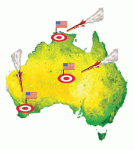 North Korea highlights 1250 US marines in Darwin to claim America is preparing for nuclear war, SMH, Kirsty Needham and James Massola, 25 Apr 17, North Korea’s state newspaper has singled out the United States’ deployment of 1250 marines to Darwin to claim America is preparing for nuclear war.
And as regional tensions escalate and a US carrier strike group approaches the Korean peninsula, Australian Foreign Minister Julie Bishop said the secretive regime “must be stopped” as it represented a threat to the region and, potentially, globally.
In a phone call with US president Donald Trump, Chinese president Xi Jinping said China opposed any actions that went against UN security council resolutions, as Japan confirmed it was joining drills with the strike group led by the USS Carl Vinson that is headed to Korean waters.
Pusan National University associate professor Robert Kelly told Fairfax Media North Korea’s missiles might have the range to reach northern Australia, but played down the threat as “the question is guidance, not range”.
Rodong Sinmun, the official paper of the Worker’s Party of North Korea, highlighted the US marines’ arrival in northern Australia on April 18. The marines will be joined by 12 military helicopters including five Cobra helicopters and four Osprey carriers.
“This is the largest scale US military presence in Australia after World War 2,” the newspaper reported on Monday. “America is fanatically, crazily trying to optimise its nuclear war readiness,” it claimed.
The story, on page six of the North Korean newspaper, was headlined: America prepares for nuclear war in different overseas military deployments. Darwin was the only city named…….
Australia-based defence experts believe it is unlikely North Korea has the capacity to strike Australia yet, though they may do within the next three years. The nation’s most recent missile test, earlier this month, failed just seconds after launch…….
The deployment of 1250 marines is the largest to Darwin since the former prime minister Julia Gillard and former president Barack Obama struck a deal back in 2011 to undertake the yearly rotation of troops.
with Sanghee Liu, AAP http://www.smh.com.au/federal-politics/political-news/north-korea-highlights-1250-us-marines-in-darwin-to-claim-america-is-preparing-for-nuclear-war-20170424-gvrbzl.html
April 26, 2017
Posted by Christina Macpherson |
AUSTRALIA, North Korea, politics international, USA, weapons and war |
Leave a comment
The cold hard reality is there is no viable military option against North Korea. They have nuclear weapons, which they can respond with. They have formidable conventional artillery, which they can use to hit Seoul. A preventive strike may provoke the very action it is designed to prevent. As Bismarck warned, it is like committing suicide from fear of death.
A political settlement with Pyongyang is probably not plausible, so America and its allies have no choice but to contain North Korea as best we can. Deterrence and diplomacy have risks, to be sure, but the risks seem far lower than those involved in attacking or further isolating North Korea.
Of course North Korea wants nukes. We should learn to live with it
Deterrence and diplomacy carry risks, but attacking or further isolating North Korea could be worse. The Age , Tom Switzer, 23 Apr 17, “……I listen to the debates about North Korea’s nuclear ambitions. Once again, we are told that a rogue state is bent on developing nuclear weapons that threaten world peace and that either a preventive strike or regime change, or both, will disarm this strategic and moral threat.
But remember the realists were right about Iraq. Leave aside that Saddam’s regime did not even possess serious weapons of mass destruction capacity. Regime change was always fraught with the danger of unintended consequences. Iran and its Shiite militias acquired new influence within Iraq and the broader region while parts of Iraq fell into the hands of Sunni jihadists, who were even more fanatical than al-Qaeda.
Although anguish over a nuclear North Korea is understandable, it’s a fair bet the realists are also right today.
We are told Kim Jong-un is really a madman because he really has nuclear weapons. But although he is a nasty piece of work, the North Korean despot is not crazy. His primary goal is survival: the end of his regime means the end of Kim. From his perspective, it makes sense to develop nuclear weapons.
Why? Because nukes are the ultimate deterrent. North Korea is a minor power surrounded by three major powers – China, Japan, Russia – and with an outside power – the US – constantly threatening it with regime change. As Professor John Mearsheimer, the doyen of foreign-policy realism, told me recently, when Washington strikes Bashar al-Assad’s Syria, or helps topple Saddam’s Iraq or Colonel Gaddafi’s Libya, it gives Pyongyang a very powerful incentive to keep its nuclear weapons.
We are told that Beijing must force North Korea into giving up its nukes or at least not develop an intercontinental ballistic missile that can hit California and Darwin. Chinese co-operation would be ideal and Beijing’s leaders, as Malcolm Turnbull reiterated at the weekend, have some leverage with their communist comrade.
But China also needs North Korea for geopolitical reasons. It is a vital strategic asset. Remember that China entered the Korean War in late 1950 when the Americans crossed the 38th Parallel.
From Beijing’s standpoint, the collapse of North Korea would create a refugee crisis and mean a reunified Korea under a US nuclear security umbrella. If you think Russia is overly sensitive about Ukraine being a western bulwark on its doorstep, imagine how China would respond to a western bulwark on its doorstep. As unfashionable as it is to say, great powers still have spheres of influence.
We are told that regime change is an option in dealing with the North Korean menace. But if there is any hope of discouraging Pyongyang from using nuclear weapons, the West will need to stop threatening regime change and try to reach an accommodation with the Hermit Kingdom. The only way North Korea will jettison its nukes is if it feels relatively secure and has the sense that relations with the West are improving.
Alas, Donald Trump sounds tougher with Pyongyang than even Bush and Barack Obama. At the weekend, Vice-President Mike Pence told the Prime Minister the US will not relent until the Korean peninsula is free of nuclear weapons. That could box in Trump, limit his options, and force him on a path that could push him into a preventive war.
The cold hard reality is there is no viable military option against North Korea. They have nuclear weapons, which they can respond with. They have formidable conventional artillery, which they can use to hit Seoul. A preventive strike may provoke the very action it is designed to prevent. As Bismarck warned, it is like committing suicide from fear of death.
A political settlement with Pyongyang is probably not plausible, so America and its allies have no choice but to contain North Korea as best we can. Deterrence and diplomacy have risks, to be sure, but the risks seem far lower than those involved in attacking or further isolating North Korea. Just think of Iraq.
Tom Switzer is a Fairfax Media columnist and a presenter on the ABC’s Radio National. http://www.theage.com.au/comment/of-course-north-korea-wants-nukes-we-should-learn-to-live-with-it-20170423-gvqkbs.html
April 24, 2017
Posted by Christina Macpherson |
2 WORLD, politics international, weapons and war |
Leave a comment
North Korea issues nuclear warning to Australia, Camden Narellan Advertiser ,23 Apr 2017 Beijing: North Korea’s foreign ministry has lashed out at Foreign Minister Julie Bishop and warned Australia was “coming within the range of the nuclear strike”. The threats were reported by the North Korean state news agency KCNA as being made on Friday, in response to a radio interview given by Ms Bishop.
 According to a translation of the KCNA report, which was dated Friday, the same day US Vice-President Mike Pence arrived in Australia, Ms Bishop had said in the radio interview that North Korea seriously threatens regional peace and she supports the US policy that “all options are on the table”.
A spokesman for the Foreign Ministry of North Korea – officially the Democratic People’s Republic of Korea (DPRK) – was quoted as saying: “The present government of Australia is blindly and zealously toeing the US line. It is hard to expect good words from the foreign minister of such government.”….
“If Australia persists in following the US moves to isolate and stifle the DPRK and remains a shock brigade of the US master, this will be a suicidal act of coming within the range of the nuclear strike of the strategic force of the DPRK.”….
The KCNA report continued: “The Australian foreign minister had better think twice about the consequences to be entailed by her reckless tongue-lashing before flattering the US.”
Prime Minister Malcolm Turnbull on Saturday pledged support for the US policy on North Korea and again urged China to do more to place economic pressure on North Korea.
China has turned back coal shipments to North Korea in recent weeks, one of the regime’s few sources of funding. Chinese media have speculated the Chinese government is also considering cutting oil supplies.
There are renewed concerns that North Korea may conduct its sixth nuclear test on Tuesday, the 85th anniversary of its military, and China said this week it was “gravely concerned”.
China’s official People’s Daily newspaper on Saturday evening reported online that new satellite images of the North Korean nuclear test site had shown probable new trailer activity, citing US research website 38 North. http://www.camdenadvertiser.com.au/story/4614177/north-korea-issues-nuclear-warning-to-australia/?cs=5
April 24, 2017
Posted by Christina Macpherson |
AUSTRALIA, North Korea, politics international |
Leave a comment
But besides demanding North Korea give up its only trump card — no pun intended — some are pushing the administration to go even further: to consider launching a preemptive strike on Pyongyang.
What happens next is one of the worst military and human tragedies in history: Kim orders a nuclear strike on Seoul. While the missile lands four miles outside of the city thanks to a targeting error, millions of people are instantly killed with millions more poisoned by radioactive fallout. In a sheer panic, the millions of people who survive the attack rush south, creating a massive humanitarian crisis of the worst magnitude.
From here, things get even worse……the price of such a victory could be millions of people dead and large sections of Korea rendered uninhabitable for decades, if not longer.
No one wants to talk to the dictator of a nation with over 200,000 people or more in prison camps — but an attack that could lead to a conflict where millions could die in a nuclear war is far worse. The stakes are too great to at least not consider it.
 How a preemptive strike on North Korea could end up killing millions http://theweek.com/articles/692872/how-preemptive-strike-north-korea-could-end-killing-millions Harry J. Kazianis 21 Apr 17 While North Korea might not have tested another nuclear weapon in recent days, tensions in Asia keep rising — and Washington is at least partially to blame.
First, it seems the Trump administration is ready to take the toughest of lines when it comes to dealing with the Hermit Kingdom. In an interview with The Washington Post‘s Josh Rogin, Vice President Pence declared that North Korea must give up its nuclear and missile programs in exchange for nothing, not even talks.
As the piece points out, it is tough to tell at this point if this was just rhetoric, maybe a trial balloon of sorts, or a new Trump administration policy. The vice president, however, seemed clear: “I think the path of negotiations with North Korea has been a colossal failure now for more than 25 years.”
But besides demanding North Korea give up its only trump card — no pun intended — some are pushing the administration to go even further: to consider launching a preemptive strike on Pyongyang.
In an interview on the Today show, Sen. Lindsey Graham (R-S.C.) explained that if China would not stop North Korea from building a missile that can hit the U.S. homeland, Washington should use diplomacy, sanctions, and possibly “a military strike to stop their program.”
On the surface, both comments in isolation might not draw oodles of attention. But taken together with the facts that Washington will not negotiate with North Korea and that the Hermit Kingdom already has, according to most estimates, 10-20 nuclear weapons, the comments are nothing short of apocalyptic.
In order to appreciate the ramifications of such a policy, let’s game out what such ideas would look like in practice. Let us assume in the near future that Washington decides to push China hard into somehow “solving” the North Korea issue. Beijing, for its part, does cut back some food and fuel aid and does, to its credit, end all direct and indirect aid to Pyongyang’s various military programs. North Korea’s nuclear and missile programs continue to advance, but instead of racing towards a missile that can nuke America, the program is slowed dramatically.
The Trump administration is not satisfied. It threatens China, declaring that it must do more. But Beijing does not want to precipitate the possible downfall of the Kim dynasty. They fear Washington’s wrath, but they’re much more worried about millions of hungry North Koreans trying to seek refuge in China as well as potentially loose nuclear, chemical, and biological weapons. Combined with Beijing’s other great concern — that Seoul would eventually unite the Korean peninsula under its control and continue its military alliance with the U.S. — China decides to take its chances with America.
Washington is now faced with a dilemma. They have made substantial progress on curtailing the speed in which Pyongyang can pair a nuclear warhead with a long-range missile — but the threat does remain. So the Trump administration leaks to the press that it is considering military action, and begins to move its best military assets into the region — and this time it’s for real. President Trump orders B-2 bombers at the ready, with the ability to evade radar and drop large, bunker-buster bombs on North Korean nuclear facilities.
But North Korea is not to be deterred. It declares to the world that if the Trump administration decides to attack, Pyongyang will unload its full arsenal on South Korea and Japan. And considering North Korea’s large military — thousands of artillery pieces, rocket launchers, 4,300 tanks, 1.1 million men under arms, 200,00 special forces, and a dangerous offensive cyber warfare capability — it is a threat that can’t exactly be taken lightly
But Trump presses ahead. After moving three aircraft carrier battlegroups into the region and sending additional bombers and fighters to South Korea, Japan, and Guam, the administration warns North Korea that “it must decide whether it wants peace or war” and that “the Kim regime clearly can see that now we truly have all options on the table.” Trump then goes on Twitter, declaring, “I hope Kim makes the right choice!”
Kim Jong Un, North Korea’s third dynastic dictator, decides not to budge. He knows that if he gives up his nukes he has no leverage with America. And even worse, North Korea’s political elites will see him as weak — and regime change could occur from within. He makes the only choice he can, and hopes Trump is bluffing.
Unfortunately for Kim, and Asia, war is now inevitable.
Trump orders a massive assault on North Korea’s nuclear weapons and missile programs. The goal is simple: Destroy not only Pyongyang’s ability to create nuclear weapons and advanced missiles, but the current stockpiles they have. Washington launches what can only be described as a “shock and awe” campaign on steroids: over 1,000 cruise missiles in the first few hours alone, B-2 bombers flying around the clock from bases in Missouri with stealth F-22 Raptors leading the way.
The assault itself, according to every metric conceivable, is a success. North Korea’s nuclear and missile programs are set back a decade or more with most of Kim’s nuclear weapons and missile launchers destroyed. Republicans and Democrats alike applaud President Trump’s bold actions — acting when leaders of the past decided to do nothing.
There is however a catch to what seems like a resounding military success: The Kim regime’s nuclear deterrent was not completely destroyed. One weapon, buried deep underground, survived the attack. And since North Korea’s chemical and biological weapons were largely hidden underground as well, Kim has a terrible choice to make: Use the weapons he has now, or lose them in a potential second wave of strikes. He decides to use his full arsenal before it’s too late.
What happens next is one of the worst military and human tragedies in history: Kim orders a nuclear strike on Seoul. While the missile lands four miles outside of the city thanks to a targeting error, millions of people are instantly killed with millions more poisoned by radioactive fallout. In a sheer panic, the millions of people who survive the attack rush south, creating a massive humanitarian crisis of the worst magnitude.
From here, things get even worse. Kim launches dozens of chemical and biological weapons at South Korea and Japan. Sarin, VX ,and other toxins are lobbed at Tokyo, Pusan, and other large cities. Millions of people try to flee the impacted areas just as in Seoul — creating a panic not seen since World War II.
In just a few hours, hell is unleashed on the Korean peninsula. And while the United States and its allies would eventually win any war against North Korea, it is clear from the above — far from what could be the most extreme of examples of a Second Korean War — what damage the Kim regime could do in a military confrontation. Indeed, the price of such a victory could be millions of people dead and large sections of Korea rendered uninhabitable for decades, if not longer.
Yet, there is another path forward. It seems due time for President Trump to remember his own words from the campaign when it comes to talking to North Korea — and maybe even to Kim Jong Un directly: “I would speak to him. I would have no problem speaking to him.”
No one wants to talk to the dictator of a nation with over 200,000 people or more in prison camps — but an attack that could lead to a conflict where millions could die in a nuclear war is far worse. The stakes are too great to at least not consider it.
April 24, 2017
Posted by Christina Macpherson |
North Korea, politics international, USA, weapons and war |
Leave a comment

 Why Trump Can’t Rip Up Iran’s Internationally Brokered Nuclear Deal ,
  Sputnik News 21 Apr 17 While the Trump administration admitted that Iran has complied with the 2015 nuclear agreement, it continues to send mixed signals to Tehran, accusing the latter of sponsoring terrorism. Speaking to Sputnik Persian, Hamid Gholamzadeh assumed that Washington is looking for any excuse to rip the deal up.
Although the Trump administration admitted Tuesday that Iran is complying with the terms of the 2015 nuclear agreement and extended the sanctions relief given to Tehran, US Secretary of State Rex Tillerson leveled criticism at Iran on Wednesday, dubbing the deal a “failed approach.”
Tillerson emphasized that the US is going to carry out a “comprehensive review” of its policy toward Iran, which, according to the Secretary of State, is about to follow in North Korea’s footsteps.
“The Trump administration is currently conducting across the entire government a review of our Iran policy… an unchecked Iran has the potential to follow the same path as North Korea and take the world along with it. The United States is keen to avoid a second piece of evidence that strategic patience is a failed approach,” Tillerson said as quoted by CNBC……..
Speaking to Sputnik Persian, Hamed Mousavi, a professor at the Department of Political Sciences of the University of Tehran, highlighted that Iran’s nuclear agreement is an international deal in the first place.
“One should pay attention to a few points, in particular, the multilateral nature of the obligations under the JCPOA. The US should not forget that a nuclear deal is not a bilateral agreement between [Washington] and Iran. The United States cannot unilaterally abolish the international agreement that was signed by Iran and several other countries and which was approved by the UN Security Council. This is contrary to international law,” Mousavi emphasized.
Grigory Yarygin, Associate Professor at the Department of American Studies of the School of International Relations at St.Petersburg State University, echoed Mousavi.
“This nuclear deal was concluded not only between Tehran and Washington, but it is Iran’s deal with six international mediators. Therefore, it is highly unlikely that the attempt to cancel this deal will succeed,” Yarygin told Radio Sputnik.
“We must understand that at the international level, significant efforts were made… to ease tensions between Iran and the United States and prevented possible tragic consequences related to the [Iranian] nuclear program,” he said.
For his part, Hamid Gholamzadeh, an expert on North America and English Chief Editor of Mehr News Agency, suggested in an interview with Sputnik Persian that Washington is looking for an excuse to undermine the deal.
“The US has recognized that Iran is fulfilling its obligations. But this did not convince them. Therefore, the US is looking for new pretexts, which they want to prove using the relevant documents. Despite the reaffirmation of Iran’s commitment to its obligations, the US accused it of supporting terrorism in order to obtain a justification [for imposing sanctions],” Gholamzadeh explained.
“I believe that the US will play out its own scenario: they will try to reimpose the sanctions, unless Europe, Russia and China, as the main negotiators, try to prevent these plans,” he added.
The question then arises as to why the new administration is pushing ahead with its plan to rip the Iran nuclear deal up?
Robbie Gramer of Foreign Policy magazine believes that Donald Trump is seeking to restore US-Saudi relations, which were undermined by the US nuclear deal struck under Obama………https://sputniknews.com/politics/201704201052818335-trump-iran-nuclear-deal/
April 22, 2017
Posted by Christina Macpherson |
Iran, politics international |
Leave a comment
 The greatest threat to the future of mankind? http://www.manilatimes.net/greatest-threat-future-mankind/323418/ BY JAIME J.YAMBAO ON APRIL 22, 2017
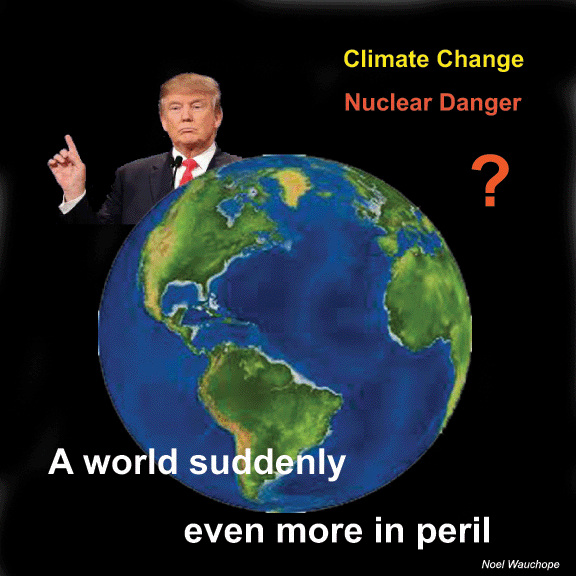
 UNLESS rebuffed by the US Congress like it did with his repeal of Obamacare, President Trump’s proposal to boost the budget for nuclear weapons production could make him the greatest threat to the future of mankind. Not climate change. Not terrorism.
Already America’s 5,500 strategic nuclear weapons possess enough destructive power to destroy Planet Earth at least five times over; some experts estimate up to 50 times over.
The US and Russia own 95 percent of the world’s nuclear warheads, with Russia slightly ahead. But the two powers have been reducing their stockpiles under the US- Russia Strategic Arms Reduction Treaty (START). Obviously not a candidate for the Nobel Peace prize, Trump has announced his wish to renegotiate the new START and be at the top of the nuclear heap, not only numerically but also in lethalness.
Trump’s desire to be absolutely No. 1 could conceivably trigger a new nuclear arms race among the nuclear powers today. This could also encourage new aspirants for the exclusive nuclear circle as the race further accentuates the basic flaw of the Non-Proliferation Treaty: its discriminatory nature. The nuclear powers as of July1968, the time of signing of the NPT, are exempt from the ban the treaty imposes.
Sanctions have not prevented states from violating the NPT. India with an economy large enough to go autarkic considered the sanctions imposed on it after its nuclear tests “meaningless.” Sanctions against Pakistan were dropped as soon as its cooperation was deemed essential by the US in the latter’s Afghan wars. For all the sanctions slapped on it, North Korea has so far conducted nuclear and missile tests at relentlessly short intervals that the risk of a nuclear detonation being made either by the US or North Korea today is considered the highest since the Cold War.
Small wonder that the world has not been too happy and content with the NPT. In accordance with the decision of the majority last year, the UN General Assembly a few days ago launched a conference to negotiate a new legally binding treaty to prohibit nuclear weapons in line with previous treaties prohibiting chemical and biological weapons, landmines and cluster munitions.
Customary international law makes no mention of nuclear weapons because they are of a later invention. But as their immediate and longer term effects were demonstrated in Hiroshima and Nagasaki, nuclear weapons clearly fall under the weapons prohibited by customary international law—weapons which are of a nature to strike at military objectives and civilians without distinction.
It was the monitoring of the effects of the bombing of Hiroshima and Nagasaki that showed how a single nuclear bomb detonated over a large city could kill millions of people, bring unimaginable suffering to survivors and their future generations, and cause catastrophic and long-term damage to the environment. The use of tens or hundreds of nuclear bombs would be cataclysmic, severely disrupting the global climate and causing widespread famine. The UN conference serves to negotiate a treaty that would for the first time explicitly and universally prohibit nuclear weapons. The ban would include the five permanent members of the Security Council.
For all its defects, the NPT by the number of countries subscribing to it manifests the desire of the vast majority of countries around the world (almost 200) to ban nuclear weapons. One hundred fifteen countries are also part of nuclear weapons-free zones which cover Southeast Asia, Central Asia, the South Pacific, Latin America and the Caribbean, and Africa. While a majority of UN members are participating in the conference. The United States and its allies have boycotted it, calling it an unrealistic exercise. One US ally, the Philippines is not in that boycott. Its own Constitution bans nuclear weapons.
Given Trump’s pledge to make America great again in nuclear weapons and given the ongoing efforts in the United Nations to negotiate a ban, it appears that the world is at a historic juncture. To ban or not to ban.
With the US boycotting the conference, one cannot be sanguine about what any resulting treaty can amount to. The colossal nuclear stockpile of the US will be outside the ban. Would a label or reputation as a rogue leader matter to Trump? Probably not. The United States anyway has a history of not ratifying landmark treaties and not learning any lesson from the disastrous consequences of its non-ratification.
Trump is one damn determined fellow. This is shown by the fact that to make a significant increase in his defense and nuclear weapons budget, he has to make drastic cuts in components of the federal budget that contribute significantly to national security. Trump is also one narrow-minded fool. Said a New York Times
“[T]he armed forces are a vital component of the national security tool kit, but so are diplomacy, economic engagement, and post-conflict reconstruction. The use of military force should always be a last resort, and the balanced application of other, less costly tools of national power helps prevent wars and crises from arising in the first place.”
The reason the US gave for the bombing of Hiroshima and Nagasaki, killing millions of civilians, was to stop the war and prevent further US military casualties.
The nuclear bomb has been associated to this day with caring for the lives of America’s soldiers. It has been noted that Trump counts on the customary popularity of defense with legislators to get his budget passed. Trump may get the additional more powerful nuclear bombs that he wants.
What makes people nervous about this prospect is that in the few weeks he has been in the White House, Trump has done little to dispel the notion engendered by the election campaign that his short-fuse temperament may willy-nilly unleash a nuclear cataclysm. His issuance of orders without much consultation with appropriate agencies, his all-bluster-and-wind assaults on mass and social media grounded on “alternative facts” are far from reassuring of a man close to the nuclear button.
It seems that under the protocol concerned, the US President, contrary to the popular imagery, does not actually press his finger on the button. He issues an order to a War Room in the Pentagon where officials are bound by law to execute the order. There is an anecdote related in the Internet of one such top brass fired for asking whether he should follow an order to release nuclear bombs coming from an insane President. The US President has the sole authority to use nuclear weapons. The Pentagon must simply obey his command. Theirs not to question why…
Jaime J. Yambao is a retired Ambassador of the Philippines
April 22, 2017
Posted by Christina Macpherson |
politics international, safety, USA |
Leave a comment
Russia ‘moves troops and equipment’ to North Korea border, as Kim Jong-un warns of ‘super-mighty pre-emptive strike’, Telegraph UK Roland Oliphant Reuters 20 APRIL 2017 Russia has moved heavy military equipment towards its border with North Korea amid mounting fears of a military clash between Pyongyang and the United States over the North’s nuclear program.
A flurry of military activity in Russia’s far east came as the UN Security Council strongly condemned North Korea’s latest missile test and threatened to impose new sanctions against Pyongyang for its “highly destabilizing behavior.”
In a unanimous statement, the council demanded that North Korea “conduct no further nuclear tests” and said Pyongyang’s “illegal missile activities” were “greatly increasing tension in the region and beyond.”……
It was revealed earlier this week that a US aircraft carrier group led by the USS Carl Vinson would spend another 30 days at sea
before heading towards North Korean waters. Last week Donald Trump, the US president, said he had ordered an “armada” into the northwest Pacific in a show of force designed to deter North Korea from further missile and nuclear weapons test.
The US defence ministry acknowledged on Tuesday that the ships had actually travelled into the Indian Ocean to carry out manoeuvres with Australian forces, and only began its journey north recently.
Mr Trump has called on China, Pyongyang’s only ally, to rein in North Korean leader Kim Jong-un, but has threatened to act alone to “solve” the problem if necessary.
Residents and local media in Russia’s Far East reported large military convoys travelling in the direction of the North Korean border since the weekend, in what appear to be contingency plans to contain fallout from a possible military clash between the United States and North Korea.
A video published by local news site DVHab.ru showed a train carrying twelve tracked vehicles, including Tor surface to air missile systems, travelling through Khabarovsk in the direction of Vladivostok.
“Some say the situation around North Korea is a fiction, but this is the third train of equipment we’ve seen since this morning,” a man can be heard saying in the film. “Looks like something is being sent to the Korean border.”………
South Korean presidential candidates clashed on Wednesday night in a debate over the planned deployment in South Korea of a US-supplied Terminal High Altitude Area Defense (THAAD) anti-missile system, which has angered China.
Frontrunner Moon Jae-in was criticised for leaving his options open before the May 9 election.
On Monday, Hwang and Pence reaffirmed their plans to go ahead with the THAAD, but the decision will be up to the next South Korean president. For its part, China says the system’s powerful radar is a threat to its security.
The North has said it has developed a missile that can strike the mainland United States, but officials and experts believe it is some time away from mastering the necessary technology, including miniaturising a nuclear warhead.http://www.telegraph.co.uk/news/2017/04/20/north-korea-warns-super-mighty-preemptive-strike-will-reduce/
There has been some confusion over the whereabouts of a US aircraft carrier group after Trump said last week he had sent an “armada” as a warning to North Korea, even as the ships were still far from Korean waters.The US military’s Pacific Command explained that the USS Carl Vinson strike group first had to complete a shorter-than-planned period of training with Australia. It was now heading for the Western Pacific as ordered, it said.
China’s influential Global Times newspaper, which is published by the People’s Daily, the Communist Party’s official paper, wondered whether the misdirection was deliberate.
“The truth seems to be that the US military and president jointly created fake news and it is without doubt a rare scandal in US history, which will be bound to cripple Trump’s and US dignity,” it said. http://www.telegraph.co.uk/news/2017/04/20/north-korea-warns-super-mighty-preemptive-strike-will-reduce/
April 21, 2017
Posted by Christina Macpherson |
politics international, Russia, weapons and war |
Leave a comment
China criticizes North Korea, praises US on nuclear issue, By Brad Lendon, CNN April 20, 2017 China may be getting fed up with continued nuclear bluster from long-time ally North Korea and tilting toward the United States. A day after North Korea’s Vice Foreign Minister said Pyongyang would test missiles weekly and use nuclear weapons if threatened, a Chinese Foreign Ministry spokesman said Beijing was “gravely concerned” about North Korea’s recent nuclear and missile activities.
April 21, 2017
Posted by Christina Macpherson |
China, politics international |
Leave a comment
 Tillerson Slams Nuclear Deal after State Department Certifies Iranian Compliance, A proliferation expert suggests the certification was made to comply with law and avoid a crisis while reviewing its Iran policy. The Weekly Standard, APR 20, 2017 | By JENNA LIFHITS Secretary of State Rex Tillerson slammed the Iran nuclear deal for its limited scope and eventual sunset date Wednesday, and said the Trump administration is conducting an exhaustive review of its Iran policy.
The secretary’s rebuke came one day after his State Department certified that Iran is complying with the deal. The decision to certify likely follows from the administration being knee-deep in an intensive review of the agreement and uncertain about next steps, top proliferation experts told THE WEEKLY STANDARD………
While Tillerson did not specify whether the administration would scrap or rigorously enforce the deal, he and other administration officials have suggested a preference for the latter.
Late Tuesday, Tillerson certified to Congress that Iran is complying with the nuclear deal.
The president must by law report to Congress about Iranian compliance with the deal every three months. If the administration does not submit a compliance certification or determines that Iran is in “material breach” of the deal, Congress has the ability to quickly re-impose sanctions lifted under the deal. The certification drew the ire of some in the White House who would have preferred to see no certification filed and the deal subsequently done away with.
The administration likely issued the certification to meet the conditions of the law and avoid a crisis while reviewing its Iran policy, a top proliferation expert told TWS………
If the administration had not issued the certification, the diplomatic fallout could have been significant, David Albright (founder of the Institute for Science and International Security) added.
Tillerson said this week that the administration is conducting a broad review of its Iran policy, including the nuclear agreement and whether to maintain related sanctions relief…….
Administration officials have also reportedly been considering broadening sanctions against Iran and its Islamic Revolutionary Guard Corps (IRGC). http://www.weeklystandard.com/tillerson-slams-nuclear-deal-after-state-department-certifies-iranian-compliance/article/2007709
April 21, 2017
Posted by Christina Macpherson |
Iran, politics international, USA |
Leave a comment
 White House Shouldn’t Try To Reverse Iran Nuclear Deal, Parsi Says, NPR, April 20, 20175 , Heard on Morning Edition Steve Inskeep talks to Trita Parsi, an Iran scholar, who warns of dire consequences if Trump officials renege on the nuclear accord and reverse a pledge to ease sanctions against Tehran.
STEVE INSKEEP, HOST:
Let’s make sense of two moves that President Trump’s administration made this week. The administration affirms that Iran is following a nuclear deal. The administration also says Iran is misbehaving around the Middle East. Put another way, Secretary of State Rex Tillerson says Iran is following a deal that the Trump administration really doesn’t like.
INSKEEP: One observer of the administration moves is Trita Parsi, president of the National Iranian American Council. He supported the nuclear deal made by the Obama administration, although he is not on good terms with Iran’s government. Welcome to the program.
INSKEEP: So what does it mean that President Trump, who said he would rip up this nuclear deal on day one, instead says Iran is following it?…..
PARSI: Well, I think the first thing to say is that it doesn’t seem as if the Trump administration really knows what it’s doing. It’s a significant contradiction to first come out and say that the Iranians – contrary to all of their claims that Iran would be cheating – actually is living up to the deal only to come out the day after and saying, well, we hate the deal anyways and signaling that the U.S. might actually be walking away from the deal, unless of course the aim is to get rid of the deal without the U.S. having to pay the cost for it, meaning instead of the U.S. violating the deal directly by not renewing these sanctions waivers, killing the deal by escalating tensions in Yemen and elsewhere in the region and hoping that that will force the Iranians out of the deal…….
INSKEEP: Wouldn’t you like some pressure on this government, though, even though you are a supporter of the nuclear deal?
PARSI: Certainly. There’s many areas in which there needs to be pressure on Iran, particularly, I would say, on the human rights front. But an approach that is centered on pressure and that is completely void of diplomacy most likely will lead to a military confrontation…….
INSKEEP: Can you just remind us what the basics of this nuclear deal are? Iran still has a nuclear program – right? – but it’s restricted.
PARSI: Iran has a restricted nuclear program. There are inspections in every aspect of Iran’s program. And all of the various pathways that Iran had towards building a nuclear bomb as a result of this deal has been closed. Some of these restrictions will be lifted in about 15 or so years. But the most important restriction is the inspections regime, the additional product called a Non-Proliferation Treaty, will be permanent, granted, of course, that all sides live up to their end of the bargain. And as the Trump administration certified two days ago, so far, the Iranians are living up to the bargain. And now, the United States also has to continue to waive sanctions in order for the United States to be in compliance with the deal.
INSKEEP: OK. You just mentioned waiving sanctions. Does President Trump have to actively do something to keep the sanctions off Iran for the moment?
PARSI: Yes. Before May 18, the United States is obliged to continue to waive sanctions in order for the U.S. to be in compliance. If it doesn’t, then the U.S. pulls out of the deal, and that will likely cause the Iranians to do the same.
INSKEEP: So that would be the next big moment to watch, potentially, is whether President Trump is willing to affirmatively keep sanctions eased on Iran.
PARSI: Exactly. And the day after the deadline is the Iranian presidential elections.
INSKEEP: And in which the president who did the deal, President Hassan Rouhani, is up for re-election.PARSI: He is up for re-election. And if he loses, then we will have a president in the United States and a president in Iran that most likely will be opposed to this deal. And that would be very negative for the continuation of this nuclear accord.
INSKEEP: Trita Parsi has a book coming out called “Losing An Enemy: Obama, Iran, And The Triumph Of Diplomacy.” He’s with the National Iranian American Council……http://www.npr.org/2017/04/20/524833644/white-house-shouldnt-try-to-reverse-iran-nuclear-deal-parsi-says
April 21, 2017
Posted by Christina Macpherson |
Iran, politics international, USA |
Leave a comment

 The Trump Administration Is Apparently Terrified of Actually Making a Decision About Paris Sad!, Mother Jones, OLIVER MILMAN, APR. 19, 2017 This story was originally published by the Guardian and is reproduced here as part of theClimate Desk collaboration.
Donald Trump’s aides have abruptly postponed a meeting to determine whether the US should remain in the Paris climate agreement, with an unlikely coalition of fossil fuel firms, environmental groups and some Republicans calling on the president to stick with the deal.
Trump’s top advisers were set to meet on Tuesday to provide the president with a recommendation ahead of a G7 meeting in May. However, a White House official said the meeting had been postponed due to conflicting schedules. It is unclear when it will now take place.
Trump has already signed executive orders to start the demolition of the clean power plan, throw open federal land to coal mining, and halt new vehicle emissions standards but has so far not acted on his campaign pledge to “cancel” the Paris compromise.
His aides are understood to be split on whether the US should stay in the voluntary agreement, which was fully ratified last year. Barack Obama pledged that the US would cut greenhouse gas emissions by 26-28 percent by 2025, based on 2005 levels, as part of a landmark global effort that for the first time required emissions reduction goals from all nations, including the large developing emitters China and India.
Trump’s adviser Steve Bannon and the Environmental Protection Agency head, Scott Pruitt, are both in favor of ditching the Paris agreement. Last week, Pruitt called the agreement a “bad deal” for the US that imposes a burden that other countries do not have to bear.
However, the weight of opinion may be in favor of those who support the agreement. Trump’s daughter, Ivanka, and son-in-law, Jared Kushner, both advisers to the president, have positioned themselves as defenders of the agreement, while Rex Tillerson, the secretary of state, has supported the idea of “keeping a seat at the table.” Other advisers at the meeting were expected to include Rick Perry, the energy secretary; Gary Cohen, an economic adviser; and HR McMaster, the national security adviser.
Support for the Paris deal has come from seemingly unlikely quarters—the oil giant ExxonMobil wrote to the White House to advocate it as an “effective framework for addressing the risks of climate change.” BP and Shell have also previously endorsed the Paris deal, along with dozens of other businesses including Gap, General Mills and the Kellogg Company.
A group of Republicans in Congress also warned against withdrawing from the agreement. The Florida congressman Carlos Curbelo, in his role as co-chair of the Climate Solutions Caucus, said it was “imperative that we maintain our seat at the table.”
“The world’s leading nations must work together to not only reduce the impact carbon emissions have on climate change, but also mitigate and prepare for the effects, which communities like ours are dealing with every day,” Curbelo said in a joint statement with Ted Deutch, a Democrat who is his fellow co-chair……..
If Trump decides to exit the deal, it will require a three-year notice period before the process begins. In order to speed up the process, he could remove the US from the overall UN climate change framework or submit the deal to the Senate to be ratified as a treaty, where it will probably fail.
A third, and perhaps most likely, option is to remain in the agreement in name only, retaining a modicum of US prestige abroad while dismantling Obama-era rules designed to reduce emissions. The US will face no penalty for not meeting its emissions targets, although some other countries have raised the possibility of imposing a “carbon tariff” on American goods.
Regardless of whether the US stays within the Paris deal, its chances of making deep cuts in its emissions have receded since Trump took office. Without the clean power plan, more stringent emissions standards on vehicles and gas and oil drilling operations or any sort of tax on greenhouse gases—a plan recently floated by some Republicans—the US will pull back from the effort to help avoid more severe heatwaves, droughts, the disappearance of coral reefs and coastal inundation.
“Regardless of what Trump does on Paris, he has abrogated our position,” said Tom Steyer, a leading hedge fund manager and climate campaigner. “This is an administration trying as hard as possible to bring back coal mining; they have given up American leadership on energy and climate. They have already walked away.” http://www.motherjones.com/environment/2017/04/trump-aides-postpone-meeting-paris-climate-deal
April 21, 2017
Posted by Christina Macpherson |
climate change, politics international, USA |
Leave a comment
 Championing Nuclear Non-Proliferation Rules: The EU and Iran , Lobelog, by Peter Jenkins, 20 Apr 17 In a newly published book, Tarja Cronberg contrasts EU and US conceptions of multilateralism in the nuclear field. Her work is titled Nuclear Multilateralism and Iran.
A former member of the European Parliament (EP) and chair of the EP delegation for EU relations with Iran, Cronberg writes: “For the US multilateralism is a means to an end, but for Europeans it is an end in itself.” Both the EU and the US are committed, she continues, to upholding international law, well-functioning international institutions, and a rules-based international order. But the EU’s commitment is more heartfelt and goes deeper than the US commitment. After all, the EU itself is a multilateral institution, and, lacking military resources, is more dependent on global rules. The US approach is “utilitarian,” writes Cronberg, quoting Robert Kagan, whereas the EU approach could be characterized as both idealistic and needy (my words, not hers).
These distinctions are the starting-point for an analysis of the EU contribution to resolving the concern aroused by International Atomic Energy Agency (IAEA) reports in 2003 that Iran had “pursued a policy of concealment” for 18 years and had failed to declare the possession and use of nuclear material to develop a uranium enrichment capability. Cronberg finds that the EU contribution was important, even essential to the eventual outcome of that process. The EU showed itself to be a “unified” and effective “actor.”
Good Cop/Bad Cop
This finding leads her to offer several recommendations to EU policymakers. Her chief recommendation relates to the role the EU should aspire to play in the event of similar nuclear proliferation cases in the future. She would like the EU role to be “autonomous.” In effect she is advocating that the EU put itself forward as a purer champion of a multilateral rules-based order than the United States, to lead the international search for peaceful solutions.
In support of that recommendation she makes a telling point. On moral and political grounds the five Nuclear Non-Proliferation Treaty (NPT) Nuclear Weapon States (NWS) ought to have disbarred themselves from preaching nuclear non-proliferation years ago. Most NPT parties resent the continuing reluctance of the NWS to act on their NPT pledge to negotiate “in good faith” on nuclear disarmament. Indeed most parties find NWS hypocrisy nauseating. In contrast, although two NWS are members of the EU (only one, in all probability, from April 2019), the EU as a whole is entitled to characterize itself as a non-nuclear weapon entity………
This is a thought-provoking book that draws on “front-line” experience of the issues and historical events that the author addresses. It appears at a time when the commitment of the United States to the multilateral rules-based order that it fathered over 70 years ago seems weaker than ever. http://lobelog.com/championing-nuclear-non-proliferation-rules-the-eu-and-iran/
April 21, 2017
Posted by Christina Macpherson |
Iran, politics international, resources - print |
Leave a comment
‘Trump’s U-turn on NATO: Making it more expansionist, rather than more defensive, ’https://www.rt.com/op-edge/384649-nato-trump-policy-defense/ 13 Apr, 2017 President Trump is going along with NATO chief Jens Stoltenberg on the alliance’s increased deployment in Eastern Europe to supposedly deter Russia, but it will only reduce European security, Martin Sieff of the Global Policy Institute told RT.
US President Donald Trump on Wednesday had his first face-to-face meeting with NATOSecretary General Jens Stoltenberg in Washington DC.
He admitted changing his position on NATO, calling the alliance the “bulwark of international peace and security.”
However, his stance on having peaceful relations with Russia also stays in place, and Stoltenberg supported it.
“It would be wonderful, as we were discussing just a little while ago if NATO and our country could get along with Russia. Right now, we’re not getting along with Russia at all. We may be at an all-time low in terms of a relationship with Russia. This has built over a long period of time. But we’re going to see what happens. Putin is the leader of Russia. Russia is a strong country. We’re a very, very strong country. We’re going to see how that all works out,” Trump said.
Former CIA analyst Elizabeth Murray shared her thoughts with RT on President Trump’s change of tune on NATO.
“That seems to be in line with a lot of contradictory messages that have been coming from the White House. It seems like just over a week ago we heard that the Syrian people were going to decide their leadership. Apparently now it seems they don’t have that option. So it seems that we’re hearing a lot of contradictory statements from the White House and it is hard to know what to make of it,” she said.
As to why this is happening, Murray suggested that perhaps this has something to do “with the ratcheting up of tensions and ratcheting up of rhetoric vis-à-vis both Syria and Russia.”
“As you well know, we have a record number of NATO troops massed on the border with Russia – in Poland and the Baltic States. This is consistent with the tensions that have been rising since last week after this chemical incident in Syria and then the bombing of the Syrian airfield. I’m just hoping that dialogue, cool heads, and adult supervision will prevail here,” she added.
Martin Sieff of the Global Policy Institute called Trump’s change of rhetoric “depressing” but at the same time “predictable.”
“President Trump is inexperienced in the foreign policy area. He has not made the same effort he made in the economic sphere to appoint senior officials and advisors who would implement the policies that he spilled out consistently during his election campaign. Instead, he is letting himself be swayed by establishment positions,” he told RT.
Effectively, in Seiff’s view, Trump has made a U-turn on his NATO policy.
“He repeatedly said during his campaign that NATO was obsolete, that it needs to be restructured. Now he says it is not obsolete,” he said. “If he is going to change NATO radically, it looks like he is going to change it by making it more expansionist rather than more defensive and stabilizing. This is exactly the opposite of the positions he took consistently during his campaign.”
Speaking on Wednesday Trump yet again raised the spending issue.
“Fair burden-sharing has been my top priority since taking office. We have now turned a corner,” the president said.
Seiff says that even if European countries do increase their NATO spending, it will make no difference in practical terms.
“Secretary General Stoltenberg today in Washington – and he is a hawk in these issues – expressed confidence that the overall spending rates would be rising to 3.8 per cent for NATO. He said there are now $10 billion more of defense spending in NATO. But when you look currently – only five NATO nations have reached the two per cent of GDP standard, which Stoltenberg has been pushing, and which Trump is now also pushing – last year in 2016. Stoltenberg says another two or three nations will reach this stage in the next year or two. This includes very small countries: Romania, which although is a large country geographically, has a very weak economic base; and Latvia, which is a very small country indeed,” he explained.
He went on to say that in Germany and France powerful political forces are emerging who want neither increases in defense spending nor heightened tension with Russia.
“This year we’re going to see elections in a couple of weeks in France – the first round of the presidential elections. And we’re going to see the German elections for the Federal government coming in the fall, in September. If those go against the hawks, then all of Trump’s hopes to have increased spending in NATO is going to go by the board. It is not going to happen,” he said.
Trump’s reassessment of NATO could also have an impact on the United States’ relations with Russia, the analyst said.
“The signs again in the short term are very pessimistic, unfortunately. NATO has been pushing under President Obama and under NATO Secretary General Stoltenberg to deploy increased numbers of forces in Eastern Europe allegedly to deter Russian aggression. This will only have the opposite effect. It is Russia that was invaded from Western Europe and devastated in WWI and WWII. It was the Russian people who suffered more than anyone else. This concern, these historic memories go deep in Russia. Even relatively small forward NATO deployments, especially in countries that have very anti-Russian popular traditions in them – small countries even like Latvia, or even larger countries like Poland – create great alarm in Russia,” he said.
“So far from giving increased security to NATO and to its eastern members, these deployments that Stoltenberg wants, and Trump is going along with, will reduce security in Europe, and are much more likely to threaten the very catastrophes and breakdown of peace and security that they allegedly claim to prevent,” Seiff concluded.
“If he is going to change NATO radically, it looks like he is going to change it by making it more expansionist rather than more defensive and stabilizing. This is exactly the opposite of the positions he took consistently during his campaign.”
April 19, 2017
Posted by Christina Macpherson |
EUROPE, politics international, USA, weapons and war |
Leave a comment