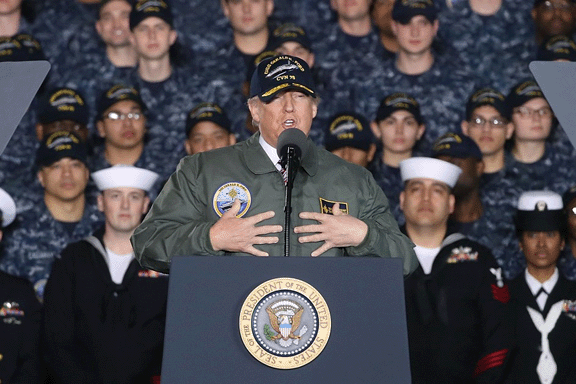
Haley: Trump ‘has grounds’ to say Iran violating nuclear deal, Politico, By NAHAL TOOSI, 09/05/2017
Donald Trump’s U.N. ambassador says the president “has grounds” to declare that Iran is not complying with the 2015 nuclear deal, stoking doubts about whether Trump intends to keep an international agreement and core legacy achievement for former President Barack Obama.
Nikki Haley, speaking Tuesday in Washington, said she did not know what Trump plans to do next month when he is due to certify to Congress whether Tehran is complying with the agreement. But she appeared to lay the groundwork for Trump to declare that Iran is in violation of the deal……..http://www.politico.com/story/2017/09/05/trump-iran-violate-nuclear-deal-nikki-haley-242331
September 6, 2017
Posted by Christina Macpherson |
Iran, politics international, USA |
Leave a comment
North Korea: What can actually be done to deal with a nuclear Pyongyang? http://www.abc.net.au/news/2017-09-03/north-korea-is-it-time-to-accept-it-will-remain-a-nuclear-threat/8868138, ANALYSIS By chief foreign correspondent Philip Williams, From the first tweak of the seismograph it was clear this was no ordinary tremor — it signalled the most powerful bomb of all.
The North Korean TV newsreader announced with a flourish this was the state’s first hydrogen bomb.If that now means Pyongyang has the weapon and the delivery system that could wipe out a Los Angeles, a San Francisco or a Sydney in a flash, then the world is now a different place.
Nuclear weapons are supposed to be a deterrent — make yourself so dangerous no-one will ever dare challenge you — and it is a fact that barring some Scuds aimed at Israel during the 1991 Gulf War and some border skirmishes between China and Vietnam and India and Pakistan, no nuclear-armed state has ever faced a serious attack by another country.
Clearly the thinking for three generations of Kim is that the regime is made safe if everyone fears you. And the clear impression you are crazy helps too — no-one wants to aggravate a disturbed mind.
But what to do? US President Donald Trump has described the test as hostile and dangerous and said Pyongyang “only understands one thing”.
Appeasement was not working, he said, and the rogue nation has become a “great threat and embarrassment” to China. He later tweeted the US was considering “stopping trade with any country doing business with North Korea”.
That would include both China and Russia. While both signed on to the latest UN sanctions, cutting trade altogether would be a far more serious step.
Beijing would have to cut off oil supplies and Moscow send back the North Korean labourers who “volunteer” to work in Siberian forestry camps in what have been described as slave-like conditions.
The whole region and beyond is in a fix. China especially is feeling the squeeze from the United States, and even Australia has argued Beijing has not applied full muscle against North Korea to mend its errant ways.
But the Chinese Government has agreed to the latest sanctions and deeply resents the assertion it could stop Kim Jong-un if it really wanted to. There is nothing for the Chinese to gain from a nuclear war on the Korean Peninsula.
Not only would there be the risk of nuclear contamination, what really worries Beijing is the thought of millions of refugees pouring over the border seeking shelter from a nuclear storm. Not to mention the terrible human and economic cost of shattered neighbours.
The constant refrain from Mr Trump and Malcolm Turnbull for China to do more and do it now could soon become counterproductive. Beijing’s influence on North Korea’s leadership is often overstated.
Its troublesome neighbour has repeatedly embarrassed China by testing bombs or missiles at an inopportune moment. This latest test happened at the opening of a major BRICS (Brazil, Russia, India, China and South Africa) conference held in China and hosted by President Xi Jinping.
Not only was his thunder stolen, he and guest Vladimir Putin were forced to issue a joint statement condemning the test but urging a negotiated solution. Mr Trump underlined that via a tweet, saying: “North Korea is a rogue nation which has become a great threat and embarrassment to China, which is trying to help but with little success.”
For his part, the US leader has wedged himself with rhetoric — it was only a couple of days ago he said the time for talking was over. But what does that leave?
The US military will have its plans ready, just in case. And Mr Trump is the only person with power to order what would be the destruction of North Korea. Is he really contemplating the death of millions, the ruin of cites on both sides of the 38th parallel?
Only if North Korea crosses his red lines. Do they exist in the seas off Guam, Hawaii, or the West coast of the mainland itself?
Surely Mr Kim and his predecessors have not come all this way to self-destruct. After all, these bombs and missiles are supposed to protect, not trigger an end game conflict. No party to this conundrum wants this to happen.
But the scene is set, the main players less than predictable and the talk tough. North Korea will never willingly trade away its newfound military clout, it is seen as vital for survival, but successive US presidents have made it clear they will never live with a nuclear armed and able North Korea.
It is a country that revels in regular threats to wipe out entire US cities. It is no longer trash talk that can be ignored and no-one, it seems, has a plausible answer.
One commentator suggested arming both South Korea and Japan with nuclear weapons to act as a foil to the North. That would mean five countries in the region with the ability to erase entire cities from the planet.
Our once relatively safe and increasingly prosperous neighbourhood is taking a serious turn for the worse. Only two people on the planet can change all that, and neither is showing signs there is a safe way out.
Asked by a reporter if the US would attack North Korea, Mr Trump said: “We’ll see.”
September 4, 2017
Posted by Christina Macpherson |
North Korea, politics international, weapons and war |
Leave a comment
Haley’s remarks show US envoy’s ignorance of JCPOA text: Iran FM, Press TV, 3 Sept 17 Iranian Foreign Minister Mohammad Javad Zarif says the recent remarks by US Ambassador to the United Nations Nikki Haley show her lack of familiarity with the content of the historic nuclear agreement between Iran and the P5+1 group of countries.
“What Ms.Haley has declared mostly show her ignorance of the text of the [nuclear] agreement in all fields, about which she expressed her opinion,” Zarif said in an interview with the official news website of the Iranian administration, dolat.ir, published on Saturday.
He added that the deal, known as the Joint Comprehensive Plan of Action (JCPOA), is a “completely clear and transparent” agreement, adding that the level of monitoring has been determined in it.
He said the JCPOA has been negotiated and written very precisely and has a complete framework with specified approaches in all fields.
Underlining the Islamic Republic’s stance, Zarif tweeted later on Saturday that the International Atomic Energy Agency (IAEA) certifies Iran’s commitment to the nuclear agreement according to the provisions and conditions outlined in the deal, “not the ulterior motives of US officials, nor of lobbyists.”
Iran and the five permanent members of the United Nations Security Council – the United States, France, Britain, Russia and China plus Germany – signed the JCPOA on July 14, 2015 and started implementing it on January 16, 2016.
Under the nuclear agreement, Iran undertook to put limitations on its nuclear program in exchange for the removal of nuclear-related sanctions against Tehran.
Speaking at a news conference in New York on August 25, Haley called on the IAEA to request access to Iranian military sites, in what is regarded as an attempt by Washington to undermine the JCPOA, which is a multilateral nuclear deal.
“We are encouraging the IAEA to use all the authorities they have and to pursue every angle possible with the JCPOA, and we will continue to support the IAEA in that process,” she said.
The IAEA is tasked with monitoring Iranian compliance with the deal, a basically technical matter that falls within the agency’s area of expertise. The IAEA has consistently verified that Iran has been in compliance since the start of the implementation of the deal.
In reaction to Haley’s comments, Iranian Foreign Ministry Spokesman Bahram Qassemi said on August 27 that the European countries of the P5+1 group must counter the US unilateral policies and said they should not allow any country to unilaterally undermine the JCPOA. ……http://www.presstv.ir/Detail/2017/09/02/533804/Iran-US-IAEA-JCPOA-Mohammad-Javad-Zarif-Nikki-Haley
September 4, 2017
Posted by Christina Macpherson |
politics international, USA |
Leave a comment
 Amid Nuclear Tensions, Trump Mulls Exit From South Korea Trade Deal, NYT, By GLENN THRUSH and GARDINER HARRIS, SEPT. 2, 2017, WASHINGTON
 — President Trump is considering pulling out of a major trade agreement with
South Korea as he tries to fulfill get-tough campaign pledges on international trade. But he has not yet made a final decision, two senior administration officials said Saturday.
September 4, 2017
Posted by Christina Macpherson |
politics international, South Korea, USA |
Leave a comment
NORTH KOREA MISSILES COULD HIT U.S., EUROPE ‘WITHIN MONTHS’ IN NUCLEAR STRIKE, FRANCE SAYS, NewsWeek, BY JOSH LOWE ON 9/1/17 North Korea could have the ability to strike the U.S. and Europe with nuclear weapons within months, France’s foreign minister has warned.
Jean-Yves le Drian, in charge of foreign affairs in President Emmanuel Macron’s government, said that following a string of missile tests by Pyongyang and increasingly bellicose rhetoric, “We see a North Korea whose objective is to have missiles capable of transporting a nuclear weapon tomorrow,” according to Agence France-Presse.
The situation, le Drian said, is “extremely serious.” He urged North Korea to open new dialogue with other states in an attempt to defuse tensions and prevent nuclear conflict…..
China and Russia have both urged calm from all sides and suggested that U.S. military drills in the region may be provoking North Korea. The two countries have proposed that diplomatic talks resume, while missile tests in North Korea and joint military exercises by the U.S. and South Korea both be put on pause.
The U.N. Security Council has denounced Pyongyang’s latest tests and called for an end to its missile program.
Macron has previously warned against an “escalation” of tensions between the rogue state and its opponents.
In a statement, Macron expressed “concern at the ballistic and nuclear threat coming from North Korea,” saying the international community had to try to get Pyongyang to “resume the path of dialogue without conditions.” http://www.newsweek.com/north-korea-missiles-strike-us-europe-france-months-658311
September 2, 2017
Posted by Christina Macpherson |
France, politics international |
Leave a comment
The Canadian province’s Minister of International Relations, Christine St-Pierre, offered to send equipment, power crews, sleeping materials and hygenic products to Texas. But Texas Secretary of State Rolando Pablos turned down her offer and simply asked for “prayers from the people of Quebec.”
Hurricane Harvey has also had the incidental effect of shedding light on the newly complicated and tense relationships that America has with the rest of the world under President Donald Trump.
Mexico and Venezuela have both offered to help the United States despite facing hostility from the Trump administration, according to Politico. Mexico was insulted by Trump during the 2016 campaign when he said they sent rapists and drug dealers to the United States, and after taking office Trump later had an infamously tense conversation with Mexican President Enrique Peña Nieto. Venezuela on the other hand has been the subject of harsh sanctions by the Trump administration.
They aren’t alone among nations alienated by Trump who are coming to America in its time of need. For instance, the European Union has shared its satellite mapping with emergency responders, even though Trump has created tension in America’s relationship with Europe due to his harsh criticisms of NATO.
All of this is well and good, but as Hoover Institution visiting fellow Markos Kounalakis told Politico, “Foreign governments are holding back, and that hasn’t been the case historically. They appear to be much more cautious, whether it’s for domestic political reasons or displeasure with President Trump. Do they want to be seen as helping Trump?”
Texas and Quebec have a close relationship thanks to both trade and the aerospace industry, and despite Pablos’ response, St-Pierre still said of Texas, “They are our friends, this is what friendship means.” As America is learning, however, those bonds of friendship may not be as strong as they used to be. Matthew Rozsa is a breaking news writer for Salon. He holds an MA in History from Rutgers University-Newark and his work has appeared in Mic, Quartz and MSNBC.
September 2, 2017
Posted by Christina Macpherson |
Canada, politics international, USA |
Leave a comment

 Contradicting Trump, U.N. Monitor Says Iran Complies With Nuclear Deal, NYT, By RICK GLADSTONE, AUG. 31, 2017 Iran is adhering to the limits placed on its nuclear activities under the 2015 agreement with six world powers, the United Nations monitor said Thursday in a quarterly report that could further complicate President Trump’s vow to find the Iranians in violation of the accord.
September 1, 2017
Posted by Christina Macpherson |
Iran, politics international |
Leave a comment
U.S. pressure or not, U.N. nuclear watchdog sees no need to check Iran military sites, http://www.reuters.com/article/us-iran-nuclear-inspections-idUSKCN1BB1JC , Francois Murphy, VIENNA , 31 Aug 17, – The United States is pushing U.N. nuclear inspectors to check military sites in Iran to verify it is not breaching its nuclear deal with world powers. But for this to happen, inspectors must believe such checks are necessary and so far they do not, officials say.
Last week, U.S. Ambassador to the United Nations Nikki Haley visited the International Atomic Energy Agency (IAEA), which is scrutinizing compliance with the 2015 agreement, as part of a review of the pact by the administration of President Donald Trump. He has called it “the worst deal ever negotiated”.
After her talks with officials of the U.N. nuclear watchdog, Haley said: “There are… numerous undeclared sites that have not been inspected. That is a problem.” Iran dismissed her demands as “merely a dream”.
The IAEA has the authority to request access to facilities in Iran, including military ones, if there are new and credible indications of banned nuclear activities there, according to officials from the agency and signatories to the deal.
But they said Washington has not provided such indications to back up its pressure on the IAEA to make such a request.
“We’re not going to visit a military site like Parchin just to send a political signal,” an IAEA official said, mentioning a military site often cited by opponents of the deal including Iran’s arch-adversary Israel and many U.S. Republicans. The deal was struck under Trump’s Democratic predecessor Barack Obama.
IAEA Director-General Yukiya Amano frequently describes his Vienna-based agency as a technical rather than a political one, underscoring the need for its work to be based on facts alone.
The accord restricts Iran’s atomic activities with a view to keeping the Islamic Republic a year’s work away from having enough enriched uranium or plutonium for a nuclear bomb, should it pull out of the accord and sprint towards making a weapon.
September 1, 2017
Posted by Christina Macpherson |
Iran, politics international |
Leave a comment
US state department to abolish climate change envoy Climate Home 29/08/2017, Critics say Rex Tillerson’s restructuring will further diminish US’ standing in international affairs, By Karl Mathiesen
Secretary of state Rex Tillerson has informed Congress that the US will no longer have a special envoy for climate change, the official that has led delegations to UN climate talks since 2009.
In a letter (below) addressed to Bob Corker (R-Tenn), the chairman of the Senate committee on foreign relations, Tillerson outlined a plan to abolish 36 out of 66 special envoy positions.
Some of the positions would be entirely scrapped, said Tillerson, or “if an issue no longer requires a special envoy or representative, then an appropriate bureau will manage any legacy responsibilities”. This was the case with climate change, which will now be managed under the Bureau of Oceans and International and Scientific Affairs (OES)……..
Under president Donald Trump, the US administration has announced plans to withdraw from the Paris climate agreement, although it remains a party to the accord until it can formally withdraw in 2020……..
In May, in response to budget proposals to cut 32% from his budget, Tillerson agreed to slim down the department. Other state department cuts under Trump include abolishing the Global Climate Change Initiative, which funds the UN climate process. http://www.climatechangenews.com/2017/08/29/us-state-department-abolish-climate-change-envoy/
September 1, 2017
Posted by Christina Macpherson |
climate change, politics international, USA |
Leave a comment
 Donald Trump’s nuclear obsession with Iran is misplaced, The US president would be better advised to try defusing tensions with North Korea, Ft.com Roula Khalaf, 30 Aug 17,
Donald Trump had two nuclear tantrums this summer, though you may know about only one of them. He warned North Korea it would face “fire and fury like the world has never seen” if it made further threats to the US, and set much of the world fretting about nuclear war as a consequence. The former director of national intelligence James Clapper noted that there is nothing to stop Mr Trump from carrying out a first strike, which, as he rightly puts it, is “pretty damn scary”. Also scary is Mr Trump’s determination to reopen another nuclear dispute that was parked in 2015, thanks to deft diplomacy by his predecessor. He doesn’t rage as much about Iran as North Korea but Mr Trump hates the Iran nuclear deal, which rolled back Tehran’s enrichment programme in exchange for a lifting of international sanctions. Every time the state department confirms Iran is in compliance with it (Congress mandates this every 90 days), the president has a fit.
This summer, according to US media, during one such episode, Mr Trump ordered his lieutenants to come up with a reason why Iran is flouting the agreement next time they report back to him. For foreign policy watchers, this brought back memories of George W Bush’s obsession with Saddam Hussein and the resulting politicisation of intelligence on weapons of mass destruction to justify the invasion of Iraq. The consequences of that misguided adventure are still spilling Iraqi and American blood……
With the crisis intensifying in North Korea — which, unlike Iran, does have nuclear weapons — ensuring an Iranian nuclear programme stays inactive for a decade is rather reassuring. Though the circumstances and the nature of the regimes of North Korea and Iran are different, the same painstaking multilateral diplomacy that produced the deal with Tehran will be needed to resolve the stand-off with Pyongyang peacefully….
while it would have been preferable to force Iran into a total surrender, it was not possible. If there had been a better deal to be had, the six world powers involved in the talks would have negotiated it. Mr Trump fancies himself as a master negotiator, but he would meet his match if he sat down with the Iranians. The US administration is under the impression that undermining the nuclear agreement would force Iran into submission to its Sunni Arab neighbours. More likely, quite the opposite would happen. Mr Trump is obsessing about Iran for the wrong reasons. More useful would be to study the nuclear agreement for the lessons it might offer about dealing with North Korea.
roula.khalaf@ft.com https://www.ft.com/content/3534bbf6-8c96-11e7-9084-d0c17942ba93
September 1, 2017
Posted by Christina Macpherson |
Iran, politics international, USA |
Leave a comment
 All options on the table after missile: Trump Sky News , 30 August 2017 US president Donald Trump has said ‘all options are on the table’ after North Korea launched a ballistic missile over Japan.
Mr Trump spoke as China said tensions on the Korean peninsula were now at ‘tipping point’.
North Korea fired a midrange ballistic missile that flew over Japan on Tuesday, a test considered one of the most provocative ever from the reclusive state.
It came as US and South Korean forces conduct annual military exercises on the peninsula. Chinese foreign ministry spokeswoman Hua Chunying reiterated Beijing’s call for peace talks, saying ‘pressure and sanctions’ against North Korea ‘cannot fundamentally solve the issue’, and said the country needed to exercise restraint.
‘The UN Security Council has put through several resolutions and sanctions have all along been put in place but everyone can see whether they’ve had actual results,’ she added.
‘On the one hand, sanctions have continued to be put in place via resolutions and on the other hand North Korea’s nuclear and missile launch process is still continuing.’……http://www.skynews.com.au/news/top-stories/2017/08/30/all-options-on-the-table-after-missile–trump.html
August 30, 2017
Posted by Christina Macpherson |
North Korea, politics international, USA |
Leave a comment
 Can the world live with a nuclear North Korea?, BBC, Jonathan MarcusDiplomatic correspondent, 30 August 2017, This is, by any standards, the most provocative of North Korea’s recent missile tests.
August 30, 2017
Posted by Christina Macpherson |
North Korea, politics international |
Leave a comment
NORTH KOREA KEEPS SAYING IT MIGHT GIVE UP ITS NUCLEAR WEAPONS — BUT MOST NEWS OUTLETS WON’T TELL YOU THAT, The Intercept Jon Schwarz, August 26 2017 “…….here’s what you don’t know, unless you’re an obsessive North Korea-watcher:
Also starting on July 4, North Korea has been saying over and over again that it might put its nuclear weapons and missiles on the negotiating table if the United States would end its own threatening posture.
This fact has been completely obscured by U.S. and other western media. For the most part, newspapers and television have simply ignored North Korea’s position. When they haven’t ignored it, they’ve usually mispresented it as its opposite – i.e., claiming that North Korea is saying that it will never surrender its nuclear weapons under any circumstances. And on the rare occasions when North Korea’s statements are mentioned accurately, they’re never given the prominence they deserve.
North Korea’s proclamations have been closely tracked by Robert Carlin, currently a visiting scholar at Stanford University’s Center for International Security and Cooperation and formerly head of the Northeast Asia Division in the State Department’s intelligence arm. Carlin has visited North Korea over 30 times.
Via email, Carlin described how it is difficult but critical to accurately decode North Korean communications. “Observers dismiss as unimportant what the North Koreans say,” Carlin writes, and “therefore don’t read it carefully, except of course if it is colorful, fiery language that makes for lovely headlines. Some of what the North says is simply propaganda and can be read with one eye closed. Other things are written and edited very carefully, and need to be read very carefully. And then, having been read, they need to be compared with past statements, and put in context.”
With that in mind, here’s Kim Jong-un’s statement on July 4:
[T]he DPRK would neither put its nukes and ballistic rockets on the table of negotiations in any case nor flinch even an inch from the road of bolstering the nuclear force chosen by itself unless the U.S. hostile policy and nuclear threat to the DPRK are definitely terminated. [emphasis added]
That formulation again appeared in an August 7 government statement after the United Nations Security Council passed new sanctions on North Korea. The same day, North Korean Foreign Minister Ri Yong Ho also said it during a speech at the Association of Southeast Asian Nations regional forum in the Philippines.
And on August 22 at the UN Conference on Disarmament in Switzerland, North Korean diplomat Ju Yong Chol made exactly the same point, stating, “As long as the U.S. hostile policy and nuclear threat remains unchallenged, the DPRK will never place its self-defensive nuclear deterrence on the negotiating table.”
In the past North Korea has pledged to renounce its nuclear weapons program. During the so-called Six-Party Talks in 2005, all the nations involved, including North Korea, affirmed that the North Korea was “committed to abandoning all nuclear weapons and existing nuclear programs.” Meanwhile, the United States and North Korea agreed to “respect each other’s sovereignty, exist peacefully together, and take steps to normalize their relations.”
Then the situation soured. Carlin writes that more recently “the routine formula in lower level media commentaries was that the nuclear deterrent was ‘not a mere bargaining chip to put on the table for negotiations with the United States.’”
So all of this seems quite clear and straightforward. North Korea is again telling the world that it is willing to consider renouncing its nuclear weapons program. Obviously Kim’s regime may not be telling the truth, especially given the fact that it has violated prior agreements. But the United States has flagrantly violated those agreements as well. The only way to find out whether there’s a path to North Korean disarmament is to honestly engage with them about it.
There are huge roadblocks to that happening, and one of the biggest is the failure of western media simply to inform their audience of the basics of what’s happening.
Since July 4, the New York Times and Washington Post have published hundreds of articles about North Korea. Both papers have informed their readers that Kim has called Americans “bastards.” But they’ve each only published one story quoting Kim’s key caveat, that North Korea will consider giving up its nukes if “the U.S. hostile policy and nuclear threat to the DPRK are definitely terminated.” And in both cases the Post and Times simply reprinted an AP story — in which Kim’s words appear in the 23rd paragraph – rather than running pieces of their own………
Coverage in other publications has tended to be, if anything, shoddier, with television coverage worst of all. The BBC World Service soberly explained on August 15 that “North Korea says its nuclear program can never be on the negotiating table and that’s where the stand-off is.” Other outlets have generally maintained a discreet silence about North Korea’s position.
Taken in total, the media’s performance on North Korea so far is an extremely ominous development. We know because of the Iraq War that newspapers and TV can provide a key assist in launching catastrophic U.S. wars. As things stand now, it’s by no means impossible that they will do it again. https://theintercept.com/2017/08/25/north-korea-keeps-saying-it-might-give-up-its-nuclear-weapons-but-most-news-outlets-wont-tell-you-that/
August 28, 2017
Posted by Christina Macpherson |
North Korea, politics international, weapons and war |
Leave a comment
North Korea vows to ‘sharpen its nuclear sword’ in WORLD WAR 3 threat to USA, Express UK 27 Aug 17 NORTH Korea has sparked fears of all-out war with the USA after threatening to “sharpen its nuclear sword” as tensions continue to escalate., By JOEY MILLAR, Aug 27, 2017 North Korea has issued yet another sabre-rattling statement to its Western enemies, warning the US it would show “no mercy” in any conflict.
August 28, 2017
Posted by Christina Macpherson |
North Korea, politics international, weapons and war |
Leave a comment