AUKUS. Deal of the century! … For the Americans

by Rex Patrick | Oct 23, 2025, https://michaelwest.com.au/aukus-deal-of-the-century-at-least-for-the-americans/
“Submarines in our time!” He didn’t say it, but Anthony Albanese might as well have, as he returned triumphantly from his meeting with Donald Trump this week.
AUKUS is indeed a fantastic deal. For the Americans, at least.
“Trump is not going to cancel AUKUS”, a well-connected industry source told MWM two weeks ago.
“AUKUS is so good for US industry – Australia is spending billions on their shipyards, and then there’s the purchase of the submarines themselves. General Dynamics Electric Boat and Huntington Ingalls Industries will see tens of billions of Australian dollars flow their way, as will Lockheed Martin and Raytheon”, said the source.
“And assuming things go well, the shipyard mess in the UK will see us going from three US Virginia-class subs to five, and then likely eight. Australia will abandon the UK AUKUS-designed subs, and even more Australian money will flow into the bank accounts of US companies.”
‘They’ll be lobbying the White House to ensure this cash keeps on flowing.’
And clearly, the lobbying has worked so far. Trump has endorsed AUKUS. It’s the sort of deal he likes.
As former Prime Minister Malcolm Turnbull stated in the lead-up to the meeting, it wasn’t going to be in Trump’s interest to withdraw, “The AUKUS deal is a fantastic deal for the Americans, a terrible deal for Australia, so there is no way Donald Trump will walk away from it because what does he get?” he said.
Turnbull was right. He was also right in his analysis after the meeting, “warm words don’t build submarines”.
Submarine woes
The United States is not building enough Virginia-class subs. They’re not building enough for their own Navy, let alone ours. That is the determining fact sitting in the middle of the AUKUS slipway.
For more than a decade, the US Government has been trying to build two Virginia subs per year. But they haven’t been able to move the shipbuilding dial. They’re currently struggling along at 1.1 submarines per annum, not enough to meet their own demand, let alone the 2.3 boats per annum they need to hit to be able to spare a submarine or three for Australia.
The spin from US and Australian politicians is turning in the opposite direction to the analysis of the United States Congressional Research Service, the US Government Audit Office and the US Chief of Naval Operations. No matter the spin from politicians, they can’t cause a change in the engineering and construction taking place at Groton, Connecticut and Newport News, Virginia.
Trump needn’t be worried though; he won’t be the President in the early 2030s when the first Virginia Class sub can’t be delivered because doing so,
will have a detrimental effect on the US Navy’s undersea warfare capability.
The US Congress has enshrined that “America First” requirement in their AUKUS legislation, and the crunch point is already less than a decade away – too little time for the US submarine industrial base to make the enormous strides that are so easily spruiked but so difficult, if not impossible, to achieve.
Eroding our sovereignty
Meanwhile, MWM’s industry source has foreshadowed the closing down of some Australian Defence companies struggling to make ends meet after Defence has cancelled a range of local programs, and is not initiating replacement work, so that they can meet the almost $10B in payments to both the US and UK governments to invest in their industry.
‘AUKUS is sending Australia into a sovereignty-eroding spiral.’
We are already tightly integrated into the US military with common hardware, common ordinance and common tactics. As the US turns its eye towards its superpower competitor, China (incidentally, our biggest trading partner), we are also seeing an expanding US military footprint on Australian soil, including:
and logistics storage in both Victoria and Queensland.
the long-standing Pine Gap joint communications and intelligence facility at Alice Springs,
the critical submarine very low frequency communications station at WA’s North West Cape,
a new mission briefing/intelligence centre and aircraft parking aprons at RAAF Darwin,
fuel storage at Darwin Port, infrastructure at RAAF Tindal near Katherine,
And there’ll be a forward staging base for US Navy Virginia-class subs out of HMAS Stirling near Perth from 2027.
US nuclear-powered, and by the early 2030s likely nuclear-armed, submarines will be using Western Australia as a strategic base for operations extending from the Gulf of Aden and Arabian Sea, the Bay of Bengal, to the South China Sea and the East China Sea and beyond.
‘All th’is is about strategic competition with China.‘
The Australian Defence Force, as it diverts money to AUKUS, will suffer in terms of independent capability. Industry will suffer. The taxpayer will suffer.
Best deal in history
Trump must be rubbing his hands together. This will play out well for the US.
Billions of Australian dollars will flow into the continental US to contribute to its submarine industry – this is a certainty. In contrast, the US will almost certainly not deliver. There is no clawback of expended money for non-delivery.
Australia’s Collins Class submarine capability will atrophy further, as will the general capabilities of the Australian Defence Force, starved of funds. More reliance on the US will see the US Navy station more subs in WA, the US Air Force stationing and staging additional air capabilities in our north, and an increase in the number of US Marines rotating through Darwin.
More than ever, Australia will be reduced to being “a suitable piece of real estate” in US war planning (to adopt the words of one of Australia’s most insightful strategic critics, the late Professor Des Ball).
Australia will have little choice but to let the US do this … and we might be pressured into much more.
‘There will be no choice but to follow the US into conflict with China.‘
We will have limited capabilities and will be left totally reliant on red, white and blue military capabilities. When Richard Marles talks of sovereign capabilities and decision-making, it’s just a political con job.
Trump will, in retirement, post on Truth Social his genius and how he suckered retired Prime Minister Albanese into what Paul Keating would call, in the view from the White House and Pentagon, the best deal in all of history.
Rex Patrick is a former Senator for South Australia and, earlier, a submariner in the armed forces. Best known as an anti-corruption and transparency crusader, Rex is also known as the “Transparency Warrior.”
AUKUS proves why Australia is no longer a middle power with sovereignty and autonomy

If AUKUS is such a good deal for the Americans, why did Albanese fall over himself to talk it up in DC? It points towards a crisis of control.
Wanning Sun, Oct 24, 2025, https://www.crikey.com.au/2025/10/24/aukus-deal-united-states-america-australia-anthony-albanese-defence/?utm_campaign=daily&utm_medium=email&utm_source=newsletter
Australian media coverage of Prime Minister Anthony Albanese’s meeting with US President Donald Trump was teetering on the brink of euphoria.
Emerging from the cabinet room where the meeting took place, the ABC’s reporter Jane Norman appeared breathless in her account of the big moment. Even Sally Sara, host of Radio National’s Breakfast, who is usually calm and is known to ask probing questions, seemed to have abandoned her cool. She pronounced: “Well, the bonds between the United States and Australia appear tighter than ever today.’
But our prime minister didn’t rest on his laurels, even after securing various assurances from Trump. Albanese seemed to feel he needed to further convince the Americans of our nation’s commitment to their nation. As he told a roomful of US Congress members: “We’ve already contributed a billion dollars to your industrial base; there’ll be a billion dollars on its way before Christmas.”
He went on to say there would be “a further billion dollars next year because … we want to uplift your industrial capacity. … We’ll be providing a capacity for maintenance of your subs from 2027 on top of the facilities that we have already in the West.” And just to ensure his audience understood his message, he added, “It will increase your capacity to forward project.”
In other words, he wanted to drive home that AU
When asked by Sara what securing a commitment from Trump meant, the ABC’s John Lyons said: “From America’s point of view, why wouldn’t you? When a country comes along and says we will pay you $380 billion to boost your manufacturing industry in America for submarines you may one day see, of course! America loves the deal.”
But Lyons didn’t mention that while the AUKUS contract commits the US to deliver eight nuclear-powered submarines to Australia by 2032, there’s a condition: under the US legislation, the president of the day can stop the transfer if the American government believes the sale could affect its undersea capabilities, thereby undermining the national interest. To put it plainly: Australia has no way of recovering its money, even if we end up with no submarines.
If AUKUS is such a good deal for the Americans, why does our prime minister feel the need to keep talking up AUKUS to them? KUS is really in America’s national interest.
Could the Albanese government be so desperate to secure a continuous commitment because it needs to convince Australian voters it is doing its utmost to persuade America to stay the course, so that their taxpayer money won’t go down the drain? Perhaps the government believes it can’t afford to let up on the PR surrounding AUKUS in both the US and Australia, even though it isn’t certain the submarines will eventually turn up, nor that they will deter Australia’s enemies?
Australia’s news media are prone to switch from pursuing a “public interest” mandate to a “national interest” mandate when covering foreign policy. For this reason, despite Trump’s assurances this week, they will doubtlessly continue to focus on the trope of “Is AUKUS on track or is it in trouble?” They are likely to keep ignoring or downplaying critical questions such as “What does Australia get out of the AUKUS deal?” and “Will the US submarines keep us safe?”
Both past and present Labor prime ministers, as well as foreign policymakers, like to describe Australia as a middle power. This self-description is consistent with our leaders’ rhetoric of what Australia does: that it is a good global citizen, that it seeks to maintain “the existing global rules-based order”, and that it believes in multilateralism.
Although middle powers have less global influence, they nevertheless exercise agency strategically in the emerging multipolar world as great powers contest the rules of order. They gain influence by mediating between great powers through what international relations theorists call “hedging”.
Such scholars believe that hedging enables middle powers to engage with competing great powers, while avoiding alignment that limits their autonomy. Through hedging, less powerful states preserve sovereignty in a context of uncertainty by balancing engagement and resistance. Our Asian neighbours, such as India, Indonesia and Singapore, do precisely that.
Despite our leaders’ rhetoric, signing up to AUKUS seems to signal that Australia has somewhat voluntarily relinquished its capacity as a middle power to practise effective hedging.
For instance, Sydney University’s James Curran believes AUKUS could mean the US would expect Australia to join them in a potential war with China over Taiwan:
Similarly, the Lowy Institute’s Sam Roggeveen argues that Australia’s deeper alignment with the US and the hosting of US bomber capabilities at Tindal and future nuclear-submarine infrastructure raises the likelihood of Australia becoming “an important target” in a conflict with China.
Neither of the major parties has ruled in or out the possibility that Australia would join the US in a potential war. But despite Defence Minister Richard Marles’ rebuttal of criticism from AUKUS critics over the issue of sovereignty, one thing is clear: unlike many Western European and Scandinavian middle powers, Australia’s constitution implies that decisions to engage in armed conflict are made by the executive government under prerogative powers, not by parliament as a whole.
In other words, the Parliament of Australia apparently has no power to stop Australia from going to war, even though it could be consulted.
It is for these reasons that Clinton Fernandes, in the Future Operations Research Group at UNSW Canberra, believes that “rules-based international order” is a “euphemism” for the US-led imperial order, and that Australia is really a “subimperial power upholding a US-led imperial order”.
Without giving a full account of the myriad concerns raised by critics of AUKUS, let’s just say here that with AUKUS, Australia’s capacity to function as a true middle power — one that is confident of its sovereignty, autonomy and capacity to exercise agency to influence superpowers — seems gravely in doubt. And signing up to AUKUS may be another case study that supports Fendandes’s argument.
Wanning Sun, Contributor
Wanning Sun is a professor of media and cultural studies at the University of Technology, Sydney. She also serves as the deputy director of the UTS Australia-China Relations Institute. She is a fellow of the Australian Academy of the Humanities and a member of the Australian Research Council’s College of Experts (2020-23). She is best known in the field of China studies for her ethnography of rural-to-urban migration and social inequality in contemporary China. She writes about Chinese diaspora, diasporic Chinese media, and Australia-China relations.
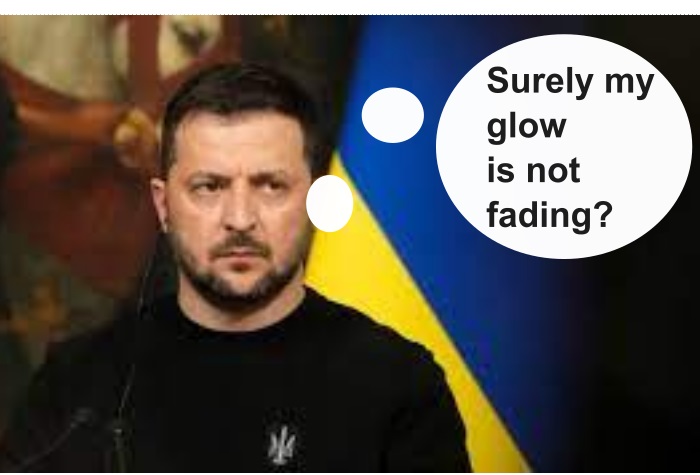
Trump-Zelensky meeting was ‘bad’ – Axios.
18 Oct, 2025 , https://www.rt.com/news/626650-trump-zelensky-meeting-bad/
The Ukrainian leader left Washington without promises on Tomahawk missiles, the outlet’s sources say
Friday’s White House meeting between US President Donald Trump and Vladimir Zelensky was “tense,” with the Ukrainian leader failing to secure deliveries of long-range Tomahawk missiles, Axios has reported, citing sources.
Trump told Zelensky he does not plan to provide Tomahawks “at least for now,” according to two people briefed on the meeting. The talks lasted around two and a half hours and were described by one source as “not easy,” and by another as “bad.” At times, the discussion “got a bit emotional,” the outlet said.
”Nobody shouted, but Trump was tough,” one source told Axios. The session ended abruptly when Trump reportedly said, “I think we’re done. Let’s see what happens next week,” possibly referring to upcoming Russia-US talks.
Speaking to reporters afterwards, Zelensky declined to answer questions about Tomahawk deliveries, only saying the US “does not want escalation.”
Trump said “it’s not easy” for Washington to provide the missiles because it needs to maintain its own supplies for the nation’s own defense. He also acknowledged that allowing Kiev to conduct strikes deep into Russia could lead to an escalation.
Moscow has warned against supplying the missiles to Ukraine, arguing they would “not change the situation on the battlefield” but would “severely undermine the prospects of a peaceful settlement” and harm Russia-US relations.
Zelensky has sought Tomahawks – which have a maximum range of 2,500km (1,550 miles) – for weeks, insisting that Ukraine would only use them against military targets to increase pressure on Russia and move toward a peace deal. However, the Ukrainian leader has threatened Russia with blackouts in border regions and Moscow. Russian officials also suggested that Kiev is plotting to use the missiles for “terrorist attacks.”
The Trump-Zelensky meeting followed a phone call between Trump and Putin, after which both sides signaled plans for a summit in Budapest, Hungary, in the near future.
Iran says restrictions on nuclear programme ‘terminated’ as deal expires

Iran also expresses commitment to diplomacy as landmark 10-year nuclear deal with Western powers officially ends
By News Agencies, 18 Oct 202518 Oct 2025, https://www.aljazeera.com/news/2025/10/18/iran-says-restrictions-on-nuclear-programme-terminated-as-deal-expires
Iran has said it is no longer bound by restrictions on its nuclear programme as a landmark 10-year deal between it and world powers expired, though Tehran reiterated its “commitment to diplomacy”.
From now on, “all of the provisions [of the 2015 deal], including the restrictions on the Iranian nuclear programme and the related mechanisms are considered terminated,” Iran’s Ministry of Foreign Affairs said in a statement on Saturday, the day of the pact’s expiration.
“Iran firmly expresses its commitment to diplomacy,” it added.
The deal’s “termination day” was set for exactly 10 years after the adoption of resolution 2231, enshrined by the United Nations Security Council.
Officially known as the Joint Comprehensive Plan of Action (JCPOA), the agreement between Iran and China, France, Germany, Russia, the United Kingdom and the United States saw the lifting of international sanctions against Iran in exchange for restrictions on its nuclear programme.
But Washington unilaterally left the deal in 2018 during President Donald Trump’s first term in office and reinstated sanctions. Tehran then began stepping up its nuclear programme.
Talks to revive the agreement have failed so far, and in August, the UK, Germany and France triggered the so-called “snapback” process, leading to the re-imposition of the UN sanctions.
“Termination day is relatively meaningless due to snapback,” Arms Control Association expert Kelsey Davenport told the AFP news agency.
Ali Vaez, the International Crisis Group’s Iran project director, told AFP that while the nuclear deal had been “lifeless” for years, the snapback had “officially buried” the agreement, with “its sorry fate continuing to cast a shadow over the future”.
Western powers and Israel have long accused Iran of seeking to acquire nuclear weapons, a claim Tehran denies.
Neither US intelligence nor the International Atomic Energy Agency (IAEA) said they found any evidence this year that Iran was pursuing atomic weapons.
Nuclear talks between Iran and world powers are currently deadlocked.
“Iran remains sceptical of the utility of engaging with the US given its history with President Trump, while Washington still seeks a maximalist deal,” Vaez told AFP.
On Monday, Trump said he wanted a peace deal with Iran, but stressed the ball was in Tehran’s court.
Tehran has repeatedly said it remains open to diplomacy with the US, provided Washington offers guarantees against military action during any potential talks.
The US joined Israel in striking Iran during a 12-day war in June, which hit nuclear sites, but also killed more than 1,000 Iranians, including hundreds of civilians, and caused billions of dollars in damage.
Angered that the IAEA did not condemn the attacks and accusing the agency of “double standards”, President Masoud Pezeshkian signed a law in early July suspending all cooperation with the UN nuclear watchdog and prompting inspectors to leave the country.
For its part, the IAEA has described its inability to verify Iran’s nuclear stockpile since the start of the war “a matter of serious concern”.
The three European powers last week announced they will seek to restart talks to find a “comprehensive, durable and verifiable agreement”.
Iranian top diplomat Abbas Araghchi said during an interview last week that Tehran does “not see any reason to negotiate” with the Europeans, given they triggered the snapback mechanism.
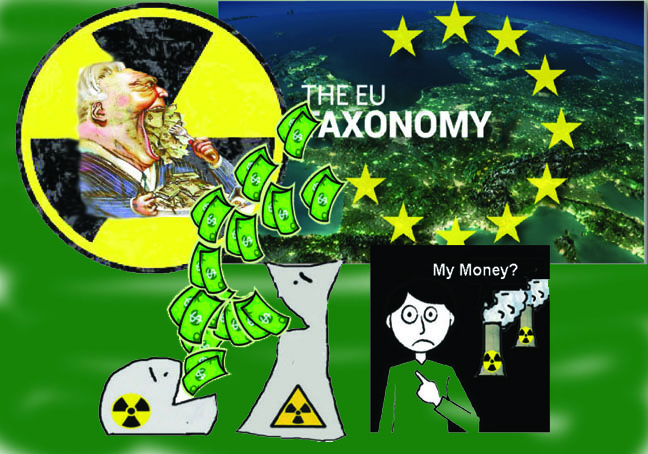
Monique Barbut, Minister for Ecological Transition, raises doubts among nuclear industry.
Monique Barbut has been appointed Minister of Ecological
Transition. She succeeds Agnès Pannier-Runacher, who, from the Ministry of
Energy Transition to that of Ecological Transition, has worked tirelessly
in favor of nuclear electricity.
The latter carried the law accelerating nuclear power adopted in 2023 and is at the origin of the Nuclear Alliance, which brings together a dozen European countries that have opted for this
energy and/or are in the process of reviving it.
The contrast with her successor is striking. When Monique Barbut was head of WWF France, between 2021 and 2024, the NGO, true to its line, took a stand against nuclear power. ” We call in particular on the European Parliament not to give in to pressure from France and other countries by agreeing to classify fossil gas and nuclear energy as sustainable in its taxonomy “…
Le Figaro 13th Oct 2025, https://www.lefigaro.fr/societes/monique-barbut-ministre-a-la-transition-ecologique-fait-douter-les-industriels-du-nucleaire-20251013
Outsized and Eccentric: The Farce Behind the Nobel Peace Prize
12 October 2025 Dr Binoy Kampmark, https://theaimn.net/outsized-and-eccentric-the-farce-behind-the-nobel-peace-prize/
The fuss about the Nobel Peace Prize has always been excessively outsized to its relevance. Like most prizes, the panel is bound to have its treasure trove of prejudices and eccentricities in reaching any decision. Thin resumes have swayed the Norwegian committee to acts of dottiness. Surprising moments of dark humour have made an appearance in the award of the prize to warmongers and those antithetical to peace. And those on the Nobel Prize peace panel would barely cause a murmur of acknowledgement outside the spine-like length of that country of only 5.6 million inhabitants. (The current membership of five features, for instance, three politicians: Anne Enger, former leader of the country’s Centre Party; former Conservative Party education minister Kristin Clement, and former state secretary of the Labour Party, Gry Larsen.)
Rather feebly, Asle Toje, another member of the five, uses a gastronomic metaphor in describing the selection process: “We do it pretty much the same way you make a good sauce – you reduce and reduce and reduce.” The reduction formula leads to surprising, rancid results. In 1973, the ruthless, toadying poseur Henry Kissinger was overcome with joy in receiving the prize. The National Security Adviser and US Secretary of State had supposedly done much to advance the cause of peace in the Indochina conflict by “spearheading cease-fire negotiations” that led to an armistice in January 1973. His co-awardee, the North Vietnamese negotiator Le Duc Tho, was far more sensible, refusing to accept a peace award where there was no peace to be had.
The choice of Kissinger was almost mockingly ghoulish. This was the same man who left his marks all over secret and illegal bombing campaigns in Laos and Cambodia during the Nixon administration, oversaw the extinction of democratically elected governments in Latin America in favour of murderous, authoritarian regimes, and spent his early academic career arguing that small-scale nuclear might be feasibly pursued by the United States as a psychological lever.
The selection for 2025 was always going to be shadowed by the theatre known as the Donald Trump show. In claiming not to want it, the US President has done much to pad out his credentials to make himself eligible. He has put on an incomplete, disputable show of halting conflicts while indulging in spells of violence (strikes on Venezuelan shipping, ostensibly carrying drugs to the US; the illegal bombing of Iran’s nuclear facilities).
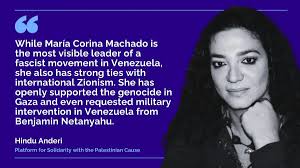
What the committee has done is the next best (or worse) thing. In opting for María Corina Machado, seen as the main figure of the Venezuelan opposition to the current government of Nicolás Maduro, they have offered the prize to a Trump medium. “I dedicate this prize to the suffering people of Venezuela and to President Trump for his decisive support in our cause,” she cooed on X.
Almost hinting at something in the works – that is to say, the ongoing regime change agenda so enthusiastically sought by Washington – Machado was convinced of being “on the threshold of victory and today, more than ever, we count on President Trump, the people of the United States, the peoples of Latin America, and the democratic nations of the world as our principal allies to achieve freedom and democracy.” Given Latin America’s record on peaceful transitions from coups, this was fine humour indeed.
The award to Machado was, according to the Nordic wiseacres, based on her “tireless work promoting democratic rights for the people of Venezuela and for her struggle to achieve a just and peaceful transition from dictatorship to democracy.” They go on to be didactic, talking about democracy being in global retreat, with Machado being its illuminating defender. (On being barred from running, she installed the surrogate opposition leader Edmundo Gonzálezwho allegedly won the July 2024 election.)
This is the bromide of binary thought. Machado’s record, befitting most political records, is untidy. David Smilde, a student of Venezuelan politics, sees her as “a controversial pick, less a peace activist than a political operator willing to use some of the trade’s dark arts for the greater democratic good.” Even that might be generous.
For one thing, she is clearly biding her time, shunning local and regional elections, treating the honouring of the 2024 presidential election results as absolute. She has openly argued for the necessity of foreign intervention in removing Maduro and endorsed Trump’s military buildup in the Caribbean, calling the recent bombing of suspected drug boats a matter of“saving lives”. To remove Maduro was essential, she argues, because of his alleged credentials as “the head of a narco-terrorist structure of cooperation.”
Disingenuously, she has swallowed the dubious theory that Maduro is the true figure running the Tren de Aragua gang, which Trump accuses of directing operations against the United States. Her Vente Venezuela party has enthusiastically shared the threats by US officials against supposed Venezuelan drug traffickers on X. “If you’re in the Caribbean,” states one recent post, “if you’re north of Venezuela and you’re trying to traffic drugs to the US, you’re a legitimate target for the US.”
Machado is undoubtedly readying herself to step into any presidential vacancy, forced or otherwise. She claims to have a plan for the first 100 hours and the first 100 days of a transition process, promising the generation of wealth for the country to the value of $1.7 trillion over 15 years. Her advisor on international affairs, Pedro Urruchurtu, has been open about communicating with the Trump administration over Maduro’s removal.
Again, this says much about the eccentric reading of peace embraced by the insular Norwegian grandees. If Tom Lehrer was right to call political satire obsolete after Kissinger’s award, it would also be accurate to say that instances of rich farce have come in its wake.
Israeli Historian Ilan Pappé: Despite Ceasefire, Palestinians Still Face “Elimination, Genocide”
October 13, 2025, Democracy Now – https://www.youtube.com/watch?v=0VBDIaaryG8
Renowned Israeli historian, author and professor Ilan Pappé discusses the postwar prospects of Palestinian statehood and of Israeli Prime Minister Benjamin Netanyahu, who is under investigation for corruption in Israel and subject to an international arrest warrant from the International Criminal Court. Despite the newly implemented Gaza ceasefire, says Pappé, Israeli political leaders have not changed their policy aim to ethnically cleanse Palestinians from their remaining territory. “Nothing has changed in the dehumanization and the attitude of this particular Israeli government and its belief that it has the power to wipe out Palestine as a nation, as a people and as a country,” he explains. Pappé’s latest book is titled Israel on the Brink: And the Eight Revolutions That Could Lead to Decolonization and Coexistence.
Transcript……………………………..
ILAN PAPPÉ:………………………………………….. I don’t think we are in such an historical moment as President Trump claimed in his speech in the Knesset and beforehand. We are not at the end of the terrible chapter that we have been in it for the last two years. And that chapter is an Israeli attempt by a particularly fanatic, extremely right-wing Israeli government to try and use ethnic cleansing in the West Bank and genocide in Gaza to downsize the number of Palestinians in Palestine and impose Israel’s will in a way that they hope would be at least endorsed by some Arab governments and the world. And so far, they have an alliance of Trump and some extreme right-wing parties in Europe.
And now I hope that the world will not be misled that Israel is now ready to open a different kind of page in its relationship with the Palestinians………………nothing has changed in the dehumanization and the attitude of this particular Israeli government and its belief that it has the power to wipe out Palestine as a nation, as a people and as a country. And I hope the world will not stand by, because up to now it did stand by when the genocide occurred in Palestine………..
…………………………………………….. it is the nature of the Israeli government that was elected in November 2022, this alliance between a very opportunistic politician, who’s only interested in surviving and keeping his position as a prime minister, alongside messianic, neo-Zionist politicians who really believe that God has given them the opportunity to create the Greater Israel, maybe even beyond the borders of Palestine, and, in the process, eliminate Palestinians. I think that his [Netanyahu’s] consideration should all — are always about his chances of survival. …..
………… My greatest worry is that he does believe that his only chance of being reelected is still to have a war going on, either in Gaza or in the West Bank or against Iran or in the north with Lebanon. We are dealing here with a reckless, irresponsible politician, who is even willing to drown his own state in the process of saving his skin and his neck. And the victims will always be, from this adventurous policy, the Palestinians…….
…………………. I do hope that political elites will understand their — especially in the West, their role now is not to mediate between Israelis and Palestinians. Their role now is to protect the Palestinians from destruction, elimination, genocide and ethnic cleansing. ……………………………………………………https://www.democracynow.org/2025/10/13/ilan_pappe_israel_on_the_brink
Putin and Trump, between the war of deadly Tomahawks and the peace of disarmament “START 3”.
by Alfredo Jalife-Rahme, Translation, Maria Poumier
Source La Jornada (Mexico) The world’s largest Spanish-language daily newspaper. Voltaire Network | Mexico City (Mexico)
| October 11, 2025, https://www.voltairenet.org/article222961.html
Donald Trump and Vladimir Putin are trying, against the instincts of their administrations, to end the confrontation between their two countries since the Cold War. The American president is balancing threats and peace proposals, while his Russian counterpart is showing patience. Will the two men succeed in freeing their countries from the trap they have built for eighty years and which is closing in on them?
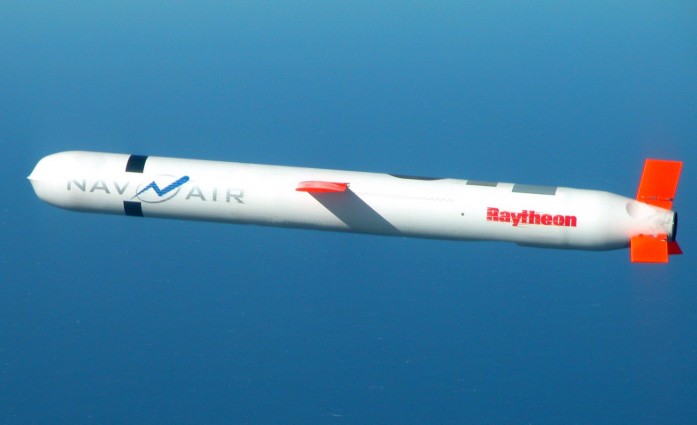
The relationship between Putin and Trump has reached a turning point that will decide between war and peace, between the two greatest nuclear superpowers in the Milky Way [ 1 ] . Catholic Vice President JD Vance told FoxNews Sunday that “the United States is reviewing Ukraine’s request for long-range Tomahawk missiles” that would strike deep into Russian territory. The young millennial vice president added that President Trump would make the “final decision
On the other hand, retired General Keith Kellogg, 81, Trump’s special envoy to Ukraine, has byzantinely declared that Russia—against all tangible evidence on the battlefield where Ukraine is currently being thrashed—”lost the war” because “it failed to destroy Ukraine [ 3 ] .” It should be noted that General Kellogg’s daughter is addicted to the illegitimate regime of Khazarian comedian Zelensky, who is also delusional, trying to make people believe that he is “winning the war.”
If Ukraine, a vassal of NATO and the European Union, was indeed “winning the war,” why would it need the help of the fearsome Tomahawks, which can carry US-NATO nuclear weapons? At the same time, the genocidal Netanyahu is planning to deliver Patriot defense systems to his Khazarian coreligionist in kyiv….
Russian philosopher and geopolitician Alexander Dugin claims that “delivering the Tomahawks to Kiev would be a pure disaster” that “would irreversibly damage Russian-American relations”: the “neoconservatives’ dream would be to drag the United States into a third world war
[ 4 ] “, which would tragically be nuclear in nature.
Contrary to the drums of war that are sounding more forcefully within the European NATO countries, President Putin, during his participation in the plenary meeting of the Valdai Club in Sochi, invited Trump to “peaceful coexistence [ 5 ] “.
Regarding the hypothetical delivery to Ukraine of deadly Tomahawk missiles—with a range of 2,500 kilometers and a cost of $1.3 million each, capable of reaching Moscow and beyond—Putin said that this would not change the irreversible course of the war, which is now favorable to Moscow, but that it would constitute “a new step in the escalation,” because Ukraine cannot use these sophisticated missiles without the control of the US military.
India ‘s Economic Times speculates that “the US is unlikely to send Tomahawk missiles to Ukraine” because “it faces obstacles related to stockpiles committed to its navy operations.” This appears to be a Trump-like bargaining chip.
Since last year, the neoliberal think tank American Enterprise Institute (AEI) has denounced the sharp decline in the number of these deadly US missiles, already widely used in Yemen against the Ansar Allah guerrillas
[ 6 ] .
China ‘s Global Times highlights Putin’s warning about delivering Tomahawks to Ukraine, as the Russian president “praised U.S. President Donald Trump’s efforts to help broker peace in Ukraine,” calling his August summit in Alaska “productive,” while “reiterating Russia’s confidence in its nuclear shield. ” [ 7 ]
Putin told members of the Russian Security Council that “Moscow will respect the limits set on nuclear weapons for one more year, after the expiration on February 5, 2026, of the “START 3” nuclear treaty (Treaty on the Reduction of Strategic Nuclear Arms) with the United States [ 8 ] . Trump responded that Putin’s nuclear proposal was “a good idea” [ 9 ] .
The world is anxiously awaiting Trump’s final decision on the Tomahawks, a decision he appears to have already made, but which he will keep secret until he deems the time opportune [ 10 ] , while waging a veritable “civil war” from Oregon to Illinois against what he calls the terrorist group Antifa, financed by George Soros and his son Alex.
References ……………………………………………………………………………..
Worlds Extinguished: Hostage Returns, Central Casting and the Gaza Ceasefire
14 October 2025 Dr Binoy Kampmark, https://theaimn.net/worlds-extinguished-hostage-returns-central-casting-and-the-gaza-ceasefire/
Depending on which source you consult, the twenty-point peace plan of President Donald Trump for securing peace in Gaza shows much exultance and extravagant omission. The exultance was initially focused on the return of the hostages. It then shifted to the broader strategic goals of the various parties. Commentary on this point, even as the living Israeli hostages convalescence after their exchange for Palestinian detainees, sidesteps the Palestinian people, those fly in the ointment irritants who never seem to exit the political scene.
The peace plan, in effect, is being executed to eliminate Hamas and any semblance of a Palestinian militant movement in favour of an Israel-Arab-US axis of preferment and normalisation. Doing so puts a firm lid on Palestinian sovereignty and statehood in favour of sounder relations between Israel and the Arab states.
Consider, for instance, the views from the American Jewish Committee in their October 10 assessment. “President Trump’s unconventional approach created new diplomatic realities and forced Israel and key Arab states to align in new ways.” The peace plan was “the most credible framework to date for advancing Israeli-Arab peace, creating new opportunities for regional engagement, and countering Hamas’ ideology through a united alliance of Israel and Arab nations committed to peace, security, and prosperity.” Clearly, Palestinians are, if not footnotes, then invisible ink lines in such arrangements.
This attitude is also echoed in remarks made by the US Vice President, J.D. Vance. Palestinian subservience is assumed in any new proposed arrangement which prioritises Israeli security and a collective of overseeing nation states that will guard against any mischief in the Strip. “The President convinced the entire Muslim world really, both the Gulf Arab states, but as far as South-East Asia as Indonesia, to really step up and provide ground troops so that Gaza could be secured in safety.”
Egyptian Foreign Minister Badr Abdelatty gave some sense of what is expected. “We are going to support and commit troops within specific parameters,” he told CBS. A UN Security Council mandate would be required, along with clear specifications for what the mission of the troops on the ground would be, “which will be peacekeeping and providing training to Palestinian police.”
Trump’s near cinematic appearance on October 13 in the compact, claustrophobic Knesset after the handover of the hostages set the scene for Israeli grandstanding, staged mawkishness and denial. Netanyahu was in typical form, accusing Israel’s friends of blood libel stupidity for recognising Palestine; in doing so, they had effectively committed acts of antisemitism, buying “into Hamas’s false propaganda.” Massacring and starving those in the Gaza Strip warranted no mention, but disarming Hamas and demilitarising the enclave did. With praise for both himself and Trump, Netanyahu spoke of jointly forging “a path to bring the remaining hostages home and end the war. End a war in a way that ensures the disarming of Hamas, the demilitarisation of Gaza, and that Gaza would never again pose a threat to Israel.”
He also thanked Trump for “fully” backing the decision to make the last murderous assault into Gaza City. This “military pressure” provided momentum that eventually saw Hamas capitulate. The US President then “succeeded in doing something that no one believed was possible. You brought most of the Arab world, you did, you brought most of the world behind your proposal to free the hostages and end the war.”
Opposition leader Yair Lapid, for his part, explicitly denied any genocide or “intentional starvation” of the Palestinians, then proceeded to overlook them in calling on “all the nations of the Islamic world” to engage Israel.
Trump’s own speech was meandering, personal and free of complex turns. He spoke about his envoy Steve Witkoff as a Henry Kissinger who did not leak, an emissary of singular genius. An interruption by Hadash lawmakers Ayman Odeh and Ofer Cassif, both demanding that Palestine be recognised, did not faze him. And then came mention of theUkraine War, and Russian President Vladimir Putin and more adulatory remarks for the US delegates who have paid homage to the US God King. They were all part of “central casting.”
Not a sliver of reference to the Palestinian cause for sovereignty made an appearance, which continues to moan under the strategic expediency of it all, the residents of Gaza doomed to indefinite invigilation at the hands of Trump’s “Board of Peace.” More to the point, he was happy to admit providing weapons at the request of “Bibi” at a moment’s notice. The US made “the best weapons in the world, and we’ve given a lot to Israel, … and you used them well.” But the slaughter could not continue, and the Israeli PM would be remembered “far more” for accepting the peace agreement. “The timing for this is brilliant. I said, ‘Bibi you’re going to be remembered for this far more than if you kept this thing going, going, going, kill, kill, kill.’”
The Palestinians, granted brief respite from military violence, will be desperately wary. When Lapid mentioned that Trump had “saved far more than one life, and life is an entire world,” it can also be assumed that killing one life kills a world. Some 68,000 Palestinian worlds (a conservative estimate) were extinguished by the munitions and weapons of Israel and its backers. As humanitarian workers return to Gaza, they see the horrors of a lunarscape of devastation. If only Trump had considered paying a visit to that particular part of earth.
Could Trump’s peace capsize the undead British Empire?
Peace in the Middle East and the defeat in Ukraine will prove extremely embarrassing for Britain.
Alex Krainer, Oct 14, 2025, https://alexkrainer.substack.com/p/could-trumps-peace-capsize-the-undead?utm_source=post-email-title&publication_id=1063805&post_id=176048481&utm_campaign=email-post-title&isFreemail=true&r=1ise1&triedRedirect=true&utm_medium=email
It’s only been four days since the Israeli cabinet approved Donald Trump’s Middle Eastern peace deal. In spite of much entrenched pessimism and incidents like the suspicious death of four Qatari negotiators in Egypt, so far the regional players have taken the deal seriously and it seems that their commitment is for real. My hunch, which I shared in Friday’s TrendCompass report, was that this development could turn out to be a “massive defeat for the Empire,” and that if the peace holds “the implications for the region would be nothing short of massive.”
Apart from repurposing the region’s “unsinkable aircraft carrier,” which could complicate the Empire’s efforts in prevention of peace, it seems that Trump has now wrested the loyalty of states like Qatar, Egypt and Saudi Arabia away from the Empire. Here’s what I mean by that: it is important for us not to regard the United States as a monolith. By “the Empire” I’m referring to the City of London with its satellites on Wall Street, in Paris, Frankfurt, Basel, Tokyo, etc. Also, its lackeys in the British government along with the American Neocons Jake Sullivan, Victoria Nuland and Antony Blinken. It also includes the Empire’s minions staffing the key positions in the EU and NATO.
I believe that President Trump and his government (some of them at least), are NOT part of this imperial cabal. Of course, it is possible, as some say, that Trump is “controlled opposition” and that we’re witnessing an elaborate deception. However, I believe that this is unlikely. Such deception would be needless and overly elaborate; I can’t imagine why keeping it up would even be necessary. At any rate, Trump’s peace deal in the Middle East indicates that his government is real, not controlled, opposition and it has now put the imperial cabal in a bind: where were they while Trump and other leaders in the region worked to stop the genocide? Suddenly, they seem to be in a damage-control mode.
Scrambling for moral high grounds
UK’s education secretary Bridget Phillipson, who had vocally opposed any ceasefire in Gaza, went to SkyNews yesterday (Sunday, 12 October 2025) to claim credit for the Middle East peace deal:
“We have played the key role behind the scenes in shaping this. It’s right that we do so because it’s in all of our interests, including our own national interest, that we move toward a lasting peace in the region.”
When her interviewer asked her to specify, “when you say, ‘behind the scenes,’ – like what?” Phillipson launched into an eloquent-sounding but hollow word salad that sounded like a student explaining the plot of “Ana Karenina” after she never read the book:
“These are complex matters of diplomacy that we are involved in, but we do welcome and recognize the critical role that the American government played in moving us to this point…”
It’s complex, you see, so I don’t want to burden you with the details, but look how noble and magnanimous we are in welcoming and recognizing the role of the American government: they too contributed a little bit. But it seems that Ms. Phillipson either doesn’t know, or pretended she didn’t, that the Empire created Israel precisely for the purpose of preventing a lasting peace from breaking out in the region. If you’re in the Empire’s camp, you don’t want peace and that’s why you exerted no effort towards it. Then you explain the perpetual war you engineered as something that’s near-impossible to solve: it’s the “centuries-old hatreds” that are incomprehensible to us pure-hearted Westerners.
Then Trump swaggered into the region and solved it (at least for now), forcing the obvious question: why wasn’t this done at any point after 7 October 2023, hundreds of thousands of dead Palestinians ago? If it wasn’t too complicated for Trump, how was it too complicated all the sophisticated folks with posh accents in London? These uncomfortable questions are reason why Bridget Phillipson went to SkyNews yesterday. She herself spent months explaining why her government was staunchly against any ceasefire and did less than nothing to de-escalate the conflict.
Nobody’s buying it anymore
But her disingenuous attempt to usurp credit for the peace deal didn’t go unnoticed and it was torpedoed in very undiplomatic terms. U.S. Ambassador to Jerusalem, Mike Huckabee posted the clip of her statement on X and commented that, “I can assure you that she’s delusional. She can thank @realDonaldTrump just to set the record straight.” That post got 2.4 million views in under 24 hours. Even if it’s from Mike Huckabee, it’s not bad. For the British government, that was a humiliating rebuke, and it wasn’t the only one!
Italy’s Giorgia Meloni was sharper still, publicly blasting Phillipson’s boss Sir Keir: “If anything [Keir Starmer] harmed peace negotiations, trying to impose his master Tony Blair on Palestinians. Now he wants to get a photo op and claim he helped.” She added: “He should stop wasting his time meddling in international affairs and sort out his own country, the people are fed up.”
Namely, documents have been leaked online showing that Johnson has profited from the ongoing conflict in Ukraine. According to The Guardian reports published on Friday, 10 October, Johnson visited Ukraine in September 2023 together with his billionaire donor Christopher Harborne, who donated £1 million to a private company he founded after resigning as Prime Minister. For Johnson, that was killing one stone with three birds: striking at Russia, contributing to depopulation (-1.7 million Ukrainian men) and making a buck quid in the process. No wonder Johnson felt as jubilant at the time (video at link):
It’s only a few bad apples, you see…
But the Middle East peace isn’t the only piece of bad news for London. There’s also Ukraine, which is being lost… Inevitably, if the Empire loses in Ukraine, it will also lose the opportunity to craft the dominant narrative. Britain’s role there, and particularly Boris Johnson’s consistent efforts to sabotage peace in April 2022, after only 5 weeks of hostilities, will prove extremely embarrassing. To contain the damage, it seems that the cabal is ready to throw Johnson overboard and cast the blame for the whole fiasco on him and another few bad apples.
Namely, documents have been leaked online showing that Johnson has profited from the ongoing conflict in Ukraine. According to The Guardian reports published on Friday, 10 October, Johnson visited Ukraine in September 2023 together with his billionaire donor Christopher Harborne, who donated £1 million to a private company he founded after resigning as Prime Minister. For Johnson, that was killing one stone with three birds: striking at Russia, contributing to depopulation (-1.7 million Ukrainian men) and making a buck quid in the process. No wonder Johnson felt as jubilant at the time (video at link):
Johnson dismissed this report, calling it a “pathetic non-story” derived from an “illegal Russian hack.” Of course: everything we hate is Russian, so please disperse, there’s nothing to see here… But through history, losing a war came with severe costs, and today may be no different. However, rather than taking the pain itself, the Empire will attempt to cast the blame to its unruly minions and push them under the bus.
Then, the narrative will be changed once more: we’ve always only wanted to be at peace with Eurasia but for a handful of corrupt bad apples… Once we’ve dealt with them, we’ll join the victory parade and celebrate the peace in which we ourselves played the key role, you see, behind the scenes we did, of course. By now however, anyone who’s paid any attention can see through this sinister game.
We want to keep Ukraine fighting and desire an all-out war with Russia!
In all this, the Empire’s scriptwriters and propagandists always counted on the public having low IQs and a short attention spans. But in the age of the Internet and social media, the same formula no longer works. In addition to throwing Boris Johnson and Christopher Harborne overboard, they’ll also have to explain Lieutenant General Charlie Stickland’s Project Alchemy which brought together a whole group of bad apples from Britain’s academic, military and intelligence institutions to put forward an array of plans “to keep Ukraine fighting,” along with plans to “aggressively pursue” and “dismantle” independent media outlets.
Project Alchemy’s “elders” were united by a desire for an all-out war between Russia and the West. That’s a very monstrous and sinister desire: the last time they orchestrated such a war, some 60 million people perished across Europe. What could possibly be the reason for desiring such a thing? The elders were kind enough to spell it out: in order to “defeat Putin in Ukraine and set the conditions for the reshaping of an open international order of the future.” Here are the full 36 pages of their monstrous recommendations:
Ukraine’s Next Chapter – Elders Grand Strategy Options Paper.
The fact that any group of “elders” would take such a cavailer attitude with a world war begs the question of whether there are any good apples in their ranks at all? Or is being a degenerated genocidal maniac a job requirement where they work? Judging by the quality of characters that have floated up to the top in the British institutions of power, and by the enterprise’s track record around the world over the past 300 years, this definitely seems to be the case.
The same system promotes individuals like Tony Blair and Boris Johnson to the very top while mercilessly destroying those like Andrew Bridgen, George Galloway and Jeremy Corbyn is selecting for dishonesty, degeneracy, and ruthlessness. Being a bad apple is par for the course and probably has been for centuries.
Hopefully, with the Empire’s defeat in Ukraine and Trump’s peace in the Middle East, the old, undead Empire will finally capsize along with its cabal’s dreams of an all-out war against Russia. That should be a good day for the rest of humanity, including for the people of the British isles.
Israeli Government Votes to Implement Trump Peace Plan for Gaza as Hamas Pledges to Uphold It

Juan Cole, 10/10/2025, https://www.juancole.com/2025/10/government-implement-implementation.html
Ann Arbor (Informed Comment) – According to the Israeli newspaper Arab 48 , the Israeli government on Friday approved the ceasefire in Gaza and the hostage exchange, and agreed to begin withdrawing troops from the west of the Strip. The approval came after the arrival of President Donald Trump’s Middle East envoys Steve Witkoff and Jared Kushner and their meeting with Israeli Prime Minister Benjamin Netanyahu.
The ceasefire was expected to go immediately into effect, with the Israeli military beginning its withdrawal from Gaza, to be followed by the exchange of hostages between Hamas and Israel over the next three days.
The extreme-right Religious Zionism and Jewish Power blocs, led by Bezalel Smotrich and Itamar Ben-Gvir respectively, voted against the agreement. Ordinarily, Netanyahu would need these votes for a majority in the 120-member Knesset or Israeli parliament, where his coalition has 64 seats. In this instance, however, the other Israeli parties, mostly center-right, had wanted this sort of agreement all along, and so they supported the sitting government from its left.
Orit Strook, Minister of Settlements and National Missions, also from Religious Zionism, said she was disappointed that Netanyahu had not explained to President Trump that Gaza is an inalienable part of Israel. (It isn’t.)
Smotrich expressed “Mixed feelings on a complex morning.” He spoke of his joy about the release of the remaining hostages, even though he had earlier repeatedly said that achieving the release of the hostages was not a high priority.
Smotrich defended his earlier obstructionism on the grounds that he had opposed “partial deals” that would have prevented the occupation of Gaza and the elimination of Hamas. In fact, of course, he opposed all deals and wanted to empty Gaza of its indigenous Palestinians, or the ones still left alive after two years of intensive bombing of civilian apartment buildings and infrastructure. Smotrich had also obstructed the delivery of aid to Gaza’s civilian population. He also opposed the release of 250 Palestinian hostages taken over the years by Israel, warning that they would go on to spill Jewish blood. Large numbers of the some 10,000 Palestinians kidnapped by Israel have never been so much as charged with committing violence, much less convicted. He pledged to go on striving to “eradicate” Hamas. Some ceasefire.
Conflicting reports are issuing from high Trump administration officials about whether 200 American troops would be sent to Gaza as observers of the ceasefire, with some confirming it and others denying it.
Hamas affirmed that they were committed to a deal that would end the two-year-long conflict.
Meanwhile, the United Nations Relief and Works Agency said that it has enough food aid ready to go into Gaza to last for three months. The Israeli government has attempted to ban UNRWA, formed by the United Nations to help Palestinian refugees expelled from their homes by the Israelis, from operating in the occupied Palestinian territories, and has blocked most food aid since April. Gaza cannot feed itself, especially after the Israelis destroyed 80% of Gaza’s farmland. Nevertheless, UNRWA still has 12,000 workers in Gaza ready to swing into action to relieve the Israeli-imposed famine.
About the Author
Juan Cole is the founder and chief editor of Informed Comment. He is Richard P. Mitchell Professor of History at the University of Michigan He is author of, among many other books, Muhammad: Prophet of Peace amid the Clash of Empires and The Rubaiyat of Omar Khayyam. Follow him on Twitter at @jricole or the Informed Comment
Will Trump’s ceasefire plan really lead to lasting peace in the Middle East? There’s still a long way to go
Andrew Thomas, Lecturer in Middle East Studies, Deakin University October 12, 2025, https://theconversation.com/will-trumps-ceasefire-plan-really-lead-to-lasting-peace-in-the-middle-east-theres-still-a-long-way-to-go-267112?utm_medium=email&utm_campaign=Latest%20from%20The%20Conversation%20for%20October%2013%202025%20-%203547436165&utm_content=Latest%20from%20The%20Conversation%20for%20October%2013%202025%20-%203547436165+CID_bcade8c9c4dad1f5a754fd2f23566c83&utm_source=campaign_monitor&utm_term=Will%20Trumps%20ceasefire%20plan%20really%20lead%20to%20lasting%20peace%20in%20the%20Middle%20East%20Theres%20still%20a%20long%20way%20to%20go
The first steps of the peace plan for Gaza are underway. Now both parties have agreed to terms, Hamas is obligated to release all hostages within 72 hours and the Israeli Defence Forces (IDF) will withdraw to an agreed-upon line within the strip.
Hopes are high, particularly on the ground in Gaza and in Israel after two years of brutal conflict. Some argue the parties are now closer than ever to an end to hostilities, and US President Donald Trump’s 20-point peace plan may be an effective road-map.
But the truth is we have been here before. Hamas and Israel have now agreed to a road-map to peace in principle, but what is in place today is very similar to ceasefire deals in the past, and a ceasefire is not the same as a peace deal or an armistice.
The plan is also very light on specifics, and the devil is definitely in the detail. Will the IDF completely withdraw from Gaza and rule out annexation? Who will take on governance of the strip? Is Hamas going to be involved in this governance? There were signs of disagreement on these issues even before the fighting stopped.
So if the ceasefire steps hold in the short term – then what? What would it take for the peace plan to be successful?
First, the political pressures to refrain from resuming hostilities will need to hold. Once all the hostages are returned, which is expected to take place by Tuesday Australian time, Hamas effectively loses any remaining leverage for future negotiations if hostilities were to resume.
Once the hostage exchange is complete, it’s likely Israeli Prime Minister Benjamin Netanyahu will see some pressure from his right to resume hostilities.
With Hamas relinquishing this leverage, it will be essential for the Israeli government to see these negotiations and the end of the war as fundamental to its long term interests and security for peace to hold. There must be a sincere desire to return to dialogue and compromise, not the pre-October 7 2023 complacency.
Second, Hamas will likely have to relinquish its arms and any political power in Gaza. Previously, Hamas has said it would only do this on the condition of recognition of a sovereign Palestinian state. As recently as October 10, factions in Gaza have said they would not accept foreign guardianship, a key part of the peace plan, with governance to be determined “by the national component of our people directly”.
Related to this, any interim governance or authority that takes shape in Gaza must reflect local needs. The proposed “body of peace” headed by Trump and former UK prime minister Tony Blair, could risk repeating previous mistakes of cutting Palestinians out of discussions over their own future.
Part of the peace deal is the resumption of humanitarian aid flows, but the fate of the Gaza blockade that has been effectively in place since 2007 is unclear. The land, sea and air blockade, which was imposed by Egypt and Israel following Hamas’ political takeover of Gaza, heavily restricts imports and the movement of Gazans.
Prior to October 2023, unemployment in the strip sat at 46%, and 62% of Gazans required food assistance as a result of the limits placed on imports, including basic food and agricultural items such as fertiliser.
Should the blockade continue, at best Israel will create the same humanitarian conditions in Gaza of food, medical and financial insecurity that existed prior to the October 7 attacks. While conditions and restrictions are orders of magnitude worse in Gaza today, NGOs called early incarnations of the blockade “collective punishment”. For peace to hold in the strip, security policy needs to be in line with global humanitarian principles and international law.
Most importantly, however, all parties involved must see peace in Gaza as fundamentally connected to broader peace between Israelis and Palestinians. Seeing the Gaza conflict as discrete and separate from the broader Palestinian-Israeli conflict would be a mistake. Discussions of Palestinian national self-determination in Gaza and the West Bank must be taken seriously and be a central part of the plan for peace to last.
While the 20-point plan mentions a “credible pathway to Palestinian self-determination and statehood”“, history tells us these pathways struggle to get past the rhetoric stage.
Many challenges stand in the way, including Israeli settlement and annexation, the status of Jerusalem and the question of demilitarisation.
A meaningful step would be for the US to refrain from using its veto power at the UN Security Council (UNSC) against votes supporting Palestinian statehood. While several states recognised a Palestinian state at the recent UN General Assembly, the US has blocked formal status at the UNSC every time.
Despite all these concerns, any pause in hostilities is undeniably a good thing. Deaths from October 7 2023 number nearly 70,000 in total, with 11% of Gaza’s population killed or injured and 465 Israeli soldiers killed. The resumption of aid delivery alone will go far in addressing the growing famine in the strip.
However, peace deals are incredibly difficult to negotiate at the best of times, requiring good faith, sustained commitment and trust. The roots of this conflict reach back decades, and mutual mistrust has been institutionalised and weaponised. Difficulties in negotiating the Oslo Accords in the 1990s showed just how deep the roots of the conflict are. The situation is now much worse.
It is not clear if any party involved in negotiation possesses the political will needed to reach an accord. However, an opportunity exists to reach one, and it should not be taken for granted.
Yemen’s Houthis To ‘Monitor’ Israel Compliance With Gaza Ceasefire Deal
Yemeni attacks will stop if Israel implements the deal
by Dave DeCamp | October 9, 2025, https://news.antiwar.com/2025/10/09/yemens-houthis-to-monitor-israel-compliance-with-gaza-ceasefire-deal/
Abdul-Malik al-Houthi, the leader of Yemen’s Ansar Allah, said on Thursday that Yemen will be “monitoring” Israel’s compliance with the Gaza ceasefire deal, warning Yemeni support for the Palestinians in Gaza would continue if the deal isn’t implemented.
“We must be at the highest levels of caution and readiness, and continue the massive popular momentum with the Palestinian people, until we determine whether the agreement will be achieved, or whether we will continue our path of support and assistance to the Palestinian people,” al-Houthi said, according to Yemen’s SABA news agency.
“We will remain vigilant, prepared, and monitor the progress of the agreement. Will it lead to an end to the aggression on the Gaza Strip and the entry of aid, food, medicine, and humanitarian needs to the Palestinian people? Will the Americans and Israelis stop their genocide against the Palestinian people and commit to a ceasefire? This is what we hope for, and it was our goal in the support operations and confronting the attack on the Palestinian people and the nation in general,” al-Houthi added.
Ansar Allah, commonly known as the Houthis, has maintained that its attacks on Israel and blockade of Israeli-linked shipping in the Red Sea would end if there were a ceasefire in Gaza and an end to the Israeli blockade on aid entering the Palestinian territory. The Houthis halted their attacks back when a ceasefire deal was signed in January 2025.
After Israel violated the ceasefire deal in March by imposing a total blockade on Gaza, al-Houthi announced that Yemen would restart its blockade on Israeli shipping. In response to that announcement, the US began a very heavy bombing campaign targeting Yemen, known as Operation Rought Rider, which lasted from March 15 to May 6 and killed over 250 civilians.
While the Trump administration framed the bombing campaign as necessary to protect American ships, the Houthis were not attacking US vessels before it started. It ended with an agreement that the Houthis wouldn’t target US ships if the US stopped bombing Yemen, as the Trump administration gave up on trying to get Ansar Allah to stop its attacks on Israel.
Moniz’s Proposal for a Regional Nuclear Consortium with Iran
11 October 2025
WANA (Oct 11) – As the reinstatement of international sanctions against Iran effectively signals the formal collapse of the JCPOA, Ernest Moniz, former U.S. Secretary of Energy and a key figure in the original nuclear deal, has reintroduced the debate on Iran’s nuclear program with a bold proposal. In an article published in Foreign Policy, Moniz calls for the creation of a regional nuclear consortium involving Iran and other Middle Eastern countries—an initiative he claims could curb nuclear tensions while promoting peaceful nuclear energy across the region.
The End of the JCPOA and a New Idea Emerges
Moniz argues that the return of international sanctions highlights the final breakdown of the JCPOA, which had successfully restrained Iran’s nuclear activities until the U.S. withdrawal in 2018. He claims that Iran’s accelerated uranium enrichment to 60 percent and reduced cooperation with the International Atomic Energy Agency (IAEA) have made the deal irreparable.
Yet, Moniz emphasizes that military action or sanctions alone cannot resolve the issue. The only viable path, he argues, is a new framework based on regional cooperation: a “Middle Eastern Nuclear Consortium.”
Consortium: Cooperation or Control?
Under this plan, countries in the region—including Iran, Saudi Arabia, the UAE, Jordan, and Egypt—would jointly participate in the production and peaceful use of nuclear energy. According to Moniz, the nuclear fuel cycle would be distributed among multiple countries, preventing any single state from independently developing nuclear weapons.
This division of responsibilities—from uranium extraction to fuel production—would accelerate peaceful nuclear technology while raising the cost and difficulty of nuclear weapons development. Countries found v
Iran’s Special Role: Limitation or Participation?
The most contentious aspect of Moniz’s plan concerns Iran. He argues that uranium enrichment should not take place on Iranian soil, but rather in a neutral location—potentially an island in the Persian Gulf or territory in Oman—under direct IAEA supervision.iolating the consortium’s rules could be removed, and their nuclear programs dismantled.
“Iran has enriched over 400 kilograms of uranium to 60 percent, which has no reasonable civilian purpose. To prevent recurrence, enrichment must occur in an international facility outside Tehran’s direct control,” Moniz writes.
He also proposes regional nuclear fuel banks to ensure all member states, including Iran, have secure access to nuclear fuel. Meanwhile, Iran could temporarily continue limited enrichment (up to 5 percent) until the regional fuel cycle is fully operational. In exchange for halting enrichment on its territory and accepting enhanced transparency, Western countries would facilitate investment in Iran’s civilian nuclear energy program.
Silence on Israel’s Nuclear Arsenal
A notable criticism of Moniz’s proposal is the absence of any reference to Israel’s nuclear weapons. Previous Iranian proposals, such as the “Minaret Plan” by former Foreign Minister Mohammad Javad Zarif and ex-ambassador Mohsen Baharvand, emphasized a nuclear-weapon-free Middle East. Moniz’s plan, however, does not address Israel’s arsenal, which some analysts view as a one-sided U.S. approach……………………………………………………
Moniz stresses that implementing this plan requires tough decisions from all parties. From his perspective, Iran must dilute its 60-percent enriched uranium, return to JCPOA-level cooperation, and accept expanded inspections. In return, the U.S. and Europe would reopen pathways for investment in Iran, fostering the growth of civilian nuclear energy within the country.
However, Iranian officials have repeatedly affirmed that domestic enrichment is a red line and that Iran’s nuclear program remains entirely peaceful—a position echoed by IAEA Director General Rafael Grossi.
Moniz’s plan can be seen as an attempt to reimagine the JCPOA in a regional format: ostensibly promoting peaceful nuclear energy while structurally limiting Iran’s nuclear capabilities. Analysts note that if designed on the principles of mutual respect, non-discrimination, and equal participation, such multilateral cooperation could reduce tensions and enhance nuclear technology collaboration in the Middle East.
Yet, the fundamental question remains: Will Iran, having experienced what it considers Western breaches of trust in the JCPOA, agree to transfer parts of its most sensitive nuclear activities abroad? https://wanaen.com/monizs-proposal-for-a-regional-nuclear-consortium-with-iran/
The Nobel that wasn’t Trump’s: Why Oslo chose a Venezuelan rebel over a peacemaker.
What Oslo calls a “peaceful transition” others might see as a strategy of regime change.
Machado in many ways stands on the same side as Trump. She’s seen positively by figures like Secretary of State Marco Rubio, and all of them share a goal of opposing Nicolás Maduro’s regime. So this may not have been a snub to Trump – it’s more of a balancing act.”
Rt.com 10 Oct 25
By honoring an opposition leader wanted in Caracas, the Nobel Committee reignited a debate over who gets to define “peace”.
The 2025 Nobel Peace Prize has gone to María Corina Machado, one of the most prominent faces of Venezuela’s opposition. The committee’s language is familiar – ”rights,” “peaceful transition” – but the story behind it isn’t. Machado’s record blends volunteer election networks with long-running fights over foreign funding; her name has appeared in cases tied to efforts to unseat the government – charges she rejects; and a country remains split over where legitimate politics ends and regime change begins.
The award lifts a domestic struggle onto a global stage and drops it into a fresh context: for much of the year, chatter about a “Nobel for Trump” hung in the air, and the very idea of what counts as peacemaking is once again up for debate far beyond Caracas.
From steel dynasty to political underground
María Corina Machado is an engineer by training and one of the most recognizable figures in Venezuela’s opposition over the past two decades. Born in Caracas to a family linked to the industrial group SIVENSA, she studied at the Andrés Bello Catholic University and later at IESA, Venezuela’s leading management school. Early exposure to the family business and an affinity for market-friendly ideas shaped her public profile: an emphasis on entrepreneurship, privatization, and integration with global markets
In 2002, Machado co-founded Súmate, a civic platform that built volunteer networks to train election observers and run parallel vote counts. That is when the first major controversy took hold: authorities alleged the group received funding from US-based organizations; her supporters countered that the money supported legitimate civic initiatives. From then on, every move she made in politics was viewed through the lens of where to draw the line on outside assistance.
That same year brought Venezuela’s most dramatic recent upheaval – the brief ouster of President Hugo Chávez and the “Carmona decree,” which proclaimed a provisional government. Machado’s name surfaced in debates over who backed the decree; she denied participating. The legal and historical arguments never fully settled, but the episode fixed an image of Machado as a politician whom opponents associate with the idea of “regime change.”
A long stretch of investigations and restrictions followed. Between 2003 and 2005, prosecutors examined alleged “illegal foreign funding” for NGOs; travel bans appeared periodically. In 2014, amid street protests, Machado became one of the most prominent voices criticizing the government and, in official rhetoric, was linked to cases alleging a plot and even an attempt on President Nicolás Maduro’s life. Machado rejected the accusations as politically motivated. The upshot was a prolonged ban on holding public office…………………………………………………….
After the 2024 vote, Machado largely disappeared from public events. Her statements came via video, with her whereabouts undisclosed. The phrase “underground network” took hold in media shorthand: supporters saw a movement operating under pressure; opponents argued it was a continuation of street-level tactics and external lobbying against the authorities. Against that backdrop, the Nobel Peace Prize elevates Machado’s biography to the international stage – and carries a long-running national argument over the limits of political struggle to a much wider audience.
Why Oslo chose her
In announcing its decision, the Nobel Committee said it was honoring María Corina Machado “for her tireless work promoting democratic rights for the people of Venezuela and for her struggle to achieve a just and peaceful transition from dictatorship to democracy.”
The language was familiar — rights, democracy, peaceful transition — but the context was not. Machado’s record blends civic mobilization and volunteer networks with long-running controversies over foreign funding. Her name has appeared in cases tied to efforts to unseat the government — allegations she has consistently rejected — and Venezuela remains deeply divided over what counts as legitimate political struggle.
Those contradictions make the award particularly charged. Within Venezuela, the same actions that Oslo calls “peaceful resistance” have been framed by officials as destabilization efforts supported from abroad. For Machado and her allies, the prize validates years of activism under pressure; for the government, it confirms a long-held view that Western institutions reward political opposition disguised as democracy promotion.
The decision also fits a larger pattern. By awarding Machado, the Nobel Committee effectively reintroduced Venezuela into the global political conversation – not as an energy supplier or a sanctions case, but as a test of how the world now interprets democracy itself. What Oslo calls a “peaceful transition” others might see as a strategy of regime change. That tension is what makes this year’s prize less about peace – and more about the politics of defining it.
The Nobel announcement also landed amid one of the most charged moments in US–Venezuela relations in years. Since early 2025, Washington has tightened its posture toward Caracas – reviving energy sanctions that had been partially lifted after the 2023 Barbados agreements and signaling a renewed focus on “transnational crime networks” in the Caribbean. In practice, that meant more joint naval patrols, renewed intelligence activity, and a sharper tone linking Venezuela to the regional drug trade – an accusation Caracas dismissed as a pretext for pressure.
At the same time, the Biden-era approach of limited engagement had given way to a more assertive line under Trump’s second administration. The new White House framed its strategy as a “war on narcotics” and a push to restore regional stability; in Venezuela and across Latin America, many viewed it as an attempt to reassert US influence in a region increasingly connected to Russia, China, and Iran.
Notably, María Corina Machado publicly voiced support for Washington’s decision to combat Venezuelan drug cartels through military means. Her statement drew wide attention, as it aligned her stance with the US administration’s tougher regional policy and blurred the boundary between domestic opposition and foreign strategy………..
The Nobel that got away
For much of the year, Washington buzzed with talk of a “Nobel for Trump.” The president himself didn’t hide his ambition: he wanted to go down in history as a peacemaker. After returning to the White House, he made foreign policy the centerpiece of his second term – launching a flurry of initiatives aimed at cooling global flashpoints and projecting a renewed American presence abroad.
Supporters pointed to a record few modern leaders could match. The Abraham Accords, signed during his first term, had already redefined Israel’s ties with its neighbors – and served as the basis for his 2024 nomination by congresswoman Claudia Tenney.
By late 2025, Trump’s team listed seven cases where US diplomacy had helped halt or de-escalate conflicts:………………………………………
……………………………………………………………………………………………………………………………………….. Anastasia Gafarova, deputy director of the Center for Political Information, described the Nobel Committee’s choice as “an attempt at compromise rather than confrontation.”
“Despite tensions between Washington and Caracas, Machado in many ways stands on the same side as Trump. She’s seen positively by figures like Secretary of State Marco Rubio, and all of them share a goal of opposing Nicolás Maduro’s regime. So this may not have been a snub to Trump – it’s more of a balancing act.”……………………………………………
What ‘peace’ means now
For the Nobel Committee, María Corina Machado’s name will likely stand beside those of activists and reformers who defied authoritarian systems. For Washington and Caracas, however, the meaning of her award reaches far beyond that frame………………….
To her critics, it is yet another example of Western institutions rewarding political alignment under the banner of human rights……………
Trump’s shadow still looms over the story. His claim to the title of “peacemaker” has turned the Peace Prize itself into a political mirror: a reflection of who gets to define peace, and on whose terms.
According to Fyodor Lukyanov, Trump’s prospects may not be gone for good:
“The door isn’t completely closed. For his achievements – real or perceived – he could very well be nominated again next year, and the Nobel Committee will have a chance to weigh everything once more.”…………..
1 This Month
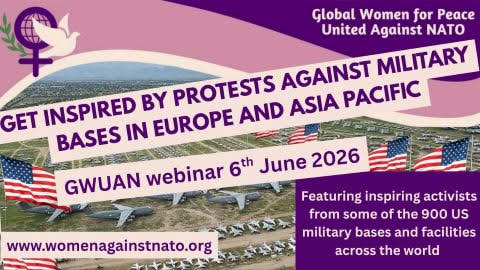
6 June – WEBINAR- Get Inspired by Protests Against Military Bases!

Cuba Is Not a Failed State – It Is a Besieged State
PETITION: “Global Appeal to Endorse Palestinian Right of Return of Refugees”


of the week– Nuclear Reactor Information Task Force
To see nuclear-related stories in greater depth and intensity – go to https://nuclearinformation.wordpress.com
-
Archives
- June 2026 (34)
- May 2026 (306)
- April 2026 (356)
- March 2026 (251)
- February 2026 (268)
- January 2026 (308)
- December 2025 (358)
- November 2025 (359)
- October 2025 (376)
- September 2025 (257)
- August 2025 (319)
- July 2025 (230)
-
Categories
- 1
- 1 NUCLEAR ISSUES
- business and costs
- climate change
- culture and arts
- ENERGY
- environment
- health
- history
- indigenous issues
- Legal
- marketing of nuclear
- media
- opposition to nuclear
- PERSONAL STORIES
- politics
- politics international
- Religion and ethics
- safety
- secrets,lies and civil liberties
- spinbuster
- technology
- Uranium
- wastes
- weapons and war
- Women
- 2 WORLD
- ACTION
- AFRICA
- Atrocities
- AUSTRALIA
- Christina's notes
- Christina's themes
- culture and arts
- Events
- Fuk 2022
- Fuk 2023
- Fukushima 2017
- Fukushima 2018
- fukushima 2019
- Fukushima 2020
- Fukushima 2021
- general
- global warming
- Humour (God we need it)
- Nuclear
- RARE EARTHS
- Reference
- resources – print
- Resources -audiovicual
- Weekly Newsletter
- World
- World Nuclear
- YouTube
-
RSS
Entries RSS
Comments RSS
 nuclear-news