Climate change disasters help authoritarian leaders to seize power
Climate Kings How a new generation of authoritarian leaders are using climate change to seize power https://newrepublic.com/article/148861/climate-change-authoritarian-leaders, By SAMUEL MILLER MCDONALD, July 30, 2018
National crises make governments vulnerable to autocracy—a rather obvious assessment, perhaps, but one rarely seen in debates about climate change. Take the Maldives, an atoll nation in the Indian Ocean. Rising seawater is projected to consume most, if not d Nall, of the country this century. In 2008, the Maldives chose its first democratically elected president, Mohameasheed. Almost immediately, he made climate change preparations central to his administration. He announced plansto move 360,000 Maldivian citizens to new homelands in Sri Lanka, India, or Australia, and he promised to make the Maldives the world’s first carbon-neutral country. Nasheed also demonstrated a flair for the dramatic, staging an underwater Cabinet meeting that turned him into a viral climate celebrity. “What we need to do is nothing short of decarbonizing the entire global economy,” he said. “If man can walk on the moon, we can unite to defeat our common carbon enemy.”
In 2012, the military deposed Nasheed, forcing him to flee the country at gunpoint after mass protests over economic stagnation and spikes in commodity prices. His eventual successor, Abdulla Yameen, has since suspended parts of the constitution, giving himself sweeping powers to arrest and detain opponents, including two of the country’s five Supreme Court justices and even his own half-brother. Meanwhile, Yameen has tossed out Nasheed’s climate adaptation plans and rejected renewable energy programs, proposing instead to build new islands and economic free zones attractive to a global elite. “We do not need cabinet meetings underwater,” his environment minister told The Guardian. “We do not need to go anywhere. We need development.”
If any lesson can be drawn from the power struggle in the Maldives, it is that people who feel threatened by an outside force, be it foreign invaders or rising tides, often seek reassurance. That reassurance may come in the form of a strongman leader, someone who tells them all will be well, the economy will soar, the sea walls hold. People must only surrender their elections, or their due process, until the crisis is resolved. This is perhaps the most overlooked threat of climate change: Major shifts in the global climate could give rise to a new generation of authoritarian rulers, not just in poorer countries or those with weak democratic institutions, but in wealthy industrialized nations, too.
Refugee crises, famine, drought—these are materials strongmen can use to build power. Already, strife and civil instability are spreading throughout the global South, with droughts and floods stoking conflict and refugee crises in parts of Africa and the Middle East. According to a 2016 paper in Science, climate change will increase the risk of armed conflict across Africa by 50 percent by 2030. Eastern Africa is particularly vulnerable. The genocidal strife in Darfur is one of the bloodiest examples, but even countries with robust economies and democracies are susceptible. In Kenya, for example, a crippling drought has led to rapid inflation of food prices, doubling the number of food-insecure people since 2014. That, and disputes over who owns land in the Laikipia region, north of Nairobi, has contributed to violent clashes there, threatening the political stability of the country. This has enabled Kenya’s President Uhuru Kenyatta to tighten his grip on power. In October, amid reports that he’d rigged a recent presidential election, Kenyatta declared the drought a national disaster—this, just weeks before the next round of voting. He was reelected and, amid continued chaos, has cracked down on his opponents in the media.
It’s not just developing nations that are at risk of opportunistic climate-fueled authoritarianism. Wealthy countries may possess the resources to insulate themselves from the near-term physical impacts of climate change—they can afford sea walls, emergency services, and air conditioning. But when conflicts over resources break out in the developing world, they are bound to generate crises that spill into wealthier countries.
A study published in the Proceedings of the National Academy of Sciences in 2015 drew a direct link between the 2007–2010 drought in the greater Fertile Crescent, which “exacerbated existing water and agricultural insecurity and caused massive agricultural failures and livestock mortality,” and Syria’s 2011 civil war, which has forced millions of people to seek refuge in Europe. Their arrival has helped fuel antidemocratic movements throughout the continent. “Even the specter of refugee crises and population movements can impact attitudes toward authoritarianism,” said Jonathan Weiler, co-author of Authoritarianism and Polarization in American Politics. These fears aren’t going away: According to a 2017 study published in The Lancet, extreme weather could displace up to a billion people around the world by the middle of the twenty-first century—an unprecedented human migration will undoubtedly influence the politics of wealthy countries, pushing them to the right.
The best way to counteract this phenomenon is naturally to halt, or at least slow, the effects of climate change. So far, the Paris agreement is the only tangible result of those efforts, and its fate is far from certain, with the United States threatening to withdraw. But this might change, if the problems caused by climate change—not just stronger hurricanes, droughts, and rising seas, but political rupture—keep washing up on the disappearing shorelines of wealthy governments.
Samuel Miller McDonald studies climate and energy politics at Oxford University. @@sjmmcd
Japan keen to have a nuclear export business: it all depends on building nuclear reactors in the UK
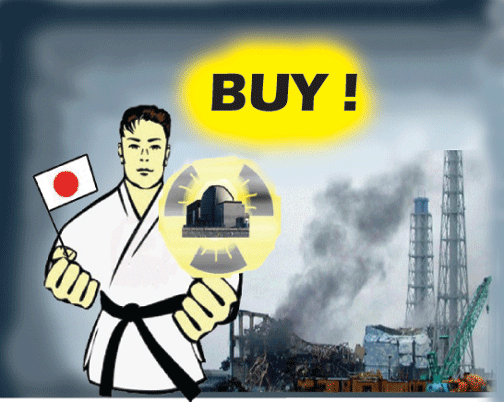
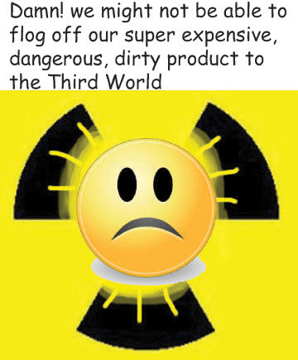 Japan and Hitachi pin nuclear export hopes on U.K. project in Wales https://www.japantimes.co.jp/news/2018/07/29/business/japan-hitachi-pin-nuclear-export-hopes-u-k-project-wales/#.W14xP9IzbGg, BY JUNKO HORIUCHI KYODO
A nuclear power plant project in Britain is giving Japan a glimmer of hope for spurring infrastructure exports, a key growth strategy of Prime Minister Shinzo Abe.
Hitachi Ltd. and the U.K. government started official talks last month on building new reactors in Wales, with a goal of firing them up in the first half of the 2020s.
The outlook for the ¥3 trillion project is unclear, with both sides facing a string of challenges in the talks going forward.
For Tokyo, the plan is one of its few remaining major overseas projects on the horizon, with other nuclear power generation plans discontinued or facing cancellation.
The government’s bet on nuclear power plants as a pillar of infrastructure exports comes as the likes of Germany, Italy, Taiwan and South Korea are pulling out of atomic power generation.
Critics argue that a surge in safety costs and accident worries caused by the 2011 Fukushima disaster, in addition to the lack of viable disposal solutions for radioactive waste, mean there is no justification for keeping faith in nuclear energy. Compounding the sector’s decline is the rapidly dropping cost of tapping such renewable energy sources as wind and solar power.
Still, some emerging economies look like they will need new nuclear power plants, and Japanese builders see few chances to construct new ones anytime soon in Japan.
“The Japanese government has been pushing hard for exports of nuclear power plants but it’s clear that it’s not going well,” said Tadahiro Katsuta, a professor at Meiji University. “The government will spare no effort in giving momentum to the exports.”
If the project in Britain proves successful, it will give the government “a good excuse” to push harder abroad, he said.
Before the official talks began, Hitachi had told Britain it might not take part in the project to build two advanced boiling water reactors on the Isle of Anglesey in Wales, because the price tag had soared higher than initially estimated.
But an offer by London to shoulder about two-thirds of the cost convinced Hitachi stay in. Tokyo welcomed its decision to begin the talks.
“The nuclear business overseas is significant … it would lead to strengthening and maintaining human resources and technology for nuclear power in Japan,” Minister of Economy, Trade and Industry Hiroshige Seko told a news conference.
Under the agreement, the British government will subsidize much of the cost through direct investment and loan guarantees, according to sources close to the matter.
“We are currently examining the financial and cost issues of the project, before making a final decision in 2019 on whether to invest in the project,” Hitachi Chief Financial Officer Mitsuaki Nishiyama said Friday at a news conference to announce earnings.
For Hitachi, nuclear power is a core operation. It wants to increase revenue from the business by more than 33 percent to ¥250 billion over the four years through March 2022, mainly through boosting overseas revenue.
Rival Toshiba Corp. exited overseas nuclear operations after incurring huge losses in the United States, a decision that could cripple Tokyo’s efforts to promote Japanese nuclear plants abroad.
Mitsubishi Heavy Industries Ltd., is pursuing a nuclear power plant project in Turkey. But it hit a snag when it saw safety-related costs surge and trading house Itochu Corp. walked away from the project.
In another blow to the government, Vietnam in 2016 decided to abandon a plan to build its first nuclear power plant with Japanese assistance due to tight state finances.
Those failures have led to an increased focus on the new power station in Wales. But London and Hitachi still need to address such issues as how to spread the remainder of the costs among Hitachi, local companies and Japan-backed financial institutions. They also need to determine who should be held liable if there’s a major accident.
They are also at odds over how much the electricity produced at the plant should cost. Britain at one point offered a price some 20 percent lower than what Hitachi wanted, a source familiar with the matter said.
“A key focus of discussions with Hitachi has been and will continue to be achieving lower-cost electricity for consumers,” Greg Clark, British business and energy secretary, told Parliament last month.
The two sides also need to talk to residents and win over those worried about the new power station.
“We have a major multinational and two governments supposed to be democracies playing a high-stakes game of poker … without any transparency or scrutiny for the people that they are representing,” Mei Tomos, a resident of Wales, said at a news conference in Tokyo during a recent visit to Japan.
“We have seen the destruction which nuclear power can cause. It is really too much to expect us to take the same risks. Even if such an accident didn’t happen at Anglesey we will still be faced with over a hundred years of storage of nuclear waste on site which presents a massive danger to us,” another resident, Robert Davies, said at the news conference.
China’s plan for global nuclear dominance depends on Britain
 China’s long game to dominate nuclear power relies on the UK https://www.theguardian.com/environment/2018/jul/26/chinas-long-game-to-dominate-nuclear-power-relies-on-the-uk
Approval of Chinese nuclear technology in the UK would act as a springboard to the rest of the world, Guardian, Adam Vaughan and Lily Kuo in Beijing, 27 Jul 2018
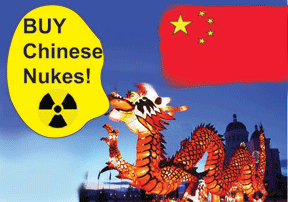
China wants to become a global leader in nuclear power and the UK is crucial to realising its ambitions.
While other countries have scaled back on atomic energy in the wake of the Fukushima disaster, state-backed Chinese companies benefit from the fact that China is still relying on nuclear energy to reach the country’s low-carbon goals.
“China is going in the opposite direction. The massive experience possessed by the Chinese nuclear industry, consistently building for the past 30 years and adopting various next-generation technologies, is being recognised by the global nuclear industry,” said Zaf Coelho, the director of Asia Nuclear Business Platform, based in Singapore.
The UK, where as many as six new nuclear power stations could be built over the next two decades, is an obvious export target for Chinese nuclear. If state-owned China General Nuclear Power (GNP) – the main player in China’s nuclear industry – buys a 49% stake in the UK’s existing nuclear plants, as it was recently reported to be considering, that would mark a significant expansion of China’s role in the UK nuclear sector.
But the depth of CGN’s existing involvement in UK nuclear may surprise some.
The most high-profile project is the £20bn Hinkley Point C power station in Somerset, which is being built by EDF Energy with a French reactor design but was only made possible by CGN UK’s 33.5% stake to underwrite its daunting finances.
It was that Chinese ownership of a strategic piece of infrastructure that led Theresa May to temporarily halt the signing of the crucial subsidy deal for Hinkley when she became prime minister.
Isabel Hilton, the CEO of Chinadialogue.net, said the UK opening up vital infrastructure to China was without parallel in the western world. “No other OECD country has done this. This is strategic infrastructure, and China is a partner but not an ally in the security sense.
“You are making a 50-year bet, not only that there will be no dispute between the UK and China, but also no dispute between China and one of the UK’s allies. It makes no strategic sense.”
The UK has appeared amenable to Chinese investment, though recently the UK cybersecurity watchdog warned British telecommunications companies against dealing with Chinese tech firm ZTE. One expert acknowledges that security concerns are a potential check to Chinese ambitions.
Zha Daojiong, a professor of non-traditional security studies at Peking University, said: “The question is not whether your nuclear technology is safe or not, it’s a question of politics. To be blunt, most countries think: ‘Anybody but China.’ This kind of thinking is becoming more and more popular among western countries. It’s a serious problem.”
CGN is also drawing up plans for Bradwell B in Essex, where China hopes to showcase its own nuclear reactor technology. CGN UK holds the majority stake (66.5%) in the development company, with EDF in a supporting role. Then there is a third joint venture to get Bradwell’s Chinese reactor design through the UK nuclear regulatory process.
Finally, there is Sizewell C in Suffolk, where EDF wants to build a clone of Hinkley Point C if it can attract enough private investment. CGN holds a 20% share.
While Germany and other western countries have turned their backs on nuclear, the UK is strongly committed to new nuclear to meet its carbon goals and this means, despite security concerns, the government needs Chinese involvement.
Robert Davies, the chief operating officer of CGN UK, said: “The UK is open to investment, and we want to invest in clean energy in this country.”
He is acutely aware of the need for future plants to be cheaper, given criticism over the cost of the EDF subsidy deal. “We understand the cost of electricity has to fall significantly from Hinkley Point,” he said.
But the company is open about the bigger prize – the UK as a springboard for exporting Chinese nuclear technology to other countries.
“For us, the UK is an important stepping stone into Europe. The GDA process [UK regulatory approval] is recognised in the nuclear world as having a lot of clout,” said Davies.
Asked if the UK should be concerned about China owning its nuclear power stations, he said: “We are not surprised and see nothing wrong with governments questioning our rationale for investing in their country.”
For now, the company’s UK footprint is small – just 70 of its 44,000 staff are based here. But his hope is the firm will become viewed “not as an outsider that has come in, but part of the furniture”.
China’s commitment was on show at a recent lavish nuclear industry event in London. No expense was spared on hosting the summit at the prestigious Guildhall building, where the Chinese ambassador to the UK told jokes and argued the case for new nuclear.
Mycle Schneider, a Paris-based nuclear industry analyst, said cost was not an issue for Beijing because the Chinese are playing a long game. “It was clear quite early on there was a strategy to make the UK a platform … A few billion here or there is not the point. It’s about strategic assets.”
But he said CGN still had a lot to learn about how the UK worked. “China does not have any building experience in any countries other than Pakistan, and that is not really comparable to the UK.”
Zhou Dali, a former Chinese energy official, as director of the energy research institute of China’s National Development and Reform Commission, said: “We are learning how to do business with patience. Because you cannot force others to do something. You can only help.
“We will give more and more information about the technology’s improvements, but the final decision will be made by the UK people and your politicians.”
Additional reporting by Wang Xueying
EU Energy and Environment Sub-Committee want clarity on UK’s nuclear plans after Brexit
 House of Lords 19th July 2018 The EU Energy and Environment Sub-Committee has written to the Minister for Business and Industry, Richard Harrington MP, following an evidence session with the Office for Nuclear Regulation which considered their efforts to prepare for Brexit.
The Committee has written to BEIS’ Minister for Business and Industry to ask for further clarity on the ONR’s future funding arrangements, and to request regular updates between now and the point of withdrawal to ensure the ONR’s preparation remains on track.
The Committee also asks for an update on negotiations regarding the intended Nuclear Cooperation Agreements with the USA, Canada, Japan and Australia.
https://www.parliament.uk/business/committees/committees-a-z/lords-select/eu-energy-environment-subcommittee/news-parliament-2017/nuclear-preparedness-letter-to-minister/
U.S. Secretary of State Pompeo accused North Korea of hiding nuclear facilities, enriching uranium
Pompeo accused North Korea of hiding nuclear facilities, enriching uranium: Report , Straits Times, 17 July 18 TOKYO (THE YOMIURI SHIMBUN/ASIA NEWS NETWORK) – US Secretary of State Mike Pompeo accused North Korea of operating secret facilities for the enrichment of uranium when he met senior North Korean official Kim Yong Chol during his July 6-7 visit to the country, the Yomiuri Shimbun has learned.
The US top diplomat’s move appears to underscore Washington’s increasing suspicion that Pyongyang is covertly proceeding with activities that are contrary to denuclearisation, despite its declared commitment to the goal.
It also raises the possibility that even if North Korea starts the process of denuclearisation, the alleged existence of secret facilities will become an issue during the declaration and verification phases.
According to sources knowledgeable about Japan-US-South Korea trilateral talks, Pompeo said at his meeting Kim Yong Chol that Pyongyang was enhancing the production of enriched uranium and also concealing nuclear-related facilities and nuclear warheads.
Citing information that construction activities are under way at a missile plant at Hamhung in the north-eastern province of South Hamgyong to expand the facility, Pompeo stressed that this was not beneficial to US-North Korean relations.
Kim Yong Chol, a top North Korean party official and former spy agency chief with whom Pompeo played a key role in arranging an unprecedented summit between US President Donald Trump and North Korean leader Kim Jong Un in Singapore on June 12, flatly denied Pompeo’s claim, according to the sources.
Pyongyang has never hidden or operated a secret uranium enrichment site, the North Korean official was quoted as saying.
Kim also reportedly argued that activities at the Hamhung missile plant were part of construction work in preparation for the rainy season, not expansion work.
On July 7, a North Korean foreign ministry spokesman released a statement accusing Washington of showing a “regrettable” attitude at the meeting between Pompeo and the North Korean official……..https://www.straitstimes.com/asia/east-asia/pompeo-accused-north-korea-of-hiding-nuclear-facilities-enriching-uranium-report
Japan, U.S. extend nuclear pact amid concern about plutonium stockpile
KYODO NEWS 17 July 18 Japan and the United States extended on Tuesday a bilateral nuclear agreement that has served as the basis for Tokyo’s push for a nuclear fuel recycle policy.
The pact, which entered into force in July 1988, has authorized Japan to reprocess spent fuel, extract plutonium and enrich uranium for 30 years. As neither side sought to review it before the end of the term, it will remain effective, leaving Japan the only country without nuclear arms that is allowed to reprocess spent nuclear fuel.
But the passing of the initial 30-year period raises uncertainty over the future of the pact, now that it can be terminated anytime six months after either party notifies the other.
The United States is seen as concerned about Japan’s stockpiles of plutonium
………Japan has around 47 tons of plutonium, which is enough to produce about 6,000 nuclear warheads.
Of the 47 tons, around 10 tons were stored in Japan and the reminder in Britain and France as of the end of 2016, according to government data.
In early July, Japan clearly stated for the first time in its basic energy plan that it will trim the amount.
Spent fuel from nuclear reactors is reprocessed to extract uranium and plutonium, which is then recycled into fuel called mixed oxide, or MOX, for use in fast-breeder reactors or conventional nuclear reactors.
But following the 2011 Fukushima nuclear disaster, most of Japan’s nuclear power plants remain offline as they are required to pass newly established safety regulations……..
The Rokkasho plant, a key pillar of the country’s nuclear fuel recycling policy, will be able to produce around 8 tons of plutonium a year when fully operational. https://english.kyodonews.net/news/2018/07/d0e37985dc1c-japan-us-extend-nuclear-pact-amid-concern-about-plutonium-stockpile.html
European Court of Justice’s ruling gives high-risk nuclear technology with billion-dollar subsidies an unfair competitive advantage.
Rebecca Harms MEP 12th July 2018 ,Rebecca Harms , spokeswoman for the Greens / EFA Group in the European
Parliament , comments on the European Court of Justice’s ruling that the EU
Commission’s decision to grant aid to the United Kingdom for the
construction of a nuclear reactor at the Hinkley Point nuclear power plant
is legitimate .
“The Euratom Treaty is a relic of the past and gives the
high-risk nuclear technology with billion-dollar subsidies an unfair
competitive advantage. The Euratom Treaty does not match the European
requirements for clean energy and fair competition. We must end the
distortion of competition in the European energy market, reform the Euratom
Treaty and rely on the energy transition. ”
Here you will find the report ”
Pathways to a Euratom Reform ” on behalf of the Greens / EFA Group.
http://rebecca-harms.de/post/zitat-von-rebecca-harms-zur-entscheidung-des-europaeischen-gerichtshof-gruenes-licht-fuer-hinkley-point-subventionen-euratom-vertrag-zu-geben-36732
Donald Trump ready to go to war against Iran?
 Don’t Let Trump Go to War With Iran https://www.theatlantic.com/international/archive/2018/07/dont-let-trump-go-to-war-with-iran/565082/ Fifteen years after the U.S. entered Iraq, the president is inching us closer to another unnecessary fight. TIM KAINE
Japan-US nuclear energy pact set to renew automatically in July 2018
https://mainichi.jp/english/articles/20180116/p2a/00m/0na/005000c (Mainichi Japan)
A nuclear energy cooperation agreement between Japan and the U.S. will renew automatically in July 2018, it is expected to be confirmed on Jan. 16.
The existing accord, officially called the Agreement for Cooperation Between the Government of the United States of America and the Government of Japan Concerning Peaceful Uses of Nuclear Energy, recognizes Japan’s extraction of plutonium from spent nuclear fuel and use of mixed oxide (MOX) fuel as part of its “nuclear fuel cycle.” Renewing the pact will enable Japan to continue with its nuclear fuel cycle policy.
However, after the pact is renewed, if either Japan or the U.S. gives notice, then the agreement will be halted after six months — which would mean that Japan’s nuclear policy would be more easily affected by the will of the U.S.
The nuclear energy agreements that the U.S. has in place with other countries control the handling of nuclear materials and related equipment — from the standpoint of non-proliferation — whenever the U.S. provides nuclear technology to those other nations.
Under the existing agreement between Japan, a non-nuclear nation, and the U.S., nuclear fuel cycle operations such as the reprocessing of spent nuclear fuel and also uranium enrichment are recognized, in what is considered an exceptional case.
With the pact coming into effect in July 1988, the 30-year deadline of the current agreement will be reached on July 16, 2018. As long as neither Japan nor the U.S. give notice to withdraw six months prior to the deadline, the pact will be automatically renewed.
The Japanese government did try to negotiate with the U.S. about maintaining the agreement as it is. However, the administration under U.S. President Donald Trump has not been in a position to negotiate, and so the pact looks set to renew automatically, without any serious negotiations taking place.
Mike Pompeo holds nuclear talks with North Korean officials in Pyongyang
Secretary of state predicts ‘productive’ meeting on his third visit, joking: ‘If I come one more time, I will have to pay taxes here’, Guardian, Julian Borger in Washington and Justin McCurry in Tokyo 7 Jul 2018
Mike Pompeo and a US delegation held talks in Pyongyang with North Korean officials on Friday, in an effort to make progress towards disarmament and improved bilateral relations three weeks after Donald Trump’s Singapore summit with Kim Jong-un.
The US secretary of state is seeking to persuade the North Korean leadership to take concrete steps that Trump said he was promised in Singapore, including the destruction of a missile engine testing site and the repatriation of remains of US soldiers killed in the Korean war.
Pompeo is also asking for more substantial steps towards disarmament, reportedly including an inventory of the North Korean arsenal of warheads and missiles.
Mike Pompeo and a US delegation held talks in Pyongyang with North Korean officials on Friday, in an effort to make progress towards disarmament and improved bilateral relations three weeks after Donald Trump’s Singapore summit with Kim Jong-un.
The US secretary of state is seeking to persuade the North Korean leadership to take concrete steps that Trump said he was promised in Singapore, including the destruction of a missile engine testing site and the repatriation of remains of US soldiers killed in the Korean war.
Pompeo is also asking for more substantial steps towards disarmament, reportedly including an inventory of the North Korean arsenal of warheads and missiles.
…….. He is under time pressure to produce results by August, when the US and South Korea were due to hold joint military exercises. Those exercises were cancelled on Trump’s orders in Singapore as an up-front concession. Adding to the pressure, the president has repeatedly claimed that the testing site has already been destroyed, and that the soldiers’ remains have been sent back, neither of which has happened.
Trump has also made extravagant claims about what was agreed in Singapore. At a rally in Montana on Thursday, he claimed: “We signed a wonderful paper saying they’re going to denuclearise their whole thing. It’s going to all happen.”
In a joint statement with Trump, Kim agreed to move towards “complete denuclearisation” but that has been a stock phrase in North Korean rhetoric since 1992 and signifies a vague and long-term process of multilateral disarmament on the Korean peninsula. Since the Singapore meeting, satellite images and intelligence leaks have suggested that North Korea is upgrading critical parts of its nuclear programme
……….. The meeting lasted two hours and 45 minutes and Pompeo then had dinner with his senior aides. The next session is due to start at 9am. It is unclear whether Pompeo will meet Kim Jong-un on this trip.
There were reports before Pompeo began his visit, that he might relax the US demand for complete, verifiable, irreversible disarmament (CVID), and settle for mutual confidence-building measures that defused tensions without dismantling the North Korean arsenal.
His spokeswoman, Heather Nauert, denied those reports on Thursday, saying: “Nothing could be further from the truth. Our policy toward North Korea has not changed.
“We are committed to a denuclearised North Korea and Secretary Pompeo looks forward to continuing his consultations with North Korean leaders to follow up on the commitments made at the Singapore summit,” Nauert added……….. https://www.theguardian.com/us-news/2018/jul/05/mike-pompeo-north-kroea-visit-pressure-nuclear-progress
Concern that Iran might abandon nuclear deal, – package will not fully compensate for U.S. sanctions
Germany says Iran package will not fully compensate for U.S. sanctions https://www.reuters.com/article/us-iran-nuclear-germany/germany-says-iran-package-will-not-fully-compensate-for-us-sanctions-idUSKBN1JW18T, 6 july 18
VIENNA (Reuters) – Germany’s foreign minister said on Friday world powers would not be able to fully compensate for companies leaving Iran due to new U.S. sanctions, but warned Tehran that abandoning its nuclear deal would cause more harm to its economy.
“We will not be able to compensate for everything that arises from companies pulling out of Iran,” Heiko Maas told reporters before a round of talks among the remaining parties to the deal.
He said he did not think this round of talks would end negatively but it was likely more negotiations would be needed on the issue.
Reporting by Francois Murphy; writing by John Irish; editing by Parisa Hafezi
U.S. Secretary of State Mike Pompeo faces delicate task of negotiating with North Korea on reducing nuclear weapons
Mike Pompeo under pressure to secure nuclear progress in North Korea visit , Guardian Justin McCurry in Tokyo and agencies 5 Jul 2018 Secretary of state faces pressure to establish timeline for denuclearisation as well as duty to reassure regional allies Weeks after Donald Trump declared the world a safer place following his historic summit with Kim Jong-un, Mike Pompeo is due to arrive in Pyongyang on Friday amid growing doubts over the regime’s willingness to abandon its nuclear weapons.
Unnamed US intelligence officials also concluded that North Korea does not intend to completely give up its nuclear stockpile.
Pompeo will also use his visit to consult and reassure Washington’s allies in the region, with meetings planned with Japanese and South Korean officials in Tokyo on Sunday. Japan has voiced support for the leaders’ Singapore declaration, but reacted cautiously to Trump’s decision to cancel a joint US-South Korea military exercise scheduled for August.
Pompeo must establish how far North Korea’s nuclear and missile programmes have advanced before US officials can even attempt to draw up a potential timeline for America’s central demand – their complete, irreversible and verifiable dismantlement [CVID].
At present, the US has no reliable information on where all of North Korea’s production and testing facilities are located or the size of its ballistic inventory.
In a tweet this week, Trump said Washington and Pyongyang had been having “many good conversations” with North Korea over denuclearisation. “In the meantime, no Rocket Launches or Nuclear Testing in 8 months, he said. “All of Asia is thrilled. Only the Opposition Party, which includes the Fake News, is complaining. If not for me, we would now be at War with North Korea!”
Sceptics have pointed out that Kim no longer believes such tests are necessary now that the North has successful developed an intercontinental ballistic missile, and that dismantling North Korea’s missile and nuclear infrastructure represents a much tougher diplomatic challenge that could take years and cost billions of dollars, if it happens at all.
“Denuclearisation is no simple task,” Daryl Kimball, executive director of the Arms Control Association, wrote in a commentary. “There is no precedent for a country that has openly tested nuclear weapons and developed a nuclear arsenal and infrastructure as substantial as the one in North Korea to give up its nuclear weapons.”
Experts have played down Trump’s upbeat appraisal of his 12 June meeting with Kim in Singapore, where the leaders made a loose commitment to work towards the denuclearisation of the Korean peninsula and agreed goodwill measures such as the possible return of the remains of US soldiers from the 1950-53 Korean war.
There are signs Pompeo might abandon all-or-nothing demands for CVID and replace them with incremental steps that South Korea has reportedly suggested would be more likely to secure Kim’s cooperation…….https://www.theguardian.com/us-news/2018/jul/05/mike-pompeo-north-kroea-visit-pressure-nuclear-progress
Iran warns that it may reduce co-operation with IAEA if USA increases sanctions
 Iran threatens to cut cooperation with nuclear body after Trump move https://www.reuters.com/article/us-iran-oil-sanctions/iran-threatens-to-cut-cooperation-with-nuclear-body-after-trump-move-idUSKBN1JU1E9?feedType=RSS&feedName=topNews, Bozorgmehr Sharafedin, -5 July 18
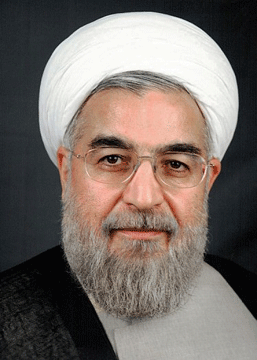
LONDON (Reuters) – Iran could reduce its co-operation with the U.N. nuclear watchdog, President Hassan Rouhani told the body’s head on Wednesday, after he warned U.S. President Donald Trump of “consequences” of fresh sanctions against Iranian oil sales.
In May, Trump pulled out of a multinational deal under which sanctions on Iran were lifted in return for curbs to its nuclear program, verified by the International Atomic Energy Agency (IAEA). Washington has since told countries they must stop buying Iranian oil from Nov. 4 or face financial measures.
“Iran’s nuclear activities have always been for peaceful purposes, but it is Iran that would decide on its level of cooperation with the IAEA,” Iranian state news agency IRNA quoted Rouhani as saying after meeting IAEA head Yukiya Amano in Vienna.
“The responsibility for the change of Iran’s cooperation level with the IAEA falls on those who have created this new situation,” he added.
Rouhani said earlier in the day Tehran would stand firm against U.S. threats to cut Iranian oil sales.
“The Americans say they want to reduce Iranian oil exports to zero … It shows they have not thought about its consequences,” Rouhani was quoted as saying by IRNA.
On Tuesday, Rouhani hinted at a threat to disrupt oil shipments from neighboring countries if Washington tries to cut its exports.
He did not elaborate, but an Iranian Revolutionary Guards commander explicitly said on Wednesday Iran would block any exports of crude for the Gulf in retaliation for hostile U.S. action.
“If they want to stop Iranian oil exports, we will not allow any oil shipment to pass through the Strait of Hormuz,” Ismail Kowsari was quoted as saying by the Young Journalists Club (YJC) website.
Major-General Qassem Soleimani, commander of the Quds force, in charge of foreign operations for the Revolutionary Guards, said in a letter published on IRNA: “I kiss your (Rouhani’s) hand for expressing such wise and timely comments, and I am at your service to implement any policy that serves the Islamic Republic.”
Rouhani, in Vienna trying to salvage the nuclear deal, said U.S. sanctions were a “crime and aggression”, and called on European and other governments to stand up to Trump.
“Iran will survive this round of U.S. sanctions as it has survived them before. This U.S. government will not stay in office forever … But history will judge other nations based on what they do today,” he said.
Rouhani told reporters that if the remaining signatories – the Europeans Britain, France and Germany as well as China and Russia – can guarantee Iran’s benefits: “Iran will remain in the nuclear deal without the United States.”
Despite Donald Trump’s brash confidence, serious and delicate negotiations will be needed with North Korea
 Donald Trump is typically bullish about North Korea nuclear talks – but the hard work begins this week
Analysis: However confident Mr Trump is about nuclear talks with Pyongyang, the hard work is just beginning, The Independent, Chris Stevenson International Editor, 5 July 28, “……….In the lead-up to the unprecedented summit between Donald Trump and the North Korean leader in Singapore on 12 June – and in the weeks afterwards – the US president has sought to paint a picture of a problem solved. Indeed this week Mr Trump tweeted that talks were “going well,” and “All Asia is thrilled”.
Russia and China to co-operate in nuclear power build
Russia to build two new nuclear power units in China, 5 July 18
President Vladimir Putin mentioned that energy is the most important sector of cooperation, in a meeting with Chinese President Xi Jinping in the previous month. Moneycontrol News@moneycontrolcom Moscow and Beijing may sign agreements to build additional two power units of 1,200-Megawatt units in China by 2026 and 2027, as per reports by Russia’s state nuclear power corporation Rosatom.……. As reported by RT, the two countries are also working together on One Belt, One Road initiative. At this rate of growth, the trade between the two countries is expected to reach the target of $100 billion. https://www.moneycontrol.com/news/business/russia-to-build-two-new-nuclear-power-units-in-china-2674481.html
1 This Month
26 September – International Day for the Total Elimination of Nuclear Weapons





PLEASE OPPOSE HR 8255 AND S.3639 – bills would accelerate satellite deployment, with no environmental review or safeguards – https://ncstd5li.quorum.us/campaign/169331/
To see nuclear-related stories in greater depth and intensity – go to https://nuclearinformation.wordpress.com
-
Archives
- September 2026 (305)
- August 2026 (330)
- July 2026 (355)
- June 2026 (287)
- May 2026 (306)
- April 2026 (356)
- March 2026 (251)
- February 2026 (267)
- January 2026 (308)
- December 2025 (358)
- November 2025 (359)
- October 2025 (375)
-
Categories
- 1
- 1 NUCLEAR ISSUES
- business and costs
- climate change
- culture and arts
- ENERGY
- environment
- health
- history
- indigenous issues
- Legal
- marketing of nuclear
- media
- opposition to nuclear
- PERSONAL STORIES
- politics
- politics international
- Religion and ethics
- safety
- secrets,lies and civil liberties
- spinbuster
- technology
- Uranium
- wastes
- weapons and war
- Women
- 2 WORLD
- ACTION
- AFRICA
- Atrocities
- AUSTRALIA
- Christina's notes
- Christina's themes
- culture and arts
- Events
- Fuk 2022
- Fuk 2023
- Fukushima 2017
- Fukushima 2018
- fukushima 2019
- Fukushima 2020
- Fukushima 2021
- general
- global warming
- Humour (God we need it)
- Nuclear
- RARE EARTHS
- Reference
- resources – print
- Resources -audiovicual
- Weekly Newsletter
- World
- World Nuclear
- YouTube
-
RSS
Entries RSS
Comments RSS

