USA negotiations with North Korea may be on the verge of breakdown
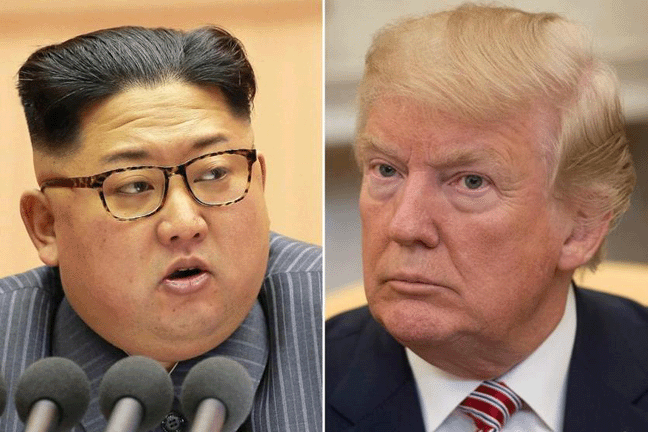
 The current US negotiating strategy with North Korea is doomed, Bulletin of the Atomic Scientists, By Perry World House, August 30, 2018 US negotiations with North Korea over the latter’s nuclear weapons program appear to have hit a major roadblock. While North Korea has temporarily suspended nuclear and missile testing and partially destroyed its nuclear test site, both steps are reversible, and North Korea has largely balked at US President Donald Trump’s demand for “complete, verifiable, and irreversible denuclearization.” Consequently, negotiations with Pyongyang may be on the verge of breakdown. Trump recently cancelled his secretary of state’s planned trip to the country, and the administration has gone back and forth in the last few days about whether Washington will continue to suspend joint military exercises with South Korea, a concession Trump made to North Korean leader Kim Jong-un during their historic summit in June. Given this critical juncture in negotiations, it is time to reevaluate what talks can actually achieve. It would be great if Kim agreed to hand over all of his nuclear weapons, but the reality is that North Korea will not be completely, verifiably, or irreversibly denuclearizing anytime soon. Therefore, if the Trump Administration wants to salvage the negotiations, it needs a new strategy.
Why North Korea won’t denuclearize. The first step to a successful negotiating strategy is understanding how your opponent thinks. So why does North Korea want nuclear weapons in the first place? For the same reason Israel, France, India, and others wanted them—security. Specifically, security against the United States.
North Korea’s murderous dictator has good reason to worry about an American intervention to overthrow his regime. First of all, the United States is much more powerful than North Korea. While the size of North Korea’s entire economy is about $40 billion at most, America spends over $700 billion on its military alone. Second, this fact, combined with Washington’s long history of military interventions, is enough to make any despot shake in his shoes. Finally, the specific history between the United States and North Korea is not reassuring to Kim. The two countries fought against each other in the Korean War, President George W. Bush branded North Korea part of the “axis of evil,” and Trump threatened Pyongyang with “fire and fury like the world has never seen.”
Like many relatively weak countries facing a threat, North Korea turned towards nuclear weapons not because its leader is crazy, but to deter a stronger power. By threatening to punish the United States and its allies with a nuclear response if it is attacked, North Korea is able to effectively dissuade Washington from such attempts. Since Kim’s top priority, like most autocrats, is regime security, he will only give up the protection of his nuclear weapons if he is very confident that he can retain his power without them. Though Trump committed to guaranteeing North Korea’s security in the Singapore Declaration, a number of recent historical episodes will make it difficult to convince Kim he can remain safe if he surrenders all his nuclear weapons.
One example involves Libya. In 2003, Libyan dictator Muammar Gaddafi agreed to give up his nascent nuclear weapons program and permit international inspections. In return, US President George W. Bush promised that Libya could “regain a secure and respected place” among nations. However, just eight years later, in 2011, the United States led a NATO military intervention in Libya that resulted in the brutal killing of Gaddafi. In recent months John Bolton, Trump’s national security advisor, has repeatedly said that Washington has the “Libya model” in mind for North Korea, probably the least reassuring example that could be communicated to Kim.
A second leader who did not do well after suspending his nuclear weapons program was Iraq’s Saddam Hussein. While states that possess nuclear weapons can almost always effectively deter military intervention, states that do not, like Iraq in 2003, are vulnerable. In a fate not much better than Gaddafi’s, Saddam was removed from power by an American military intervention in 2003 and ultimately hung in 2006…….
Trump personally undermined American negotiating credibility in two ways; one indirect and one direct. Indirectly, he hurt Washington’s credibility by withdrawing from the Iran nuclear deal, even though, according to the International Atomic Energy Agency, Iran was complying with its terms. The Trump Administration has now moved to severely punish Iran for its compliance by instituting tough sanctions………..
Given this record, North Korea is very unlikely to agree to fully denuclearize in the short or medium-term, and demanding that it do so is only likely to lead to negotiation failure. To make real progress on this issue, the White House will need to take a different tack.
What Washington’s strategy should be. The Prussian statesman Otto von Bismarck said, “politics is the art of the possible, the attainable.” If North Korea will not be handing over its entire nuclear stockpile anytime soon, what possible, attainable options might curtail the threat? The most extreme option, of course, would be to launch a massive military attack against North Korea in an effort to destroy all of its nuclear weapons and infrastructure—the “fire and fury” Trump threatened. However, such an operation would be reckless to the point of insanity. North Korea has the ability to deliver nuclear missiles to South Korea, Japan, and American military bases in the Pacific. If even one or a handful of nuclear missiles survived an American first strike, hundreds of thousands could die beyond those killed in the initial US attack. Furthermore, even if the United States could reliably locate and destroy all of North Korea’s nuclear weapons in a first strike, Pyongyang would still be able to inflict tens of thousands of casualties daily using conventional and chemical weapons. Given that there is no imminent threat from North Korea’s nuclear program, a preventive war of this type would be nonsensical.
The most sensible option to address the nuclear threat from North Korea would be to pursue an approach dubbed “less for less” by nuclear scholar James Acton. Rather than demanding total denuclearization, the United States should seek a smaller-scale deal that puts significant restrictions on North Korea’s nuclear program in return for moderate sanctions relief and other limited concessions. ……….
Though the prospect of living with a nuclear-armed North Korea for the foreseeable future may seem unacceptable, the world has survived with a nuclear-armed Russia for the last 69 years, China for the last 54 years, Pakistan for the last 20 years, and, yes, North Korea for the last 12 years. Just as North Korea’s nuclear weapons have effectively deterred the United States from a major military intervention, America’s vastly superior nuclear arsenal and conventional capabilities will almost certainly deter North Korea.
This column was written by Joshua A. Schwartz, a PhD candidate in political science at the University of Pennsylvania. https://thebulletin.org/2018/08/the-current-us-negotiating-strategy-with-north-korea-is-doomed/?utm_source=Bulletin%20Newsletter&utm_medium=iContact%20email&utm_campaign=August31
Samoan Prime Minister Tuilaepa Sailele berates world leaders who fail to take climate issue seriously
World leaders who deny climate change should go to mental hospital – Samoan PM https://www.theguardian.com/environment/2018/aug/31/world-leaders-who-deny-climate-change-should-go-to-mental-hospital-samoan-pm
Tuilaepa Sailele berates leaders who fail to take issue seriously, singling out Australia, India, China and the US, Guardian, Kate Lyons, 31 Aug 18 The prime minister of Samoa has called climate change an “existential threat … for all our Pacific family” and said that any world leader who denied climate change’s existence should be taken to a mental hospital.
In a searing speech delivered on Thursday night during a visit to Sydney, Tuilaepa Sailele berated leaders who fail to take climate change seriously, singling out Australia, as well as India, China and the US, which he said were the “three countries that are responsible for all this disaster”.
“Any leader of those countries who believes that there is no climate change I think he ought to be taken to mental confinement, he is utter[ly] stupid and I say the same thing for any leader here who says there is no climate change.”
Speaking at the Lowy Institute, just days before the beginning of the Pacific Islands Forum in Nauru, the Samoan prime minister seemed to take a swipe at Australia’s commitment to minimising the impact of climate change, which he called the “single greatest threat to the livelihood, security and wellbeing peoples of the Pacific
“While climate change may be considered a slow onset threat by some in our region, its adverse impacts are already felt by our Pacific islands peoples and communities,” said Sailele. “Greater ambition is necessary to limit global warming to 1.5 degrees centigrade and Pacific island countries continue to urge faster action by all countries.”
Sailele said addressing climate change required “political guts” from leaders. “We all know the problem, we all know the causes, we all know the solutions. All that is left would be some political courage, some political guts to get out and tell the people of your country, ‘Do this, this, this, or there is any certainty of disaster.’”
Sailele’s speech comes as leaders of Pacific nations are preparing to meet at the Pacific Islands Forum in Nauru next week, where Australia is expected to face questions about its emissions targets.
Australia’s new prime minister, Scott Morrison, is under pressure from some members of his party to abandon Australia’s commitment to reducing emissions under the Paris agreement.
His immediate predecessor, Malcolm Turnbull, was due to attend the forum, but Morrison has announced he is sending his new foreign minister, Marisa Payne, a move the opposition Labor party condemned as “an insult to our neighbours” as well as “a serious strategic mistake”.
Saliele’s speech also touched on China’s rising influence in the Pacific, saying the region had become “an increasingly contested space”. “The big powers are doggedly pursuing strategies to widen and extend their reach, inculcating a far-reaching sense of insecurity.”
Beyond the backyard: understanding geopolitics for a more peaceful foreign policy
Dr Adam Broinowski, College of Asia and the Pacific, Australian National University, adam.broinowski@anu.edu.au,31 Aug 18
At this moment of shifting world order, in which the atomic clock has been returned to two minutes to midnight (the first time since 1953) and the United States has committed to a 1.5 trillion dollar upgrade to its nuclear arsenal, one can be forgiven for a sense of déja vu. Unlike the 1950s, however, we are now aware of the risk of even greater extinctions in the next 100 years not only from potential full-scale nuclear war but also from the impacts of climate disruption across the entire biosphere.
From here, if we are to identify the dynamics of both militarism and climate disruption with a view to achieving and perpetuating more peaceful conditions, we must recognise how oil – and control over its distribution – has been pivotal to the development of US-led world order since the turn of the 20th century. When US leaders claim the ‘exceptionalism’ of the ‘indispensable’ US nation, they are primarily referring to the US military capability to allow or deny access to supply corridors for the flow of vital resources, products, labour and market access. In this brief overview, we can track this through various stages of the US empire.
Stage I: Beyond the western hemisphere
Having expropriated the lands of native Americans and propelled by its own abundant supply of oil, the US claimed the trophies of Cuba, Puerto Rico, Guam and the Philippines after the Spanish-American War in 1898 and entrenched itself in the oil-rich Gulf of Mexico and Caribbean region (‘Western Hemisphere’).
As envisioned by ‘world island’ theory, in which maritime powers could claim hegemony by encircling and containing from the ‘rimlands’ any rival economic and military land-based power emerging on the Eurasian ‘heartland’, the US sent naval flotillas from US bases to control geostrategic ‘land nodes’, ‘geographical pivots’, and ‘choke points’ along resource corridors supplying the largest market at the time: western Europe.
In 1900, the Russian empire accounted for over 50 percent of the world’s oil production and was the world number two producer by the 1920s. After the British procured an exclusive petroleum concession in 1901, British and French powers sought to undermine any coordinated resistance from a united Arabia by forming weak Arab provincial administrations that relied on revenue from oil extraction and distribution to Europe. By the 1920s, however, the US had over 70 percent of world oil production with an economy the size of the next six powers combined. After Standard Oil secured concessions in Dharan, ‘one of the greatest material prizes in history,’ on the Saudi peninsula by 1938, the US consolidated its operations east of Suez by 1944.
Stage II: Cold War
At war’s end, having escaped major destruction from WWII as compared to nations in Europe, the Soviet Union and Asia, the US possessed:
- over 50 percent of world GDP;
- guaranteed oil supply from Saudi Arabia, and Israel as a foothold in the Middle East;
- 70 percent of world monetary gold and the US dollar fixed as world currency reserve.
This leverage permitted the US to construct a ‘division and alliance architecture’ (UN system, NATO, US military bases) in which US bases were set up primarily in western Europe and East Asia on either side of the ‘world island’. US bases carry and store nuclear weapons and related systems; they surround territories with large oil and gas reserves and strategic transport corridors; they facilitate rapid interventions and support for proxy wars, economic warfare, and information/psychological warfare. US operations conducted from these bases have primarily targeted governments, authoritarian or otherwise, that seek autonomous and sovereign control over their country’s resources, markets and finances.
Despite the hype surrounding Soviet plans to invade western Europe and its potential attack US cities in the early Cold War years, there is evidence to show that it was indeed hype, and by 1960, the US could target and destroy almost all Soviet and Chinese cities with near-simultaneous nuclear attack, ostensibly in ‘retaliation’ for a nuclear attack by the enemy. Only by the mid 1970s did the Soviets really catch up with the US in terms of scale and sophistication of nuclear weapons to establish a period of détente. In the intervening years more nations acquired nuclear capability in either a clandestine fashion or outside the Non Proliferation Treaty while others relied on US ‘extended nuclear deterrence’ in return for hosting US bases and other bilateral agreements.
Stage III: Oil politics
In the 1970s, with large debt from the American War in Vietnam, and with several countries seeking return of their gold security deposits from the US Federal Reserve, the Nixon administration withdrew from the gold-backed system rather than allowing the dollar to devalue. When oil prices sky-rocketed with the OPEC oil embargo, the US arranged a financial mechanism whereby all OPEC nations would trade oil exclusively in US dollars in return for US military protection and weapons contracts. The dollar remained the world currency reserve, the US could disregard its national debt from foreign wars and US and UK banks amassed huge profits from commissions on foreign currency exchanges for the purchase of oil, the world’s largest commodity.
The Tengiz field oil reserves in the Caspian Sea were discovered in 1979, the same year as Iran’s Islamic Revolution. The latter was met with heavy sanctions while Saudi Arabia’s Wahabbist Islamic uprising at Mecca was not. The US armed and trained Islamist mujahideen to fight against the Soviet-backed government in Afghanistan (Operation Cyclone). Saddam Hussein’s Ba’ath Party was installed by the CIA in Iraq and aided to fight Iran for eight years. Wahabbism spread to Pakistan and to Chechnya, Dagestan, Albania and Kosovo – Russia’s soft oil-rich underbelly.
Stage IV: Middle East wars
In 1991, despite the opportunity to withdraw US foreign bases and ratify arms control treaties with the disintegration of the Soviet Union, the US together with NATO proceeded to foment ‘Colour Revolutions’ in resource-rich former Soviet-aligned states (Yugoslavia, Ukraine, Georgia, Moldova). The Persian Gulf War launched that year, rather than to stop an illegal invasion by a dictatorial regime and to keep local gas prices low, was primarily to enable US control over the distribution of Iraqi oil and further its reach in the region.
Similarly in Afghanistan 2001 and Iraq 2003, rather than retaliation for the 11 September 2001 attacks or to destroy mythical Weapons of Mass Destruction, the Iraq War was to prevent Iraqi oil being traded in Euro, to weaken the Iraqi state by supporting competing factions and claim a stake in roughly one-third of Iraqi oil production. Since then, in 2018 the Trump administration added insult to injury by demanding that the costs of the US-led engagement in the Iraq War be paid for in oil. The selection of Hamid Karzai, with connections to the US oil industry, to lead Afghanistan, and the installation of US bases (including the huge Bagram base), allowed the US to further its access and control over oil and gas pipelines from Tengiz and Turkmenistan and leverage over the economies of US rivals in the region (Russia in the north-west, China in the East, Iran in the South).
In Syria, while the Assad government stands accused of human rights abuses to its own population (and this needs careful scrutiny), US intervention in this multinational proxy war is not about democracy or international law. In 2009 President Assad rejected a ten billion dollar pipeline offer (proposed in 2000) from Qatar (North Dome field) and signed onto a PARS pipeline project from Iran (South Pars field) to Europe. Rather, it is yet another in a long line of US interventions to destabilise the Syrian government since 1947, and to increase its control over (via US bases in the north-eastern part of Syria) the distribution of oil and gas through the region to Europe.
Similarly, rather than to bring about a corrective to Iran’s human rights record, years of US sanctions against Iran (Iran is an NPT signatory, maintains legal levels of uranium enrichment, centrifuge deployment and heavy water stocks, it has altered its Arak reactor to prevent significant plutonium production, provided the IAEA 24-hour access to its declared facilities and subjected its uranium mining to novel verification, has a legal right to possess non-nuclear missiles and combats terrorist groups) have been to weaken its control over resource flows through the Strait of Hormuz, slow its oil and gas exports to inhibit its economic growth and development of its military capacity and to support its rivals (and US allies) Saudi Arabia and Israel (nuclear-armed) which seek regional hegemony.
Stage IVa: North Korea
On the eastern side of the world island, the Korean peninsula has remained divided despite the end of the Cold War. Having lost its security guarantee from the Soviet Union in 1991, North Korea has on many occasions sought direct talks with the US to arrive at a formal conclusion to the Korean War in a peace treaty and the normalisation of relations both with the US and South Korea. While North Korea is a garrison state that has developed under siege conditions for over sixty years, media hyperventilation over North Korean missiles and nuclear weapons has conspicuously ignored several important points. These include:
- the gross imbalance in military and economic capacity between North Korea and the US and its allies.
- many nations outside the permanent (P5) nuclear weapons states such as Israel, the NATO nuclear umbrella states, India and Pakistan possess far higher numbers of nuclear weapons while remaining free of sanctions or threats.
- it is not illegal to conduct non-nuclear missile tests or sell missile technology to other countries.
- the US regularly tests its own non-loaded nuclear weapons and obviously sells missile technologies to many other countries.
- North Korea was the only nuclear weapons state to support the motion for the UN Treaty for the Prohibition of Nuclear Weapons in 2017.
- the US’ legacy of abrogating its commitments in negotiations with North Korea.
- the US has conducted sporadic underground ‘subcritical’ nuclear tests since it ended its nuclear explosion tests in 1992, the latest of which was in December 2017.
Over the course of the 20th century, having experienced the long game to weaken and force China and Russia, or any other perceived rival, to submit to US-led world order, these nations have responded by establishing an alternative geopolitical and geo-economic system, potentially dividing the world once more. This can be seen, for example, in the opening of the Northern Sea Route along the Russian Arctic coast from the Kara Sea, along Siberia, to the Bering Strait. In what is one of the most significant logistical developments since the opening of the Suez Canal, this will enable Russia, China and others an alternative sea route that is not under US control – unlike that which passes through the Straits of Malacca and the Indian Ocean – connecting the European market with suppliers. It is crucial to question further the dominant narrative repeated in mainstream media to better understand the underlying drivers of wars in recent history when we seek to identify ways of achieving denuclearisation, reducing the impacts of global heating and promoting long-lasting peace in the 21st century.[i]
[i] This paper is part of a longer chapter with citations by the author: Adam Broinowski, ‘Nuclear Power and Oil Capital in the Long Twentieth Century,’ Bellamy B. and J. Diamanti (Eds.), Materialism and the Critique of Energy, Alberta and Chicago: MCM Press, 2018: 197-240. http://www.mcmprime.com/books/marxism-and-energy
Adam Broinowski is a lecturer and researcher at the ANU, https://researchers.anu.edu.au/researchers/broinowski-arg.
U.S.-North Korea Nuclear Talks are going nowhere
Why the U.S.-North Korea Nuclear Talks Have Stalled, Bloomberg, By David Tweed, August 29, 2018 Just a few months after Donald Trump’s historic handshake with Kim Jong Un in June, nuclear talks between the U.S. and North Korea are going nowhere.
Last week the U.S. president publicly acknowledged for the first time that discussions weren’t going according to plan, canceling a trip to Pyongyang by Secretary of State Michael Pompeo. North Korean state media then accused the U.S. of “double-dealing attitudes” and returning to “gunboat diplomacy.”
The problem is, neither side can agree on what the Singapore Declaration signed by both leaders actually means. Pompeo asserts that Kim accepted the “final, fully verified denuclearization of North Korea.” North Korean Foreign Minister Ri Yong Ho says all four provisions must be implemented simultaneously, not denuclearization first.
……… The failure to formally resolve the 1950-53 Korean War lies at the heart of the dispute, with each side using the continued threat of attack to justify its own military activities. Thus, the agreement between Trump and Kim — like earlier deals by their predecessors — included a pledge to “build a lasting and stable peace regime on the Korean Peninsula.”
Signing a peace treaty without a disarmament deal carries risks for the U.S. because it could legitimize Kim’s control over half of the peninsula and undermine the rationale for stationing 28,000 or so American troops in South Korea. Although Trump suspended some military drills with South Korea, he has so far refused to accept a symbolic peace declaration. That’s prompted the North Koreans to accuse the U.S. of backtracking on its commitments.
Denuclearization
Despite Trump’s post-summit claim that North Korea was “no longer a nuclear threat,” his agreement with Kim provided no timetable for giving up his nuclear weapons. Even the phrase “complete denuclearization” — a term preferred by North Korea’s that could be read to include nuclear-capable U.S. bombers and submarines — was left open to negotiation.
While Kim has followed through on pledges to refrain from weapons tests and dismantle testing facilities, those were moves he committed to before meeting with Trump. Pompeo has conceded before the U.S. Senate that Kim’s regime continues producing fissile material and has provided no inventory of its nuclear program and facilities. North Korea has warned that the U.S.’s focus on “denuclearization first” risks derailing talks.……… https://www.bloomberg.com/news/articles/2018-08-29/why-u-s-north-korea-nuclear-talks-have-stalled-state-of-play
Following Trump, Canada and Australia go backwards on climate change action

The Global Rightward Shift on Climate Change, President Trump may be leading the rich, English-speaking world to scale back environmental policies. The Atlantic , ROBINSON MEYER, AUG 28, 2018 Last Thursday, Malcolm Turnbull was the prime minister of Australia. By the end of this week, he’ll be just another guy in Sydney.
China reaffirms commitment to no first use of nuclear weapons
China stands by its commitment not using nuclear weapons, Pakistan Observer , August 28, 2018 BEIJING : China on Tuesday reiterated that it will not use nuclear weapons first and foremost at any time and under any circumstances.
Russian official threatens use of nuclear weapons in Syria
Among such measures, the official said the deployment of Russian tactical nukes in countries such as Syria, the use of gold-linked cryptocurrencies for Russian arms exports and the suspension of a number of treaties with the US – such as non-proliferation of missile technologies.
Mr Gutenev said: “I believe that now Russia has to draw its own ‘red lines.’ “The time has come to ponder on variants of asymmetric response to the US, which are now being suggested by experts and are intended not only to offset their sanctions but also to do some retaliatory damage.
Among such measures, the official said the deployment of Russian tactical nukes in countries such as Syria, the use of gold-linked cryptocurrencies for Russian arms exports and the suspension of a number of treaties with the US – such as non-proliferation of missile technologies.
Mr Gutenev said: “I believe that now Russia has to draw its own ‘red lines.’
“It’s no secret that serious pressure is being put on Russia, and it will only get worse.
“It is intended to deal a blow to defence cooperation, including defence exports.”
The minister added that Russia should follow the advice of “experts” and follow the US’ example of deploying nuclear weapons in other countries.
He added: “We should follow the advice of certain experts, who say that Russia should possibly suspend the implementation of treaties on non-proliferation of missile technologies, and also follow the US example and start deploying our tactical nuclear weapons in foreign countries.
“It is possible that Syria, where we have a well-protected airbase, may become one of those countries.”……….https://www.express.co.uk/news/world/1008474/world-war-3-russia-nuclear-weapon-syria-us-sanctions
Following Brexit, UK will no longer be a member of Nuclear Fusion for Energy
Nucnet 23rd Aug 2018 , If the UK and the EU fail to reach an agreement on Brexit terms, the UK
will no longer be a member of the Euratom R&T programme, no longer be a
member of Fusion for Energy, and will no longer be able to collaborate on
the International Thermonuclear Experimental Reactor (Iter) project through
the EU, the government said today.
In a paper on nuclear research if there is no Brexit deal, the UK government said it is committed to continued
domestic research and other international partnerships to ensure the UK
retains its “world leading position” in this field. The paper said the
UK is on track to have bilateral nuclear cooperation agreements in place
with “key priority partners” ahead of Brexit in March 2019. This will
allow for continued, unimpeded civil nuclear trade and nuclear research
cooperation with these countries.
But the UK will no longer be a member of Fusion for Energy, the organisation responsible for providing the EU’s
contribution to the multinational Iter fusion project in France. This means
UK businesses will not be able to bid for contracts to work on the Iter
project. However, the UK government said today it would be willing to
discuss opportunities for UK researchers, companies, and institutions, to
collaborate on “this critical experiment”.
https://www.nucnet.org/all-the-news/2018/08/23/uk-will-not-be-able-to-contribute-to-iter-without-brexit-deal-says-government
Russia -Iran negotiations on building new nuclear power plant
Iran resumes talks with Russia to build new nuclear power plant Reuters Staff (Reuters) 26 Aug 18 – Iran has resumed talks with Russia to build a new nuclear power plant capable of generating up to 3,000 megawatts of electricity, energy minister Reza Ardakanian said Saturday, according to the Tasnim news agency.
The Islamic Republic currently has the capacity to produce 1,000 megawatts of nuclear electricity, Tasnim reported.
Iran already runs one Russian-built nuclear reactor at Bushehr, its first. Russia signed a deal with Iran in 2014 to build up to eight more reactors in the country.
The United States in May pulled out of a deal between Tehran and major powers to limit Iran’s nuclear ambitions, and Washington imposed new sanctions on Tehran in August.
Reporting By Babak Dehghanpisheh in Geneva; Editing by Ros Russell
Donald Trump has directed the secretary of state, Mike Pompeo, to delay a planned trip to North Korea
 Trump orders Pompeo to delay nuclear North Korea talks due to lack of progress https://www.theguardian.com/us-news/2018/aug/24/trump-pompeo-delay-nuclear-north-korea-talks-lack-of-progress
‘I do not feel we are making sufficient progress’
Trump suggests US-China trade dispute may be to blame, Guardian, Martin Pengelly, 24 Aug 18, Donald Trump has directed the secretary of state, Mike Pompeo, to delay a planned trip to North Korea, the president tweeted on Friday, “because I feel we are not making sufficient progress with respect to the denuclearisation of the Korean Peninsula”.
Trump met Kim Jong-un in Singapore in June, after months of abuse and threats between the two leaders and the US-led imposition of tough sanctions against Pyongyang.
Trump claimed the Singapore summit was a success, after he signed a joint statement which said in part: “President Trump committed to provide security guarantees to the DPRK, and Chairman Kim Jong-un reaffirmed his firm and unwavering commitment to complete denuclearization of the Korean peninsula.”
North Korea has returned to the US remains of soldiers killed in the Korean war, which was fought between 1950 and 1953 and has never formally ended. But critics have said the Singapore statement achieved nothing concrete and progress has been slow.
On Friday, at the end of a week in which the International Atomic Energy Agency said North Korea was still developing nuclear weapons, Trump made a striking U-turn.
Some of the blame rested with China, he said, “because of our much tougher Trading stance”.
Trump’s imposition of tariffs on steel and other imports has touched off an intensifying trade war with Beijing.
Trump added: “I do not believe they are helping with the process of denuclearization as they once were (despite the UN Sanctions which are in place).
“Secretary Pompeo looks forward to going to North Korea in the near future, most likely after our Trading relationship with China is resolved.”
Pompeo, formerly CIA director, has played a leading role in talks with North Korea, meeting Kim twice on three visits to Pyongyang. On Thursday, he appointed a senior Ford executive, Steven Biegun, to be his special envoy. The two men would visit the country next week, Pompeo said.
A senior White House official told Reuters Trump asked Pompeo not to go to North Korea during a meeting at the White House on Friday afternoon.
Trump tweeted: “I would like to send my warmest regards and respect to Chairman Kim. I look forward to seeing him soon!”
In response, Kelly Magsamen, vice-president for national security and international policy at the Center for American Progress and a former Pentagon and White House adviser on Asia, tweeted that Trump was “undermining his own leverage again. Not to mention his [secretary of state] and new envoy”.
“It’s fine to not send the secretary due to lack of progress,” she wrote, “but don’t then also talk about how you are eager to meet with [Kim] and how China is thwarting you.”
Trump left the White House on Friday for Ohio, where he was due to visit a hospital and speak at a Republican dinner. He did not respond to shouted questions about North Korea.
UK government outlines plans for the civil nuclear sector if Britain leaves European Union without any deal
‘No deal’ nuclear Brexit papers published by BEIS https://utilityweek.co.uk/no-deal-nuclear-brexit-papers-published-beis/ 24/08/2018 at 8:02pm Adam John The government has outlined plans for the civil nuclear sector to prepare for a scenario in which the UK leaves the EU with “no deal”.
As part of the first batch of 25 documents, which offer advice to people and organisations, the government has published two papers looking at the key issues of regulations and research for nuclear.
Rules on the ownership of nuclear material, supply contracts and nuclear import and export licences are set out in the papers.
All operators in the UK civil nuclear sector will need to comply with a new domestic safeguards regime, which will come into force after 29 March 2019. The UK has already passed new legislation so that the Office for Nuclear Regulation (ONR) can oversee domestic safeguards instead of the European Atomic Energy Community (Euratom).
The new regime is not dependent on there being a deal with the EU and Euratom, the Department of Business, Energy and Industrial Strategy (BEIS) said.
Agreements have been signed by the government and the International Atomic Energy Agency (IAEA) to replace the existing trilateral agreements between the IAEA, Euratom and the UK.
BEIS says Euratom ownership of special fissure material in the UK will end and operators will have full ownership after Brexit. Energy UK said the documents contain “some important clarifications” but the trade body expects the second batch of papers to provide “more clarity”.
It stresses a “no deal” scenario will have “significant and negative consequences” for the energy industry.
But the government insists a scenario in which the UK leaves the EU without agreement “remains unlikely”.
It said it has a duty to “prepare for all eventualities” until it can be certain of the outcome of those negotiations.
Under current rules the UK is a member of Euratom, which facilitates cooperation between EU countries in the civil nuclear sector. Following Brexit the country will leave the organisation.
Upon exit from the EU, Euratom Supply Agency approval will no longer be required for supply contracts for nuclear material agreed by UK-established operators, except where these involve an EU27-established operator.
With regards to import and export licences, if there is no deal on exit day then under updated arrangements, importers may need to obtain an import licence for relevant nuclear materials from the EU.
Rules on managing spent fuel and radioactive waste have also been considered. A no deal situation will mean the UK will no longer have to notify the European Commission of plans for the disposal of radioactive waste.
A second notice explains how civil nuclear research that the UK already undertakes with the EU will be affected in the event of no deal.
Through the Euratom research and training programme, of which the country is currently a part of, the UK participates in several research programmes.
In a no deal scenario, the UK will:No longer be a member of the Euratom research and training programme
No longer be a member of Fusion for Energy
Therefore, no longer be able to collaborate on the international thermonuclear experimental reactor project through the EU
The government has however reaffirmed its commitment to nuclear research. This will mean continued domestic research, as well as its other international partnerships, to ensure the UK retains its “world leading position” in this field. Responding to the publication of the first batch of advice papers, Energy UK’s head of European affairs, Marta Krajewska, said: “While it contains some important clarifications for the nuclear sector, as well as on a number of horizontal issues with impact on our industry, we would expect the second batch to provide more clarity in a number of other areas critical for the energy sector.
“We would also stress that, while it is responsible for government and business to prepare for all eventualities, a ‘no-deal’ scenario will have significant and negative consequences for the energy industry and would likely create cost pressure that could impact customers’ bills.
“Energy UK believes that a deal, with a transition period, is by far the best way forward for the energy industry and the UK as a whole.” The first batch of papers also covered areas including medical supplies, financial services, farming and organic food production. Around 80 notices are expected to be released in the coming weeks.
Brexit secretary Dominic Raab admitted to a risk of potential “short-term disruption” if the UK leaves the EU without a deal but said it remains an unlikely outcome.
Trump declared the North Korea nuclear threat over. The United Nations isn’t so sure,
LA Times,By TRACY WILKINSON Two months after President Trump boasted that North Korea is “no longer a nuclear threat,” growing evidence suggests that leader Kim Jong Un has not shut down the country’s illicit production of bomb-making material and other nuclear activities, raising concerns that the proposed denuclearization deal has stalled at the starting gate………http://www.latimes.com/nation/la-na-pol-us-norkor-nuclear-20180823-story.html
Anxiety in Norway over Russia’s missing reactor-powered cruise missile in the Barents Sea
«There is no reason for any state to have a nuclear-powered missile»
Russia’s missing reactor-powered cruise missile in the Barents Sea obviously causes concerns, says Norway’s Environment Minister, Ola Elvestuen. Barents Observer ByThomas Nilsen August 23, 2018
«We have to take this seriously. From an environmental point of view this obviously causes concern,» Minister Elvestuen says to the Barents Observer.
Norway and Russia share the stocks of cod in the Barents Sea, a multi-billion business and important for tens of thousands of dinner-tables across Europe every day. A missing reactor-powered missile is no good news.
On Wednesday, Minister Ola Elvestuen met with the Barents Observer at the Fram Center in Tromsø, a Arctic climate and research center where also Norway’s High North section of the Radiation Protection Authority opened its new offices and lab.
«A possible missing nuclear-powered missile in important fishing grounds of the Barents Sea shows the importance of having a radiation emergency preparedness unit in Tromsø,» Elvestuen says.
First made public by President Vladimir Putin in March this year, the existence of a nuclear-powered cruise-missile was shown in a defense ministry video of the test-launching. Putin told that during the flight, the missile reached its design capacity and provided necessary propulsion. That would mean a start of the reactor, although the reactor going critical is not confirmed. During initial launch, the missile lifts off with regular fuel as can be seen in the video.
«We have to take this seriously. From an environmental point of view this obviously causes concern,» Minister Elvestuen says to the Barents Observer.
Norway and Russia share the stocks of cod in the Barents Sea, a multi-billion business and important for tens of thousands of dinner-tables across Europe every day. A missing reactor-powered missile is no good news.
On Wednesday, Minister Ola Elvestuen met with the Barents Observer at the Fram Center in Tromsø, a Arctic climate and research center where also Norway’s High North section of the Radiation Protection Authority opened its new offices and lab.
«A possible missing nuclear-powered missile in important fishing grounds of the Barents Sea shows the importance of having a radiation emergency preparedness unit in Tromsø,» Elvestuen says.
First made public by President Vladimir Putin in March this year, the existence of a nuclear-powered cruise-missile was shown in a defense ministry video of the test-launching. Putin told that during the flight, the missile reached its design capacity and provided necessary propulsion. That would mean a start of the reactor, although the reactor going critical is not confirmed. During initial launch, the missile lifts off with regular fuel as can be seen in the video………..
Attention to possible incidents or accidents involving nuclear reactors are raising in Norway, not least because of the increasing number of nuclear powered submarines sailing in Arctic waters. Both Northern Fleet submarines from bases on the Kola Peninsula and U.S. or British submarines making port calls to Northern Norway.
For the nuclear experts at NRPA in Tromsø though, the news about testing of reactor-powered missile and crashes are worrying. From Russia, little information about what’s going on is available. The missile program is surrounded by secrecy by the military………
Intelligence service confirms crashes
Norway’s military intelligence confirms to the Barents Observer their knowledge about two of the tested missiles failing during flight.
«The intelligence service confirms that Russia in November 2017 conducted two failed test-shootings of a new land-based cruise-missile from a temporarily test range at Novaya Zemlya. The first failed shortly after launch and fell down on the island. The other had a longer flightpath before failing or the test was aborted. That missile fell down in the sea near the shores on the west coast of Novaya Zemlya,» says Major Brynjar Stordal, spokesperson with the Joint Headquarters.
He says the intelligence service connects the tests to the new weapon President Putin described earlier this year. «It is indicated that the new missile is using a reactor-propulsion system. The intelligence service can not confirm that the missiles tested in November 2017 had such propulsion system,» Stordal says.
Also, the intelligence service has so far not registered, or received any information about, unormal levels of radiation from this area that is located some 800 kilometers from Norway……..
Small reactor, little radiation
In July, the Russian online Popular Mechanics published a longer article about the new missile powered by a small reactor. The article argues that the reactor could be a fast neutron reactor like the largest space reactors used by the Soviet Union. Also, the core may consist of Americium-242.
The reactor is very small in size, maybe less than half a meter.
Nils Bøhmer, nuclear physicist with Bellona says such reactor core might be possible. «It would then need less fissionable material to reach critical mass and consequently it would be less radioactivity compared with amore traditional reactor with uranium fuel,» Bøhmer says.
He underlines that there are many unanswered questions and a lot of uncertainty regarding such untested technology.
Testing a missile with a small nuclear reactor will, whatever, involve a calculated radiation risk. Any missile launched will have to come down, whether it is by accident or it hits its designated target. https://thebarentsobserver.com/en/security/2018/08/there-no-reason-any-state-have-nuclear-powered-missile
UK: Licences may be needed to import nuclear materials under Brexit no deal.
Whitehaven News 24th Aug 2018 Licences may be needed to import nuclear materials under Brexit no deal.
And Government confirms a new domestic nuclear safeguards regime will come
into force. A paper – one of 24 released by Whitehall outlining
preparations and scenarios that could play out if no Brexit deal can be
agreed before Britain leaves the EU in March – on civil nuclear
regulation states that an import licence may be required to bring nuclear
material, equipment and technology from EU countries to Britain.
Licences are not required under current arrangements, but the document warns that
after March 29 2019 “importers may need to obtain an import licence for
imports of relevant nuclear materials from the EU”. It adds: “The UK will
engage with importers on any new arrangements that will apply from this
date and provide further guidance on these.”
http://www.whitehavennews.co.uk/news/business/Licences-may-be-needed-to-import-nuclear-materials-under-Brexit-no-deal-da1a1c41-2c5f-4b57-b961-372fe47e7687-ds
Britain is now contributing to upgrade of Iran’s Arak nuclear reactor
Middle East Monitor 23rd Aug 2018 , Iran announced on Wednesday that Britain would contribute in upgrading the
Arak nuclear reactor after the United States withdrew from the nuclear
deal. “Experts from Britain will replace their US counterparts during
reactor redesign process,” said Ali Akbar Salehi, head of Iran’s Atomic
Energy Organization.
Under the nuclear deal, experts from both the United
States and China were redesigning the Arak heavy water reactor to reduce
the amount of plutonium produced by the reactor as a by-product. In the
same vein, Iranian officials said that the choice of Britain as a partner
of China was not their call, according to media reports.
https://www.middleeastmonitor.com/20180823-tehran-britain-will-help-upgrade-arak-nuclear-reactor/
1 This Month
26 September – International Day for the Total Elimination of Nuclear Weapons





PLEASE OPPOSE HR 8255 AND S.3639 – bills would accelerate satellite deployment, with no environmental review or safeguards – https://ncstd5li.quorum.us/campaign/169331/
To see nuclear-related stories in greater depth and intensity – go to https://nuclearinformation.wordpress.com
-
Archives
- September 2026 (305)
- August 2026 (330)
- July 2026 (355)
- June 2026 (287)
- May 2026 (306)
- April 2026 (356)
- March 2026 (251)
- February 2026 (267)
- January 2026 (308)
- December 2025 (358)
- November 2025 (359)
- October 2025 (375)
-
Categories
- 1
- 1 NUCLEAR ISSUES
- business and costs
- climate change
- culture and arts
- ENERGY
- environment
- health
- history
- indigenous issues
- Legal
- marketing of nuclear
- media
- opposition to nuclear
- PERSONAL STORIES
- politics
- politics international
- Religion and ethics
- safety
- secrets,lies and civil liberties
- spinbuster
- technology
- Uranium
- wastes
- weapons and war
- Women
- 2 WORLD
- ACTION
- AFRICA
- Atrocities
- AUSTRALIA
- Christina's notes
- Christina's themes
- culture and arts
- Events
- Fuk 2022
- Fuk 2023
- Fukushima 2017
- Fukushima 2018
- fukushima 2019
- Fukushima 2020
- Fukushima 2021
- general
- global warming
- Humour (God we need it)
- Nuclear
- RARE EARTHS
- Reference
- resources – print
- Resources -audiovicual
- Weekly Newsletter
- World
- World Nuclear
- YouTube
-
RSS
Entries RSS
Comments RSS

