US curbs China nuclear exports as Trump warns that Americans are not ‘stupid’
US ‘cannot ignore national security implications’ of supplying China with nuclear technology any longer, Energy Secretary Rick Perry said, SCMP, 12 October, 2018, The United States said Thursday that it will increasingly restrict civilian nuclear exports to China as President Donald Trump vowed a hard line on trade, bluntly warning not to think Americans are “stupid”……..
Energy Secretary Rick Perry said that there were “national security implications” to continuing the trade, but an insider said that the government is concerned by Beijing’s strategy “to acquire nuclear technology to gain economic advantage”………
The Energy Department said it would not end exports to China but would show greater scrutiny and that there “will be a presumption of denial” for new licences related to the state-owned China General Nuclear Power Corp.
The company was indicted last year along with a naturalised US citizen on charges of conspiring to develop sensitive nuclear material with US know-how without going through the required approval process……
October 13, 2018
Posted by Christina Macpherson |
China, politics international, USA |
Leave a comment
Why North Korea’s latest nuclear concession isn’t one at all
Secretary of State Mike Pompeo wants you to believe North Korea just gave up something big. It didn’t. Vox By Alex Ward@AlexWardVoxalex.ward@vox.com Oct 8, 2018, Secretary of State Mike Pompeo said on Monday that he and North Korean leader Kim Jong Un made “significant progress” over the weekend toward dismantling Pyongyang’s nuclear program. The problem is it’s not clear what advancement he’s pointing to.
The two met for a nearly three-hour summit in Pyongyang on Sunday to discuss a way to break the impasse in discussions. Speaking after the meeting on Monday, Pompeo told reporters that North Korea has agreed to let international inspectors visit Punggye-ri, the site of all six of North Korea’s nuclear tests. In September 2017, Pyongyang tested a nuke there that was around seven times stronger than the bomb America dropped on Hiroshima in 1945.
Letting inspectors visit the facility may sound well and good, except for one thing: It’s already been destroyed.
North Korea blew up that facility in May. And although the country’s leaders had originally invited international inspectors to witness the demolition, they changed their minds and said they would only allow a small group of foreign journalists to watch. CNN, for example, could only watch the destruction from about 1,600 feet away.
Letting inspectors in now to verify that the site is, in fact, destroyed is certainly a welcome step. After all, North Korea has been reluctant for years to let outsiders into its nuclear facilities and question officials at the sites. And while it’s unclear how much access the inspectors will get, it’s understandable that Pompeo is touting this as a victory……….
A second Trump-Kim summit may be on the horizon
The US and North Korea remain in a stalemate over how to dismantle Pyongyang’s nuclear program.
Washington wants Pyongyang to destroy much of its nuclear arsenal upfront and offer an inventory list of all parts of its program. Kim’s regime, meanwhile, wants President Donald Trump to sign a peace declaration — a nonbinding document that would formally end the Korean War — before Pyongyang makes any concessions.
Experts are split on whether that’s a good idea. Those who want the US to sign the agreement say it’s costless because it’s nonbinding, and therefore America has nothing to lose and everything to gain by signing it………https://www.vox.com/2018/10/8/17952178/pompeo-north-korea-trip-nuclear-site
October 11, 2018
Posted by Christina Macpherson |
North Korea, politics international |
Leave a comment
MOSCOW https://www.kwtx.com/content/news/Russia-challenges-US-compliance-with-nuclear-arms-treaty-495949041.html?ref=041 (AP) 8 Oct 18— Russia on Monday challenged the U.S. claim that it has fulfilled its obligations under a pivotal nuclear arms deal, a new argument that could further fuel tensions between Moscow and Washington.
The Russian Foreign Ministry said it “can’t confirm” the latest U.S. State Department data indicating that the U.S. has complied with the thresholds set by the 2010 New START treaty. It limits each country to no more than 1,550 deployed nuclear warheads and 700 deployed missiles and bombers.
The ministry said the U.S. removed 56 Trident II submarine-launched intercontinental ballistic missiles and 41 B-52H strategic bombers from its count of nuclear arsenals after re-equipping them to carry conventional weapons.
But it argued that the U.S. had failed to let Russia verify the move in line with the treaty, and failed to list four land-based missile silos converted for training purposes — a move Russia said didn’t conform to the treaty.
The ministry said the perceived U.S. breach of the treaty’s limits was “unacceptable,” adding that it expects Washington to “show a constructive approach to settling that acute issue.”
The tough statement marked the first time Russia raised the issue of the alleged U.S. non-compliance with the pact signed by President Barack Obama and then-Russian President Dmitry Medvedev amid a brief thaw in Russia-U.S. ties. The New Start came into effect in 2011 and is to expire in 2021 unless the two countries extend it.
Officials in both Russia and the U.S. have given mixed signals about the pact’s future.
Russia-U.S. ties have sunk to their lowest levels since the Cold war times over the Ukrainian crisis, the war in Syria, the allegations of Russian meddling in the 2016 U.S. presidential election and alleged Russian hacking of world anti-doping bodies, athletes, plane investigations and chemical weapons probes, among other disputes.
In the arms control sphere, Moscow and Washington also have been at loggerheads over another arms control treaty — the 1987 Intermediate-range Nuclear Forces Treaty.
The U.S. has accused Russia of deploying a new type of missile in violation of the pact that bans an entire class of weapons — all nuclear and conventional ground-launched ballistic and cruise missiles of intermediate range. Russia has rejected the accusations.
October 9, 2018
Posted by Christina Macpherson |
politics international, Russia, USA |
Leave a comment
POMPEO: U.S., N.KOREA HOPE TO BREAK NUCLEAR STALEMATE https://www.jpost.com/Breaking-News/Pompeo-US-NKorea-hope-to-break-nuclear-stalemate-568823
BY REUTERS OCTOBER 7, 2018 EOUL, – US Secretary of State Mike Pompeo said on Sunday he met North Korean leader Kim Jong Un during his trip to Pyongyang, aimed at breaking a stalemate in nuclear negotiations between the two countries.
Shortly after arriving in South Korea following the visit, Pompeo posted a photo of himself walking along with Kim on Twitter, saying: “Had a good trip to #Pyongyang to meet with Chairman Kim. We continue to make progress on agreements made at Singapore Summit. Thanks for hosting me and my team @StateDept.”
October 8, 2018
Posted by Christina Macpherson |
North Korea, politics international, USA |
Leave a comment
U.S. stresses safety in talks on nuclear power with Saudi Arabia: Perry https://www.reuters.com/article/us-usa-saudi-nuclear/u-s-stresses-safety-in-talks-on-nuclear-power-with-saudi-arabia-perry-idUSKCN1M707W
Timothy Gardner, WASHINGTON (Reuters) 7 Oct 18, – The United States is close to working with Saudi Arabia on building nuclear power reactors, but talks on tough non-proliferation standards with the kingdom remain a challenge, U.S. Energy Secretary Rick Perry said on Wednesday.
Perry has held talks with several Saudi leaders this year, including King Salman and Crown Prince Mohammed bin Salman, on the kingdom’s ambition of initially building two nuclear power stations. Saudi Arabia wants to ultimately construct 16 reactors in coming decades at a cost of about $80 billion.
Discussions had been held up on Saudi Arabia’s desire to relax nonproliferation standards and potentially allow the country to enrich uranium and reprocess plutonium, technologies that non-proliferation advocates worry could one day be covertly altered to produce fissile material for nuclear weapons.
Perry said progress on non-proliferation standards had been made, but that talks were not going as quickly as either side would have hoped. Perry has shared with Saudi leaders that being “perceived as very, very strong on non-proliferation was a most important message, globally,” he told reporters at the Energy Department headquarters.
Perry said part of the talks center on making sure any nuclear inspections would not be intrusive for sensitive areas in the kingdom.
Discussions had been held up on Saudi Arabia’s desire to relax nonproliferation standards and potentially allow the country to enrich uranium and reprocess plutonium, technologies that non-proliferation advocates worry could one day be covertly altered to produce fissile material for nuclear weapons.
Perry said progress on non-proliferation standards had been made, but that talks were not going as quickly as either side would have hoped. Perry has shared with Saudi leaders that being “perceived as very, very strong on non-proliferation was a most important message, globally,” he told reporters at the Energy Department headquarters.
Perry said part of the talks center on making sure any nuclear inspections would not be intrusive for sensitive areas in the kingdom.
October 8, 2018
Posted by Christina Macpherson |
politics international, Saudi Arabia, USA |
Leave a comment
 What does the UK’s nuclear future look like?, By Chris MasonPolitical correspondent, BBC News, 5 October 2018
October 8, 2018
Posted by Christina Macpherson |
politics, politics international, UK |
Leave a comment
What Happened
In a speech on Oct. 2 in Brussels, U.S. Ambassador to NATO Kay Bailey Hutchison demanded that Russia return to complying with the Intermediate-Range Nuclear Forces (INF) Treaty or else the United States would be forced to develop its own non-INF-compliant weapons to match Russian capabilities. In response, Russian Foreign Ministry spokeswoman Maria Zakharova said that “It seems that people who make such statements do not realize the level of their responsibility and the danger of aggressive rhetoric.”
Some Background on the INF
The INF Treaty is a key arms control pact between the United States and Russia that halted a destabilizing buildup of intermediate-range nuclear missiles in Europe during the 1980s. The pact served as a cornerstone in efforts to end the Cold War. Recently, however, the United States has accused Russia of developing, testing and deploying a type of cruise missile that violates the limits set by the INF, and Moscow in turn has accused Washington of deploying drones and missile launchers that violate the terms of the treaty.
Over the past year, the United States has tried various tactics to get Russia to comply with the treaty. Washington has sanctioned Russian officials and tried to pressure Moscow by deploying tactical nuclear weapons aboard its submarine-launched ballistic missiles. The U.S. Congress has also passed legislation that would pave the way for the development of a missile that, if fielded, would violate the INF treaty. None of these measures appear to have worked yet; the United States and its NATO allies insist that the Russians are still in violation of the treaty.
Why It Matters
Hutchinson’s statements show that the White House is clearly determined to follow Congress’ lead in considering the deployment of U.S. missiles that violate the INF. The first open INF violations from both the United States and Russia will likely lead to many more violations that could kill the already fragile treaty. The demise of the INF would further catalyze a budding and potentially highly destabilizing arms race between the United States and peer competitors Russia and China. It would also be deeply alarming to Washington’s European allies, who would once again sit between Russian and U.S. intermediate range nuclear missile arsenals, just as they did during the Cold War.
An additional concern is that an ugly fight over the status of the INF could spill over into negotiations for the renewal of the other big global nuclear arms control treaty: the New START treaty, which limits the number of U.S. and Russian deployed strategic nuclear weapons and launchers. Unlike the INF, New START is nominally on much surer ground, as Russia and the United States both already have so many strategic nuclear weapons that there are few major incentives to violate it. However, mistrust from the demise of the INF could potentially erode New START anyway. This outcome, although unlikely for now, would lead to a far more serious arms race than is currently taking place.
October 8, 2018
Posted by Christina Macpherson |
politics international, Russia, USA, weapons and war |
Leave a comment

 South Korea says Kim Jong Un could have 60 nuclear weapons SEOUL, South Korea , CBS News, 2 Oct 18-
– A top South Korean official told lawmakers that
North Korea is estimated to have up to 60 nuclear weapons, in Seoul’s first public comment about the size of the North’s secrecy-clouded weapons arsenal. Unification Minister Cho Myoung-gyon told parliament Monday the estimates on the size of North Korea’s nuclear arsenal range from 20 bombs to as many as 60. He was responding to a question by a lawmaker, saying the information came from the intelligence authorities.
The National Intelligence Service, South Korea’s main spy agency, couldn’t immediately comment.
Cho may have unintentionally revealed the information. His ministry said Tuesday Cho’s comments didn’t mean that South Korea would accept North Korea as a nuclear state, suggesting Seoul’s diplomatic efforts to rid the North of its nuclear program would continue.
The South Korean assessment on the North’s arsenal is not much different from various outside civilian estimates largely based on the amount of nuclear materials that North is believed to have produced……….https://www.cbsnews.com/news/north-korea-kim-jong-un-60-nuclear-weapons-south-korea-minister-atomic-bombs/
October 5, 2018
Posted by Christina Macpherson |
North Korea, politics international, South Korea, weapons and war |
Leave a comment
US threatens to ‘take out’ Russian missiles if Moscow keeps violating nuclear treaty By Ryan Browne and Frederik Pleitgen, CNN October 2, 2018 CNN)The United States Permanent Representative to NATO, Amb. Kay Bailey Hutchison, warned Tuesday that the US could “take out” Russian missiles that are perceived to be in violation of the Intermediate-Range Nuclear Forces Treaty should Moscow continue to violate the agreement…..
October 5, 2018
Posted by Christina Macpherson |
politics international, Russia, USA, weapons and war |
Leave a comment
 Is the global nuclear industry Russia’s latest power play? , Telegraph UK 4 Oct 18 “…….Amid the financial fallout of the West’s attempts at a new nuclear dawn, Russia is quietly building an army of nuclear reactors across the world in an increasingly important power play for a country that has traditionally been powered by fossil fuels.
Kirill Komarov, the first deputy chief executive of Russia’s Rosatom, is also the head of the World Nuclear Association. It is a fitting role for man helping to lead Russia’s global nuclear expansion.
“We are the ultimate leader in the majority of nuclear sectors,” he says, and it is hard to disagree. “In the last 11 years we have commissioned 13 new nuclear plants, which is probably the biggest number in the world even compared to the increase from our Chinese friends.”………
“We are a unique company in that we have activities in all areas of the nuclear business; starting with mining of natural uranium, enrichment fuel fabrication, developing our own nuclear equipment, the construction of nuclear power plants, the decommissioning, waste management… everything,” says Komarov…..
says Tim Yeo, a former Tory MP and the leader of New Nuclear Watch, an industry-backed lobby group.
“They back this up with helpful vendor financing packages, which the Russian government is ready to support where necessary,”………https://www.telegraph.co.uk/business/2018/10/04/global-nuclear-industry-russias-latest-power-play/
October 5, 2018
Posted by Christina Macpherson |
business and costs, politics international, Russia |
Leave a comment
The Latest: North Korea says it won’t disarm without trust https://apnews.com/3465b94b6a9641f3a5942e5aecb0c3f6 North Korean Foreign Minister Ri Yong Ho says his nation will never disarm its nuclear weapons first if it can’t trust Washington.
Ri was speaking Saturday at the United Nations General Assembly. He called on the United States to follow through on promises made during a summit in Singapore between the rivals’ leaders.
His comments come as US. Secretary of State Mike Pompeo seems to be on the verge of restarting deadlocked nuclear diplomacy more than three months after the Singapore with North Korea’s Kim Jong Un.
Ri says it’s a “pipe dream” that continued sanctions and U.S. objection to a declaration ending the Korean War will ever bring the North to its knees.
Washington is wary of agreeing to the declaration without Pyongyang first making significant disarmament moves.
Both Kim and U.S. President Donald Trump want a second summit. But there is widespread skepticism that Pyongyang is serious about renouncing an arsenal that the country likely sees as the only way to guarantee its safety.
Pompeo is planning to visit Pyongyang next month to prepare for a second Kim-Trump summit.
October 1, 2018
Posted by Christina Macpherson |
North Korea, politics international |
Leave a comment

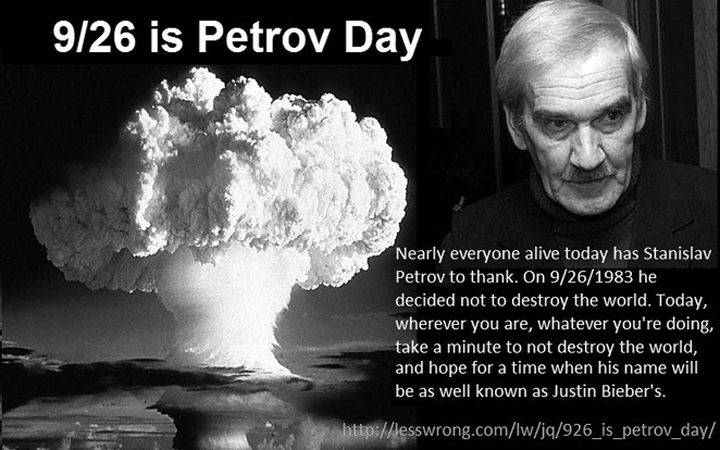
35 years ago today, one man saved us from world-ending nuclear war https://www.vox.com/2018/9/26/17905796/nuclear-war-1983-stanislav-petrov-soviet-union
On September 26, 1983, Stanislav Petrov saved the world. By Dylan Matthews@dylanmattdylan@vox.com Sep 26, 2018 On September 26, 1983, the planet came terrifyingly close to a nuclear holocaust.
The Soviet Union’s missile attack early warning system displayed, in large red letters, the word “LAUNCH”; a computer screen stated to the officer on duty, Soviet Lt. Col. Stanislav Petrov, that it could say with “high reliability” that an American intercontinental ballistic missile (ICBM) had been launched and was headed toward the Soviet Union. First, it was just one missile, but then another, and another, until the system reported that a total of five Minuteman ICBMshad been launched.
“Petrov had to make a decision: Would he report an incoming American strike?” my colleague Max Fisher explained. “If he did, Soviet nuclear doctrine called for a full nuclear retaliation; there would be no time to double-check the warning system, much less seek negotiations with the US.”
Reporting it would have made a certain degree of sense. The Reagan administration had a far more hardline stance against the Soviets than the Carter, Ford, or Nixon administrations before it. Months earlier President Reagan had announced the Strategic Defense Initiative(mockingly dubbed “Star Wars,” a plan to shoot down ballistic missiles before they reached the US), and his administration was in the process of deploying Pershing II nuclear-armed missiles to West Germany and Great Britain, which were capable of striking the Soviet Union. There were reasons for Petrov to think Reagan’s brinkmanship had escalated to an actual nuclear exchange.
But Petrov did not report the incoming strike. He and others on his staff concluded that what they were seeing was a false alarm. And it was; the system mistook the sun’s reflection off clouds for a missile. Petrov prevented a nuclear war between the Soviets, who had 35,804 nuclear warheads in 1983, and the US, which had 23,305.
A 1979 report by Congress’s Office of Technology Assessment estimated that a full-scale Soviet assault on the US would kill 35 to 77 percent of the US population — or between 82 million and 180 million people in 1983. The inevitable US counterstrike would kill 20 to 40 percent of the Soviet population, or between 54 million and 108 million people. The combined death toll there (between 136 million and 288 million) swamps the death toll of any war, genocide, or other violent catastrophe in human history. Proportional to world population, it would be rivaled only by the An Lushan rebellion in eighth-century China and the Mongol conquests of the 13th century.
And it’s likely hundreds of millions more would have died once the conflict disrupted global temperatures and severely hampered agriculture. International Physicians for the Prevention of Nuclear War put the potential death toll from starvation at about 2 billion.
Petrov, almost single-handedly, prevented those deaths.
Preventing the deaths of hundreds of millions, if not billions, of people was a costly decision for Petrov. If he had been wrong, and he somehow survived the American nuclear strike, he likely would’ve been executed for treason. Even though he was right, he was, according to the Washington Post’s David Hoffman, “relentlessly interrogated afterward [and] never rewarded for his decision.”
After the Cold War, Petrov would receive a number of commendations for saving the world. He was honored at the United Nations, received the Dresden Peace Prize, and was profiled in the documentary The Man Who Saved the World. “I was just at the right place at the right time,” he told the filmmakers. He died in May 2017, at the age of 77. Two new books about the Petrov incident and other nuclear close calls in 1983 (related to the NATO exercise Able Archer) came out just this year: Taylor Downing’s 1983 and Marc Ambinder’s The Brink.
Petrov isn’t the only man who’s prevented nuclear war
Petrov was not the only Russian official who’s saved the world. On October 27, 1962, Vasili Arkhipov, a Soviet navy officer, was in a nuclear submarine near Cuba when US naval forces started dropping depth charges (a kind of explosive targeting submarines) on him. Two senior officers on the submarine thought that a nuclear war could’ve already begun and wanted to launch a nuclear torpedo at a US vessel. But all three senior officers had to agree for the missile to fire, and Arkhipov dissented, preventing a nuclear exchange and potentially preventing the end of the world.
Even more recently, on January 25, 1995, Russian early warning radars suggested that an American first strike was incoming. President Boris Yeltsin was alerted and given a suitcase with instructions for launching a nuclear strike at the US. Russian nuclear forces were given an alert to increase combat readiness. Yeltsin eventually declined to launch a counterstrike — which is good, because this was another false alarm. It turns out that Russian early warning systems had picked up a Norwegian-US joint research rocket, launched by scientists studying the northern lights.
But September 26, Stanislav Petrov Day, is as good a time as any to celebrate the ordinary officers who took a stand when it counted to prevent hundreds of millions of deaths. And it’s as good a time as any to remember that as long as the US and Russia retain massive nuclear arsenals, these kinds of close calls will remain possible — and in the future, a false alarm could result in an accidental first strike.
|
|
|
September 28, 2018
Posted by Christina Macpherson |
depleted uranium, history, PERSONAL STORIES, politics international, Reference, Religion and ethics |
Leave a comment
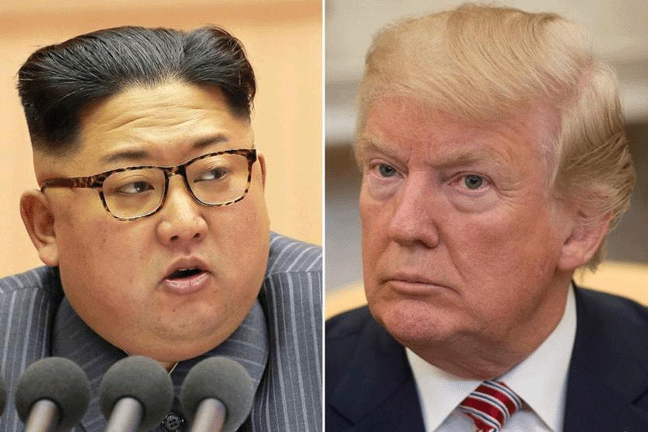
 Trump preparing for 2nd summit with Kim despite little nuclear progress, abc news, By CONOR FINNEGAN
Sep 24, 2018 President Donald Trump is preparing for his second summit with North Korean leader Kim Jong Un, he said on Monday while meeting with South Korean President Moon Jae-in
While critics have warned against holding another meeting when North Korea has taken no meaningful steps toward dismantling its nuclear arsenal, Trump had nothing but praise for Kim, and U.S. Secretary of State Mike Pompeodefended the potential sit-down as something of “enormous value” but only “if we can continue to make progress and have conversations.”
Trump said that the meeting would happen “in the not too distant future,” not in Singapore but a “location to be determined.” He added that Kim had shown “tremendous enthusiasm … toward making a deal” and praised their relationship as “very good. In fact, in some ways it’s extraordinary.”
“We are in no rush. There’s no hurry. … We’ve made more progress than anybody’s made ever, frankly, with regard to North Korea,” he added.
But that kind of talk has negatively impacted the push to have North Korea denuclearize, according to diplomats and experts. By praising Kim and saying there is no rush while North Korea has taken no concrete steps to dismantle its nuclear-weapons program, he takes the pressure off North Korea……..
talks have been stuck in a deadlock over the sequencing, with the U.S. insistent that it will make no more concessions until North Korea denuclearizes — although it’s unclear how far along that process it will have to be before the U.S. responds. North Korea wants some actions, like signing a declaration to formally end the Korean War, first. ………https://abcnews.go.com/Politics/trump-preparing-2nd-summit-kim-nuclear-progress/story?id=58049260
September 26, 2018
Posted by Christina Macpherson |
North Korea, politics international, USA |
Leave a comment
To Secure Peace Between the Koreas, US Must Declare an End to the War, Christine Ahn, Truthout, September 24, 2018,A historic opportunity to end the seven-decade Korean War is suddenly within reach. The world witnessed world-class peacemaking between North and South Korea last week at the third inter-Korean summit in Pyongyang as North Korean leader Kim Jong Un and South Korean President Moon Jae-in declared “a Korean Peninsula free of war” and “a nuclear-free Korean peninsula.” But peacemaking between the two Koreas alone is not enough: The success of this process also rests on progress between Washington and Pyongyang, and particularly on the signing of a peace treaty to end the Korean War.
To a packed audience of 150,000 North Koreans wildly cheering on their feet on September 20 at the May Day Stadium in Pyongyang, President Moon affirmed, “We have lived together for 5,000 years and been separated for 70 years. We must live together as one people.”
At their summit, Kim and Moon announced a long list of actionable stepsthey will take to improve relations, from establishing a reunion center for divided families to reopening the Mt. Kumgang tourism center and the Kaesong industrial zone — two inter-Korean development projects from the previous Sunshine Policy years that were shut down as relations worsened between the two Koreas during the previous two hardline administrations. The defense ministers also agreed in a separate military agreement to reduce military tensions by downsizing the number of guards near the Military Demarcation Line, the border dividing North and South Korea in the De-Militarized Zone (DMZ) established by the Armistice Agreement in 1953. The Korean leaders also agreed to de-mine a village in the DMZ surrounding the border between North Korea and South Korea.
As part of the Pyongyang Declaration by the two Koreas to transform the Korean Peninsula “into a land of peace free from nuclear weapons and nuclear threats,” Kim committed to “permanently dismantle the Dongchang-ri missile engine test site” in the presence of international inspectors, and “the permanent dismantlement of the nuclear facilities in Yongbyon.” But this would depend on “corresponding measures” by the United States “in accordance with the spirit of the June 12 US-DPRK Joint Statement.”
Trump last month canceled Secretary of State Mike Pompeo’s trip to North Korea, saying North Korea had not made “sufficient progress” toward denuclearization. North Korean leaders, however, say the United States hasn’t honored its end of the Singapore Declaration in which the first two items were to improve relations and establish a peace process. Denuclearization came third, and the repatriation of the remains of US service members was a last added item.
Pyongyang has already made several concessions: It has halted missile and nuclear tests, begun to dismantle the Sohae missile launch site and destroyed the Punggye-ri nuclear test in the presence of foreign journalists, released three detained Americans, and repatriated the remains of US service members from the Korean War. The United States, meanwhile, has halted one joint military exercise after Trump’s spontaneous announcement at the press briefing following his meeting with Kim. But these joint exercises could easily be resumed.
North Korea has made clear that denuclearization will require a peace process that includes concrete steps toward a Peace Treaty, as promised in the 1953 Armistice Agreement signed by the United States, North Korea and China. James Laney, a former US ambassador to South Korea under Clinton, has argued, “A peace treaty would provide a baseline for relationships, eliminating the question of the other’s legitimacy and its right to exist. Absent such a peace treaty, every dispute presents afresh the question of the other side’s legitimacy.”
But North Korea is unlikely to unilaterally surrender its nuclear weapons without improved relations. We knew that the Clinton and Bush administrations were close to waging a pre-emptive strike on Pyongyang, but now Bob Woodward’s book Fear has also confirmed that even President Obama weighed a first strike on North Korea. Kim has seen what happened to Iraq, Libya and Iran, not to mention his own country’s experience of a devastating US bombing.
Most Americans have no idea that in just three years, the Korean War claimed over 4 million lives. The US dropped 635,000 tons of bombs on Korea, more than it did in the rest of the Asia-Pacific in WWII combined, and it used 33,000 tons of napalm in Korea — more than in Vietnam. Curtis LeMay, a US Air Force general in the Korean War, testified, “We burned down just about every city in North Korea and South Korea … we killed off over a million civilian Koreans and drove several million more from their homes.” The US’s indiscriminate bombing campaign leveled 80 percent of North Korean cities, killing one out of every four family members. The bombing of homes was so devastating that the regime urged its citizens to build shelter underground.
On July 27, 1953, the Korean War ended in a stalemate with a ceasefire. Military commanders from the US, North Korea and China signed the Armistice Agreement and promised within 90 days to return to negotiate a peace settlement. Sixty-five years later, we are still waiting for that Peace Treaty to end the Korean War.
A peace treaty would end the state of war between the United States and North Korea, taking the threat of a military conflict off the table. A ceasefire — a temporary truce — is what has defined the US-North Korean relationship.
One tangible step that the Trump administration can take that the North Koreans would view as a “corresponding measure” is to declare an end to the Korean War……….https://truthout.org/articles/to-secure-peace-between-the-koreas-us-must-declare-an-end-to-the-war/
September 26, 2018
Posted by Christina Macpherson |
North Korea, politics international, South Korea, USA |
Leave a comment

 Months after Calder Hall opened, the Euratom Treaty established the European Atomic Energy Community. The UK did not formally join straight away but did have a relationship with it.