|
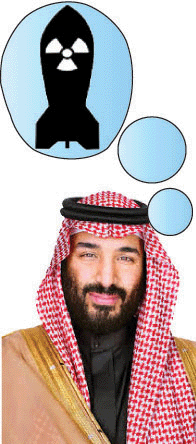
Saudis Want a U.S. Nuclear Deal. Can They Be Trusted Not to Build a Bomb? NYT, By David E. Sanger and William J. Broad, Nov. 22, 2018, WASHINGTON — Before Saudi Arabia’s crown prince, Mohammed bin Salman, was implicated by the C.I.A. in the killing of Jamal Khashoggi, American intelligence agencies were trying to solve a separate mystery: Was the prince laying the groundwork for building an atomic bomb?The 33-year-old heir to the Saudi throne had been overseeing a negotiation with the Energy Department and the State Department to get the United States to sell designs for nuclear power plants to the kingdom. The deal was worth upward of $80 billion, depending on how many plants Saudi Arabia decided to build.
But there is a hitch: Saudi Arabia insists on producing its own nuclear fuel, even though it could buy it more cheaply abroad, according to American and Saudi officials familiar with the negotiations. That raised concerns in Washington that the Saudis could divert their fuel into a covert weapons project — exactly what the United States and its allies feared Iran was doing
before it reached the 2015 nuclear accord, which President Trump has since abandoned.
Prince Mohammed set off alarms when he declared earlier this year, in the midst of the negotiation, that if Iran, Saudi Arabia’s fiercest rival, “developed a nuclear bomb, we will follow suit as soon as possible.” His negotiators stirred more worries by telling the Trump administration that Saudi Arabia would refuse to sign an agreement that would allow United Nations inspectors to look anywhere in the country for signs that the Saudis might be working on a bomb, American officials said.
Asked in Congress last March about his secret negotiations with the Saudis, Energy Secretary Rick Perry dodged a question about whether the Trump administration would insist that the kingdom be banned from producing nuclear fuel.
Eight months later, the administration will not say where the negotiations stand. Now lurking behind the transaction is the question of whether a Saudi government that assassinated Mr. Khashoggi and repeatedly changed its story about the murder can be trusted with nuclear fuel and technology. Such fuel can be used for benign or military purposes: If uranium is enriched to 4 percent purity, it can fuel a power plant; at 90 percent it can be used for a bomb.
Privately, administration officials argue that if the United States does not sell the nuclear equipment to Saudi Arabia someone else will — maybe Russia, China or South Korea.
They stress that assuring that the Saudis use a reactor designed by Westinghouse, the only American competitor for the deal, fits with Mr. Trump’s insistence that jobs, oil and the strategic relationship between Riyadh and Washington are all far more important than the death of a Saudi dissident who was living, and writing newspaper columns, in the United States.
Under the rules that govern nuclear accords of this kind, Congress would have the opportunity to reject any agreement with Saudi Arabia, though the House and Senate would each need a veto-proof majority to stop Mr. Trump’s plans.
“It is one thing to sell them planes, but another to sell them nukes, or the capacity to build them,’’ said Representative Brad Sherman, Democrat of California and a member of the House Foreign Affairs Committee.
Following Mr. Khashoggi’s death, Mr. Sherman has led the charge to change the law and make it harder for the Trump administration to reach a nuclear agreement with Saudi Arabia. He described it as one of the most effective ways to punish Prince Mohammed.
“A country that can’t be trusted with a bone saw shouldn’t be trusted with nuclear weapons,” Mr. Sherman said, referring to Mr. Khashoggi’s brutal killingin the Saudi Consulate in Istanbul last month.
Nuclear experts said Prince Mohammed should have been disqualified from receiving nuclear help as soon as he raised the prospect of acquiring atomic weapons to counter Iran.
“We have never before contemplated, let alone concluded, a nuclear cooperation agreement with a country that was threatening to leave the nonproliferation treaty, even provisionally,” said William Tobey, a senior official in the Energy Department during the Bush administration who has testified about the risks of the agreement with Saudi Arabia.
He was referring to the crown prince’s threat to match any Iranian nuclear weapon — a step that would require the Saudis to either publicly abandon their commitments under the nonproliferation treaty or secretly race for the bomb.
The Trump administration declined to provide an update on the negotiations, which were intense enough that Mr. Perry went to Riyadh in late 2017. Within the last several months, a senior State Department official engaged in further discussions over the deal in Europe.
……..The core challenge for the Trump administration is that it has declared that Iran can never be trusted with any weapons-making technology. Now, it must decide whether to draw the same line for the Saudis.
The United States’ own actions may be helping to drive the Saudis’ nuclear thinking. Now that the Iran agreement, brokered with world powers, is on the edge of collapse after Mr. Trump withdrew the United States, analysts are worried that the Saudis may be positioning themselves to create their own nuclear program in response.
The kingdom has extensive uranium deposits and five nuclear research centers. Analysts said Saudi Arabia’s atomic work force was steadily growing in size and sophistication — even without producing nuclear fuel.
Saudi leaders saw a political opening when Mr. Trump was elected.
In its early days, the administration spent considerable time discussing ways that Saudi Arabia and other Arab states could acquire nuclear reactors. Michael T. Flynn, who briefly served as Mr. Trump’s national security adviser, backed a plan that would have let Moscow and Washington cooperate on a deal to supply Riyadh with reactors — but not the ability to make its own atomic fuel.
As a precondition, American economic sanctions against Russia would have been dropped to allow Moscow to join the effort. Mr. Flynn was fired in early 2017 as questions swirled around his conversations with Russia’s ambassador to the United States, including about ending the trade restrictions.
At his Senate confirmation hearing in November 2017, Christopher A. Ford, the assistant secretary of state for international security and nonproliferation, called the safeguards a “desired outcome.” But he equivocated on whether the United States would insist on them.
Senator Edward J. Markey, a Massachusetts Democrat who sits on the Senate Foreign Relations Committee, described the administration’s approach as “a recipe for disaster.”…….The crown prince made headlines in March by shifting the public discussion over Riyadh’s intentions from reactors to atomic bombs. In a CBS News interview, he said that if Iran acquired nuclear arms, Saudi Arabia would quickly follow suit. …….Mr. Falih, the energy minister, raised concerns about the outcome of negotiations with Washington by insisting publicly that Riyadh would make its own atomic fuel. ………https://www.nytimes.com/2018/11/22/world/middleeast/saudi-arabia-nuclear.html
|
|
November 24, 2018
Posted by Christina Macpherson |
politics international, Saudi Arabia, weapons and war |
Leave a comment
Russia rewrites nuclear rule book to fire first, The Times, 23 Nov 18 President Putin would have the power to launch nuclear first strikes under plans approved by the Russian parliament.
Senators in the Federation Council, the upper house, have recommended tearing up the military doctrine that forbids initial use of weapons of mass destruction. It comes after Mr Putin said that Moscow would retaliate if the United States withdrew from a landmark Cold War missile treaty.
Russia
The revision would allow the president to order nuclear strikes in response to enemy use of conventional weapons, a significant departure from the military doctrine that prohibits first use unless Russia is threatened by weapons of mass destruction or if its “very existence is in jeopardy” ……. (subscribers only) https://www.thetimes.co.uk/article/russia-rewrites-nuclear-rule-book-to-fire-first-r9gg2mpqm
November 24, 2018
Posted by Christina Macpherson |
politics international, Russia, weapons and war |
Leave a comment
IAEA calls on North Korea to re-admit nuclear inspectors, Money control , 23 Nov 18
IAEA inspectors were expelled from North Korea in 2009 but Director General Yukiya Amano said the agency continues to prepare for their possible re-admittance. The head of the UN’s atomic watchdog has called on North Korea to allow inspectors back into the country to monitor its nuclear program………
On the other hand, Amano told board members that Iran continues to abide by the deal reached in 2015 with major world powers that aimed at preventing Tehran from building atomic weapons in exchange for economic incentives.
He reiterated the agency’s findings in a report distributed to member states earlier this month that “Iran is implementing its nuclear-related commitments under the Joint Comprehensive Plan of Action.”
The issue has grown more complicated since the US withdrew unilaterally in May from the deal and then re-imposed sanctions. Iran’s economy has been struggling ever since and its currency has plummeted in value.
The other signatories to the deal — Germany, Britain, France, Russia and China — are continuing to try to make it work. Amano stressed that “it is essential that Iran continues to fully implement” its commitments.
In its full report, the IAEA said its inspectors continue to have access to all sites in Iran that it needs to visit and that inspectors confirmed Iran has kept within limits of heavy water and low-enriched uranium stockpiles.
“The agency continues to verify the non-diversion of nuclear material declared by Iran under its safeguards agreement,” Amano said. “Evaluations regarding the absence of undeclared nuclear material and activities in Iran continue.https://www.moneycontrol.com/news/world/iaea-calls-on-north-korea-to-re-admit-nuclear-inspectors-2-3213921.html
November 24, 2018
Posted by Christina Macpherson |
Iran, politics international |
Leave a comment
 Pompeo to Seoul: Nuclear progress must not lag better Korea ties, REUTERS, November 21, 2018 WASHINGTON--The United States has told its ally South Korea it should not improve ties with North Korea faster than Pyongyang takes steps to give up its nuclear weapons, U.S. Secretary of State Mike Pompeo said on Tuesday.
Speaking as a working group with South Korea to coordinate North Korean policy held an inaugural meeting in Washington, Pompeo indicated that Washington had been concerned that Seoul had moved too quickly with Pyongyang.
“We have made clear to the Republic of Korea that we do want to make sure that peace on the peninsula and the denuclearization of North Korea aren’t lagging behind the increase in the amount of inter-relationship between the two Koreas,” he told a news briefing………
Last month, in a rare sign of discord between Seoul and Washington, South Korean Foreign Minister Kang Kyung-wha said Pompeo had expressed “discontent” at an inter-Korean military pact reached during a summit in September.
The Koreas also agreed in October to begin reconnecting rail and road links despite U.S. concerns that the rapid North-South thaw could undermine efforts to press Pyongyang to give up its nuclear weapons.
At an unprecedented summit in June, U.S. President Donald Trump and North Korean leader Kim Jong Un agreed to work toward denuclearization and peace on the Korean Peninsula and establish new relations.
But negotiations have since made little headway, with Pyongyang upset by Washington’s insistence that international sanctions must remain until it gives up its nuclear weapons.
Last week, South Korean Unification Minister Cho Myoung-gyon said in Washington it was important to provide North Korea with motivation to denuclearize but that sanctions would stay in place “until we see actual progress on denuclearization.” http://www.asahi.com/ajw/articles/AJ201811210041.html
November 22, 2018
Posted by Christina Macpherson |
North Korea, politics international, South Korea, USA |
1 Comment
Putin mulls Russian response to US exit from nuclear pact http://www.wmcactionnews5.com/2018/11/19/putin-mulls-russian-response-us-exit-nuclear-pact/ November 19 MOSCOW (AP) — Russian President Vladimir Putin has gathered his top military officials to discuss a response to the planned U.S. withdrawal from a key nuclear arms pact.
U.S. President Donald Trump declared last month that he intends to opt out of the 1987 Intermediate-Range Nuclear Forces Treaty, or INF, over alleged Russian violations. Russia has denied breaching the pact.
Putin told the top military brass Monday that the U.S. withdrawal from the treaty “wouldn’t be left without an answer from our side.” He noted that Russia has responded to the U.S. missile defense program by developing new weapons that he said are capable of piercing any prospective missile shield.
While warning of a possible Russian retaliation, Putin voiced hope that Moscow and Washington could engage in arms control talks to reduce tensions.
November 19, 2018
Posted by Christina Macpherson |
politics international, Russia |
Leave a comment
Channel News Asia, 19 Nov 18 Iran is still hopeful that its 2015 nuclear deal with major powers can be saved despite the withdrawal of the United States, a foreign ministry spokesman said on Monday. DUBAI: Iran is still hopeful that its 2015 nuclear deal with major powers can be saved despite the withdrawal of the United States, a foreign ministry spokesman said on Monday.
“There are some ambiguities on implementation of the EU’s mechanism to protect trade with Iran from America’s sanctions … But we remain hopeful that the Europeans can save the deal,” Bahram Qasemi told a news conference broadcast live on state TV.
Other signatories trying to salvage the deal since May, when U.S. President Donald Trump abandoned it. Washington restored sanctions targeting Iran’s oil, banking and transportation sectors this month.
The European Union has been trying to establish a Special Purpose Vehicle (SPV) for non-dollar trade with Iran to save the deal, under which most sanctions were lifted in 2016 in exchange for Tehran curbing its nuclear programme……… (Writing by Parisa Hafezi; editing by Darren Schuettler and John Stonestreet)
Read more at https://www.channelnewsasia.com/news/world/iran-hopeful-that-europe-can-salvage-nuclear-deal—foreign-ministry-10946216
November 19, 2018
Posted by Christina Macpherson |
EUROPE, Iran, politics international |
Leave a comment
Nov. 13 (UPI) — U.S. Vice President Mike Pence vowed to work toward the complete denuclearization of North Korea and fully enforce sanctions during a joint press conference with Japan’s prime minister on Tuesday.
Pence, who is expected to attend the APEC meeting in Papua New Guinea on Saturday instead of President Donald Trump, said the United States stands firmly against countries that threatened freedom and openness in the region, including North Korea, NHK reported……
Pence told reporters economic sanctions against North Korea will be fully enforced until complete denuclearization, and that there is still a lot of work that needs to be done before embargoes are lifted. ….https://www.upi.com/Top_News/World-News/2018/11/13/Mike-Pence-North-Korea-sanctions-to-remain-until-denuclearization/8321542114175/
November 17, 2018
Posted by Christina Macpherson |
North Korea, politics international, USA |
Leave a comment
What’s In the 585-Page Brexit Divorce Deal Document?, By Ian Wishart, November 15, 2018,
November 17, 2018
Posted by Christina Macpherson |
politics international, UK |
Leave a comment
Dave Toke’s Blog 14th Nov 2018 , Clark’s plan to underwrite losses on Wylfa nuclear project will likely lead
to an embarrassing state-aid plea to the EU Commission.
Now that it seems, short of an extended ‘no-deal’ Brexit scenario, the UK will remain within
EU state-aid rules for a long time to come, Greg Clark will have to oversee
an embarrassing state aid case in support of his proposals to underwrite
the (almost certain) losses from building the Hitachi-led Wylfa nuclear
power plant.
I have already discussed how the taxpayer (and/or electricity
consumer) is exposed to almost certain multi-billion losses as a result of
the plan that Clark is touting here and in Japan. The last time that the UK
applied for what amounted to an exemption from EU state aid rules for
nuclear power was in late 2013 when Ed Davey led the plea for the Hinkley C
deal. The state aid was granted in October 2014 after the Commission ruled
that the Hinkley C deal was a reasonable way to avoid ‘market failure’.
Any application for state aid for Wylfa would be a tougher challenge. Indeed
the very proposal whereby the state will take at least a half equity share
in the project and take responsibility for cost overruns is an action that
in itself creates market failure if curbing carbon emissions is the
objective!
The Government’s cover story in 2013 was that support for
Hinkley C was on the same level available for renewable energy since
renewable energy schemes were also being offered CfDs (as well as very
extensive loan guarantees that most renewable energy schemes could not get
from the Government of course). The European Commission seemed to buy into
this line stating ‘The aid would not have a negative impact on other
low-carbon sources, given that they are also supported by the UK, and there
is no discrimination against renewable technologies’
https://realfeed-intariffs.blogspot.com/2018/11/clarks-plan-to-underwrite-losses-on.html
November 17, 2018
Posted by Christina Macpherson |
politics international, UK |
Leave a comment
 The Latest: Nuclear watchdog: Iran stays within deal limits https://www.kansas.com/news/business/article221528430.html, The Associated Press, November 12, 2018 VIENNA The Latest on U.N. nuclear watchdog’s new report on Iran :
The U.N. atomic watchdog says Iran continues to stay within the limitations set by the nuclear deal reached in 2015 with major powers, aimed at keeping Tehran from building nuclear weapons in exchange for incentives.
In a confidential quarterly report distributed to member states Monday and seen by The Associated Press, the International Atomic Energy Agency said Iran has stayed with key limitations set in the so-called Joint Comprehensive Plan of Action, or JCPOA.
The issue has grown more complicated since the U.S. withdrew unilaterally in May from the deal and then re-imposed sanctions. Iran’s economy has been struggling ever since and its currency has plummeted in value.
The other signatories to the deal — Germany, Britain, France, Russia and China — are continuing to try and make it work.
The IAEA says the agency had access to all sites in Iran that it needed to visit and that inspectors confirmed Iran has kept within limits of heavy water and low-enriched uranium stockpiles.
November 13, 2018
Posted by Christina Macpherson |
Iran, politics international |
Leave a comment
 House Democrat to introduce new bill punishing Saudi Arabia over Khashoggi, It would block a controversial nuclear deal that’s very important to Saudi Arabia. Vox By Alex Ward@AlexWardVoxalex.ward@vox.com Nov 9, 2018 A House Democrat will soon introduce legislation to punish Saudi Arabia over the murder of journalist Jamal Khashoggi — by trying to halt an impending nuclear deal with the country.
Obtained exclusively by Vox, the bill — nicknamed the “No Nuclear Weapons for Saudi Arabia Act of 2018” — if passed would be the strongest rebuke to Saudi Arabia yet since the uproar over Khashoggi’s fate.
Khashoggi, a US resident, was killed by Saudi officials inside the country’s consulate in Istanbul last month. That led to a major international outcry over his death, including from many in the US who wanted to see the Washington-Riyadh relationship curtailed.
Most of the discussions on how to do that center on stopping billions of dollars in arms sales to the kingdom, but President Donald Trump has repeatedly said he doesn’t want to jeopardize money coming into the United States, and some members of Congress privately worry that stopping weapons shipments to Saudi Arabia might negatively impact jobs.
So instead of doing that, Rep. Brad Sherman (D-CA) wants to stop a major nuclear deal between the US and Saudi Arabia that’s been under negotiation for months, and which he has long railed against.
“I don’t think this bill would’ve passed prior to the events in Istanbul,” Sherman told me. “Now I think we have a chance.” It’s also very possible a Republican will co-sponsor the bill when it’s officially introduced in the next 10 congressional days.
The legislation would do three main things:
- Force Trump to submit a “123 Agreement,” or a set of rules that make it legal for the US to sell nuclear technology to another country, for congressional approval.
-
- Force the administration to tell Congress that Saudi Arabia will abide by the agreement’s “Gold Standard” (more on that below) and an inspections agreement with the International Atomic Energy Agency, the world’s nuclear watchdog
- Require the administration to write reports on Saudi Arabia’s probe into Khashoggi’s murder and the state of human rights in the kingdom
Sherman’s bill could completely block Saudi Arabia’s plans to obtain nuclear technology from the United States, especially since there’s growing bipartisan support to reprimand Riyadh over Khashoggi.
It would come as a big blow to Saudi Arabia: Crown Prince Mohammed bin Salman, the kingdom’s de facto ruler, more commonly known as MBS, launched a project on Monday to build his country’s first nuclear research reactor.
There’s also some bipartisan support to stop nuclear talks with Riyadh in the Senate.
Sens. Edward Markey (D-MA) and Marco Rubio (R-FL), for example, have sent letters to Trump requesting he at least suspend negotiations with Saudi Arabia over the nuclear deal. It’s unclear if either of them will draft parallel legislation to the House version, although a spokesperson for Rubio’s office told me the senator “possibly” could consider a bill in the future. …….
American companies have already lined up to sell and build nuclear parts for Saudi Arabia, …….
-
Saudi Arabia could accelerate a nuclear arms race in the Middle East
There’s legitimate concern about what Riyadh would do with a brand new nuclear reactor if this indeed happens.
On March 18, MBS openly admitted on CBS’s 60 Minutes that obtaining a nuke was a possibility……..
- There are other signs that Saudi Arabia’s burgeoning nuclear program is really all about weapons — and not mainly for energy — like it repeatedly says. One possible indicator is that Riyadh has focused on nuclear energy and not renewable energy to bring power to its millions of citizens. …….https://www.vox.com/2018/11/9/18072660/saudi-arabia-nuclear-deal-congress-123-agreement-sherman?fbclid=IwAR1-MMsdZfBxfPVPs0jxhEm1k8eWPzi22OTWpOCHavjtdWa5MKBcBhWGj9Y
November 10, 2018
Posted by Christina Macpherson |
politics, politics international, Saudi Arabia, USA |
Leave a comment
In Bipartisan Pleas, Experts Urge Trump to Save Nuclear Treaty With Russia, NYT, By Rick Gladstone, Nov. 8, 2018 Alarmed at what they see as disintegrating curbs on nuclear weapons, a bipartisan array of American nonproliferation experts has urged President Trump to salvage a Cold War-era treaty with Russia that he has vowed to scrap.
In letters sent to the White House this week that were seen by The New York Times, the experts said the pact, the Intermediate-Range Nuclear Forces Treaty, had reduced the risk of nuclear war.
Despite the treaty’s flaws, they said, the United States should work to fix the accord, not walk away from it.
“The INF Treaty has prevented the unchecked deployment of nuclear missiles in Europe,” stated one of the letters, sent Wednesday to the White House. It was signed by more than a dozen prominent figures in arms control, including former Secretary of State George P. Shultz and former Senators Richard Lugar and Sam Nunn.
Another letter, dated Tuesday and sent by the American College of National Security Leaders, a group of former high-level military officers, said: “The INF Treaty is a bedrock to our current arms control regime and serves rather than hampers American interests.”
There was no immediate comment from the Trump administration on the letters.
The treaty’s fate may come up this weekend if Mr. Trump sees President Vladimir V. Putin of Russia during a memorial event in France celebrating the centennial of the end of World War I. But there have been conflicting accounts from the White House and the Kremlin on whether the two will even meet.
……….In the letter signed by Mr. Shultz and others, the arms control experts recognized what they called Russia’s noncompliance with the treaty. But rather than move to terminate it, they called on Mr. Trump “to direct your team to redouble efforts to negotiate technical solutions to U.S. (and Russian) INF compliance concerns.”
Both letters also urged Mr. Trump to engage in negotiations with the Russians on prolonging the New Strategic Arms Reduction Treaty, or New START, which will expire in February 2021 unless both sides agree to an extension. That pact limits the number of long-range missiles, bombers and warheads in the American and Russian arsenals.
Should the treaty expire, the former military commanders said in their letter, it would be the first time since 1972 that the United States and Russia “have not been bound by a binding arms control agreement.” https://www.nytimes.com/2018/11/08/world/europe/trump-russia-arms-treaty.html
November 10, 2018
Posted by Christina Macpherson |
politics international, USA |
Leave a comment
 Why Europe wants to sidestep US sanctions over Iran nuclear might Why Europe wants to sidestep US sanctions over Iran nuclear might
Signatories of 2015 weapons deal disagree with Trump over the effectiveness of the pact, Guardian, Saeed Kamali Dehghan@SaeedKD– 6 Nov 2018
|
|
|
November 6, 2018
Posted by Christina Macpherson |
EUROPE, Iran, politics international |
Leave a comment
North Korea warns of returning to nuclear policy, News 24 2018-11-04 North Korea has warned the US it will “seriously” consider returning to a state policy aimed at building nuclear weapons if Washington does not end tough economic sanctions against the impoverished regime.
For years, the North had pursued a “byungjin” policy of simultaneously developing its nuclear capabilities alongside the economy.
In April, citing a “fresh climate of detente and peace” on the peninsula, North Korean leader Kim Jong Un declared the nuclear quest complete and said his country would focus on “socialist economic construction”.
But a statement issued by the North’s foreign ministry said Pyongyang could revert to its former policy if the US did not change its stance over sanctions.
“The word ‘byungjin’ may appear again and the change of the line could be seriously reconsidered,” said the statement carried by the official KCNA news agency late on Friday.
Sanctions
At a historic summit in Singapore in June, US President Donald Trump and Kim signed a vaguely-worded statement on denuclearisation.
But little progress has been made since then, with Washington pushing to maintain sanctions against the North until its “final, fully verified denuclearisation” and Pyongyang condemning US demands as “gangster-like”.
“The improvement of relations and sanctions are incompatible,” said the statement, released under the name of the director of the foreign ministry’s Institute for American Studies.
“What remains to be done is the US corresponding reply,” it added.
The statement is the latest sign of Pyongyang’s increasing frustration with Washington……..
In an interview with Fox News on Friday, US Secretary of State Mike Pompeo reiterated that sanctions will remain until Pyongyang carries out it denuclearisation commitments made in Singapore, adding he will meet with his North Korean counterpart next week. https://www.news24.com/World/News/north-korea-warns-of-returning-to-nuclear-policy-20181104
November 5, 2018
Posted by Christina Macpherson |
North Korea, politics international, USA, weapons and war |
Leave a comment
Pompeo Resuming Nuclear Talks with N. Korea This Week, VOA, November 04, 2018 Ken Bredemeier,
U.S. Secretary of State Mike Pompeo says he is resuming denuclearization talks with North Korea this week in New York, meeting with Pyongyang’s second in command, Kim Yong Chol.
Progress on ending Pyongyang’s nuclear weapons programs has slowed in the months since the Singapore summit in June between U.S. President Donald Trump and North Korean leader Kim Jong Un, when the two leaders signed a general statement calling for the denuclearization of the Korean peninsula.
But Pompeo called the coming talks “a good opportunity” to move toward specifics of when and how North Korea might end its nuclear weapons program. The United States is seeking to finalize a deal by the end of Trump’s first term in office in January 2021.
Pyongyang said Friday it would “seriously” consider resuming its nuclear testing if U.S. economic sanctions against North Korea are not lifted, but Pompeo, in an interview on Fox News Sunday, dismissed the threat……..
Pompeo said there would be “no economic relief until we have achieved our ultimate objective,” the end of North Korea’s nuclear program.
The United States has said it would maintain the sanctions against North Korea until it has reached “final, fully verified denuclearization…….https://www.voanews.com/a/pompeo-resuming-nuclear-talks-with-n-korea-this-week-/4644158.html
November 5, 2018
Posted by Christina Macpherson |
North Korea, politics international, USA |
Leave a comment








