The right to have nukes
by beyondnuclearinternational, https://beyondnuclearinternational.org/2026/02/11/the-right-to-have-nukes/
No country should have nuclear weapons, but the ones that do should disarm first before telling others they can’t have them, writes Linda Pentz Gunter
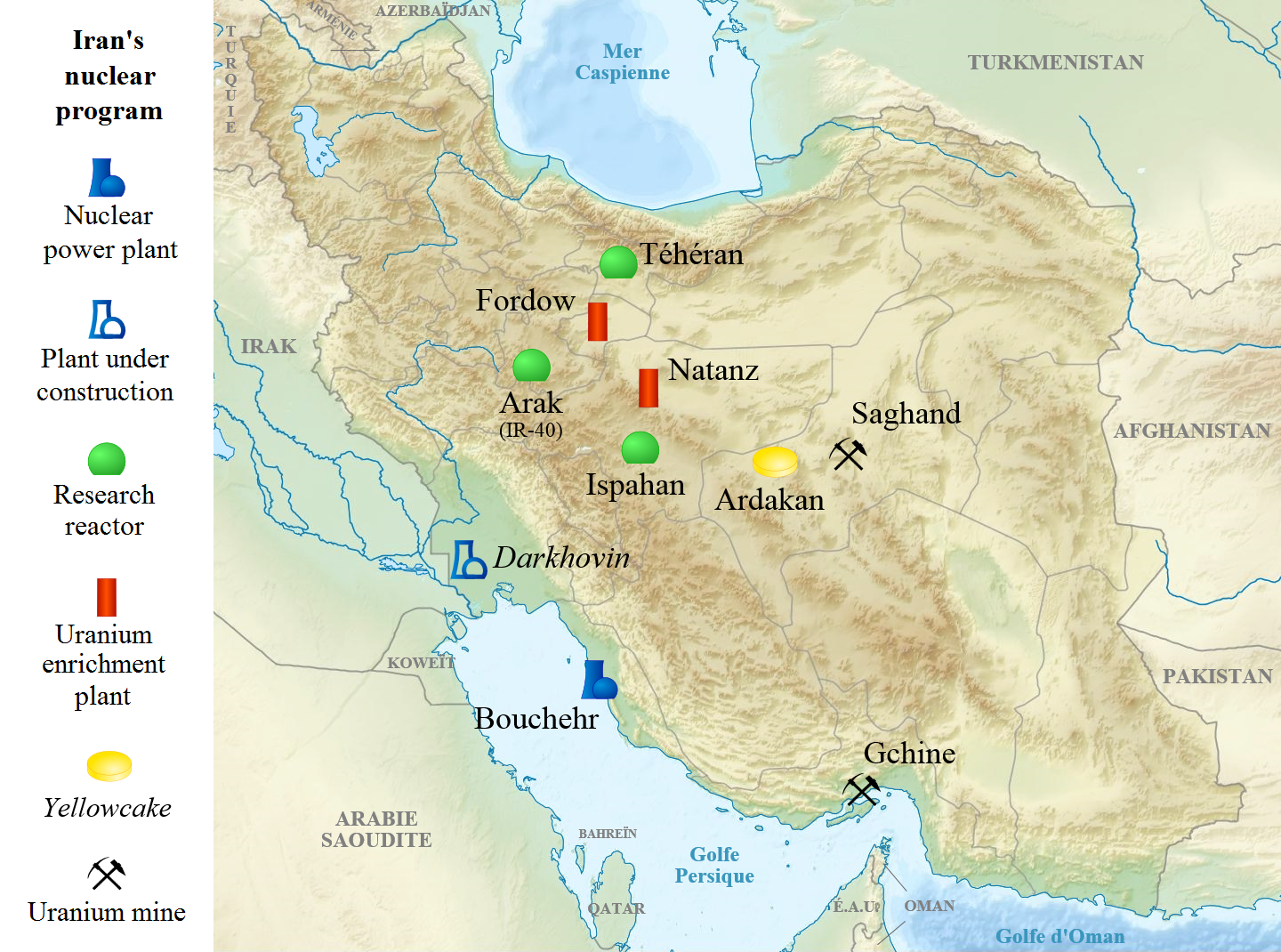
The trouble with telling Iran it can’t have nuclear weapons is, look who’s doing the talking. The United States, which, with more than 5,000 nuclear weapons, has the second largest inventory in the world behind Russia. And Israel, an undeclared nuclear weapons nation with anywhere from 80 to 200 bombs. Israel is actually allowed to maintain the disingenuous position of “nuclear opacity” within the UN, neither confirming nor denying its nuclear arsenal.
This is despite the fact that the UN General Assembly adopts a resolution every year calling on Israel to renounce possession of nuclear weapons and to place its nuclear facilities under international supervision, something the Jerusalem Center for Security and Foreign Affairs, equally disingenuously describes as “the annual three-month ‘Israel-bashing’ festival”.
Since we know that US President Trump doesn’t actually care whether or not the Iran government is shooting demonstrators in the streets, especially given he is quite happy for his own Homeland Security to do it here —albeit in not nearly as high numbers, or not yet — we must reckon with the other motivations for continuing to threaten Iran. And one of those is absolutely about stopping Iran from developing the bomb.
There is further irony here, because, unlike nuclear-armed Israel, non-nuclear armed Iran is a signatory to the nuclear Non-Proliferation Treaty (NPT). And unlike the US, Iran so far appears to have abided by its terms. Article IV — one of the major flaws of the treaty as Iran perfectly exemplifies — gives signatories the “inalienable right” to develop nuclear power as long as they don’t transition to nuclear weapons development. Article VI demands that the nuclear-armed nations pursue negotiations in good faith on effective measures relating to cessation of the nuclear arms race at an early date and to nuclear disarmament.
Iran could argue that it is abiding by Article IV. The US clearly cannot make the case that it is abiding in any way by Article VI. On the contrary, with the collapse last week of the New START Treaty, the last surviving nuclear arms reduction treaty between the US and Russia, both countries could now significantly ramp up their respective arsenals.
According to a statement put out last week by International Physicians for the Prevention of Nuclear War, which won the Nobel Peace Prize back in 1985, these increases could happen by uploading additional warheads on each country’s existing long-range missiles. This would mark the first increase in the sizes of their deployed nuclear arsenals in more than 35 years. According to independent estimates, Moscow and Washington could double the number of strategic deployed warheads without New START.
Iran’s nuclear facilities were seemingly pulverized by the provocative bombing raids carried out by Israel and the US last June. But they were no means completely “obliterated”, as Trump claimed. New satellite imagery suggests there is currently considerable activity at the Iranian nuclear sites, but some of these appear to be simple repairs such as the rebuilding of roofs and other structures destroyed in the attacks. There is more activity, according to analysis of the satellite images by the New York Times, at conventional missile sites, presumably in anticipation of another attack by Israel and/or the US.
Iran has and may well continue to insist it is developing its uranium enrichment capabilities for a civil nuclear program. And that could be true. Or not. The level to which it has lately been enriching uranium — to at least 60 percent and possible higher — before first Israel and then the US bombed its nuclear facilities, puts it in that gray area of weapons-usable rather than weapons-grade uranium enrichment. All this points once again the flaw in the NPT that continues to hand back the keys to the nuclear weapons lab by encouraging the development of nuclear power.
A delegation from the White House went to Oman last Friday to negotiate a new nuclear deal with Iran, even though it was Trump’s own regime back in 2018 that destroyed the perfectly workable Iran nuclear deal — known as the Joint Comprehensive Plan of Action — that had been in place up until then.
The negotiating team was led by Steve Witkoff and Jared Kushner. Witkoff is Trump’s Middle East Envoy but Kushner has no official position within the US government and no actual qualifications, other than an unsavory and predatory zeal about beachfront property — Iran has 5,800 km of coastline along the Caspian Sea, the Persian Gulf and Sea of Oman.
Should Iran have nuclear weapons? Of course not. But that also goes for the nine nations who do. And they should be the first to disarm before any demands are made elsewhere.
Linda Pentz Gunter is the founder of Beyond Nuclear and serves as its international specialist. Her book, No To Nuclear. Why Nuclear Power Destroys Lives, Derails Climate Progress and Provokes War, can be pre-ordered now from Pluto Press
Rot at the Top: The Elite’s Darkest Secrets Spill Out
February 12, 2026, by Joshua Scheer, https://scheerpost.com/2026/02/12/rot-at-the-top-the-elites-darkest-secrets-spill-out/
In a political moment defined by secrecy, impunity, and the open decay of democratic institutions, few conversations cut as sharply as this one. Chris Hedges — Pulitzer Prize–winning former New York Times Middle East bureau chief — joins George Galloway to dissect the explosive Epstein files and the global elite they expose. What emerges is not a scandal at the margins, but a portrait of a ruling class so insulated, so depraved, and so unaccountable that its corruption has become a structural feature of Western power.
From the redactions shielding Trump and Netanyahu, to the British political meltdown engulfing Starmer’s inner circle, to the bipartisan rot in Washington, Hedges argues that the Epstein revelations are not an aberration but a window into a collapsing order. As he puts it, the files reveal “a depraved corrupt ruling global elite that has created a club that has locked the rest of us out,” one now reaching for authoritarian tools as its legitimacy crumbles.
This is a conversation about the Epstein affair — but also about the death spiral of American democracy, the rise of police‑state tactics, and the dangerous volatility of a declining empire whose leaders are losing their grip on reality. And with the Persian Gulf once again on the brink, Hedges warns that the same unaccountable forces exposed in the Epstein files are steering the world toward catastrophe.
If you want to understand the moment we’re living through — the corruption, the cover‑ups, the authoritarian drift, and the geopolitical brinkmanship — this exchange is essential.
Key Highlights
1. The Epstein Files as a Window Into Elite Rot
- Hedges calls the documents “a depraved corrupt ruling global elite that has created a club that has locked the rest of us out.”
- He argues the files expose not just individuals but the structure of unaccountable power across the US, UK, Israel, and Europe.
2. Trump’s Deep Exposure in the Files
- Mentioned “38,000 times” in emails, according to Hedges.
- Hedges says the redactions were designed “to protect Trump and Netanyahu.”
- The Republican Party’s resistance to releasing the files “crumbled,” forcing Trump’s hand.
3. UK Political Meltdown
Galloway details cascading scandals around Starmer’s appointments — from Mandelson to a newly exposed associate tied to a convicted pedophile.- British media saturation contrasts sharply with US silence, which Hedges says reflects “the breakdown of democratic institutions.”
4. Bipartisan Complicity in the US
- Hedges names Clinton, George Mitchell, and even Noam Chomsky as figures caught in the web.
- He stresses that both parties are implicated, making accountability structurally impossible.
5. The Missing Videos & Intelligence Links
- Epstein’s mansion contained a “closet‑sized safe” filled with recorded material.
- Hedges: “It’s a question to what extent Epstein was working for the Mossad.”
- Clear ties to Ehud Barak and Israeli intelligence raise the specter of kompromat.
6. Trump’s Cognitive Decline
- Hedges cites Trump claiming he imposed tariffs on Switzerland because of its “prime minister” — a position that doesn’t exist.
- He warns that a mentally deteriorating commander‑in‑chief is dangerous amid multiple potential war fronts.
7. The Rise of American Death‑Squad Policing
- Hedges describes ICE and federal agents as “death squads… killing with impunity,” ignoring court orders.
- He frames this as the defining feature of a police state.
8. Will Trump Attack Iran?
- Pentagon opposition remains strong.
- Netanyahu’s repeated visits suggest he’s not getting the commitment he wants.
- Hedges: Trump is impulsive enough that “he could wake up tomorrow” and reverse course.
9. Epstein as a Global Operator, Not a Lone Predator
- Epstein involved in Ukraine, Somaliland, even “a potential coup against Putin.”
- Hedges emphasizes his inexplicable rise: “He can barely write English… that is the enigma.”
10. The Authoritarian Turn as Self‑Protection
- As elites are exposed, Hedges argues they are “rapidly imposing authoritarian states” to maintain control.
- He cites both US and UK crackdowns on dissent as evidence.
Bad Beginnings: The End of New START
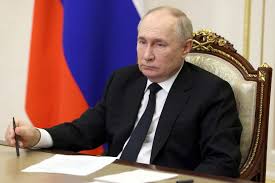
Putin was also of the opinion that “a complete renunciation of New START’s legacy would, from many points, be a grave and short-sighted mistake”, having “adverse implications for the objectives of the [Nuclear Non-Proliferation Treaty].
11 February 2026 Dr Binoy Kampmark, AIM,
Future of How awful could it get? The New Strategic Arms Reduction Treaty (New START) expired on February 5, terminating an era of arms control and imposed limits on lunatically contrived nuclear weapons programs of the United States and Russia. The New START Treaty entered into force on February 5, 2011 and initially imposed a timeline of seven years for the parties to meet the central limits on strategic offensive arms. Those limits would then be maintained for the duration of the Treaty.
Till its expiry, the countries maintained limits on the following nuclear arms and systems: 700 deployed intercontinental ballistic missiles (ICBMs), deployed submarine-launched ballistic missiles (SLBMs), and deployed heavy bombers capable of using nuclear armaments; 1,550 nuclear warheads on all three deployed platforms; and 800 deployed and non-deployed nuclear capable systems (ICBM launchers, SLBM launchers, and nuclear capable heavy bombers).
Such limits were hardly laudatory, or even exceptional. The cap of 1,550 nuclear warheads is the sort of thing that would only impress the limited crazed circle that passes for arms negotiators in this field, and the various thanocrats who populate such institutes as RAND. Such a show is merely intended for both Moscow and Washington to tell other countries with, or without nuclear weapons, that they could impose restraints on their own gluttonous conduct. Even then, New START, as with all such instruments dealing with limiting nuclear weapons, came with the intended, gaping lacunae. It failed to cover, for instance, tactical nuclear weapons, nor limit the deployment of new strategic weapon systems.
The treaty also fell into neglect with the outbreak of the COVID-19 pandemic. Suspended on-site inspections never resumed after 2022. As François Diaz-Maurin of the Bulletin of the Atomic Scientists points out, “Russia has not shared data on its deployed strategic nuclear forces since September 2022, it suspended its treaty participation altogether in February 2023, and the United States has not published any aggregate numbers since May 2023.” New START came to increasingly look like a gentleman’s agreement being sniffed at by truculent adolescents.
In September last year, Russian President Vladimir Putin dangled the prospect of extending the treaty’s core limits for a year. At a September 22, 2025 Russian Security Council Meeting, he promised that Moscow was “prepared to continue observing the … central quantitative restrictions” stipulated in New START for twelve months provided the US acted “in similar spirit.” Following the year’s extension, “a careful assessment of the situation [and] a definite decision on whether to uphold these voluntary self-limitations” would be made. Putin was also of the opinion that “a complete renunciation of New START’s legacy would, from many points, be a grave and short-sighted mistake”, having “adverse implications for the objectives of the [Nuclear Non-Proliferation Treaty].
When word of this reached the White House, Press Secretary Karoline Leavitt expressed the view that the proposal sounded “pretty good.” Two weeks later, President Donald Trump responded to a question posed by a TASS reporter that Putin’s proposal sounded “pretty like a good idea to me.” Little, however, was subsequently done. Indeed, Trump has cut the number of diplomats tasked with nuclear matters in the State Department and made public statements last October that nuclear testing might be resumed. He has also complicated arms control matters by insisting that China be added to the limitation talks, something Beijing has shown little interest in doing. In January this year, the president seemed unfussed that the international document was about to pass into the archives of diplomatic oblivion. “If it expires, it expires. We’ll do a better agreement.”
The US political establishment had been struck by a distinct lack of interest, even lethargy, on the subject. New START seemed to be yet another irritating fetter on an administration more enthused by ignoring international obligations than following them. Only a clutch of Democrats seemed to show concern in reflecting about what would follow the treaty’s expiration in House speeches given on January 14. This month, Massachusetts Democrat Sen. Ed Markey, co-chair of the Senate’s Nuclear Weapons and Arms Control Working Group, held a press conference urging the Trump administration to renew the vows of fidelity to arms control agreements. “Let’s be honest. America needs another nuclear weapon about as much as Donald Trump deserves a Nobel Peace Prize.”………………………………………………………..
The two powers most responsible for keeping nuclear weapons unforgivably attractive to those who would acquire them show promise of blotting their copybook further. There is a serious sentiment in Washington that the nuclear stockpile will and should grow. The Bulletin of Atomic Scientists, in a fit of gloominess, moved its metaphorical Doomsday Clock just that bit closer to “midnight,” the point where biblical calamity will be assured. It now stands at 85 seconds to midnight. Not long to go now. https://theaimn.net/bad-beginnings-the-end-of-new-start/
Iran offers to dilute enriched uranium in exchange for full sanctions relief
By Euronews, 09/02/2026
Iran says it could dilute its 60% uranium stockpile if “all sanctions” end, amid renewed Oman talks and uncertainty over missing nuclear material.
Tehran is prepared to dilute its stockpile of highly enriched uranium if sanctions against Iran are lifted, the head of its atomic energy agency said on Monday following indirect talks with Washington.
Mohammad Eslami, head of the Atomic Energy Organisation of Iran, said the possibility of diluting 60% enriched uranium “depends on whether all sanctions would be lifted in return”, according to the official IRNA news agency.
The statement did not specify whether Eslami was referring to all international sanctions on Iran or only those imposed by the United States.
The offer comes as the whereabouts of more than 400 kilograms of highly enriched uranium Iran possessed before last year’s conflict with Israel and the US remains unknown……………………………………………………………………………………………….
Indirect talks to resume after Oman meeting
Eslami’s statement followed indirect talks between Iranian Foreign Minister Abbas Araghchi and US Middle East envoy Steve Witkoff in Oman last Friday, the first negotiations since the June conflict.
Both sides agreed to continue negotiations. However, Araghchi warned that “the mistrust that has developed is a serious challenge”.
US President Donald Trump has repeatedly called for Iran to accept a total ban on uranium enrichment, a condition unacceptable to Tehran and far less favourable than the 2015 agreement.
Iran maintains it has a right to a civilian nuclear programme under the Nuclear Non-Proliferation Treaty, to which 191 countries are signatories.
Western countries, led by the US, suspect the Islamic Republic is seeking to develop nuclear weapons, a claim Iran has consistently denied. https://www.euronews.com/2026/02/09/iran-offers-to-dilute-enriched-uranium-in-exchange-for-full-sanctions-relief
Sixth Trump meeting with his de facto boss…good day to fire him.
Walt Zlotow West Suburban Peace Coalition Glen Ellyn IL , 12 Feb , 26
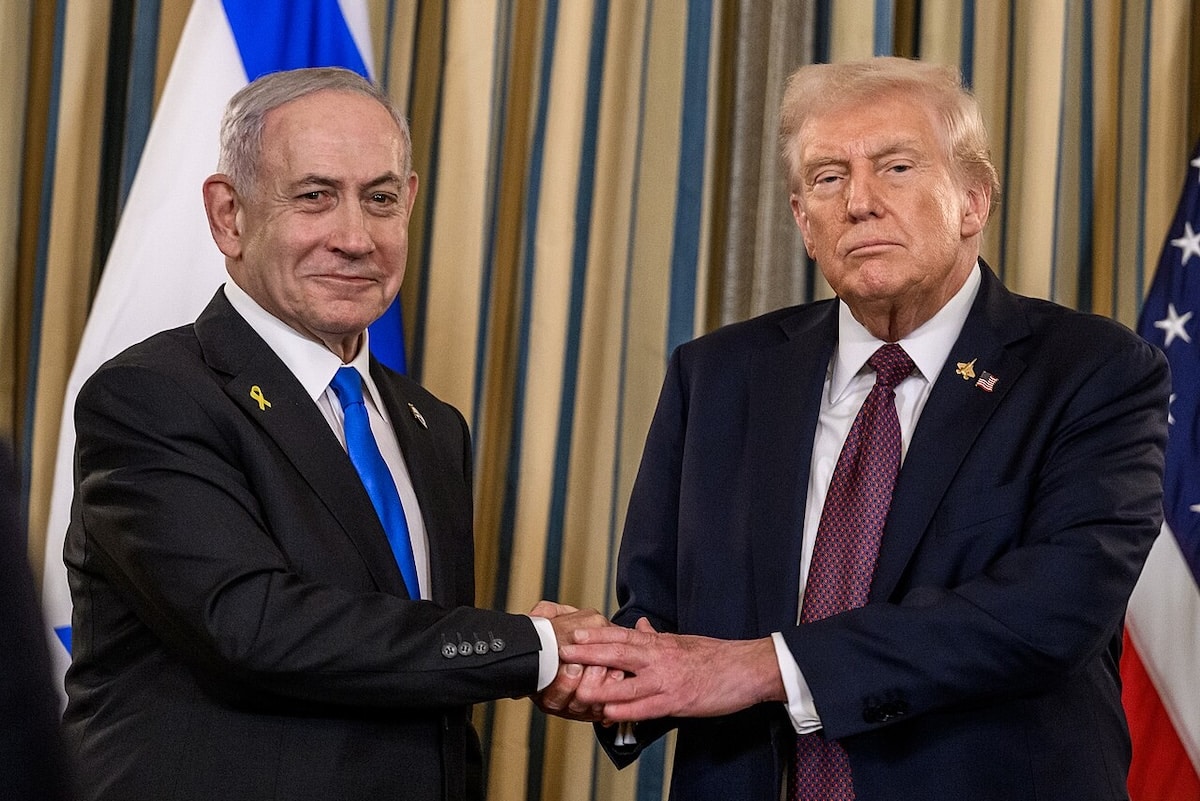
President Trump’s de jure, constitutional boss is We the People. 77 302,580 of us, giving Trump 58% of the Electoral College, hired him November 5, 2024. Trump serves and reports to Us.
But during the past 13 months he’s dismissed his true boss to take orders from Israeli Prime Minister Benjamin Netanyahu. Support the Israeli genocide obliterating Palestinians in Gaza with billions in weapons…check. Conspire with Netanyahu to sucker punch Iran with a sneak attack to decapitate their regime last June…check. Support Israeli provocateurs to infiltrate domestic Iranian protests to overthrow the Iranian regime last December…check.
Netanyahu is furious both his murderous Iranian regime change ventures failed. So he demanded, and of course got, his sixth sit down with Trump scheduled for today. Topic Number One? Iran, and not to make peace with Iran, likely the next and most massive attack that will finally achieve Netanyahu’s cherished dream of a decapitated, degraded Israeli rival for Middle East supremacy.
At Netanyahu’s behest Trump has moved a massive military armada into the region. Pulling back is near impossible when Trump’s boss demands he pull the trigger on senseless war that could blow up the Middle East, indeed possibly the world.
It would take a psychiatrist, maybe a team of psychiatrists, to unravel why Trump allows Netanyahu to be his real boss. It may simply be the near quarter of a billion dollars Netanyahu’s Israel Lobby has provided Trump’s campaign coffers since 2020.
Regardless, someone in the Trump orbit needs to convince Trump who his real boss is. We the People do not want our treasure supporting genocide in Gaza. Nor do we want it used to launch massive war on Iran to please Trump’s de facto boss Benjamin Netanyahu.
Trump needs to usher Netanyahu into the Oval Office today and immediately announce…’You’re fired.’
US congressional report explores option of not delivering any Aukus nuclear submarines to Australia.

COMMENT – What a typical USA plan?
They reneg on delivering the “goods” sold, but keep the $368 billion!
the Congressional Research report describes an alternative “military division of labour”, under which the US would not sell any Virginia-class submarines to Australia.
Report offers alternative of the US navy retaining boats and operating them out of Australian bases
Ben Doherty, Guardian, 6 Feb 26
A new United States congressional report openly contemplates not selling any nuclear submarines to Australia – as promised under the Aukus agreement – because America wants to retain control of the submarines for a potential conflict with China over Taiwan.
The report by the US Congressional Research Service, Congress’s policy research arm, posits an alternative “military division of labour” under which the submarines earmarked for sale to Australia are instead retained under US command to be sailed out of Australian bases.
One of the arguments made against the US selling submarines to Australia is that Australia has refused to commit to supporting America in a conflict with China over Taiwan. Boats under US command could be deployed into that conflict.
The report, released on 26 January, cites statements from the Australian defence minister, Richard Marles, and the chief of navy that Australia would make “no promises … that Australia would support the United States” in the event of war with China over Taiwan.
“Selling three to five Virginia-class SSNs [nuclear-powered general-purpose attack submarines] to Australia would thus convert those SSNs from boats that would be available for use in a US-China crisis or conflict into boats that might not be available for use in a US-China crisis or conflict,” the report argues.
“This could weaken rather than strengthen deterrence and warfighting capability in connection with a US-China crisis or conflict.”
Under the existing Aukus “optimal pathway’, Australia will first buy between three and five Virginia-class nuclear-powered conventionally armed submarines, the first in 2032.
Following that, the first of eight Australian-built Aukus submarines, based on a UK design, is slated to be in the water “in the early 2040s”.
But the Congressional Research report describes an alternative “military division of labour”, under which the US would not sell any Virginia-class submarines to Australia.
The boats not sold to Australia “would instead be retained in US Navy service and operated out of Australia” alongside US and UK attack submarines already planned to rotate through Australian bases.
The report speculated Australia could use the money saved to invest on other defence capabilities, even using those capabilities as a subordinate force in support of US missions.
“Australia, instead of using funds to purchase, build, operate, and maintain its own SSNs, would instead invest those funds in other military capabilities – such as … long-range anti-ship missiles, drones, loitering munitions, B-21 long-range bombers … or systems for defending Australia against attack … so as to create an Australian capacity for performing other missions, including non-SSN military missions for both Australia and the United States.”
The report also raises cybersecurity concerns, noting that “hackers linked to China” are “highly active” in attempting to penetrate Australian government and contractors’ computers.
It argues that sharing nuclear submarine technology with another country “would increase the attack surface, meaning the number of potential digital and physical entry points that China, Russia, or some other country could attempt to penetrate to gain access to that technology”.
The debate over whether the US should sell boats to Australia is also grounded in ongoing concern over low rates of shipbuilding in the US: the country’s shipyards are failing to build enough submarines to supply America’s own navy, let alone build boats for Australia.
For the past 15 years, the US Navy has ordered boats at a rate of two a year, but its shipyards have never met that build rate “and since 2022 has been limited to about 1.1 to 1.2 boats per year, resulting in a growing backlog of boats procured but not yet built”.
The US fleet currently has only three-quarters of the submarines it needs (49 boats of a force-level goal of 66). Shipyards need to build Virginia-class submarines at a rate of two a year to meet America’s own needs, and to lift that to 2.33 boats a year in order to be able to supply submarines to Australia.
Legislation passed by the US Congress prohibits the sale of any submarine to Australia if the US needs it for its own fleet. The US commander-in-chief – the president of the day – must certify that America relinquishing a submarine “will not degrade the United States undersea capabilities”.
The report argues that Australia’s strict nuclear non-proliferation laws could also weaken US submarine force projection under the current Aukus plan.
Australian officials have consistently told US counterparts that, in adherence to Australia’s commitments as a non-nuclear weapon state under the Treaty on the Non-Proliferation of Nuclear Weapons, Australia’s attack submarines can only ever be armed with conventional weapons.
“Selling three to five Virginia-class SSNs to Australia would thus convert those SSNs from boats that could in the future be armed with the US nuclear-armed sea-launched cruise missile with an aim of enhancing deterrence,” the report states……………………………………………………………………. https://www.theguardian.com/world/2026/feb/05/not-delivering-any-aukus-nuclear-submarines-to-australia-explored-as-option-in-us-congressional-report
In nuclear race with Russia, Trump goes back to a Cold War future
After letting New START expire, Trump threatens to replace the era of arms control with a new arms race against Russia and China.
Aaron Maté, Feb 07, 2026
As if the lingering prospect of a new attack on Iran is not dangerous enough, the Trump administration is toying with a greater threat to global security.
With Thursday’s expiration of the New START treaty, the US and Russia no longer have any legal constraints on their arsenals of nuclear weapons. President Trump let the treaty collapse rather than accept a Kremlin offer to extend for one year, the maximum possible. This removes the last formal constraint on a renewed arms race between two states that already can destroy the world many times over.
There are unconfirmed reports that the two sides have reached an informal understanding to observe the treaty’s terms for at least six months. And, in a rare sign of progress, Moscow and Washington have announced a resumption of high-level military-to-military dialogue. The Biden administration suspended those contacts in late 2021 as Russia built up its forces on Ukraine’s borders.
Yet the news is far from reassuring…………………………………….(Subscribers only) https://www.aaronmate.net/p/in-nuclear-race-with-russia-trump?utm_source=post-email-title&publication_id=100118&post_id=187111056&utm_campaign=email-post-title&isFreemail=true&r=ln98x&triedRedirect=true&utm_medium=email
Iran’s Comprehensive Peace Proposal to the United States

The Middle East stands at a crossroads between endless war and comprehensive peace. A framework for peace does exist. Will the US finally seize it?
Jeffrey D. Sachs, Sybil Fares, Common Dreams, Feb 09, 2026
History occasionally presents moments when the truth about a conflict is stated plainly enough that it becomes impossible to ignore. Iranian Foreign Minister Abbas Araghchi’s February 7 address in Doha, Qatar (transcript here) should prove to be such a moment. His important and constructive remarks responded to the US call for comprehensive negotiations, and he laid out a sound proposal for peace across the Middle East.
Last week, US Secretary of State Marco Rubio called for comprehensive negotiations: “If the Iranians want to meet, we’re ready.” He proposed for talks to include the nuclear issue, Iran’s military capabilities, and its support for proxy groups around the region. On its surface, this sounds like a serious and constructive proposal. The Middle East’s security crises are interconnected, and diplomacy that isolates nuclear issues from broader regional dynamics is unlikely to endure.
On February 7, Iranian Foreign Minister Araghchi’s responded to the United States’ proposal for a comprehensive peace. In his speech at the Al Jazeera Forum, the foreign minister addressed the root cause of regional instability – “Palestine… is the defining question of justice in West Asia and beyond” and he proposed a path forward.
The Foreign Minister’s statement is correct. The failure to resolve the issue of Palestinian statehood has indeed fueled every major regional conflict since 1948. The Arab-Israeli wars, the rise of anti-Israel militancy, the regional polarization, and the repeated cycles of violence, all derive from the failure to create a State of Palestine alongside the State of Israel. Gaza represents the most devastating chapter in this conflict, where Israel’s brutal occupation of Palestine was followed by Hamas’s attack on Israel on October 7, 2023, and then by Israel’s genocide against the people of Gaza.
In his speech, Araghchi condemned Israel’s expansionist project “pursued under the banner of security.” He warned of the annexation of the West Bank, which Israeli government officials, as National Security Minister Ben Gvir, continually call for, and for which the Knesset has already passed a motion.
Araghchi also highlighted another fundamental dimension of Israeli strategy which is the pursuit of permanent military supremacy across the region. He said that Israel’s expansionist project requires that “neighboring countries be weakened—militarily, technologically, economically, and socially—so that the Israeli regime permanently enjoys the upper hand.” This is indeed the Clean Break doctrine of Prime Minister Netanyahu, dating back 30 years. It has been avidly supported by the US through 100 billion dollars in military assistance to Israel since 2000, diplomatic cover at the UN via repeated vetoes, and the consistent US rejection of accountability measures for Israel’s violations of international humanitarian law.
Israel’s impunity has destabilized the region, fueling arms races, proxy wars, and cycles of revenge. It has also corroded what remains of the international legal order. The abuse of international law by the US and Israel with much of Europe remaining silent, has gravely weakened the UN Charter, leaving the UN close to collapse.
In the concluding remarks of his speech, he offered the US a political solution and path forward. “The path to stability is clear: justice for Palestine, accountability for crimes, an end to occupation and apartheid, and a regional order built on sovereignty, equality, and cooperation. If the world wants peace, it must stop rewarding aggression. If the world wants stability, it must stop enabling expansionism.”
This is a valid and constructive response to Rubio’s call for comprehensive diplomacy…………………………………………………………………………………………………………………….. https://www.commondreams.org/opinion/comprehensive-peace-plan-middle-east
Collapsing Empire: US Bows To African Revolutionaries
Kit Klarenberg, Global Delinquents, Feb 09, 2026
On February 2nd, the BBC published an extraordinary report on how the Trump administration “has declared a stark policy shift” towards Burkina Faso, Mali and Niger, the governments of which have sought to eradicate all ties to Western imperial powers, and forged the Alliance of Sahel States (AES). The independent bloc is a revolutionary enterprise, with the prospect further countries will follow its members’ lead. Washington is under no illusions about the new geopolitical realities unfolding in Africa.
The British state broadcaster records how Nick Checker, State Department African Affairs chief, is due to visit Mali to convey US “respect” for the country’s “sovereignty”, and chart a “new course” in relations, moving “past policy missteps.” Checker will also express optimism about future collaboration with AES, “on shared security and economic interests.” This is an absolutely unprecedented development. After military coups deposed the elected presidents of all three countries 2020 – 2023, the trio became Western pariahs.
France and the US initially aimed to isolate and undermine the military governments, halting “cooperation” projects in numerous fields. Meanwhile, the Economic Community of West African States, a neocolonial union of which all three were members, first imposed severe sanctions on Burkina Faso, Mali, and Niger, before its combined armed forces prepared to outright invade the latter in summer 2023. The three countries didn’t budge, and in fact welcomed Western isolation, forging new international partnerships and strengthening their ties. ECOWAS military action never came to pass.
In January 2025, the trio seceded from the union and created AES. Western-funded, London-based Amani Africa branded the move “the most significant crisis in West Africa’s regional integration since the founding of ECOWAS in 1975,” claiming it dealt “a significant blow to African…cooperation architecture.” Meanwhile, Burkina Faso’s leader Capt Ibrahim Traoré has become a media hate figure. A disparaging May 2025 Financial Times profile slammed him as a cynical opportunist leading a “Russia-backed junta”, and his supporters a “cult”.
As the BBC unwittingly explains, such antipathy towards Traoré stems from establishing himself “as a standard-bearer in resisting ‘imperialism’ and ‘neocolonialism’.” Via “vigorous social media promotion, he has gained huge support for this stance and personal popularity among young people across the continent and beyond,” ever since seizing office in September 2022. Far from just talk, Traoré and his fellow AES “junta” leaders have systematically neutralised malign Western influence locally, while pursuing left-wing economic policies for the good of their populations.
France and the US have proven markedly powerless to hamper, let alone reverse, this seismic progress…………………………………………………………………………………………………………………………………………………………………………………………………………………………. https://www.kitklarenberg.com/p/collapsing-empire-us-bows-to-african
Without an economic reset with Russia, a peace deal for Ukraine may render Britain and Europe weakened relics of a unipolar past.

the peace deal available to Ukraine and also to its European sponsors, will never be as good as the one available today.
It won’t be as good as the deal that was available to Ukraine in April 2022 in Istanbul.
Fighting on for another year will simply stack the advantages more in favour of Russia such that any final settlement just gets progressively worse.
Ian Proud, Feb 09, 2026, https://thepeacemonger.substack.com/p/without-an-economic-reset-with-russia?utm_source=post-email-title&publication_id=3221990&post_id=187362231&utm_campaign=email-post-title&isFreemail=true&r=1ise1&triedRedirect=true&utm_medium=email
In recent days, I have seen more mainstream media commentators claiming that a peace deal can’t be agreed without Ukraine. But that is a statement of the blindingly obvious.
Of course, Ukraine must agree to the terms of any agreement.
But Russia must also agree to the terms of any agreement, and it has been the exclusion of Russia from any direct dialogue on ending the war which has led to the war dragging on for almost four years.
It seems an obvious thing to say, although not obviously clear to mainstream pundits, but a peace deal has to be agreed by both Russia and Ukraine.
This is a war that will not end with a decisive military victory by either side, with either Ukraine or Russia capitulating, even if Russia emerges in a stronger position, which appears likely.
Ultimately, the contours of any peace deal will represent that which both sides can live with, in terms of how they present peace to their publics.
But its detailed terms will reflect the relative weight of both sides in the final negotiation.
The one certainty in any peace deal is that Ukraine will become militarily unaligned, with NATO membership taken permanently off the table, in return for which it receives security guarantees that both it, and Russia, can accept.
There is simply no scenario I can see in which Ukraine continues on its path to NATO membership.
Deadlock on this issue, which Russia will not back down from, will lead to the continuation of the war, with Russia in a progressively stronger position militarily and better able to navigate the economic impacts than Ukraine, which is already bankrupt.
Britain and European will increasingly struggle to give Ukraine the resources that it needs, not just to fight, but also to avoid a shocking economic meltdown.
Everything else is in the peace plan will be down to fine points of detail and white noise.
But, of course, the terms of the peace deal will reflect the relative weight of both sides in the negotiations.
And let’s be clear that Russia continues to hold the stronger hand of cards in negotiations.
Russia will end the war with the strategic advantage on the battlefield, their army the most battle hardened and well equipped that it has been since the end of World War II.
Their core aim, to prevent NATO expansion in Ukraine will decisively have been achieved.
Russia will have managed the economic consequences of war better than Ukraine and its western sponsors, in particular Europe.
Ukraine will end the war, wanting to maintain an army of 800,000 but without the money to do so without British and Europeans donations of aid that will become harder to secure as peace sets it.
It will have failed to land NATO membership and the prospects for joining the EU might not be as bright as the Ukrainian population would expect.
It will be functionally bankrupt and will need quickly to reintroduce itself to a healthy relationship with western financial markets, in order to stay afloat.
However, the peace deal available to Ukraine and also to its European sponsors, will never be as good as the one available today.
It won’t be as good as the deal that was available to Ukraine in April 2022 in Istanbul. Fighting on for another year will simply stack the advantages more in favour of Russia such that any final settlement just gets progressively worse.
So, what is at stake?
Both sides will sign an agreement when they are satisfied that it meets their respective needs.
For Ukraine, that means a guarantee of not being attacked in the future, possibly accelerated membership of the EU, and provisions to help invest in post-war reconstruction. These represent basic requirements for its stability as a state, though not a strategic victory.
For Russia, by far the biggest requirement is that Ukraine is never able to join NATO in the future, which on its own will represent a huge strategic victory over the west.
These are central issues.
However, for Russia and also for Europe and Ukraine, an end to war may not deliver a genuinely normalised and enduring peace unless there is a normalisation of economic relationships, including but not limited to the lifting of economic sanctions.
A continued state of economic warfare would simply risk pressing the pause button on military warfare, at a time of European rearmament.
There would be little to motivate Russia to stop fighting in the first place, or to reduce its military readiness significantly following any armistice, if it believed that its economy would continue to be squeezed by the west, even though it has successfully navigated the economic shock of war better than Europe in particular.
On economics in particular, Russia will be concerned about Ukraine within Europe pushing for a maintenance of economic warfare against Russia, as it has since 2014, and as the Poles and Baltic States, not the mention the Brits, have done for many years.
Russia will also undoubtedly want issues such as the widespread cancellation of Russia from the international arena reversed, borders reopened, and readmittance to international sporting and cultural events.
So, even though the USA is in pole position in bringing both sides together in the negotiation process, it will be decisions in Europe that dictate whether any peace sticks.
And that raises questions about the role that the EU plays in the negotiation process.
Read more: Without an economic reset with Russia, a peace deal for Ukraine may render Britain and Europe weakened relics of a unipolar past.Until now, the European Union and Britain have proved themselves singularly unwilling to enter into direct dialogue with Russia to end the war, adding to the sense that they are invested in its continuance.
Efforts in Europe to agree a lead negotiator with Russia have so far come to nothing.
It is therefore right that the US has mediated the talks between Russia and Ukraine, and for this President Trump must take the credit, as without initiative it would not have happened.
However, that poses risks, that the US will not be able to leverage EU policy towards Russia and include in any peace deal clauses that depend on European agreement.
And US leverage over Europe may have been weakened by its posture towards the future status of Greenland.
It does therefore make sense rationally for the Europeans to be introduced into the peace process at some stage.
Even if not in the main bilateral part of the talks between Russia and Ukraine, there may need to be a process in which the USA, perhaps directly with Europe, negotiates the contours of a unified economic off-ramp from a war that Ukraine and Russia have agreed bilaterally to bring to a halt.
Hitherto, the Europeans have been unable to coordinate on who this should be involved in negotiations, and the Russians clearly don’t want it to be Kaja Kallas, who has shown herself set against any peace deal to end the war, setting unrealistic conditions that she is not in a position to enforce on Russia.
Based on the evidence so far, the Europeans will need for the first time to reimagine their role as an external party to the conflict, having to date, positioned themselves directly as a party to the conflict, through military, political and financial support to Ukraine, and a stated strategy to defeat Russia.
That means both a commitment to integrate and support Ukraine into the Union and to normalise relations with Russia, both of which are more complex tasks that sending money to Ukraine to keep fighting.
This may prove almost as difficult a task as obtaining bilateral agreement between the combatants themselves to end the fighting, given the lack of clear and decisive leadership within Europe itself. It is hard to see Ursula von der Leyen playing the peace maker role. Will it be the leader or a group of leaders from Member States? And would it, in fact, make sense to include a small group of leaders, including from Central European States like Hungary, who have long opposed unconditional support for Ukraine and for the war? What role would Britain play, sitting outside of the EU, and having been one of the biggest advocates for the continuation of the war?
These are hugely complicated, and I am not confident that a decisive position will be reached soon, not least given the months it has taken already to discuss the basics of who might engage in direct dialogue with President Putin.
At the same time, the Europeans risk being even further sidelined in the process if they refuse to engage, which may force them to commit to a meaningful role in peace talks which they have hitherto ruled themselves out of.
One of the most fascinating aspects of the peace process is how it will finally be agreed and signed.
Zelensky has appeared for many months determined to sign off an any agreement through a direct meeting with President Putin.
It is entirely normal for Heads of State to meet to sign off landmark treaties and peace deals. After World War II, the surrender of both Germany and Japan was signed off by more junior figureheads, but Ukraine will not be surrendering.
It might not seem immediately obvious why Zelensky should want to meet Putin, having spent the whole war encouraging Russia’s isolation on the world stage.
Yet here the optics appear more about Zelensky’s desire to legitimise his role as President, in circumstances where he hasn’t faced an election since 2019.
Knowing that an end to the war will usher in Presidential elections in Ukraine, signing a peace deal may epitomise his desire to present himself to Ukrainian citizens as a peace maker, with one eye on boosting his popularity before elections.
I personally think that even if he meets Putin, Zelensky is probably still doomed to lose a future Presidential poll, because any deal he signs will be worse than the deal that was available to him in April 2022 in Istanbul.
Putin will also not want to give Zelensky a gift of free publicity and in any case will be concerned that Zelensky will simply try to pull a publicity stunt if he meets Putin. In any case, I don’t see such a hypothetical meeting taking place without Trump who wants to position himself as the ultimate peacemaker. And Putin will want to keep President Trump on side with one eye on a much bigger and more valuable to Russia reset in economic relations with America.
So, I don’t think Putin would see it in his interests to make not meeting Zelensky a red line issue, so long as Trump committed to making sure the choreography of the event was proper.
He will in any case know that he has a stronger claim to victory coming out of the war than Zelensky.
He will be seen by Russian people as the President who stared down NATO and prevented its expansion, weakening the perception of western hegemony among countries in the developing world, and sowing serious division within the European Union.
Zelensky, in the cold light of day, will be seen as the President who settled for a worse deal than that which was available to him in April 2022. And even if the prospect of EU membership is accelerated, it is unlikely that Ukraine will be allowed to join as an equal member and will have bankrupted and depopulated itself for the right to second class citizenship.
Both countries will have lost very large numbers of troops to death or injury. Russia will reach back into history to justify this on the basis of fending off an existential threat to its nation in the guise, not of Ukraine itself, but of the NATO military alliance.
Ukrainian leaders will have to explain why so many men and women died or were injured to bring about a less favourable peace to that which was available in Istanbul four years earlier, and that will be a harder case to make
But when it comes down to it, no one really wins in a war, and primarily ordinary working people suffer.
Which again serves as a reminder that wars are often judged in hindsight on their political aftermath.
The Second World War decisively signalled the end of the British Empire leaving only two in its place, the United States and the Soviet Union.
Ukraine will emerge from this war significantly weakened against a Russia that has renewed standing in the developing world. There is a significant chance that the Euro-integration project will have reached its high-water mark and, like the British Empire, will also go into decline.
The end of the war in Ukraine will decisively usher in a more multi-polar world, in which Europe and Britain are seen as weakened relics of a unipolar past.
Trump is not threatening war on Iran over its nuclear program, but because it challenges U.S. dominance.

In short, it is about removing Iran from the strategic playing field, as it is the sole actor in the region that is powerful, influential, and beyond the United States’ direct control. The U.S. and Israel desperately want to remove that oppositional force.
So Trump is buying time by agreeing to talks that cannot succeed on the terms he and Rubio have laid down. He is likely to use that time to magnify the threat against the Iranian leadership in the vain hope that they will acquiesce to his demands.
The U.S. is once again threatening a war on Iran that could devastate the region. Trump knows Iran is not pursuing nuclear weapons, but that has never been the point. It is about removing Iran as the only actor in the region beyond U.S. control.
By Mitchell Plitnick February 6, 2026, https://mondoweiss.net/2026/02/trump-is-not-threatening-war-on-iran-over-its-nuclear-program-but-because-it-challenges-u-s-dominance/
American and Iranian negotiators are meeting in Muscat to see if they can come to an agreement and avoid an American attack on Iran. The chances don’t look good.
There was some initial hope because Donald Trump agreed to hold talks at all. The buildup of American forces in the region and the frequent planning meetings with Israeli political and military officials gave the appearance of an unstoppable buildup to war.
But American allies Türkiye, Saudi Arabia, Qatar, and Oman have been working hard to convince Trump not to attack Iran. They fear the potential backlash of an American attack on the Islamic Republic, believing that Iran is not likely to respond to an attack with the restraint they have shown in the past.
Israel is urging Trump to attack, as the government of Benjamin Netanyahu is the one entity that stands to benefit from the chaos that an attack on Iran could bring.
Indeed, Iran has warned that an attack this time will be met with a very different response than previous ones. Yet, paradoxically, it is the very fact that Iran is capable of a more damaging response than it has taken in the past that creates the impasse that is likely to derail negotiations.
What each side wants
Iran’s desires from any talks with the U.S. are straightforward: they want the U.S. to stop threatening to attack, and to lift the sanctions that have helped to cripple Iran’s economy.
But the United States has more complicated demands.
- The United States wants Iran to completely abandon nuclear power. This demand is not just about weaponry, but includes all civilian nuclear power under Iran’s control. No uranium at all can be enriched by Iran, regardless of whether it is for civilian or military purposes, and all enriched uranium Iran has must be handed over.
- The U.S. is demanding that Iran agree to limits dictated by Washington on the range and number of ballistic missiles it can possess.
- The U.S. is demanding that Iran end its support of any and all armed resistance groups in the region.
All of these demands are unreasonable. But the United States is holding a loaded gun to Iran’s head. The U.S. has moved a large carrier group into the waters near Iran, and between American and Israeli intelligence, they surely have a very clear map of where they want to strike to go along with the technical capability to essentially ignore Iran’s defenses.
But while Iran can do very little to shield itself from an American or Israeli attack, it is capable of responding to one. That is what the last two American demands are focused on, and it’s really the reason all of this is happening.
If the U.S. or Israel attacks Iran and Iran elects to respond with all of its capabilities—which it has not done in previous attacks—it has the ability to kill many American soldiers, severely disrupt oil production in the Gulf, or cause significant damage to Israel.
Iran can do this because it has a large battery of long-range ballistic missiles. It has already shown, last June, that it can hurt Israel, and that was an attack largely meant to be a warning.
Iran also backs various militias in the region, some large, like Ansar Allah in Yemen, others smaller. That means it can launch guerrilla attacks on American bases or other key sites in places like Iraq and Syria.
Iran can also target oil fields throughout the region, either with missiles or drones or with militia attacks. That’s a major reason Trump’s friends in the Gulf are reluctant to see him start a war.
The ability to do all of that gives Washington pause. Donald Trump likes it when he can do quick operations with little or no pushback, as he did recently in Venezuela or last year in Iran. Trump has carefully avoided situations where American soldiers might be killed. Iran might not let the U.S. off so easily this time around.
The reality behind U.S. demands
That brings us to why talks are so unlikely to succeed.
Iran has already made it clear it has no intention to negotiate on their support for groups throughout the region or on their ballistic missile arsenal. They understand that the reason the United States is trying to force them to agree to such measures is that it would leave Iran defenseless. Giving in to these demands would be tantamount to national suicide.
The Iranian leadership is more than happy to discuss the issue of nuclear power. As unfair as the terms might be, they might even be willing to reach a compromise that allows them to use nuclear power without enriching uranium themselves. That’s far from ideal, but Iran is facing a considerable threat.
But this holds little interest for the Trump administration. Despite American chest-thumping, they know that Iran is not pursuing a nuclear weapon, nor were they before the U.S. damaged so much of their nuclear infrastructure last year. Trump’s own intelligence corps confirmed that Iran was not actively seeking a nuclear weapon, just as it had affirmed that finding every year since 2007.
But none of this has ever been about an Iranian nuclear weapon. Rather, it has always been about pressuring the Islamic Republic either to fall or to radically change its behavior in the region. It has always been about getting Iran to stop supporting the Palestinian cause rhetorically and to stop arming Palestinian factions. It has always been about stopping Iran from supporting militias in the region that act outside of the American-run system, unlike those that are backed by Saudi Arabia, the UAE, or other states in the region that are on good terms with Washington.
In short, it is about removing Iran from the strategic playing field, as it is the sole actor in the region that is powerful, influential, and beyond the United States’ direct control. The U.S. and Israel desperately want to remove that oppositional force.
Trump weighs the consequences of attacking Iran
Does Trump really want a war? That concern with Iran is a long-term U.S.-Israeli policy goal. What Donald Trump personally wants is always difficult to know. It can change from day to day, and is often based on a less-than-full understanding of the real world.
From all appearances, Trump felt emboldened by the American success in Venezuela. He kidnapped the head of state and his wife, and suffered no American casualties in doing so. The short-term political backlash, both in Latin America and in the U.S., was brief and minimal.
No doubt, he envisioned a similar success in Iran, when the protests there and the Iranian government’s brutal response helped to create what might have looked superficially like similar circumstances. Trump began issuing one threat after another, and while their frequency has been intermittent, they have not stopped.
But his friends in Saudi Arabia, Qatar, Türkiye, and elsewhere in the Mideast explained to Trump that the outcome in Iran would be very different from that in Venezuela. Iran has the capabilities we’ve already discussed here, but there are other key differences.
For one, Iran has a deep governmental infrastructure, and there is no one in it who is both capable of taking over from Ayatollah Ali Khamenei and willing to compromise with Trump in the way Delcy Rodriguez has in Caracas. Despite the occasional protester in Iran calling out the name of Reza Pahlavi, the son of the last Shah of Iran, who was deposed in 1979, there is no infrastructure of support for him in Iran, and it would likely be impossible to simply install him without a full-scale invasion of the country.
So Trump is buying time by agreeing to talks that cannot succeed on the terms he and Rubio have laid down. He is likely to use that time to magnify the threat against the Iranian leadership in the vain hope that they will acquiesce to his demands.
But the primary purpose of that time is to continue to position American and Israeli forces to counter what they can anticipate of an Iranian response. That would mean not just the stationing of ships in striking distance of Iran, but also positioning whatever military assets they might have in countries like Iraq and Syria, as well as in other Gulf states, to counter guerrilla attacks by Iran-aligned militias and getting friendly states to agree to help with shooting down Iranian missiles and drones, as they did last year.
With Rubio and Benjamin Netanyahu pushing Trump toward a regime change war with Iran, and given the amount of bluster he has already put out there, it is hard to see Trump backing away from a war if Iran will not agree to compromise on its missiles and the militias it supports. And Iran is not about to do that.
The war that will ensue stands a good chance of toppling the Iranian government, but with nothing to replace it, the power vacuum that will surely follow will mean chaos not only for Iran but for the whole region. That isn’t really in Trump’s interests, and it certainly does not benefit his Gulf Arab allies.
Netanyahu, on the other hand, will have made the “neighborhood” that much more dangerous just as Israel’s election season begins to ramp up. While many Israelis have lost faith that “Mr. Security” can protect them after October 7, a heightened sense of danger to Israelis remains the atmosphere that is most favorable to Netanyahu electorally. It’s therefore no surprise that Israel is the one actor in the region that is pressing for this regime change war.
Averting that war will mean the Trump administration climbing down from its maximalist demands. There are indications that the U.S. is looking, at least,for an option that allows it to do that without appearing to have shied away from Iranian retaliation. But that remains an unlikely outcome, as hawks in Israel, Washington, and among the anti-regime exile Iranian community continue to urge an attack.
Iran suggests it could dilute highly enriched uranium for sanctions relief
Aljazeera, 9 Feb 26
Iran’s atomic energy chief makes comment as more mediated negotiations with the US expected.
Iran’s atomic energy chief says Tehran is open to diluting its highly enriched uranium if the United States ends sanctions, signalling flexibility on a key demand by the US.
Mohammad Eslami made the comments to reporters on Monday, saying the prospects of Iran diluting its 60-percent-enriched uranium, a threshold close to weapons grade, would hinge on “whether all sanctions would be lifted in return”, according to Iran’s state-run IRNA news agency.
Eslami did not specify whether Iran expected the removal of all sanctions or specifically those imposed by the US.
Diluting uranium means mixing it with blend material to reduce its enrichment level. According to the United Nations nuclear watchdog, Iran is the only state without nuclear weapons enriching uranium to 60 percent.
US President Donald Trump has repeatedly called for Iran to be subject to a total ban on enrichment, a condition unacceptable to Tehran and far less favourable than a now-defunct nuclear agreement reached with world powers in 2015.
Iran maintains it has a right to a civilian nuclear programme under the provisions of the nuclear Non-Proliferation Treaty, to which it and 190 other countries are signatories.
Eslami made his comments on uranium enrichment as the head of Iran’s Supreme National Security Council, Ali Larijani, prepares to head on Tuesday to Oman, which has been hosting mediated negotiations between the US and Iran.
Al Jazeera’s Ali Hashem, reporting from Tehran, said Larijani, one of the most senior officials in Iran’s government, is likely to convey messages related to the ongoing talks
Trump said talks with Iran would continue this week……………………………………………………………………………………………………………………………. https://www.aljazeera.com/news/2026/2/9/iran-suggests-it-could-dilute-highly-enriched-uranium-for-sanctions-relief
Why Iran–US negotiations must move beyond a single-issue approach to the nuclear problem
By Seyed Hossein Mousavian | February 5, 2026, https://thebulletin.org/2026/02/why-iran-us-negotiations-must-move-beyond-a-single-issue-approach-to-the-nuclear-problem/?utm_source=ActiveCampaign&utm_medium=email&utm_content=Iran-US%20negotiations&utm_campaign=20260209%20Monday%20Newsletter
Iran’s nuclear crisis has reached a point at which it can no longer be treated as a purely technical or legal dispute within the framework of the Nuclear Non-Proliferation Treaty (NPT). It has evolved into a deeply security-driven, geopolitical, and structural challenge whose outcome is directly tied to the future of the nonproliferation order in the Middle East and beyond. If the negotiations scheduled for Friday between Iran and the United States are to be effective and durable, they must move beyond single-issue approaches and toward a comprehensive, direct, and phased dialogue.
The format and venue of Iran–US negotiations. The first round of talks between Iranian Foreign Minister Abbas Araghchi and US envoy Steve Witkoff took place on April 12, 2025, in Muscat, Oman. At Iran’s insistence, these negotiations were defined as “indirect.” On April 8, 2025, I emphasized in a tweet that direct negotiations—particularly in Tehran—would significantly increase the chances of reaching a dignified, realistic, and timely agreement. “Wasting time is not in the interest of either country,” I insisted. Despite these warnings, nearly 10 months were lost, during which the region suffered heavy and regrettable losses.
It now appears that Tehran has agreed to direct talks among Witkoff, son-in-law and key adviser to President Trump Jared Kushner, and Araghchi, again in Oman. The most effective format going forward, however, would be to hold direct talks in Tehran and then in Washington. This formula would not only break long-standing political taboos but also enable deeper mutual understanding. A visit by Witkoff and Kushner to Tehran would allow them to engage not only with the foreign minister but also with other key decision-makers, including the secretary of the Supreme National Security Council, members of parliament, and relevant institutions—engagement that is essential if any sustainable agreement is to be achieved. Araghchi should engage in Washington not only with US negotiators, but also with President Trump, officials from the Pentagon, and members of the US Congress, to gain a clearer understanding of the current political environment in Washington.
Why a single-issue agreement is not sustainable. In hundreds of articles and interviews since 2013, I have argued that a single-issue agreement—even if successful on the nuclear file—will be inherently unstable. Under current conditions, three core issues require reasonable, dignified, and lasting solutions.
The US demand for zero enrichment. Ahead of negotiations, the United States is demanding that Iran entirely stop all uranium enrichment and give up its stockpile of around 400-kilograms of highly enriched uranium, steps that would prevent Tehran from possible diversion toward weaponization. Since 2013, a group of prominent nuclear scientists from Princeton University and I have proposed a “joint nuclear and enrichment consortium” for the Persian Gulf and the broader Middle East as a way for Iran to continue its peaceful nuclear program and for the United States and regional countries to be reassured that program will not be used as a cover for the production of nuclear weapons. This proposal was repeatedly articulated—up to 10 days before the 2025 Israeli and US attacks on Iran—but unfortunately failed to gain serious attention.
Today, the only realistic solution to the question of uranium enrichment remains the establishment of a joint nuclear and enrichment consortium involving Iran, Turkey, Egypt, Saudi Arabia, the Arab states of the Persian Gulf, and major global powers. This model would address nuclear proliferation concerns while safeguarding equal access to peaceful nuclear technology.
Iran’s missile and defensive capabilities. Defensive capabilities are the ultimate guarantor of territorial integrity, sovereignty, and national security. Since 2013, I have repeatedly recommended two regional agreements: a conventional weapons treaty and a non-aggression pact among the states in the Persian Gulf and the Middle East. A regional conventional weapons treaty would ensure a balance of defensive power, while a non-aggression pact would lay the foundation for collective security. Without these frameworks, expectations for unilateral limitations on Iran’s defensive capabilities are neither realistic nor sustainable.
Iran’s support for the “axis of resistance” and regional security order. My book, A New Structure for Security, Peace, and Cooperation in the Persian Gulf, presented a comprehensive framework for regional cooperation and collective security, including a nuclear and weapons of mass destruction free zone. This framework would enable progress on four major issues: the roles of non-state and semi-state actors; the Persian Gulf and energy security; the antagonism among Iran, the United States, and Israel; and a safe and orderly US withdrawal from the region.
If a sustainable agreement is to be reached, Iran and Israel must put an end to mutual existential, military, and security threats. “Despite major differences, the United States and China both worry about the conflict. China has close Iran relations, and Israel is a US strategic partner, making them qualified mediators serving as communication channels,” I suggested in 2023.
A warning to Washington: Iran’s nuclear file and the future of nonproliferation. The global non-proliferation order is undergoing a fundamental transition. The world is moving away from a system in which nuclear strategy is defined by possession or non-possession of nuclear weapons, and toward one defined by positioning, reversibility, and strategic optionality.
Nuclear-weapon states have not only failed to meet their NPT obligations to make good-faith efforts toward nuclear disarmament; they are also actively modernizing and expanding their arsenals. At the same time, some non-nuclear states that face threats to their security are seeking deterrence without formal weaponization, and political leverage without legal rupture.
The Iranian case demonstrated that full compliance with the 2015 Joint Comprehensive Plan of Action (aka the Iran nuclear deal) and unprecedented cooperation with the International Atomic Energy Agency (IAEA) did not produce security for Iran. The US withdrawal from the agreement, the imposition of sweeping sanctions, and subsequent military attacks conveyed a clear message to the Iranian government: Maximum restraint can create vulnerability. Meanwhile, Israel—outside the NPT and enjoying unwavering US support—remains the region’s sole nuclear-armed state.
For the first time in the history of nuclear non-proliferation, safeguarded nuclear facilities of a non-nuclear-weapon state were attacked, without meaningful condemnation from either the IAEA or the UN Security Council. This episode has fundamentally altered the meaning of non-proliferation commitments.
The conclusion is clear: If Iran’s nuclear crisis is treated as a narrowly defined, Iran-specific issue, it will not lead to a sustainable agreement. Instead, it will accelerate the spread of “nuclear ambiguity” across the Middle East as multiple countries seek the capability to build nuclear weapons, even if they do not immediately construct weapons. Any new nuclear agreement between Iran and the United States must therefore be firmly grounded in the principles and obligations of the Nuclear Non-Proliferation Treaty (NPT), applied in a balanced, non-discriminatory, and credible manner. The fate of Iran-US negotiations is inseparably linked to the future of non-proliferation in the region and around the world. Decisions made today will shape regional and international security for decades to come.
Iran says US nuclear talks off to ‘good start’ but draws line at missile, proxy issues.

Iran’s top diplomat struck an optimistic note after talks on its nuclear program, despite US pressure to broaden the agenda.
7 February 2026, https://www.sbs.com.au/news/article/iran-says-us-nuclear-talks-off-to-good-start-but-draws-line-at-missile-proxy-issues/hkypxkf3e
Iran’s top diplomat said that nuclear talks with the US mediated by Oman were off to a “good start” and set to continue, lowering concerns that failure to reach a deal might nudge the Middle East closer to war.
But Iranian foreign minister Abbas Araqchi reiterated that it wanted the talks to solely focus on the country’s nuclear program.
“Any dialogue requires refraining from threats and pressure. [Iran] only discusses its nuclear issue … We do not discuss any other issue with the US,” he said.
Discussions on Friday took place in the Omani capital Muscat, which involved Araqchi, US special envoy Steve Witkoff and US President Donald Trump’s son-in-law Jared Kushner.
The US has wanted to expand the dialgogue to cover Iran’s ballistic missiles, support for armed groups around the region and “treatment of their own people,” US secretary of state Marco Rubio said on Wednesday.
A regional diplomat briefed by Iran on the talks said Iran insisted on its “right to enrich uranium” during the negotiations with the US, and its missile capabilities were not raised in the discussions.
Trump on Friday ratcheted up the pressure on Iran with an executive order imposing a 25 per cent tariff on imports from any country that “directly or indirectly” purchases goods from Iran, following through on a threat he made last month.
The White House has said the measure is intended to deter third countries from maintaining commercial ties with Iran, particularly in energy, metals and petrochemicals, sectors that remain key sources of revenue for the Iranian government.
Very serious’ talks, Oman says
Mediator Badr al-Busaidi, Oman’s foreign minister, said the talks had been “very serious” and the goal was to reconvene in due course.
Despite the talks, the United States announced on Friday it was sanctioning 15 entities and 14 shadow-fleet vessels connected to illicit trade in Iranian petroleum, petroleum products and petrochemical products.
Iran’s leadership remains deeply worried that Trump may carry out his threats to strike Iran after a US military buildup in the region.
Last June, the US struck Iranian nuclear targets, joining in the final stages of a 12-day Israeli bombing campaign. Iran has since said it has halted uranium enrichment activity.
The naval buildup, which Trump has called a massive “armada,” has followed a bloody government crackdown on nationwide protests in Iran last month, heightening tensions between the US and Iran.
Trump has said “bad things” will probably happen if a deal cannot be reached, increasing pressure on the Islamic Republic in a standoff that has led to mutual threats of airstrikes
Sorrowful day for peace largely ignored thruout America
Walt Zlotow West Suburban Peace Coalition Glen Ellyn IL, 7 Feb 26
The New Start Treaty between Russia and US expires today and America largely yawned. Big story on mainstream news? Faggedaboudit. Ask the person on the street about New Start and he might mutter something about giving disadvantaged kids free comprehensive early childhood education. Wait, wait…that’s Head Start.
Nope, New Start is the 16 year old treaty Obama signed with Russian President Dmitry Medvedev on February 8, 2010. It caps the number of nuclear warheads each side can deploy at 1,550 and limits the number of deployed and non-deployed strategic launchers to 800. Still enough for either side to incinerate us all, but prevents a senseless arms race and symbolic of the critical need to reduce nuclear tensions.
But limited US Russian nuclear arsenals go back 54 years as 2010 Russian New Start signer Medvedev reminded us yesterday. “That’s it. For the first time since 1972, Russia (the former USSR) and the US have no treaty limiting strategic nuclear forces. SALT 1, SALT 2, START I, START II, SORT, New START – All in the past, winter is coming.”
President Trump rebuffed Russian President Putin’s offer to extend the limits for another year for sensible diplomacy to negotiate a new treaty.
Secretary of State Marco Rubio used the lame excuse that any new treaty must include China. But with a nuclear arsenal a pittance of the two nuclear giants, China demurred saying any treaty involving China must include US Russian nuclear stockpiles reduced to China’s level. Rubio knew his requirement was a poison pill deal breaker for any new extension of New Start.
Dumping nuclear agreements is nothing new for Trump. He left office in January 20, 2021 ignoring New Start’s eminent expiration. Successor Biden promptly renewed New Start for 5 years, exactly 5 years ago today. This time Trump has succeeded in letting it expire on his watch.
This gives Trump a trifecta in dumping critically needed nuclear agreements. In August 2019 Trump withdrew from the Intermediate Range Nuclear Forces (INF) Treaty that banned all land-based missiles with ranges between 500 and 5,500 km. . In November 2020, just before leaving office, Trump withdrew from the 2002 Open Skies Treaty which allowed the US and Russia to conduct short-notice, unarmed reconnaissance flights over each other’s territory to monitor military activities.
The only positive glimmer to put on Trump’s refusal to extend New Start, even for a measly year to negotiate a long term agreement? Trump has no more nuclear agreements to withdraw from in the last sorrowful 3 years of his second term.
This January the Bulletin of Atomic Scientists moved the Doomsday Clock, symbolic of approaching global catastrophe, to 85 seconds to Midnight, the closest in its 79 year history. With Trump president, the Bulletin might want to quickly reconvene for another gander at our march toward world annihilation. Next January, none of us might around to hear the 2027 announcement.
1 This Month


Shut down the radiation-damaged Heysham nuclear reactors now
To see nuclear-related stories in greater depth and intensity – go to https://nuclearinformation.wordpress.com

Say No to NASA’s Reckless Nuclear Reactor on the Moon
Say No to NASA’s Reckless Nuclear Reactor on the Moon
-
Archives
- October 2026 (256)
- September 2026 (339)
- August 2026 (330)
- July 2026 (355)
- June 2026 (287)
- May 2026 (306)
- April 2026 (356)
- March 2026 (251)
- February 2026 (267)
- January 2026 (308)
- December 2025 (358)
- November 2025 (359)
-
Categories
- 1
- 1 NUCLEAR ISSUES
- business and costs
- climate change
- culture and arts
- ENERGY
- environment
- health
- history
- indigenous issues
- Legal
- marketing of nuclear
- media
- opposition to nuclear
- PERSONAL STORIES
- politics
- politics international
- Religion and ethics
- safety
- secrets,lies and civil liberties
- spinbuster
- technology
- Uranium
- wastes
- weapons and war
- Women
- 2 WORLD
- ACTION
- AFRICA
- Atrocities
- AUSTRALIA
- Christina's notes
- Christina's themes
- culture and arts
- Events
- Fuk 2022
- Fuk 2023
- Fukushima 2017
- Fukushima 2018
- fukushima 2019
- Fukushima 2020
- Fukushima 2021
- general
- global warming
- Humour (God we need it)
- Nuclear
- RARE EARTHS
- Reference
- resources – print
- Resources -audiovicual
- Weekly Newsletter
- World
- World Nuclear
- YouTube
-
RSS
Entries RSS
Comments RSS

