Kim Jong Un’s round of summits: the latest with Vladimir Putin
 Ingram Pinn’s illustration of the week: Nuclear roundabout – (illustration on original) Kim Jong Un turns to Vladimir Putin, https://www.ft.com/content/fcd74e58-675a-11e9-a79d-04f350474d62 . INGRAM PINN
North Korean leader Kim Jong Un received a red-carpet welcome when he arrived by armoured train in Russia’s pacific port of Vladivostok for his first summit with Russian President Vladimir Putin. After four summits with Chinese President Xi Jinping and two with US President Donald Trump, Mr Kim has now turned to Mr Putin. The US-North Korea talks in Hanoi in February broke down in acrimony. Since then, North Korean state media has said they no longer wanted to deal with Mike Pompeo, US secretary of state, as a nuclear negotiator and that they wanted to work with someone “more careful and mature in communicating”. Mr Kim was also claimed to have launched a new missile designed to carry a “powerful warhead” and that the test was “of a very weighty significance in increasing the combat power of the (Korean) People’s Army”. “Chairman Kim Jong Un himself personally asked us to inform the American side about his position and the questions he has about what’s unfolding on the Korean Peninsula,” Mr Putin told reporters after the summit ended. “[And] of course I will speak tomorrow in Beijing, probably with the leadership of the People’s Republic of China.” INGRAM PINN
North Korean leader Kim Jong Un received a red-carpet welcome when he arrived by armoured train in Russia’s pacific port of Vladivostok for his first summit with Russian President Vladimir Putin. After four summits with Chinese President Xi Jinping and two with US President Donald Trump, Mr Kim has now turned to Mr Putin. The US-North Korea talks in Hanoi in February broke down in acrimony. Since then, North Korean state media has said they no longer wanted to deal with Mike Pompeo, US secretary of state, as a nuclear negotiator and that they wanted to work with someone “more careful and mature in communicating”. Mr Kim was also claimed to have launched a new missile designed to carry a “powerful warhead” and that the test was “of a very weighty significance in increasing the combat power of the (Korean) People’s Army”. “Chairman Kim Jong Un himself personally asked us to inform the American side about his position and the questions he has about what’s unfolding on the Korean Peninsula,” Mr Putin told reporters after the summit ended. “[And] of course I will speak tomorrow in Beijing, probably with the leadership of the People’s Republic of China.”
Reviewing the state of the Treaty on the Non-Proliferation of Nuclear Weapons
 Open Forum: Time for a reality check on nuclear diplomacy, San Francisco Chronicle, By Jerry Brown and William Potter April 24, 2019 On Monday,diplomats from around the world are meeting at the United Nations in New York to review the state of the Treaty on the Non-Proliferation of Nuclear Weapons. This treaty, commonly known as the NPT, came into force 49 years ago, and is widely regarded as the cornerstone of international disarmament and nonproliferation diplomacy.……..In some respects, the promise of the NPT has been realized. The pace of proliferation has been much slower than anticipated, and the treaty’s membership now includes almost all the nations of the world. To be sure, three nuclear-armed states — India, Pakistan and Israel — refused to join. A fourth — North Korea — joined and then chose to withdraw. But of the 13 past and present nuclear nations, four countries (South Africa, Belarus, Kazakhstan and Ukraine) renounced those weapons and ratified the treaty.
The size of the global nuclear arsenal is much smaller today than it was at the peak of the Cold War — a fact that the two states with the largest nuclear forces, the United States and Russia, say shows their good faith under the treaty to pursue negotiations to stop the nuclear arms race at an early date and eventually achieve nuclear disarmament.
What is less evident is whether any of the nuclear-armed states actually believes in nuclear disarmament.
It is also unclear if the overall reduction in nuclear weapons has made the world a safer place. Indeed, we believe that the use of nuclear weapons is actually more likely today than at any time in recent memory.
The greatest nuclear danger today is the potential for a military confrontation among nuclear-armed states because of mistake, miscalculation or accident. The danger of nuclear blunder has always existed. In fact, there have been a large number of “close calls” in the past that did not escalate into military conflict.
The biggest difference between today and the past is that there is an absence of trust between the United States and Russia. There simply is no inclination on either side to interpret ambiguous information — such as an early warning signal of a missile launch — as anything other than the worst case.https://www.sfchronicle.com/opinion/openforum/article/Open-Forum-Time-for-a-reality-check-on-nuclear-13793344.php
Russia urges for six-part talks as the practical way to deal with North Korea
|
Kremlin: Six-party talks only efficient way to tackle nuclear North Korea https://www.reuters.com/article/us-northkorea-russia-kremlin/kremlin-six-party-talks-only-efficient-way-to-tackle-nuclear-north-korea-idUSKCN1S01BNMOSCOW (Reuters) Writing by Anton Kolodyazhnyy; Editing by Maria Kiselyova – 24 Apr 19,The Kremlin said on Wednesday that six-party talks, which are currently stalled, were the only efficient way of addressing the de-nuclearisation of the Korean peninsula, but all other efforts also merited support.
North Korean leader Kim Jong Un arrived in the Russian city of Vladivostok on Wednesday for a summit he is likely to use to seek support from Russian President Vladimir Putin while Pyongyang’s nuclear talks with Washington are in limbo. “There are no other efficient international mechanisms at the moment,” Kremlin spokesman Dmitry Peskov said. “But, on the other hand, efforts are being made by other countries. Here all efforts merit support as long as they really aim at de-nuclearisation and resolving the problem of the two Koreas,” he told reporters. |
|
End of nuclear cooperation waivers could quietly kill Iran deal
|
Forget oil sanctions, end of nuclear cooperation waivers could quietly kill Iran deal https://www.al-monitor.com/pulse/originals/2019/04/iran-jcpoa-nuclear-deal-sanctions-waivers-trump-arak-fordow.html April 24, 2019 Much of the current debate on the Donald Trump administration’s “maximum pressure campaign” against Iran concerns its decision not to extend waivers allowing eight nations – including China, India and Turkey – to import limited amounts of Iranian oil. However, it is the possible revocation of waivers that allow the remaining parties to the deal signed in 2015 to engage in civil nuclear cooperation with Iran — with the aim of reducing the proliferation risks of the Iranian nuclear program — that poses the greatest threat to the future of the nuclear deal. US national security adviser John Bolton and a group of hawkish lawmakers in Congress are agitating for the Trump administration to cancel three key waivers issued in November 2018, when the United States reimposed secondary sanctions on Iran. These waivers pertain to technical work on Iran’s civil nuclear program required under the terms of the Joint Comprehensive Plan of Action (JCPOA) and cover activities at three sites: Fordow, Arak and Bushehr. The aim of this cooperation is to jointly work toward significantly reducing proliferation risks. In Arak, a waiver is necessary to enable Iran to redesign its heavy water research reactor in order to “support peaceful nuclear research and radioisotope production for medical and industrial purposes.” The proposed redesigned Arak reactor would vastly cut the potential for a plutonium path to the bomb. The underground uranium enrichment facility of Fordow is being converted into a “nuclear, physics and technology center.” The aim here is to keep uranium enrichment literally closer to the surface and thus more vulnerable in case of an Iranian dash for the bomb. At Bushehr, the site of a Russian-built nuclear power plant that became operational in 2011, the waiver is necessary to allow Iran to continue to purchase the fuel it needs to run the reactor and produce electricity. A decision to revoke the waivers for civil nuclear cooperation would constitute perhaps the most direct US assault on the JCPOA to date. For this reason, Secretary of State Mike Pompeo and other figures in the Trump administration, worried about political blowback, have been arguing for their continuation, with European governments lobbying the United States aggressively on the issue. Note, however, that even with the present waivers in place, it is apparent that implementation of the nuclear cooperation has been faltering. Revocation of the waivers would have further and grave consequences for the future of the JCPOA. |
|
|
Russia’s attitude to North Korea’s nuclear weapons
What Russia thinks about North Korea’s nuclear weapons, Bulletin of the Atomic Scientists, By Anastasia Barannikova, April 24, 2019, North Korean leader Kim Jong Un arrived in Russia today for a meeting with President Vladimir Putin….. Despite Russia’s past vote in favor of sanctions on Kim’s regime, Moscow has many reasons not to lean too hard on Kim over nuclear disarmament…………
Russia wants a stable North more than a non-nuclear North. Although, Russia continues to officially oppose North Korea’s nuclear status on the basis of its strict interpretation of the NPT, experts already speak about “nuclear emancipation” for the North, meaning recognition of its status as a lesser nuclear state. These ideas coincide with an idea some Chinese scholars have developed whereby North Korea would reduce its nuclear arsenal but keep some weapons as a deterrent. From Russia’s perspective, nuclear weapons now guarantee the security of the North Korean regime. The weapons can prevent attempts at violent regime change by external force. Through them, North Korean leadership has the independence to make changes within its borders. That’s good for Russia.
Many Russian analysts consider North Korea’s nuclear program to be defensive. Looking at the North’s nuclear doctrine, it seems likely the country wouldn’t use its nuclear weapons against a country that isn’t planning an attack. While little is known about Russia’s military planning beyond its publicly available doctrines, the specifics of the bilateral relations it holds with the North may guarantee that Russia has no plans to attack its neighbor.
……….The security of Kim’s regime, in turn, guarantees stability near Russia’s eastern borders. For Russia, a stable North Korean regime guarantees the absence of refugees flows, a normal feature of conflict zones, but also prevents US troops from deploying in a potentially disintegrating North. And with its nuclear weapons as diplomatic leverage, North Korea can maintain some independence from China. Thus, Moscow views Kim’s stability as providing something of a buffer between Russia and China.
Do North Korean nuclear weapons pose a threat to Russia? From Moscow’s perspective, the Korean Peninsula and Northeast Asia are relatively stable and don’t pose any immediate threats to security. Relations between Russia and North Korea are neutral, if not friendly. North Korean leadership appreciates Russia’s cautious, slow approach to the relationship, in contrast to China’s activist take on issues on the Korean Peninsula. Russia’s emphasis on the need to respect state sovereignty as a fundamental principle of international relations further lubricates the bilateral relationship: Russia avoids any attempt to interfere in the internal affairs of the North, so Pyongyang does not consider Russia as an external threat.
Many Russian analysts consider North Korea’s nuclear program to be defensive. Looking at the North’s nuclear doctrine, it seems likely the country wouldn’t use its nuclear weapons against a country that isn’t planning an attack. While little is known about Russia’s military planning beyond its publicly available doctrines, the specifics of the bilateral relations it holds with the North may guarantee that Russia has no plans to attack its neighbor.
But there is one scenario whereby North Korea’s nuclear weapons could threaten Russia. If Kim launches missiles against the United States, experts say they’ll fly over Russian territory. A US anti-missile response could, thus, risk a war between Russia and the United States. But Russian experts don’t believe that North Korea would ever attack the United States; they consider Kim Jong Un too rational for that. ………https://thebulletin.org/2019/04/what-russia-thinks-about-north-koreas-nuclear-weapons/
Despite World Trade Association ruling, Japan still asks S. Korea to lift ban on Fukushima seafood
Japan asks S. Korea to lift Fukushima seafood ban despite WTO ruling April 23, 2019 (Mainichi Japan) TOKYO(Kyodo) — Japan on Tuesday urged South Korea to lift import restrictions on Japanese seafood introduced in the wake of the 2011 Fukushima nuclear disaster, even after the World Trade Organization ruled in favor of Seoul over the issue……
Seoul imposed a ban on some types of seafood products from eight prefectures, including Aomori, Fukushima, and Chiba, in the wake of the 2011 reactor core meltdowns at the Fukushima Daiichi nuclear power plant triggered by a powerful earthquake and tsunami.
It expanded the ban in September 2013 to include all seafood products from the eight prefectures, and added a requirement that Japanese companies attach safety certificates when any traces of radiation are found in seafood from other regions.
In August 2015, Tokyo filed a complaint with the WTO against the restrictions, which it considers unfair discrimination, and an initial ruling by a dispute settlement panel sided with Japan. South Korea appealed the decision, however, and the WTO’s appellate body, the highest judicial entity of its dispute ettlement mechanism, ultimately ruled in Seoul’s favor on April 11…….. https://mainichi.jp/english/articles/20190423/p2g/00m/0na/059000c
Australian rare earths company Lynas in a pickle over its radioactive wastes in Malaysia
Record result but still no breathing space for Lynas, The Age, Colin Kruger, April 20, 2019
It should have been a great week for Lynas Corp….. Despite soft prices in the rare earths market – and a forced shutdown of its operations in Decemberdue to a local Malaysian government cap on its production limits – Lynas reported a 27 per cent jump in revenue to $101.3 million in the March quarter……
the company was still “seeking clarification” on comments earlier this month by Malaysian Prime Minister Mahathir Mohamad, which appeared to solve the problem of the licence pre-condition that Lynas says it cannot meet – removal of the radioactive waste by September 2.
Mahathir said Lynas – or any potential acquirer (without explicitly naming Lynas’ estranged suitor, Wesfarmers, whose $1.5 billion indicative offer for the group was rebuffed in March) – would be able to continue to operate in Malaysia if it agreed to extract the radioactive residue from its ore before it reached the country.
Despite two cabinet meetings since that announcement, Mahathir has failed to clarify his comments, or confirm whether it means Lynas might not need to move the existing mountain of radioactive waste that has been accumulating at its $1 billion, 100-hectare processing facility in Kuantan province.
The PM’s comments – which have mired Wesfarmers in controversy over what exactly its chief executive, Rob Scott, said to Mahathir in a meeting ahead of this statement – hinted at a path Lynas could have taken instead of processing its ore in Malaysia.
Crown jewel
Lynas’ crown jewel is its world-class rare earths deposit in Mt Weld, Western Australia.
The eventual decision to set up its processing plant in Malaysia meant Lynas also exported the controversy over what happens to the toxic waste produced by the extraction process. And as the water-leached purification (WLP) residue – which contains low-level radioactive waste – has accumulated since production started in 2013, so has the push-back.
It reached its nadir in December last year when the Malaysian government made the export of the radioactive waste a pre-condition of its licence being renewed beyond September.
The Malaysian PM would be well aware that the implications of closing the rare earth processing plant extend well beyond Malaysia and Australia.
Global implications
There are significant global concerns about the fact that China dominates the supply of rare earths – a group of 17 elements crucial to the manufacture of hi-tech products like digital cars, smart phones and wind turbines.
Lynas is the only significant miner and processor of rare earths outside China.
Not that this means anything in Malaysia, where there has been no end to the negative news that has dogged the Lynas operations since it set foot in the country.
Lynas was just this week forced to deny fresh allegations it had breached Malaysian environmental regulations by storing more than 1.5 million tonnes of waste on-site for years. The worry for Lynas is that the latest complaint, by Malaysian MP Lee Chean Ching, related to the 1.13 million tonnes of non-toxic waste produced by its operations, not the 450,000 tonnes of radioactive waste.
The Sydney Morning Herald and The Age also revealed this week that Lynas was warned in a confidential 2011 report, by crisis management group Futureye, that there was an “urgent need” for it to win the local community’s support.
The report presciently warned that its operations in the country could be jeopardised if it did not change the way it dealt with environmental concerns and the government. ….
Concerns pre-date Lynas
Malaysian concerns around rare earth processing pre-date Lynas.
India’s Prime MinisterModi boasts of India’s nuclear arsenal
India’s nuclear weapons not for Diwali — Modi, PM accuses Congress party of losing the upper hand after the 1971 war with Pakistan
U.S. Ignored Russia’s Nuclear War Prevention Pact – Reports
“Nuclear war cannot be won and it must never be unleashed,” Kommersant quotedRussia’s draft joint declaration, which was sent to the U.S. in October 2018, as stating.
Similar declarations have been adopted between the U.S. and the Soviet Union in the early 1970s. Russian Foreign Minister Sergei Lavrov reportedly suggested a revival of the nuclear war avoidance pact ahead of U.S. national security adviser John Bolton’s visit to Russia in October 2018.
Andrea Kalan, spokeswoman for the U.S. Embassy in Moscow, told the publication that Washington adheres to arms control systems with partners “that honor their commitments responsibly.”
Kremlin spokesman Dmitry Peskov accused the U.S. of routinely ignoring Russia’s inroads on Friday.
Russia’s proposals to the U.S. included “strategic security and stability, cooperation in the fight against cybercrime, and so on,” Peskov said.
“All these Russian initiatives and proposals were in effect left unanswered,” he was quoted as saying to reporters by Kommersant.
More disappointments for Europe’s new nuclear stations- no nuclear future for Europe?
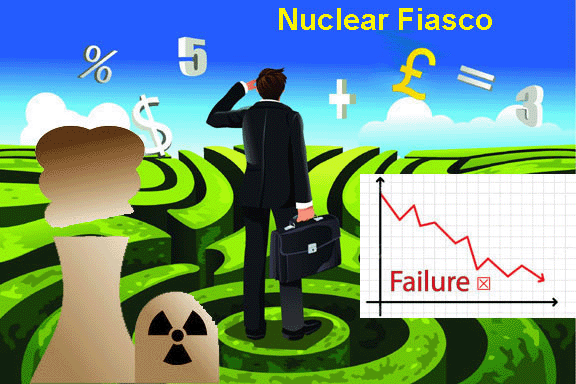 Europe’s new nuclear plants hit more snags https://climatenewsnetwork.net/europes-new-nuclear-plants-hit-more-snags/ Europe’s new nuclear plants hit more snags https://climatenewsnetwork.net/europes-new-nuclear-plants-hit-more-snags/
|
|
Will the Japanese people agree to their government welcoming American nuclear weapons inside Japan?
The Pain and Politics of Hiroshima
Nuclear Weapons in the Reiwa Era https://allthingsnuclear.org/gkulacki/nuclear-weapons-in-the-reiwa-era, GREGORY KULACKI, CHINA PROJECT MANAGER AND SENIOR ANALYST | APRIL 11, 2019 Japan will soon have a new emperor and a new dynastic name to mark the traditional Japanese calender: Reiwa (令和). Interminable commentary on the significance of the name is just beginning, but in the end it will be defined not by words but by deeds. One of the most important acts the Japanese people may be compelled to take as the new era begins is to decide whether to allow their government to introduce US nuclear weapons into Japan. They may have to choose between continuing to honor the LEGACY OF HIROSHIMA and the warnings of the HIBAKUSHA or abandoning Japan’s longstanding role as a leading voice for peace and nuclear disarmament.
UCS obtained a document that contains a detailed description of the Japanese foreign ministry’s requirements for US nuclear weapons. Multiple conversations with the Japanese official who presented this document to his US counterparts not only confirmed its content, they also revealed this small group of hawkish officials wants to train Japanese military personnel to deliver US nuclear weapons. They would even like the United States to grant Japanese leaders the authority to decide when to use them. Japanese officials refer to this arrangement as “nuclear sharing.”
Public opinion polls indicate many Japanese people would like to make the use or threat to use nuclear weapons illegal, which is the purpose of the recently adopted UN Treaty on the Prohibition of Nuclear Weapons (TPNW). A large majority of their elected representatives, even within Abe’s ruling LDP, want to uphold Japan’s Three Non-Nuclear Principles, which forbid “nuclear sharing.” Many Japanese people take pride in the belief that their country plays a leading role in advancing nuclear disarmament.
Abe appears to have injected his nationalist agenda into the selection of the name for the new era. Press reports highlight that Reiwa (令和) is the first Japanese dynastic name not taken from the Chinese classics. The collection of Japanese poetry that inspired Abe’s selection was popular among the military officers of Imperial Japan who led their nation into World War II. Critics panned Reiwa as a cold expression of Abe’s authoritarian tendencies, but it seemed to be well-received and gave an immediate lift to the popularity of a man on track to become the longest serving prime minister in Japanese history.
Only time will tell. Japanese attitudes towards nuclear weapons may be the most important window into the ultimate meaning of Reiwa. Making sure the Japanese people know what their government is saying and doing about nuclear weapons may be the best way to ensure that window is clear.
Trump and South Korea’s Moon Jae-in meet, as USA-North Korea stalemate continues
Trump, South Korea’s Moon look for way to curb North Korea nuclear weapons, Syracuse.co, By The Associated Press,12 Apr 19, WASHINGTON (AP) — President Donald Trump’s meeting with South Korean President Moon Jae-in comes amid uncertainty over whether the leader of North Korea is considering backing out of nuclear negotiations or restarting nuclear and missile tests.
Trump, in his first meeting with Moon since the unsuccessful U.S. summit with Kim in Hanoi, said the U.S. wants to keep economic sanctions in place to pressure Kim to denuclearize. But Trump said he retains good relations with Kim and didn’t rule out a third summit or taking steps to ease food or other shortages in the repressive nation.
“We want sanctions to remain in place,” Trump said Thursday at the White House. “I think that sanctions right now are at a level that’s a fair level.”
Moon, for his part, has called for an easing of sanctions, including those holding back joint economic projects between North and South Korea. But he didn’t speak to the sanctions issue as he and Trump spoke with reporters at the start of their talks.
……… Negotiations on Pyongyang’s nuclear program appear to be stalled, and there is uncertainty over whether Kim is considering backing out of talks or restarting nuclear and missile tests. The Korean Central News Agency on Thursday said that at a party meeting on Wednesday, Kim stressed “self-reliance” in his country to “deal a telling blow to the hostile forces” that “go with bloodshot eyes miscalculating that sanctions can bring” North Korea “to its knees.”
Moon said it’s important to maintain the “momentum of dialogue” and express a positive outlook to the international community that a “third U.S.-North Korea summit” will be held.
…….. Trump walked away from making a deal with Kim at their meeting in late February. Trump said Kim was asking for sanctions relief without wanting to fully dismantle all his nuclear weapons programs. There is ongoing debate over whether harsh sanctions can pressure Kim to denuclearize or will keep him away from the negotiating table.
……… North Korea’s Deputy Foreign Minister Choe Son Hui said last month that Kim would soon make clear his post-Hanoi position. She said her country might pull out of the nuclear negotiations with the United States, citing a lack of corresponding steps to some disarmament measures North Korea took last year. She also hinted that Kim was considering whether to continue the talks and his moratorium on nuclear and missile tests. https://www.syracuse.com/politics/2019/04/trump-south-koreas-moon-look-for-way-to-curb-north-korea-nuclear-weapons.html
The untold story of the campaign to smear Julian Assange
This prospect prompted the UN Working Group on Arbitrary Detention and 33 EU parliamentarians to issue strongly worded statements to both the UK and Ecuadorian governments in December last year, warning against facilitating the prosecution of a journalist, editor and publisher for “publishing the truth”. The statements demanded Assange’s “immediate release, together with his safe passage to a safe country”, and reminded the UK of its “binding” legal obligations to secure freedom for Assange.
A critical task for propagandists such as those waging a psychological war on Wilkileaks, then, is to feed audiences material that supports official narratives and exclude that which does not. Since its inception, the smear campaign against Julian Assange and Wikileaks has been remarkably concerted and consistent in that regard.
With the new year, however, news broke that the International Monetary Fund (IMF) had offered Ecuador a $10 billion bailout in return for handing Julian Assange over to the United States. This bounty came on top of earlier US pressures and inducements, reportedly including increased oil exports, military co-operation and another $1.1 billion in IMF loans, with the US representative of the IMF instructing Ecuador that it must “resolve” its relationship with Julian Assange in order to receive the IMF money.
Australian Barrister Greg Barns has called it the blackmailing of a nation. News website 21st Century Wirecalled it “one of the biggest international bribery (or extortion) cases in history.”
While there is “not a single shred of evidence that any of [Wikileaks’] disclosures caused anyone harm”, writes journalist and author Nozomi Hayase, what Wikileaks did do in 2010 was expose thousands of previously unreported civilian deaths in Iraq and Afghanistan. These deaths included the nonchalant gunning down of children, journalists and their rescuers, and other “indiscriminate violence… torture, lies [and]bribery”, writes Chris Hedges. According to Pentagon Papers whistleblower Daniel Elsberg, the leaks exposed “a massive cover-up over a number of years by the American authorities”.
Julian in ‘critical danger’, new rules ‘torture’ – Assange mother *AUDIO*
The Psychology Of Getting Julian Assange, Part 2: The Court Of Public Opinion And The Blood-Curdling Untold Story, New Matilda, By Dr Lissa Johnson February 25, 2019 In her ongoing special investigation into the detention of Julian Assange, Dr Lissa Johnson turns to the art of smear, and how to corrupt a judicial system.
On Friday 14th February, the Editor in Chief of news website Consortium News, Joe Lauria, visited Sydney to host a ‘Politics in the Pub’ event: Whistleblowing, Wikileaks and the Future of Democracy. The event took place in anticipation of upcoming rallies to free Assange…….
. It is imperative that we pressure the Australian government to make sure its citizen, Julian Assange, is protected from the lawlessness of the American Empire.” Continue reading
PAKISTAN’S Prime Minister Imran Khan issues warning on conflict with India, the nuclear danger
Pakistan PM Khan: Kashmir issue ‘cannot keep boiling’ – BBC News
India Pakistan CONFLICT: Imran Khan issues India nuclear WARNING – ‘no one can predict’
PAKISTAN’S Prime Minister Imran Khan issued a dire warning to his neighbouring country as he branded India’s attack on his “nuclear-armed” country as “irresponsible” and warned Pakistan “would have no choice” but to strike back in the future.
“And there is only one difference, which is Kashmir. It has to be settled.
“The Kashmir issue cannot keep on boiling like it is because anything happening in Kashmir – through a reaction to the oppression which is taking place in Kashmir – it would be palmed off n Pakistan.
“We would be blamed and tensions would rise as they have risen in the past.
“So if we can settle Kashmir, the benefits of peace are tremendous in the subcontinent.”
But speaking about the dangers of confrontation escalating between the two countries, Mr Khan warned: “Once you respond, no-one can predict where it can go from there.”……. https://www.express.co.uk/news/world/1112264/India-Pakistan-news-Kashmir-Imran-Khan-nuclear-weapons-india-election
U.S Secretary of State Mike Pompeo says that Russia complies with the New START nuclear arms control treaty
|
Pompeo: Russia complying with nuclear treaty that’s up for renewal , The Hill 10 Apr 19, Secretary of State Mike Pompeo said Wednesday that Russia is largely in compliance with the New START nuclear arms control treaty with the United States, but indicated the Trump administration is looking at expanding the scope of the pact as renewal talks begin.“There are some arguments on the edges each, but largely they have been compliant,” Pompeo told the Senate Foreign Relations Committee. “Both the Russians and the United States have been compliant. We’re at the very beginning of conversations about renewing that. If we can get the deal right, if we can make sure it fits 2021 and beyond, President Trump has made very clear that if we can get a good solid arms control agreement, we ought to get one.”
The New START Treaty caps the number of nuclear warheads the United States and Russia can deploy at 1,550 each. There are also limits on the number of deployed intercontinental ballistic missiles (ICBM), submarine-launched ballistic missiles and heavy bombers equipped for nuclear warheads, as well as the number of deployed and nondeployed launchers. The Obama-era treaty expires in 2021, but there is an option to extend it another five years. Arms control advocates are worried Trump will let New START expire after he withdrew from a separate arms control treaty with Russia. Advocates warn that for the first time in decades the two biggest nuclear powers might not have limits on their nuclear arsenals. The other treaty, known as the Intermediate-Range Nuclear Forces (INF) Treaty, banned the United States and Russia from having nuclear and conventional ground-launched ballistic and cruise missiles with ranges between 300 and 3,400 miles. Trump announced in February he was starting the six-month process to withdraw from the INF Treaty after years of Russian violations. Current and former officials broadly agree Russia is in violation of the INF agreement, but there have been no similar accusations regarding New START. Still, in 2017, Trump called New START a “one-sided deal” that was “just another bad deal” made by former President Obama. At Wednesday’s hearing, Republicans touted the benefits of New START……. https://thehill.com/policy/defense/438217-pompeo-russia-complying-with-nuclear-treaty-up-for-renewal |
|
1 This Month
26 September – International Day for the Total Elimination of Nuclear Weapons





PLEASE OPPOSE HR 8255 AND S.3639 – bills would accelerate satellite deployment, with no environmental review or safeguards – https://ncstd5li.quorum.us/campaign/169331/
To see nuclear-related stories in greater depth and intensity – go to https://nuclearinformation.wordpress.com
-
Archives
- September 2026 (291)
- August 2026 (330)
- July 2026 (355)
- June 2026 (287)
- May 2026 (306)
- April 2026 (356)
- March 2026 (251)
- February 2026 (267)
- January 2026 (308)
- December 2025 (358)
- November 2025 (359)
- October 2025 (375)
-
Categories
- 1
- 1 NUCLEAR ISSUES
- business and costs
- climate change
- culture and arts
- ENERGY
- environment
- health
- history
- indigenous issues
- Legal
- marketing of nuclear
- media
- opposition to nuclear
- PERSONAL STORIES
- politics
- politics international
- Religion and ethics
- safety
- secrets,lies and civil liberties
- spinbuster
- technology
- Uranium
- wastes
- weapons and war
- Women
- 2 WORLD
- ACTION
- AFRICA
- Atrocities
- AUSTRALIA
- Christina's notes
- Christina's themes
- culture and arts
- Events
- Fuk 2022
- Fuk 2023
- Fukushima 2017
- Fukushima 2018
- fukushima 2019
- Fukushima 2020
- Fukushima 2021
- general
- global warming
- Humour (God we need it)
- Nuclear
- RARE EARTHS
- Reference
- resources – print
- Resources -audiovicual
- Weekly Newsletter
- World
- World Nuclear
- YouTube
-
RSS
Entries RSS
Comments RSS

