Bosnia and Herzegovina oppose Croatia’s nuclear waste plan
 BiH warns Croatia against storing nuclear waste from Krško at borderhttps://balkangreenenergynews.com/bih-warns-croatia-against-storing-nuclear-waste-from-krsko-at-border/ Bosnia and Herzegovina Croatia April 3, 2020 An environmental impact study is underway after Croatia gave the green light to a special fund to use a former barracks near the border with Bosnia and Herzegovina for the disposal of nuclear waste from the Krško nuclear power plant. Both the government in Sarajevo and the Republic of Srpska entity protested against the decision. BiH warns Croatia against storing nuclear waste from Krško at borderhttps://balkangreenenergynews.com/bih-warns-croatia-against-storing-nuclear-waste-from-krsko-at-border/ Bosnia and Herzegovina Croatia April 3, 2020 An environmental impact study is underway after Croatia gave the green light to a special fund to use a former barracks near the border with Bosnia and Herzegovina for the disposal of nuclear waste from the Krško nuclear power plant. Both the government in Sarajevo and the Republic of Srpska entity protested against the decision.
Bosnia and Herzegovina’s Minister of Foreign Trade and Economic Relations Staša Košarac told Croatia’s Ambassador Ivan Sabolić that the neighboring country’s intention to build a storage site for radioactive and nuclear waste from Krško less than a kilometer from the border is unacceptable. The Čerkezovac location at Trgovska gora is a former army barracks near the town of Dvor. Croatia’s Fund for Financing the Decommissioning of the Krško Nuclear Power Plant and the Disposal of Krško NPP Radioactive Waste and Spent Nuclear Fuel just got the approval to use the facility. It revealed an environmental impact study would be conducted before it seeks permits. The Una river, separating the two states, is a protected area. Following earlier announcements about the project, BiH threatened to sue the other country and pursue arbitration and its officials have cited risk from seismic activity. Protests have been held as well.
Košarac claimed more than 250,000 people living near the river would be endangered if the plan is implemented and that it would be bad for the environment. BiH will continue to prove the damaging effect and mobilize its institutions, his ministry said. Čerkezovac is near the country’s northwestern tip. The fund based in Zagreb vowed to cooperate with the local community, the general public and stakeholders on the other side. It claimed that if the project goes through, it would manage the radioactive waste from Krško in a safe, systematic and standardized way. The nuclear power plant is in Slovenia, just 10 kilometers from the border with Croatia and just over 30 kilometers from the center of Zagreb. It was built jointly by the two republics, then part of Yugoslavia, in 1981. Slovenia plans to store waste in Krško’s vicinity, in Vrbina, but there is no consensus with Croatia.
Croatian authorities have filed the domestic national strategy with the European Atomic Energy Community (Euratom) for evaluation. The said study is planned to include geological work and the determination of the so-called zero radiation conditions. The fund said it would perform security analysis as well. Košarac informed Johann Sattler, Head of the Delegation of the European Union and the EU’s Special Representative in BiH, of the country’s stance. |
|
The Russian point of view on nuclear arms control
|
Russia’s View on Nuclear Arms Control: An Interview With Ambassador Anatoly Antonov, Arms Control Association April 2020Arms Control Today conducted a written interview in early March with Anatoly Antonov, Russian ambassador to the United States on issues including the current status of U.S.-Russian strategic security talks, the future of New START, talks on intermediate-range missile systems, engaging China in arms control, and President Vladimir Putin’s proposal for a summit of the leaders of the five permanent members of the UN Security Council……..
Amb. Anatoly Antonov: Russia and the United States are the largest nuclear weapons powers and permanent members of the UN Security Council. They bear a special responsibility for preserving world peace and security. That is why it is crucial to maintain the bilateral strategic stability dialogue at any given circumstance, regardless of political situation. It goes without saying that such engagement should be conducted on a regular basis. ……. As for the consultations in January, our reaction can be described as “cautious optimism.” On the bright side is the fact that the meeting did take place, even though it exposed serious disagreements between our countries on a number of topics. ….. There is no doubt that the Russian-U.S. bilateral arms control agenda remains relevant. We are open to discussing within the strategic dialogue the issue of the newest and prospective weapons that do not fall under New START. ……. https://www.armscontrol.org/act/2020-04/interviews/russias-view-nuclear-arms-control-interview-ambassador-anatoly-antonov |
|
New hypersonic weaponry complicates Nuclear Arms Control Regime
The advent of hypersonic weaponry introduces a new complication to the arms control landscape. Fortunately, New START is a flexible treaty. It includes specific provisions for dealing with emerging weapon systems via its Bilateral Consultative Commission. And, as Russia has demonstrated, hypersonic weapons can be incorporated into existing arms control protocols.
With the United States and Russia suddenly in agreement on the need to limit the deployment of hypersonic missiles, now is an ideal time to explicitly and transparently address these weapons under the New START framework. Doing so would ensure that nuclear arms limitations remain robust, even as tensions flare. With the clock ticking on renewal, neither nation can afford to let a hypersonic arms race get in the way of a proven instrument of global security. https://allthingsnuclear.org/ctracy/fitting-hypersonic-weapons-into-the-nuclear-arms-control-regime
New START’s hypersonic gap
New START sets limits on the deployment of US and Russian nuclear forces. Because these nations possess the vast majority of the world’s nuclear weapons, it constitutes the bedrock of modern nuclear arms control.
The treaty’s core provisions were carefully crafted to address the complexities of nuclear weapons technology. It does not directly limit the number of nuclear warheads either nation may possess, as these are difficult to track and account for. Rather, it focuses on the nuclear warhead delivery systems—ground-launched missiles, submarine-launched missiles, and heavy bomber aircraft—by which these destructive payloads can be carried intercontinental distances. New START limits the number of these systems each nation may possess (up to 800) and deploy (up to 700), as well as the number of warheads that can be mounted on them (up to 1,550).
China is Willing to Negotiate on Nuclear Arms, But Not on Trump’s Terms

 China is Willing to Negotiate on Nuclear Arms, But Not on Trump’s Terms, Defense One, BY GREGORY KULACKI, 30 Mar 20
President Trump announced to the world in a March 5 tweet that he would propose “a bold new trilateral arms control initiative with China and Russia.” China immediately rejected the idea the very next day. It would be wrong, however, to infer that Chinese leaders are opposed to nuclear arms control. They are not. They are just not interested in what Trump appears to be offering.
There are good reasons for China to suspect Trump’s motives. He used China as a scapegoat when withdrawing from the Intermediate Nuclear Forces Treaty, for example, and he may be using this vague new initiative to justify allowing the New START Treaty to expire. China was not a party to either agreement. Walking away from treaties with Russia and blaming China for it is unlikely to encourage Chinese leaders to come to the negotiating table.
Trump premised his announcement of this new initiative with a questionable claim that China will “double the size of its nuclear stockpile” before the end of the decade. That sounds ominous, but in fact China has only about 300 warheads and barely enough plutonium to get to 600. Meanwhile, the United States and Russia each possess more than 6,000 warheads. Any new agreement based on parity among the three states would require steep U.S. and Russian cuts even if China did indeed double its arsenal.
China certainly would welcome major U.S. and Russian reductions. But there is no sign either nation is willing to make them. On the contrary, Trump and President Putin have announced ambitious nuclear modernization programs that dwarf China’s. Since neither of the two countries are planning to reduce their arsenals, it is difficult for Chinese leaders to understand what Trump wants to discuss. Neither the president nor his aides have provided a tentative agenda or cited desired outcomes.
Despite Trump’s apparent failure to engage China, if he or his successor wants to bring China to the negotiating table, there is a path to follow. Below are four steps the United States can take to convince Chinese leaders to negotiate on nuclear arms.
Step 1. Pursue International, not Multilateral, Negotiations
There is a marked difference between international and multilateral negotiations, and it matters to China……..
Step 2. Accept Mutual Vulnerability
Accepting mutual vulnerability sounds defeatist. But all it means is that no one can win a nuclear arms race. The United States cannot prevent China from being able to retaliate and deliver some number of nuclear weapons if the United States should ever choose to use nuclear weapons first during a war……
Step 3. Take No-First-Use Seriously
China is serious about not using its nuclear weapons first in an armed conflict. In a statement after its first nuclear test in 1964, the Chinese government declared it will “never at any time and under any circumstances be the first to use nuclear weapons.”…
Step 4. Discuss Limits on Missile Defense
When the United States and the Soviet Union finally realized that no one could win a nuclear arms race, they decided to talk. Negotiators quickly discovered that limiting offense was impossible without limiting defense as well, since an effective way to counter defenses is to build more offensive weapons…..https://www.defenseone.com/ideas/2020/03/china-willing-negotiate-nuclear-arms-not-trumps-terms/164204/
With all eyes on pandemic, Nuclear Non Proliferation Treaty still needs attention
 Nuclear Proliferation Treaty Troubles Remain Unaddressed Amid a Global Pandemic, https://nationalinterest.org/feature/nuclear-proliferation-treaty-troubles-remain-unaddressed-amid-global-pandemic-138162 It is vital that would-be bombmakers be disabused of any notion that they could evade tough international sanctions. We need a country-neutral, reasonably predictable, more-or-less automatic sanction regime that puts all countries on notice, even friends of the powerful. Nuclear Proliferation Treaty Troubles Remain Unaddressed Amid a Global Pandemic, https://nationalinterest.org/feature/nuclear-proliferation-treaty-troubles-remain-unaddressed-amid-global-pandemic-138162 It is vital that would-be bombmakers be disabused of any notion that they could evade tough international sanctions. We need a country-neutral, reasonably predictable, more-or-less automatic sanction regime that puts all countries on notice, even friends of the powerful.
by Victor Gilinsky Henry Sokolski, 27 Mar 20, Just as we’ve had to discard business-as-usual thinking to deal with the current worldwide health emergency; it’s time to get serious about the spread of nuclear weapons. It doesn’t have the immediacy of the coronavirus, but it will last a lot longer and is no less threatening. In particular, we need to fortify the Nuclear Nonproliferation Treaty (NPT), which is fifty years old this year and badly needs fixing. The April 2020 Review Conference will likely be postponed, which provides time to develop something more than the usual charade of incremental proposals that nibble at the problem.
What needs fixing? Five problems: The NPT allows withdrawal on three months notice; it does not bar the use of nuclear explosives as fuels; its inspection arm, the International Atomic Energy Agency (IAEA), is too much involved in promoting nuclear energy; it lacks an established enforcement system, so each violation requires an improvised response; and it is undermined by the holdouts—India, Israel, North Korea, and Pakistan—thumbing their noses at the treaty. International lawyers may scream, but we need to make it essentially impossible to exercise the NPT’s withdrawal provision. This is vital because the member states’ safeguards agreements with the IAEA remain in force only so long as the states remain parties to the treaty. A country should not be allowed to gather the wherewithal for a bomb while a member and then free itself of its treaty responsibilities by announcing its withdrawal. It shouldn’t be allowed to leave the treaty with technology, imported or indigenous, it obtained as a member, because it did so with the forbearance of other members on the assumption that it was doing so for peaceful uses.There has to be a wide safety margin between genuinely peaceful and potentially military applications to make it impossible to surprise the world with a bomb.
The oft-cited “inalienable right” to “nuclear energy for peaceful purposes” in the NPT’s Article IV has to be interpreted strictly in terms of the treaty’s overriding objective expressed in Article I (nuclear weapons countries can’t help others get bombs), and Article II (non-weapons countries can’t get them, period). That’s a long way of saying no commercial use of highly enriched uranium or plutonium, which today has no economic justification.
Another relic embedded in the NPT and the IAEA Statute is their promotion of nuclear power. With mind-numbing regularity, IAEA officials argue that accommodating countries on nuclear energy technology helps to gain their assent to control measures. But this approach weakens the NPT by creating a zero-sum game in which nonproliferation obligations of the many members are held hostage to technology sharing by the main supplier states. Unfortunately, too many members want dangerous technologies. That is not all. The agency’s singling out of nuclear energy as the anointed energy source leads to a misallocation of economic and scientific resources in countries that can’t afford it.
In the initial years of the NPT, there was an implicit assumption that the Western states and Soviets would police their spheres. But now, with the Cold War over, the NPT needs an established enforcement mechanism to deal predictably with violations, instead of each instance requiring improvisation by the leading members. The logic of “safeguards” assumes rapid international reaction, but experience shows it is more often measured in years. It is vital that would-be bombmakers be disabused of any notion that they could evade tough international sanctions. We need a country-neutral, reasonably predictable, more-or-less automatic sanction regime that puts all countries on notice, even friends of the powerful. A permanent secretariat attached to the treaty would help. Finally, it undermines the treaty when a non-member is used to enforce it, as when the United States acquiesced in Israel’s 2007 bombing of Syria’s clandestine reactor, instead of involving the IAEA, or when it cooperated with Israel in sabotaging Iran’s nuclear program.
The most difficult issue is what to do about the three NPT holdouts—India, Israel, and Pakistan—and the member-in-violation, North Korea. The drafters’ intent to only recognize five nuclear states was to first make sure that number did not grow larger while treating reductions among the five separately. To add new nuclear weapon members in addition to these five would undermine the treaty. However impossible it may now seem, the only way that all states can be brought under the NPT system is if all commit themselves to reduce their nuclear weapons to zero. The United States and Russia have made substantial reductions, but the continuation of that process requires all nuclear states to join in further cuts. Towards this end, we would universalize the treaty—that is, regard it as applicable to all states. The three holdouts would then be in non-compliance. Of course, as a legal matter, you cannot force a country to join a treaty. But if the 190 NPT members so decided, they could treat the three holdouts, and North Korea, as countries in non-compliance, with appropriate disadvantages that would follow from that. At the same time, if these countries joined the weapons reductions process under adequate monitoring, they could be considered as approaching compliance, and disadvantages could be moderated.
This much is clear: Incremental, least-common-denominator steps are never going to get us to where we need to be, and serious people responsible for security know it. To cope with proliferation hazards in the face of weak international controls over nuclear programs, the world seems to be slipping—witness the case of Iran—into relying on greatly increased national intelligence operations backed up in the last instance by bombing and even assassinations. It is difficult to imagine that this is a workable solution for the long term.
To stop the further spread of nuclear weapons, we have to stop downplaying the NPT. Instead, we should strengthen and use it. Victor Gilinsky is a program advisor for the Nonproliferation Policy Education Center (NPEC) in Arlington, Virginia. He served on the Nuclear Regulatory Commission under Presidents Ford, Carter, and Reagan. Henry Sokolski is executive director of NPEC and the author of Underestimated: Our Not So Peaceful Nuclear Future (second edition 2019). He served as deputy for nonproliferation policy in the Cheney Pentagon. |
|
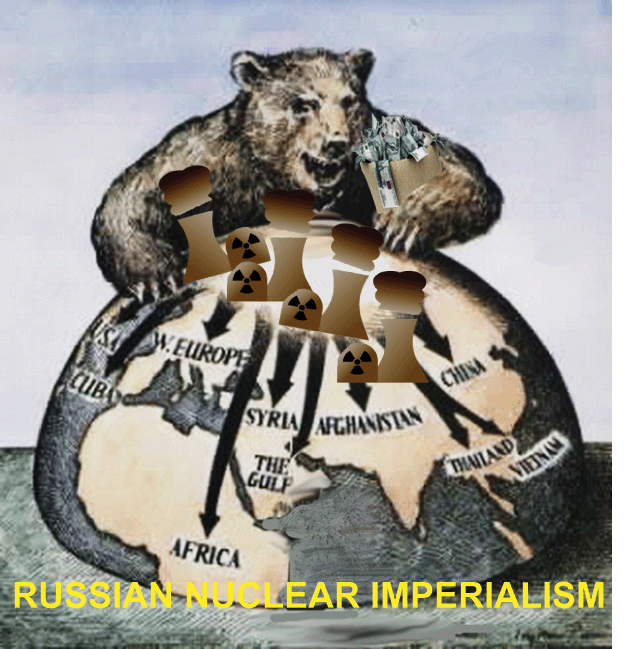
Belarus to swap gas dependence on Moscow for nuclear dependence on Moscow
|
Belarus to swap gas dependence on Moscow for nuclear dependence on Moscow https://bellona.org/news/nuclear-issues/2020-03-belarus-to-swap-gas-dependence-on-moscow-for-nuclear-dependence-on-moscowA nuclear power plant built to lessen Belarus’s dependence on Moscow for natural gas – but constructed and lavishly financed by Russia’s state nuclear corporation Rosatom – is due to begin operation later this year, officials in the Belarus capital of Minsk have said. March 24, 2020 by Charles Digges
A nuclear power plant built to lessen Belarus’s dependence on Moscow for natural gas – but constructed and lavishly financed by Russia’s state nuclear corporation Rosatom – is due to begin operation later this year, officials in the Belarus capital of Minsk have said. The plant will feature two VVER-1200 reactors – the second of which will come online next year – that will together generate some 2.4 gigawatts of power in the cloistered post-Soviet dictatorship on Russia’s western border. The International Atomic Energy Agency found that the plant largely fulfilled general safety guidelines and issued a number of recommendations for improvement. Others have raised alarm over potential safety issues. GlobalData quoted energy and nuclear policy analyst Mycle Schneider as warning: “Neighboring countries have voiced concern over the lack of review of some serious safety concerns, and Lithuania has transmitted an official note to the European Council.” Since its inception in the early 2000s, the Belarus nuclear power plant, in Ostrovets near the border of Lithuania, has been fraught with difficulties. Environmentalists who oppose the plant are routinely harassed and stifled and in some cases kicked out of the country. Neighboring Lithuania, once seen as a promising potential market when construction began, is now so opposed to the plant that its parliament outlawed purchasing any electricity it produces and has sent envoys to other countries encouraging them to do the same. Poland and the Ukraine have also spoken out against the plant. Each of these groups have called attention to the mishaps that have plagued the plant during its construction, including an incident in 2016 when technicians inadvertently dropped a 330-ton reactor pressure vessel – which houses the core – from a crane. A replacement unit sent to the site was accidentally run into a column at a railway station when it arrived. But the plant also illustrates an energy conundrum facing many European countries. While a number of nations in the old Soviet orbit seek to diversify their energy supplies away from Russian natural gas, Rosatom is more than willing to step into the vacuum left by that shift. By offering huge loans to build and supply nuclear power plants, Rosatom can keep customers financially and technically beholden to Moscow for as long as 50 years. With other kinds of power infrastructure, a contractor builds a facility and leaves it to be operated by the country where it stands. Not so with nuclear power plants, where foreign government customers, like Belarus, remain dependent on Rosatom – and thus the Russian state – for fuel, know-how and eventual decommissioning works. That geopolitical strategy is not lost on Lithuania, whose prime minister recently told the New York Times that: “The [Ostrovets} nuclear plant is an example of Russia’s desire to keep states along its borders in its orbit at all costs – it helps them preserve more influence.” The policy is has broad implications. Rosatom has convinced dozens of countries to sign memorandums of understanding on all manner of nuclear services, from research and training facilities to nuclear power plant construction. As a result, Rosatom says that its portfolio of foreign projects has swelled to more than $200 billion. But that figure invites skepticism. Many of the counties Rosatom counts toward that figure – like Ethiopia, Algeria, Nigeria, Sudan and Rwanda – won’t be ready to support nuclear power on their grids for decades. Others where Rosatom builds are already underway – like India’ Kudankulam, Iran’s Bushehr and China’s Tianwan – are already familiar with Rosatom’s typical cost overruns and delays. Furthermore, a deep dig into Rosatom’s claimed income by the Russian environmental group Ecodefence revealed that business wasn’t going quite as indicated. A report by the group, published last year, detailed a number of cases where the corporation misstated the worth of its overseas reactor construction projects, and inflated their worth by several billion dollars. Still, the corporation is an ambitious and successful presence on the international market. According to one study, cited by the New York Times, Rosatom has sold more nuclear technology abroad since 1999 than the United States, France, China, South Korea and Japan combined. Rosatom’s approach to marketing its reactors is distinct from its western competitors because it offers to finance, build and operate the plants that it builds abroad. These generous terms come thanks to the enormous state subsidies Rosatom receives – and which it can then funnel into loans that boost its profits on paper. The Belarus plant, for instance, comes thanks to a $10 million line of credit from Rosatom. Hungary, a member of the EU, became another customer when it took an $11 billion loan to build its Paks II in 2016. Rosatom also won a $30 billion contract for four reactors in Egypt, and another big nuclear plant deal in Turkey. While it’s tempting to see a strategy afoot in Rosatom’s foreign projects, the Kremlin insists it’s just business. President Vladimir Putin has publicly distanced himself from mixing politics with foreign commerce. |
|
Iran, hit by hardship and coronavirus, gets callous sanctions from Trump administration
 Trump’s callous sanctions risk tipping Iran over the nuclear precipice, Mike Pompeo’s imposition of further sanctions is another disaster for the people of Iran and could cause Tehran to raise the stakes, Guardian, Simon Tisdall Sun 22 Mar 2020
Displaying the sort of unthinking bellicosity that has characterised his tenure as US secretary of state, Mike Pompeo chose last week – a time of unprecedented global turmoil – to impose yet more unilateral sanctions on Iran. This was akin to pouring petrol on a burning building, then waiting to see how big an explosion ensues.
The timing of the new measures was doubly inept. Iran’s freeing of thousands of political prisoners last week raised hopes of full pardons for jailed US citizens and the British-Iranian dual national Nazanin Zaghari-Ratcliffe, who has been temporarily released.
Those hopes have receded now. Meanwhile, Pompeo’s heedless intervention risked fuelling calls inside Iran to
not only the creaking 2015 nuclear deal but also the nuclear non-proliferation treaty (NPT) – the cornerstone since 1970 of international efforts to curb the spread of nuclear weapons.
,………. the move could hardly have been more provocative, or more cruel. Iranians have endured many months of intensifying hardship as US sanctions have shrunk the economy, destroyed jobs and depressed living standards. They have been badly hit by the coronavirus, which the health ministry has said is killing one person every 10 minutes.
Advertisement
Callous US disregard for Iran’s Covid-19 emergency – it is effectively blocking bilateral medical aid and a request for a $5bn loan from the International Monetary Fund – suggests that Washington is not interested in confidence-building measures. “The Wuhan virus is a killer and the Iranian regime is an accomplice,” Pompeo snarled.
Iran’s leadership is under pressure from conservative hardliners after the latter’s recent election successes. This latest manifestation of Washington’s unremitting hostility may help push them over the brink. Thanks mainly to Donald Trump and his sidekick, Tehran could soon move a crucial step closer to going nuclear – the very outcome the Americans most fear……. https://www.theguardian.com/commentisfree/2020/mar/21/trump-pompeo-iran-callous-sanctions-nuclear-precipice
Sun 22 Mar 2020 Trump’s callous sanctions risk tipping Iran over the nuclear precipiceSimon Tisdall
isplaying the sort of unthinking bellicosity that has characterised his tenure as US secretary of state, Mike Pompeo chose last week – a time of unprecedented global turmoil – to impose yet more unilateral sanctions on Iran. This was akin to pouring petrol on a burning building, then waiting to see how big an explosion ensues.
The timing of the new measures was doubly inept. Iran’s freeing of thousands of political prisoners last week raised hopes of full pardons for jailed US citizens and the British-Iranian dual national Nazanin Zaghari-Ratcliffe, who has been temporarily released.
Those hopes have receded now. Meanwhile, Pompeo’s heedless intervention risked fuelling calls inside Iran to
not only the creaking 2015 nuclear deal but also the nuclear non-proliferation treaty (NPT) – the cornerstone since 1970 of international efforts to curb the spread of nuclear weapons.
,………. the move could hardly have been more provocative, or more cruel. Iranians have endured many months of intensifying hardship as US sanctions have shrunk the economy, destroyed jobs and depressed living standards. They have been badly hit by the coronavirus, which the health ministry has said is killing one person every 10 minutes.
Callous US disregard for Iran’s Covid-19 emergency – it is effectively blocking bilateral medical aid and a request for a $5bn loan from the International Monetary Fund – suggests that Washington is not interested in confidence-building measures. “The Wuhan virus is a killer and the Iranian regime is an accomplice,” Pompeo snarled.
Iran’s leadership is under pressure from conservative hardliners after the latter’s recent election successes. This latest manifestation of Washington’s unremitting hostility may help push them over the brink. Thanks mainly to Donald Trump and his sidekick, Tehran could soon move a crucial step closer to going nuclear – the very outcome the Americans most fear……. https://www.theguardian.com/commentisfree/2020/mar/21/trump-pompeo-iran-callous-sanctions-nuclear-precipice
What effect will pandemic have on tensions with North Korea?
Breakthrough or Crisis? How Will Coronavirus Impact Tensions with North Korea?
Is a breakthrough possible?: “As it continues to call on Pyongyang to resume negotiations, Washington could consider gathering support for an interim agreement from Seoul, Tokyo, Beijing, and Moscow. If successful, perhaps North Korea will feel pressured to return to dialogue or risk being blamed for breaking the diplomatic process. If a deal cannot be reached before November, the elements of such an interim agreement could be the starting point of discussions with the US administration after the elections.” National Interest, by Duyeon Kim, 22 Mar 20 The novel coronavirus pandemic has accelerated geopolitical tensions first in Northeast Asia, with the original outbreak in China, and now around the world as the United States, Europe and many others battle their own epidemics and global markets spiral downward. Leaders among the big powers—particularly the US, China, and Russia—already trying to exploit this global crisis to gain advantage and exert power instead of coming together to fight a common threat. This climate adds another layer of uncertainty over the Korean Peninsula where an authoritarian leader is trying to exert his power at a time when every world leader is preoccupied with the viral disease that is simultaneously testing their leadership and competence.
Nuclear-powered submarines – fraught with legal and political problems

|
The Complex Policy Questions Raised by Nuclear Energy’s Role in the Future of Warfare, Just Security by Alex Gilbert, Morgan Bazilian and Julia Nesheiwat, March 16, 2020 The United States military, as well as other militaries around the world, are racing to develop high-energy weapons—lasers, high-powered microwaves, and electromagnetic rail guns—in order to compete with near-peer competitors on the next generation of military technologies. But the electricity to power these systems will need to derive from somewhere, and so military planners are eyeing a new generation of energy-dense nuclear reactors, despite potential policy and legal challenges to doing so…….. The Army is considering mobile nuclear power plants, in part to drive high-energy weapons, an idea one retired three-star hailed as a potential logistics revolution. And should the U.S. build space-based lasers for missile defense, nuclear energy may be the only way to provide the needed megawatts. All this raises key policy concerns in relation to international law, rules of engagement, and the laws of warfare. Basing, or even deploying, nuclear reactors in the territorial waters or land of an overseas ally requires the permission of the host government, which may be averse to expanding nuclear power as in the case of major bases like Yokosuka, Japan. Diego Garcia, an island in the Indian Ocean, provides another challenging case as the ongoing territorial dispute between the United Kingdom and Mauritius threatens the U.S. base there, and a nuclear plant would only complicate the existing dispute. The U.S. Navy already faces constraints on where their nuclear-powered ships can visit. Floating nuclear power plants, like those developed by Russia and China, face similar concerns if they transit foreign waters or, in the case of the South China Sea, are stationed in disputed territories. Similarly, mobile reactors, like those considered by the U.S. Army, would likely be transported by air, requiring permission of all overflight countries. Beyond basing, a critical question is whether the U.S. military would own and operate these new reactors, as the Navy currently does, or whether they would pursue commercial alternatives, as the Army is considering. The U.S. Army report on mobile reactors noted that, with either government or commercial ownership, there are concerns about international rules and licensing that present potential barriers to deployment. In some cases, potential host countries do not even have nuclear regulatory agencies. Further, commercial ownership raises liability concerns, both in the case of a military incident or an accident. International nuclear liability treaties are not well harmonized between the U.S. and most of its allies, especially when it comes to the unique concerns of transportable reactors. Using nuclear power for high-energy weapons also creates targeting dilemmas for the U.S. and foreign militaries. High-energy weapons and their support infrastructure, including reactors, may be initial targets in a conflict. The social, environmental, and reputational impacts of damaging a nuclear reactor, particularly on a country’s home territory, or with effects on a third country, could lead to conflict escalation and international condemnation……. Nuclear-powered laser satellites could aggravate concerns about nuclear arms controls as such systems could be used for anti-ballistic missile or anti-satellite applications. While the Outer Space Treaty prohibits weapons of mass destruction in orbit, it does not prohibit other types of weaponry. During the Cold War, Soviet military space reactors raised calls for bans on space nuclear power, particularly after one accidentally crashed in Canada. Recent calls for space arms control have been unsuccessful. As with terrestrial nuclear-powered lasers, the unique role of laser satellites would make them early targets in any major power conflict, leading to risks of collateral damage from radioactive and dangerous space debris, as occurred after the accidental 2009 collision involving a decommissioned Soviet nuclear satellite.. The article below is not about Australia, but it is about small nuclear reactors. Everybody knows, (just quietly) that Australia won’t be getting small nuclear reactors for providing electricity. The real aim is for nuclear-powered submarines. So this article, about the legal and political problems of nuclear reactors for Defence is applicable to Australia, too
The Complex Policy Questions Raised by Nuclear Energy’s Role in the Future of Warfare, Just Security by Alex Gilbert, Morgan Bazilian and Julia Nesheiwat, March 16, 2020 The United States military, as well as other militaries around the world, are racing to develop high-energy weapons—lasers, high-powered microwaves, and electromagnetic rail guns—in order to compete with near-peer competitors on the next generation of military technologies. But the electricity to power these systems will need to derive from somewhere, and so military planners are eyeing a new generation of energy-dense nuclear reactors, despite potential policy and legal challenges to doing so…….. The Army is considering mobile nuclear power plants, in part to drive high-energy weapons, an idea one retired three-star hailed as a potential logistics revolution. And should the U.S. build space-based lasers for missile defense, nuclear energy may be the only way to provide the needed megawatts.
All this raises key policy concerns in relation to international law, rules of engagement, and the laws of warfare.
Basing, or even deploying, nuclear reactors in the territorial waters or land of an overseas ally requires the permission of the host government, which may be averse to expanding nuclear power as in the case of major bases like Yokosuka, Japan. Diego Garcia, an island in the Indian Ocean, provides another challenging case as the ongoing territorial dispute between the United Kingdom and Mauritius threatens the U.S. base there, and a nuclear plant would only complicate the existing dispute.
The U.S. Navy already faces constraints on where their nuclear-powered ships can visit. Floating nuclear power plants, like those developed by Russia and China, face similar concerns if they transit foreign waters or, in the case of the South China Sea, are stationed in disputed territories. Similarly, mobile reactors, like those considered by the U.S. Army, would likely be transported by air, requiring permission of all overflight countries.
Beyond basing, a critical question is whether the U.S. military would own and operate these new reactors, as the Navy currently does, or whether they would pursue commercial alternatives, as the Army is considering. The U.S. Army report on mobile reactors noted that, with either government or commercial ownership, there are concerns about international rules and licensing that present potential barriers to deployment. In some cases, potential host countries do not even have nuclear regulatory agencies. Further, commercial ownership raises liability concerns, both in the case of a military incident or an accident. International nuclear liability treaties are not well harmonized between the U.S. and most of its allies, especially when it comes to the unique concerns of transportable reactors.
Using nuclear power for high-energy weapons also creates targeting dilemmas for the U.S. and foreign militaries. High-energy weapons and their support infrastructure, including reactors, may be initial targets in a conflict. The social, environmental, and reputational impacts of damaging a nuclear reactor, particularly on a country’s home territory, or with effects on a third country, could lead to conflict escalation and international condemnation…….
Nuclear-powered laser satellites could aggravate concerns about nuclear arms controls as such systems could be used for anti-ballistic missile or anti-satellite applications. While the Outer Space Treaty prohibits weapons of mass destruction in orbit, it does not prohibit other types of weaponry. During the Cold War, Soviet military space reactors raised calls for bans on space nuclear power, particularly after one accidentally crashed in Canada. Recent calls for space arms control have been unsuccessful. As with terrestrial nuclear-powered lasers, the unique role of laser satellites would make them early targets in any major power conflict, leading to risks of collateral damage from radioactive and dangerous space debris, as occurred after the accidental 2009 collision involving a decommissioned Soviet nuclear satellite…. …… https://www.justsecurity.org/69056/the-complex-policy-questions-raised-by-nuclear-energys-role-in-the-future-of-warfare/
|
|
Iran continues to provide international inspectors access to its nuclear facilities
“The agency has not observed any changes to Iran’s implementation of its nuclear-related commitments under the JCPOA in connection with this announcement, or in the level of cooperation by Iran in relation to agency verification and monitoring activities under the JCPOA,” Grossi said in prepared remarks……..
The JCPOA promised Iran economic incentives in return for the curbs on its nuclear program, but since President Donald Trump pulled the U.S. out of the deal unilaterally in 2018 and imposed new sanctions, the country’s economy has been struggling.
Its violations of the pact are intended to pressure the other nations involved to increase economic incentives to make up for the American sanctions. So far, attempts by the other members of the JCPOA have fallen short of Iran’s demands.
In a separate report to members last week, the IAEA said it had identified three locations in Iran where the country possibly stored undeclared nuclear material or undertook nuclear-related activities without declaring it to international observers.
The activities at those locations are believed to have dated from the early 2000s, before the nuclear deal, and Iran responded to the report by suggesting that the IAEA had no legal basis to inspect those sites.
In his speech to the board members, Grossi called on “Iran to cooperate immediately and fully with the agency, including by providing prompt access to the locations specified by the agency.”
“The agency has identified a number of questions related to possible undeclared nuclear material and nuclear-related activities at three locations that have not been declared by Iran,” Grossi said, according to his prepared remarks. “The agency sought access to two of the locations. Iran has not provided access to these locations and has not engaged in substantive discussions to clarify the agency’s questions.” https://www.japantimes.co.jp/news/2020/03/09/world/u-n-atomic-watchdog-says-iran-still-providing-nuclear-access/#.XmbVIagzbIU
Trump’s America prepares to use low-level nuclear weapons as “a viable option” – Russia fears
 Russia Fears US Under Trump Now Ready to Use Nuclear Weapons as ‘Viable Political Option’ https://www.commondreams.org/news/2020/03/06/russia-fears-us-under-trump-now-ready-use-nuclear-weapons-viable-political-option“This dramatically increases the chance of a nuclear exchange due to miscalculation or human error.”by Eoin Higgins, staff writer
 |
“Washington is not just modernizing its nuclear forces, but is striving to give them new capabilities, which greatly expands the likelihood of their use,” Russian Foreign Ministry spokeswoman Maria Zakharova said Friday. Zakharova told reporters that the U.S. increase in nuclear weapons capabilities earlier in the year, when the military deployed a low-yield ballistic warhead to its submarines, reduces the threshhold for using the weapons and brings the world closer to the possibility of nuclear war. As Common Dreams reported, the move was seen by International Campaign to Abolish Nuclear Weapons treaty coordinator Tim Wright as “an alarming development that heightens the risk of nuclear war.” “Of particular concern is the expansion of the range of U.S. low-yield weapons in its nuclear arsenal, including the development and deployment of such munitions for strategic carriers,” said Zakharova. The U.S. in February angered Russian officials for a war game in which the Pentagon ran a scenario where Russia attacked a NATO ally with a low-yield nuclear weapon and the U.S. responed with a “limited” nuclear strike. According to RT, the Russian government’s concerns are based in part on the U.S.’s nuclear doctrines:
As the Washington Physicians for Social Responsibility’s Bruce Amundson and Joseph Berkson wrote for the Seattle Times in February after the U.S. deployment of low-yield weapons was announced, the deployment raises the risk of overreaction and escalation:
In her remarks Friday, Zakharova said Moscow was treating U.S. moves as a sign the country “has made a decision to consider a nuclear conflict as a viable political option and are creating the potential [scenario] necessary for it.” President Donald Trump and his administration have been reluctant to commit to renewing the Nuclear Nonproliferation Treaty in April 2021. The treaty turned 50-years-old on March 5, leading United Nations General Secretary António Guterres in a statement to call on treaty signatories to recommit to world peace. “The Secretary-General calls on States parties to make the most of this opportunity to strengthen international peace and security through the promotion of non-proliferation of nuclear weapons and nuclear disarmament, as well as measures to strengthen implementation of the NPT and achieve its universality,” said Guterres. |
Westinghouse nuclear reactors – a very poor deal for India
Pushing the wrong energy buttons, https://www.thehindu.com/opinion/op-ed/pushing-the-wrong-energy-buttons/article30965454.ece?fbclid=IwAR1ymOL6TLlSxlUKkVVSL6_ukPPeiSzDlI_JM-He3CMG2qBD4HaBU0vezog, M.V. Ramana, Suvrat Raju, MARCH 03, 2020
The idea of India importing nuclear reactors is a zombie one with serious concerns about their cost and safety
Red flags in the U.S. deal
Because of serious concerns about cost and safety, the two organisations should have been told to abandon, not finalise, the proposal.
Indeed, it has been clear for years that electricity from American reactors would be more expensive than competing sources of energy. Moreover, nuclear reactors can undergo serious accidents, as shown by the 2011 Fukushima disaster. Westinghouse has insisted on a prior assurance that India would not hold it responsible for the consequences of a nuclear disaster, which is effectively an admission that it is unable to guarantee the safety of its reactors.
The main beneficiaries from India’s import of reactors would be Westinghouse and India’s atomic energy establishment that is struggling to retain its relevance given the rapid growth of renewables. But Mr. Trump has reasons to press for the sale too. His re-election campaign for the U.S. presidential election in November, centrally involves the revival of U.S. manufacturing and he has been lobbied by several nuclear reactor vendors, including 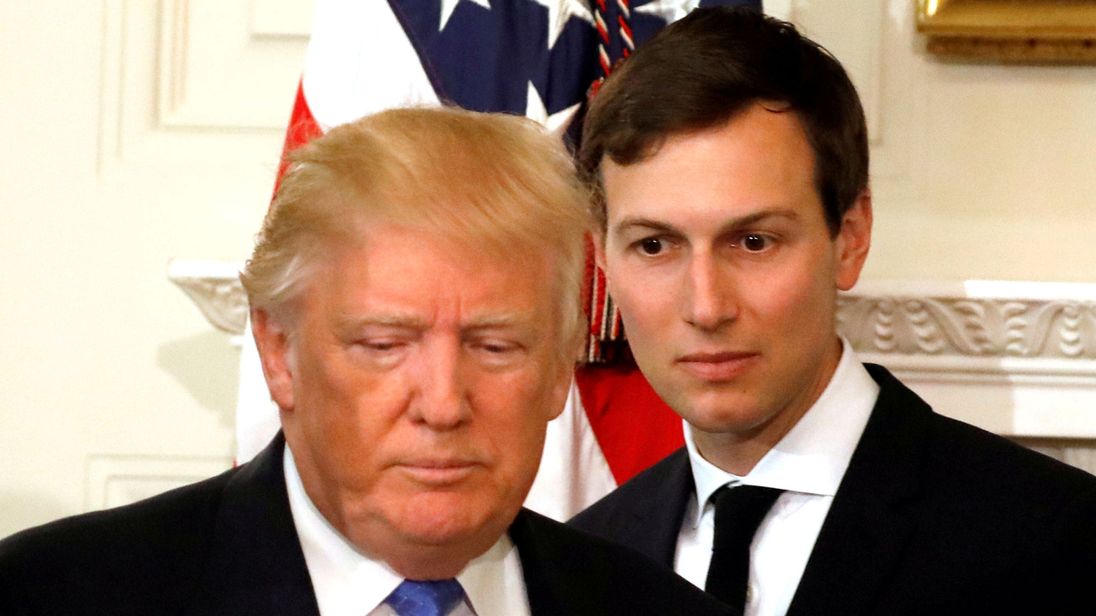 Westinghouse, reportedly to “highlight the role U.S. nuclear developers can play in providing power to other countries”. Finally, he also has a conflict-of-interest, thanks to his son-in-law and adviser, Jared Kushner, who accompanied him during the India visit.
In 2018, the Kushner family’s real-estate business was bailed out by a Canadian company that invested at least $1.1-billion in a highly unprofitable building in New York. Earlier that year, Brookfield Business Partners, a subsidiary of that Canadian company, acquired Westinghouse Electric Company. It violates all norms of propriety for Mr. Kushner to be anywhere near a multi-billion dollar sale that would profit Brookfield enormously.
What renewables can offer
Analysts estimate that each of the two AP1000 units being constructed in the U.S. state of Georgia may cost about $13.8 billion. At these rates, the six reactors being offered to India by Westinghouse would cost almost ₹6 lakh crore. If India purchases these reactors, the economic burden will fall upon consumers and taxpayers. In 2013, we estimated that even after reducing these prices by 30%, to account for lower construction costs in India, the first year tariff for electricity would be about ₹25 per unit. On the other hand, recent solar energy bids in India are around ₹3 per unit. Lazard, the Wall Street firm, estimates that wind and solar energy costs have declined by around 70% to 90% in just the last 10 years and may decline further in the future.
How safe?
Nuclear power can also impose long-term costs. Large areas continue to be contaminated with radioactive materials from the 1986 Chernobyl accident and thousands of square kilometres remain closed off for human inhabitation. Nearly a decade after the 2011 disaster, the Fukushima prefecture retains radioactive hotspots and the cost of clean-up has been variously estimated to range from $200-billion to over $600-billion.
The Fukushima accident was partly caused by weaknesses in the General Electric company’s Mark I nuclear reactor design. But that company paid nothing towards clean-up costs, or as compensation to the victims, due to an indemnity clause in Japanese law. Westinghouse wants a similar arrangement with India. Although the Indian liability law is heavily skewed towards manufacturers, it still does not completely indemnify them. So nuclear vendors have tried to chip away at the law. Instead of resisting foreign suppliers, the Indian government has tacitly supported this process.
Starting with the Tarapur 1 and 2 reactors, in Maharashtra, India’s experiences with imported reactors have been poor. The Kudankulam 1 and 2 reactors, in Tamil Nadu, the only ones to have been imported and commissioned in the last decade, have been repeatedly shut down. In 2018-19, these reactors produced just 32% and 38%, respectively, of the electricity they were designed to produce. These difficulties are illustrative of the dismal history of India’s nuclear establishment. In spite of its tall claims, the fraction of electricity generated by nuclear power in India has remained stagnant at about 3% for decades.
The idea of importing nuclear reactors is a “zombie idea” that, from a rational viewpoint, should have been dead long ago. In fact an earlier plan to install AP1000s in Mithi Virdi, Gujarat was cancelled because of strong local opposition. In 2018, Gujarat Chief Minister Vijay Rupani declared that the reactors “will never come up” in Gujarat. The Prime Minister should take a cue from his own State and make a similar announcement for the rest of the country.
Middle East nuclear arms race to begin, as United Arab Emirates to open world’s largest nuclear reactor?
State-run Korea Electric Power Corporation of South Korea is finishing work on four nuclear reactors in the Al Dhafra region of Abu Dhabi. Known as Barakah and owned by Emirates Nuclear Energy Corporation, the plant is scheduled to go online later this month with a capacity of 5.6 gigawatts.
Barakah is likely to fuel fears in the already tense region, given the uncertainty over the Joint Comprehensive Plan of Action, or Iran nuclear deal, and Israel’s lack of transparency over its nuclear program. Experts warn about more nuclear plants, increased uranium enrichment, and a possible nuclear arms race in what is arguably the most volatile region in the world……
the UAE’s neighbors are far from comfortable with the new plant.
Qatar expressed concern in a letter to the International Atomic Energy Agency, stating that an accidental discharge of radioactive material from Barakah could reach the capital of Doha in under 13 hours.
There are also concerns that the facility could be attacked. Paul Dorfman, researcher at University College London, told Nikkei that the risk of a missile attack on a nuclear facility is not to be discounted. Yemeni rebels claimed responsibility for just such an attack that targeted Barakah while still under construction in 2017. ……
Egypt and Jordan have also jumped on board the nuclear bandwagon. Egypt is set to build four nuclear reactors this year in collaboration with Russia in the El Dabaa region west of Cairo. Lawmaker Ahmed al Tantawi is wary of his country’s nuclear program, stating that Egypt already has a surplus of electricity.
Jordan’s nuclear program, however, faces problems such as financing and how to mitigate potential terrorist attacks. There is also a shortage of water needed to cool reactors, as it is one of the world’s most arid countries.
Iran’s nuclear ambitions are the most alarming. The country already has one nuclear power reactor at the Bushehr power plant and has two other Russian-designed reactors in the works. Construction on one began in November 2019 and is scheduled to finish in 2023. Another is still in the planning stage.
Tehran had curtailed enrichment under the nuclear deal, from which the U.S. withdrew in 2018. But the situation drastically changed in January after the U.S. drone assassination of Iranian Gen. Qassim Soleimani.
“Iran is still adhering to some of its duties under the JCPOA, such as International Atomic Energy Agency oversight,” Mohammed Marandi, political analyst at the University of Tehran, told Nikkei. “But with regards to research and development, the Iranians will no longer accept limitations due to the Europeans and Japanese [not cooperating],” he added.
The European Union tried to save the Iran Nuclear Deal after the administration of U.S. President Donald Trump withdrew. Later, however, the U.K., France and Germany invoked the dispute settlement framework in the deal after Iran increased enrichment activities on the heels of Soleimani’s assassination. Even Japan tried to help by mediating between Tehran and Washington but ultimately failed to ease tensions.
Israel, which is notably not a signatory to the Treaty on the Non-Proliferation of Nuclear Weapons, has a highly advanced military. The Nuclear Threat Initiative, a U.S. nuclear research entity, warns that Israel possesses nuclear weapons along with a large supply of ballistic and cruise missiles to deliver them. And there is no open consensus among experts as to the extent of Israel’s nuclear program.
Analysts say that U.S. policy is encouraging a Middle East nuclear arms race in two ways. First, the U.S. defense and nuclear industries view the region as a lucrative market, with Saudi Arabia being a key buyer. Second, the inaction of Europe, Russia and China to counter U.S. sanctions against Iran do not encourage Tehran to remain a party to the nuclear deal. https://asia.nikkei.com/Politics/International-relations/UAE-s-nuclear-plant-fuels-fears-of-Middle-East-arms-race
Veterans groups not happy -France wants to abolish the National Commission for Monitoring the Consequences of Nuclear Tests.
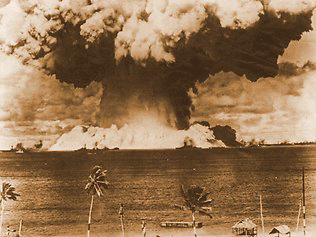 Dismay over plans to scrap French nuclear monitoring commission, https://www.rnz.co.nz/international/pacific-news/410780/dismay-over-plans-to-scrap-french-nuclear-monitoring-commission 2 March 2020 Nuclear test veterans groups in French Polynesia have reacted with dismay at reports that Paris wants to abolish the National Commission for Monitoring the Consequences of Nuclear Tests.
Last week, the French publication Canard Enchaine reported that as part of administrative changes and cost-cutting measures, dozens of commissions would be disestablished.
The commission is the body bringing together state authorities, representatives of the French Polynesian government and veterans associations to work on the list of radiation-induced illnesses deemed to be relevant for compensation.
The head of the group Moruroa e tatou Hiro Tefaarere has told the broadcaster La Premiere the move was inadmissible yet not surprising for the Macron government.
He said the French president on one hand described colonialism as a crime against humanity and on the other everything was suppressed which would recognise the consequences of the tests.
France carried out more than 190 nuclear weapons tests in the Pacific and until 2010 maintained that they were clean and posed no threat to human health.
Iran Nuclear Accord Parties Meet to Try to Salvage Deal
|
Iran Nuclear Accord Parties Meet to Try to Salvage Deal https://www.voanews.com/middle-east/voa-news-iran/iran-nuclear-accord-parties-meet-try-salvage-deal By RFE/RL, February 26, 2020 The remaining members of the floundering Iran nuclear deal are set to meet in Vienna Wednesday for the first time since Germany, France, and Britain initiated dispute procedures that could reimpose U.N. sanctions on Tehran.
The talks come as the signatories try to rescue the landmark 2015 accord, which has been faltering since U.S. President Donald Trump unilaterally withdrew from it in 2018 and enforced crippling sanctions on Iran. It will be attended by senior diplomats from Iran, Britain, France, Germany, China, Russia, and the EU. They have promised to uphold the deal that saw Iran agree to reduce its program of developing nuclear weapons in exchange for an easing of sanctions, even without Washington’s support. However, since the U.S. withdrawal, Iran has stepped up its program in defiance of Washington’s “maximum pressure” campaign.“ This is a chance — though not of 100 percent — to stop escalation before it’s too late,” Russian Foreign Minister Sergei Lavrov was cited as saying by the Russian Embassy in Vienna on Twitter. Why EU Powers Rejected Trump’s Call to Leave Iran Nuclear Deal
EU foreign policy chief Josep Borrell said Friday the 28-nation bloc will keep trying to save the Iran nuclear deal despite Trump’s call on EU to join US in breaking away from it
This is a chance — though not of 100 percent — to stop escalation before it’s too late,” Russian Foreign Minister Sergei Lavrov was cited as saying by the Russian Embassy in Vienna on Twitter. Iran has since breached its main limitations, exceeding the stockpiles of heavy water and uranium allowed, the number and types of centrifuges it can operate to enrich uranium, and the purity of uranium. As a result, in mid-January, the three European countries said they had “no choice” but to trigger a dispute mechanism in the accord, citing reduced compliance. The process for ultimately reimposing U.N. sanctions consists of several steps, the final one of which is to notify the U.N. Security Council. The restrictive measures would then automatically be reinstated after 30 days unless the Security Council voted to keep them lifted. Trump has called the deal “fatally flawed,” in part because it did not restrict Tehran’s ballistic-missile program or address its support for terrorist groups in the Middle East. Iran insists its nuclear program is for civilian purposes only and that the Joint Comprehensive Plan of Action (JCPOA) allows the country to run reactors to generate power. |
1 This Month
26 September – International Day for the Total Elimination of Nuclear Weapons





PLEASE OPPOSE HR 8255 AND S.3639 – bills would accelerate satellite deployment, with no environmental review or safeguards – https://ncstd5li.quorum.us/campaign/169331/
To see nuclear-related stories in greater depth and intensity – go to https://nuclearinformation.wordpress.com
-
Archives
- September 2026 (290)
- August 2026 (330)
- July 2026 (355)
- June 2026 (287)
- May 2026 (306)
- April 2026 (356)
- March 2026 (251)
- February 2026 (267)
- January 2026 (308)
- December 2025 (358)
- November 2025 (359)
- October 2025 (375)
-
Categories
- 1
- 1 NUCLEAR ISSUES
- business and costs
- climate change
- culture and arts
- ENERGY
- environment
- health
- history
- indigenous issues
- Legal
- marketing of nuclear
- media
- opposition to nuclear
- PERSONAL STORIES
- politics
- politics international
- Religion and ethics
- safety
- secrets,lies and civil liberties
- spinbuster
- technology
- Uranium
- wastes
- weapons and war
- Women
- 2 WORLD
- ACTION
- AFRICA
- Atrocities
- AUSTRALIA
- Christina's notes
- Christina's themes
- culture and arts
- Events
- Fuk 2022
- Fuk 2023
- Fukushima 2017
- Fukushima 2018
- fukushima 2019
- Fukushima 2020
- Fukushima 2021
- general
- global warming
- Humour (God we need it)
- Nuclear
- RARE EARTHS
- Reference
- resources – print
- Resources -audiovicual
- Weekly Newsletter
- World
- World Nuclear
- YouTube
-
RSS
Entries RSS
Comments RSS

