American-Israeli strategy developing for clandestine not-quite-war strikes on Iran?
 Long-Planned and Bigger Than Thought: Strike on Iran’s Nuclear Program Long-Planned and Bigger Than Thought: Strike on Iran’s Nuclear Program
Some officials say that a joint American-Israeli strategy is evolving — some might argue regressing — to a series of short-of-war clandestine strikes. NYT, By David E. Sanger, Eric Schmitt and Ronen Bergman, 12 July 20 As Iran’s center for advanced nuclear centrifuges lies in charred ruins after an explosion, apparently engineered by Israel, the long-simmering conflict between the United States and Tehran appears to be escalating into a potentially dangerous phase likely to play out during the American presidential election campaign.
New satellite photographs over the stricken facility at Natanz show far more extensive damage than was clear last week. Two intelligence officials, updated with the damage assessment for the Natanz site recently compiled by the United States and Israel, said it could take the Iranians up to two years to return their nuclear program to the place it was just before the explosion. An authoritative public study estimates it will be a year or more until Iran’s centrifuge production capacity recovers.
Another major explosion hit the country early Friday morning, lighting up the sky in a wealthy area of Tehran. It was still unexplained — but appeared to come from the direction of a missile base. If it proves to have been another attack, it will further shake the Iranians by demonstrating, yet again, that even their best-guarded nuclear and missile facilities have been infiltrated.
Although Iran has said little of substance about the explosions, Western officials anticipate some type of retaliation, perhaps against American or allied forces in Iraq, perhaps a renewal of cyberattacks. In the past, those have been directed against American financial institutions, a major Las Vegas casino and a dam in the New York suburbs or, more recently, the water supply system in Israel, which its government considers “critical infrastructure.”
Officials familiar with the explosion at Natanz compared its complexity to the sophisticated Stuxnet cyberattack on Iranian nuclear facilities a decade ago, which had been planned for more than a year. In the case of last week’s episode, the primary theory is that an explosive device was planted in the heavily-guarded facility, perhaps near a gas line. But some experts have also floated the possibility that a cyberattack was used to trigger the gas supply.
Some officials said that a joint American-Israeli strategy was evolving — some might argue regressing — to a series of short-of-war clandestine strikes, aimed at taking out the most prominent generals of the Islamic Revolutionary Guards Corps and setting back Iran’s nuclear facilities…….. https://www.nytimes.com/2020/07/10/world/middleeast/iran-nuclear-trump.html
|
|
|
France’s state auditor questions the wisdom of EDF’s Hinkley Point nuclear project in UK

Telegraph 11th July 2020, Doubts cast on EDF’s ability to build power stations on time and budget.
French auditor questions wisdom of state-owned utility’s involvement in building the new Hinkley Point C power station in Somerset.
France’s state auditor has questioned the ability of the company building Britain’s next nuclear power plant to construct new reactors within “acceptable” costs and timeframes. State-owned EDF has already said that its Flamanville nuclear plant in Normandy will now cost €12.4bn due to the expense of fixing 66 faulty welds. On top of that, the project will cost another €6.7bn, according to France’s Court of Accounts in a new report.
EDF has also said the plant’s start date will be delayed until the end of 2022. Flamanville was originally due to cost €3.3bn and start operations in 2012.
Presenting the damning 148-page report this week, Court of Accounts chief Pierre Moscovici said: “There is still uncertainty on the ability of the French nuclear industry, despite its current strong efforts, to build new nuclear reactors within a time frame and costs that remain acceptable.”
The criticism follows a £3bn surge in costs at the Hinkley Point C reactor EDF is building in Somerset. The bill for the project will now be £22.5bn – £2.9bn more than previously forecast – with overruns paid for by EDF. The energy giant has faced lags at its other projects, including Finland’s Olkiluoto 3 nuclear reactor, which is running more than
a decade behind schedule.
In its report, the state auditor questioned the wisdom of involvement in Hinkley Point C, saying its construction was
“weighing heavily” on the financial situation of EDF, whose net debt hit €41bn at the end of last year.
UK Ministers losing enthusiasm for small nuclear reactors developed with China
DBD, a Cheshire-based engineering firm, was working with China’s Institute of Nuclear and New Energy Technology to build a fleet of gas-cooled small reactors, and had hoped to win government funds. However, ministers have awarded £10m each to three rival projects — including an experimental plan for a fusion reactor. A version of the DBD reactor has already been built in China. DBD declined to comment……. (subscribers only) https://www.thetimes.co.uk/article/ministers-cool-on-chinese-nuclear-reactors-k2m8j76qf
Iran says world ‘must respond’ to Israel after blast at nuclear site
|
Iran says world ‘must respond’ to Israel after blast at nuclear site, Times of Israel, Government spokesman calls for ‘limits to these dangerous actions by the Zionist regime’; Mideast official says explosion at Natanz was meant as a ‘wake-up call’ to Tehran By TOI STAFF7 July 2020, Iran on Tuesday called for action against Israel, following a recent blast at the Natanz nuclear facility that has been blamed on the Jewish state.
“This method Israel is using is dangerous, and it could spread to anywhere in the world,” government spokesman Ali Rabiei said during a press conference, according to a translation of his remarks by Israel’s Channel 12 news. He added: “The international community must respond and set limits to these dangerous actions by the Zionist regime.” His comments came as Iran appeared to publicly acknowledge on Tuesday that last week’s fire at Natanz, which badly damaged a building used for producing centrifuges, was not an accident. Israeli TV reports, without naming sources, have said the blast destroyed the laboratory in which Iran developed faster centrifuges and set back the Iranian nuclear program by one or two years. Nour News, seen as a mouthpiece of Iran’s Supreme Council of National Security, claimed that the blast at the Natanz facility, which came amid a series of mysterious disasters that struck sensitive Iranian sites in recent days, bore similarity to other strikes against the country’s security infrastructure. While asserting that “an airstrike on the Natanz plant is almost impossible” due to its strong air defenses, an article on the site said that “the combination of intelligence, logistics, action and the volume of destruction” prove that the incident was deliberate. The Washington Post and New York Times quoted Middle Eastern officials earlier this week as saying the blast at Natanz was caused by a large bomb planted by Israeli operatives…….. A member of the Revolutionary Guard confirmed to the Times on Sunday that an explosive was used, but didn’t specify who was responsible. ….. The building at Natanz was constructed in 2013 for the development of advanced centrifuges, though work was halted there in 2015 under the nuclear deal with world powers, Iran’s atomic agency spokesman Behrouz Kamalvandi said earlier this week. When the United States withdrew from the nuclear deal, work there was renewed, Kamalvandi said. He claimed the fire had damaged “precision and measuring instruments,” and that the center had not been operating at full capacity due to restrictions imposed by the nuclear deal. Iran began experimenting with advanced centrifuge models in the wake of the US unilaterally withdrawing from the deal two years ago…….. https://www.timesofisrael.com/iran-says-world-must-respond-to-israel-after-blast-at-nuclear-site/ |
|
Julian Assange’s father calls on Australia’s Prime Minister Scott Morrison to help this Australian citizen
 Assange’s father calls extradition process ‘disgrace’ https://telanganatoday.com/assanges-father-calls-extradition-process-disgrace?fbclid=IwAR1a7bQ0W_Xcgc9EIeGaAHVP7Zmm2cM6nNV65ZXtkhCwNUlarqIYTJVw6xo1 July 20, The 80-year-old is organizing public events in Australia despite the ongoing coronavirus pandemic and hopes to travel to London in August to support Assange during his extradition trial.
Sydney: WikiLeaks founder Julian Assange’s father, John Shipton, is fighting tirelessly for the release and return of his son, who is facing an extradition trial in London for publishing classified information, a process he described as abuse.
“We maintain that the extradition request is a fraud in the English court… It’s a fraud in the English legal system, it’s a case of abuse of process, it is a disgrace,” Shipton, who travelled from Melbourne to Sydney to campaign for his son’s release, told Efe news in an interview.
The 80-year-old is organizing public events in Australia despite the ongoing coronavirus pandemic and hopes to travel to London in August to support Assange during his extradition trial which, he says, is being carried out under “dire” circumstances.
In May 2019, the UN Special Rapporteur on Torture, Nils Melzer, said, after visiting Assange in the Belmarsh prison along with two medical experts, that he showed “all symptoms typical for prolonged exposure to psychological torture, including extreme stress, chronic anxiety and intense psychological trauma”.
Assange has spent almost a decade in confinement, first under house arrest in a British town and then at the Ecuadorian embassy in London between 2012 until 2019, when Ecuador withdrew his political asylum status.
Shipton has urged the Australian government to mediate with the UK administration for the release of his son, who is wanted in the US on 18 charges of espionage and computer intrusion, for which he could be sentenced to prison for up to 175 years.
“I believe the government can, if it wishes to, assist us in bringing Julian home. I believe that (it) is very simple for the Prime Minister (Scott Morrison) to pick up the phone and ring (his UK counterpart) Boris Johnson and say Julian Assange is an Australian citizen in dire circumstances.
“This will resolve this immediately and that’s easily possible,” he told Efe news during the interview.
Russia’s nuclear imperialism in Africa
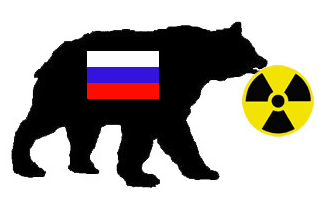
Russia’s nuclear play for power in Africa, DW 2 July 20,
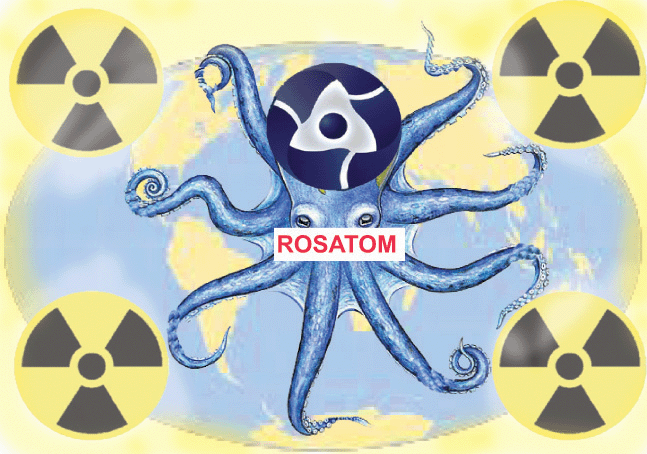
Russia is pushing nuclear technology to African nations to both turn a profit and expand its political might on the continent. Rwanda’s parliament has just approved a plan for Russia’s state-owned Rosatom nuclear conglomerate to build it a nuclear research center and reactor in the capital, Kigali.
The Center of Nuclear Science and Technologies, planned for completion by 2024, will include nuclear research labs as well as a small research reactor with up to 10 MW capacity.
Ethiopia, Nigeria and Zambia have signed similar deals with Rosatom, while countries such as Ghana, Uganda, Sudan and DRC have less expansive cooperation agreements.
Rosatom has been aggressively wooing African nations since the mid-2000s and the nuclear deals are seen as part of Russia’s push turn a profit and also gain influence in Africa.
Western sanctions first imposed on Russia in 2014 over its annexation of the Crimea in the Ukraine have forced Russia to seek alternative sources of incomes and also new friends.
Nuclear technology instead of trade
“For Putin to remain relevant in Russia, he really has to ensure that Russia has a big influence,” said Ovigwe Eguegu, a geopolitics analyst with the international affairs platform, Afripolitika. “That’s why he is looking at African markets so he has more parties to partner with when it comes to international issues.”
African nations constitute the largest voting bloc in the United Nations.
While the Soviet Union had a close relationship to various African states during the Cold War, Russia’s trade balance with Africa is one tenth of that of China, meaning it needs to look for other means to get a foothold on the continent.
“Russia is using the tools that they have to expand their influence and right now, Russia has lots of experience in the nuclear energy area,” Eguegu said in a phone interview from Abuja.
Rosatom nuclear leader
Rosatom is the world’s biggest nuclear company by foreign orders. While it has projects in developed countries such as Finland and Hungary, it’s mainly involved in developing regions.
The Rosatom packages are popular because the corporation’s sheer size means it can offer all-in-one deals, from training local workers to developing nuclear science curricula, supplying uranium for the plant’s life time and dealing with nuclear waste — with the added plus of Russian state loans for the projects.
The cost and financing of Rwanda’s nuclear research center is still undisclosed. But Russia is extending a $25 billion (€22.23 billion) loan to Egypt to cover 85% of the cost of the El Dabaa nuclear power plant, which Rosatom is constructing.
Rosatom has come to dominate nuclear exports to developing countries because of their generous financing and worker training,” according to the 2018 Center for Global Development policy paper, Atoms for Africa.
Additionally, Russia is itself a major player in the nuclear market, responsible for some 8% of uranium production worldwide as well as 20% of uranium conversion and 43% of uranium enrichment (conversion and enrichment are stages of processing uranium so it can be used by commercial nuclear power reactors)………….
many experts, including Gatari, believe that nuclear technology doesn’t yet make sense for African countries. They lack the highly skilled local workforce required to run the technological intricacies of such reactors. Plus, nuclear facilities are vastly expensive and take years to build.
Gatari warns of countries becoming locked into costly projects that end up being “white elephants”.
“Such a project can only be driven by strong and educated local human resources,” the nuclear researcher said. “That knowledge isn’t possible by rushing young students through training for a short time.
And the cost of maintaining that kind of installation can cripple the budget of a country for a long, long time.”
Doing the smooth sell
Currently, South Africa is the only country in sub-Saharan Africa with a functioning nuclear power plant, while Nigeria and Ghana have research reactors, which are primarily used for studying and training and to test materials, such as minerals.
In Europe, safety concerns around nuclear technologies have already caused countries such as Germany, Italy, Spain and Switzerland to vote to phase out nuclear power.
These concerns are compounded in Africa, given the the political instability of certain regions and the threat of sabotage or terrorist attacks. This hasn’t stopped Rosatom, and Russia, from doing a soft sell of nuclear technologies on the continent.
Rosatom funds scholarships for students from sub-Saharan Africa to study nuclear sciences and engineering in Russia. As of January 2020, around 300 students from more than 15 African countries were studying nuclear specialties there.
It runs an online video competition, Atoms for Africa, where participants stand a chance to win an all expenses paid trip to Russia for a video dedicated to innovative nuclear technologies.
In 2019, it even held an international fishing competition near the Leningrad nuclear power station, Russia’s largest, to demonstrate the safety of nuclear power for water bodies. (The competition was won by an Egypt team).
“There is good money if you can sell a research reactor,” said nuclear scientist Gatari. “Unfortunately, the convincing capacity of [Rosatom’s] marketing is very high, and the understanding of those who are buying is low.” https://www.dw.com/en/russias-nuclear-play-for-power-in-africa/a-54004039
Many experts question Trump’s claim on China’s nuclear weapons buildup
- When negotiators from the United States and Russia met in Vienna last week to discuss renewing the last major nuclear arms control treaty that still exists between the two countries, American officials surprised their counterparts with a classified briefing on new and threatening nuclear capabilities — not Russia’s, but China’s.
….. Many outside experts question whether China’s buildup — assessed as bringing greater capability more than greater numbers — is as fast, or as threatening, as the Trump administration insists.
The United States conducted more nuclear tests during the Cold War than the rest of the world combined. Over decades of experimentation, and more than 1,000 tests, its bomb designers learned many tricks of extreme miniaturization as well as how to endow their creations with colossal destructive force. Compared with the atomic bomb that leveled Hiroshima, the nation’s first explosive test of a hydrogen bomb, in 1954, produced a blast 1,000 times as powerful.
Because of that history, many nuclear experts now argue that if Mr. Trump begins a new wave of global testing, it would aid American rivals more than the United States.
For years, some Republicans have urged preparations for a test and poured money into the effort. One instrument now being prepared for the Nevada complex costs $800 million; it would test the behavior of plutonium.
Today, Republicans are still urging more upgrades and speedups, including at the Nevada complex. This month, Senator Tom Cotton, Republican of Arkansas, offered an amendment to a defense bill that would add at least $10 million to “carry out projects related to reducing the time required to execute a nuclear test.”
Top Democrats in the House told the Pentagon and the Energy Department in a recent letter that the idea of a renewal in nuclear testing was “unfathomable,” as well as “shortsighted and dangerous.”
But Mr. Billingslea thinks he succeeded in getting the Russians to think about what is happening in China, not in the Nevada desert. During his meeting last week, the Russians were taking copious notes on China’s buildup, while reviewing classified slides. He insists they want to sit down and talk more later in the summer.
They will do so without the Chinese….https://www.nytimes.com/2020/06/30/us/politics/trump-russia-china-nuclear.html
UK upholding the nuclear non-proliferation regime, supports Iran nuclear deal
Upholding the nuclear non-proliferation regime, Gov.UK
Statement by Ambassador Jonathan Allen, UK Chargé d’Affaires to the UN, at the Security Council meeting on non-proliferation., 30 June 2020.…..The United Kingdom has frequently restated our full commitment to the JCPoA, in line with our collective security interests, which include upholding the nuclear non-proliferation regime and preventing Iran from developing a nuclear weapon.
We have also frequently stated our unequivocal regret and concern at the United States decision to leave the JCPoA and to reimpose sanctions on Iran. We understand the continued impact this has had in Iran and on the Iranian people.
Since May 2018, we have worked tirelessly to preserve the JCPoA. We have fully upheld our commitments and we have gone beyond our obligations to develop INSTEX, which is operational and facilitating transactions.
Mr President, the United Kingdom deeply regrets that since 2019, Iran has taken nuclear measures contrary to its commitments under the JCPoA. These measures seriously undermine the non-proliferation benefits of the agreement. This is the reason that the E3 initiated the JCPoA’s Dispute Resolution Mechanism on the 14th of January as one of the last tools under the agreement to find a diplomatic way forward and bring Iran back into compliance with the Deal. ………
Preservation of the JCPoA will continue to be the guiding principle for the E3 on this agenda. This is because we believe in the absence of a viable alternative, that the agreement provides the best means of achieving our shared objectives on regional security and stability, upholding the nuclear nonproliferation regime and ensuring the continued authority and integrity of the Security Council. https://www.gov.uk/government/speeches/upholding-the-nuclear-non-proliferation-regime
France’s EDF in a financial pickle over huge costs of UK’s Hinkley C nuclear project
Dave Toke’s Blog 27th June 2020, The chickens are coming home to roost for EDF for their 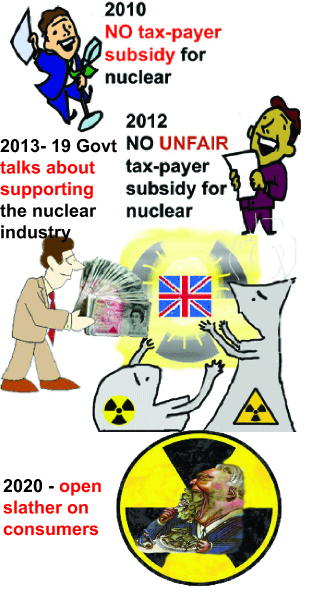 questionable decision to go ahead with building Hinkley C -a decision they took despite the lack of certainty over whether they would get enough backing from the British Government.
Originally EDF was publicised as being offered UK Treasury loan guarantees that had been widely touted as a vital basis for building Hinkley C. But now the French Financial Markets Regulator has
sanctioned EDF for not flagging up how conditional such loan guarantees were. These loan guarantees have never materialised.
Essentially, EDF is now continuing to build Hinkley C using money borrowed on its own balance
sheets – borrowings which are much more costly than UK Government backed guarantees and which reduce its own (EDF) profitability.
The Finance Officer of EDF actually resigned at the time EDF decided to go ahead with building Hinkley C. Of course all this is happening at the same time when we are being asked to believe that the next EPR (at Sizewell C) is going to be delivered at low cost to the consumer if the risk of building the plant is transferred from EDF to the British taxpayer and consumer!
This is the so-called RAB mechanism, something that could well just turn out to be an
almost unlimited cash facility for EDF to park their financial black hole in the centre of British finances (as well as those of the French).
https://realfeed-intariffs.blogspot.com/2020/06/edf-sanctioned-by-french-regulators-for.html
Hitachi- no plans to sell Wylfa nuclear site to China
Chinese corporation after comments by Donald Trump. The US president was
quoted by the Sunday Times warning it not to sell Wylfa, on Anglesey, “to
China”.
rising costs after Hitachi failed to reach a funding agreement with the UK
government. A Horizon Energy spokesman said: “We don’t comment on
speculation. “Our focus remains on securing the conditions necessary to
restart this crucial project, which would bring transformative economic
benefits to the region and play a huge role in helping deliver the UK’s
climate change commitments.”
lead the project to build the site. “We are not aware of any plans to sell
the project to China,” Hitachi told the Reuters news agency.https://www.bbc.co.uk/news/uk-wales-politics-53212790
Unacceptable to build a radioactive waste repository on the BiH border, Bosnia forming an expert team to plan Croatian nuclear waste disposal .
He expects that after the formation of the expert team, a meeting with the competent ministry in the Government of Croatia will follow and that, based on the application of European conventions, scientific, research and professional staff from BiH will be able to come to Trgovska Gora…… Košarac added, they are working on forming a proposal of a team for legal experts not to give up on the internationally recognized rights that BiH has signed at the international level.
He reiterated that it is completely unacceptable to build such a landfill on the border with BiH. https://www.sarajevotimes.com/164093-2/
European Union countries agreed to exclude nuclear, fossil gas from green transition fund
 EU ministers exclude nuclear, fossil gas from green transition fund EU ministers exclude nuclear, fossil gas from green transition fund
EURACTIV.com with Reuters European Union countries agreed on Wednesday (24 June) that the bloc’s flagship fund to wean regions off fossil fuels should not finance nuclear or natural gas projects, despite calls from some Eastern countries for gas to be eligible for EU funding. The European Commission, the EU’s executive, wants to set up a €40 billion Just Transition Fund, comprised of €30 billion from an EU coronavirus recovery fund and €10 billion from its budget for 2021-27. The fund aims to encourage a shift from high-carbon industries that would help coal miners to retrain and find new low-carbon jobs, and support regions whose economies depend on polluting sectors to build new industries. Ambassadors from the EU’s 27 member states agreed on Wednesday that the Just Transition “shall not support the decommissioning or the construction of nuclear power stations” nor “investment related to the production, processing, distribution, storage or combustion of fossil fuels,” according to a document, published on Thursday (25 June). The position is in line with the Commission’s, making it likely that the final Just Transition Fund will exclude nuclear and gas. The proposal will be finalised following negotiations between member states, the Commission and EU Parliament, with the latter typically favouring ambitious climate change policies…….. https://www.euractiv.com/section/energy/news/eu-ministers-exclude-nuclear-fossil-gas-from-green-transition-fund/ |
|
US, Russia nuclear arms talks end with plans for second round
US, Russia nuclear arms talks end with plans for second round, Aljazeera, 26 June 20,
US says any new agreement on curbing nuclear weapons should include China, a condition Russia calls ‘unrealistic’. US and Russian negotiators have concluded a round of nuclear arms control talks in Austria’s capital, Vienna, aimed at producing a new agreement to replace the New START treaty that expires next year.
US negotiator Marshall Billingslea told reporters on Tuesday that the day of high-level “marathon discussions” ended late on Monday.
Billingslea said the talks had been productive enough to establish several technical working groups to delve deeper into the issues in order to pave the way for a second round of talks by late July or early August…… https://www.aljazeera.com/news/2020/06/coronavirus-deaths-children-extremely-rare-live-updates-200626000914304.html
Russia’s priority is to involve UK, France in future nuclear arms control talks — diplomat
Russia’s priority is to involve UK, France in future nuclear arms control talks — diplomat
The two states are the US closest NATO allies that possess nuclear weapons, the senior diplomat explained, MOSCOW, June 26. /TASS/. Russia thinks it necessary that the United Kingdom and France join the strategic nuclear arms control process as the United States’ closest NATO allies, Russian Deputy Foreign Minister Sergei Ryabkov said in an interview with TASS First Deputy Director General Mikhail Gusman on Friday……. https://tass.com/politics/1172109
North Korea to ‘counter nuclear with nuclear’ against US
|
North Korea to ‘counter nuclear with nuclear’ against US https://www.9news.com.au/world/north-korea-to-counter-nuclear-with-nuclear-against-us/f1da3676-8adb-4056-9245-363b039406e9
By Inga Neilsen, Jun 26, 2020 North Korea has claimed it is prepared to use nuclear weapons in response to “hostile policy” by the US, according to an official government report.
The Democratic People’s Republic of Korea (DPRK) issued a report by the Ministry of Foreign Affairs Institute for Disarmament and Peace, which said the country had no choice but to counter “nuclear with nuclear.”
“In order to eliminate the nuclear threats from the US, the DPRK government made all possible efforts either through dialogue or in resort to the international law, but all ended in vain,” the report read.
“The option left was only one, and that was to counter nuclear with nuclear.”
The report, released on state run media on the 70th anniversary of the start of the Korean War, said the socialist state will continue to bolster its power to “to contain the persistent nuclear threats from the US.”
The Trump administration and Kim Jong Un’s regime embarked on a series of talks in an attempt to stop North Korea’s nuclear ambitions, but did not reach a binding agreement.
North Korea responses by firing short-range missile tests which blew up an inter-Korean liaison office, cutting communication lines with South Korea.
The option left was only one, and that was to counter nuclear with nuclear.”
South Korean President Moon Jae-in, speaking at a ceremony to honour veterans of the Korean War, urged North Korea to seek peace.
“We will continuously search for routes that are mutually beneficial for both Koreas through peace,” he said.
“Before speaking of unification, I hope that we can become friendly neighbours first.”
|
|
1 This Month
26 September – International Day for the Total Elimination of Nuclear Weapons





PLEASE OPPOSE HR 8255 AND S.3639 – bills would accelerate satellite deployment, with no environmental review or safeguards – https://ncstd5li.quorum.us/campaign/169331/
To see nuclear-related stories in greater depth and intensity – go to https://nuclearinformation.wordpress.com
-
Archives
- September 2026 (281)
- August 2026 (330)
- July 2026 (355)
- June 2026 (287)
- May 2026 (306)
- April 2026 (356)
- March 2026 (251)
- February 2026 (267)
- January 2026 (308)
- December 2025 (358)
- November 2025 (359)
- October 2025 (375)
-
Categories
- 1
- 1 NUCLEAR ISSUES
- business and costs
- climate change
- culture and arts
- ENERGY
- environment
- health
- history
- indigenous issues
- Legal
- marketing of nuclear
- media
- opposition to nuclear
- PERSONAL STORIES
- politics
- politics international
- Religion and ethics
- safety
- secrets,lies and civil liberties
- spinbuster
- technology
- Uranium
- wastes
- weapons and war
- Women
- 2 WORLD
- ACTION
- AFRICA
- Atrocities
- AUSTRALIA
- Christina's notes
- Christina's themes
- culture and arts
- Events
- Fuk 2022
- Fuk 2023
- Fukushima 2017
- Fukushima 2018
- fukushima 2019
- Fukushima 2020
- Fukushima 2021
- general
- global warming
- Humour (God we need it)
- Nuclear
- RARE EARTHS
- Reference
- resources – print
- Resources -audiovicual
- Weekly Newsletter
- World
- World Nuclear
- YouTube
-
RSS
Entries RSS
Comments RSS

